SONG-LYRICS BASED LESSONS WITH CONTROVERSIAL ISSUES TO FOSTER PRODUCTIVE LANGUAGE SKILLS INTERACTION IN THE EFL CLASSROOM
DIANA MILENA DÍAZ PELÁEZ
UNIVERSIDAD PEDAGÓGICA NACIONAL
SCHOOL OF HUMANITIES
MAESTRÍA EN ENSEÑANZA DE LENGUAS EXTRANJERAS
BOGOTÁ
SONG-LYRICS BASED LESSONS WITH CONTROVERSIAL ISSUES TO FOSTER PRODUCTIVE LANGUAGE SKILLS INTERACTION IN THE EFL CLASSROOM
DIANA MILENA DÍAZ PELÁEZ
Study directed by: JAIR AYALA
Research study presented
To obtain Master’s degree in
Foreign languages teaching
UNIVERSIDAD PEDAGÓGICA NACIONAL
SCHOOL OF HUMANITIES
MAESTRÍA EN ENSEÑANZA DE LENGUAS EXTRANJERAS
BOGOTÁ
NOTE OF ACCEPTANCE
_______________________________
_______________________________
_______________________________
_______________________________
_______________________________
_______________________________
_________________________________________
President of the Jury’s signature.
ACKNOWLEDGEMENTS
First, I would like to thank my mother, for her infinite support through these years of study and for being the first and greatest teacher of all. Even when going through the hardest moments of our lives this past year, you always stood by me. Thank you.
To my fellow colleagues and administrative staff at José Max León School, whose support was invaluable in the hardest moments of this process.
To my dearest teacher Luis Fernando Gómez (R.I.P) for believing in this project and for helping me in the hardest moment of my life. As well as Jaime Ruiz (R.I.P) whose instructions were always filled with knowledge and love for what we do every day as teachers. You will always be in our hearts.
To my advisor, Jair Ayala for getting into this process just in the right time. For giving me the tranquility that I needed to fulfil this project just in the right moment. I appreciate your kindness and understanding.
Finally, to my dearest students from ninth grade at José Max León school. Your whole existence is heart-warming for me. I am so glad to have the best students in the whole wide world.
Thank you for letting me lead your learning process and for letting me be part of your lives as a teacher, you will always mean the world to me.
RAE
1.Información General
Tipo de documento Trabajo de grado.
Acceso al documento Universidad Pedagógica Nacional. Biblioteca Central.
Título del documento
Song-lyrics based lessons with controversial issues to foster productive language skills interaction in the EFL classroom. (Lecciones basadas en canciones con temas controversiales para fortalecer la interacción de habilidades lingüísticas relacionadas con producción en el aula de inglés como lengua extranjera).
Autor(es) DÍAZ PELÁEZ, Diana Milena.
Director AYALA, Jair.
Publicación Bogotá, 2015. 160 Páginas.
Unidad Patrocinante Universidad Pedagógica Nacional
Palabras Claves Music; Songs; Controversial issues; Interaction; EFL. 2.Descripción
La presente investigación, expone los métodos y resultados del uso de lecciones basadas en canciones con temas controversiales, como un recurso en la clase para el mejoramiento de la interacción en el aula de inglés como lengua extranjera; particularmente, en estudiantes de grado noveno, del Colegio José Max León, ubicado en Cota, Cundinamarca. Teniendo en cuenta los aportes del modelo dialogante interestructurante promovido por la institución, así como la filosofía ética y pedagógica que allí se promueve y que busca conectarse con los conceptos de respeto, autonomía, honestidad y responsabilidad crítica; una metodología basada en temas controversiales abordados a través de canciones fue aplicada, con ayuda de los medios tecnológicos ofrecidos por la institución. La recolección y análisis de datos mostraron que la metodología utilizada, fortalece las habilidades más necesarias a la hora de interactuar en el aula de inglés como lengua extranjera: motivación, sensación de dominio de la lengua, uso de vocabulario, disminución de la ansiedad al participar en clase, etc. Para terminar, el documento ofrece una serie de recomendaciones para el uso apropiado de esta metodología.
3.Fuentes
En el presente trabajo se citan 48 fuentes. Aquí se presentan las diez fuentes de mayor relevancia:
Barton, K., & McCully, A. (2007). Teaching controversial issues... where controversial issues really matter. Teaching history, (127), 13.
Brown, H. D., & Lee, H. (1994). Teaching by principles: An interactive approach to language pedagogy (Vol. 1, p. 994). Englewood Cliffs, NJ: Prentice Hall Regents.
Chen, Y. C., & Chen, P. C. (2009). The effect of English popular songs on learning motivation and learning performance. WHAMPOA-An Interdisciplinary Journal, 56, 13-28.
Clarke, P. (2005). Teaching controversial issues: A four-step classroom strategy for clear thinking on controversial issues. BCTF/CIDA Global Classroom Initiative 2005.
2018, from http://www.scielo.org.co/scielo.php?script=sci_arttext&pid=S1657-07902006000100004&lng=en&tlng=en.
Ellis, R., & Ellis, R. R. (1994). The study of second language acquisition. Oxford University.
Fernández Abarca, M. (2004). Interaction in the English classroom; an exploratory study. Revista
Electrónica" Actualidades Investigativas en Educación", 4(1): [Fecha de consulta: 1 de noviembre de 2018] Disponible en:<http://www.redalyc.org/articulo.oa?id=44740108> ISSN
Harwood, A. M., & Hahn, C. L. (1990). Controversial issues in the classroom. Bloomington, IN: ERIC Clearinghouse for Social Studies/Social Science Education.
Manual de convivencia. (2018). 61st ed. [ebook] Cota, Cundinamarca: Colegio José Max León. Available at: https://josemaxleon.edu.co/wp-content/uploads/2016/12/Manual-de-Convivencia-2018-2019.pdf [Accessed 18 Nov. 2018].
Palacios, N., & Chapetón, C. M. (2014). Students' Responses to the Use of Songs in the EFL Classroom at a Public School in Bogotá: A Critical Approach. GIST Education and Learning Research Journal, 9, 9-30.
4.Contenidos El presente trabajo se divide en seis capítulos:
El primer capítulo, presenta el contexto interno y externo del Colegio José Max León, haciendo uso del PEI, misión, visión y modelo pedagógico. Además, expone una delimitación de la población objeto de estudio con su respectivo diagnóstico, el planteamiento del problema, la pregunta problema proveniente de la observación, los objetivos de la investigación y finalmente la justificación del trabajo.
En el segundo capítulo, se encontrarán los fundamentos teóricos de la investigación como lo son el estado del arte y el marco teórico.
En el tercer capítulo, se alude al diseño metodológico, que a su vez expone el tipo de investigación, los instrumentos de recolección de datos, unidades de análisis y las consideraciones éticas a tener en cuenta al llevar a cabo un proceso investigativo.
En el cuarto capítulo, se muestra la propuesta pedagógica realizada por el investigador, donde se explica por etapas el procedimiento para el diseño pedagógico y la malla curricular propuesta para el desarrollo de la fase de intervención.
En el quinto capítulo, se hace un detallado análisis del producto de la investigación, así como los descubrimientos hechos en el aula. Finalmente, el sexto capítulo delimita las conclusiones, las implicaciones pedagógicas, limitaciones del estudio, las posibles investigaciones que se pueden generar en el futuro y las recomendaciones pertinentes para el uso de la metodología planteada en la presente investigación.
5.Metodología
estudiantes. Finalmente, las etapas de reflexión y análisis de datos fueron llevadas a cabo por medio del análisis de los datos recolectados, llevando a evidenciar el impacto del uso de la metodología utilizada, en el fortalecimiento de la interacción en aula.
6.Conclusiones
El objetivo principal de la presente investigación fue identificar los factores que influyen en la interacción de los estudiantes en el aula de inglés como lengua extranjera, cuando se implementan lecciones basadas en música con temas controversiales. Después de implementar la metodología propuesta y analizar los resultados de los datos recopilados, se pueden exponer las conclusiones:
Primero, los estudiantes sintieron una gran afinidad con la música presentada en las lecciones, así como con los temas controversiales propuestos. Esto, les ayudó a hacer una reflexión efectiva, tanto oral como escrita. El factor musical es alentador y motivador, ya que los estudiantes se sienten cercanos a algunas canciones y se apropian del discurso dado en esas letras a un nivel personal. Por lo tanto, la interacción se llevó a cabo gracias a las lecciones proporcionadas, el uso de la música y los temas controversiales elegidos. Segundo, el impacto principal de la metodología propuesta es concebir la posibilidad de usar y permitir a los estudiantes percibir la clase de inglés como un vehículo para aprender lecciones valiosas y útiles para sus vidas, mientras mejoran sus habilidades orales y escritas sin darse cuenta de ello, pues consideraron que las actividades eran divertidas y con gran impacto o significado profundo.
Tercero, exponer a los estudiantes a la metodología propuesta los hizo conscientes de su propio intercambio constante de ideas y sentimientos, al tiempo que los involucró en nuevas perspectivas y formas de ver el mundo a través de sus compañeros y las letras de las canciones proporcionadas, de las cuales estaban a cargo de analizar.
Cuarto, los estudiantes decidieron qué decir o escribir, cómo y cuánta intervención y participaciones hacer, lo que terminó ayudando a su trabajo autónomo y grupal.
Finalmente, los estudiantes discutieron más y participaron cuando se sintieron escuchados y seguros en el aula. Cuando se respetaban sus ideas. Por lo tanto, el papel del maestro era proporcionar ese ambiente para que los estudiantes desarrollaran sus ideas y comenzaran a construir argumentos ayudados por sus compañeros. En este asunto, los temas controversiales fueron de gran ayuda para mantener motivados a los estudiantes.
Aquí, los factores socioculturales y afectivos desempeñaron un gran papel en la interacción de los estudiantes con sus compañeros y el maestro, ya que el aporte proporcionado fue significativo y los hizo sentir relajados.
Elaborado por: Diana Milena Díaz Peláez
Revisado por: Jair Ayala
Fecha de elaboración del
Abstract
The present project is aimed at analyzing the impact of the implementation of song-lyrics based lessons with controversial issues in the fostering of EFL students’ productive language skills interaction, particularly in 901 graders’ at José Max León School.
In terms of the Common European Framework (CEFR) and having in mind the latest experience with this same group in seventh grade, the students' level of English in general was A2 and should be established as B1 at the end of ninth grade, academic year in which the target population is at the moment. As the participant’s teacher, class observations evidenced that, although students have in general good management of English communicative skills, interaction in the classroom is always expected to be directed by the teachers and is particularly
contaminated by classroom planning and management, leading students to be second hand participants in their own learning process. Having in mind students’ motivation in class when listening to songs, the implementation of song-lyrics based lessons and the approach to
controversial issues, had as purpose to foster students’ productive language skills interaction, by collecting data through diaries, audio recordings and field notes.
It is expected with the present research that students identify, understand and put into action interactional skills required for every moment of their learning process, not only while interacting in English, but during their academic life as well. This may yield fresh insights for implementing song-lyrics based lessons with controversial issues in EFL classrooms, making students aware of their own processes of learning.
Resumen
El presente proyecto tiene como objetivo analizar el impacto de la implementación de lecciones basadas en canciones y temas controversiales para fomentar la interacción de habilidades lingüísticas relacionadas a la producción en estudiantes de inglés como lengua extranjera, particularmente en estudiantes del grado 901 en el Colegio José Max León.
En términos del marco común europeo (MCER) y teniendo en cuenta la última experiencia que tuve con este mismo grupo en grado séptimo, el nivel de inglés de los
estudiantes en general, era de A2 y debía constituirse como B1 al finalizar grado noveno, año académico en el que la población de estudio se encuentra en este momento. Las observaciones evidenciaron que, aunque los estudiantes en general tienen un buen manejo de las habilidades comunicativas en inglés; siempre se espera que la interacción en el aula sea dirigida por los maestros y está demasiado contaminada por la planificación y el manejo del aula, lo que lleva a los estudiantes a ser participantes de segunda mano en su propio proceso de aprendizaje.
Teniendo en cuenta la motivación de los estudiantes al escuchar canciones en clase, la
implementación de lecciones basadas en música y el enfoque de temas controvertidos tenían el propósito de fomentar las habilidades de interacción de los estudiantes, mediante la recopilación de datos a través de diarios, grabaciones de audio y notas de campo.
temas controversiales en las aulas de inglés como lengua extranjera en colombiana, lo que hace que los estudiantes conozcan sus propios procesos de aprendizaje.
Introduction
Nowadays, learning a foreign language has become relevant in terms of work, study and everyday life. The ability to speak more than one language is more than just a social advantage, as it helps improving cognitive skills related to language and fights diseases such as dementia. According to Kalkan (2014), individual’s cultural experience creates greater tolerance and open-mindedness. Thus, it is possible to say that learning a “new” language modifies and motivates social interaction by having the opportunity to engage and be a part of different scenarios throughout life.
Students nowadays have access to many sources of information that allow them to convey the way they perceive the world and associate with those individuals they find similar; especially when those individuals belong to a particular social group, like urban tribes and groups related to music.
In addition, it is widely accepted that music can be used as a tool to foster vocabulary learning and listening skills in the EFL classroom, as suggested by Lo and Li (As cited in
Table of Contents
Abstract ... 8
Resumen ... 9
Introduction ... 11
CHAPTER ONE: CONTEXT AND PROBLEM ... 17
1.1. CONTEXT. ... 17
1.2. STATEMENT OF THE PROBLEM. ... 20
1.3. RESEARCH QUESTION. ... 30
1.4. RATIONALE ... 31
CHAPTER TWO: LITERATURE REVIEW ... 34
THEORETICAL FRAMEWORK ... 34
Interaction in the EFL classroom ... 34
Use of songs as a literacy situated practice: ... 38
Teaching Controversial issues... 39
STATE OF THE ART ... 42
CHAPTER THREE: RESEARCH DESIGN ... 50
Type of Study ... 51
Setting ... 55
Researcher's Role ... 57
Data collection instruments ... 58
Field notes ... 58
Diaries ... 59
Transcription of audio recording sessions... 60
Data Collection Procedures ... 61
Ethical Considerations ... 62
CHAPTER FOUR: PEDAGOGICAL INTERVENTION AND IMPLEMENTATION . 63 PEDAGOGICAL DESIGN PROCEDURE ... 63
IMPLEMENTATION PHASES ... 65
ACADEMIC PROGRAM ... 64
CHAPTER 5: DATA ANALYSIS AND FINDINGS ... 72
Procedures for Data Analysis ... 74
Findings ... 76
Category 1: Interactional factors conveyed in Oral and writing skills, fostered through song-lyrics based lessons with controversial issues. ... 77
Category 2: Development of Critical Responsibility by reflecting on controversial issues through song-lyrics based lessons ... 91
Category 3: Music and the fostering of interaction in the EFL classroom. ... 94
Conclusions ... 102
Pedagogical Implications ... 103
Limitations of the study and recommendations ... 104
Further research ... 105
REFERENCES ... 107
APPENDIXES ... 113
APPENDIX A. Diagnostic Test (Sample) ... 113
APPENDIX B. Survey (Sample) ... 118
APPENDIX C. Field notes (Samples). ... 122
APPENDIX D. Teacher’s logs (2017-2018) ... 124
APPENDIX E. Survey results in graphics. ... 126
APPENDIX F. Consent form (Sample) ... 127
APPENDIX G. Transcription of audio recording sessions (Sample) ... 129
APPENDIX H. Students’ diaries (Sample) ... 139
APPENDIX I. Lesson Plans ... 142
LESSON PLAN NO. 1 ... 142
LESSON PLAN NO. 2 ... 146
LESSON PLAN NO. 3 ... 151
Table of Figures
Figure 1. Difficulties or annoyance towards the English class ... 23
Figure 2. Helping others with their difficulties in English. Figure 3. Friends that can help with difficulties in English. ... 24
Figure 4. Satisfaction towards the English class. ... 24
Figure 5. Influence from instructor’s/school facilities. (Appendix B) ... 25
Figure 6. What do you do when you see a problem that is too difficult (English class)? . 25 Figure 7. Intrinsic / Extrinsic motivation. ... 26
Figure 8. L2 Self ... 26
Figure 9 Use of music in the EFL classroom. ... 27
Figure 10. Language which students prefer in regards to music... 28
Figure 11. Cyclical AR model based on Kemmis and McTaggart (1988)... 53
Figure 12. Cycles to work in the pedagogical intervention. ... 54
Figure 13. Sample of Diagnostic Test (Writing Section) ... 57
Table of Tables
Table 1. Criteria to analyze interaction in the EFL classroom. Taken from Brown and Lee
(1994) ... 37
Table 2. Reviewed Researches of the State of the Art ... 43
Table 3. Recommendations for taking field notes. Taken from Bricki, N., & Green, J. (2007). A guide to using qualitative research methodology. ... 59
Table 4. Implementation Phases ... 66
Table 5. Sample of First Term Lesson Planning at José Max León School ... 66
Table 6. Stages developed in each lesson. ... 71
Table 7. Data collection instruments coding. ... 73
CHAPTER ONE: CONTEXT AND PROBLEM
1.1. CONTEXT.
As part of the context in which the present research takes place, it is important to mention that Cota is located in Cundinamarca, in the province of Sabana Centro. Composed by the urban area that includes a couple of neighborhoods and its 8 lanes: La Moya, Cetime, El Abra, Pueblo Viejo, Parcelas, Rozo, Vuelta Grande and Siberia. Additionally, it connects the west of the savannah with the municipalities of the north (Chía, Cajicá, Tocancipá, etc.)
Cota is known as the Colombian indigenous capital, because most of the aboriginal Chibcha settlements were closer to this territory. Chibcha (Chibcha people, 2020) were
South American Indians who at the time of the Spanish conquest occupied the high valleys
surrounding the modern cities of Bogotá and Tunja in Colombia. With a population of more than 500,000,
they were notable for being more centralized politically than any other South American people outside
the Inca empire. (p. 1)
Given its proximity to Bogotá, thanks to its quiet environments, many schools have settled in Cota with their facilities; one of them is the José Max León school, which is located in Parcelas 21, 2.7 kilometers near Siberia. It is a private institution, secular, co-educational, legally approved by Ministerio de Educación Nacional (MEN) and Secretaría de educación de
Cundinamarca, which is part of the formal education system, teaching at the levels of Preschool, Basic (Primary and Secondary) and Media in the academic modality.
The school (Manual de convivencia, 2018) states that building a community needs to be based on the Ethics of care, and directs its philosophy towards this statement. It implies the active role of each member within the institution to promote respect, autonomy, honesty and critical responsibility. Furthermore, the school attempts to educate children under 3 principles: 1. Caring for yourself; 2. caring for the other and 3. caring for the public.
In regards to its mission, José Max León School promotes the development of people with Critical Responsibility, based on the integration of the rights of feeling, knowing and doing, in order to construct a project of integral and ethical life, that allows the personal development and the transformation of the environment (Manual de convivencia, 2018).
In contrast, its vision states that the School will be a bilingual institution recognized as a reference in terms of training, by 2023, thanks to constant innovation and the culture of
continuous improvement with high standards of quality, viability and sustainability, reflected in its Pedagogical proposal of integral Development (Manual de convivencia, 2018).
in the class, to carry out an assertive feedback; this feedback must be related to students' reflection as an input of the metacognitive process (Manual de convivencia, 2018).
The institution provides an education structured in cycles of six days, which allows to maximize the time students spend with every subject and has an intensive English program which is supported by Cambridge English Schools, Cambridge University Language Assessment and Cambridge University Press -signed in the 2015-2016 school year- in order to help
developing students’ skills in terms of EFL learning by: preparing them for taking English International tests aligned with the CEFR and having a time intensity of eight hours per cycle, more than the rest of the subjects at the school, aiming at becoming certified as a national bilingual school for the 2022-2023 school year.
It also has a reading plan in English that changes every two cycles and works with the series “Prepare!” (Cambridge) and “Reading Explorer” (Cengage). Furthermore, the groups are required to work with the online platforms from the books mentioned before, two hours per cycle. Furthermore, English teachers at the school must have at least a B2 level of proficiency in English, certified.
Mesa Bayona & Ramirez Zarate (2018) stated in their research done at the same school, and according to its English department plan, that:
The English curriculum at José Max León School is based on this international standard from
kinder to 11th grade as follows: First approach to language: Kinder to 1st grade; A1 – Breakthrough /
Beginner: 2nd to 4th grade; A2 – Waystage / Elementary: 5th to 8th grade; B1 – Threshold / Intermediate:
1.2. STATEMENT OF THE PROBLEM.
Although it is widely accepted that songs can be used as a tool to foster vocabulary learning and listening skills in the EFL classroom, as suggested by Lo and Li (As cited in
Schoepp, 2001) who claimed that songs provide a break from classroom atmosphere in which the four language skills can be enhanced, as the enjoyment aspect of learning language through songs is directly related to affective factors (Schoepp, 2001); there has been little inquiry into how songs are portrayed in regards to social interaction.
Besides, music and songs to foster interaction are commonly used in populations with attention-deficit disorder and cognitive issues, as stated by Zhang F et al. (2012):
It can help children (and adults) with a wide range of needs arising from various causes such as
learning disabilities, mental and physical illness, physical and sexual abuse, stress and terminal illness,
because songs are part of human existence in terms of responses such as pulse, rhythm, breathing and
movement, and the whole range of emotions… These connections with music can remain despite disability
and illness and so music therapists and counselors can use music to help children. (p.13).
Thus, there is an extensive background with the point of view of psychologists, but not in EFL learning. On top of that, similar researches have been conducted in Asia, but not in our local context, so this topic is under-explored in our field.
In terms of communicative skills, and bearing in mind the Basic English standards
increasing their speaking and writing abilities, as it has been shown in the different mock exams and international exam that the population have taken.
About the characterization of the group selected for this research project, which is ninth grade in José Max León school and based on the results of one survey, as well as the diagnostic test performed at the beginning of the school year; it was established that this group is formed by 25 students, 12 boys and 13 girls whose ages ranged between 14 and 16 years old. However, for the purpose of this study, the selected focal group is established by 12 students who agreed to participate voluntarily, categorized as follows:
One repeating student; seven students who had outstanding results in the diagnosis test applied for the present research (two of them find difficult to participate in class), participate actively, engage easily in every activity presented and achieved the highest score in the
diagnostic test; and finally, four students who received a low score in the diagnostic test and do not participate actively in class.
Firstly, the main diagnosis test (Appendix A) answered by 25 students, attempted to measure students’ level of English according to what it is proposed in the Common European Framework of reference (CEFR). This test was divided into three different sections: the first part, attempted to analyze students’ level in terms of Listening; the second part, attempted to
distinguish students’ level in regards to Reading and writing; and the third part, analyzed
students’ level in terms of speaking. This diagnostic test allowed gathering relevant information about students’ strengths and weaknesses in terms of their communicative skills in English.
In regards to their weaknesses, although some students got a lower score in those areas related to production (writing and speaking). It was evident that students find difficult to
participate in class and they feel noticeable unconfident when speaking in front of their partners or writing at an academic level –according to the results of class observations-.
Secondly, the survey (Appendix B) took by 22 students while being in 8th grade,
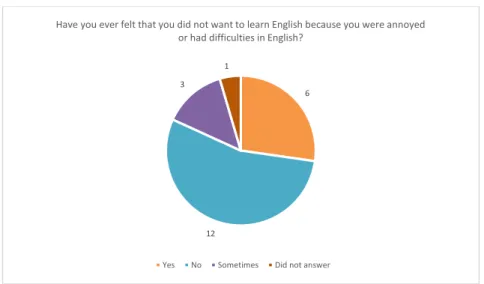
Figure 1. Difficulties or annoyance towards the English class
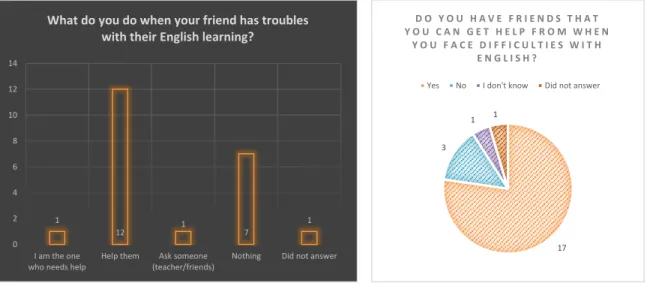
Another interesting fact conveyed in the survey is that a high percentage of the population is willing to help others when having troubles learning in the English class and manifested
having friends who could help them with any difficulty they may have in the subject, which is a demonstration of their friendship and group work in class. Besides, 68% of the students
mentioned satisfaction towards the English class, which can be used further on to explore learning motivational factors (See Figures 2, 3 and 4).
6
12 3
1
Have you ever felt that you did not want to learn English because you were annoyed or had difficulties in English?
Figure 2. Helping others with their difficulties in English. Figure 3. Friends that can help with difficulties in English.
Figure 4. Satisfaction towards the English class.
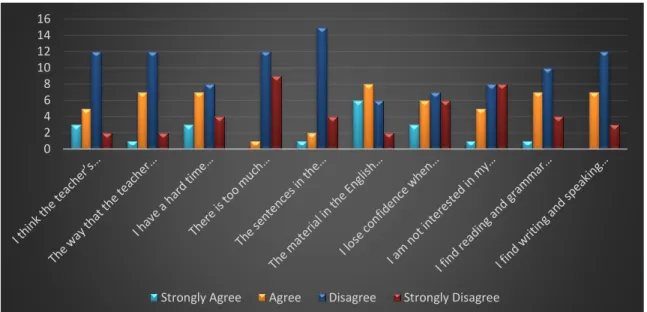
Moreover, they have a good relationship with their English teacher and feel confident enough to talk and ask for help when they find problems that are too difficult in the English class. In general, the influence from instructors and school facilities is positive for most of the population as they feel interested and engaged in the different activities proposed coming from this subject (See Figures 5 and 6).
1 What do you do when your friend has troubles
with their English learning?
Yes No I don't know Did not answer
15
Figure 5. Influence from instructor’s/school facilities. (Appendix B)
Figure 6. What do you do when you see a problem that is too difficult (English class)?
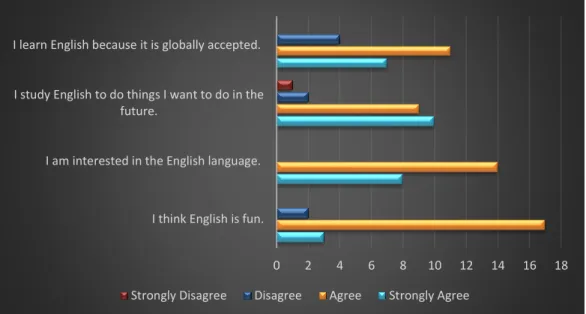
In regards to students’ motivation in the English class, most of them claimed to agree with those factors related to learning English for being globally accepted or because it will help them achieving their goals in the future. In addition, students manifested in general interest towards the English class, as well as an interest in watching their English skills improve in order to speak fluently to foreign people or as a feeling of respect in society (See Figures 7 and 8).
0
Strongly Agree Agree Disagree Strongly Disagree
12 6
3 1
0 2 4 6 8 10 12 14
Figure 7. Intrinsic / Extrinsic motivation.
Figure 8. L2 Self
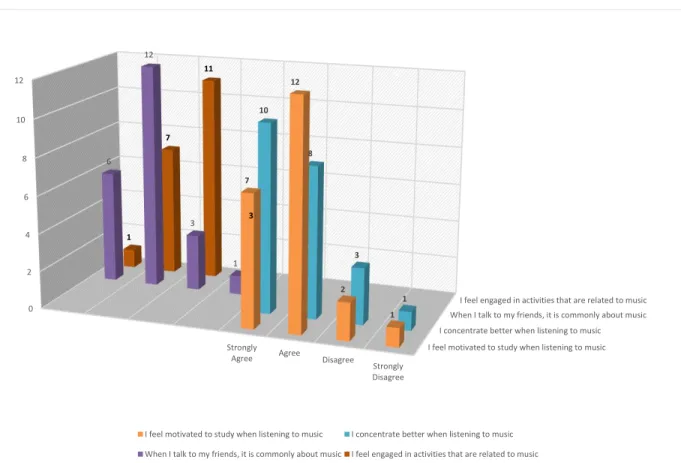
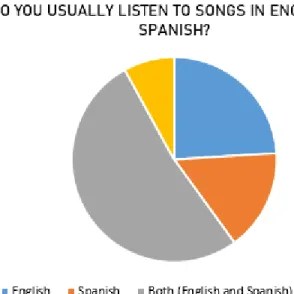
In regards to the use of music in the English class, between 42% and 50% of the students stated that they find easier to engage and concentrate on activities related to music as well as motivated to learn, which shows students perception toward music as a possible tool to be used in their learning. However, another percentage felt “undecided” and stated at the end of the survey that they did not clearly understand the statements presented. Furthermore, almost 60% of
0 2 4 6 8 10 12 14 16 18
I think English is fun. I am interested in the English language. I study English to do things I want to do in the
future.
I learn English because it is globally accepted.
Strongly Disagree Disagree Agree Strongly Agree
the population manifested a preference of listening to music both in Spanish and English, while a 27% prefers listening to music only in English. A small percentage of the class listens to music in Spanish, which shows that their preferences towards music in English can be used as a tool to enrich students’ learning in the EFL classroom (See Figures 9 and 10).
Figure 9 Use of music in the EFL classroom.
I feel motivated to study when listening to music I concentrate better when listening to music
When I talk to my friends, it is commonly about music I feel engaged in activities that are related to music 0
Figure 10. Language which students prefer in regards to music.
Thirdly, the field notes (Appendix C) gathered important information about students’ interaction in the classroom in relation to activities presented with music and it also provided the possibility to pay attention to the most relevant communicative, language, social, and affective needs of the group of students and to think about the possible approaches for them: for example, students’ performance in writing test was low because of factors that students mentioned
themselves, like finding those exercises boring and exhaustingly long, insecurity of talking when they know that they are being evaluated, etc.
describe (not physically but in terms of Fashion and clothing). This activity, as simple as it sounds, engaged students into participating and interacting orally among them in regards to the topic presented.
The second activity presented in the teacher’s log (when the target population was still in seventh grade) gave the teacher-researcher an indication on the motivation perceived when addressing controversial issues: this activity was related to Gun regulation in the US, where several videos (“Evan” – Sandy Hook Promise, “10 deadly mass shootings in the US”, etc) about mass shootings were presented in order to contextualize the topic; then, one state was assigned to each one of the students in order to conduct a research about specific gun regulation laws in that state. Each student did a short presentation on the topic and started discussing the topic by means of comparison. Further on, two music videos specifically related to the topic were presented (“Jeremy” by Pearl Jam and “Pumped up Kicks” by Foster the people) and a series of guiding questions were implemented in order to motivate students’ participation. The result of this activity is that students were engaged with the topic, the information presented and they were in charge of conducting the class discussion while the researcher listened presented different points of view on the same topic. These controversial topics are motivating for students as it helps them understanding a controversy through their perceptions and arguments.
mispronouncing words. This kind of behavior could have an impact in their disposition towards the class.
In spite of the situations presented above, one aspect called the attention of the
researcher: students’ attentiveness to activities developed with music and controversial topics as they find easier to concentrate, engage and show interest in this kind of lessons (as stated
previously in the survey).
Thus, it is pertinent to mention the course of action that this research will take in order to show how songs are portrayed in regards to productive language skills interaction: five stages will take place in the classroom, divided in four song-lyrics based lessons following
controversial topics (Discrimination, Bullying, Insecurity, Consumerism) which will have four different components: 1. contextualization (done by students with videos, texts, etc.); 2. exposure to three songs related to the topic; 3. Activities; 4. discussion, reflection and closure.
In conclusion and based on the evidence described above, as well as the problem presented in terms of communicative skills; bearing in mind the Basic English standards
established by Ministerio de Educación Nacional (2006) as well as the CEFR levels of English to accomplish, this population does not accomplish the goals set for ninth grade at a communicative level in terms of production: writing and speaking. Hence, these activities aim to foster students’ interaction by implementing song-lyrics based lessons lesson with controversial issues.
1.3. RESEARCH QUESTION.
OBJECTIVES
Research Objective
●To identify the factors that influence students’ productive language skills interaction in the EFL classroom when song-lyrics based lessons with controversial issues are implemented.
Specific objectives
●To identify the impact of a song-lyrics based methodology on the fostering of EFL students’ productive language skills interaction in the classroom.
●To analyze, describe and document how ninth graders’ productive language skills interaction is carried out through the creation of song-lyrics based lessons with controversial issues.
●To analyze, document and describe socio-cultural and affective factors that may influence students’ productive language skills interaction.
1.4. RATIONALE
According to the reading done for the present research, it is possible to say that learning a foreign language requires a very complex process that involves building, acquiring and
Here, songs enter as a facilitating component of learning, being relaxing and producing stimulus that impact on the way students perceive and internalize the foreign language, which according to Sevik (2011) inspires creativity and use of imagination in a relaxed classroom atmosphere. According to Adkins and Stefan (1997), students have experienced at least once in their lives having that song (favorite or not) "stuck" on the head, which leads them to sing in silence without the possibility of forgetting their lyrics. That same intention should be used in the classroom when using music in context.
Songs are a fundamental part of the life of people from a very young age and are part of the development of the child's speech. Adkins and Stefan (1997) stated that, as they are fun and easy to remember, they become a tool during the early years of learning. However, when students grow up, they become reluctant to participate in the songs used in class, traditional songs begin to lack meaning in their minds, as they will be inclined towards their personal taste in music. In the first years of high school, students are more open to listening to any kind of music, and this makes it easier for them to retain linguistic tricks in English. Even translations into their mother tongue can become a foreign language learning tool.
In this regard, Brown (2006) stated that culture is an integral part of the interaction between language and thought. To him, cultural patterns, customs, and ways of life shape the way we think and understand the world around us and at the same time, it is reflected in the way we use language. To sum up, a bridge between culture, language, and thought exists and
incorporated when accompanied by music and the process carried out for integration, which makes words and music to follow a continuous flow from expression to communication. Thus, song-lyrics based lessons to foster productive language skills interaction in the EFL classroom, will likely help students build up their interactional processes as EFL learners by giving them a sense of self-confidence when highly motivated.
CHAPTER TWO: LITERATURE REVIEW
This chapter presents a literature review related to the topic presented in previous sections and clarifies each one of the constructs that support this research. Four main constructs are defined by different authors whose perspectives are contributions to the present study, to mention: Interaction, use of music in the EFL classroom, use of songs as a situated literacy practice and teaching controversial issues.
First, it deals with how interaction is perceived in the EFL classroom. Then, it works through the concept of the use of songs as a literacy situated practice. Finally, it presents theory on how to teach controversial issues.
THEORETICAL FRAMEWORK
Interaction in the EFL classroom
Brown & Lee (1994) define Interaction as the heart of reciprocal communication related to the exchanging of thoughts, feelings, or ideas between a group of people that use language to “negotiate” meanings. In the same line of thought, Allwright (as cited by Ellis, 1994) sees interaction as the foundational element of classroom pedagogy, as every situation that happens inside of it, constitutes a process of live one-on-one interaction.
Automaticity: proposed as the real interaction based on meanings and messages instead of target language.
Intrinsic motivation: As the drive of students in order to feel fulfillment and satisfaction when being engaged with each other in speech acts and being able to appreciate their own competence to use language.
Moreover, Dörnyei’s (2001) model describes the basic elements of intrinsic motivation over time, which includes: 1) Creating basic motivational conditions, in order to promote students’ enthusiasm and engagement with the activities proposed; 2) Generating initial motivation, to raise learners’ intrinsic interest in the learning process as well as encouraging a positive disposition towards the class; 3) Maintaining and Protecting Motivation, as a way to promote student’s self-motivation and to keep learning as something stimulating and enjoyable, in order to help diminish language anxiety in the learning environment; and 4) Encouraging positive self-evaluation, by providing positive feedback and offering rewards as a motivational encouragement.
Strategic investment: which requires the use of a specific language competence in order to make decisions on how to use language according to the context and the topics, as well as to make corrections and use feedback in their own communication process. It also requires the component of spontaneity and involves diverse strategies for production and comprehension.
Risk-taking: Brown & Lee (1994) explain that this principle “...requires the risk of
Language-culture connection: The interactive communication component is loaded with a cultural tone of which participants need to be aware.
Interlanguage: Error treatment and feedback done by the teacher is an important part of students’ language development that impacts interaction.
Communicative competence: In regards to this important principle related to interaction, Brown & Lee (1994) state that “all the elements of communicative competence are involved in human interaction. All aspects must work together for successful communication to take place.” (p.166)
In addition, Kang Shumin (as cited in Richards & Renandya, 2002) states that learning to speak a foreign language requires a set of abilities that go from knowing its structure as well as
knowing how native speakers use the language in different contexts. On account of effective oral
communication, that requires the ability to use the language appropriately in social interactions.
Thus, he proposes that it is necessary to investigate the factors that affect learners’
interaction and oral communication, such as: 1) sociocultural factors, having in mind that many
cultural characteristics of a language affect foreign language learning. Furthermore, linguistic
communication happens in structured exchange settings in which we share traditions and beliefs;
2) Affective factors,which are stated as one of the most important influences in learners’ process
(their success or failure). Factors such as emotions, self-esteem, empathy, anxiety, attitude,
frustration, uneasiness, self-doubt and motivation are related to foreign language learning.
In regards to this issue, Krashen (1982) proposed that affective factors are strictly linked
to the acquisition of a new language and stated three categories related to those factors: 1)
language acquisition; 2) self-confidence, that explains how performers with self-confidence and a good self-image tend to do better in language acquisition, and 3) anxiety, because low anxiety (even if is personal or inside the classroom) seems to be relevant in language acquisition. It is also mentioned that those classrooms that promote low anxiety levels among students are more successful.
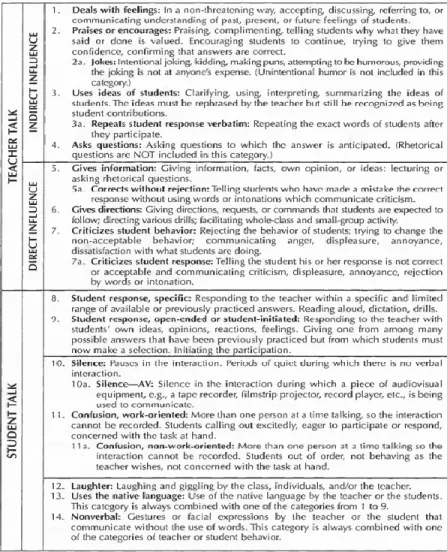
Brown & Lee (1994) proposed the following categories to analyze interaction in the EFL classroom:
In regards of the table presented before, it is pertinent for the present study to focus on Students’ talk, as they are going to be the foundation and direct participants of the research from whom data will be collected. Specially, those categories related to students’ responses, use of target language and nonverbal communication.
In regards to the role of the teacher in terms of interaction, according to Brown & Lee (1994), it is possible to focus on categories such dealing with feelings, praising and encouraging, asking questions, using students’ exact or paraphrased ideas and providing information; in order to analyze its impact on students’ productive language skills interaction when song-lyrics based lessons with controversial issues are presented in the class.
Use of songs as a literacy situated practice:
Brandt & Clinton (2002) explain that social practice perspectives on literacy were put
together in the late 1970s and early 1980s as a way to explain cultural changes in globalized modern societies that tended to focus only on alphabetic literacy.
In regards to the situated learning approach, Clancey (1995) stated that it is related to how learning occurs every day. He also proposed that teaching cannot be necessarily "situated", as this is a theory about knowledge being dynamically and socially constructed. In the same line of thought, Stein (1998) proposed that skills are learned in contexts that contemplate how
knowledge can be acquired and applied in everyday situations.
Moreover, and specifically in regards to literacy as a situated practice, Brandt and Clinton (2002) argued that this model of literacy as a situated -and social- practice defines students’
represents the capacity of written language to “break free” of the limits of time and place, as well
as the ability of printing and reorienting their perception of the world.
They also claim that (Brandt & Clinton, 2002) one of the most valuable contributions of
this practice is the breaking of “the oral-literate binary in which speaking and writing appeared
as formally and functionally distinct systems” (p. 348). Thus, these were able to recognize how
much talking and writing could be combined in actual communication depending on the context
and the circumstances. Moreover, Li (2001) praises the socio-cultural context of literacy as an
approach to help making the transition from students’ familiar world of home into the unfamiliar
world of school. In order to do that, teachers must understand the different realities of the
students and their needs.
Finally, in regards to the use of songs as a literacy situated practice and taking into
account the theory mentioned before, it is pertinent to mention that for the purpose of this
specific research, literacy cannot be understood as the way in the participants make a proper
production according to certain standards, but the way in which they connect with the activities
in order to participate and engage with their own process of developing communicate
competences, especially those related to writing and speaking
Teaching Controversial issues
Harwood & Hahn (1990) define controversial issues in the classroom as “a reflective
dialogue among students, or between students and teachers, about an issue on which there is
disagreement. Typically, a discussion is sparked by a question or assertion made either by a
that helps engaging into different points of view, creating a nature of interactive endeavor and
reflective dialogue.
A topic is considered an issue if a group of people disagree with it; according to Harwood
& Hahn (1990), those topics which divide society and create conflictive explanations/solutions,
may be considered controversial. Thus, controversial issues may range from local problems to
international concerning matters.
Another relevant factor when teaching and discussing controversial issues in the classroom, according to Harwood and Hahn (1990) is the importance of creating an accurate classroom environment in which students may be able to share and express their ideas in an
emancipating way, with various topics that they can find engaging, leading to a positive
outcome.
As topics need previous preparation in order to provide successful information and lead
to positive outcomes, Harwood & Hahn (1990) proposed a set of steps to ensure the fruitfulness
of the interaction with the students:
Selecting Issues. Here, teachers must bear in mind students’ interests, as
they need to have a field of “expertise” in the subject/topic presented.
Preparing Students for Discussion. Training students in discussion
techniques is important before providing with the information and the topics to be
discussed. Both teachers and students need to decide cooperatively and beforehand the
guidelines for interaction.
Providing Adequate Information Sources. Accurate information must be
held during the class. It requires to provide useful resources (magazines, blogs, films,
videos, etc.) and material for students to feel engaged and participative in discussions.
Establishing an Open Discussion Climate. The creation of an accurate
and safe environment for students’ participation, in which they feel that their ideas are
being listened and respected, is fundamental for successful interaction. Even if points of
view are too different, if the teacher manages to create a “non-threatening arena”,
students will be able to share their ideas and opinions.
Maintaining Focus and Direction. Ideas may wander off topic or evolve
into different branches that are not related to the main topic. Encouraging students to
keep one direction and a specific structure, is a fundamental role of the teacher when
dealing with controversial issues.
Ensuring Intellectual Balance. Not only providing information is the
right way to discuss a topic, but to provide and consider all the possible perspectives.
Thus, a range of opinions on one specific topic, may provide this information.
Encouraging Equal Participation. It is difficult to achieve the right level
of participation, especially when there are some outspoken students. Thus, it is important
to empower students into participating more actively.
The Expression of Teachers' Personal Views. Teachers tend to make
points and take a stand when dealing with controversial issues in the classroom.
However, these perspectives must be clearly addressed as a well-supported opinion, in
order to set an example for students.
Furthermore, Clarke (2005) stated that teachers may feel uncomfortable when teaching
provide a framework for teaching controversial issues, Clarke (2005), stated a set of questions to be asked when analyzing one of these topics, such as: 1) What is the issue about? which aims at identifying the topic of the controversy. When answering this, students will be able to analyze the nature of the problem and go straight to its core; 2) What are the arguments? students will be able to identify all the possible points of view that surround the issue; 3) What is assumed?
Once students have considered the possible points of view, they could start working on the validity of the issue as well as the assumptions made by people when addressing this topic; and 4) How are the arguments manipulated? This is a more “political” step in the discussion process and it is related to how the information they obtained may manipulate or change their perspective on the topic, by giving this information a validity based on their believes, likes, dislikes and. This can be used as a powerful reflection tool for the present research,
Furthermore, Barton & McCully (2007), proposed that teaching controversial issues in
the classroom is a powerful way to change people’s perspectives and points of view in a
democratic world, in order to take part in reasoned discussions with those whose opinion may
differ, which must be the intention when approaching to this kind of topics.
STATE OF THE ART
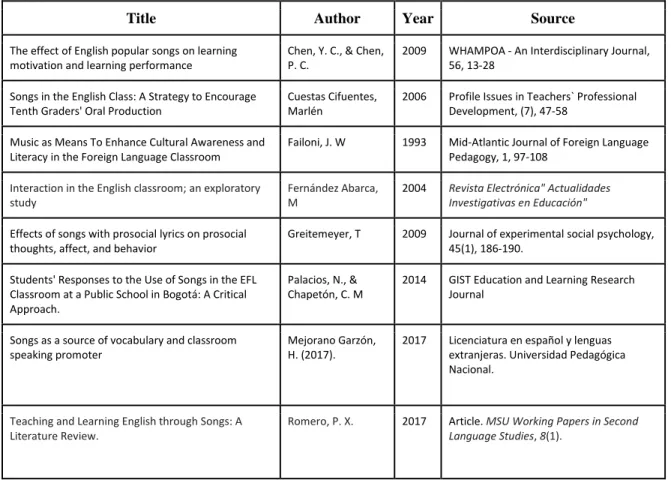
Title Author Year Source
The effect of English popular songs on learning motivation and learning performance
Chen, Y. C., & Chen, P. C.
2009 WHAMPOA - An Interdisciplinary Journal, 56, 13-28
Songs in the English Class: A Strategy to Encourage Tenth Graders' Oral Production
Cuestas Cifuentes, Marlén
2006 Profile Issues in Teachers` Professional Development, (7), 47-58
Music as Means To Enhance Cultural Awareness and Literacy in the Foreign Language Classroom
Failoni, J. W 1993 Mid-Atlantic Journal of Foreign Language Pedagogy, 1, 97-108
Interaction in the English classroom; an exploratory study
Fernández Abarca, M
2004 Revista Electrónica" Actualidades Investigativas en Educación"
Effects of songs with prosocial lyrics on prosocial thoughts, affect, and behavior
Greitemeyer, T 2009 Journal of experimental social psychology, 45(1), 186-190.
Students' Responses to the Use of Songs in the EFL Classroom at a Public School in Bogotá: A Critical Approach.
Palacios, N., & Chapetón, C. M
2014 GIST Education and Learning Research Journal
Songs as a source of vocabulary and classroom speaking promoter
Mejorano Garzón, H. (2017).
2017 Licenciatura en español y lenguas extranjeras. Universidad Pedagógica Nacional.
Teaching and Learning English through Songs: A Literature Review.
Romero, P. X. 2017 Article. MSU Working Papers in Second Language Studies, 8(1).
Table 2. Reviewed Researches of the State of the Art
The researcher focused on three main aspects in order to develop this research: 1) the use of English popular songs as a learning motivation factor in young learners; 2) aspects of English popular songs that young learners find motivating and 3) improvement of students’ English skills after learning English popular songs. By introducing four English popular songs accompanied by fragments of films (to introduce plots) during the semester, the researcher hoped to motivate students to learn but also to provide a context to help students review sight vocabulary.
This research summarized its findings in four main aspects related to students’ perceptions: 1) motivation had significantly increased after creative teaching using popular songs; 2) students were motivated to become active learners; 3) according to students’ responses, most of them were fond of learning English popular songs and got interested in learning more after these activities and 4) students felt that their English abilities had improved after learning these English popular songs. According to Chen and Chen (2009), this kind of activities could increase students’ learning motivation as they would be eager to talk about the songs or learn to read the vocabulary and sentences of the lyrics.
In regards to the use of songs in the English class to encourage Oral production, Cuestas Cifuentes (2006) developed a research project with 45 tenth graders (14 and 17 years old) divided into small groups of 5 or 6 students, at León de Greiff public school, in Bogotá. This particular group of students was interested in finishing high school with a good English level, particularly in the speaking area. Their interests were the foundation of the project, having in mind that public schools in Colombia spend less time practicing speaking skills in comparison to the other communicative abilities. Thus, the purpose of this research was to promote oral
activities in order to examine their effectiveness, by observing and registering in field notes and video recording students’ attitudes or reactions, as well as their changes in regards to oral production.
Cuestas (2006) stated that these activities actually helped improving their classes and to achieve very good results with the students, because: 1) when they were given songs in English during the activities proposed, they showed some attitudes that can be considered favorable (motivation, participation, cooperation, relaxation and self-confidence) and they were pleased with the songs proposed (they loved the lyrics, melodies and music groups or singers); 2) the use of songs helped diminishing anxiety and lack of confidence; 3) students change of pace in term of oral production (improvement) when they expressed their ideas freely instead of worrying about accuracy; 4) students felt motivated to speak more in English when they talked about songs because they found the topics appealing; 5) working in small groups helped students working on issues such as solidarity.
Hence, it is possible to say that songs can be favorable when approaching to matters such as interaction (oral production), as it keeps students engaged and their anxiety levels are low in comparison to other types of exercises. Thus, it may be related to the present research project in regards to the use of songs to promote oral interaction.
Furthermore, Failoni (1993) carried out a research project in order to enhance cultural awareness and literacy in the foreign language classroom with Music. Based on Gardner’s (1985)
with actual classroom learning because it is directly linked to students' interests. According to Failoni (1993):
Music may allow a teacher to introduce a more advanced text through music because, unlike
spoken conversation, there are pitches and melodies, rhymes, and beats and measured phrases, that may
help students remember vocabulary or grammatical structures and aid in comprehending the general
meaning (p. 101).
For my purposes, this specific article may be helpful in regards to 1. the choice of music made by the teachers, which might confirm or introduce a stereotype, and 2. how music activities help strengthen various language skills. However, in disagreement with the article, this topic needs to be explored further, as she provides no evidence or references for these claims but gave a lot of advice with little support.
In terms of interaction in the EFL classroom, Fernández Abarca (2004)presented an article of a study that was carried out with 33 ninth graders at an academic public high school in the province of Alajuela (Costa Rica) in order to describe the interaction process that took place in this particular classroom. By observing, interviewing, questioning, and notetaking, Fernández (2004) stated that teacher’s interaction corresponds to a series of question-making processes, games, conversations, dialogues, puzzles, and songs that were hindered sometimes because of time factors. Besides, students’ reasons to kept their motivation towards the English class was because they believed it was very important for their lives and they also considered that the teacher provided interesting activities that involve them in the learning process.
teaching methodologies, techniques, and activities in order to promote students' active participation through the exchange of information that impacts the creation of meaningful experiences to achieve academic success. This study is not only helpful in regards of interaction itself, but on how to approach it to a very similar population as the one presented in the research project.
Apart from the topic of interaction, Greitemeyer (2009) carried out a study on effects of songs with prosocial lyrics on prosocial thoughts, affect, and behavior. with different populations in three different experiments (1st experiment: 34 students; 2nd experiment: 38 students; 3rd experiment: 90 students) from the Ludwig-Maximilians University (LMU) in Munich, Germany, who were randomly assigned to one of the two song conditions (prosocial vs. neutral) in order to examine effects of exposure to prosocial songs.
Participants generally were welcomed by one experimenter, learned the purpose of the study and proceeded to complete a series of tasks related to word completion or surveys. Then, participants answered two control questions to verify that the prosocial and the neutral songs were different in terms of content. What Greitemeyer (2009) noticed is that listening to prosocial (relative to neutral) songs, fostered prosocial thoughts, generated empathy, and promoted
prosocial action, proving that media exposure on social tendencies affects social behavior and related variables not only negatively, but may also do so positively. These results are valuable to bear in mind in further research about the use of songs with social content in the EFL classroom.
ideas and to discover the impact of songs in regards to this problematic. Through observation, field notes and students’ artifacts, the researcher tried to establish a relation between the impact of songs to learn new vocabulary and students’ classroom speaking performance.
What Mejorano Garzón (2017) found is that: 1) the songs implemented helped students building new vocabulary, as well as retain topics and grammar structures; 2) students
contextualized words while approaching to the topics presented in the lessons; 3) teaching and learning vocabulary cannot be taken as a memorizing task; 4) songs result fascinating and meaningful to students to learn vocabulary; 5) the approach used by the teacher to introduce the songs, is what determines the participation/learning of the students; 6) the approach of the activities promote classroom speaking performance, as students participated by giving answers using new vocabulary; 7) the vocabulary given during the sessions helped improving students’ oral skills, and the result was evident in terms of their production; 8) students practiced and reinforced the new vocabulary through the oral activities while giving them the opportunity to speak in English and feel motivated by them.
In regards to teaching and learning English through songs, an article by Romero (2017)
aims at providing an account of current studies involving music and songs by contextualizing
them within a cognitive, behavioral, and linguistic framework that supports the use of music and
songs in the EFL classroom and following five main statements: 1) Works published in this topic
so far, 2) skills that have been studied, 3) instruments used to measure gains, 4) kind of songs
Romero (2017) established that the different studies considered in this paper contributed
to build the case for the use of songs with positive effects at cognitive, linguistic, and
pedagogical levels while fostering motivation at several educational levels (kindergarten to high
school), especially young learners. To sum up, this paper stated possible areas for further
research on this topic, such as: conducting comparative studies with adult learners and children
to determine if the effect of music for EFL learning is similar. The transferability of language in
terms of grammar, vocabulary, or pronunciation in every generation changes or not, among
CHAPTER THREE: RESEARCH DESIGN
This chapter is aimed at describing the type of research which supports the present study. From dealing with the research approach, to the setting and participants in which the research takes place, as well as the data collection instruments used. All relevant in the understanding of the perspective that acts as a foundation and purpose for the present study.
Thus, bearing in mind the theories presented in the last chapter, it is relevant to articulate a research design that, through the bases of action research, leads to identify how ninth graders’ interaction is influenced when song-lyrics based lessons with controversial issues are
implemented in the EFL classroom.
According to Rothwell (1993), qualitative research is defined as a way to explore and to see what factors are involved in the classroom in order to gain the understanding of a topic, without necessarily needing to know how often these factors occur or affect the normal behavior of the subjects (Seliger & Shohamy, 1989). In the same line of thought, Sutton & Austin (2015) stated that qualitative study seeks to convey why people have thoughts and feelings that might affect the way they behave.
key elements of data collection, which is to observe participants' behaviors by participating in their activities.
Therefore, data of the present research will be collected based on the parameters of qualitative research, as it favors the observation and analysis of attitudes, behaviors towards song-lyrics based lessons with controversial issues as a way to foster productive language skills interaction in the EFL classroom.
Type of Study
As previously stated, the present study lies under the foundation of action research (henceforth referred to as AR) that Burns (2009) defines as an appealing way to look closely at classroom situations that may be incomprehensible or to try to get to the bottom of teaching dilemmas. Burns (2009) also mentions the main objectives of AR in English language teaching; for instance, to identify a real ‘problematic’ situation happening in the classroom or an issue that the participants consider worth looking into more deeply and systematically, in order to bring about changes and improvements based on actual information and observable evidence.
This, because it is not possible to bring forward a situation based on hunches or assumptions of what is happening inside the classroom, leading to real and positive change, making teachers be aware of their own approaches and methods to teach (Burns, 2003).
Hult, Lennung and McKernan (As cited in Cohen, Manion & Morrison, 2002) mentioned that action research has several benefits for qualitative research, such as: making for practical problem-solving as well as expanding scientific knowledge; is collaborative; is undertaken directly in situ; it seeks to understand particular complex social situations; it seeks to understand the processes of change; it seeks to improve the quality of human actions and focuses on those problems that are of immediate concern to practitioners, making it participatory.
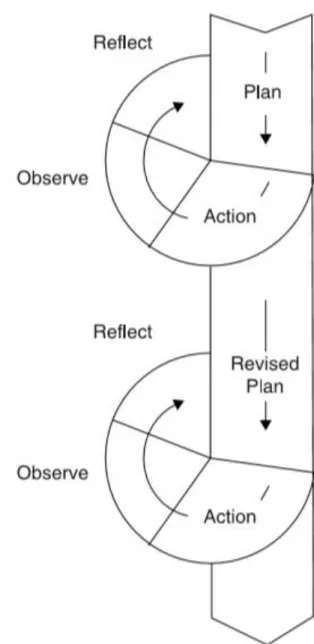
In regards to the main stages of AR, Burns (2009) stated that it typically involves four cyclical phases or stages: The first one is called planning, in which a problem is identified and a plan of action in order to bring about improvements in a specific area of the research context is developed. The second one, is called action and involves some deliberate interventions into the teaching situation that the researcher put into action over an agreed period. The third stage is called observation and involves observing systematically the effects of the action and
documenting the context, actions and opinions of those involved. Finally, there is a stage called
Figure 11. Cyclical AR model based on Kemmis and McTaggart (1988). - Cited by Burns (2009).
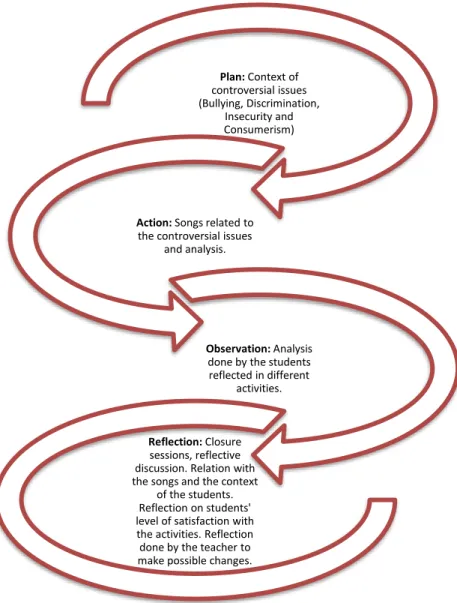
Figure 12. Cycles to work in the pedagogical intervention.
It is important to clarify that the stages presented before are those conceived by the researcher as part as the process of developing the pedagogical intervention. However, a careful planification should be done, especially in the stage of reflection in order to make changes or improvements to the activities and the lessons presented.
Plan:Context of the songs and the context
Setting
The present research took place at José Max León School, located in Cota,
Cundinamarca. It is a private, co-educational, secular school founded in 1954 (originally a male school), that offers education from nursery to 11th grade. Most of its students come from the north
of Bogotá, as well as the northwestern part of the city (Calle 80, Ciudadela colsubsidio, Cortijo, etc), Suba and the nearest towns to Cota (Tenjo, Cajicá, Chía, Subachoque, among others).
In the time of its foundation, education in Bogota (where the school was initially located) was governed by Catholic formation structures. This school led a new perspective in the way of teaching and learning, which generated disconcert among the conservative communities.
As previously stated on chapter 1, the School aims at becoming a certified national bilingual institution by 2023, and for this reason, students have 8 hours per cycle (more than the rest of the subjects in the school) of an intensive English program in which they develop
different skills according to the levels established by the school and that is supported by Cambridge English Schools, Cambridge University Language Assessment and Cambridge University Press since 2015-2016 school year.
Participants
sample (in which participants are not chosen, but participate voluntarily) and the sample that consist of the total population.
For the purpose of the research, the sampling type chosen was the volunteer sample. Thus, the data was collected from a focus group of twelve students who decided to voluntarily participate. These ninth graders could be characterized as teenagers with a high sense of responsibility, who follow the rules stated by the school, as well as its vision of critical responsibility, taking care of themselves, others and the environment.
It is pertinent to mention that I already knew the group because I was their teacher when they were in 7th grade (academic year 2017-2018); so it is possible for me to say that they
engaged easily with activities in which music was involved, listening activities, and almost every activity that require for them to discuss, debate or to move around the classroom (Appendix D).
By the time that the observation took place (academic year 2018-2019), over 70% of the class had a high standard of quality in terms of results that they got in the different subjects proposed by the school. Moreover, in relation to the English subject, there were eight (8) students whose skills were under the average, while seven (7) of them showed excellence in regards of their skills in the subject. On the other hand, twelve (12) students showed an average level, understood for this particular case as the grades obtained by the students in the scales from the school (1-7).
activities related to writing very specific chores, which they found extremely long and tedious, pointing specifically at the amount of words required for the exercises (See Figure 12)
Figure 13. Sample of Diagnostic Test (Writing Section)
Researcher's Role
Sutton and Austin (2015) mentioned that the role of the researcher in qualitative research is to attempt to access the thoughts and feelings of study participants. As the researcher belongs to the community to which the participants belong, her role would be being a participant