C
OMPUTERSCIENCE
D
EPARTMENTRelevance-Based Language Models:
New Estimations and Applications
PH
D THESIS
Javier Parapar L´
opez
P
H
D T
HESIS
Relevance-Based Language Models:
New Estimations and Applications
Javier Parapar L´
opez
PhD supervisor:
Prof. Dr. ´
Alvaro Barreiro Garc´ıa
Thesis committee:
Prof. Dr. Fabio Crestani
Prof. Dr. Jos´
e Luis Freire Nistal
Dr. Leif Azzopardi
Dr. David E. Losada Carril
D. ´Alvaro Barreiro Garc´ıa, Catedr´atico de Universidad en el ´area de Cien-cias de la Computaci´on e Inteligencia Artificial de la Universidad de A Coru˜na
CERTIFICA
Que la presente memoria titulada Relevance-Based Language Models:
New Estimations and Applicationsha sido realizada bajo su direcci´on y
con-stituye la Tesis que presentaD. Javier Parapar L´opezpara optar al grado de Doctor con menci´on Internacional por la Universidad de A Coru˜na.
A Coru˜na, febrero de 2013
Firmado: Dr. ´Alvaro Barreiro Garc´ıa Director de la Tesis
Abstract
Relevance-Based Language Models introduced in the Language Modelling framework the concept of relevance, which is explicit in other retrieval mod-els such as the Probabilistic modmod-els. Relevance Modmod-els have been mainly used for a specific task within Information Retrieval called Pseudo-Relevance Feed-back, a kind of local query expansion technique where relevance is assumed over a top of documents from the initial retrieval and where those documents are used to select expansion terms for the original query and produce a, hope-fully more effective, second retrieval.
Acknowledgments
This work will be not finished without the help of many. First of all, I must thank my advisor Prof. ´Alvaro Barreiro for his great supervision and guidance and for letting me to be part of his research group and writing this thesis un-der his advice. Of course, I also wish to acknowledge the support of every member of the Information Retrieval Lab at University of A Coru˜na, and par-ticularly Roi, Chema, Edu, Isma, Xose, Mart´ın and Pedro for their support all through these years. I have also to acknowledge the help of a former mem-ber, Dr. David Losada, for his help and support during all the stages of this dissertation.
During my period as Ph.D. student I had the pleasure of visiting the Uni-versity of Lugano, I shall not forget to thank Prof. Fabio Crestani, Dr. Mark Carman and the whole USI IR Group for their warm reception. I also visited Prof. Ricardo Baeza at Yahoo!, again I must thank him and the whole Yahoo! Research Labs Barcelona for their friendly welcome and great support.
I want also acknowledge the input of those reviewers who contributed to improve this and other works. Specially, I must thank the members of this thesis’ committee for their effort. I shall acknowledge the financial support of
Xunta de Galiciaand the Government of Spain for my Ph.D. grant, the travel grants, and the funding through research projects.
Index
Chapter 1: Thesis Outline . . . 1
1.1 Introduction . . . 1
1.2 Motivation . . . 2
1.3 Thesis Statement . . . 4
1.4 Thesis Outline . . . 5
Chapter 2: Introduction to Relevance Models. . . 7
2.1 Information Retrieval . . . 7
2.2 Language Models . . . 10
2.3 Pseudo-Relevance Feedback . . . 13
2.4 Relevance Models . . . 15
Chapter 3: Promoting Divergence in Relevance Models . . . 19
3.1 Introduction and Motivation . . . 19
3.2 Background . . . 21
3.2.1 Kullback Leibler Divergence for Pseudo Relevance Feed-back . . . 21
3.3 Promoting the Divergence in PRF in the LM Framework . . . . 22
3.3.1 Kullback Leibler Divergence Based Query Expansion in the Language Modelling Framework . . . 23
3.3.2 Relevance Models with Promotion of Divergent Terms . 24 3.4 Experiments and Results . . . 26
3.4.1 Collections . . . 26
3.4.2 Compared Methods . . . 27
3.4.3 Training and Evaluation . . . 27
3.4.4 Results . . . 29
ii Index
3.6 Conclusions . . . 31
Chapter 4: Cluster Based Retrieval and Relevance Models . . . 33
4.1 Introduction and Motivation . . . 33
4.2 Cluster Based Relevance Modelling . . . 35
4.2.1 Clustering Algorithm . . . 35
4.2.2 Cluster Query Likelihood . . . 37
4.2.3 Cluster Based Reranking . . . 37
4.3 Experiments and Results . . . 39
4.3.1 Settings and Methodology . . . 39
4.3.2 Compared Methods . . . 39
4.3.3 Training and Evaluation . . . 40
4.3.4 Results . . . 41
4.4 Related Work . . . 41
4.5 Conclusions . . . 44
Chapter 5: Estimating the Size of the PRF Set. . . 45
5.1 Introduction and Motivation . . . 45
5.2 Background . . . 48
5.2.1 Score Distributions . . . 48
5.3 Modelling Score Distributions for Pseudo-Relevance Feedback . 51 5.4 Experiments and Results . . . 55
5.4.1 Settings and Methodology . . . 55
5.4.2 Compared Methods . . . 55
5.4.3 Training and Evaluation . . . 56
5.4.4 Results . . . 56
5.5 Related Work . . . 57
5.6 Conclusions . . . 59
Chapter 6: Relevance Modelling of Constrains for Text Clustering . . 61
6.1 Introduction and Motivation . . . 62
6.2 Background . . . 63
6.2.1 Constrained Clustering . . . 64
6.3 Relevance-Based Language Modelling of the Constraints . . . . 65
6.3.1 Clustering Algorithms . . . 66
6.3.1.1 Partitional algorithms . . . 67
6.3.1.2 Spectral Algorithms . . . 68
Index iii
6.4.1 Constraints and Seed Initialisations . . . 69
6.4.2 Collections . . . 70
6.4.3 Compared Methods . . . 70
6.4.4 Metrics . . . 71
6.4.5 Training . . . 71
6.4.6 Statistical Significance . . . 72
6.4.7 Results . . . 72
6.5 Related Work . . . 74
6.6 Conclusions . . . 75
Chapter 7: Relevance Modelling of Recommender Systems . . . 77
7.1 Introduction and Motivation . . . 77
7.2 Relevance-Based Language Modelling for Recommendation . . 80
7.2.0.1 Method 1: i.i.d. sampling . . . 81
7.2.0.2 Method 2: conditional sampling . . . 82
7.2.0.3 Final Estimation Details . . . 82
7.3 A Probabilistic Neighbour Selection Technique . . . 83
7.3.1 Posterior Probabilistic Clustering . . . 84
7.3.2 Neighbour Selection based on PPC . . . 85
7.4 Experiments and Results . . . 86
7.4.1 Collections . . . 86
7.4.2 Compared Methods . . . 87
7.4.3 Training and Evaluation . . . 88
7.4.4 Results . . . 90
7.4.4.1 Experiment 1: Relevance-Based Language Mod-els . . . 90
7.4.4.2 Experiment 2: Probabilistic Clustering for Neigh-bourhood Selection . . . 94
7.4.4.3 Experiment 3: Probabilistic Clustering and Re-levance Models . . . 95
7.4.4.4 Discussion . . . 98
7.5 Related Work . . . 99
7.6 Conclusions . . . 101
Chapter 8: Conclusions and Future Research . . . .103
8.1 Conclusions . . . 103
iv Index
Appendix A: Summary in Spanish. . . .109
A.1 Motivaci´on . . . 110
A.2 Objetivos . . . 112
A.3 Estructura . . . 114
A.4 Publicaciones . . . 115
A.4.1 Publicaciones Recientes en Congresos de Referencia . . 115
A.4.2 Publicaciones Recientes en Revistas JCR . . . 118
List of Tables
3.1 Collections and topics for training and test used in the docu-ment retrieval evaluation . . . 26
3.2 Values for Mean Average Precision (MAP) on the test topics. Statistical significant improvements (Wilcoxon p < 0.1, and Wilcoxonp <0.05underlined) with respect to LM, RM3, KLD3, and RM3DT are superscripted withl, r,k, anddrespectively. Best values are bolded. . . 29
3.3 Values for Robustness Index (RI) with respect to the LM base-line model for every collection. Best values are bolded. . . 29
4.1 Values for Mean Average Precision (MAP) on the test topics. Statistical significant improvements (Wilcoxon p < 0.1, and Wilcoxonp < 0.05underlined) with respect to LM, RM3, Re-sampling, and CBRM3 are superscripted withl,r,s, andc re-spectively. Best values are bolded. . . 40
4.2 Values for Robustness Index (RI) with respect to the LM base-line model for every collection. Best values are bolded. . . 41
5.1 Values for Mean Average Precision (MAP) on the test topics. Statistical significant improvements (Wilcoxon p < 0.1, and Wilcoxonp <0.05underlined) with respect to LM, RM3, and SDRM3 are superscripted with l, r, and d respectively. Best values are bolded. . . 56
vi List of Tables
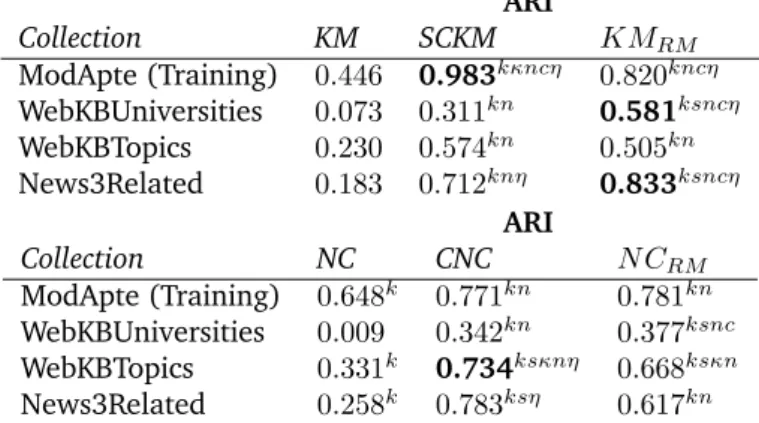
6.1 Adjusted Rand Index values, statistical significant improvements w.r.t to the alternative set-up for each algorithm according with the Sign Test are starred (the null hypothesis is rejected for a
p-value≤0.0547). . . 73 6.2 Adjusted Rand Index values, statistical significant improvements
w.r.t KM, SCKM,KMRM, NC, CNC andN CRM according with
the Sign Test are marked ask, s, κ, n, c, ηrespectively (the null hypothesis is rejected for ap-value≤0.0547). Best values bolded. 73 7.1 Statistics about the datasets used in the experiments. . . 87 7.2 Summary of the results for each approach, best values for each
collection and metric bolded. Statistical significant improve-ments according to Wilcoxon Test (p < 0.01) w.r.t. MF, UB, User-basedRM, UIR-User, RM1, RM2, PPC, PPC+RM1 and PPC+RM2 are superscripted witha, b, c, d, e, f, g, handirespectively. . . . 91 7.3 Performance results for the combination of PPC and RM
List of Figures
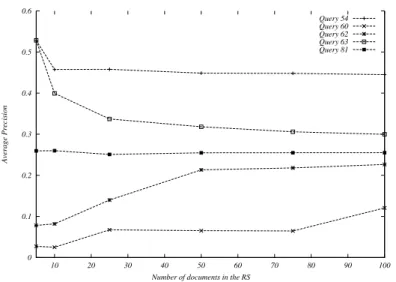
5.1 RM3 behaviour in terms of Average Precision for different queries from the training query set of the AP-8889 collection witht = 100andλ= 0.8andµ= 1000 . . . 47 5.2 Mixture of Gaussians fit to relevant and non-relevant data
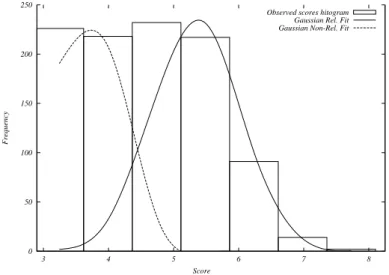
ob-tained processing the scores of TREC query 154 over the AP88-89 collection produced with the LM retrieval function with Dirichlet smoothing (µ= 1000) . . . 49 5.3 Example of idealised Receiver Operating Characteristic (ROC)
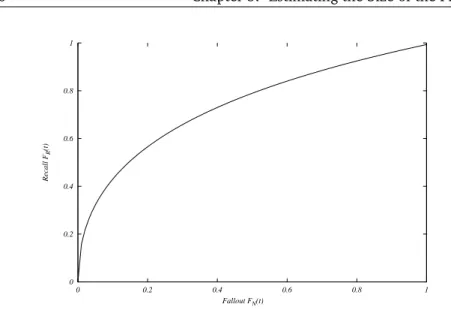
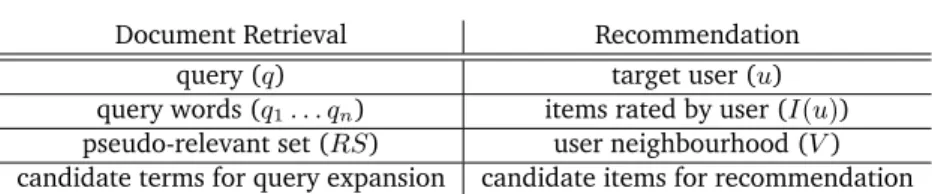
for a cut-off or thresholdt . . . 50 6.1 Analogies between the use of Language Based Relevance
Mod-els for document retrieval and for constrained text clustering . . 63
7.1 Analogies between the use of Language Based Relevance Mod-els for document retrieval and for item recommendation . . . . 79 7.2 Performance and coverage (cvg) in the Movielens 100K
collec-tion when varying the amount of smoothing applied for the RM1 method . . . 93 7.3 Performance and coverage (cvg) in the Movielens 100K
collec-tion when varying the amount of smoothing applied for the RM2 method . . . 93 7.4 Performance and coverage (cvg) in the Movielens 100K
collec-tion when varying the number of clusters PPC method . . . 95 7.5 Performance and coverage (cvg) in the Movielens 100K
collec-tion when varying the number of clusters PPC+RM1 method . . 96 7.6 Performance and coverage (cvg) in the Movielens 100K
Chapter 1
Thesis Outline
1.1
Introduction
Since the first formal statements of how the search process should be car-ried out in the libraries’ archives during the fifties, Information Retrieval (IR) techniques have become essential for the daily activity of most of the human beings. Nowadays the homepage of almost every web browser installed in the personal computers point to a web search engine such as Google, Yahoo! or Bing, this is not only for marketing purposes, but also, and more importantly, it is because today the search engines are vital to access information. And those search engines would not be possible without the research efforts made on the Information Retrieval field. Information Retrieval is in fact thescience of searching, or maybe a better description could be thescience of finding. Sev-eral definitions have being proposed to characterise this, still young, research area, in our opinion one of the most accurate ones was stated in Manning et al. (2008):
Information Retrieval is finding material (usually documents) of an unstructured nature (usually text) that satisfies an information need from within large collections (usually stored on computers)
2 Chapter 1. Thesis Outline
to his information need. Several retrieval models have been proposed along the history of Information Retrieval. Particularly, this thesis work is framed under the well-known and highly effective Statistical Language Models. Ponte and Croft (1998) introduced the use of the Language Models (LM) in Infor-mation Retrieval, models which closest roots have to be found in the field of automatic speech recognition. Specifically, in this work we will deal with a later expansion for LM called Relevance-Based Language Models (Lavrenko and Croft, 2001). Relevance Models (RM) introduced in the LM framework the concept of relevance, which is explicit in other retrieval models such as the Probabilistic models. RM have been mainly used for a specific task within IR called Pseudo-Relevance Feedback (PRF). PRF is a kind of local query ex-pansion technique where relevance is assumed over a top of documents from the initial retrieval; these documents are used to select expansion terms for the original query and produce a, hopefully more effective, second retrieval.
In this thesis we investigate some new estimations for RM for both PRF and other tasks beyond retrieval, particularly, constrained text clustering and item recommendation in recommender systems. We study the benefits of our proposals for those tasks in comparison with existing estimations. We also play attention to some practical aspects in RM such as parameter tuning, and specially a new proposal for automatically determine the size of the top of documents selected for PRF.
In the remaining of this chapter we discuss the motivation of this Thesis (1.2), the contributions of this work (1.3) and finally a general overview of the work presented in this thesis (1.4)
1.2
Motivation
es-1.2. Motivation 3
timations of RM have been carried out (Lv and Zhai, 2009a). That is, in fact, the main motivation of this thesis; producing new RM estimations for the retrieval task comparing their performance against state-of-the-art base-lines. We do not only aim to produce more effective models but also to derive more robust estimations that, at some point, tackle the endemic topic drift problem of the PRF techniques. In line with this we want to further explore mainly two different paths: promotion of divergence and cluster based meth-ods. Referring to the former, the promotion of divergence at term level in PRF has been previously explored in other retrieval frameworks with suc-cess (Carpineto et al., 2001), meanwhile in RM the attempts to do this were not conclusive (Zhai and Lafferty, 2001) and only at model level rather than at term level. Regarding cluster based techniques to boost up RM, research efforts have been centred on apply cluster based retrieval approaches to im-prove the selection of the pseudo-relevant set (Lee et al., 2008) and this is the idea that we want to further explore not only with the aim of improving effectiveness but also robustness.
4 Chapter 1. Thesis Outline
When addressing this research it is mandatory to tackle some practical problems. Specifically, a good election of the values of the parameters it is known to be crucial in the performance of the different formulations of RM. Some studies have been lately published on this issue (Winaver et al., 2007; Huang et al., 2008), but the efficiency of existing approaches compromises their use in query-time in real applications. Because of this, we decided to study this point in detail, trying to produce meaningful automatic methods for determining the values of some of these parameters in a less computationally expensive way.
1.3
Thesis Statement
The main claim of this work is that it is possible to formulate new estima-tions of the Relevance Models for further improving the effectiveness of the retrieval task and tasks beyond retrieval. This new modellings will be able to not only improve the effectiveness of the existing estimations and methods but also to outperform their robustness, a critical factor when dealing with PRF methods. These objectives are pursued by different means: promoting diver-gent terms in the estimation of the RM, presenting new cluster-based retrieval models, introducing new methods for automatically determining the size of the pseudo-relevant set on a query-basis, and producing new modellings un-der the RM framework for the constrained text clustering and recommending problems.
ef-1.4. Thesis Outline 5
fect in terms of effectiveness and the consequences in terms of efficiency with respect to existing methods.
Furthermore, two new modellings away from the document retrieval task are presented. On the one hand, a new modelling of the constrained text clustering task is introduced, where the corresponding estimations of the RM in order to introduce the constraints’ information directly in the document representation are formulated. On the other hand, the formulation of the item recommendation problem in the context of a recommender system as an RM estimation is formalised. All these techniques are validated on empirical evidence, through several series of thorough experiments, which prove to be robust across different collections.
1.4
Thesis Outline
The main novel contributions in this thesis are presented in chapters 3, 4, 5, 6 and 7. Chapter 2 contains a general introduction to RM that an IR specialist could skip, but any interested reader may find it as a brief introduction to the state of the art. The organisation of the chapters is as follows1:
• Chapter 2 is a brief overview of the main concepts of IR, PRF and above all RM. The different steps of how PRF is traditionally addressed in a search process are clarified and particularly how those are produced in RM. A brief review of the literature in terms of PRF techniques and RM estimations is presented with the aim of providing with a clear view of the existing alternatives to the ones proposed in this work.
• Chapter 3 presents the first of our efforts to produce further RM esti-mations, in this case based on the promotion of divergent terms when computing the relevance model for a given query. A detailed evalua-tion against the standard formulaevalua-tion for RM and other non RM based PRF approach is produced comparing both effectiveness and robustness values.
• Chapter 4 introduces our proposal for modifying the selection of the documents belonging to the pseudo-relevant set by applying cluster-based retrieval strategies. Our aim is not only to exploit in this process
6 Chapter 1. Thesis Outline
the information fromgoodbut also frombad clusters. Evaluation against the results of previous efforts in this line is reported comparing again effectiveness and robustness figures.
• Chapter 5 describes our attempts for providing with an automatic me-thod to determine, at query level, the number of documents selected from the top of the initial retrieval over which it is estimated the query relevance model. Our proposal, which is based on the study of the score distributions, tries to improve the effectiveness but above all the robust-ness of RM. We studied how our method compares with other previous techniques remarking its advantages.
• Chapter 6 begins with our proposals for modelling new tasks under the RM framework. In this case we approach the constrained text clustering task. In this chapter we present how to accommodate the constraints directly in the document representation, avoiding the use of specially tailored constrained clustering algorithms while achieving comparable and even better clustering effectiveness that those ones.
• Chapter 7 examines another problem beyond document retrieval: item recommendation. We propose an alternative formulation of the collab-orative filtering methods based in the RM framework, modelling the item recommendation problem as a profile expansion problem and for-mulating the corresponding estimations for the RM. Detailed compar-ison with state-of-the-art recommendation methods shows impressive improvements for the different effectiveness measures.
Chapter 2
Introduction to
Relevance Models
This chapter is devoted to introduce the basic concepts of Information Re-trieval (IR), Pseudo-Relevance Feedback (PRF) and Relevance-Based Langua-ge Models (RM). In this chapter we pretend to briefly revisit essential aspects for understanding the remaining of this thesis but mainly to illustrate RM for the unfamiliarised reader.
2.1
Information Retrieval
In the beginnings of the Web, the most common information access approach was by direct browsing. Later on, the web directories appeared facilitating the categorized classification of the web pages for access. But the greatest change in how web pages were accessed was produced by the advent of the web searchers and their use of Information Retrieval (IR) methods. Of course, was not the Web where IR and searchers were born, but it was, in our opinion, the most successful application domain, having web searchers a very important responsibility in the spread of the Web usage.
8 Chapter 2. Introduction to Relevance Models
of documents where the answer to the question is contained by a subset of them. Ideally the user would read the documents of the collection discard-ing those not interestdiscard-ing for answerdiscard-ing the question and keepdiscard-ing those which contain pieces of information that satisfy his need (Van Rijsbergen, 1979). Documents without an actual information need are merely data, becoming information when they increase the knowledge of a user for a given need commonly expressed in form of questionor query. One important problem very recurring in the literature (Belkin et al., 1982) is the difficulty for the user of expressing his actual information need which results bad query for-mulations. Belkin refers to this problem as theAnomalous State of Knowledge
hypothesis and justify this problem because the gap in the user knowledge, gap which the user is trying to fill producing a kind of vicious circle.
Once that we have a user, an information need and a collection of data, we can try to define the subjective concept ofrelevance. A simplistic way of defining relevance is at document level, a document is relevant to a user’s in-formation need if it totally or partially satisfies the user need. The most satis-fies the need the most relevant the document is. IR systems should preferably rank documents in decreasing order of relevance.
Information Retrieval spans beyond traditional document retrieval. Sev-eral tasks in the scope of IR do not depend on the expression of the informa-tion need as a query such as clustering or topic detecinforma-tion and tracking; or they do not depend on answering that information need with a set of documents such as question answering or expert search. But, for the sake of simplic-ity, we will explain the search process considering the traditional document retrieval paradigm or ad-hoc retrieval task.
The objective of retrieval models is to compare the representations of the documents in the collection with the information need representation return-ing a ranked list of documents ordered by their relevance to the user’s infor-mation need. Three important steps have to been performed: the computa-tion of the documents’ representacomputa-tion (document indexing), the computacomputa-tion of user’s information need representation (the query formulation problem) and the comparison of both of them, resulting in the document ranking (the document retrieval).
2.1. Information Retrieval 9
compression, etc. (Blanco, 2008).
The query formulation problem comprises the process of coding the user’s information need from the user’s mind to the IR system representation. The most common way in which this task is accomplished is through the use of search boxes where the users introduce natural language queries. These queries are commonly processed in the same way as documents had been treated in order to allow an easy query-document comparison. Natural lan-guage words are therefore on-line converted in query terms applying tech-niques such as stemming or stop-word removal.
Once that the document representation and the query formulation pro-cess are cleared, the next step is the matching phase. In this stage, the IR systems must return a rank of documents ordered from most relevant to less relevant according to the user’s information need. This objective is achieved by using specific ranking algorithms commonly referred as retrieval models. Retrieval models are formal mathematical models which exploit information, commonly, from the document collection and the user query to provide with an effective document ranking. Several retrieval models were presented along the IR history: the Boolean Retrieval Model (Lancaster and Fayen, 1973), the Vector Space Model (Salton et al., 1975), the Probabilistic Models (Fuhr, 1992), etc. An alternative probabilistic retrieval framework is the Language Modelling Framework to which this thesis is devoted to. Language Models (Ponte and Croft, 1998) were presented with the aim of predicting the likeli-hood of observing the query terms once observed the probability distributions of the documents in the collection.
10 Chapter 2. Introduction to Relevance Models
original query representation with more terms that are ideally correlated, in terms of relevance, with the original query (Salton and Buckley, 1990).
Among the most successful PRF methods that were presented in the con-text of the Language Models retrieval framework are the Relevance-Based Language Models (Lavrenko and Croft, 2001). To those models this thesis is devoted and we will explain those in detail in the next sections. So in the remaining of this chapter, we will briefly review the most commonly used retrieval models, particularly explaining the Language Modelling framework ( 2.2), then we will review existing approaches for Pseudo-Relevance Feed-back ( 2.3) and comment in detail the basis of the Relevance Models ( 2.4).
2.2
Language Models
Statistical Language Models (Zhai, 2008) were originally introduced in Ponte and Croft (1998). Ponte and Croft proposed a new document scoring strategy coined as query likelihood scoring. In this framework, first, a probabilistic model of the documents in the collection is estimated based on its textual contents. Second, each document is scored according to the likelihood of generating the query with its estimated model. The probabilistic distributions estimated over the sequences of words are the so called Language Models (LM).
As previously commented, Language Models had been previously tested for assessing the language usages on other research areas such speech recog-nition or machine translation where it is very important to infer the likelihood of words to appear. In speech recognition, for instance, the main use of LM is to estimate the likelihood of a word to be said, considering a sequence of previous words already recognised, and so to determine which of the candi-date words is chosen as output of the speech recogniser. When translating the use of the LM to the retrieval (document scoring) task, each document plays a similar role to the already recognised sequence of words meanwhile the query plays the role of a candidate word. The ranking is constructed by sorting the documents by the probability of the query to be generated by the corresponding document language model.
2.2. Language Models 11
d. Then the score of documentdgiven the queryqis defined as
score(q, d) =P(q|Θd) (2.1)
Two main problems remain to be determined: how to define the language modelΘdand how to estimateΘdbased on the document contents.
Depend-ing on the alternatives used to address those two problems different variations of the LM have been proposed. It is not the aim of this chapter to review that precise topic but for defining the LM we can mention the original multiple Bernoulli model (Ponte and Croft, 1998), the multinomial model (Song and Croft, 1999) or the Poisson model (Mei et al., 2007).
The event generation model based on the original multiple Bernoulli (Ponte and Croft, 1998) assumes that the presence or absence of each word is inde-pendent of each other. Every wordwjin the lexiconV has a random variable
Xj ∈ {0,1} indicatingXj = 1the presence of the wordwj in the query and
Xj= 0its absence. Thus, the multiple Bernoulli language model is estimated
as:
Θd={P(Xj= 1|Θd)}
|V|
j=1 (2.2)
Resulting in the following query likelihood
P(q|Θd) =
In this thesis, we will mainly use a multinomial language model. In the multinomial distribution model, also called uni-gram language model, the sequence of words is obtained by generating each word independently having the multinomial distribution the same number of parameters as the size of the lexicon:
whereP(wj|Θd) corresponds with the probability of the termwj according
to the estimated distribution andV is the lexicon of the collection. Assuming
12 Chapter 2. Introduction to Relevance Models
wherec(w, q)is the count of wordwin the queryqandnthe number of terms in the query.
In order to rank the documents in the collection, the probability of a doc-ument given a query,P(d|q), is estimated using the Bayes’ rule as presented in Eq. 2.6.
P(d|q) =P(q|d)·P(d)
P(q)
rank
= logP(q|d) + logP(d) (2.6) In practice P(q) is dropped for document ranking purposes. The prior
P(d) encodes a-priori information on documents and the query likelihood,
P(q|d)is estimated with Eq. 2.3 when using multiple Bernoulli or 2.5 when considering a multinomial distribution. Usually, P(d)is assumed to be uni-form, not affecting to the document ranking, although it also can be used to capture query-independent evidences such as document lengths (Blanco and Barreiro, 2008; Losada and Azzopardi, 2008; Parapar et al., 2009), page linkage in web retrieval (Thijs Westerveld et al., 2002) or other document features.
In every modelling alternative, an important topic is the probability as-signed to the unseen query words in the documents. This problem generally affects the performance of different language modelling approaches and is tackled by thesmoothing methods(Zhai and Lafferty, 2004) such as Jelinek-Mercer, Dirichlet, Absolute Discount or Laplace Smoothing. The smoothing process is the adjustment of the maximum likelihood estimator used in the language model in order to produce more accurate estimations. In this thesis we will mainly work with Dirichlet smoothing as it has been demonstrated together with multinomial modelling as one of the best performing LM alter-natives.
In the Bayesian smoothing method using Dirichlet Prior (a.k.a. Dirich-let smoothing) (MacKay and Peto, 1994) the language model is a multi-nomial distribution where the conjugate prior for Bayesian analysis is the Dirichlet distribution with the following parameters: (µP(w1|C), µP(w2|C), . . . , µP(w|V||C)). Thus, the final estimation for the query likelihood using the
multinomial model and Dirichlet smoothing is obtained as in Eq. 2.7.
2.3. Pseudo-Relevance Feedback 13
qi ind, |d|is the document length expressed in number of terms, and µ is
a parameter for adjusting the amount of smoothing applied. P(qi|C) is the
probability of the termqioccurring in the collectionCthat is usually obtained
with the maximum likelihood estimator computed using the collection of doc-uments.
2.3
Pseudo-Relevance Feedback
Traditionally, retrieval models only considered the user’s query as the input against which compare the collection of documents to produce the results ranking. This was a valid strategy in early stage search engines. In the past, the systems were designed to search over library catalogues where the queries were structured, very refined and the user tend to be an expert in the task. Unfortunately, with the popularisation of the search engines the situation changed dramatically. Nowadays, the most successful use of search engines is considered to be the web searchers. In the case of web search, there is no assumption on the expertise of the users neither with respect to the query’s topic nor with the search process itself. Furthermore, the average length of user’s queries in web search, although it increased lately, is still under three words (Hitwise, 2011; Arampatzis and Kamps, 2008). This short nature of the queries can produce a poor matching between of user’s query terms and collections terms, resulting in low retrieval effectiveness.
For dealing with the issues explained above, the most successful attempts were made by producing the expansion of the original query by different means. Automatic Query Expansion (QE) has its roots in early works in the sixties (Maron and Kuhns, 1960). Since then, several ways to approach the expansion of the original query have been explored. We can classify the QE approaches in: linguistic analysis methods, corpus-specific techniques, query-specific techniques, methods exploiting the analysis of search logs or meth-ods exploiting other external resources (Carpineto and Romano, 2012). All of them share some common sub-sequential steps: data acquisition, data pre-processing, candidate feature generation and ranking, feature selection, query reformulation and second retrieval. Depending on how those steps are carried out we will deal with one or other type of QE method.
14 Chapter 2. Introduction to Relevance Models
QE tend to show improvements in recall but affecting the precision figures. Although, later on the improvements were achieved for both precision and re-call these improvements were in average across queries, in fact, some queries were greatly improved but some other were negatively affected. This prob-lem, which is commonly known as the robustness probprob-lem, is still nowadays a known issue of QE methods. It motivated a lot of research in terms in for which queries QE is appropriated (selective QE) and to what extent (adaptive QE). Also, methods for better selection of the sources in the data acquisition step have been explored.
A lot of factors affect to the effectiveness and robustness of the QE meth-ods, and we will address in this thesis some of them in a particular a QE tech-nique called Pseudo-Relevance Feedback. Pseudo-Relevance Feedback (PRF) is a blind and local method for QE where, without the existence of explicit re-levance judgements, a certain set of documents are considered to be relevant for the original query. This set of documents is called the Pseudo-Relevant Set (RS). Using the RS information and the original query the PRF methods compute an expanded version of the original query. So the data acquisition step is based on recollection of the RS and the features involved are simply the terms with highest importance in the RS. Both Relevance Feedback and PRF reinforce the retrieval model original decision over relevance, the dif-ference is that in Relevance Feedback there is an explicit assess by the user over the relevance of the initial ranking documents, meanwhile in PRF that is assumed.
2.4. Relevance Models 15
2.4
Relevance Models
Relevance-Based Language Models (Popularly, Relevance Models or RM for short) (Lavrenko and Croft, 2001) are among the best-performing ranking techniques in text retrieval. They were devised with the aim of explicitly introducing the concept of relevance, intrinsic to the probabilistic model of IR, in statistical Language Models. In fact, both LM and Probabilistic mod-els have been directly connected by assuming in the Probabilistic framework that P(d, q|R = ¯r) = P(d|R = ¯r)P(q|R = ¯r) and P(d,R) = P(d)P(R)
(Lafferty and Zhai, 2002). Relevance Models achieve state-of-the-art perfor-mance in terms of effectiveness for the pseudo-relevance feedback task. RM have been established as high-performance PRF approaches showing great improvements over the results obtained with the initial ranking. Since this approach was originally presented by Lavrenko and Croft (2001) it has been used in combination with other methods such as the employment of query variants (Collins-Thompson and Callan, 2007), cluster based retrieval (Lee et al., 2008), passage retrieval (Li and Zhu, 2008) or sentence retrieval (Bal-asubramanian et al., 2007).
The RM approach builds better query models using the information given by the pseudo-relevant documents. A formal definition of relevance model could be a mechanism that determines the probabilityP(w|R)of observing a wordwin the documents relevant to a particular information need (Lavrenko and Croft, 2001). Given an accurate model of relevance R, if we want to rank a set of documents to be presented to the user according to the Proba-bility Ranking Principle (PRP)(Robertson, 1997) the best rank would be con-structed by sorting the documents according to the posterior probability of their belonging to the relevant classR. This is equivalent to rank the docu-ments by the odds of being observed in the relevant class: P(d|R)/P(d|R¯). Under the word independence assumption the rank can be computed as:
P(d|R)
Only one question remains to be answered, how to learn the relevance model
R. This is equivalent to answer the following question: given an unknown process R from which we have sampled every query wordq1. . . qnaftern(the
16 Chapter 2. Introduction to Relevance Models
The objective now is to estimate the joint probability of observing the word
wand the query terms together (the numerator of Eq. 2.9). The denominator of Eq.2.9 can be computed asP(q1. . . qn) =PwP(w, q1. . . qn).
Two estimations were originally presented (Lavrenko and Croft, 2001). RM1 assumes that the words in the relevant documents and the query words are sampled identically and independently from the relevance model (i.i.d. sampling). The steps of the derivation can be observed in the original paper and the result is an estimation where the query likelihood for every document is used as the weight for the document and the probability of a word is av-eraged over every document language model. In contrast, RM2 assumes that the query words are independent of each other, but they are dependent of the words of the relevant documents (conditional sampling). The result is that relevant documents containing query words can be used for computing the association of their words with the query terms. A quite detailed explanation of the RM for PRF is given in the Chapter 7 of the book Croft et al. (2009).
In RM the original query is considered a very short sample of words ob-tained from the relevance model (R). If more words from R are desired then it is reasonable to choose those words with highest estimated probability when considering the words for the distribution already seen. So the terms in the lexicon of the collection are sorted according to that estimated probability, which after doing the assumptions using the RM1 method, is estimated as in Eq. 2.10.
lihood given the document model, which is traditionally computed using Dirichlet smoothing (see Eq. 2.7). Then for assigning a probability to the terms in the relevance model we have to estimateP(w|d); in order to do so it is also common to use Dirichlet smoothing. The final retrieval is obtained by four steps:
2.4. Relevance Models 17
smoothing, commonly Dirichlet smoothing as in Eq. 2.7.
2. A certain top r documents from the initial retrieval are taken for the estimation instead of the whole collection C, let us call this pseudo-relevance setRS.
3. The relevance model probabilitiesP(w|R)are calculated using the esti-mate presented in Eq. 2.10, withRSinstead ofC.
4. To build the expanded query theeterms with highest estimatedP(w|R)
are selected. The expanded query is used to produce a second document ranking using negative cross entropy as in Eq. 2.11. In this second retrieval Dirichlet smoothing is commonly used.
e
X
i=1
P(wi|R)·logP(wi|d) (2.11)
RM3 (Abdul-jaleel et al., 2004) is a later extension of RM that performs better than RM1 in terms of effectiveness. RM3 interpolates the terms se-lected by RM1 with the original query as in Eq. 2.12 instead of using them directly. The final query is used in the same way as in RM1 to produce a second ranking using negative cross entropy.
Chapter 3
Promoting Divergence in
Relevance Models
In this chapter we present an alternative estimation of RM promoting terms that being present in the pseudo-relevant set are also distant from the lan-guage model of the collection. We compared this approach with the RM3 estimation and with an adaptation to the Language Modelling framework of the Rocchio’s KLD-based term ranking function. The evaluation showed that this alternative estimation of RM reports consistently better results than RM3, showing in average to be the most stable across collections in terms of robust-ness.
3.1
Introduction and Motivation
20 Chapter 3. Promoting Divergence in Relevance Models
feedback task. Carpineto et al. (2001) presented a term ranking function which is based on computing Kullback Leibler divergence between the collec-tion and RS distribucollec-tions.
On the other hand, Relevance Models (RM) (Lavrenko and Croft, 2001), have been established as a high-performance PRF approach showing great im-provements over the results obtained with the initial ranking. But, despite the success of RM, it was only recently when the researchers tackled the necessity of comparing different estimations for the RM. Lv and Zhai (2009a) compared five methods to estimate the query language models: RM3 and RM4 (Abdul-jaleel et al., 2004); a divergence minimization model (DMM) and a simple mixture model (SMM) (Zhai and Lafferty, 2001); and a regularized mixture model (RMM) (Tao and Zhai, 2006). The main finding of Lv and Zhai was that, in general, RM3 is the best and most stable method among the others. As commented before, RM3 and RM4 Abdul-jaleel et al. (2004) are extensions of the originally formulated RM1 and RM2 approximations, respectively. These extensions linearly interpolate the original query with the terms selected for expansion using RM1 or RM2.
As the introduction of the divergence in the Rocchio’s framework resulted in important improvements in effectiveness (Carpineto et al., 2001) we wanted to test how the use of divergence could be incorporate in the LM framework and particularly in the RM framework. For that reason, in this chapter we will devise a new RM estimation which incorporates the idea of divergence taken from other relevance feedback frameworks (Parapar and Barreiro, 2011b). So, the contributions of this chapter are two techniques that promote diver-gent terms comparing them with the traditional RM3 estimation. First we adapt the discriminational model to score candidate expansion terms in the Rocchio’s framework based on the Kullback-Leibler Distance (KLD) to work under the LM framework, improving also the performance of the original me-thod by interpolating the selected expansion terms with the original query as in RM3. In our second contribution we present a new RM estimation that promotes divergent terms for expansion, i.e., terms that are far from the col-lection language model. We adopted the evaluation methodology from Lv and Zhai (2009a) and the results showed that the new estimated relevance model performs better than RM3 and that its behaviour, in terms of robustness across collections, is more stable than the other methods.
3.2. Background 21
with promotion of divergence. In Section 3.4 the evaluation and its results are reported. Section 3.5 describes the related work and, finally, conclusions are reported in Section 3.6.
3.2
Background
In this section we will introduce some theoretical basis for this chapter not reviewed in the general background chapter.
3.2.1
Kullback Leibler Divergence for Pseudo Relevance
Feedback
Rocchio (1971) introduced the first experiments in query modification com-bining query expansion with term reweighting. Rocchio’s framework was pre-sented over the Vector Space Model (VSM) (Salton et al., 1975; Salton, 1989). In this framework the expanded query (q0) is obtained as:
q0=q+1
where r is the number of relevant documents, nr is the number of non-relevant documents, Ri is the vector representation of the ith relevant
doc-ument andSi is the vector representation of the ithnon-relevant document.
Thus, the original idea was to combine the vectors of the original query with an average of the vectors of the relevant documents and subtracting the average vector of the non-relevant documents. Although initial results where positive they were soon surpassed by other works (Ide, 1971) incorporating other ideas such as the normalization for the number of relevant and non-relevant documents, the use of only non-relevant documents (positive relevance feedback), and limiting the number of terms which are going to be present in the expanded query.
22 Chapter 3. Promoting Divergence in Relevance Models
an important weakness: the terms are weighted with respect to their useful-ness in the whole collection rather than their importance with respect to the query.
With the intention of solving this weakness, studies which compare the dif-ferences in the term distribution over the pseudo-relevant set and the whole collection were carried out. Particularly, Carpineto et al. (2001) presented a method for term scoring in the context of Rocchio’s framework for PRF. The authors tried to maximize the divergence between the probability dis-tributions of the terms estimated in the pseudo-relevant set (pRS) and the
distribution estimated over the whole collection (pC). In order to do so they
used the Kullback Leibler Divergence (KLD) calculated as in Eq. 3.2.
KLD(pRS, pC) =
X
w∈V
pRS(w)·log
pRS(w)
pC(w)
(3.2)
This use of KLD captures the relative entropy between the collection and the RS distributions. To build the expanded query they selected the terms which most contribute to the divergence of both distributions (higher KLD score). In that work they compared the KLD term ranking function with Roc-chio’s weights, Robertson’s Selection Value (Robertson, 1991), Chi-squared and Doszkoc’s variant of Chi-squared (Doszkocs, 1978). The results showed that the presented KLD term scoring function performed the best.
This work inspired us in two ways: first we wanted to adapt this KLD scor-ing method to work under the LM framework, which is known to perform much better than the traditional VSM. Second we wanted to explore the in-corporation the divergence from the collection idea into the RM framework. These work lines are reported in the next section.
3.3
Promoting the Divergence in Pseudo
Relevan-ce Feedback in the Language Modelling
Fra-mework
3.3. Promoting the Divergence in PRF in the LM Framework 23
3.3.1
Kullback Leibler Divergence Based Query Expansion
in the Language Modelling Framework
Unfortunately, although the KLD method outperformed the other term rank-ing methods in the Rocchio’s framework, it was not compared with RM. This was mainly motivated because they were published at the same time. One of the objectives of this thesis is to devise new RM estimations which take into account the divergence idea. In order to establish a fair comparison with the state of the art we considered a priority to migrate the KLD idea to a bet-ter performing framework such as LM. With this adaptation we could fairly compare RM3, the KLD based approach and our new estimation.
The adaptation of the KLD to the LM framework was quite direct, the KLD scoring function was computed as in Eq. 3.3
kldscore(w) =pRS(w)·log
wheretf(w, RS)is the raw term frequency ofw in the pseudo-relevant set,
V(RS)is the lexicon of the pseudo-relevant setRS, V is the lexicon of the collection andtf(w,C)is the raw term frequency ofwin the whole collection. One of the key success factors of this PRF approach was to select only a certain number of terms (e) for expansion. The terms selected are those with the highest scores assigned by the weighting function. Working under the LM framework, it is desirable that those weights could be considered as probability values. To obtain a probability value for each of those e terms selected for expansion we decided to re-normalize the scores obtained with Eq. 3.3 as in Eq. 3.4.
KLD(w) =Pekldscore(w) i=1kldscore(wi)
(3.4)
scor-24 Chapter 3. Promoting Divergence in Relevance Models
ing formula with the original query. Therefore, the second retrieval is pro-cessed with an interpolated query as presented in Eq. in 3.5:
P(w|q0) = (1−λ)·P(w|q) +λ·KLD(w) (3.5)
3.3.2
Relevance Models with Promotion of Divergent Terms
The KLD-based introduction of divergence in the Language Modelling frame-work presented above was made as a plug-in in the Language Modelling framework. According to the analysis presented in Lv and Zhai (2009a), the advantage in terms of stability of RM3 was attributable to the use of the query likelihood scores in the estimation made by RM1, which is not present in the KLD approach. Thus, to take advantage of this, we present a new RM estima-tion that promotes divergent terms maintaining the benefits from the original RM estimations, i.e., the use of the query likelihood scores. This new esti-mation arises naturally when the objective is to select expansion terms that, having high estimated probability in the RS, diverge from the collection dis-tribution, i. e. they are more discriminative terms.
Based on the original RM1 estimation presented in Eq. 2.10, the most straightforward way of introducing such idea is by replacing theP(w|d)by
P(w|d)−P(w|C). In this way, those terms whose density is higher in RS than in the collection are promoted, meanwhile those with low density in the RS are demoted.
Another important point in order to reinforce the promotion of divergent terms is howP(w|d)is smoothed. Usually in RM this is done using Dirichlet smoothing choosing as background distribution the collection distribution. In the presented method, we decided to apply the smoothing but instead of us-ing the collection distribution as background distribution we chose to use the distribution in the relevance set. Therefore, the objective is to get for expan-sion the best terms that describe the documents taking into account both the RS and the divergence from the collection distribution. The computation was performed as in Eq. 3.6.
3.3. Promoting the Divergence in PRF in the LM Framework 25
Note thatP(w|d)−P(w|C)could provide negative scores for those terms with less estimated probability in the documents of the relevant set than in the whole collection. In order to avoid this, a re-normalization of such sub-traction is done, let us call the re-normalized term PC−(w|d). With these considerations the final estimation is computed as in Eq. 3.7.
P(w|R)∝ X
After this, the second retrieval was performed as in RM3 (interpolating with the original query) as indicated in Section 2.4.
Another way of introducing the divergence idea would be the use of a doc-ument prior to promote docdoc-uments that are far away from the collections’ dis-tribution, acting at document level rather than at term level. Nevertheless, no improvements were achieved with our experiments applying that approach.
Now we have to remark an important point that, to the best of our knowl-edge, was never discussed properly in the context of RM: the different roles of the smoothing parameters in the distinct steps of the process. In RM3 smooth-ing is applied up to four times (see Section 2.4), and Dirichlet is commonly used in every occasion, so we can distinguish:
1. µ1, the smoothing parameter in the initial retrieval (Eq. 2.7, step 1). 2. µ2, the smoothing parameter inP(w|d)(Eq. 2.10, step 3).
3. µ3, the smoothing parameter inQ
n
i=1P(qi|d)(Eq. 2.10, step 3).
4. µ4, the smoothing parameter in the second retrieval (Eq. 2.11, step 4). Usually in the literature all the four parameters are considered to be only one and the parameter is even not trained taking default values as for exam-ple in Lv and Zhai (2009a) (µ = 1000). Although this may produce good values, being a very good property of the method, the roles of the differentµ
26 Chapter 3. Promoting Divergence in Relevance Models
Nevertheless it is demonstrated in Zhai and Lafferty (2004) that the optimal
µvalues in both scenarios are quite similar, so we can fixµ1=µ3=µ4. On the contrary, the smoothing parameterµ2is used to control the smooth-ing when estimatsmooth-ing the probability of the terms under the relevance model in order to select them to do the expansion. Although it is still the language model of a document, here the document is not involved in the computation of a query likelihood, therefore, it can be considered a different parameter. For this reason, it does not seem reasonable a-priori to fix the same values for theµparameters used for retrieval as for theµ parameter used in the esti-mation ofP(w|d). This intuition was confirmed later in the experimentation, being the trained values quite different for both smoothing parameters. In fact, the optimal values trained in the evaluation process of both parameters in RM3 never matched.
3.4
Experiments and Results
In this section we describe the evaluation methodology, including collection and metric election, and we carefully analyse the results comparing the be-haviour of our proposals with respect to the baselines. We will reuse the most part of these experimental conditions in the remaining of the thesis.
3.4.1
Collections
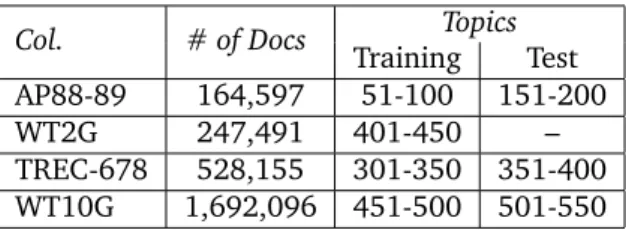
Table 3.1: Collections and topics for training and test used in the document retrieval evaluation
Col. # of Docs Topics
Training Test AP88-89 164,597 51-100 151-200
WT2G 247,491 401-450 –
TREC-678 528,155 301-350 351-400 WT10G 1,692,096 451-500 501-550
3.4. Experiments and Results 27
(TREC-678). Additionally, we decide to use the WT10G collection, which was not used in Lv and Zhai (2009a), to report test values in a web collection. In AP88-89, TREC-678 and WT10G we used training and test evaluation: we performed training for Mean Average Precision in a set of topics and testing over another set. For WT2G we report well-tuned values over the trained topics, as it was done in Lv and Zhai (2009a). Short queries (title only) were used because they are the most suitable to be expanded. All the collections were preprocessed with standard stop-word removal and Porter stemmer, as it has been demonstrated the best performing scenario for this task (Lv and Zhai, 2009a). In Table 3.1 the evaluation settings are summarized.
3.4.2
Compared Methods
We compared four methods:
• LM: the baseline Language Modelling retrieval model with Dirichlet smoothing as in Eq. 2.7
• RM3: the standard formulation of RM3, as explained in Section 2.4.
• KLD3: the KLD based PRF method adapted to the LM framework as detailed in Section 3.3.1.
• RM3DT: the proposed formulation of RM with estimations promoting divergent terms as described in Section 3.3.2.
3.4.3
Training and Evaluation
The two basic metrics in IR evaluation are precision and recall. The preci-sionProf a ranking produced by a retrieval method at some cut-off pointr
is the fraction of the toprdocuments that are relevant to the query. On the other side, the recall Rr of a method at a value r is the proportion of the
28 Chapter 3. Promoting Divergence in Relevance Models
As discussed before, we performed a training and test strategy, more pre-cisely we performed training for MAP and test for AP88-89, TREC-678 and WT10G meanwhile well-tuned values are reported for WT2G as in Lv and Zhai (2009a).
The parameters tuned were: the smoothing parameter of the initial re-trievalµ1 (µ1 ∈ {10,100, 1000,2000,3000,4000,5000,6000}), which trained value was also used for µ3 and µ4 and which was tuned for LM, KLD3, RM3 and RM3DT. The number of documents in the pseudo-relevant setr =
|RS| (r ∈ {5,10,25,50,75,100}) was tuned for KLD3, RM3 and RM3DT. The number of terms selected for expansion e (e ∈ {5,10,25,50,75,100}) was tuned for KLD3, RM3 and RM3DT. The interpolation weight λ (λ ∈ {0,0.1,0.2,0.3,0.4,0.5,0.6,0.7,0.8,0.9,1}) was tuned for KLD3, RM3, RM3DT. The smoothing parameterµ2(µ2∈ {10,100,1000,2000,3000,4000,5000,6000}) was tuned for RM3 and RM3DT.
Finally, test values are reported for MAP and Robustness Index (RI) over the initial retrieval (LM). One of the aims of this thesis is to devise more robust estimations of Relevance Models. In order to assess the robustness of the methods we decided to use this RI measure specially designed to evaluate the behaviour of PRF methods. The Robustness Index (−1 ≤ RI(Q) ≤ 1), also called Reliability of Improvement Index, of a model with respect to a baseline was formulated in Sakai et al. (2005) as in Eq. 3.8:
RI(Q) = n+−n−
|Q| (3.8)
where Q is the set of queries over the RI has to be calculated, n+ is the number of improved queries,n−the number of degraded queries and|Q|the
total number of queries inQ.
3.4. Experiments and Results 29
Table 3.2: Values for Mean Average Precision (MAP) on the test topics. Sta-tistical significant improvements (Wilcoxonp <0.1, and Wilcoxonp < 0.05
underlined) with respect to LM, RM3, KLD3, and RM3DT are superscripted withl,r,k, anddrespectively. Best values are bolded.
MAP
Col. LM RM3 KLD3 RM3DT
AP88-89 .2775 .3606l (+30%) .3667l (+32%) .3625l (+31%)
WT2G .3115 .3445lk(+10%) .3352l (+07%) .3467lk(+11%)
TREC-678 .1915 .2295l (+20%) .2293l (+20%) .2412lrk(+26%)
WT10G .2182 .2468l (+13%) .2238 (+02%) .2478lrk(+13%)
Table 3.3: Values for Robustness Index (RI) with respect to the LM baseline model for every collection. Best values are bolded.
RI
Analysing the MAP values for the test topics (see Table 3.2) it has to be noted that the three PRF methods always outperform the baseline LM as expected. The adaptation of the KLD method to the LM framework using query inter-polation performs quite well, obtaining improvements up to the 32% in the AP88-89; this is a very interesting point considering that KLD3 has fewer pa-rameters to tune. Nevertheless the other PRF methods achieve statistically significant improvements over the KLD3 in four occasions.
The RM3 method performs also quite well in terms of effectiveness with great improvements over the baseline as expected, as it is the state-of-the art in PRF. RM3 performs better than KLD3 in three collections, achieving in one case statistically significance. In the AP88-89 collection the differences across the three PRF methods are negligible, not being ever statistically significant.
30 Chapter 3. Promoting Divergence in Relevance Models
across collections, except in the WT10G collection. RM3 values are still ac-ceptable (always bigger than zero) but are considerable lower than the other methods in the AP88-89 and TREC-678 collections. Contrarily RM3 performs slightly better than the other methods in the WT2G collection. This fact may be explained because the values on the WT2G collection are well-tuned, sug-gesting that a good parameter setting affects more to the robustness of the RM3 method than to the other ones. Comparing both RM methods RM3DT seems to be more stable in terms of RI across collections.
The differences in robustness between RM3 and RM3DT can be analysed observing the queries penalized by RM3 and improved by RM3DT. Let us take as example the queryParkinson’s disease, for this query LM obtained an average precision of 0.3231, RM3 damaged the query to 0.2927, while RM3DT improved it to 0.5083. Observing the top 25 expansion terms selected in both approaches we can view that many good terms are selected by both methods (for examplepatient, brainoralzheimer) but the RM3 method introduces terms that are so common that, although being very present in the RS, they introduce a lot of noise in the retrieval such aspage, can, year,
will, new, say, may or home, meanwhile those terms are not present in
the top 25 RM3DT expansion terms because they were penalized for being so common in the collection.
3.5
Related Work
in-3.6. Conclusions 31
troduction of three additional parameters in the model, for adjusting these new aspects in the estimation, evaluation showed some improvements over RM3. Particularly the method seems to be more robust to the variation in the number of feedback documents.
This thesis is framed under the Language Modelling framework but it is necessary to say that the idea of using divergence to improve the retrieval performance has been already deeply studied under other retrieval models, to the point of existing whole models based on it. The Divergence From the Randomness (DFR) model (Amati and Van Rijsbergen, 2002) is based on a similar idea: the more the terms occurrences in the documents diverge from their expected occurrences considering a random distribution the more information carried by the terms. In the DFR model the QE process is done based on a generalization of the Rocchio’s framework (He and Ounis, 2007). Different weighting schemes, including the aforementioned KLD, were tested being the Bose-Einstein Bo1 model the best in terms of effectiveness, which also select those terms that diverge most from the randomness, using for those estimations the collections’ statistics. In another paper (Ye et al., 2010) the Rocchio’s classical feedback method was integrated in the DFR framework for PRF.
In other IR tasks such as adaptive filtering this divergence idea has also been used. Lv and Zhai (2009b) presented different discriminative features for queries and documents to be used in a technique which learns for each query the interpolation weight of the original query with the expansion terms. Particularly the entropy of the feedback documents and the document clarity are used. With the entropy of the feedback documents basically they capture at term level how heterogeneous is the term distribution in the RS. With the clarity of the feedback documents they try to “explain away” common terms present in the RS.
3.6
Conclusions
32 Chapter 3. Promoting Divergence in Relevance Models
the terms’ probability in the document its probability in the collection and applying the smoothing over the RS.
Chapter 4
Cluster Based Retrieval and
Relevance Models
In the last years, cluster based retrieval has been demonstrated as an effective tool for both interactive retrieval and pseudo-relevance feedback techniques. In this chapter we propose a new cluster based retrieval function which uses the best and worst clusters of a document in the cluster ranking, to improve the pseudo-relevant set. In this way we approach one vital point for RM and in general for every PRF method which is the RS construction. The evaluation shows improvements in some standard TREC collections over classical non cluster-aided RM and other cluster-based baseline in both effectiveness and robustness.
4.1
Introduction and Motivation
34 Chapter 4. Cluster Based Retrieval and Relevance Models
novelty detection (Fernandez et al., 2010), etc. Indeed, several experiments (Hearst and Pedersen, 1996; Tombros et al., 2002) have demonstrated that clustering algorithms working at pseudo feedback time can obtain clusters with a high percentage of relevant documents, still the automatic identifica-tion of these clusters between the whole set of them is still a challenge.
Although initial experiments using query specific clustering (Liu and Croft, 2004) in order to improve the retrieval effectiveness were not conclusive, after improving the cluster representation (Liu and Croft, 2008) and with the use of clustering algorithms that support overlapping (Kurland and Lee, 2004), finally the quality of the initial ranking was significantly improved with cluster based re-ranking (Liu and Croft, 2008; Kurland, 2009).
It was only recently when a cluster based retrieval approach was used to improve the quality of the pseudo-relevant set, for further use in query ex-pansion methods (Lee et al., 2008). This approach takes advantage of the better initial ranking produced by the cluster based retrieval to select a bet-ter pseudo-relevant set, improving in this way the effectiveness, sometimes significantly. But, although this kind of methods tend to improve the effec-tiveness in average, one known problem of them is the lack of robustness, i.e., still a significant amount of queries are negatively affected by them. One of the main factors of this behaviour is the presence of non-relevant documents in the feedback set.
In this chapter we aim to accomplish one of the thesis objectives which is to produce more robust RM methods. With this objective, we present a new cluster based retrieval method that exploits bad clusters in order to reduce the amount of non-relevant documents in the feedback set. We consider not just if a document is present inside a “good” cluster to update its score, but also the presence of the document in “bad” (low relevance score) clusters. As far as we know the information referring bad clusters has not been exploited yet in the context of pseudo-relevance feedback.
We tested our approach in several TREC Collections and compared with the Language Modelling retrieval approach (Zhai and Lafferty, 2004), tradi-tional RM3 formulation (Abdul-jaleel et al., 2004) and with the Resampling method presented by Lee et al. (2008). The evaluation shows that the results in terms of MAP are better than the Resampling approach; furthermore, our method consistently improves the robustness values in all the collections.
4.2. Cluster Based Relevance Modelling 35
evaluation methodology and comments the results. In Section 4.4 we describe the related work and finally conclusions are reported in Section 4.5.
4.2
Cluster Based Relevance Modelling
In order to get a better pseudo-relevant set we formulated a new cluster based re-ranking function. Every re-ranking approach has a set of common-steps: obtaining of the initial retrieval, selection of the set of documents to re-rank, the re-ranking process itself and, optionally, further processing based on the re-ranked results.
For the initial retrieval and aligned with the topic of this thesis we chose the high performance LM framework. More precisely, we performed the ini-tial retrieval assuming a multinomial model with Dirichlet smoothing (see Eq. 2.7). The second step is to fix the top of documents subject to be re-ranked (dinit). We will refer to the size of this top hereinafter as the parameterN.
The next phase in a cluster based technique is to perform the document clus-tering. For our proposal, we chose a clustering algorithm with overlapping. Once the top documents are clustered, we calculate the cluster query likeli-hood for every resulting cluster. Finally, the clusters query likelilikeli-hoods and the documents query likelihoods are combined by our proposed retrieval formula and the documents are reranked according to the new scores. And lastly, the top documents of the new ranking are used as PRS to feed a query expansion process based on RM.
For the discussion of how to perform the initial retrieval we refer to the reader to Chapter 2. Next, we will address those issues of our proposal not commented before, namely: the clustering algorithm, the estimation of the cluster query-likelihood, the re-ranking process and the application of RM.
4.2.1
Clustering Algorithm
Once that the initial ranking is obtained, clustering is performed over the top
36 Chapter 4. Cluster Based Retrieval and Relevance Models
to use the information provided by bad clusters to avoid non-relevant doc-uments in the pseudo-relevant set. In order to do this we used a clustering algorithm that supports overlapping, i.e. one document can belong to one or more clusters.
The straightforward selection based in previous works could be using ak -nearest neighbours (k-NN) algorithm, but thek-NN forces each document to have exactlykneighbours. This aspect is not desired in our approach because we will exploit that a document belongs to a low scored cluster. If we had usedk-NN, a non-relevant document with low query likelihood and no close neighbours could attract other documents that, although they are not close to that document, they are the closest ones.
So we decided to cluster the documents in base to a given threshold t, grouping for each document those neighbours that are more similar thant. Let’s call this way of groupingthr-NN. Given a documentdi, its
neighbour-hood is the set of documentsdj such thatsim(di, dj)≥t. The purpose of this
algorithm is that non-relevant documents could be isolated in singletons (Lu et al., 1996).
Term Frequency-Inverse Document Frequency (tf·idf) was used as doc-ument representation in the clustering algorithm. tf·idf measures the im-portance of a term to describe a document not only based on the number of times that it appears in the document, but also to the number of documents in which it appears. A term which appears very rarely in the collection should be given more weight for describing a document, as it is very specific. So the weight of the termwi in the documentdj was computed as in Eq. 4.1:
weight(wi, dj) =tf(wi, dj)·log
For the similarity measure between documents (sim(di, dk)) we choose
traditional cosine distance as in Eq. 4.2
sim(di, dj) =