This is an
Accepted Manuscript
, which has been through the
Royal Society of Chemistry peer review process and has been
accepted for publication.
Accepted Manuscripts
are published online shortly after
acceptance, before technical editing, formatting and proof reading.
Using this free service, authors can make their results available
to the community, in citable form, before we publish the edited
article. We will replace this
Accepted Manuscript
with the edited
and formatted
Advance Article
as soon as it is available.
You can find more information about
Accepted Manuscripts
in the
Information for Authors.
Please note that technical editing may introduce minor changes
to the text and/or graphics, which may alter content. The journal’s
standard Terms & Conditions and the Ethical guidelines still
apply. In no event shall the Royal Society of Chemistry be held
responsible for any errors or omissions in this
Accepted Manuscript
or any consequences arising from the use of any information it
contains.
Accepted Manuscript
Organic &
Biomolecular
Chemistry
Cite this: DOI: 10.1039/c0xx00000x
www.rsc.org/xxxxxx
ARTICLE TYPE
Transmembrane anion transport and cytotoxicity of synthetic
tambjamine analogs†
Elsa Hernando,
aVanessa Soto-Cerrato,
bSusana Cortés-Arroyo,
bRicardo Pérez-Tomás
band Roberto
Quesada*
aReceived (in XXX, XXX) Xth XXXXXXXXX 20XX, Accepted Xth XXXXXXXXX 20XX
5
DOI: 10.1039/b000000x
Ten synthetic analogs of the marine alkaloids tambjamines, bearing aromatic enamine moieties, have been synthesized. These compounds proved to be highly efficient transmembrane anion transporters in model liposomes. Changes in the electronic nature of the substituents of the aromatic enamine or the alkoxy group of the central pyrrole group did not affect this anionophore activity. The in vitro activity of
10
these compounds has also been studied. They triggered apoptosis in several cancer cell lines with IC50
values in the low micromolar range as well as modify the intracellular pH inducing the basification of acidic organelles.
Introduction
The development of small molecules capable of facilitating the
15
transmembrane transport of ions is an active field of research.1 These compounds can mimic the activity of natural ionophores, which are widely used as antibiotics and tools for biomembrane research.2 Their potential as future anticancer drugs and chemotherapeutics in conditions related to the dysfunction of
20
natural transport mechanisms is starting to be recognized.3 The majority of these compounds facilitate the transmembrane transport of cations and anion selective ionophores are relatively scarce, the prodiginines being the most representative examples.4 These compounds display intriguing pharmacological activities,
25
and there is a growing evidence linking the ionophoric activity of these molecules and their cytotoxicity.5 These molecules can permeabilize cellular membranes, upsetting the normal ionic balance and modifying the intracellular pH, triggering apoptosis. We decided to study the marine alkaloids tambjamines. These
30
naturally occurring compounds are structurally related to the prodiginines, being characterized by an imine substituted 4-methoxy-1H,1'H-2,2'-bipyrrole moiety.6 Likewise, these compounds have been shown to display antimicrobial and antitumor activities.7 The mechanism of action of these
35
compounds is unclear but may involve their ionophoric activity.5 We recently reported the anion transport activities of some tambjamine derivatives.8 They proved to be very efficient anion exchangers in model liposomes, promoting both chloride and bicarbonate transport. All naturally occurring tambjamines
40
present alkyl substituted imine groups. Nevertheless, during our previous studies, we identified the synthetic tambjamine analog 2, bearing an aromatic substituent, outperforming the naturally occurring derivatives studied.8 Prompted by this result, we decided to explore the anion transport and antiproliferative
45
activities of synthetic tambjamine analogs bearing aromatic
substituents in the enamine moiety as well as the effect of varying the substitution of the alkoxy substituent of the bipyrrole.
Results and discussion
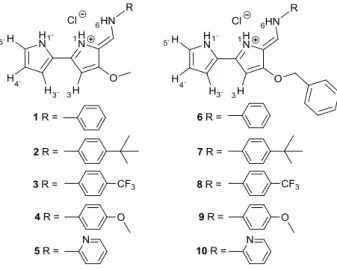
Compounds 1-10 were synthesised by acid catalyzed
50
condensation of the 4-alkoxy-2,2´-bipyrrole aldehyde and the corresponding amine (Fig. 1).9 The products were obtained in good yields as orange-yellow solids in the form of hydrochloric salts. In their protonated form, these compounds are stable for several weeks in organic solutions. We decided to explore
55
aromatic enamine groups bearing both electron donating and electron withdrawing substituents as well as a heteroaromatic (pyridine) group. We also decided to modify the substitution of the pyrrole ring replacing the methoxy group characteristic of the naturally occurring derivatives by a benzyloxy group.
60
Compounds 1 and 2 were previously reported by us.8
Fig. 1 Synthetic tambjamine analogs 1-10.
The 1H NMR spectra of these compounds provide evidence of
O
rg
a
n
ic
&
B
io
m
o
le
c
u
la
r
C
h
e
m
is
tr
y
A
c
c
e
p
te
d
M
a
n
u
s
c
ri
p
2 | Journal Name, [year], [vol], 00–00 This journal is © The Royal Society of Chemistry [year]
a strong interaction of the chloride anion with the tambjamine derivative through the hydrogen cleft formed by the bypyrrole-enamine moiety. Chloride binding in solution was studied by 1H NMR titration experiments of perchlorate salts of compounds 1
-10 with tetrabutylammonium chloride (TBACl) in
DMSO-5
d6/0.5% water. Perchlorate salts of 1-10 were prepared by
washing crude reaction mixtures with diluted aqueous perchloric acid. Addition of TBACl resulted in the effective replacement of the perchlorate anion by chloride, as evidenced by the 1H NMR spectra indistinguible from that of the corresponding hydrochloric
10
salt. Fitting of the data obtained in the 1H NMR titration experiments using WinEQNMR2 software provided a quantitative assessment of the chloride binding affinity for 1-10
under these conditions (Table 1).10 The values of the association constants were found to be similar for all the compounds. Thus
15
the electronic character of the aromatic substituent as well as the nature of the alkoxy substitution of the central pyrrole ring had little influence in the calculated Ka value. Although the electronic
nature of the aromatic substituent should influence the binding capability of the molecule, it should be noted that the binding
20
process involved both the dissociation of the perchlorate anion and the coordination of chloride. Thus, since perchlorate is also bound by these compounds this effect was not reflected in the values of the calculated association constants.
Table 1: Association constants (Ka, M-1) of compounds 1-10 with chloride 25
(added as tetrabutylammonium salt) determined from 1H NMR titration
experiments in DMSO-d6/0.5 H2O at 293 K.
Interestingly, the chemical shift of the NH1' proton (see ESI for
two-dimensional NMR data) remained almost unaltered during the titration experiments with tetrabutylammonium chloride
30
whereas that of the C-H group in the 3' position experienced an important downfield shift (Fig. 2). This result is in agreement with the involvement of the C-H3' proton in the binding of
chloride. Gale and colleagues have described a similar anion binding behaviour for a pyrrole group.11
35
Fig. 2 Stack plot of partial 1H NMR of compound 4 in DMSO-d
6/0.5 H2O
solution with the addition of increasing amounts of tetrabutylammonium chloride.
Anion transport assays
40
The transmembrane anion transport activity of compounds 1-10
was explored in 1-palmitoyl-2-oleoyl-sn-glycero-3-phosphocholine (POPC) liposomes. Using a chloride selective electrode, the chloride efflux from chloride loaded vesicles was monitored over time, according to reported methods.12 The EC50,
45
defined as the concentration of carrier needed to induce a 50% chloride release in the time scale of our experiments (300 seconds), was calculated using hill plot analyses (Table 2). All the compounds proved to be very efficient anion transporters with EC50 values in the submicromolar range and down to nanomolar
50
levels for the most efficient derivatives in the chloride/nitrate exchange assay.
Table 2: Transport activities expressed as EC50 (nM) of compounds 1-10
Compound EC50 (nM)
avesicles loaded with 488 mM NaCl dispersed in 488 mM NaNO 3 (5 mM
phosphate buffer, pH 7.2). bvesicles loaded with 451 mM NaCl dispersed 55
in 150 mM Na2SO4 (20 mM phosphate buffer, pH 7.2) upon addition of a
NaHCO3 pulse to make the extravesicular bicarbonate concentration 40
mM.
The transport activity was found to be dependent of the nature of the extravesicular anion. Thus, the EC50 values were found to
60
be roughly an order of magnitude lower when nitrate was used as external anion instead of bicarbonate. This result reflected the higher lipophilicity of nitrate compared to bicarbonate. The lack of significant chloride efflux when sulfate was the only extravesicular anion further supported anion exchange as the
65
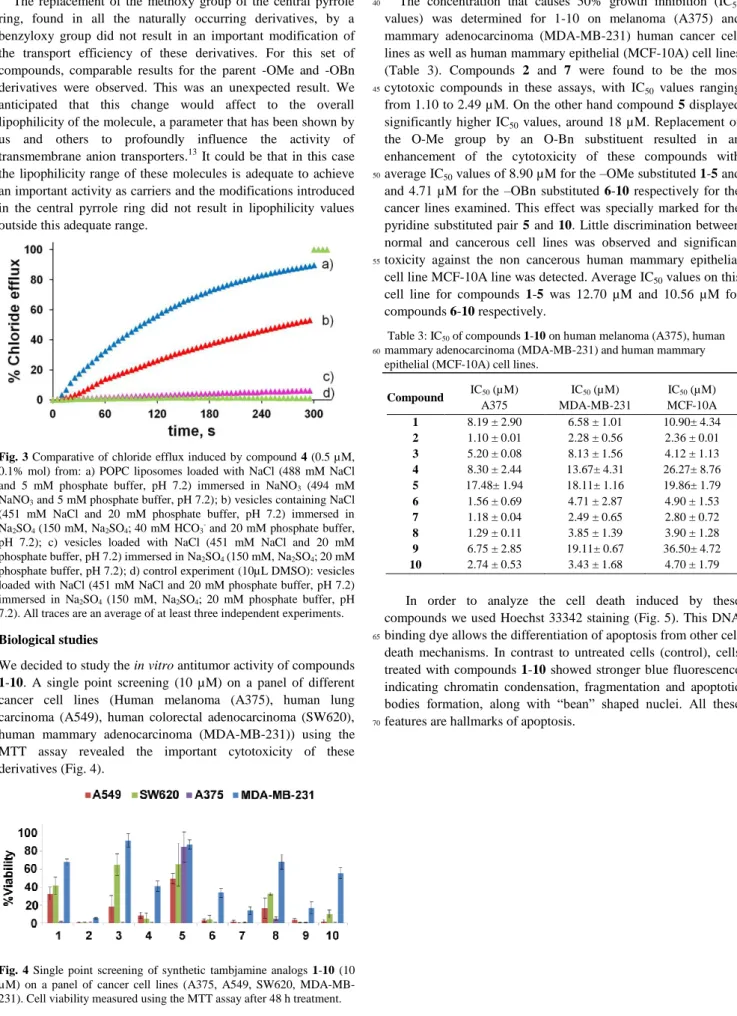
transport mechanism accounting for the activity of these compounds (Fig. 3). A Hill parameter value around 1 was consistent with a non cooperative effect and a carrier mechanism for the transmembrane transport activity of these compounds (Table 2).
70
Similarly to the results observed in the quantification of the chloride binding affinity, the nature of the aromatic substituent showed little effect in the ionophoric efficiency of these compounds. Compounds bearing both electron withdrawing and electron donor substituents promoted anion transport with
75
excellent activity. The trifluoromethyl substituted compounds 3
and 8 were found to be the less active derivatives, with 8
displaying the highest EC50 values. When performing transport
experiments using this compound precipitation of the added carrier was evident. It could be possible that the comparatively
80
lower efficiency of 8 was due to the failure to partition into the liposome membranes. Compound 5 was found to be the most efficient chloride/nitrate exchanger with a calculated EC50 of 20
nM. This derivative outperforms our previously reported carrier 2
The replacement of the methoxy group of the central pyrrole lipophilicity of the molecule, a parameter that has been shown by us and others to profoundly influence the activity of transmembrane anion transporters.13 It could be that in this case
10
the lipophilicity range of these molecules is adequate to achieve an important activity as carriers and the modifications introduced in the central pyrrole ring did not result in lipophilicity values
NaNO3 and 5 mM phosphate buffer, pH 7.2); b) vesicles containing NaCl
(451 mM NaCl and 20 mM phosphate buffer, pH 7.2) immersed in
20
Na2SO4(150 mM, Na2SO4;40 mM HCO3-and 20 mM phosphate buffer,
pH 7.2); c) vesicles loaded with NaCl (451 mM NaCl and 20 mM phosphate buffer, pH 7.2) immersed in Na2SO4(150 mM, Na2SO4;20 mM
phosphate buffer, pH 7.2); d) control experiment (10µL DMSO): vesicles loaded with NaCl (451 mM NaCl and 20 mM phosphate buffer, pH 7.2)
25
immersed in Na2SO4(150 mM, Na2SO4;20 mM phosphate buffer, pH
7.2). All traces are an average of at least three independent experiments.
Biological studies
We decided to study the in vitro antitumor activity of compounds
1-10. A single point screening (10 µM) on a panel of different
30
cancer cell lines (Human melanoma (A375), human lung carcinoma (A549), human colorectal adenocarcinoma (SW620), human mammary adenocarcinoma (MDA-MB-231)) using the MTT assay revealed the important cytotoxicity of these derivatives (Fig. 4).
35
Fig. 4 Single point screening of synthetic tambjamine analogs 1-10 (10 µM) on a panel of cancer cell lines (A375, A549, SW620, MDA-MB-231). Cell viability measured using the MTT assay after 48 h treatment.
The concentration that causes 50% growth inhibition (IC50
40
values) was determined for 1-10 on melanoma (A375) and mammary adenocarcinoma (MDA-MB-231) human cancer cell lines as well as human mammary epithelial (MCF-10A) cell lines (Table 3). Compounds 2 and 7 were found to be the most cytotoxic compounds in these assays, with IC50 values ranging
45
from 1.10 to 2.49 µM. On the other hand compound 5 displayed significantly higher IC50 values, around 18 µM. Replacement of
the O-Me group by an O-Bn substituent resulted in an enhancement of the cytotoxicity of these compounds with average IC50 values of 8.90 µM for the –OMe substituted 1-5 and
50
and 4.71 µM for the –OBn substituted 6-10 respectively for the cancer lines examined. This effect was specially marked for the pyridine substituted pair 5 and 10. Little discrimination between normal and cancerous cell lines was observed and significant toxicity against the non cancerous human mammary epithelial
55
cell line MCF-10A line was detected. Average IC50 values on this
cell line for compounds 1-5 was 12.70 µM and 10.56 µM for compounds 6-10 respectively.
Table 3: IC50 of compounds 1-10 on human melanoma (A375), human
mammary adenocarcinoma (MDA-MB-231) and human mammary
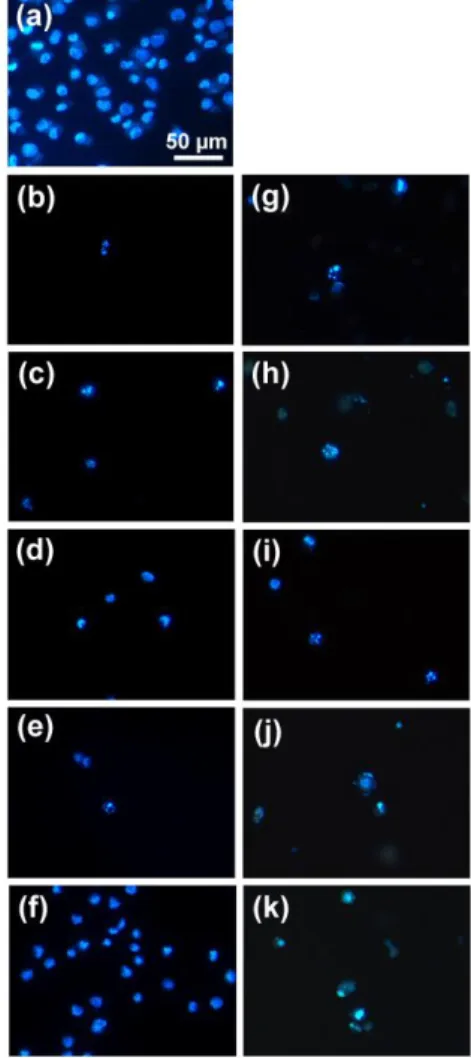
60 compounds we used Hoechst 33342 staining (Fig. 5). This DNA binding dye allows the differentiation of apoptosis from other cell
65
4 | Journal Name, [year], [vol], 00–00 This journal is © The Royal Society of Chemistry [year]
Fig. 5 Hoechst 33342 staining on melanoma (A375) human cancer cell line. a) Untreated (control) cells; b)-k) cells treated with compounds 1-10. Treated cells showed typical features of apoptotic processes.
Finally, vital staining with acridine orange (AO) was used to
5
evaluate the effects of these compounds on the intracellular pH levels. Protonation and accumulation of this dye in acidic compartments such as lysosomes results in a characteristic orange fluorescence emission, whereas it emits green fluorescence at higher pH.14 Human melanoma (A375) cells were stained with
10
AO and granular orange fluorescence was observed in the cytoplasm, corresponding to acidic organelles (Fig. 6). Treatment of these cells with compounds 1-10 resulted in the disappearance of the orange fluorescence, suggesting the basification of acidic organelles. The observed qualitative results correlate well with
15
the antiproliferative activity of these derivatives. The effect was more evident for the most cytotoxic compounds whereas the action of the less toxic derivatives such as 5 led only to minimal changes and appearance similar to untreated cells.
20
Fig. 6 Acridine orange staining on melanoma (A375) human cancer cell line. a) Untreated (control) cells; b)-k) cells treated with compounds 1-10. Treated cells showed significant disappearance of orange fluorescence due to basification of acidic organelles.
25
Conclusions
Synthetic analogs of tambjamine alkaloids bearing aromatic enamine substituents represent privileged structures for the development of highly efficient transmembrane anion transporters. These compounds efficiently promoted nitrate and
30
bicarbonate/chloride exchange in model liposomes at very low concentrations. At this stage it is unclear which parameters make these compounds so effective as anionophores and studies aimed to shed light on this matter are currently underway in our laboratories. In vitro studies showed that they were able to alter
35
the intracellular pH levels, triggering apoptosis in different cancer cell lines with IC50 values in the low micromolar range. The
toxicity of these compounds is an important issue to be addressed in order to continue their development as potential anticancer drugs. The tolerance of this motif regarding changes in both the
40
electronic nature of the aromatic enamine substituent as well as the alkoxy group of central pyrrole ring suggest that it could be possible to introduce modifications aimed to increase the selectivity toward cancer cells without losing their anionophoric properties.
45
Page 4 of 7
Organic & Biomolecular Chemistry
O
rg
a
n
ic
&
B
io
m
o
le
c
u
la
r
C
h
e
m
is
tr
y
A
c
c
e
p
te
d
M
a
n
u
s
c
ri
p
Experimental section
General Procedures and Methods
Commercial reagents were used as received without any further purification. NMR spectra were recorded in Varian Mercury-300 MHz and Varian Unity Inova-400 MHz spectrometers. Chemical
5
shifts are reported in ppm with using residual solvent peak as reference, coupling constants are reported in Hz. High resolution mass spectra (HRMS) were recorded on a MicromassAutospec S-2 spectrometer using EI at 70eV. 4-Methoxy-S-2,S-2'-bipyrrole-5- 4-Methoxy-2,2'-bipyrrole-5-carboxaldehyde and
4-Benzyloxy-2,2'-bipyrrole-5-10
carboxaldehyde were prepared as described.151H NMR titrations experiments were performed in DMSO-d6/H2O 99.5:0.5 mixtures
at 303 K. Data fitting was carried out using WinEQNMR2 software (see the Supporting Information for details).9
15
Synthesis of tambjamine analogs
Compounds 1-10 were synthesised using modifications of the previously reported method.9 To a mixture of the 2,2'-bipyrrole-5-carboxaldehyde (190 mg, 1 mmol,) and the corresponding amine (1.3-3 mmol, 1.3-3 equivalents) in 10 mL of chloroform, 40 µL
20
of acetic acid were added. The mixture was stirred at 60 ºC until TLC showed disappearance of the starting material. The reaction was then diluted with 40 mL of dichloromethane and washed with HCl 1M (3 x 25 mL). The organic fraction was dried over Na2SO4 and the solvent evaporated to yield 1-10 as
yellow-25
orange solids in good to excellent yields.
(Z)-1-(4-methoxy-1H,1'H-[2,2'-bipyrrol]-5-yl)-N-(CH), 122.53 (C), 116.88 (Z)-1-(4-methoxy-1H,1'H-[2,2'-bipyrrol]-5-yl)-N-(CH), 114.67 (Z)-1-(4-methoxy-1H,1'H-[2,2'-bipyrrol]-5-yl)-N-(CH), 113.17 (C), 111.27 (CH), 92.06 (CH), 58.79 (CH3), 34.58 (C), 31.31 (CH3); HRMS
(EI) m/z calcd for [C20H23N3O] 321.1841; found: 321.1844.
(Z)-1-(4-methoxy-1H,1'H-[2,2'-bipyrrol]-5-yl)-N-(4-(trifluoromethyl)phenyl)methanimine (3). Yield 80 %. 1H
50
131.86 (C), 130.43 (CH), 124.88 (CH), 122.65 (C), 118.59 (CH), 115.05 (CH), 114.35 (CH), 112.89 (C), 111.24 (CH), 91.91 (CH), 58.76 (CH3), 55.65 (CH3). HRMS (EI) m/z calcd for
(C), 148.49 (CH), 145.97 (C), 138.92 (CH), 128.83 (CH), 126.23 (CH), 122.40 (C), 120.69 (CH), 116.04 (CH), 114.73 (C), 113.85 (CH), 111.79 (CH), 92.47 (CH), 58.98 (CH3). HRMS (EI) m/z
80
calcd for [C15H14N4O] 266.1168; found: 266.1168.
(Z)-1-(4-(benzyloxy)-1H,1'H-[2,2'-bipyrrol]-5-yl)-N-(CH), 122.55 (C), 117.27 (Z)-1-(4-(benzyloxy)-1H,1'H-[2,2'-bipyrrol]-5-yl)-N-(CH), 115.11 (Z)-1-(4-(benzyloxy)-1H,1'H-[2,2'-bipyrrol]-5-yl)-N-(CH), 113.81 (C), 111.45 (CH), 93.13 (CH), 73.88 (CH2). HRMS (EI) m/z calcd for (trifluoromethyl)phenyl)methanimine (8). Yield 44 %. 1H
6 | Journal Name, [year], [vol], 00–00 This journal is © The Royal Society of Chemistry [year] (CH), 122.16 (C), 119.12 (CH), 114.93 (CH), 112.49 (C), 112.24 (CH), 110.89 (CH), 93.25 (CH), 72.82 (CH2), 55.47 (CH3).
(CH), 145.75 (C), 139.48 (CH), 135.13 (C), 128.71 (CH), 128.49 (CH), 127.75 (CH), 126.28 (CH), 121.86 (C), 120.98 (CH), 114.11 (CH), 113.98 (C), 112.92 (CH), 111.64 (CH), 93.89 (CH),
25
73.38 (CH2). HRMS (EI) m/z calcd for [C21H18N4O] 342.1481;
found: 342.1490.
Preparation of Phospholipid Vesicles
A chloroform solution of 1-palmitoyl-2-oleoyl-sn -glycero-3-phosphocholine (POPC) (20 mg/mL) (Sigma-Aldrich) was
30 subjected to nine freeze-thaw cycles and twenty-nine extrusions through a 200 nm polycarbonate Nucleopore membrane using a LiposoFast Basic extruder (Avestin, Inc.). The resulting unilamellar vesicles were dialyzed against NaNO3 solution (488
40
mM NaNO3 and 5 mM phosphate buffer, pH 7.2) or a Na2SO4
solution (150 mM Na2SO4 and 20 mM phosphate buffer, pH 7.2)
to remove unencapsulated chloride.
ISE Transport Assays
Unilamellar vesicles (200 nm mean diameter) composed of POPC
45
containing an encapsulated solution of 488 mM NaCl and 5 mM phosphate buffer, pH 7.2 or 451 mM NaCl and 20 mM phosphate buffer, pH 7.2, were suspended in a solution 494 mM NaNO3 and
5 mM phosphate buffer, pH 7.2 or 150 mM Na2SO4 and 20 mM
phosphate buffer, pH 7.2 respectively, for a final lipid
50
concentration of 0.5 mM and a total volume of 5 mL. A DMSO solution of the carrier molecule, typically 5 μL to avoid influence of the solvent molecules in the assay, was added and the chloride release from vesicles was monitored using a sympHony combination chloride electrode. At the end of the experiment the
55
vesicles were lysed with detergent (triton-X 10% dispersion in water, 20 μL) to release all chloride ions; the resulting value was
considered to represent 100% release and used as such. For the bicarbonate anion exchange assays to the vesicles suspended in a Na2SO4 solution of NaHCO3 (150 mM in Na2SO4 buffered to pH human colorectal adenocarcinoma (SW620), human mammary adenocarcinoma (MDA-MB-231) and human mammary epithelial (MCF-10A) cell lines were purchased from the American Type Culture Collection (ATCC, Manassas, VA). Cells
75
were cultured in DMEM medium (Biological Industries) supplemented with 10% heat-inactivated foetal bovine serum (FBS; Life Technologies, Carlsbad, CA), 100 U/ml penicillin, 100 µg/ml streptomycin, and 2 mM L- glutamine, all from Biological Industries. MDA-MB-231 cell line was cultured in
80
DMEM:F12 media (1:1, Biological Industries) supplemented with 10% heat-inactivated FBS), 100 U/ml penicillin, 100 µg/ml streptomycin, and 2 mM L- glutamine. MCF10A cell line was cultured in DMEM:F12 media (1:1) supplemented with 5% horse serum (Life Technologies), 20 ng/ml EGF, 0.5 µg/ml
85
Hydrocortisone, 100 ng/ml Cholera toxin, 10 µg/ml insulin all from Sigma-Aldrich Chemical Co. (St. Louis, MO) and 100 U/ml penicillin, 100 µg/ml streptomycin, and 2 mM L- glutamine. Cells were grown at 37ºC in a 5% CO2 atmosphere.
Cell Viability Assay
90
Cells (1 x 10⁵ cells/ ml) were seeded in 96-well plates and allowed to grow for 24 h. Afterwards, they were treated with 10 µM of each compound for single point experiments and dose response curves were performed ranging from 0.39 to 50 µM for 48 h to calculate the inhibitory concentration of 50% of cell
95
population (IC50) values of the most potent compounds. Cell
viability was determined by MTT assay. After treatment, 10 µM of 3-(4, 5-dimethylthiazol-2-yl)-2,5-diphenyltetrazolium bromide (Sigma-Aldrich) was added to each well for an additional 4 h. DMSO was added in control cells. Media was aspirated and the
100
blue MTT formazan precipitate was dissolved in 100 µl of DMSO. The absorbance at 570 nm was measured on a multiwell plate reader. Cell viability was expressed as a percentage of control cells, and data are shown as the mean value ± S.D. of three independent experiments performed in triplicate for single
105
point evaluation or in duplicate for dose-response curves. IC50
values were calculated with GraphPad Prism 5 software.
Acridine Orange Staining
A375 cells (105 cells/ ml) were seeded on glass slices and 48 h later they were treated with IC50 value during 1:30 h. DMSO was
110
PBS-10% FBS three times and examined by fluorescence in a NIKON eclipse E800 microscope (SCT filter 330/380nm).
Hoechst Staining
A375 cells (105 cells/ ml) were seeded in 12-well plates, allowed
to grow for 24 h and then treated with 10 μM of each compound
5
for 48 h. DMSO was added in control cells. They were washed in PBS, resuspended in 2 µg/ml Hoechst 33342 (Sigma-Aldrich Chemical Co.) and incubated for 30 min at 37ºC in the dark. Finally, cells were washed in PBS and examined by fluorescence in a NIKON eclipse E800 microscope (SCT filter 330/380nm).
10
Acknowledgements
The authors gratefully acknowledge Andrea Sancho for contributions to the synthesis. This research was supported by Consejería de Educación de la Junta de Castilla y León (Project BU340U13) and Fundació la Maratón de TV3.
15
Notes and references
1 (a) N. Busschaert and P. A. Gale, Angew. Chem. Int. Ed., 2013, 52, 1374–1382; (b) N. Sakai and S. Matile, Langmui., 2013, 29, 9031−9040; (c) S. Matile, A. Vargas Jentzsch, J. Montenegro and A. Fin, Chem. Soc. Rev., 2011, 40, 2453–2474; (d) J. T. Davis, O.
20
Okunola and R. Quesada, Chem. Soc. Rev., 2010, 39, 3843–3862; (e) C. J. E. Haynes and P. A. Gale, Chem. Commun., 2011, 47, 8203– Chem. Commun., 2010, 46, 3950–3952.
2 (a) M. M. Faul and B. E. Huff, Chem. Rev., 2000, 100, 2407–2473; Schmitzer, MedChemComm., 2012, 3, 1231–1234; (d) S. Rastogi, E.
35
Marchal, I. Uddin, B. Groves, J. Colpitts, S.A. McFarland, J. T. Davis and A. Thompson, Org. Biomol. Chem., 2013, 11, 3834–3845; (e) S. J. Moore, M. Wenzel, M. E. Light, R. Morley, S. J. Bradberry, P. Gomez-Iglesias, V. Soto- Cerrato, R. Perez-Tomas and P. A. Gale, Chem. Sci., 2012, 3, 2501–2508. Salmond, Future Microbiol., 2007, 2, 605–618; (d) M. S. Melvin, M.
45
W. Calcutt, R. E. Noftle and R. A. Mandeville, Chem. Res. Toxicol., 2002, 15, 742–748; (e) R. Pérez-Tomás, B. Montaner, E. Llagostera and V. Soto-Cerrato, Biochem. Pharmacol., 2003, 66, 1447–1452. 5 (a) P. A. Gale, R. Peréz-Tomás and R. Quesada, Acc. Chem. Res.,
2013, 46, 2801–2813; (b) B. Díaz de Greñu, P. Iglesias Hernández,
50
M. Espona,D. Quiñonero, M. E. Light, T. Torroba, R. Pérez Tomás, and R. Quesada, Chem. Eur. J., 2011, 17, 14074–14083. M. Gavagnin, Bioorg. Med. Chem. Lett., 2010, 20, 2668–2670; (b) L. N. Aldrich, S. L. Stoops, B. C. Crews, L. J. Marnett and C. W.
60
Lindsley, Bioorg. Med. Chem. Lett., 2010, 20, 5207–5211; (c) D. M. Pinkerton, M. G. Banwell, M. J. Garson, N. Kumar, M. O. de
Moraes, B. C. Cavalcanti, F. W. A. Barros and C. Pessoa, Chemistry & Biodiversity, 2010, 7, 1311–1324; (d) F. Ballestriero, T. Thomas, Angew. Chem., 2003, 115, 5081–5083; Angew. Chem. Int. Ed., 2003,
42, 4931–4933.
13 (a) V. Saggiomo, S. Otto, I. Marques,V. Félix, T. Torroba and R. Quesada, Chem. Commun., 2012, 48, 5274–5276; (b) N. Busschaert,
80
S. J. Bradberry, M. Wenzel, C. J. E. Haynes, J. R. Hiscock, I. L. Kirby, L. E. Karagiannidis, S. J. Moore, N. J. Wells, J. Herniman, G. J. Langley, P. N. Horton, M. E. Light, I. Marques, P. J. Costa, V. Félix, J. G. Frey and P. A. Gale, Chem. Sci., 2013, 4, 3036–3045. 14 A. C. Allison and M. R. Young, Lysosomes in Biology and
85
Pathology, Vol. 2., 1969, North-Holland Publishing Co., Amsterdam. 15 K. Dairi, S. Tripathy, G. Attardo and J.-F. Lavallee, Tetrahedron Lett.
2006, 47, 2605–2606.
a Departamento de Química, Facultad de Ciencias, Universidad de
90
Burgos,09001 Burgos, Spain. E-mail: [email protected]
b Department of Pathology and Experimental Therapeutics, Cancer Cell
Biology Research Group, Universidad de Barcelona, Barcelona, Spain. E-mail: [email protected]
95