UNIVERSIDAD DE CUENCA
FACULTAD DE FILOSOFÌA, LETRAS Y CIENCIAS DE LA EDUCACIÒN
CARRERA DE LENGUA Y LITERATURA INGLESA
Exploring Pragmatics and the Speech Acts of Requesting and Offering in Senior High School Students and Native Speakers of English
Trabajo de Titulación previo a la obtención del Título de Licenciado en Ciencias de la Educación en Lengua y Literatura Inglesa
Autores: Priscila Tatiana Colcha Caldas C.I. 0105755375
Hugo Eduardo Sibri Vélez C.I. 0103703518
Tutor: Mst. Gerardo Esteban Heras Urgilés C.I. 0301453239
Cuenca-Ecuador
Universidad de Cuenca
Resumen
Basado en la teoría de los actos del habla, cuyo objetivo es que las personas conozcan que las palabras no sólo dicen algo, sino que también llevan a cabo acciones, este estudio tiene el propósito de explorar la pragmática y los actos de habla de solicitar y ofrecer en estudiantes de secundaria de Inglés como lengua extranjera y nativos de Inglés. Para lograr este objetivo, los autores realizaron lo siguiente: primero, revisión de literatura la cual muestra que en todo el mundo la teoría de los actos del habla ha sido ampliamente investigada, pero en Ecuador no se lo hace a profundidad. Segundo, se llevaron a cabo entrevistas con profesores de secundaria lo que demuestra que ellos tienen diferentes perspectivas acerca de esta teoría. Tercero, aplicaron pruebas de finalización del discurso (DCTs por sus siglas en inglés) a estudiantes de EFL de instituciones públicas y nativo hablantes de inglés la que compara sus respuestas en términos de pertinencia, cortesía y uso del vocabulario. Además, se ha analizado el libro de inglés que se utiliza actualmente para enseñar inglés a este nivel y muestra que la mitad de éste, ofrece oportunidades para desarrollar habilidades pragmáticas. En este contexto, es importante que los maestros recuerden que el desarrollo de los actos del habla en clase puede ayudar a los estudiantes a entender el trasfondo sociocultural de la lengua que se está aprendiendo para mejorar su competencia comunicativa.
Universidad de Cuenca
Abstract
Based on the Speech Acts theory, which aims people to be aware that words do not only say something but also carry actions, this research study has the purpose of exploring pragmatics and the speech acts of requesting and offering in senior high school EFL students and native speakers of English. To accomplish this objective, the authors have done the following: first, a literature review which shows that around the world the theory of speech acts has been widely researched, but in Ecuador, this topic is not so well investigated. Second, they conducted interviews with high school teachers which demonstrates that teachers have different perspectives about this theory. Third, they applied Discourse Completion Tests (DCTs) to EFL students of public high schools and native speakers of English. The DCTs compare EFL students’ answers with native speakers’ answers in terms of appropriateness, politeness and vocabulary use. Additionally, the English textbook which is currently being used to teach English to high school level has been analyzed and shows that fifty percent of it offers opportunities to develop pragmatic skills. In this context, it is important for teachers to remember that the development of speech acts in class can help students understand the socio-cultural background of the target language to enhance their communicative competence.
Universidad de Cuenca
1.3. Pragmatics in Language Teaching and Learning ………..………..25
1.4. How to develop pragmatic competence in the EFL classroom? ………..……..26
1.5.The Influence of Situational context, Social Context, and Cultural Context in EFL teaching and learning ………..………28
1.6. Communication and miscommunication among cultures ………..…………30
1.7. Speech Acts ………...………….32
1.7.1. Classification of Speech Acts ……….36
1.7.2. Speech Acts in Previous Studies ……….39
CHAPTER II ……….…...43
2. Research Methodology ……….………43
CHAPTER III ………..……….46
3. Data analysis ………..………..46
3.1. Analysis of the Interviews ………..………….46
Universidad de Cuenca
3.2.2. Students’ answers to the requesting speech act situation:
Analysis …...57
3.2.3. Native speakers’ answers to the offering speech act situation: Analysis ………...……63
3.2.4. Students’ answers to the offering speech act situation: Analysis ………..………….65
3.3.Textbook Analysis ………..………….68
CHAPTER IV ………..………74
4. Conclusions and Recommendations ………..………. 74
REFERENCES ……….……79
APPENDICES ………..85
Interview with the teachers ………..85
Discourse Completion Test: Requesting Speech Act ……….…100
Native speakers (NS) Answers ……….……..…100
Students’ answers ………...102
Discourse Completion Test: Offering Speech Act ……….…107
Students (NNS) answers ………108
LIST OF FIGURES ………112
Universidad de Cuenca
Dedication
This exploratory study is dedicated to my dear parents and sister who supported me to reach my achievements since the beginning of my career. Priscila Colcha Caldas
Universidad de Cuenca
Acknowledgements
I would like to express the most truthful gratitude to the English Language and Literature School and to all the teachers during my student life at the University of Cuenca, especially to my tutor Esteban Heras Urgiles; without his support, this monograph would not be possible. Thanks to my family for their constant well-wishing which encourages me to achieve all my dreams.
Hugo Sibri Velez Thanks to all the teachers during my student life at
the University of Cuenca. I would like to express my gratitude to my tutor Esteban Heras for his support through this monograph.
Universidad de Cuenca
EXPLORING PRAGMATICS AND THE SPEECH ACTS OF REQUESTING AND OFFERING IN SENIOR HIGH SCHOOL STUDENTS AND NATIVE SPEAKERS OF
Universidad de Cuenca
Introduction
Pragmatics is the branch of linguistics which studies the aspects of meaning and
language use that are dependent on the speaker, the addressee and the context of utterance. “Every time somebody utters something, he or she intends to have some effect on the listener and wants the listener to recognize this intention” (Searle, 1969, p. 22). In this sense, “Speech acts are functional units in communication which help us understand how people accomplish things with their words” (Baldovino, 2013, p. 10).
In this context, speech acts, in English language teaching, have been broadly researched in other countries. However, in Ecuador, there are only a few studies which cover this area, but not to a great extent, for example, at the universities in Cuenca, there have been a couple of studies about pragmatics, but they do not analyze speech acts in-depth. One of them, Carlos Cartagena (2015) seeks to use conversation analysis to enhance the pragmatic skills of senior high school students. In the other study, Esteban Heras (2014) designed a piloting part of an introductory pragmatic workbook to “improve students’ pragmatically appropriate language comprehension and production” (p. 3).
With this in mind, the aim of this monographic study is to explore how Ecuadorian senior high school students, native speakers, and teachers are using speech acts (requesting and offering). For this purpose, data collection instruments had been administered to students and teachers to assess their pragmatic competence.
Universidad de Cuenca
Background and Justification
English is considered one of the most important means of communication in the world because it is the most commonly used language among foreign language speakers. It becomes a requirement for people who travel to another country to study or to start a new business because if they do not have a command of the language, it will be difficult to interact with people who frequently use English to communicate.
In this context, when we speak, we do not only convey someone a certain message, but we also execute all kinds of utterances to complete our part in the complex world of communication. Whether we offer, request, thank, or simply refuse something, we perform speech acts which involve the complex world of pragmatics. In particular, British
philosopher of language J. L. Austin (1956) outlined his theory of speech acts, in which “to say something is to do something” (p. 32). For instance, “a speaker can say something without meaning it, by meaning something else or perhaps nothing at all” (Allan & Jaszczolt 2012, p. 33).
Universidad de Cuenca
Foreign-language learners should be conscious of the use of the unlimited features that the target language offers to accomplish communicative competence. Therefore, we consider that speech acts should be considered as an item that should be taught.
A study carried out by Ridvan Tuncel (n.d.) highlights the importance of teaching speech acts. This study concluded that “intercultural miscommunication occurs when the learners rely on their native language socio-cultural norms and pay no attention to the target language’s speech acts” (p. 851). It means that whoever is acquiring a foreign language, does not only have to pay attention to the linguistic competence, but also to the pragmatic competence.
Unfortunately, as mentioned before, speech acts have not been widely researched in our country and they are not mentioned as a specific category in the Ecuadorian curriculum. Some work has already been done, though, in the academic field. The first study has been developed at Bachelor’s level and focuses on conversation analysis to enhance the
pragmatic skills of senior high school students (Cartagena, 2015). The second one, at Master’s level, deals with an introductory pragmatic workbook (Heras, 2014). In sum, both pieces of research mention the use of pragmatics to gain communicative competence. However, they do not go deep into the study of speech acts.
Furthermore, after checking the textbook which is currently being used to teach English to senior high school students in our country (provided by the Ministry of
Universidad de Cuenca
Universidad de Cuenca
Research Question
What kind of language do senior high school students use when requesting and offering in comparison with native speakers?
Objectives
General Objective
To do an exploratory study about how requesting and offering speech acts are used by Ecuadorian senior high school students, high school teachers, and English native speakers.
Specific Objectives
1. To demonstrate the importance of learning speech acts by examining articles, books and research studies.
2. To analyze the existing material provided by the Ecuadorian Ministry of Education to find out if it offers opportunities to develop students’ pragmatic competence. 3. To compare English native speakers’ answers with Ecuadorian senior high school
Universidad de Cuenca
CHAPTER I
1. Literature Review
English is the most widespread international language. Taken together, more than 1.6 billion people use it for global communication. This figure includes about 375 million native speakers, 400 million who use it as a second language, and the so-called expanding circle where English is taught as a foreign language (Kachru, 1985).
According to the website Internet World Stats, the five most used languages on the internet are English, Chinese, Spanish, Arabic, and Portuguese. Why is it that English remains as number one on the internet? The simple answer is that English has been the official international language for many years and indeed a virtual lingua franca used to communicate between the cybercasts all over the world.
Through history, English has been considered as a dynamic language due to its ability to change and adapt. While old words die, new words are put into circulation every day. Consequently, if we consider technology, we can find new vocabulary and thousands of uses for it.
Pragmatics is one branch of linguistics that has a central function in all languages and English is no exception. However, at least in classroom practice, it appears to be a neglected point in teaching and that is something that the present study would like to remedy.
Another aspect, which derives from pragmatics, is the way that speech acts are present in our everyday conversations. “Speech Acts are real-life interactions which require not only understanding the language but also the correct use of it within a given
Universidad de Cuenca
In this study, we consider the analysis of speech acts performing requesting and offering to discover what kind of language EFL students tend to use and how their responses agree or differ from native speaker responses.
To start with, we must define requesting. The Merriam Webster dictionary defines requests as the “act or an instance of asking for something; an act of politely or formally asking for something; or the condition or fact of being requested”. Requesting, therefore, invites the hearer to perform an action in which the speaker or requester is the beneficiary. In some situations, the way we request will make the hearer to be willing or not to perform such a request. In other words, for some situations, one may need to be more polite than in others.
Secondly, the American Heritage Dictionary defines offering as “the act of making an offer; something, such as stock, that is offered; a presentation made to a deity as an act of religious worship or sacrifice; an oblation; a contribution or gift, especially one made at a religious service”. However, as Hussein states (2012) “generally speaking, in any society, people tend to cooperate with one another and help one another, for example, one
individual does things for the good of others to express a friendly and cooperative attitude; an example of a cooperative attitude is offering” (p. 1).
After reviewing the previous definitions, let us introduce two important concepts to show our position in the process of English language teaching and learning.
The first actor is the native speaker who, according to Eric Anchimbe (2006), “occupies a basic position” (p. 7).
Universidad de Cuenca
Andisheh Saniei (2011) cites Chomsky who defines a native speaker as “the ideal speaker-hearer. The native speaker can at any time provide valid and stable judgments on his or her
language. ill-formed grammatical expressions in their languages although they may not be able to explain exactly why they are ill-formed” (p. 7).
The second actor is the non-native speaker, whom the Cambridge Dictionary
defines as “someone who has learned a particular language as a child or adult rather than as a baby”; likewise, the Oxford Dictionary says that it is the state of “not having spoken the language in question from earliest childhood”.
Non-native speakers are in the process of becoming bilingual and expressing themselves in another language. English learners become EFL speakers, through which they express themselves in a multilingual world that uses English as an instrument of interaction among people from different cultures (Shaozhong, 2005, p. 5).
At this moment, it is a must to highlight the importance of the English Language. For that, we have to pay attention to how English has influenced many countries throughout history. This influence can be measured by the amount of power English has over different nations that it has been in touch with. In this sense, English has obtained more importance than other native languages in the countries that the British colonized.
Moreover, it is necessary to pay attention not only to how widely English is used but upon extra-linguistic factors and their use. If we compare English with other languages, for example, French, we can easily see that the usage of English is more powerful than the otherwise very appealing language of the French.
Universidad de Cuenca
a global language, perhaps even more than now. English is indeed the dominant
international language “because of its propensity of acquiring new identities, its power of assimilation, its adaptability to any environment, its manifestation in a range of varieties, and for its flexibility to literary and other aspects across languages and cultures” (Saraceni, 2015 p. 44). Under these circumstances, English is considered as a Lingua Franca, which means people who speak different languages as mother tongues can communicate in any part of the world using a common language that is familiar to them.
Within the educational environment where English is taught and learned, there are some terminologies that people use, for example, English as a foreign language (EFL). It is the kind of English which is taught in schools, often widely, but it does not play an
essential role in national or social life; in other words, in countries where English is generally not a local medium of communication. It involves teaching adults and children whose first or main language is not English. Students may learn English for either business or leisure. EFL teachers use a range of course books and materials, plus a variety of audio-visual aids. A strong emphasis is placed on dialogue and role-playing, but structured exercises, language games, grammar, and literature are also used.
In Ecuador, through a ministerial decree, teaching English as a Foreign Language is mandatory from the second year of basic education in public and private schools to
university level. This decision provides more opportunities for students to learn the language at early stages of their education.
Universidad de Cuenca
language, there are important fields we must study in order to master it. That is the case with pragmatics and within that, the study of Speech Acts.
1.1. Communicative Language Competence
The Ecuadorian Ministry of Education in its National Curriculum Guidelines for EFL teaching and learning has two main objectives. One, to ensure high-school graduates reach a minimum of B1 language proficiency level according to the (CEFR) Common European Framework of Reference for Language Learning, Teaching and Assessment. This implies that learners will become independent users of the language, and have come across most of the basic structures and lexis of the language and, therefore, have acquired a degree of fluency and comprehension of some general authentic English. Two, to build up
learners’ communicative language competence. Communicative language competence can be perceived as the “knowledge of not only if something is formally possible in a language, but also whether it is feasible, appropriate, or done in a particular speech community” (Villalba & Rosero, 2012, p. 10).
For this purpose, three aspects need to be considered: linguistic, sociolinguistic, and pragmatic components and developed within the four language skills: listening, speaking, reading, and writing (Villalba and Rosero, 2012, p. 12).
Linguistic competence: according to the Council of Europe, (n.d.) it includes
Universidad de Cuenca
Sociolinguistic competence: this skill “refers to the sociocultural conditions of
language use. It is concerned with the knowledge and skills required to deal with the social dimension of language use, for example, rules of politeness, norms of relations between generations, sexes, classes, social groups, etc. It affects all language communication between representatives of different cultures”. This component also facilitates the identification of “linguistic markers such as social class, regional or national origin, ethnicity, occupational group, etc.” (Council of Europe, n. d. p. 13).
Pragmatic competence: implies the ability to communicate an intended message
with all its dimensions in any socio-cultural context and to interpret the message of the interlocutor as it was intended. It is concerned with the functional use of linguistic
resources such as production of language functions, speech acts, etc.” For example, the use of language in different scenarios, how to act on a social event, or participate in a job interview, etc. “It also concerns the mastery of discourse, cohesion and coherence, the identification of text types and forms, such as irony, and parody” (Council of Europe, n.d. p. 13).
The Ecuadorian Ministry of Education stresses the need for the development of communicative competence and provides insights about how students can develop this skill in all areas of language learning. These competences can be explored by teachers as
essential tools in order to make students pay attention to, as social actors, internal
Universidad de Cuenca
1.2. The Study of Pragmatics
One of the objectives suggested by the Ecuadorian National Curriculum Guidelines is to develop the students’ pragmatic competence. For this reason, the study of pragmatics
in our context is essential. With this in mind and for the purposes of this work, it is necessary to start from the general term, pragmatics. “Pragmatics places emphasis on real language use which necessitates the codification of the full range of functions of language in social contexts” (Demirezen, 1991, p. 281).This implies that we follow a great number of social rules which constrain the way we speak since certain pragmatic factors always influence our selection of utterances, vocabulary items and other grammatical
constructions.
Universidad de Cuenca
1.3. Pragmatics in Language Teaching and Learning
Although pragmatics is viewed as an important point in foreign language teaching and learning, language teachers rarely provide their students opportunities to develop their pragmatic ability. In this context, Demirezen (1991) argues that we, humans, “are able to construct and recognize the structure of features because we follow a great number of social rules which show the way we speak since certain pragmatic factors such as sounds,
vocabulary, phrases, expressions, items and other grammatical constructions” (p.281). Demirezen also states that “in the field of Language Teaching, pragmatics must not be confused with semantics. While Semantics is a study of meaning which directly depends on the meaning of words and linguistic constructions themselves, pragmatics handles the meaning of utterances that come from the context themselves”. In conclusion, “pragmatics and semantics are complementary to each other. So, pragmatics starts out at the point where semantics ends up” (p. 282).
Harlig et al (2006) say that “the teaching of pragmatics aims to facilitate the learners” sense of being able to find socially appropriate language for the situations that they encounter. Within second language teaching and learning, pragmatics encompasses speech acts, conversational structure, conversational implicature, conversational
management, discourse organization, and sociolinguistic aspects of language use such as choice of address forms” (p. 174).
Universidad de Cuenca
efficacy on several different learner populations. Very few studies, however, focus on the teacher development issues associated with the instructional delivery.
1.4. How to develop pragmatic competence in the EFL classroom?
For many years, the learning of a second or foreign language was associated with linguistic or grammatical accuracy. However, since the adoption of new methods, this focus has passed to second place, giving primary importance to the achievement of functional abilities in the target language with the final purpose of understanding and producing language that is appropriate for communication in accordance with specific sociocultural parameters; in other words, failure to develop pragmatic ability may cause
misunderstandings and communication breakdowns as well as the stereotyping of the Target Language (TL) learners who might be perceived as insensitive, rude, or inept (Tello, 2006).
As it has been said, pragmatic competence is the “knowledge of conditions and manner of appropriate use (of the language), in conformity with various purposes” (Chomsky, 1980). It is the key to effective communication in a second language. “While communicative competence and grammatical competence are explicitly taught and developed in the EFL classroom, developing pragmatic competence is often overlooked”
Universidad de Cuenca
Tello (2006) also states that “the role of explicit pragmatic instruction becomes even more important in EFL classrooms where opportunities for the full range of human
interactions are limited, and in consequence learners have more difficulties in acquiring appropriate language use patterns” (p.170).
Foreign language speakers, even at beginner level, possess communicative competence. For example, let us say when somebody is asking for someone’s pen. The most basic linguistic request form would simply be ‘Pen!’ (While pointing at the pen). Once some grammatical competence begins to develop and some more vocabulary is acquired, then the utterance would most likely progress to something like “Give me your pen, please!”
While the above sentence is grammatically correct and the second language speaker has communicated effectively what he wants, the problem is that he is being impolite or rude without noticing. In other words, he is being pragmatically incompetent. For this reason, it is the role of the EFL teacher to guide the student to use socio-cultural constrains for making the request more contextualized in an English speaking environment. He might end up saying: “Could I have your pen, please?”
To develop pragmatic competence in the EFL classroom, we need to fulfill three functions: one, to expose learners to appropriate TL input; two, to raise learners’ pragmatic
Universidad de Cuenca
The objective of obtaining pragmatic skills should not be to force learners to adopt a native speaker attitude, but to expose learners to positive evidence, making them aware of a variety of linguistic resources that are used in combination with specific contextual factors.
The American Speech Language Hearing Association (n. d.) suggests the following tips to teach pragmatic skills:
• Using language for different purposes: for example, to request, to offer, or to refuse. • Changing language for different listeners or situations: for example, pretending to
talk to different people in different situations or discussing different ways of presenting a message.
• Developing conversation and storytelling skills: for example, commenting on a topic, paraphrasing part of a story, etc.
As EFL teachers, we need to be aware of the different ways in which pragmatics manifests itself since it can have a profound impact on our students. Using English in a socio-culturally appropriate way is vital for effective communication and for immersion in an English speaking society and culture. This is why the role of the EFL teacher is to build up pragmatic competence in his students to enhance effective communication.
1.5. The Influence of Situational context, Social Context, and Cultural Context in EFL teaching and learning
According to Dr. Jellud (2008), professor of the Department of English at the University of Mosul, “every single meaningful oral or written statement is made in a
Universidad de Cuenca
statement is referred to. “Knowing about the situation is what is meant by contextual orientation” (ibid.). Language can be used in different states of affairs like going shopping, ordering a meal or meeting people, etc. “The context of the situation is used as a technical
term to mean the situation which serves as an appropriate environment for a given piece of language” (ibid).
An utterance may be interpreted in several ways, and people decide about how to understand a given statement based on how it is defined and what happens at the time of the interaction. In other words, people who live within the same social setting tend to
participate in what is called ‘social solidarity’. They are more inclined to trust and help each another. The surroundings which make up a social context are tagged as a natural resource that improves the life of a person. It includes culture one was raised and groups one interacts with. It also includes elements of social diversity such as lifestyle, religion, language, etc.
The more one is exposed to certain elements of culture, the more likely those elements are to be absorbed by this person. Therefore, foreign language learners have to pay special attention to the different ways of addressing people. What is accepted in a particular situation in a particular culture may not be accepted in a similar situation in a different culture.
Universidad de Cuenca
Dr. Jellud also suggests that EFL students “should know enough about the culture of the native speakers of the foreign language in order to understand it fully and attach meaning to its features when they are heard or read” (p. 171). In sum, it is important that
EFL students should have both a deep understanding of the target culture as well as an awareness of their own culturally conditioned behavior, beliefs, attitudes, and values. Teachers must present all these aspects in order to encourage and motivate their students to be willing to engage in language learning in all senses.
With this in mind, teaching and learning a foreign language must be undertaken within social interactions, but it does not require that both parties be in the same room. Writing a letter to a friend, two individuals speaking on the phone or two parties playing an Internet game can be taken as social interactions.
To conclude, both learners and native members are involved in the process of cultural understanding by recognizing specific utterances while they are engaged in a conversation. “Native speakers use a variety of communication strategies taking advantage of their extensive linguistic and cultural representations of the target language” (Byram and Grundy, 2003. p. 1). Consequently, when talking to them, learners can get relevant
information about how real language is used within an appropriate social and cultural context, but pragmatic skills can also be made part of the teaching-learning process.
1.6. Communication and miscommunication among cultures
Universidad de Cuenca
EFL learners also face all sorts of concerns when trying to understand some cultural referents necessary to master communication in the target language. Declan Mulkeen (2014), highlights some examples where cultural norms, values and behaviors may be interpreted very differently among different groups of people:
The use of language, which can also cause a lot of cultural miscommunication, even when
all parties are speaking the same language. The challenges are wide ranging. It may be that a choice of words that is innocuous in one culture could cause offence in another culture, while the use of slang or references to popular culture may not travel or resonate with another culture.
Non-verbal communication can be even more difficult to interpret. A strong tone of voice
can sound commanding to one culture and thus represent status and authority. Another culture, however, may judge the same style to be rude, discourteous, or arrogant. Body language, tone and being modest are all interpreted through our own cultural lenses.
Directness of a message, which emphasizes what you mean clearly and precisely, may
seem to be the correct thing to do in one culture. However, this may not actually be the case in other cultures.
Humor is something you have to be careful with. What may be funny in one culture may be
offensive in another one. Something that may be funny in both cultures may still cause difficulties if delivered in a formal environment, especially if one culture considers it to be an inappropriate setting.
Diversity may cause awkward situations both at an individual and a cultural level. What
Universidad de Cuenca
As a result, the way in which we understand culture, just as the way we understand language, affects the way we teach culture in language learning. When translated into language teaching and learning, the knowledge of culture often takes the form of teaching information about another country, its people, its institutions, and so on. Culture is not, however, simply a body of knowledge but rather a framework in which people live their lives and communicate shared meanings with each other.
Taking an intercultural perspective in language teaching and learning involves more than developing the knowledge of other people and places. It means learning that all human beings are formed by their cultures and the way they communicate plays an important part in their social lives. Therefore, effective intercultural learning occurs when the student engages in the relationships between the cultures and the language being taught in the classroom.
“The goal of learning is to decenter learners from their own culture-based assumptions and
to develop an intercultural identity as a result of an engagement with an additional culture. Here the borders between self and other are explored, problematized and redrawn” (Scarino and Liddicoat p.21).
1.7. Speech Acts
Universidad de Cuenca
In the same way as Austin, John R. Searle developed further the notion of speech acts. Nevertheless, some philosophers have pointed out a significant difference between the two authors: whereas Austin emphasized the conventional interpretation of speech acts, Searle (1975) emphasized a psychological interpretation based on beliefs, intentions, etc.
In this context, to understand the meaning of speech acts, it involves that the speaker and the listener must have a basic knowledge of their backgrounds. Otherwise, miscommunication may occur. Furthermore, speech acts mean real-life interactions and require not only the knowledge of the language but also the appropriate use of that language within a given culture. Here are examples of speech acts we use or hear every day:
Greeting: “Hello, Mark. How are things going?”
Request: “Can I have some more water, please?”
Offer: “We are going to the cinema. Would you like to come with us?”
Complain: “I’ve been looking for you. Where have you been?”
Invitation: “I am fixing a surprise party for Priscilla on Saturday evening, I was wondering if you and Veronica are not busy then!”
Compliment: “Wow! That is an amazing car!”
Universidad de Cuenca
When learning a second language, speech acts are difficult to perform because learners may not have the knowledge of some linguistic features, such as, idiomatic
expressions and, likewise, may lack awareness of the cultural norms of the target language, or they simply do not have basic pragmatic competence. Students may end up translating everything into their mother tongues and applying their rules pertaining to their first language. However, it is important for them to recognize what other cultures mean by certain terms in that language, so they understand what is transferable or not. Something that is said in English might not be fully understood by a Spanish speaker. For example, when ending a conversation:
Jim: “Nice talking to you, see you around”
Juan: “Hmmm…. What time?”
In the example, Jim is trying to say good bye by saying “see you around”, but Juan thinks that Jim wants to meet up at a certain time. Juan could have just said, bye! and the conversation could have been perfect.
Austin divided words and sentence into two categories: constatives and performatives
Constatives are sentences which describe something as true or false or words that
describe a situation. For example, if we see a sign: “The office closes at 4 pm”, and we
Universidad de Cuenca
Performatives are sentences or words denoting or calling for action. For instance, if
there is a “Place garbage in the trash can” sign, it is a performative because it requires an action. Rather than just conveying a message, it acts upon the world, it does something; so the performative of “Place garbage in the trash can” is to request people to put their garbage in it.
Words do not only mean actions, sometimes words are actions themselves. These actions include, but are not limited to, ordering, promising, apologizing, warning,
sentencing, christening, and even marrying. However, performatives depend on context and reception; and according to Austin these are known as felicity conditions.
Felicity conditions are the rules under which the performative can be enacted. These are fairly logical. The performative should have proper authority, it should be understood, it should be clear, and it should be able to be executed. If the performative does not meet these conditions, then it does not have the power to denote action (Austin, 1962).
In other words, just “because a performative meets its conditions, and it is clearly stated, does not mean that it is implicitly followed” (Justová, 2006). Returning to the
example of the trash can, there are people who do not follow what the sign says. The phrase “Place garbage in the trash can” does not seem to have power over them. So, they might end up getting a performative by the park guard, handing them a fine.
In this context, speech acts is an important area of teaching and learning EFL. Learners of English tend to have difficulty understanding the intended meaning
Universidad de Cuenca
must become part of what we teach in the classroom if we are to realize the goals of communicative competence for our students” (p.29).
Often the use of language is unconscious and its speakers may be able to explain what one should say, but are unlikely to have an accurate, comprehensive, or objective picture of how people actually interact. For example, in textbooks, speakers typically accept a compliment along the following lines:
A: What a beautiful dress!
B: Thank you. I’m glad you like it.
However, in real life, when someone compliments a person, they may end up replying:
A: That’s a cute dress you’re wearing.
B: Really? This old rag? I got it at a garage sale for $5.00! Or: “You’re the third person today who’s complimented me on it. I must have done something right!”
So real life examples often vary widely from the textbook examples students are used to see. Accordingly, we must pay attention to the socio-cultural background of the speaker.
1.7.1. Classification of Speech Acts
Within the speech act theory, Austin distinguishes three different acts: locutionary, illocutionary and perlocutionary acts.
Universidad de Cuenca
“Bring me some bread from the supermarket please”. This example implies a direct request and it does not need a complete knowledge of the cultural aspects by the hearer to understand the message.
When we perform locutionary acts we shall be performing acts like: • Asking or answering a question: Can you come tomorrow?
• Giving some information or an assurance or a warning: Be careful, that trick is dangerous.
• Announcing a verdict or an intention: Those earrings would look beautiful on you. • Pronouncing sentence: The cat is on the windowsill.
• Making an appointment or an appeal or a criticism: I would like to see the doctor on Thursday afternoon please.
• Making an identification or giving a description: The new stage is awesome.
2. An illocutionary act is the way in which a word or a sentence is used to express an attitude with a certain function or force. An illocutionary act is a way of using language, and it is performed when a speaker utters a certain meaningful message (correctly, literally, etc.) with certain intentions. Example: The hearer is going to the supermarket; the speaker says: “By the way, we do not have any bread”. In this example, the hearer needs to understand the indirect request of the speaker.
Universidad de Cuenca
In Austin's How to Do Things With Words, an illocutionary act is an act for the performance of which it must make it clear for an individual to some other person that the act is performed, and the performance of which involves the production of what Austin calls “conventional consequences” as, e.g., rights, commitments, or obligations (Austin, 1962).
3. A perlocutionary act corresponds to the effects brought about by performing an illocutionary act, to its consequences (intentional or non-intentional) on the feelings, thoughts, or actions of the participants. According to Austin, the speaker, by saying what she says, performs another kind of act (like persuading, convincing, or alerting) because he/she can be taken as responsible for those effects (Austin, 1962).
It is viewed at the level of its psychological consequences, such as persuading, convincing, scaring, enlightening, inspiring, or otherwise getting someone to do or realize something. The perlocutionary effect is in some sense external to the performance. It may be thought of, in a sense, as the effect of the illocutionary act via the locutionary act. Therefore, when examining perlocutionary acts, the effect on the hearer or reader is emphasized.
Yet the perlocutionary consequences of illocutionary acts are non-conventional, not being completely under the speaker’s control, but rather related to the specific circumstances in which the act is performed (Austin, 1962).
Example: “You know what, I have that movie on DVD, would you like to borrow it?”
The speaker wants the hearer to realize that he owns that DVD and perhaps he wishes the hearer to acknowledge it.
Universidad de Cuenca
Speech acts have been studied widely by many authors in academia, be it English as a mother tongue, a second or a foreign language.
A study carried out by Pribadi Hadhi (2013) at the University of Indonesia pointed out the need of teaching speech acts to foreign language learners. Their teachers discussed the way how some speech acts work in the English language and provided activities which resulted in a better understanding of the application of speech acts. Therefore, they
concluded that students became aware of what strategies they needed to develop knowledge and skills required to recognize and produce such speech acts.
A similar study accomplished by Shoshana Blum-Kulka and Elite Olshtain (n.d.) at the Hebrew University of Jerusalem compared across languages the realization patterns of two Speech Acts, requests and apologies to establish the similarities and differences between native and non-native speakers’ patterns. The instrument applied to collect data was a discourse completion test in order to ensure cross-cultural comparability. They concluded that “students’ requesting behaviors are inherently based on choices from a variety of options ranging from direct to indirect ones; the scale of indirectness
encompasses at least three main types of options: direct, conventionally indirect, and non-conventionally indirect” (p.209).
Universidad de Cuenca
expressing the speaker’s expectation of the hearer with regard to prospective action, verbal or nonverbal” (p. 6). Furthermore, they stated that “culture plays an important role in the variance of the speech act of offering. Thus, the study recommends that speech acts and the act of offering in particular should be validated in cross-cultural contexts” (ibid.).
As shown above, there are many studies about the use of speech acts in language teaching and learning; they clearly show how this knowledge enhances communicative competence in EFL learners. However, in our region, South America, studies of this kind are few and far between. An exception is a piece of research performed by Laura Elizabeth Stapleton (2004) in Brazil, who analyzes how ten pairs of attitudes affect the intentional contours of four speech acts: statement, yes/no question, request and order with four emotional patterns: emotion, sadness, joy and anger plus the neutral form in order to contribute to the description of emotive speech and try to answer specific questions about the speech act versus emotion interaction (p. 1).
The conclusion was that emotional patterns do not always affect different speech acts in the same way. Nevertheless, there is a relation between certain speech acts and emotions from a pragmatic point of view. Thus, sadness is naturally associated with request and anger, and it is associated with order, too, i.e., when recognizing a request, the subjects tend to consider it sad and, when identifying an order, there was an inclination to choose anger as being the emotion expressed by the particular utterance (p. 4).
In Ecuador, a pilot pragmatic workbook (Heras, 2014) was introduced to third level students at the University of Cuenca. This study examined the extent to which the
Universidad de Cuenca
comprehension and production. The pragmatic feature which was analyzed was the Speech Act of clarification. It concluded that the “students’ pragmatic skills need to be improved in regards to asking for and offering clarification” (p. 3).
In conclusion, “communication requires a clear distinction between form and function” (Manoliu, M. 2015, p.14). For example, when someone says “That cake looks delicious!”, he or she may not just be saying that the cake looks good (form), but he or she wishes a piece of that cake (function). In other words, every utterance has a different purpose; nevertheless, what really matters is the act of communication and for that, “people must be acquainted with what kind of message they are sending or receiving” (ibid.).
For this reason, it is important to introduce the study of pragmatics and speech acts from the very beginning of EFL teaching and learning. Even if we are teaching beginners, we may always present different ways of saying things, from which our students will elicit how language can be understood considering different perspectives, for example, trying different ways of saying hello every day.
Furthermore, language and culture are inseparable, “in a real life situation communication cannot be restricted to linguistic competence, but also the acquisition of pragmatic competence” (Hadhi, 2013. p. 1). People around the world use different
linguistic features for communication. Whether they request, thank, apologize, compliment, or greet, what they say is surely different from the utterances of the people from another country.
With this in mind, Dell Hymes, as cited in Tuncel (n.d), says that communication “integrates many features of the language, like attitudes, values, motivations, etc.”
Universidad de Cuenca
In this sense, communication in English is a “parallel connection between first language acquisition and second/foreign language learning”. It means that whoever is acquiring a foreign language “has not only had to pay attention to linguistic competence, but also to communicative competence” (ibid.).
Helping our students to associate tasks with the socio-cultural background, instead of just memorizing grammar structures, is a central objective in language teaching. Their participation in the classroom will be more communicative, and they will express what they feel and think. In this manner, we will develop their pragmatic skills and improve their communication needs in our forever changing society.
Universidad de Cuenca
2. Research Methodology
First of all, the intention of this work is to explore the usage of speech acts in English language teaching by Ecuadorian senior high school students and English native speakers, and to discover to what extent English teachers include this knowledge in their lesson plans. Furthermore, the existing material provided by the Ministry of Education, will be analyzed in the next chapter to find out if it offers opportunities to develop the students’ pragmatic competence.
The participants were divided into three groups. The first one was the senior high school students group of a public high school in Cuenca. The second group includes British and American native speakers of English. The third group consists of English teachers who are working in public high schools.
According to what we have read, one of the most commonly used instruments to collect data about pragmatic knowledge is the use of Discourse Completion Tests (DCT), which are written questionnaires containing short descriptions of a particular situation intended to reveal the pattern of a speech act being studied such as requesting or offering (Nurani, 2009). For example: You are talking to your friend after class. You missed the last class and you want to borrow your friend’s notes. How do you ask for them? Many answers
can be provided to such a question; while students of English intend to answer it by using a whole set of grammatical rules, the native speaker will answer it spontaneously with the implicit grammar that it requires.
Universidad de Cuenca
public high school in Cuenca, and thirteen English native speakers. The intention of this application to the participants mentioned was to analyze the kind of language they use when they perform requesting and offering utterances.
In order to find out the teachers’ perspective and knowledge of the usage of pragmatic competence in their classes, interviews and questionnaires were used as data collection instruments. This methodology helped us obtain more reliable information. It has given us thorough knowledge of the teachers’ opportunities for practicing not only the speech acts of requesting and offering but also any further pragmatic content in the classroom.
The interviews were conducted with twelve English high school teachers to
discover to what extent they are aware of pragmatics and if they include this content in their lesson plans. The results of the interviews provided us with qualitative type of data which permit us to underline reasons and opinions, and to go deeper about the interviewees’ knowledge on pragmatics.
Furthermore, the textbook English Level B1.1 Student’s book for Bachillerato General Unificado provided by the Ministry of Education was analyzed in order to
determine to what extent it provides relevant pragmatic material. The analysis was developed through rubrics which had been proven for this purpose.
Universidad de Cuenca
Ultimately, there are four considerations. First, the understanding of the cultural aspects of a foreign language provides a better perception and a smoother interaction between learners and native speakers. Second, the participants (students, native English speakers, and English teachers) have provided information from their own experiences, which allows us to obtain qualitative and quantitative types of data. Third, it is clear that the pragmatic dimension of any language is important to understand what the real message is. Finally, the information obtained by the data collection instruments provides us with sufficient information to offer a reliable analysis which can lead us to a heightened awareness of the use of speech acts in our lesson plans in the future.
CHAPTER III
3. Data analysis
Universidad de Cuenca
As one of the methods of collecting data, this exploratory study uses a common technique for the purpose. The interview was conducted with twelve English teachers who are currently teaching EFL students. The results have helped us to answer some questions on important points associated with pragmatics and speech acts knowledge. Besides, it has given us some relevant insights into the position of teachers related to their teaching techniques. The first part of the interview was set up as a focus group session for T1, T2, T3 and T4 (“T” stands for teacher). The other teachers were interviewed separately. The discussion started with the question about what teachers know about pragmatics.
The following chart demonstrates the teachers’ awareness of pragmatics as a linguistic concept.
From among the twelve teachers who were interviewed, five understand that pragmatics as the kind of language used in different social contexts or situations. For instance, T1 says that “it is basically how we use the language into different social contexts
5
4
2
1
Universidad de Cuenca
and according to the situation” and T2 adds that “the situations may be informal or formal”. T8 states that it is mostly related to “informal conversations”. Finally, T9 explains that it is “a process in which the speaker interacts with a listener”, which is agreed by T7, who says
that it is the exchanging of information with other people.
T10 says that pragmatics is understood as the “everyday language” in which “the meanings of words and phrases are constantly implied”. We can see that this teacher has a clearer idea of what pragmatics is.
There are four teachers who did not provide any answers because of the nature of the interview which was partly conducted as a focus group session, and even though they were asked to answer, they did not always do so.
Two of the twelve teachers could not describe what pragmatics is, but they just followed the interview after the explanation of the term pragmatics by the interviewer. In this case, these teachers understood that they sometimes teach pragmatics unconsciously.
• Less than 50% (five teachers) understand the concept • Incorrect and incomplete make up more than half
• Why: teachers have different perspectives about the concept, but most of
them agree on the idea that pragmatic use social interaction.
Universidad de Cuenca
One of the questions included in the interview was related to the teachers’ knowledge of speech acts. Out of the twelve teachers interviewed, four of them did not know what these linguistic concepts are. However, the other eight provided answers from different perspectives, for example: T3 mentions that it is related to “how to respond or what is appropriate or inappropriate according to different situations and different expressions”. Along the same lines, T12 states that “speech acts include real-life
interactionswhich require not only knowledge of the language but also appropriate use of it within a given culture or a given context”.
Talking about culture, T4 and T5 agree that speech acts have to do with
understanding cultural language and expressions. That is to say, when we speak, we find all kinds of formal and informal ways to express our thoughts.
Three of the twelve teachers understand that speech acts are the use of different functions of the language, for example, “in the case when you use colloquial phrases” (T7).
2
3
3 4
Universidad de Cuenca
T11 mentions that “teachers and students perform speech acts when we offer a greeting or invitation, for example, Hi, Steven. How are things going?” This example shows clearly that some teachers try to develop the study of Speech Acts in their classrooms.
• Two-thirds (eight teachers) have a fair understanding of the concept • One-third does not know
• Why: most of the answers relate speech acts with the appropriateness of the
language used when interacting.
Another question included in the interview was if the teachers thought that students develop better communicative skills when learning speech acts. Eight teachers answered “yes, they do”. For example, T10 says that while students are talking and sharing ideas they are developing communicative skills because they try to understand different ideas,
perspectives and points of view.
On the other hand, some teachers think that they do not develop such
communicative skills because “if we try to give the students the opportunity to speak, they don’t actually speak because they are not immersed in the context of the English language” (T6). They think that it is necessary to travel to be in touch with the language.
Universidad de Cuenca
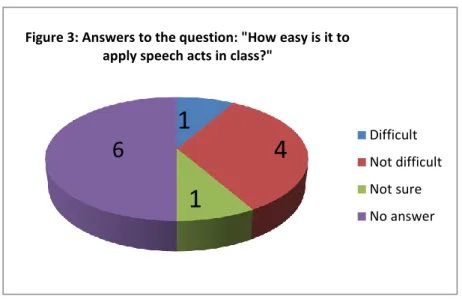
One of the key questions in our investigation was to find out how easy or difficult it is to apply speech acts in class. For this reason, we guided the interview towards what teachers think about developing such knowledge. Four people out of twelve thought it was not difficult to apply speech act type activities in their classrooms. That is the case of T6, who thinks that motivation is what students need to start talking, it doesn’t matter if they make mistakes; however, some clues help them to implicitly use the language and apply that to communicate to each other.
There is another case of a teacher who thinks it is easy to apply speech acts in class. Nevertheless, it depends on different factors such as the level of the student and the kind of practice they have in the course of their school life. This teacher provides an example: “for beginners, it may be a little hard because they don’t know the meaning of the expressions”. However, “with intermediate level students, they have more experience using phrases and pragmatic expressions”.
One of the teachers answers that it is difficult to apply this kind of knowledge in the classroom because there are expressions and phrases that are difficult for a student to
1
4
1
6
Figure 3: Answers to the question: "How easy is it to apply speech acts in class?"
Difficult
Not difficult
Not sure
Universidad de Cuenca
understand, for example, if you say how are you doing? and “what are you doing” to the students, they may get confused.
There is a teacher who is not sure whether it is easy or difficult to develop speech acts learning in the class because this teacher thinks that there is a lack of resources to do so in our Ecuador. Moreover, it is important to mention that fifty percent of the teachers interviewed did not answer the question because they were not sure how to apply Speech Acts in their classrooms.
• Half did not answer
• One-third says that is not too difficult to apply speech acts in the classroom • Why: the nature of the interview (focus group) did not allow all the teachers
to answer; however, some answers revelled that it is not difficult because what students need is motivation.
To continue with our analysis, we have reached the point when we must talk about strategies teachers usually use when they teach English as a second language. With this study we try to answer our research question which highlights the importance of the kind of language students use when they express themselves. Obviously, they would refer to what they normally see in class. In this context, most of the teachers, as the Ministry of
Universidad de Cuenca
command the options in the platform of the institution”. On the other hand, some teachers would love to use all that technology in class, but they point out some limitations in public schools. For example, T4 mentions that teachers do not have enough resources because of the space, and the number of students; also, the projector is difficult to get because other people need it at the same time and in the same day. She says she tries to use videos and dialogues to push them to use the language in real situations.
As we can see, teachers are willing to use communicative activities to get advantage of today’s technology; however, the lack of resources, as they mentioned, sometimes forces them to stay with other approaches.
The teachers’ perceptions about the way students react towards including
pragmatics in their classes are very interesting because most learners respond positively. Related to this, T1 stresses that students like it because they see how native speakers use the language and they say it is cool when students are talking with their friends they like to use the informal language.
In the same way, T5 argues that at the beginning, students are usually afraid of using these kinds of expressions, but later they feel more comfortable. T6 agrees and says that students, at the beginning, can be scared because it is something new for them, but by monitoring every piece of language, she thinks they can get used to that.
Universidad de Cuenca
The next question was aimed at finding out if, in the teachers’ opinion, the new course book included any content that was suitable to develop their students’ pragmatic skills.
One of our specific objectives was to find out if the new material provided by the Ministry of Education presents opportunities for students to develop pragmatic skills. The interviews with the teachers show clearly that most of them believe that the actual English textbook provides too much grammar material, and very few opportunities to develop pragmatic skills. The figure above demonstrates that half of the teachers interviewed think that the course book is unsuitable to teach pragmatic skills. One-third of the interviewees were of the opinion that the book fulfills this need to some extent. The remaining two teachers (16.6%) stated that the course book does contain teaching material for pragmatic skills.
6
2
4
Figure 4. Answers to the question: Do you consider the new English textbook has opportunities for students to
develop pragmatic skills?
No
Yes
Universidad de Cuenca
As for the details, T3 argued that the actual curriculum designed for students who are studying in public high schools does not match with the context presented in the textbook because of the social-economical background they have. T2 said that she was afraid of using technology in class even though some activities in the book would require its use. As she stressed, sometimes it is dangerous when teachers ask students to bring their cell phones or computers to do an activity in the class because the teachers are responsible for them, for example, if they are stolen.
Four teachers from the twelve interviewed said that there is some pragmatic content in the book. Regarding the same question, T5 mentioned that she has to bring her on topics to class. Additionally, she highlighted that the book does not really have activities that teachers can apply with their students; moreover, some activities are confusing for them. T9 and T11 also affirmed that the new English book provides hints to improve students’
Universidad de Cuenca
3.2. Discourse Completion Test Analysis
Our general objective was to carry out an exploratory study about how requesting and offering speech acts are used by Ecuadorian senior high school students and English native speakers. Beyond that, one of our specific objectives was to compare English native speakers’ answers with Ecuadorian senior high school students’ answers to Discourse Completion Tests in order to discover similarities and differences in their utterances. For this reason, sixty-five students of English and thirteen native speakers were asked to answer two questions.
The first situation asked for a requesting speech act, while the second required an offering speech act. Both of these have been tested by professional linguists around the world.
To analyze the answers, we have to take into account several aspects that we consider important for academic rigor. One consideration is that we were not checking the grammatical or syntactical correctness of the answers. However, the latter two constitute the most common difficulties for students. Another limitation we found was the students’ lack of vocabulary, even though they tried very hard to remember words they could fit in and to sound right.
Universidad de Cuenca
You are studying in your room for an exam and you hear loud music coming from the next room. You don’t know the person who lives there, but you want to ask him/her to turn
the music down. What do you say?
It is important to clarify that in order to code the participants native speakers will be referred as “NS” and students will be marked as “NNS” which stands for non-native
speakers.
3.2.1. Native speakers’ answers to the requesting speech act situation: Analysis
As it was expected, the answers provided by the native speakers have a structure, which represents four steps. In the example below, we present how these steps are clearly marked.
Native speaker sample structure:
• Introduction: Excuse me, I live next door…
• Request: I would be most grateful if you could help me by turning the music down.
• Justification: I am studying for an exam tomorrow. • Thanking: I would really appreciate it.
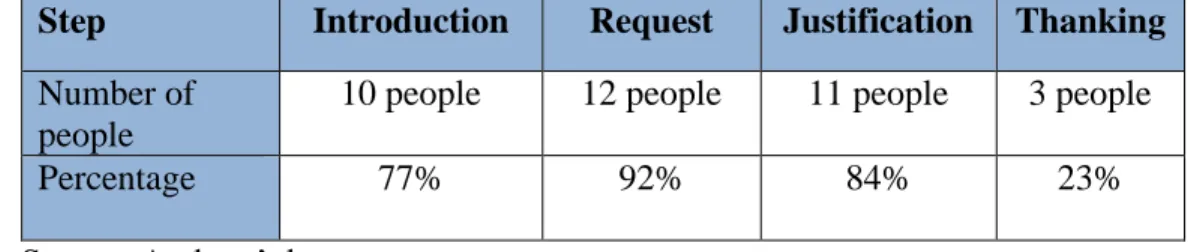
Table 1. Native speakers’ answers
Step Introduction Request Justification Thanking
Number of people
10 people 12 people 11 people 3 people
Percentage 77% 92% 84% 23%
Source: Authors’ data
Universidad de Cuenca
Twelve people out of thirteen answered the question by performing a request except for one that did not answer what we had asked.
Moreover, eleven people (84%) think that a justification was needed for such
request. However, it is surprising that only three people thank. In this case, the nature of the utterance may not require such step.
3.2.2. Students’ answers to the requesting speech act situation: Analysis
For the purposes of the analysis, we decided to design and use a rubric in which we highlighted the most important criteria such as appropriateness, politeness and type of vocabulary.
It needs to be clarified that the rubric below applies only to the students’ answers. It is only to be expected that the native speakers’ responses are appropriate and polite; besides, they use the language fluently and coherently.
Rubric 1: Requesting speech act analysis
Source: Author’s data
Criteria Appropriateness Politeness Vocabulary
Description Number of people 26 students 16 students 24 students
Universidad de Cuenca
As stated above, the structure used by most of the native speakers showed four steps: introduction, requesting, justification and thanking. In terms of appropriateness, we are assuming that this structure is a model of a high level of pragmatic competence.
The first criterion we will discuss is appropriateness. In this context, we found that 26 students (40%) resorted to the above-mentioned structure. That is the case of, NNS-6 who manages to produce the ideal utterance. He says: “Hello! Please, can you turn down the music? I am studying for a very important exam. Thanks!”
The student’s answer shows the four steps:
Introduction: Hello!
Requesting: Please, can you turn down the music? Justification: I am studying for a very important exam. Thanking: Thanks!
We can point out that this particular case can be labeled as a high level of appropriateness. On the other hand, we have the case of NNS-27: “sorry you can turn down the music please.” In this example, we can see that he/she achieves only two steps of the ideal utterance. He says:
Introduction: sorry
Requesting: you can turn down the music please.
Based on the example, we can observe that the student’s answer represents a low level of appropriateness.
Universidad de Cuenca
contain as many as fifteen words: “I would be most grateful if you could help me by turning the music down.” In our dataset, only sixteen students (24, 5%) have shown some level of politeness.
Looking at the same criterion, it is interesting to see that NNS-38 utters “Please, can you turn the music down?” In this case, the student answered using seven words. Even though the request seems to be complete; when compared with the native speakers’ ideal utterance, it appears to reach a medium level of politeness.
To cite an opposite example, NNS-39 says: “Please, down the music”. We can call this an incomplete request because he/she does not use at least a modal auxiliary verb to begin the question. In this case, we can say that this utterance shows a low level of politeness.
The third criterion considered in the rubric is vocabulary. We have stated that the key vocabulary for this particular requesting speech act has to be related to the following set phrases:
• Turn the music down • Turn down the music • Turn down the volume