Depicting Young Learners' Construction of Social Awareness through Language Learning Strategies
Maira Jarleydy Bulla Ibagon José Daniel Monroy Serrano
Universidad Distrital Francisco José de Caldas Facultad de Ciencias y Educación
Licenciatura en Educación Básica con Énfasis en Inglés, Lengua Extranjera Bogotá, Colombia
Depicting Young Learners' Construction of Social Awareness through Language Learning Strategies
Maira Jarleydy Bulla Ibagon José Daniel Monroy Serrano
Director: Yolanda Samacá Bohórquez
A dissertation submitted according to the requirements of Acuerdo no. 31 (2014), artículo 6°. - Monografía
Universidad Distrital Francisco José de Caldas Facultad de Ciencias y Educación
Licenciatura en Educación Básica con Énfasis en Inglés, Lengua Extranjera Bogotá, Colombia
Acuerdo 19 de 1988 de Consejo Superior Universitario
Acknowledgements
We would like to express our gratitude to our professor and director Yolanda Samacá Bohórquez for her help and guidance during the process of this action research as well as the work developed at the school. Without her patience, complete dedication and professionalism this research could not have been developed as it is presented.
Besides our director, we also want to thank the academic community in which this research was carried out for their permission and facilities that allowed us to conduct it without any major limitations.
Abstract
Violence in the classroom is an issue that has been strongly studied in the last years. This matter makes English language teaching a difficult task in which the teacher is not only
responsible for teaching the English language, but to keep the order and manage different conflict situations that might occur in the classroom. Following this further, this action research attempts to characterize the students’ responses in regards to their initial process of social
awareness from social values implemented in the English class through learning strategies, these responses were collected and analyzed through field notes, video recordings and interviews. Data revealed that social awareness in second graders emerged from two main aspects, perceptions towards their own actions in the school and familiar contexts and how they perceive partners’ actions at school.
Table of Contents
Introduction ………...………..9
Justification ………...………....11
Problem Statement ………...………...12
Research Question ………...….13
General Objective ………..……...13
Specific Objective ………..14
Literature Review ………..15
Understanding Social Awareness in the Educational Field ………..….15
From the Comprehension of Social Values to its Application at the School ….………18
Learning strategies for EFL learners ………..23
Research Design ………...…….28
Research Paradigm ……...……….…….28
Type of Study …...………..28
Research Question ………...………...29
Research Objective ………...……...29
Specific Objective ………..……...29
Context and Participants ……….29
Data Collection Instruments and Procedures ……….…………30
Field notes ……….………..31
Video recordings ……….32
Interviews ………32
Ethical Issues ………..33
Instructional Design ………..35
Learning Strategies: Enhancing Social Awareness of Second Graders……….….…35
Theoretical Foundation ……….……….35
Innovation ……….………..38
Pedagogical Objectives ……….……….38
Pedagogical Implementation ………..39
Criteria of Assessment ……….………..41
Role of the Teacher ………...……….42
Role of the Students ………..……….42
Role of the Materials ………..………42
Data Analysis ……….………...44
Data Analysis Procedures ………...44
Category 1: Students’ Recognition of Their Role through Personal Experiences ………….46
Category 2: Students’ Moral Judgment towards Others’ Actions and Roles ………..……...53
Conclusions………...……….58
Pedagogical Implications and Further Research ………..……….60
Pedagogical Implications ………….……….….60
Further Research ………62
Limitations ……….………...………63
References ………..…...64
List of Figures and Tables
Figure A1. Curricular Platform……….……….35
Table B1. Distribution and Organization of Content during the Pedagogical Implementation …39 Table B2. Outline: Classification of Results ……….…46
List of Appendices Appendix A. Field Note Format ……….………..……68
Appendix B. Video Recording Transcription Format ………..……60
Appendix C. Interview Transcription Format ………...………..….70
Appendix D. Consent Form Format ………..………...71
Appendix E. Journals Format ……….………..…72
Appendix F. Posters ……….………...73
Appendix G. Puppets ………..………..…74
Appendix H. Big Books ………..………..……75
Appendix I. Cartoon ………..77
Introduction
This action research aimed at characterizing second graders’ responses towards social awareness as well as reducing their violent behaviors in the English classes. In the teaching practicum with second graders from a state school in Bogotá, violence was noticeable. Students showed lack of respect towards their partners, verbal and physical violence and the inability to follow rules. These situations made us wonder about how to address social values through the English class. Besides, the students’ behaviors and attitudes are important factors in order to create a respectful, rich and comfortable environment for learning as De Angelis and Selman (cited in Pérez, 2013) stated that the main role of schools is helping students to regulate their emotions and prevent violent episodes by promoting social awareness, which can diminish the harmful episodes in a community.
We planned to intervene creating a comfortable environment in the classroom by providing a space in which young learners might be aware of their violent behaviors towards their partners. In addition, we aimed at promoting metacognitive, cognitive and social/affective strategies from Cognitive Academic Language Learning Approach (CALLA) proposed by Chamot and O’Malley (1994) in order to enhance students’ awareness regarding their own English language learning process and social values. This approach encourages students’
These aspects mentioned are explored along this action research focusing on social awareness as the main goal.
The students’ responses were analyzed from gathered data through interviews, field notes and video recordings applying the Grounded Theory (Corbin & Strauss, 1990). In this way, three main concepts are addressed in this study, social awareness, learning strategies and social values, supported on recent studies and theory such as Durlark (cited by Pérez, 2013); Silva (2004), Yarce (2004), Chamot & O’Malley (1994) and Cortina (2001); respectively. Following this further, these theories were helpful in order to answer how second graders’ responses reveal social awareness in the English class using learning strategies supported by social values.
The contents of this paper are presented as follows. In this first chapter, it is stated the purpose and the importance of the study in the EFL field; the information is related to the context and background of second graders, research questions and objectives. In the second chapter, the discussion in the literature review is addressed focusing on concepts such as social awareness, social values and learning strategies from recent research from its definition to its importance at school. Then, the third chapter presents the research paradigm and type of study guiding this action research, the research question and objectives as well as the data collection methods are also stated in this section. In regards to the fourth chapter, it is addressed the pedagogical intervention with its respective theoretical foundation, the implementation with the materials as well as the role proposed to each one of the participants of the class(teacher, students and materials).
focuses on the pedagogical reflections and future studies that can derive from ours. Finally, we present the limitations that our research embraced.
Justification
This action research focuses on EFL learning and teaching in which social values are required in order to decrease the second graders’ violent behaviors as well as to promote social awareness in regards to their English learning process. In the same way, the conscious process that they should develop in relation with their English language learning process as well as their behavior inside and outside the school might be meaningful for them. As Mayordomo (2006) claimed, the role of the school needs to be addressed by integrating the cognitive dimension, the development of attitudes, habits and skills as well as presenting values in order to comprehend the students’ social reality and experiences. The construction of students’ social awareness might improve the environment in the English classes where students work cooperatively being aware of their behavior and process, respectfully and actively.
The impact that this action research might have on second graders is focused on the students’ understanding of social values and their construction of social awareness in the EFL class. According to Mayordomo (1998) the education on values, convictions and social
This action research study attempted to strengthen students’ language learning process in regards to promote strategies that allow students learning new English language content while they are aware of their own learning process. These strategies also support students’ process in order to overcome difficulties when facing vocabulary, spelling and situations they might find complex related to new language content. Following this further, the implementation of social values places English language as a means to teach not only the language per se, but also to engage students in diverse content that encourage their humanistic development along the process.
Problem Statement
In our teaching practicum at a state school in Bogota, we faced episodes of violence with our students in which they fight, bite, spit, throw materials, verbally attack and hide their
partners’ belongings. Consequently, the students were not able to follow classroom rules to keep a good environment such as raising their hand when they need to talk, turn talking, and respect the physical and emotional integrity of their partners, among others. The attitudes of our students used to be relaxed and unaware of their own acts; some of them kept in silence, started laughing and avoided the responsibility after these violent episodes. For this reason, we considered pertinent to look for strategies to deal with this issues problematizing the English class. As EFL teachers, we decided to focus not only on teaching the English language content but also to educate the students regarding social values and proper behavior inside and outside the classroom, which should be the aim of every instructional design.
English language level. This workshop consisted of three main activities where students
recognized Basic English vocabulary, presented and linked classroom rules, and expressed their likes and preferences. These activities required listening, speaking and reading processes. In this way, we confirmed that second graders presented constant violent episodes in the EFL class that were previously explained.
Similarly, the results of a study carried out by Gavidia, Talavera and Hamdan (2014) revealed that students were mostly involved in the role of “witnesses” in episodes of violence, acting indifferent towards violent episodes whenever they occur. This study showed similarities on the behaviors of our students as well as the lack of attitudes to point out people responsible for the violent act to avoid being aggressed as we found in the needs analysis.
At this level, we planned to promote social awareness through learning strategies that involved social values in the EFL class. The purpose of this implementation aimed at fostering social awareness in regards to the second graders’ behavior as well as their English learning process. The construction of awareness in the classroom was addressed by Gavidia et al. (2014) where teachers implemented real stories, news and current events in order to farther the students’ awareness process making emphasis on reflections regarding the situation proposed and the possible solutions to the lack of values portrayed in the activity.
Research Question
What do second graders’ responses reveal about the construction of social awareness through learning strategies in an EFL class?
General Objective
Specific Objective
Literature Review
Violence inside the school is a phenomenon that has been present since the start of our teaching practicum. This issue deteriorates the environment of the EFL classroom and the students’ lives. In our case, the needs analysis carried out portrayed that second grade students presented verbal and physical violent behaviors that obstructed not only the English learning process but also the relationship and interaction among students during the EFL class. For this reason, we consider that education should aim at teaching students the importance of social values in their lives, their relationship with others and the way they interact in the society. Based on this previous educational view, this action research study is framed into the concepts of social awareness, social values and learning strategies that are explained below.
Understanding Social Awareness in the Educational Field
The main purpose of this action research study is to promote the construction of social awareness in second grade students in a school located in Bogotá. In this way, this concept embraces the core of this research. Pérez (2013) has defined social awareness as the ability of a person to be aware of their role, position and behavior towards his/her society in which
awareness can vary depending of the violence inside a group or the goals they have in common. Based on this definition, we can observe that social awareness is focused on the individual and his/her personal actions. However, social awareness should be also considered as an
intrapersonal and interpersonal skill allowing the individual to be conscious of his role and actions within the society.
or a community in dissimilar contexts such as political, religious, and even philosophical. This means, that when the population cannot recognize their role and their position in the society conflicts emerge, in this case it is necessary to use different guides and processes to dissolve tensions among participants. Consequently, we affirm that working on social awareness in the English class might help students to promote an insight of their acts and its impacts on their lives and their congeners. Therefore, we propose social awareness as a reflective process in which a person acknowledges his role, position and behavior inside a society creating an impact on the individuals and institutions around him/her in order to become an active member of the society, who proposes actions to change the social reality.
The function of social awareness should be addressed not only from a social perspective as research had exposed, but also from the educational field which should be beneficial for the EFL learning that cannot be separated from the social reality. In this way, Durlark (cited in Pérez, 2013) claimed that social awareness is a human ability of being conscious about problems that the society faces in different contexts and situations, where conflict situations within a society emerge as a result of the lack of awareness about their own problems and responsibilities. In a similar definition, the function of social awareness is addressed by Silva (2004) as self-reflection process and consulting others in order to acquire a shaped and mature awareness to prove or reprove an act.
reflecting about students’ social awareness but also observing how second grade students apply it at school.
The benefits of social awareness in the EFL field might create a space in which self-reflection is always present when students are learning new content as well as when they are aware of their behavior. At this point, it is pertinent to mention how the class environment might be influenced by violent behaviors from students. According to De Angelis (cited in Pérez, 2013) social awareness can diminish episodes of violence inside a community focusing on the emotions that interfere with the awareness process. In other words, the personal emotions that interfere with awareness lead the person to behave violently.
In this situation, school takes part in the creation of spaces where students learn to
regulate negative emotions that might damage their congeners. Besides that, we consider that it is fundamental not only to attend those episodes of violence whenever they occur, but also to prevent them inside the class, by teaching and showing different conflictive situations where social awareness can solve tensions and difficulties among partners. These spaces cannot be isolated from the curriculum, social awareness must be a constant in every class where students are taking and making emphasis on problem solving activities (Selman cited in Pérez, 2013).
Consequently, Csóti and Durlark (cited in Pérez, 2013) emphasized on how the teaching of values not only resides on the shoulders of the teachers but also on the students’ attitudes and behaviors which must be coherent to the space they are sharing with their classmates.
Following the previous idea, a study conducted by Aguirre, Moliner and Traver (2014) portrayed a similar purpose in which social awareness is addressed from the students’ reality and their actions towards it to encourage students to keep involved and construct critical citizens. After some exercises the students started reflecting on the need for transforming their
environment where the school provided a space for students to become familiar with their reality, students were active participants into a self-criticism stage about their experiences making a range of possible changes towards a specific situation. This study evidences the students’ level of awareness from their reality assuming participative and active roles in order to reflect and
propose solutions for problems perceived in their society. This process is promoted through opportunities at the school in the English class that seeks reflection towards problematic situations as well as in the English learning process.
Certainly, social awareness is a process that is enhanced by different factors such as students’ attitude, context, teachers’ formation and social values which are important to its development; these factors allow people accepting or rejecting an act in different situations. Following this idea, social values take place as an important part of social awareness where one is a component of the other respectively. A society establishes and creates the model of citizen which should be followed from rules, manners, and behaviors. For this reason, it is necessary to address one of the factors that the society establishes which is addressed in the following section: social values.
From the Comprehension of Social Values to its Application at the School
relationships among the members of a community or society. For this reason, we consider
pertinent to work on social values in order to modify the violent behaviors perceived in the needs analysis with second graders in order to make them aware of their behavior through its
promotion.
Certainly, recent research has been focused on the students’ behavior and attitudes at school from its causes, the influence of students’ reality and the integration of the curriculum to provide opportunities of reflection. One remarkable example of research that addressed the importance of students’ social development was carried out by Dumitriu and Dumitru (2014), which was focused on citizenship education where the students’ cognitive development was achieved through civic behavior in diverse subjects along the curriculum. Although the emphasis of this study is on citizenship education, its purpose is similar to our study in which we attempted to promote social awareness as well as to provide social values in the English language class through the use of learning strategies. In addition, the dialogic method applied by Dumitriu and Dumitru (2014) allowed students sharing experiences related to values and civic behavior as an intercultural exchange. This conversational method from our point of view should be considered in order to provide opportunities for students to construct social awareness and reflect about social values.
the social interaction, these social values vary depending on how each society sees the world forcing people to act depending on what should be consider as right or wrong.
Based on the previous definition, we consider that social values are basic components of the society that should be constantly taught in every subject around the students’ academic formation, these social values should be present in every decision that the students make. Therefore, we conceive social values as a set of basic rules, behaviors and attitudes that must guide people’s worldview, without losing the principles of rightness, justice, respect and tolerance.
Based on the previous idea, our definition of social values establishes three main dimensions (rules, behaviors and attitudes) which are evidenced in social interactions. This means that social values in their particular dimensions are necessary to establish rich
interpersonal relationships. For example, respect has to be present in different scenarios in daily interactions such as an established rule which maintains healthy relationships among citizens. In the same way, this established rule has to be extended to each people’s behaviors as well as how their attitudes evidence respect when interacting with others. Moreover, the definitions proposed by Yarce (2004) and Silva (2004) in regards to social values have been thought as aspects that are pertinent in a society and must be taught but these are not carried out to practice by the individual.
values, capability values, vital values, aesthetic values, intellectual values, religious values, and social values. Within social values we can observe values such as justice, freedom, equality, honesty, willingness to dialogue, solidarity, tolerance, and respect.
Cortina (2001) also claims that social values have to be practiced towards other people and the person itself to achieve an integral personal development. In this way, English teaching should also provide an environment for students to develop diverse skills using social values that allow creating a respectful English classroom where every person can have different opinions and perceptions without being rejected.
The impact of social values could be observed from personal reflections and daily common life situations of the individual. Silva (2004) claims that a person who has acquired social values will be able to be congruent with his acts and thoughts. This means that a person is aware of the consequences of his acts in every situation he faces. Based on this previous idea, we can conclude that Silva (2004) emphasizes on the coherence rather on the moral judgment of the acts. However, Yarce (2004) proposes the importance of social values on a subject’s lifestyle providing a different perspective: “The values most appreciated are those which help us to act better, to consolidate our moral, to construct our character and the way of life of people and communities” (p.53). We can assert that Yarce (2004) proposes an integral perception of the purpose of social values while Silva (2004) aims at an intrapersonal perspective.
The advantages of social values in the educational field could be found in the behaviors, attitudes, and intrapersonal relationships among students in the EFL classroom. These
advantages are addressed by Yarce (2004) in terms of its utility to educate people constantly in order to support input as well as to develop abilities to achieve positive studying habits.
their own acts, their attitudes towards the English class and especially to enhance social values in order to educate them to live respectfully in their society.
The education on values was addressed in an ethnographic study by Álvarez (2014) where dialogue was a basic strategy used by teachers and students to acquire knowledge, attitudes, behaviors, and reflection in regards to values across the curriculum. The results portrayed that students shared their experiences on values and civic behavior from their context such as helping and talking with their relatives. This leads us to the conclusion that dialogue inside the classes is vital to the acknowledgement of the flaws, difficulties and purposes of the students’ educational process to promote opportunities to construct social awareness.
Finally, the construction of social awareness through social values should be addressed from an approach that allows students to be aware not only of their English learning process but also their behavior inside and outside the classroom. One example about how this can be carried out is a study conducted by Hashim, Ho-Abdullah and Yusof (2011), which portrays the
importance of including literature on social issues in the syllabus. This research emphasized on the relevance of including real situations which create awareness about people’s reactions on different situations as well as to analyze the causes of them. Besides, in our case, the
construction of social awareness in this action research is focused on students’ behavior as well as their learning process.
Recent research has been focused on strategies that allow students being aware of certain content or processes. Onatra (2010) as well as Izquierdo and Jiménez (2014) revealed that the use of strategies increased awareness towards reading to overcome difficulties and empower students towards their own learning process. Based on the previous ideas, we consider that learning strategies provide opportunities to the students to monitor, evaluate, and reflect about their process in terms of weaknesses and strengths in the EFL class as well as their behavior from a holistic formation at school.
Learning strategies for EFL learners
could provide students enough resources to be aware of their learning process as well as the influence of their behaviors and attitudes in the EFL class.
In the first place, it is necessary to define what learning strategies are from diverse perspectives that aim at a unique goal. Taking into account the definition of Chamot and O’Malley (1994) learning strategies are procedures to help learners comprehend and intake any content without focusing on their proficiency level or abilities. These strategies help the learner to organize, manipulate, evaluate and monitor new information with a clear understanding. Moreover, learning strategies point at the social aspect which relay on the cooperative work where the learner can be assisted by other learner with different abilities to achieve a common goal.
Considering other definitions, Griffiths (cited in Gerami and Ghareh, 2011) defines learning strategies as conscious activities chosen by learners to regulate their own language learning. Similarly, Wenden (cited in Gerami and Ghareh, 2011) proposes learning strategies as mental steps or operations used by students in order to learn and regulate a new language. However, these strategies only focus on helping a learner to acquire another language. For this reason, we decided to apply some of those strategies to help the learners to learn not only the English Language content, but also social values based on their behaviors and actions inside the classroom.
which are focused on managing language learning. Later on, Chamot and O’Malley (1994) classified learning strategies into three categories: cognitive, metacognitive and social-affective strategies. The first category is related with the memorization of new information, the second category is focused on the consciousness and reflection on the new content, and the last category is concerned about the cooperative work and the generation of motivation in the student.
At this point, it is relevant to highlight the role of social-affective strategies. These strategies promote social interactions and cooperation among students with the purpose of creating a space in which learners are going to be prepared for life outside their classrooms where they need to cooperate with one another to achieve common goals. This means, that this type of strategies encourage students to strengthen not only their cognitive level towards the target language but also their social skills required to be an active member of the society.
The use of learning strategies is an issue that has been studied recently in diverse contexts as well as populations focusing on how learners apply them and how beneficial these are. A study addressed by Gerami and Ghareh (2011) portrayed the importance of applying learning strategies with successful and unsuccessful learners where metacognitive and cognitive strategies are the most used by the students to improve their process and management of the target
language. Although, the use of learning strategies is relevant for the learning process of a target language, this will be strictly mediated by the preferences that the learner has, for example, Qasimnejad and Hemmati (2014) found that young adults had preferences towards the cognitive strategies rather than on social affective strategies.
revealed that students may prefer some strategies depending on the assigned task and their
learning process. This study depicts that students selected Cognitive and Metacognitive strategies to improve, in a lower level, their writing proficiency. Although social/affective strategies could be meaningful to improve learners’ language skills. In a final consideration, learning strategies are efficient for students to become more autonomous in order to overcome difficulties, improve and develop language skills. However, it is necessary to take into account the preferences, weaknesses and abilities of the students to promote learning strategies that correctly fit to these features.
Finally, the application of learning strategies has been carried out in a national context, showing its importance in the foreign language learning process. A study conducted by Mejia and Meza (2014) in Pasto, Colombia, evidenced that students do not need a permanent teacher’s assessment in order to use learning strategies in higher levels. In fact, students apply learning strategies depending on their needs, weaknesses and preferences to find solutions to problems and difficult situations encountered along the learning process. Consequently, the teachers’ role lay not only on teaching learning strategies but also to make them clearly perceived by the students in order to become active and conscious users.
Secondly, the teaching of social values in any community, in special an academic one, is fundamental to enhance interpersonal skills towards the creation of social awareness in our students, this process can promote and enhance their learning process in any subject through the applications of learning strategies. In terms of the definition of social values proposed by authors as Yarce (2004) and Silva (2004) we realized that these have been considered as aspects which are pertinent in a society and must be taught. Nevertheless, social values should be taken into account not only as content of the curriculum to promote reflection, but as a tool that must be present in every aspect of the students’ formation starting from its practice in their personal lives.
Considering all the studies and the information gathered by the researchers, we have found that recent research focused on applying learning strategies on teenagers and young adults who are at higher levels of education. This means that implementing learning strategies has not been focused on primary students, leading us to the conclusion that learning strategies seem to be interesting only when the population is not a young learner and has higher cognitive
Research Design
In this chapter we present the research paradigm and type of study, research questions and objectives that guided the research process as well as the context and participants that took part in this action research. Finally, we describe the data collection instruments and its processes to gather second graders’ responses, the type of data that we aimed to find and the permissions required to use the students’ information.
Research Paradigm
This action research study is based on a qualitative research which is defined by Johnson and Christensen (2004) as an exploration and description of situations, contexts, and social episodes in which the main factors are the perceptions and opinions of the participants. In this type of research the interviews, observations, field notes and questionnaires are the most used methods to collect data from the participants. Following these further, field notes, video
recordings and semi-structured interviews were the selected data collection instruments for our action research study in order to gather the students’ responses in regards to social awareness in the EFL class.
Type of study
This research follows the action research type of study; this is defined by Nunan (1992) as: It is carried out by practitioners rather that outside researchers; it is collaborative and it aims at changing things. A distinctive feature of action research is that those affected by planned changes have the primary responsibility for deciding on courses of critical inform action which seems
Taking into account this definition, action research aims at changing certain issues in a context where the researchers take part on it. Nevertheless, the definition of Nunan (1992) excludes the role of teacher researchers. In a more recent definition of action research, Burns (2010) proposes it as a central action to intervene in problematic situations in order to change and improve practices. These actions are based on information gathered systematically by the action researcher.
Following this further, we consider pertinent this type of study to focus in terms of enhancing social awareness in second graders using learning strategies to promote social values. Besides, an action research in the context mentioned previously, it is pertinent the frequent contact with the students for implementing this type of research.
Research Question
What do second graders’ responses reveal about the construction of social awareness through learning strategies in an EFL class?
Research Objective
To characterize the second grade students’ responses towards their own social awareness in the English class from the implementation of social values through learning strategies.
Specific Objective
● To describe how the students’ responses reflect social awareness in their behavior during the implementation of learning strategies in the English class.
Context and Participants
goals, topics and competences in order to develop abilities in the students across all the areas of knowledge. In this institution the students have the opportunity to engage into different
extracurricular activities such as chess, karate, soccer, and painting, among others. Besides, high school students also receive courses in order to prepare them for college environment.
The population consisted of 38 students of second grade from a state school at Bogotá. The second grade students are in a range of 7 to 8 years old in socioeconomic strata levels 2 and 3. In addition, most of the students presented verbal and physical violent behaviors during the English classes in which they could not follow rules and there was a general lack of respect. Some students are able to communicate using short sentences to describe themselves or ask for permissions. In the same way, they were able to understand references to elements in their surroundings, commands, and greetings, but they have difficulties at understanding complex instructions or long sentences.
The participants were eight students, who were selected for their interactions and relevant perceptions given during the intervention. In one hand, these students were active participants, perceptive, and interested in the topics of discussion in the class. On the other hand, their behavior was similar to the rest of the students, as it was previously mentioned.
Data Collection Instruments and Procedures
classroom (Cohen et al., 2007) in order to observe and gather second graders’ perceptions but also the attitudes and behaviors in the EFL class through field notes.
The second procedure was carried out using video recordings and semi-structured interviews which permitted collecting data from students’ responses and insights in the EFL classroom. This procedure allows “the researcher to elicit constructs that subjects customarily use in interpreting and predicting the behavior of those people who are important in their lives” which are mainly constructs and elements stated by the participants (Cohen et al., 2007, p.436). The collected data from instruments allowed us to find themes in order to analyze and compare them from the students’ responses focused on answering our research question.
Field notes. This data collection instrument is defined by Marshall and Rossman (1999) as a “systematic noting and recording of events, behaviors, and artifacts (objects) in the social setting chosen for study” (p. 107). These authors also stated that one of the benefits of using field notes is that it allows the researcher to document and register any kind of interaction among the participants. Following this idea, the researcher can also discover recurrent behaviors that occur in the environment by taking notes and analyzing them. For this purpose, we applied a format of field notes which includes the comments of the participant observer in order to amplify the data analysis; the selected format is attached in the appendices section (See Appendix A).
At this point, field notes were applied with the purpose of collecting the students’ responses towards the use of social values and the different activities in which they were
involved in the EFL class. The protocol for field notes was scheduled to be applied every English class during the teaching practicum period in order to provide data in regards to students’
Video recordings. Video recording are an instrument that allowed us to record events, behaviors, attitudes and perceptions of second graders which were used as units of analysis in this study. In words of Marshall and Rossman (1999) “is a powerful tool for inquiry into past events. Film has the unique ability to capture visible phenomena seemingly objectively” (p. 125). In this way, this instrument allowed us observing and analyzing row data repeatedly.
This instrument was implemented according to the schema proposed by Sorenson (cited in Marshall and Rossman, 1999) where the programmed sampling consists of selecting the dates of video recording. In our case we selected the beginning of the class in which we presented social values to second graders where they were supposed to engage in discussions related to common life examples in which the lack of social values could be clearly observed.
The purpose of this instrument was to gather students’ responses towards social values and common-life situations that were presented at the beginning of every EFL lesson. These lessons were taught every two weeks. The protocol scheduled for the application of this
instrument consisted of recording every two classes, at the moment of the discussion of the social value selected for the session. Later, the students’ responses were transcribed in a format (See Appendix B) in order to organize the collected data.
participants’ concentration and what kind of climate the interviewer provides (Marshall & Rossman, 1999).
Following these issues at interviewing young participants, Marshall and Rossman (1999) claimed that interviewing children is a method that allows collecting their perspectives which are relevant and insightful regarding experiences in order to learn more about them. In this way, we planned to interview eight students in order to know their insights about the process we
implemented. These participants were chosen depending on the relevant ideas given during the intervention in order to expand second graders’ insights in regards to their social awareness process and the implementation of social values in their daily lives.
The protocol for this instrument consisted of eight students’ interviews at the end of the intervention process; in these, students answered different questions addressed to their opinions and comments towards different situations perceived in the EFL class. The students’ perceptions in the interview were transcribed into a format that allowed us observing and analyzing the collected data (See Appendix C).
Role of the Researchers
The role of the researcher was participant observer “as its name suggests, is part of the social life of participants and documents and records what is happening for research purposes” (Cohen et al., 2007, p.437). This role is due to the teacher researchers who were in permanent contact with second grade students as well as the designers of the curriculum of the school year. Ethical Issues
collected during the implementation and research process. In the same way, the institution had granted us permission for the teaching and research process through a consent form signed by the academic coordinator. The information used in this action research depended on the amount of permissions signed by the parents and the institution in order to guarantee the validity of the data. Finally, the students’ personal information as well as the name of the institution remained secret as part of the agreement between the institution and the researchers.
After considering the research design and what this implies, we proceed to the
Instructional Design
Learning Strategies: Enhancing Social Awareness of Second Graders
The lack of awareness of second graders’ behaviors inside our EFL classroom leaded us to design a pedagogical intervention that is entitled “Learning Strategies: Enhancing Social Awareness of Second Graders” which promoted a set of activities where students used different learning strategies that aimed at enhancing awareness in regards to behaviors, attitudes and EFL learning process. This pedagogical intervention implemented a group of didactic materials in order to create a friendly and comfortable environment for the students to express their insights, ideas, experiences and practicing the foreign language.
Theoretical Foundation
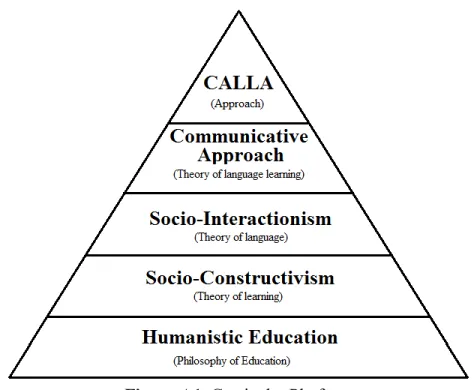
Figure A1. Curricular Platform
This illustration shows the theoretical foundation which supported and guided the pedagogical implementation process with second grade students.
The philosophy of education which supported this pedagogical intervention is
Education should embrace the teaching of values inside the classrooms in order to place the teaching process as a development of the individual rather than only teaching content.
Humanism is based on generation of knowledge, meaning, and expertise through interpersonal and intrapersonal intelligence. At this point, Montessori (1917) has proposed that adults or teachers are perceived as guides who promote a comfortable and meaningful
environment focused on responsibility, love and self-effacing. Learners adapt prior knowledge to the new content, making personal interpretations in order to acquire new experiences. Following this further, the purpose of this philosophy is to enhance students’ autonomy, self-awareness of knowledge and active participation in their own reasoning and assessment. This leads to a more social and interactive learning where the student is aware of their knowledge and also is able to cooperate with others in order to perform different tasks.
In this way, Socio-constructivism fosters the social role between teachers and students to construct collaborative knowledge. Based on the work of Vygotsky (1986) and Bruner (1977), this theory proposes that learners should be active participants of their own learning process; it implies meaningful interaction where learners create new ideas based on previous knowledge and their context. The curriculum needs to be learner-centered in order to use most of the experiences to build new knowledge; the instruction has to be structured, in this way the learner can easily understand and explore.
promote cooperative and collaborative work, social values and active interaction through communicative tasks which is also an important component of this intervention.
Following this further, the communicative approach in language teaching consists on using common life situations. One of the advantages of the communicative approach is that the teacher will spend less time guiding the class and much more time listening to the students output. This output in our proposal will be the results of stories focused on lack of social values in common life situations which generate episodes of violence and harmful events. Larsen-Freeman (2000) proposed that the communicative approach fosters the teacher to spend most of the time listening to the student’s performance as a monitor. Besides, our goal is to enhance students’ interaction as well as to promote social awareness; this was carried out through
common life situations in which second graders could share their experiences generating a space of real communication in the EFL class.
Finally, considering our pedagogical implementation which aimed at promoting social awareness towards students’ EFL learning as well as behaviors. Cognitive Academic Language Learning Approach (CALLA) is focused on the integration of learning strategies in the
instruction of academic language. These strategies help the students to learn efficiently, this means that students comprehend spoken and written language while they enhance their speaking and writing skills.
Learning strategies allow students being aware of their own learning process to become autonomous and self-regulated. The strategies used in this approach are divided in three
categories as follows: metacognitive, cognitive and social/affective (Chamot & O'Malley, 1994). Metacognitive strategies are used to plan, monitor and evaluate the comprehension and
new information is manipulated by the students in order to make it understandable for them. Finally, social/affective strategies are those which imply interaction and cooperative learning among learners.
Innovation
The first aspect, in which our pedagogical intervention is innovative for second graders’ educational context as well as the EFL teaching, is the implementation of learning strategies in primary students. Recent research has focused on learning strategies in young adults and adolescents leaving young learners outside.
The second aspect is related to the role of materials which varied depending on the social values to be taught. In this way, we implemented flash cards and posters (Appendix F), puppets (Appendix G), big books (Appendix H) and cartoons (Appendix I) to present social values in companion with English language content. Finally, we decided to carry out this pedagogical intervention aimed at enhancing social awareness from common life situations using cooperative and collaborative activities.
Pedagogical Objectives
● To enhance social awareness of the English language learning and the behavior during the EFL classes.
● To foster the use of learning strategies towards English language learning as well as the behavior and relationships.
Pedagogical Implementation
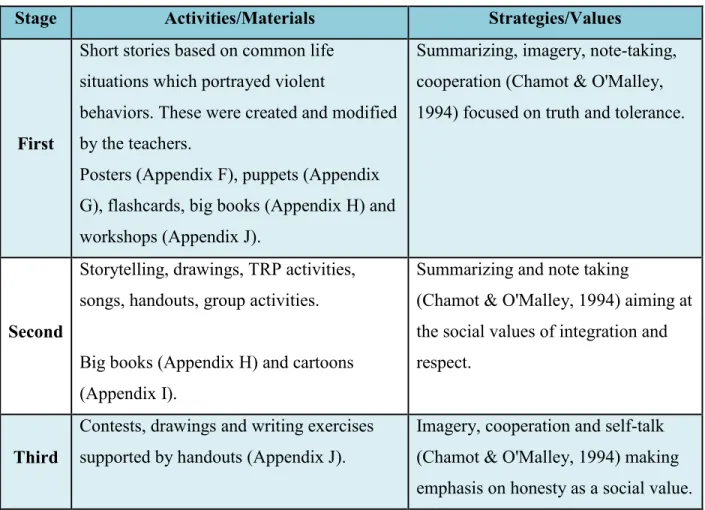
This pedagogical implementation was carried out in four months with second graders during 14 weeks. What we expected form this proposal is that our students become aware of their own learning process as well as their behavior in the English classes through learning strategies and social values. In this way, we could create a rich, comfortable and respectful environment in our classroom.For this propose, we proposed the following activities in which social values such as truth, tolerance, integration, respect, and honesty were implemented.
Table B1. Distribution and Organization of Content during the Pedagogical Implementation First, short stories based on common life situations portrayed some of the issues related to the violent behavior of the students and the lack of social values. These stories were modified in terms of content to make them suitable for the age and English level of the students; some
Stage Activities/Materials Strategies/Values
First
Short stories based on common life situations which portrayed violent
behaviors. These were created and modified by the teachers.
Posters (Appendix F), puppets (Appendix G), flashcards, big books (Appendix H) and workshops (Appendix J).
Summarizing, imagery, note-taking, cooperation (Chamot & O'Malley, 1994) focused on truth and tolerance.
Second
Storytelling, drawings, TRP activities, songs, handouts, group activities.
Big books (Appendix H) and cartoons (Appendix I).
Summarizing and note taking
others were created by us or taken from the internet, focusing on fables and short stories. In this activity the teacher provided vocabulary or phrases focused on meaning. The social values and stories were represented in posters (Appendix F), puppets (Appendix G), big books (Appendix H) and cartoons (Appendix I) in which the teacher was in constant communication with the students in order to provide feedback and clarify doubts; this activity implied the cognitive strategies of summarizing, imagery, note-taking and cooperation.
Second, students were engaged in cooperative exercises where they participated in competences, games, workshops (Appendix J) in which they worked in groups and activities that implied following instructions. These exercises were focused on monitoring comprehension, self-talk and cooperation strategies (Chamot & O'Malley, 1994).
Third, writing and speaking exercises also made part of our pedagogical intervention. These activities provided the students different language expressions and vocabulary which are useful for the students in terms of communicative skills in the EFL class. Cooperation and note taking strategies (Chamot & O'Malley, 1994) were addressed during these activities.
Fourth, students were immersed in discussions and activities that imply reflections towards short stories that were presented in the classroom, these activities were centered on summarizing and cooperation strategies (Chamot & O'Malley, 1994) making emphasis on the students’ perceptions and insights towards social values and the situations presented.
Fifth, handcrafting activities and listening activities were implemented in order to
Finally, we expected to create an EFL classroom where the students participate actively using their communicative skills. We hoped learners to use content regarding the English language such as vocabulary and common expressions using learning strategies that will help to improve their learning process. In addition, the activities that implied cooperation and reflection responded to strengthen social awareness which is related to the purposes stated previously from Constructivism and Humanism.
Criteria of Assessment
We planned to assess the students’ English language learning process and the
pedagogical intervention from different roles and perspectives. This process was carried out from roles as guides, storytellers, mediators, researchers and teachers through social values, learning strategies and diverse activities in the EFL class. In addition, the assessment as well as the feedback was provided to second graders in terms of their behavior, performance in the English classes and activities, using group and individual talks in order to guide students’ learning process taking into account their lacks and their strengths. Finally, the learning processes were supported by the construction of social awareness in regards to rules, social values and reflections.
At this point, the assessment was addressed along the process of the pedagogical intervention as well as at its conclusion. The data collection instruments to assess the
pedagogical intervention were group interview (See Appendix C) and journals (See Appendix E) and a Group interview is defined by Bogdan and Biklen (cited by Cohen, Manion and Morrison, 2007) as a tool that provides insights of the participants of the study in a faster way than
triangulation in qualitative research. These instruments were applied in order to gather data and answer our pedagogical question: How do learning strategies enhance second graders’ conscious EFL learning?
Role of the teacher
The teachers’ role was centered on guiding the students’ English learning process; group and individual feedback were provided at different stages of the classes. Hopefully, the feedback should help students with their doubts towards English language content. We also expected to provide less feedback as the pedagogical implementation advances in order to provide students opportunities to gain confidence and language content. The teacher should take into
consideration students’ insights and experiences in order to nurture the social values’ presentation, following humanistic ideals.
Role of the students
The role of the students had an ongoing process in which they participated actively and autonomously in diverse activities that imply English language content and social values to encourage their reflective processes. Students also practiced learning strategies in order to be aware of their EFL learning process. They were provided with spaces to become autonomous and responsible towards their acts inside and outside the classroom. This means that students should be aware of what they were doing while engaged in cooperative and individual activities sharing their insights, understandings and experiences towards social values in the English class. Role of the materials
materials were designed in order to provide spaces for the students to share experiences from their reality. In the same way, materials promoted the exemplification of social values as well as English language content such as vocabulary, phrases and rules.
To conclude, it is noticeable how the pedagogical implementation aimed at promoting social awareness through learning strategies and social values. The creation of activities took into account the theoretical background as well as the expectations we had towards students’
proficiency. It is relevant to highlight the innovation and pertinence of this pedagogical
Data Analysis
This chapter presents the data analysis process and the findings obtained by analyzing students’ responses from the data collection methods in order to answer the research question. This process was carried out by implementing Grounded Theory by Corbin and Strauss (1990) in order to label, organize and analyze the gathered information which revealed how second graders construct social awareness in the English class as a Foreign Language. In addition, the findings are presented in two categories described from its corresponding aspects which were analyzed from samples and theory that support this study.
Data Analysis Procedures
During the process of data analysis was relevant to apply Grounded Theory in order to have a scaffolding procedure. According to Corbin and Strauss (1990) this approach theory looks for “not only to uncover relevant conditions but also to determine how the actors under
investigation actively respond to those conditions and to the consequences of their actions” (p. 419). Taking into account this definition, Grounded Theory allowed us to unveil the students’ perceptions from the data collection instruments and its permanent contrast or compare procedures in order to narrow concepts to categories.
concepts or issues in each instrument to narrow them into eleven preliminary patterns which were labeled with different letters according to the students’ responses. This process is explained by Corbin and Strauss as: “comparing incidents and naming like phenomena with the same conceptual term can a theorist accumulate the basic units for theory. These concepts in the grounded theory approach become more numerous and more abstract as the analysis continues” (Corbin & Strauss, 1990, p. 420).
Following this further, these eleven preliminary patterns were given color codes and contrasted with the theory to validate them as sources to answer the research question; this validation was also mixed with some examples from the instruments to help the researchers to keep the focus when analyzing the students’ perceptions. In other words, theoretical memos are relevant in the coding process, which allow the researcher to revise the theory from the
beginning until the end of the analysis procedures (Corbin & Strauss, 1990).
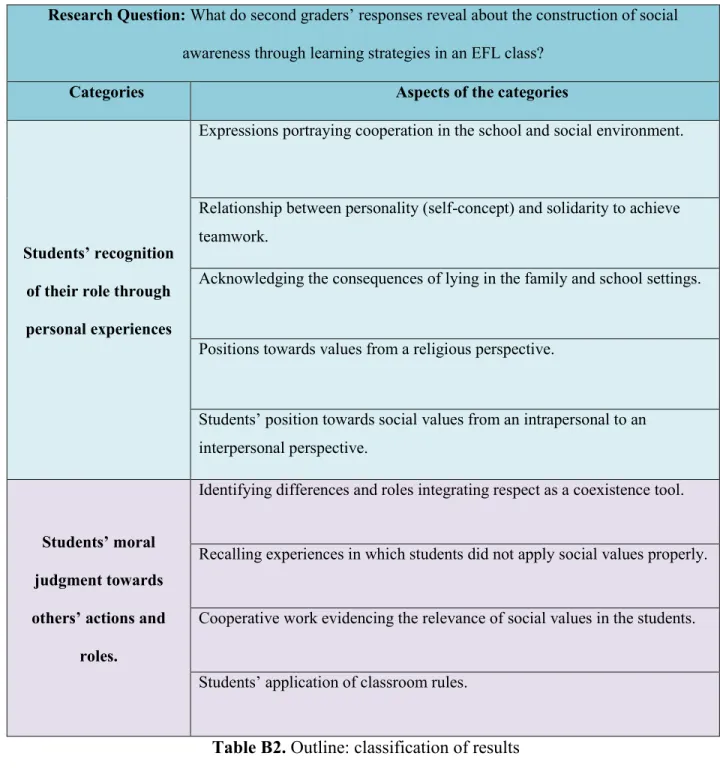
Research Question: What do second graders’ responses reveal about the construction of social
awareness through learning strategies in an EFL class?
Categories Aspects of the categories
Students’ recognition
of their role through
personal experiences
Expressions portraying cooperation in the school and social environment.
Relationship between personality (self-concept) and solidarity to achieve teamwork.
Acknowledging the consequences of lying in the family and school settings.
Positions towards values from a religious perspective.
Students’ position towards social values from an intrapersonal to an interpersonal perspective.
Students’ moral
judgment towards
others’ actions and
roles.
Identifying differences and roles integrating respect as a coexistence tool.
Recalling experiences in which students did not apply social values properly.
Cooperative work evidencing the relevance of social values in the students.
Students’ application of classroom rules.
Table B2. Outline: classification of results
Category 1:Students’ Recognition of Their Role through Personal Experiences
social environment. Second, Relationship between personality (self-concept) and solidarity to achieve teamwork. Third, Acknowledging the consequences of lying in the family and school settings. Fourth, Positions towards values from a religious perspective. And finally, Students’ position towards social values from an intrapersonal to an interpersonal perspective.
Pursuing this further, the first aspect called Expressions portraying cooperation in the school and social environment reveals the students’ perceptions and how they would react when facing different situations, which can be solved by using their cooperative work at the school setting. The following excerpt evidences how students proposed solutions to situations in which they would help a disabled student:
115 T: Listo. ¿Tú qué harías?
116 S2: Yo lo metería al grupo y lo ayudaría 117 T: Ayudar ¿Cómo le ayudarías?
118 S2: Lo ayudaría, digamos si él no puede jugar fútbol pues le ayudo y le enseño a jugar fútbol 119 con un pie si está en muletas.
(Video Recording 03. April 2nd, 2014. sic, Miguel Díaz)
English version:
115 T: Okay. What would you do?
116 S2: I would integrate him in the group and I would help him. 117 T: To help ¿How would you help him?
118 S2: I would help him, let’s say if he cannot play soccer I help him, and I teach him how to 119 play soccer with his foot if he uses crutches.
(…) then the teacher mentioned a hypothetical situation in which one student with a disability arrives to the classroom. The students expressed that they would help the disable student to learn or to play.
(Field Note 07. April 2nd, 2014.)
(2001) also claims that social values have to be practiced towards other people and the person itself to achieve an integral personal development. This practice was carried out by the students in terms of proposing solutions that implied helping others as well as keeping rules which were important for the English class, this result is similar to the findings portrayed by Aguirre,
Moliner and Traver (2014) in which the students were engaged into exercises using the students’ reality to propose solutions to certain situations that needed change.
The second aspect that supported the construction of this category aimed at the importance of the self-concept in order to achieve teamwork. In these examples, the students connect their experiences and actions towards the cooperation inside the classroom, including those people who may have differences with the rest of the group:
148 S11: Lo que importa es su personalidad porque nunca va cambiar, hay que 149 aceptarlo como es.
(Video Recording 03. April 2nd, 2014. sic, Juana Camacho)
English version:
148 S11: What it matters is his personality because he is never going to change, we have to 149 accept him the way he is.
56 T: Listo, muy bien. ¿Crees que es importante la integración? 57 S: Sí.
58 T: ¿Por qué?
59 S: Porque a veces cuando uno no…está integrado uno no… entonces uno dice ah
60 no mejor yo lo hago solo y le queda mal, y en equipo uno trabaja y cuando todos trabajan 61 pues lo hacen bien.
(Interview Transcription 04. May 16th, 2014. sic, Miguel Díaz) English version:
56 T: Okay, very good. ¿Do you think that integration is important? 57 S: Yes.
58: T: Why?
59 S: Because sometimes, when I don’t… I am integrated I don’t… So I say Ah!
Second graders’ perceptions are based on respect and tolerance, where they recognize the importance of working together, respecting and accepting people’s physical appearance and preferences. These might reveal social problems such as beauty constructs or standards, lack of tolerance in regards to differences and individualism. According to Durlark (cited in Pérez, 2013) social awareness implies being conscious about problems that the society faces in different contexts and situations, where conflict situations within a society emerge as a result of the lack of awareness about their own problems and responsibilities.
It is important to highlight that these perceptions portray the importance of some social values such as respect, tolerance and cooperation that aimed at emphasizing on the personality and acts rather than superficial and ephemeral aspects such as physical appearance and personal likes or preferences. Taking into account the study of Álvarez (2014) we can observe that there is a relationship between the students’ experiences and the values discussed in the class in terms of reflecting about behaviors across the curriculum.
At this point, Acknowledging the consequences of lying in the family and school settings exemplifies the consequences that the students recognize when they lie towards their parents and partners as we can observe in the examples below.
They said that Pinocchio was lying and that is why he had a long nose. The teacher also asked students about if they tell lies. Students started telling the situation in which they lie such as when they receive the evaluation’s grade, when they hit someone, etc. The students also expressed the consequences of lying and that it was wrong to do it.
(Field Note 09. April 30th, 2014.)
33 T: En esa clase también mencionaste que mentir es malo, con lo de pinocho, ¿te 34 acuerdas? ¿Por qué crees que mentir es malo?
35 S: Porque después la gente sabe que uno está diciendo mentiras y cuando uno 36 les dice la verdad no le creen.
English version:
33: T: In that class you also said that lying is bad, with Pinocchio ¿do you remember? 34 ¿Why do you think lying is bad?
35 S: Because… after people know that I am telling lies and when we I tell them the truth they don’t believe us.
102 S3: Cuando uno dice mentiras mucho tiempo entonces los papas ya no le creen.
103 T: Exactamente, pierdes credibilidad. ¿Qué pasaría si una persona miente durante todo el 104 mes? Yo les puedo decir…
105 S8: Pues después de mucho tiempo ya no le creen. (Video Recording 04. April 30th, 2014. sic, Sandro Veloza)
English version:
102 S3: When you lie too long your parents won’t longer trust you.
103 T: Exactly, you lose credibility. What would happen if a person lies during a whole month? 104 I can say…
105 S3: After too much time they don’t trust him.
The students’ perceptions reveal that they are aware of the consequences of lying from their personal experiences in a school and family context. Both examples imply a recognition of problems and situations that exist within one person, group or a community in dissimilar
contexts such as political, religious, and even philosophical which have been asserted by Durlark (cited in Pérez, 2013). In this case, students’ social awareness emerges from their experiences when they previously recognize the conflict situations that they would face when they lie. In addition, self-criticism is also present in the students such as the study of Aguirre, Moliner and Traver (2014), in this research students started being critic towards their actions and experiences in the past. This means that students are reflecting about previous episodes using what they have learnt.
In the second example, the student’s response revealed awareness in regards to the consequences of lying or the lack of honesty which is connected with their experiences in their family context. In this way, the construction of social awareness proposed by Silva (2004) implies a
self-reflection process and consulting others in order to acquire a shaped and mature awareness to prove or reprove an act.
As it was previously explained, social awareness is also constructed from considering the opinion of others. In this way, there is another figure that might guide students’ social awareness because of traditions in our country. In this aspect (Positions towards values from a religious perspective), the religion plays a role which establishes values and rules that should be followed in a community as the next example illustrates.
24 T: ¿Por qué? ¿Por qué dices que los colores son para todos?
25 S: Porque Dios no los hizo para unos para los hombres y otros para las mujeres, 26 los hizo para todos. Y si un niño quiere tener algo rosado, lo puede tener, o una 27 niña quiere tener algo negro y rojo lo puede tener.
(Interview Transcription 04. May 16th, 2014. sic, Miguel Díaz)
English version:
24 T: Why? Why do you say that colors are for everybody?
25 S: Because God did not make some of them for men and others for women,
26 He made them for everybody. And if a boy wants to have something pink, he can have it, or a 27 girl wants something black and red, she can have it.
In particular, the previous example portrays how the student’s perception emerges in a specific cultural context which influences the way of acting, thinking and perceiving the world. The student’s response in regards to God exposes beliefs that were learnt from his context and interactions as Silva (2004) and Yarce (2004) have stated, in which social values are
depending on the social interaction. This means, these learnt values were taught in a different setting besides the school and personal, which is reflected on the student’s opinions.
Students demonstrated that social awareness is also addressed from their self-concept and personality, pointing out the importance of being themselves without modifying their behavior by external opinions and considering the consequences of their actions, this aspect receives the name of (Students’ position towards social values from an intrapersonal to an interpersonal perspective). These are some examples of this aspect:
73 S11: Uno siempre va a ser igual y uno nunca va a cambiar la forma de ser. (Video Recording 03. April 2nd, 2014. sic, Juana Camacho)
English version:
73 S11: One is always going to be the same and never is going to change the way I am.
18 T: Bueno, muy bien. También durante las clases de inglés ¿te acuerdas que 19 estábamos hablando del respeto? Como tú dijiste ahorita y mencionaste que tú 20 viste un niño acá en el colegio que llevaba una maleta rosada y que lo molestaban 21 por eso ¿sí? ¿Por qué crees que lo molestan cuando llevaba eso?
22 S: Porque es que llevaba una maleta rosada, y como dicen que los niños tienen 23 los colores oscuros y eso. Pero yo creo que los colores son de todos.
(Interview Transcription 04. May 16th, 2014. sic, Miguel Díaz) English version:
18 T: Okay, all right. During the English classes, do you remember 19 we talked about respect? Like you said before, you mentioned that you 20 saw a boy, here in the school, with a pink bag and he was being bullied
21 by that, is that right? Why do you think he was bullied when he carried that element? 22 S: Because he was wearing a pink schoolbag, and as people say, boys have
dark colors and that. But I think that colors belong to everybody.