i
PENÍNSULA OF SANTA ELENA STATE UNIVERSITY
FACULTY OF EDUCATION AND LANGUAGES
ENGLISH TEACHING CAREER
TOPIC:
THE USE OF AN ELECTRONIC PORTFOLIO FOR INCREASING
ENGLISH WRITING SKILLS TO TENTH GRADE AT ESCUELA
DE EDUCACIÓN BÁSICA “JOSÉ PEDRO VARELA”, LA
LIBERTAD, PROVINCE OF SANTA ELENA, 2015-2016.
RESEARCH PAPER
AS A PREREQUISITE TO OBTAIN A:
BACHELOR´S DEGREE IN ENGLISH
AUTHOR:
JAZMINE RAIZA BARZOLA TIGRERO
ADVISOR:
Lcda. JEANNETTE CEVALLOS MSc.
i
UNIVERSIDAD ESTATAL PENÍNSULA DE SANTA ELENA
FACULTAD DE CIENCIAS DE LA EDUCACIÓN E IDIOMAS
CARRERA DE LICENCIATURA EN INGLÉS
TEMA:
“EL USO DE UN PORTAFOLIO ELECTRÓNICO PARA
INCREMETAR LA DESTREZA DE ESCITURA EN LOS
ESTUDIANTES DE DÉCIMO AÑO DE LA ESCUELA DE
EDUCACIÓN BÁSICA “JOSÉ PEDRO VARELA”, LA
LIBERTAD, PROVINCIA DE SANTA ELENA, 2015-2016”
TRABAJO DE TITULACIÓN
Como un pre-requisito para obtener el título de:
LICENCIADA EN INGLÉS
AUTOR: JAZMINE RAIZA BARZOLA TIGRERO
TUTOR: Lcda. JEANNETTE CEVALLOS MSc.
LA LIBERTAD – ECUADOR
ii La Libertad, May 2nd 2016
ADVISOR´S APPROVAL
In my role as Advisor of the research paper under the title “THE USE OF AN
ELECTRONIC PORTFOLIO FOR INCREASING ENGLISH WRITING SKILLS
TO TENTH GRADE AT ESCUELA DE EDUCACIÓN BÁSICA “JOSÉ PEDRO
VARELA”, LA LIBERTAD, PROVINCE OF SANTA ELENA, 2015-2016”
prepared by Jazmine Raiza Barzola Tigrero, undergraduate student of the English
Teaching Career, Faculty of Education and Languages at Peninsula of Santa Elena
State University, I declare that after having oriented, studied and reviewed the
project, I approve it in its entirety, because it meets the requirements and is
sufficient for its submission to the evaluation of the academic tribunal.
Sincerely
___________________________
iii La Libertad, May 2nd 2016
STATEMENT OF AUTHORSHIP
I, Jazmine Raiza Barzola Tigrero, with ID number. 2400102253 undergraduate
student from the Peninsula of Santa Elena State University, Faculty of Education
and Languages, as a prerequisite to obtain a Bachelor´s degree in English, in my
role as author of the research paper, “The use of an Electronic Portfolio for
increasing English writing skills to tenth grade at Escuela de Educación Básica
“José Pedro Varela”, La Libertad, Province of Santa Elena, 2015-2016”certify that
this work is of my authorship, except for the quotes and reflections used in this
research paper.
Sincerely
____________________________
Jazmine Raiza BarzolaTigrero
iv
BOARD OF EXAMINERS
Dra. Nelly Panchana Rodríguez, MSc. Lcda. Glenda Pinoargote Parra,M.A.Ed.
FACULTY OF EDUCATIONAND ENGLISH TEACHING LANGUAGES DEAN CAREER DIRECTOR
Lcda. Jeannette Cevallos Alcívar, MSc Ing. Verónica Vera Vera, MSC.
ADVISOR SPECIALIST
______________________________ Abg. Joel Espinoza Ayala, MSc.
v
DEDICATION
I dedicate this work to my family: my parents Arnold Barzola and Rosa Tigrero
because they always taught me how to work hard for what I want and deal with
everything, for their efforts and constant advices to not give up my dream, to my
niece and nephews because they look at me as an example for them. To my
boyfriend, Santiago Miranda because of his patient and constant advises and to my
whole family who supported me and helped in carrying out this work. I also
dedicate it to all the people who have supported me during the development of this
work: dear friends and professors.
vi
ACKNOWLEDGMENT
The development of this research project is especially dedicated to my Lord because
he gave me the force, blessings, the power and the intelligence to create and finish
this work despite of some obstacles that showed me; to my advisor who always
guided me throughout this process; she never accepted anything less than my best
efforts
To UPSE for giving me the opportunity to prepare myself in this institution and for
all the supports during my academic preparation, to all my professors for their
dedication, patience and guidance.
Lcda. Narcisa García Cajape, MSc. Principal from “José Pedro Varela” school and
teachers who let me apply this proposal.
The Director of the English Teaching Career MSc. Glenda Pinoargote Parra. For
her guidance and expertise managing the English Teaching Career.
vii
DECLARATION
The content of the following Graduation work is my responsibility; the intellectual
property belongs to Peninsula of Santa Elena State University.
_____________________________
Jazmine Raiza Barzola Tigrero
viii
TABLE OF CONTENTS
COVER ... i
ADVISOR´S APPROVAL ... ii
STATEMENT OF AUTHORSHIP... iii
BOARD OF EXAMINERS ... iv
DEDICATION ... v
ACKNOWLEDGMENT ... vi
DECLARATION ... vii
TABLE OF CONTENTS ... viii
GRAPHICS ... xvii
PICTURES ... xviii
APPENDIXES ... xix
ABSTRACT ... xx
INTRODUCTION... 1
CHAPTER I ... 3
STATEMENT OF THE PROBLEM ... 3
1. TITLE ... 3
1.2.1 Context ... 3
1.2.2. Critical Analysis ... 6
1.2.3 Formulation of the Problem ... 8
1.2.4 Guideline questions ... 9
1.2.5 Delimitation of research object ... 9
ix
1.4 OBJECTIVES OF THE RESEARCH ... 12
1.4.1 General objective ... 12
1.4.2 Specific objectives ... 12
CHAPTER II ... 13
THEORICAL FRAMEWORK ... 13
2.1PREVIOUS RESEARCH ... 13
History of Writing ... 15
English Writing ... 17
The Use of Technology in Ecuador ... 19
Importance of ICTs in Education ... 20
How ICTs influence in English writing skills ... 22
The Beginning of e-Portfolios ... 23
Classification of Portfolios ... 24
What should an e-portfolio contain? ... 25
2.2 PHILOSOPHICAL BASIS ... 27
2.1 FUNDAMENTAL CATEGORIES ... 29
Autonomous works. ... 29
Technological tools ... 30
Writing skills ... 30
Grammar skills ... 30
I.C.T. Information and communications technology. ... 30
Electronic portfolio. ... 31
Cuadernia. ... 31
x
Asynchronic. ... 31
Grammatical competences. ... 31
Sociolinguistic competence. ... 32
Discursive competence... 32
Strategic competence. ... 32
Informative tool. ... 32
Situating tool. ... 32
Constructive tool. ... 32
Communicative tools. ... 32
Specific tools. ... 33
Document management tools. ... 33
Social software tools. ... 33
Virtual environment Tools. ... 33
2.4 LEGAL BASIS ... 33
Constitution of Ecuador ... 34
Law of Intercultural Education ... 35
Childhood and Adolescence Code ... 35
2.5 HYPOTHESES ... 36
2.6 VARIABLES OF STUDY ... 36
2.6.1 Dependent Variable ... 36
2.6.2 Independent Variable ... 36
CHAPTER III... 37
METHODOLOGY ... 37
xi
3.1.1 Observation method ... 37
3.1.2 Experimental- analytical method ... 37
3.1.3 Analysis–synthesis ... 38
3.1.4 Quantitative method ... 38
3.1.5 Qualitative method ... 38
3.1.6 Comparative method ... 38
3.2 LEVEL OR TYPE OF RESEARCH... 39
3.2.1 Field research ... 39
3.2.2 Applied research... 39
3.2.3 Descriptive research ... 39
3.2.4 Ethnographic research ... 40
3.2.5 Historical research ... 40
3.2.6 Bibliographic research ... 40
3.3 POPULATION AND SAMPLE ... 41
3.3.1 Population ... 41
3.3.2 Sample ... 41
3.4 VARIABLES OPERATIONALIZATION ... 42
3.4.1 Independent Variable ... 42
3.4.2 Dependent variable... 43
3.5 TECHNIQUES AND INSTRUMENTS FOR DATA COLLECTION ... 44
3.5.1 TECHNIQUES ... 44
3.5.1.1Direct Observation ... 44
3.5.1.2Survey ... 44
xii
3.5.2 INSTRUMENTS ... 45
3.5.2.1Notebook ... 45
3.5.2.2Camera, video camera ... 45
3.5.2.3Questionnaire ... 45
3.6 DATA COLLECTION PLAN ... 45
3.7 DATA PROCESSING PLAN ... 47
3.8 ANALYSIS AND INTERPRETATION OF RESULTS ... 48
3.8.1 Survey directed to EGB “José Pedro Varela” students ... 48
3.8.2 Interview directed to specialist... 57
3.8.3 Interview directed to EGB “José Pedro Varela” teachers. ... 60
3.8.4 Results chart-students... 63
3.8.5 Analysis of results- students... 64
3.9 Observation Guide ... 64
3.9.1 Observation Class to Tenth Grade “A” ... 65
3.9.2 Observation Class to Tenth Grade “B” ... 66
3.10 CONCLUSION AND RECOMMENDATIONS ... 67
CHAPTER IV ... 69
THE PROPOSAL... 69
4.1 INFORMATIVE DATA ... 69
4.2 PROPOSAL BACKGROUND ... 70
4.3 SIGNIFICANCE ... 71
4.4 OBJECTIVES ... 72
4.4.1 General ... 72
xiii
4.5 DESIGN AND DEVELOPMENT OF THE PROPOSAL... 72
4.5.1 CUADERNIA ... 73
4.5.2 VARELA_EPORTFOLIO ... 74
4.5.3 HOW TO ACCESS TO “Varela_ePORTFOLIO” ... 75
4.5.4 DESCRIPTION OF “Varela_ePORTFOLIO” ... 75
4.5.4.1 Cover page ... 75
4.5.4.2 Table of content page ... 76
4.5.4.3 General objective page ... 76
4.5.4.4 Introduction page ... 77
4.5.4.5 Units from the Varela_eportfolio ... 78
4.5.4.6 Practice pages ... 78
4.5.4.7 Extra- activities pages... 80
4.6 Lesson plans for the activities in Cuadernia ... 82
4.7 EVALUATION ... 92
4.8 Assessment Process ... 93
4.9 Students’ improvement of tenth grade “A” ... 94
4.10 Students’ improvement of tenth grade “B” ... 97
4.11 STRATEGIES OF IMPROVEMENT ... 100
4.12 CONCLUSIONS AND RECOMMENDATIONS ... 100
CHAPTER V ... 102
ADMINISTRATIVE FRAMEWORK... 102
5.1 RESOURCES ... 102
5.1.1 Institutional ... 102
xiv
5.1.3 Materials ... 102
5.1.4 Technology ... 102
5.1.5 Economic... 102
5.1 TIMETABLE ... 103
5.2 BIBLIOGRAPHY ... 104
xv
CHARTS
Chart 1: Population ... 41
Chart 2: Independent Variable ... 42
Chart 3: Dependent Variable... 43
Chart 4: Data Collection Plan ... 46
Chart 5: Data Processing Plan ... 47
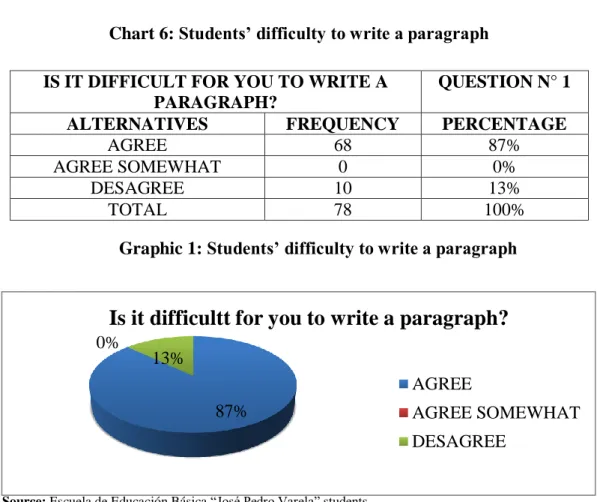
Chart 6: Students’ difficulty to write a paragraph... 48
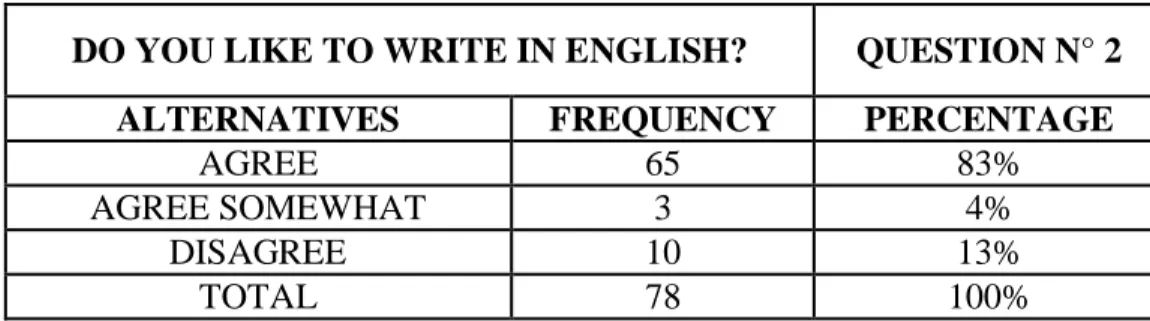
Chart 7: Students’ acceptance about writing in English ... 49
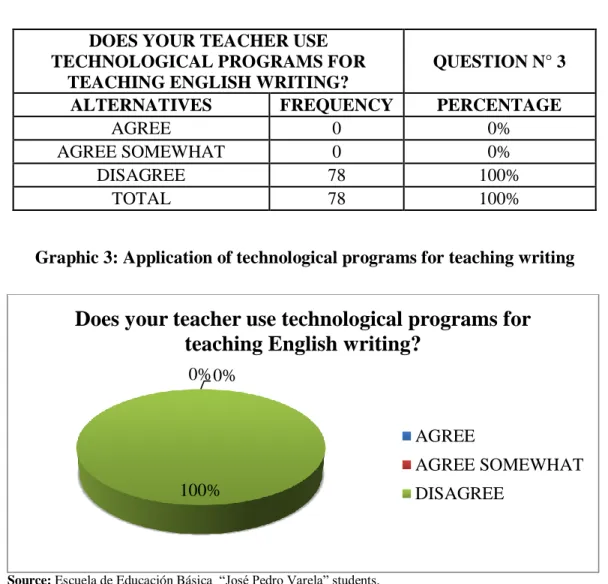
Chart 8: Application of technological programs for teaching writing ... 50
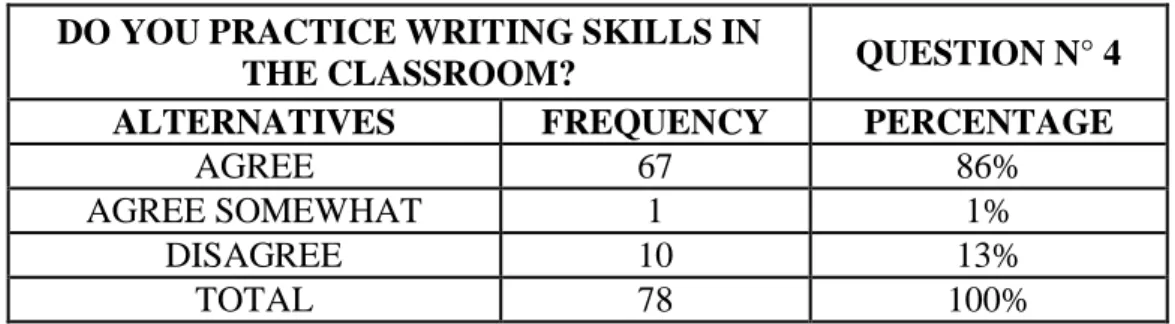
Chart 9: Practice of writing skill in the classroom ... 51
Chart 10: Importance of improving writing skill ... 52
Chart 11: Writing practice with innovative activities ... 53
Chart 12: Importance of using ICTs to improve English writing ... 54
Chart 13: The use of computers at school ... 55
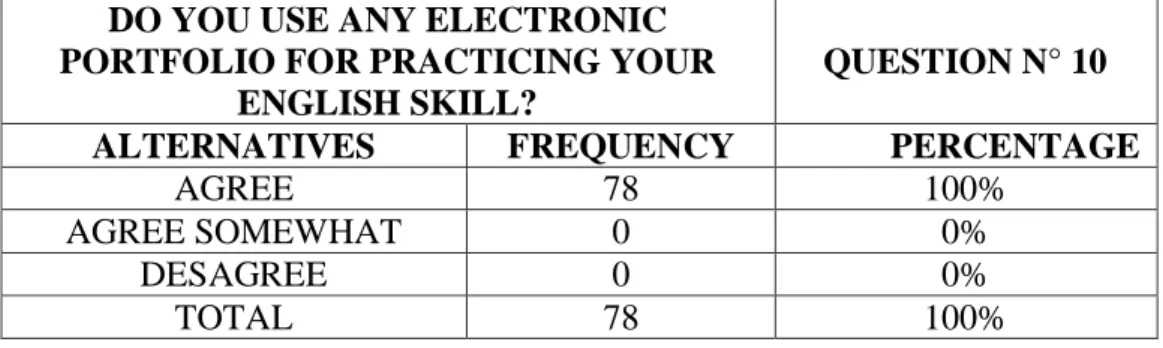
Chart 14: Use of electronic portfolios for practicing writing... 56
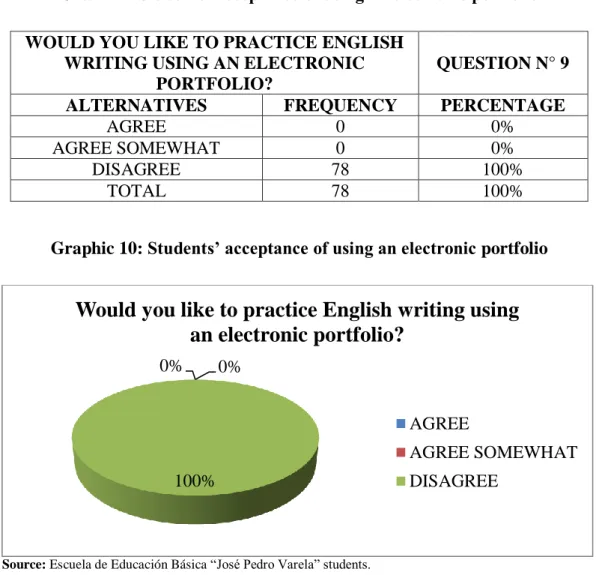
Chart 15: Students’ acceptance of using an electronic portfolio ... 57
Chart 16: Result students’ chart ... 63
Chart 17: Lesson Plan of Activity Nº 1 ... 83
Chart 18: Lesson Plan of the Activity Nº 2 ... 83
Chart 19: Lesson Plan of Activity Nº3 ... 84
Chart 20: Lesson Plan of Activity Nº 4 ... 84
Chart 21: Lesson Plan of the Activity Nº 5 ... 85
Chart 22: Lesson Plan of the Activity Nº 6 ... 85
xvi
Chart 24: Lesson Plan of Activity Nº 8 ... 86
Chart 25: Lesson Plan of Activity Nº 9 ... 87
Chart 26: Lesson Plan of Activity Nº 10 ... 87
Chart 27: Lesson Plan of Activity Nº 11 ... 88
Chart 28: Lesson Plan of Activity Nº 12 ... 88
Chart 29: Lesson Plan of Activity Nº 13 ... 89
Chart 30: Lesson Plan of Activity Nº 14 ... 89
Chart 31: Lesson Plan of Activity Nº 15 ... 90
Chart 32: Lesson Plan of Activity Nº 16 ... 90
Chart 33: Lesson Plan of Activity Nº 17 ... 91
Chart 34: Lesson Plan of Activity Nº 18 ... 91
Chart 35: Assessment Rubric ... 92
Chart 36: Students' Improvement-Tenth Grade "A" ... 94
Chart 37: Students' Improvement-Tenth Grade "B" ... 97
Chart 38: Strategies of improvement ... 100
xvii
GRAPHICS
Graphic 1: Students’ difficulty to write a paragraph... 48
Graphic 2: Students’ acceptance about writing in English ... 49
Graphic 3: Application of technological programs for teaching writing ... 50
Graphic 4: Practice of writing skill in the classroom ... 51
Graphic 5: Importance of improving writing skill ... 52
Graphic 6: Writing practice with innovative activities ... 53
Graphic 7: Importance of using ICTs to improve English writing ... 54
Graphic 8: The use of computers at school ... 55
Graphic 9: Use of electronic portfolios for practicing writing... 56
Graphic 10: Students’ acceptance of using an electronic portfolio ... 57
Graphic 11: Students' Improvement-Tenth Grade "A" ... 95
xviii
PICTURES
Picture 1: Cuadernia Empty e-book. ... 73
Picture 2: Varela e-PORTFOLIO cover... 75
Picture3: Table of content Page ... 76
Picture 4: Objective Page ... 77
Picture 5:Introduction Page ... 77
Picture 6: Resume of unit One ... 78
Picture 7: Activity page ... 79
Picture 8: Activity example... 79
Picture 9: Instruction buttom ... 80
Picture 10: Crossword Activity ... 81
Picture 11: Fill in the Gap Exercise ... 81
xix
APPENDIXES
Appendix 1: Specialist’s Interview ... 107
Appendix 2 Survey applied to students at EGB "José Pedro Varela ... 109
Appendix 3 Survey applied to Teachers at EGB "José Pedro Varela" ... 110
Appendix 4: Survey applied to the Principal at EGB "José Pedro Varela" ... 112
Appendix 5 Tenth “A” students’ List ... 113
Appendix 6: 10th “B” Students’ List ... 114
Appendix 7: Observation Guide ... 115
Appendix 8: Diagnostic Test ... 116
Appendix 9: Final Test ... 118
Appendix 10 Gallery ... 122
Appendix 11: Legal Basis ... 128
Appendix 12: Urkund Report ... 131
Appendix 13 Acceptance Letter to Apply the Proposal ... 133
xx
PENÍNSULA OF SANTA ELENA STATE UNIVERSITY
FACULTY OF EDUCATION AND LANGUAGES
ENGLISH TEACHING CAREER
THE USE OF AN ELECTRONIC PORTFOLIO FOR INCREASING WRITING SKILLS TO TENTH GRADE AT EGB “JOSÉ PEDRO VARELA”, LA LIBERTAD, PROVINCE OF SANTA ELENA ,2015-2016.
Author: Jazmine Barzola Tigrero
Advisor: MSc. Jeannette Cevallos Alcívar
ABSTRACT
In the present days, the use of information and communication technologies (ICTS) has emerged in our society due to the globalization. Big changes have been developed thanks to the use of technology especially in medicine and education field. Technology and education are closely connected because educators had implemented new strategies with the use of ICT, these tools allow students to acquire knowledge, develop skills, and create their own knowledge looking for new methodological resources using internet. The use of an electronic portfolio let students to develop the necessary skills in the teaching and learning process with the supervising of teachers in their role of guides. The present research shows the improvement of English writing skills work of the tenth grade students at Escuela de Educación Básica “José Pedro Varela” through the implementation of an electronic portfolio. The fundamental base of this research is to help students in their academic performance, the research is also based in the opinions and theories of important authors that used technology in education, as Jeremy Harmer, Bartholomae, Hyland, Margarita Garrido and others. To carry out the research project was necessary to select different methods and also techniques as surveys and interviews to obtain the highest level of accuracy and reliability. Portfolios are a collection of work used for some purposes, in education field nowadays it is common to use portfolios to collect information and activities given in the academic year with the purpose of reviewing and reinforcing knowledge. The uses of electronic portfolios will benefit students with low academic performance through the constant practice of activities given in the cuadernia application.
1
INTRODUCTION
To combine ICTs with education has become a significant aspect over the last few
decades. The application of technology in the English language classroom provides
many advantages for both teacher and students, for example, students take control
of their own learning as much as possible; technology provides them certain
freedom to work independently, students feel more engaged using technology to
practice any topic, in the case of teachers, they use technology as an resource to
find immense teaching strategies that support the teaching-learning process.
Moreover, technology facilitates the comprehension of the classes’ contents
through the use of digital aids.
This work derives from an analysis of student’s academic performance, causes and
effects about strategies that teachers used into the classroom. At first, it was
determined that students had writing problems at Escuela de Educación Básica
“José Pedro Varela”, the results of the interviews showed that teachers did not use
modern ways to teach and they were only focused on the practices from the English
books that government provides them, so students did not like to English writing
because they found it difficult and boring. Through the application of a diagnostic
test, students showed English writing skills weakness. To deal with students’
problems was not easy because it was necessary to look for different strategies and
select the best for avoiding the problem. In addition, the best option was to design
an electronic portfolio that will help students to develop English writing skills in a
2 The arrangement of this research paper is established by chapters which explain
different aspects of this work. They are described below:
Chapter I: This chapter gives detail about the statement of the problem, the critical
analysis, the significance of the problem, general and specific objectives.
Chapter II: It is about the theoretical framework, it contains previous researches,
philosophical basis, fundamental categories, legal basis, hypothesis and variables
of the study.
Chapter III: It is based on the use of various methods and techniques of current
need in evidence; in it you will find the research approach, level or type of the
research, population and sample, techniques and instruments, analysis and
interpretation of the results and finally conclusions and recommendations.
Chapter IV: In this part, the proposal is explained, which is the solution problem,
it contains informative data, proposal background, significance, objectives (general
and specifics), design and development of the proposal, charts, tables and graphs,
and interpretations of the results of surveys.
Chapter V: This chapter determines the budget which includes all the resources
needed for the development and implementation of this work, timetable and
3
CHAPTER I
STATEMENT OF THE PROBLEM
1. TITLE
THE USE OF AN ELECTRONIC PORTFOLIO FOR INCREASING ENGLISH
WRITING SKILLS TO TENTH GRADE AT ESCUELA DE EDUCACIÓN
BÁSICA “JOSÉ PEDRO VARELA” ,LA LIBERTAD, PROVINCE OF SANTA
ELENA, 2015-2016.
1.2 STATEMENT OF THE PROBLEM
1.2.1 Context
Currently, due to globalization, to learn English is considered as a necessity for
human beings around the world because of the great benefits that dominating a
second or foreign language offers, such as, better job opportunities, international
studies, establishing relationships with English speakers and knowing a different
culture. In Ecuador, the English language is the most used in many areas of life as
well as in personal and professional development. That is why the government
through the “Ministerio de Educacion” has implemented programs and necessary
equipment for teachers and students, with the purpose of increasing language
4 programs but there are still deficits in the English language teaching because not all
public schools have suitable tools for the development of English language.
Even though English is essential and important in the daily life for some people, it
becomes difficult at the moment to learn and develop the principal skills such as;
listening, speaking, reading and writing, and the other sub-skills, such as,
vocabulary, grammar and pronunciation. Recently, researches show that writing
and grammar are the most difficult part when a person is learning a foreign
language.
As a result of that, the educational authorities have implemented changes in the
English curriculum in order to students achieve the language proficiency that is
established by the Common European Framework of Reference for Languages
(CEFR). Thus, English Language Learning Standards, based on the Common
European Framework of Reference for Languages provide a common basis for the
description of objectives for every class, content and methods that teacher need to
apply during the lessons. For the Ecuadorian English language learners, the
proficiency levels determined by the CEFR are described below:
Level A1: At the end of 9th year Educación Básica General, students must achieve this level.
Level A2: Students of 1st Bachillerato must achieve this level at the end the course.
5 These are the level of proficiency of the English language that students need to
acquire at the end of their courses; they are basically developed taking into account
the communicative language components and the language skills as an important
aspect of the program: listening, speaking, reading and writing.
Lately, the Santa Elena province due to its economic and cultural development has
increased the visits of English foreigners. These English speakers come to know the
touristic sectors that the province has. Therefore, it has increased the necessity that
native people (children, teenagers, and adults) learn the English language in
educational institutions or in diverse programs.
Taking into account the English language levels of proficiency, students need to be
taught with a variety of strategies that guarantee the correct acquisition of the
language. The responsibility of teachers is to look for the most innovative methods
to present students the lesson topics.
Nevertheless, even though the application of strategies in the English language
classrooms, students still have problems in the different language areas.
Additionally, some students have a low level of motivation for learning because
books, in certain cases, are not related to the real necessities of them.
Therefore, teachers should adapt the contents of the English books to the students’
interest using different resources. An electronic portfolio is a didactic way for
presenting the topics to students because technology is present in the daily routine
6 with English subject because it is a motivational tool in which students feel
comfortable so they will learn in an enjoyable way.
At EGB “José Pedro Varela” English teachers still use the traditional methods and
traditional resources for teaching students the language. They solely focus on the
book exercises that government provides them. Those books sometimes become
very difficult for students because they have foreign information that they do not
recognize such as traditions, famous people, addresses, and others.
As mentioned above, the topics from the English books that the government
provides to public institutions, in some cases, are not according to their reality. This
can be a reason why most of students do not understand the information and ideas
about each topic given by the books therefore writing skill and grammar become
more difficult to understand.
To sum up, the use of technology is important because people are more
technological than past time. Nowadays, it is common to see students surfing on the
internet at any free moment, teenagers are inquisitive they like to discover new
things so adrenaline in them are focused on internet, they spend time in innovative
programs, so it will be easy to encourage students with an electronic portfolio
because they are going to spend time is something that they like more that is using
technological resources.
7 The implementation of technology in the English language courses is highly
important due to the benefits that this source provides to teachers and students in
order to enhance the teaching-learning process. Technology can be employed for
teaching and practicing any topic that is related with any English skill. In the case,
of writing, technology facilitates the writing instruction and writing process.
Escuela de Educación Básica “José Pedro Varela” is an honorable institution in the
Santa Elena province that works every day implementing new methodologies and
strategies to help the youth. However, it is important to make the point that students
of tenth grade at Escuela de Educación Básica “José Pedro Varela” from La
Libertad in the Province of Santa Elena face different problems that are caused by
different reasons. These reasons affect negatively in their English language writing
development.
There are many problems in students when they want to learn and improve their
English writing skills. First, the principal reason that affects the writing skill of
students is that teachers still apply traditional methods that produce the low level of
learning motivation of students. Unfortunately, the excessive use of the blackboard,
the English book and students’ notebooks in the English writing lessons do not
contribute to solve this problem. Moreover, the lack of the application of additional
material for writing is a serious problem because students just practice using the
exercises that come from their books, but those topics, in some cases, do not
respond to their reality. It is always essential to look for extra exercises that
8 It is known that public institutions have to cope with a huge number of students in
their classrooms; this has become an obstacle for achieving the various educative
objectives that are planned at the beginning of the courses. In the case of Escuela
de Educación Básica “José Pedro Valera”, classrooms are crowded of students and
therefore, it is difficult to check the progress of each one due to the lack of time to
supervise the writing performance of all students.
As a consequence, students do not domain the whole English language writing skill.
They do not know the writing process and therefore, their writing pieces do not
represent the knowledge they should have already acquired. Problems in grammar
structures, sentences order and the bad selection of vocabulary words are the
responsible of a low level in the writing competence.
To finish, these problems need to be solved in order to support students in their
English writing proficiency. Learners must feel familiarized with the English
subject using diverse strategies that incentive them to work on the English writing
learning; it is important that students feel confident during the writing lessons.
Hence, the use of an electronic portfolio is one way to maintain interesting English
classes, contributing to the development of the educative community in a virtual
way; this will fortify and improve their abilities, specially writing skill, because
technological resources engages students with the content and activities given by
teachers.
9 What are the benefits of the use of an electronic portfolio for improvement of
writing skills to tenth grade at Escuela de Educación Básica “José Pedro Varela”?
1.2.4 Guideline questions
How could English writing skill be determined in students of tenth grade?
How could an electronic portfolio be designed by using cuadernia web tool?
Could the implementation of an electronic portfolio improve the English writing
skill?
How to evaluate the impact of the application of an electronic portfolio in the
improvement of English writing skill in students of tenth grade?
1.2.5 Delimitation of research object
Field: Education
Area: English
Aspect: writing skills using an electronic portfolio.
Title: “The use of an electronic portfolio for increasing English writing skills to
tenth grade students at Escuela de Educación Básica “ JOSÉ PEDRO VARELA”,
10
Problem: what are the benefits of using an electronic portfolio for improvement
English writing skills to tenth grade students at Escuela de Educación Básica “José
Pedro Varela”?
Time limitation: The research will be target during the school year 2015-2016.
Population limitation: Escuela de Educación Básica “José Pedro Varela”
students.
Space limitation: Escuela de Educación Básica “José Pedro Varela”.
Context limitation: this research will be targeted on the importance of use of an
electronic portfolio to increase English writing skills at Escuela de educación
Básica “José Pedro Varela”.
1.3 SIGNIFICANCE
To justify the importance of this project development, it is necessary to collect
essential information using approaches, methods, and techniques which will show
reasons for students’ low academic performance, causes and effects and how to deal
with them. In addition, it is important to know that teachers what are the strategies
they use in order to strengthen students’ learning, the implements and tools that
they use and how to replace, change and adapt them.
Students of tenth grade at Escuela de Educaión Básica “Jose Pedro Varela” will be
11 the use of an electronic portfolio. This educative resource will help to promote and
develop English language learning, practicing the vocabulary, grammar structure,
and promoting the attention, memory and comprehension of students.
Powers, Thomson y Buckner (2000) considered in their book that electronic
portfolios are a learning resource that helps students in the cognitive process.
Despite electronic portfolio have the same content that a traditional portfolio the
way in which the material will be shown change using technological tools giving a
guide and facilitate language understanding. The activities let students to work in
an autonomous way developing the sense of responsibility. On the other hand, it
ensures minimal training that everyone wants to acquire and increase giving
students something to do in their free-time. Also, an e-portfolio enhances learners’
lives and stimulates their development acquiring more and better control over their
time of learning, so greater concentration and memorization is acquired in a better
way.
Excellent results will be obtained with the development and application of this
project because students will work on writing activities in an electronic portfolio
which will encourage them to develop their writing skills. The goal to achieve is to
reinforce the knowledge students have already acquired from the previous lessons
and to encourage students to continue working in their free-time practicing writing
skills through the compilation of activities developed after class. Finally, the use of
an electronic portfolio will promote learners autonomy and critical reflective
12
1.4 OBJECTIVES OF THE RESEARCH
1.4.1 General objective:
To evaluate the impact of an electronic portfolio by analyzing different theoretical
fundaments in order to increase the English writing skill in students of 10th grade
at Escuela de Educación Básica “José Pedro Varela”
1.4.2 Specific objectives:
To determine the English writing level according to the Common European
Framework of Reference for Languages (CEFR) of students of tenth grade.
To design an electronic portfolio using cuadernia web tool in order to increase the
writing skill of students of tenth grade.
To implement an electronic portfolio in students of tenth grade.
To evaluate the application of an electronic portfolio in the improvement of the
13
CHAPTER II
THEORICAL FRAMEWORK
2.1PREVIOUS RESEARCH
Education is a part of culture and society, and its role is to contribute and bring
people to be placed in culture and society, thereby, they can be independent and
recognize where it came from.
As countries are developing, new changes have been adapted to different aspects;
education is improving gradually and the implementation of new and technological
devices promotes the betterment of the teaching-learning process. ICTs are
powerful tools for extending educational opportunities, for which are necessary to
know advantages and disadvantages of using them into the teaching-learning
process.
Blanskat, Blamire and Kefala (2006) carried out a research in Europe about the
impact that ICTs exert in students of primary, the findings proved that ICTs had
positive effects on students’ performances in all knowledge areas of the English
language. Furthermore, results showed that in schools which used technology in the
classroom, their students had a rapid and relevant increase in their score
14 Many students considered that ICT tools were helpful because their aim was to
support them doing assignments, playing while they were learning through the use
of application and social networks, so most of learners felt comfortable with the use
of ICTs.
On the other hand, the implementation of technology helped to decrease student’s
social problems, because they had the possibility to work in teams or alone in an
enjoyable way with the purpose of performing a task given by teachers. Moreover,
it also created in students the sense of responsibility because they sought the way
to organize their work through activities or projects using technology.
Additionally, the study proved that using ICTs is extremely important in the
teaching-learning process and it also helped students that showed difficulties in
their learning. As a conclusion,ICTs made possible asynchronous and synchronic
learning, because they contributed students to achieve their necessities by
facilitating the management of information about each topic that requires to be
learned.
Likewise, Kevin Kelly and Ruth Cox, in 2012 between San Francisco State
University and the City College of San Francisco carried out an investigation in
which they employed the term “e-Porticulture” where e-Portfolio was explained as
seeds that grow among students, the project was developed in order to explain how
students acquire skillful and mental knowledge through the production, assessment
15 shared in a virtual way. The authors of the research were focused on the
development of effective instances of student learning with an emphasis on
documenting learning; they provided advices on selecting best tools for examining
assessment practices through e-Portfolios. They also mentioned that students who
owned e-Portfolios, incorporated individual learning goals; e-Portfolios are
formative in nature, capturing student interests into meaningful learning
experiences.
Another example of assessment practices using electronic portfolio was developed
at Clemson University, where e-Portfolios are required for graduation. Gail Ring
and Barbara Ramirez (2012) make an examination of how e-Portfolios are utilized
to assess general education requirements. The purpose of the program is to find a
mechanism to demonstrate how basic competences can be evaluated. Their theory
of change includes inputs, such as the e-Portfolio requirements and software;
including activities and participation based on short, medium, and long term goals
so student learning should be measured through established objectives. The
epistemological perspective applies external criteria to student learning, while an
ontological approach extends to the internal experience of the learners and their
changing ways of being with others.
History of Writing
According to Fischer (2004) “writing is much more than Voltaire’s painting of the
16 cultural medium (literature), the means of democratic expression and popular
information (the press) and art form in itself (calligraphy). The development of
writing has been important in the cultural development of human beings and their
psychological development. Its appearance marks the end of prehistory and it
begins to write the history of humanity. Also, its appearance in the child's
development marks the beginning of the psychological development of children to
higher levels.
Martin (1995) mentions that writing represents a recourse to graphic expression and
it seems to be represented man’s need to give visual form to his interpretations of
the external world. A thousand years ago, when the first groups of humans (homo
sapiens) appeared in the earth, their first manifestation of writing was done by the
use of images; these images were the way of communication that allowed them to
transmit their thoughts to others.
Later, a kind of writing appeared in West Asia that still traces drawing but it
aditionally gives a image sign to every word and it was called ideographic writing.
The writing teaching was restricted to small group of people in that time. (Christin,
2002)
Since the time that humans began to fix their thoughts using the written language,
this has followed a long process of evolutionary development in people. But not all
countries have the same way to write. Due to the colonization, people adopted
17 In the case of English language, English is a germanic language and nowadays is
the most spoken language, the history of English can be described from the arrival
of three Germanic tribes to the British Islands around 500 B.C. The Angles, Saxons
and Jutes. The angles called their own language “Englisc”, a word derived in
English.
English Writing
Harmer (2007) maintains that the building od writing habit is important; studnets
need to start writing because they like it. The role that English writing plays in
students of second language can be different from people that use it as a mother
language; therefore, students of second language show deficit to acquire abilities
of the written English language. The written communication has become an
imprecindible tool within many professional fields.
Hyland (2002) claims that writing has taken the center stage into the applied
linguistics and it remains today a subject of debate in the field of research to qualify
the skill to determine what guidelines to follow in their teaching and acquisition
procedure.
Getting a good writing proficiency is not easy even in the mother tongue despite
years in the development of this skill in various levels of people´s education.
Writing is considered a difficult language skill to acquire even if it is in a second
18 discomfort that reflect many students to face an activity that requires the use of
written competition.
Written language has evolved in the society because it is an important part of
communication as a social necessity and as a way to gain knowledge and solve
problems. The difference of spoken and written communication is that written
language is to communicate in one direction, the sender does not receive an
immediate response from the message receptor because of the physical distance
between the sender and receptor, so it requires paying more attention to the logical
organization of information, the receptor has to understand everything without
asking for clarification, the receptor needs to make a number of inferences about
the relevant knowledge and decide what to include in the message and what to
ignore, and must create a message that facilitate communication at all times.
For writing, it is important to have certain knowledge in different aspects, such as,
vocabulary, grammar, spelling, mechanics because they are necessary for a clear
written production. Peterson (2003) determines that grammar is fundamental for a
good written communication; students have to know different rules in order to
formulate questions, negotiate meanings, and combine sentences.
Thus, when people write a text must remember the figure of the reader and take into
account every rule of writing in order to give a clear and comprehensible message
19 information or ideas in verbal way from one individual or group, it can be formal
or informal depending on the situation in which a person is.
There are some situations when written communication is more effective. For
example, if a person wants to exchange information that can be documented in the
business world, it can be noticed that verbal skills is less detailed and
misunderstanding that writing skills; the ability to write in a clear and concise way
does not come natural, it must be practiced until to be mastered.
The Use of Technology in Ecuador
The use of technology in Ecuador has increased due to the constant progress of
education in this country, for which the use of technological applications is more
frequent in Ecuadorian classrooms. So, students looked interested in learning how
to use the technological programs. Using technology for teaching any topic
guarantees the assimilation and internalization of that knowledge. Technology
provides students the opportunity to appreciate the different educational
experiences becoming them more conscious for their own learning.
Ecuadorian people are ready to communicate and maintain economic, social and
political treatment with foreign people. It is important to make the point that some
educational institutions are being equipped with labs and other spaces with
20 Recently, the use of Portfolios is frequent in schools because it is considered a way
in which a person can evaluate students’ improvements. "Portfolio" is used as a
meaningful learning strategy and evaluation in the classroom, due to it seeks
selective, deliberate and varied productions gathering participants and teachers. In
the educational field, portfolios are accompanied by reflective works and
autonomous works.
According to technological advances, teachers need to upgrade their teaching
strategies, so nowadays; the use of manual portfolios is out. Innovative teachers
look for the best strategies with the purpose to help students’ learning, currently,
there are e-Portfolios that have the same goal that manual portfolios but what makes
the difference is the implementation of technology in the design of them which let
students to learn and practice in a virtual environment.
To conclude, an e-Portfolio is not a simple collection, it serves as a tool to control,
administrate and organized works created with different applications because it
includes additional exercises, personal reflections, and it usually promotes the
exchange of ideas and feedback.
Importance of ICTs in Education
The use of information and communication technologies (ICTs) has become
popular in almost all aspects of people’ life, in the last centuries, the use of ICT has
increased especially in the education field which has been traditionally associated
21 important and acceptable role in a digital medium of information. It is necessary to
know that today young people are an “online population”; technology is embedded
in our culture and society so it is necessary to be ready and provide learners relevant
and contemporary information that allow them to be successfully engaged with
technology and new knowledge.
The importance that new technologies prevailed in this modern world make people
prepare and educate constantly in the process of formation so they know when and
how to use them. Therefore, many people, with the use of internet, have access to
the world wide information and learning materials for approximately all subjects in
a variety of virtual contents. There is a variety of educative platforms, such as,
Facebook, Moodle, SchoolRack, Edmodo, Schoology, Blackboard, and others.
These educative platforms have educative purposes; they promote the learning of
students in a virtual and digital context.
ICTs also have a motivational influence on students’ learning all over the world.
ICTs do not only help students to acquire new knowledge but they also help teachers
because they facilitate the finding of new didactic strategies and materials for
teaching. With the use of technology, learners feel more motivated to continue
learning outside the classroom. Jacobsen and Kremer (2000) make the point that
“teachers have more flexibility ‘anytime and anywhere’ using technology because
they can plan motivational lessons, using ICTs make successful learners because
22
How ICTs influence in English writing skills
The use of ICTs in students of second language helps to develop easier and faster
all skills such as listening, speaking, reading and writing. This research is centered
in English writing skills, so it is necessary to point out the meaning of writing skills
and how ICTs can influence on the enhancement of this skill.
Harmer (2004) affirms that “activities which should engage students writing, build
their confidence, and make them feel comfortable with writing” (p. 5). He tried to
say that English activities will be assigned to students according to their real
necessities in order to get a better understanding and a better written production.
After any English language lesson, it is necessary that teachers provide students
positive feedback after their performances because they can reinforce the
knowledge learned previously. The feedback must be according to the content
explained in class not to new knowledge. For the writing lessons, Bartholomae
(2008) mentions that it is essential to analyze writing errors during and after English
classes because it led teachers to develop new techniques an methods to help
students to improve English writing skills” (p, 256).
Writing activities using ICTs give students opportunities to practice their writing
skill in an innovative form. Writing using technological tools contributes to the
development of a constructive environment. Additionally, motivation is a
fundamental aspect in the learning process, if students do not have interest to write,
23 wil be positively immersed in the activity because they will work deliberately
without pressure or being obliged to do it. In other words, ICTs influence, in a
positive way, on the achievement of better learning results of students.
The Beginning of e-Portfolios
Because globalization has emerged, changes in the field of education have been
adapted, so nowadays, technology is used around the word into the teaching
learning process. Dr. Helen Barrett is a retired educator, and internationally known
for her research on electronic portfolios in education. She is considered one of the
first teachers who discussed the importance of portfolios in a digital medium. She
also said that it is a tool to show the growth of students over time.
Electronic portfolios have a variety of purposes as assessments tool for employment
and the growth and development of students of all ages and levels from preschool
to professionals. The purpose and goals of portfolios is determined by the content.
Zubizaretta, (2004), in his book about Learning Portfolios in higher education,
describes the principal motive of a learning portfolio: “To improve students’
learning by the systematically reflection over time on the learning process and the
development of aptitudes, skills and habits that come only from critical reflection”
(p. 15).
The origin of the term portfolio comes from the French word “portefeuille” which
24 Prendes and Sánchez (2008) make the differences of the portfolio conception
according of two perspectives:
General perspective: a portfolio is a work log, a collection of material and work.
Educative perspective: it is a collection of learning evidence.
Classification of Portfolios
Poyatos-Matas and Allan (2005) claim that the portfolio is one of the best tools used
to develop student’s skills, such as, writing, grammar, speaking and listening.
Students are able to develop writing reports, synthesis, initiative and autonomy
capacity. It also lets teachers to differentiate the levels achieved by students and
document the enhancement of certain general skills. But chiefly, it allows knowing
the learning process of students after the lessons because they are evidence of
students’ practices.
There are different kinds of portfolios which will be mentioned bellow:
Teacher portfolios: The purpose of teachers’ portfolio is to document evidences
of teaching process, competences and guide long-term professional development;
teachers need archives’ information and evidence of teaching and learning progress.
Student portfolios: These tools will help students to demonstrate what they have
25 more works-in-progress that illustrate the creation of a product, as an essay,
evolving through various stages of conception, drafting, and revision.
Electronic portfolios: Electronic portfolios can be divided in two parts, the
multimedia development and the portfolio development, the first one means to
decide, design, develop and assess, the second one means to compile, choose and
observe. Both processes are important and indispensable for effective electronic
portfolio development. The role of an electronic portfolio is to provide learners and
teachers a powerful tool for demonstrating the advancement over time, which is the
elementary assessment of a portfolio.
They are also named as e-Portfolios, Web-Folio, e-Folio. Those are applications
based on educative which consist on personal digital records containing different
activities. An electronic portfolio should have: relevant information, save activities,
add reflections and comments, objectives, methodology, Store and manage
educational or reference materials, etc.
What should an e-portfolio contain?
An e-Portfolio is an educative tool used since many years ago in different countries
especially in the United Stated. The main purpose of e-portfolios is collect all
information given during the school year or at the end of each class unity; it is a
way of a continue evaluation because a portfolio cannot be done in a day, week or
26 things such as: activities, test, reflections, knowledge, process, preparation,
pictures, objectives, comments, etc.
Furthermore, according to IMS (Multimedia System), each e-Portfolio must have
the following features:
Identification: it is the identity of ePortfolio owner, it should have the name,
contact information, and demographics information.
Afiliation: It is a professional membership.
Product: it is all material that can be store electronically produced by the Owner.
Rubric: it is how a portfolio part is to be assessed.
Relationship: it will be portfolio Part-elements.
Competency: In this part, the owner of the portfolio must explain wich abilities and
skills will be acquired.
Goal: it means the objective of the e-Portfolio posessor.
Reflexion: it is to give a general comment identifying strengths and weaknesses of
the done tasks.
27
Activity: makes a record activities developed in class
Access code: it is the password for a better work security.
Free access: it is an advantage because anyone has acess.
2.2 PHILOSOPHICAL BASIS
Ausubel (1968) proposes that students’ learning depends on the cognitive structure
that is a set of concepts and ideas in a particular field of knowledge, as well as its
organization. Therefore, in the process of learning orientation, it is vital to know
the student's cognitive structure; not only about knowing the amount of information
it has, but what are the concepts and propositions that handles as well as its degree
of stability. This means that despite learners do not have scientific knowledge they
have experiences which have to be used in order to learn new learning so it is the
learning in which a student relates the new information with the already information
had redesigning and reconstructing both into the process.
The Vygotsky theory (1980) is based specifically in the socio-cultural learning of
the student and his environment. He considered that learning is a fundamental part
in the learners’ personal development. In his opinion, the best teaching is the
interaction with the environment in which a person grows. School learning must be
consistent with the child’s development level. Learning proceeds smoothly in group
situation where knowledge is not objects that go by one to another but they are
28 interaction. In this case, in order to students have social interaction with others, it
is important to develop language to communicate and written language is also a
way of communication, therefore, it is fundamental to practice and domain this
skill.
Dewey (1998) described that education is a constant construction of experiences.
The school and society was a great influence work, in which explained that
education is the medium by which people claim to have a chance to survive.
According to Dewey (1998), any educational system should satisfy the four basic
psychological needs of the child: experiences, ideas, reflection and learning. Hence,
teachers are the agents through which knowledge and skills are communicated and
rules of conduct enforced.
Bright (2007) notes that in today’s world, being able to write effectively contribute
enormously to a students’ ability to successfully navigate future life’s demands and
expectations. For example, it allows students to compose paragraphs in letters,
memos, e-mails, and others or write cards and thank-you notes in their personal
lives. Writing provides students with the opportunities to express themselves
creatively. Writing exercises, such as, writing lists supports students to clarify their
ideas or thoughts and their daily routines.
Gallagher (2006) makes the point that it is one thing to assign writing activities to
students; it is another to teach them how to write in those activities. Students are
29 writing instruction. Hence, students need a correct writing support by teachers and
it is necessary to assign writing tasks related to interesting and engaging topics for
students.
Kumari (1998) mentions that as information technologies become increasingly
accessible resources for educators to use in their teaching activities, meaningful
integration of these resources into learning activities becomes a fundamental issue
for pre-service and in-service teacher education. Therefore, teachers will need to
confront the vast amount of information that the Internet hosts and develop the
ability to harness this resource purposefully and productively in their classrooms.
Cambridge, Cambridge and Yancey (2009) note that learning about portfolios in
the past has become portfolio learning in the present through a shift in emphasis
from the implementation to inquiry. Likewise, when electronic portfolios emerged
in the educative field, many educators realized the possibilities for eportfolios uses
for improving documenting and assessing how students learn. This means that
teachers need to be ready for the diverse future challenges; and they must start using
technology as mediums to survive using computers which help them to get
reflective thinkers, developers, solver problems and self-evaluator of their own
learning.
2.1 FUNDAMENTAL CATEGORIES
Autonomous works: It is the act of work independently, self-controlling and not
30
Technological tools: Technological tools are methods that are used into the
teaching learning process it also driving the way that teachers teach and student’s
learned. There are many educational technology tools available to use in English
classroom
Writing skills: Writing skills are an important part of communication that allows
students to place ideas, feeling and creativities into a text. It is important to have
well- organized writing because good writing skills let to communicate messages
with clarity information and easy to understand to a far larger audience than through
face to face or telephone conversations.
Grammar skills: Grammar is the Branch of linguistic that deals with syntax and
morphology, sometimes also phonology and semantics a series of rules and the
order to have a better sentences understanding.
I.C.T. Information and communications technology: It is the unification of all
telecommunications use around the world with the purpose of informs and keeps
entertained to people in a nice way using the technology. According to UNESCO
(2002) information and communication technology (ICT) can be view as the
combination of computer and communication technology there is where different
kinds of ICT educative tools come from as mails, media conferences, television,
interactive applications, voice response system, audio-cassettes, cods, programs,
31
Electronic portfolio: A portfolio is a compilation of work developed across study
time. The electronic portfolio is different way to arrange, store and illustrate pieces
of work. The electronic portfolio allows designing a colorful and entertainment
works using the technology, which may include videos, audio, pictures, etc. in
addition electronic portfolios are becoming nowadays a popular alternative because
they offer the opportunity to review, correct and add virtual resources in an
asynchronous manner.
Cuadernia: It is a digital application that allows teachers and its other users the
design and creation of eBooks or ePortfolios in order to present students dynamic
and virtual activities that promote a better learning.
Synchronic: It is the interchange of information through internet in a real time. It
is also a kind of communication that exists between people and computers is
mediated by computers.
Asynchronic: Asynchronous refers to the event that has no place in temporary total
correspondence with another event. Asynchrony also refers activities that do not
require the simultaneous connection of the facilitator and participants, but everyone
involved in their own time. One example is the asynchronous forums in which all
participate in the conversation, but at different times.
Grammatical competences: It is the ability to recognize and produce the
distinctive grammatical structures of a language and to use them effectively in
32
Sociolinguistic competence: It is the ability to interpret the social meaning of the
choice of linguistic varieties and to use language with the appropriate social
meaning for the communication situation.
Discursive competence: Textual discourse competence refers to the ability to
understand and construct monologues or written texts of different genres, it
involves how to relate different types of discourse what is going to involves, be able
to relate information in a coherent way to the readers and hearers.
Strategic competence: It means the use of verbal and non-verbal communication,
to better the lack of grammatical comprehension that a speaker has in order to
promote an effective communication and compensate failures that limit
communication.
Informative tool: The Internet is a good way to keep information. There are various
tools to search information such as books, encyclopedias, world atlas, Google sites.
Etc.
Situating tool: With the use of this, teacher or students can create real situations,
using student’s imagination and experiences in real time using virtual media.
Constructive tool: It means to construct students own understanding.
Communicative tools: These tools can be used to communicate in real and
33
Specific tools: This includes all the tools that have been created specifically for the
creation and use of electronic portfolios. It can be programs installed in the
computers based on free software.
Document management tools: Those are programs used to created portfolio for
example Microsoft office Word, PDF, open office, etc. which replace the portfolio
handwriting. Handwriting portfolios are useful but do not have the advantages than
offer an electronic portfolio.
Social software tools: those are set of communication tools that facilitate the
interaction and collaboration; this includes digital publishing systems, such as wikis
and weblogs, Cuadernia app, etc. which can serve as digital portfolios.
Virtual environment Tools: Those are tools like blog and virtual communities
which serve to exchange information, some of them also include a space for an
e-portfolio. Those are designed to promote learning through shared knowledge,
conversation and reflection in an academic / social context.
2.4 LEGAL BASIS
In the development of this research, it was necessary to focus on the following laws:
Constitution of Ecuador, Law of Intercultural Education and the Childhood and
34
Constitution of Ecuador
With the purpose of improving peoples’ standards lives, Ecuadorian constitution
has promoted an intercultural and bilingual education. The main objective of this
system is to offer learners the opportunity to have communication with members of
other nationalities, towns and communities. In our country, this system has
increased from the smallest to the biggest cities.
For the development of this investigation, the author based on the article 27 form
the Constitution of Ecuador. This article is focused on the development of human
beings, respect of human rights, and the environment. People must be educated
without any kind of discrimination, taking into account justice, solidarity and peace;
stimulating critical thinking, art and development of intellectual abilities and
capabilities.
Moreover, the author based this research on the article 28. In this article, it is
established that public education must be universal and free for the whole educative
period of Ecuadorian citizens. People have the right to be involved in the educative
process interchanging ideologies of different cultures.
The investigator also analyzed the article 29 and mentions that this article mainly
refers to the right that all people who live in Ecuador have the right to get an
education of high level standards. Learners also have the right to study according
35
Law of Intercultural Education
The author analyzed the article 4 from the Intercultural Education Law. In this
article, it is determined that the Constitution of Ecuador will guarantee the
necessary condition for the realization of human rights, holding a quality education
secular, free and available in the initial, basic and high school level.
Furthermore, the article 185 was analyzed and it can be said that it is about the
evaluation and it refers that students must have a principal purpose that teacher
guide students in an accurate, relevant and timely way in order to help them to
achieve their goals.
Finally, the author based the investigative work on the article 186. This article
establishes that the kind of evaluation must be according to each purpose:
Diagnosed: it is applied at the beginning of each period.
Training: it is applied during the teaching learning processes and help to know
students achievements.
Summative: it is applied at the end of each period.
Childhood and Adolescence Code
The author also analyzed the article 37 from the Childhood and Adolescence Code.