
Estudio morfológico de talcos con microscopio electrónico de barrido (sem): aplicaciones farmacéuticas
13
0
0
Texto completo
(2) 24. cristalino (propiedad física) influye en la elaboración de suspensiones, facilidad de disolución y comportamiento frente a la compresión en la elaboración de comprimidos3. Las partículas de forma alargada son las de mayor compresibilidad4. Las de tipo laminar, con mayor recuperación y energías elásticas, presentan una menor deformación plástica durante la compresión que en el caso de los cristales poliédricos5. En tecnología, la morfología se entiende como la forma que adquiere la materia cuando se divide finamente, en función de su estructura y de los procesos de cambio que induce dicha forma6. La ultramicrofábrica se define como la organización de la muestra en términos de disposición espacial de las partículas constituyentes (teniendo en cuenta su forma, tamaño y frecuencia), considerada desde un punto de vista configuracional, funcional y genético y a escala ultramicroscópica (100/1000-10000X) (adaptado de7). Este carácter ilustra la evolución de las partículas de talco durante la molienda y las características intrínsecas de las muestras. Para uso en Farmacia los polvos de talco deben cumplir requisitos químicos, físico-químicos, mineralógicos y de Farmacopeas8,9, pero hasta el presente no se habían tratado los aspectos morfológicos, sobre todo para el caso de los excipientes. El Microcopio Electrónico de Barrido (SEM) es una herramienta fundamental para estudiar la morfología de partículas de muy pequeño tamaño; permite una visión tridimensional, que puede ser identificativa; sin embargo, tampoco hay muchos precedentes del empleo del SEM en Farmacia. El talco tiene de fórmula ideal: Mg 3 (OH)2 Si4 O 10(SiO 2 = 62.50%; MgO = 31.70%; H 2O = 4.80%), clase silicatos, subclase filosilicatos, estructura laminar tipo 2:1, grupo pirofilita-talco, carga laminar cero y por tanto, las láminas se unen entre si por fuerzas residuales de Van der Waals10. Es un mineral rico en magnesio, ligado a rocas magnesianas (rocas ultramáficas y dolomías silíceas metamorfizadas) que se origina por metamorfismo o metasomatismo de este tipo de rocas11,12. De simetría monoclínica, grupo puntual 2/m; son infrecuentes los macrocristales; suele presentar aspecto pétreo, compacto, macizo, o en masas exfoliables. Para uso industrial y en Farmacia requiere diversos tratamientos como: lavado, purificación y pulverización, hasta la obtención de polvos de un tamaño de partícula Ars Pharmaceutica, 43:1-2; 173-185, 2002. GÁMIZ E, SORIANO M, DELGADO G, PÁRRAGA J, DELGADO R.. crystalline habit (physical property) bears an influence in the production of suspensions, the ease with which it may be dissolved and its behaviour in processes of compression for the manufacture of tablets. Elongated particles have the greatest compressibility4. Laminar types, having greater recovery and elastic energies, are less prone to plastic deformation during compression than polyhedron crystals. In technology, the morphology is understood as the shape that the material acquires when it is finely divided, in accordance with its structure and the processes of change that induces such a formation6. The ultramicrofabric is defined as the organisation of the sample in terms of spacial arrangement of constituent particles (taking into account its form size and frequency), as considered from a configurational, functional and genetic point of view, on an ultramicroscopic scale (100/100010000X) (adapted from7). This character illustrates the evolution of the talc particles during the grinding and the intrinsic characteristics of the samples. For pharmaceutical use, talcum powders should satisfy chemical, physicochemical, mineralogical, and pharmacopoeia8,9 requirements. However, at present, morphological aspects, above all in the case of excipients, have not been dealt with. The Scanning Electron Microscope (SEM), is a fundamental tool for the study of very small particles that allow a tridementional observation and the possibility of identifying particles. However, few precedents of its use in pharmacy exist. Talcs possess the ideal formula: Mg3 (OH)2 Si4 O 10(SiO2 = 62.50%; MgO = 31.70%; H 2O = 4.80%), silicate types, phyllosilicate sub-types, layer type 2:1, pyrophillite-talc group, zero layer load and therefore, the layers bind with each other as a consequence of Van de Waals10 residual forces. It is a mineral rich in magnesium, bonded to magnesium rocks (metamorphosed silicous dolomite) that originate through metamorphism or metasomatism of these types of rocks11,12 ,. monoclinic symmetry specific group 2/m macrocrystals are infrequent. In appearance, it is a stonelike compact solid or is apparent in cleaved masses. For industrial and pharmaceutical use, several treatments are required such as: washing, purification and pulverisation until a powder of a particle size between 0.1 and 10µm, the limits for this type of product, is obtained. The crystalline struc-.
(3) ESTUDIO MORFOLÓGICO DE TALCOS CON MICROSCOPIO ELECTRÓNICO DE BARRIDO (SEM).... entre 0.1 y 10 µm, que son los límites para este tipo de productos 2,13. La estructura cristalina y composición química condicionan en el talco una dureza muy baja (1 en la escala de Mohs), exfoliación perfecta según 00l y poder lubricante. Pulverizado, presenta poder adsorbente, adherente, protector y una alta inercia química 14. Estas propiedades determinan sus aplicaciones en Farmacia y en Cosmética, como excipiente de comprimidos y de formas farmacéuticas de aplicación tópica 15. El objetivo de este trabajo es estudiar algunos aspectos de la forma de las partículas de talco pulverizado para uso industrial y farmacéutico y de preparados comerciales en forma de polvos de talco (constituidos por talco y diversos aditivos) Tales aspectos son: forma y tamaño de las partículas, apilamiento y exfoliación. Otro objetivo, ha sido la determinación de la ultramicrofábrica de muestras seleccionadas por su pureza en talco o por la presencia considerable de minerales impurificantes, de los que se analiza también la morfología.. 25. ture and chemical composition determine properties of very low hardness, (1 on the Mohs scale), perfect cleavage according to 001 and lubricating power. In a pulverised state, it possess adsorbent, adherent and protective properties as well as chemical inertia. These properties determine its applications in pharmacy and cosmetics, as an excipient in tablets and in pharmaceutical formulas for topical use 15. The objective of this work is to study some of the aspects of the shape of the pulverised talc industrial and pharmaceutical use and of comercial preparations in the form of talcum powders (made up of talc and various additives). Such aspects are:. shape and size of the particles, stacking and cleavage. Another objective, has been to determine the ultramicrofabric of samples selected for talc purity or for the considerable presence of nonpurifying minerals whose morphology is also analysed.. MATERIALS AND METHODS MATERIAL Y MÉTODOS Se estudian 12 muestras de polvos de talco procedentes de los cinco Continentes, clasificadas en: a) formulaciones de uso dermatológico y cosmético, con base de talco y aditivos diversos, de venta en comercios y Farmacias y b) muestras proporcionadas por yacimientos o compañías comercializadoras, para uso en Farmacia y Cosmética. (Caracteres generales en tablas I y II) 8 El estudio morfológico se ha realizado en el Servicio de Microscopía Electrónica de Barrido de la Facultad de Farmacia, con un microscopio electrónico de barrido Hitachi-S-510, resolución garantizada de 70 Å, rango de magnificación 20150.000, voltaje de aceleración 2-25KV, sistema de reducción de tres lentes y objetivo de apertura de lente fija de 0.1 y 0.3 mm de diámetro. El sistema de registro es fotográfico (35mm). Las muestras han sido directamente espolvoreadas sobre un papel adhesivo de doble cara; una parte se reserva para la observación y la otra se adhiere al portamuestras, asegurando la adherencia con pegamento de plata coloidal. Previamente a la observación, la superficie de la muestra ha sido metalizada con oro (50 a 100 Å de espesor) en dos orientaciones diferente16 , en un metalizador de vacio Semprep-2 Sputter Coaters.. Twelve samples of talcum powder from five continents were studied and classified into: a) formulations of a talc base and various additives for dermatological and cosmetic use, sold in chemists and on general retail, and b) samples obtained from natural deposits or retailing companies for cosmetic and pharmaceutical use. (General characters in tables I & II) 8 The morphological study was carried out with the aid of the Scanning Electron Microscope at the Faculty of Pharmacy, with a Hitachi-s-510 Scanning Electron Microscope, with a guaranteed resolution of 70 Å, a magnification range of 20-150.000, acceleration voltage 2-25KV, a three lens reduction system and fixed aperture lens of 0.1 and 0.3 mm in diameter. The recording system is photographic(35mm). The samples were sprinkled directly over double sided adhesive paper, one part reserved for observation and the other attached to the sample holder, assuring adherence with colloidal silver glue. Prior to observation, the surface of the sample was metalized with gold (50 to 100 Å of thickness) in two different orientations 16 in a vacuum metalizer semprep-2 sputter coaters.. Ars Pharmaceutica, 43:1-2; 173-185, 2002.
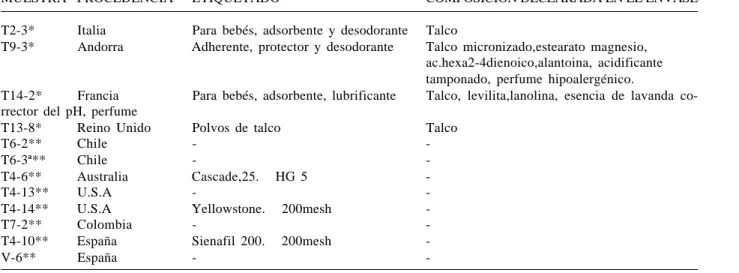
(4) 26. GÁMIZ E, SORIANO M, DELGADO G, PÁRRAGA J, DELGADO R.. TABLA I.- Características generales de las muestras. MUESTRA PROCEDENCIA. ETIQUETADO. COMPOSICIÓN DECLARADA EN EL ENVASE. T2-3* T9-3*. Para bebés, adsorbente y desodorante Adherente, protector y desodorante. Para bebés, adsorbente, lubrificante. Talco Talco micronizado,estearato magnesio, ac.hexa2-4dienoico,alantoina, acidificante tamponado, perfume hipoalergénico. Talco, levilita,lanolina, esencia de lavanda co-. Polvos de talco Cascade,25. HG 5 Yellowstone. 200mesh Sienafil 200. 200mesh -. Talco -. Italia Andorra. T14-2* Francia rrector del pH, perfume T13-8* Reino Unido T6-2** Chile T6-3ª** Chile T4-6** Australia T4-13** U.S.A T4-14** U.S.A T7-2** Colombia T4-10** España V-6** España. *:”Polvos de talco” comerciales de venta en farmacias y perfumerías.**: Muestras de yacimientos para uso industrial y farmacéutico TABLE 1. General Characteristics of the Samples. SAMPLE. ORIGIN. LABELLING. COMPOSITION STATED IN CONTAINER. T2-3* T9-3*. Italy Andorra. For babies, absorbent and deodorant Adherent, protective and deodorant. T14-2*. France. For babies, absorbent, lubricating. T13-8* T6-2** T6-3ª** T4-6** T4-13** T4-14** T7-2** T4-10** V-6**. United Kingdom Chile Chile Australia U.S.A. U.S.A. Colombia Spain Spain. Talcum powder Cascade,25. HG 5 Yellowstone. 200mesh Sienafil 200. 200mesh -. Talc Micronized talc, magnesium stearate, hexa-2,4dienoic acid, allantoin, buffered acidifier, hypoallergenic scent. Talc, lanolin, lavender scent, pH corrector, perfume Talc -. *:Commercial “Talcum powder” on sale in pharmacies and drugstores .**: Site samples for industrial and pharmaceutical use.. Ars Pharmaceutica, 43:1-2; 173-185, 2002.
(5) A MORPHOLOGICAL STUDY OF TALCS WITH SCANNING ELECTRON MICROSCOPY (SEM).... 27. TABLA II.- Características granulométricas y mineralógicas de las muestras. MUESTRA. ARCILLA. LIMO. ARENA. PUREZA. MIN. IMPURIFICANTES. T2-3 T9-3 T14-2 T13-8 T6-2*. n.d. 10.0 5.1 n.d. 4.2. n.d. 60.8 75.3 n.d. 58.3. n.d. 29.2 19.6 n.d. 37.5. (++) (+) (+) (+++) (+). T6-3ª* T4-6* T4-13* T4-14* T7-2* T4-10*. 4.1 14.5 4.0 13.6 8.4 3.9. 66.6 82.9 52.1 51.5 62.9 50.2. 30.3 2.5 43.9 34.9 28.7 54.9. (+) (+++) (+) (+++) (+) (+). V-6*. 5.0. 5.7. 39.3. (+++). Clorita, mica, calcita, cuarzo, dolomita Clorita, calcita mica, dolomita, FeldNa Clorita, tr. de mica, de Feld K, de interestratificados Tr. de mica, de cuarzo, de FeldK, de calcita Clorita, mica, cuarzo, magnesita, dolomita, feld.Na, tr de anfíboles** Clorita,mica,magnesita, Feld.Na, cuarzo, dolomita Tr. de cuarzo, de FeldK, de FeldNa, de calcita, de dolomita Clorita, cuarzo, tr de FeldNa, de magnesita, de dolomita Tr. de interestratificados Clorita, calcita, anfibol, dolomita, tr. de interestratificados Clorita, mica, tr. de cuarzo, de calcita, de interestratificados FeldNa, tr. de dolomita, de calcita, de interestratificados. Granulometría: % en peso de arcilla(<2µm), limo (2-20µm) y arena (>20µm). Pureza en talco (DRX): (+++) muy puro; (++) medianamente puro; (+) poco puro. *Análizado en fracción arcilla. **Detectados mediante SEM y microanálisis. Tr.: trazas; Feld.Na: feldespato sódico. Feld.K: feldespato potásico; n.d.: no determinado. TABLE II.- Granulometric and mineralogical characteristics of samples. SAMPLE. CLAY. SILT. SAND. PURITY. MIN. NON-PURIFYING SUBSTANCES. T2-3 T9-3 T14-2 T13-8 T6-2*. n.d. 10.0 5.1 n.d. 4.2. n.d. 60.8 75.3 n.d. 58.3. n.d. 29.2 19.6 n.d. 37.5. (++) (+) (+) (+++) (+). T6-3ª* T4-6* T4-13* T4-14* T7-2* T4-10* V-6*. 4.1 14.5 4.0 13.6 8.4 3.9 5.0. 66.6 82.9 52.1 51.5 62.9 50.2 5.7. 30.3 2.5 43.9 34.9 28.7 54.9 39.3. (+) (+++) (+) (+++) (+) (+) (+++). Chlorite, mica, calcite, quartz, dolomite Chlorite, calcite, mica, dolomite, Na Feld Chlorite, tr. of mica, of K Feld, of interstratified Tr. of mica, of quartz, of K Feld, of calcite Chlorite, mica, quartz, magnesite, dolomite, Na Feld, traces of amphiboles** Chlorite, mica, magnesite, NA Feld, quartz, dolomite Tr. of quartz, of K Feld, of Na Feld, of calcite, of dolomite Chlorite, quartz, traces of Na Feld, of magnesite, of dolomite Traces of interstratified Chlorite, calcite, amphibole, dolomite, traces of interstratified Chlorite, mica, traces of quartz, of calcite, of interstratified Na Feld, traces of dolomite, of calcite, of interstratified. Granulometry: in clay weight (<2µm), mud (2-20µm) and sand (>20µm). Talc purity (DRX): (+++) high purity; (++) medium purity; (+) low purity. *Analysing in clay fraction. ** Detected through SEM and microanalysis. Tr.: traces, Feld.Na: sodium feldspar Feld K: potasium feldspar; n.d.: not determined.. RESULTADOS Y DISCUSIÓN. RESULTS AND DISCUSSION. 1. Morfología del mineral talco. 1. Morphology of Mineral Talc. 1.1. Forma y tamaño de las partículas. 1.1. Shape and size of particles. Las morfologías de las partículas de talco las hemos clasificado en: Partículas pequeñas con cierta unidad estructural, aunque pueden estar en proceso de exfoliación. La molienda, genera estas partículas de hábitos laminares, heterométricas (tamaños entre 5 y 15 µm), irregulares, muchas de ellas ligeramente alargadas y con tendencia a curvarse (Fig.1 a).. The morphology of the talc particles have been classified into: Small particles that although having a certain structural unity, may be in the process of cleavage. Grinding generates particles of laminar habit, heterometric (of sizes between 5 and 15µm) many of which are slightly elongated and have a tendency to curve (fig 1 a). Ars Pharmaceutica, 43:1-2; 173-185, 2002.
(6) 28. GÁMIZ E, SORIANO M, DELGADO G, PÁRRAGA J, DELGADO R.. Partículas grandes de tamaño entre 20 y 50 µm, están en proceso de pérdida de unidad física, por la baja dureza y la exfoliación según 00l. Presentan un muestrario de morfologías que pueden ilustrarse en las siguientes figuras: 1 b, 1 c y 1 d. La Fig.1c recoge el proceso de formación de los agregados en “bolsa”. La Fig. 1d podría considerase como un ejemplo intermedio entre gran partícula y agregado.. Large particles of a sizes between 20 and 50mm are in the process of loosing physical unity due to low hardness and cleavage according to 001. They present a collection of samples of morphologies that can be illustrated in the following figures: 1b, 1c and 1d. Fig 1c reflects the formation process of the aggregates in “pockets”. fig. 1d could be considered as an intermediate example between large particles and aggregates.. Agregados de partículas constituidos por partículas grandes y pequeñas, desordenadas, de aspecto poroso o masivo. Las partículas se encuentran asociadas (agregadas) en unidades morfológicas compuestas (Figs.2a, 2b, 2c y 2d) Algunos hechos destacables son que el agregado de la Fig.2a posiblemente se origina por evolución de una gran partícula durante el proceso de molienda. En la Fig.2b no se descarta que internamente pueda ser un agregado en “bolsa”. Particle aggregates made up of disorganized large and small particles of porous or masive appearance. The particles are encountered in associated formations (aggregates) in units of morphological compounds. (figs 2a, 2c, and 2d). One outstanding observation is that the aggregate in fig. 2a comes into being through the evolution of a large particle during the grinding process. In fig. 2b the possiblity that internally, a “pocket” aggregate exists, cannot be ruled out. “Pocket” aggregates made up of large thin laminates, that during the grinding process are easily fragmented, due to perfect cleavage according to 001, low hardness and little consistency. Due to its elasticity, small particles are curved and enveloped. fig. 3a & b). Agregados en “bolsa” compuestos por láminas grandes, delgadas que en la molienda se fragmentan fácilmente debido a la exfoliación perfecta según 00l, la escasa dureza y la poca consistencia. Por su elasticidad, se curvan y envuelven a partículas más pequeñas.( Fig. 3a y b).. FIGURA 1. a) Fot. 0002. TV-6. Partículas individuales, laminares, de pequeño tamaño (5 a 15µm), poco curvadas y subredondeadas. Fábrica laminar en dominios. b) Fot. 0017. T13-8. Partícula grande (20 a 50µm). Hemipseudoesférica, subredondeada, curvada, en proceso de exfoliación. Fábrica laminar concéntrica. c) Fot. 6272. T13-8. Partícula grande. Pseudopoliédrica, subredondeada, poco curvada, con gran integridad estructural. d) Fot. 0027. TV-6. Caso mixto entre partícula grande y agregado. FIGURE 3 a & b) phot. 0002. TV-6. Individual particles, laminates small in size (5 to 15µm), little curving and subrounded. Laminar fabrics in domains. b) Phot. 0017. T13-8. Large particle (20 to 50µm). Hemipseudospherical, subrounded, curved, in the process of cleavage. Concentric laminar fabric. c) Phot. 6272. T13-8. Large particle. Pseudopolyhedral, sub-rounded, slight curvature, with high degree of structural unity. d) Phot. 0027. TV-6. Mixed example between large and aggregated particles.. a). Ars Pharmaceutica, 43:1-2; 173-185, 2002. b).
(7) ESTUDIO MORFOLÓGICO DE TALCOS CON MICROSCOPIO ELECTRÓNICO DE BARRIDO (SEM).... c). 29. d). 1.2. Ultramicrofábrica:. 1.2. Ultramicrofabric:. Ha sido considerada parcialmente al tratar la forma de las partículas, la presencia de agregados y su génesis (proceso de molienda). No obstante, aquí se tratarán específicamente los aspectos configuracionales.. Ultramicrofabric has been partially considered in the study of the shape of the particles, the presence of the aggregates and their genesis (grinding process). However, configurational aspects will be specifically dealt with here.. Fábricas laminares concéntricas y planares Configuradas por láminas o capas subredondeadas, de pequeño tamaño de partícula y con predominio de uniones cara-cara entre las partículas (Fig.1b y 1d). La forma redondeada y pseudoesférica de los agregados, por molienda (Fig. 2c y 2d), alcanza no sólo a la configuración externa sino también al curvamiento de las láminas y al desarrollo de una fábrica interna en dominios laminares, organización concéntrica, muy anisotrópica y con tendencia a desescamarse, comparable a la estructura de una cebolla. Si el efecto del curvamiento es poco manifiesto, la fábrica será laminar-plana, como sucede en algunas partículas grandes (Fig. 1c).. Concentric and flat laminated fabrics consisting of laminates or sub-rounded layers of small particle size and a predominance of face to face links between particles (fig 1b and 1d). The rounded and pseudospherical shape of the aggregates through grinding (fig. 2c & 2d) extends not only to the external configuration but also to the curvature of the laminates and to the development of the internal fabric in the laminar domains, concentric organisation, marked anisotropism and a tendency to flake off. This structure is comparable to that of onion. Where the curvature is less manifest, the fabric will present a flat laminate formation, as occurs in the case of large particles. (fig 1c. Fábricas laminares en dominios Los dominios laminares individualizados corresponden a una mayor evolución, por reducción de tamaño debida a la molienda, y en ellos son frecuentes las láminas individualizadas curvadas, desflecadas, abiertas, junto a dominios de mayores dimensiones, con forma más paralelepipédica. En la Fig.1a, ya comentada, constituida por partículas pequeñas se aprecian también algunas uniones entre partículas tipo cara-cara y borde-cara.. Domains of laminar fabrics. The individualized laminar domains present a greater evolution due to a reduction in size caused by the grinding process. In such domains, curved individualized laminates are encountered, which are frayed and open, being found together with domains of greater dimensions, in parallelopipedic formation. In fig 1a, as already mentioned, whilst made up of small particles, some face to face and edge to face bindings among particles may be observed.. Fábricas de agregados Intermedias entre las fábricas anteriores. Así, los agregados en “bolsa”, mezclan la fábrica laminar concéntrica o planar. Aggregated fabrics are intermediate fabrics with regard to those previously mentioned. The “pocket” aggregates, mix the concentric laminar Ars Pharmaceutica, 43:1-2; 173-185, 2002.
(8) 30. GÁMIZ E, SORIANO M, DELGADO G, PÁRRAGA J, DELGADO R.. (envoltura externa) y en dominios (interior) (Fig.3a y 3b).. or planar fabric(external covering) and in domains (interior) (fig 3a and 3b).. FIGURA 2. TV-6. a) Fot. 6229. Agregado de partículas, poroso y desordenado. Tamaño entre 50 y 70µm. Fábrica de agregados con uniones cara-cara y cara-borde. b) Fot. 6230. Agregado cuasiesférico y redondeado, con tamaño de ≈100µm. Con pocas partículas en proceso de exfoliación. Fábrica de agregados. c y d) Fot. 0005 y 0021. Agregados redondeados, menos compactos que Fot. 6230 y de menores dimensiones. FIGURE 3 a & b) phot. 6229. Aggregates of particles, porous and disorganised. Size between 50 & 70µm. Aggregates of fabrics with face to face and face to edge bindings. b) Phot. 6230. Quasisherical and rounded aggregates, with size of ≈100µm. Few particles in the process of cleavage. Aggregate fabric. c & d) phot. 0005 & 0021. Rounded aggregates, less compact than Phot. 6230 and smaller in dimension.. a). b). c). d). Los agregados desordenados (Fig 2a) tienen una fábrica también basada en las anteriores, con matices diferenciadores. El tipo básico es la fábrica laminar en dominios, de partículas pequeñas (frecuentemente <15µm) que se agregan en unidades mayores (>50µm de diámetro), porosas, con muchas uniones cara-borde.. Ars Pharmaceutica, 43:1-2; 173-185, 2002. The disorganized aggregates (fig 2a) possess a fabric that is also based on previous cases but present slight differences. Laminar fabrics in domains are the basic types with small particles (frequently <15µm) that are aggregated within larger entities, porous, with many face to edge bindings..
(9) A MORPHOLOGICAL STUDY OF TALCS WITH SCANNING ELECTRON MICROSCOPY (SEM).... 31. FIGURA 3. a y b) Fot. 0024 y 0030. TV-6. Agregados en “bolsa” de 50 mm de tamaño. La Fot. 0024 muestra un agregado más poroso que la Fot. 0030. c) Fot. 0008. T14-2. Partículas laminares de clorita (impurificante muy abundante en la muestra, tabla II), menos curvadas y más gruesas que el talco. d) Fot. 6270. T7-2. Partícula fibrilar de anfíbol (impurificante) (>250mm de longitud y relación de dimensiones <1/10). Destacan en ella las exfoliaciones prismáticas. FIGURE 3 a & b) phot. 0024 & 0030. TV-6 Aggregates in pockets, 50mm in size. Phot 0024 shows a more porous aggregate than the phot. 0030. c) Phot. 0008. T14-2. Laminar particles of chlorite ( Non-purifying and very abundant in the sample, table II) less curvature and thicker than talc. d) Phot. 6270. T7-2 Fibril particle of amphibole (nonpurifying) (>250mm in length and relationship of dimensions <1/10). Prismatic cleavage in clear evidence.. a). b). c). d). 2. Morfología de los Minerales impurificantes. 2. Morphology of Non-purifying Minerals. Estos minerales distintos al talco han sido detectados mediante DRX (tabla II). El estudio morfológico los identifica por sus hábitos característicos.. These minerals that present differences with talc have been detected with DRX (table II) The morphological study identifies them by means of their behavioural characteristics.. Cloritas: Silicatos, subclase filosilicatos, tipo 2:1, carga variable y fórmulas diversas. Como ejemplo se expone la fórmula de la clorita, para media celdilla unidad, del talco T4-10: (Si3.52 Al 0.48)(Mg 5.21Al 0.78)O 10 (OH)88. La clorita tiene. Chlorites: silicates, phyllosilicate sub-types, type 2:1, variable loads and varying formulas. As an example, the formula of chlorite is exhibited for the half cell entity of talc T4-10: (Si3.52 Al 0.48)(Mg5.21 Al 0.78)O10(OH) 88 . The chlorite has Ars Pharmaceutica, 43:1-2; 173-185, 2002.
(10) 32. GÁMIZ E, SORIANO M, DELGADO G, PÁRRAGA J, DELGADO R.. enlaces entre las láminas 2:1, más fuertes; la interlámina es una capa octaédrica y el enlace lámina–interlámina es por puentes de hidrógeno. En el talco, sin interlámina, las fuerzas de unión entre láminas son residuales9. Estas diferencias con el talco suponen: cristales de formas más planas, menos curvadas y láminas exfoliadas más gruesas (Fig.3c). Los tamaños oscilan entre 20 y 60 mm. A veces aparecen morfologías intermedias entre talco y clorita debidas a la presencia de interlaminaciones.. bonds between the laminates 2:1 stronger; the interlaminate is a octahedron layer and the laminar-interlaminar bonds are hydrogen bridges. In talc, without interlaminates, the bonding forces between laminates are residual. These differences with talc mean: crystals with flatter shapes, less curvature and thicker cleaved laminates (Fig 3c). Sizes oscillate between 20 and 60mm. Sometimes intermediate morphologies between talc and chlorite appear due to the presence of interlaminations.. FIGURA 4. a) Fot. 6205. T6-2. Partícula fibrilar de anfibol (impurificante), >50µm de longitud (relación de dimensiones <1/10), en campo de partículas individuales de talco. b) Fot. 6275. T2-3. Partícula de carbonato (impurificante). c) Fot. 6231. TV-6. Grano de cuarzo de 70-100mm de tamaño (impurificante). Las características superficiales son las propias de este mineral. FIGURE 3 a & b) Phot. 6205. T6-2 fibrilar particle of anphibole (non-purifying), <1/10, in individual particle fields of talc. b) Phot. 6275. T2-3 particle of carbonate (non-purifying). c) Phot. 6231. Tv-6. Quartz grain of 70-100mm in size (non-purifying) The superficial characteristics are typical of this mineral.. a). b). c). Ars Pharmaceutica, 43:1-2; 173-185, 2002.
(11) ESTUDIO MORFOLÓGICO DE TALCOS CON MICROSCOPIO ELECTRÓNICO DE BARRIDO (SEM).... 33. Anfíboles: Silicatos, subclase inosilicatos, cadena doble. Las especies minerales se identifican por el tipo y proporción de cationes en la fórmula; la tremolita, que aparece a veces en el talco, es: Ca 2Mg5Si8O 22(OH)217. Por la gran toxicidad de las fibras minerales (destacan las que pertenecen al grupo de los anfíboles y al grupo de las serpentinas) interesa detectar la presencia de estos minerales, aunque se encuentren en pequeña cantidad18 . Una ventaja que aporta el SEM es la observación directa de las fibras y la determinación de las relaciones dimensionales (criterio de toxicidad según 19). En las Figs.3d y 4a, se observan partículas de hábito fibroso y con una relación de dimensiones ancho/largo <1/ 10, calificables de fibras y por tanto potencialmente cancerígenas. Son fibras de anfíbol como se ha podido comprobar con DRX (tabla II).. Amphiboles Silicates, inosilicate sub-classes, double chain. The mineral species are identified by their type and cation proportion in the formula; tremolite, which sometimes appears in talc, is: Ca2Mg5Si8O22(OH) 217 . due to the high toxicity of mineral fibres ( the most outstanding of which belong to the amphibole and serpentine groups), it would be of interest to detect the presence of these minerals, even though they are encountered in small quantities. One of the advantages of SEM is that the fibres may be observed directly and the dimensional relationships determined (Toxicity criteria according to 19). In figs 3d and 4a, particles of fibrous habit may be observed together with a relation of dimensions width/length <1/10, classifiable as fibres and therefore, potentially cancerous. Anphibol fibres are present according to DRX checks (table II).. Carbonatos: Calcita (CaCO3), dolomita (Ca Mg(CO3)2) y magnesita (MgCO3), en cantidades variables, con tamaños entre 20 y 60 mm. La geometría trigonal y exfoliación romboédrica son características (Fig.4b).. Carbonates: Calcite (CaCO3), dolomite (Ca Mg(CO 3) 2) y magnesite (MgCO 3), in varying quantities with sizes of between 20 and 60 mm. Characteristic trigonal geometry and rhombohedral cleavage.. Cuarzo: Silicato, subclase tectosilicatos, grupo del cuarzo, fórmula SiO 2. En SEM, se diferencian por el carácter masivo, la fractura concoide, la superficie exenta de alteraciones, etc. Destacan algunos huecos que son figuras de corrosión trigonales heredadas de la roca (Fig.4c). Estas partículas no son deseables para el uso tópico por presentar: aristas agudas, dureza elevada (7 en la escala de Mohs) y un tamaño (de 40 a 100 µm) mayor incluso que el de los carbonatos.. Quartz: Silicate, tectosilicate subclass, quartz group, formula SiO 2. In SEM, they are differentiated by their massive character, conchoidal fracture, surfaces without alterations, etc. Some hollows stand out that are trigonal corrosion figures inherited from the rock (fig.4c) These particles are not desirable for topical use for presenting: sharp edges, high hardness (7 on the Mohs scale) and a size (of 40 to 100 µm) even greater than that of the carbonates.. CONCLUSIONES. CONCLUSIONS. Las morfologías y la ultramicrofáfrica del mineral talco observadas en este trabajo son: partículas pequeñas y grandes, agregados de partículas y en “bolsa”, fábricas laminares concéntricas y planares, fábricas laminares en dominios y fábricas de agregados; todas debidas al proceso de molienda. Esta morfología se adquiere por: la estructura laminar, la escasa dureza y la exfoliación perfecta según 00l. Las morfologías detectadas se consideran como idóneas para el uso tópico farmacéutico por las siguientes razones:. The morphologies and the ultramicrofabric of the talc mineral that were observed in this work are: large and small particles, aggregates of particles and aggregates in “pockets”, concentric and planar laminar fabrics, laminar fabrics in domains and aggregates of fabrics; all of which occur owing to the grinding process. This morphology is acquired due to: laminar structure, low hardness and perfect cleavage according to 001. The morphologies detected were considered as ideal for topical pharmaceutical use for the following reasons: Ars Pharmaceutica, 43:1-2; 173-185, 2002.
(12) 34. GÁMIZ E, SORIANO M, DELGADO G, PÁRRAGA J, DELGADO R.. 1. La morfología laminar y en menor medida la pseudoesférica (ambas subredondeadas) favorecen la aplicación sobre la piel. 2. La exfoliación, el desorden de los dominios laminares, la porosidad, y en suma la labilidad de las uniones entre láminas debida la exfoliación perfecta según el plano (00l) del mineral talco explica el poder lubricante de este material. Así absorberá la energía de los movimientos corporales mediante las exfoliaciones. También por estas causas la aplicación tópica supondrá una reducción del tamaño de la partícula y cambio de forma desde los agregados hasta finalmente, láminas individualizadas. Aplicado sobre la piel, el polvo quedará como un enlosado o cobertura de láminas de talco de unas 3-10 µm. 3. Las fábricas detectadas constatan que el material estudiado tiene una superficie específica relativamente importante: por la abundancia de intersticios, irregularidades, planos, etc. De esta forma el poder adsorbente y absorbente de principios activos y humores corporales queda garantizado. Se justifica el uso como excipiente (vehículo) y refrescante cutáneo. 4.- A las propiedades para el uso tópico, ya señaladas, habría que añadir la baja dureza del talco y su inercia química que lo hacen no irritativo para la piel.. 1. The laminar morphology and to a lesser extent the pseudospherical laminates (both subrounded) are favourable for application on the skin. 2. The cleavage, the disorganisation of the laminar domains, the porosity, and in short the lability of the bindings between laminates due to perfect cleavage according to plane (001) of the mineral talc, explain the lubricative power of this material. The energy of corporal movements will thus be absorbed by means of cleavage effects. Furthermore, due to these causes its topical application will result in a reduction in particle size and a change in shape from aggregates to finally, individual laminates. Once applied on the skin, the powder will remain as a ‘tiled’ covering of talc laminates with a thickness of 3-10µm. 3. The fabrics detected verify that the studied material has a relatively important specific surface: due to the abundance of interstitial spaces, irregularities, planes, etc. Consequently, the power of adsorption and absorption of bodily smells of the active ingredients is guaranteed. Its use as an excipient (vehicle) and skin refresher is justified. 4. To the previously mentioned properties for topical use, the low hardness of the talc and its chemical inertia should be added, making it a non-irritant for the skin.. BIBLIOGRAFÍA / BIBLIOGRAPHY 1. Lachman L, Lieberman HA & KaniG JL. The theory and practice of industrial pharmacy. Lea-Febiger. Philadelphia 1970, 902. 2. Ecanow B & Mrtex RG, Martin EV (ed.). Dispensing of Medication Farmerly Husas Pharmaceutical Dispensing. Seventh ed. Mak Publishing Company. Pennsylvania 1971. 3. Haleblian JK. Characterization of habits and crystalline modification of solids and their pharmaceutical applications. J. Pharm. Sci. 1975, 64, 8: 1269-1288. 4. Obae K, Iijima H & Imada K. Morphological effect of microcrystalline cellulose particles on tablet tensile-strength. Int. J. Pharm. 1999, 182, 2: 155-164. 5. Garekani HA, Ford JL, Rubinstein MH & Rajabisiahboomi AR. Formation and compression characteristics of prismatic polyhedral and thin plate-like crystal of paracetamol. Int. J. Pharm. 1999, 187, 1: 77-89. 6. Beddow JK. Recent applications of morphological analysis. Beddow JK (ed.) Particle Characterization in Technology. Morphological analysis. Third ed. CRC Press. Florida 1986, pp. 149-122. 7. Bullock P, Federoff N, Jongerius A, Stoops G & Tursina T. Handbook for soil thin section description. Waine Research Pub. Wolverhamptom WV73JJ 1985. 155. 8. Gámiz E, Caballero E, Delgado M y Delgado R. Ëtude de talcs espagnols â usage pharmaceutique. Composition minéralogique, chimique, proprietés physico-chimiques. Ann. Pharm. Fr. 1989a, 47, 2: 53-61. Gámiz E, Delgado G, Párraga J y Delgado R. Ëtude de talcs à usage pharmaceutique.Essais des Pharmacopées. Ann. Pharm. Fr. 1989b, 47, 1: 33-41. 9. Soriano M. Estudio geofarmacéutico de polvos de talco. Primera aproximación a la Farmacopea Internacional. Tesis doctoral, Universidad de Granada 1994, 618. Soriano M, Delgado G, Gámiz E, Ollero J y Delgado R. Particle-size analysis of pharmaceutical talcum powders using SEM and image analysis. Electron Microscopy. EUREM 92, 2. Granada 1992, 589. 10. Bailey SW. Structures of layer silicates. Brindley G. W. & Brown G. (eds.) Crystal structures of clay minerals and their X-ray identification. Mineralogical Soc. London 1980, pp. 1-125. Ars Pharmaceutica, 43:1-2; 173-185, 2002.
(13) A MORPHOLOGICAL STUDY OF TALCS WITH SCANNING ELECTRON MICROSCOPY (SEM).... 35. 11. Sanford RF. Growth of ultramafic reaction zones in greenschist to amphibolite facies metamorphism. Am. J. Sci. 1982, 282: 543-616. 12. Hoisch T. Heat transport by fluids during Late Cretaceous regional metamorphism in the Big Maria Mountains, southeastern California. Geol. Soc. Am. Bull. 1987, 98: 549-553. 13. Rees JE. Characterization of Pharmaceutical particulate material. Boll. Chim. Farm. 1977, 116: 125-141. 14. Kuzvart M. Industrial minerals and rocks. Elsevier. Amsterdam 1984. 15. Dawoodbhai C & Rhodes T. Drug Develop. Industr. Pharm. 1990, 16: 2409–2429. 16. Bohor BF & Hughes RE. Scaning electron microscopy of clays and clay minerals. Clays and clay min. 1971, 19: 4954. 17. Milovski AV & Kónonov OV. Mineralogía. Mir. Moscú 1988, 320. 18. Pott F, Roller M, Ziem U, Reiffer FJ, Bellman B, Rosenbruch M & Huth F. Carcinogenicity studies on natural and manmade fibres with the intraperitoneal test in rats. In: Bignon J, Peto J & Saracci R (eds.) Non occupational exposure to mineral fibers. IARC Sci.Publ. 90. Lyon 1989, 173. 19. Rödelsperger K, Brúckel B, Manke J, Woitowitz HJ & Pott F. Potential health risks from the use of fibrous mineral adsorption granulates. Brit. J. Ind. Med. 1987, 44: 337-343.. Ars Pharmaceutica, 43:1-2; 173-185, 2002.
(14)
Figure


+3


Documento similar