
In Class Flip: Triggering Second Graders Self Regulation
139
0
0
Texto completo
(2) 2 IN CLASS FLIP: TRIGGERING SELF- REGULATION Declaration We hereby declare that our research report entitled: In Class Flip: Triggering Second Graders Self- Regulation is the result of our own work and includes nothing which is the outcome of work done in collaboration except as declared and specified in the text; is neither substantially the same as nor contains substantial portions of any similar work submitted or that is being concurrently submitted for any degree or diploma or other qualification at the Universidad de La Sabana or any other university or similar institution except as declared and specified in the text; complies with the word limits and other requirements stipulated by the Research Subcommittee of the Department of Foreign Languages and Cultures; and has been submitted by or on the required submission date.. Date: October 31st, 2018 Full Names: Signatures:. Edith Andrea Ramírez and Liz Katherine Diaz Munevar.
(3) 3 IN CLASS FLIP: TRIGGERING SELF- REGULATION Acknowledgements We want to thank our families for their encouragement and help in this journey. We feel we are better professionally and personally and that could not have been achieved without them by our side. Special thanks to our director Carolina Rodriguez Buitrago for her support to make this work outstanding..
(4) 4 IN CLASS FLIP: TRIGGERING SELF- REGULATION Abstract The current action-research explored the effects of In-class Flip on second graders selfregulation when writing narrative texts. The strategy selected to address the problem proposed a shift towards a student-centered classroom in elementary education where there is a transition from teacher-centered to student-centered environments. The study was conducted with a group of 25 female students between 8 and 9 years old at a private trilingual institution in Bogota. No previous studies have been conducted in the area of In-class flip to foster self-regulation in elementary students, for this reason this study presents relevant findings in the field. Data were collected through different instruments such as teacher’s journals, focus group, writing artifacts, satisfaction survey and a self-regulation questionnaire; these were analyzed using the Grounded Theory method. Results evidenced that In-class flip triggered self-regulatory behaviors and enhanced participants’ writing process. The study concluded that providing a student-centered atmosphere improves self-regulation but requires a change in teachers’ mindset, careful planning and thoughtful consideration of students’ needs and interests. Key words: In-class flip; self-regulation; metacognition; writing process, motivation. Resumen El presente estudio de investigación-acción exploró los efectos de In-class flip en la autorregulación de estudiantes de segundo grado al escribir textos narrativos. La estrategia seleccionada para abordar el problema propuso un cambio hacia un aula de educación básica donde profesores y estudiantes cambian de un ambiente centrado en el docente a uno centrado en los estudiantes. El estudio se realizó con un grupo de 25 niñas entre 8 y 9 años en una institución privada trilingüe en Bogotá. No se han realizado estudios previos en el área de In-class flip para fomentar la autorregulación en estudiantes de primaria, por esta razón este estudio presenta.
(5) 5 IN CLASS FLIP: TRIGGERING SELF- REGULATION hallazgos relevantes en el campo. Los datos fueron recolectados a través de diferentes instrumentos tales como diarios de clase, un grupo focal, artefactos de escritura, encuesta de satisfacción y cuestionarios de autorregulación; estos se analizaron utilizando el método de La Teoría Fundamentada. Los resultados evidenciaron que In-class Flip generó comportamientos de autorregulación y mejoró el proceso de escritura de los participantes. El estudio concluyó que proporcionar un ambiente centrado en el estudiante mejora la autorregulación, pero requiere un cambio en la mentalidad de los docentes, planificación cuidadosa y consideración de las necesidades e intereses de los estudiantes. Palabras claves: In-class flip; autoregulación; metacognición; proceso de escritura, motivación..
(6) 6 IN CLASS FLIP: TRIGGERING SELF- REGULATION Table of Contents Acknowledgements ......................................................................................................... 3 Abstract ............................................................................................................................... 4 Resumen .............................................................................................................................. 4 Table of Contents ................................................................................................................ 6 Table of Figures ................................................................................................................ 10 Table of Tables .................................................................................................................. 10 Chapter 1: Introduction ..................................................................................................... 11 1.1. Introduction to the Study ..................................................................................... 11. 1.2. Rationale of the Study ......................................................................................... 11. 1.2.1. Needs analysis and problem statement. ........................................................... 13. 1.2.2. Justification of problem’s significance. ........................................................... 17. 1.2.3. Strategy selected to address problem............................................................... 18. 1.3. Research Question(s) and Objective(s) ............................................................... 19. 1.3.1. Research questions. ......................................................................................... 19. 1.3.2. Research objectives. ........................................................................................ 19. 1.4. Conclusion........................................................................................................... 19. Chapter 2: Literature Review ............................................................................................ 21 2.1. Introduction ......................................................................................................... 21. 2.2. Theoretical framework. ....................................................................................... 21. 2.3. Self-regulated Learning ....................................................................................... 21. 2.3.1. How is Metacognition Developed in Children? .............................................. 23. 2.3.2. Cognitive development theory......................................................................... 25. 2.3.3. Applications of Piaget’s theories to education: children as active learners. ... 26. 2.3.4. Zone of proximal development........................................................................ 27. 2.3.5. Theories of mind. ............................................................................................. 28. 2.4 2.4.1. Flipped Learning ................................................................................................. 28 Flipped learning pillars. ................................................................................... 29.
(7) 7 IN CLASS FLIP: TRIGGERING SELF- REGULATION 2.4.2. Flipped learning benefits. ................................................................................ 31. 2.4.2.1 Motivation, engagement and differentiated instruction. ................................ 31 2.4.2.2 Metacognitive skills. ...................................................................................... 33 2.4.3. Flipped learning and traditional instruction..................................................... 34. 2.5. In-class flip. ......................................................................................................... 36. 2.6. Writing ................................................................................................................ 39. 2.6.1. Foreign language writing. ................................................................................ 39. 2.6.2. Teaching writing to young learners. ................................................................ 41. 2.7. State of the art ..................................................................................................... 42. 2.8. Conclusion........................................................................................................... 46. Chapter 3: Research Design .............................................................................................. 47 3.1. Introduction ......................................................................................................... 47. 3.2. Type of Study ...................................................................................................... 47. 3.3. Context ................................................................................................................ 49. 3.3.1. Participants. ..................................................................................................... 50. 3.3.2. Researcher’s role. ............................................................................................ 51. 3.3.3. Ethical considerations. ..................................................................................... 51. 3.4 3.4.1. Data Collection Instruments ................................................................................ 52 Descriptions and justifications......................................................................... 52. 3.4.1.1 Questionnaires. ............................................................................................... 52 3.4.1.2 Teacher’s journal. ........................................................................................... 52 3.4.1.3 Students’ artifacts. .......................................................................................... 53 3.4.1.4 Satisfaction survey. ........................................................................................ 53 3.4.1.5 Focus group. ................................................................................................... 54 3.4.2 3.5. Validation and piloting. ................................................................................... 54 Conclusion........................................................................................................... 55. Chapter 4: Pedagogical Intervention and Implementation ................................................ 56 4.1. Introduction ......................................................................................................... 56. 4.2. Visions of Language, Learning, and Curriculum ................................................ 56. 4.2.1. Vision of language. .......................................................................................... 56. 4.2.2. Vision of learning. ........................................................................................... 56. 4.2.3. Vision of curriculum. ....................................................................................... 57.
(8) 8 IN CLASS FLIP: TRIGGERING SELF- REGULATION 4.3. Instructional design. ............................................................................................ 58. 4.3.1. Lesson planning. .............................................................................................. 59. 4.3.2. Implementation. ............................................................................................... 61. 4.4. Conclusion........................................................................................................... 64. Chapter 5: Results and Data Analysis ............................................................................... 65 5.1. Introduction ......................................................................................................... 65. 5.2. Data Management Procedures ............................................................................. 65. 5.2.1. Validation. ....................................................................................................... 66. 5.2.2. Data analysis methodology. ............................................................................. 66. 5.3. Categories ............................................................................................................ 67. 5.3.1. Overall category mapping. .............................................................................. 67. 5.3.2. Discussion of categories. ................................................................................. 69. 5.3.2.1 Motivational activators. .................................................................................. 70 5.3.2.1.1 Student engagement. ................................................................................... 71 5.3.2.1.2 Learner support. ........................................................................................... 74 5.3.2.1.3 Material. ...................................................................................................... 77 5.3.2.2 Learning- teaching ecology ............................................................................ 81 5.3.2.2.1 Student-centered environment. .................................................................... 82 5.3.2.2.2 Teacher’s role. ............................................................................................. 87 5.4 5.4.1. Core Category ..................................................................................................... 89 Learners’ Self-regulatory Traits. ..................................................................... 89. 5.4.1.1 Awareness. ..................................................................................................... 89 5.4.1.2 Behaviors. ....................................................................................................... 93 5.5. Conclusion........................................................................................................... 96. Chapter 6: Conclusions and Pedagogical Implications ..................................................... 97 6.1. Introduction ......................................................................................................... 97. 6.2. Comparison of Results with Previous Studies’ Results ...................................... 97. 6.3. Significance of the Results .................................................................................. 99. 6.4. Limitations of the Present Study ....................................................................... 100. 6.5. Further Research ............................................................................................... 101. 6.6. Conclusion......................................................................................................... 102. References ....................................................................................................................... 104.
(9) 9 IN CLASS FLIP: TRIGGERING SELF- REGULATION Appendixes...................................................................................................................... 113 Appendix A: Needs Analysis Student’s Artifacts ....................................................... 113 Appendix B: Needs Analysis- Teacher’s Journal ....................................................... 114 Appendix C: Needs Analysis Questionnaire ............................................................... 115 Appendix D: Carta consentimiento colegio ................................................................ 119 Appendix E: Consentimiento padres de familia.......................................................... 120 Appendix F: Exit Slip ................................................................................................. 122 Appendix G: Teacher’s Journal .................................................................................. 123 Appendix H: Writing rubric ........................................................................................ 124 Appendix I: Students’ artifacts ................................................................................... 126 Appendix J: Satisfaction survey .................................................................................. 127 Appendix K: Focus group ........................................................................................... 129 Appendix M: Sample of Materials .............................................................................. 133 Appendix N: Data analysis ......................................................................................... 134 Appendix O: Final Self-Regulation Questionnaire. .................................................... 137.
(10) 10 IN CLASS FLIP: TRIGGERING SELF- REGULATION Table of Figures Figure 1 Needs’ analysis. February 2018. ......................................................................... 14 Figure 2. Needs’ analysis. February, 2018 ........................................................................ 15 Figure 3. Needs’ analysis. February, 2018 ........................................................................ 15 Figure 4. Needs’ analysis. February, 2018. ....................................................................... 16 Figure 5. Needs’ analysis. February, 2018. ....................................................................... 17 Figure 6. . Academic Learning Cycle Phases. Illustration of the open-ended process of learning on the part of the learner. Zimmerman (1998)................................................................ 22 Figure 7. The four pillars of Flipped Learning by the FLN, (2014) ................................. 30 Figure 8. Bloom’s taxonomy. A hierarchical model to classify educational learning objectives ...................................................................................................................................... 34 Figure 9. Types of In Class Flip Stations. Ramirez, M. (2017, May 30). ......................... 37 Figure 10. In class Flip mixed sequence. Ramirez, M. (2017, May 30). ......................... 38 Figure 11. In Class Flip Simple Sequenced stations. Ramirez, M. (2017, May 30). ........ 38 Figure 12. In-class Flip Group configuration. Buitrago and Ramirez (In press). ............. 39 Figure 13. Dialectic action Research Spiral Mills in Creswell (2012) ............................. 48 Figure 14. Sequence of this In-Class Flip implementation. .............................................. 60 Figure 15. Coding Paradigm ............................................................................................. 69 Figure 16. Satisfaction Survey. May 3rd, 2018 ................................................................ 72 Figure 17. Satisfaction Survey. May 3rd, 2018 .................................................................... 76 Figure 18. Satisfaction survey, May 3rd, 2018. ................................................................. 81 Figure 19. Satisfaction survey, May 3rd, 2018. ................................................................. 83 Figure 20. Initial and final Self-Regulation Questionnaire Results. May 9th, 2018 .......... 90 Figure 21. Initial and final results Self- regulation strategies in writing, percentage of always ........................................................................................................................................... 95 Figure 22. Initial and final results Self- regulation strategies in writing, percentage of never. ............................................................................................................................................. 95. Table of Tables Table 1 Traditional vs Flipped class time distribution ...................................................... 35 Table 2 Instruments Timeline ........................................................................................... 47 Table 3. Implementation process detail ............................................................................ 61 Table 4. Open Coding Phase. ............................................................................................ 68.
(11) 11 IN CLASS FLIP: TRIGGERING SELF- REGULATION Chapter 1: Introduction 1.1 Introduction to the Study Language education has been transforming in the last years through efforts to shift practices and advance towards a more engaging model where students can be active participants in their process. However, teachers still need to adapt to students’ needs. Language classrooms can be, at times, spaces where communication is not privileged, and the teacher's is the only predominant voice (Bastidas, 2017). Language education needs to be modernized as with the advent of technology we are no longer isolated. Teachers need to prepare learners to actively participate in their learning and be engaged to exploit their skills to the fullest. To improve learning and teaching practices, this research seeks to engage learners in a student-centered classroom where differentiated language activities will allow them to assume their learning process and develop learning strategies to become self-regulated. With the implementation of an innovative teaching-learning approach, students will be immersed in an atmosphere where the role of the educator is that of a guide and the students can manage their learning. 1.2 Rationale of the Study To start changing teachers’ and students’ conceptions about education, innovative ideas and approaches must be part of our classrooms nowadays. Approaches such as Flipped Learning (FL) allow for a transition from a teacher to a student model where students are empowered to be active participants in their learning process (Baker, 2000). This type of knowledge construction is aligned with the sociocultural theory, which has been relevant in the field of second language research (Kim & Yoon, 2012). The role of the teacher, according to the sociocultural theory, is to build the bridge between what the students already know and where they need to be. To make this connection, teachers must be flexible, facilitate peer interaction, and create the space for.
(12) 12 IN CLASS FLIP: TRIGGERING SELF- REGULATION students to construct their learning. These elements are evidenced in FL since according to the FLN (2014), students interact actively, cooperative work is involved and students can work at their own pace reviewing concepts when necessary and developing habits that will help them become self-regulated in their academic process. However, this approach counts on the student being able to access and dedicate time to perform tasks at home, which is not always possible due to technology and time constraints. Alternatively, the In-Class Flip approach, brings the home assignments to the classroom and sets a dynamic classroom environment where students can understand and apply the knowledge. This alternative approach liberates teachers’ time to monitor students’ learning and to assess their work while students can work at their own pace, review information, and practice with the language. (Gonzalez, 2014). In this study, this configuration will be used to reduce homework time and to guarantee students work on the presentation part of the class. Regarding the current study, the participants have been immersed in teacher-centered environments; and consequently, demonstrate difficulty when self-regulating and solely depend on the instructions provided by the teacher. During the first semester of the school year, students demonstrated difficulties in their writing process as evidenced by the final writing product of the semester in which most students did not incorporate text elements such as title and did not follow the text structure previously practiced (appendix A). In addition, the teacher-researcher’s journal kept during that semester, registered students’ lack of engagement towards writing and lack of self-regulatory behaviors (appendix B). As a strategy to trigger self-regulation in students and enhance their writing process, the In-Class FL approach was selected to offer an alternative for teachers and students to maximize class time and help students develop self-regulatory processes in their writing skill..
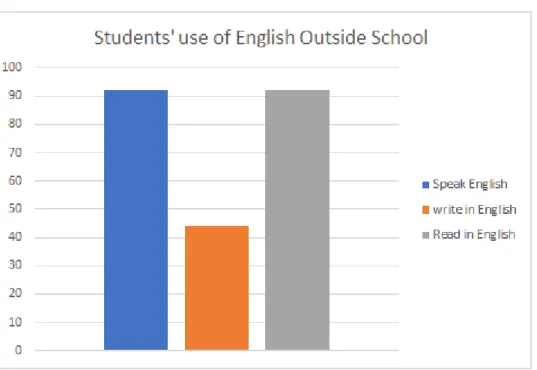
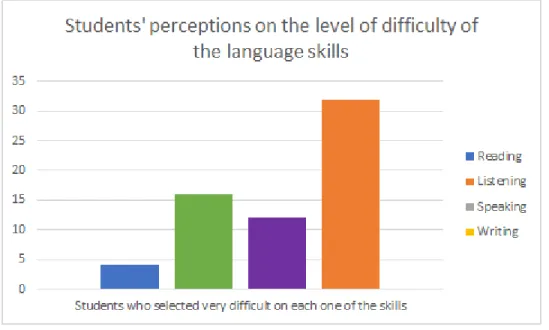
(13) 13 IN CLASS FLIP: TRIGGERING SELF- REGULATION 1.2.1 Needs analysis and problem statement. The participants in this action-research were 25 second-grade female students at a trilingual private institution in Bogota. The research was conducted towards the last third of the academic year after analyzing the information registered in the teachers’ journal and students’ artifacts which evidenced students’ dependence on the teacher and low quality in their final writing products (appendix A and B). By implementing an approach that includes time for peer and teacher feedback, students could develop self-regulatory skills such as planning, monitoring and revising their written production. The initial stage of the project included gathering information on students’ perceptions through a needs’ analysis survey focused on self-regulation (Appendix C), using a Likert scale where students selected among options that indicated frequency of the action, context and level of agreement with the statement. The examination of the results of the needs analysis questionnaire’ provided information to support teacher’s previous findings that are used as the foundation for this study. When asked about their use of each of the four skills outside the academic context, students reported they used writing the least; 44% answered they wrote for non-academic purposes, whereas 92% selected they spoke or read in contexts that are not connected to school. Additionally, when answering which language skill they considered to be the most difficult, 32% responded that writing was difficult compared to only 12% who marked these options in speaking, 16% in.
(14) 14 IN CLASS FLIP: TRIGGERING SELF- REGULATION listening and 4% in reading. The results are displayed in figure 1.. Figure 1. Needs’ analysis. February 2018.. These results revealed students’ perception of writing as a difficult skill to master, plus the low use of this skill in contexts outside of school which accounts for less practice compared to speaking, listening and reading. Also, students were also asked about their self-perception on each of the English language skills. Only 20% of the students believed their writing skills were excellent compared to 64% in speaking, 60% in listening and 28% in reading as seen in figures 2 and 3..
(15) 15 IN CLASS FLIP: TRIGGERING SELF- REGULATION. Figure 2. Needs’ analysis. February, 2018. Figure 3. Needs’ analysis. February, 2018. .. These results show students’ low self-efficacy which is their personal perception on their ability. According to Zimmerman (1990) self-regulation is associated with self-efficacy since self-regulated learners exhibit high levels of self-efficacy..
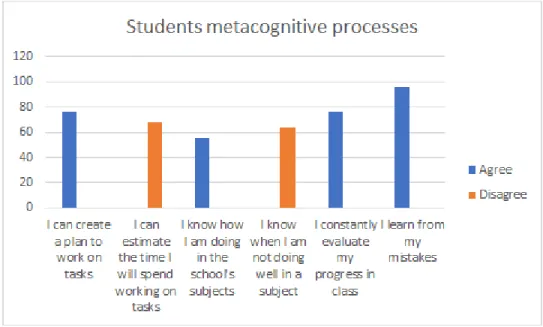
(16) 16 IN CLASS FLIP: TRIGGERING SELF- REGULATION Regarding self-regulation, students were inquired about their metacognitive processes by asking them how they prepare for their academic activities in general and for writing tasks in particular. Students’ responses reflected lack of awareness on their metacognitive processes due to the contradictions results presented as evidenced in figure 4.. Figure 4. Needs’ analysis. February, 2018.. 76% stated that they created a plan to work on their tasks; however, 68% answered that they had difficulty estimating time to work on their assignments. Additionally, 56% answered they did not know how they were doing in their subjects, but 64% marked they knew when they were not doing well in a subject. Some results also showed contradiction when compared to what the teacher had observed in class; about reflection processes, 76% answered they constantly evaluated how well they were doing a task, and 96% replied that they learned from their mistakes. Concerning self-regulation when writing, students were asked about frequency of their planning, revising, and reflection strategies by selecting always, sometimes and never. 52%.
(17) 17 IN CLASS FLIP: TRIGGERING SELF- REGULATION answered they sometimes planned, 48% said they sometimes verified word spelling, 60% answered they always confirmed if the sentences were complete and 64% mentioned that they always made sure their writing met the rubric. In regards to reflection, 88% said they took teacher’s feedback into consideration to improve their writing, and 68% said they checked what went wrong for future writings. Their answers are shown in figure 5.. Figure 5. Needs’ analysis. February, 2018.. When analyzing these answers against the teacher’s observations and the needs analysis instruments (appendix A), it could be inferred that students mostly answered based on their perception of what they know good writers must do, but answers do not correspond to their real writing process. 1.2.2 Justification of problem’s significance. Comparing the needs analysis responses and the teacher’s observations, it is evident students are not aware of their learning process and what strategies they use to learn. If students.
(18) 18 IN CLASS FLIP: TRIGGERING SELF- REGULATION were self-regulated, they could be able to plan their tasks, monitor their progress and evaluate the results; which means they would use metacognitive strategies. (Zimmerman, 2000) As students in this study have been immersed in traditional classroom settings, the Inclass Flip model could enable a transition towards a learner-centered space where students are responsible for planning, monitoring and evaluating their work, thus developing self-regulatory behaviors. In addition, and due to the existing restrictive homework policy at school, the In-class FL guarantees students will work on the flip portion in the class. Considering the aforementioned, this research study is important for the population under scrutiny, as it will be addressing key factors that might contribute to the global discussion on the topic. It could also transform the learning experience of the students by implementing a new teaching approach that facilitates engagement and the development of metacognitive skills. Lastly, the outcome of this research might shed some light into the field of In-class FL in primary settings, which to the present is scarce. 1.2.3 Strategy selected to address problem. The FL approach was selected as the strategy to address the problem of second-graders’ lack of self-regulation when writing narrative texts in English; as this blended approach to learning promotes student-centered learning and engagement (Johanssen and Cherry Paul, 2016). In addition to this, Gonzalez (2014) describes the In-class FL approach as an alternative scenario in which the home part of the class is done in the classroom. This alternative model which facilitates students’ work on the presentation stage of the class, redirects the attention to students and frees teachers’ time from delivering the content to monitoring learners as they perform different activities. To accomplish this, students rotate among presentation and practice tasks and are exposed to a variety of activities that can foster individual and cooperative.
(19) 19 IN CLASS FLIP: TRIGGERING SELF- REGULATION work. In this sense, the teacher becomes the “guide on the side” and not the “sage on the stage” (Baker, 2000). This pedagogical approach will be implemented to flip narrative writing, using a process-product approach. It is expected that through the use of the In-class FL approach, learners’ self-regulatory skills increase. 1.3 Research Question(s) and Objective(s) 1.3.1 Research questions. This study intends to portray the effects In-class flip has on second graders’ selfregulation when writing narrative texts, thus the question guiding the paper is: ● What effect does In-class flip have on second graders’ self-regulation when writing narrative texts? 1.3.2 Research objectives. Bearing in mind the question guiding this research, the following are the objectives proposed: ● To foster second-graders’ self-regulation through the implementation of In-class Flip. ● To characterize the connection between self-regulation and writing production. ● To develop strategies to help second graders become self-regulated. 1.4 Conclusion In-class FL offers an alternative to the traditional classroom setting since this approach tests educators by placing them in the role of a guide (Bergman and Sams, 2015). This can be challenging when managing second graders who have been educated in teacher-centered environments. For students, learning how to write and produce a quality piece of narrative writing is a difficult process since they feel reluctant to re-write their compositions and are.
(20) 20 IN CLASS FLIP: TRIGGERING SELF- REGULATION unable to plan, monitor and assess their process and their production. By implementing this approach, students are expected to develop metacognitive strategies to monitor and evaluate their progress which could contribute to the development of self-regulation..
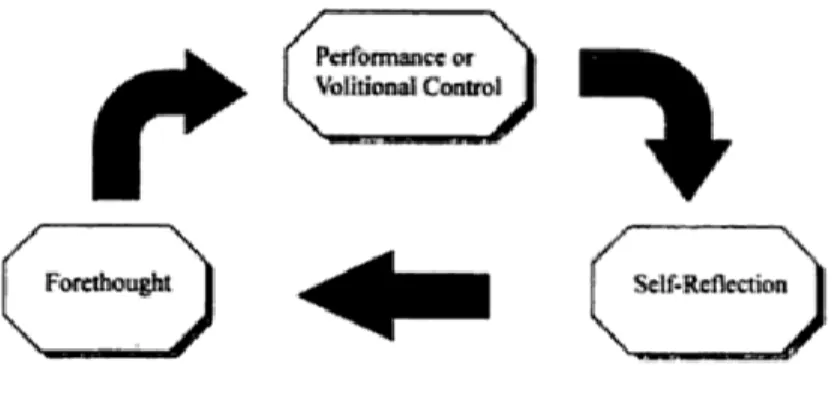
(21) 21 IN CLASS FLIP: TRIGGERING SELF- REGULATION Chapter 2: Literature Review 2.1 Introduction This chapter elaborates on the theories and recent studies on the main constructs of this study; self-regulation, In-class flip, and writing production in young learners. It also incorporates information on the underlying fields of theories of mind and FL. Understanding the connections between FL and cognitive processes in children when developing their writing skills will allow the researchers to focus and analyze the results of the current research. 2.2 Theoretical framework. 2.3 Self-regulated Learning Self-regulated learning is a “self-directive” process in which learners transform their mental abilities into academic skills” (Zimmerman, 1998, p. 2). Self-regulated learners differentiate from other learners because they take an active role in their learning process by planning, monitoring and reflecting upon their experiences. Learning is multidimensional as it involves behavioral, cognitive and emotional dimensions, which means that for an academic skill to be mastered repeated trials must be attempted since different strategies apply to different learners and the effectiveness of a strategy will vary depending on the degree of mastery of the learner. Based on this, an approach such as In-class flip could foster the multidimensional aspect of learning, as it implies more active practice time in class and allows students to apply different strategies to conduct a task. Self-regulation is portrayed as an open-ended cyclical activity carried out by the learner. It has three major phases as shown in figure 6..
(22) 22 IN CLASS FLIP: TRIGGERING SELF- REGULATION. Figure 6.Academic Learning Cycle Phases. Illustration of the open-ended process of learning on the part of the. learner. Zimmerman (1998).. The Forethought refers to the pre-existing beliefs that set the stage for learning. The Performance or Volitional control includes the efforts that occur during learning; these efforts affect performance and concentration. Lastly, the Self-regulatory phase occurs after the learning and affect learners’ reaction to the experience. In this phase Zimmerman (1998) includes five sub processes which are goal setting, strategic planning, self-efficacy, goal orientation, and intrinsic interest. These stages described by Zimmerman refer to the metacognitive processes that students should develop to be able to reflect about their learning; this theory on metacognition is presented in the next section in this chapter. The Performance or Volitional phase incorporates three subprocesses; attention focusing (ability to concentrate in the task), self-instruction /imagery (refers to telling oneself how to approach a task), and self-monitoring (informs learners about their process). Regarding self-reflection, four sub processes have been identified; self-regulation (comparing the information given by self-monitoring against the goal), attributions (understand and attribute a cause or a reason to certain outcome. Self-regulated learners attribute mistakes to causes that can be corrected and success to their own abilities), self-reactions (attributions of.
(23) 23 IN CLASS FLIP: TRIGGERING SELF- REGULATION mistakes to strategies leads to positive self-reactions which helps in adapting the performance based on the source of the error), adaptivity (learners discover the skill that they can use to have a successful outcome). The current study identified students’ lack of self-regulation as an obstacle to achieve better results and increase engagement in writing production. Considering that there has been scarce investigation in the field of self-regulatory processes in young learners, this research aims at contributing with strategies to develop this competence in children, thus allowing our students to create behaviors that will enable them to assume challenges and achieve success in their short and long-term goals. Self-regulation should be taught to children because, according to Goetz, Frenzel, Pekrun, Hall and Lüdtke (2007), it is commonly a prerequisite for becoming autonomous and being responsible which is one of the goals of education. As explored in this section, self-regulation involves the development of metacognition in students. This element and its development in children will be presented below. 2.3.1 How is Metacognition Developed in Children? Metacognition is a very important element in children’s learning. Flavell (2004) defined metacognition as “thinking about thinking”. He divided metacognition into four key areas: metacognitive knowledge, metacognitive experience, goals, and the activation of strategies. Flavell declared that the development of metacognitive processes occurs through the interaction of these four areas. According to Scardamalia, Bereiter, and Steinbach (1984), children can develop knowledge of their own learning capacities, which will later give them the ability to plan, monitor and correct errors when needed. Research explained by Brown, Bransford, Ferrara & Campione (1983) concluded that children develop different strategies to aid planning and.
(24) 24 IN CLASS FLIP: TRIGGERING SELF- REGULATION monitoring during a task; these strategies become more sophisticated as they develop their cognitive skills and know more about their learning. According to this, the participants of the current study, who had not displayed self-regulatory behaviors when writing in English, are expected to develop certain strategies to initially, reflect about their learning capacities and know how they approach a task through the utilization of different strategies. Such strategies are specific to the field of writing since the teaching of metacognitive strategies is not generic across subjects. Goctu (2017) stated that the teaching of metacognitive skills across subjects has led to failure. For writing specifically, metacognitive strategies invite learners to understand their writing process. This approach is based on contemporary models of writing that conceive it as a process that involves cognitive, linguistic, affective, behavioral and physical components. Goctu divided the metacognitive strategies that learners can use in writing among each step; planning, monitoring and evaluating. Planning happens when the writers create a plan before they have started writing; however, it can also happen during the writing itself, as modifications may occur. This step can be done individually or as a group. The plan created here might include keywords and must be constantly reviewed after the actual writing starts. Monitoring refers to checking your writing and verifying the progress in terms of organization, mechanics, grammar, and content. This step is better conducted individually. Lastly, evaluating takes place; in this step, writers revise the text and check for global and specific elements, it can be done as peer feedback or self-correction. Goctu (2017) concludes that metacognitive writing strategies can improve writing performance. The characterization of writing as a process instead of as a product allows the researchers of this study to make the metacognitive processes evident throughout the implementation of the research. This, in turn, will scaffold students’ transition into acquiring self-regulatory behaviors..
(25) 25 IN CLASS FLIP: TRIGGERING SELF- REGULATION Another advantage of writing as a process is that students will understand why they need to make certain corrections or rewrite their text, which may avoid experiencing frustration during the process. Nevertheless, researchers must consider how to scaffold the process for students based on their developmental stage, which will be explored in the section below. 2.3.2 Cognitive development theory. Due to the age range of the current research participants, Piaget’s research findings for children between 7 to 11 years old will be the focus here; he called this stage Concrete Operations. It is important to highlight that the changes and descriptions for every stage described by Piaget are only a reference as each child displays different developmental processes; nevertheless, the sequence of stages is linear and invariant for all children. According to Ginsbürg and Opper (2016), children in the Concrete Operations Stage have differentiated patterns of thought regarding concrete objects and can focus on different aspects of an object or situation simultaneously, notice transformations in the information presented, and identify similarities in two objects that are different. Additionally, Piaget conducted research on the transition mechanism, which makes the transition from one stage to the other possible for individuals, this mechanism is fostered by their learning experiences; hence, the connection between previous knowledge of the world and new information prevails in promoting learning. Ginsburg and Opper (2016) summarized two kinds of learning according to Piaget; learning in the narrow sense, which suggests the acquisition of new information about a specific situation; and learning in the broad sense, also called development, which refers to general structures of thought that can be transferred to different situations. For Piaget, the latter accounts for meaningful learning since the acquisition of general cognitive structures makes the learning in the narrow sense possible. Meaningful learning occurs.
(26) 26 IN CLASS FLIP: TRIGGERING SELF- REGULATION only when the child has developed the schemes and structures of thought to make sense of the experiences. Nevertheless, according to Ginsburg and Opper, Piaget conditioned this development to four factors: maturation, experience, social transmission and equilibration. Maturation refers to the growth of physical systems such as the brain and the central nervous system; these systems allow thought and language to appear in the child. Experience has to do with the child’s interaction with the environment and everything he learns from this. Social transmission refers to the wisdom transmitted to the child by their parents or teachers. Lastly, Equilibrium, according to Piaget, refers to the state of balance between what is already known and the new information. Piaget’s contributions portrayed learners as active agents who construct their knowledge instead of being passive recipients. The concept of learners, as the center of their own learning process in education, will be discussed in the next section. 2.3.3 Applications of Piaget’s theories to education: children as active learners. Piaget’s theories confirmed that children play an active role in their own learning process. First, as mentioned by Elkind (as cited in Cabral, 1977), learning, as evidenced from early stages of development comes from active participation and not merely observation. This implies that teachers should engage students in mental and physical activities to promote long-lasting learning. Second and connected to this idea, Piaget’s findings place genuine learning as a process of reinvention. Reinvention happens when the student is placed in a situation where, as the result of an activity, he creates a concept that is not the result of teacher transmission. Finally, according to Ginsbürg and Opper (2016), Piaget’s theories help us conclude that children cannot assimilate content that is completely novel and disconnected from their scheme. As a result, experiences must ideally be moderately novel to represent a challenge to the student.
(27) 27 IN CLASS FLIP: TRIGGERING SELF- REGULATION and to generate a reorganization and equilibrium of their cognitive structures. The presentation of these scaffolded experiences that teachers should foster will be described below. 2.3.4 Zone of proximal development. Vygotsky (1978) was interested in the role of social environment in children’s development; he stated that interaction plays an important role in psychological development. As well as Piaget’s cognitive constructivism, Vygotsky’s social constructivism also emphasized on the active role learners should have. One of his most influential ideas was the Zone of Proximal Development (ZPD) (Vygotsky, 1978) which, he defined as “the distance between the actual developmental level as determined by independent problem solving and the level of potential development as determined through problem solving under adult guidance, or in collaboration with more capable peers.” (Vygotsky, 1978. p. 86). Vygotsky believed that the assistance of a more competent peer would allow the student to perform the same activity on his own in the future, thus raising their ZPD. Vygotsky emphasized on the importance of creating tasks and activities proximal to the current cognitive developmental stage, but that included a challenge to build on existing abilities and knowledge. According to Verenikina (2003), this means that the role of the more capable peer is flexible and will shift from task to task as the learner progresses and needs different levels of assistance. Vygotsky’s ZPD portrays the principle of cooperation as an opportunity to learn. Lidz and Gindis (as cited in Shabani, Mohammad and Ebadi, 2010) said that this focus on cooperation results in a learner-centered environment where the teacher and the student engage in a dialogue to construct knowledge. Vygotsky's conception of the interaction between the learner and the background knowledge he possesses, sets ground to study ways to emphasize on the active role students.
(28) 28 IN CLASS FLIP: TRIGGERING SELF- REGULATION should have in their learning process. The theories of mind, explained in the next section, study the connection between previous knowledge in students’ minds and their learning process. 2.3.5. Theories of mind. The child’s theory of mind states that children have conceptions and understandings. about what it means to learn and understand and how their mind works which impact their approach to learning (Wellman, 1990). According to Dweck (2006), children have two types of beliefs; fixed theory and growth theory. This author states that children with a fixed theory believe that intelligence is a fixed property, whereas children with a growth mindset theory consider that intelligence is flexible and linked to practice, training and effort. However, children can incorporate both theories simultaneously for different subjects at school. Additionally, the author states that motivation affects the way children approach learning, so it is in the teacher’s hands to guide children towards a healthy understanding of their potential for learning. By using these findings, the researchers of the current study can focus on enhancing first, children’s beliefs on their own skills in writing, which were low, according to the discussion of the needs analysis and generate a growth mindset in second-graders. This task could be difficult to implement without the aid of a student-centered approach such as In-class flip which will be detailed in the sections below. 2.4 Flipped Learning Flipped Learning (FL) is a learning approach that transitions from traditional language teaching methods and presents both educators and learners a new paradigm to avoid the limitations occurring in traditional classroom environments like the one participants in this study are immersed in. As FL can be considered the umbrella approach, it also considers In- class flip which is the focus of this study and will be discussed later in the chapter. FL shares views of.
(29) 29 IN CLASS FLIP: TRIGGERING SELF- REGULATION Constructivism, which according to Schunk (2011), considers three key factors. First, learning is seen as an active process where the learner constructs knowledge based on experiences and the surrounding environment. Students are then given an opportunity to explore and learn from experience. Second, constructivism affects curriculum and instruction proposing a shift towards learner-centered environments where teachers act as guides rather than content deliverers. Lastly, this theory challenges educators to create learning scenarios where students are actively involved in the manipulation of materials and social interaction which can in turn, create spaces for peer collaboration and cooperation. This leads us to consider the definition of FL by the Flipped Learning Network (FLN) in which the above mentioned, can be connected: Flipped Learning is a pedagogical approach in which direct instruction moves from the group learning space to the individual learning space, and the resulting group space is transformed into a dynamic, interactive learning environment where the educator guides students as they apply concepts and engage creatively in the subject matter. (Flipped Learning Network, 2014) From its constructivist foundations, FL establishes four pillars to portray its principles that will be discussed in the next section. 2.4.1 Flipped learning pillars. Along with the definition provided, the FLN (2014) also proposed four pillars of FL..
(30) 30 IN CLASS FLIP: TRIGGERING SELF- REGULATION. Figure 7. The four pillars of Flipped Learning by the FLN, (2014). The first pillar is flexible environment which challenges the view of traditional instruction. Students are given the opportunity to choose when and where to learn thus becoming responsible for their own learning. According to Ray and Powell (as cited in Keengwe, Onchwari and Oigara 2014), during the flipped part of the lesson plan, learners can assess their understanding; then during class time, they engage and interact with the same concepts or clarify misunderstandings. Flexibility allows learners to become more independent by making decisions on their own and could contribute to the development of self - regulatory behaviors which needs to be fostered in this study's population. The second pillar of FL is learning culture where the traditional in-class time turns into a space for teachers to pose contradictions, present new information or challenge students’ current views on a topic. In this view, the teacher is no longer the figure that transmits the knowledge and the whole class turns into a space where the learner is at the center of the learning experience (Hamdan, McKnight, McKnight, & Arfstrom, 2013)..
(31) 31 IN CLASS FLIP: TRIGGERING SELF- REGULATION The third pillar of FL is Intentional content. According to Hamdan et al. (2013), teachers that implement FL decide what they need to teach directly and the kind of materials and activities students would manage on their own. They also maximize class time including various methods of instruction like peer-instruction, active learning strategies, problem-based learning and consequently appropriate conditions for learners to interact among themselves and the content are created (Mehring and Leis, 2018). Lastly, the fourth pillar of FL proposes a view of a professional educator which according to Hamdan et al (2013) engages in self-reflection, tolerates controlled classroom chaos and accepts constructive criticism as well as transcends to being connected and networked to collaborate with other educators. The teacher in FL becomes essential in making decisions on when and how to redirect instruction from the group to the individual space as well as guide students through the different learning scenarios in the classroom. Implementing these pillars, presents a challenging scenario for teachers as it puts at test traditional teacher education, but it also presents an opportunity to transform education and offer learners better classroom experiences. Benefits of the FL approach and how they can facilitate the enhancement of writing and the development of self- regulatory behaviors will be discussed in the next section. 2.4.2 Flipped learning benefits. 2.4.2.1 Motivation, engagement and differentiated instruction. Some of the positive effects of FL include motivation, engagement and differentiated instruction. Although motivation can be pondered from different angles, one of the views to explore in the context of FL is intrinsic motivation. According to Ryan and Deci (2000), intrinsic motivation is linked to the internal desire to do something for its inherent satisfaction rather than.
(32) 32 IN CLASS FLIP: TRIGGERING SELF- REGULATION for a separable outcome. In FL “students move from being the product of teaching to the center of learning, where they are actively involved in knowledge formation through opportunities to participate and evaluate their learning in a manner that is personally meaningful” (Hamdan et al, 2013, p.5). Such meaningfulness allows learners to increase their levels of motivation towards the subject and become more responsible for their learning. Along with motivation, engagement plays a crucial role in learning. According to Bergmann and Sams (2015a), disengagement could occur when classrooms are teacher-centered. Such scenarios prevail in traditional education where the teacher responds to a transmission model and students disengage because, as the learners in this study, they do not feel responsible for their learning and are not engaged to fulfill a writing task. A countermeasure to this phenomenon relies on setting a classroom atmosphere to foster creativity, interest and discovery. FL allows educators to take learning “further” which often entails embarking in the inquiry process, letting students explore their interests and exercise their creativity (Bergmann and Sams, 2015a). Learners in this study could benefit from increasing their intrinsic motivation towards writing because they could develop knowledge and skills easily. Another key element in FL is differentiated instruction which requires teachers to “provide specific alternatives for individuals to learn as deeply as possible and as quickly as possible, without assuming one student’s road map for learning is identical to anyone else’s.” (Tomlinson, 2014, p.4) This entails careful understanding of students’ skills and interests which are often overlooked as sometimes the focus is on following the set curriculum. Additionally, the author mentions that teachers who differentiate are demanding so that students meet high standards and understand that learning requires taking risks, making mistakes and achieving goals..
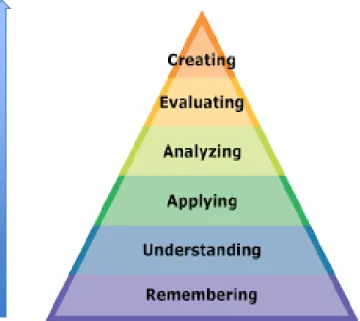
(33) 33 IN CLASS FLIP: TRIGGERING SELF- REGULATION By understanding students’ differences, the teacher can create meaningful learning spaces for all students. According to Carbaugh and Doubet (2016), the flipped classroom offers a rich environment to foster differentiation due to its increased flexibility which allows learners to experience different grouping scenarios, scaffolded content, multiple instruction systems and student choice. All this present an advantage to transform the learning experience of second graders as they could be more connected to their learning process and would see language learning more purposefully. 2.4.2.2 Metacognitive skills. FL serves as an activator of strategies to foster self-reflection, self-regulation and high order thinking skills. In this regard, “the higher cognitive functions associated with class activities, accompanied by the ongoing peer instructor interaction that typically exists in a FL environment, can lead to metacognition which is in turn associated with deep learning” (Brame, 2013, p.3) Deep learning is determined by the learning objectives established. In FL environments, students not only explore and understand the content but also demonstrate mastery of the topic, apply gained knowledge in varied situations and create learning artifacts to show the depth of their learning (Bergmann and Sams, 2015b). According to Kostka and Brinks-Lockwood (2015), in a traditional setting, students have to apply, analyze, synthesize and evaluate at home using the material from class, thus challenging them to use the higher-level Bloom’s skills without any support whereas in In-class flip students have the opportunity to work on these skills with the teacher´s guidance..
(34) 34 IN CLASS FLIP: TRIGGERING SELF- REGULATION. Figure 8. Bloom’s taxonomy. A hierarchical model to classify educational learning objectives. This accounts for the development of the high order thinking skills described in Bloom's taxonomy which are important in young learners because they could allow them to make connections to their world and analyze and draw conclusions from the information presented rather than simply memorizing. 2.4.3 Flipped learning and traditional instruction. Traditional education continues to be present in some classrooms. According to King (1993), in a traditional environment, the teacher has the central role in the classroom and possesses the knowledge to be memorized by students and then tested in an exam. Keengwe, Onchwari and Oigara (2014) go on to mention the problem of inert knowledge because of students being passive recipients. In a FL environment, teachers modify the lecture or presentation phase and assign this to take place at home by using different resources including videos, reading materials among others. The “home part” of the class happens before the actual class takes place so students come prepared to class. As students have already been exposed to.
(35) 35 IN CLASS FLIP: TRIGGERING SELF- REGULATION the new content, class time is used to activate knowledge and for practice and application. In this scenario, the teacher frees time to concentrate on monitoring and guiding students rather than on directing the class. According to Fulton (2014), in a FL model, students come prepared to class to analyze, discuss and apply the information they previously absorbed. Such approach to instruction allows teachers to promote the democratization of learning and foster autonomy (Pinnelli and Fiorucci, 2015) as students can access the information anytime and at their own pace making them responsible for their own learning. According to Morris, Thomasson, Lindgren Streicher, Kirch, and Baker (as cited in Fulton, 2014), FL allows teachers to develop a flipping mindset involving three key elements: 1. Making the best use of their face-to-face time with students. 2. Using student-centered pedagogy. 3. Having intentional focus on higher-level thinking, rather than on memorization. A major difference between traditional models and FL lies on class time. Bergmann and Sams (2012) note a different distribution of classroom dynamics in Table 1 below: Table 1 Traditional vs Flipped class time distribution Traditional classroom. Flipped Classroom. Activity. Time. Activity. Time. Warm up activity. 5 min. Warm up activity. 5 min. Go over previous night’s homework. 20 min. Q& A time on video. 10 min. Lecture new content. 30-45 min. Guided and independent practice and or lab activity. 75 min. Guided and independent practice and or lab activity. 20-35 min. Note. Adapted from Bergmann, J., & Sams, A. (2012). Flip Your Classroom: Reach Every Student in Every Class Every Day. International Society for Technology in Education. ISTE.
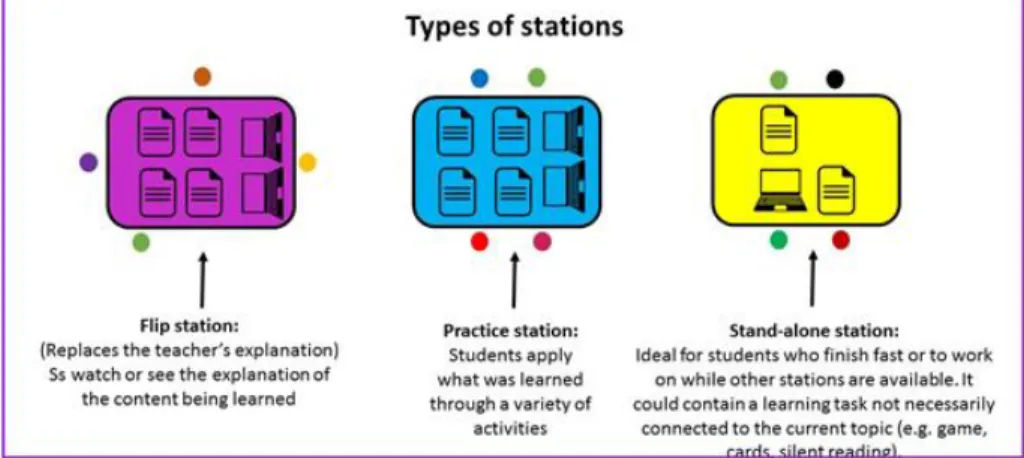
(36) 36 IN CLASS FLIP: TRIGGERING SELF- REGULATION Most of the classroom time is then devoted to more extensive and problem-solving scenarios where students are guided by the teacher. Teachers can then foster ownership of learning (O´Flaherty and Philips, 2015) and create more active learning experiences in class. Although FL has been widely implemented in higher education, primary education is now interested in transitioning from traditional methodologies to student-centered approaches. According to Bergmann and Sams (2016), FL with young learners implies a setting that adapts to their abilities and needs. This setting will be new and beneficial to second-graders in this study as they have been accustomed to relying merely on teacher´s instructions and guidance without taking initiative to learn. 2.5 In-class flip. In-Class Flip emerges as an option to allow teachers to bring the flip into the class by doing the home part of the flip in class (Barnes and González, 2015). According to Barnes and Gonzalez (2015), the In-class Flip model also presents a solution to the limitations in the traditional flip such as lack of access to a working device, internet and an environment conducive for learning. Additionally, for those students who do not know how to prepare and familiarize with the new content prior to class (Rigotsou, 2018), the in-class flip guarantees a space in class for students to approach the content and still work independently or in groups freeing the teacher from lecturing or presenting content. In an In-class flip implementation, teachers set stations for students to rotate among them. According to Ramirez (2017), one station is used for flip, where the content is delivered via videos, audios or readings. The other stations are used for practice or reinforcement of the content being learned. There are also “stand-alone” stations for free practice..
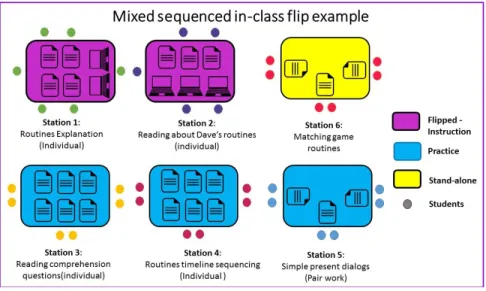
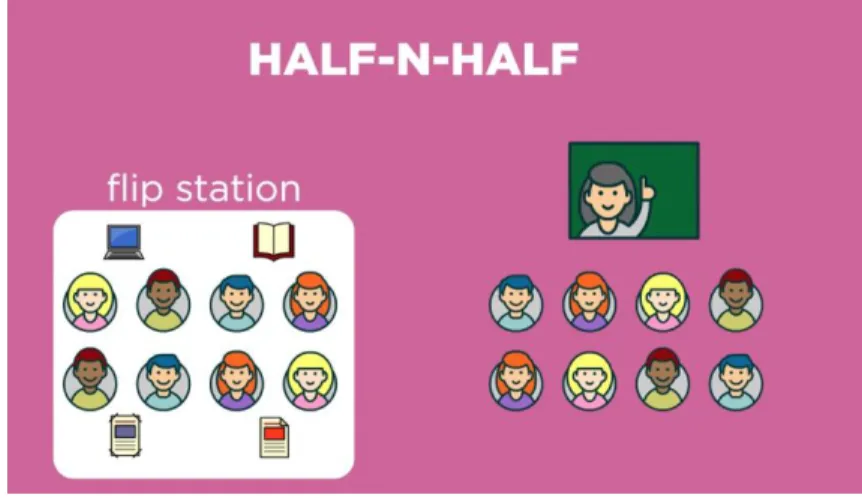
(37) 37 IN CLASS FLIP: TRIGGERING SELF- REGULATION. Figure 9. Types of In Class Flip Stations. Ramirez, M. (2017, May 30). What’s an in-class flip? Retrieved from http://martharamirez.com.co/blog/whats-an-in-class-flip/in-classflip/. Additionally, Tucker (2016), describes the station rotation model as one where teachers create smaller communities of practice and learning inside a larger community. Students can engage in different activities working on varied learning modalities (auditory, visual, tactile and kinesthetic) resulting in personalized instruction. The dynamics of the in-class Flip can vary depending on the model adopted. Buitrago and Ramirez (in press) propose four alternatives for rotation models and three for non-station work. Rotation models include mixed, sequenced, looped and half-n-half. Non-rotation models include solo, duo and group. This implementation used the simple and mixed sequences, the half-andhalf and the solo and duo configurations, which will be explained below. In a mixed sequence pattern, students move at their own pace and rotate based on their needs. If the students have prior knowledge, the flip station can be skipped, and they can rotate among the other stations. In a simple sequence model, students rotate following a pre-established order set by the teacher. Students start at the Flip station where content is presented, then sequentially rotate around the other stations to practice the content. In this kind of in-class flip arrangement, stations can be duplicated depending on the number students. Half-n-half.
(38) 38 IN CLASS FLIP: TRIGGERING SELF- REGULATION configuration allows half of the class to work independently, while the teacher works with the rest of the group and then students switch. The solo and duo configurations allow students to work independently or in pairs within the group environment. All scenarios require for the teacher to support and monitor students as well as give constant feedback.. Figure 10. In class Flip mixed sequence. Ramirez, M. (2017, May 30). What’s an in-class flip? Retrieved from http://martharamirez.com.co/blog/whats-an-in-class-flip/. Figure 11. In Class Flip Simple Sequenced stations. Ramirez, M. (2017, May 30). What’s an in-class flip? Retrieved from http://martharamirez.com.co/blog/whats-an-in-class-flip/.
(39) 39 IN CLASS FLIP: TRIGGERING SELF- REGULATION. Figure 12. In-class Flip Group configuration. Buitrago and Ramirez (In press). Retrieved from https://learn.flglobal.org/courses/CertLevel2. As presented in this section, in- class flip allows teachers to guarantee students are exposed to the new content while in class. This is highly relevant in this study as second graders are just starting to develop responsibility and autonomy. It will also avoid the limitations of having content presented at home through videos as there are school´s restrictions in regards to homework assignment. Also, In-class flip emphasizes on the learning process by scaffolding learner’s tasks; this focus on process is used in the approach to writing which is explored in the next section. 2.6 Writing 2.6.1 Foreign language writing. Writing as a productive skill has always entailed a major challenge for learners. According to Nunan (1999), producing a coherent, fluent piece of text can be difficult even for native speakers. To write, learners need to consider their audience (readers) and produce a piece that is clear, coherent, relevant and preferably interesting to the reader (Celce-Murcia, Brinton & Snow, 2014)..
(40) 40 IN CLASS FLIP: TRIGGERING SELF- REGULATION It is also important to consider the instructional view of the writing process. Two different views have prevailed: process and product writing. The process approach concentrates on the creation of the text rather than on the final product (Nunan, 1999) and gives special attention to the supporting of the learner through the different stages. Celce-Murcia et al (2014), describe five stages in the process approach: 1. Pre-writing: brainstorming and outlining activities are put into practice. 2. Drafting: Focusing on content and getting ideas on the text 3. Giving and receiving feedback: working on peer feedback and receiving feedback from the teacher. 4. Revising: re-seeing and rethinking content 5. Editing: focusing on form (grammar, punctuation, and spelling). According to Nunan (1999), product-oriented approaches focus on the final product and concentrate on producing error-free texts. Learners usually imitate, copy and transform models provided by the teacher being the first at the sentence level grammar. Although process and product approaches seem to dictate different routes, Nunan (2007) acknowledges the importance of maintaining a process- product orientation since writers and educators should focus on both. Based on the aforementioned, the current study will follow a process-product approach to writing which will reinforce on the concept of metacognitive strategies and also will allow researchers to make metacognitive strategies evident to foster self-regulation in students. Nevertheless, this process must consider students’ developmental stage to create strategies that are relevant to the population. Some strategies to work on writing with young learners will be presented below..
(41) 41 IN CLASS FLIP: TRIGGERING SELF- REGULATION 2.6.2 Teaching writing to young learners. Young English Language Learners (YELLs) process information in the second language differently from adults. To start with, students do not understand abstract concepts such as parts of speech or grammar because they create a clear mental image with the input received (Bourke, 2006). According to Nunan (2011), writing is not a natural skill, which implies that it requires training on the ability to produce coherent pieces. Writing has a cognitive function in formal education that supports development of thinking and reasoning skills. Linse (as cited in Nunan, 2011) highlights some important aspects to consider when teaching young learners such as bearing in mind that YELLs are refining their second language oral skills and still working on their writing skill in their first language. Nunan (2011) also states that approaches to teaching writing to young learners vary depending on the age and first language proficiency. Children start copying and tracing, then writing words to the sentence and text-level. Our research participants are at the text level as they must produce complete texts and connect sentences. At this stage, Nunan recommends exposing students to authentic pieces of text to connect their practice with their world and previous knowledge. The author also highlights the relevance of teacher-guided practice and collaborative work when writing since at the beginning, students encounter problems related to unknown vocabulary that might generate negative feelings towards the task. Due to the fact that In-class flip liberates teacher’s time, the possibility to offer teacher-guided practice while writing is present in this approach. In addition, Nunan affirms that young beginner writers should carry out highly controlled activities where they have access to clear models for their production and are presented with activities that scaffold their writing process such as texts where they just must select the appropriate phrase from word banks..
(42) 42 IN CLASS FLIP: TRIGGERING SELF- REGULATION 2.7 State of the art This section presents research that has been conducted in the field of Flipped learning, writing and self-regulation in young learners including their contributions to the arena. The following studies serves to contextualize the action research developed in this study and will contribute to the discussion of the development of self-regulation in young learners by implementing In-class Flip. Due to the limited research on In-class flip in the language classroom with young learners and its impact on self-regulation, the research studies below may differ in population or subject taught. Buitrago and Diaz’s (2018) case study was focused on the effectiveness of the FL approach on writing composition and motivation towards the use of technology in an English as a foreign language (EFL) setting. Findings in this research revealed improvement in the writing process due to the implementation of FL as well as an increase in students’ motivation when using technology for language learning. Although the population in the study differs, the current study also used a process-product approach to writing and flipped the writing component. Other similarities include guiding students through different stages of the writing process and flipping the presentation aspect of the content. Flipping writing can benefit students by collaborating with peers and receiving feedback from the teacher or from peers. Students are then not left alone in the process of writing and are able to go through the stages of writing (i.e., brainstorming, outlining, drafting, revising, and editing) as they are guided by the teacher (Buitrago and Diaz, 2018). Flipping writing can create more engaging scenarios where students are able to see all the bonds in the writing process and become more aware of their learning process. While, Buitrago and Diaz mention that by using FL in a writing workshop, students can develop a better understanding of their weaknesses and strengths through peer-assessment techniques and the.
(43) 43 IN CLASS FLIP: TRIGGERING SELF- REGULATION constant analysis of written products; the current study will provide input on how to develop self-regulatory skills in young children by the creation of engaging scenarios where writing is seen as a process as well as in this study. Hernandez & Torres’ (2017) research examined the impact of differentiated flipped instruction on English process writing with high school students. Through the analysis of the data, researchers were able to evidence enhancement in students’ writing skill as shown by the clarity, quality and complexity of the written texts produced. The implementation of the approach also produced positive effects towards language learning and fostered learners’ autonomous behaviors. Even though the population and the focus of the study were different to the ones in the current study, both used the same approach to writing and fostered differentiated instruction scenarios. Evans and Ricke´s (2015) study was done to explore the connection between FL and metacognitive skills (associated to self-regulation) in 27 first and 21 second-grade students in the subjects of EFL, math and science; the study was conducted during four weeks in a private institution in Bogota, Colombia. At the beginning of their research, the investigators raised students’ awareness towards the Flipped Learning approach and allowed students to make connections between this new model and the traditional models students were exposed to in the classroom. During the implementation, students were provided with a weekly outline that included videos and games available online to be seen at home the day before class, these videos reinforced concepts presented in class and included a comprehension checks that helped students reflect on and monitor their understanding of the information presented. At the end of the research exercise, students completed a short survey to evaluate the effectiveness of the implementation. The researchers found that most students enjoyed the videos and those resources.
(44) 44 IN CLASS FLIP: TRIGGERING SELF- REGULATION allowed them to become more independent by giving them the possibility to rewatch them if needed. The videos students watched at home became flexible tools that could be adapted to reinforce topics seen in class. The authors concluded that flipped classrooms have positive results in young learners to contribute to the development of independence and motivation. This study is one of the few research exercises that has inquired on the effects of Flipped Learning on elementary students. The population of Evans and Ricke’s study matches the participants of the current study in age and socio-cultural setting. Even though, our research used the in-class flip approach to make sure students accessed the videos due to their age, Evans and Ricke also replayed the videos in class as a mechanism to provide students the opportunity to access the content. One difference between both studies is that videos (and posters in the case of our research) were used to present content, and Evans and Ricke’s used them to review it. Lai and Hwang (2016) conducted a quasi-experimental four-week study to verify the connection between Flipped Learning and self-regulation being the latter one of the difficulties of the flip approach since students’ lack of self-regulation results in poor preparation of the content at home. The participants of the study were fourth graders, 20 students in the experimental group who were exposed to the self-regulated flipped classroom and 24 in the control group who learned with the conventional flipped classroom. Lai and Hwang used a pretest, post-test and questionnaires to measure the effectiveness of the implementation. The researchers concluded that students in the experimental group improved their self-regulation as evidenced by students’ use of planning and monitoring in their independent study time. The authors further conclude that the students’ performance is linked to the development of their selfregulatory processes. It is important to highlight that the participants of Lai and Hwang’s study are in the same cognitive stage as the participants of the current research and self-regulatory.
Figure

+7

Documento similar
The “Course for Erasmus and International Exchange Students” of the University of Mala- ga, 70 class hours, allows students to consolidate and acquire Spanish skills in order to
To become even more of a world-class university which brings together the best national and inter- national talent, of students, professors, and resear- chers, to foster a
Once established that motivation, enjoyment/satisfaction, and participation in class are the variables that, according to our analysis, influence learning, we defined a
In this way, the eco-friendly and sustainability scope of biofuels as energy resource depends on the class and the nature of biomass employed as feedstock, as
In this study, based on the same students as this study, it was found that a positive attitude of the school and teachers towards parents could explain evolutions in parent
UnitProcedure class inherits the properties of MainObject and it has also additional attributes as: the reference to the Unit resource used, a reference to the Stage object executed
The data for learning self-regulation (higher values in this variable mean that the students used more strategies oriented to learning goals) is coming from the
Suspect screening and target quantification of multi-class pharmaceuticals in surface water based on large-volume injection liquid chromatography and time-of-flight
