Antonio Ríos, Ana Isabel López-Navas, Ana Isabel López-López, Francisco Javier Gómez, Jorge Iriarte,
Rafael Herruzo, Gerardo Blanco, Francisco Javier Llorca, Angel Asunsolo, Pilar Sánchez-Gallegos,
Pedro Ramón Gutiérrez, Ana Fernández, María Teresa de Jesús, Laura Martínez-Alarcón, Alberto Lana,
Lorena Fuentes, Juan Ramón Hernández, Julio Virseda, José Yelamos, José Antonio Bondía,
Antonio Miguel Hernández, Marco Antonio Ayala, Pablo Ramírez, Pascual Parrilla
Antonio Ríos, Ana Isabel López-Navas, Laura Martínez-Alarcón, Marco Antonio Ayala, Pablo Ramírez, International Collaborative Donor Project (“Proyecto Colaborativo Internacional Donante” , 30007 Casillas, Murcia, Spain
Antonio Ríos, Pablo Ramírez, Parrilla Pascual, Department of Surgery, Paediatrics, Obstetrics and Gynaecology, University of Murcia, Avenida de las Fuerzas Armadas, 30800 Espinardo, Murcia, Spain
Antonio Ríos, Laura Martínez-Alarcón, Pablo Ramírez, Pascual Parrilla, Transplant Unit, Surgery Service, IMIB - Virgen de la Arrixaca University Hospital, Carretera Madrid-Cartagena s/n, 30120 El Palmar, Murcia, Spain
Antonio Ríos, Pablo Ramírez, Regional Transplant Centre, Consejería de Sanidad y Consumo de la Región de Murcia, 30008 Ronda de Levante, Murcia, Spain
Antonio Ríos, Hospital Clínico Universitario Virgen de la Arrixaca, Departamento de Cirugía General y del Aparato Digestivo, Unidad de Trasplantes, 30007 Casillas, Murcia, Spain Ana Isabel López-Navas, Department of Psychology, Universidad Católica San Antonio (UCAM), Avenida de los Jerónimos, 30107 Guadalupe, Murcia, Spain
Ana Isabel López-López, Department of Urology, San Juan University Hospital of Alicante, 03010 Calle Pintor Baeza, Alicante, Spain
Francisco Javier Gómez, Universidad de Granada, Avenida del Hospicio s/n, 18010 Granada, Spain
Jorge Iriarte, Universidad de Navarra, Campus Universitario, 31080 Pamplona, Navarra, Spain
Rafael Herruzo, Universidad Autónoma de Madrid, Ciudad
Gerardo Blanco, Servicio de Cirugía HBP y Trasplante Hepático, Complejo Hospitalario Universitario de Badajoz, Hospital Infanta Cristina, Avenida Elvas s/n, 06006 Badajoz, Spain
Francisco Javier Llorca, Universidad de Cantabria, Avenida los Castros s/n, 39005 Santander, Cantabria, Spain
Angel Asunsolo, Departamento de Cirugía, Ciencias Médicas y Sociales, Facultad de Medicina y Ciencias de la Salud, Universidad de Alcalá Campus Científico-Tecnológico, Plaza de San Diego s/n, 28801 Alcala de Henares, Madrid, Spain
Pilar Sánchez-Gallegos, José Antonio Bondía, Facultad de Medicina, Universidad de Málaga, 29071 Avenida de Cervantes, Málaga, Spain
Pedro Ramón Gutiérrez, Servicio de Urología (Complejo Hospitalario Universitario de Canarias, CHUC) y Departamento de Cirugía (Universidad de La Laguna, ULL), Calle Molinos de Agua s/n, 38207 San Cristóbal de La Laguna, Santa Cruz de Tenerife, Spain
Ana Fernández, Departamento de Ciencias Biomédicas Básicas, Facultad de Ciencias Biomédicas, Universidad Europea de Madrid, Avenida de Fernando Alonso, 28108 Madrid, Spain María Teresa de Jesús, Universidad Rey Juan Carlos, Calle Tulipán s/n, 28933 Mostoles, Madrid, Spain
Alberto Lana, Facultad de Medicina y Ciencias de la Salud. Área de Medicina Preventiva y Salud Pública, Universidad de Oviedo, Calle San Francisco, 33003 Oviedo, Asturias, Spain
Lorena Fuentes, Departamento de Farmacología y Fisiología Facultad de Ciencias de la Salud y del Deporte, Universidad de Zaragoza, 50018 Calle Pedro Cerbuna, Zaragoza, Spain
Juan Ramón Hernández, Universidad de las Palmas de Gran Canaria, Calle Juan de Quesada s/n, 35001 Las Palmas de Gran DOI: 10.3748/wjg.v22.i25.5800 © 2016 Baishideng Publishing Group Inc. All rights reserved.
ORIGINAL ARTICLE
Observational Study
Acceptance of living liver donation among medical students:
A multicenter stratified study from Spain
Revised: May 8, 2016 Accepted: June 15, 2016 Article in press: June 15, 2016 Published online: July 7, 2016
Abstract
AIM: To analyze the attitude of Spanish medical students toward living liver donation (LLD) and to establish which factors have an influence on this attitude.
METHODS: Study type: A sociological, interdisciplinary, multicenter and observational study. Study population: Medical students enrolled in Spain (
n
= 34000) in the university academic year 2010-2011. Sample size: A sample of 9598 students stratified by geographical area and academic year. Instrument used to measure attitude: A validated questionnaire (PCID-DVH RIOS) was self-administered and completed anonymously. Data collection procedure: Randomly selected medical schools. The questionnaire was applied to each academic year at compulsory sessions. Statistical analysis: Student´s t test,χ
2 test and logistic regressionanalysis.
RESULTS: The completion rate was 95.7% (
n
= 9275). 89% (n = 8258) were in favor of related LLD, and 32% (n = 2937) supported unrelated LLD. The following variables were associated with having a more favorable attitude: (1) age (P
= 0.008); (2) sex (P
< 0.001); (3) academic year (P < 0.001); (4) geographical area (P
= 0.013); (5) believing in the possibility of needing a transplant oneself in the future (P < 0.001); (6) attitude toward deceased donation (P < 0.001); (7) attitude toward living kidney donation (P
< 0.001); (8) acceptance of a donated liver segment from a family member if one were needed (P
< 0.001); (9) having discussed the subject with one's family (P < 0.001) and friends (P < 0.001); (10) a partner's opinion about the subject (P < 0.001); (11) carrying out activities of an altruistic nature; and (12) fear of the possible mutilation of the body after donation (P
< 0.001). CONCLUSION: Spanish medical students have a favorable attitude toward LLD.Key words: Attitude; Living liver donation; Medical students; Transplantation; Organ donation; Psychosocial variables; Spain
© The Author(s) 2016. Published by Baishideng Publishing
Group Inc. All rights reserved.
Core tip: Students of medicine represent a new generation of physicians, although their attitude towards living liver donation (LLD) has not been studied to any great extent, and most of the studies carried out use measurement tools that have not been validated. The objective of the authors was to analyze the Canaria, Las Palmas, Spain
Julio Virseda, Universidad de Castilla La Mancha, Campus Universitario de Albacete s/n, 02071 Albacete, Spain
José Yelamos, Department of Immunology, Hospital del Mar, 08003 Passeig Marítim, Barcelona, Spain
Antonio Miguel Hernández, Endocrinology and Nutrition Service, Hospital Clínico Universitario Virgen de la Arrixaca, Servicio Murciano de Salud, Carretera Madrid - Cartagena s/n, 30120 El Palmar, Murcia, Spain
Marco Antonio Ayala, Hospital Regional de Alta Especialidad del Bajío, San Carlos la Rocha, Guanajuato 37660, León, Mexico
Marco Antonio Ayala, HGSZ No. 10 del Instituto Mexicano del Seguro Social Delegación Guanajuato, Calle San Clemente, Guanajuato 36010, León, Mexico
Author contributions: Ríos A designed the study; Ríos A, López-Navas AI, López-López AI, Ayala MA, Ramírez P and Parrilla P analyzed and interpreted the data; Ríos A and López-Navas AI contributed to statistical expertise, drafted the manuscript, and supervised this program; Ríos A, López-Navas AI, Ayala MA, Ramírez P and Parrilla P critically revised the manuscript for important intellectual content; all authors contributed to acquisition of a substantial portion of data, obtaining funding for this project or study, and final approval of the version to be published.
Institutional review board statement: The study was reviewed and approved by the “Proyecto Colaborativo Internacional Donante” Institutional Review Board.
Informed consent statement: All study participants provided informed verbal consent prior to study enrollment.
Conflict-of-interest statement: All authors declared that there is no conflict of interest to disclose.
Data sharing statement: No additional data are available. Open-Access: This article is an open-access article which was selected by an in-house editor and fully peer-reviewed by external reviewers. It is distributed in accordance with the Creative Commons Attribution Non Commercial (CC BY-NC 4.0) license, which permits others to distribute, remix, adapt, build upon this work non-commercially, and license their derivative works on different terms, provided the original work is properly cited and the use is non-commercial. See: http://creativecommons.org/ licenses/by-nc/4.0/
Manuscript source: Invited manuscript
Correspondence to: Dr. Antonio Ríos, Hospital Clínico Universitario Virgen de la Arrixaca, Departamento de Cirugía General y del Aparato Digestivo, Unidad de Trasplantes, Avenida de la Libertad No. 208, 30007 Casillas, Murcia,
Spain. [email protected] Telephone: +34-968-270757 Fax: +34-968-369716 Received: February 16, 2016
Peer-review started: February 17, 2016 First decision: March 21, 2016
attitude of Spanish medical students towards LLD. The project is a sociological, interdisciplinary, multicentre and observational study. A sample of 9598 students is stratified by geographical area and academic year. The instrument is a validated questionnaire (PCID-DVH RIOS) it was self-administered and completed anonymously.
Ríos A, López-Navas AI, López-López AI, Gómez FJ, Iriarte J, Herruzo R, Blanco G, Llorca FJ, Asunsolo A, Sánchez-Gallegos P, Gutiérrez PR, Fernández A, de Jesús MT, Martínez-Alarcón L, Lana A, Fuentes L, Hernández JR, Virseda J, Yelamos J, Bondía JA, Hernández AM, Ayala MA, Ramírez P, Parrilla P. Acceptance of living liver donation among medical students: A multicenter stratified study from Spain. World J Gastroenterol 2016; 22(25): 5800-5813 Available from: URL: http://www. wjgnet.com/1007-9327/full/v22/i25/5800.htm DOI: http://dx.doi. org/10.3748/wjg.v22.i25.5800
INTRODUCTION
Liver transplantation offers long survival periods and improved quality of life for patients with liver disease whose vital prognosis is short if they do not have a transplant. However, the current transplant organ donation rates are insufficient for covering minimum transplant needs[1], and the shortage of available livers
means that mortality on the waiting list is increasing[1].
Even in Spain in the 21st century, the country with the highest donation rates, mortality on the liver transplant waiting list has been increasing[1]. All of this is making
it necessary to encourage alternatives to deceased liver donation. The transplantation of the right liver lobe from a living donor to an adult recipient has been successfully carried out and in countries such as Japan, the United States and some European countries it is becoming more common[2,3]. Even so, in many
countries living liver donation (LLD) is at a very low level[1]. One of the possible barriers to its development
could be the risk involved for the donor and the fact that the results of the transplant are slightly worse than when the liver is transplanted from a deceased donor[4,5]. However, in experienced centers the results
are acceptable[6,7]. Nevertheless, it should be taken
into account that professionals in healthcare centers do not always have a favorable attitude toward LLD, and consequently they do not create the right kind of social climate for its implementation[8-10]. Therefore, healthcare
professionals have a fundamentally important role to play in its development, given that they have the capacity to generate favorable or unfavorable attitudes in other groups of the population. In fact, in the public it has been seen that attitude toward organ donation which is based on the information provided by healthcare workers, whether positive or negative, is very solid[11].
Students of medicine represent a new generation of physicians, although their attitude toward LLD has not been studied to any great extent[12]. It should be
remembered, however, that the adequate training of future physicians in the transplantation and donation process involves specifically finding out those varia-bles that have an effect on certain attitudes toward donation from the stage of being a student. In this sense, a knowledge of the factors that influence attitudes toward donation will allow us to optimize the resources invested in carrying out donation and transplantation promotion campaigns and to act in a more specific way.
The objective of this study was to analyze the attitude of medical students from Spanish universities toward related and unrelated LLD.
MATERIALS AND METHODS
Type of study
A sociological, interdisciplinary, multicenter and ob-servational study carried out in Spain in the university academic year of 2010-2011.
Study population
The study population comprised of students studying a degree in medicine in Spain. The number of students enrolled in the academic year of 2010-2011 was estimated using data published by the Spanish National Institute of Statistics (INE)[13]. The number
of students in other medical schools not included in the information of the INE was obtained over the telephone. As a result, the estimated number of medical students enrolled in the academic year of 2010-2011 was 34000. It should be noted that in Spain a degree in medicine lasts for 6 years. Once the degree has been completed and in order to start specialist training, the students have to take the public competitive (MIR) exam which involves a training period lasting between 3 and 5 years.
Sample size
The sample size calculated for a population of 34000 students was 9598 students, considering an estimated proportion (attitude in favor of donation) of 76%, a confidence of 99% and a precision of ± 1%.
Sample stratification
Geographical stratification: In the academic year of 2010-2011 there were 40 medical schools in Spain with active teaching activity. These medical schools were grouped into four geographical regions covering the country: (1) The North: including the Autonomous communities (Ac) of Galicia, the Principality of Asturias, the Basque country, the Foral community of Navarra, La Rioja, cantabria and castilla León; (2) The central area: including the Acs of castilla-La Mancha, Extremadura and the community of Madrid; (3) The
of administered questionnaires) was greater than 80% of the students present at the aforementioned compulsory student sessions. After a brief explanation of the study was provided by the study personnel about the structure and content of the questionnaire, and after specifying the confidentiality of the data gathered, a questionnaire was handed out to each student at one of the compulsory sessions. The questionnaire was self-administered, and completed voluntarily and anonymously by each student in a period of 5-10 min.
The final selection of the participating groups was carried out using non-probabilistic convenience sampling until the necessary number of questionnaires for each academic year was reached according to the proportionality factor. Given that the questionnaires were handed out in compulsory student sessions, an academic year was considered to be full when the number of questionnaires administered had a range of ± 5% of the number of questionnaires calculated to be necessary.
Instrument for measuring attitude
The instrument of measurement used was a validated questionnaire of attitude toward Organ Donation and Transplantation[8,9] [“PcID - DVH Rios”: A questionnaire
of the International collaborative Donor Project about Living Liver Donation (“Proyecto colaborativo Internacional Donante sobre Donación de Vivo Hepático” in Spanish) developed by Dr. Ríos]. This questionnaire included items distributed into three subscales or factors, and it was validated in the Spanish population, presenting a total explained variance of 63.995% and a cronbach’s Alpha confidence coefficient of 0.778. Each factor has an internal consistency, measured by Cronbach’s Alpha Confidence coefficient of α = 0.801, 0.696, and 0.559 respectively, and an explained variance of 38.461%, 14.228%, and 11.306% res-pectively. In Addition an ad hoc questionnaire was applied including other variables.
Study variables
As a dependent variable we studied attitude toward related and unrelated LLD. The independent variables studied were classified into the following groups: (1) Socio-personal: age and sex; (2) University: Type of university, academic year of the degree in medicine and geographical location; (3) Knowledge of, and attitude toward, organ donation and transplantation: knowing a transplant patient, knowing a donor, believing that one might need a transplant in the future, attitude toward deceased organ donation, attitude toward living kidney donation and acceptance of a liver segment from a living donor if it was needed; (4) Social interaction: discussion with family and friends about donation and transplantation, the respondent’s partner’s opinion about the donation of a family member’s organs; (5) Pro-social behavior: East: including the Acs of catalonia, Aragon, Valencia
and Murcia; and (4) The South: including the Acs of Andalucía, ceuta and Melilla, the canary Islands, and the Balearic Islands.
In order to obtain the sample, an initial sampling stage was planned which was stratified proportionately to the number of students enrolled in each geographical region. In the North, 14% of the students were enrolled, corresponding to a sample of 1343; in the central area there were 25% corresponding to 2400; in the South there were 23.5% corresponding to 2256; and in the East there were 37.5% corresponding to 3,599 respondents.
Stratification by academic year: In each geo-graphical area stratified sampling was carried out according to each academic year. In order to do this, the proportion of students from each year in each geographical area was calculated and the corresponding sample was obtained. The percentage and number of students in each area in each academic year were as follows: In the North: 28% of the students (corresponding to 376 respondents) were enrolled in the first year; 15.5% (n = 208) were enrolled in the second year; 16% (n = 215) in the third year; 14% (n = 188) in the fourth; 12% (161) in the fifth and 14.5%( n = 195) in the sixth year; In the central Area: 23% of the student (n = 552) were enrolled in the first year; 25.5% (n = 540) in the second year; 12% (n = 288) in the third year; 13% (n = 312) in the fourth year; 11.5% (n = 276) in the fifth year; and 18% (n = 432) in the sixth year; In the South: 21% of the students (n=474) were enrolled in the first year; 20% (n = 451) in the second year; 13% (n = 293) in the third year; 15% (n = 338) in the fourth year; 15% (n = 338) in the fifth year; and 16% (n = 362) in the sixth year; In the East: 21% of the students (n = 756) were enrolled in the first year; 22% (n = 791) in the second; 18% (n = 648) in the third; 14% (n = 504) in the fourth; 11% (n = 396) in the fifth; and 14% (n = 504) in the sixth.
Data collection procedure
In each geographical area, a number of randomly selected medical schools were formally invited to participate in the study. contact was made with the Dean of the school at each university to obtain authorization to conduct the research. The ques-tionnaires were administered to medical students by members or collaborators from the “International Donor collaborative Project” group in the selected medical schools that agreed to participate in the study.
With the aim of preventing selection bias, the questionnaire was applied to each academic year and in each selected school, at one or several compulsory sessions (lectures, seminars, or practical classes). A group was only considered as valid when the response rate (number of completed questionnaires/number
carrying out pro-social type activities; (6) Religious: the respondent’s religion and knowing the attitude of his or her religion toward donation and transplantation; and (7) Attitude toward the body: concern about possible mutilation of the body after donation.
Statistical analysis
The data were stored on a database and analyzed using the SPSS 21.0 statistical package (IBM Software Group, chicago, IL, United States). A descriptive statistical analysis was carried out and in order to compare the different variables Student’s t-test and the
χ
2 test were applied complemented by an analysisof the remainders. For determining and assessing multiple risks, logistic regression analysis was under-taken using the variables that were statistically significant in the bivariate analysis. In all cases, p values below 0.05 were considered to be statistically significant. The statistical review of the study was performed by a biomedical statistician.
RESULTS
Medical faculties included and the response rate
obtained
The 22 randomly selected medical schools agreed to
take part in the study. Of the 9688 selected students (the 9598 selected plus the 0.9% per type of sample) 9275 correctly completed the questionnaire (a res-ponse rate of 95.73%). In Table 1, the sampling and completion data is given for each university and academic year.
In the North, the lowest completion rate was found (84.4%) because one of the universities (N1) did not provide any respondents in the end. In the central area the completion rate was 96.56%. In this area, the third year of medical school c5 and the second of medical school c6 were excluded from the analysis because the 80% response rate was not reached in the compulsory sessions when the questionnaire was handed out. In the South the completion rate was 96.41%, with the resulting exclusion of the fourth year of medical school S1, together with the first and fifth year of medical school S2 due to a response rate of less than 80%. In the East the completion rate was 98.97%.
Attitude toward living liver donation
89% (n = 8258) were in favor of related LLD, 1% (n = 78) against and 10% (n = 939) undecided. If the donation was unrelated, 32% (n = 2937) were in favor, 11% (n = 1001) were against and 57% (n = Table 1 Sample and completion data for university medical students according to geographical area, university and academic year
1st 2nd 3rd 4th 5th 6th TN 0 TNR TR N0 NR N0 NR N0 NR N0 NR N0 NR N0 NR N1 45 0 30 0 30 0 30 0 30 0 35 0 200 0 N2 96 91 96 91 N3 133 133 87 87 97 95 100 99 65 65 92 92 574 571 N4 100 100 89 88 84 84 58 58 73 73 72 71 476 474 NT 374 324 206 175 211 179 188 157 168 138 199 163 1346 1136 84.39% C1 32 29 32 29 C2 107 107 116 116 61 61 73 73 62 52 77 77 496 486 C3 87 86 139 139 94 94 172 171 58 58 124 124 674 672 C4 95 93 128 128 53 53 42 42 62 62 123 123 503 501 C5 53 53 48 48 23 0 124 101 C6 120 120 29 0 23 22 172 142 C7 108 107 95 94 43 43 28 28 64 62 103 93 441 427 NT 570 566 555 525 297 273 315 314 278 263 427 417 2442 2358 96.56% S1 12 0 25 25 38 38 75 63 S2 24 0 27 27 24 23 75 75 22 0 28 28 200 153 S3 193 193 241 238 155 153 99 98 144 143 145 143 977 968 S4 59 59 68 67 25 25 50 50 26 26 38 38 266 265 S5 181 179 116 125 86 85 115 114 152 141 119 112 769 756 NT 457 431 452 457 290 286 351 337 369 335 368 359 2287 2205 96.41% L1 114 114 148 145 116 114 156 151 101 92 113 112 748 728 L2 69 69 122 122 98 98 76 76 84 84 110 110 559 559 L3 261 261 265 265 284 284 123 123 114 114 133 133 1180 1180 L4 83 82 57 57 140 139 L5 199 195 195 192 145 141 144 143 87 87 139 137 909 895 L6 49 48 28 27 77 75 NT 775 769 815 808 643 637 499 493 386 377 495 492 3613 3576 98.97% NT 2176 2090 2028 1965 1441 1375 1353 1301 1201 1113 1489 1431 9688 9275 95.73%
N1 to N4: Medical schools in the North; C1 to C7: Medical schools in the Central Area; S1 to S5: Medical schools in the South; L1 to L6: Medical schools in the East; 1st to 6th years: Academic years; N
0: Questionnaires administered; NR: Questionnaires obtained; TN0: Total number of questionnaires administered;
5337) were undecided.
Of the students who were in favor of this type of donation, 42% (n = 3506) believed that LLD involved a considerable amount of risk, 30% (n = 2484) quite a lot of risk, 10% (n = 817) hardly any, 9% (n = 799) had not considered this matter and 8% (n = 652) believed it to be a highly risky kind of donation.
Factors affecting attitude toward LLD
Socio-personal variables: Regarding age, significant differences have been found in favorable attitudes toward LLD. In the related type of donation, the younger respondents had a more favorable attitude (p = 0.008), while in unrelated donation it was the older students who were more in favor (p < 0.001) (Table 2). With regard to sex, this factor has only been found to be associated with attitude toward related LLD, with females having a more favorable attitude toward related LLD than males (91% vs 86%, p < 0.001) (Table 2).
University variables: The respondent’s academic year was an influential factor on attitude toward LLD, with the latter years being the ones when a more favorable attitude has been observed. When considering related donation, for instance, attitude was more favorable among students in the fifth and sixth year compared to those in the first year (92%
vs 87%, p < 0.001). The same was also true for
unrelated donation; the fifth and sixth years had the students with the most favorable attitude compared
to those in the first year (40% and 37% vs 25%, p < 0.001) (Table 2). Finally, with regard to geographical location, significant differences have only been found in attitudes toward related LLD with the students from the central area and the South having a better attitude compared to those from the North and East (90% vs 88%, p = 0.013) (Table 2).
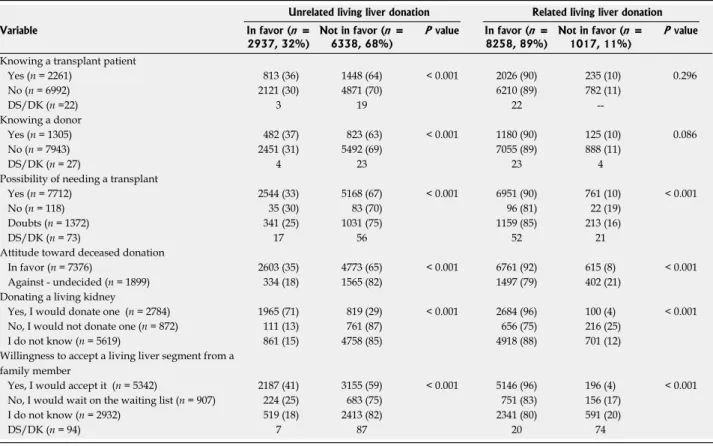
Variables of knowledge about, and attitude toward, organ donation and transplantation: Among the factors associated with a favorable attitude toward related LLD, we have found that a respondent’s belief that he or she might need a transplant in the future tended to encourage a favorable attitude as opposed to when he or she had not considered this possibility (90% vs 81%, p < 0.001) (Table 3). In addition, the acceptance of other types of donation, such as deceased (92% vs 79%, p < 0.001) or living kidney donation (96% vs 75%) (p < 0.001), was also associated with a more favorable attitude compared to when these other types of donation were rejected. Finally, it should be noted that the willingness to accept a liver segment from a family member also tended to be associated with a favorable attitude toward LLD compared to when there were doubts about this option or there was an unwillingness to accept it (96% vs 80%, p < 0.001) (Table 3).
With regard to attitudes toward unrelated LLD, significant relationships have been found with all the variables analyzed in this section. We can see that those who had had previous links with donation and Table 2 Socio-personal and university variables related to organ donation and transplantation affecting the attitude of university medical students toward unrelated and related living liver donation n (%)
Unrelated living liver donation Related living liver donation Variable In favor (n =
2937; 32%) Not in favor (6338; 68%)n = P value In favor (8258; 89%)n = Not in favor (1017; 11%)n = P value
Socio-personal variables Age (21 ± 3 yr) 22 ± 4 yr 21 ± 3 yr < 0.001 21 ± 3 yr 22 ± 4 yr 0.008 Sex 0.195 < 0.001 Male (n = 2702) 830 (31) 1872 (69) 2310 (86) 392 (14) Female (n = 6499) 2086 (32) 4413 (68) 5889 (91) 610 (9) DS/DK (n = 74) 21 53 59 15 University variables Type of university 0.68 0.103 Public university (n = 8192) 2600 (32) 5592 (68) 7278 (89) 914 (11) Private university (n = 1083) 337 (31) 746 (69) 980 (91) 103 (9) Year of medicine < 0.001 < 0.001 First (n = 2090) 521 (25) 1569 (75) 1811 (87) 279 (13) Second (n = 1965) 544 (28) 1421 (72) 1736 (88) 229 (12) Third (n = 1375) 422 (31) 953 (69) 1212 (88) 163 (12) Fourth (n = 1301) 480 (37) 821 (63) 1166 (90) 135 (10) Fifth (n = 1113) 443 (40) 670 (60) 1020 (92) 93 (8) Sixth (n = 1431) 527 (37) 904 (63) 1313 (92) 118 (8) Geographical location 0.109 0.013 North (n = 1136) 365 (32) 771 (68) 1002 (88) 134 (12) Central area (n = 2358) 718 (30) 1640 (70) 2118 (90) 240 (10) South (n = 2205) 741 (34) 1464 (66) 1993 (90) 212 (10) East (n = 3576) 1113 (31) 2463 (69) 3145 (88) 431 (12)
transplantation, that is, people who knew a transplant patient (36% vs 30%, p < 0.001), or donor (37%
vs 31%, p < 0.001) (Table 3), had a more favorable
attitude compared to those respondents who did not have this personal experience.
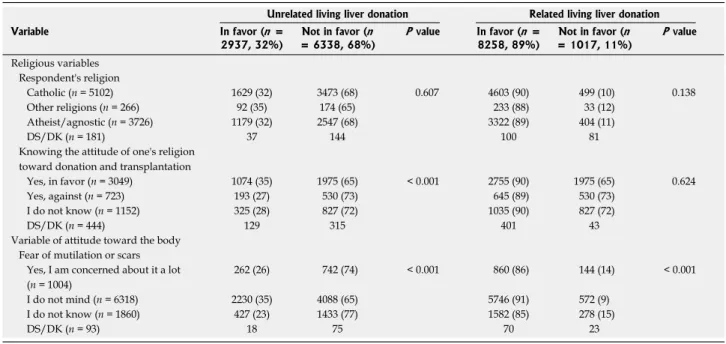
Variables of social interaction: As shown in Table 4, all of these variables were associated with attitude toward LLD. Accordingly, the students who had discussed the subject of donation and transplantation, both with their families and friends, had a more favorable attitude toward related and unrelated LLD. It has also been found that the favorable attitude of a respondent’s partner toward donation and transplantation had a favorable influence (Table 4). Variables of pro-social behavior: Among the students surveyed, a more favorable attitude has been observed toward both related and unrelated LLD among those who carry out altruistic type activities or who would be prepared to take part in them (Table 4). Religious variables: In the present study no sig-nificant relationships were found between attitude toward LLD and the religious variables analyzed (Table 5). However, it is notable that believers who considered that their doctrine was in favor of donation
and transplantation were more in favor of unrelated donation than those who believed their religion was against (35% vs 27%) (p < 0.001).
Variable of attitude toward the body: Finally, it has been seen that not being concerned about the possible mutilation of the organism after donation tended to be associated with a favorable attitude toward LLD unlike in the case of those who were concerned about this aspect (p < 0.001) (Table 5).
A multivariate analysis of the factors affecting attitude
toward related LLD
The multivariate analysis has shown that the following independent factors affected attitude toward related LLD (Table 6): (1) Being a female (OR = 1.356; p < 0.001); (2) Studying in the last academic years of the degree in medicine (fifth and sixth year) (OR = 1.485;
p = 0.005); (3) Being in favor of deceased organ
donation (OR = 2.169; p < 0.001); (4) Being in favor of living kidney donation (OR = 3.278; p < 0.001); (5) Being willing to be a recipient of a liver segment from a living donor (OR = 6.493; p < 0.001); (6) Not having a partner, and therefore, not being influenced by this person’s opinion (OR = 1.569; p = 0.040); and (7) Being involved in regular pro-social activities (OR = 1.620; p = 0.012).
Table 3 Variables of the university medical students' knowledge about, and attitude toward, related and unrelated living liver donation n (%)
Unrelated living liver donation Related living liver donation Variable In favor (n =
2937, 32%) Not in favor (6338, 68%)n = P value In favor (8258, 89%)n = Not in favor (1017, 11%)n = P value
Knowing a transplant patient
Yes (n = 2261) 813 (36) 1448 (64) < 0.001 2026 (90) 235 (10) 0.296 No (n = 6992) 2121 (30) 4871 (70) 6210 (89) 782 (11) DS/DK (n =22) 3 19 22 --Knowing a donor Yes (n = 1305) 482 (37) 823 (63) < 0.001 1180 (90) 125 (10) 0.086 No (n = 7943) 2451 (31) 5492 (69) 7055 (89) 888 (11) DS/DK (n = 27) 4 23 23 4
Possibility of needing a transplant
Yes (n = 7712) 2544 (33) 5168 (67) < 0.001 6951 (90) 761 (10) < 0.001
No (n = 118) 35 (30) 83 (70) 96 (81) 22 (19)
Doubts (n = 1372) 341 (25) 1031 (75) 1159 (85) 213 (16)
DS/DK (n = 73) 17 56 52 21
Attitude toward deceased donation
In favor (n = 7376) 2603 (35) 4773 (65) < 0.001 6761 (92) 615 (8) < 0.001
Against - undecided (n = 1899) 334 (18) 1565 (82) 1497 (79) 402 (21)
Donating a living kidney
Yes, I would donate one (n = 2784) 1965 (71) 819 (29) < 0.001 2684 (96) 100 (4) < 0.001
No, I would not donate one (n = 872) 111 (13) 761 (87) 656 (75) 216 (25)
I do not know (n = 5619) 861 (15) 4758 (85) 4918 (88) 701 (12)
Willingness to accept a living liver segment from a family member
Yes, I would accept it (n = 5342) 2187 (41) 3155 (59) < 0.001 5146 (96) 196 (4) < 0.001 No, I would wait on the waiting list (n = 907) 224 (25) 683 (75) 751 (83) 156 (17)
I do not know (n = 2932) 519 (18) 2413 (82) 2341 (80) 591 (20)
DS/DK (n = 94) 7 87 20 74
Table 4 Variables of social interaction and pro-social behavior affecting the attitude of university medical students toward unrelated and related living liver donation n (%)
Unrelated living liver donation Related living liver donation Variable In favor (n = 2937, 32%) Not in favor (n = 6338, 68%) P value In favor (n = 8258, 89%) Not in favor (n = 1017, 11%) P value
Variables of social interaction Family discussion
Yes (n = 6565) 2255 (34) 4310 (66) < 0.001 5946 (91) 619 (9) < 0.001
No (n = 2689) 675 (25) 2014 (75) 2297 (85) 392 (15)
DS/DK (n = 21) 7 14 15 6
Discussion with friends
Yes (n = 6841) 2307 (34) 4534 (66) < 0.001 6172 (90) 669 (10) < 0.001
No (n = 2418) 627 (26) 1791 (74) 2074 (86) 344 (14)
DS/DK (n = 16) 3 13 12 4
A partner's opinion about donation and transplantation
Yes, it is favorable (n = 2740) 1045 (38) 1695 (62) < 0.001 2511 (92) 229 (8) < 0.001
I do not know (n = 2451) 603 (25) 1848 (75) 2101 (86) 350 (14)
Yes, he or she is against (n = 247) 71 (29) 176 (71) 204 (83) 43 (17) I do not have a boyfriend/girlfriend (n = 3654) 1162 (32) 2492 (68) 3281 (90) 373 (10)
DS/DK (n = 183) 56 127 161 22
Donation of a family member's organs
Yes (n = 8424) 2776 (33) 5648 (67) < 0.001 7592 (90) 832 (10) < 0.001
No (n = 667) 128 (19) 539 (81) 536 (80) 131 (20)
DS/DK (n = 184) 33 151 130 54
Variable of pro-social behaviour Participation in pro-social activities
Yes, regularly (n = 882) 348 (40) 534 (60) < 0.001 778 (88) 104 (12) < 0.001
Yes, occasionally (n = 1968) 710 (36) 1258 (64) 1756 (89) 212 (11)
No, nor am I going to (n = 598) 92 (15) 506 (85) 499 (84) 99 (16)
No, but I would be willing to (n = 5766) 1774 (31) 3992 (69) 5201 (90) 565 (10)
DS/DK (n = 61) 13 48 24 37
DS/DK: Does not say/does not know.
Table 5 Religious variables and attitude toward the body which affect the attitude of university medical students toward unrelated and related living liver donation n (%)
Unrelated living liver donation Related living liver donation Variable In favor (n = 2937, 32%) Not in favor (n = 6338, 68%) P value In favor (n = 8258, 89%) Not in favor (n = 1017, 11%) P value Religious variables Respondent's religion Catholic (n = 5102) 1629 (32) 3473 (68) 0.607 4603 (90) 499 (10) 0.138 Other religions (n = 266) 92 (35) 174 (65) 233 (88) 33 (12) Atheist/agnostic (n = 3726) 1179 (32) 2547 (68) 3322 (89) 404 (11) DS/DK (n = 181) 37 144 100 81
Knowing the attitude of one's religion toward donation and transplantation
Yes, in favor (n = 3049) 1074 (35) 1975 (65) < 0.001 2755 (90) 1975 (65) 0.624
Yes, against (n = 723) 193 (27) 530 (73) 645 (89) 530 (73)
I do not know (n = 1152) 325 (28) 827 (72) 1035 (90) 827 (72)
DS/DK (n = 444) 129 315 401 43
Variable of attitude toward the body Fear of mutilation or scars Yes, I am concerned about it a lot (n = 1004)
262 (26) 742 (74) < 0.001 860 (86) 144 (14) < 0.001
I do not mind (n = 6318) 2230 (35) 4088 (65) 5746 (91) 572 (9)
I do not know (n = 1860) 427 (23) 1433 (77) 1582 (85) 278 (15)
DS/DK (n = 93) 18 75 70 23
A multivariate analysis of the factors affecting attitude
toward unrelated LLD
The multivariate analysis has shown the following independent factors to affect attitude toward unrelated LLD (Table 7): (1) Age (OR = 1.026; p < 0.001); (2) Studying in the final years of medicine (fourth, fifth and sixth years) (OR = 1.436 and p = 0.006; OR = 1.594 and p = 0.001; OR = 1.745 and p < 0.001); (3) Being in favor of deceased organ donation (OR = 1.724; p < 0.001); (4) Being in favor of living kidney donation (OR = 12.820; p < 0.001); (5) Being willing to be a recipient of a liver segment from a living donor (OR = 3.115; p < 0.001); (6) Having a partner who is in favor of organ donation (OR = 1.443; p < 0.001) or not having a partner, and therefore, not being influenced by that person (OR = 1.410; p < 0.001); (7) Regular participation in altruistic activities (OR = 1.992;
p = 0.002); and (8) A respondent’s belief that his or
her religion is in favor of donation and transplantation (OR = 1.398; p = 0.002).
DISCUSSION
Knowing about people’s attitude toward organ dona-tion allows us to determine which factors affect this attitude and to be able to create adequately designed
and cost-effective campaigns. The application of questionnaires is one of the most widely-used data collection techniques in social research, given that (1) it has a low cost; (2) it makes it possible to reach a larger number of participants; and (3) it facilitates the analysis of the results obtained[14]. However,
questionnaires also have their limitations, such as the loss of verbal communication. Furthermore, it is fundamentally important for the questionnaire to be designed so that it can quantify and universalize this information, and thus standardize the inter-view process. Therefore, a questionnaire should be subjected to a creation and validation process to confirm to what degree it reflects the situation that we are trying to measure. This basic premise has not been fulfilled in research into attitude toward donation, given that most of the studies carried out and published use measurement tools that have not been designed for such a purpose and have not been validated. Finally, we should remember that the interpretation of the results should involve the recognition of certain limitations that arise in opinion questionnaires. The first of these is the result of the tendency of all the participants to respond according to what is considered to be “socially desirable” in the surroundings where they live. The second is caused by the distance Table 6 Variables affecting the attitude of university medical students toward related living liver donation, a multivariate study Variable Regression
coefficient (b)
Standard error OR (CI) P value
Sex
Male (n = 2702) 1
Female (n = 6499) 0.304 1.356 (1.602-1.146) < 0.001
Academic year of degree in medicine:
First (n = 2090) 1 Second (n = 1965) 0.090 0.111 1.095 (1.360-0.880) 0.416 Third (n = 1375) 0.096 0.127 1.101 (1.412-0.858) 0.449 Fourth (n = 1301) 0.078 0.135 1.081 (1.408-0.830) 0.561 Fifth (n = 1113) 0.396 0.157 1.485 (2.024-1.091) 0.012 Sixth (n = 1431) 0.396 0.143 1.485 (1.964-1.123) 0.005
Attitude toward deceased donation
Against – Undecided (n = 1899) 1
In favor (n = 7376) 0.774 0.088 2.169 (2.577-1.824) < 0.001
Donating a living kidney
I do not know (n = 5619) 1
Yes, I would donate one (n = 2784) 1.189 0.127 3.278 (4.219-2.557) < 0.001
No, I would not donate one (n = 872) 0.914 0.109 2.494 (2.016-3.086) < 0.001
Willingness to accept a liver segment from a family member
I do not know (n = 2932) 1
Yes, I would accept it (n = 5342) 1.872 0.096 6.493 (7.874-5.376) < 0.001
No, I would wait on the list (n = 907) 0.347 0.115 1.414 (1.769-1.129) 0.003
The respondent's partner's opinion about donation and transplantation
Yes, he or she is against (n = 247) 1
Yes, it is favorable (n = 2740) 0.383 0.225 1.466 (2.277-0.943) 0.089
I do not know it (n = 2451) 0.157 0.220 1.169 (1.801-0.759) 0.477
I have not got a boyfriend or girlfriend (n = 3654) 0.450 0.219 1.569 (2.409-1.021) 0.040 Participation in pro-social activities
No, I have no intention to participate (n = 598) 1
Yes, regularly (n = 882) 0.482 0.193 1.620 (1.110-2.364) 0.012
Yes, occasionally (n = 1968) 0.332 0.171 1.394 (0.997-1.948) 0.052
between the responses and the responent’s actual behavior if the situation under consideration were to occur in real life[15].
One of the main efforts of this sociological study was to achieve a representative sample of medical students in the whole of Spain. In addition, the response rate in any attitude study is an indicator of the quality of the data and it is desirable for it to be above 75% in order to prevent a positive bias given that those who tend to respond are those who are more interested in the topic[16].
LLD has been very controversial, although after a steep learning curve, there have been improved outcomes for both donors and recipients in specialist centers making this an acceptable therapeutic option[6,17,18]. This type of living donation has therefore
become especially necessary because of the shortage of livers available for transplantation and the mortality on the transplant waiting list[1]. Until now LLD has not
been developed to a great extent in Spain, where LLD rates are lower than 0.1 per million population[1].
With the objective of boosting LLD, it has become necessary to improve the social image of this do-nation[19]. In order to achieve this, it has become
essential to find out the attitude of the population about the issue, because it is not free of fear and mistrust[19,20]. Furthermore, healthcare professionals
should get involved in the matter, given that although they might not be directly involved in the donation and transplantation process, they are groups that generate opinions and therefore they influence the decisions of potential donors[8,9]. This study has shown that medical
students, who will be physicians in a few years, have a clearly favorable attitude toward related LLD. This fact is very important, because it should be taken into account that for its development it is essential for healthcare professionals to encourage living donation. However, other factors should be analyzed given that donation rates are not increasing in spite of this positive attitude[1].
Attitude was favorable in 89% of the respondents, a percentage that is higher than the rate reported in Table 7 Variables affecting the attitude of university medical students toward unrelated living liver donation, a multivariate study Variable Regression
coefficient (b)
Standard error OR (CI) P value
1 Age (21 ± 3 yr) 0.026 0.012 1.026 (1.051-1.002) 0.037 Year of medicine First (n = 2090) 1 Second (n = 1965) 0.082 0.120 1.085 (1.373-0.857) 0.496 Third (n = 1375) 0.205 0.131 1.226 (1.587-0.949) 0.118 Fourth (n = 1301) 0.362 0.131 1.436 (1.855-1.111) 0.006 Fifth (n = 1113) 0.467 0.141 1.594 (2.100-1.210) 0.001 Sixth (n = 1431) 0.556 0.138 1.745 (2.288-1.331) < 0.001
Attitude toward deceased donation
Against - Undecided (n = 1899) 1
In favor (n = 7376) 0.546 0.106 1.724 (2.123-1.402) < 0.001
Donating a living kidney I do not know (n = 5619)
Yes, I would donate one (n = 2784) 2.552 0.078 12.820 (14.925-10.989) < 0.001
No, I would not donate one (n = 872) 0.099 0.146 1.104 (0.830-1.469) 0.495
Willingness to accept a liver segment from a family member
I do not know (n = 2932) 1
Yes, I would accept it (n = 5342) 1.137 0.089 3.115 (3.717-2.617) < 0.001
No, I would wait on the waiting list (n = 907) 0.257 0.144 1.293 (1.715-0.974) 0.074
A partner's opinion about donation and transplantation
I do not know it (n = 2451) 1
Yes, it is favorable (n = 2740) 0.367 0.099 1.443 (1.751-1.187) < 0.001
Yes, he or she is against (n = 247) 0.336 0.227 1.398 (2.183-0.896) 0.139
I do not have a boyfriend/girlfriend (n = 3654) 0.344 0.094 1.410 (1.694-1.173) < 0.001 Donating a family member's organs
No (n = 667) 1
Yes (n = 8424) 0.395 0.162 1.483 (2.040-1.078) 0.015
Participation in pro-social activities
No, I do not intend to particpate in them (n = 598) 1
Yes, regularly (n = 882) 0.690 0.219 1.992 (3.067-1.297) 0.002
Yes, occasionally (n = 1968) 0.611 0.200 1.841 (2.724-1.243) 0.002
No, but I would be willing to (n = 5766) 0.518 0.190 1.677 (2.439-1.157) 0.006
Knowing the attitude of one's religion toward donation and transplantation
Yes, against (n = 723) 1
Yes, in favor (n = 3049) 0.336 0.110 1.398 (1.736-1.127) 0.002
the Spanish general public[19] and in other European
countries[21], where about 75% are in favor. In all
of these cases it is related donation that is under consideration, that is, when there is some kind of connection between the donor and recipient. This is the reason why it has such a high acceptance level in every stratum, both in the population[12] and healthcare
workers[8]. A lot of sensitivity toward unrelated living
donation has also been found, with rates of more than 30% in favor. This differs from the data found in English speaking societies where there is a lower acceptance rate[21].
Attitudes toward LLD have not been studied very extensively and there have only been a few isolated studies on medical students. Among these the most notable is the one by Dahlke et al[12] which analyzed
the attitude of students in the United States, Germany and Japan, and although the sample was small, it suggests that acceptance is mainly influenced by cultural factors. For example, they state that acceptance is greater in the United States compared to Germany and Japan, with a greater willingness for infant donation than adult donation, and therefore they suggest that socio-demographic differences should be taken into account to establish protocols of clinical practice in living donation. Although this is very important, this aspect is well-known in attitude studies, given that there are many cultural differences between the different continents. We should point out that there have not been any studies about this issue covering a whole country, or a specific geographical area, or even the whole degree in medicine. Instead of this, researchers have focused on a specific group of a specific university. Therefore, until today the only generalizable conclusions about the attitude of medical students toward LLD, in this case in Spain, are the ones presented in this study.
The student’s academic year has an effect on attitude toward LLD. As the student advances through the years there is a gradual progress in technical knowledge of the issue which allows students, mainly in the second half of their degree, to establish contact with the healthcare system and certain clinical services related to transplantation making it possible for students to develop a personal view of the subject[22,23].
In this way, it has been seen that students in the fifth and sixth years have a more favorable attitude than those in the earlier years.
Regardless of academic training and university progression, a close relationship has been observed between attitude toward LLD, and attitude toward the other kinds of human organ donation, both deceased and living kidney donation. This coincides with findings in the Spanish speaking population, where there is a clear association between attitude toward deceased and living donation[24]. Organ donation is an altruistic
aspect of life, and if one is able to accept one type of donation then other kinds are also generally
acceptable. Furthermore, as reported in deceased organ donation, feelings of reciprocity also have an influence[14], that is, doing to others what we would
like to be done to ourselves. Thus, the principal related factors that have been found have this component of reciprocity, such as the belief that one might need a transplant in the future and if this were the case, a respondent’s willingness to receive an organ from a living donor.
The variables of social interaction have a very clear association with attitude toward the donation of one’s own organs[25-28]. The way each respondent
perceives opinions in his or her surroundings has a great influence on his or her ultimate decision on whether to donate or not. For instance, being in a family and social context in which there is a favorable attitude multiplies the chances of the student having a favorable attitude. In current times, when it is uncommon to live independently of the family during the university period, and when students tend to continue to depend on the family for financial support, this fact is becoming more evident.
Family factors should also be noted[29], in the sense that
the respondent’s partner’s attitude toward donation has an important influence on the respondent’s attitude. This is a factor that has been typically reported in attitude toward deceased donation[14,30], and it has
been seen that when one’s partner is against donation there is a significant increase in the percentage of respondents with doubts or who are against this kind of donation and vice versa. This aspect continues to reinforce the theory that we should keep talking about donation and transplantation, and underlines the importance of expressing favorable attitudes toward donation, because this simple act will have a promotional effect on donation which is generally greater than any organized campaign.
Finally, there is the fear of possible mutilation as a consequence of living donation. Healthcare professionals are just as sensitive as the general public with regard to feelings that arise due to the manipulation of the body, and it has been seen that they have greater difficulty in allowing action to be carried out on it even when there are well-accepted objectives such as in transplantation[19].
We have the basic pillars in place such as future professionals with a relatively high favorable attitude (when deceased donation was first encouraged in Spain, attitude toward this kind of donation was less favorable than current attitude toward LLD), and we also have a receptive population. If institutional and political support can be achieved, as occurred in deceased donation, it is hoped that in the coming years we could relaunch this kind of donation, so we could reach a point where we are able to prevent mortality on the waiting list.
However, we should be cautious about its deve-lopment and restrict it to experienced centers to
prevent unnecessary morbidity among donors[1].
Therefore, given that current mortality on the liver transplant waiting list in Spain ranges between 8%-10%, our objective should be to arrive at this percentage, and no more. If this is not achieved, we are going to create a healthy young population subjected to liver surgery with frequent morbidity and occasional mortality[31]. Moreover, we should
remember that among all the potential liver donors for each recipient a series of invasive procedures need to be performed such as biopsy, arteriography, etc. that produce morbidity in people who do not even become donors[6]. On the other hand, it is well-known
that there is an improvement in the bond between the donor and recipient and their self-esteem as a result of this kind of transplant, especially when it is donation from a parent to a child[32], while parents who have
refused to donate to their children report consequent stress, anxiety, psychosomatic syndromes and feelings of guilt[32].
To conclude, the attitude of medical student toward related and unrelated LLD is very favorable, and is associated with factors directly and indirectly related to donation and transplantation, family and religious factors, and factors related to attitude toward the body.
COMMENTS
Background
Liver transplantation offers long survival periods and improved quality of life. However, the current transplant organ donation rates are insufficient for covering minimum transplant needs. Even though living liver donation (LLD) has been successfully carried out in many countries it is at a very low level. One of the possible barriers to its development could be the risk involved for the donor. However, in experienced centers the results are acceptable. Nevertheless, it should be taken into account that professionals in healthcare centers do not always have a favorable attitude toward LLD. Students of medicine represent a new generation of physicians, although their attitude toward LLD has not been studied to any great extent. It should be remembered, however, that the adequate training of future physicians in the transplantation and donation process involves specifically finding out those variables that have an effect on certain attitudes toward donation from the stage of being a student. In this sense, a knowledge of the factors that influence attitudes toward donation will allow us to optimize the resources invested in carrying out donation and transplantation promotion campaigns and to act in a more specific way.
Research frontiers
Attitudes toward LLD have not been studied very extensively and there have only been a few isolated studies on medical students. Among these the most notable is the one by Dahlke et al analyzing the attitude of students in the United States, Germany and Japan, and although the sample is small, it suggests that acceptance is mainly influenced by cultural factors. For example, they state that acceptance is greater in the United States compared to Germany and Japan, with a greater willingness for infant donation than adult donation, and therefore they suggest that socio-demographic differences should be taken into account to establish protocols of clinical practice in living donation. Although this is very important, this aspect is well-known in attitude studies, given that there are many cultural differences between the different continents. We should point out that there have not been any studies about this issue covering a whole country, or a specific geographical area, or even the whole degree in medicine. Instead of this, researchers have focused on a specific
group of a specific university. Therefore, until today the only generalizable conclusions about the attitude of medical students toward LLD, in this case in Spain, are the ones presented in this study.
Innovations and breakthroughs
In studies of attitude toward organ donation, there are few stratified studies that have stratified the study population so that generalizations can be made from the results obtained. The study presented in this article represents the first stratified and validated study carried out on medical students covering a whole country, in this case Spain. Attitude was favorable in 89% of the respondents, a percentage that is higher than the rate reported in the Spanish general public and in other European countries, where about 75% are in favor. In all of these cases it is related donation that is under consideration, that is, when there is some kind of connection between the donor and recipient. Attitudes toward LLD have not been studied very extensively in medical students. Dahlke et al analyzed the attitude of students in the United States, Germany and Japan, and although the sample was small, it suggests that acceptance is mainly influenced by cultural factors.
Applications
The authors have the basic pillars in place such as future professionals with a relatively high favorable attitude (when deceased donation was first encouraged in Spain, attitude toward this kind of donation was less favorable than current attitude toward LLD), and the authors also have a receptive population. If institutional and political support can be achieved, as occurred in deceased donation, it is hoped that in the coming years this kind of donation could be relaunched, so that they could reach a point where they are able to prevent mortality on the waiting list. However, they should be cautious about its development and restrict it to experienced centers to prevent unnecessary morbidity among donors. Therefore, given that current mortality on the liver transplant waiting list in Spain ranges between 8%-10%, our objective should be to arrive at this percentage, and no more. If this is not achieved, the authors are going to create a healthy young population subjected to liver surgery with frequent morbidity and occasional mortality. Moreover, the authors should remember that among all the potential liver donors for each recipient a series of invasive procedures need to be performed such as biopsy, arteriography, etc. that produce morbidity in people who do not even become donors. On the other hand, it is well-known that there is an improvement in the bond between the donor and recipient and their self-esteem as a result of this kind of transplant, especially when it is donation from a parent to a child, while parents who have refused to donate to their children report consequent stress, anxiety, psychosomatic syndromes and feelings of guilt.
Terminology
Liver transplantation offers long survival periods and improved quality of life for patients with liver disease whose vital prognosis is short if they do not have a transplant. However, the current transplant organ donation rates are insufficient for covering minimum transplant needs, and the shortage in available livers means that mortality on the waiting list is increasing. Even in Spain in the 21st century, the country with the highest donation rates, mortality
on the liver transplant waiting list has been increasing. All of this is making it necessary to encourage alternatives to deceased liver donation. The living liver transplantation has been successfully carried out and in some countries it is becoming more common.
Peer-review
This is a very interesting manuscript that explores the views of the next generation of Spanish doctors about living related liver donation. The study includes a large number of medical students with an excellent response rate.
REFERENCES
1 Council of Europe. International Figures on Donation and
Transplantation 2013. Newsletter Transplant, 2014
2 Dutkowski P, Linecker M, DeOliveira ML, Müllhaupt B, Clavien
PA. Challenges to liver transplantation and strategies to improve outcomes. Gastroenterology 2015; 148: 307-323 [PMID: 25224524
COMMENTS
DOI: 10.1053/j.gastro.2014.08.045]
3 Xu DW, Long XD, Xia Q. A review of life quality in living donors
after liver transplantation. Int J Clin Exp Med 2015; 8: 20-26 [PMID: 25784970]
4 Olthoff KM, Abecassis MM, Emond JC, Kam I, Merion RM,
Gillespie BW, Tong L; Adult-to-Adult Living Donor Liver Transplantation Cohort Study Group. Outcomes of adult living donor liver transplantation: comparison of the Adult-to-adult Living Donor Liver Transplantation Cohort Study and the national experience. Liver Transpl 2011; 17: 789-797 [PMID: 21360649 DOI: 10.1002/ lt.22288]
5 Wan P, Yu X, Xia Q. Operative outcomes of adult living donor
liver transplantation and deceased donor liver transplantation: a systematic review and meta-analysis. Liver Transpl 2014; 20: 425-436 [PMID: 24478109 DOI: 10.1002/lt.23836]
6 Li KW, Wen TF, Yan LN, Li B, Zeng Y, Zhao JC, Wang WT, Xu
MQ, Yang JY, Ma YK, Chen ZY, Huang B. Donor right hepatectomy in living donor liver transplantation: report of 143 cases. Hepatogastroenterology 2010; 57: 1232-1236 [PMID: 21410064] 7 Azoulay D, Bhangui P, Andreani P, Salloum C, Karam V, Hoti E,
Pascal G, Adam R, Samuel D, Ichai P, Saliba F, Castaing D. Short- and long-term donor morbidity in right lobe living donor liver transplantation: 91 consecutive cases in a European Center. Am J Transplant 2011; 11: 101-110 [PMID: 21199351 DOI: 10.1111/ j.1600-6143.2010.03284.x]
8 Ríos A, Ramírez P, Rodríguez MM, Martínez L, Rodríguez JM,
Galindo PJ, Parrilla P. Attitude of hospital personnel faced with living liver donation in a Spanish center with a living donor liver transplant program. Liver Transpl 2007; 13: 1049-1056 [PMID: 17600353 DOI: 10.1002/lt.21226]
9 Ríos A, Ramírez P, Rodríguez MM, Martínez L, Montoya MJ,
Lucas D, Parrilla P. Personnel in cadaveric organ transplant-related hospital units faced with living liver donation: an attitudinal study in a Spanish hospital with a cadaveric and living liver transplant programme. Liver Int 2007; 27: 687-693 [PMID: 17498255 DOI: 10.1111/j.1478-3231.2007.01464.x]
10 Castaing D, Azoulay D, Danet C, Thoraval L, Tanguy Des Deserts C, Saliba F, Samuel D, Adam R. Medical community preferences concerning adult living related donor liver transplantation. Gastroenterol Clin Biol 2006; 30: 183-187 [PMID: 16565648 DOI: 10.1016/S0399-8320(06)73151-7]
11 Conesa Bernal C, Ríos Zambudio A, Ramírez Romero P, Rodríguez Martínez MM, Canteras Jordana M, Parrilla Paricio P. [Importance of primary health-care professionals in the sanitary education about organ donation]. Aten Primaria 2004; 34: 528-533 [PMID: 15607055 DOI: 10.1157/1306958]
12 Dahlke MH, Popp FC, Eggert N, Hoy L, Tanaka H, Sasaki K, Piso P, Schlitt HJ. Differences in attitude toward living and postmortal liver donation in the United States, Germany, and Japan. Psychosomatics 2005; 46: 58-64 [PMID: 15765822 DOI: 10.1176/appi.psy.46.1.58] 13 Instituto Nacional de Estadistica. (Spanish Statistical Office).
Available from: URL: http//www.ine.es/
14 Ríos A, Cascales P, Martínez L, Sánchez J, Jarvis N, Parrilla P, Ramírez P. Emigration from the British Isles to southeastern Spain: a study of attitudes toward organ donation. Am J Transplant 2007; 7: 2020-2030 [PMID: 17617867 DOI: 10.1111/ j.1600-6143.2007.01879.x]
15 Tourangeau R, Rips LJ, Rasinski K. The Psychology of Survey Response. Cambridge University Press, 2000 [DOI: 10.1017/ CBO9780511819322]
16 Ríos A, López-Navas A, Ayala-García MA, Sebastián MJ, Abdo-Cuza A, Alán J, Martínez-Alarcón L, Ramírez EJ, Muñoz G, Suárez-López J, Castellanos R, Ramírez R, González B, Martínez MA, Díaz E, Ramírez P, Parrilla P. Spanish-Latin American multicenter study of attitudes toward organ donation among personnel from hospital healthcare centers. Cir Esp 2014; 92: 393-403 [PMID: 24565516 DOI: 10.1016/j.ciresp.2013.12.017]
17 Morioka D, Egawa H, Kasahara M, Ito T, Haga H, Takada Y,
Shimada H, Tanaka K. Outcomes of adult-to-adult living donor liver transplantation: a single institution’s experience with 335 consecutive cases. Ann Surg 2007; 245: 315-325 [PMID: 17245187 DOI: 10.1097/01.sla.0000236600.24667.a4]
18 Lai JC, Pichardo EM, Emond JC, Brown RS. Resource utilization of living donor versus deceased donor liver transplantation is similar at an experienced transplant center. Am J Transplant 2009; 9: 586-591 [PMID: 19191773 DOI: 10.1111/j.1600-6143.2008.02511.x] 19 Conesa C, Ríos A, Ramírez P, del Mar Rodríguez M, Rivas
P, Parrilla P. Socio-personal factors influencing public attitude towards living donation in south-eastern Spain. Nephrol Dial Transplant 2004; 19: 2874-2882 [PMID: 15316100 DOI: 10.1093/ ndt/gfh466]
20 Popp FC, Eggert N, Hoy L, Lang SA, Obed A, Piso P, Schlitt HJ, Dahlke MH. Who is willing to take the risk? Assessing the readiness for living liver donation in the general German population. J Med Ethics 2006; 32: 389-894 [PMID: 16816037 DOI: 10.1136/ jme.2005.013474]
21 Neuberger J, Farber L, Corrado M, O’Dell C. Living liver donation: a survey of the attitudes of the public in Great Britain. Transplantation 2003; 76: 1260-1264 [PMID: 14578769 DOI: 10.1097/01.TP.0000087835.09752.70]
22 Radunz S, Juntermanns B, Heuer M, Frühauf NR, Paul A, Kaiser GM. The effect of education on the attitude of medical students towards organ donation. Ann Transplant 2012; 17: 140-144 [PMID: 22466921 DOI: 10.12659/AOT.882648]
23 Schaeffner ES, Windisch W, Freidel K, Breitenfeldt K, Winkelmayer WC. Knowledge and attitude regarding organ donation among medical students and physicians. Transplantation 2004; 77: 1714-1718 [PMID: 15201671 DOI: 10.1097/00007890-200406150-00015]
24 Brown RS, Russo MW, Lai M, Shiffman ML, Richardson MC, Everhart JE, Hoofnagle JH. A survey of liver transplantation from living adult donors in the United States. N Engl J Med 2003; 348: 818-825 [PMID: 12606737 DOI: 10.1056/NEJMsa021345] 25 Ríos A, López-Navas AI, Navalón JC, Martínez-Alarcón L,
Ayala-García MA, Sebastián-Ruiz MJ, Moya-Faz F, Garrido G, Ramirez P, Parrilla P. The Latin American population in Spain and organ donation. Attitude toward deceased organ donation and organ donation rates. Transpl Int 2015; 28: 437-447 [PMID: 25557362 DOI: 10.1111/tri.12511]
26 Wakefield CE, Watts KJ, Homewood J, Meiser B, Siminoff LA. Attitudes toward organ donation and donor behavior: a review of the international literature. Prog Transplant 2010; 20: 380-391 [PMID: 21265292 DOI: 10.7182/prtr.20.4.p54651601pg80183]
27 Ríos A, Ramírez P, del Mar Rodríguez M, Martínez L, Montoya MJ, Lucas D, Alcaraz J, Parrilla P. Attitude of ancillary personnel faced with living kidney donation in a hospital with a living donor kidney transplant program. Transplantation 2007; 83: 336-340 [PMID: 17297409 DOI: 10.1097/01.tp.0000247799.35846.b1]
28 Ríos Zambudio A, López-Navas A, Ayala-García M, Sebastián MJ, Abdo-Cuza A, Alán J, Martínez-Alarcón L, Ramírez EJ, Muñoz G, Palacios G, Suárez-López J, Castellanos R, González B, Martínez MA, Díaz E, Ramírez P, Parrilla P. Level of awareness of personnel in hospital services related to the donation process: A Spanish and Latin American multicenter study. J Heart Lung Transplant 2012; 31: 850-857 [PMID: 22551932 DOI: 10.1016/ j.healun.2012.03.011]
29 Ríos A, Conesa C, Ramírez P, Galindo PJ, Martínez L, Pons JA, Rodríguez MM, Parrilla P. Attitudes toward living liver donation among hospital personnel in services not related to transplantation. Transplant Proc 2005; 37: 3636-3640 [PMID: 16386489 DOI: 10.1016/j.transproceed.2005.10.037]
30 Ríos A, Ramírez P, Martínez L, Montoya MJ, Lucas D, Alcaraz J, Rodríguez MM, Rodríguez JM, Parrilla P. Are personnel in transplant hospitals in favor of cadaveric organ donation? Multivariate attitudinal study in a hospital with a solid organ transplant program. Clin Transplant 2006; 20: 743-754 [PMID: 17100725 DOI: 10.1111/
j.1399-0012.2006.00562.x]
31 Kaido T, Uemoto S. Does living donation have advantages over deceased donation in liver transplantation? J Gastroenterol Hepatol 2010; 25: 1598-1603 [PMID: 20880167 DOI: 10.1111/ j.1440-1746.2010.06418.x]
32 Kärrfelt HM, Berg UB, Lindblad FI, Tydén GE. To be or not to be a living donor: questionnaire to parents of children who have undergone renal transplantation. Transplantation 1998; 65: 915-918 [PMID: 9565094 DOI: 10.1097/00007890-199804150-00 009]
P- Reviewer: Bramhall S, Gruttadauria S, Qin JM S- Editor: Gong ZM L- Editor: A E- Editor: Wang CH