UNIVERSITARY MASTER DEGREE:
Master in Construction Research, Technology and Management in Europe – Máster en Investigación, Tecnología y Gestión de la
Construcción en Europa
RISK MANAGEMENT IN CONSTRUCTION SECTOR: NEW
METHODOLOGY FOR PROCUREMENT IN SME´S
GESTIÓN DE RIESGO EN EL SECTOR DE LA CONSTRUCCIÓN:
NUEVA METODOLOGÍA PARA LA OBTENCIÓN DE OBRAS EN
PYMES
FINAL DISSERTATION/ TRABAJO FIN DE MASTER 2016/2017
Research by: Antonio Alvarez Lameiro
Supervisor:
Regner Bæk Hessellund Co-Supervisor: Jorge RodríguezUniversities: Escuela Técnica Superior de Ingenieros de Caminos, Canales y Puertos. Universidad de Cantabria & VIA University College (Horsens)
Submitted: 01 September 2017
2
I ABSTRACT
Construction industry is associated with complex projects with a great number of Risks. Within this sector, SME´s in Europe represent the majority of the companies in the sector and are responsible for sustaining the construction economy. Normally, managers of this kind of companies do not know about Project Management Methodologies and do not have time or resources to use them. The purpose of this final dissertation is the application of a New Risk Management Methodology to apply in SME´s within the Tendering Process with the intention to have more documentation to stablish a proper GO/NO-GO decision in the early stage of the project. The methodology is based in a broad comprehension of the literature review and a complete understanding of risk management in construction. The aim is to confer knowledge to improve quality and reduce time and costs during the Project Life Cycle. Three case studies provided by a SME of the construction industry were analysed and the methodology was applied. The results showed that applying Risk Management Practices with criteria can be helpful in the decision making and assessing when is possible to continue or not with the procurement of the project.
I.I KEY WORDS
Risk - Risk Management - Risk Management Process - Construction - Project Life Cycle - SME´s - Methodology - Tendering Process.
3
II ACKNOWLEDGEMENTS
First of all I would like to thank my supervisor Regner Bæk Hessellund, senior lecturer at VIA University College – Faculty of Civil Engineer & Construction Manager and my co-supervisor Jorge Rodríguez Hernández, PhD professor at the Universidad de Cantabria for the constant assistance and corrections during these months of work.
I am grateful to the company Oreco S.A. for the opportunity to carry out the master´s practices in their offices. Above all, to Beatriz Iglesias who has been the person who allowed me to perform the mentioned practices and to Jose María who has had the patience and has taught me everything I have learned in the company and provided me the samples for the cases studies.
Last but not least I would like to thank my family for the unconditional support, especially to my parents and sister who have always been there in both good and bad times. Also to my girlfriend, who has had to endure me in moments of complaints and has always had such a positive attitude that facilitated me to continue with the dissertation when I needed most. Without all of them this work would not have been possible.
4
III CONTENTS
I ABSTRACT ... 2
I.I KEY WORDS ... 2
II ACKNOWLEDGEMENTS ... 3 III CONTENTS ... 4 IV FIGURES ... 6 V TABLES ... 6 1 INTRODUCTION ... 7 1.1 CONCEPT OF RISK ... 7 1.2 RESEARCH QUESTIONS ... 9 1.3 OBJECTIVES ... 9 1.4 FRAMEWORK ... 9
2 RISK MANAGEMENT PROCESS ... 11
2.1 PLAN RISK MANAGEMENT ... 14
2.2 RISK IDENTIFICATION ... 15
2.3 RISK ANALYSIS ... 18
2.4 PLAN RISK RESPONSES ... 21
2.5 MONITORING AND CONTROL ... 24
2.6 LESSONS LEARN & DATA STORAGE ... 26
2.7 RISK COMMUNICATION ... 26
3 RISK MANAGEMENT IN CONSTRUCTION ... 29
3.1 FACTORS OF RISK IN CONSTRUCTION ... 30
3.2 MANAGING RISKS IN CONSTRUCTION ... 33
3.3 SME´s IN CONSTRUCTION ... 34
3.4 PROJECT LIFE CYCLE... 35
3.4.1 PROJECT PHASES ... 37
3.4.2 TENDERING PROCESS ... 38
4 PROPOSED METHODOLOGY FOR RISK MANAGEMENT IN PROCUREMENT FOR SME´S ... 40
4.1 GENERAL DESCRIPTION ... 40
4.2 STEP 1: ALIGNMENT OF PROJECT & BUSINESS GOALS AND ESTABLISHMENT OF THE WORK TEAM ... 42
4.3 STEP 2: STUDY OF THE DOCUMENTATION ... 42
4.4 STEP 3: PLANNING ORGANIZATION ... 42
5
4.6 STEP 5: GO/NO-GO DECISION ... 45
4.7 STEP 6: PREPARATION OF THE TENDERING BID ... 46
4.8 STEP 7: DATA STORAGE & LESSONS LEARNED ... 46
4.9 LIMITATIONS ... 47
5 CASES STUDIES ... 48
5.1 DATA COLLECTION ... 48
5.2 CASE STUDY 1: REHABILITATION AND EXTENSION OF THE PRIMARY SCHOOL ALONSO DANIEL RODRIGUEZ CASTELAO (VIGO-PONTEVEDRA) ... 48
5.2.1 PROJECT DESCRIPTION ... 48
5.2.2 APPLICATION OF THE PROPOSED METHODOLOGY... 49
5.2.3 RESULTS & DISCUSSION ... 52
5.3 CASE STUDY 2: CONDITIONING OF THE SPACE FOR THE ENLARGEMENT OF THE UNIVERSITY ROOM OF THE UNED IN PREMISES OF THE AUDITORIUM AND CONFERENCE HALL OF VIGO. ... 53
5.3.1 PROJECT DESCRIPTION ... 53
5.3.2 APPLICATION OF THE PROPOSED METHODOLOGY... 53
5.3.3 RESULTS & DISCUSSION ... 56
5.4 CASE STUDY 3: SUPERMARKET REFORM ... 57
5.4.1 PROJECT DESCRIPTION ... 57
5.4.2 APPLICATION OF THE PROPOSED METHODOLOGY... 57
5.4.3 RESULTS & DISCUSSION ... 59
5.5 GENERAL DISCUSSION ... 60 6 CONCLUSIONS ... 62 7 REFERENCES ... 64 8 APPENDIXES... 69 APPENDIX A ... 69 APPENDIX B ... 70 APPENDIX C ... 72
6
IV FIGURES
Figure 1 -2 Traditional vs Recommended Emphasis of RM. ... 12
Figure 2 -2.1 Plan Risk Management. ... 14
Figure 3 -2.2 Risk Identification. ... 16
Figure 4 -2.3 Risk Analysis. ... 19
Figure 5 -2.4 Plan Risk Responses. ... 22
Figure 6 -2.5 Risk Monitoring and Control. ... 25
Figure 7 -2.7. The risk management process. ... 27
Figure 8 -3.2 Potential over the use of RM in construction projects. ... 33
Figure 9 -3.3 Company size in relation to revenue and employment ... 34
Figure 10 -3.4 Relation between costs and time during the PLC ... 36
Figure 11 -3.4 Relation between cost and Risk & Uncertainty during the PLC. ... 36
Figure 12 -4.1. New Risk Management Methodology for Tendering Processes. ... 41
Figure 13 -4.5 Workshop model sample ... 45
Figure 14 -5.2.2 Time Line of the Tendering Process. ... 52
Figure 15 -5.3.2 Time Line of the Tendering Process. ... 56
V TABLES
Table 1 -2.1 Planning Risk Management Methodologies. ... 15Table 2 -2.2 Planning Risk Management Methodologies.. ... 17
Table 3 -2.3 Qualitative and Semi-quantitative Risk Analysis Methodologies.. ... 19
Table 4 -2.3 Quantitative Risk Analysis Methodologies ... 20
Table 5 -2.4 Plan Risk Responses Methodologies.. ... 24
Table 6 -2.5 Monitor and Control Methodologies.. ... 25
Table 7 -3.1 Risk Classifications ... 32
Table 8 -3.3 Project and organization according to their size. ... 35
Table 9 -4.4 Risks in Tendering Process. ... 44
Table 10 -5.2.1 Case Study 1 General Data. ... 49
Table 11 -5.2.2 Case Study 1 SWOT Analysis. ... 49
Table 12 -5.2.2 Case Study 1 Risk Analysis. ... 51
Table 13 -5.3.1 Case Study 2 General Data. ... 53
Table 14 -5.3.2 Case Study 2 SWOT Analysis. ... 54
Table 15 -5.3.2 Case Study 2 Risk Analysis ... 55
Table 16 -5.4.1 Case Study 3 General Data ... 57
Table 17 -5.4.2 Case Study 3 SWOT Analysis. ... 57
Table 18 -5.4.2 Case Study 3 Risk Analysis ... 58
7
1 INTRODUCTION
The construction sector is diverse and tremendously complex. Events in the last few years in many countries in Europe have change the behaviour of companies and clients within the construction industry. The decrease of the demand generates a competition between enterprises increasing the necessity to improve quality and reduce cost and time. This is the reason why Risk Management Practices became one of the most important topics of analysis for professionals in the last years. Risk interpretation and management is one of the most important features of Project Management (PM) in construction. PM cannot be performed with greater success without Risk Management (RM) (Cretu, et al., 2011).
Construction projects evolve with the course of its life cycle. They have a lot of stakeholders involved with different experiences and skills that may have uncommon interests and expectations, making the projects even more complex and dynamic. Most of these projects are always unique and unpredictable and risks appear from many different sources.
1.1 CONCEPT OF RISK
From the etymological point of view, the term risk comes from the Latin and Vulgar Latin (resicum, riscum, riscus: cliff, récif, Felsklippe). It is said that is the origin of the Italian words risico, risco, rischio, in Spanish riesgo and in French risque. While in English we have to look forward till the 18th century to found it in their vocabulary (Skjong, 2005). According with some
dictionaries the Latin word comes from a Greek navigation term: rhizikon, rhiza, which was referred to “root, stone, cut of the firm land”. A metaphor to “difficulty to avoid in the sea” (Sandoval, 2016).
Nowadays there are different explanations and definitions of the term risk, and thus it is hard to decide which one is in every case true. Risk is a broad subject and its definition can differ and be difficult to apply in every sector. Each author provides his own understanding depending on experience, profession, project and field of industry.
It is necessary to distinguish between risk and uncertainty because both are perhaps the most used concepts covering RM. In many cases the definitions of these concepts are adapted for the use of a particular project (Gajewska & Ropel, 2011). Winch (2002) defines risk as a stage where there is a lack of information, but by looking at past experience, it is easier to predict the future. The same author defined uncertainty as a part of the information required in order to take a decision. The required information consists of the amount of available information and uncertainty. The level of uncertainty will decrease the further a project is proceeding throughout the lifecycle. Webb (2003) explained risk as a situation in which he possesses some objectives information about what the outcome might be, and uncertainties as situations with an outcome about which a person has no knowledge. Cooper, et al. (2005) said that risk is exposure to the consequences of uncertainty. Smith et al. (2006) indicated that Risks occur where there is some knowledge about the event while for uncertainties there might be not enough information about the occurrence of an event, but we know that it might occur. Cleden (2009) affirmed that risk is the statement of what may arise from that lack of knowledge. Risks are gaps in knowledge which constitute a threat to the project.
8 Uncertainty is the intangible measure of what we do not know. Uncertainty is what is left behind when all the risks have been identified. Darnall and Preston (2010) defined risk as a possibility of loss or injury. Schieg (2010) said that risk is usually defined as a positive or negative deviation of variables from its expected value. Most of the times understood it only as loos. Cretu, et al. (2011) defined uncertainty as “the quality or state of being uncertain”. It is a state of not knowing. Luck of knowledge about current and future information and circumstances. Finally Winch (2010) considered uncertainty as the absence of information required for the decision that needs to be taken at a point in time.
Both terms are described as situations where the luck of information and knowledge are present. But the biggest difference is that uncertainty is not measurable. Always, when there is an uncertainty, a risk appears.
Risk is considered as a future phenomenon. Is not possible to find events that occur before they happens, hence is difficult to develop precise methodologies to deal with them. Nonetheless, Darnall and Preston (2010) stablished that there are some risks that there are more predictable and easy to identify than others that could result in additional cost and unexpected delays.
Most of the times people assumed that risk have negative consequences, and this is only because it represents an uncertain outcome. But the truth is that risks represent positive and negative results: negative risks as threats and positive ones as opportunities (Cretu, et al., 2011).
Risks have been evolved and their study becomes more important in the business practices and therefore in construction industry. There is even more evident the need to control every threat that can affect the normal operation of a company and generate losses economically, socially and in the environment of the image of the corporate governance (Mejía, 2013). But also, understand the positive consequences that the risk could have.
“Risk can be managed, minimised, shared, transferred or accepted. But it cannot be ignored”. (Latham, 1994). The application of different methodologies or techniques to manage risks has to be formulated from the initial design phase of the project to its completion. If these risks are not understood and satisfactorily solved could be a problem of delays in time, cost overruns and quality that may affect the project. Mulcahy (2010) affirmed that the ignorance of risks causes between 8 and 20 % in additional cost of the project.
Despite this and that companies are taking RM in a proactive way, the reality shows that project managers still ignore risks and think that RM is only available for large projects so that they do not look to the causes of the risks (Mulcahy, 2010).
As it is showed, the concept of risk has a multi-dimensional approach. They are going to be with us and the lack of their predictability could suppose a damaging factor to the overall project, either in failing to obtain positive results, or making negative ones even worse.
That is why risk interpretation and management is every day more important and shifts constantly.
9 1.2 RESEARCH QUESTIONS
All of these factors lead to the formulation of the following research questions:
- Which is best way to identify, implement and manage risk in construction industry? - How can we improve RM in terms of cost, time and quality in SMEs of the construction
sector in Europe?
- Is there any difference between the public and the private sector while taking care of risks?
1.3 OBJECTIVES
The aim of this thesis is to create a new methodology for Project Risk Management. The idea is to find out which of the processes of the RM process is facing more problems in Construction and in particular in projects of SME´s in Europe and try to develop a new method or combination of methods that will help to create more quality value. It will help in the correct measurement of risks and reduce the probability of the risk occurrence. It should be a model that will help the company to increase the profitability in order to be more competitive and help contractors to avoid, reduce or retain risks.
The new methodology will aim to be generic. It has to by dynamic but at the same time strong and with the intention to represent real situations. A method that warrant the extraction of a large amount of information with the intention of facilitating the management and being able to automated into a high level. The intention with the application of this methodology is the time/ cost reduction and the increase in quality by reducing, increment the benefits and handle the main risks that will affect the Project Life Cycle (PLC).
1.4 FRAMEWORK
For that goal it is necessary to understand and support the following aspects:
- Understanding of the Risk Management Process (RMP) and the particular situation in the construction sector.
- Presentation of the PLC for construction projects and identified which is the critical phase in small and medium projects to apply the new methodology.
- Explanation of the new methodology. It has to be a combination of the methods analyzed before.
- Implementation of the methodology in a case study in the company. The case study will be provided by the Construction Company ORECO, SA which operates in Vigo (Spain).
The popularity of a method will vary depending on its complexity, the requirements or not of appropriate computer programs, the clarity and the quality of the results and the further used and verification during the project (Dziadosz & Rejment, 2015).
10 The first step is the identification of difficulties that SME´s face when new projects are given. It is important to understand the needs and the characteristics of the methodology. And then know their experience and problems in recent projects and the tools that they are using about management. This will provide the basis of the methodology.
As a result of the practical experience in a SME that operates in the construction sector, a case study will be analyse in order to find out if the methodology could help to avoid different issues related with RM that the company had faced or is facing during the life cycle of the construction project.
11
2 RISK MANAGEMENT PROCESS
RM is an integral part of PM, being an element of any project management methodology. It should not be an independent function from the rest of the PM disciplines (Pritchard, 2005). Some authors understand RM as a method of managing the events that have a potential to cause unwanted change (Pritchard, 2005). But as we could see above, risks not always provide us negative experiences. Others define RM as a systematic and proactive approach to take the control of the projects by decreasing or understanding uncertainties (Mulcahy, 2010). RM implicates the idea of minimize the consequences of negative events and increase the results of the positive events (threats and opportunities). It is necessary that these opportunities are included because things that go in a good direction give greater advantage over the things that go in a bad one. Understand which risk are more important than others will establish the success or not of the project. It is used in all kind of industries, from automobile to textile industries to the construction sector.
The international Organization for Standardization (ISO), in their standard ISO 31000 (ISO, 2009) define RM as the coordinated activities to direct and control an organization in terms of risk and identifies the next principles of RM:
- RM creates value
- RM is an integral part of the organizational processes - RM is part of the decision making.
- RM explicitly addresses uncertainty. - RM is systematic, structured and timely. - RM is based on the best available information. - RM is tailored.
- RM integrates human and cultural factors. - RM is transparent and inclusive.
- RM is dynamic, iterative and responsive to change.
- RM is capable of continuous improvement and enhancement.
The Project Management Institute (2013) considered it as one of the nine Project Management Knowledge areas in the last and previous versions of the PMBOK Guide. Its philosophy in RM evolves towards the incorporation of new tools that reflect how times have changed regarding the incorporation of a greater number of risks in projects.
RM is part of our daily live, even if is it noticed or not. Most of the time, it is assess on an unconscious level, using habits to solve them. But theses habits are different from person to person. Not everyone manage risk in the same way, but most of the times common sense commands the way of managing the risks (Cretu, et al., 2011).
Not every project faces the same risks. Increasing the complexity of the project increases risk, and that is why not every project needs the same management approach. However, cost and schedule are the main goals that the organizations tend to pay more attention to. But the consequences of cost and schedule decisions, associated with technical risks, are based in uncertainties.
12 Using intuitive reasoning always helps as a starting point of decision process, but to manage more important risks effectively and achieve benefits it is necessary to look forward and apply a systematic process which implements the basic practices (Pritchard, 2005).
Every activity of a project present some risk. What changes from one activity to another is the amount of risk involved (Ehsan, et al., 2010). That is why it is possible to define Project Risk Management (PRM) as an integral process which aims to identify and respond to a potential risk associated with a project taking advantage of activities that can maximize the outcomes of the positive events and minimize the negative ones. As (Jardine, 2007) asserted, PRM includes quality and safety, cost management, time management, scope and change management, procurement and contracts, people management and external influences.
The problem these days is that the projects move on so fast, that there is no time or money to check or examine potential problems that are difficult to be resolved. (Pritchard, 2005). This way, RM and their risks become a secondary problem at the beginning of the project, and companies do not realise the importance of it until the opportunity is missed.
Within RM, one concept that is necessary to introduce is the RMP. As the main idea of RM is to decrease the possibility of impact of negative events and increase the likelihood of positive ones, the following processes should be consider (Project Management Institute, 2013).
- Risk planning - Risk identification
- Risk Analysis (Qualitative and Quantitative) - Risk response
- Risk monitoring and control
These steps are presented in a pyramid form where the planning is the basement and the monitoring and control at the peak. This approach seems to have sense from the process perspective, but according with Cretu, et al. (2011) if the size of each step is understood as the measurement of effort to perform them, each step becomes more difficult as the project move forward (See Figure 1 -2.1).
13 If the best planning is not applied or implement, then does not have any sense to make it and it is a waste of time. This could be basic, but as the author confirmed, traditional RM invested more effort in the analysis of the problems than in their solutions.
RMP established the context with the identification, analysis, evaluation, treatment, monitoring and communication of risks with the application of policies, processes and procedures related with management (Cooper, et al., 2005).
Not only the PMBOK has identified different phases in the RMP. Several authors consider, agreed or include more steps to the process.
According with Ehsan, et al. (2010) and Rodríguez (2012) RM includes four phases:
- Risk identification: the process of identify which risks are more prone to affect the project and characterize them.
- Risk quantification: evaluation of the outcomes of the project based on the interaction of these risks.
- Risk response development: The definition of all the activities related to the elimination of risks during the PLC.
- Risk response control: Response to the changes to eliminate risks during the project. Smith et al. (2006) only focused in the main steps: identification, assessment & analysis, response and review, as it is shown in. Banaitis & Banaitiene (2012) also stablish 4 key steps: identification, assessment, mitigation and monitoring.
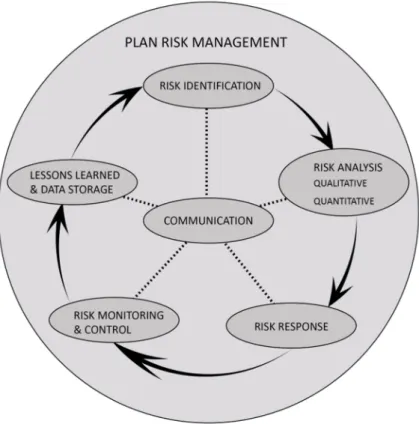
Zhang, et al. (2016) includes another phase apart from the others mention before: The communication phase, which seeks to establish who needs to know about RM. The process is shown as a wheel highlighting the continuity throughout the PLC. Communication is the center of the wheel and it is considered as the means to the information flow.
Every step should be included while dealing with risks effectively. They have serials of inputs and outputs that will help to manage the risks in every project dealing them with different methods and techniques.
14 2.1 PLAN RISK MANAGEMENT
“If I had an hour to solve a problem and my life depended on the answer, I would spend the first 55 minutes figuring out the proper questions to ask. For if I knew the proper questions, I could solve the problem in less than five minutes” Albert Einstein.
The purpose of Plan Risk Management (PRM) is to engage managers to provide an organizational infrastructure to help them to deal with the identification of which risks are worth investment of time and money, try to eliminate or minimize risks, develop other strategies and stablish time and money reserves to deal with that risks that cannot be eliminated. It is a developed and organize infrastructure that support the other risk processes in a specific project (Pritchard, 2005).
PRM involves the process of setting how to proceed, when and which activities must be done during the PLC, who should be involved in these activities and how often should be done. PRM helps to complete the works faster, effectively and in an easier way (Mulcahy, 2010). It is important the communication with every stakeholder to get the support and ensure that the process will be performed during the whole PLC (Project Management Institute, 2013).
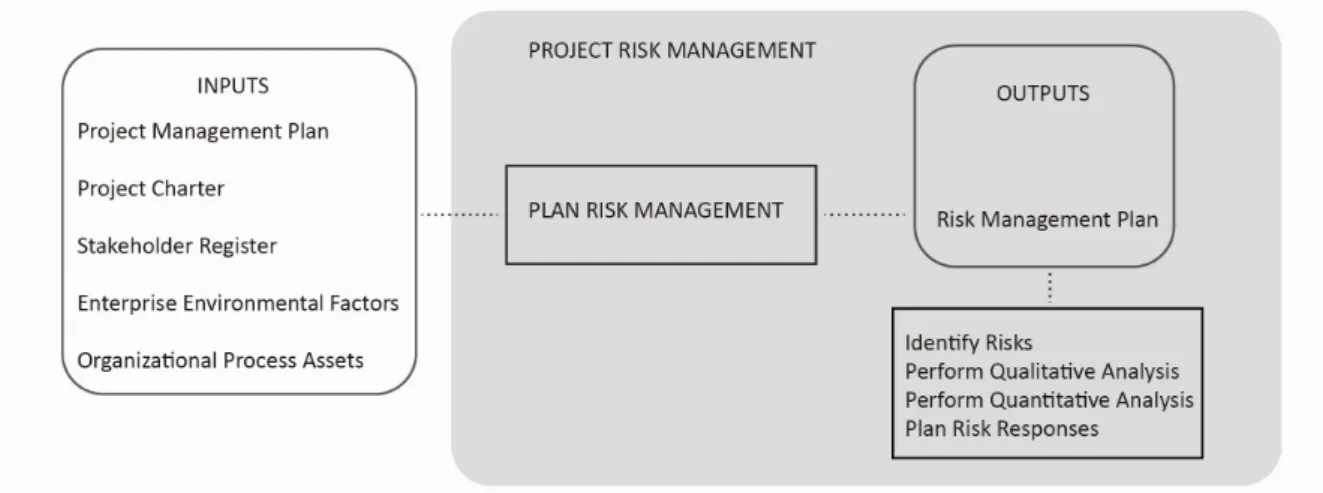
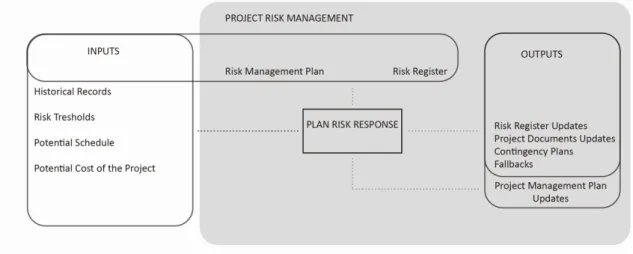
PMI (2013) and Mulcahy (2010) identified several inputs and outputs that are necessary for this process and are summarized in Figure 2 -2.2.
Figure 2 -2.1 Plan Risk Management.
The complexity of the project, the experience of the team and the importance of the process has to be according with the level and type of what is done. Rodríguez (2012) affirmed that PRM has a straight t relationship with the human factor, not only because is one of the sources that generates uncertainty, but they are those who will assess them and will propose corrective measures to them.
15
RISK
PLANNING METHODS REFERENCE methods
Predominant Use
Chart of responsibilities, time and
budget (Mulcahy, 2010)
Planning Meetings (Pritchard, 2005), (Project Management Institute, 2013)
Risk Practice Methodology (Pritchard, 2005)
Project Templates (Pritchard, 2005)
Risk Modelling (Pritchard, 2005)
Strategic Risk Scoring Sheets (Project Management Institute, 2013)
Stakeholder Risk Profile Analysis (Project Management Institute, 2013)
Secondary Use
Expert Interviews (Pritchard, 2005), (Project Management Institute, 2013)
Documentation Reviews (Pritchard, 2005)
Delphi Technique (Pritchard, 2005)
SWOT Analysis (Pritchard, 2005)
Check Lists (Pritchard, 2005)
Risk Breakdown Structure (Pritchard, 2005)
Root Cause Identification (Pritchard, 2005)
Risk Register Tables (Pritchard, 2005)
Estimating Relationships (Pritchard, 2005)
Rating Schemes (Pritchard, 2005)
Risk Factors (Pritchard, 2005)
Risk Response Matrix (Pritchard, 2005)
Performance Tracking (Pritchard, 2005)
Risk Reviews and Audits (Pritchard, 2005)
Table 1 -2.1 Planning Risk Management Methodologies. Self-Produced.
2.2 RISK IDENTIFICATION
The interest in identify risks has existed since ancient times as a result of preventing unfavorable events (Mejía, 2013).
Risk Identification involves the process that identifies and records the list of threats and opportunities that may affect the project, understand these risks and clarifies the responsibilities of every risk using a combination of methods. It is an organized and complete approach to find the risks that are associated with a project. Everyone should be involved. It is one the most important process but at the same time one of the less precise elements in RMP. Is no possible to manage risks without identify and understand them (Pritchard, 2005), however it is also impossible to coverage all risks (005). It is usually done by experience of older minds or by brainstorming sessions (Winch, 2010).
16 Some authors as Banaitis & Banaitiene (2012), Mejía (2013) and Carbone & Tippett (2004) considered this process as the first and most important step in RMP. It develops the basis for the next steps and ensures RM effectivity.
It is vital to identify risks in the early stages of the project, in that way future problems can be avoided through appropriate action plans. This does not mean that Risk identification should be only a process to develop at the beginning of the project. It has to be an iterative process throughout the life cycle of the project since is not possible to recognize every risk before the frst phase of the project and during the process more risks will emerge (Rodríguez, 2012; Office of Statewide Project Management Improvement (OSPMI), 2007).
Some authors understand this step in an informal way, saying that the identification of risks rely mostly on previous experiences (Winch, 2002).
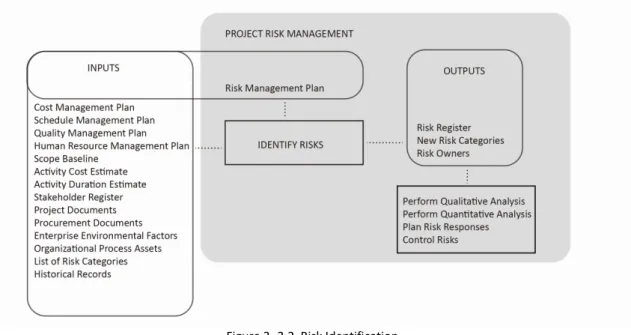
Several inputs and outputs have been identified (Project Management Institute, 2013; Mulcahy, 2010)(Figure 3-2.2):
Figure 3 -2.2 Risk Identification.
17
RISK
IDENTIFICATION METHODS REFERENCE methods
Predominant Use
Sticky notes (Mulcahy, 2010)
Forms & Checklists
(Mulcahy, 2010), (Pritchard, 2005), (Project Management Institute, 2013)
Prompt list (Mulcahy, 2010)
Historical records (Mulcahy, 2010), (Gajewska & Ropel, 2011)
Review other documentation
(Mulcahy, 2010), (Pritchard, 2005), (Gajewska & Ropel, 2011)
Brainstorming (Mulcahy, 2010), (Pritchard, 2005), (Winch, 2010), (Project Management Institute, 2013), (Mejía, 2013) Conduct a "Pre-Mortem" (Mulcahy, 2010)
Affinity Diagrams (Mulcahy, 2010)
Expert Interviews
(Mulcahy, 2010), (Pritchard, 2005), (Winch, 2010), (Project Management Institute, 2013), (Gajewska & Ropel, 2011), (Mejía, 2013)
Nominal Group Technique (Mulcahy, 2010) Delphi Technique
(Mulcahy, 2010), (Pritchard, 2005), (Project Management Institute, 2013), (Gajewska & Ropel, 2011), (Mejía, 2013)
Cause and Effect Diagram
(Mulcahy, 2010), (Pritchard, 2005), (Project Management Institute, 2013), (Mejía, 2013) Failure Modes and Effects
Analysis (Mulcahy, 2010)
SWOT Analysis (Mulcahy, 2010), (Pritchard, 2005), (Project Management Institute, 2013)
Force Field Analysis (Mulcahy, 2010), (Pritchard, 2005)
Influence Diagrams (Mulcahy, 2010), (Pritchard, 2005), (Project Management Institute, 2013)
Assumptions analysis (Pritchard, 2005), (Project Management Institute, 2013)
Analogy comparisons (Pritchard, 2005)
Crawford Slip Method (Pritchard, 2005)
Root Cause Identification (Pritchard, 2005), (Project Management Institute, 2013)
Top-level Risk Matrix (Pritchard, 2005)
Network Diagrams (Pritchard, 2005)
Flowcharts (Pritchard, 2005), (Project Management Institute, 2013)
Plan Evaluation (Pritchard, 2005)
Risk Breakdown Structure (Pritchard, 2005), (Gajewska & Ropel, 2011)
Sensitive Analysis (Pritchard, 2005)
Benchmarking (Gajewska & Ropel, 2011)
Questionnaires (Gajewska & Ropel, 2011)
Past Experience (Gajewska & Ropel, 2011)
Workshops (Gajewska & Ropel, 2011)
Visits to the location (Gajewska & Ropel, 2011) Research assumptions and
interfaces (Gajewska & Ropel, 2011)
Secondary Use
Risk Register Tables (Pritchard, 2005)
Program Evaluation and
Review Technique. PERT (Pritchard, 2005)
Planning Meetings (Pritchard, 2005)
18 2.3 RISK ANALYSIS
As Radu (2009) stated there are 3 methods to ascertain risks in a project: The qualitative, semi-quantitative and semi-quantitative procedures.
Qualitative Risk Analysis
The qualitative approach uses criteria based on judgements to identify the outcomes. Qualitative Risk Analysis is the process which involves the initial look at the risks that have been identified and try to determine the risks that will be quantified later and will be addressed in the Plan risk response process. It is the first effort to classify risks according with probabilities and impacts. It introduces which risks can be quantitatively evaluated and which ones cannot, affording time and money to managers (Pritchard, 2005).
The main objectives of Qualitative Risk Analysis are the subjectively evaluation of the impact and probability of every risk, stablish which risks will be addressed in the response plan and make the go/no go decision (Mulcahy, 2010). The quality and reliability of the information pays an important role in this process.
Semi - quantitative Risk Analysis
The Semi – qualitative methodologies are used when relative risks appear. To analyse the probabilities of a risk to occur is not necessary mathematical data, but this methodologies provide a rigorous approach compared with qualitative assessments. They are useful when quantification of risks is hard to obtain and qualitative analysis are too subjective.
Quantitative Risk Analysis
Quantitative Risk Analysis tries to determine how much risks have the project and where, with the intention in focus time and effort in those risks that are more prone to occur or have a greater impact in the project. They provided numerically more information than the Qualitative analysis to make proper decisions (Mulcahy, 2010).
Between the objectives, the decision of which risks need a response, the objectively evaluation of the impact and probability of ever risk, determine the level of risk and the overall cost and time of the project and the identification of which risks will need a response planning are the most important (Pritchard, 2005).
This analysis should be performed after the Risk response plan to determine if the minimum amount of risk is acceptable within the cost and time necessities of the project. It is important to determine where to perform the Quantitative Analysis because will cost time and money. More sophisticated techniques and methods for construction projects are used. It is also important to combine different methods to assess the probability and impact of the risks. Some authors as (Mulcahy, 2010) agreed in that this process is not the most important part of RM. Time spent in identify risks can have more benefits than quantitative analysis.
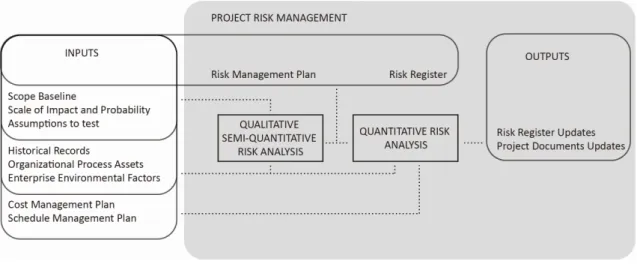
As in the previous steps, to perform qualitative and quantitative analysis is necessary the next inputs shown in the next Figure 4 -2.3:
19
Figure 4 -2.3 Risk Analysis.
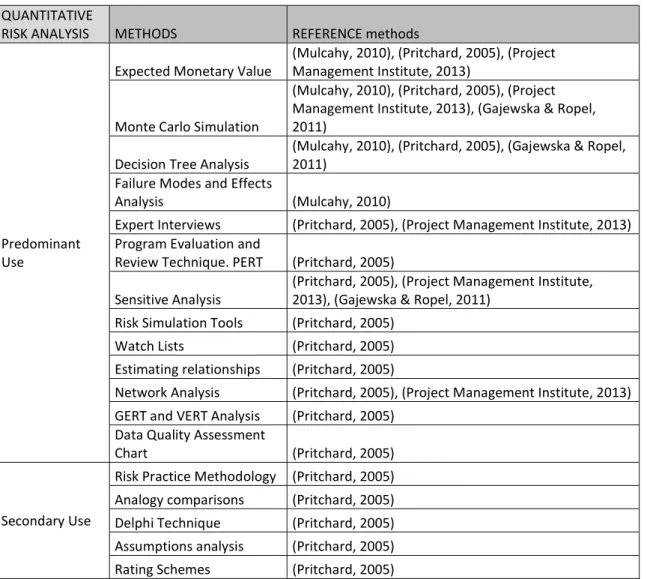
Different methods can be found within qualitative and quantitative analysis. The following Tables 3 -2.3 & 4 -2.3 show which ones are used as predominant and which ones are used as secondary.
QUALITATIVE & SEMI-
QUANTITATIVE RISK ANALYSIS METHODS REFERENCE methods
Predominant Use
Data Quality
Assessment Chart (Mulcahy, 2010), (Pritchard, 2005), (Project Management Institute, 2013) Probability and
Impact Matrix (Mulcahy, 2010), (Winch, 2010), (Project Management Institute, 2013), 006 Qualitative Risk
Analysis Templates (Mulcahy, 2010), (Project Management Institute, 2013), (Gajewska & Ropel, 2011)
Use of Analogies (Pritchard, 2005)
Affinity Diagrams (Pritchard, 2005)
Urgency
Assessments (Pritchard, 2005), (Project Management Institute, 2013), (Gajewska & Ropel, 2011) Rating Schemes (Pritchard, 2005), (Gajewska & Ropel, 2011)
Risk Factors (Pritchard, 2005)
Secondary Use
Expert Interviews (Pritchard, 2005), (Project Management Institute, 2013) Planning Meetings
(Pritchard, 2005), (Project Management Institute, 2013)
Risk Practice
Methodology (Pritchard, 2005)
Analogy comparisons (Pritchard, 2005)
Delphi Technique (Pritchard, 2005)
Risk Breakdown
Structure (Pritchard, 2005)
Root Cause
Identification (Pritchard, 2005)
Risk Register Tables (Pritchard, 2005)
Project Templates (Pritchard, 2005)
Assumptions analysis (Pritchard, 2005)
Risk Modelling (Pritchard, 2005)
Sensitive Analysis (Pritchard, 2005)
20 Proper uses of qualitative methods are found when risks can be placed on descriptive scales from low to high level. Quantitative methods are based in numerical estimations.
Depending on the type of risk and project one or other method should be chosen. This will vary depending on past experience, expertise and if there is the availability of the right software and the proper formation to use them (Gajewska & Ropel, 2011).
QUANTITATIVE
RISK ANALYSIS METHODS REFERENCE methods
Predominant Use
Expected Monetary Value (Mulcahy, 2010), (Pritchard, 2005), (Project Management Institute, 2013) Monte Carlo Simulation
(Mulcahy, 2010), (Pritchard, 2005), (Project Management Institute, 2013), (Gajewska & Ropel, 2011)
Decision Tree Analysis (Mulcahy, 2010), (Pritchard, 2005), (Gajewska & Ropel, 2011) Failure Modes and Effects
Analysis (Mulcahy, 2010)
Expert Interviews (Pritchard, 2005), (Project Management Institute, 2013)
Program Evaluation and
Review Technique. PERT (Pritchard, 2005)
Sensitive Analysis
(Pritchard, 2005), (Project Management Institute, 2013), (Gajewska & Ropel, 2011)
Risk Simulation Tools (Pritchard, 2005)
Watch Lists (Pritchard, 2005)
Estimating relationships (Pritchard, 2005)
Network Analysis (Pritchard, 2005), (Project Management Institute, 2013)
GERT and VERT Analysis (Pritchard, 2005)
Data Quality Assessment
Chart (Pritchard, 2005)
Secondary Use
Risk Practice Methodology (Pritchard, 2005)
Analogy comparisons (Pritchard, 2005)
Delphi Technique (Pritchard, 2005)
Assumptions analysis (Pritchard, 2005)
Rating Schemes (Pritchard, 2005)
Table 4 -2.3 Quantitative Risk Analysis Methodologies. Self-Produced.
Quantitative methods seem more suitable for medium and large projects. The amount of time and resources required to perform this kind of methodology is remarkable. Also, it is needed trained personal and complex and expensive software to succeed and obtain reliable results. Quantitative analyses are limited in the assumptions made for the calculations. Quantitative models are as good as the algorithms used for them. But the limitation is that is difficult for them to adjust to the real world.
On the other hand, in small and medium size projects, where there is luck of time and limited resources, the application of simple techniques when a quick assessment is needed, is more effective (Heldman, 2005).
21 2.4 PLAN RISK RESPONSES
Plan Risk Responses will determine what actions are necessary to apply to reduce or increase the probability and impact of threats and opportunities of the overall risk of the project. Some authors consider it as the critical part of RM because determines what action or actions are taking to act against or in favor of those risks evaluated and identifies in the previous activities of identification, qualification and quantification (Pritchard, 2005).
It is a creative process and according with the literature reviewed the following strategies are the most common for this process (Cretu, et al., 2011; Mulcahy, 2010; Pritchard, 2005; Winch, 2010; Ehsan, et al., 2010; Rodríguez, 2012; Gajewska & Ropel, 2011).
- Avoidance: The process of trying to eliminate risks by looking at alternatives in the project. It is the best way to deal with risks. Communication is the most important part of risk avoidance. If the approach is not well documented or not well communicated then the risk can be reintroduced. Modifying the project scope is an example to do it. If the cost to avoid the risk is less than the expected impact then is a good solution. This is another reason about why RM should be incorporate in the early stages of the project.
- Transference: Change the responsibility and give it to a third party. It does not eliminate the risk. It used to benefit the costumer and the project in general if is well structured. The success depends on the ability of the other party to deal with the risk. Always has an extra cost.
- Mitigation: The process of taking different paths to reduce probability and impact of risks. Do not avoid the risk, but reduces the probability and impact. As soon as the risk is mitigated less cost will have.
- Acceptance: As simple as accept the risk. It is also known as retention and is the decision to recognize and support the consequences of a risk hen it occurs. This strategy will work with very small risks or risks that are unlikely to happen. It is necessary to understand the risks and their consequences and probabilities of occurrence. Even if is it accepted, has to be assumed and communicated. If risks have been accepted, then contingency plans should appear, normally in the budget or in the schedule. This strategy will work for threats and opportunities.
- Exploitation: It is the process that seeks the achievement of the opportunities to take full advantage of them. Enhancing the possibility that an opportunity will happen. It requires some investment but during the PLC cycle will be worth it.
- Share: Make a win-win situation by shearing the opportunity with other stakeholders. When one organization is not capable of handling the opportunity by itself, the process of sharing partnership can help to optimize the probability and impact of the opportunity.
- Enhancement: Is the process that allows increasing the probability and impact of an opportunity.
Other resources include Insure risks and Delay decisions in the group above (Winch, 2010). Depending on the classification of the risk source the decision of which option is optimal will vary: For probable disaster, mitigate or avoid; un-probable disaster, insure the risk. If not, mitigation better than acceptance. Transference is not an option for risks with large impact because the clients usually think in finances than the suppliers of construction sector.
22 Risks with lower impact can be managed with externalization. The best option is to allocate the risk to the actor that will be close to the source of the risk. Acceptance is valid when it is a case of “bad luck”. Another approach is to include an extra payment for excessive transaction costs.
Delay the decision is one of the most useful ways (Winch, 2010), until more information is available. It is favored when risks come from laws. That is another reason why clients prefer to obtain the design and execution from different services. Most of the uncertainties come from the design phase, but at the same time the cost of design is relatively lower comparing with the total cost of the project. If there is an option to postpone the decision of the high-cost activities through an extension in time of the design phase, then most of the risks can be mitigated or even eliminated. As it is obvious, this strategy cannot be used while handling critical situations.
Risks should be assigned to groups or individuals to let them take the responsibility of the implementation of planned risk responses. The strategies should be reviewed through the life cycle of the project (Mulcahy, 2010).
The next inputs and outputs are included and obtained in Risk Response process (Figure 5 -2.4):
Figure 5 -2.4 Plan Risk Responses.
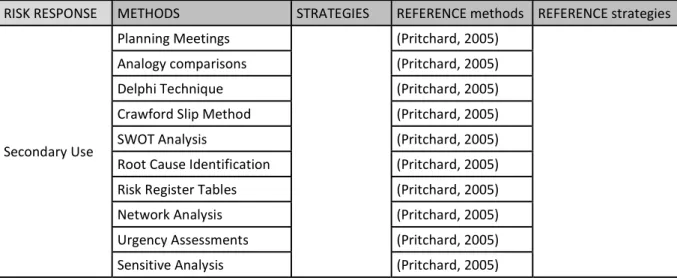
The following Table 5 -2.4 shows a resume of all the activities and strategies that may help in this process.
23
RISK RESPONSE METHODS STRATEGIES REFERENCE methods REFERENCE strategies
Predominant Use Brainstorming (Cretu, et al., 2011) Value
Methodology (Cretu, et al., 2011)
Expert
Opinions Avoidance
(Mulcahy, 2010), (Pritchard, 2005), PMBOK
(Cretu, et al., 2011), (Mulcahy, 2010), (Pritchard, 2005), (Project Management Institute, 2013), (Ehsan, et al., 2010) Form for threats or opportunities Transference (Mulcahy, 2010)
(Cretu, et al., 2011), (Mulcahy, 2010), (Pritchard, 2005), (Winch, 2010), (Project Management Institute, 2013), (Ehsan, et al., 2010)
Mitigation
(Cretu, et al., 2011), (Mulcahy, 2010), (Pritchard, 2005), (Winch, 2010), (Project Management Institute, 2013), (Ehsan, et al., 2010)
Strategy Matrix Acceptance (Pritchard, 2005)
(Cretu, et al., 2011), (Mulcahy, 2010), (Pritchard, 2005), (Winch, 2010), (Project Management Institute, 2013), (Ehsan, et al., 2010)
Exploitation
(Cretu, et al., 2011), (Cretu, et al., 2011), (Pritchard, 2005), (Project Management Institute, 2013) Share (Cretu, et al., 2011), (Cretu, et al., 2011), (Pritchard, 2005), (Project
Management Institute, 2013) Enhancement (Cretu, et al., 2011), (Mulcahy, 2010), (Pritchard, 2005), (Project
Management Institute, 2013)
Contingency Plans
(Mulcahy, 2010), (Pritchard, 2005), (Project Management Institute, 2013), (Ehsan, et al., 2010)
Fallback Planning (Mulcahy, 2010), (Pritchard, 2005)
Triggers
Delay decisions (Winch, 2010)
Insure (Winch, 2010)
Risk Register (Mulcahy, 2010)
Reserve
24
RISK RESPONSE METHODS STRATEGIES REFERENCE methods REFERENCE strategies
Secondary Use
Planning Meetings
(Pritchard, 2005)
Analogy comparisons (Pritchard, 2005)
Delphi Technique (Pritchard, 2005)
Crawford Slip Method (Pritchard, 2005)
SWOT Analysis (Pritchard, 2005)
Root Cause Identification (Pritchard, 2005)
Risk Register Tables (Pritchard, 2005)
Network Analysis (Pritchard, 2005)
Urgency Assessments (Pritchard, 2005)
Sensitive Analysis (Pritchard, 2005)
Table 5 -2.4 Plan Risk Responses Methodologies. Self-Produced.
2.5 MONITORING AND CONTROL
Monitoring and control risks (MCR) is the process to observe, ensure compliance, measure, take corrective actions, evaluate the efficiency and refine the risk management plan. It covers the implementation, compliance and management of risk response plans; creation of workarounds; control the risks; update the risk register; performance of additional risk identification, analysis and response panning; communication with the rest of stakeholders; Lessons Learned (LL) and scope, schedule and cost evaluation for risk impacts (Mulcahy, 2010).
MCR is the phase of the project that consists on “doing” instead of “discussing” (Cretu, et al., 2011). It is an essential part of the RMP and continues during the life of the project.
Monitoring the risk include the identification of the owner of the risk, the responsible for monitoring the risk, the nature and frequency that the task manager will report to the project manager and establish a protocol according with these updates.
Controlling risks appears because every project changes during its life cycle. Cretu, et al. (2011) suggested 3 project milestones with the intention to do a workshop: concept development, preliminary design, and final design, while interim reviews have to be done between these milestones.
If the process is developed in a proper way, it gives information that will help with the decision making before the risk appears. The communication between the stakeholders to keep under control the levels of risk is necessary. The control of risks will help to adopt the emergency measures, new corrective measures or modifications to the contingency plans. As Rodríguez (2012) claimed, a recommendable practice is to deliver and manage the risk reports inside the company, to take profit from past experiences.
25 The next inputs and outputs are included and obtained in MCR process (Figure 6 -2.5):
Figure 6 -2.5 Risk Monitoring and Control.
The next Table 6 -2.5, as it has been done so far, shows the main methods used in this phase:
RISK MONITORING
AND CONTROL METHODS REFERENCE methods
Predominant Use
Risk monitor schedule (Cretu, et al., 2011), (Gajewska & Ropel, 2011)
Risk database (Cretu, et al., 2011)
Earned Value Analysis (Pritchard, 2005), (Project Management Institute, 2013) Technical Performance
Measurement (Pritchard, 2005), (Project Management Institute, 2013)
Checklists (Pritchard, 2005)
Risk Register Tables (Pritchard, 2005)
Urgency Assessments (Pritchard, 2005)
Performance Tracking (Pritchard, 2005)
Risk Reviews and Audits
(Pritchard, 2005), (Project Management Institute, 2013), (Gajewska & Ropel, 2011) Management by wandering
around (Winch, 2010)
Informal Meetings (Winch, 2010), (Project Management Institute, 2013), (Gajewska & Ropel, 2011)
Spotting the weak trends (Winch, 2010)
Reserve Analysis (Project Management Institute, 2013)
Secondary Use
Plan Evaluation (Pritchard, 2005)
Risk Breakdown Structure (Pritchard, 2005)
Project Templates (Pritchard, 2005)
Table 6 -2.5 Monitor and Control Methodologies. Self-Produced.
No method is better than other, depends on the person or group of persons who are identifying the risks, and depends in the organization the final decision for how to proceed (Gajewska & Ropel, 2011).
26 2.6 LESSONS LEARN & DATA STORAGE
Lessons Learn (LL) is the learning profit that is obtained from the process of performing the project (Project Management Institute, 2013). Trevino & Anantatmula (2008) identify 5 essential activities in the practice of LL:
- Capturing important lessons - Analyzing lessons
- Storing lessons - Disseminating lessons
- Making effective use of these lessons
In order to provide a solid basement for the next projects it is crucial for companies to record any action and activity that take place in the project (Marcelino-Sádaba, et al., 2013).
Even if LL is shown in the last step of the wheel, it should not be a process that takes place at the end of the project, but during each life cycle phase. The learning process takes place during the life cycle in order not to forget important considerations during the activities of the project. The risk register is the method to effectively face this process. Creating a risk register will allocate every risk. It provides effective feedbacks for future projects and useful information. Advantages and disadvantages of the processes will come up and the project work will improve.
2.7 RISK COMMUNICATION
Communication is the process of shearing information and documents between all the participants in a project to achieve the project´s goals (Ceric, 2011). Within construction projects involves a multidisciplinary tasks with different interpretations and perspectives where the participants should collaborate, share, compare and integrate the information about the project and its objectives. It is a crucial part of a project (Ceric, 2012).
According with Cohrssen & Covello (1989) risk communication has to be dynamic, flexible and interact with the public at every step. It is a difficult task and will vary depending on several factors. That makes it different every time that a project has to be faced. The authors outlined that the following areas has to be taken into account:
- Information and education.
- Behavior change and protective actions. - Warnings and emergency information. - Problem solving and resolution of conflicts.
The transparency, credibility and the right to make mistakes should be the basis of RM (Marcelino-Sádaba, et al., 2013).
The result is a continuous process that is developed along the whole project and this is why it is represented in a circular way as it is shown in Figure 7 -2.7, where the communication is the heart of the process and the way for the project team to continuously evaluate the coherence of the project.
27
Figure 7 -2.7. The risk management process. Self-Produced
As it is possible to see, through all these phases, several benefits for the project can be found. But not only for the project itself, there are also benefits for the participants. Clear understanding and awareness of risks, more control of the whole project and an effective process of problem solving are main examples.
Despite the information analyzed before, not all are advantages while applying RM. A great amount of time can be waste if the risks are not assessed properly. A lot of resources can be derived to assess risks that are unlikely to occur, losing profitability on the entire project. Although nowadays inside the companies they know most of the benefits of RM, due to the luck of knowledge and many doubts whether these techniques really work, RM processes are rarely used (Banaitis & Banaitiene, 2012).
The level of risk of a construction project depends on the level of complexity that it presents. It used to happen, that as bigger as a project is (in time and area), more potential risk may face. The main important factors that can arouse the appearance of risks are related with financial, quality, time, design and environmental factors (Gould & Joyce, 2002).
As mentioned before, one thing is clear: every project has risks, and it is impossible to deal and eliminate them all. RM should be used as a tool to keep a balance between time, cost and quality with the intention to deal with as many risk as possible and ones that will affect the project the most.
28 RM needs a constant effort to keep the efficacy at every step of the project. Is not possible to predict what will happen, however with a great effort and honesty is it possible to minimize risks and uncertainties in construction projects, always having in mind that even the most perfect and well executed plan is able to fail.
During the early stages of the project, the level of uncertainty acquires its higher value. Thus, the vast effort for managing risks and uncertainty should occur in this phase. On the other hand, it is the moment where the project has lowest levels of reliable data. Many of the decisions taken in the early stage of the project may have consequences on how the risks will manage throughout the life cycle. Because of this, and construction projects are one shot play (there are not two similar works), managers should be more proactive in managing risks than decision-makers.
In construction industry, two kinds of professional trainings can be found (Mulcahy, 2010). The first one encourages the belief that there is only one way to solve a problem on a project; the second one encourages that qualitative methods are the way to solve the problems. Use to happen that the first group is composed by engineers and the second group by architects. But the truth is that to effectively manage risks, it is necessary the combination of maturity to admit that there is not enough information to give a final answer to the client, and the intellect to analyze the available information.
29
3 RISK MANAGEMENT IN CONSTRUCTION
As in many other scenarios, every construction project is not free of risks. At the moment that the projects come into existence are exposed to risks. Moreover risks and uncertainties in construction practices are higher than in other industries.
Experience and research have demonstrated that most of the construction projects show cost overrun and schedule delays. Clear examples of that can be found in the construction of the Opera of Sydney and the Elbphilharmonie in Hamburg:
The Sydney Opera House is the iconic symbol of Australia being recognized all over the world. But not everybody knows that the building, originally schedule in 4 years and a budget of 7 million AUS dollars, ended up in 14 years of construction process and 102 million AUS dollars. The unclear goals in the competition, giving more importance in quality factors than in time or cost, the luck of skills of the executive committee and the obstacles that the government create by preventing changes during the works contributed to the final delays and cost overrun.
The Elbphilharmonie on the Kaispeicher is now the new centre of cultural, social and daily life of Hamburg. But many problems within the construction process and a disastrous organization by the local council are translated in a project where the cost overruns and the delay in time exceed in more than 10 times the initial parameters. The project started in 2001 with an initial budget of 77 million euros and has ended up costing 789 million, 7 years later than the date of completion of the works (2010), becoming the twelfth most expensive building in history. Luck of expert knowledge, the unrealistic low initial budget, the organizational chaos and the failure to contemplate the risks that a project of these dimensions entails, have been the triggering events to reach such situation.
The building sector is not only facing these problems. An investigation about the cost of public works in Europe and North America based in 258 transport infrastructures projects conclude that 9 out of 10 projects are underestimated. In the case of rail projects the actual cost is on 45% average higher than estimated costs (Flyvbjerg, et al., 2002). They realised that the luck of proper risk analysis, the poorly defined scope at the initial phase and external pressures that these projects are facing, are the factors that affects cost overruns.
Clearly, as the construction sector becomes more sophisticated and the society more complex, it is required a suitable RM.
In construction, due to the fact that every project is unique, risks differ between them. The complexities of each project can change the initial conditions of it. That is the main reason because several authors considered RM as the most difficult area of the PM areas (Winch, 2002; Potts, 2008; Banaitis & Banaitiene, 2012). Winch (2010) affirmed that the project is the process of reduction uncertainty through time. Then RM should be the centre of PM.
30 3.1 FACTORS OF RISK IN CONSTRUCTION
There are several factors that may affect risk in construction (Ehsan, et al., 2010):
- Complexity: Depending on the difficulty and complexity of a project risks could be higher.
- Historical: A new project developed with new technologies and procedures that were not used before is more prone to have more risks than a project done many times in the past.
- Experience and expertise of the stuff: The luck of knowledge of the members of a construction site could be translated in delays on time, poor quality and changes of the estimated costs.
- Team size: Sometimes difficulties with communication could arise in the increase of problems.
- Management Stability: Share the same vision and direction.
- Availability of resources: As more accessible are the resources the probability of solving problems is higher.
- Compression of time: It is not a common case that construction projects finished before it is expected. But is true that more time gives more flexibility and this leads to avoid risks.
The same article also listed the common sources of risk in the construction sector: - Changes in the scope and requirements of the project.
- Errors related to design.
- The inadequate definition of responsibilities. - Lack of skills of the construction workers. - Subcontractors.
- Luck of contractor experience.
- The uncertainty about the relationships between the participants of the project. - New technologies.
- Luck of knowledge of the construction site environmental conditions. - Force majeure.
For an effective construction RM, many suggestions on risk classification have been proposed in the literature review. Table 7 -3.1 shows a summary of them.
31
Construction
risk categories Factors of risk Reference
Technical risk Incomplete design (Ehsan, et al., 2010) (Project Management Institute, 2013) Appropriateness of specifications
Uncertainty over the source and availability of materials Design process The US Department of Transportation (2006) Environmental factors
Inaccurate assumptions on technical issues
Requirements in fact sheets Logistical/Oper ational Risks Availability of sufficient transportation facilities (Ehsan, et al., 2010) Availability of resources (construction equipment, spare parts, fuel and labour)
Management related risks
Uncertain productivity of resources
(Ehsan, et al., 2010)
Industrial relations problems
Poorly definition of purpose, objectives and needs of the projects
The US Department of Transportation
(2006) Delays of contractor or consultants
Errors in schedules Communication breakdowns The US Department of Transportation (2006) Luck of coordination
Inadequate workers, availability of resource or inexperience
Abundance of projects
No control over staff
Organisational risks
Loss of critical staff Luck of time
Changes of objectives
Inconsistence of cost time and quality External risks Contractual regulations The US Department of Transportation (2006) (Mulcahy, 2010) Force majeure Social factors Environmental factors Internal risks
Political issues, exchange rates, etc. (CarreersinAudit, 2013) (Tah & Carr, 2000) Non-compliance of information
breaches (Ehsan, et al., 2010) (Project Management Institute, 2013)
Environmental and physical risks
Weather and seasonal implications
(Ehsan, et al., 2010)
Natural disasters
Geotechnical
(Guerra & Teixeira, s.f.)
Subsurface & phreatic level conditions
32
Construction risk
categories Factors of risk Reference
Financial risks
Availability and fluctuation in foreign exchange
(Ehsan, et al., 2010)
Delays in payment
Inflation Teixeira, s.f.) (Guerra &
Local taxes
Funding Teixeira, s.f.) (Guerra &
Socio-political risks
Repatriation of funds
(Ehsan, et al., 2010)
Constraints on the availability and
employment of expatriate staff Customs and important restrictions and procedures
Difficulties in disposing of plant and equipment
Insistence on use of local firms and agents Availability of soil (Guerra & Teixeira, s.f.) Environmental pressures Regulations
Strikes & public disorders
Security risks Vandalism (Guerra & Teixeira, s.f.) Terrorism Corruption Assaults Negligence Intrusion
Contractual and legal risks
Delays in dispute of resolutions
(Guerra & Teixeira, s.f.)
Delays in payments
Changes in the negotiation
Insolvencies
Acceptable risk Do not have a negative impact on a project
(Ehsan, et al., 2010)
Unacceptable risk Negative impact on a project
Short term duration
risk Impacts that are visible immediately
Long term duration
risk Impacts that are visible in the future
Manageable risk Risks that can be accommodate
Unmanageable risk Risks that cannot be accommodate
Business risk Risk of loss or gain
Pure risk Risk of loss exclusively
33 It is necessary to take care about all of these types of risk and identify the key risk factors in every category depending on the nature of each project.
3.2 MANAGING RISKS IN CONSTRUCTION
Ehsan, et al. (2010) established several advantages while managing the risk in the construction sector:
- Attainment of objectives - Reliability of shareholders - Capital cost reduction - Decrease the uncertainty - Increase of the value
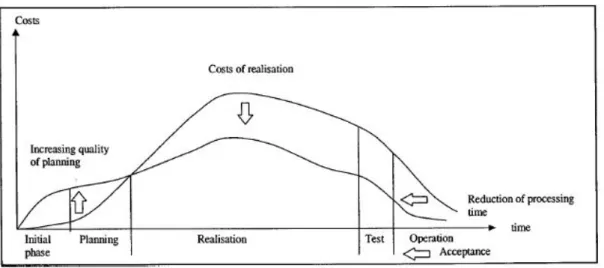
Banaitis & Banaitiene (2012) provided other benefits like the identification and analysis of risks, the effective use of resources and improvement of the construction management process. Also with “quality”, risk is the term that is used more often in construction. As it is shown in Figure 8 -3.2 despite the fact that the use of RM affects the cost of the project in the beginning step, this is offset by the advantages mentioned before. This will result in a reduction of costs in the period of realisation of the project as well as in a reduction of the operational time. The analysis of the risk potential of a project shows how the risk of the project affects to the risk situation of the company.
Figure 8 -3.2 Potential over the use of RM in construction projects (Schieg, 2010).
Even though more construction companies are starting to be more conscious about the necessity of RM processes, they do not apply methodologies and techniques for RM. Many researches reveal that construction companies of the construction sector deal with project risks using their own judgement based on experience and intuition (Akintoye & Macleod, 1997; Ehsan, et al., 2010). The main reasons for this approach are based on the ignorance of the team members in managing RM techniques, doubts presented related to the utility of risk response methodologies and their difficulties to implement valid data. This contradicts the fact that the sector is trying to have more control of the projects alike become more cost and time efficient.
34 3.3 SME´s IN CONSTRUCTION
Small and Medium enterprises (SME´s) in Europe represent a significant part of its economy (Eurostat, 2017). The 99% of all businesses in the EU are created by these kinds of companies, employing over 90 million people. They provided 2/3 of the private sector employment and create around 85% of new jobs.
Particularly, construction industry provides 18 million jobs and makes a contribution of about 9% of the European Union (EU) GDP. Up to 95 % of the companies are micro-enterprises or SME´s (Figure 9- 3.3), being these ones the companies that more employ generate. Unlike large companies, SME´s tend to focus on specialized tasks and construction itself. On the other hand, great players are more committed to civil engineering and offer a wide variety of services.
Figure 9 -3.3 Company size in relation to revenue and employment. https://buildingradar.com/es/construction-blog/la-industria-de-la-construccion-en-europa/
Because of the resource limitations to respond to different hazards that can cause huge amount of loss or insolvency, this kind of enterprises need to increase and perform the RM processes, unlike the large organizations that have more resources. These kinds of companies do not usually use some of the most recognized standards as the PMBOK mentioned before (Table 8 -3.3). This is due to several factors like the complexity compared with the size of the projects or the ignorance or luck of knowledge of the managers about the matter.
35
Table 8 -3.3 Project and organization according to their size. (Perez & Marcelino, 2012)
In order to achieve a high level of RM practices it is necessary to develop an appropriate RM framework which addresses the requirements, resources, and preferences of the SME´s in construction sector (Sommerville, et al., 2015) and also decrease costs while managing risk. 3.4 PROJECT LIFE CYCLE
The PLC may help in the identification of which phase is needed to pay more attention of the project in order to proceed with the methodology. It is the series of sequential phases that a project goes through from the initial point to the end (Project Management Institute, 2013). These phases can be divided by objectives, deliverables, milestones or financial availability. It provides the basic framework from the project to be managed.
According with the PMI 4 phases are identified: Starting the project. Organizing and preparing, Carrying out the work and Closing the project.
The following Figure 10 -3.4 shows the relation between cost and time during the different phases of the life cycle of a project. At the beginning cost and staffing levels are low, they increase and reach a peak when the work is carry out and drastically decreases while the closure is approaching. As it is logical, this cannot be applied at all projects. Some of them may need significant cost at the starting phase for instance.
36
Figure 10 -3.4 Relation between costs and time during the PLC. (Project Management Institute, 2013)
On the other hand, risk and uncertainty are higher at the beginning of the project and decrease as soon as the decisions are reached, while the cost of any change or correcting errors flows in the opposite direction as It is shown if Figure 11 -3.4.
Figure 11 -3.4 Relation between cost and Risk & Uncertainty during the PLC. (Project Management Institute, 2013)
Knowing the production processes of the company also helps to understand in which part the main problems erases.
As Boquera (2015) stated, there are different types of production processes: - Continuous process
- Chain process - Batch process - Process by project