FACULTAD de FILOSOFÍA Y LETRAS
DEPARTAMENTO de FILOLOGÍA INGLESA
Grado en Estudios Ingleses
TRABAJO DE FIN DE GRADO
THE ACQUISITION OF DEFINITE AND INDEFINITE
ARTICLES BY TYPICALLY
DEVELOPED CHILDREN AND BY CHILDREN WITH
SPECIFIC LANGUAGE IMPAIRMENT
María García Baños
Tutora: Raquel Fernández Fuertes
ABSTRACT
This dissertation provides an empirical study on the acquisition of overt articles by native speakers of English. The study investigates how articles are acquired by typically developed children (TD) and by children with specific language impairment (SLI). The analysis of the data carried out in this dissertation centers on five semantic contexts in which the definite and the indefinite article may appear. The type of data analyzed in the study is spontaneous and it has been extracted from CHILDES. The TD and SLI participants have been matched considering two parameters: their MLU and their age. The study finally points out that in the acquisition of articles, the production of SLI participants is similar to that of their MLU-matched TD peers rather than to that of their AGE-matched TD ones.
KEYWORDS: Acquisition, articles, children with specific language impairment (SLI), English, semantic context, typically developed children (TD).
RESUMEN
Este trabajo aporta datos empíricos sobre la adquisición de los artículos explícitos del inglés por parte de niños nativos. El estudio examina cómo niños que se desarrollan de forma normal y niños con un trastorno específico del lenguaje (TEL) adquieren los artículos. El análisis de los datos realizado se centra en cinco contextos semánticos en los que el artículo definido y el indefinido pueden aparecer. El estudio analiza datos espontáneos extraídos del proyecto CHILDES. En el análisis los participantes se han agrupado teniendo en cuenta dos parámetros: su LME y su edad. Por último, en lo que respecta a la adquisición de los artículos, el estudio apunta a que la producción de los niños con TEL se parece más a la de los niños sin trastornos del lenguaje que tienen la misma LME más que a la de aquellos cuya edad cronológica coincide con la de los niños con TEL.
CONTENTS
FOREWORD: CONTEXTUALIZATION OF THE UNDERGRADUATE
DISSERTATION………1
1. INTRODUCTION……….…….3
2. THEORETICAL FRAMEWORK………5
1. DEFINITENESS IN ENGLISH…………..…….……….…….….…5
2. SPECIFICITY IN ENGLISH……….….……7
3. THE OVERT ARTICLE FORMS………..….8
3.1 THE DEFINITE ARTICLE THE……….……..…10
3.2 THE INDEFINITE ARTICLE A (AN)………...….14
3. ACQUISITION WORKS …...………..…..16
1. THE ACQUISITION OF ARTICLES IN TD CHILDREN ………....…16
1.1 THE ACQUISITION OF THE DEFINITE ARTICLE…………..…...17
1.2 THE ACQUISITION OF THE INDEFINITE ARTICLE………..20
2. THE ACQUISITION OF ARTICLES IN CHILDREN WITH SLI……..……...21
3. STUDIES DEALING WITH TD AND SLI CHILDREN’S SPONTANEOUS PRODUCTION ...………....23
4. OBJECTIVES OF THE STUDY AND RESEARCH QUESTIONS……..…27
1. QUESTION SET 1: GENERAL PERFORMANCE………27
1.1 RESEARCH QUESTION 1: DEFINITE AND INDEFINITE ARTICLES………27
1.2 RESEARCH QUESTION 2: GRAMMATICAL AND ORTHOGRAPHICAL ERRORS………..28
2. QUESTION SET 2: SEMANTIC CONTEXTS………...……28
2.1 RESEARCH QUESTION 1: DEFINITE ARTICLE……….………….28
2.2 RESEARCH QUESTION 2: INDEFINITE ARTICLE………..28
3. QUESTION SET 3: MLU AND AGE MATCHING………...29
3.1 RESEARCH QUESTION 1: DEFINITE AND INDEFINITE ARTICLES………....29
3.2 RESEARCH QUESTION 2: GRAMMATICAL AND ORTHOGRAPHICAL ERRORS………..…29
3.4 RESEARCH QUESTION 4: INDEFINITE ARTICLE…….…….…....30
5. DATA METHODOLOGHY………….………...…………..31
1. DATA SELECTION………..……….…..32
1.1 CORPORA………..……32
1.2 PARTICIPANTS: GEOGRAPHICAL AREA………...………....35
1.3 PARTICIPANTS AND DATA: MLU-MATCHING……….35
1.3.1 MLU-MATCHING: PARTICIPANT SELECTION PROCEDURE……….…..35
1.3.2 MLU-MATCHING: FILE SELECTION PROCEDURE……37
1.4 PARTICIPANTS AND DATA: AGE-MATCHING………..…38
1.4.1 AGE-MATCHING: PARTICIPANT SELECTION PROCEDURE………...…38
1.4.2 AGE-MATCHING: FILE SELECTION PROCEDURE…...39
2. DATA EXTRACTION ON ARTICLE USE………40
3. DATA CLASSIFICATION………..41
3.1 VARIABLES OF THE STUDY……….………41
3.2 DISCARDED CASES………....44
6. RESULTS……….…47
1. QUESTION SET 1: GENERAL PERFORMANCE………..………..47
1.1 RESEARCH QUESTION 1: DEFINITE AND INDEFINITE ARTICLES ………...…47
1.2 RESEARCH QUESTION 2: GRAMMATICAL AND ORTHOGRAPHICAL ERRORS………..49
2. QUESTION SET 2: SEMANTIC CONTEXTS………...53
2.1 RESEARCH QUESTION 1: DEFINITE ARTICLE……….….53
2.2 RESEARCH QUESTION 2: INDEFINITE ARTICLE………..55
3. QUESTION SET 3: MLU AND AGE MATCHING……….………..57
3.1 RESEARCH QUESTION 1: DEFINITE AND INDEFINITE ARTICLES………..……..57
3.2 RESEARCH QUESTION 2: GRAMMATICAL AND ORTHOGRAPHICAL ERRORS………..59
3.3 RESEARCH QUESTION 3: DEFINITE ARTICLE………..…60
7. CONCLUSIONS……….63
1
FOREWORD: CONTEXTUALIZATION OF THE
UNDERGRADUATE DISSERTATION
The present undergraduate dissertation is the last final formal requirement to conclude the degree in English Studies at the University of Valladolid. The topic of this dissertation belongs to contents in the A2 subject “Scientific description of the English Language”, as presented in the teaching guide of the academic year 2015-2016. This subject encompasses the following seven courses given in this degree: three on English descriptive grammar, two on phonetics and phonology, one on the origins of the English language and the final one on English/Spanish comparative grammar.
The present dissertation centers on the description and the acquisition of the English grammar. More specifically, it deals with the acquisition of the definite and the indefinite article in English. Therefore, I consider that the present study can provide me with useful information on the acquisition of the English language by English native speakers. Firstly, as a non-native speaker, researching on this particular area will help me in the sense that it will give me more knowledge about the topic in question and, secondly, as a researcher, I will become familiar with the research procedure of analyzing previous works, proposing my own research questions, selecting the data and the participants of the study, extracting the data from CHILDES by using some CLAN programs, and classifying and analyzing the data.
Moreover, this dissertation has given me the opportunity to undertake research on a specific grammar category (i.e. articles). I have selected this grammatical category given that the acquisition of articles is not as simple as it may seem at first sight and given that, as a functional category, it is an essential part of language use. Thanks to this dissertation, I have explored this grammatical category more in depth than in a simple assignment essay. Furthermore, my own interest on research has increased since this dissertation has opened me a new horizon to direct my future professional career.
In this dissertation, I have applied some of the competences acquired in the different courses taken along the four-year degree. More specifically, through the elaboration of the present dissertation I have had to put into practice the following general and specific competences described below. Theses competences are reflected in the official description of the English degree, too.
2 resources as online articles and websites. This has strengthened both general and specific competences like the following:
Ability to manage technological means and resources. Ability to identify, manage and synthesis bibliography. Skills on managing information.
Ability to manage specific technological means and resources related to the main professional possibilities of the degree.
Capacity to analyze and systematize conceptualization and abstraction. Research skills: investigation techniques and documentation.
Even though I have been working under the supervision of my tutor, I have been able to develop my own research work by selecting linguistic data from CHILDES whose analysis I present in this dissertation. This way of working reflects general competences like the next ones:
Creativity.
Ability to solve problems. Autonomous learning. Critic and constructive spirit.
Given that the focus of my work is not only on grammatical description but on how TD and SLI children acquire a grammatical category of the English language, my dissertation also covers specific competences like the ones below:
Capacity to write and speak in the English language.
Capacity to understand and produce in the English language texts related to the main professional possibilities of the degree.
3
1. INTRODUCTION
The acquisition of a language is a task that native speakers as well as non-native speakers have to accomplish. In general terms, a particular language and all its grammatical properties are always acquired through a period of time. This is so for both native and non-native speakers. During this acquisition process, the use of correct structures coincides with that of incorrect or ungrammatical ones. It is the case of the acquisition of overt articles in English. This process involves more than just acquiring the article forms the and a/an. For example, native children who are acquiring the grammatical properties of their first language also have to acquire the different semantic contexts in which articles may appear. It could be a source of difficulty for speakers and therefore both correct and incorrect uses may emerge.
The present dissertation is based on an empirical study which considers how native typically developed (TD) children and children with specific language impairment (SLI) acquire the articles in English. Moreover, this study investigates the type of article (i.e. definite and the indefinite article) that is most commonly used by each type of participant as well as the grammatical (i.e. overgeneralization cases) and orthographical errors that the acquisition of articles may involve. The principal objective of this study is to consider if the results obtained by the SLI participants are more similar to the results produced by their MLU1-matched TD peers or to the ones produced by the AGE-matched TD participants.
This paper is divided into eight main chapters. The introduction is the first one. In the second one, the grammatical category under analysis (i.e. articles) is described considering two semantic contexts for the definite article (i.e. the anaphoric reference and the bridging use of the definite article) and three semantic contexts for the indefinite article (i.e.
1
5
2.
THEORETICAL FRAMEWORK
Determiners are functional words which delimit and specify the noun they go with. They can be classified in different subgroups. In this dissertation, I am going to focus on a subgroup of central determiners denominated articles. Huddleston and Pullum (2002: 368) describe the article as “a subcategory of determiners that denotes the basic expression of definiteness and indefiniteness.” There are two types of articles: overt and zero articles. In this dissertation, I will analyze overt articles.
In this chapter 2, firstly I will introduce the concepts of definiteness and specificity as they are the two basic concepts that articulate the use of articles. This will lead us to the third part, where I will explain the two types of overt article forms: the definite article and the indefinite article.
1. Definiteness in English
Chondrogianni and Marinis (2014: 2) defend that definiteness is “a complex semantic notion that encodes the degree to which an entity denoted by a noun phrase (NP) is familiar and identifiable by both the speaker and the hearer”.
In order to describe the semantic distinctions between definite and indefinite articles, Chondrogianni and Marinis (2014) use a set of two semantic features with a positive and a negative feature value (i.e. [+/- hearer, +/-speaker]). In this way, they express the presence and the absence of speaker and hearer knowledge.
6 definite expressions belong to the common knowledge shared between the speaker and the hearer. Moreover, they can be identified by the feature combination [+speaker, +hearer]. On the other hand, these linguists point out that the entity of indefinite expressions does not belong to the common knowledge of the speaker and the hearer. Thus, indefinite expressions assume the lack of hearer knowledge [- hearer], and may or may not involve speaker knowledge [+/-speaker].
(1) They would like to meet the Queen of England. (Abbott, 2006)
On the one hand, example (1) includes an instance of a definite NP (in italics in the example 1). According to Abbot (2006), this NP is known as “definite descriptions” in the philosophical literature. In example (1), The Queen of England is a definite expression given that it is part of the common knowledge of both the hearer and the speaker. Therefore, it is identified with the features [+speaker, +hearer].
(2) She told me a secret yesterday. (Von Heusinger, 2002)
On the other hand, the NP in italics in example (2) represents the idea of indefinite expression since it does not belong to the common knowledge between the speaker and the hearer. In this case, a secret is introduced by the indefinite article a, and its referent is known by the speaker but not by the hearer. Example (2) is a representation of indefinite expressions characterized as [+speaker, -hearer].
(3) And I know that he [= the Evil One] can impel his victims to do evil in such a way that the blame falls on a righteous man. (Von Heusinger, 2002)
Example (3) is an illustration of indefinite expressions of the type [-speaker, -hearer]. In this case, the indefinite expression a righteous man is introduced by the indefinite article a.
7 Finally, the combination [-speaker, +hearer] is not adequate since it is not possible that the speaker refers to an entity which is not familiar to him/her and that, at the same time, that entity is known by the hearer.
2. Specificity in English
According to Barrera Rodríguez (2008: 2), specificity refers to “the knowledge held by the speaker.” Below, I will explain some examples in order to get a better understanding of this linguistic term.
(4) He will select the candidate who is most qualified.
(Barrera Rodríguez, 2008)
As example (4) depicts, the NP the candidate who is most qualified, is identifiable and that is the reason why the definite article the has been used. Nevertheless, the referent is non-specific since nobody knows who the best candidate is going to be before carrying out the selection. Putting together definiteness and specificity, example (4) is represented with this semantic feature combination [+definite, –specific].
(5) We will select the candidate that is from Kenya.
(Barrera Rodríguez, 2008)
In example (5), the NP the candidate that is from Kenya is identifiable by the speaker and the hearer. Besides, the referent of the NP is alluding to a person who is not hypothetic but real. Therefore, this example can be represented as being [+definite, +specific].
8 interpretation corresponds to the [-definite, –specific] semantic features, while the second one can be represented by the semantic features [-definite, +specific].
(6) He wants to get married with a girl from Cuba.
(Barrera Rodríguez, 2008)
In (6), a first possible interpretation is the following: the NP a girl from Cuba is not familiar to both the speaker and the hearer, and thus the indefinite article has been used. Moreover, the referent is unidentifiable and hypothetic since every Cuban girl can be the selected one. Therefore, the corresponding semantic features of this sentence are [-definite,–specific].
The second possible interpretation associated with indefinite NPs can be depicted by the use of the [-definite, +specific] semantic features. Now, the NP a girl from Cuba is an indefinite expression since it involves that the entity does not belong to the common knowledge between the speaker and the hearer; maybe the girl is only known by the speaker and not by the hearer. Following this interpretation, the girl is specific since the speaker knows her, and, for instance, he can express that she is very smart.
3. The overt article forms
9 Table 1. Article forms
As it can be seen in table 1, three distinct forms appear: the, a (n) and zero (Ø). I will present here some initial examples and, in the next subsections, a more detailed approach concerning the grammatical properties of overt articles will be provided as they are the focus of the present study.
The most common and basic overt determiners are the definite article the and the indefinite article a /an. Both articles take a different spoken (and written) form when the following word stars with a vowel.
(7) a. /Ԥ/ a frog b. /Ԥn/ an elephant (8) a. /ð Ԥ/ the frog b. / ð ܼ/ the elephant
In example (7a), the written form a is used before a noun which is pronounced with an initial /f/, while an is found before nouns with an initial silent /h/, like in example (7b). In the case of the definite article, no spelling change is produced, as shown in (8a) and (8b), but a change in the phonological articulation is produced instead.
COMMON COUNTABLE
COMMON UNCOUNTABLE
PROPER
[-DEF] [+DEF] [-DEF] [+DEF] [-DEF] [+DEF]
SINGULAR a frog / an
elephant
the frog/ the
elephant
Ø wine the wine - Ø George
PLURAL Ø frogs/ Ø
elephants
the frogs/ the
elephants
10
3.1 The definite article the
The definite article the is the basic indicator of definiteness and specific reference. As it is illustrated in (9), it is compatible with all types of common nouns: countable singular (pencil in 9a), countable plural (pencils in 9b)and uncountable (water in 9c).
(9a) Bring me the pencil. Definite article + singular count noun (9b) Bring me the pencils. Definite article + plural count noun (9c) Bring me the water. Definite article + uncountable noun
According to Biber et al. (1999: 263), “the definite article specifies that the referent of the NP is assumed to be familiar and identifiable both by the speaker and by the addressee.” Therefore, the knowledge shared by the speaker and the hearer is associated with the linguistic context, either the preceding or the following linguistic context or even the situational context. This leads us to the explanation of the three main semantic contexts in which the definite articles may appear in English: the anaphoric reference, the cataphoric reference and finally the situational reference.
Firstly, the anaphoric reference occurs when there is a link between the preceding context and the current utterance, as illustrated in example (10).
(10) I saw a frog on the grass. The frog was green and tiny.
11 alluding to the previous linguistic context in which the indefinite article has been used. This argumentation explains the anaphoric use of the definite article and, as I have considered, it is based on the previous use of the indefinite article in order to introduce a new entity. Consequently, the entity is known by both the speaker and the hearer.
Secondly, definite articles are also used to make reference to something depicted in the following context. This type of correlation is called cataphoric reference,as exemplified in (11).
(11) Thecar which John bought was very expensive.
In example (11), the entity the car is introduced by the definite article the since car refers to something that will be explained afterwards in the sentence. In this case, the car is alluding to John’s car, as presented in the wh- relative clause which John bought.
Thirdly, according to Biber et al. (1999: 264), the last use of the definite article “reflects the shared situational context of the speaker and the hearer.” It is called situational reference.It usually occurs in oral conversation due to the fact that conversation takes places in a situation shared by the speaker and the hearer, as shown in (12).
(12) I think she is waiting for us in thepark.
12 (13) A: Could you get me from the shelfthe black felt pen?
B: Which shelf?
A: The big one with all the “unclear” on top. (Biber et al., 1999)
In (13) the speaker makes use of the definite article the since he /she thinks that the hearer perfectly knows which shelf he /she is referring to. In other words, the speaker believes that the hearer is able to identify the shelf. However, as the conversation continues, the speaker realizes that the hearer cannot identify such shelf so that the hearer asks the speaker which shelf he/she is referring to.
Together with these three uses of the definite article, Chondrogianni and Marinis (2014) add one more. They argue that the definite article can also have an associative use called bridging use. As these authors state, in this type of reference, the entity is introduced by means of the definite article, without being previously introduced into the discourse. Nevertheless, the entity is easily understood by the both speaker and hearer, as illustrated in (14).
(14) Jane wanted to open a jar. She removed the lid and scooped out some ham. (Chondrogianni and Marinis, 2014)
13 At this point, Biber et al. (1999) specify that the bridging use of the definite article also appears in fiction. In this context, the definite article presents people, things and events in a very familiar way to the reader, despite the fact that these entities had not been previously introduced in the context. In this way, the audience can imagine the fictional world described by the author.
(15) “Their apprehensions arise from several changes they dread in the celestial bodies: for instance, that theearth, by the continual approaches of thesun towards it, must, in course of time, be absorbed, or swallowed up; that the face of the sun,[…]”
(Swift, 1995.Gulliver’s Travels into several remote Nations of the world)
Example (15) shows the belief of some inhabitants in an imaginary island depicted in Gulliver’s Travels. The author makes use of the definite article the to introduce new objects such as the sun and the earth that are part of all readers’ previous knowledge.
Finally, as I have previously pointed out, the definite article can express a generic reference. In this regard, there are two ways to indicate generic reference. The first consists of the use of the definite article followed by a singular count noun, as exemplified in (21).
(16) Thestudent must pay attention. Definite article + singular count noun
In example (16), the definite article the goes before the singular count noun student. In this case, reference is not made to a specific student but rather to the whole category of students.
14 (17) TheRussianslost the war. Definite article + plural nationality
noun
(18) The oppressed had no voice. Definite article + adjective
In example (17), the definite article the is followed by a plural nationality noun, Russians. Whereas in example (18), the precedes an adjective, oppressed. To sum up, although both examples illustrate different grammatical constructions, both denote the same generic meaning, in the sense that the speaker is not referring to an individual person but to the whole class or group.
3.2 The indefinite article a (an)
In general terms, the indefinite article is used when the NP is not familiar to the speaker and to the hearer. As stated in section 2 of this chapter, it is important to take into account the difference between specificity and referentiality.
Chondrogianni and Marinis (2014: 3) explain that the term specificity refers to “the identifiability of the entity denoted by the noun”, while referentiality deals with “the degree to which the indefinite NP signals a particular member of a class or a generic reference.”
(19) She bought a dog three months ago.
In example (19), the use of the indefinite article a implies that the entity a dog is only identifiable by the speaker as he/she has a particular dog in mind or, on the contrary, a dog
has been selected as an example or a member of the dog class.
15 In the first place, when the indefinite article precedes a singular count noun, it is limiting the entity denoted by the following noun to a single member of a class. This first use of the indefinite article is commonly applied in order to introduce a new entity in the discourse given that the speaker assumes that the hearer does not know about the particular entity he/she is talking about. This use is known as referential specific indefinite, and it is illustrated by a very productive article in (20).
(20) I read a very productive article in the New York Times.
The second use of the indefinite article implies a non-referential reading. It occurs when the NP is preceded by an indefinite article and it does not denote a specific member within a class, as I have reflected in (20), but rather signals a class membership itself, as in (21).
(21) She felt terribly, she needed a friend. (Biber et al., 1999)
In example (21), the entity denoted by the indefinite NP a friend is not known to either the speaker or the hearer. In this way, the indefinite receives a “de dicto reading” as argued by Fillmore (1967: 5) since it refers to an unspecified friend that belongs to the whole class of
friends rather than to a specific friend. Thus, the indefinite article denotes a whole class membership, and not a specific member of that class.
Finally, the indefinite article can also denote a generic meaning. In this context, the indefinite NP can appear as the complement of a predicate such as have or be, as in (22).
(22) A doctor has a lab coat. Indefinite article + singular count noun (Chondrogianni and Marinis, 2014)
16
3.
ADQUISITION WORKS
This third chapter of my dissertation is divided into three main sections. The first one deals with the acquisition of articles in typically developed (TD) children. Firstly, I will explain some of the most prominent works regarding the acquisition of the definite article, and subsequently, a general view on how indefinite articles are acquired will be provided. In the second section, I will examine some studies about the same topic but, in this case, the participants are children with specific language impairment (SLI). In the last section, I will offer a review of studies based on the spontaneous data of both TD and SLI children.
1. The acquisition of articles in typically developed children
The following section deals with the acquisition of articles in TD children. It is organized into two main subsections: On the one hand, subsection 1.1 discusses the acquisition of the definite article in TD children, where I will focus on Maratsos’ (1976) study and that of Schafer and de Villiers’ (2000); on the other hand, section 1.2 presents some of the studies carried out in order to analyze how TD children acquire the indefinite article. Here, I will show the main conclusions of Schafer and de Villiers’ (2000) study.
17
1.1 The acquisition of the definite article
Initial studies examining the acquisition of English articles (e.g. Brown (1973) and de Villiers and de Villiers (1973)) demonstrate that articles are acquired when children are 3 years old. Many linguists have focused on the acquisition of articles in TD children; nevertheless, each linguist has analyzed different semantic properties of the articles.
For instance, some studies focus on the acquisition of the anaphoric and the cataphoric use (as shown in subsection 3.1 of chapter 2) of the definite article, while other linguists establish as their field of research the acquisition of the indefinite article (as displayed in subsection 1.2 of this chapter).
In one of these studies, Maratsos (1976) examines the way 3 to 4 year old English speaking children acquire and produce definite articles. In particular, he focuses on two semantic contexts in which the definite article occurs: the anaphoric context and the bridging context (as presented in subsection 3.1 of chapter 2). In order to carry out his study, he uses an elicitation task which contains short stories without pictures.
He obtains the following results, as Chondrogianni and Marinis (2014) present in their study. In the anaphoric condition, when Maratsos’ participants are 3 years old, they correctly produce definite articles at a rate of 55%. When children are 4 years old, they are fluent in this semantic context of the definite article so that they produce definite articles at a rate of 95%. Nevertheless, when Maratsos examines the acquisition of the definite articles in a bridging context, he discovers that, in this semantic context, articles are correctly produced 83% of the time in 3 year old children and 98% of the time in 4 year old children. This means that bridging uses are acquired sooner than anaphoric ones.
18 In this regard, Maratsos’ study and Schafer and de Villiers’ study conclude that children develop the bridging use of the definite article better than the anaphoric one.
Schafer and de Villiers (2000) also examine the errors made by children when they acquire the definite article. They reached the conclusion that most of these errors are omission cases, although they also found some substitutions of the definite and the indefinite article. This substitution is clearer in the anaphoric context than in the bridging one.
As Chondrogianni and Marinis (2014) refer to, the difficulties in the acquisition of the anaphoric use of definite articles have been examined in subsequent works such as Van Hout et al.’s (2010) in which they use short stories with and without pictures in order to examine the acquisition of the anaphoric use of definite articles.
According to Chondrogianni and Marinis (2014), there is a point of disagreement between Maratsos’ study and Schafer and de Villiers’ study. The former study states that at the age of 4 years old, children have completely mastered the anaphoric use of the definite article, whereas Schafer and de Villiers argue that at the age of 5 years old children have not entirely mastered it.
Schafer and de Villiers (2000) affirm that the reason why TD children have difficulties with the anaphoric use is that children at a young age are not able to understand the different perspectives that a person transmits when he/she talks and, as a result, children are incapable of indicating the [+/- hearer] distinction.
19 antecedent and its posterior mention in the discourse can be explained taking into account the cognitive limitations that children have in their early years. As Chondrogianni and Marinis (2014) suggest, these limitations are related to the development of the Theory of Mind (TOM) and to the lack of the [+hearer] feature in children’s grammar. Therefore, Schafer and de Villiers’ (2000) study how children’s early NPs do not exhibit the feature [+ hearer]; instead they incorporate the feature [unique]. Schafer and de Villiers (2000: 611) explain that the is “lexically presented as being [unique] and occurs with NPs whose referent can only be identifiable by the child in the context of the utterance.” This interpretation explains the reason why the semantic features of definite articles are different depending on whether they have been used by children or, on contrary, by adults. That is, the definite article in young TD children lacks the [+ hearer] semantic feature in these initial stages of the acquisition process.
Other studies have examined how children acquire the bridging use of the definite article. For instance, Avrutin and Coopmans (2000) focus on Dutch and Russian young children. According to Chondrogianni and Marinis (2014), the results of this study show that children are able to use correctly this bridging relationship since it is based on world knowledge.
20
1.2 The acquisition of the indefinite article
Most studies have centered their attention on whether TD English-speaking children misuse definite articles in the context of indefinites. These studies include for instance de Cat (2011), Schaeffer and Matthewson (2005) and van Hout et al. (2010).
As Chondrogianni and Marinis (2014) argue, Van Hout et al. (2010) explain that the substitution of indefinite articles with definite articles in children’s production depends on the task carried out in the study. Maratsos (1976: 1) describes these errors based on substitution as being “egocentric” since children are not able to take into account the hearer’s perspective when a new referent known by the speaker is introduced.
Nevertheless, sparse studies have been carried out examining whether or not the different semantic contexts of the indefinite article affect children’s article production. For instance, de Villiers et al. (2000) and Schafer and de Villiers (2000) analyze the use of indefinite articles in three semantic contexts, which are the referential specific indefinite, the non-referential predicational and the non-non-referential instrumental.
21
2. The acquisition of articles in children with specific language impairment
In this section, I will show some of the studies conducted by linguists on SLI children. Particularly, I will focus on Polite et al.’s (2011) study due to the fact that it examines the production of both definite and indefinite article in SLI children.
Most studies concerned with children with SLI have focused on the study of other grammatical categories such as verbal inflection (e.g. Leonard et al. (2009)), the acquisition of plurals (e.g. Le Normand et al. (1993)) or articles (e.g. Leonard et al. (1997), McGregor and Leonard (1994) or Schaeffer et al. (2003)).
The early studies analyzing the morpho-syntactic properties of English articles in pre-school children with SLI use naturalistic data. Thanks to these initial studies, linguists have determined the differences between TD children and SLI children in the production of articles.
In contrast to the large quantity of studies on the acquisition of definite and indefinite articles in TD English-speaking children (as presented in section 1 of this chapter), there is a scarcity in the number of experimental studies investigating the acquisition of articles in SLI English children.
Two of the most relevant experimental studies examining the acquisition of definite and indefinite articles in English-speaking children with SLI are McGregor and Leonard (1994) and Polite et al. (2011).
22 so, to investigate the use of the definite article, they determine the anaphoric context and, for the analysis of the indefinite article, the non-referential instrumental context. According to Chondrogianni and Marinis (2014), these authors discover that children with SLI have notably a worse performance when they use definite articles in the anaphoric context compared to the same use of the article by their MLU-matched TD peers.
Moreover, both SLI children and their MLU-matched TD peers do not vary in the use of the indefinite article in a non-referential context given that all the participants show a good performance in this condition. As Chondrogianni and Marinis (2014) refer, in terms of error patterns, both participants have more errors in substitutions than in omissions. However, if the number of substitutions of both participants is compared, children with SLI produce more substitutions of the definite with the indefinite article. As a consequence, SLI children make more errors than MLU-matched TD children.
Polite et al. (2011) point to a deficiency in the definite article production, whereas the acquisition of the indefinite article by SLI children is not problematic. In order to explain the problems related to the use of the definite article, they follow the ideas stated by Montgomery (1995) claiming that children with SLI have certain limitations in their working memory.
23
3. Studies dealing with TD and SLI children’s spontaneous production
In this section, I will briefly introduce some of the most relevant studies concerned with the spontaneous production of articles by TD and SLI children. These studies are very useful for my project, since, as I will present later, the study I have carried out is also based on spontaneous data.
In de Villiers et al.’s (1973) study, speech samples are elicited from 21 children aged between 16-40 months. Their aim is to investigate how fourteen grammatical morphemes are acquired in early child speech. Thus, they examine when each grammatical morpheme is acquired by the child and consequently they establish a rank-ordering. Besides, they provide cross-sectional data on the use of these fourteen morphemes in children speech. For the study, they also register the frequency of use of the grammatical morphemes in their parent’s speech. This study takes a point of departure Brown’s (1973) study. Some instances of these fourteen morphemes proposed by Brown (1973) are third person singular -s, both past regular –d and irregular verbal forms, the preposition in and the conjunction
or, or the articles a and the. This last grammatical morpheme is the one I am interested in the present dissertation and, therefore, in what follows only reference to articles in de Villiers et al.’s (1973) study and Brown’s (1973) study will be made.
24 Table 2. Acquisition of articles in De Villiers et al.’s (1973) study
As table 2 shows, the MLU and the percentage of morphemes produced by Michael is higher than those produced by Zoe, since Zoe is 16 months and Michael is older. We can also appreciate from this table that other grammatical morphemes analyzed in De Villiers et al.‘s (1973) study also show this gradual curve such as the contractive copula.
Moreover, Brown (1973) contemplates in his study the semantic specific and non-specific feature of definite and indefinite articles. He asserts that, in those contexts in which it is possible to determine which article has to be chosen, children rightly select the correct option. Brown’s and de Villiers et al.’s studies also take into account instances in which the article is obligatory in a particular context and it is not used by the participant, and vice versa, when the article should not be used in that context, but it is actually included. This indicates that children at some stages are not able to distinguish between definite and indefinite articles. Another semantic feature which was also taken into consideration in this study is whether the article is followed by a proper or a common noun.
(23) TheRover. (de Villiers et al., 1973)
In example (23), Rover is a dog so that children should not call him The Rover but Rover by using the zero article.
Another study on the acquisition of articles by children is the one carried out by Schaeffer et al. (2003). They compare the spontaneous language produced by fourteen English
NAME MLU AGE IN MONTHS
PERCENTAGE OF ARTICLES A
AND THE
PERCENTAGE OF CONTRACTIVE
COPULA
Zoe 1.31 16 2.8 3.5
Rachel 2.04 26 30.3 28.2
George 4.23 29.5 98.9 94.9
25 speaking SLI children with data elicited from English speaking TD children with a similar MLU, and also compared with the data elicited from TD children of the same age. The children with SLI were between the ages of 3-4 and they had an MLU range from 2 to 5, while TD children had an average age of 3 years and a mean MLU of 6.3.
Schaeffer et al. (2003) wanted to support the hypothesis that the deficits of SLI children are connected to the grammar of the language. This is the reason why SLI children sometimes have problems with the syntax and the semantics of the language. They also took into consideration the linguistic phenomenon of overgeneralization of the, which consists on the use of the definite article in contexts in which adults would use an indefinite article. Maratsos (1974) affirmed that overgeneralization on the other direction, which is using an indefinite instead of a definite article, is not commonly attested.
(24) Sarah: Where’s theblack tape?
Mother: What black tape? (Brown, 1973)
In example (24) the child Sarah uses the definite article the in a context in which the indefinite article a should have been used since it is the first time that the child introduces the entity the black tape. For this reason, her mother does not understand what Sarah is talking about so that Maratsos (1974: 4) proposes that it is an example of “communication breakdown.”
26 Schaeffer et al. (2003) conclude that children with SLI older than 3 years old do not overgenerate the definite article the. Therefore, they correctly produce indefinite articles taking into account the different semantic contexts in which they may appear. Moreover, SLI participants behave similarly to their MLU-matched and AGE-matched participants given that they never overgenerate the definite article the in indefinite contexts. They also affirm that TD children younger than 3;0 acquire the overgeneralization the at a rate of 16%. Whereas children with SLI older than 3 behave similarly to their TD-matched children older than 3. In this way, 4 year old children with SLI are similar to both MLU and AGE-matched participants.
In a subsequent work, Schaeffer et al. (2014) examine the choice between a definite and an indefinite article in children with High Functioning Autism (HFA) and children with SLI. The study consists on an elicited production task and the participants are 16 Dutch- speaking children with HFA, 16 AGE-matched Dutch-speaking children with SLI, and 16 TD children.
They conclude that the selection of indefinite articles does not imply any error among the three types of participants. Surprisingly, when they examine the selection of the definite article, they realize that HFA participants produce more errors than the TD group and the SLI group. Concretely, 38% (6/16) of the children with HFA versus 13% (2/16) of the children with SLI regularly produce indefinite articles in definite contexts.
27
4.
OBJECTIVES OF THE STUDY AND RESEARCH
QUESTIONS
The principal aim of this study is to find out if there is any difference in the production of definite and indefinite articles in TD children and in SLI children. If these variations based on the acquisition and the use of articles in children exist, a second aim is to seek for a possible reason behind it when choosing the definite or the indefinite article.
In this fourth chapter of the dissertation, I will present the research questions on definite and indefinite articles that have guided the study. This chapter is divided into three sections. In each section, I will present a different question set. In turn, each question set may consist of one or more research questions.
1. Question set 1: General performance
The first question set deals with the general performance of the participants when they make use of articles. In this question set, the next two research questions have been proposed:
1.1Research question 1:Definite and indefinite articles
28
1.2Research question 2:Grammatical and orthographical errors
Are there any grammatical errors related to a particular group of participants as in the case of overgeneralizations of the (in the line of Maratsos (1974) and Schaeffer et al. (2003))? Are there any orthographical errors related to a particular group of participants?
2. Question set 2: Semantic contexts
The second question set focuses on the different semantic contexts in which both the and
a(n) may appear. In order to state the following research questions, I have taken into consideration the semantic contexts previously presented in sections 3.1 and 3.2 of chapter 2. These semantic contexts will also be associated with the second variable that will be explained in the next chapter (subsection 3.1 of chapter 5).
2.1Research question 1: Definite article
It deals with the different types of semantic contexts in which the definite article tends to appear in the production of each group of participants. Is there any inclination between the bridging use of the definite article and its anaphoric use like in Maratsos’ (1976) study? Is that preference bound to SLI children or to TD children?
2.2Research question 2: Indefinite article
29
3. Question set 3: MLU and AGE matching
The last question set has to do with the MLU and AGE matching classification of TD and SLI children in the line of what previous works (such as Schaeffer et al. (2003)) have done. In the case of my study, the MLU-matching and AGE-matching groups will be explained in subsections 1.3 and 1.4 of chapter 5. This question set is divided into four main research questions. These research questions are the same as the ones in question sets 1 and 2 previously presented but, in this case, the research field is delimited as follows. Here, I will consider if the results obtained by the SLI participants are more similar to the results produced by their MLU-matched TD participants or to the ones produced by the AGE-matched TD participants.
3.1Research question 1: Definite and indefinite articles
Are SLI participants more similar to the MLU-matched TD participants or to the AGE-matched TD participants in the general performance on articles?
3.2Research question 2: Grammatical and orthographical errors
Do the grammatical and the orthographical errors produced by SLI participants resemble the results obtained by the MLU-matched TD participants or those produced by the AGE-matched TD participants?
3.3 Research question 3: Definite article
30
3.4 Research question 4: Indefinite article
It centers on the different types of semantic contexts in which the indefinite article may be used. In the semantic contexts of the indefinite articles, are the results produced by SLI participants more similar to those obtained by the MLU-matched TD participants or to those produced by the AGE-matched TD participants?
31
5.
DATA METHODOLOGHY
In the fifth chapter of this dissertation, I will introduce the whole process carried out to elaborate the empirical study. This chapter is divided into three main sections named data selection (section 1), data extraction (section 2) and data classification (section 3).
In turn, the data selection section is also organized into four different subsections; firstly, I will present the two corpora selected for the analysis the data as well as a brief general description of the participants. Three criteria were used to select the participants of the study: the participants’ geographical area (subsection 1.2), the MLU-matching criteria and AGE-matching criteria. Subsection 1.3 deals with the organization of the participants taking into account their MLU while subsection 1.4 explains the classification of the participants considering their age. Given the difficult process of MLU and AGE matching, these last two subsections will also include a detailed account on how this double matching has been done, both in terms of the participants selected (subsections 1.3.1 and 1.4.1) as well as in terms of the files selected for each participant (subsections 1.3.2 and 1.4.2).
In the second section, the procedure followed to extract the data on definite and indefinite articles will be explained. Particularly, I will focus on three CLAN programs: MLU, FREQ and KWAL.
32
1. Data selection
1.1 Corpora
In order to select the data of the study, I have made use of the corpora available through the CHILDES project (MacWhinney, 2000). CHILDES is a compilation of different corpora that contains the video/audio recordings of the spontaneous linguistic production of children and their parents and the data transcription of these oral recordings. Thus, the type of data of the study is spontaneous.
I have selected data from two different corpora to carry out my study. On the one hand, from the English UK- MOR corpora, I have picked the Manchester 1 Corpus. Later on, from that corpus I have chosen five English monolingual TD participants. On the other hand, from the Clinical –MOR /Language disorders corpora, I have chosen the corpus called Conti-Ramsden 3. From there, I have selected three English monolingual SLI children.
33 Table 3. Main properties of the MANCHESTER corpus: TD participants
CHIL D NAME MLU AVERAGE MLU RANGE AGE RANGE GEOGRAPHICAL VARIETY
# OF FILES
Anne 2.115 1.55-2.57 1;10-2;9 6 from Manchester and 6 from
Nottingham
68
Aran 2.849 1.31-4.26 1;11-2;10 66
Becky 2.464 1.34-3.40 2;0-2;11 68
Carl 2.803 1.75-3.98 1;8-2;8 65
Domin 2.238 1.32-3.51 1;10-2;10 68
Gail 2.690 1.50-3.68 1;11-2;11 68
Joel 2.391 1.30-3.55 1;11-2;10 68
John 2.424 1.68-3.50 1;11-2;10 64
Liz 2.773 1.39-4.15 1.11-2.10 68
Nic 1.897 1.08-3.06 2; 0-3;0 68
Ruth 1.960 1.25-3.22 1;11-2;11 66
War 3.091 1.70-4.33 1;10-2;9 67
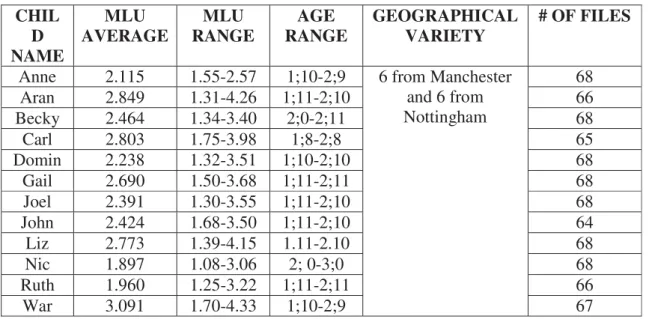
As we can see from table 3, the Manchester 1 corpus contains the spontaneous linguistic production of twelve English monolingual TD children. They are six boys and six girls. Some of them are from Manchester and others are from Nottingham. Moreover, the MLU of the participants ranges from 1.0 to 4.3 and their ages vary from one year and ten months to three years. The number of files of each participant is between 64 and 68.
Table 4. Main properties of the CONTI-RAMSDEN 3 corpus: SLI participants
CHILD NAME MLU AVERAG E MLU RANGE AGE RANGE GEOGRAPHICAL VARIETY # OF FILES
Bonnie 3.308 2.4-4.24 4;0-5;0 North West of England
22
Daniel 1.938 1.00-3.25 2;6-3;11 23
Harry 2.814 1.88-3.90 3;5-4;8 29
Nathan 3.060 1.20-4.34 2;11-4;3 33
34 aged between 2.6 and 5.0 years old and their MLU range is between 1.00 and 4.34. The number of files that each participant has is between 22 and 33.
This study is conducted with two groups of participants. Five TD children aged between 2 and 4 years and three SLI children aged between 2 and 5 years old. All the participants are monolingual speakers of British English. The linguistic profile of the participants is described below and the information is taken from the manual section of the CHILDES project. In particular, for the TD children the manual used is the British English one; and for the SLI children it is the language disorders one.
TD children are all first born, cared by their mothers primarily and most of them belong to middle-class families. They were recorded in their homes during one year.
Children with SLI, in contrast, had no history of hearing problems or autistic tendencies. Moreover, they had a good degree of intelligibility, but poor language capacities and non-verbal abilities within the normal range. These children were attending mainstream nursery schools and were either receiving speech or language therapy or had received it in the previous six months. Data were collected for a period of sixteen months in the children’s homes.
35
1.2 Participants: geographical area
Firstly, participants were selected taking into account their geographical area. For this reason, I have adjusted the participants to the same geographical area and variety. In the present study, all the participants belong to the North West of England: some of them are from Nottingham, Manchester or other places in the North West of England.
The second step affects the comparison between TD and SLI children. In this case, I have classified the participants into two well-defined groups: MLU-matched participants and AGE-matched participants. This classification was taken into account when I carried out the study since the main aim of the study is to examine and to contrast if the acquisition of English articles depends on the age or on the MLU of the children when comparing TD and SLI children.
Both matching procedures followed for both TD and SLI children are explained below. Firstly, I will present the MLU-matching (see subsection 1.3), and then, I will continue with the AGE-matching explanation (see subsection 1.4).
1.3 Participants and data: MLU-matching
1.3.1 MLU-matching: participant selection procedure
I have automatically calculated the MLU of each of the participants by using the CLAN program called MLU, since MLU shows the linguistic development of the children.
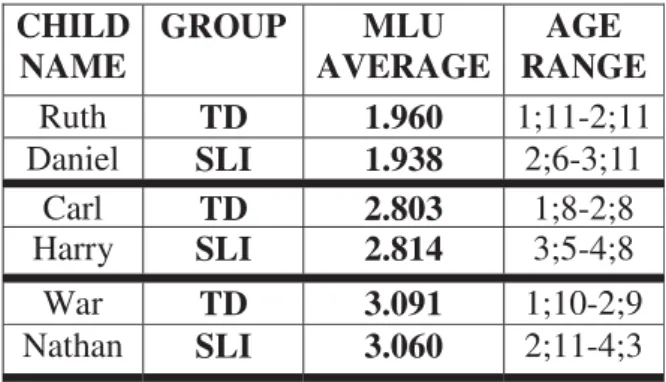
36 Once the MLU of each participant in both corpora had been calculated, I matched up the participants in order to create possible combinations and, afterwards, I paired TD participants with SLI participants. Table 5 shows the MLU correspondence between TD and SLI participants taking into account their MLU (not their age).
Table 5. TD and SLI MLU-matching: Participants selection
In table 5, the age of the participants is also presented so that we can realize that SLI children have the same MLU than TD children although SLI children are, of course, older. For instance, Ruth, a TD child, has an MLU of 1.96 when she is between 2 and 3 years old, whereas Daniel, an SLI child, reaches the same MLU when he is aged between 2 and a half and 4 years approximately. This reflects that SLI children’s language development is slower than that of TD children.
We can also realize that the first two participants (Ruth and Daniel) have an MLU around 1.9, the next two participants (Carl and Harry) present an MLU around 2.9, and lastly, War and Nathan share a similar MLU around 3.
CHILD NAME
GROUP MLU AVERAGE
AGE RANGE
Ruth TD 1.960 1;11-2;11
Daniel SLI 1.938 2;6-3;11
Carl TD 2.803 1;8-2;8
Harry SLI 2.814 3;5-4;8
37 1.3.2 MLU-matching: file selection procedure
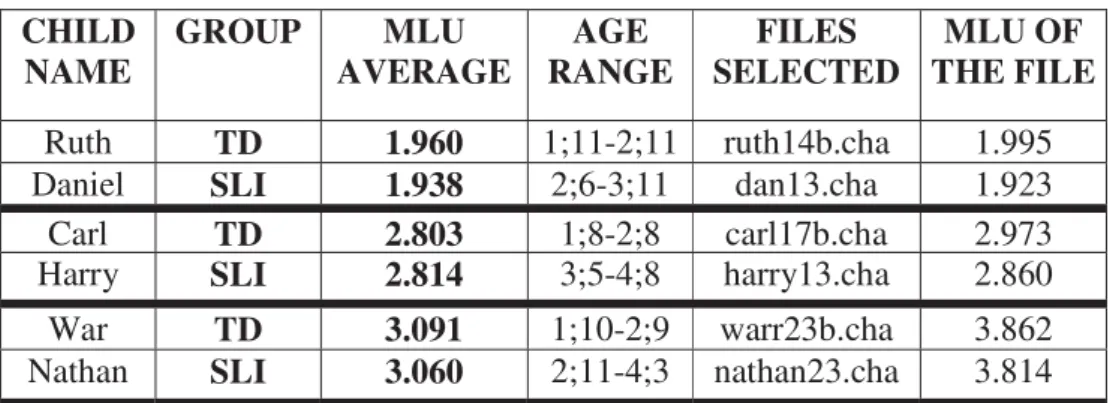
Once the participants have been selected, I have calculated the MLU of each child’s file in the corpus, and later on, I have matched the results. Table 6 presents the files I have examined in the MLU-matching section of the study.
Table 6. Selected files based on MLU-matching
In table 6, the files examined in the MLU-matching section are shown. The table includes information on the participants such as the child name and the group to which the participant belongs. Moreover, table 6 provides information on the files selected such as the name of the file in the corpus and the MLU of the participant in each file selected for the study. Once again, from this table, we can realize that the first two participants (Ruth and Daniel) have an MLU around 1.9, the next two participants (Carl and Harry) present an MLU around 2.9, and lastly, War and Nathan share a similar MLU around 3.
CHILD NAME
GROUP MLU AVERAGE
AGE RANGE
FILES SELECTED
MLU OF THE FILE
Ruth TD 1.960 1;11-2;11 ruth14b.cha 1.995
Daniel SLI 1.938 2;6-3;11 dan13.cha 1.923
Carl TD 2.803 1;8-2;8 carl17b.cha 2.973
Harry SLI 2.814 3;5-4;8 harry13.cha 2.860
38
1.4 Participants and data: AGE-matching
1.4.1 AGE-matching: participant selection procedure
In the case of AGE-matching, I have matched up the participants regarding their age and without considering their MLU. Firstly, I have examined the ages of each participant in each file. This information has been taken from the headers of each of the files.
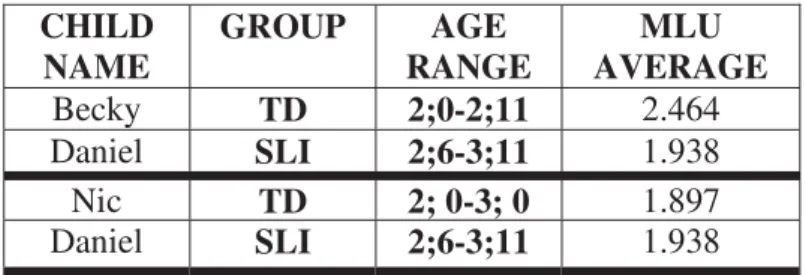
Secondly, I have established Daniel, an SLI participant, as a prototype and I matched him with two different TD children (Daniel and Becky). The AGE range of each participant is very similar in the sense that they are aged between 2;6 years and 3 years. Table 7 shows the participants analyzed in this section.
Table 7. TD and SLI AGE-matching: Participant’s selection
From table 7, we can appreciate that firstly Daniel has been paired off with Becky, a TD child, and then he has been matched up with Nic, another TD child. This table also presents that when Beck is aged between 2 and 3 years old, her MLU is approximately of 2;46. While an SLI child, such as Daniel, when his age corresponds to the same interval of time, his MLU is lower. Once again, the linguistic delay associated with SLI children is suggested.
CHILD NAME
GROUP AGE RANGE
MLU AVERAGE
Becky TD 2;0-2;11 2.464
Daniel SLI 2;6-3;11 1.938
Nic TD 2; 0-3; 0 1.897
39 1.4.2 AGE-matching: file selection procedure
In order to obtain the files to be analyzed in this section, I have taken into consideration the participants’ ages. Therefore, I have divided Daniel’s files into two sections:
− First section. Files in which Daniel is aged from 2;6 years to 2;11. This section starts with Daniel01 file and it finishes off with Daniel06 file.
− Second section. Files in which Daniel is from 2;11 years to 3 years. In this section, files from Daniel07 file to Daniel09 file are included.
Later on, I have matched up Daniel’s files with Becky’s and Nic’s files:
− First section. Daniel’s files are matched up with Becky’s files. It includes Becky’s files from Becky18a file to Becky31b file.
− Second section. Daniel’s files are matched up with Nic’s files. It covers files from Nic31a file to Nic34b file.
40 Table 8. Selected files based on MLU-matching
This different matching in terms of MLU and age between TD and SLI children (tables 6 and 8 respectively) will allow a double comparison between TD and SLI children. It will also provide crucial information regarding the grammatical property under consideration, that is, articles.
2. Data extraction on article use
Since definite and indefinite articles are the grammatical categories I am interested in, I have made used of the CLAN programs to select them. They are tools that allow the user to work with spontaneous linguistic data taken from CHILDES (MacWhinney 2000) and to perform automatic analyses.
The principal aim of using this useful tool, CLAN, is to obtain each instance in which each participant uses the definite article or the indefinite article. These instances will be the ones analyzed for the study.
CHILD NAME
GROUP AGE RANGE
# OF FILES
FILES SELECTED
AGE IN THE FILES
Becky TD 2;0-2;11 28 Becky28a and Becky28b
2;9.13 Daniel SLI 2;6-3;11 6 Dan05 and
Dan06
2;9.11 and 2;10.21 Nic TD 2; 0-3; 0 8 Nic33a and
Nic33b
3;0.03
41 I have carried out three main analyses using CLAN programs: I have used the CLAN program MLU in the process of choosing the participants and the selected files (as stated in subsection 1.3 above). Moreover, I have analyzed the selected files using FREQ to have an idea of the number of instances of the or a/an that appear in each file. Moreover, in order to get each particular instance in which these articles were used in each file, I have examined the data using the KWAL program. The KWAL program allows the user to search for the specific linguistic context in which each participant produces a definite or an indefinite article.
3. Data classification
This section is divided into two parts. Firstly, I will present the variables of the study and, subsequently, the discarded cases will be explained.
3.1 Variables of the study
The different article cases obtained from the data selected of the SLI and TD participants have been codified in an excel document attached to this dissertation in an electronic format. This document contains two sheets: one for the MLU-matching analysis and the other one for the AGE-matching analysis.
42 Table 9. General properties of the database
CORPUS CHILD NAME AGE FILE MLU INSTANCE
Conti-Ram3 Daniel 2;9.11 dan05.cha 1.312 a da [: cat]
This example presented in table 9 is produced by Daniel when he was 2;9 years old. It is extracted from the file dan05.cha of the Conti-Ramsden 3 Corpus.
Moreover, in the excel database, I have also added the three variables of study. The first variable when arranging each article instance is to consider the article type, that is, whether the instance contains a definite article or an indefinite article. Table 10 shows some examples of this first variable.
Table 10. Variable I: Determiner type
CORPUS CHILD NAME INSTANCE DET TYPE
Conti-Ram3 Harry <the castle> . The
Manchester1 Carl I want to make a house there. A
Manchester1 Becky That’s laid an egg, isn't it? An
Once the type of determiner is classified, the determiner subtype is analyzed. At this point, depending on the article type, the instance can depict several subtypes. For this classification regarding the subtype, I have taken into account the semantic contexts of each type of article, as presented in subsections 3.1 and 3.2 of chapter 2 of this dissertation. Therefore, for the definite article, I have considered two main subtypes, based on the semantic contexts in which the can appear: the anaphoric (ana) and the bridging context (bri).
43 Table 11 shows some examples of this variable considering both definite and indefinite article subtypes.
Table 11. Variable II: Determiner subtype
CORPUS CHILD NAME
INSTANCE DET TYPE
DET SUBTYPE
Conti-Ram3 Nathan The lady's hurting her xxx +/.
The Ana
Manchester1 Becky <I have> [/] I have those in the bath.
The Bri
Manchester1 Ruth A house. A Rsi
Manchester1 Nic Nicole have a drink. A Cm
Manchester1 Warr Not very big a minute. A Gm
Conti-Ram3 Daniel An accide(nt) . An Cm
44 Table 12. Variable III: Adulthood
CORPUS CHILD NAME
INSTANCE ADULT HOOD
NON-ADULT TYPE
Manchester1 Warr Not very big a
minute.
A Conti-Ram3 Daniel Yeah a train track. NON-A gram error (the)
Conti-Ram3 Harry This is a heye [ eye]. NON-A ortho error(an) Conti-Ram3 Daniel No (.) dat [: that] a
dat [: that] way.
NON-A gram error (double use of det)
This procedure based on the previously stated variables is the one used to classify all the data of the study.
3.2 Discarded cases
At this point, I will clarify some decisions that were taken when classifying the data of the study that lead to the exclusion of some instances. Firstly, I will deal with cases of imitation, then, I will consider unclear cases and, finally, I will present the way I have classified the repetitions of sentences produced by the participants.
Cases of imitation are not very commonly found in the study. When they occur, the child imitates the previous sentence stated by his or her mother, as example (25) presents.
(25) *MOT: we've got a robber.
*CHI: we've got a robber. [+ imi] (Daniel, 3; 4.05, dan13.cha)
45 I have also found some cases in which the child does not use the appropriate article in the sentence, and his/ her mother explicitly corrects the child’s utterance by repeating the same sentence with the correct article. In example (26), Daniel’s mother corrects him since he is not using the appropriate form of the indefinite article.
(26) *MOT: in that little basket? *CHI: a owl.
*MOT: an owl. (Daniel, 3; 4.05, dan13.cha)
In these cases, the first instance produced by the child is classified, but not the second one as it is a repetition of the mother’s correction.
Moreover, when classifying the data, I have also encountered cases in which the child uses the article followed by an adjective, such as example (27). In (27a), the indefinite article a
is followed by a quantifier bit and an adjective bored. In example (27b), the indefinite article is followed by the adjective blue. Therefore, these cases are discarded from the analysis as they do not include an article-noun sequence.
(27) a.*CHI: I'm getting a bit bored. (Becky, 2; 9.13, becky28b.cha) b.*CHI: a blue. (Nic, 3; 0.03, nic33b.cha)
I have also discarded cases in which the child uses an invented word preceded by an article, as in examples (28), in which the child has created the word that follows.
46 In examples (28) the symbol @c attached to the word depicts that the word has been invented by the child. For this reason, these special forms have been discarded from the study.
Cases in which the child uses an article but it is not followed by a noun, or by a clear identifiable noun have also been discarded from the analysis. In example (29), Nathan employs the definite article the followed by an unintelligible word marked as xxx.
(29) *CHI: mum where is the xxx gone? (Nathan, 3; 9.17, nathan23.cha)
Finally, I would like to point out the way I have counted the repetitions when classifying the data in the study. Repetitions in the same utterance are typically counted as one case. However, I have no found any example of this type of repetition in the data.
The other type of repetition I have considered occurs when the repetition takes place in different utterances. In this case, the repetition counts as a different and independent case. An example is provided in (30), in which Carl repeats the same sentences in two correlative utterances. These have been counted as 2 independent instances.
(30) *CHI: I wanna make a house.
*CHI: I wanna make a house. (Carl, 2; 2.15, carl17b.cha)
In the case of instances in the same utterance in which the child uses the articles twice with different nouns, each entity is counted as an independent instance. For instance, in example (31), Daniel makes use of both a definite article and an indefinite one in the same utterance.
47
6.
RESULTS OF THE STUDY
In this chapter 6, I will explain the results I have obtained after carrying out the study. In order to provide an answer to each of my research questions presented in chapter 4 of the dissertation, this chapter is divided into three main sections corresponding to each of the question sets previously presented.
Firstly, I will deal with the first set of the research questions, which is related to the general performance of the participants. Subsequently, in the second section of this chapter, I will show the results obtained regarding the semantic contexts of the definite and the indefinite article. Lastly, in the third section, I will compare the results produced by SLI participants and those produced by the MLU-matched TD and AGE-matched TD participants of the study.
1. Question set 1: General performance
1.1Research question 1: Definite and indefinite articles
In order to answer the first research question (i.e. the predominance or deficiency in the choice of both articles) results have been classified as in table 13.
Table 13. Question set 1: Research question 1. General performance
DEFINITE ARTICLE
INDEFINITE ARTICLE
TOTAL
TD CHILDREN 111 (44,05%) 141 (55,95%) 252 (100%) (47,54%)
SLI CHILDREN 90 (32,37%) 188 (67,63%) 278 (100%) (52,46%)