UNIVERSIDAD NACIONAL ABIERTA Y A DISTANCIA UNAD LICENCIATURA EN INGLES COMO LENGUA EXTRANJERA
ESCUELA DE CIENCIAS DE LA EDUCACIÓN ECEDU
Vclass, a virtual homework strategy to reinforce and improve the English communicative skills of EFL young learners
Paula Andrea González López Cód. 43.985.864
Advisor
Juan Carlos López Marín
EXECUTIVE SUMMARY
1. Type of document
Applied project
2. Title of the document
Vclass, a virtual homework strategy to reinforce and improve the English communicative skills of EFL young learners.
3. Authors:
Paula Andrea Gonzalez Lopez
4. Key Words
Language skills, English foreign language, Moodle, virtual learning guide, Computer assisted language learning (CALL), information and communication technologies (ICTs), Education institution project (PEI), bilingual program, self –efficacy, communicative approach, Common European Framework, Vclass .
5. Description
This applied project expects to establish the effects of virtual homework through the tool Vclass as a strategy to reinforce and improve English communicative skills as a foreign language to seventh and eighth grade groups with low levels at the "New School” institution.
6. Sources
analysis.
The literature research was focused on authors and theories such as Krashen,
Motteran , Taylor, Ausubel, Rebecca Oxford, Kumaravadivelu, Farooq and Hubbard amd Bandura with the theory fo self-efficacy and human agency.
The teachers and head department experiences at The New School, also provided information and opinions about the results of the virtual guide last school year and the spectations to the new school year.
7. Contents
The applied project starts by describing some important previous knowledge, research and experiences those others authors and practitioners have advanced before.
Digital tools in a language learning environment, are recognized as computer assisted language learning (CALL) (Hubbard, 2009). The practitioners in this area suggests the following: Research into the optimum age for language learning is inconclusive; an early start has a positive impact on children’s attitudes and the only advantage of an early start is the total amount of time spent actively on learning a language (Hubbard, 2009).
Searching an opportunity to use the ICT in pedagogical way The New School has designed some online activities and their own virtual guide called Vclass. The
learning guides have been included in the main subjects as a portion of the total grade in each subject’s area (The New School, 2016, p. 46). Thanks to the ICT evolution the learning guide change to virtual guides. Although the students have English class 5 hours per week, there are some students that are not easy to improve their
relative to the topics as a rehearsal virtual tool. These are the reasons why it is important to consider Vclass as a virtual homework strategy in which students can review the topics at the same time that they are involve in the digital world in which most of them really engage and are motivated.
The next part of the applied project was focused on the description of the methodology, the stages, description of the population and the resources required to collect the information. To assess the virtual guide, it was relevant to visit and share opinions from other schools and institutions that have applied it and their experiences with the students, comparing the level of English and the time practicing English by themselves.
Finally there is a description about the results and analysis of them. Conclusions and suggestions complete the applied project. The author provides a scheme of possible task that could be included or considered to next updating to achieve the higher level languages skills in students taking account motivations, school’s model, approaches and new virtual tools.
8. Methodology
Causal effect: on determining cause-and-effect and Mixed research, from data collected: quantitative and qualitative. Comparing with some theory references and writing some close and open questions to search more about the topic. In this step the questionnaire is more structured and it is possible to collect more data. Focus Group: short open questions to deal the focus group with students and teachers. Bench-marketing to analyze the others schools experiences. Case of study research: We should research and analyze the school data: internal records are reviewed.
9. Conclusions and Recommendations
The applied project contributed to achieve the conclusions and
recommendations that could determine the new virtual strategies that will be applied on the platform "Vclass". The assessment and analysis of the data gathered about Vclass as strategy to improve and reinforce the English communicative skills in the groups of the seventh and eighth grade and the theoretical that supported it, allowed considering this tool as one of the learning strategy in a virtual environment. This strategy should be evolved and improved every time that teachers examined and considered it relevant; taking account the students’ needs and opinions, the pedagogical approaches, methodologies and strategies established by the school.
Recommendations
The “Vclass platform” should be modified or changed constantly when it is necessary considering the needs, motivation, level, background and previous knowledge of the studies and using tools, programs and topics that are updated to the students and can be applied to learn and practice more.
TABLE OF CONTENTS
PROJECT FORMULATION ... 11
OBJECTIVES ... 15
THEORETICAL FRAMEWORK ... 16
METHODOLOGY ... 24
RESULTS ... 29
ANALYSIS ... 37
CONCLUSIONS AND SUGGESTIONS ... 42
LIST OF TABLES
TABLE 1. LEVELS ACCOMPLISHED BY GRADE: ... 12
TABLE 2. COMMON REFERENCE LEVELS: GLOBAL SCALE ... 14
TABLE 3. RESULTS OF THE DATA COLLECTED IN THE SURVEY ... 29
TABLE 4. OPENING QUESTIONS. ... 31
TABLE 5. FOCUS GROUP CHART ... 32
LIST OF FIGURES
FIGURE 1. THE GRAPHIC SHOWS, ACCORDING TO THE SURVEY, THE RESULT OF
THE FREQUENCY OF USING THE PLATFORM. ... 30
FIGURE 2. THE GRAPHIC SHOWS IN PERCENTAGE BASED ON THE SURVEY’S RESULTS, THE QUANTITY OF SUBJECTS THAT STUDENTS PRACTICE
THROUGH “VCLASS” . ... 30 FIGURE 3. THE GRAPHIC SHOWS, ACCORDING TO THE SURVEY, THE RESULT OF
THE NUMBER OF THE STUDENTS WHO USE “VCLASS” AT SCHOOL, HOME OR BOTH. ... 30 FIGURE 4. PERCENTAGE OF THE AVERAGE TIME INVESTED BY STUDENTS IN
THE VCLASS PLATFORM PER TERMS. ... 33
FIGURE 5. ACCUMULATED TIME PER MINUTES INVESTED AT HOME AND AT SCHOOL. ... 33 FIGURE 6. TIME SPENT PER TERM AND GRADE. ... 34 FIGURE 7. COMPARATIVE –TOTAL TIME SPENT IN VCLASS BETWEEN FIRST
TERM 2016-2017 AND MID-FIRST TERM 2017-2018 ... 34
FIGURE 8. COMPARATIVE –PERCENTAGE OF USERS OF SEVENTH GRADE
STUDENTS PER TERM AND SUBJECT ... 34
FIGURE 9. COMPARATIVE –PERCENTAGE OF USERS OF EIGHT GRADE
STUDENTS PER TERM AND SUBJECT ... 34
FIGURE 10 . COMPARATIVE –PERCENTAGE OF USERS OF EIGHT AND SEVENTH GRADE STUDENTS IN THE FIRST TERM AND SUBJECT 2016-2017 VS. 2017-2018 ... 35 FIGURE 11. AVERAGE TIME PER USERS AND SUBJECT OF EIGHT AND SEVENTH
GRADE STUDENTS. ... 35 FIGURE 12. AVERAGE STUDENTS WHO FAILED AND GOT MORE THAN 3 IN THE
INTRODUCTION
“Each generation comes to college with varying characteristics that distinguish
them from their predecessors” (Monaco & Martin, 2007). There is a new generation of students who are growing up around the digital world. Young and kids waste long time on the net. R.J. and A.B., (2007), propose to search an opportunity to use the ICT in
pedagogical way some schools have made up some online activities and their own virtual classroom.
Digital tools are useful for teaching and learning English. “These digital tools are recognized field of computer assisted language learning (CALL), but are also increasingly a core part of English language teaching (ELT) in general” (Motteram, 2013, p. 5).
John Erskine (1999) in his article “Actes du colloque/ Colloquium proceedings” explains that certain type of individual teacher takes the initiative and implements
technology into their classrooms. Although they do not recognize some virtual tools, they try to search information about them and practice to evaluate they are prospered in class. That is the case of some teachers of The New School1, who made up a virtual guideline in Moodle2 platform, in order to organize and standardize the teachers’ guides and create a motivating online learning environment.
Research indicates that “training in ICT skills is crucial in implementing ICT integration in the teaching and learning of English” and “the extent to which teachers are given time and access to pertinent training to use computers to support learning plays a major role in determining whether or not technology has a major impact on achievement.” (R.J. & A.B., 2007, p. 2)
The New school is one of the Colombian schools that want to innovate with virtual practice activities in order to encourage students to practice more. The tool is called Vclass and it uses Moodle program. Vclass is designed and made up by The New School teachers.
1
The New School is an educational institution located in Medellin, Antioquia. The school has collaborated in the development of this project document and it is the owner of “Vclass” platform
Although the teachers do not have experience about tools online, they know their students and needs. Even more, this tool is a new project from the school that needs to be adjusted to the needs and the goals proposed in each term, level and grade. Based on the students’ progress and final grade, it is necessary to check and analyze the online activities about how much motivating, interesting and positive they are, and comparing it with the traditional activities and learning style. This process will allow the institution getting the results of the program and evaluating how much the student would improve their skills and knowledge using it as an extra curriculum or leveling. This project is an opportunity to assess Vclass as a virtual homework strategy to reinforce and improve in the seventh grade group the English communicative skills as a foreign language
The New school is one of the users that require innovating with virtual practice activities and encouraging students to enter on it and practice more. The tool is called Vclass and it uses Moodle program. This project was developed last school year (2016- 2017). It is used to reinforce their skills and knowledge in the main subjects of the school. Some of the subjects are: English, math, Spanish and science. All of the subjects except Spanish are in English and might be considered as a part of the foreign language learning process in a content method. In the context of this project, it will be focused on English as a subject and the others like practice content. The English virtual guide is designed just for eight and seventh graders due to the level that they should get at the end of the school year, according with the curriculum charts that the language art area established as a goal and students start ninth grade with higher level of English .
PROJECT FORMULATION
The New School institution is a private school focused on its pedagogical model and the bilingual program that is committed to form its students in English. According with the Education institution project (PEI) (2003):
The main objective of the bilingual program of “The New School” is to train bilingual students who are able to write, read, listen, speak and learn Spanish, and English in a permanent process of training that involves the cognitive, affective, social and communicative dimensions, as determinants of human development and to involve the entire educational community in the strengthening of bilingual communicative competences. (The New School, 2013, p. 49).
The bilingual program gives the opportunity to students to graduate with a bilingual certification given by First Certificate in English (FCE) test which has international validity and responds to professional and work demand.
At the school, learners have English class 5 hours per week, plus other subjects that are advanced in the same language. However, the final grades and results in each term and in general school year have demonstrated that some students do not do well improving English communicative skills, even having many hours immersed in that language.
Although they have schedule homework, some of the students do not advance on them at home. Teachers from the school, at the time to inquire the reason why some of them do not practice at home or do the homework, students shared reasons such as: the tasks are around the topics but sometimes they are not motivating, they do not remember, they do not have the tools to complete them, and so on.
2016 conceived Vclass as a virtual strategy in which students can review the topics at the same time that they are involved in the digital world in which most of them really engage and are motivated. The last school year 2016-2017 was designed the first edition of Vclass and now it is time to review, analyze and modify the virtual platform based on the results gotten in the first year, teacher and students perceptions, and motivations and needs of the students.
Implementing Vclass tool according to the English students’ needs and goals as a virtual homework strategy will be part of the results to this project. Also, Vclass should be improved and adapted based on the European common framework3 and the aims
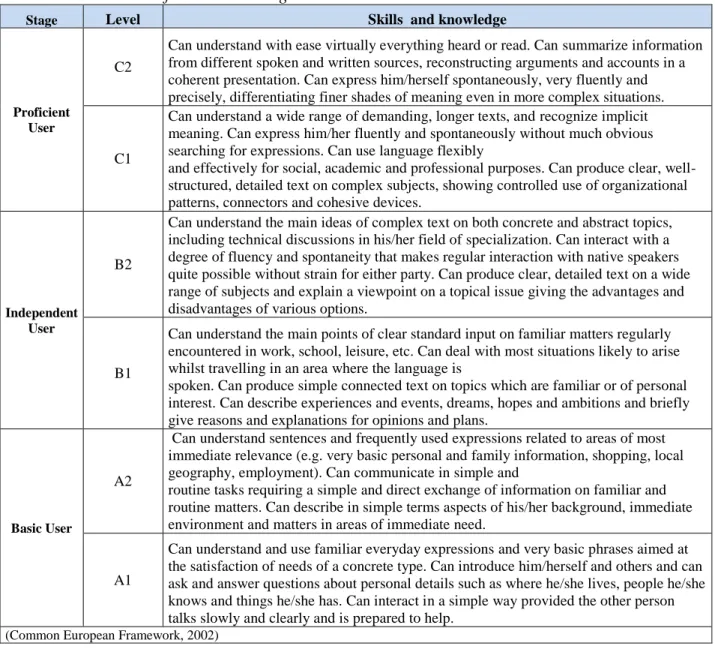
established by the institution to achieve a higher level of English from A1 and A2 to A2.2 and B1 level of English in seventh and eighth grades students to start ninth grade in B1 (see table 1.Common Reference Levels: global scale). Moreover, teacher should get from the students autonomous participation and practice English as a foreign language through developing the activities that students can find in the virtual platform.
The language arts curriculum established levels that students should be in determine grades to develop the communicative competence and guarantee the
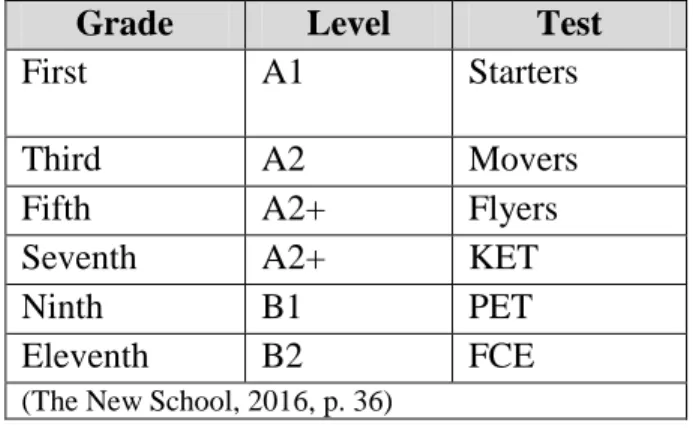
improvement in the learning process in a foreign language and when students finish the school in eleventh grade can accomplished an international bilingual certificate B2 or C1 (Table 1 ).
Table 1. Levels accomplished by grade:
Grade Level Test
First A1 Starters
Third A2 Movers
Fifth A2+ Flyers
Seventh A2+ KET
Ninth B1 PET
Eleventh B2 FCE
(The New School, 2016, p. 36)
3
The objectives by the grades
A2+ sixth – eight : “To understand short and simple text that includes common and useful vocabulary” (The New School, 2016, p. 42). B1 ninth and tenth : “To advance and improve the communicative competence through different genders of literature and writing text considering the vocabulary that the level require” (The New School, 2016, p. 42).
English teaching is very important nowadays because “it is the most spoken language around the world” (Petruţa, 2012, p. 1). There are many reasons why students should learn English as a foreign language. Some of them are: increasing the
understanding culture evens the native culture, asset for the learners’ career, opportunities to work and study abroad, connection with new cultures and people, or just to have fun (Petruţa, 2012). In addition to these, “the development of any country necessarily passes through its proper insertion in the globalized world, in which the formation of
communicative competences coherent with the new global environments (foreign language and capacities to use information networks)” (Perez, 2009). For that reason schools have been increasing the time and the subjects in which the language is English, in order to improve the learners’ language skills.
In addition to this, the school is based on two pedagogical models: meaningful learning and new school. Through Vclass learners can develop the information and the tasks according to the particular learning process that each of them has, as The New School proposes, while meaningful learning establishes that each student has autonomy, interest and skills to build their knowledge (Ballester, 2002). Those premises are suitable to the idea to adapt Vclass as a learning strategy to develop at home.
Table 2. Common Reference Levels: global scale
Stage Level Skills and knowledge
Proficient User
C2
Can understand with ease virtually everything heard or read. Can summarize information from different spoken and written sources, reconstructing arguments and accounts in a coherent presentation. Can express him/herself spontaneously, very fluently and precisely, differentiating finer shades of meaning even in more complex situations.
C1
Can understand a wide range of demanding, longer texts, and recognize implicit meaning. Can express him/her fluently and spontaneously without much obvious searching for expressions. Can use language flexibly
and effectively for social, academic and professional purposes. Can produce clear, well-structured, detailed text on complex subjects, showing controlled use of organizational patterns, connectors and cohesive devices.
Independent User
B2
Can understand the main ideas of complex text on both concrete and abstract topics, including technical discussions in his/her field of specialization. Can interact with a degree of fluency and spontaneity that makes regular interaction with native speakers quite possible without strain for either party. Can produce clear, detailed text on a wide range of subjects and explain a viewpoint on a topical issue giving the advantages and disadvantages of various options.
B1
Can understand the main points of clear standard input on familiar matters regularly encountered in work, school, leisure, etc. Can deal with most situations likely to arise whilst travelling in an area where the language is
spoken. Can produce simple connected text on topics which are familiar or of personal interest. Can describe experiences and events, dreams, hopes and ambitions and briefly give reasons and explanations for opinions and plans.
Basic User
A2
Can understand sentences and frequently used expressions related to areas of most immediate relevance (e.g. very basic personal and family information, shopping, local geography, employment). Can communicate in simple and
routine tasks requiring a simple and direct exchange of information on familiar and routine matters. Can describe in simple terms aspects of his/her background, immediate environment and matters in areas of immediate need.
A1
Can understand and use familiar everyday expressions and very basic phrases aimed at the satisfaction of needs of a concrete type. Can introduce him/herself and others and can ask and answer questions about personal details such as where he/she lives, people he/she knows and things he/she has. Can interact in a simple way provided the other person talks slowly and clearly and is prepared to help.
OBJECTIVES
General Objective
To establish the effects of virtual homework through the tool Vclass as a strategy to
reinforce and improve the English communicative skills in students of A1 and A2 levels of seventh and eighth grade groups of The New School institution.
Specific Objectives
To analyze the use of Vclass as a virtual learning process of the seventh and eighth grade groups.
To assess the importance of establishing the virtual homework as a strategy to reinforce and improve the English communicative skills.
THEORETICAL FRAMEWORK
Hubbard (2009) describes deeply the method Computer assisted language learning (CALL) referring the Betty definition “it is any process in which a learner uses a computer and, as a result, improves his or her language” (Hubbard, 2009, p. 1)to surf and use the computer to advance the activities that are in the virtual guide. Also Hubbard (2009) emphasizes the specific meanings of “computer” and “improve” in the definition and proposes the advantages to apply CALL in the learning process. Some of them are: learning efficiency (students learn faster), learning effectiveness ( they can associate and learn more than they consider); access ( the diversity of materials that teacher and learners can find and interactions among others); convenience (learns can practice in any place where they have access and longer period of time); motivation (most of them enjoy surfing on the net and develop activities in the computer) and institutional efficiency ( it can reduce physical resources).
It is important to highlight the three statements that Bernhardt (2009) proposes in her booklet “Teaching other languages” in chapter eight about technology: first, technology is not a site to learn, it is a tool that should be included in the lesson plan for the learning process. Second, teachers are the responsible to check and verify that the virtual tools are properly designed to the learners and they are according to the level that they are teaching. Third, technology is a useful tool not just for the students it is also important to teachers to search and share their experience to others (p 22).
Also Bernhardt (2009) in chapter one establishes some ideas and difference between kids, young and older learners during the learning process, summarizing our current understanding in this area suggests the following:
Research into the optimum age for language learning is inconclusive
An early start has a positive impact on children’s attitudes
Motteram (2013) names Thorne and Reinhardt (2008) at the time to talk about the technology as a ‘bridging activities’, which simplistically is about getting learners to talk about how learners are using technology in their ‘out of class lives’ in the classroom” (p. 7)
Nowadays, young learners are growing up using devices and virtual environment to search information, contact to the others or just for playing video games. Some teachers who are part of this new era of technology have taken advantage of this opportunity as a way to motivate and encourage students to practice and learn easier. Teachers and game users are adapted and innovated in developing games to teach foreign languages. This strategy is also known Digital game- based learning (DGBL). “There have been several attempts to define and categorize digital games for learning” (Sigurđardóttir, 2016). Some of the digital games that teachers can find on internet or design by themselves are: “1) drill/quiz games, that is, games that test/drill what users already know and 2) exploration games or games that require no previous knowledge of the topic and are scripted to teach something new 3) commercial games” (Sigurđardóttir, 2016), that are the games that cannot be adapted or modified by teachers.
Teacher training is necessary to improve the virtual learning environment. Teachers and practitioners are the people that should be in charge to design and apply the virtual tools. Motteram (2013) retakes the Samuel and Zitun proposal in 2007 about the importance of teacher learning process of virtual environment and “the extent to which teachers are given time and access to pertinent training to use computers to support learning plays a major role in determining whether or not technology has a major impact on
achievement.”(p. 46). It establishes how can affect positively the teachers technology training in the learners success.
LinkedIn, Google+ and Renren have the potential to become important disruptive technologies”. However, the connectivity is important to consider in the institution or school where the platforms can be developed. Web 2.0 gives students the opportunity to have a control of the process in the platform and it is a positive interactive tool to improve their language skills. “It changes people from passive to active information consumers, allowing the online voice to be part of the conversation” (Okello-Obura & Ssekitto, 2015, p. 4)
Talking of education technology, Moodle is a virtual learning environment, in which teachers can design their virtual classes and students interact with others while they are learning. The platform is designed according to the goals and competences that learners should achieve at the end of the course. One of the benefits is the interaction that learners have with others as a study group. This software allows many different types of activities and learning methods and can be used for beginners or advance learners. For those who like ICT, virtual learning environment is one of the best ways to improve their knowledge or language skills. Moodle was created by Martin Dougiamas who designed it following the constructivism approach. The constructivism proposes that the knowledge is built (Moodle, 2017) from learners’ mind and their followers believe that learners built their knowledge from their previous information.
Vclass was designed on Moodle and based on the education theory and methods that The New School adopted and adapted. The following are some theories and
practitioners that propose the cognitivism and metacognition as the methods of teaching English and are in the school document.
In the Language arts curriculum (2016) The New School teachers define input through the authors Krashen (1985) and Ellis (1994) “as the contact a person has with the foreign language, either through direct interaction with it in informal settings, or through instruction as in an educational institution." (The New School, 2016, p. 19)
receive and how much they can learn unconsciously. Krashen (1985) says “To be more precise, input is the essential environmental ingredient” (p.3). In addition to this the
researcher provides pieces of advices about how the learners might feel during the learning process and the importance that teachers must be alerted to some changes. When the
acquirers (as Krashen calls the learners) are unmotivated, lacking in self-confidence, or anxious is because most of the time they feel weakness in front of the knowledge that they acquire. “People acquire foreign language only if they obtain comprehensible input and if their affective filters are low enough to allow the input” (Krashen , 1985, p. 9). The input hypothesis also considers silent period as necessary part of the learning process, and occurs when the learners are listening or reading and processing the information that they are acquiring. This hypothesis is acknowledged in the curriculum at The New School and even is part of the method to develop the Vclass platform.
Vclass as a virtual learning environment develops through learners the Autonomy, one of the school premises. The language arts curriculum teachers (2016) recognize this ability in the students and values the difficulties to get it during the learning process. For this topic teachers contemplate one of the Taylor’s (1983) statements “They must have the capacity to know how to use prior knowledge, how they perform certain activity, where the strategies they themselves learn to achieve good results must be effective, analyzing and reflecting” (The New School, 2016, p. 19).
The main aim to Vclass is to offer as a tool different opportunities and strategies to develop the topics determined in the learning process per specific level and grade in order to reinforce and improve the students learning skills. This platform is designed not just for foreign language subjects; it is also to the others subjects that learners develop during a school year. This is why teachers who are in charge of the design and creation of the platform Vclass must follow the school philosophy, its model, and the structure of level that foreign language established in their curriculum chart.
person.
On the other hand the new school model, proposes the different learning styles and the importance to recognize learners with different characteristic to the others. It means that each person has their own process of learning, motivation, background and experience.
For Dewey, education is a process of continuous reconstruction of experience. Education comprises two aspects: psychological and social, according to the psychological aspect is to stimulate skills and abilities, or what in other terms is called "powers" of the child and the young, but this stimulus only comes from the social situation . The psychological and sociological are related in an organic way, because in order to know a capacity, it is a power to do, it is necessary to know what is the purpose and its use, which cannot be achieved unless the individual operates in the midst of social relations and be able to gain control over himself (Londoño Ramos , n.d., p. 157).
The last proposal that the school took as part of its model is systematic thinking, in which the education system is seen as holistic and the learner is part of the system. Morin (2007) describes the institutions and education system as a community in which there are different factors that influence in the education of the learners and proposes the learning process in a student not just about knowledge it is also spirit, traditions, culture, history. Thanks to that, learners are able to create and improve in the subjects that each of them considers relevant for their live.
In addition to the models adopted in the school, the language arts curriculum chart concerts some theory and method of learning foreign language. One of the practitioners is Rebecca Oxford (2003) who establishes the language learning styles and they should be contemplate at the time to plan a lesson. Oxford (2003) describes each learning style based on tendencies, personalities, background and others. Some of them are:
Sensory preferences: visual, auditory, kinesthetic
Personality types: “extraverted vs. introverted; intuitive-random vs. sensing-sequential; thinking vs. feeling; and closure-oriented/judging vs.
Biological differences: biorhythms, sustenance.
"Teaching a language is much more than teaching a language. It is not only the transmission of phonological, syntactic and pragmatic knowledge about the use of language, but also the transformation of cultural forms and interested and partial knowledge to give meaning to the experiences lived by teachers and learners” (Kumaravadivelu, 2012, p. 6) .
Similarity, “motivation and self- efficacy work together in the socio-cognitive theory in which integrate metacognition and the elements motivating for the
self-regulation” (Chacon Corzo, 2006, p. 52). The students’ motivation includes their personal goals, self-efficacy and the expectation that they have to the subject and specifically to the virtual platform. Corzo (2006) in the document proposes the Bandura’s position to the socio-cognitive theory about the self-regulation Bandura (1993) said “the self-efficacy believes are fundamental in the self-regulation of the motivation. It means that students should regulate by themselves in order to achieve their goals and the aims subject, including practical activities like virtual tasks and the responsibility and autonomy to administrate the their time and skills. Students should trust in themselves about their “personal skills to organize and develop the duties and tasks required achieving the results expected” (Chacon Corzo, 2006, p. 45).
Finally, the levels and the structure that students should follow are based on the Common European Framework of Reference of languages (CEFR), communicative and literature approach. The school sets up the groups of the studies by the levels and following the knowledge, language skills and abilities that students have in common and what will be the aims that they should achieve in a term.
Nowadays the information and communication technologies (ICT) can be assumed as an important tool to use in the foreign language learning process to improve the learners’ skills. English and the ICT as tools practice and interact with real situations. Some people consider that students need to have contact with real situations in which they learn
practice at home and review topics that they have not understood or completed before, thanks to practice a foreign language (L2) through ICT they can elicit and share their opinions about any topic.
The education system has been integrating ICT into the institutions, including computer applications, mobile technology or recording and communication systems, have become essential and highly relevant items in teaching (Friedman , 2006).
Computer assisted language learning (CALL) is defined by Levy (1997) as “the search for and study of applications of the computer in language teaching and learning. CALL is also increasingly a core part of English language teaching (ELT) in general (Motteram, 2013, p. 2). In addition to this, learners can get materials or experience interactions that would otherwise be difficult or impossible to get or do traditional classes (Hubbard, 2009, p. 2). But, are ICT useful for learning process?
ICT facilitates collaborating whilst also offering the potential for personalized the learning process (Sutherland, 2004). However Hattie (2009) argues that children learning process is likely to be most successful, most visible, when teachers are able to see learning thorough the eyes of their children.
Some practitioners disagree about the teachers who design do not have experience about developing some virtual material. They argue to have a background and knowledge about pedagogical tools to adjust the program as much as is possible to the learners’
achievements. Motteram (2013) argues that, teachers then take the ideas and adapt them to their own classroom.
Farooq (2009) states that educationists are responsible for curriculum design. They should consider the learner as the focal point in a virtual learning environment. They should select resources and tasks according to the learning requirements (p. 2).
Hubbard (2009) claims that learners enjoy the virtual language learning process more and this engage more fully. However, Farooq (2009) in his paper argues, according to a research with CALL institutions, that some of the students expressed uncertainty
suggested a blend of online and face to face activities as a way to improve more their language skills.
To adapt Vclass to the school pedagogical model, it is necessary to review the premises that the institution adopted from meaningful learning and new school. According to the educational project institution of The New School and following some practitioners focused on those models, the new school defined the learner as the center of the
pedagogical activities, independent, unique, different to the others and autonomous. This model proposes that the differences among learners are also from their abilities, the way how to struggle problems, the learning process, motivations, personal aims and the
relationship that have built the individual differences and their needs. This model proposes the autonomy and the critical sense of the students through analytic and reflexive process. Those are assumptions that have to be included at the time to design Vclass.
The last literature review allows understanding more the variables and the different point of view that researchers and practitioners have about the virtual learning environment as a part of the foreign language class. It could help to improve learners’ knowledge and skills and teachers could use it as a tool to reinforce and support their teaching process. Teachers still are important in order to support learners during the process but, learners are motivated using ICT as a way to practice language.
METHODOLOGY
“Mixed methods research refers to use data collection methods that collect both qualitative and quantitative data”. (Burke , Onwuegbuzie, & Turner , 2007, p. 10). Based on Burke et al. (2007), this method research will provide better understanding, enhance description and understanding, provide richer, more meaningful, and more useful answers to the research. Mixed method will develop applying survey, data collection, and quantitate viewpoints.
Exploratory process starts when a group of 24 students gives information throughout a survey, open-ended or unstructured interviews so they can provide
information and opinions directly from the students, meaning, from the users. Based on the first information, that interviews give from the students, comparing with some theory references and writing some close and open questions to search more about the topic. In this step, the questionnaire is more structured and it is possible to collect more data. Then, choosing two different groups: one who practices at home online through the Vclass application and another one who practices on their own. After that, evaluating the results and separating the qualitative and quantitative parts of the research study. The testing or evaluation will have better results when the questionnaires combine qualitative and quantitative questions “to provide all the information that is potentially relevant to the purpose of the study” (Burke et al.,2007, p. 127)
Focus Group: one of the methods in which a moderator guides a group of 8-12 people with specific characteristics or profile. This group evaluates some products or situations (experience). In this particular research project, the principal and a teacher, different from those who designed the application, talk to the group and get information about the Vclass, motivation and knowledge that have gotten using it. The groups are classified according to the grade and their level .
Benchmarking: There are others schools or institutions that encourage students to work online and complete the online activities in order to practice and improve the language skills. It allows comparing and checking what method or activities are used and are useful, and effective to improve students learning process.
Case of study research: We should research and analyze the school data: internal records are reviewed, sometimes individuals are interviewed, and sometimes situations or people are observed carefully.
Type of study
Causal research: “Research design in which the major emphasis is on determining cause-and-effect relationships” (Queensland University of Technology, 2011). For the institution, Vclass is a new tool that needs to be evaluated about how much useful it is or not, and also how motivating it is to the students who are working on it. The institution needs to compare and analyze the results and the improvement of the learning process between students that use this tool and those who do not. The evidences are important to make decisions about modifications, changes, or even stopping the Vclass application as a virtual learning environment.
For really important decisions, sometimes we need stronger evidence than we can get with descriptive research. Also, according with the causal studies of the Vclass, it could offer the advantages of replication if necessity arises. If the application gives good results about the improvement in the English learning process, the school could think up the idea to apply the application with other grades or for leveling some students who really need to reinforce more the language skills.
Although it can be difficult to reach appropriate conclusions on the basis of causal research findings due to the impact of a wide range of factors and variables in the students learning process, this research studies might give some ideas on how to develop, change or use the Vclass application.
realistic situation in which one or more independent variables are manipulated by the experimenter under as carefully controlled conditions as the situation will permit” (Queensland University of Technology, 2011). According to the case of studies, the students are using and practicing English on this application, for this reason a field
experiment is the one that is going to use to assess the independent and dependent variables analyzing their impact in the learning process
STAGES:
Stage 1: Diagnosis
The diagnostic results come from the survey (appendix 1) and a focus group, completed by the seventh and eighth graders students at The New School institution, in which it allows evaluating the strengths, and weaknesses that students consider that the Vclass tool has had, and the main drawbacks that they found on it. In addition to this, the survey provides, from the point of view of the students, information about the interest, motivation and how useful Vclass is for their learning process.
Focus group: Also the study of the platform must be evaluated by teachers as designers and responsible of the process. A short meeting in which teachers share their experience with the platform and the activities and strategies were useful to the students (appendix 2).
Stage 2: Bench marketing
This result is displayed through a comparative chart with Vclass platform and analyzed them to contemplate some changes in the platform.
Stage 3: Modifying and refreshing
According to the results and the information collected in the stages one and two, following the structure of the platform, it might be modified and refreshed. Taking account the pedagogical approaches, methodologies and strategies established by the school. This change is considering the teachers previous guide and new ideas and strategies.
Stage 4: Applying the renovated tool
Students have the opportunity to surf on the virtual platform and check the activities and topics. In this stage students practice at home and develop the activities according to the teacher instructions in order to motivate them to have an autonomous participation and practice English as a foreign language.
The participation and activities development progress are measured through reports from Vclass: course participation, statistics of users. It is the time to analyze and verify the content and the students’ interests, the content and any modification that is considered relevant to do.
Stage 5: Vclass as extra homework
Virtual homework Vclass as a strategy of improvement and reinforce of English language communicative competence. Implementing Vclass as virtual guide to practice at home and review the topics worked in class. It is a support to the activities and an
opportunity to learners to verify and improve their language skills.
This stage is assessed through reports from Vclass: course participation, statistics of users. Also, at the end of the school year, students take a test to check and compare their previous knowledge to their current language skills.
POPULATION
A group of forty six teenage students, females and males, from The New School of seventh and eighth grades; with ages between 13 and 15, who practice English using Vclass virtual application as a tool to improve their language skills. Most of the students families can afford to provide English classes or interchange programs in which students improve their language skills. The level of English of this group is A1 and A2 (according to the Common European Framework) and need to improve to ninth grade to B1
INSTRUMENTS
Unstructured Questionnaire: Designing this type of questionnaire in which students complete the online form. On Vclass application there is the possibility to design a questionnaire that students should answer at the end of each term. Unstructured form gives the opportunity to get more information, advice or complains about the program.
Statistics and data of the Vclass: The application has data information about the number of the students, people who work on it, time, frequency and the activities they click on it and practice them. This tool helps for recognizing the students who work on it and compare with the others who do not. Also, it gives information about the periods of time they invest on it.
Unstructured interview: Collecting information from the students about how useful and motivating the application is for them. To get this information, I will choose randomly 12 students from each grade and they will complete a semi-oriented interview.
Comparative chart: to show the results between students who use the application and those who do not. Although there are other variables that might influence the results, the grades might give us an idea on how important this tool could be for the students.
RESULTS
The data gathered during the applied project had through three stages: students’ survey, focus group and bench marketing, and data from Moodle systems. The following are the results of those researches:
Students’ survey
The survey was applied to 46 students, 27 from seventh grade and 19 from eighth grade. It represents the 61,3% of the total of the students in both grades. The students were able to complete the survey by themselves. The format survey had 7 closed questions and 4 opened questions.
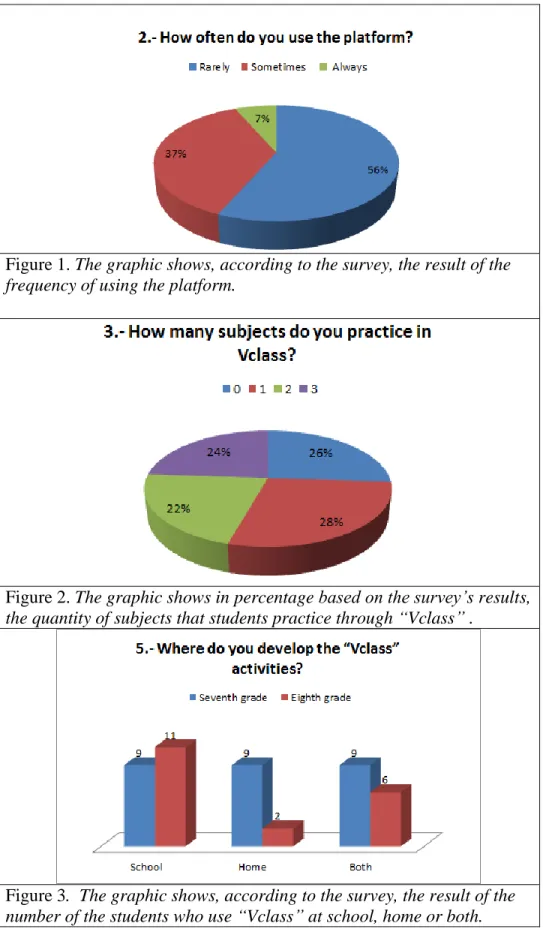
Table 2 shows the results of the survey based on the closed questions. Figures 1, 2 and 3 compare by graphics the score gotten in the questions two, three and five.
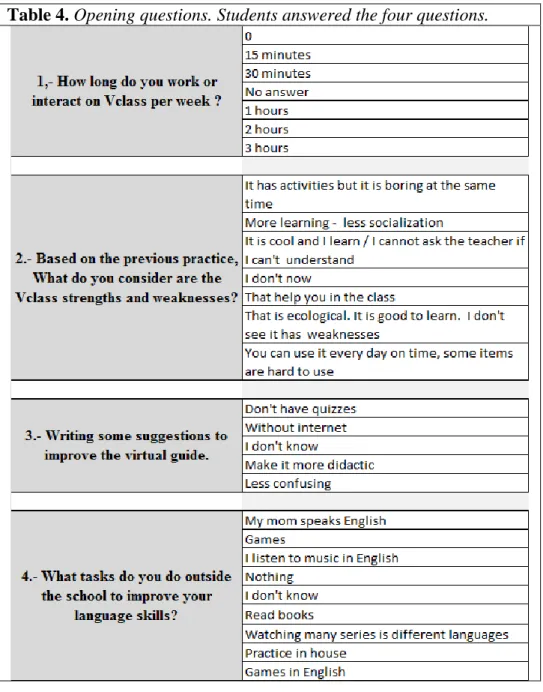
In addition to this, students considered in the opening question the strengths and weaknesses that teachers display through Vclass. Also, this section of the survey provides a brainstorming of some ideas on how students gain progress in their language skills at home. Table 3 shows some of the answers that they wrote about it.
Figure 1. The graphic shows, according to the survey, the result of the
frequency of using the platform.
Figure 2. The graphic shows in percentage based on the survey’s results, the quantity of subjects that students practice through “Vclass” .
Table 4. Opening questions. Students answered the four questions.
Focus group
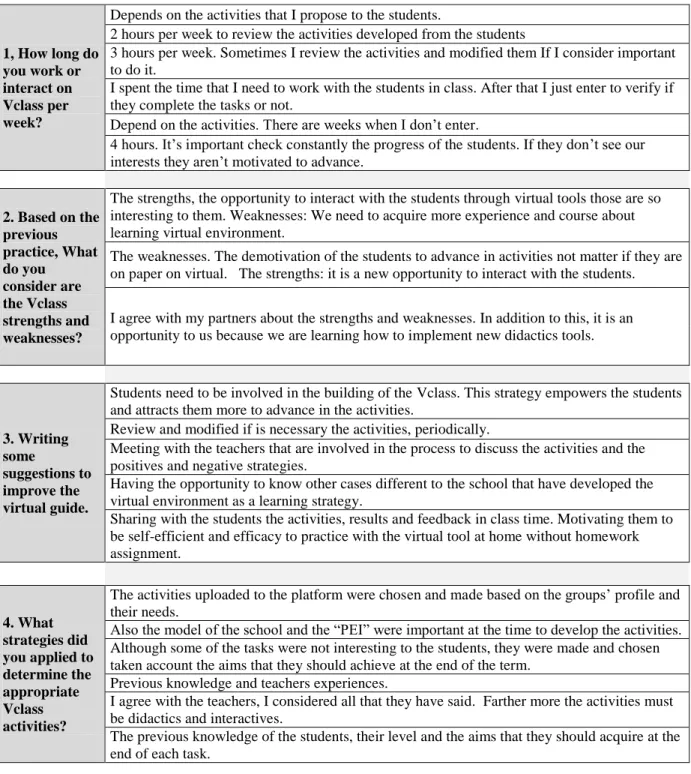
Some of the teachers from The New School were invited to participate in a focus group, to discuss their experience with the platform. The activities and strategies were useful and teachers could suggest and share their ideas about it. The discussion was around four questions.
subjects of math, social studies, science and language arts (the last one is called English subject). Table 4 shows some of the comments, and arguments deliberated during the focus group.
Table 5. Focus group chart
1, How long do you work or interact on Vclass per week?
Depends on the activities that I propose to the students.
2 hours per week to review the activities developed from the students
3 hours per week. Sometimes I review the activities and modified them If I consider important to do it.
I spent the time that I need to work with the students in class. After that I just enter to verify if they complete the tasks or not.
Depend on the activities. There are weeks when I don’t enter.
4 hours. It’s important check constantly the progress of the students. If they don’t see our interests they aren’t motivated to advance.
2. Based on the previous practice, What do you consider are the Vclass strengths and weaknesses?
The strengths, the opportunity to interact with the students through virtual tools those are so interesting to them. Weaknesses: We need to acquire more experience and course about learning virtual environment.
The weaknesses. The demotivation of the students to advance in activities not matter if they are on paper on virtual. The strengths: it is a new opportunity to interact with the students.
I agree with my partners about the strengths and weaknesses. In addition to this, it is an opportunity to us because we are learning how to implement new didactics tools.
3. Writing some suggestions to improve the virtual guide.
Students need to be involved in the building of the Vclass. This strategy empowers the students and attracts them more to advance in the activities.
Review and modified if is necessary the activities, periodically.
Meeting with the teachers that are involved in the process to discuss the activities and the positives and negative strategies.
Having the opportunity to know other cases different to the school that have developed the virtual environment as a learning strategy.
Sharing with the students the activities, results and feedback in class time. Motivating them to be self-efficient and efficacy to practice with the virtual tool at home without homework assignment.
4. What strategies did you applied to determine the appropriate Vclass activities?
The activities uploaded to the platform were chosen and made based on the groups’ profile and their needs.
Also the model of the school and the “PEI” were important at the time to develop the activities. Although some of the tasks were not interesting to the students, they were made and chosen taken account the aims that they should achieve at the end of the term.
Previous knowledge and teachers experiences.
I agree with the teachers, I considered all that they have said. Farther more the activities must be didactics and interactives.
The previous knowledge of the students, their level and the aims that they should acquire at the end of each task.
Moodle as virtual learning tool provides statistics and data about the students’ process. The data collected to this applied project was from the scholar years 2016-2017 until the mid-first term 2017-2018. It provides a series of information that help to
understand the traffic of the platform, the time that students have invested and number of the users. In order to compare and analyze the data, it was organized through graphics and charts. The following are the ones that are meaningful for the project.
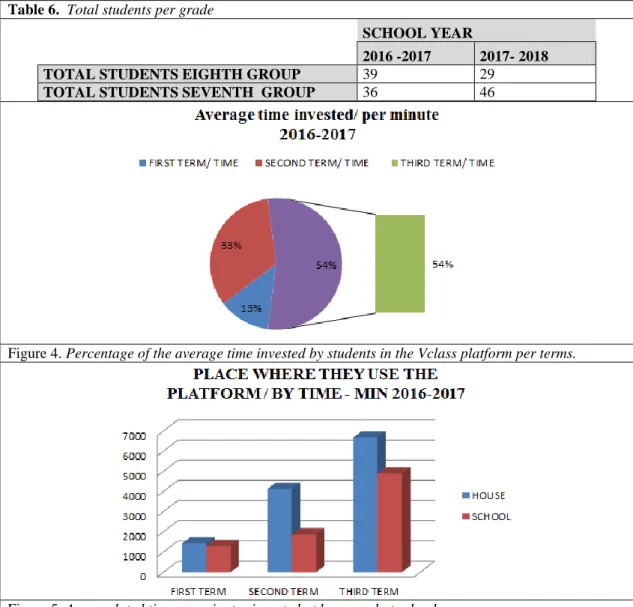
Table 6. Total students per grade
SCHOOL YEAR
2016 -2017 2017- 2018
TOTAL STUDENTS EIGHTH GROUP 39 29
TOTAL STUDENTS SEVENTH GROUP 36 46
Figure 4. Percentage of the average time invested by students in the Vclass platform per terms.
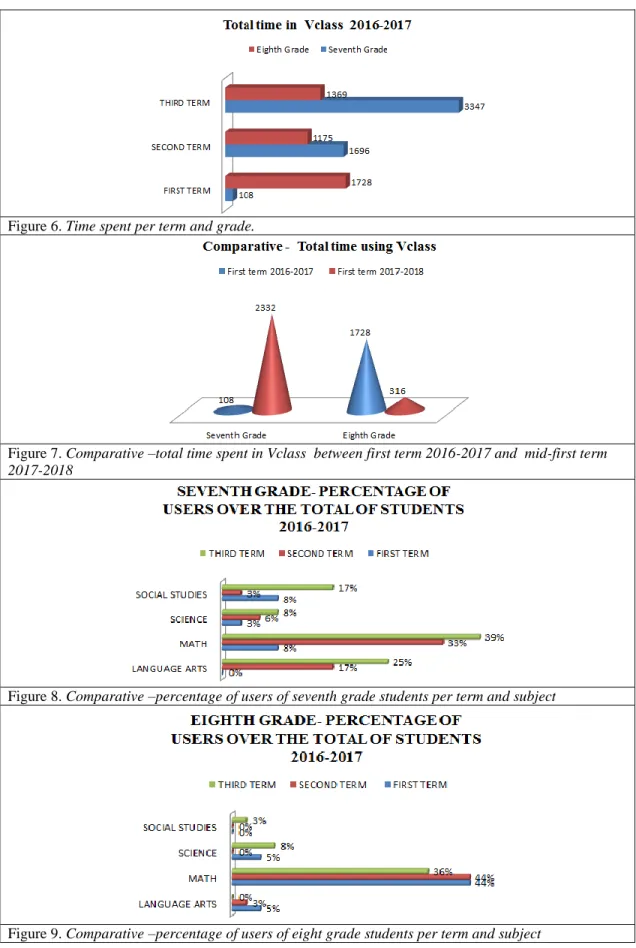
Figure 6. Time spent per term and grade.
Figure 7. Comparative –total time spent in Vclass between first term 2016-2017 and mid-first term 2017-2018
Figure 8. Comparative –percentage of users of seventh grade students per term and subject
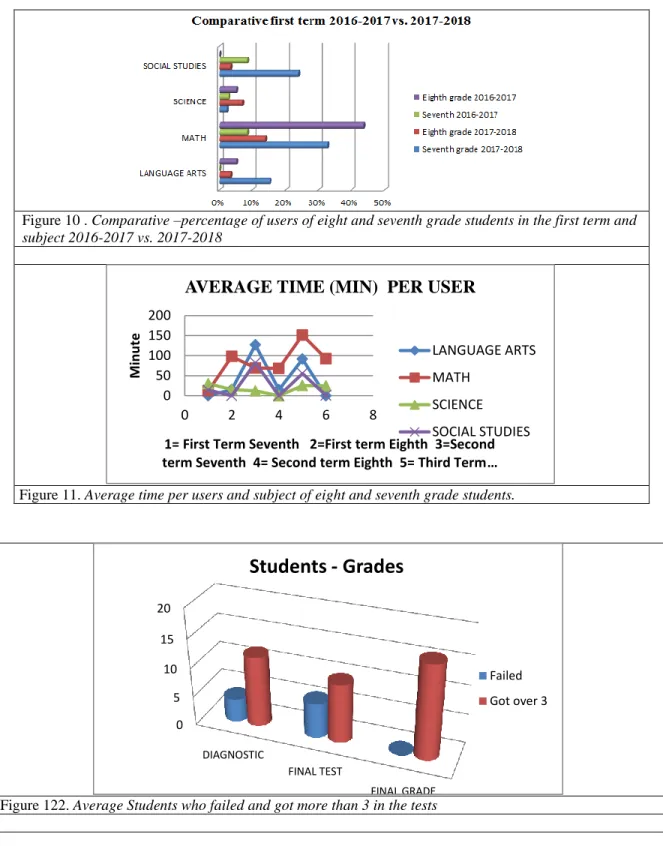
Figure 10 . Comparative –percentage of users of eight and seventh grade students in the first term and subject 2016-2017 vs. 2017-2018
Figure 11. Average time per users and subject of eight and seventh grade students.
Figure 122. Average Students who failed and got more than 3 in the tests 0
50 100 150 200
0 2 4 6 8
M
in
u
te
1= First Term Seventh 2=First term Eighth 3=Second term Seventh 4= Second term Eighth 5= Third Term …
AVERAGE TIME (MIN) PER USER
LANGUAGE ARTS
MATH
SCIENCE
SOCIAL STUDIES
0 5 10 15 20
DIAGNOSTIC
FINAL TEST
FINAL GRADE
Students - Grades
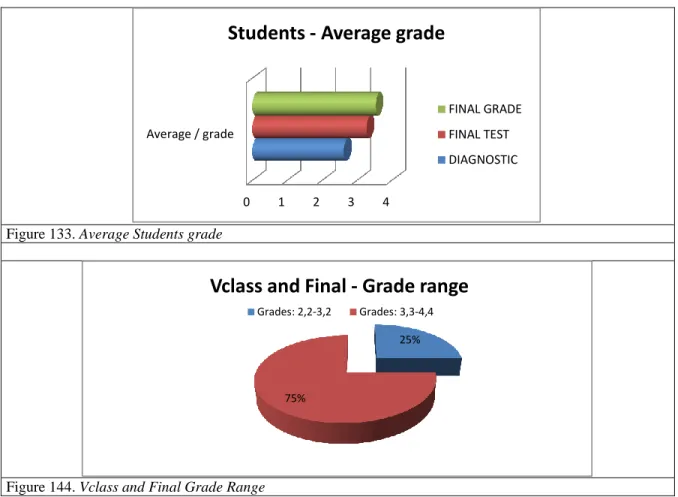
Figure 133. Average Students grade
Figure 144. Vclass and Final Grade Range
On the other hand, the bench marketing, considered as a part of the research in the applied project, did not give any reliable results. Due to that the information collected during this process was developed through an informal conversation. They did not allow a formal interview. They consider the platform, its designs, documents, activities and reports as a copyright. For that reason, it could not be able to verify the information that the
coordinator proportioned. Even though, the coordination shared their personal opinion about Moodle as an educational platform and emphasized how most of the students
perceive and accept it as a friendly online tool in which they have the possibility to connect any time and practice the topics of any subjects.
0 1 2 3 4
Average / grade
Students - Average grade
FINAL GRADE FINAL TEST DIAGNOSTIC
25%
75%
Vclass and Final - Grade range
ANALYSIS
The results showed in the last chapter displayed a series of data that facilitated the construction of the objective proposed in this document about the platform Vclass. This chapter “contains a discussion, interpretation and evaluation of the results with reference to the literature” (Kothari, 2004, p. 130). The interpretation of the figures and tables are organized based on the methodology of research tools applied: students’ survey, teachers’ focus group, and the statistics and data Moodle platform and bench marketing. Each of them is compared with the theoretical framework proposed in this applied project and the aims stablished in this document to conclude and suggest the final recommendations to the project.
The survey was developed with a group of 46 students, which represents the 61.2% of the total of the students who are in seventh and eighth grade at The New School. It is a representative group which can provide relevant information to understand more their impressions about Vclass as a virtual tool that facilitates their learning process. Conforming to the specific objectives, the survey provided data to analyze the use of Vclass as a virtual learning process in seventh and eighth grades.
Table 2 presents the closed questions and the total of each answer. Questions number 4, 5 and 6 allowed analyzing the opinion of the students about Vclass and the place where they developed the activities. Although most of them answered that they use the platform more at school than at home, the statistics of Moodle supported the opposite. The system shows (figure 5), according to the time students spent, that they use it more at home, and at school, just when the teacher uses it during class. This information supports the theory that Chacon (2006) affirms about the auto regulation, self- efficacy, and how
learning process and the importance for teachers to be warned about some changes, when the acquirers (as Krashen calls the learners) are unmotivated.
Figure 2 represents the quantity of subjects that students practice in the platform. The graphics is distributed in similar portions. That suggests that not all the subjects or teachers emphasized on the importance of practicing the topics through Vclass tool or to work with the teacher at the classroom where they have the possibility to interchange knowledge and clarify any doubt with the teacher directly. The last statement is also part of the answers that students shared during the opening questions, specifically question 2 about the strengths and weaknesses of Vclass. Some of them consider a weakness not to have the teacher to resolve or monitor the tasks immediately. It is justified by Farooq, (2009) who in his paper argues that some students suggest a blend of online and face to face activities as a way to improve more their language skills. It means that each person has their own process, learning style, motivation, background and experience to improve their skills.
Hubbard (2009) refers the importance to consider CALL in the learning process because it provides benefit to those students who enjoy the technology. Some of them were shared by the students in the survey, such as the fact that it helps to the learning process, its convenience because it works at any time, it is interactive, motivational and didactic. Even though, there were some suggestions that teacher should consider changing or modifying like to use it without internet, to design it less confusing and more didactic.
The last opening question was designed thinking about new strategies that students could advance at home and can be added to the platform. Some ideas that students provided to be added were: games, listen to music, reading books, watching programs they like and are engaging.
On the other hand, the focus group of teachers gave as a result some evolved proposals and their experience with the tool was interchanged, they shared ideas and
proposed to the students, and more on the deadline than on the time they spend to change or review the activities displayed in the system by them. As Bernhardt (2009) proposes in her booklet “Teaching other languages”, teachers are responsible to check and verify that the virtual tools are properly designed and it has to be seen as a useful tool and the method on how to teach.
Retaken as Motteram (2013) named about Samuel and Zitun’s proposal in 2007, about the importance of teacher learning process of virtual environment, and ‘the extent to which teachers are given time and access to pertinent training to use computers to support learning, which plays a major role in determining whether or not technology has a major impact on achievement”. (p. 46). This corresponds with some answers that teachers shared at the time to give some suggestions to improve Vclass. They talked about training, not just form seminars; they even proposed to have meetings with their partners and coworkers to experience new didactic activities and strategies. Moreover, planning activities with the students in which they share their ideas and opinions about the platform as a way to learn and motivate students to be part of the project is a considerable strategy in the new school model.
The constructivism proposes that the knowledge is built from learners’ mind and their followers believe that learners built their knowledge from their previous information. In this same Krashen (1985) considers that the teacher should know how much information the students could receive and how much they can learn unconsciously. Krashen (1985) also says that “to be more precise, input is the essential environmental ingredient” (p. 2).
In the focus group was reflected the structure and the importance to follow the model, philosophy and culture of The New School when teachers design the tasks for the virtual platform. They named the relevance to consider the students profile and needs without forgetting the approaches established at the school as a model to educate.
At the last part of the results chart there are some table and graphics related to the statistics and data collected by the Moodle platform. It provides reliable information to support the idea to implement Vclass as a homework tool to improve their knowledge and skills by themselves at home or outside the school. In figures 8, 9 and 10 the results demonstrated how useful is to practice the topics through the platform while the students work on it to achieve their aims.
As a Moodle web site offer, this software allows many different types of activities and learning methods that can be used for beginners or advance learners. For those who like ICT and virtual learning environment, it is one of the best ways to improve their knowledge or language skills. The main subjects have been developed on this platform and the
facilities and tasks made them easier strategies to encourage students to improve their knowledge. For instance, Math section is designed in English and the didactic activities provided by teacher in charge challenged students to complete the tasks and achieve the goals, and then the statistics showed the traffic that this subject had in the platform.
Focused on English results and the impact of Vclass as a tool to reinforce and improve the level of communicative skills to the low level group, the figures 12, 13 and 14 show the grades that students accomplished and compare the results from the diagnostic test to the final grade. Although in the figure 12 shows that in diagnostic test were more students who got over three than in the final test, the figure 13 shows that average of the grade in the final test was higher than the diagnostic. It demonstrates that students improved their skills and knowledge in English as a foreign language.
same who got lower grades at the end of the term. The results might be a cause of the use of Vclass in classroom and outside it to practice more the topics. These results are related to the one of the specific objectives to demonstrate there is an impact to the results and in the improvement of the language skills to the students who practice more using Vclass as another strategy to reinforce the knowledge.
CONCLUSIONS AND SUGGESTIONS
The applied project contributed to achieve the objectives, the conclusions and recommendations that could determine the new virtual strategies that will be applied on the platform Vclass. The assessment and analysis of the data gathered about Vclass as strategy to improve and reinforce the English communicative skills in the groups of the seventh and eighth grade and the theoretical that supported it, allowed considering this tool as one of the learning strategy in a virtual environment. This strategy should be evolved and improved every time teachers examined and considered it relevant; taking into account the students’ needs and opinions, the pedagogical approaches, methodologies and strategies established by the school.
The survey and the focus group data collection contributed to analyze the use of Vclass as a virtual learning process and assess the importance of establishing the virtual homework as a strategy to reinforce and improve the English communicative skills in the seventh and eighth groups. Even so, the principles that students and teachers stablished during the research informed the importance to consider their personal needs and aim as a part of the activities that teachers design on the virtual platform. In addition to this non all of the students agree with the virtual environment because they value the teacher as an essential monitor and helper to improve or advance their language skills.
That principle had to be considered to estimate the impacts of the traditional English students learning process with the virtual learning environment process. It is not just the
autonomous learning process, there will be some of the students that due to their learning style will not be able to follow activities if they do not have someone to help or monitor them. The
estimated through the grades that students achieved at the end and their positive results in the level of the students.
Vclass tool will have to be improved and adapted according to the students’ needs and aims established by the institution to achieve a higher level of English. It will be a cooperative work with the learners in order to encourage them to advance in the tasks and have an active participation in the construction of the platform.
Although the project to this research finished in the stage 5, the challenge to renew and build a useful and motivating virtual guide is constant, and it also needs to be evaluated every school year and compared with the new ICT tools.
According to the process and the research project, the results that might be achieved about the adaptation and modification of Vclass tool are gotten, and it requires to be analyzed every term based on the results and users successful participation.
The autonomous learning process of the students is a process that cannot be considered finished with this project because there are variables that depend directly on the students and others to the teachers’ self-efficacy.
Until the end of this applied project, students have not finished the first term and it did not allow comparing the final grades with the last school year ones. But, based on the focus group activity and the students survey collected, teachers recognized the advanced motivation that students achieved in the subjects that have acquired the platform as a strategy to practice at home and reinforce the topics worked in class.
The applied project was an opportunity to encourage teachers and students to implement the tasks that the platform has in each subject as virtual homework. Even more, some students have become interested to practice and learn through Vclass as a
self-strategy for autonomous learners to complement or review the topics before and after class. After the analysis of the results, it is important to acknowledge the following suggestions:
students the opportunity to interact and communicate more with the teacher in class through the activities that they complete or search at home.
The Vclass platform should be updated constantly when necessary, considering the needs, motivation, level, background and previous knowledge of the students; and use tools, programs and topics that are updated for the students and that can be applied to learn and practice more.
To manage the system and keep monitoring the students’ progress in the platform, teachers should have a program or check list to help them organize the time they spend weekly to promote and check the activities developed by students.
The objectives determined in this applied project were achieved. The research allowed to analyze the use of Vclass and concluded the importance of keeping updating it periodically. Vclass is useful to reinforce and improve virtual communicative skills if teacher and students assume their responsibility into the process. Although, the ICT tools are relevant to the students and catch their attention, some of the students agree with the importance of the teacher in their learning process at the time to use the virtual platform. Vclass as a strategy to develop as homework is positive because it helps and allows students to reinforce and improve the students’ level and be more confident and self- efficacy.
Previous to this document, there was not any research document to provide information about the application Vclass at The New School. It could be necessary to analyze deeply why other students do not use the platform or how teachers evaluate the activities to those ones who did not advance on the platform.
The following are two practitioners’ ideas that are approached to the final conclusion of this applied project:
About the development of input and class interaction, and the permanent feedback between teachers and learners, the teacher should be willing and be able to modify the planning and improvise teaching actions and activities (Kumaravadivelu, 2012, p. 6) .
autonomy to administrate the their time and skills. Students should trust in themselves about their personal skills to organize and develop the duties and tasks required achieving the results expected. (Chacon Corzo, 2006, p. 45).
Applied Project product
After analyzing the information and data collected and concluding the importance, impact and the teachers and students responsibilities in the learning process to design and advance the activities in the virtual learning environment, the applied Project was shared and discussed with the principal of the school. She considered relevant the necessity to modify and adapt the platform based on the successful cases, results, and the strategies that students and teachers contributed during this research.
The implication of this applied project at the school was positive. First it demonstrated that Vclass is useful as one of the strategies to reinforce and practice not just English also the others subjects that are in the platform. Secondly, the students’ possibility to train and reinforce at home or outside the classroom the topics worked in class. Finally the modification and adaptation that teachers should do to improve the platform based on the background, needs, likes and goals of the students.
The platform cannot be statics, it has to be changed depending on the results and the frequency of the users. It has to be evaluated periodically to be updated and designed according to the real situation. This was one of the project’s suggestions that the head teachers and coordinators consider to program for every school year.
REFERENCES
Ausubel, D. (1983). Psicología educativa : un punto de vista cognoscitivo. (Segunda edición de Educational psychology : a cognitive view.). (M. Sandoval P, Trad.) México: Editorial Trillas.
Ballester, A. (2002). El Aprendizaje significativo en la practica: cómo hacer el aprendizaje significativo en el aula. Retrieved 03 30, 2016, from
http://www.aprendizajesignificativo.es/libreria-digital/el-aprendizaje-significativo-en-la-practica-como-hacer-el-aprendizaje-significativo-en-el-aula/
Bernhardt, E. B. (2009). Teaching other languages. Retrieved from
http://www.ibe.unesco.org/fileadmin/user_upload/Publications/Educational_Practic es/EdPractices_20.pdf
Burke , J., Onwuegbuzie, A., & Turner , L. (2007). Toward a definition of Mixed Methods Research. Retrieved from
http://www.dedoose.com/publications/toward%20a%20definition%20of%20mixed %20methods%20research.pdf
Chacon Corzo, C. T. (2006). Las creencias de autoeficacia: un aporte para la formación del docente de ingles. Acción pedagógica, 44-54.
Common European Framework. (2002). Common European Framework. Retrieved from http://cvc.cervantes.es/ensenanza/biblioteca_ele/marco/cvc_mer.pdf
Dicks, J. E. (1999, November). Actes du Colloque/ Colloquium Proceedings. Canada. Educando. (2009). Educando, el portal de la educación Dominicana. Retrieved from
http://www.educando.edu.do/articulos/docente/desde-las-tic-la-web-2-0/
Farooq, U. (2009). Creating Virtual Learning Environment for English Language Teaching Programmes. (Vol.12, No.2, pp. 01-16). AJK-Pakistan: University of Azad Jammu & Kashmir. Retrieved from
http://www.academia.edu/3055166/Creating_Virtual_Learning_Environment_for_E nglish_Language_Teaching_Programmes