Dynamic
participation
processes
for
policy
packaging
in
transport
backcasting
studies
Julio
A.
Soria-Lara,
David
Banister
A B S T R A C T
Scenarioanalysisisparticularlyusefulwhenmajorchangesarerequiredtoreachclimatechangegoalsoveralongertimeperiod.Backcasting
providesoneapproachtodeveloppolicypackagesthattogetherwillhelpachievetheseobjectives,butonemissingelementhasbeentherolethat
stakeholderengagementcanplayintheidentificationofsuitablepolicymeasures,inthepackagingprocess,andindeterminingthesuitability,the
feasibilityandthetimescaleinvolved.Thispaperdevelopsanoveldynamicparticipatoryprocesstoaddressthepolicy-implementationgapthrough
theengagementofpractitioners, policymakersandresearchersinaseries of workshopsthat allowtheseissuestobediscussedinanopen
deliberativeprocess.ThespatialcontexttakenistheAndalusiaregion(Spain),wherethereisaclearpolicydesiretoimplementasustainable
transportstrategyfor2050.Thepaperoutlinesthemethodologicalprocess,thedevelopmentofthepolicypathways,thedialogueprocess,the
refinementofthepolicypathways,thefinalstrategy,anditthenreflectsontheusefulnessofstakeholderengagementinthepolicyformulation
process.
1. Introduction
The backcasting approach is one type of scenario analysis particu-larly useful when the business-as-usual case is no longer appropriate,
and significant changes in transport policy are required in order to
reach climate goals (Banister et al., 2000; Hickman et al., 2011;
Hickman and Banister, 2014; Höjer and Mattsson, 2000; Mattila and Antikainen, 2011; Niemeier et al., 2008; Olsson et al., 2015; Tuominen et al., 2014). Itfirst establishes desirable endpoints in the longer term, and it then examines the policy pathways to reach those futures (Vergragt and Quist, 2011).
This paper focuses on the“policy packaging phase” of transport
backcasting studies. The strong emerging consensus is that integrated
policy measures –including smarter choices, green technologies,
eco-logical driving, etc.- are all required to achieve desired transport
futures (Hickman et al., 2012 p. 561). For this reason, the policy
packaging phase firstly focuses on identifying a long list of policy
measures. Those policies are then assessed in terms of their levels of
implementation and effectiveness individually, before being clustered
into mutually supporting policy packages. Then, the policy packages are combined to provide policy pathways to reach the desirable
endpoints (futures targets) that have been set. They arefinally assessed
according to their suitability, political feasibility and timescale (Fig. 1).
The main question being addressed here is how the policy packa-ging phase can best engage stakeholders. Two-way interactions be-tween researchers and stakeholders have been extensively used in the
past (e.g. Delphi surveys, interviews, extensive discussions) (Hickman
et al., 2009; Marchau and Van Der Heijden, 2003; Tuominen et al., 2014;Zimmermann et al., 2012). It is argued in this paper that a continuous process of stakeholder involvement is one means to bridge
the implementation gap between research and effective action
(Banister and Hickman, 2013).
A participatory approach for the policy packaging phase of trans-port backcasting studies has been developed through three interrelated steps: (i) A bottom-up process, in which practitioners and policy-makers determine both the relevant policy packages and the pathways for implementation; (ii) A dynamic implementation of dialogue spaces,
which evolves from generic and preliminary discussions to specific and
focus-group views; (iii) A learning process, where participants can meet face-to-face, promoting transparency in mutual discussions, so that
refinement of collective views can take place. The context of the
transport sector in Andalusia (Spain) is used as a case study. The
participants’views on the implementation of a set of policy packages to
formed the basis for afinal transport scenario. The“transport scenario”
is defined here as the desired transport future (2050), together with the
combination of policy packages that provide three individual policy pathways to reach the desired transport future: lower carbon emis-sions, technological innovation and urban compactness.
Section 2 outlines the theoretical framework, and the desired transport future for Andalusia. This transport future provides the basis for the participatory policy packaging phase, which is the main focus of
this paper.Section 3presents the research design, including a detailed
description of the participatory approach.Section 4shows the main
results, while Section 5 closes the paper with some reflections and
concluding remarks.
2. Background and context
2.1. Participatory policy packaging in transport backcasting studies
Although many transport backcasting studies only occasionally
involve stakeholders (Ashina et al., 2012; Hickman and Banister,
2007; Markus and Jonsson, 2006; Mattila and Antikainen, 2011; Schade and Schade, 2005; Winyuchakrit et al., 2011), a growing number of studies emphasise the use of participatory methods during
the policy packaging phase (Marchau and Van Der Heijden, 2003;
Shiftan et al., 2003; Tuominen et al., 2014;Zimmermann et al., 2012). The use of participatory workshops is one of the common methods
used by different authors (Banister and Hickman, 2013; Hickman
et al., 2011; Tuominen et al., 2014). For example Banister and
Hickman (2013)combined workshops and extensive discussions with colleagues in the context of Delhi (India). The results included the design of 8 policy packages (e.g. low emissions vehicles; alternative fuels) to reach three desirable transport futures by 2030. In a similar way,Hickman et al. (2011)compared several pathways to reach lower
carbon emissions from London (U.K) and Delhi (India). Tuominen
et al. (2014) also used participatory workshops to design policy packages in the context of Finland. The key dimensions to create those policy packages were: (i) Timing and preconditions for implementa-tion; (ii) Timescale; (iii) Spatial scale; (iv) Interactions with other
societal sectors. Marchau and Van Der Heijden (2003) combined
workshops with conferences and interviews, incorporating visions from
different stakeholders. They aimed at defining the scope of policy
development in the context of possible Automated Vehicle Guidance developments.
Other participatory methods (e.g. surveys and/or interviews) have
been also used. For example,Zimmermann et al., (2012)conducted a
qualitative backcasting approach, designed to visualise a desirable electric mobility future in Germany, and to determine the measures to bridge the present and this desirable future. It was combined a Delphi
process and interviews from 15 different stakeholders groups.
These studies mainly focused on two-way interactions between researchers and stakeholders. The present research goes further and explores the usefulness of open, interactive and learning dialogue spaces for the policy packaging phase of transport backcasting studies,
where participants can actively interact with each other – this is a
dynamic participation process. Fig. 1.Policy package scheme. Inspired byHickman et al. (2012).
The storyline of the desired transport future provides the basis for
the formulation of different policy pathways covered in this paper,
which bridges the gap between the present and this future.Soria-Lara
and Banister (2017)have presented the storyline as follows:
“This desirable transport future relies on a fundamental change in
the economic model of Andalusia. The agricultural model would be more orientated towards the production of high-quality ecological products focusing on local consumption, reducing the distance of freight travel and facilitating home delivery of goods. Meanwhile, the existing coastal tourism is expected to decrease and to become re-orientated as a sustainable tourist model based on cultural
tourism (e.g.historic monuments, town centres, etc.). This means a
reduction of both air and car traffic.
Collective and public transport systems would provide the main motorised transport modes in Andalusia by 2050, with the preferred mode being the railway transport system (even for freight transport). The use of private vehicles would be strongly reduced, fostering car sharing initiatives between citizens. The implementation of zero and low emissions vehicles would be strongly promoted in both private and public transport modes (principally electric and hybrid vehicles), including the introduc-tion of electric bikes.
There would be a preference for cities to be free of motorised vehicles, where the distances to daily destinations were shorter. In this sense, part of the existing car infrastructures would be used as socialization spaces for pedestrians; cycling and public transport infrastructures, including an increase in the number of intermodal facilities, as this would encourage a higher use of public transport
modes”.
This future image was obtained through a participatory process that
combined two different methods: (i) Delphi methods; (ii)
semi-structured interviews. A total of 40 Andalusian stakeholders partici-pated in the study. The Delphi method was intended to reach consensus between participants, and the semi-structured interviews
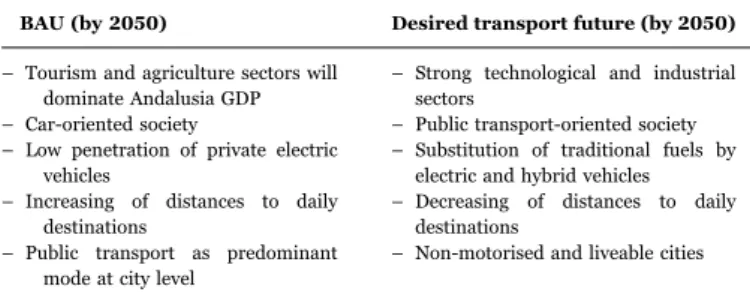
BAU (by 2050) Desired transport future (by 2050)
– Tourism and agriculture sectors will dominate Andalusia GDP
– Car-oriented society
– Low penetration of private electric vehicles
– Increasing of distances to daily destinations
– Public transport as predominant mode at city level
–Strong technological and industrial sectors
–Public transport-oriented society
–Substitution of traditional fuels by electric and hybrid vehicles
–Decreasing of distances to daily destinations
–Non-motorised and liveable cities
Fig. 3.Research method. Inspired byHickman et al. (2012).
2.2. TheregionofAndalusia:adesiredtransportfuture
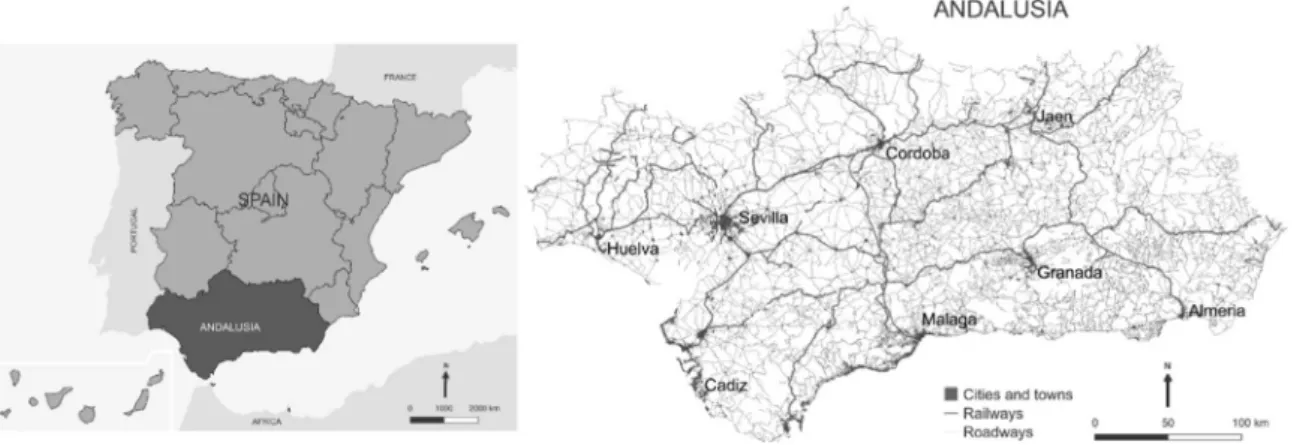
TheregionofAndalusia(Spain)has8,402,305inhabitants(Fig.2).
A new strategic plan is currently being discussed bythe “Agencia
Andaluza de la Energía” to meet climate change targets by 2050
(AgenciaAndaluzadela Energía, 2014).Itmainly aimsat covering
threemainobjectives:(i)Reaching20%reductionintheuseofprimary
energy; (ii) An increment of 20% in the percentage of renewable
energy;(iii)AreductionofCO2emissionsof60%by2050compared
withdomesticemissionsin1990(inallsectors,includingtransport).
Given thiscontext, a desiredtransportfuture of the Andalusian
transportsector(2050)wascreated,exploringthepreferencesandthe
concerns from Andalusian society. To address this, a participatory
processwas conductedcombiningaDelphi analysisand
semi-struc-turedinterviewsfrom awiderange ofstakeholders (Soria-Lara and
Banister,2017).Incontrasttothebusiness-as-usualprojection(BAU),
theresultsshowedthedesireofaradicaltransformationinboththe
Andalusianeconomicmodelandhowpeopleexperiencethetransport
sector(Table1).
Table1
ContrastingtheBAUprojectionwiththedesiredtransportfutureinAndalusia.
ness. Then, participants were provided with the list of 53 individual
policies, and were asked to classify such policies into different policy
packages. Consensus was sought to identify the criterion that would help to classify the list of policy measures into policy packages. Each policy package should be based on: (i) A set of individual measures with a similar nature (e.g. technological, economic, lifestyle etc.); (ii) Measures that are likely to work well together; (iii) Measures that might create positive synergies. Participants were also encouraged to add additional policy measures.
Participants were then asked to indicate thesuitabilityandpolitical
feasibility of each policy package for each of the three individual
pathways. The levels of consensus between participants were meant to
distinguish between threesuitabilityandpolitical feasibilitylevels: (i)
Low; (ii) Medium; (iv) High. The results provided the three initial pathways.
3.3. Phase 3: pathways refinement
In this Phase three focus-group workshops were organised, focusing respectively on the three initial pathways developed during the previous phase. A total of 12 participants took part in each
focus-group workshop (Table 3). Some participants (3–5) provided
continu-ity between the Phases 2 and 3. The duration of each focus-group
workshop wasflexible, dividing each workshop into three steps with
two breaks (Fig. 4).
Researchers werefirstly showed the desired transport future for
Andalusia, and this was supplemented by one of the three initial pathways: lower carbon emissions (1st workshop), technological innovation (2nd workshop) and urban compactness (3rd workshop).
Participants had to distinguish betweenfivesuitability levelsfrom each
policy package: (i) Very low; (ii) Low; (iii) Medium; (iv) High; (v) Very
high.Suitabilityshowed how each policy packagefitted into a specific
policy pathway. The increased degree of separation 3–5 options)
between Phases 2 and 3 resulted from the need for higher sensitivity, and it was thought that there was more experience from the partici-pants with the thinking behind the policy packages.
Participants then discussed thepolitical andfinancial feasibilityof
the policy packages.Political feasibilityreferred to the possibility that
policy measures would be implemented without paying attention to
financial issues, and focusing on aspects such as: direct or indirect
implementation from institutions, ease of communication, social
acceptability, etc.Financial feasibilityreferred to the possibility that
policy implementation would be influenced according to their costs.
Participants again had to distinguish betweenfive feasibility levels: (i)
Very low; (ii) Low; (iii) Medium; (iv) High; (v) Very high.
Participants were thirdly asked to reflect on the timescale and
responsibilityfor policy implementation. With regard to thetimescale,
participants had to select between three different temporal horizons for
each policy measure:(i) Shorter-term (2025); (ii) Mid-term (2035);
and (iii) Longer term (2050). Concerning theresponsibilityfor policy
implementation, participants had to select between: (i) Regional institutions; (ii) Local institutions; (iii) Citizens; and (iv) Private sector.
3.4. Phase 4: an integrated policy pathway
Thefinal stage required the presentation of an integrated policy
pathway that focused on identifying severallevels of implementation
for the range of policy packages, based on: (i) the combinedsuitability
of policy packages for the three individual pathways; and (ii) the
combinedpolitical andfinancial feasibilityof policy packages for the
three individual pathways.
Professional groups Number of participants and description
Policy-makers 3 from the regional government 3 from local governments
Consultants 2 from the technological sector 2 transport planners 1 sociologists 1 urban planner
representedamuchmoreopenparticipatoryprocess.Theinterviewer
hadaseriesofgeneralquestions,aswellashavingsomelatitudetoask
more detailed follow-up questions inresponse to whatare seen as
significantreplies(Soria-LaraandBanister,2017).
Thepresentpaperdevelopsasetofpolicypackagesandpathways
forimplementationtoreachthedesiredtransportfutureforAndalusia
describedabove.Todothat,anovelmethodologicalapproachhasbeen
developed,basedondynamicandlearningdialoguespacesinvolving
researchers,practitionersandpolicy-makers.
3. Thedynamicparticipationapproach:researchdesign
The participatory process was structured into four sequential
phases that interactively combines both: transport research and
transport practice(Fig. 3): (i) Policy measures; (ii) Policypackages
and initial pathways; (iii) Pathways refinement; (iv) An integrated
pathway.
3.1. Phase1:policymeasures
Theresearchteamcarriedoutacomprehensivereviewofthefull
rangeofpolicymeasures.Thisreviewwasbasedonacademicarticles
and experiences from European transport practice. A total of 53
individual policy measures were selected as being relevant for the
objectivesofthepre-establishedfutureforAndalusia(Section2.2).The
practitionersandpolicy-makerswere alsoencouraged toaddfurther
policymeasuresifnecessary.
3.2. Phase2:policypackagesandinitialpathways
Phase 2 was operationalised through a workshop where
practi-tionersandpolicy-makersmetface-to-face.Theaimoftheworkshop
wasto:(i) clusterthelistof53policymeasuresintodifferentpolicy
packages;(ii)definethreeinitialpolicypathwaysdesignedtoreachthe
desired transport future for Andalusia. The themes of the three
pathwayswere:(i)Lowercarbonemissions;(ii)Technological
innova-tion;(iii) Urbancompactness.Thechoiceofthosethreepathwaysis
relatedtohowAndalusian'sstakeholdersvisualisedthedesired
trans-port future for Andalusia,highlighting those threetopics asdesired
pathways in the shorter, medium and longer term (Soria-Lara and
Banister,2017).
A total of 12 participants took part (Table 2). An experienced
transportconsultanttookontheroleofmediator,andtheresearchers
mainlyactedasobservers.Thedurationoftheworkshopwasflexible
(approximately3h30hdividedintotwostepswithabreak).
Theresearchteamfirstdetailedthepre-establishedtransportfuture
forAndalusia,focusingonthethreepossiblepolicypathways:(i)Lower
carbonemissions;(ii)Technologicalinnovation;(iii)Urban
compact-Table2
4. Results
4.1. Definition of policy packages
The 53 policy measures were clustered into different policy
packages (PPs), and this was operationalised through a workshop where participants met face-to-face (Phase 2). PPs were, therefore, created by combining a set of individual measures that are likely to work well together, concentrating on those that might create positive synergies. A total of ten PPs were developed. Participants decided both
the theme of each PP and the constituent set of measures (Table 4).
Two main discussions appeared. Thefirst focused on whether the
policies related to the freight transport sector should be combined in a
specific PP, rather than being distributed among the rest of PPs. The
final decision was to create a specific PP on freight transport due to its
relevance for Andalusia's emissions. The second discussion focused on whether the policies related to non-motorised transport modes should
be added toPP6 liveable cities. Participantsfinally signalled that the
policies related to non-motorised modes should be part of a separate
PP, whilePP6 liveable citiesshould be exclusively focused on land use
policies. Fig. 4.Setup of focus group workshops.
Table 3
Description of participants during Phase 3.
Professional groups Number of participants and description
1stFocus-group workshop: 2ndFocus-group workshop: 3rdFocus-group workshop:
Lower Carbon Emissions Technological innovation Urban compactness
Policy-makers 3 from the regional government 3 from the regional government 3 from the regional government 3 from local government 3 from local government 3 from local government
Consultants 2 geographers 2 car manufacturers 3 architects
4.2. Policy pathway 1: lower carbon emissions
The development of this pathway followed a dynamic process of
refinement, operationalised through 2 different workshops. Thefirst
workshop was generic and focused on defining an initial pathway
(Phase 2). The second workshop was based on focus-group partici-pants, and it was much more specialised (Phase 3).
The initial stages of this focus-group workshop (Phase 3) were not
really productive due to the different language approaches used
between participants. While policy-makers notably focused their dis-course on economic issues related to policy packages (e.g. economic
sustainability; capacity to make profit, etc.), the rest of participants
discussed more from the social benefits of policy packages. This
initially generated controversial views and non-compatible discourses.
Then, the mediator stopped the discussion, and facilitated a specific
discussion-framework where the discourse from both sides were intrinsically recognised and integrated. The mediator encouraged participants to separately discuss the convenience of each policy package from economic, environmental, and societal viewpoints. This meant that policy-makers should avoid the almost exclusive focus on economic issues and appreciate other perspectives. The same rules were imposed on the other groups. Together, this provided participants with a new understanding, orientated towards creating a common language to facilitate agreement. At the end of the focus-group
work-shop, three implementation levels of PPs were finally identified
(Table 5). The highest priority was given toPP5 Multi-modalityand
PP10 Infrastructure investments, while an intermediate priority was
given to the following PPs: PP7 Non-motorised modes, PP1 Low
emission vehicles andPP4 Freight transport. The rest of PPs were
signalled as low-priority.
The refinement process demonstrated the disagreement about
which PPs were more suitable for this pathway, and it triggered an
interesting learning process that adjusted initial differences between
participants. While participants from the first workshop (Phase 2)
indicated that a combination of a wide spectrum of PPs was needed, this thinking was not followed by participants from the second work-shop (Phase 3). In this respect, the three people (2 policy-makers and 1
sociologist) who had participated during thefirst (generic) workshop
supported (during the second workshop) the need of a wide spectrum of PPs for this policy pathway. However, the rest of participants (who
had not participated during thefirst workshop) strongly argued on the
convenience of reducing the number of PPs as being most suitable.
Arguments on the need to be specific and reliable during the design of
policy pathways convinced the three participants from thefirst
work-shop to change their initial views. It was collectively concluded that
“reducing the number of PPs with high suitability was needed to make
the pathway more reliable and feasible”. Accordingly, the number of
PPs highly suitable was reduced from the initial seven tofive (Table 5).
This was inspired by the belief that“the most effective way to achieve a
lower carbon Andalusian society should be based on an effective
modal shift from conventional transport modes to lower emissions
modes”. It also highlighted thefinal inclusion ofPP4 Freight transport
as highly suitable after thefirst workshop, arguing that“a transition
towards rail freight transport could drastically reduce the carbon
emissions in Andalusia”.
Participants also signalled PP7 Non-motorised modes and PP5
Multi-modalityas the most politically feasible due to“no big
inter-ventions were needed at the city level”. However, the financial
feasibility was seen as an important shortcoming of the selected PPs. The most suitable timescale was the mid-term (2035) and longer-term (2050). Both local and regional institutions were seen to have main responsibility for the implementation of PPs, and the private sector was
also seen to be essential, as in the case ofPP1 Low emission vehicles
andPP4 Freight transport.
It is worth mentioning that no power dynamics between partici-pants were highlighted. The mediator had a central position ensuring that no participant/group took a dominant role in the discussion, and participants respected that independence.
Table 4
Description of policy packages (PPs).
POLICY PACKAGES
PP1. Low Emission Vehicles. Participants considered a total of 4 individual measures under this package, focused largely on hybrid technologies and lean burn engines. It also pursues additional benefits if alternative fuels are used in conjunction with petrol and diesel hybrids and conventional internal combustion engines. There is a major role here for the motor industry and the regional government fostering the purchase of hybrid and electric vehicles.
PP6. Liveable cities. This package focuses on using urban form and the planning system to support sustainable transport, with public transport oriented developments, green belts, as well as a new strategic planning model that facilitates the integration between land use and the transport system.
PP2. ICT. A total of 3 individual measures were considered by participants to integrate this package. They explore the potential to modify travel patterns and reduce carbon emissions from ICT developments. These measures are mainly targeted at personal and freight travel.
PP7. Non-motorised modes. Participants considered a total of 3 individual measures under this package, aimed at promoting lower-emissions mobility and focused on pedestrianization and the promotion of cycling infrastructures. This package is mainly targeted at personal travel.
PP3. Pricing regime. This is the package where a major number of individual measures have been included by participants. It has a double objective: (i) Reorienting car taxes towards more environmental friendly schemes; (ii) Making the public transport system cheaper. These measures are mainly targeted at personal travel.
PP8. Traffic management. This package covers three main purposes: (i) Ecological driving (e.g. decreasing speed limits); (ii) Smarter choices (e.g. implementing company transport plans); (iii) lower carbon mobility (e.g. limiting circulation to motorcycles). These measures are mainly targeted at personal and freight travel.
PP4. Freight transport. There is a wide range of measures under this package from subsidiarity (fostering local production and reducing freight travel distance) to implementing hybrid and electric technologies for urban delivery.
PP9. Public awareness. The aim of this package is to increase the awareness of citizens concerning major transport impacts. The set of measures integrated in this package cover from campaigns for car sharing and ecological driving habits to traveller information. This package is mainly targeted at personal travel.
PP5. Multimodality. It covers a set of individual measures focused mainly on increasing the interconnections between the different transport modes: private and public modes, individual and collective modes, motorised and non-motorised modes. Moreover, these measures aim at incrementing the transport network efficiency.
4.3. Policy pathway 2: technological innovation
The development of this pathway also followed a dynamic process of
refinement, operationalised through the 2 workshops. Thefirst was more
generic (Phase 2). The second was much more specialised (Phase 3).
Two different kinds of languages were identified during the
dynamic participatory process in the discussions of policy pathways.
Thefirst focused on technological issues and business models, and it
was associated with participants who came from the technological sectors (mainly car, bike and train manufacturers). The second and more holistic perspective came from the rest of participants
(policy-makers and practitioners from several social sciences fields). These
language profiles were not problematic during the first (generic)
workshop, as the number of participants from the technological sector
was small. However, more problems appeared to differentiate between
languages during the second workshop, where the numbers from the technological sector were higher. To address that, the mediator encouraged participants to discuss on the convenience of each policy package at two overlapping levels. Firstly, participants discussed on technological implications of each policy package. Secondly, partici-pants discussed on the role of each policy package on lifestyle, social
preferences, etc. In this way, the discussion ranged from a more specific
and technological discussion to a more general and holistic vision of the policy pathway. This also facilitated the creation of a common language between participants.
Finally, three implementation levels for PPs were identified for this
pathway (Table 6). The highest priority was given to two PPs:PP1 Low
emission vehiclesandPP2 ICT.A second level of priority was given to
PP4 Freight transportandPP8 Traffic management. The rest of PPs
were signalled as low-priority.
While three PPs were indicated as being highly suitable for this
pathway during thefirst workshop(PP1 Low emission vehicles; PP2
ICT; PP5 Multi-modality), focus-group participants concluded that
PP5 Multi-modality was not so relevant, even “considering that
technological innovations on collective transport modes would be
higher in a context of excellent multi-modality”. This was a
conse-quence of the learning process implemented during the dynamic participatory process. Although, some participants (2 policy-makers
and 1 train manufacturer) from first workshop explained why PP5
Multimodalitywas highly suitable for them, the rest of participants
argued extensively and convincingly that PP5 had not a technological component itself. This reasoning facilitated the unanimous view that
PP5 Multimodalityshould be removed as a high-priority PP. Moreover,
focus-group participants agreed to indicate that both PP4 Freight
transportandPP8 Traffic managementshould be recognised as highly
suitable in the context of technological innovation, as there were a large number of technological innovations related to home delivery (e.g. drones or/and automated vehicles).
With the exception of PP4 Freight transport, it was concluded that
the most suitable PPs were also highly feasible at the political level.
However, onlyPP8 traffic managementwas considered highly feasible
at thefinancial level. A recurrent theme in the conversation noted how
the vehicles stock had increased recently, and the difficulties about
improving their technological standards in the shorter-term.
Participants also agreed that“there were importantfinancial barriers
from Andalusian local institutions to facilitate the implementation of
electric and hybrid modes”.
Regarding timescale and the implementation potential,PP1 Low
emission vehiclesand PP2 ICTwere considered mid-term packages,
while PP4 Freight transport was seen as a long-term package.
Participants also highlighted the importance of the public sector for increasing the penetration of the technological innovation in the Table 5
Policy pathway 1: lower carbon emissions.
Policy package Suitability Feasibility Timescale Responsibility
Political Financial
PP5. Multi-modality Very high High Medium Mid-term Regional and local institutions PP10. Infrastructure
investments
Very high Medium Low Longer-term Regional and local institutions
PP7. Non-motorised modes High High Medium Mid-term Local institutions
PP1. Low emission vehicles High Medium Low Mid-term Regional, local institutions and private sector
PP4. Freight transport High Medium Low Longer-term Regional institutions and private sector
PP8. Traffic management Medium High High Shorter-term Regional and local institutions PP3. Pricing regime Medium High Very high Shorter-term Regional and local institutions PP6. Liveable cities Medium Medium Medium Mid-term Local institutions
PP9. Public awareness Medium High Medium Shorter-term Regional, local institutions and citizens
PP2. ICT Very low Low Medium Mid-Term Private sector and citizens
The process of refinement:
Initial pathway Final pathway Changes-Refinement
(1stWorkshop) (2ndWorkshop)
1. A total of 7 PPs were signalled as highly suitable:(i) PP1 Low emission vehicles; (ii) PP3 Pricing regime; (iii) PP5 Multi-modality; (iv) PP7 Non-motorised modes; (v) PP8 Traffic management; (vi) PP9 Public awareness; (vii) PP10 Infrastructure investments.
2.PP1 low emissions vehiclesandPP3 pricing regimeas the packages with the lowest political feasibility
3. High priority to those PPs low cost and with high impact on personal travel behaviour
4. High importance to coordinate local and regional institutions
1. A total of 5 PPs were signalled as highly suitable: (i)PP5 Multi-modality; (ii) PP10
Infrastructure; (iii) PP7 Non-motorised modes; (iv) PP1 Low emission vehicles; (iv) PP4 Freight transport
2.PP5 multi-modality and PP7 non-motorised modesas the packages with the highest political feasibility
3.PP10 Infrastructures investments, PP1 Low emission vehicles and PP4 Freight transportas the packages with the lowestfinancial feasibility 4. The timescale of PPs highly suitable was the
mid-term and longer-mid-term
5. Both regional and local institutions were considered key to implement this policy pathway
1. A reduction in the number of PPs highly suitable was recommended according to criteria of feasibility and reliability
2. The inclusion of PP4 freight transportas highly suitable was strongly recommended during the focus-group workshop 3.PP3 pricing regime, PP8 traffic management and PP9
public awarenesswere not considered highly suitable during the focus-group workshop
Andalusian transport sector (e.g. subsidies).
The power dynamics between participants triggered some problems for the mediator during the implementation of the dynamic participa-tory process. This was especially relevant during the focus-group workshop. Participants from the technological sector (2 car manufac-turers, 2 bike manufacmanufac-turers, and 2 train manufacturers) tended to spend more time than others making their interventions, and they did not really appreciate the views from the rest of participants. Recurrent
efforts from the mediator were made to address this particular
situation. First, the mediator stopped the discussion to allot equivalent
speaking time to each party. Second, the mediator specifically gave an
opportunity to those participants that felt less safe to talk.
4.4. Policy pathway 3: urban compactness
The development of this pathway also followed a dynamic process
of refinement, with thefirst workshop being more generic (Phase 2)
and the second more detailed (Phase 3). The dynamic of language
differences between participants was not a relevant issues here. There
was no problem during the workshops in this respect, and all participants seemed to feel comfortable hearing and understanding views from each other. Three implementation levels of PPs were
identified (Table 7). The highest priority was given to four PPs:PP5
Multi-modality, PP6 Liveable cities, PP7 Non-motorised modes and
PP8 Traffic management. An intermediate level of priority was given to
PP10 Infrastructure investments. The rest of PPs were considered less
relevant.
A description of the learning process showed that there was
consensus between participants from thefirst and second workshop,
considering thatPP6 Liveable cities, PP7 Non-motorised modesand
PP10 Infrastructure investmentswere highly suitable for this pathway.
However, focus-group participants indicated that only these three
packages seemed to be insufficient. Accordingly, they also signalled
PP8 Traffic managementandPP5 Multi-modalityas being also highly
suitable. In both workshops, participants highlighted that a large effort
should be made to change the current Andalusian policies to achieve higher levels of urban compactness, since limited attention has been traditionally paid to the impact of urbanisation processes on transport.
A medium level of political feasibility was assigned toPP6 Liveable
cities and PP10 infrastructure investments, while participants
indi-cated as highly feasible the rest of suitable PPs. However, thefinancial
feasibility ofPP10 Infrastructure investmentswas indicated as low.
Participants considered“very hard to achieve funding from local and
regional institutions for new transport infrastructures, since over the last years too budget was spent in transport infrastructure such as regional highways, international airports and high speed rail. So, the
social acceptability of this PP could became extremely low”.
Regarding timescale and the implementation potential, with the
exception ofPP10 Infrastructure investments, signalled as a
longer-term package, the rest of PPs were considered shorter-longer-term packages.
Participants highlighted“the urgency of implementing packages such
as PP5 multi-modality and PP7 non-motorised modes to reach a
higher urban compactness”. Finally, participants declared that both
regional and local institutions should be responsible for the imple-mentation of this pathway.
The power dynamics between participants were the more evident during the implementation of the participatory process in this policy
pathway, and this was really significant during the focus-group
work-shop. Architects and transport planners tended to establish a bidirec-tional discussion between them, and this extended the duration of the
workshop by almost 1 h. The mediator made a big effort to give a voice
to the rest of participants. However, this intervention was not effective
on several occasions during the workshop. Although the mediator stopped the discussion several times to allot equivalent speaking times, this did not work well for this policy pathway.
Table 6
Policy pathway 2: technological innovation.
Policy package Suitability Feasibility Timescale Responsibility
Political Financial
PP1. Low emission vehicles Very high High Low Mid-term Regional, local institutions and private sector
PP2. ICT Very high High Medium Mid-Term Regional, local institutions, private sector
PP4. Freight transport High Low Low Longer-term Regional institutions and private sector
PP8. Traffic management High High High Shorter-term Regional and local institutions PP3. Pricing regime Medium High Very high Shorter-term Regional and local institutions PP5. Multi-modality Medium Medium Medium Longer-term Regional and local institutions PP9. Public awareness Medium High Medium Shorter-term Regional, local institutions and
citizens
PP10. Infrastructure investments Medium Low Low Longer-term Regional and local institutions PP6. Liveable cities Low Medium High Mid-term Local institutions
PP7. Non-motorised modes Low High High Mid-term Local institutions
The process of refinement:
Initial pathway Final pathway Changes-Refinement
(1stWorkshop) (2ndWorkshop)
1. A total of 3 PPs were signalled as highly suitable:(i) PP1 Low emission vehicles; (ii) PP2 ICT; (iii) PP5 Multi-modality.
2.PP2 ICT was considered crucial for this pathway
3.PP5 multi-modality was considered very important, as technological innovations can have a higher impact on a more efficient transport network
4. Subsidies as a tool to facilitate the penetration of technological innovations
1. A total of 4 PPs were signalled as highly suitable:(i) PP1 Low emission vehicles; (ii) PP2 ICT; (iii)PP4 Freight transport; (iv) PP8 Traffic management
2.PP1 low emission vehicles and PP2 ICT were considered crucial for this pathway
3. The timescale of PPs highly suitable was between mid-term and longer-term 4. Both regional and local institutions were
considered key to implement this policy pathway
1. An increase in the number of PPs highly suitable was recommended according to criteria of feasibility and reliability
2. The exclusion ofPP5 Multi-modalityas highly suitable was strongly advised during the focus-group workshop 3. The inclusion ofPP4 Freight transport and PP8 Traffic managementas highly suitable was strongly advised during the focus-group workshop
4.5. An integrated policy pathway
From the three individual pathways established, the research team
identified different levels of implementation for PPs (Phase 4). This was
based on criteria of suitability, political andfinancial feasibility.
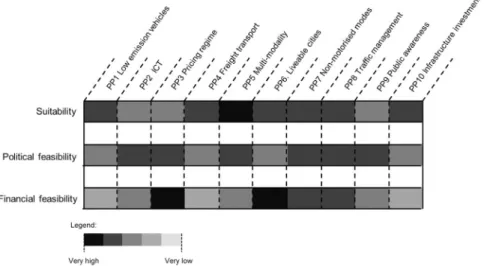
Regarding PPs’ suitability, three different implementation levels
were identified (Fig. 5). First, PP5 Multi-modalitywas seen as the most
important PP for all three pathways studies. Second, a total of six PPs
were identified within a second level of implementation. They werePP1
Low emission vehicles, PP4 Freight transport, PP6 Liveable cities, PP7
Non-motorised modes, PP8 Traffic management and PP10
Infrastructure investments. The remaining PPs formed a third
im-plementation level with a medium suitability for the three pathways studied.
Concerning the political feasibility of PPs, two different
implemen-tation levels were recognised (Fig. 5). First, a total of six PPs were
identified as the most politically feasible for the three pathways. They
were PP2 ICT, PP3 Pricing regime, PP5 Multi-modality, PP7
Non-motorised modes, PP8 Traffic management and PP9 Public
aware-ness.Local and regional institutions were indicated as having the main
responsibility for the implementation of those PPs. A second level of
implementation would be integrated byPP1 Low emission vehicles,
PP2 Freight transport, PP6 Liveable cities and PP9 Infrastructures
investments. In voice of the participants, “the political feasibility of
PPs such as PP1 Low emission vehicles and PP2 freight transport was lower than others due to the dependency of external factors to
Andalusia (e.g. global market)”. The low social acceptability of
transport mega-projects in Andalusia due tofinancial crisis impedes
the perception of a high political feasibility ofPP6 Liveable citiesand
PP9 Infrastructure investments.
Finally, four different levels of implementation were identified that
related to the financial feasibility of PPs. The highest financial
feasibility was signalled for PP3 Pricing regime and PP6 Liveable
cities, while the lowestfinancial feasibility was signalled forPP1 Low
emission vehicles, PP4 Freight transport and PP10 Infrastructure
investments.The rest of PPs were integrated into two intermediate
levels offinancial feasibility (Fig. 5). Table 7
Policy pathway 3: urban compactness.
Policy package Suitability Feasibility Timescale Responsibility
Political Financial
PP5. Multi-modality Very high High Medium Shorter-term, Mid-term
Regional and local institutions
PP6. Liveable cities Very high Medium Medium Mid-term Local institutions PP7. Non-motorised modes Very high High Medium Mid-term Local institutions
PP8. Traffic management Very high High High Shorter-term Regional and local institutions PP10. Infrastructure
investments
High Medium Low Longer-term Regional and local institutions
PP3. Pricing regime Medium High Very high Shorter-term Regional and local institutions PP4. Freight transport Medium Medium Low Longer-term Regional institutions and private
sector
PP9. Public awareness Medium High Medium Shorter-term Regional, local institutions and citizens
PP1. Low emission vehicles Low Low Low Mid-term Regional, local institutions and private sector
PP2. ICT Very low High Medium Mid-Term Regional, local institutions, private sector and citizens
The process of refinement:
Initial pathway Final pathway Changes-Refinement
(1stWorkshop) (2ndWorkshop)
1. A total of 3 PPs were signalled as highly suitable:(i) PP6 Liveable cities; (ii) PP7 Non-motorised modes; (iii) PP10 Infrastructure investments
2.PP6 Liveable cities was considered crucial for this pathway
3. It was highlighted the limited attention paid in Andalusia to the effects on urbanisation processes on the transport sector
1. A total of 5 PPs were signalled as highly suitable:(i) PP6 Liveable cities; (ii) PP7 Non-motorised modes; (iii) PP10 Infrastructure investments; (iv) PP8 Traffic management; (v) PP5 Multi-modality
2.PP6 Liveable cities and PP5 Multi-modality were considered crucial
3. The timescale of PPs highly suitable was between mid-term and longer-mid-term
4. Both regional and local institutions were considered key to implement this policy pathway
1. An increase in the number of PPs highly suitable was recommended according to criteria of feasibility and reliability
5. Conclusions and discussion
This paper has developed and tested a novel participatory approach applied to the policy packaging phase of transport backcasting studies. It has focused on dynamic dialogue spaces that involved researchers (as observers), practitioners and policy-makers. The Andalusian transport sector (Spain) was used as a spatial laboratory for the experimentation.
5.1. Linking academia and transport practice: the use of bottom-up approaches
While the transport policy-making process in Andalusia has been traditionally carried out by transport engineers, this research has used a bottom-up approach that has involved a wider range of professional
domains (traffic engineers, sociologists, geographers, urban planners,
economists, etc).
This has resulted in the creation of a more democratic way of establishing policy pathways, rather than the traditional deliberative
process involving a narrow group of actors. The difficulty here is to
determine whether participants with different backgrounds are really
prepared for sharing knowledge with each other. Converting individual
knowledge to collective knowledge requires interaction between“tacit”
and“explicit”knowledge in an iterative fashion (Te Brömmelstroet and
Bertolini, 2008). While“explicit knowledge”is characterised as easily
codified and expressed in words and numbers,“tacit knowledge”is
deeply rooted in personal experience in a specific context. It is harder
to share. Specific attention should be paid to this phenomenon. For
example, the mediator should translate into a “common language”
those particular viewsfirmly rooted in the professional experience of
participants (e.g. transport planners tend to use quantitative tion, while land-use planners tend to use more qualitative informa-tion). The role of the mediator was central to the translation of
participants´ views into a“common language”so that the focus-group
workshops (see Sections 4.2 and 4.3) worked effectively. For both
policy pathwayslower carbon emissionsandtechnological innovation,
the mediator had to create a specific communication framework to
integrate the different types of languages in order to facilitate better
understanding between participants.
The creation of open dialogue spaces, where a wide range of participants interacted, was considered essential by participants to link academia and transport practice. In their opinion, this has facilitated the co-production of policies pathways with practitioners and policy-makers, confronting the more technocratic thinking on policy implementation with a more business-oriented model. However,
participants also agreed that the important barriers to the effective
implementation of the dynamic participation processes are mainly
institutional, and related to politicians and the Andalusian planning process. Participants underlined the observation that policy-makers
will have difficulties to explain the benefits of the participation process
to politicians. This is due in part to the bottom-up approach, as Andalusian politicians feel safer when transport planning processes are more focused on top-down approaches where technocratic views are predominant. Furthermore, the participation process was seen as being a time-consuming process. The conclusion reached by the participants was that the dynamic participation process presented in this paper is not likely to be usable in Andalusia in the near future. Legal barriers and the low commitment of Andalusian politicians to participation processes are seen as obstacles to be overcome in real practice. Nevertheless, it was recognised by participants that the approach has added value for the Andalusian transport policy-making process. Further research could be focused on distilling this participatory framework to overcome current implementability barriers. In this respect, the present research should be seen as an initial point of
innovation that needed to be refined.
5.2. Dynamic dialogue spaces and pathways refinement
The participatory approach followed a sequential process, where
three individual policy pathways were systematically refined: lower
carbon emissions, technological innovation and urban compactness (Fig. 4). This succession of explicit dialogue spaces has worked well in the context of Andalusia, producing a new participatory approach that contrasts with previous studies where a non-sequential design has been
predominant (Hickman et al., 2011; Marchau and Van Der Heijden,
2003; Tuominen et al., 2014).
The sequential process was implemented according to different
specialisation levels (from more generic to more specific). This has
contributed to a wide acceptability level for the different PPs and
pathways. The importance of continuity between the core participants
throughout the different sequential phases was seen as an essential part
of its success, as this allowed clarification of the choices made in
previous steps. However, this group of participants can also induce a biased process if their discourse is dominant. An important aspect here is the role of the mediator. In this research, the mediator was strongly encouraged to have a central position in ensuring that no participant/ group took a dominant role in the discussion. To address that, the mediator was provided with rules of style (allotting equivalent speaking time to each party) and respect (giving a voice to all participants).
Examples of that can be seen inSections 4.2, 4.3, and 4.4.
The design of the dynamic participation processes needs to be
customised for each particular situation, providing“unique processes”.
However, this can negatively affect to the usability of this approach,
The methodological improvements associated with the means by
which participatory approaches can help in addressing the deep uncertainty of the policy packaging phase in transport have been covered here, both methodologically and practically. The literature
confirms a low penetration rate for adaptive policy frameworks in real
transport practice (e.g. using methods such as Real Options Analysis; Adaptive foresight; Adaptive Policymaking; Dynamic Adaptive Policy
Pathways) (Haasnoot et al., 2013; Marchau et al., 2010). Consequently,
bottom-up approaches can help to gain more insights into the main barriers associated with those adaptive policy frameworks, and most innovatively, to overcome them by testing solutions in (almost) real situations.
Acknowledgements
This paper has been developed in the following Marie Curie research project BACK-SCENE: Backcasting Scenarios as collaborative learning process: Involving stakeholders in transport climate policy. The project was funded by the European Union's Seventh Framework
Programme, Marie Skłodowska-Curie actions (COFUND - Grant
Agreement no. 291780) and theMinistry of Economy, Innovation, Science and Employment of the Junta de Andalucía (Spain).
References
Agencia Andaluza de la Energia, 2014. World energy Outlook 2014. OECD/IEA, Paris, (Available at)〈https://www.agenciaandaluzadelaenergia.es/〉.
Ashina, S., Fujino, J., Masui, T., Ehara, T., Hibino, G., 2012. A roadmap towards a low-carbon society in Japan using backcasting methodology: feasible pathways for achieving an 80% reduction in CO 2 emissions by 2050. Energy Policy 41, 584–598.
Banister, D., Hickman, R., 2013. Transport futures: thinking the unthinkable. Transp. Policy 29, 283–293.
Banister, D., Dreborg, K., Hedberg, L., Hunhammar, S., Steen, P., Akerman, J., 2000. Transport policy scenarios for the EU: 2020 images of the future. Innov.: Eur. J. Social. Sci. Res. 13 (1), 27–45.
Bertolini, L., 2007. Evolutionary urban transportation planning: an exploration. Environ. Plan. A 39 (8), 1998–2019.
Curtis, C., 2011. Integrating land use with public transport: the use of a discursive accessibility tool to inform metropolitan spatial planning in Perth. Transp. Rev. 31 (2), 179–197.
Haasnoot, M., Kwakkel, J.H., Walker, W.E., ter Maat, J., 2013. Dynamic adaptive policy pathways: a method for crafting robust decisions for a deeply uncertain world. Glob. Environ. Change 23 (2), 485–498.
Habermas, J., 2007. Classical pragmatism and communicative action. In: Hickman, L.A. (Ed.), Pragmatism as post-postmodernism: Lessons from John Dewey 2007. Fordham Univ Press, 21.
Hickman, R., Banister, D., 2007. Looking over the horizon: transport and reduced CO 2 emissions in the UK by 2030. Transp. Policy 14 (5), 377–387.
Hickman, R., Banister, D., 2014. Transport, Climate Change and the City. Routledge.
Hickman, R., Ashiru, O., Banister, D., 2009. Achieving carbon-efficient transportation: backcasting from London. Transp. Res. Rec.: J. Transp. Res. Board 2139, 172–182.
Hickman, R., Ashiru, O., Banister, D., 2011. Transitions to low carbon transport futures: strategic conversations from London and Delhi. J. Transp. Geogr. 19 (6), 1553–1562.
Hickman, R., Saxena, S., Banister, D., Ashiru, O., 2012. Examining transport futures with scenario analysis and MCA. Transp. Res. A: Policy Pract. 46 (3), 560–575.
Höjer, M., Mattsson, L.G., 2000. Determinism and backcasting in future studies. Futures 32 (7), 613–634.
Innes, J.E., Booher, D.E., 2010. Planning with Complexity: an Introduction to Collaborative Rationality for Public Policy. Routledge, London.
Marchau, V.A., Walker, W.E., Van Wee, G.P., 2010. Dynamic adaptive transport policies for handling deep uncertainty. Technol. Forecast. Social. Change 77 (6), 940–950.
Marchau, V.A.W.J., Van Der Heijden, R.E.C.M., 2003. Innovative methodologies for exploring the future of automated vehicle guidance. J. Forecast. 22 (2–3), 257–276.
Markus, R., Jonsson, R.D., 2006. Assessment of transport policies toward future emission targets: a backcasting approach for Stockholm 2030. J. Environ. Assess. Policy Manag. 8 (04), 451–478.
Mattila, T., Antikainen, R., 2011. Backcasting sustainable freight transport systems for Europe in 2050. Energy Policy 39 (3), 1241–1248.
Niemeier, D., Gould, G., Karner, A., Hixson, M., Bachmann, B., Okma, C., Del Valle, D.H., 2008. Rethinking downstream regulation: california's opportunity to engage households in reducing greenhouse gases. Energy Policy 36 (9), 3436–3447.
Olsson, L., Hjalmarsson, L., Wikström, M., Larsson, M., 2015. Bridging the
implementation gap: combining backcasting and policy analysis to study renewable energy in urban road transport. Transp. Policy 37, 72–82.
Schade, B., Schade, W., 2005. Evaluating economic feasibility and technical progress of environmentally sustainable transport scenarios by a backcasting approach with ESCOT. Transp. Rev. 25 (6), 647–668.
Shiftan, Y., Kaplan, S., Hakkert, S., 2003. Scenario building as a tool for planning a
reinforcing institutional barriers. The central element should be to
providearecurrentrefinementofthepolicypathways,contributingto
increasingtheiracceptabilityatbothtechnical(frompractitionersand
policy-makers)andsociallevels(from thepublic). Inthispaper,the
sequential process was completed through two refinement rounds
based on different levels of specialisation from the participants.
Alternativedynamicprocessescanbebasedonrefiningpolicy
path-ways accordingtodifferentspatialscales(from nationaltolocal) or
according todifferentlevels of decisions (from strategic-orientedto
blueprint-oriented).
5.3. Learningdialoguespacesandpathwaysdevelopment
Inthecontextofincreasingattentiontocommunicativeplanning
approaches(Bertolini,2007;Curtis,2011;Habermas,2007;Innesand
Booher,2010),thepolicypackagingphaseprovidesatoolthatguides
mutuallearningprocessesbetweenthedifferentactors.However,
two-wayinteractionsbetweenexpertsandresearchershavebeenprioritised
bypreviousbackcastingstudies(Hickmanetal.,2009;Zimmermann
etal.,2012).Toaddressthis,thepresentresearchhascreatedexplicit
learningdialoguespaces.Severalmethodologicalaspectscanbe
high-lighted.
First,creatingspaceswheretheparticipantshadtheopportunityto
get toknow each other and build relationships facilitated learning
processes.Participantsfeltabletoopine,andmoreattentionwaspaid
tocriticalcommentsandtocollectivelybuildconsensus.Theoptionof
hearingeachotherandmodulatingthediscourseaccordinglyincreased
opportunitiesforfindingwin-winsolutionsduringthepolicypathway
refinement.Animportantconsiderationhereisthetimeallocatedto
discussion. It is crucial to provide enough time for substantive
discussion, and notonlyfor introducingthe individualparticipant's
viewpoints. The timefor thedialogue spaces was flexible
(approxi-mately 3h for the first workshop and 4h for each focus-group
workshop).Participantsfeltthattheirviewswereaccommodated.
Second,consensusbetweenparticipantswasthecriterionusedto
establishthefinalPPsandpathways.Thepursuitofconsensusmeant
that participantssystematicallyhadtomodulatetheir discourseand
hear each other until agreement was reached. The mediator was
ultimatelythepersonin-chargetodecideprioritiesandwhichpackages
are included ineach policypathway. This usually took place when
consensushadbeenachievedbyparticipants.However,thetimeofthe
workshops was limited, and several times the mediator had to
adjudicate without consensus. In those cases, the mediator was
encouraged to decide when majorities were higher than 75% of
participants. In case of large disagreements (2 times during the
research),themediatorextendedthediscussionuntilreachmajorities
between60–75%.Thisalsomeantthatthedurationoftheworkshops
was extended.Itis importanttohighlightthe situationthat simple
majorities were exceptionally used when win-win solutions were
extremelydifficulttofind.
5.4. Furtherresearch
This paper hasprovided an intermediatestage ina wider
back-castinganalysisfortheAndalusiantransportsector(2050).Thiswider
studyislargelyfocusedonusingparticipatorymethodsbyexamining
two sets of issues: (i) the assessment of backcasting scenarios and
collaborativelearningprocessesintransportandclimatechangepolicy;
and(ii)themeansbywhichtheimplementationgapbetweentransport
researchandpolicyactioncanbebridged.Thenextstepswillassessthe
effectiveness of the integrated policypathway in terms of real
im-plementation inthecontextof Andalusia. The likelihoodand
desir-abilityofthisintegratedpathwaywillbediscussedwithregional
policy-makers, exploring additionalinsightsinto how backcastingresearch
meaningful information through a dialogue between modelers and planners. Transp. Policy 15 (4), 251–259.
Tuominen, A., Tapio, P., Varho, V., Järvi, T., Banister, D., 2014. Pluralistic backcasting: integrating multiple visions with policy packages for transport climate policy.
Futures 60, 41–58.
Vergragt, P.J., Quist, J., 2011. Backcasting for sustainability: introduction to the special issue. Technol. Forecast. Social. Change 78 (5), 747–755.
Winyuchakrit, P., Limmeechokchai, B., Matsuoka, Y., Gomi, K., Kainuma, M., Fujino, J., Suda, M., 2011. Thailand's low-carbon scenario 2030: analyses of demand side CO 2 mitigation options. Energy Sustain. Dev. 15 (4), 460–466.
Zimmermann, M., Darkow, I.L., Heiko, A., 2013. Integrating Delphi and participatory backcasting in pursuit of trustworthiness—the case of electric mobility in Germany. Technol. Forecast. Social. Change 79 (9), 1605–1621.
sustainabletransportationsystem.Transp.Res.D:Transp.Environ.8(5),323–342.
Soria-Lara,J.A.,Banister,D.,2017.Participatoryvisioningintransportbackcasting studies:methodologicallessonsfromAndalusia(Spain).J.Transp.Geogr.58, 113–126.