Title
1. INTRODUCTION
Cuba as an island is naturally isolated because geographic conditions. But there are
oth-er conditions that are not intrinsically natural that have worsened this isolation from the
rest of the world and in a very special manner from the most important neighbor
coun-try, the United States. There are some signs that allow envisaging that this condition
could change in a not very long time. The task of foreseeing how the maritime transport
in Cuba could evolve is the objective of the work that is presented in this paper. The
nature of the special conditions in Cuba makes difficult to use models that have been
successfully applied in other countries. The fall of the barriers that still difficult the free
commerce with other countries will be a special point that will break the continuity
from the past until such moment. The drivers that could change the present conditions
are of different class. Some depend mainly on the external conditions and others on the
internal ones. However there is a special relationship between both of them. The model
presented in this paper takes into account many of the parameters that have been
identi-fied to have a relevant and plausible weight in the future. The assumption that those are
relevant parameters needs to be justified in a proper way. In Cuba as for any country,
geography and history, both the recent one and the more ancient, play a crucial role. But
the difference with other countries is that artificial barriers have distorted the natural
environment throughout many years. The barriers that difficult the free flow of
com-merce, are of external nature, but there are some internal difficulties as well that do not
ease the desired change that would facilitate the economic development. In any case the
rupture of the barriers will need the participation of the maritime transport as the
needs the participation of the maritime transport as the way to increase the export and
import activities, but can also open a new service to the international commerce as
could be the transshipment activity as well as others namely the logistic ones.
2. SPECIAL CONDITIONS IN CUBA
Since the early 60’s there is an embargo on Cuba that practically deters any trade
rela-tion between United States and Cuba. Moreover, since 1992 the Cuban Democracy Act
(U.S.Congress, 1992), best known as the Torricelli act, prohibits vessels which enter
Cuba to engage in trade from loading or unloading any freight in the United States
with-in 180 days after departure from Cuba. It also prohibits transactions between
U.S.-controlled firms in third countries and Cuba. The Cuban Liberty and Democratic
Soli-darity (LIBERTAD) Act of 1996 (U.S. Congress, 1996) promotes more measures for
encouraging foreign countries to restrict trade and credit to Cuba, but allows to change
the conditions if some requests are fulfilled. Many foreign investments were cancelled
and also many foreign companies that were established several years before, eventually
abandoned Cuba (Kaufman Purcell e Murillo S, 2003) .
The embargo caused a great damage to the Cuban economy, since Cuba is so close to
the United States and 70% of the Cuban trade was done with them before. The
situa-tion was worsened with the end of the Soviet Union and the COMECOM. Torricelli and
Helms-Burton Acts contributed to worsen more the possibilities of trading not only with
the United States, but with other countries. The fact that the vessels that trade with Cuba
have restrictions to operate in the US ports did not help to alleviate the isolation of
cen-tralization of the decision making process were also barriers for the development of the
Cuban economy.
There are some evidences that show the consequences of the embargo. Most
neighbor-ing countries around the world have strong ties among them. This is particularly true if
the neighbor is the most important economy in the world. Canada and Mexico have
more than the 64% of their commerce with United States, with high figures in other
countries such as Bahamas 82%, Dominican Republic 47%, Jamaica 38% or Costa Rica
40%.
The average distance of trade transport of Cuba, calculated with data from the WTO, is
about 9,000 km, that is closer to the one of New Zealand that is 10,000 and more than
Australia that is 8,600 km. Again countries from the area as Bahamas that has 2600 km,
Jamaica 4700 km or Dominican Republic with 4000 km show the singularity of Cuba.
The maritime transport in the area is one of the more intense in the world, but a very
scarce number of them have Cuba as origin, destination or as intermediate
transship-ment point.
The movement of imports and exports in Cuban ports was 9.5 million tons in 1985 and
10 millions in 2014. Those figures are from the ONEI, the official statistic office of
The analysis of the data shows that Cuba is operating on different conditions than those
of other countries in the world and in a special manner if the comparison is done with
the Caribbean countries.
Whether which part of this situation could be attributed to the embargo or to internal
conditions is difficult to find out. The historical perspective could help in this. Since
1958, when Cuba was the third country in GDP per capita in Latin America, it
de-scended to the 9-12 position in 2007 (Mesa-Lago, 2010). Though the GDP has
in-creased along the years, the pace has been much slower than in other countries in the
area. The end of the Soviet Unions and of the socialist countries in Europe has
contrib-uted to diminish in a very important manner all the productive activity in Cuba, namely
agriculture, fisheries, industry and trade. The worsening of the embargo with the 90’s
U.S. acts put Cuba in the verge of catastrophic conditions.
Although it is going to be analyzed with more detail, following the standard growth
methodology of Cobb-Douglas the production depends on labor and on capital. In this
case it is difficult to accumulate capital as an input due to the barriers that difficult the
export and import activities that affect the production capacity and the generation of
savings. The access to foreign credit, as Cuba has before 1990 with the Soviet Union, is
no longer available due to the restriction imposed. The possible inefficiency of the
in-ternal system is another factor to be considered. But the labor and the human capital
(Brundenius, 2009) are still one of the more valuable assets of Cuba and is above other
countries of the area. There is evidence of the success of the Cuban migration around
the world, even with some special conditions, and that is a consequence of a notable
So it seems that the embargo has a very important role in undermining the development
of Cuba, and it seems to contribute in restricting the opening of Cuba to a more efficient
and less centralized economy. A change in that direction could allow a major
participa-tion of the Cuban people in the decision making process that could be the foundaparticipa-tion of
such a decentralized system.(Surowiecki e Silverman, 2007)
3. OPPORTUNITIES
There are many reasons for expecting a future development of maritime traffic in Cuba.
All of them are related with external and internal conditions. Maritime activity in Cuba
could have various branches.
• The import and export maritime transport.
• Transshipment and logistic services
• Cruisers and ferries
Some ports in Cuba could be suitable for that purpose, but the focus in this paper is the
axe Mariel-Havana. This is by far the most important port system in Cuba. (Alligood,
1995)
The geographic situation of Cuba presents some advantages for different activities.
There are possible locations for manufactures or services production centers very
3.1 TRANSSHIPMENT
The location of Cuba for the establishment of transshipment and logistic services is a
privileged one. The new Panama Channel is a real challenge for the development of
hubs in the Caribbean (Rodrigue e Ashar, 2016) ,and Cuba could take advantage of this
opportunity.
It could be considered the use of the maritime transport facilities for trade, export and
import, and for transshipment or logistics services hat have somehow a relative
inde-pendence of the export-import activity. The growth of the transshipment and logistic
services needs the concurrency of an internal development that supports all the
com-plementary services that the activity requires. In this line it could be considered an
evo-lution towards a mixed port that combines the characteristics of a gateway port and a
pure transshipment hub. (Notteboom et al., 2014)
The possibility of the future development of the transshipment activity of the Mariel
Port could rest on two of its characteristics. One is its strategic position to serve many
of the ports of the South of United States and of the rest of the area and the world. The
other is that the traffic in the area is quite intense and a portion of it could be attracted in
the future to Cuban ports (Javier Morales et al., 2013).
The application of Campbell “Integer Programming Formulations of discrete hub
loca-tion problems” (Campbell, 1994) and subsequent developments by Skorin and
Kapov(Skorin-Kapov et al., 1996) or more recent studies (Aversa et al., 2005) shown
the feasibility of the port of Mariel, considering distances and the competiveness in
costs of neighbor ports.
The other circumstance that could drive to the future use of Mariel as transshipment port
is the fact that there are several successful ports in the area and around the World in the
transshipment activity, that shows how competiveness in not an obstacle. Examples as
Tangier (Dubreuil, 2007), not far from Algeciras, or the ports of Central Europe or in
China show that new ports do not really reduce the total volume in the area, but impel a
greater development (Heaver et al., 2001). Bahamas, Jamaica, Dominican Republic
and Puerto Rico with more than 1 million to nearly 2 millions of TEUs show the
oppor-tunity for sharing a part of the market.
Ports as Kingston in Jamaica or Freeport in Bahamas are specialized in transshipment
with more than 80% of their total container traffic. Caucedo in the Dominican Republic
has 56% of transshipment. On the other hand, Cuba with only 300,000 TEUs is quite
behind other countries in the area. Indicators as the number of containers per capita or
per GPD are very far from others in the area. Those data could drive to a further
partici-pation of international operators in the event that the necessary changes take place.
(Rodrigue, 2006)
3.2 EXPORT AND IMPORT
Imported goods in 1985 were 7138 thousand tons, and 7648 in 2014. The exported
goods were 2308 in 1985 and 2351 in 2014. In 1994, imports felt down to 1200
thou-sand of tons, and exports to 400 thouthou-sands of tons. It can be interpreted that after thirty
years the situation is the same as in 1985. It has to be taken into account that the end of
the COMECON changed in an abruptly way the economy in Cuba. (Mesa-Lago, 2010).
There are other symptoms of the slowdown of the production in Cuba. Moreover the
difference between imports and exports shows the inefficiencies of the Cuban economy.
Using official data from ONEI, the value of exports in 2014 were 4187 millions of
cur-rent dollars while the value of the imports amounted to 13 037. The value of imports has
increased since 1985, but exports reached a maximum of 6000 millions of dollars in
1985. So those results are even worse than in the previous in which only the weigh in
tons was considered.
In other countries of the Caribbean, using data from UNCTAD, the situation is quite
different because the trade activity is higher than in Cuba.
Table 2. Imports and Exports as % of GDP
So the situation in Cuba is worse in terms of trade than in other countries of the area,
but it could be shown as an opportunity to improve. Again the end of the embargo can
improve the situation and allows Cuba to behave as other countries in the area. But it
em-bargo also brings a scarcity of the credit that Cuba needs for its development. The Gross
Capital Formation in Cuba in 2014 was 11.56 % of GDP. In 1989 was 26.28%. Since
then the average is 11.26%. The average in most of the countries is over the 20%. Cuba
needs in an urgent manner an increase of investments in order to guarantee its
sustaina-bility and development.
Table 3 Gross capital formation as % of GDP
Taken into account the differences with other countries in the area, the present situation
could be seen as an opportunity for foreign investments, if the previous mentioned
re-quirements take place.
In recent years several products that in the past were the main part of the export activity
have decreased drastically and with the help of foreign investments could be reactivated
or replaced by others.
The collaboration of the maritime transport is crucial for the development of Cuba.
There is a need to import capital goods via maritime transport as equipment, machinery
and others to renew the obsolete means with more than 30 years, and as well, for being
the vehicle to send the Cuban production to possible partner’s countries, especially the
United States.
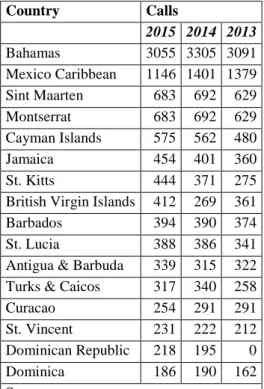
Although the value added generated by cruise activities is relatively limited as it was
pointed out in the OCDE report by Merk (Merk, 2013) because the passenger and crew
spending are not so high, it could be a not negligible source of income and could open
doors to a more stable kind of tourism. Cruiser activity is growing in a constant pace
since many years ago in the world, and it is particularly active in the Caribbean. Cuba is
again immersed in a heavy traffic area of cruisers, but without profiting of such
oppor-tunity for the same reasons mentioned above for other types of maritime traffic.
Table 4 Cruise Ship Calls in the Caribbean
Country Calls
2015 2014 2013
Bahamas 3055 3305 3091 Mexico Caribbean 1146 1401 1379 Sint Maarten 683 692 629 Montserrat 683 692 629 Cayman Islands 575 562 480 Jamaica 454 401 360 St. Kitts 444 371 275 British Virgin Islands 412 269 361 Barbados 394 390 374 St. Lucia 388 386 341 Antigua & Barbuda 339 315 322 Turks & Caicos 317 340 258 Curacao 254 291 291 St. Vincent 231 222 212 Dominican Republic 218 195 0 Dominica 186 190 162 Source.: American Association of Port Authorities
Although this activity could have some disadvantages due to the overcrowding of cities
as in Barcelona (Mayorga-Cárdenas et al., 2014) or Venice if it is carefully treated it
could be beneficial. Cuba has a great potential because of its historical and cultural
at-tractions as well as for its sun and beach tourism potential.
At present Cuba only receives less than ten cruisers per year. As Bahamas receive more
ex-pected that Cuba would increase in a great manner the call of cruisers ships when the
present restrictions finish. Besides the cultural and historic heritage, Cuba proximity to
United States has to be contemplated. There is even the possibility for the establishment
of ferry lines that regularly connect Havana or other ports with Miami or Key West.
4. CONSIDERATIONS FOR THE FUTURE
The future of the maritime traffic in Cuba greatly depends on the development of the
country. In turn the development of Cuba, as for any other country depends on many
factors that could be approached in a more or less rational way. But in this case there are
two uniquely dependent factors that are difficult to predict: the end of the embargo and
the changes that open the Cuban economy to a more participated one. The task of
mod-eling the future is usually based on the behaviors recorded along the time and hence,
with the analysis of those data, it would be possible to make an inference of what will
happen in the future. Here again a difficulty arises, because the changes mentioned will
break the continuity in a abrupt way that drives to a new stage that is not easy to predict.
Nevertheless there are some examples of countries that have suffered changes that,
though they are not equal to those in Cuba, can inspire the prediction task. The changes
in countries of the COMECON or the case of China or Vietnam can be taken into
ac-count. The main difference is that those countries do not suffer the conditions of the
Cuban embargo, and that they are not as close as Cuba to the country that is the first
For designing a prediction model for the future development of maritime traffic in
Cu-ba, the external conditions that can facilitate it as well as the internal ones were taken
into account.
As have been analyzed before, there are no other objective reasons but the embargo and
the internal restrictions to free economic relationships that make Cuba so different from
neighbor countries. Although almost 50 years is a long period of time ahead, Cuba in
the past was an important nation in the trade market, and as China and other eastern
Europeans countries it could recover its ancient position.
Once the embargo ends and the economy activity can evolve in a not constrained way
under the rule of law, it would be possible to start the change in Cuba.
It has been considered that the development of the maritime transport system would
have a very strong link with the development of the entire economy. Though the special
economic zone of Mariel has already been established (Bu Marcheco, 2013) it does not
seem that this zone could be separated from the rest of the country following the model
of those zones in China as Shenzhen (Mckinnon, 2011). The population and extension
of Cuba not do have the same dimension as in China, and after the embargo it would be
difficult to maintain two separate societies(Bontjes, 2013). At least it is assumed that
the development of Cuba is endorsed by the entire island and all of its population.
Of course the Mariel Zone will play an important role but with the necessary openness
The model will relay on two main assumptions: the present situation in Cuba and its
close history as a starting point, and the behavior of other economies with some degree
of similitude to the Cuban conditions.
Assuming a classical approach as the Cobb-Douglas production function Yt = AtKtαLtβεt
where Y is the GPD, K is the capital and L is the labor capacity at time t. A depends on
the level of technology, and
ε
is the error. Some authors consider as Romer (Romer,1994) a third parameter Hνt that is the human capital or the level of education of the
labor force. The parameters α,β,ν are the elasticities of each one. In the case of Cuba
the labor stock is difficult to measure its productivity since the present conditions of the
labor market and the available data are difficult to be considered. The human capital in
Cuba is quite high according to UNESCO, as the literacy rate is the highest in Latin
America 99.7 %, and the population with secondary and higher education is 81.1%, the
higher after Bahamas 88.1% (Dominican Republic 56%, Jamaica 58%, México 57%).
As it is difficult to measure the effect of the labor, and as the education level is quite
high, it could be considered neutral in the production model without any risk of
overes-timation. On the other hand due to the low wages that the Cuban workers receive and
that many jobs could be amortized because the capital investment and rationalization,
enough amount of workers could be available under demand. Moreover the education
level will play an important role in the beginning of a new era but then its effect could
be constant (Benhabib e Spiegel, 1994). So for the model purposes the capital will be
If the production is X = X(K,L) the partial derivative
K X ∂ ∂
is the marginal productivity
of capital. With the assumption of Cobb-Douglas that marginal production is
propor-tional to the production per unity of capital:
K X K X β = ∂ ∂ Then K K X X ∂ = ∂ β
The differential equation can be solved:
∫
∫
∂ = ∂ K K X X β K X lnln =β
This equation will be used for developing the model and will be used with data from
different sources and applied to the case of Cuba.
Those equations give a relationship between the growth of the production or GDP and
formation of capital. The first problem is how to increase capital. The gross formation
of capital in Cuba is so low that it doesn’t allow a real growth and could only preserve
part of the existing capital. The capacity, either of private citizens or the government to
generate savings is practically negligible. The only possible way is to look for foreign
capital in the form of loans or as partnerships in different production areas. Endogenous
growth (Romer, 1994) is practically impossible in the present circumstances.
factors are the ones that are going to be used in the model for triggering the
develop-ment.
Among those factors are: Geography location, population, education, history and
sala-ries (Haralambides, 2002). There are other factors as the end of the embargo that will
act as a gate with two possible positions, opened or closed. The internal change is
con-sidered to be linked to the end of the embargo, but will evolve as it has been concon-sidered
above, and it will take some time. There could be other factors, but those that are chosen
were considered to be the most relevant.
The weight of geography and education has been addressed before. The population
could be attractive both as a labor force and as consumers; Cuba has 11.4 million
inhab-itants while Dominican Republic has10.5, Jamaica 2.8 and Bahamas 0.3. The growth
rate is only 1%, a not very high one, but it could change if the economy improves. The
direct salaries that Cubans receive are one of the lowest in the world, the average is
about 24$ per month. Foreign companies cannot contract workers directly; they must
hire workers to a government agency. The salaries paid by foreign companies could be
of 600 $, and under the «two coefficient rule» the worker receives the double, that is
1200, but in Cuban pesos, equivalent to 50$, that is an excellent salary for Cuban
condi-tions.
Another factor is history; it was assumed that could have some weigh in the decision
process. It has to be taken into account the capacity of Cuba as producer and exporter
before the embargo and that it has been maintained and increased under the existence of
The form of evolution of those factors along time was considered to be approximated by
the logistic function because it was considered the most appropriate for their nature.
) ( 0 1 1 Year Year k e Fact − +
= The maximum value of each factor is 1, Year0 is the middle point
and k is the steepness of the curve. In the model a weight will be assigned to each value.
The model will consider the gross capital formation or investment per year and the rate
of the increase of the capital formation. The
t Investment ent IncInvestm ∂ ∂
= , that depends
on many factors, included the previous investment so:
) int , , , , , ,
(Investment geography education salaries population history ernalchange f
ent IncInvestm =
The end of the embargo will act as a gate that could delay the investment progress.
So the investment is the integration of: InvestmentT =
∫
TIncInvestmnett•∂t0
The relationship between the investment and the gross domestic product could be useful
to foresee the effect of an increase in the investment. As has been assumed before it is
considered the effect ceteris paribus where only the capital invested changes and other
factors as labor remain constants. GDP= f
(
GCF)
, that is, the gross domestic productdepends on the Gross Capital Formation. Assuming the regression analysis of the
natu-ral logarithms of both the regression expression is: lnGDP=α +βln(GCF)+u, u is
the error and α and β are the coefficients of the regression. So it can be considered that
GCF
GDP %
% ≈ ∆
∆ β or that
GCF GCF GDP GDP ∂ ∂ =
Table 5 Regression analysis between GDP and investment
In Cuba an increase of 1% in the investment represents only a 0.68% in the GDP, while
in 226 countries and in a period of 44 or 23 years is 0.99 or 0.85. In China is a little bit
higher. Cuba presents special circumstances that are expected that could change in the
future.
If the analysis is done in different sectors in Cuba
Table 6 Elasticity of the GPD over GCF in different sectors
It was assumed that the increase of the investment will be divided among different
sec-tors taking into account the elasticity factor, and the fact of their role in the Cuban
economy. So the industry will receive 32% of the investments, commercial services
25%, agriculture 17%, and mining 2%.
The same scheme will be used for other parameters, aiming at the number of TEUs and
the number of tons or the calls for cruisers. That is using elasticities as
GDP
TEUS %
% ≈ ∆
∆ β which could be obtained from the performance in many
coun-tries. For containers it seems that countries with greater number of transshipment
activi-ty have a larger elasticiactivi-ty as Bahamas with 8.3 or Jamaica with 7.5. Values form 1 to 2
Table 7 Elasticity TEUS/GDP
5. THE MODELISTIC EFFORT
Due to the many uncertainties in forecasting stemming from the great gap that will be
between the after and before conditions, a System Dynamics technique for modeling the
evolution of the maritime traffic in Cuba was chosen (Castellacci e Hamza, 2013).
Whenever was possible elasticities between factors were used for modeling the growth
and its effect in different parts of the model. The present situation in Cuba and what is
usual in other countries around the world, in particular those in the same area, has been
balanced. The System Dynamics model allows to establish many relations among
dif-ferent factors and can consider the accumulative effect over time. In the entire model it
is relatively easy to change parameters and to measure the effect. It is also possible to
make sensitivity analysis with Monte Carlo simulations. The software used is Vensim
developed by Ventana Systems Inc.
The model starts with the open, closed or delayed door that is the end of the embargo. It
could be assumed that 2018 could be the starting point, but the event that a delay occurs
has to be assumed. Then the different attractions forces start to work impelling the
in-crease of the investment in the Cuban economy. It is assumed that those elements have
enough power of attraction if a rational analysis of the environment is carried out
point-ing out the opportunity cost of investpoint-ing in an emergent economy. Such investments are
assumed to be distributed in a proportional way to the expected benefit of each sector.
The relatively cost benefit ratio among sectors is assumed to be similar to the present
one. Those investments will yield increases of the Gross Domestic Product, but with
certain delay, because the result cannot be immediate. The maritime traffic has been
traffic has a great dependence on the GDP: namely the containers traffic and the cargo
activities. The transshipment and the Cruisers activity could be regarded as more
inde-pendent of the production. But both need the contribution of many services that have to
be deployed which depends on the investments and that could not be isolated, but
im-mersed in a wider set of improvements. So they are too linked in a considerable way to
the fate of the rest of the production sector. Nevertheless as it is not easy to find a
link-age among other productive sectors and the cruisers or transshipment activities, the
ob-jective conditions of Cuba and the comparison with their neighbors can justify a
con-servative increase of them.
Figure 2 System Dynamic model for maritime transport in Cuba. Simplified version
There are many relationships from the drivers for a change that relate an increase of the
investments to the final results of containers, cargo, and cruisers. The need to construct
new infrastructures when the capacity is nearly to be exceeded was also considered.
Figure 3 Some trees of causes used in the model
The result of the base run of the model is that in a 20 years period, or in 2038 the
num-ber of TEUs will be 2.8 million, the cargo 136 million tons, and the numnum-ber of call for
cruisers 1950.
The model also allows taking into consideration many scenarios; there are many
possi-bilities but one that is quite plausible is a delay in the end of the embargo. If there is a 2
the number would be 2.4 million and if there is a 4 years delay the number of TEUs
decrease to 2.2 million. The sequence for the number of cruises runs from 1950 if there
is no delay to 1137 for a four years delay. For a delay of four years the cargo will
change from 137 million to 114 million tons. Four years means that the end of embargo
will take place in 2022.
Figure 4 Effect of delays for the end of embargo, in TEUs
There are many other factors that could change and a sensitivity analysis can be
per-formed over the base model. The weights of the different factors that could change the
decision to invest in Cuba have been considered in a range from 0.4 to 1.3 with a lower
weigh to history and higher to geography and population. Combining all the factors and
with 200 simulations along the 20 years it can be obtained for different levels of
confi-dence the intervals of variation for the indicators of maritime activity.
Table 8 Sensitivity analysis
Figure 5 Sensitivity analysis for containers traffic
6. DISCUSSION
The model here presented is based on two assumptions; one is that the elasticity among
different factors of other economies could be applicable to Cuba when a certain level of
normality is reached. The other one is the emulation of other countries in the area that
present better conditions than Cuba in the maritime transport. It is assumed that such
differences lies on the isolation that Cuba has suffered as a consequence of the embargo
and the economic system. If the embargo disappears and Cuban economy opens to a
competitive market, Cuba could be in similar conditions to other countries, though in a
lower initial level, but with other advantages.
The model allows considering different scenarios and different weights of its constants
and factors, but there is a convergence to values that could be contrasted with the
evolu-tion of other countries.
The model foresees an average growth of the GDP in the 20 years analysis period of
10.4% that is a figure that could be assumed as possible for an emergent economy.
The containers traffic that the model foresees is between 2.2 million TEUs and 2.9
mil-lion of TEUs. If the growth rates remain the same as in the past 14 years the container
traffic in the area will be around 5.5 millions TEUs in Bahamas and 4.9 in Jamaica.
Cu-ba as Nicaragua could have a greater growth because they come from very low amount
of traffic for their population. So it seems that the forecast for Cuba is quite reasonable.
Table 9Future containers traffic
The model depends so much on the political decisions, and though the possible delays
in crucial decisions has been considered, as well as a period of adaptation to changes in
the economic activity, there is a great uncertainty in how the future will evolve. It could
be also questionable that the investment of foreign capital will be attracted by Cuba.
The future conditions of the international markets and the global trade policies could
also affect Cuban development, but it seems that there are objective reasons that
sup-port, at least the relative conditions, the future of the maritime transport in Cuba
de-scribed by the model.
7. SUMMARY AND CONCLUSIONS
The embargo has created a differentiation of Cuba from other countries of the
Caribbe-an area as cCaribbe-an be observed with the help of some trade indicators. In a not improbable
case that the embargo ends, there are many opportunities for foreign investment that
could drive Cuba to start a development that follows the performance of neighbor
coun-tries. To foreseeing the evolution a model was designed using the elasticity between
different factors obtained from the econometric analysis of other economies that could
be used as an example. At the same time the present situation of those countries and the
higher level that Cuba could emulate in the future was considered, in particular in the
maritime transport. As there are many possible interactions among different factors a
system dynamics model was developed. The model presented aims to establish a
framework in which the influence of various factors could be assessed. Moreover, it
facilitates the managing of alternative scenarios with different possibilities in terms of
A sensitivity analysis was as well carried out for measuring the effect of the variation
of the weight of factors that could trigger the foreign investment. All the possibilities
show good perspectives for the evolution of the maritime transport that are congruent
with the evolution of other countries in Central America and the Caribbean.
REFERENCES
ALLIGOOD, A. Cuba's seaports and airports: Can they handle a post-embargo cargo boom?.The Columbia Journal of World Business, 1995, vol. 30, no 1, p. 66-73..
AVERSA, R. et al. A Mixed Integer Programming Model on the Location of a Hub Port in the East Coast of South America. Maritime Economics & Logistics, Basingstoke, v. 7, n. 1, p. 1-18, Mar 2005 2005. ISSN 14792931.
BENHABIB, J.; SPIEGEL, M. M. The role of human capital in economic development evidence from aggregate cross-country data. Journal of Monetary economics, v. 34, n. 2, p. 143-173, 1994. ISSN 0304-3932.
BONTJES, M. The Influence of the Special Economic Zone Status of Kashgar on the Living Conditions of the Population. 2013.
BRUNDENIUS, C. Revolutionary Cuba at 50: Growth with Equity Revisited. Latin
American Perspectives, v. 36, n. 2, p. 31-48, 2009. ISSN 0094582X.
BU MARCHECO, J. V. 100 Questions and Answers about the Mariel Special Development Zone in English - Cuba Business News - Havana Journal. 2013. .
CAMPBELL, J. F. Integer programming formulations of discrete hub location problems. European Journal of Operational Research, v. 72, n. 2, p. 387-405, 1994. ISSN 0377-2217.
CASTELLACCI, F.; HAMZA, K. Policy Strategies for Economic Development in Cuba: A Simulation Model Analysis. Norwegian Institute of International Affairs. 2013
DUBREUIL, D. El futuro puerto Tánger-Med:¿ signo de renovación de los puertos del sur del Mediterráneo o proyecto único? , Med. 2007: el año 2006 en el espacio Euromediterráneo, 2007, Instituto Europeo del Mediterráneo, IEMed. p.268-275.
HEAVER, T.; MEERSMAN, H.; VAN DE VOORDE, E. Co-operation and competition in international container transport: strategies for ports. Maritime Policy &
Management, v. 28, n. 3, p. 293-305, 2001. ISSN 0308-8839.
KAUFMAN PURCELL, S.; MURILLO S, L. La Ley Helms-Burton y el embargo estadounidense contra Cuba. Foro internacional, p. 704-718, 2003. ISSN 0185-013X.
MAYORGA-CÁRDENAS, M. et al. "Del urbanismo del proyecto urbano al urbanismo ciudadano y de apropiacion social. (1980-2013). Reflexiones sobre las transformaciones urbanas del puerto y frente maritimo de Barcelona". Bitácora Urbano Territorial, Bogota, v. 1, n. 24, 2014. ISSN 01247913.
MCKINNON, A. HONG KONG AND SHENZHEN PORTS: Challenges, Opportunities and Global Competitiveness. CITY UNIVERSITY OF HONG KONG 2011.
MERK, O. The Competitiveness of Global Port-Cities: Synthesis Report. Organisation
for Economic Cooperation and Development (OECD). Paris, p.0_1,1-2,7-183. 2013
MESA-LAGO, C. - Balance económico-social de 50 años de Revolución en Cuba Y1 - 2010. - América Latina Hoy, 2010. ISSN - 1130-2887.
MORALES, JAVIER S. et al. Benchmarking Container Port Technical Efficiency in Latin America and the Caribbean. IDEAS Working Paper Series from RePEc. St. Louis: Federal Reserve Bank of St Louis 2013.
NOTTEBOOM, T.; PAROLA, F.; SATTA, G. Partim transshipment volumes.
Portopia, Deliverable, v. 1, 2014.
RODRIGUE, J.-P. Challenging the derived transport-demand thesis: geographical issues in freight distribution. Environment and Planning A, v. 38, n. 8, p. 1449, 2006. ISSN 0308-518X.
RODRIGUE, J.-P.; ASHAR, A. Transshipment hubs in the New Panamax Era: The role of the Caribbean. Journal of Transport Geography, v. 51, p. 270-279, 2016. ISSN 0966-6923.
ROMER, P. M. The Origins of Endogenous Growth. The journal of economic
perspectives,v. 8, n. 1, p. 3-22, 1994.
SKORIN-KAPOV, D.; SKORIN-KAPOV, J.; O'KELLY, M. Tight linear programming relaxations of uncapacitated p-hub median problems. European Journal of
Operational Research, v. 94, n. 3, p. 582-593, 1996. ISSN 0377-2217.
SUROWIECKI, J.; SILVERMAN, M. P. The wisdom of crowds. American Journal of
U.S.CONGRESS. Cuban Democracy Act of 1992.102d Congress. 2nd Session. HR
5323 RFS 1992.