International Renewable Energy Congress November 5-7, 2010 – Sousse, Tunisia
Radiowave Propagation Prediction in a Wind Farm Environment and
Wind Turbine Scattering Model
A. Calo
1, M. Calvo
1, L. de Haro y Ariet
1, Pedro Blanco-González
21Dpto. de Señales, Sistemas y Radiocomunicaciones. Universidad Politécnica de Madrid
E-mail: {acalo, miguel, leandro}@gr.ssr.upm.es
2
Iberdrola S.A
E-mail: [email protected]
Abstract - One of the environmental effects of wind farms is the electromagnetic interference due to the scattering produced by the wind turbines on the electromagnetic waves of different radio communication services propagating through them. A previous work [4] is updated here and the scattering models for the nacelle and the wind turbine are shown and validated. Radio wave propagation losses are estimated more precisely through a parabolic equation approach. Finally, a comparison between theoretical and measured values for the Power Delay Profile (PDP) of the multipath channel through a wind farm is showed.
Keywords - Wind farm, wind turbine, Radio service, diffraction, Radar Cross Section
1. Introduction
Nowadays, wind power is one of the more important renewable energy sources (it allows a sustainable exploitation of the resources with relatively low costs). Compared to the environmental effects of traditional energy sources, the environmental effects of wind power are relatively minor. Unlike fossil fuel power sources [2],wind power do not consumes fuel, and do not emit no air pollution,
Despite its high profitableness and low environmental effects, planned installations of wind turbines or wind farms have to be approved by building authorities on the base of statements of the wind turbines providers or the utilities that may run the systems. For that, safeguarding zones are intended to be defined on the basis of the predicted interference effects [3].
In this paper, the interference caused by wind farms over the broadcast TV service will be analyzed as an example. Wind turbines act as scattering devices of the electromagnetic radio waves, producing signal echoes. These echoes potentially degrade the TV signal reception.
determine the delay and the interference requirements from a single turbine to maintain a good analog TV reception quality
2. Scattering Model
An essential element in considering the effect of a wind turbine over the TV signal is the strength of the echoes from the turbine. This is measured by the wind turbine RCS, which is measured in square meters.
It is known and a well established fact [1] that the Radar Cross Section RCS is defined for plane wave excitation only. The limit condition R implies that explicitly.
𝜎 = lim
𝑅→∞4𝜋𝑅 2 𝐸𝑠 2
𝐸𝑖 2
In order to estimate de RCS of a wind turbine the full turbine is modeled as a set of parts or scattering centers.
Figure 1: Main Scatter centers of a wind turbine.
In a previous work [4
]
, a scattering model of the blades and the tower of a wind turbine was developed. In this section an analytical (physical optics based) model of the nacelle is presented. The nacelle has been considered as a metallic rectangular box and each face is modeled as a different scattering centre. The shadowing effect (which depends on the incidence direction) among the scattering centers has been taken into accountz ˆ z ˆ
xˆ xˆ
yˆ yˆ
z ˆ z ˆ
xˆ xˆ
yˆ yˆ ' y ˆ ' y ˆ ' y ˆ ' y ˆ ' xˆ '' xˆ ' ' z ˆ' z ˆ' z ˆ' z ˆ
' xˆ '' xˆ ' ' y ˆ ' y ˆ ' y ˆ ' y ˆ
' z ˆ' z ˆ' z ˆ' z ˆ ' xˆ '' xˆ '
' y ˆ ' y ˆ ' y ˆ ' y ˆ
Figure 2: Model of a nacelle
The RCS has been calculated as the sum of the field scattered by each of the scattering centers, taking into account also their relative phase.
The Figure 3 shows a comparison between the theoretical (analytical) RCS values of a nacelle of 15x5x5 m3 and that obtained from the Feko electromagnetic simulation software. The RCS has been studied for two different incidence directions:
θi = 30 and θi = 60, and for the scattering plane
ϕs = 90. It can be observed the good agreement between both results.
Figure 3: Analytical versus simulated bistatic RCS values.
From the RCS models of the different parts of a wind turbine is possible to obtain its total RCS according to the following equation:
σ = σi
N
i=1
e−jβ(−r inc·d i+r s·d i) 2
To validate the full model, the analytical RCS values of a wind turbine have been compared with those calculated with the software Feko. We used a wind turbine that had a 80m high tower and 40m long blades (the nacelle had the same size than the previous one). Results are shown in figure 4.
Figure 4: Analytical versus simulated bistatic RCS values of a wind turbine.
3. 3D Scattering Model
To obtain a more accurate value of the RCS of a wind turbine requires detailed geometrical information so that a computer aided design (CAD) model of the turbine can be created. The electrical properties of the construction materials (if not made from metal) are also required. .
Two CAD models were made, one of them with a curved nacelle and the other with a rectangular one. They were used with the EM analysis software and the results compared with the obtained using the analytical models.
(a) (b) (c)
Figure 5: Rectangular (a), curved (b) 3D model and simplified (c) model.
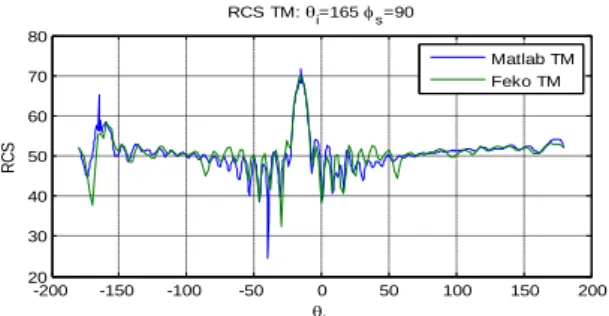
Next, a comparison between the analytical (simplified) and CAD models of a wind turbine will be shown. The use of an analytical model will allow carrying out a more accurate EM analysis of a wind farm. To import correctly the CAD models into Feko, the size of these ones was slightly modified. The new size is: 38m long blades, 15m long x 15m wide nacelles and 72m long tower (3m radius). The incidence direction of the plane wave is normal to the blade surface and its frequency is 827MHz.
In the Figure 6 the two smallest curves belong to the RCS of the 3D analytical models and the others are the obtained with the EM numerical code. The differences between them can be due to the geometry of the tower; in the 3D model is a cone while in the idealized model it is a cylinder. In any case, the analytical RCS can be seen as a worst case result. -200 -150 -100 -50 0 50 100 150 200
-50 -35 -20 -5 10 25 40 50
i
RCS
RCS TM: i=60 s=113
Matlab TM Feko TM
-200 -150 -100 -50 0 50 100 150 200
20 30 40 50 60 70 80
i
RCS
RCS TM: i=165 s=90
Figure 6: Comparison between the RCS of the simplified (analytical) and 3D (numerical) model.
4. Parabolic Equation
In a previous work [4], Recommendation ITU-R P.1546 was used to estimate the field attenuation in the propagation path (from the transmitter/wind turbine to the receiver/wind turbine). It provides a “method for point-to-area predictions for terrestrial services in the frequency range 30 MHz to 3000 MHz”. Specifically, it is a step-by-step method for predicting field strengths in VHF and UHF point-to-area terrestrial radio links based on propagation curves (measured data). In order to improve the accuracy and to estimate the phase of the electromagnetic field (which may be used to calculate the surface current over the obstacles), the split-step formulation of the parabolic equation has been implemented in Matlab. Parabolic equation techniques have been used extensively in radio wave propagation modeling since the mid-1980s. It is an approximation of the wave equation which models energy propagating in a cone centered on a preferred direction, the paraxial direction [9
]
.The results presented in this section were obtained for a wind farm located close to a TV transmitter. The transmitter antenna is placed at 50 m over the ground, operating around the central frequency of the UHF band (600 MHz). Vertical axis (height) is sampled at “λ” meters, and horizontal axis at 100 m. A standard atmosphere profile is considered.
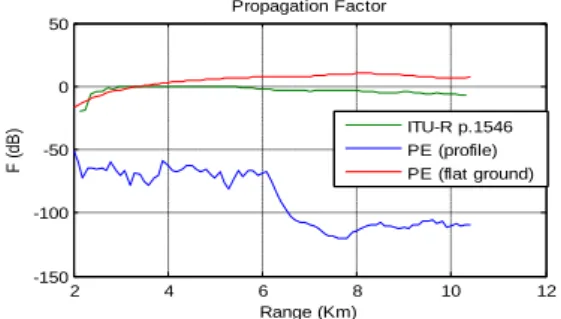
Next, a comparison between the path loss estimate in a realistic “transmitter - wind turbine” link via ITU-R P.1546 and parabolic equation is shown. As can be observed (for this scenario characterized by a smooth profile) the ITU-R P.1546 prediction values (Figure 7) are closer to those obtained via parabolic equation assuming flat terrain (Figure 8).
Figure 7:.Path loss prediction according to Recommendation ITU-R P.1546.
Figure 8:.Path loss prediction calculated via parabolic equation (flat terrain).
Figure 9: Path loss prediction calculated via parabolic equation (terrain profile).
Figure 10 shows the propagation factor (ratio between estimated and free space field) over a path 50m high from the transmitter to the wind turbine. The proximity of the ITU-R P.1546 field values to those obtained in free space show that the field strength could have been overestimated. However (for the same path) field values estimated taking into account the terrain profile (Figure 9) show high range dependence.
Figure 10: Propagation factor comparison (range).
The application of the parabolic equation to calculate the blockage of the signal caused by an obstacle placed along the propagation path is straightforward. In this case, due to the lack of flexibility of the split-step method to impose the boundary conditions over an arbitrary geometry obstacle, a wind turbine located at different positions from the transmitter has
-2000 -100 0 100 200
20 40 60 80
RCS
H
e
ig
h
t
(m
)
Path Loss (dB): fo=600MHz, z=30, htx=50
400 600 800 1000 1200
100 150 200 250 300 350
Range (Km)
H
e
ig
h
t
(m
)
Path Loss (dB): fo=600MHz, z=1, =30, htx=50
2 4 6 8 10
0 200 400 600 800 1000 1200
50 100 150 200 250 300 350
Range (Km)
H
e
ig
h
t
(m
)
Path Loss (dB): fo=600MHz, z=1, =30, htx=50
2 4 6 8 10
400 600 800 1000 1200
50 100 150 200 250 300 350
2 4 6 8 10 12
-150 -100 -50 0 50
F
(
d
B
)
Range (Km) Propagation Factor
The following figures show the path loss estimated in a link with a rough terrain profile. While Figure 11 shows the pat loss over a free obstacle path, Figure 12 and Figure 13 make evident how these values are changing when a wind turbine is placed at 4.5 km and 8.5 km far away from the transmitter antenna. The closer the obstacle is placed, the higher path losses are.
Figure 11: Path loss (free obstacle path).
Figure 12: Path loss (wind turbine located at 8.5 km).
Figure 13: Path loss (wind turbine located at 4.5 km).
Figure 14 show the propagation factor versus height at 14 km far away from the transmitter. For a free obstacles scenario (“flat terrain” and “profile terrain” curves) the field strength is higher than the cases where a wind turbine was placed in the middle of the path. When the wind turbine is far enough from the transmitter (see “black” curve) the blockage of the signal is negligible (the blockage is also height dependence).
Figure 14: Propagation factor comparison (height).
5. Measurements
In a previous work [4
]
, as a mechanism to predict the RCS of wind turbines and understand the interaction of TV transmitter energy and turbines, a computer model was developed. This model was designed to predict and simulate the wanted to unwanted power signal ratio as a function of the delay between them (see Figure 15).Figure 16 shows a comparison between the theoretical narrow band profile and measured values taking into account the change in the received power due to the rotation of the blades and gathering the echoes with similar delays (horizontal line represents the maximum C/I value allowed by the receiver).
Figure 15: Wanted to unwanted ratio vs. Measurements.
In order to carry out a more realistic comparison between both values, the wideband PDP was calculate. In this way, the time length of the echoes is considered.
Figure 16: Wideband PDP vs. measurements.
6. Conclusions
In this work a scattering model for a nacelle have been proposed and validated with results obtained by Range (Km)
H
e
ig
h
t
(m
)
Path Loss (dB): fo=600MHz, z=1, =30, htx=50
2 4 6 8 10 12 14
900 1000 1100 1200
100 150 200 250 300 350
Range (Km)
H
e
ig
h
t
(m
)
Path Loss (dB): fo=600MHz, z=1, =30, htx=50
2 4 6 8 10 12 14
900 1000 1100 1200
100 150 200 250 300 350
Range (Km)
H
e
ig
h
t
(m
)
Path Loss (dB): fo=600MHz, z=1, =30, htx=50
2 4 6 8 10 12 14
900 1000 1100 1200
100 150 200 250 300 350
0 200 400 600 800 1000 1200
-300 -250 -200 -150 -100 -50 0 50
F
(
d
B
)
Height (m) Propagation Factor
Profile terrain Flat terrain
Profile + Obstacle (4.5Km,80m)) Profile + Obstacle (4.5Km,120m)) Profile + Obstacle (8.5Km,120m))
0 1 2 3 4 5 6 7 8
-120 -100 -80 -60 -40
s
|h
(t
)|
simulation software (Feko). From the scattering model of the scattering centers of a wind turbine we have obtained its RCS which also was validate with Feko software. A comparison between the Recommendation ITU-R P.1546 and the parabolic equation is shown. Finally, the wideband power delay profile of the propagation of the TV signals over a wind farm has been estimated and compared with measurements.
7. References
[1] IEEE STD 211-1997, Definition of terms
[2] http://www.sustainabilitycentre.com.au/WindPo wersStrength.pdf
[3] Gerhard Greving, “Weather Radar and Wind Turbines – Theoretical and Numerical Analysis of the Shadowing Effects and Mitigation Concepts”, The Fifth European Conference On Radar In Meteorology And
Hydrology, ERAD 2008.
[4] A. Calo, M. Calvo, L. de Haro and P. Blanco,
“Scattering Analysis of a Wind Farm”, The 20th
International Zurich Symposium on Electromagnetic
Compatibility, Zurich, January, 2009.
[5] ITU-R BT 805 “Assessment of impairment caused to television reception by a wind turbine”
[6] C. A. Balanis, “Advanced Engineering Electromagnetics”, J. Wiley & Sons 1989.
[7] R. J. Luebbers, W. A. Foose, and G. Reyner,
“Comparison of GTD propagation model wide-band path
loss simulation with measurements,”IEEE Trans. Antennas
Propagat., vol. 37, pp. 499–505, Apr. 1989.
[8] E.F. Knott et.al, “Radar Cross Section”, Artech House, London 1992
![Figure 1: Main Scatter centers of a wind turbine . In a previous work [4 ] , a scattering model of the blades and the tower of a wind turbine was developed](https://thumb-us.123doks.com/thumbv2/123dok_es/6852693.837933/1.892.571.679.770.905/figure-scatter-centers-turbine-previous-scattering-turbine-developed.webp)