PENÍNSULA OF SANTA ELENA STATE UNIVERSITY FACULTY OF SCIENCES OF EDUCATION AND LANGUAGES
ENGLISH LANGUAGE TEACHING CAREER
TOPIC:
“PROMPTS TO IMPROVE THE WRITING SKILLS TO STUDENTS OF
EIGHTH BASIC YEAR AT ESCUELA DE EDUCACIÓN BÁSICA “DIECIOCHO DE AGOSTO”, SANTA ELENA, SANTA ELENA
PROVINCE, 2015 - 2016”
RESEARCH PAPER As a prerequisite to obtain a:
BACHELOR’S DEGREE IN ENGLISH
AUTHOR: SANDRA YADIRA RAMÍREZ GONZÁLEZ ADVISOR: ING. SANDRA CAAMAÑO LOPEZ MSc.
LA LIBERTAD-ECUADOR
UNIVERSIDAD ESTATAL PENÍNSULA DE SANTA ELENA FACULTAD DE CIENCIAS DE LA EDUCACIÓN E IDIOMAS
CARRERA DE LICENCIATURA EN INGLÉS
TEMA:
“PROMPTS TO IMPROVE THE WRITING SKILLS TO STUDENTS OF
EIGHTH BASIC YEAR AT ESCUELA DE EDUCACIÓN BÁSICA “DIECIOCHO DE AGOSTO”, SANTA ELENA, SANTA ELENA PROVINCE, 2015 - 2016”
TRABAJO DE TITULACIÓN
Como un pre-requisito para obtener el título de: LICENCIADA EN INGLÉS
AUTOR: SANDRA YADIRA RAMÍREZ GONZÁLEZ TUTOR: ING. SANDRA CAAMAÑO LOPEZ MSc.
LA LIBERTAD-ECUADOR
PENÍNSULA OF SANTA ELENA STATE UNIVERSITY FACULTY OF SCIENCES OF EDUCATION AND LANGUAGES
ENGLISH LANGUAGE TEACHING CAREER
TOPIC:
“PROMPTS TO IMPROVE THE WRITING SKILLS TO STUDENTS OF
EIGHTH BASIC YEAR AT ESCUELA DE EDUCACIÓN BÁSICA
“DIECIOCHO DE AGOSTO”, SANTA ELENA, SANTA ELENA
PROVINCE, 2015 - 2016”
RESEARCH PAPER As a prerequisite to obtain a:
BACHELOR’S DEGREE IN ENGLISH
AUTHOR: SANDRA YADIRA RAMÍREZ GONZÁLEZ
ADVISOR: ING. SANDRA CAAMAÑO LÓPEZ MSc.
LA LIBERTAD – ECUADOR
iv La Libertad, August 8th 2016
ADVISOR’S APPROVAL
In my role as advisor of the research paper under the title “PROMPTS TO IMPROVE THE WRITING SKILLS TO STUDENTS OF EIGHTH BASIC YEAR AT ESCUELA DE EDUCACIÓN BÁSICA “DIECIOCHO DE AGOSTO”, SANTA ELENA, SANTA ELENA PROVINCE, 2015- 2016”, prepared by Sandra Ramírez González undergraduate student of the English Teaching Career, Faculty of Education and Languages at Península of Santa Elena State University, I declare that I have revised the project and approve it in its entirety, because it meets the requirements and is sufficient for its submission to the evaluation of the Board of Examiners.
Sincerely,
______________________________ Ing. Sandra Caamaño López MSc.
v La Libertad, August 8th 2016
STATEMENT OF AUTHORSHIP
I, Sandra Ramírez González with ID number 091692842-7 undergraduate student from the Península of Santa Elena State University, Faculty of Education and Languages, as a prerequisite to obtain a Bachelor´s degree in English, in my role as author of the research paper “PROMPTS TO IMPROVE THE WRITING SKILLS TO STUDENTS OF EIGHTH BASIC YEAR AT ESCUELA DE EDUCACIÓN BÁSICA “DIECIOCHO DE AGOSTO”, SANTA ELENA, SANTA ELENA PROVINCE, 2015- 2016”, certify that this work is of my authorship, except for the quotes and reflections used in this research paper.
____________________________ Sandra Ramírez González
vi BOARD OF EXAMINERS
__________________ ____________________
Dra. Nelly Panchana Rodríguez, MSc. Lcda. Glenda Pinoargote Parra, M.A. Ed. FACULTY OF EDUCATION AND ENGLISH TEACHINGLANGUAGES DEAN CAREER DIRECTOR
__________________________ ___________________________
Ing. Sandra Caamaño López, MSc Abg. Leonardo Chávez Gonzabay, MSc. ADVISOR SPECIALIST______________________________ Abg. Brenda Reyes Tomalá, MSc.
vii DEDICATION
This work is dedicated with infinite love to God; He has given me the pledge and the fortress to go on every day. I also dedicate this work to my parents; for the unconditional support they gave during each academic period.
To the three most important men in my life: my husband Miguel, my son Guille and my baby Maxi. This is dedicated to them because they have known how to understand that the time I could not be with them was because I was preparing for providing them a better future.
Finally, my work is dedicated to my sisters, friends, and other people who have been an invaluable support to me in the achievement of this goal successfully.
viii ACKNOWLEDGMENT
First of all, I immensely thank God because He has undoubtedly been the responsible of achieving this important goal guiding each step in my entire life. I also thank my parents who have been my support since my childhood until now.
Moreover, I thank my husband and the two most beautiful blessings God has given to me; my two sons. They are definitely the motivation I needed to go on the way of success.
I have to thank to my thesis advisor, Ing. Sandra Caamaño, MSc. for her guidance in the development of this research paper and to the professors at English Teaching Career for their knowledge and their incredible enthusiasm, and for teaching me and my other classmates the love for the teaching profession.
Finally, I thank the principal of Escuela de Educación Básica “Dieciocho de Agosto” and the English teacher because they provided me the opportunity to implement this investigation in that institution.
ix DECLARATION
The content of the following graduation work is my responsibility; the intellectual property belongs to Península of Santa Elena State University.
_________________________________ Sandra Ramírez González
x TABLE OF CONTENTS
ADVISOR’S APPROVAL ... iv
STATEMENT OF AUTHORSHIP... v
BOARD OF EXAMINERS ... vi
DEDICATION ... vii
ACKNOWLEDGMENT ... viii
DECLARATION ... ix
TABLE OF CONTENTS ... x
CHARTS ... xvi
ILLUSTRATIONS ... xvii
GRAPHICS ... xviii
APPENDIX ... xix
ABSTRACT ... xx
INTRODUCTION... 1
CHAPTER I ... 3
STATEMENT OF THE PROBLEM ... 3
1.1 TITLE ... 3
1.2 STATEMENT OF THE PROBLEM ... 3
1.2.1 Context ... 3
1.2.2 Critical analysis ... 4
1.2.3 Formulation of the problem ... 6
1.2.4 Guideline questions ... 6
1.2.5 Delimitation of the research object ... 7
1.3 SIGNIFICANCE ... 8
1.4 OBJECTIVES OF THE RESEARCH ... 9
1.4.1 General objective ... 9
1.4.2 Specific objectives ... 9
CHAPTER II ... 10
THEORETICAL FRAMEWORK ... 10
xi
2.1.1 Teaching English writing ... 11
2.1.2 The relevance of English writing skill ... 13
2.1.3 Kinds of writing skill ... 14
2.1.4 Another classification of writing ... 14
2.1.5 Teachers tips for encouraging students to write ... 16
2.1.5.1 Before the writing task: ... 16
2.1.5.2 During the writing task: ... 16
2.1.5.3 After the writing skill: ... 17
2.1.6 Teaching English to teenagers ... 17
2.1.7 Adolescents’ motivation for learning a language... 18
2.1.8 Teaching writing to adolescents ... 19
2.1.9 Why do students write? ... 20
2.1.10 Why students do not want to write? ... 22
2.1.11 Strategies for teaching writing ... 22
2.1.12 Activities for teaching writing ... 23
2.1.13 The process of writing ... 25
2.1.14 Scales and rubrics to judge the good quality of writing ... 27
2.1.15 Prompts for writing ... 28
2.1.16 How to select prompts ... 29
2.1.17 Benefits of using prompts for writing ... 29
2.1.18 Kinds of writing prompts ... 30
2.2 PHILOSOPHICAL BASIS ... 31
2.3 PEDAGOGICAL BASIS ... 32
2.4 PSYCHOLOGICAL BASIS ... 32
2.5 SOCIOLOGICAL BASIS ... 33
2.6 FUNDAMENTAL CATEGORIES ... 34
2.7 LEGAL BASIS ... 35
2.8 HYPOTHESIS ... 36
2.8.1 Variables of the study... 36
CHAPTER III... 37
xii
3.1 RESEARCH APPROACH... 37
3.1.1 Qualitative method ... 37
3.1.2 Inductive-deductive method ... 37
3.1.3 Observation method ... 38
3.2 LEVEL OR TYPE OF RESEARCH... 38
3.2.1 Exploratory research ... 38
3.2.2 Field research ... 38
3.2.3 Bibliographic research ... 38
3.2.4 Applied research... 39
3.3 POPULATION AND SAMPLE ... 39
3.3.1 Population ... 39
3.3.2 Sample ... 40
3.4 VARIABLES OPERATIONALIZATION ... 41
3.4.1 Independent variable operationalization: Prompts ... 41
3.4.2 Dependent variable operationalization: Writing Skills ... 42
3.5 TECHNIQUES AND INSTRUMENTS FOR DATA COLLECTION .... 43
3.5.1 Techniques ... 43
3.5.1.1 Observation ... 43
3.5.1.2 Survey ... 43
3.5.2.3 Interview ... 43
3.5.2 Instruments ... 44
3.5.2.1 Observation Guide ... 44
3.5.2.2 Camera, video - camera... 44
3.5.2.3 Questionnaire ... 44
3.6 DATA COLLECTION PLAN ... 44
3.7 DATA PROCESSING PLAN ... 46
3.8 ANALYSIS AND INTERPRETATION OF RESULTS ... 47
3.8.1 Interview directed to the principal ... 47
3.8.2 Interview to the English teacher ... 49
3.8.3 Interview to specialist Nº 1 ... 52
xiii
3.8.5 Survey applied to students ... 60
3.8.6 Results chart- students... 70
3.8.7 Analysis of Survey Results- Students ... 72
3.8.8 Results of the observation session... 73
3.8.9 Analysis of the observation session ... 74
3.9 CONCLUSIONS AND RECOMMENDATIONS ... 75
3.9.1 CONCLUSIONS ... 75
3.9.2 RECOMMENDATIONS ... 76
CHAPTER IV ... 77
THE PROPOSAL... 77
4.1 INFORMATIVE DATA ... 77
4.1.1 Title of the proposal ... 77
4.1.2 Executing institution ... 77
4.1.3 Beneficiaries ... 78
4.1.4 Location... 78
4.1.5 Estimated time for execution ... 78
4.1.6 Responsibles ... 78
4.1.7 Budget ... 78
4.2 PROPOSAL BACKGROUND ... 79
4.3 SIGNIFICANCE ... 79
4.4 OBJECTIVES ... 80
4.4.1 General Objective... 80
4.4.2 Specific Objectives... 80
4.5 DESIGN AND DEVELOPMENT OF THE PROPOSAL... 81
4.5.1 What is a prompt? ... 81
4.5.2 What are the benefits of using prompts? ... 82
4.5.3 Kinds of prompts ... 82
4.5.4 English book level 1 contents ... 83
4.6 A Booklet with prompts to improve English writing skill ... 85
INTRODUCTION... 86
xiv
4.6.2 Rubric for assessing the writing prompts ... 89
4.6.3 Prompts for the writing activities ... 90
4.6.3.1 Writing a personal profile ... 90
Writing prompt worksheet: “My Personal Profile” ... 91
4.6.3.2 Writing about favorites ... 92
Writing prompt worksheet: “My Favorites” ... 93
4.6.3.3 Writing about favorite celebrities... 94
Writing prompt worksheet: “My Favorite Celebrities” ... 95
4.6.3.4 Writing about favorites things ... 96
Writing prompt worksheet: “My Favorite Things” ... 97
4.6.3.5 Writing the location of favorite things ... 98
Writing prompt worksheet: “Location of Favorite Things” ... 99
4.6.3.6 Writing differences of pictures... 100
Writing prompt worksheet: “Finding the Differences” ... 101
4.6.3.7 Writing about Family Members ... 102
Writing prompt worksheet: “Introducing my Family”... 103
4.6.3.8 Writing Comic Scripts... 104
Writing prompt worksheet: “Comic Scripts” ... 105
4.6.3.9 Writing Wh-questions ... 106
Writing prompt worksheet: “Wh-questions” ... 107
4.6.3.10 Writing a Letter ... 108
Writing prompt worksheet: “A Letter to my Friend”... 109
4.6.3.11 Writing about Activities from a Schedule ... 110
Writing prompt worksheet: “Schedule Activities” ... 111
4.6.3.12 Describing Family Members ... 112
Writing prompt worksheet: “Family Members Description”... 113
4.6.3.13 Describing Famous People ... 114
Writing prompt worksheet: “Physical Description of Famous People”... 115
4.6.3.14 Describing Likes and Dislikes ... 116
Writing prompt worksheet: “Likes and Dislikes Description” ... 117
xv
Writing prompt worksheet: “Story creation” ... 119
4.6.4 Strategies of improvement ... 120
4.6.5 Kagan’s cooperative learning matrix ... 120
4.6.6 Results of implementation... 122
4.6.6.1 Analysis of the implementation results ... 125
4.7 CONCLUSIONS AND RECOMMENDATIONS ... 128
4.7.1 Conclusions ... 128
4.7.2 Recommendations ... 129
CHAPTER V ... 130
ADMINISTRATIVE FRAMEWORK... 130
5.1 BUDGET... 130
5.2 TIMETABLE ... 131
5.3 BIBLIOGRAPHY ... 132
5.4 VIRTUAL UPSE BIBLIOGRAPHY ... 134
xvi CHARTS
Chart Nº 1: Population chart ... 39
Chart Nº 2: Operationalization of the independent variable ... 41
Chart Nº 3: Operationalization of the dependent variable ... 42
Chart Nº 4: Data collection plan ... 45
Chart Nº 5: Data processing plan ... 46
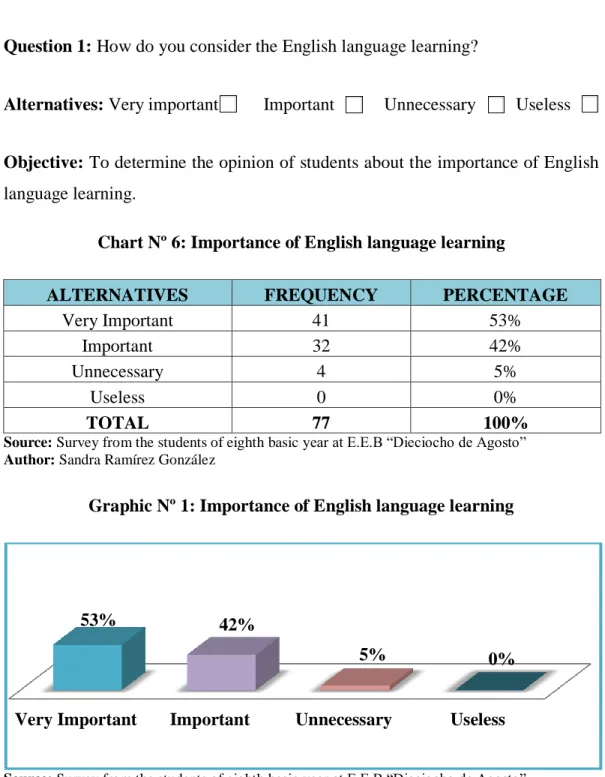
Chart Nº 6: Importance of English language learning ... 60
Chart Nº 7: Appreciation of students about writing in English... 61
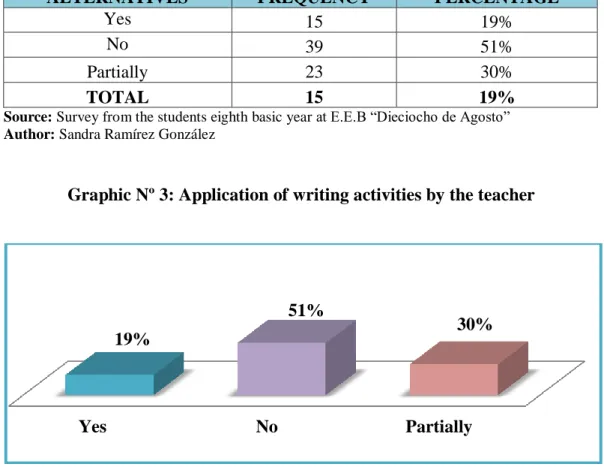
Chart Nº 8: Application of writing activities by the teacher ... 62
Chart Nº 9: Students’ opinion about writing in English ... 63
Chart Nº 10: Activities for practicing writing skill ... 64
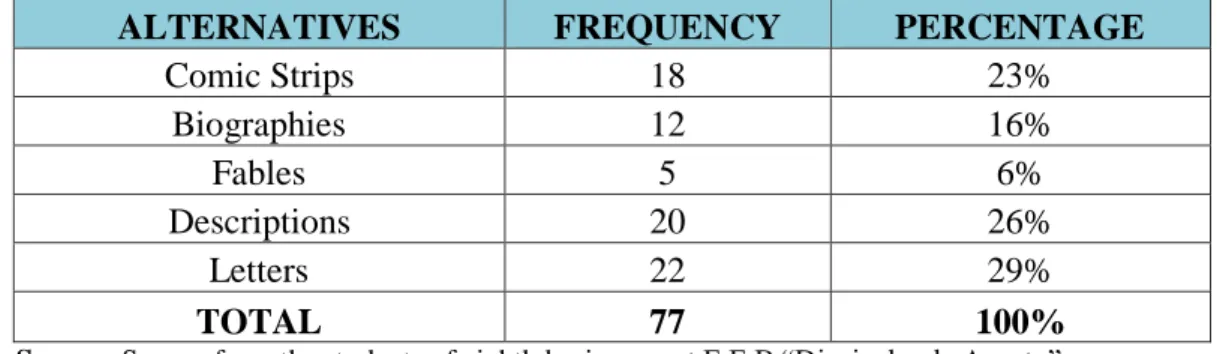
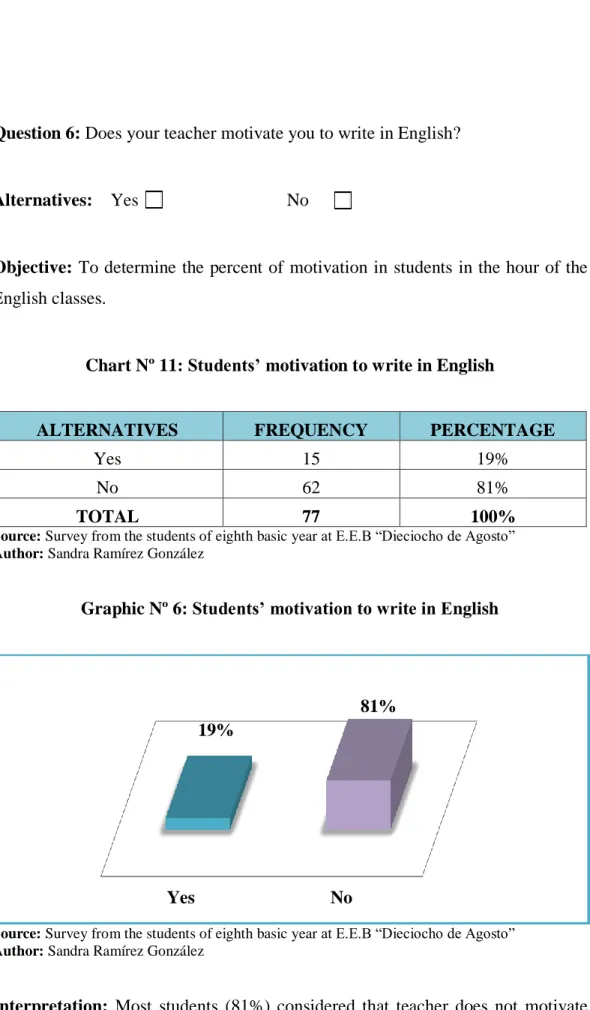
Chart Nº 11: Students’ motivation to write in English ... 65
Chart Nº 12: Use of prompts in the writing lessons ... 66
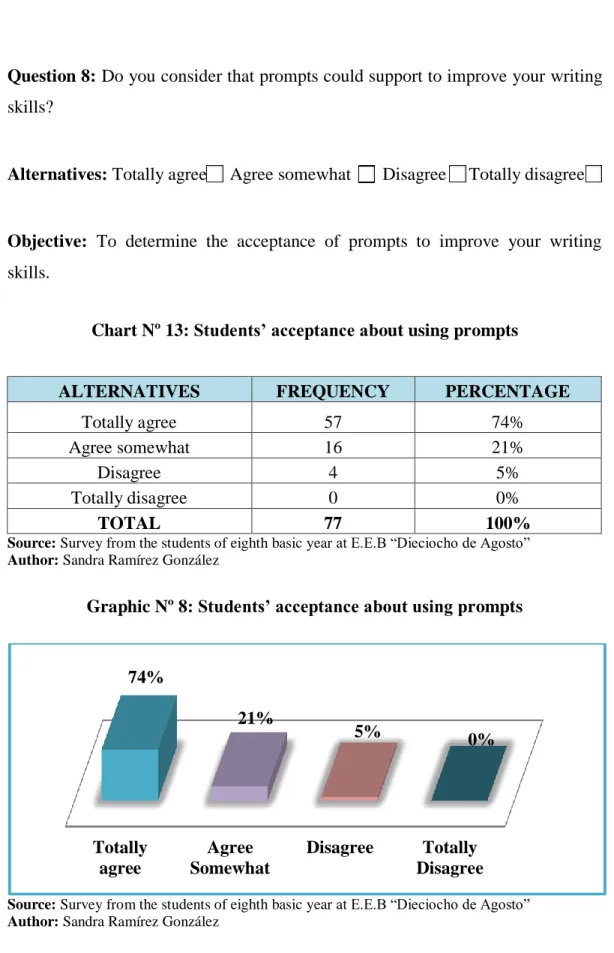
Chart Nº 13: Students’ acceptance about using prompts ... 67
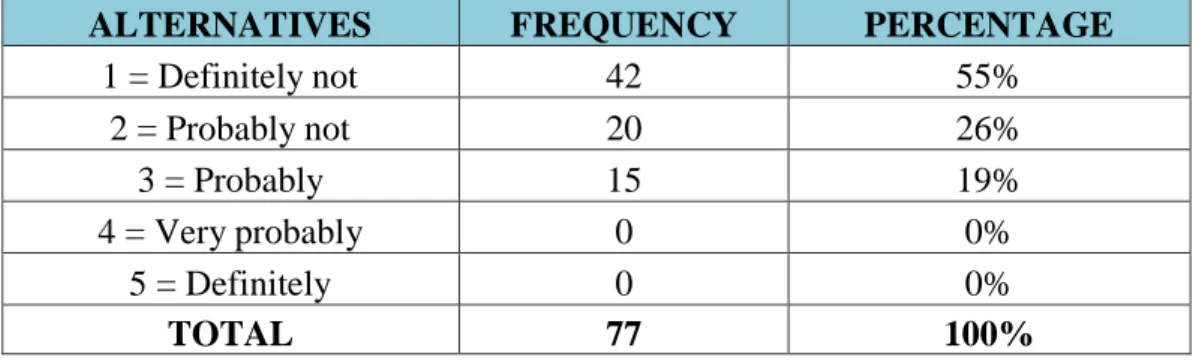
Chart Nº 14: Students’ willingness of using prompts ... 68
Chart Nº 15: Students’ willingness to learn writing ... 69
Chart Nº 16: Students’ survey results ... 70
Chart Nº 17: Content of the booklet ... 87
Chart Nº 18: Rubric for assessing the writing prompts ... 89
Chart Nº 19: Strategies of improvement ... 120
Chart Nº 20: Kagan's cooperative learning matrix ... 121
Chart Nº 21: Improvement of eight grade students "A" ... 122
Chart Nº 22: Improvement of eight grade students "B" ... 124
Chart Nº 23: Timetable ... 131
Chart Nº 24: Rubric for evaluating students’ writing ... 148
xvii ILLUSTRATIONS
Illustration Nº 1: Problem Tree Analysis ... 5
Illustration Nº 2: Degrees of specialist Nº 1 ... 53
Illustration Nº 3: Degrees of specialist Nº 2 ... 57
Illustration Nº 4: Escuela de Educación Básica "Dieciocho de Agosto" ... 77
Illustration Nº 5: Location of E.E.B. "Dieciocho de Agosto" ... 78
Illustration Nº 6: English book contents ... 84
Illustration Nº 7: Students writing their personal profile ... 90
Illustration Nº 8: Students writing about their favorites ... 92
Illustration Nº 9: Students writing about their favorite celebrities... 94
Illustration Nº 10: Students writing about their favorite things ... 96
Illustration Nº 11: Students writing about favorite things location ... 98
Illustration Nº 12: Students writing the differences of pictures ... 100
Illustration Nº 13: Students writing about their family members ... 102
Illustration Nº 14: Students writing comic scripts ... 104
Illustration Nº 15: Students completing a dialogue with Wh-questions ... 106
Illustration Nº 16: Students writing a letter ... 108
Illustration Nº 17: Students writing about activities from a schedule ... 110
Illustration Nº 18: Students describing their family members ... 112
Illustration Nº 19: Students describing their favorite famous person ... 114
Illustration Nº 20: Students describing likes and dislikes ... 116
xviii GRAPHICS
Graphic Nº 1: Importance of English language learning ... 60
Graphic Nº 2: Appreciation of students about writing in English... 61
Graphic Nº 3: Application of writing activities by the teacher ... 62
Graphic Nº 4: Students’ opinion about writing in English... 63
Graphic Nº 5: Activities for practicing writing skill ... 64
Graphic Nº 6: Students’ motivation to write in English ... 65
Graphic Nº 7: Use of prompts in the writing lessons ... 66
Graphic Nº 8: Students’ acceptance about using prompts ... 67
Graphic Nº 9: Students’ willingness of using prompts ... 68
Graphic Nº 10: Students’ willingness to learn writing ... 69
Graphic Nº 11: Improvement of eight grade students "A"... 126
xix APPENDIX
Appendix Nº 1: Survey applied to students ... 135
Appendix Nº 2: Interview applied to the principal ... 138
Appendix Nº 3: Interview applied to the English teacher ... 140
Appendix Nº 4: Interview applied to the specialist ... 142
Appendix Nº 5: Diagnostic test applied to students ... 144
Appendix Nº 6: Final test applied to students ... 146
Appendix Nº 7: Rubric for evaluating students’ writing... 148
Appendix Nº 8: Observation guide ... 149
Appendix Nº 9: Students’ names-eighth grade "A" ... 150
Appendix Nº 10: Students’ names-eighth grade "B" ... 151
Appendix Nº 11: Legal articles ... 152
Appendix Nº 12: Students during the survey ... 154
Appendix Nº 13: Interview to the principal ... 154
Appendix Nº 14: Interview to the English teacher ... 155
Appendix Nº 15: Students during the diagnostic test ... 155
Appendix Nº 16: Investigator during the proposal application ... 156
Appendix Nº 17: Investigator during the proposal application ... 156
Appendix Nº 18: Investigator during the proposal application ... 157
Appendix Nº 19: Investigator during the proposal application ... 157
Appendix Nº 20: Students during the final test ... 158
Appendix Nº 21: Request to the Education District Office ... 159
Appendix Nº 22: Letter of acceptance ... 160
Appendix Nº 23: Certification of the proposal application ... 161
Appendix Nº 24: Urkund report ... 162
xx PENÍNSULA OF SANTA ELENA STATE UNIVERSITY
FACULTY OF EDUCATION AND LANGUAGES ENGLISH LANGUAGE TEACHING CAREER
TOPIC:
“PROMPTS TO IMPROVE THE WRITING SKILLS TO STUDENTS OF EIGHTH BASIC YEAR AT ESCUELA DE EDUCACIÓN BÁSICA “DIECIOCHO DE AGOSTO”, SANTA ELENA, SANTA ELENA PROVINCE, 2015 - 2016”.
Author: Sandra Yadira Ramírez González Advisor: Ing. Sandra Caamaño López, MSc. ABSTRACT
Writing is distinguished as a way of communication that represents the language through the inscription of words. People write e-mails, lists of words, notes, reports, journals, essays, etc. they often do it on blogs, forums or web pages. All these writing activities have the objective of communicating something. Most people have the innate necessity to express their ideas, thoughts, feelings and emotions. However, in most cases, writing is a complex task for beginning students due to the different aspects that a good, clear and comprehensible writing requires.
Teaching writing may be one of the hardest jobs a teacher faces. Teachers who are teaching in middle schools, high schools know the depth of challenges they have to face for teaching this English skill due to its importance. The application of dynamic activities that engage students to write is necessary and, therefore, this investigation makes emphasis on the relevance of applying a booklet with prompts to improve such an important skill as writing. This research paper demonstrates that using prompts promotes the motivation of students during the writing process because the topics were taken according to the real necessities and interest of students. Eighth basic year students from Escuela de Educación Básica “Dieciocho de Agosto” in Santa Elena, Santa Elena Province.
1 INTRODUCTION
Around the world people need to establish different types of relationships with others in order to achieve certain purposes, but most of them have a serious problem; they do not speak the same language. Therefore, it has increased the necessity to have a global language and English is considered the primary global language of communication. Communication involves a process where people exchange believes, thoughts, feelings, and others. This communication can be done through two different ways; oral and written.
The main objective of this research paper is to determine the importance of developing writing skills in order to apply it in situations where people need to transmit and express their positions about various situations in a written form. Writing is a complex process that permits writers to explore thoughts, and ideas and make them visible and concrete. Writing motivates thinking and learning about diverse topics; it motivates communication and makes thought available for reflection because when something is written down, ideas can be examined, reconsidered, rearranged, changed and/or added.
Given the importance of writing skill, it is essential to mention that a good way to enhance this skill is through the application of a booklet with prompts. Prompts provide students with the opportunities of writing in a relaxed and engaged way. This booklet is a didactic way and it can be used as a support for both teacher (during the writing instruction) and students (during the writing lessons).
2 Chapter I-The Problem: this chapter gives details about the statement of the problem, the critical analysis, the significance of the problem, general and specific objectives of the investigation.
Chapter II-Theoretical Framework: It provides details about all the theories of important authors and previous researches that support the investigation topic. It also gives details about the philosophical, psychological and legal basis of this work, and the research hypothesis.
Chapter III-Methodology: It explains methodological strategies in order to get a successful work. This chapter also contains the level of the research, population, sample, strategies and instruments to collect significant information, data collection with the respective analysis and interpretation, conclusions and recommendations.
Chapter IV-The Proposal: This chapter describes the solution for the problem and it analyses the outcomes of this investigative work. It describes the background, significance and objectives of the proposal application. Moreover, it has the booklet with fifteen prompts to improve the writing skill.
3 CHAPTER I
STATEMENT OF THE PROBLEM
1.1 TITLE
“PROMPTS TO IMPROVE THE WRITING SKILLS TO STUDENTS OF
EIGHTH BASIC YEAR AT ESCUELA DE EDUCACIÓN BÁSICA “DIECIOCHO DE AGOSTO”, SANTA ELENA, SANTA ELENA
PROVINCE, 2015- 2016”.
1.2 STATEMENT OF THE PROBLEM
1.2.1 Context
Escuela de Educación Básica “Dieciocho de Agosto” shows a deficiency in
English language especially in grammar, coherence, vocabulary which is relevant
for developing the writing skill. Therefore, it is becoming a major problem for the
teaching process to make the scholars structure more complex compositions due
to the poor training they receive from their teachers, and in order to help students
with the ability to write compositions and develop critical thinking skills with the
comprehension of the content, it is significant to develop a proposal for enhancing
the writing instruction.
The consequence of a poor writing proficiency of students is that receptors are not
able to understand the written message because of the innumerable grammar or
spelling mistakes. As a result, poor writing skill creates problems of
communication with others, misunderstandings can provoke that the answer is not
4 Therefore, it is relevant for high school students from Escuela de Educación
Básica “Dieciocho de Agosto” to develop writing skill because it plays an
important role for communication. Many factors have to be taken into account in
order to reflect messages correctly. Learners have to have a vast knowledge in
grammar and other rules in order to produce a comprehensible written message.
The correct use of mechanics is also important; learners have to know where to
use certain punctuation marks.
A guideline is a norm or a set of instructions that are taken into account for something, the guideline provides the basis for the development when planning an action or to perform activities. It can be said that prompts will be beneficial for students, because they are an important strategy for English teachers to improve
writing skill in their scholars by having new ideas for teaching with new
techniques. Prompts will also motivate students to learn and achieve their
academic goals: students will understand easily written exercises; create
compositions in order to improve the capacity of handwriting and developing new
knowledge and new ways of writing that may be taken to improve their skills.
1.2.2 Critical analysis
5 Illustration Nº 1: Problem Tree Analysis
It is important to point out that students of eighth basic year at Escuela de Educación Básica “Dieciocho de Agosto” have serious problems at the moment of producing the written language. Some causes of the poor writing proficiency of students were illustrated previously in a problem tree analysis. The first cause is the application of traditional methodologies and strategies; old-fashioned strategies turn into boring classes and therefore, students are not motivated at all in the learning process. Moreover, teachers do not instruct the writing skill in a correct way; it is important to explain different aspects that students need to know in order to produce adequate writing pieces.
Unfortunately, teachers do not teach vocabulary correctly using different strategies in order to affiance students’ new vocabulary knowledge. Teachers have to take into account that students need to have a good knowledge of vocabulary because without enough vocabulary, students will not be able to produce the target
Author: Sandra Ramírez González
POOR ENGLISH LANGUAGE WRITING SKILL IN STUDENTS OF EIGHTH BASIC YEAR AT ESCUELA DE
EDUCACIÓN BÁSICA “DIECIOCHO DE AGOSTO” Students do not
know vocabulary for writing activities Teachers apply old-fashioned strategies. Students are not motivated in class.
Teachers do not apply vocabulary to develop writing. Students do not know how to write. Incorrect writing instruction. Students do not have extra
exercises to practice writing skill.
Teachers focus only on exercises from
6 language in its written form. Knowing sufficient words are the basis for the development and mastering of the English language.
A final reason that causes the low level of students’ writing skill is the faithful application of exercises from English books that the Ecuadorian government provides to public educational institutions. The practice of English language writing skill is just based on the activities from books. As a consequence, students do not have the possibility to practice this important skill using extra, different and interesting exercises. This also causes that students do not feel engaged in the writing instruction because sometimes exercises from books do not keep a relationship with students’ reality; writing exercises need to be adapted to the students’ necessities and interests.
The reasons mentioned before affect the development of the writing skill of students. Therefore, it is relevant to demonstrate that a booklet with prompts are an efficient resource that will be a provider of activities and exercises for learning and improving the English language writing skill of students of eighth basic year at Escuela de Educación Básica “Dieciocho de Agsoto”.
1.2.3 Formulation of the problem
What will the impact of the application of prompts be in the writing skills of
students from eighth basic year at Escuela de Educación Básica “Dieciocho de Agosto” Santa Elena, province of Santa Elena 2015 -2016”?
1.2.4 Guideline questions
What are prompts?
7 What is the importance of writing?
What are the activities for improving writing skills?
Why is it necessary to write in English
What are the methods for teaching writing?
1.2.5 Delimitation of the research object
● FIELD: Education.
● AREA: English.
● ASPECT: Writing prompts.
TITLE: “PROMPTS TO IMPROVE ENGLISH WRITING SKILLS TO STUDENTS OF EIGHTH BASIC YEAR AT ESCUELA DE EDUCACIÓN BÁSICA “DIECIOCHO DE AGOSTO”, SANTA ELENA, SANTA ELENA PROVINCE, 2015- 2016”.
PROBLEM: What will the impact of the application of prompts be in the writing skills of students from eighth basic year at Escuela de Educación
Básica “Dieciocho de Agosto” Santa Elena, province of Santa Elena 2015 -2016”?
● TIME LIMITATION: The research will be held during the academic year 2015-2016.
8 ● SPACE LIMITATION: Escuela de Educación Básica “Dieciocho de
Agosto”
● CONTEXT LIMITATION: This research will be focused on the influence of the prompts as activities to improve the writing skill of the eighth basic year students from Escuela de Educación Básica “Dieciocho de Agosto”.
1.3 SIGNIFICANCE
In some methods of teaching writing has appeared written language as a sign
system used to transcribe spoken language, as a means to convey letters by spoken
language. However, it is not a simple transcription system. It is a complete and
independent language, a true means of communication.
Prompts are a positive teaching tool with different characteristics that play an
important role at the moment of teaching writing because pupils enjoy working
with this material and, thus, promote enjoyable and easy classes. The importance
of writing has increased the necessity to improve the writing proficiency of
students; it is a hard work for English teachers. One benefit of using prompts is
that through their application teachers can get students to write without difficulties
certain sentences, paragraphs, stories, short dialogues while differentiating the
correct way of writing, it is a positive aspect in the implementation of prompts.
If students do not have an appropriate instruction in their work, they can
misunderstand the meanings or the content of different information; this
discourages students in the acquisition of this new language. The design and
application of prompts is advantageous since it enriches elementary writing skills
in students, and improve their intellectual development in daily practice with new
vocabulary, funny and interesting exercises that include clear instructions for
9 Finally, the implementation of this study will benefit students of eighth basic year
at Escuela de Educación Básica “Dieciocho de Agosto” since they will have the
opportunity to write in a relaxing environment and in a didactic way. Second or
foreign language learners need to be motivated during the language instruction
and prompts are a good resource for increasing the standard and understanding of
the written production of students, so it is important to create prompts with
engaging and interesting exercises for students in order to learn new vocabulary,
to make a habit of writing for students that facilitate the learning process.
1.4 OBJECTIVES OF THE RESEARCH
1.4.1 General objective
To evaluate the importance and benefits of using prompts through the analysis of different investigations and theories applied in the English language teaching field in order to improve English writing skill
1.4.2 Specific objectives
To collect important theoretical foundations from books or journals in order to develop the theoretical framework of the investigation
To gather specific and significant information by applying surveys and interviews
10 CHAPTER II
THEORETICAL FRAMEWORK
2.1 PREVIOUS RESEARCH
A great number of students are learning English in primary and secondary classrooms all around the world. English has becoming a part of the curriculum of several schools, high schools and universities that want their pupils to become better at the different skills of the English language. The development of the main four English skills is complex; teachers have to integrate different activities that promote the acquisition of a language.
Teaching to students who live in a country where English is used as a foreign language is a problem because teachers and students have to deal with various obstacles during this learning process. According to Hang Khong and Saito (2014), teaching language-minority students can be challenging. The cognitive demand on these learners is greater than non native English-speaking students, because they are learning both languages and the content knowledge simultaneously. This means that teachers need to devote more time to ELLs.
11 According to Serra (2014), writing is distinguished as a manner of communication that represents language through the inscription of words. People write e-mails, lists of words, notes, reports, journals, essays, etc. they often do it on blogs, forums or web pages. These writing activities all have a communicative objective. In most languages, writing is a complex task for students who are starting to learn a language due to the different aspects that good writing requires. Students need to know that no matter what they write, the main objective is to produce clear writing pieces with clear and comprehensible messages.
2.1.1 Teaching English writing
For many people, even with English knowledge, writing does not come easily and writing effectively becomes still more difficult. Good writing conveys a purposeful message and uses of English language correctly. However, the message is more relevant that the correct presentation. It means that if the message is understandable or even a part of it, students have achieved communicative competences in the written way. In order to write clearly and masterly, students need to have an instruction in basic language system. The English language system involves knowledge of grammar, punctuation and sentence structure.
Grammar: It is essential to have grammar knowledge because correct writings are easier to understand, and easier to get published. A writer can be a professional writer without totally mastering grammar. Proper grammar is absolutely fundamental to students’ learning to produce sentences which can be understood and sound natural. Writers need to create sentences which take place in the present, past, future, present perfect, and others.
12 building blocks employed to construct pieces of written. For a good writing, the writer has to know the correct use of comma (,), full stop (.), exclamation mark (!), question mark (?), semi-colon (;), colon (:), apostrophe (‘), quotation marks (“…”), hyphen (-), brackets ([]), parenthesis (()), slash (/), etc.
Sentence Structure: it refers to syntax. Writer needs to know how a sentence is built (subject, verb, and predicate). All sentences are about something or someone: this is subject. The predicate contains information about someone or something that is the subject. However, there are more aspects that can be part of a sentence, such as, direct and indirect object, and the different modifiers. Moreover, there can be various kinds of sentences; simple sentences, compound sentences, and complex sentences.
However, another important aspect to develop writing skill is vocabulary; Brynildssen (2000) determines that in some ways, the ability to write effectively hinges upon having an adequate vocabulary even more than does the ability to read.
During the writing process, however, a student does not have the luxury of examining the context in which a word is used; he or she is creating the context. Therefore, the writer must be able to spontaneously recall words that are known not only by sight, but that are understood well enough to use correctly. The breadth and depth of a student's vocabulary will have a direct influence upon the descriptiveness, accuracy, and quality of his or her writing (Brynildssen, 2000).
13 Several teachers avoid teaching instruction precisely because it takes so much time to fulfill all this process. However, all learners benefit from being motivated to write, to bring the language in their heads onto a piece of paper or a computer screen.
2.1.2 The relevance of English writing skill
Gallagher (2006) claims that in order to become an expert at swimming, one must do a tremendous amount of swimming. One cannot just wish to be an expert swimmer; becoming an expert swimmer takes a lot of work and a lot of practice. Writing is a skill, and as such, only improves with much (guided) practice.
For Steve Peha (President of Teaching That Makes Sense Inc) is important to be clear why teachers want students to write before deciding what students should write about. People, as a society, value the written word and a world where the information is permanent it is relevant to develop writing skills because most of the information is written (Peha, 2003). Therefore, writing is an essential skill. Sometimes, most people need to write due to the advent of e-mail, instant messaging, and other texts based on written communication.
Furthermore, there is also an academic application of writing; in higher levels of instruction students need to have acquired writing and developed critical thinking. In this case, students need to write longer and more advanced pieces of writing.
14 2.1.3 Kinds of writing skill
It is helpful to identify between two very different writing purposes. Jeremy Harmer in his (2007) work identifies two types of writing:
Writing for learning: It occurs when students are asked to write sentences in preparation for some other activity. It is an enabling activity. Writing for learning tasks are short (limited to less than five or six minutes of the class time) which main purpose is to help students to think through key ideas or concepts presented in a lesson.
Writing for writing: Its main objective is the development of students’ skills as writers. The activities used in writing for writing should become students better at writing, whatever type of writing might be because in this case, the whole text is important. Writing for writing includes appropriate language, construction, style and effectiveness.
2.1.4 Another classification of writing
Writers can choose any of the below categories to achieve the purpose of their writing:
15 Expository: This writing tries to inform, explain or define a topic or subject. The writer is mostly intending to tell all about the topic avoiding the use of personal opinions and emphasizing on real facts.
Comparison and contrast: This kind of writing allows the writer to point out similarities and differences about people, places, things, and other topics. Compare means to distinguish how people, places, things are similar. Contrast means to identify the differences about the topic.
Opinion: Writer uses this writing type to express his/her ideas or beliefs about a particular subject. Writers utilize facts to support their opinions and to demonstrate why they hold their beliefs.
Narrative: The narrative writing is employed to tell a story. Everyone likes to hear different stories even if they are real or not. In this kind of writing, the writer can use a plot, a theme, characters, settings, etc. The purpose of this writing is to tell a sequence of events and experiences.
Persuasive: The writer uses persuasive writing to try to change the mind or point of view of someone. The writer can use facts and opinions in order to explain something from his/her way. The writer can use quote statistics and use them to mean what he/she what the reader thinks about.
16 Therefore, the most significant prerequisite for the proper teaching of argumentative writing is that of fostering critical thinking by means of thought-provoking pedagogy. In order to write argumentatively, it is fundamental that students develop critical and thinking skills because they have to express their ideas in an adequate way; using correct expressions in order to defend their positions
2.1.5 Teachers tips for encouraging students to write
For teaching writing is relevant to encourage students to do it without pressure; the development of an enjoyable and friendly environment is the key for students to start writing and also to improve this skill. Teachers need to know important tips to put them in practice into the writing lessons.
Before the writing task:
Ask students to brainstorm.
Help students to write about their own experiences.
Help students by clarifying the writing assignment.
Support students to identify the content they will write.
During the writing task:
Help students in the organization of their writing.
17 Provide students ideas they can use to follow writing.
After the writing skill:
Point out students’ writing strengths.
Help students to understand the process of writing.
Make a positive feedback about the writing assignment.
Encourage students to proof their pieces of writing.
2.1.6 Teaching English to teenagers
Today’s teenager students are a varied and fascinating individual group. They are changing emotional and physically, they are often worried about their appearance. They are also copying with new and rare emotions and at the same time, they are learning to think in a more abstract form, discussing issues and ideas. Through this transition, adolescents are intending to determine their identity and learn who they are.
18 Teenager students bring to the classroom and learning experience an incredible combination of social, emotional and cognitive factors. These experiences cannot always have been successful or enjoyable. As a result of that, students can develop preconceived ideas about whether or not learning English is a playful process, and whether they are good at languages or not. If students’ English learning experiences have not been positive, their level of motivation can be low. On the contrary, their previous experiences of English learning can be positive according to the level of interest when they join an English class. Therefore, it is important to include in the English lessons topics that are engaging and interesting for students and activities intellectually challenging.
Adolescents, generally, have equal characteristics with any other language learner, mentioned above:
They attend to different ways of motivation.
They usually have problems at pronunciation and vocabulary.
They receive language and immediately intend to decode meaning.
2.1.7 Adolescents’ motivation for learning a language
19 Teachers have to convince their students of the value of using English in a constructive form and create an enjoyable and supportive classroom environment where they can actively participate in the learning process and improve in different learning areas that a language is involved.
Students need to feel they can succeed in a specific subject because taking that into account students invest much effort at learning. The beliefs of learners about their capacity to learn a language can be attributed to personal internal causes, which can be a result of external factors. Intrinsic and extrinsic motivation is present in all students no matter the age or sex.
For teenagers, intrinsic motivation is described as the inner process: an adolescent can learn a language and use it in the classroom in playful tasks with his/her classmates. On the other hand, Hang Khong and Saito (2014) make the point that extrinsic motivation (it comes from outside of the individual) of teenagers is linked with their desire of succeeding in exams or tests, and getting better school scores. The work of educating ELLs therefore requires great effort on the part of teachers, in responding to them academically, culturally, and linguistically.
2.1.8 Teaching writing to adolescents
Rothstein and Lyons (2001) mention that teachers have to face different challenges in the classroom, but teaching writing to adolescents can be a formidable challenge. Many content-area teachers have not been prepared in their course work to teach writing in their discipline. In addition, many adolescent students arrive to high school without having sufficient instruction in writing about history, mathematics, or science.
20 language, their individual sensations, emotions, perceptions, observations, incipient understanding, and perspectives. Writing, as all other creation acts, is developed from the inside out.
Writing is an act of creation, which makes writing teaching uniquely from the other issues for teaching. Adolescents’ experiences hold a relevant place in writing instruction. Personal experiences give students a basis for making sense of the world, for comprehending the human conditions, for linking to new ideas, and experimenting with the potential of new text forms to support them to convey meaning.
All students, children, teenagers, adults, have a variety of thoughts and ideas in their heads, and in the writing instruction is significant to have personal experiences, stories, and worth ideas to share. Greenstein (2013) mentions that if students know you will be reading their compositions, they will devote a good deal of effort to making them well-written. Therefore, it is really important to activate the interest of students to express themselves by writing.
2.1.9 Why do students write?
Write to argue: An argument is a connected series of statements intended to establish a preposition. Students can use phrases for argument writings
21 Write to advise: A type of advisory writing with which most students will be familiar is the personal problems pages of newspapers and magazines. For example, students can write an advisory letter.
Write to inform: Students write to inform uncovering facts; they can write about them as objectively as possible. For Grenville (2001) writing to inform is one of the most common of the writing purposes; it tells the reader about something.
Write to explain: The purpose of expository writer is to collect information and facts, combine them with students’ own knowledge and experiences. Students clarify the reader who or what something is, how happened, or why something happened.
Write to describe: Students write to portray people, places, things, moments and theories with enough specific details to help the reader to create a mental picture of what is written about.
Write to entertain: Grenville (2001) establishes that “it doesn’t necessarily make the readers laugh, but it at least engages their feelings in some way”. Writing to entertain generally takes the form of so-called ‘imaginative writing’ or ‘creative writing’ (of course, all writing requires some imagination and creativity). Entertaining is often used with some other goals. Entertaining others with humor is the main goal to write in this way.
22 2.1.10 Why students do not want to write?
Writing, like all other English skills, is a complex process where students have to transmit their thoughts and ideas about a defined issue on a piece of paper. Writing is becoming a fundamental skill in today’s world. Second/foreign language students use written language to communicate each other and need to develop good writing skills, but most of students do not like writing because they were never trained to do writing tasks for pleasure. Greenstein (2013) makes the point that many students and many professors find the task of writing very hard, and they simply freeze up when asked to do it.
Most students find writing activities difficult because it is often an isolated task, given as homework. Another reason they do not write is the titles or topics of writing; students find titles boring and without a purpose. Students also reject writing because they feel uncomfortable when they receive their writing pieces covered in red ink; teachers need to be aware the way they provide writing feedback in order to not demotivate students to write. When students are asked to write they perceive it as a stressing, linking to fail and non-motivating activity because most teachers take the papers to assess students’ writing progress.
Finally, in order to avoid these problems in the writing exercises, it is essential to encourage students to write every day, at least in short periods, allowing them to express themselves without being extremely critics; this is the key to promote the writing at classrooms and outdoors.
2.1.11 Strategies for teaching writing
23 strategies for improving writing skill, but two strategies teachers can use in their writing lessons are free writing and revised writing.
Free writing: When students free write they write whatever comes into their head about any topic, without stopping and without worrying about grammatical rules. Most free writing activities are short-just five or ten minutes. Free writing helps students to practice fluency; it means quickly and easily.
As it was mentioned above, with the application of this strategy, students do not need to worry about accuracy (correct grammar and spelling). At the end of the free writing task, students read carefully their writing and can check their mistakes.
Revised writing: It is also called extended or process writing. It is a more formal strategy in which students must write a first draft, then review and edit it to write a final version of their writing. Revised or extended writing can be used for teachers in order to assess students’ writing advances.
2.1.12 Activities for teaching writing
Teachers can use several ways to teach and improve writing skill of his/her students. A variety of techniques applied into the lessons can achieve this goal. There are lots of activities that provide students the opportunity to practice their writing skill. Here it is a list of them:
Autobiography: This is personal; each student can write about personal facts or memoirs.
24 Comic strips: This is a playful activity that students enjoy a lot. Comic strips are drawings that follow in a sequence to describe a story. In this case comic skills and writing skills are involved each other.
Descriptions: With this activity, students describe a person, event, or object. It could be spoken or written; in written, this exercise can be helpful for fiction and non-fiction writing.
Diaries: Even though people do not have a diary anymore because of the technological advances, diaries are excellent ways for writing. Diaries are considered the newspaper of life where people describe events or facts that happen every day. Teacher can ask students to have one in order to practice writing skill by reporting their ideas, feelings or simply describing what they do daily.
Essays: This activity can be difficult for some students because it is a complex process. An essay must follow a structure and it is used at higher levels. Essays are used in order to produce writing pieces of different areas; they can be, descriptive, expository, narrative or persuasive.
Fables: Students can write short stories with moral values. It is an interesting activity because students have to use their creativity to write fables.
Letters: They are considered the old art of handwritten. Unfortunately, they have been fading out with the increased use of e-mails and text messages. However, it is a good option to practice writing for some teachers.
25 movie. Students can write a monologue and then present it in front of their classmates and teacher.
Plays: This exercise also includes creativity and art. Plays are pieces of drama, comedy, thriller, etc. students use their imagination to create a story with different characters and settings.
Poems: Poems are useful for promoting the writing skill of students because they can write a verbal composition transmitting their ideas, feelings or emotions. For this activity students need to have certain knowledge of using prose and other techniques applied at writing poems.
Journals: Thomas and Geursen (2013) made an investigation about the influence of public journals on the development and improvement of writing, reading and thinking skills and they conclude that keeping a public journal proved to be a valuable experience for both ourselves and our students. Thus, we want to continue writing the journal and to continue to explore the potential of writing reflectively and sharing this with students. We do see need to further investigate how it can focus more as a catalyst for our students’ own reflections.
2.1.13 The process of writing
Good writing is essential to become successful at school. When people write, they do more than just put words together in order to make sentences. The writer must not only follow rules and convections of punctuation and grammar, but also manage ideas coherently, organize thoughts, etc. Therefore, it is necessary to focus students to go through several steps to produce a good piece of writing:
26 Likewise, Urquhart and McIver (2005) establish that the importance of prewriting is often underestimated, but its function in the writing process is vital. By making a note of your ideas and arranging them into some order, you are splitting up the writing task into more easily manageable components. With a page of rough notes, you will not need to wonder what to say next. The notes act as a prompt; reminding you what topics you need to cover. You can also add to the list of notes if any new ideas emerge while you are writing.
In this phase, students start by choosing a topic; they can select it or it can be assigned by the teacher. Then, they gather ideas, and some excellent ways to collect information is by brainstorming, making a list, using diagrams, mapping out thoughts, and others. To finish this phase, students organize their ideas; they choose what idea will go first, second, and so on. Finally, it is important to establish a working thesis statement and then develop the main idea in the following sentences or paragraphs.
Drafting: Students start writing their initial composition. They can use the notes they wrote down in the previous phase creating a well-organized text to convey a particular topic or present an argument.
Revising: Here, students review, modify, and reorganize the structure and content of what they wrote; they can rearrange, add or delete some content. Reading the piece of writing silently or aloud or making peer-editing are some techniques for checking the text. The main purpose of this stage is to improve the draft.
27 Publishing: In the last step, students can share their papers with the rest of the class or maybe published online.
2.1.14 Scales and rubrics to judge the good quality of writing
Students become better writers by reading and assessing the others’ writings. Rabin (2002) points out that students need to comprehend and recognize the qualities that make a good piece of writing and the use of rubrics or checklist are very helpful for achieving this goal.
According to Rabin (2002), a rubric is an excellent way to illustrate the elements of good writing, and it serves as a reference point for both students and teachers as they evaluate a piece of writing. She designed a master rubric that divides the features of good writing into four broad categories:
Score 1: the writer lacks control of written expression.
Score 2: the paper reveals limited skill in written expression.
Score 3: the writer has a good command of written language.
Score 4: the writer has a strong control of written language.
28 Content and Organization: In this case, the content creates an effective and well-develop to the prompt. The writing must contain related ideas, supported with mature reasoning (examples, details, facts). These ideas must have a logical sequence using linking words and phrases.
Sentence construction: Students need to write a strong command of sentence structure and do not write in fragments or run-on sentences. Students know the use of compound and complex sentences, demonstrating their ability to combine related ideas. The correct use of punctuation is also important because it makes clear students’ writing.
Usage: The use of appropriate language according to the situation and the audience is relevant. Students understand the basis of grammar and make few mistakes: subject-verb agreement, pronoun reference, verb from, correct use of idioms, correct use of adjectives and adverbs, etc.
Mechanics: The writer follows spelling conventions and understands the capitalization rules.
2.1.15 Prompts for writing
29 Writing prompts benefit to prepare students for real situations. For most students it is hard to write and reject writing activities. Therefore, the most significant aspect to keep in mind when teachers trains students’ writing skill and uses prompts is this: The prompt itself, and the process of responding to it, has a huge influence on what students write.
2.1.16 How to select prompts
A fundamental factor to consider at the moment of selecting prompts for writing is the narrower the prompt, the more specific a response it requires. There are great probabilities to not get mediocre pieces of writing with narrow prompts. They produce a narrow range of results and help students to encourage writing specific information and details. On the other hand, the more broad a prompt is, the more difficult is to focus on what information to describe. Another important aspect is how motivating and engaging prompts are for students. Prompts have to appeal the students’ interest and curiosity. This aspect keeps a relation with current topics: if the topic of the prompt is current and interesting, students can be more engaged to write about the issue.
2.1.17 Benefits of using prompts for writing
In some cases, it is complicated to start writing without a cue. Having a cue or prompt helps students’ words and ideas to flow deliberately.
Writing prompts promotes the creative writing of students.
30 The constant practice of prompts is excellent for students because they will
find easier and easier to write for longer and longer.
2.1.18 Kinds of writing prompts
There are various kinds of prompts teachers can use for assignments and assessments and some of them are more arguably better than others in terms of being fair to all students and collecting more accurate information. Writing prompts can be divided into the same way of writing; descriptive, expository, persuasive and narrative, but Peha (2003) classifies them into other categories:
Open prompts: Peha (2003) also points out that this first prompt is not really a prompt at all. It is a merely invitation to the writer to write something good. In many ways, this is the fairest prompt that could be used because each writer has the same opportunity to pick something they know they can write about effectively.
Topic prompts: “These prompts are just a bit narrower than the previous set. Because of this, topic prompts attend to produce more similar writing even across highly diverse groups of students” (Peha, 2003). This kind of prompt usually happens on writing assessment and it produces a narrative writing.
Topic and mode prompts: This is another kind of prompt. Several teachers like it because they have the possibility to exert a lot of control over the writing their students produce, and the mode of response is clearly indicated. In this case, all of these prompts are either expository or persuasive (Peha, 2003).
31 writers respond to prompts about general concepts with equivalent general response (Peha, 2003).
2.2 PHILOSOPHICAL BASIS
Whiteman (2013) states that “literacy would appear to be one few elements of education that everyone agrees to be a necessity of modernity” (p. 13). The capacity to read and write is casually associated with earning a living, achieving expanding horizons of personal enlightenment and enjoyment, maintaining a stable and democratic society, and historically, with the rise the civilization itself.
Gallagher (2006) determines that it is one thing to assign writing to student; it’s another to teach them how to write. Students are being asked to write to elevated standards without the proper level of instructional support. Likewise, Gallagher, (2006) mentions that “students in classrooms where writing is assigned often show improved fluency, but it has been in my experience that without explicit writing instruction their skills stagnate” (p. 9). As a result, students may be writing frequently but not really showing the level of progression we expect. Improved fluency is a good start, but this fluency will not translate to better writing unless targeted instruction is involved.
32 Graham, MaCarthur, and Fitzgerald (2007) state that “writing can be a satisfying and mind-expanding activity for the student who has acquired the necessary skills but a frustrating and even aversive experience when these skills are lacking” (p. 242). By the middle and high school years, it is necessary for students to possess a level of writing skill that will allow them to express increasingly complex thoughts and take a critical stance toward information.
2.3 PEDAGOGICAL BASIS
Chomsky (2006) believes that the person who has acquired knowledge of a language has internalized a system of rules that relate sound and meaning in a particular way. The linguistic constructing a grammar of a language is in effect proposing a hypothesis concerning this internalized system. Almost all children learn to speak without the necessity of formal instruction. Some investigators, like Noam Chomsky, suggest that we are hardwired for language. Learning to read and write, which means learning to be literate, requires training beyond what comes naturally.
Chomsky proposed that the acquisition of a language is an innate ability of children and explains that “innate” is something that is already in minds since children’s birth. Another point in the language acquisition theory of Chomsky is the selection of the best grammar that matchers with the available information. For him, children have the opportunity to use grammar to construct well-structured sentences and determine what the best ways of use are.
2.4 PSYCHOLOGICAL BASIS
33 consequences of their actions. In other words, the environment where someone habits plays a fundamental role in the way a person acts and also affects their psychology. However, behavior is effective only through others’ mediation and the use of language has part of it.
Jean Piaget (1977) revolutionized the field of educative psychology with his cognitive theory which explains the way in which children think and solve problems. Piaget showed with his theory that young children think in strikingly different ways compared to adults.
According to Piaget, children are born with a very basic and inherent mental structure on which all subsequent learning and knowledge is based. Furthermore, Piaget (1977) establishes that cognitive development is a progressive reorganization of mental processes as a result of biological factors and environmental experiences.
2.5 SOCIOLOGICAL BASIS
Vygotsky extended the concept of mediation of human-environment interaction to the use of signs as well as tools and he maintains that “like tools, sign systems (language, writing, number systems) are created by societies over the course of human history and change with the form of society and the level of it cultural development” (Vygotsky, 1980, p. 7).
34 The Zone of Proximal Development is the explorative area for which students are trained in a cognitive way. Vygotsky considers that interaction with others is an excellent form of developing and improving skills and strategies. However, this requires the contribution and social interaction for being completely dominated. In the social context, the ZPD is the knowledge development with the support of the environment, the interaction with society, students with their teacher, then students with their classmates, finally in their working environment. He also suggests that instructors apply activities or exercises of cooperative learning where students who do not usually participate in class have more opportunities to work actively.
2.6 FUNDAMENTAL CATEGORIES
English Language learners: ELLs (English language learners) are students who are acquiring English as a second/foreign language. These students are from non-English-speaking countries and require specialized instruction. “ELLs are a special student population with unique characteristics… and their numbers have grown rapidly. They bring a wide range of cultures, languages, and family and educational backgrounds to the classroom” (Hang Khong & Saito, 2014).
Productive Skills: The English language skills are divided into two categories; receptive and productive. The productive skills are speaking and writing, because learners have the necessity to use the knowledge they have acquired in order to produce language. They are also known as active skills.