UNIVERSIDAD LAICA VICENTE ROCAFUERTE DE GUAYAQUIL FACULTAD DE CIENCIAS DE LA EDUCACION
ESCUELA DE LENGUAS
RESEARCH PROJECT:
THE APPLICATION OF DIDACTIC EXERCISES TO DEVELOP LISTENING COMPREHENSION IN THIRD COURSE “C” AT SAN JOSE LA SALLE SCHOOL IN THE SCHOOL YEAR 2013 - 2014.
PREVIO A LA OBTENCION DEL TITULO DE:
LICENCIADO (A) EN LENGUA INGLESA ESPECIALIZACION LINGÜÍSTICA Y LITERATURA
EGRESADOS:
JIMMY ISMAEL ESPINOZA LOZA MILNA YOLANDA DE LA CRUZ BALON
TUTOR:
MTEFL .JANET MORA ZAPATER AÑO ELECTIVO
2013-2014
UNIVERSIDAD LAICA VICENTE ROCAFUERTE DE GUAYAQUIL
ESCUELA DE LENGUAS
THE APPLICATION OF DIDACTIC EXERCISES TO DEVELOP LISTENING COMPREHENSION IN THIRD COURSE “C” AT SAN JOSE LA SALLE SCHOOL IN THE SCHOOL YEAR 2013 - 2014.
AUTHORS:
Jimmy Ismael Espinoza Loza Francisco de Marcos 330 y Chimborazo
042401979
[email protected] Milna Yolanda Dela Cruz Balón Urdesa, Ilanes 512 y Av. La Aguas
2885455 – 0999348766 [email protected]
TUTOR
Mtefl. Janeth Mora Zapater GUAYAQUIL – ECUADOR
DEDICATION
I dedicate this work to my 15 nephews who have been my inspiration, because almost all of them have accomplished their careers at this time. It is dedicated to the people who have abandoned their studies at university for any situation and encourage them to find time to achieve their careers at Universidad Laica Vicente Rocafuerte.
Milna De la Cruz Balon I dedicate this work with much love to my little boy Diego Andrés Espinoza Jiménez who is my greatest inspiration since he is the light of my life. I also want to thank to my dearest family who were always there for me.
ACKNOWLEDGEMENTS
I thank you Lord for having created me beautifully. Psalm 139: 3 From the womb of my mother Andreita Balón de De la Cruz you created me and you chose Segundo Fortunato De la Cruz as my father.
I thank you Lord for my brothers and the gift of life. Also I want to thank my teachers: MSc Rebeca Vera, MSc Cristina Vizcaino, MSc Xavier Torres, MSc Mario Mejia, MSc Mauricio Vizcaino and my literature teacher Mtefl Janeth Mora who knew to share her knowledge when I returned to my studies again. They spread courage in me with patience and wisdom of good teachers so I could conclude my studies at this point of my life.
I thank my partner Jimmy Ismael Espinosa since with his collaboration and understanding we could join our talents in order to carry out this research work and deliver our knowledge to the school youth at San Jose La Salle.
Jimmy Ismael Espinoza and I also thank his father Ing. Com. Ismael Espinoza Dávila who has helped us with this hard work from heaven, and when we started this job Jimmy reminded him very much, and with love to him we put all of our part to arrive at this time. Also, thanks to his mother Mrs. Fátima Loza Alarcón that was the daily motivation and due to her great heart she was our support in this time, to his brothers for always keeping an eye on our progress.
Abstract.
This study aims to develop Listening Comprehension Skills in Third Course “C” at San José La Salle School in the School Year 2013 – 2014. it is the first time that students take LCS as a subject, since they were used to see it included in language arts throughout all their learning process. Thus, the listening activities and lessons were new for them; this was the reason that carries us to find new ways, strategies and exercises to improve their comprehension. The participants were thirty six students with a varied level of proficiency among them; we saw them finishing the first term. Consequently, this problem motivated us to do our project. We did the project in the second term using some instruments such as questionnaires for students and teachers, observations, didactic exercises, and advice sessions with students. The classes were motivated and didactically performed. This finding confirms the previous literature suggesting the relationship between pronunciation awareness and listening comprehension.
1 Contents
Introduction
1.1. Background of the problem………..……… 7
Statement of the problem………... 11
1.2. Objectives: Broad and specific ………. 11
Broad objective Specific Objectives 1.3. Justification of the study ……….. 12
1.4. Scope and limitations of the study ……… 12
2. Literature Review ………. 13
2.1. Introduction 2.2. Theoretical Review 2.3.Conceptual framework ……… 29
2.4. Research questions………. 31
2.5. Hypothesis ……… 31
2.5.1. Research hypothesis 2.5.2. Null Hypothesis 2.6 Indicators and variables ……… 32
2.7. Definition of terms ………. 33
2.8. Summary ……… 35
3. Research Methodology ……… 38
2
3.3. Research Instruments ……….. 40
3.4. Data analysis methods ………....……….. 41
3.4.1. Results and finding Hypothesis 1 Histogram of Pretest Histogram of Posttest 3.5. Resources, timeline and budget ……… 86
4.1. Conclusions ……… 87
4.2. Problems and limitations ……….. 89
4.3. Recommendations ……… 91
References Appendix List of tables Tables 1. Table 1. Variables – Conceptual Definitions – Indicators – instruments ……… 32
2. Table 2.The result of one test input and output……… 42
3 List of figures
Figures
1. In the Figure #1, the Histogram of the Pre-Test is presented ……….. 43
2. In Figure #2, the Boxplot of the Pre-Test is presented ………. 44
3. In the Figure #3, the Histogram of the Post-Test is presented ………. 45
4. In Figure #4, the Boxplot of the Post-Test is presented ………. 46
Figures about questionnaire to identify the Application of Didactic Exercises to Develop Listening Comprehension in students. 1. Do you think to learn Listening subject is important in pre – intermediate level in English? ………. 47
2. Where would you like to learn Listening Subject? ……… 48
3. Which are the most important resources that your teacher uses in the listening subject? ……… 49
4. What kind of methods does your teacher use in Listening subject? …… 50
5. What is the most important schedule to learn Listening Subject? ….…… 51
6. Do you consider motivation important in the teaching-learning process? ……… 52
7. How do you consider your Teacher’s development in class? ……… 53
8. Is Listening Subject interactive? ……….. 54
9. How does your teacher use motivation in Listening Subject? ……… 55
4
Figures about questionnaire to identify the Application of Didactic Exercises to Develop Listening Comprehension in teachers.
1. Do you think teaching Listening subject is important in pre – intermediate
level in English? ………. 57
2. Where would you like to teach Listening Subject? ……… 58
3. Which are the most important resources you use in the listening subject? ……… 59
4. What kind of method do you use in Listening subject? ……….……. 60
5. What is the most important schedule to teach Listening Subject?………. 61
6. Do you consider motivation in the teaching-learning process? ……….. 62
7. How do you consider knowledge acquired by students in the Listening class? ………. 63
8. Is Listening Subject interactive? ………. 64
9.What kind of activity do you use in listening subject? …………..……… 65
10. Does Listening subject accomplish your classes’ expectations? …….… 66
Figures about observations to identify the Application of Didactic Exercises to Develop Listening Comprehension in students. 1) Daily plan according the educational project…………... 67
2) Planning the class in coordination with his/her area partner ….……… 68
3) Use resources in function of students’ needs……… 69
4) Use of natural and social environment to teach English……… 70
5) Develop innovative and didactic resources ……… 71
5
7) Reflections about our God ……… 73
8) Look at the students' clothes ……… 74
9) Arrive to class promptly……… 75
10) Propose new initiatives to work with her/his students ……… 76
11) Investigate new ways to teach English……… 77
12) Stimulate students to bring job helping to teaching environment …… 78
13) Treat students well ……….... 79
14) Give respect in the environment ……… 80
15) Accept students’ ideas ……… 81
16) Teachers worry about his or her appearance ……… 82
17) Solve problems inside the class……… 83
18) Actively look for and suggest solutions to problems ……… 84
6 Keywords
Listening: Is often confused with hearing. While hearing is a biological process that can be scientifically explained, listening is a neurological cognitive regarding the processing of auditory stimuli received by the auditory system. Comprehension: The action or capacity to understand something. It means the state of being comprehended or the capacity of the mind to perceive and understand.
7 Introduction
1.1. Background of the problem
In the first place, listening is a fundamental skill of our way to English
Didactic exercise is a number of means or instruments that favor the process of teaching and learning. On the other hand, listening is connected to comprehension, it is the action or capacity to understand something, also it means the state of being comprehended or the capacity of the mind to perceive and understand, thus the students can think and understand in the foreign language, therefore, they are not going to translate it in their minds using audio lingual method or direct method through didactic exercises.
When students translate, it brings confusion and loses time improving all skills such as speaking, reading, and writing. Although, the development of listening skills (Listening) is one of critical success factors in the process of acquiring or learning a foreign language. Process is a sequence of interdependent and linked procedures which, at every stage, consume one or more resources (employee time, energy, machines, money, etc.) to convert inputs (data, material, parts, etc.) into outputs.
8
difficult for foreign language learners, but our search has as main objective to find didactic exercises to increase students’ comprehension.
Objective is a specific result that a person or system aims to achieve within a time frame and with available resources. In general, objectives are more specific and easier to measure than goals. They are basic tools that underlie all planning and strategic activities. The didactic exercises are very important to reinforce listening, pronunciation and vocabulary, because acquiring an extensive vocabulary is one of the largest challenges in learning a second language. This goes beyond the traditional methods. It is a programmed procedure that is defined as part of a class and included in any object of that class. For example, didactic exercises obtain students’ attention to allow familiarity with a correct writing and pronunciation.
This project seeks to design didactic exercises to improve the level of listening skills in school third course “C” students. Project is the sequence of tasks, planned from beginning to end, bounded by time, resources, and required results. The problem was generated because in the school year, it was the first time that the students had listening as a subject, an area of knowledge which is studied in school, college or university. They were used to have listening within the Language arts subject and therefore listening was something unimportant or superficial. If students were not used to Listening activities and did not engage in the tasks to be developed it was difficult to interpret the messages of the listening exercises. As a consequence, they did not identify some vowels and consonants sounds such as /iy/,/I/,/ey/,/ae/,/a/,/^/,/p/, /b/, /t/, /d/, /z/, /s/.
According to Roach P.(2009) “Languages have different accents; they are pronounced differently by people from different geographical places, from different social classes, of different ages and educational back ground. The word accent is often confused with dialect. We use the world dialect to refer to a variety of a language which is different from others not just in pronunciation, but also in such matters as vocabulary, grammar and word order”.
9
The accent that we concentrate on and use as our model is the one that is most often recommended for foreign learners studying British English. It has for a long time been identified by the name Received Pronunciation “RP”, but this name is old–fashioned and misleading, thus a preferable name is BBC
The pronunciation of English in North America is different from most accents found in Britain. It is an island in the North Atlantic off the north-west coast of continental Europe. It is the largest island of the British Isles, the largest island in Europe and the ninth-largest island in the world. There are exceptions to this, you can find accents in parts of Britain that sound in America, and accents in North America that sound English, but the pronunciation that you are likely to hear from most Americans does sound noticeable different from BBC pronunciation. It is an accent of spoken English. Unlike other UK accents, it is identified not so much with a particular region as with a particular social group, although it has connections with the accent of Southern England. RP is associated with educated speakers and formal speech. It has connotations of prestige and authority, but also of privilege and arrogance.
If you are a learner of English, you are recommended to concentrate on BBC pronunciation initially, though as you work the course and become familiar with this you will probably find it an interesting exercise to listen analytically to other accent of English.
10
The School of the language Albacete is connected to the University of Castilla-La Mancha, Spain and has some careers for study. School of the language Albacete says:“Understanding a listening text is an active process that requires great attention to identify elements (words or phrases), is an oral and receptive skill, involves selecting and retain in our memory important information not only about the message that is heard, but also of the situation and the participants in the conversation. The speed of the speaker can be a problem, because some of such information is lost when more data are received quickly without giving time to process them”. There were thirty- six students in the class who were not able to manage the auditory part of the class, so it was very difficult that they could identify, select, and develop the information that they got in the environment about comprehension.
On the other hand, students sometimes did not complete book activities during the day, because they did not comprehend the audio book as quickly as others for this reason, we had to put the audio book two or three times during class. As a consequence, is that San Jose La Salle divided their students in different levels in this year. It is a catholic school and also it is a hundred years old in Guayaquil, thus is the first that wants to be bilingual school.
There were six computers in high school, so all the teachers had to share them to show all the subject, and as a result, in some hours in the listening subject, the teacher had to read the script.
Presentation, practice and production had also to be repeated in the activities so it became an issue because some students finished first than others. Second, the 40-minutes and bi-weekly classes were not appropriate time to do all the activities in student book and workbook because they had twelve units with four tasks each, so that the first month we started teaching Language arts and making a little review about English, as a result we had only nine months to work with them.
11
problem, because it is a process or sequence of learning, the previous class must be linked to the new class” as expressed by Douglas (2010), for instance one task was connected to other in a unit. Task is the smallest identifiable and essential piece of a job that serves as a unit of work, and as a means of differentiating between the various components of a project.
The communication between the teacher and students were vital in this role. For example, students’ misbehavior may damage the group activities, social relationships and cooperativeness in the classroom, if the teachers did not use the appropriate activities for them.
Students had low individual grades, when they were working in a group they did not participate in class, they did not provide the teacher's questions among them, and all these were connected to the partial evaluations, therefore obtaining low grades.
Statement of the problem
This project is to develop listening comprehension abilities through didactic exercises to achieve better grades in the listening subject.
1.2. Objectives: Broad and specific
Broad objective
The broad objective of this paper is to apply didactic exercises to perform listening comprehension in a more accurate and precise way.
Specific Objectives
To diagnose the problems that students have in their academic performance.
To identify didactic exercises through motivation in order to satisfy students´ needs for acquiring listening comprehension skills.
To select appropriate teaching strategies to achieve auditory development.
12
To understand different models of intonation and accent usages that provide the meaning and social context.
1.3. Justification of the study
As soon as the students get good Listening comprehension, it will be fundamental in learning English as a foreign language to promote the acquisition of grammatical structures, vocabulary, pronunciation and other essential aspects in this foreign language.
We will design and find several models of didactic exercises for the subject of listening for future generations, since listening is a new subject in this school year in San José La Salle and therefore such models will optimize time to do or perform other extra-curricular activities to develop their comprehension, this is important because San Jose La Salle can be a bilingual school in the future. Students will be able to develop listening comprehension by playing English songs, listening English songs, watching foreign language videos or movies, reading newspaper or English books, checking web pages and social network through all the skills developed.
Second, in this 21st century, we live in a competitive world; therefore, future graduates must have good command in English to get a job, when they leave and obtain intermediate and advanced levels.
1.4. Scope and limitations of the study
This project will be applied in the high school third classroom during the time period assigned to listening class.
13
surveys, observations classes and pre and post tests for the students, and use internet to get information about theories and strategies.
Observations class is a formal or informal observation of teaching while it is taking place in a classroom or other learning environment. Typically conducted by fellow teachers, administrators, or instructional specialists, classroom observations are often used to provide teachers with constructive critical feedback aimed at improving their classroom management and instructional techniques.
Survey is a data collection tool used to gather information about individuals. Surveys are commonly used in psychology research to collect self-report data from study participants and testing is finding out how well something works. In terms of human beings, testing tells what level of knowledge or skill has subject thus, didactic exercises will stimulate comprehension and develop English through motivation and activities for good results in academic field and life in general and, the ability to feel, perceive what other person says by sensorial way. As a consequence, literature review is a text written by someone to consider the critical points of current knowledge including substantive findings, as well as theoretical and methodological contributions to a particular topic.
2.2.Theoretical Review
14
Vandergrift pointed out (2007) that, “while listening comprehension lies at the heart of language learning, it is the least understood and last researched skill. Listening comprehension is not a passive activity. It is a complex active process in which the student must discriminate sounds, understand vocabulary and grammatical structure, interpret stress and intonation and associate it into the context”.
Terrell and Krashen argued (1983),“teachers should not force student to produce utterances in the target language until they have an opportunity for the acquisition process to begin. For this reason, it is important for teachers to find effective strategies for presenting audio input in order to help students develop listening strategies and take the maximum advantage of language learning opportunities. The importance of finding effective strategies for teaching listening was demonstrated in research done by Hasan (2000), Kim (2002) and Graham (2003, cited by Vandergrift (2007), who concluded that language learners perceive listening as the most challenging skill to be developed”. The grade of difficulty in understanding specific listening input in L2 may generate in learners a feeling of frustration and anxiety. (Graham 2003, as cited by Vandergrift, 2007). Listening skill has as much or more importance than oral skills, since one does not work without the other thus listening becomes a key social component for virtually every human being, except perhaps those persons who do not have the sense of hearing.
Improve and develop the quality of listening in learning a foreign language in this case English not only need to learn to teach well, but a correct and comprehensive way, using a dynamic methodology where participatory teaching resources play a very important hearing when used properly and so that there is an active process in the development of oral and listening comprehension paper.
15
which you have to consider to what extent the content and activities are related to the language skills to be developed.
According to Daniel (2001)the definition of didactic materials is “when we speak of teaching materials or resources, we mean a number of means or instruments that favor the process of teaching and learning. Within this process, the mediating function of the materials could be represented as Teacher (Teaching) – Materials (Curriculum) – Students (Learning)”.
According to Blázquez (1989), “materials also create conditions for teachers and students to interact as human beings in a climate where men dominate the environment”.
According to Nerici (1973), educational material “is intended to lead student to work, to investigate, to discover and build.”
The project “Didactic Strategies” was developed by Donoso, M. &Urdanigo, E. (2011) at the National High School Rocafuerte, located in the province of Manabí and they expressed that “one of the main ways to use didactic strategies for listening is having them to develop the ability of listening English through the means of education, technical, audio-visual (graphics, illustrations, charts, posters) and lingual audio (listening, repeating, videos, conversations) that are used as important means, and without no doubt they will cooperate and participate in English language teaching, which is very positive and necessary for good results in academic field and life in general.” According to Ojalvo (2010), a good listener or an attentive listening requires:
“The ability to evaluate and to decide the importance and validity of what it is heard, in a given context and the ability to respond the caller's message. On the other hand, listening has also some advantages, such as: listening reduces tension, listening is learning, listening make friends, listening stimulates the speaker, listening helps you make better decisions, listening can benefit from the other’s experience working in the same field, listening to learn working better”.
16
As an example, visual stimuli can convey the meaning of a word or phrase avoiding sometimes complicated explanations, or translation. The images do not only permit to identify isolated meaning, but also serves to convey global meaning and, contextualize a dialogue, role play, a text or practice of a grammatical structure.
Audio materials used in the classroom: Language Lab, CD.
When the teacher does a listening activity, new words may cause confusion in students and make them stop and get unfocused on what they are hearing, even some students want to stop the activity and find words at the dictionary or ask the teacher about the new word. If the activity is very clear, the students understand all the words, and therefore, the presentation has to include some new vocabulary.
There is something you just cannot control, is the speed at which people talk. First, in Listening students have the opportunity to understand the message. They should be able to recognize words and phrases in context quickly which might cause problems in them.
The students remain trying to understand previous words, when students hear a word that they have studied before; they try to remember this word while the activity continues thus, they find themselves totally lost at one moment. Otherwise, sometimes they hear similar sounds and they stop thinking on their meanings. This is very common.
17
Teaching listening with audio and video is another way to motivate students. At the same time, the teacher can show them a song they like in order to perform it enthusiastically.
Students can contextualize small dialogues and situations trying to get closer to reality, improvise conversations using mobile phone, invent a crime with keys, pistol, jewelry, police hat, sunglasses as a game and show items characteristic of English-speaking culture.
A great number of researchers ensure that the inclusion of songs and/ or sound-music elements in the teaching of foreign languages provides benefits in the learning process. The addition of instrumental music and vocal sessions help both the development of linguistic levels (phonetic, phonological, semantic and lexical), of affective factors (reduced anxiety, increased motivation), and of sociolinguistic competence (exposure to varieties and registers of language).
Trying with real situations to help students feel motivated to get a good entrepreneur for example, to make meals such as fruit salad where you can teach about each of the proteins and minerals that they have thus, the teacher may ask them if they could bring some fruits and then we can make fruit salad in class. Similarly, they can sing songs with their own skills, some students can play a musical instrument and we can create a good environment to teach listening that way.
Motivation has to be the main axis, in order to get the students perform well.
18
largely in the area of emotional arousal and are grounded in a blending of personal experiences, psychological principles, and intuition(….)”, after that, motivation is the action to give or explain the reason or cause of something; also it is a set of elements or factors that determine the individual behavior with respect to an object, a situation or any external stimulus to them. Finally, motivation involves a set of actions before achieving our goal, for example in the process we find inspiration after to get motivation, which is the power or strength to continue with our mission.
Didactic strategies from my point of view are divided into two words, strategies or plans to follow, is where you start and how far you want to go, and didactic is appropriate, pleasing and innovative something as somebody has to do in exercises .
The responsibility lies over the students (academic, reading, comprehension, typesetting, problem solving, etc.) so, students go through processes such as recognizing new knowledge, check their preconceptions about it, organize and restore this previous knowledge, join the new class with the old and the second, all those are raised by the teacher providing aid for the students to facilitate deeper processing of information and, some procedures or resources used by who teaches to promote meaningful learning.
The emphasis is designed for programming, development and implementation of learning content via verbal or written. While, didactic exercises should be designed in such a way to encourage students to observe, analyze, review, formulate hypotheses, find solutions and discover knowledge for themselves and organizing classes like environments for students to learn to learn.
Motivation and didactic strategies are a set of actions, which may develop every human being in everyday life.
19
This method relies on repetition drills and as a result it was used to teach large numbers of students at the same time. Perfect for the US army to give its soldiers a basic understanding in a foreign language where they would be posted.
This method was similar to the earlier method known as the direct method. The audio-lingual method teaches the language directly but doesn’t use the native language to explain words or grammar. However, unlike the direct method, it doesn’t focus on teaching vocabulary; instead the students are drilled in the use of grammar in the target language”.
The audio-lingual method is no longer a popular method of teaching English. In the 1950s, many shortfalls of this method were documented by popular linguists such as Noam Chomsky. The behaviorists’ psychology to language learning was also questioned by Noam Chomsky and this method was quickly phased out.
Tj Taylor language training, a school of language from Italy, says that some characteristics of this method are:
Drills are used to teach structural patterns
Set phrases are memorized with a focus on intonation Grammatical explanations are kept to a minimum Vocabulary is taught in context
Audio-visual aids are used Focus is on pronunciation
Correct responses are positively reinforced immediately
20
classroom. Rather than using analytical procedures that focus on explanation of grammar rules in classroom teaching", teachers must encourage direct and spontaneous use of the foreign language in the classroom. Learners would then be able to induce rules of grammar. The teacher replaced the textbook in the early stages of learning. Speaking began with systematic attention to pronunciation. Known words could be used to teach new vocabulary, using mime, demonstration, and pictures.
These natural language learning principles provided the foundation for what came to be known as the Direct Method, which refers to the most widely known of the natural methods. Enthusiastic supporters of the Direct Method introduced it in France and Germany (it was officially approved in both countries at the turn of the century), and it became widely known in the United States through its use by Sauveur and Maximilian Berlitz in successful commercial language schools. (Berlitz, in fact, never used the term; he referred to the method used in his schools as the Berlitz Method). In practice, it stood for the following principles and procedures:
Classroom instruction was conducted exclusively in the target language.
Only everyday vocabulary and sentences were taught.
Oral and listening communication skills were built up in a carefully graded progression organized around question-and-answer exchanges between teachers and students in small, intensive classes.
Grammar was taught inductively.
New teaching points were introduced orally.
Concrete vocabulary was taught through demonstration, objects, and pic-tures; abstract vocabulary was taught by association of ideas.
21
These principles are seen in the following guidelines for teaching oral language, which are still followed in contemporary Berlitz schools:
Never translate: demonstrate Never explain: act
Never make a speech: ask questions Never imitate mistakes: correct
Never speak with single words: use sentences Never speak too much: make students speak much Never use the book: use your lesson plan
Never jump around: follow your plan
Never go too fast: keep the pace of the student
Never speak too slowly: speak normally Never speak too quickly: speak naturally
Never speak too loudly: speak naturally Never be impatient: take it easy
In conclusion the direct method and audio lingual method are similar so in that case were used to improved students’ comprehension.
As a final point, when someone makes vowel sounds, you can practice moving your mouth.
Open your mouth a little bit, open your mouth a little more, open your mouth wide, spread your lips into a smile, make your lips a little round and push your lips forward into a tight circle.
Practice moving your tongue.
22 The sound /iy/ is very longer than /I/.
The sound /iy/ is usually spelled with the letter e: Three, see, feel, tea, eat, me, we, be and equal.
The sound /I/ is usually spelled with the letter i:Sit, did, will, interesting, begin and win.
Stressed syllables in words.
A syllable is a part of a word, thus each syllable has a vowel sound.
In English words with more than one syllable, one syllable is stressed, or stronger. The stressed syllable sounds louder and slower.
Some English words with two syllables have stress on the second syllable :re– peat, but most English words, especially nouns, with two syllables have stressed on the first syllable: Piz–za.
Stress in numbers can help you hear the difference between numbers ending in – ten and – ty.
In –teen numbers, the last syllable is usually stressed: Thirteen, fourteen, nineteen and the consonant /t/ in –teen has a clear /t/ sound; whereas, in –ty numbers the first syllable is always stressed: Forty, sixty, seventy and the t in – ty often sound like a quick /d/ sound.
Intonation is the music of language –the way the voice rises (goes up) and falls (goes down) in a phrase or sentence.
It is divided in falling intonation and rising intonation, thus the first one, the voice jumps up on the most important word in the sentence and then falls at the end. Statements and questions with questions (words who, what, where) usually end with falling intonation, not only in rising intonation the voice goes up and the end.
Yes / no questions usually end with rising intonation.
23
In a sentence, some words are stressed more than others.
Stressed words sound louder and slower, if a stressed word has more than one syllable, only syllable is stressed. The words that are stressed are words that are important for the meaning of the sentence –usually words such as nouns, verbs, adjectives and adverbs. Stress in words does not change, but sentences stress can change with the speaker’s meaning.
The sound /ae/is almost always spelled with the letter a: Hat, man, jacket, grab and sad.
In English, the most important word in the sentences stands out more than other stressed words. As a consequence, the most important word is often at the end of a sentence, especially at the beginning of a conversation.
As a conversation continues, the word that gives new or added information becomes the most important word.
The sound /^/ is usually spelled with the letter u or o:Sun, run, fun, love, money, once and done.
Many short structure words like verb to be (is, are, am, was, and were), the auxiliary do and pronouns have two pronunciations: a strong pronunciation and a weak pronunciation. The strong pronunciation is used at the end of a sentence or when the word gets special emphasis, the strong pronunciation has a long, clear vowel sound. Otherwise, the weak pronunciation is quieter and quicker. The vowel sound is very short.
Negative words like wasn’t and don’t always have a strong pronunciation.
The sound /a/ is usually spelled with the letter o or a: Stop, job, clock, chocolate, father, want, and wallet.
The sound /ow/ is usually spelled with the letter o: Go, open, told, home, boat, know and show.
24
When the sound /ow/ comes before another vowel sound, use the /w/ sound to link the two vowels together.
The sound /uw/ is usually spelled with the letters oo or u: too, soon, school, choose, student, music, move; other spellings: new, knew, and few.
Pronouns like I, you, we and them are usually unstressed and have a weak pronunciation. Pronouns are stressed when the speaker wants to emphasize them or make a contrast.
In English, people usually use contractions (like it’s or couldn’t) rather than long forms (like it is or could not) when they speak.
Contractions will not always have a strong pronunciation, even if the main word in the contraction usually has a week pronunciation.
The sound /ay/ is usually spelled with the letter i or y: Fine, like, time, ice, hi, my, light, tonight and die.
A compound noun is made up of two words: Skydiving, ice skating.
In a compound noun, the main stress is usually on the first word, the second word has a lighter stress.
Making consonant sound, you can use nose, top teeth, top lip, tongue, bottom lip, also open your lips, close your lips, close your lips tight, and make your lips round.
Practice moving your tongue: touch your top teeth, touch your bottom teeth, touch the roof of your mouth with your tongue, touch the front of the roof of your mouth with the front of your tongue and touch the back of the roof of your mouth with the back of your tongue.
Practice using your voice: Put your hand on the front of your neck, when you sing, you can feel your voice, you are using your voice, the sound of your voice is coming through your mouth, and use your voice to make some consonant such as /b/, /z/, /m/ and /l/.
25
The sound /p/ is spelled with the letter p: paper, people, envelope, happy, pepper and dropped, however the letter p is silent in these words: psychology, pneumonia, receipt and cupboard.
In a compound noun, the main stress is usually on the first word.
In an ordinary noun phrase with an adjective + a noun, the main stress is usually on the last word – the noun.
Compound nouns: Cookbook – bookshelf and birthday cake. Noun phrases: a black box – blue beads and a beautiful bracelet.
The sound /b/ is spelled with the letter b: Birthday, about, job, rubber, and robber and, the letter b is silent in climb, lamb, thumb, comb, bomb, doubt and debt.
In speech, words are linked together without a break. Link a final consonant (a consonant at the end of a word) to the sound at the beginning of the next word. Final consonant + a vowel: Link the final consonant smoothly to a vowel. Pronounce the consonant as part of the next word: Post office, First Avenue. Consonant /t/ + a vowel: If final /t/ comes after a vowel and before another vowel, the / t/ is “flapped”, pronounce the /t/ like a quick /d/: A lot of, get off.
Final consonant + the same consonant: Pronounce the two consonants as one long consonant sound. Do not say two separate sounds: a great Thai restaurant, what time is it?
Final consonant + a different consonant: say the final consonant quietly. Go right to the next sound: your best bet just past.
The sound /d/ is spelled with the letter d: door, date, didn’t, studies suddenly add.
The – ed ending is added to verbs to show the past tense.
26
The pronunciation of the –ed ending depends on the sound that comes before it in the verb.
The – ed ending is pronounced as an extra syllable /ed/ after the sound /d/ or /t/ The –ed ending is pronounced /d/ after sounds made using the voice /b/g/z/dz/v/m/n/l/r/.
The –ed ending is pronounced /t/ after sounds made without using the voice /p/k/s/f/.
The sound /s/ is usually written with the letter s or c: Sun, stop, yes, possible, kiss, promise but, the letter s is silent in these words: Island, aisle.
Adding the ending – s to a word creates a consonant cluster: for example, likes /ks/, wants /nts/, it’s /ts/.
/s/ + a vowel: If the next word begins with a vowel sound, link the final /s/ clearly to the vowel.
It’s expensive – let’s eat.
/s/ +/s/:If the next word begins with /s/, say the two /s/ sounds as one long /s/.Do not say two separate /s/sounds.
Let’s sit –let’s stay –let’s sleep.
-s endings are for plural nouns (six bees), third person singular present tense verbs (it smells funny), and possessives (Zoe’s house), and contractions (it’s amazing).
All these endings follow the same pronunciation rules.
The – s ending has three possible pronunciations: /s/, /z/, and /ez/.
The pronunciation of the – s ending depends on the sound that comes before it in the word.
27
The sound /f/ is usually spelled with the letter f: Firsts, funny, before, off, office.
Others spellings: telephone, alphabet, laugh, enough and cough. The sound /v/ is usually with the letter v: very, visit, river, have, love.
Words ending with the sound /v/ always add the letter e in the spelling. English words do not end in the letter v.
The word ‘have’ usually has a weak pronunciation when it is used with another verb: How long have you lived here?
Link the weak pronunciation of have to the word before it, have is usually contracted after a pronoun (I’ve, you’ve, etc.)
When have is used without another verb, it has a stronger pronunciation.
The sound /m/ is spelled with the letter m: maybe, family, home and yummy. Others spellings: b is silent, comb, lamb and climb also with the letter n is silent, autumn and column, otherwise the letter n is silent in these words: autumn and column.
The sound /n/ is usually spelled with the letter n: new, name none, funny and dinner.
K is silent: Know, knee, knife, and g too: foreign, sign, and design.
According to Roach (2009), “The words vowel and consonant are very familiar ones, but when we study the sound speech scientifically we find that it is not easy to define exactly what they mean”.
28
Most people would have no doubt that sounds like s, d should be called consonants. However, there are many cases where the decision is not so easy to make. One problem is that some English sound that we think of as consonants, such as the sounds at the beginning of the words “hay and way”, do not really obstruct the flow of air more than some vowels do.
Another problem is that different languages have different ways of dividing their sounds into vowels and consonants; for example, the usual sound produced at the beginning of word “red“ is felt to be a consonant by most English speakers, but in some other language (e.g. Mandarin Chinese) the same sound is treated as one of the vowels .
BBC pronunciation has a large number of diphthongs – sounds which consist of a movement or glide from one vowel to another. A vowel which remains consonant and does not glide is called a pure vowel.
The total number of diphthongs is eight.
The most complex English sounds of the vowel type are the trip thongs, and very difficult to pronounce, and very difficult to recognize. A trip thong is a glide from one vowel to another and then to a third, all produce rapidly and without interruption, the trip thongs can be looked on as being composed of the five closing diphthongs.
We begin the study of English sounds in this project by looking at vowels, and it is necessary to say or hear something about vowels in general before turning to the vowels of English. We need to know in what ways vowels differ from each other, the first matter to consider is the shape and position of the tongue. Tongue is the fleshy muscular organ in the mouth of a mammal, used for tasting, licking, swallowing, and (in humans) articulating speech.
Lips is the fleshy, movable, muscular organ, attached in most vertebrates to the floor of the mouth, that is the principal organ of taste, an aid in chewing and swallowing, and, in humans, an important organ of speech.
29
It is usual to simplify the very complex possibilities by describing just two things. First, the vertical distance between the upper surface of the tongue and the palate and, the part of the tongue, between front and back, this is raised highest.
2.3. Conceptual framework
According to Sevil A., 2012“Developing EFL learners listening comprehension skills”, you need to do an investigation with some participants. At the beginning of the study, all groups were administered a pre training test to determine their level of listening comprehension. After the pre-test, the experimental groups received the pronunciation awareness training, while the control groups continued their regular classes. At the end of the 6-week period, all groups were given a post training test to see if they have improved their listening comprehension skills.
This study gives the stakeholders; the administrators, curriculum designers, material developers, and teachers the opportunity to draw on the findings in order to shape curricula, create syllabi, develop materials, and conduct classes accordingly.
Early in the 20th century, the sole purpose of English language learning (ELL) was to understand literary works. Teaching listening was not regarded as an important component of language teaching and English language researchers and teachers focused primarily on reading and grammatical skills (Richards & Rodgers, 2001).
30
Increasing need of teaching pronunciation in communicative approach has triggered researchers to work on various components of pronunciation. As Celce-Murcia, Brinton, and Goodwin (1996) point out; early research focused mainly on the acquisition of individual vowel or consonant phonemes.
Listening comprehension is a difficult skill to develop for learners of English. In Ecuador, people do not have opportunities for authentic oral input. Neglecting the natural spoken language, teachers often speak clear and comprehensible English, and/or expose learners to modified listening passages in textbooks. slight recognition within these classes following GTM.
In direct method listening was or is one of the most important skills focused in this method since it provided natural input for orally conducted language teaching.
Listening has been defined similarly by different researchers. For instance, defines listening as involving basic auditory discrimination and aural grammar, choosing necessary information, recalling it, and relating it to everything that involves processing or conciliating between sound and composition of meaning. (Similarly, according to Brown, 2001; Carter & Nunan, 2002; Larsen-Freeman, 2000; Richards & Rodgers, 2001).
31
They made it in a public school, where the resources are not too much; the results were that listening has to be taught inside the Language arts through the didactic exercises to understand this foreign language.
Finally, Listening is one of the most problematic skills for foreign language learners (FLL) since it does not develop easily. In order to develop this skill, many different methods have been applied and various activities have been employed in classrooms. Teachers have sought ways to teach FLLs strategies to adopt. In addition to applying strategies, researchers and teachers have designed and tried to follow different techniques such as using visual aids and particular computer programs. With the help of technology, opportunities for classroom instruction arise and teachers try to take advantage of these opportunities. Nevertheless, listening has remained one of the most difficult skills due to certain reasons. For instance, no matter how different the techniques that the teachers employ in classrooms, the materials lack the strength to cover how the real listening process occurs.
2.4. Research questions
What are the best didactic exercises that we need to apply for the students in order to improve the listening comprehension?
How can we apply new didactic exercises to help students develop listening activities without problem?
How many didactic exercises do we apply in the classroom in order to help students learn and practice in an easy way?
In what way do students feel motivated in all the classes? 2.5. Hypothesis.
2.5.1. Research hypothesis
The mean of the post test is greater than the mean of the pretest, after the educational intervention.
32
There is not difference between the pretest and the posttest after educational intervention.
2.6 Indicators and variables
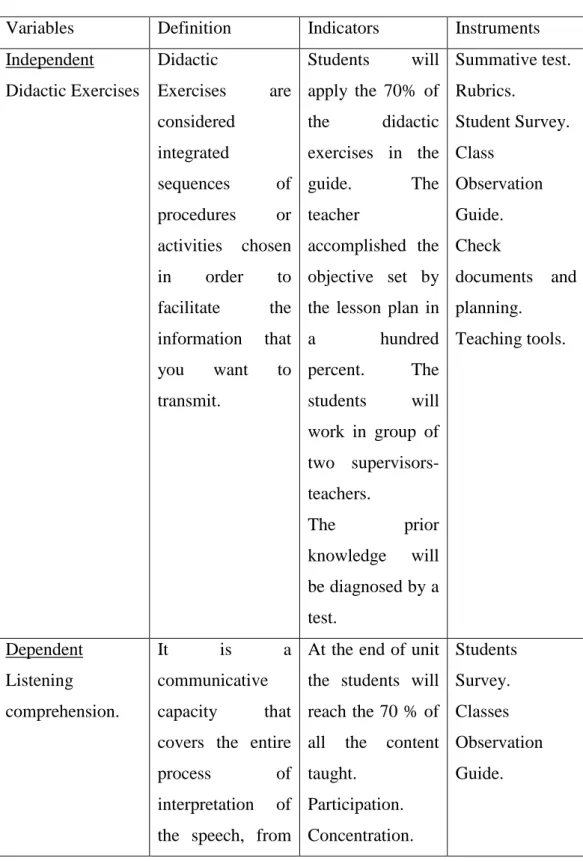
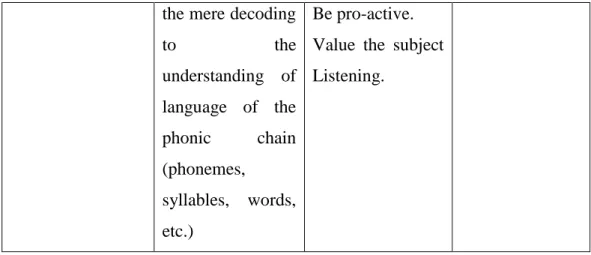
Table 1.Shows the variables, the conceptual definition, indicators and the instruments of evaluation used in this project
Variables Definition Indicators Instruments
Didactic strategies: Are training methods that tend to weigh on the educational style to engage the student's mind. Some core learning strategies include the sharing of knowledge with other students through a variety of structures. It also includes student working in groups based on ability level or interest and didactic exercises is a number of means or instruments that favor the process of teaching and learning.
Listening: Is often confused with hearing. While hearing is a biological process that can be scientifically explained, listening is a neurological cognitive regarding the processing of auditory stimuli received by the auditory system.
Comprehension: The action or capacity to understand something. It means the state of being comprehended or the capacity of the mind to perceive and understand.
San Jose la Salle high school: It is a catholic school and also it is a hundred years old in Guayaquil, so is the first that wants to be a bilingual school.
34
effects of language use on society. Sociolinguistics differs from sociology of language in that the focus of sociolinguistics is the effect of the society on the language.
Validity: Is the extent to which a test measures what it claims to measure. It is vital for a test to be valid in order for the results to be accurately applied and interpreted; also it isn’t determined by a single statistic, but by a body of research that demonstrates the relationship between the test and the behavior it is intended to measure.
A compound noun: is a noun (person, place, thing, idea) that is made up of more than one word. The parts can be connected with a hyphen, placed side by side without a space, or sometimes with a space.
Observations class: Is a formal or informal observation of teaching while it is taking place in a classroom or other learning environment. Typically conducted by fellow teachers, administrators, or instructional specialists, classroom observations are often used to provide teachers with constructive critical feedback aimed at improving their classroom management and instructional techniques.
Objective: A specific result that a person or system aims to achieve within a time frame and with available resources. In general, objectives are more specific and easier to measure than goals. Objectives are basic tools that underlie all planning and strategic activities.
Innovative: is the application of better solutions that meet new requirements, unarticulated needs, or existing market needs. This is accomplished through more effective products, processes, services, technologies, or ideas that are readily available to markets, governments and society.
35
Received Pronunciation: Often abbreviated to RP, is an accent of spoken English. Unlike other UK accents, it is identified not so much with a particular region as with a particular social group, although it has connections with the accent of Southern England. RP is associated with educated speakers and formal speech. It has connotations of prestige and authority, but also of privilege and arrogance.
2.8. Summary.
On October 14th2013, we started second term, thus the students gave us some flash cards that we sent them to do in their holidays in order to help them doing a review with the all vocabulary taught in the first term for example words like assignment, thumb, scratch, gestures, handshake, slightly, bury, spill also students did and heard new vocabulary about the last six units that they had to learn in the second term to get used to the new vocabulary.
In the first term, we finished the first six units and also we introduced rules about vowels sounds taken from Pronunciation pairs Cambridge “difference between /iy/ and /I/ sheep –ship, seat, sit, heel –hill, feel –fill and sleep –slip. The sound /I/ is usually spelled with the letter I and the sound /iy/ is usually spelled with the letter e, for this reason, the direction is “open your mouth a little more for /I/ because is a shorter, more relaxed sound than /iy/, push your tongue forward in your mouth. Second, the difference between sound /e/ and /ey/ pen –pain, wet –wait, test –taste, pepper –paper, shed –shade with the purpose that increase their comprehension when teachers start doing the didactic exercise with them. Our first didactic exercise was sing a song “Hold on little girl”, but with real musical instruments that some students played so during the class we were analyzing some vocabulary with their vowels sounds had such as seen /sin/, baby/beibi/,feel/fil/, too/tu/,fate/feIt/, will /wIl/,twist/twIst/,come /k^m/,let/let/.As a result, students enjoyed the activity because some of them had the ability to play music instruments and the opportunity to earn money when they left San Jose La Salle.
36
Add more examples like first, funny, before, off, office, difficult, telephone, alphabet, enough. The sound /p/ is spelled with the letter p .Add more examples paper, people, shopping, happy and the letter p is silent in these words: psychology, pneumonia, receipt. Also, we worked on unit 7 with all the exercises that the students’ book and workbook had, such as listen and fill in the blanks, complete the essay, true and false, and during this period we asked the students to create a comic story to develop in only one chapter in groups of five to say and explain who the characters are, principal characteristics about their creation with the purpose to let them know they can create everything they want. Similarly to the activity we developed in the first term, named Fruit salad.
Differences between creation and initiative is that creation is the act of producing or causing to exist; the act of creating, engendering and initiative is the power or ability to begin or to follow through energetically with a plan or task; enterprise and determination.
37
with lyrics and without understanding and comprehending the songs after that, we did a review playing Wii in guitar hero with them. The purpose of those activities was training the listening comprehension of the resources they had at hand and they preferred. Motivation is an inner drive to behave or act in a certain manner. These inner conditions such as wishes, desires and goals, activate to move in a particular direction in behavior.
We observed some students with good voice thus; we told them that there are some colleges that give scholarships to students with good voice for example Universidad Laica Vicente Rocafuerte as a means of motivation.
On December, we were teaching new consonants sound for example /l/ and /r/ long-wrong, light-write, pilot- pirate, glass –grass, cloud–crowd. The sound /l/ is spelled with the letter l. Add more examples late, early, sleep, told, trouble, call, spell, really, excellent. Other rule students were taught to be careful in their listening: the letter l is sometimes silent when it comes before a consonant: Talk, walk ,half, could, should, would, calm, palm. The sound /r/ is usually spelled with the letter r. Added more examples right, repeat, really, sorry, tomorrow, wrong, write, rhythm. Vowel is a speech sound which is produced by comparatively open configuration of the vocal tract, with vibration of the vocal cords but without audible friction, and which is a unit of the sound system of a language that forms the nucleus of a syllable; Contrasted with consonant.
38
false, the purpose of these activities was the importance of HIV or AIDS, because nowadays our teenagers live a free life.
Finally on January 2014, we did a reinforcement activity to cover all what was learned about vowel and consonants sound with tongue twister. Tongue-twister is a phrase that is designed to be difficult to articulate properly, and can be used as a type of spoken (or sung) word game. Some tongue-twisters produce results which are humorous (or humorously vulgar) when they are mispronounced, while others simply rely on the confusion and mistakes of the speaker for their amusement value. For example, Chester choses chestnuts, and cheddar cheese with chewy chives. He chewed them and he chose them. He chose them and he chewed them, those chestnuts, cheddar cheese and chives in cheery, charming chunks and finished unit 10; besides, we asked students for their feedback about the project but we did not finish the student book and work book, because students of 3rd course left first than the other students, as a consequence they had to do two exams the post – test and final exam on January. As a result most of them got 10, so in this year San Jose La Salle decided to take a general English exam with all the skills for the last year students, according to the regulations of the Ministry of Education. For this reason all of them got good grades in these exams too.
3. Research Methodology 3.1. Methods and Techniques
This study uses the quantitative approach and, it is exploratory because we are going to analyze and observe each of the listening classes in all third courses, so like a consequence, Explanatory, we will explain each of the didactic exercises found and analyzed in this problem. This study is also based on primary sources on the firsthand and it is finally descriptive.
The procedure was as followed :(1) Administer the pre – test, (2) Administer the questionnaire to students, (3) administer the questionnaire to teachers, (4) make the class observation, (5) apply the didactic exercises in the classroom, and (6) administer the post – test.
39
Ineval is the National Institute of Educational Assessment - is an organization autonomous in its financial, administrative and technical aspects, and is responsible for the external and internal evaluation of the National Education System of Ecuador. Also, its work is based on educational quality standards set by the Ministry of Education.
Loei is the Intercultural Education Act, is a law that regulates all educational school, it makes the students’ rights are respected and their obligations are complied; if they do not do well their obligations, they have to be punished also regularized by the ministry of education.
Pei is the Institutional education project, it analyzes the principles and purposes of the institution, teachers and learning resources available and needed, the teaching strategy, rules for teachers and students and the management system.
According to the Ineval, “the assessment process is a systematic, scientific, participatory, formative, designed to collect information related to the learning, skills, competence and students’ skills for developing values to make a better quality in the educational process”.
According to the Loei, “a test is one that offers alternative answers as true or false, identification and multiple choices“.
In our tests were clear and did not do for more than one interpretation in our questions or items, we included in our tests multiple choices, true or false, and short answers, thus we used images in the first item to understand better the question according to answer, second relate to the characters and situations about the conversation in which students had to relate, in the third and fourth item, the students had to choose the best option that that were four and finally short answer about the conversation to comprehend how students are about their comprehension.
40
We took the pretest on October 15th, 2013 and the post test was taken on January 24th, 2014 with good students’ grades.
The teachers and students’ questionnaires were taken asking several questions the impulse to our project to have positive results such as what, how who, when, what for, what I do, what I want learn, in order to have a good working environment that we could get good results in our project.
Our observations did through teachers’ skills, Comply with Rules and Regulations, aptitude to change in education, emotional development to have control among teachers that we are going to this project and also get a good planning with everything related to the topic and education.
3.2. Research population and sample
The population consists of all high school students in third course attending San José La Salle, which is 180; but we took 36 students of the parallel "C", which constitutes 20% of the population. Population is a numerical set that includes all the numbers within the entire group. We selected those students, because they got bad grades in the term; as there are just four teachers working in third year consequently we will analyze each course with them.
3.3.Research Instruments
The instruments were the following: A pre – test and post – test which contains five items:1) Listen the question and choose the correct answer,2) Circle T for true and F for false, 3) and 4) choose the correct answers, and finally 5) fill in the blanks. Didactic exercises will be measured according to student surveys thus, we will see if they are motivated or not to learn English with enthusiasm. A questionnaire to students which contains ten items to measure the quality of the listening class such as resources, schedule, motivation, develop in class, places, interactive and expectations.
41
Schedule is a plan for performing work or achieving an objective, specifying the order and allotted time for each part.
The observations check list to measure the quality listening teaching class through plans, coordination area, students’ needs, resources, environment, didactic exercises, values, investigations and respect.
Values can be defined as broad preference concerning appropriate courses of action or outcomes. As such, values reflect a person's sense of right and wrong or what "ought" to be and respect is a positive feeling of esteem or difference for a person or other entity.
The comprehensive collection of appropriate data and information activities will allow better selection of didactic exercises to be used in the classroom.
We will apply a test of vocabulary knowledge through interaction student to teacher, which would measure the level of students.
3.4. Data analysis methods
In the data analysis conducted was used the paired t-test at a significant level of 0.05.
3.4.1. Results and finding
Hypothesis 1
Hypothesis is a supposition or explanation (theory) that is provisionally accepted in order to interpret certain events or phenomena, and to provide guidance for further investigation. A hypothesis may be proven correct or wrong.
42 Table 2. The result of one test input and output
Test Students Minimum Maximum range median Standard
Deviation 7, they were 20% percent, there were thirteen students got nine that they were 60 %, only one student got 9.3, the range between minimum and maximum was 3.3, this average was 8.08 and standard deviation was 1.13.
To be more specific six students got six, two students got seven, thirteen students got nine, eight students got eight, four students got between 8.1 and 8.9 and only one student got 9.3.
In the post test also missed two students with minimum 8 and maximum 10, the maximum grade got more of 50% of students and the range was 2 with a median 9.64, the standard deviation was 0.55.
Finally, twenty three students got 10, ten students got nine and only one student got eight.
43
comprehension through our project; the results were very comfortable for us because, some students increased their grades and improved their abilities and comprehension.
In the Figure #1, the Histogram of the Pre-Testis presented,as we can see most of the students’ scores are in the range of 6 and 9.3.
According to this table, the students ‘scores in the pre – test were: 6 students were six
2 students were seven 13 students were nine 8 students were eight
4 students were between eight point one and eight point nine 1 student was nine point three
34 students took the pre –test
Histogram of Pretest
Pretest
F
re
q
u
e
n
cy
6.0 6.5 7.0 7.5 8.0 8.5 9.0 9.5
0
5
10
44
In Figure #2, the Boxplot of the Pre-Test is presented, as you can see there is one outlier that corresponds to the student who has the lowest grade, which is 6.
In this table, we can see maximum, minimum, median, and one outlier, because six students got 6.
6
.0
6
.5
7
.0
7
.5
8
.0
8
.5
9
45
In the Figure #3,the Histogram of the Post-Testis presented, as we can see most of the students’ scores are in the range of 9.5 and 10.
According to this table, the students’ scores in the post – test were: 23 students were ten.
10 students were nine. 1 student was eight.
34 students took the pre –test.
Histogram of Posttest
Posttest
F
re
q
u
e
n
cy
8.0 8.5 9.0 9.5 10.0
0
5
10
15
46
In Figure #4 is presented the Boxplot of the Post-Test, as you can see there is not an outlier in the boxplot.
In this picture, we can see maximum, minimum, median and there was not outlier.
8
.0
8
.5
9
.0
9
.5
1
0