
SYNTHESIS, CHARACTERIZATION AND PHOTOCATALYTIC EVALUATION OF NiWO4 FOR THE PRODUCTION OF H2 BY WATER SPLITTING
13
0
0
Texto completo
(2) XVIII International Congress of the Mexican Hydrogen Society. 1. Introduction The growing interest in the use of hydrogen (H2) as an energy carrier has been a consequence of today´s need of sustainable technologies. However, the routes to obtain this energy vector still have a dependence on traditional fuels, either electricity or fossil fuels [1], which does not contribute to reduce emissions of pollutants into the environment [2]. Solar energy has been taken as a reference in the use of an alternative and sustainable energy, because it is a renewable and accessible energy resource. The use of light or photons, has given rise to various investigations, which according to the thermodynamic reaction associated, can be divided into different areas such as photoelectrolysis, electrochemical photovoltaics and photocatalysis [3]. In general, the photocatalytic process material starts with the absorption of a photon over the surface of a semiconductor that induces the formation of an exciton, that is, an electron-hole pair (e-/h+), where the electrons of the valence band (BV) are promoted to the conduction band (BC), this energetic separation is called the band gap energy (Eg). In this photocatalysis process, with the use of semiconductor materials, reactions are carried out by the photons promoting oxidation and reduction reactions within the limits of interaction of the semiconductor and the water molecule, thus achieving its dissociation for the generation of H 2. The interest in obtaining the optimal properties of a photocatalytic semiconductor consists mainly in the efficiently conversion of solar energy, that is why the search for materials that meet characteristics such as photoactivity under the visible light spectrum is a desirable property. Since, by the use of these materials some portion of solar radiation that reaches the earth can be the utilized, which accounts for around 44% [4]. Otherwise, transition metal tungstates are versatile materials that are used, for their chemical stability and optical properties [5], in many industrial applications such as humidity sensors, optical fibers, ceramic pigments, catalysis [6], photoluminescent devices, capacitors [7], dielectric materials and as photocatalytic materials for the degradation of organic compounds in aqueous phase [8]. Although there is a great interest in these materials as photocatalysts, there are few studies on their use towards the photocatalysis for the generation of hydrogen by water-splitting [9, 10]. These tungstate materials can be synthesized following different synthesis routes that include: electrochemical methods [11], hydrothermal processes [12, 13], mechanochemical synthesis [14], the molten salt technique and chemical methods in aqueous phase (co-precipitation, sol- gel and precipitation [15, 16]). However, many of these routes require sophisticated equipment and conditions that limit their synthesis on a larger scale. On the other hand, the precipitation route is a simple method that allows the incorporation of physical devices as a source of stirring, or even the use of surfactants in order to control the size and dispersion of the synthesized materials to obtain particles at the nanoscale [17].. September 18th to 21st, 2018 in Mexico City, Mexico.. 376.
(3) XVIII International Congress of the Mexican Hydrogen Society. Under the precipitation route, the stirring process is crucial for obtaining powders by the appropriate mixing of reagents in aqueous phase. Different stirring devices are used in order to homogenize the dispersion and to avoid the agglomeration of particles to obtain fine particles [18]. The movement of the components in the mixture can be carried out by different basic mechanisms. In the laboratory, one of the conventional methods is to use a rotating field of magnetic force, which is used to induce a constant mechanical stirring [19], which is commonly known as magnetic agitation (AM). On the other hand, the mixture can also be homogenized by shear stress stirring [20]. In this type of stirring technique, a device employs the rotor/stator principle, where the mixture is driven axially through interstices at high speed, causing small turbulences within the mixture. This phenomenon allows an enhanced dispersion of the mixtures, as well as the incorporation of powders in liquids, as a consequence of the wet milling process that continuously occurs in the interstices of the rotor. In this paper a dissolution-precipitation route for the synthesis of nickel tungstate is proposed by the combined use of oleic acid as a surfactant and two different stirring techniques. These stirring methods consist in magnetic and shear stress, which were independently used during the precipitation process. Therefore, the aim of the present research is to synthesize, characterize and evaluate NiWO4 under a visible light radiation and to find appropriate synthesis conditions that allow obtaining a material that is suitable for the production of H 2 by water-splitting. 2. Materials and Methods Synthesis NiCl2∙6H2O, Na2WO4∙2H2O and oleic acid as surfactant were used, all of these analytical grade materials purchased from Sigma-Aldrich. NiWO4 was prepared via dissolution-precipitation directly in aqueous medium. The concentrations used were both 0.3 M, in a 1: 1 ratio for the Ni2+ and (WO4)2- ions, under two independent stirring sources: magnetic using a Thermolyne Cimarec 2, Model SP46925 and by shear stress by a Ultra-Turrax equipment model T18, IKA brand. Each of these devices were used separately. When the mixing process took place, oleic acid (AO) was added at 0.1 and 1% by volume. Later, when the mixing process ended, the precipitate was left under stirring for five additional minutes. The formed precipitate was filtered and washed with hexane, deionized water and ethanol. Then, the materials were kept at 80 ° C for 24 hours in a drying oven, and finally were heat-treated at 400 °C, for four hours. Characterization The thermal and stability behavior of the materials were analyzed by TGA in a TA Instruments model SDT Q600 V20.9. The crystalline structure of the materials was examined by the X-ray diffraction technique (XRD) using a Philips Xpert diffractometer, and employing a Cu-Kα radiation (λ = 0.15406 nm). The diffraction data were recorded for 2θ values between 10 and 80°. The crystallite size was calculated from the data of the obtained XRD patterns by using the Scherrer´s equation. While, the morphological characterization was performed using a scanning electron microscope (SEM) (Philips brand model XL 30 ESEM). The surface area was studied by N2 physisorption using the BET (Brunauer-Emmett-Teller) technique in a AUTOSORB-1C of. September 18th to 21st, 2018 in Mexico City, Mexico.. 377.
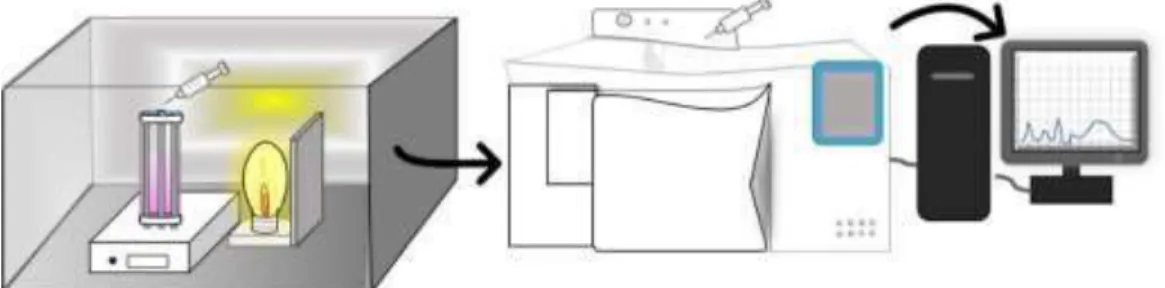
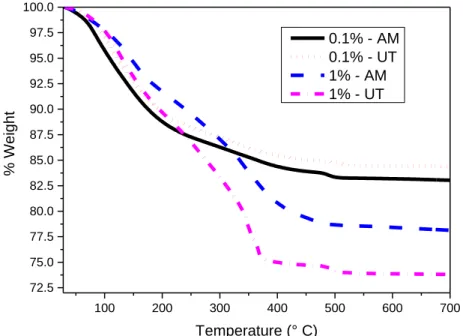
(4) XVIII International Congress of the Mexican Hydrogen Society. Quantachrome. For the band gap studies, a UV-Vis spectrophotometer equipped with an integration sphere (Perkin Elmer Lambda 25 brand) and the diffuse reflectance technique (DRS) were employed. Photocatalytic Evaluation Evaluation of the photocatalytic activity towards hydrogen production was performed using a 250 W Phillips metal halide lamp and a 2% V solution of methanol as a sacrifice agent. 0.2 grams of the synthesized NiWO4 photocatalyst was suspended in distilled water and placed in a laboratory scale reactor. The monitoring of the reaction was carried out using a gas chromatograph (Perkin Elmer Clarus 580 brand) for a period of 8 hours, with sampling at 1 hour intervals. Figure 1, presents a general scheme of the photocatalytic evaluation system employed in this research.. Figure 1. Photocatalytic evaluation system 3. Results and Discussion Thermal Analysis The thermal stability of the precipitated materials was determined through thermogravimetric analysis (TGA) experiments. Figure 2 presents results of TGA experiments performed on 0.1% V OA using magnetic stirring (AM) and 1% OA employing shear stress stirring (UT) samples and named 0.1%-AM, 0.1%-UT and 1%-AM, 1%-UT, respectively. In this Figure it can be seen that the synthesized materials present common characteristics. Below 100 °C, they present a weight loss that can be attributed to the elimination of water adsorbed on the surface of the material, consecutively the continuous loss of weight is attributed to chemically bound water up to a temperature of 100-250 °C. Furthermore, materials with 0.1% of AO have a weight loss of 8.5% by weight that is associated with the loss of 1.5 molecules of H 2O. For the samples with 1%, in the same interval, the loss was 7 and 7.5 H2O molecules for AM and UT, respectively. The subsequent weight loss of these samples is associated with the temperature at which the decomposition of the AO occurs, according to reports in the literature [21, 22]. This decomposition can occur in stages or even in a single step due to the type of OA adsorption on the surface of the material [23]. For samples with 0.1% AO, a weight loss of 3% occurs in two stages, suggesting that the AO is adsorbed on the surface in a physical and chemical manner, being this last in a lower extent. September 18th to 21st, 2018 in Mexico City, Mexico.. 378.
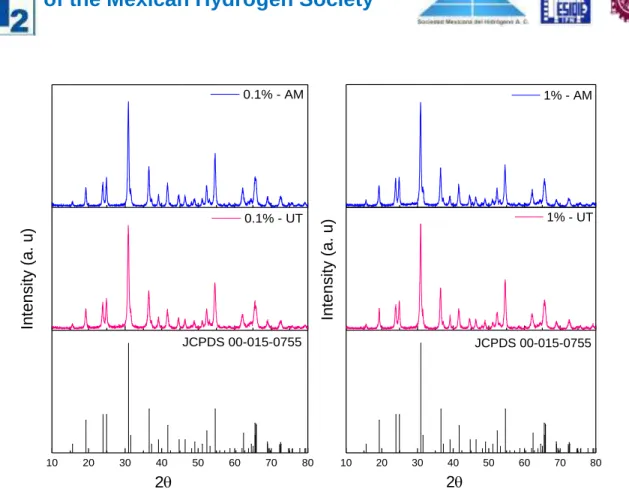
(5) XVIII International Congress of the Mexican Hydrogen Society. [22]. For the case of samples with 1% OA the weight loss is greater, therefore, the interaction between the material and the AO is expected to be stronger. 100.0 97.5. 0.1% - AM 0.1% - UT 1% - AM 1% - UT. 95.0. % Weight. 92.5 90.0 87.5 85.0 82.5 80.0 77.5 75.0 72.5 100. 200. 300. 400. 500. 600. 700. Temperature (° C). Figure 2. Thermogravimetric analysis curves of precipitated samples. X-Ray Diffraction The X-ray diffraction analysis of the thermally treated samples at 400 °C is presented in Figure 3. Based on these XRD patterns, it can be seen that identified signals present in the samples belong to a monoclinic phase of NiWO4 that matches with the standard of the Joint Committee for Powder Diffraction (JCPDS) with number 00-015-0755 [24-26]. Using the Scherrer´s equation, where half of the maximum width (FWHM) of the individual diffraction peak was taken as reference at ° 2θ = 19, crystallite sizes of 22 and 19 nm were calculated for samples with 0.1%, for AM and UT, respectively. While, samples with AO at 1% the for AM and UT presented crystallite values of 22 and 28 nm, respectively.. September 18th to 21st, 2018 in Mexico City, Mexico.. 379.
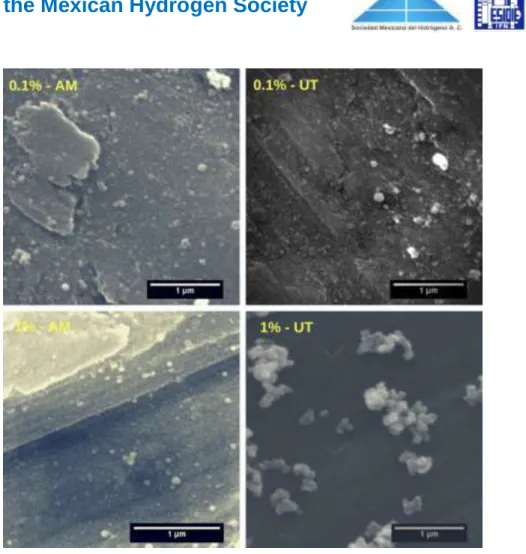
(6) XVIII International Congress of the Mexican Hydrogen Society. 0.1% - UT. 1% - UT. Intensity (a. u). 1% - AM. Intensity (a. u). 0.1% - AM. JCPDS 00-015-0755. 10. 20. 30. 40. 50. 60. 70. JCPDS 00-015-0755. 80. 10. 20. 30. 40. 50. 60. 70. 80. 2. 2. Fig. 3. Diffraction patterns of samples with 0.1 and 1% of AO using Am and UT stirring. Morphology Morphology of the samples was examined by SEM. Figure 4 show micrographs of thermally treated NiWO4 samples at different magnifications such as 20000 and 25000x. In this Figure, it is possible to notice that there are a series of lines corresponding to the sample holder and another region where a particle cluster is observed. The particles present a spherical type morphology with an average size of 75 and 65 nm for AM, with 0.1 and 1% AO, respectively. For samples stirred by UT the average size observed was 83 and 132 nm for UT with 0.1 and 1%, respectively.. September 18th to 21st, 2018 in Mexico City, Mexico.. 380.
(7) XVIII International Congress of the Mexican Hydrogen Society. Fig 4. SEM images of the heat-treated NiWO4 samples. BET surface area In order to determine the specific surface area and the pore size of the materials, BET tests were carried out. According to the results presented in Figure 5, the adsorption isotherms for the samples prepared by AM and UT (0.1 and 1% of AO) belong to a type IV with a H4 hysteresis curve, due to the range of P/Po (0.6-0.98) where the hysteresis occurs [27, 28], which is an indication that the material presents mesoporosity. Surface area of the AM samples were 22.4, and 27.7 m2/g, while for UT were 26.9 and 18.5 m 2 g for 0.1 and 1% of AO, respectively. These values agree well with those reported in the literature for this material [29-32].. September 18th to 21st, 2018 in Mexico City, Mexico.. 381.
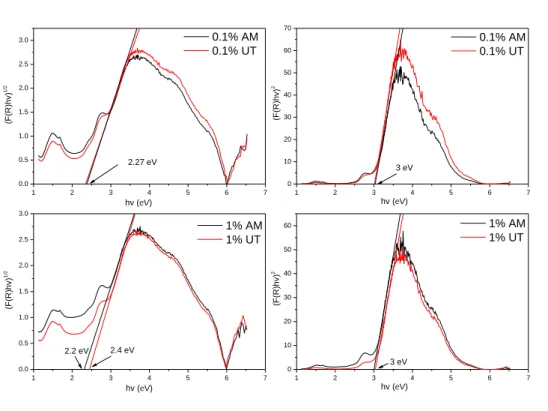
(8) XVIII International Congress of the Mexican Hydrogen Society. 0.1% AM. 25. Volumen (cc/g). Volumen (cc/g). 20. 15. 10. 5. 20. 15. 10. 5. 0. 0 0.0. 0.2. 0.4. 0.6. 0.8. 1.0. 0.0. 0.2. 0.4. 1% AM. 35. 0.6. 0.8. 1.0. 0.6. 0.8. 1.0. P/Po. P/Po. 40. 1% UT. 14 12. 30 25. Volumen (cc/g). Volumen (cc/g). 0.1% UT. 25. 20 15 10 5. 10 8 6 4 2. 0. 0 0.0. 0.2. 0.4. 0.6. 0.8. 1.0. P/Po. 0.0. 0.2. 0.4. P/Po. Fig 5. N2 physisorption isotherms for NiWO4 Optical Properties For the study of the optical properties of NiWO4, UV-Vis spectroscopy using the diffuse reflectance technique was used. The band gap energy (Eg) of the materials was calculated using the KubelkaMunk function (K-M or F (R)) that is presented in Eq. 1.. 𝐹 (𝑅∞ ) =. (1−𝑅)𝑛 2𝑅. (1). Figure 6 presents the values obtained from the F(R) function that were plotted versus hv and this representation is known as the Tauc method [33]. Furthermore, an Eg value is obtained by extrapolating a tangent line to the generated curve (with a positive slope) and the intersect value to the hv axis where F(R) is zero (see Fig. 6). The estimated values for the direct (n=½) and indirect (n=2) transitions were 2.27 and 3 eV for 0.1% OA and 2.2 ~ 2.4 and 3 eV for 1% OA, respectively for both AM and UT materials. According to the obtained Eg values from Figure 6, the values for the direct and indirect transitions fall within values reported in the literature (see Table 1). However, there are still no reports on a more accurate Eg for these materials. This is due to the fact that the material may contain structural defects that may change its optical properties, as Joy concluded [34]. In addition, considering the fact that the Eg value may vary according to an inverse relationship between the particle size and Eg, there is no significant difference in the Eg values obtained between agitation methods (AM and UT) and the amount of AO used.. September 18th to 21st, 2018 in Mexico City, Mexico.. 382.
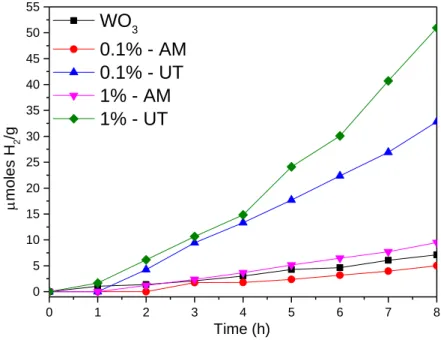
(9) XVIII International Congress of the Mexican Hydrogen Society. 70. 0.1% AM 0.1% UT. 3.0. 0.1% AM 0.1% UT. 60. 2.5. (F(R)hv)2. (F(R)hv)1/2. 50 2.0. 1.5. 1.0. 40 30 20. 0.5. 10. 2.27 eV. 0.0. 3 eV. 0 1. 2. 3. 4. 5. 6. 7. 1. 2. 3. 4. 5. 6. 7. hv (eV). hv (eV) 3.0. 1% AM 1% UT. 2.5. 1% AM 1% UT. 60. 50. (F(R)hv)2. (F(R)hv)1/2. 2.0. 1.5. 1.0. 40. 30. 20. 0.5. 2.2 eV. 10. 2.4 eV. 3 eV 0.0. 0 1. 2. 3. 4. 5. 6. 7. 1. 2. 3. 4. 5. 6. 7. hv (eV). hv (eV). Fig. 6. Tauc plots for NiWO4. Table 1. Band gap values reported for NiWO4 using direct and indirect transition This Work. Reported in the literature “n” non(n= ½) eV (n=2) eV (n=1/2) eV (n=2) eV specified 2.27 (0.1%-AM) 3.0 (0.1%-AM) 2.28 [35] 2.0 [35] 2.23 [39] 2.27 (0.1%-UT) 3.0 (0.1%-UT) 2.25 [36] 3.2 [38] 2.10 [40] 2.2 (1%-AM) 3.0 (1%-AM) 1.35 [36] 1.82 [37] 2.2 [41] 2.4 (1%-UT) 3.0 (1%-UT) 2.95 [37] Photocatalytic evaluation The photocatalytic evaluation for the generation of hydrogen was carried out for 8 continuous hours with sampling intervals of one hour for each of the synthesized materials. The comparison of H2 production was made taking WO3 as reference material during the corresponding evaluation. Figure 7 presents the photocatalytic evaluation of the NiWO4 samples in comparison with WO3 as a reference material. In this figure, the amount of H2 produced per mas of catalyst (μmH2/g) is. September 18th to 21st, 2018 in Mexico City, Mexico.. 383.
(10) XVIII International Congress of the Mexican Hydrogen Society. plotted as a function of time for each photocatalyst evaluated. In this plot it can be seen that the AM samples with 0.1 and 1% OA show a similar behavior to WO3, exhibiting a production of 5 and 10 μmol H2/g∙h. Despite the fact that these samples presented a larger BET area and a similar Eg compared to the 0.1%-UT and 1%-UT samples, the production of the latter were 30 and 50 μmol H2/g∙h, respectively. That is, the double and triple compared to AM and with respect to materials reported by López X. et al. [30]. The factors that are involved in the photocatalytic activity of each of these materials mainly consist of the recombination velocity of the excitons and on the position of the VB and CB valances according to Montini et. at [37]. It is important to note that the research reported in the literature for the generation of H 2 by water splitting under the same conditions of these materials is scarce. 55. WO3. 50. 0.1% - AM 0.1% - UT 1% - AM 1% - UT. 45 40. moles H2/g. 35 30 25 20 15 10 5 0 0. 1. 2. 3. 4. 5. 6. 7. 8. Time (h). Fig. 7 Photocatalytic evaluation of the NiWO4 samples compared to WO3 as reference 4. Conclusion The synthesis of NiWO4 powders using different stirring methods and the incorporation of AO as a surfactant was successfully carried out. The characterization of the materials indicates that with a thermal treatment at 400 °C the materials present crystalline phases corresponding to the wolframite structure. Results of the photocatalytic evaluation for the generation of H2 indicate that, it is possible to determine that the samples that were “shaken” under a UT stirring technique present a greater photocatalytic activity than those prepared by the conventional stirring method (AM. Furthermore, as part of the optical properties evaluated, in these materials no significant. September 18th to 21st, 2018 in Mexico City, Mexico.. 384.
(11) XVIII International Congress of the Mexican Hydrogen Society. differences were observed regarding the stirring method and the amount of surfactant (AO). However, from BET surface area results, it was possible to identify that an increase in the AO content in the samples did not contribute to a significant difference in the surface area values of the samples prepared by AM. On the other hand, the increase of 10% of AO in the UT sample is indicative of the limit values of the AO content that can be used for this material, if the purpose is to increase the sample surface area. Acknowledgements The authors acknowledge, Eng. Francisco Botello Rionda, M.Sc. Felix Ortega Celaya, M.Sc. Sergio Rodriguez Arias, Eng. Felipe de Jesus Marquez Torres, Eng. Wilber Antúnez Flores and Eng. Luis de la Torre Sáenz for their contributions to the results of TGA, DRX, SEM and BET. Special thanks are given to the National Nanotechnology Laboratory at the Advanced Materials Research Center, S.C. (CIMAV) and CINVESTAV Saltillo, for their support in the use of the facilities. In addition, thanks are given to CONACyT for the financial support provided to carry out the present research. References [1] Olah GA. Beyond Oil and Gas: The Methanol Economy. Angewandte Chemie International Edition. 2005;44:2636-9. [2] Ahmad H, Kamarudin SK, Minggu LJ, Kassim M. Hydrogen from photo-catalytic water splitting process: A review. Renewable and Sustainable Energy Reviews. 2015;43:599-610. [3] Pawar RC, Lee CS. Chapter 1 - Basics of Photocatalysis. In: Pawar RC, Lee CS, editors. Heterogeneous Nanocomposite-Photocatalysis for Water Purification. Boston: William Andrew Publishing; 2015. p. 1-23. [4] James Martin D. Investigation into High Efficiency Visible Light Photocatalysts for Water Reduction and Oxidation. London, United Kingdom: University College London; 2015. [5] Taneja P, Sharma S, Umar A, Mehta SK, Ibhadon AO, Kansal SK. Visible-light driven photocatalytic degradation of brilliant green dye based on cobalt tungstate (CoWO4) nanoparticles. Materials Chemistry and Physics. 2018;211:335-42. [6] Pourmortazavi SM, Rahimi-Nasrabadi M, Khalilian-Shalamzari M, Zahedi MM, Hajimirsadeghi SS, Omrani I. Synthesis, structure characterization and catalytic activity of nickel tungstate nanoparticles. Applied Surface Science. 2012;263:745-52. [7] Xing X, Gui Y, Zhang G, Song C. CoWO4 nanoparticles prepared by two methods displaying different structures and supercapacitive performances. Electrochimica Acta. 2015;157:15-22. [8] Ahmadi F, Rahimi-Nasrabadi M, Fosooni A, Daneshmand M. Synthesis and application of CoWO4 nanoparticles for degradation of methyl orange. Journal of Materials Science: Materials in Electronics. 2016;27:9514-9. [9] Chen P, He HY. H2 evolution from H2O/H2O2/MWO4 (M = Fe2+, Co2+, Ni2+) systems by photocatalytic reaction. Research on Chemical Intermediates. 2014;40:1947-56.. September 18th to 21st, 2018 in Mexico City, Mexico.. 385.
(12) XVIII International Congress of the Mexican Hydrogen Society. [10] Jothivenkatachalam K, Prabhu S, Nithya A, Chandra Mohan S, Jeganathan K. Solar, visible and UV light photocatalytic activity of CoWO4 for the decolourization of methyl orange. Desalination and Water Treatment. 2015;54:3134-45. [11] Pourmortazavi SM, Rahimi-Nasrabadi M, Fazli Y, Mohammad-Zadeh M. Taguchi method assisted optimization of electrochemical synthesis and structural characterization of copper tungstate nanoparticles. International Journal of Refractory Metals and Hard Materials. 2015;51:29-34. [12] Fu H, Lin J, Zhang L, Zhu Y. Photocatalytic activities of a novel ZnWO4 catalyst prepared by a hydrothermal process. Applied Catalysis A: General. 2006;306:58-67. [13] Deng J, Chang L, Wang P, Zhang E, Ma J, Wang T. Preparation and magnetic properties of CoWO 4 nanocrystals. Crystal Research and Technology. 2012;47:1004-7. [14] Mancheva M, Iordanova R, Dimitriev Y. Mechanochemical synthesis of nanocrystalline ZnWO4 at room temperature. Journal of Alloys and Compounds. 2011;509:15-20. [15] Pourmortazavi SM, Rahimi-Nasrabadi M, Khalilian-Shalamzari M, Ghaeni HR, Hajimirsadeghi SS. Facile Chemical Synthesis and Characterization of Copper Tungstate Nanoparticles. Journal of Inorganic and Organometallic Polymers and Materials. 2014;24:333-9. [16] Montemayor SM, Fuentes AF. Electrochemical characteristics of lithium insertion in several 3D metal tungstates (MWO4, M=Mn, Co, Ni and Cu) prepared by aqueous reactions. Ceramics International. 2004;30:393-400. [17] El-Shazly AN, Rashad MM, Abdel-Aal EA, Ibrahim IA, El-Shahat MF, Shalan AE. Nanostructured ZnO photocatalysts prepared via surfactant assisted Co-Precipitation method achieving enhanced photocatalytic activity for the degradation of methylene blue dyes. Journal of Environmental Chemical Engineering. 2016;4:3177-84. [18] Yoruç ABH, Koca Y. DOUBLE STEP STIRRING: A NOVEL METHOD FOR PRECIPITATION OF NANO-SIZED HYDROXYAPATITE POWDER. Digest Journal of Nanomaterials & Biostructures (DJNB). 2009;4:73-81. [19] Carrà S. FUNDAMENTALS OF CHEMISTRY - Volume I2009. [20] Wilkinson JB, Moore RJ, Navarro MAR, Devesa DR. Cosmetología de Harry: Díaz de Santos; 1990. [21] Baharuddin AA, Ang BC, Abu Hussein NA, Andriyana A, Wong YH. Mechanisms of highly stabilized exsitu oleic acid-modified iron oxide nanoparticles functionalized with 4-pentynoic acid. Materials Chemistry and Physics. 2018;203:212-22. [22] Zhao SY, Lee D-G, Kim C-W, Cha H-G, Kim Y-H, Kang Y-S. Synthesis of magnetic nanoparticles of Fe3O4 and CoFe2O4 and their surface modification by surfactant adsorption. Bulletin of the Korean Chemical Society. 2006;27:237-42. [23] Shen L, Laibinis PE, Hatton TA. Bilayer Surfactant Stabilized Magnetic Fluids: Synthesis and Interactions at Interfaces. Langmuir. 1999;15:447-53. [24] Nithiyanantham U, Ede SR, Anantharaj S, Kundu S. Self-Assembled NiWO4 Nanoparticles into Chainlike Aggregates on DNA Scaffold with Pronounced Catalytic and Supercapacitor Activities. Crystal Growth & Design. 2015;15:673-86. [25] Mohamed MM, Ahmed SA, Khairou KS. Unprecedented high photocatalytic activity of nanocrystalline WO3/NiWO4 hetero-junction towards dye degradation: Effect of template and synthesis conditions. Applied Catalysis B: Environmental. 2014;150-151:63-73.. September 18th to 21st, 2018 in Mexico City, Mexico.. 386.
(13) XVIII International Congress of the Mexican Hydrogen Society. [26] Song Z, Ma J, Sun H, Wang W, Sun Y, Sun L, et al. Synthesis of NiWO 4 nano-particles in lowtemperature molten salt medium. Ceram Int. 2009;35. [27] Wang Y, Liping L, Li G. Solvothermal synthesis, characterization and photocatalytic performance of Zn-rich ZnWO4 nanocrystals. Applied Surface Science. 2017;393:159-67. [28] Wang J, Zhou Y, Hu Y, O’Hayre R, Shao Z. Facile Synthesis of Nanocrystalline TiO 2 Mesoporous Microspheres for Lithium-Ion Batteries. The Journal of Physical Chemistry C. 2011;115:2529-36. [29] M Zawawi SM, Yahya R, Hassan A, Mahmud HNME, Daud MN. Structural and optical characterization of metal tungstates (MWO4; M=Ni, Ba, Bi) synthesized by a sucrose-templated method. Chemistry Central Journal. 2013;7:80. [30] López XA, Fuentes AF, Zaragoza MM, Díaz Guillén JA, Gutiérrez JS, Ortiz AL, et al. Synthesis, characterization and photocatalytic evaluation of MWO4 (M = Ni, Co, Cu and Mn) tungstates. International Journal of Hydrogen Energy. 2016;41:23312-7. [31] Mohamed MM, Ahmed SA, Khairou KS. Unprecedented high photocatalytic activity of nanocrystalline WO3/NiWO4 hetero-junction towards dye degradation: Effect of template and synthesis conditions. Applied Catalysis B: Environmental. 2014;150-151:63-73. [32] AlShehri SM, Ahmed J, Alzahrani AM, Ahamad T. Synthesis, characterization, and enhanced photocatalytic properties of NiWO4 nanobricks. New Journal of Chemistry. 2017;41:8178-86. [33] López R, Gómez R. Band-gap energy estimation from diffuse reflectance measurements on sol–gel and commercial TiO2: a comparative study. Journal of Sol-Gel Science and Technology. 2012;61:1-7. [34] Joy J. Doping Effect an Optical Band Gap and Luminescence of Pure and Nd-Doped CoWO4 Wolframite Nanostructure Synthesized by Chemical Precipitation. Int J Chem Concepts. 2015;1:44-56. [35] Pandey PK, Bhave NS, Kharat RB. Structural, optical, electrical and photovoltaic electrochemical characterization of spray deposited NiWO4 thin films. Electrochimica Acta. 2006;51:4659-64. [36] Karthiga R, Kavitha B, Rajarajan M, Suganthi A. Photocatalytic and antimicrobial activity of NiWO 4 nanoparticles stabilized by the plant extract. Materials Science in Semiconductor Processing. 2015;40:123-9. [37] Montini T, Gombac V, Hameed A, Felisari L, Adami G, Fornasiero P. Synthesis, characterization and photocatalytic performance of transition metal tungstates. Chemical Physics Letters. 2010;498:113-9. [38] Parhi P, Karthik TN, Manivannan V. Synthesis and characterization of metal tungstates by novel solid-state metathetic approach. Journal of Alloys and Compounds. 2008;465:380-6. [39] Farsi H, Hosseini SA. The electrochemical behaviors of methylene blue on the surface of nanostructured NiWO4 prepared by coprecipitation method. Journal of Solid State Electrochemistry. 2013;17:2079-86. [40] Bharati R, Singh RA, Wanklyn BM. Electrical conductivity of single crystal nickel tungstate. Journal of Materials Science. 1983;18:1540-2. [41] Ahmed MI, Adam A, Khan A, Siddiqui MN, Yamani ZH, Qamar M. Synthesis of mesoporous NiWO 4 nanocrystals for enhanced photoelectrochemical water oxidation. Materials Letters. 2016;177:135-8.. September 18th to 21st, 2018 in Mexico City, Mexico.. 387.
(14)
Figure
+4

Documento similar