
Place based education in an urban context: an ecotourist approach
94
0
0
Texto completo
(2) PLACE-BASED EDUCATION IN AN URBAN CONTEXT: AN ECOTOURIST APPROACH. CARLOS MARIO MORALES TARAPUES This project is presented to obtain the diploma of Licenciatura en Español y Lenguas Extranjeras. Project director JOHANNA MONTAÑO MORENO. UNIVERSIDAD PEDAGÓGICA NACIONAL FACULTAD DE HUMANIDADES DEPARTAMENTO DE LENGUAS BOGOTÁ, 2019.
(3) Acknowledgements This path was full of life-lasting lessons and amazing people who contributed in many ways in my process of becoming a teacher. First, I want to thank my parents and my family for their constant support and for being my motivation and the cornerstone of all my achievements. I would like also to thank Johanna Montaño for her dedication with the direction and development of this project and offering her wisdom in guidance of every step taken along the way. My most sincere gratitude to Universidad Pedagógica Nacional for allowing me to get to know the greatest teachers, people and friends. Finally, thanks to Prado Veraniego School and the students who participated in this study for letting me to live the most memorable experiences..
(4) FORMATO RESUMEN ANALÍTICO EN EDUCACIÓN - RAE Código: FOR020GIB. Versión: 01. Fecha de Aprobación: 10-10-2012. Página 1 de 5. Tipo de documento. 1. Información General Trabajo de grado. Acceso al documento. Universidad Pedagógica Nacional. Biblioteca Central. Título del documento. Place-Based Education in an urban context: an ecotourist approach (Educación basada en el lugar en un contexto urbano: un enfoque ecoturista). Autor(es). Morales Tarapues, Carlos Mario.. Director. Montaño Moreno, Johanna.. Publicación. Bogotá, Universidad Pedagógica Nacional, 2019, 93p.. Unidad Patrocinante. Universidad Pedagógica Nacional. Palabras Claves. EDUCACIÓN BASADA EN EL LUGAR, ECOTURISMO, HABILIDADES INTEGRADAS, CONTEXTO URBANO, INGLÉS COMO LENGUA EXTRANJERA, APRENDIZAJE BASADO EN PROYECTOS. 2. Descripción Investigación acción de carácter cualitativo desarrollada en el Colegio Prado Veraniego I.E.D. ubicado en la localidad de Usaquén de la ciudad de Bogotá, en la cual se llevó a cabo una intervención pedagógica en los grados sexto y séptimo con el fin de implementar el enfoque de la Educación basada en el lugar en el aula de inglés como lengua extranjera para mejorar el desarrollo de las habilidades integradas y la creación de proyectos de ecoturismo.. 3. Fuentes Alshenqeeti H. (2014) Interviewing as a Data Collection Method: A Critical Review. Sciedu Press Vol. 3, No. 1. Bloor M. and Wood F. (2006) Keywords in Qualitative Methods: A Vocabulary of Research Concepts. SAGE Publications: London. Brikci N. and Green J. (2007). A Guide to Using Qualitative Research Methodology. Medecins Sans frontieres..
(5) FORMATO RESUMEN ANALÍTICO EN EDUCACIÓN - RAE Código: FOR020GIB. Versión: 01. Fecha de Aprobación: 10-10-2012. Página 2 de 5. Brooke, R. (2003). Rural voices. 1st ed. New York: Teachers College Press. Brown, D. (2001). Teaching by Principles an Interactive Approach to Language Pedagogy. San Francisco: Longman Buck Institute for Education (2018) What is PBL? . Retrieved from: http://www.bie.org/about/what_pbl Burns, A. (2010). Doing action research in English language teaching. 1st ed. New York: Routledge Clark, D. (2008). Learning to make choices for the future: Connecting public lands, schools, and communities through place-based learning and civic engagement. Center for Place-based Learning and Community Engagement. Council of Europe. (2001). Common European Framework of Reference for Languages: Learning,Teaching, Assesment. Cambridge University Press. Corbin, J., & Strauss, A. (1990). Grounded theory Research: Procedures, canons, and Evaluate criteria. Human Sciences Press. Desai, R. (2013). Schools and Place-Based Curriculum. Retrieved from: https://bristolculturaleducationstrands.weebly.com/ Emerson, R. M., Fretz, R. I., & Shaw, L. L. (2011). Writing ethnographic field notes. University of Chicago Press. Fly, J. M. (2010). A Place-Based Model for K-12 Education in Tennessee. Universtiy of Tennessee. Retrieved from http://web.utk.edu/~markfly/documents/Place-Based K-12Education Proposal 5_10_10.pdf Getting Smart (2018) What is Place-based education and why does it matter? Retrieved from: http://www.gettingsmart.com/wp-content/uploads/2017/02/What-is-Place-Based-Education-andWhy-Does-it-Matter-3.pdf Jones, B. F., Rasmussen, C. M., & Moffitt, M. C. (1997). Real-life problem solving.: A collaborative approach to interdisciplinary learning. Washington, DC: American Psychological Association. Kolb, D. (2015) Experiential Learning: Experience as the Source of Learning and Development. Pearson Education.
(6) FORMATO RESUMEN ANALÍTICO EN EDUCACIÓN - RAE Código: FOR020GIB. Versión: 01. Fecha de Aprobación: 10-10-2012. Página 3 de 5. Lave, J., & Wenger, E. (1991) Situated Learning: Legitimate Peripheral Participation. Cambridge: Cambridge University Press. LeCompte M. & Goets J. (March 1, 1982) Problems of Reliability and Validity in Ethnographic Research. Review of Educational Research, (52), p. 31-60. Ley 300 de 1996. Diario Oficial 42845 de julio 30 de 1996. Lodico, M., Spaulding, D. & Voegtle, K. (2010). Methods in Educational Research: From Theory to Practice, 2nd Edition. San Francisco, CA: Jossey-Bass. Mathers N., Fox N. and Hunn A. (2007) Surveys and Questionnaires. The NIHR RDS for the East Midlands / Yorkshire & the Humber. Mertler C. (2008) Action Research: Teachers as Researchers in the Classroom. SAGE Publications: Thousand Oaks, CA. Ministry of Education. 2006. Estándares Básicos de Competencias en Lenguas Extranjeras: Inglés. Ospina, S. (2004). Qualitative Research. Robert F. Wagner Graduate School of Public Service. New York University Oxford, Rebecca L. (2001). Integrated skills in the ESL/EFL classroom. [Washington, DC]: [Center for Applied Linguistics, ERIC Clearinghouse on Languages and Linguistics], Parsons, R.D. & Brown K. (2002) Teacher as Reflective Practitioner and Action Researcher. Belmont, Calif.: Wadsworth/Thomson Learning. S. E. Efron & R. Ravid. (2013). Action Research in Education: A Practical Guide. New York, NY: Guilford Press. Seltiz, C. & Wrightsman, L.C. & Cook, W.S. 1976. Research m ethods in social relations. 3rd edition. New York: Holt Rinehart & Winston. Sobel, D. (2004). Place-based Education: Connecting Classroom and Community Nature and Listening, 4. The International Ecotourism Society. (2015) What is Ecotourism? Retrieved from: http://www.ecotourism.org/what-is-ecotourism.
(7) FORMATO RESUMEN ANALÍTICO EN EDUCACIÓN - RAE Código: FOR020GIB. Versión: 01. Fecha de Aprobación: 10-10-2012. Página 4 de 5. Tudor, Ian. (2001). The dynamics of the language classroom. Cambridge University Press. Scott, H. (2009) What is Grounded Theory? Retrieved from: http://www.groundedtheoryonline.com/what-is-grounded-theory/ World Tourism Organization. (2002) Ecotourism and Protected areas. Retrieved from: http://sdt.unwto.org/content/ecotourism-and-protected-areas. 4. Contenidos Este estudio presenta un enfoque de investigación acción, por lo tanto, se desarrolló a lo largo de seis capítulos. En el primer capítulo se realiza una descripción y contextualización del lugar y población con la que se llevó a cabo la intervención pedagógica. Igualmente, se identifica el problema de investigación con una posterior delimitación de la pregunta de investigación y sus objetivos, general y específico. Esta pregunta está enfocada en el análisis del impacto de implementar la Educación Basada en el Lugar a través de un proyecto de Ecoturismo para desarrollar las habilidades integradas de los participantes. En el segundo capítulo se presenta el estudio del arte y el marco teórico que soporta científica y teóricamente la creación de constructos referentes al tema de la investigación. El tercer capítulo desarrolla el diseño metodológico del proyecto, explicando el procedimiento para el uso de instrumentos de recolección de datos y el posterior análisis de estos. Luego, en el cuarto capítulo se presenta la descripción de la intervención pedagógica llevada a cabo en este proyecto el cual constó de tres ciclos. De igual manera, en el capítulo cinco se presenta el análisis de los datos recolectados a través de la intervención y los descubrimientos logrados. Por último, el capítulo seis presenta las conclusiones a su vez que discute los hallazgos del proyecto, sus impactos, limitaciones y recomendaciones del estudio.. 5. Metodología Este proyecto de investigación acción fue llevado a cabo a lo largo de tres fases. La primera fase consistió en un proceso de observación y recolección de muestras para determinar el problema y pregunta de investigación. De este modo, para la segunda fase, se diseñó la propuesta de intervención pedagógica que buscaba dar solución al problema de investigación encontrado. Así, el desarrollo de sesiones de clase con la población permitió guiar el proyecto a través de la observación, planeación, diseño y aplicaciones para luego llevar acabo un nuevo proceso de observación que permitiera realizar una reflexión sobre los datos e información recolectada durante las intervenciones. Esto permitió encontrar dificultades y debilidades a lo largo del proceso de intervención para sesiones futuras. Igualmente, la recolección de los datos se llevó a cabo a través de instrumentos como diarios de campo, grabaciones, entrevistas, encuestas y.
(8) FORMATO RESUMEN ANALÍTICO EN EDUCACIÓN - RAE Código: FOR020GIB. Versión: 01. Fecha de Aprobación: 10-10-2012. Página 5 de 5. artefactos. Finalmente, luego de la intervención pedagógica, se procedió a organizar y sistematizar la información recolectada lo cual permitió un adecuado análisis de la misma. Así pues, los hallazgos encontrados permitieron el establecimiento de conclusiones, implicaciones, limitaciones y sugerencias para futuras investigaciones en relación tema de este proyecto.. 6. Conclusiones Las conclusiones de este proyecto surgen a partir de las categorías de análisis derivadas de la pregunta de investigación y de los objetivos específicos propuestos. Así, en relación a la primera categoría de análisis, la cual busca identificar las habilidades de la lengua que se desarrollan a través de la participación en un proyecto de ecoturismo, se concluyó que las habilidades que mas se desarrollaron fueron especialmente las habilidades de escuchar, escribir y leer. A su vez, en el análisis de la segunda y tercera categoría están enfocados en describir los roles que la Educación basada en el lugar presenta y potencian al estudiante frente al aprendizaje del inglés como lengua extranjera. Estos son: un rol de conectar al estudiante con sus alrededores y un rol de apoyo en la transformación de los estudiantes en agentes de cambio ambiental. De esta manera, se pudo concluir que estos roles permiten desarrollar en los participantes diferentes actitudes hacia el lugar en donde el aprendizaje tiene lugar. Estas actitudes van dirigidas hacia la relación que tienen con su contexto inmediato y la importancia que tiene para ellos cuidar de este. De igual manera, estas actitudes se presentan en comportamientos sociales y escolares que motivan al estudiante a tomar acciones encaminadas al cuidado de la naturaleza y el medio ambiente.. Elaborado por: Revisado por:. Morales Tarapues, Carlos Mario. Montaño Moreno, Johanna.. Fecha de elaboración del Resumen:. 10. 05. 2019.
(9) CONTENT TABLE Abstract………………………………………………………………...…………………………1 Chapter I. Contextualization and research problem………………...………………………...3 Context……………………………………………………………...……………………..…...3 Participants………………………………………………...…………………………………..5 Statement of the problem….………...…………………..……………………………………5 Rationale of the study…………………………………..……………..………………………7 Research questions………………………...……………………………………..……...…...10 Research objectives………………………………………………...………...……………....10 Chapter II. Theoretical framework and Literature review……………...…………………..11 State of the art…………………………………...……………………………...……………11 Theoretical framework………………………………………………………………………15 Chapter III. Methodological design…………………………………………………….….….22 Research paradigm…………………………………………………………………………..22 Type of study……………………………………….……………………………….……......23 Data collection instruments and procedures……………………………………………….…………………………..…….....24 Chapter IV. Pedagogical intervention…………………………………………….………......30 Vision of curriculum………………………….…………………………………...…………30 Vision of learning…………………………….…………………………………...………….31 Vision of language……………………………………………………………...…………….32 Vision of classroom……………………………………………………………………..........32 Instructional design………………………………………………………………...………..33 Chapter V. Data analysis and findings…………………………………………...…………...39 Categories of analysis…………………………………………………………..……………41 Category 1: Developing EFL integrated skills through an Ecotourism project………………………………………………………………43 Category 2: Connecting to their surroundings through Place-Based Education in EFL……………………………………………………53.
(10) Category 3: Supportive role of Place-Based Education to become agents of change……………………………………………………………..……………….55 Chapter VI…………………………………….…………………………………………...........58 Conclusions…………………….……………………………………………………………...58 Implications………………………….……………………………………………….............61 Limitations…………………………………………………………………….………...........63 Further research………………………………………………………………….………….64 References……………………………………………………………………………………….65.
(11) List of tables Table 1: Plan of triangulation………………………………………………………………….25 Table 1: Pedagogical intervention….…………………………...…………………….……….35 Table 2: Categories and subcategories...…………………………………………...………….41 List of appendices Annex 1: Informed consent …………………...………………………………..……………...68 Annex 2: Characterization survey ………………...…………………….…………….………69 Annex 3: Field note sample………….………………………………………….….…………..70 Annex 4: Second cycle survey…………………………...…………..…………………………73 Annex 5: Teacher’s interview sample ……………………..………………………………….74 Annex 6: Final interview Sample …………………………..…………...……………………..75 Annex 7: Artifacts ………………………………………...…………………………………....76 Annex 8: Field trip video……………………………………………………………………….77 Annex 9: Lesson plan sample……………………………..……………………………………78 Annex 10: Presentation format………...…………..……………………………………….….83.
(12) Abstract This document presents the development of an action-research project as well as the pedagogical proposal designed in order to establish the impact of implementing Place-Based Education with the objective of developing Integrated Skills in the English as a foreign language class through participation in projects of Ecotourism. The participants in this research were sixth grade students of Prado Veraniego School I.E.D, located in Bogotá, Colombia. Throughout the intervention process, data were collected during the interventions of the pre-service, following a methodological design of three cycles in which a foundation on Ecotourism was developed, a real practice of this activity and finally the design of a project about this topic in the English classroom. The results that emerged from the triangulation of data allowed to analyze the findings and account for the conclusions, in turn to explain the implications and limitations of the project. Keywords: Place-Based Education, Integrated Skills, Ecotourism, urban context, English as a Foreign language. Resumen. Este documento presenta el desarrollo de una investigación-acción al igual que la propuesta pedagógica diseñada para establecer el impacto de implementar la Educación Basada en el Lugar con el objetivo de desarrollar Habilidades Integradas en la clase de inglés como lengua extranjera a través de la participación en proyectos de Ecoturismo. Los participantes de esta investigación fueron estudiantes de grado sexto del Colegio Prado Veraniego I.E.D, ubicado en Bogotá, Colombia. A lo largo del proceso de intervención se recopilaron datos en relación a las intervenciones del docente en formación, siguiendo un diseño metodológico de tres ciclos en los 1.
(13) que se desarrolló una fundamentación en Ecoturismo, una práctica real de esta actividad y finalmente el diseño de un proyecto sobre este tema en el aula de inglés. Los resultados que surgieron de la triangulación de datos permitieron analizar los hallazgos y dar cuenta de las conclusiones, a su vez que explicar de las implicaciones y limitaciones del proyecto. Palabras clave: Educación Basada en el lugar, Habilidades integradas, ecoturismo, contexto urbano, inglés como lengua extranjera.. 2.
(14) CHAPTER I Contextualization and Research Problem Context This study was held at Prado Veraniego School I.E.D., an official school linked to the Secretary of Education of Bogotá, which offers formal educational services in the preschool, elementary and secondary levels. It is opened to a mixed student population aged between 5 and 18 years old. This school emerges from the integration of the IED Prado Veraniego I (founded in 1960) and Prado Veraniego II (founded in 1979) in the year 2000, and it is situated in the neighborhood Prado Veraniego in the north part of the city which is, at the same time, placed in the Suba locality and it has two branches. The branch A is situated in the address Carrera 46 #130 – 65 and it serves the secondary level of education; on the other hand, the branch B is located in the address Carrera 56A #128 – 51 and it receives the preschool and Elementary levels of education. Additionally, it has a morning shift and an afternoon shift in both branches for each level of education. As the school is found in the locality 11- Suba, it becomes relevant to mention that this locality covers most part of north-western Bogotá and in the north, it limits with Chía municipality, in the east with the locality Usaquén, in the west it limits with Cota municipality and in the south, it limits with the localities Engativá and Barrios Unidos. In addition, most of the neighborhoods in the area belong to the socioeconomic strata 3, 4, and 5, however, the inhabitants of the neighborhood in which the school is found belong to the strata 2 and 3. 3.
(15) Furthermore, the most present economic activity in the school surroundings is the motorcar industry; thus, it is possible to find selling and repairing of vehicle parts and different maintenance services for automobiles. Also, the Prado Veraniego School I.E.D mission is to generate and strengthen the cognitive, social, and practical processes in the educative community, pointed towards the education of competent human beings throughout a communication with quality that allows them to appropriate the values for a healthy cohabitation. In addition, the Vision of Prado Veraniego School I.E.D proposes itself to take a stance at local, district and national level in 2020, as an institution that prepares people for life, committed with their human development and who continue with their academic education, live through values and lead positives processes of social change in order to make possible a harmonious cohabitation for building a fairer and solidary country. The institutional emphasis emerges from a discussion in which teachers from the school agreed that, based on the resources and students’ interests, VALUES and COMMUNICATION should be the foundation and the way to achieve the objectives of the Institutional Educative Project (IEP). Correspondingly, the IEP of Prado Veraniego School is: “Communication with quality towards human development”, basing its actions, its conceptual and organizational context, and its pedagogical and administrative approach on the humanistic and scientific values that identify the institution as an educative organization in search for integral development throughout high-quality communication. The pedagogical model of Prado Veraniego School (IED) bases its educative process in the social-cognitive model. This model establishes that knowledge and learning are social constructions that allow capacities development and student’s interests with each experience. It 4.
(16) is based on the solution of the daily problem through cooperative work, critic analysis, and social commitment. In terms of contents, the student is the one that chooses what is relevant to him and is able to recognize his environment and others’ opinions in order to make his own decisions. At last, assessment is dynamic, and it is based on self-assessment, peer assessment, and heteroassessment processes. Participants This research was developed with the grade 601 (during the first two semesters of observation and implementation) and the grade 701 (in the last semester of implementation) of the Prado Veraniego School IED (Branch A). These grades were formed by 38 students, boys and girls aged between 10 and 13 years old. Hence, the permission given by legal tutors using an informed consent format (see annex 1) allowed me to look into some information of the participants. In order to get to know and characterize the group, it was necessary to use three different data collection tools: a class observation process done by the researcher and compiled in field notes, the application of a characterization survey to 26 of the students (see annex 2) in order to get to know some social and family characteristics, and finally, an interview to the homeroom teacher. Statement of the problem The diagnosis held during the first semester of 2018 revealed that the most significant problem presented inside the English classes was related to the low use of the main four language skills, all of them on the same level. This means the students’ integrated skills and their capacity to use appropriate language in a communicative way were not at that moment the most. 5.
(17) developed abilities. Furthermore, the students’ language performance presented some difficulties that affected their language acquisition process and their attitudes towards the English language. The former might be presented due to the constant use of Spanish to communicate during the class. In this way, not all the interactions inside the EFL classroom were presented in the target language. On the contrary, language along the English classes was focused on vocabulary learning, rewriting exercises, and translation. Also, the different instruments provided not only a perception of the problematics found in terms of language, but also a problematic with classes’ connection with two of the three institutional emphasis (Communication and Tourism) and IEP. This last states that communication is the foundation for the construction of human beings and society, however, this is not a present factor during English classes and this could be seen in students’ failure at the moment of using the language. Additionally, as mentioned before, the development of the Tourism emphasis is transversal to every grade and area of knowledge in the Prado Veraniego School. Hence, the school proposes Ecotourism as the topic for the development of this emphasis in sixth and seventh grades. However, during the classes observed no activities on this subject had been developed. In consequence, the class was delimited to work on isolated vocabulary translation and grammar topics as Verb To be (which was the topic stated for the first term of the year). Thus, it became necessary to support and follow the process of implementation of this new emphasis in the school, aiming to the reinforcement and expansion of the Ecotourism concept and practice inside and around the school. In this way, this process was seen not only as one to cover a curricular necessity but also as an opportunity inside the EFL classroom to enhance students towards the use of all language skills in a different and innovative way, allowing them 6.
(18) to achieve a relevant development of English language performance and to have meaningful experiences in the English class. Furthermore, it is important to mention that for achieving the indicators for every single skill in sixth grade stated by the Minister of Education in the Estándares Básicos de Competencias en Lenguas Extranjeras: Inglés (2006) it became necessary to start an immersion process into the English language. The former implied that the use of the mother tongue should be reduced progressively, and English classes must be taught in the target language. It also implied that the activities and classes design must be oriented towards the improvement of all the skills. This, in order to enhance students’ communicative competences allowing them to use the English language to understand and follow basic discussions and instructions (comprehension skills), as well as to be able to express themselves and to hold short interactions in the target language (production skills). Hence, the previous was enhanced in order to achieve the European Framework statements for an A2 level user of English language, offering students a realistic and significant language learning taking into account their immediate context, environment, and surroundings. Rationale of the study Developing language integrated skills is a relevant matter in relation to the perception of English as a tool for interaction with the immediate context and our globalized world. Hence, regarding Brown (2001), the development of integrated skills not only allows the student to understand language as a whole but also “gives students greater motivation that converts to better retention of principles of effective speaking, listening, reading and writing” (p. 233).. 7.
(19) Additionally, the use of the four integrated skills inside the EFL classroom provides students with a rich environment of inputs and opportunities to interact, as well as it offers the teacher a significant flexibility in lesson planning and material creation to encompass the four skills. In this way, students can be conscious about the progress in each of their language skills at the same time they discover that language is not a set of isolated abilities that are learnt without real purposes. When using the integrated skills, Brown (2001) states that “students are given a chance to diversify their efforts in more meaningful tasks” (p. 234) as well to carry out more natural performances as in real world of language use. Moreover, since the improvement of integrated skills is given in a specific context, language is understood as a situated practice. In this way, Lave and Wenger (1991) state that the process of learning in scholars should not be presented as an isolated and decontextualized one, but as a process that implies a relation between students and their immediate context with particular social and environmental characteristics. For that reason, the Place-Based Education (PBE) approach emerges as a response to connect learning with social and contextualized behaviors towards the formation of human beings with a strong awareness of the place where they live, their communities and the importance of using knowledge in the improvement of these. Following Sobel (2004), “this approach to education increases academic achievement, helps students develop stronger ties to their community, enhances students’ appreciation for the natural world, and creates a heightened commitment to serving as active, contributing citizens.” (p. 6) On account of the above-mentioned, when using PBE, students have the possibility to use knowledge to display not only prosocial and situated attitudes but also to increase awareness towards environmental care of their immediate natural setting. Therefore, PBE is presented as a significant tool to connect the EFL classroom and students to the context in which learning is 8.
(20) taking place. Consequently, for the concerns of this study, the EFL class is understood also as a mean to link students’ development of integrated language skills and the curricular approach towards the learning of Ecotourism in the English class proposed by Prado Veraniego School. Accordingly, the formation on Ecotourism helps students in the enhancement and support of the prosocial actions searched by PBE and the notion of learning English as a foreign language as a situated practice. Following this, The International Ecotourism Society (2018) manifests that “with an emphasis on enriching personal experiences and environmental awareness through interpretation, ecotourism promotes greater understanding and appreciation for nature, local society, and culture” (par. 3). Bearing this in mind, to start a formation in Ecotourism in the English class is important to provide students with authentic material as videos and information about taking care of environment where they live, materials in regards to the places in which this practice can be carried out and, finally, an actual interaction with the environment. The former with the specific purpose of creating Ecotourism projects that help students’ to, first, enhance positive attitudes facing natural environments and, second, to act upon their immediate scholar community. In this way, the development and application of this strategies are significant vehicles to direct the learning of EFL and Ecotourism practices and principles under the light of PBE in order to achieve proper and active participation of students in the advancement of connecting content and knowledge with actions taken in the real world. All in all, Place-Based Education is an approach that allowed to integrate the development of English language integrated skills as a contextualized practice with the formation on Ecotourism and the performance of prosocial actions by students’ in their immediate community and natural environment. 9.
(21) Research Question What is the impact of implementing Place-Based Education through an Ecotourism Project on the development of the integrated skills in EFL of 6th graders of Prado Veraniego School I.E.D.? Research Objectives General Objective To establish what is the impact of implementing Place-Based Education through an Ecotourism Project to develop the integrated skills in EFL with 6th graders of Prado Veraniego School I.E.D. Specific objectives 1. To identify the language skills developed through the participation in an Ecotourism Project in an EFL classroom. 2. To determine the roles of Place-Based Education in the development of EFL integrated skills of sixth graders.. 10.
(22) CHAPTER II State of Art and Theoretical framework This chapter presents, in first place, the literature review in which the studies that contributed to the frame of this project are reviewed and; and secondly, the definition and characterization of the constructs that underpin this project are presented: Place-Based Education in an Urban context, Ecotourism as a learning memorable experience, Project-based learning: an ecotourist approach and English language integrated skills.. State of Art The establishment of the directions for this project lead to the review of different international and national research. These studies presented a similar theoretical information in relation to my study. Therefore, these works are presented in order to show their most important contributions to the development of my research. First, regarding the research done on Place Based Education, it was possible to find the study Implementing Place-Based Education in the Elementary Classroom by Hall (2015) as a valuable one to mention. This study examined how teachers in Ontario implemented Place-Based education in the elementary classroom. This research responded to the question: “How is a small sample of elementary school teachers implementing place-based education in their lessons, and what is the perceived impact of these practices on students’ academic performance and. 11.
(23) environmental conscientiousness?”, leading as purpose to provide the educational community with some of the knowledge and tools they need to implement Place-Based Education successfully in their own classrooms. The participants of this research were two teachers that had PBE as the core of their teaching process who were also interviewed. The results of these interviews showed conceptions on definition, challenges and benefits of Place Based Education. The conclusion of this study was that as it provided a narrative of two teachers that used PBE in their classes, it became a meaningful outcome for other teachers to promote PBE. Now, for this research it is relevant due to it offers a more complete review of the implementation of PBE in different international contexts. Also, it is a significant theoretical support in order to carry out the adaptation and enforcement searched in an urban context. Secondly, the study Place Based Education Action Research Project by (Norman, 2010), is another to have in mind. This research project presented the role Place Based Education approach had directly on first generation students of Native American College. This research project monitored the progress of 12 students in the course Biology and Natural History of Salish Sea Basin during spring quarter of 2010. Throughout the intervention, the researcher assessed students based on writing assessment, facilitated discussion, and a final presentation. As part of the conclusions obtained from the research, students gained a wider understanding of ecological and biological processes presented in the environment and they also became more aware of their surroundings. Also, the study showed that through PBE students increased the ability to link content to values, culture, and community. Therefore, this study becomes relevant for this research project because it worked with Place Based Education and showed the benefits this approach has on students and their immediate surroundings. It also shows the flexibility that PBE has and that it could be implemented in any context with good results.. 12.
(24) Thirdly, the study Facilitating Place-based environmental education through bird studies: an action research investigation by (Can, Lane and Ateşkan, 2016) is another one to bear in mind. This action research consisted in supporting biology teachers in Turkey through the design of a workshop to help them conducting birdwatching activities with their students and to promote the use of Place-Based Environmental Education. Hence, the nineteen participating teachers of this research were involved in a two-moment workshop which provided teachers, first, with “theoretical background through sessions on nature education, PBE, and birdwatching strategies” (p. 7); and second, with practical tasks carried out during a field trip to a local lake in order to learn how to use birdwatching equipment and provide teachers’ students with guidance on the ecological value of birds in Turkey. Additionally, the researchers considered four questions in order to conduct their investigation. These questions were related to find the strategies, motivations, barriers and implications of involving students in learning about birds under the framework of Place Based Education. Having in mind the former, the project was developed within three cycles that guided the participating teachers in implementing PBE in their classrooms. The data collected revealed as a result that the participating teachers increased their personal awareness about birds and the environment. Also, data lead to conclude that teachers consider the use of PBE in the biology classes and think of it as a powerful tool to promote environmental consciousness; additionally, researchers concluded that more workshops, preparation of teachers and continuous support are needed to sustain the interest in this topic and to overcome limitations found when implementing PBE. In this way, this study takes its relevance for my research project because it shows the significance of involving not only students but also teachers into the benefits of PBE. The review 13.
(25) of the former study proves that participating in outdoor activities with educational purposes are effective as they increase place consciousness and environment awareness in participants, which are some of the goals in practices such as ecotourism. Fourthly, one of the case studies found in the book Place-based education: Engagement from the Student Perspective by (Rote, Schroeder and D’Augistino, 2015) is a useful reference to keep in mind. The case study refers to the implementation of Place-Based Education in the fifthgrade science class at Ella White Elementary in Alpena, Michigan. This study presented how students conformed a community environment in the science classroom, in which every student had a role and complemented the “youth-run society” (p.17). However, the homeroom teacher, Bob Thomson, took big part in taking his students to interact with their immediate community guiding them to expose what they studied and learned in the classroom about taking care of sturgeons in the local lake. Thus, the students were “becoming teachers themselves, using their newly acquired knowledge to participate in and educate their communities” (p.19) obtaining as a result long-lasting benefits and knowledges. The former shows how one of the principles of Place-Based Education works and affects in students’ formation, and that is why it is a relevant study to bear in mind. The creation of Ecotourism projects by students at Prado Veraniego School will provide a starting point for connecting community and school, and for increasing interaction between educative community actors. Lastly, it was relevant to look into the study Implementing Place-Based Education in the Elementary Classroom by Salazar & Espejo (2017) at Universidad Pedagógica Nacional in Bogotá, Colombia. This study was an action-research held in the public rural school IED RURAL QUIBA ALTA with participants of fourth grade in order to implement Place Based Education in a rural context for teaching English as a Foreign Language. The teaching of English 14.
(26) was carried out through the incorporation of poems in English based on the immediate context of the students and through the approach based on textual genres. The outcomes of this pedagogical proposal were, first, a book in which the poems were collected and, second, the development of prosocial behavior. This study had three phases, to mention: first, a diagnosis and delimitation of the problematic found in the school.; second, the proposal of a pedagogical intervention and its implementation; and finally, the systematization and analysis of the data obtained after the pedagogical intervention. The conclusions of this study were presented as the success that PlaceBased Education had at learning English, connecting students emotionally to the rural context and feeding the consciousness of their environment. Additionally, the creation of poems about their rural village was a memorable and enhancing experience that created a strong sense of belonging. This study becomes one important to take into account because it shows the implementation of Place Based Education in the EFL classroom, from a Colombian context and perspective. Although it was developed in a rural context, it is a unique research that shows a reality of the immediate context. It is also a study that presents an opposite vision of my implementation proposal of PBE, due to the context in which was developed, showing a contrast with the intention of guiding a study in an urban context. Theoretical Framework This study is supported by four constructs, to mention: Place-Based Education in an urban context; Ecotourism as a learning memorable experience; Project-Based Learning: an Ecotourist approach; and finally, Integrated skills.. 15.
(27) Place-Based Education in an urban context. Referring to Place-Based Education, Sobel (2004) states that “Place-based education is the process of using the local community and environment as a starting point to teach concepts in language arts, mathematics, social studies, science and other subjects across the curriculum.” (p. 6). Thus, PBE is implemented as a model that not only integrates content among curricula, but also integrates what surrounds students and an actual application of the knowledge acquired in order to contribute to society. Regarding the former, Fly (2010) states that PBE searches a shift from a linear model of education to a more dynamic interdisciplinary approach of the information/digital age based in action research. Subsequently, the author mentions that “in the Place-Based Model, the goal is to create opportunities for students to think independently (inquiry), collect, analyze, synthesize, and critique information (data), address community opportunities and concerns, and create knowledge and innovative ideas.” (p.1). Similarly, for Clark (2008), Place-based learning helps in the process of social change, enhancing students to reflect on their local heritage, culture and the diversity of community-based opportunities and experiences where their actions can have the greatest impact. (p. 7). This way, PBE intends to create human beings with social awareness, capable to offer solutions found in their immediate context in order to unify knowledge and people to create a better society. To achieve this goal, PBE also must offer students a development of communicative skills and this is constructed through tasks in regards of their inquiry process such as “reporting their research findings through publications (written and electronic) and presentations to their peers and the community” (p. 1). Finally, PBE is seen as the foundation of this research project due to the necessity of connecting content learning and English as a Foreign Language to the institutional PEI and the emphasis of the school. Hence, for the school, communication is the basis of the construction of 16.
(28) an equal society and human development towards leadership skills; as tourism is as well one of the institutional emphasis aiming to economic growth in the country, the PBE model adapted to the requirements that a formation in ecotourism demanded due to the integration of interaction with the environment and content the model proposes. Additionally, for the particular case of this study and its participants, an Ecotourism approach in the syllabi of the classes and the implementation of PBE helped in the guidance towards the creation of an Ecotourism project. Ecotourism as a learning memorable experience. Having in mind the former, it becomes necessary to define the term Ecotourism. For (The International Ecotourism Society, 2015) Ecotourism is now defined as "responsible travel to natural areas that conserves the environment, sustains the well-being of the local people, and involves interpretation and education". Moreover, the focus on education leads the practice of Ecotourism aim to “deliver memorable interpretative experiences” in order promote the protection and the support of environmental care of the place visited. Similarly, (World Tourism Association, 2002) defines Ecotourism as “all nature-based forms of tourism in which the main motivation of the tourists is the observation and appreciation of nature as well as the traditional cultures prevailing in natural areas”. Thus, the practice of this activity must, indeed, create and spread an awareness in visitors of ecotourist attractions towards the conservation of nature among communities involved. At last, Ecotourism in Colombia is included as part of the regulations and considerations of the General Law of Tourism. Therefore, for the (Law No. 300, 1996) the practice of ecotourism not only searches the recreation and the amusement of the visitors, but also searches the education through observation and the recognition of nature values including cultural aspects related. Consequently, as part of the formation in tourism at Prado Veraniego School, and taking into account that the school had considered to include Ecotourism formation for sixth graders, it 17.
(29) became relevant for this study to put in consideration the conception this practice has for Colombian government. Therefore, an Ecotourism project in this study was oriented towards the sensitization of the educative community on the conservation of nature and the proposal to promote the environmental care. Project based learning: an ecotourist approach. One of the intentions of this study was to promote the creation of Ecotourism projects in the urban context of Bogotá. For that reason, Project-based learning (PBL) was a suitable approach to develop this study. Having this in mind, a definition given by (Jones, Rasmussen, & Moffitt, 1997; Thomas, Mergendoller, & Michaelson, 1999) states that PBL is a model that organizes learning around projects. Hence, these are complex tasks, which are based on challenging questions and guides students through design, problem solving, decision-making, or investigative activities to achieve learning. This approach “give students the opportunity to work relatively autonomously over extended periods of time and culminate in realistic products or presentations.” (Jones et al, 1997). Furthermore, it becomes relevant to mention that the outcomes of the ecotourism projects must be tangible products and that can be presented to the educative community. Also, (Buck Institute for Education, 2018) defines Project Based Learning as a teaching method in which students gain knowledge and skills by working to investigate and respond to an authentic, engaging and complex question, problem, or challenge. Then, the realistic situation for the matter of this project will be guided to the conservation and protection of nature through the creation of an Ecotourism project. Thus, similarly to Place Based Education, students were enhanced to investigate and to propose (through interaction with the environment) different methods for promoting ecotourism in local context and to preserve the existence of ecological environments. Additionally, under the beliefs of Clark (2008) in project-based learning, students 18.
(30) work in teams to explore topics in authentic ways and create presentations to share and apply what they have learned. This will result in deeper learning of the topic and in an increased selfdirection and motivation, and improved research and problem-solving skills (Clark, 2008). Integrated Skills. Finally, bearing in mind the precedent construct, it was essential for this research project to inquire into the concept of Integrated Skills for in the EFL Classroom. Following the idea of Oxford (2001), it states that language skills have been traditionally segregated among ESL/EFL courses and classrooms, referring to a misconception of curriculum administrators on skills development that leads the focus towards one or two skills (p. 7). Therefore, for the author, an Integrated-skill approach consists in the integration of the four main language skills: listening, speaking, reading and writing. In consequence, taking into account the first findings of this research, it was necessary to implement an Integrated-skill approach in the sixth grade EFL classroom at Prado Veraniego School in order to initiate an improvement process of all the problematics in language skills terms. To achieve this, the creation of Ecotourism projects was proposed, however it becomes relevant to mention that the conceptualization on this topic was developed through one of the forms of Integrated-skill Instruction: Theme-Based Instruction. In relation to this form mentioned above, Brown (2001) states that Theme-Based instruction integrates the learning of some specific topic content with the learning of a second language and the objectives on the two factors are in an equal position. In this way, this form of Integrated-skill language teaching “serve the multiple interest of students in a classroom and can offer a focus on content while still adhering to institutional needs for offering a language course per se” (p. 236). As a result, this conception of language learning became a relevant framework for the formation on Ecotourism in the sixth grade EFL class at Prado Veraniego School. This 19.
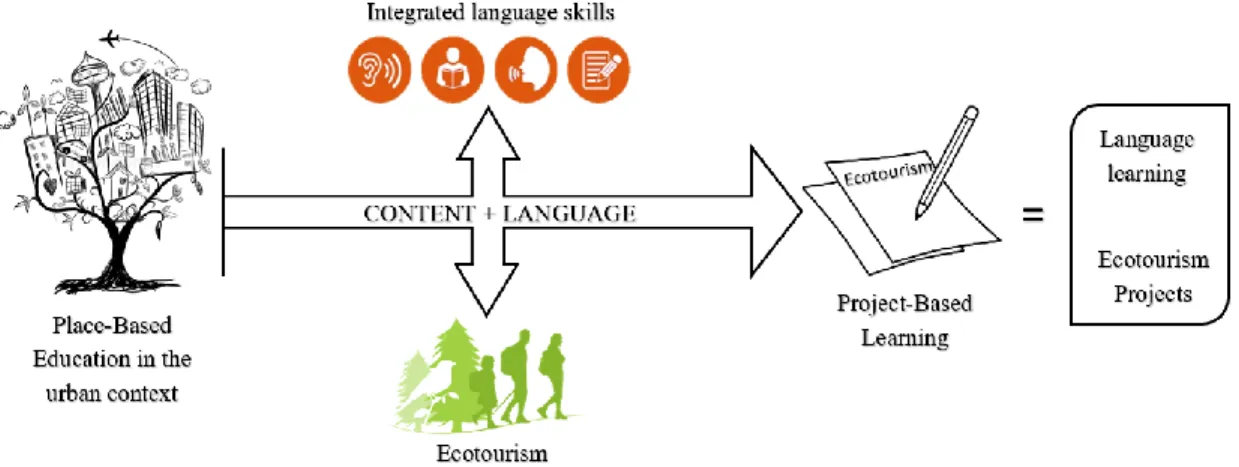
(31) formation covered the different topics, principles and concepts related to Ecotourism, to mention, environmental education, study on local geography and its fauna and flora. For this reason, the Integrated-skills approach was conceived as a useful concept to succeed in English language and content teaching. Figure 1. Concepts connection. In figure 1, my perception of the constructs described in the previous paragraphs is presented. In this way, the urban context was seen as the starting point since this is the place where learning occurs. Thus, Place-Based Education was understood as a transversal approach that integrates Ecotourism content and the development of the students’ Integrated skills. Finally, under the light of Project-Based learning, students carried out the creation and presentation of Ecotourism projects at the same time they showed a more efficient English language performance in a communicative way. This chapter presented the state of art, which included the studies and articles that framed my study. Also, the constructs that were linked to this research projects were defined and described under the light of theoretical basis. The former information aided in the comprehension. 20.
(32) of addressed concepts, and the organization of the pedagogical proposal. The next chapter presents the instruments and the procedures used for data collection.. 21.
(33) CHAPTER III Methodological design In this chapter, the aspects concerning the research paradigm, the type of study, the data collection instruments, and procedures will be presented. It is important to mention that the data collection instruments and procedures will be described taking into account their different characteristics and how they were applied in this research project. Also, the ethical issues are presented in the next paragraphs. Research paradigm Due to its characteristics, this study corresponds to a qualitative research project. An approach to this paradigm as mentioned by (Brikci and Green, 2007) states that “Qualitative research is characterized by its aims, which relate to understanding some aspect of social life, and its methods which (in general) generate words, rather than numbers, as data for analysis.” (p. 2). Thus, this paradigm allows to characterize and describe the social, educative and communicative problematics found and that affect the process of English language learning in sixth graders at Prado Veraniego School. In addition, following Ospina (2004) in the qualitative research, the researcher is immersed in the setting, having a direct contact with subjects and he aims for a holistic picture from historically unique situations, where idiosyncrasies are important for meaning. The researcher uses an inductive mode, letting the data speak (p. 4). Consequently, during the time of development of this study it became a requirement to take part in the different. 22.
(34) classes of English and the different activities related to this area in order to understand the different problematics found. Type of study The type of research adopted for this research project is the action research type. Action Research, for Parsons and Brown (2002) is a form of investigation designed for use by teachers to attempt to solve problems and improve professional practices in their own classrooms. It involves systematic observations and data collection which can be then used by the practitionerresearcher in reflection, decision-making and the development of more effective classroom strategies. This type of study is the most appropriate for this research project due to observation, analysis and diagnosis process that was held in the English classes of sixth grade at Prado Veraniego School. Thus, this participation during the classes allowed to get to know the population and determine the educative and language problems present in the population. Given the previous, for the development of this research project, it was necessary to develop and apply a pedagogical intervention process in order to enhance the improvement of integrated English language skills and to support the implementation of the Tourism emphasis that the school has adapted to their educative proposal. Finally, it is relevant to mention that based on (Burns, 2010), the action research approach has a cycle which is divided into four main stages. These stages are given in a specific order, to mention Planning, Action, Observation, and Reflection. The first stage of the Action Research approach corresponds to the Planning cycle. In this cycle, the researcher identifies the problems and issues found in the context studied. Then, the researcher starts the process of taking into consideration the different aspects that present a necessity of improvement. Subsequently, the former takes the researcher to the Action cycle, in which the interventions 23.
(35) planned takes part in the research during an established period of time (Burns, 2010). This intervention must be applied critically in order to reflect on the immediate results and the “alternative ways of doing things” (p. 8). These two first cycles allowed this research project to propose a pedagogical intervention based on the context of the study and the problematics found. The cycle of Observation is a data collection period; thus, after the action cycle, the researcher must obtain and systematize the real information and opinions of what it is happening from the participants of the research. Lastly, the Reflection cycle permits the researcher to “evaluate and describe the effects of the action” (p. 8) in order to comprehend in a deeper way the problematic studied and decide whether to implement more cycles to ameliorate the problems found or to share the study among other researchers. (Burns, 2010) Bearing in mind these last two cycles, in this research project, it was relevant to reflect on the actions that were taken during the implementation in order to highlight the effects that the intervention brought to the EFL classroom in sixth grade at Prado Veraniego School. Data collection instruments and procedures For this study, it was necessary to implement different instruments to respond to the data collection and a further triangulation of the information. In accordance with (Burns, 2010), Triangulation corresponds to the analysis of information obtained from different instruments and the subsequent cross-check in order to get a more objective perspective of data. In this way, the researcher supports his/her assumptions on evidence and not on presumptions. Therefore, the instruments that were used to collect data among this research project are Field Notes, Surveys, Interviews, Artifacts and Recordings.. 24.
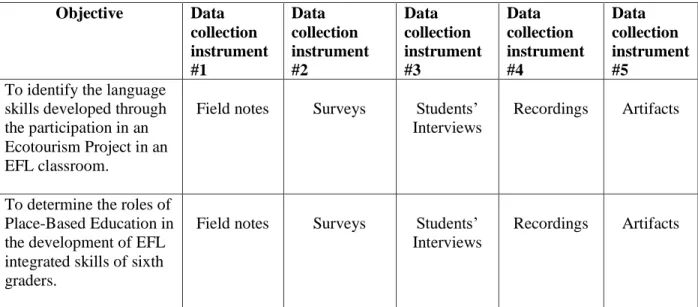
(36) Additionally, the triangulation of the data collected aimed to enhance Reliability and Validity of the information. Thus, following (Sellitz, Wrightsman & Cook, 1976) the concept of Reliability in qualitative research “is concerned with the consistency, stability and repeatability of the informant’s accounts as well as the investigators’ ability to collect and record information accurately” (p. 182). On the other hand, (LeCompte and Goetz,1982) assure that Validity “is concerned with the accuracy and truthfulness of scientific findings in qualitative research means” (p. 32). Hence, in this research project, fostering these two characteristics implied to keep in mind and follow specific procedures for collecting data as well as to carry out the plan of triangulation presented in the next table. Table 1. Plan of triangulation. Objective. To identify the language skills developed through the participation in an Ecotourism Project in an EFL classroom. To determine the roles of Place-Based Education in the development of EFL integrated skills of sixth graders.. Data collection instrument #1. Data collection instrument #2. Data collection instrument #3. Data collection instrument #4. Data collection instrument #5. Field notes. Surveys. Students’ Interviews. Recordings. Artifacts. Field notes. Surveys. Students’ Interviews. Recordings. Artifacts. Field notes. Emerson (1995) defines field notes as ethnography tools which serve to give account of the experiences and observations that the researcher has made while actively participating along with the target population. Thus, this perspective allows this research project to understand the population and the context as a social world in which different events occur.. 25.
(37) These events within the social world create conceptions in participants that occur “in and through interaction with others, when interpretation of meanings are central processes” (p. 25). As for the concerning of this research project, field notes helped in the analysis of sixth-grade students’ conducts inside the EFL classroom and their attitudes and difficulties facing language learning. These field notes were taken, firstly, during the period corresponding to the first semester of 2018 every Friday since February 23 in the time between 9:45 am and 11:00 am corresponding to the English class of sixth grade at Prado Veraniego School. Additionally, these field notes were also created during the second semester of 2018 (August – November) and the first semester of 2019 (March – May) while the pedagogical intervention process was carried out (see annex 3). Surveys. For Mathers, Fox and Hunn (2009) “surveys are a very traditional way of conducting research.” (p. 5). They are instruments useful in particular for descriptive designs that look for a description of immediate context. In that way, surveys are used to establish the predominance and occurrence of a particular condition. Also, this data collection instrument is commonly used to revise information on attitudes and behavior in a given context. Following the authors, the type of survey adopted for this data collection instrument was the Questionnaires. Having in mind that “questionnaires can be either devised by the researcher or they can be based upon some readymade index” (p. 9), in this research project a characterization survey was designed. This survey had as a purpose to get to know the population in the sixth grade at Prado Veraniego School, looking into educative, social and family aspects. Thus, in order to obtain this information, the application of this survey took place on March 16, 2018 to 26 students and it was guided by the researcher. Additionally, two perception surveys were applied after the. 26.
(38) development of cycles one and two (see annex 4) in order to analyze attitudes and learning progress towards the study and practice of Ecotourism. Interviews. Based on Easwaramoorthy & Zarinpoush (2006), interviews are an appropriate method when there is a need to collect in-depth information on people’s opinions, thoughts, experiences, and feelings. Interviews are useful when the topic of inquiry relates to issues that require complex questioning and considerable probing. Subsequently, for Alshenqeeti (2014) interviews are present in four different types: structured, open-ended or unstructured, semi-structured and focus group. However, for the purpose of this research project the type of interview adopted was the semi-structured type. Regarding this type of interview, Alshenqeeti says that it “is a more flexible version of the structured interview as it allows depth to be achieved by providing the opportunity on the part of the interviewer to probe and expand the interviewee's responses” (Rubin & Rubin, 2005 as cited in Alshenqeeti, 2014). In order to approach the information to collect in this research project, an interview with the homeroom teacher (see annex 5) was held on April 6, 2018 to look into her perception towards English teaching and the process with the grade 601 at Prado Veraniego School. Also, one interview was applied to students at the end of cycle two on November 16, 2018 in order to find their posture in relation to the process of immersion into English language and learning about Ecology. Finally, a last interview to students (see annex 6) was applied at end of the project on April 15, 2019 with objective of discovering students’ development in each of the language skills and the actions taken inside their daily lives in regards to environmental care and ecology. Artifacts. Following Efron and Ravid (2013), artifacts “are physical documents and records that allow teacher researchers to construct a layered and contextual understanding of their topics” (p.123). These elements provide the researcher with information that allows him to 27.
(39) compare it with the information that other data collection instruments have gathered. Also, based on Lodico, Spaulding and Voegtle (2010), artifacts may include different types of documents such as “familiar things like public records or reports, minutes from meetings, personal letters, bulletin boards, newspapers, yearbooks, or instructional material” (p.103). However, for Mertler (2008), artifacts may also be documents collected in classrooms which include mostly physical and visual data of activities developed “that contribute to our understanding of what is occurring in classrooms and schools” (p. 114). Following the above-mentioned, the artifacts collected in this research project corresponded to the different activities and workshops developed during the second semester of 2018 and the first semester of 2019 as the pedagogical intervention process was held. Furthermore, the artifacts created in this project were designed in response to the objective of developing language integrated skills. Thus, the process of development of artifacts aimed to the realization writing tasks as of posters for oral presentations, short stories, brochures and, reading and listening comprehension workshops (see annex 7). Recordings. In the use of this data collection instrument it is possible to state the use of two main resources of information: audio recordings and video recordings. First, Bloor and Wood (2006) state that “the recording of audio data through devices such as tape recorders has been a significant development within qualitative research, replacing the researcher’s handwritten notes” (p.16). Hence, audio recordings have been a useful tool in order to improve reliability at the moment of transcribing and creating field notes allowing the researcher to execute further analysis. Secondly, other authors as Heath, Hindmarsh and Luff (2010) stated that video recordings have many advantages as “it enables the researcher to record activities without having to anticipate events and it provides a consistent view of the stream of action” (p.40). These videos obtained allow the researcher to observe situations that may be avoided due. 28.
(40) to the nature of human sight and allow to hold stronger analysis of data collected. Hence, in this research project recording instruments were used along the classes implemented along the second semester of 2018 and the first of 2019; also, during the field trip carried on October 24, 2018 in order to visualize real-time reactions in the use of language in the classroom as well as outside it (see annex 8). This chapter presented the theoretical support in order to go in depth the research paradigm of this study, as well as the type of study, the data collection instruments implemented, and the procedures followed. The next chapter explains and describes the design of the pedagogical intervention in my research, in addition to the visions of curriculum, learning, language and classroom taken into account.. 29.
(41) CHAPTER IV Pedagogical Intervention In this chapter, the vision of curriculum, the vision of language, the vision of learning, and the vision of classroom taken into account for the Instructional Design will be presented. Additionally, the instructional design will be also displayed as a description of the pedagogical intervention proposal that this research project held in the sixth grade EFL classroom at Prado Veraniego School.. Vision of curriculum Taking into account the objectives of this research project, the study adjusted its vision of curriculum to the referred by Desai (2013) as ‘Place-Based Curriculum’. This concept shaped this study vision as for the author this curriculum takes advantage of the area surrounding and the diversity of elements it offers for successful teaching and learning processes, recognizing the importance that place has in learning scenarios. It also became relevant for this research to take into account the conception of ‘Place-Based Curriculum’ presented by Sobel (2004). The idea developed by the author exhorts the interaction between students and history, culture, society, economics and community, and how this contact mold each other (p. 9). This notion was one to keep in mind for this study because one of the goals to achieve is the awareness and connection of classroom and local space around it.. 30.
(42) Vision of learning Considering the objectives of this project, the vision of learning is focused on the capabilities found in the experiential and situated learning, taking into account that social and individual learning processes are to happen under the light of this perspective. Regarding the previous, it is important to adopt the idea proposed by Kolb (2015), in which the author states that learning occurs when ‘knowledge is created through the transformation of experience’ (p. 49). Consequently, it is the interaction with the object of study that offers students a unique experience and builds up a subjective perspective of what they are living. Therefore, this viewpoint of learning adapts the best to the intervention proposal, since the aim to guide students in the creation of an Ecotourism project is highly based on the interaction with environment and nature, as well as the enriching experience and reflection it generates. In this way, students were provided with a conceptualization on what Ecotourism is and implies in order to create their projects. Hence, it was essential to present students the definitions and differences between Tourism and Ecotourism. Also, it was relevant for students to get to know the different natural places around Bogotá to practice Ecotourism, which allowed them to discover the richness found in the different ecosystems and the value that these places have for the city. Additionally, the idea of learning as an experiential process in specific contexts is reflected when students took part in a field trip to one of these Ecotourist places in Bogotá in order to interact and reflect upon the relevance of these environments. In consequence, this process developed the students’ awareness of environmental problems that affect the city and these natural places, allowing them to take actions in their personal towards ecological concerns. Thus, the knowledge acquired by students in this process created a vision at the moment of starting an inquiry project on Ecotourism. Students developed this project by forming work 31.
Figure
Documento similar
This paper reports our approach to enable the analysis of recursive opera- tions and expressions containing the iterate collection operation in an OCL-based model finder without
The Backtracking Occupancy Grid-based Mapping (BOBMapping) approach, as shown in this paper, includes optimizations to the environment exploration approach, the sensing approach and
In 1991, Allmendinger developed an approach to the monofluorinated olefins based on the alkylation of ethyl phenylsulfinyl fluoroacetates anions 219 by alkyl halides
‘What is education for?’, by Roger Marples, critically discusses three philosophical curriculum theories in relation to the aims of education (namely, RS Peters’ and
Thus, the main contributions of this paper are (i) a strategy to detect relevant behavioral changes based on a ranking mechanism in a given share of hosts, (ii) an approach to model
Independently, we tried an experimental approach to the problem of motility based on the analysis of the variations in the speckle pattern produced by a deposit of living cells.
Abstract: In this paper we use an approach based on the maximum principle to characterise the minimiser of a family of nonlocal and anisotropic energies I α defined on
The general objective of this study is developing and implementing a simple method, based on spatially explicit linear regressions, that allows to obtain an estimate of the
