
TítuloHealth status and learning capacity: effects on human capital accumulation and economic growth
183
0
0
Texto completo
(2) UNIVERSIDAD DE A CORUNA FACULTAD DE C . ECONÓMICAS. HEALTH STATUS AND LEARNING CAPACITY: EFFECTS ON HUMAN CAPITAL ACCUMULATION AND ECONOMIC GROWTH. TESIS DOCTORAL PRESENTADA POR:^ PAOLO RUNGO. DIRECTORES PROF. DR. LUIS CLAUDIO CURRAIS NUNES PROF. DRA. BERTA RIVERA CASTIÑEIRA. ^. A CORUÑA, 2008.
(3) HEALTH STATUS AND LEARNING CAPACITY: EFFECTS ON HUMAN CAPITAL ACCUMULATION AND ECONOMIC GROWTH by Paolo Rungo. Submitted to the Department of Economic Analysis in partial fulglment of the requirements for the degree of European Doctor at Universidad de La Coruña. Febrúary 2008. Signature of Author Department of Economic Analysis and Business Administration, March 2008. Certified by Luis Currais arid Berta Rivera Professors of Economics Thesis supervisors.
(4) 3. To my mother, my father and my brother.
(5) Acknowledgments. First and foremost, it is a pleasure for me to thank my supervisors Dr. Lui ^ Currais and Dr. Berta Rivera for their constant advice, their concern with my work and, indeed, my health. Since I attended Dr. Currais' lectures on Economic Growth, they have helped me to grow both as a professional and personally. The twin pillars of my research, Health Economics and Economic Growth, constitute the main-stays of the edifice of my research, and it has been most edifying sharing my time and energy with them in gleaning many of the insights into my research. Many other individuals have made this thesis possible, highlighting my errors and making useful suggestions. The valuable commentaries of David Weil, David Mayer-Foulkes and Adriaan van Zon have added to my analysis of the health-poverty trap. Comments on econometric methodology by Stephen Morris have contributed to improving the empirical part of this thesis. During my stay at the London School of Economics, LSE-Health and Social Care staff encouraged me to consider the policy implications of my analysis. Cristina Hernandez has provided interesting insights and I esteem it to be an honour to have an on-going, friendly, productive correspondence with her. The indubitable econometric skills of Maria Ramil have also contributed to addressing said difficulties that arose during my research. A special mention goes for Bruno Casal, who has been an invaluable companion during the graduate programme in Economics at La Coruña. He has been kind,.
(6) 5. conscientious, and a paragon of dedication. I likewise wish to thank Howard Carter for his comments and insights, and I am indebted to Olga Figueroa, who has supported me during recent years. Financial support for my research through a Doctoral Grant and, later, through the Maria Barbeito programme for young researchers by the Council of Innovation and Industry, Xunta de Galicia, Spain, is gratefully acknowledged. Since I left home and my country, my family has been making a special effort to demonstrate that love is uncorrelated with distance. To my mother, my father and my brother l dedicate this thesis..
(7) Abstract. The importance of health improvements for economic growth has been underlined by a growing number of theoretical and empirical papers. This thesis contributes to the literature by analysing a specific mechanism that underlies this relationship, namely the complementarity of child health and learning ability. Health status is a constitutive component of human capital and, in addition, has a significant multiplier effect on its accumulation. Favourable health status affects practically all of the abilities and skills that children are capable of developing positively. As a direct result, school-based human capital investment provides an optimal channel for enhancing economic growth. Conversely, poor physical health constitutes a major constraint, that only serves to exacerbate deprivation. The analysis carried out in this thesis is both empirical and theoretical. Most of the empirical exercises, which explore the relationship between health and education, have required the use of instrumental variable techniques in order to assess the question of endogeneity that arises when considering the two variables simultaneously. Theoretical models rely on the OLG framework, which allows for considering intergenerational linkages and the temporal evolution of the interest variables. Throughout this thesis it is shown that parents tend to be the agents that transmit child health status, i.e. it is parents that are responsible for the investment of child-health human capital. This dynamic is instrumental in dictating both child learning capacity and the level of schooling investments. These findings have been included in a theoretical.
(8) 7. model in order to explain the possible emergence of multiple equilibria in the temporal evolution of human capital. In addition, the consequences of a particular policy aimed at improving the condition of the poor, namely balanced school meals as a means of ensuring basic alimentation, have been investigated by means of a numerical simulation. If poor health causes poverty traps to emerge, substantial health improvements are needed to escape from the bear-pit of deprivation. In copying some of the processes that led the currently developed countries to escape from the Malthusian poverty trap to the Modern Growth regime, a renewed effort to enhance health conditions is required in order to break the cycle of poverty..
(9) Contents. I. INTRODUCTION. ^. 1.1 Resumen en castellano. 11 20. II. HEALTH STATUS, EDUCATIONAL ADEQUACY ^ AND HUMAN CAPITAL ACCUMULATION. 32. 1. An overview on intergenerational transmission of health status and learning ability 2. The database and sample 3. Transmission of health status: estimates and result ^ 4. Health status and school performance Conclusions. 34 41 48 55 59. III. THE IMPACT OF HEALTH STATUS ON HUMAN CAPITAL. INVESTMENST. 62. 1. Theoretical framework 2. Health status and school initiation 3. Health status and the length of schooling Conclusions. (4 71 76 81. ^. IV. HEALTH HUMAN CAPITAL AND POVERTY TRAPS. 84. 1. The modet economy 2. Individual behaviour 3. Intergenerational transmission of human capital 4. School feeding, improved human capital and growth Conclusions. 89 94 97 102 118. V. THE ROLE OF HEALTH IMPROVEMENTS IN THE TRANSITION OUT OF DEPRIVATION. 121. 1. The structure of the model 2. Individual decisions 3. Evolution of human capital and income 4. Health improvements and economic growth Conclusions. 125 127 131 137 144. VI. CONCLUSIONS APPENDIX A APPENDIX B APPENDIX C APPENDIX D References. 148 153 159 164. 168 169.
(10) 9. Index of Figures. Figure 2.1 Figure 2.2 Figure 3.1 Figure 3.2 Figure 3.3 Figure 4.1 Figure 4.2 Figure 5.1 Figure 5.2 Figure C.1. Distribution of SAHSC Distribution of SAHSC conditional to SAHSM and SAHSF Effect of improved health status on the optimal length of schooling ^ School initiation and health status: kernel plots School length and individual height: kernel plots Cross country life expectancy histograms Temporal evolution of income per adult with multiple equilibria Income per capita, fertility, education and child consumption Temporal evolution of human capital, child nutrition, education and fertility Emergence of club convergence: kernel density plots. 45 46. -. 69 72 76 83 97 126 13 8 161.
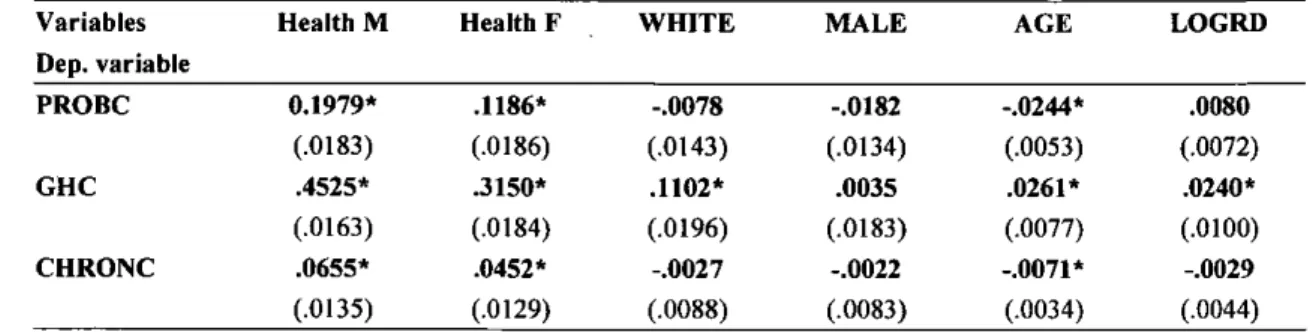
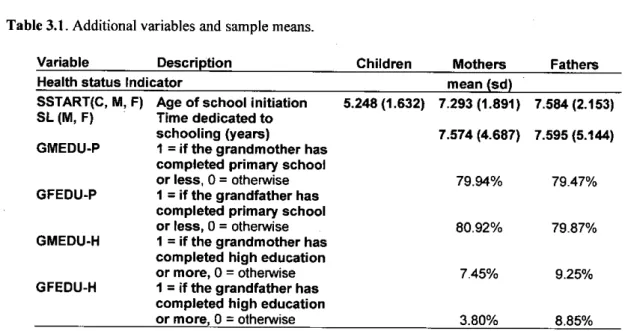
(11) 10. Index of Tables. Table 2.1 Table 2.2 Table 2.3 Table 2.4 Table 2.5 Table 3.1 Table 3.2 Table 3.3 Table 4.1 Table 4.2 Table 4.3 Table A.1 Table C.1. Variables and descriptive statistics ^ Intergenerational Transmission of Health Status Probit regressions, variables PROBC, GHC, CHRONC: marginal effects of selected variables Ordered probit regression, variable SAHSC: marginal effects Effect on health status on child educational adequacy Additional variables and sample means Effects of health status on the age of school initiation Effects of health status on school length Baseline levels of parameters Effects of school feeding: computational experiment Effects of school feeding: temporal evolution of human capital and income 2SLS estimates: results of the first stage regression Effects of parameters variations. 43 51 52 53 56 71 74 77 107 110 111 151 162.
(12) I. Introduction. Poor health conditions are a maj or barrier to the real opportunities that people enj oy. In low-income countries less -than a quarter of people reach the age of 70, and nearly a third of all deaths are among children under the age of 14 (WHO, 2007). Although cardiovascular diseases are the principal cause of death, infectious diseases (HIV/AIDS, lung infections, tuberculosis, diarrhoeal diseases and malaria) together, claim more lives. Among children under 5 years of age, about 20 million suffer severe acute malnutrition, and current estimates suggest that this causes the death of nearly 1 million children every year (WHO et al., 2007). If acute and chronic malnutrition are taken into account, these figures dramatically increase. In 2005, in all developing countries 32% of children undér 5 years of age (about 178 million children) were estimated to be stunted (defined as height -2 standard deviations below the median height-for-age of the reference population, a measure of chronic malnutrition). In that year, more than 40% of stunting was found in the WHO regions of Africa and South-East Asia; of the 39 countries with a stunting prevalence of 40% or higher, 22 are in the region of Africa and 7 in South-East Asia. Wasting (defined as being -2 standard deviations below the median of weight-forheight) is a sign of acute malnutrition and a strong predictor of morta.lity among children. The global estimate of wasting occurring among children under 5 years of age based on WHO's new standards is 10%, or 55 million (WHO, 2007). These figures are.
(13) I.INTRODUCTION 12. an example of the motivation that encourages a large number of international and national institutions, as well as non-governmental organizations, to fight daily against the global endemic of malnutrition, which evidently constitutes a development objective in its own right. The economic insights provided in this thesis offer only a partial perspective of the problem by focusing on the relationship across child health status, education and economic growth. Indeed, poor health is one of the many dimensions of poverty, and is a relationship that runs in both directions. Since Fogel (1991, 1994a 1994b, 2002) and Fogel and Wimmer (2002), a growing number of theoretical and empirical papers have underlined the importa.nce of health improvements for long-term economic growth. Fogel (2004) cited, what he called, a historical technophysio evolution, the synergistic interaction between advances in production-technology and improvements in human physiology, and concluded that the increase in the amount of available énergy and improved physical status has accounted for about 50 percent of British economic growth since 1790. Arora (2001), investigating the growth path of 10 industrialized countries over 100 to 120 years, provides further historical evidence of the importance of health for economic growth. According to this analysis, health increased the pace of growth of the countries analyzed by 30 to 40 percent, permanently altering the slope of the growth path. Conversely, the lack of health improvements may constitute a relevant barrier for the development of economies. In consonance with Fogel's pioneering work, researchers have highlighted the direct link between physical condition and worker productivity in order to explain the relationship between health and economic growth (e.g. Sahn and Alderman, 1988; Beherman, 1993; Beherman and Deolalikar, 1998; Currais and Rivera, 2005; Case and et.
(14) I.INTRODUCTION 13. al., 2005). Currais and Rivera (2005), for instance, examine the relationship between wages and health indicators at different levels of earnings distribution by carrying out quantile regressions. They conclude that health has a significant influence on worker productivity, which is measured as a function of salary, and its impact is greater at the lowest wage level, decreasing as one moves up the wage distribution ranking. Though the existence of a direct causal effect of health on produ ^tivity has beén amply demonstrated, results might hide other indirect channels related to the influence of health status on human capital accumulation. The complementarity of child health status and education is another interesting mechanism that can help to better understand the relationship between health and economic growth. The impact of health status on cognitive capacity has received some attention in the literature; though causality has not always being clearly assessed (e.g. Aylward et al., 1989; Martorell, 1995; Grantham-McGregor et al., 1999; Alderman et al., 2006). The existence of this relationship, however, is extremely important because it implies that children endowed with unfavourable health status are likely to accumulate a lower amount of intellectual human capital, which in turn will influence their future well-being. In other words, unhealthy children have a lower ability to respond to educational stimuli and thus, they achieve a lower level of education even when they dedicate the same amount of time to schooling as healthy children. Another important feature is the correlation between poor health and the socio-economic status of the family of origin, provided that lower learning capacity exacerbates the economic constraints to human capital investments for the family. Children from rich families, on the other hand, enjoy potentially longer periods of schooling, and are more receptive and have better concentration spans and hence, higher learning capacities..
(15) I.INTRODUCTION 14. .. .. Differential ability due to variations in child health status may also influence the. level of schooling-based human capital investments, since a lower return to education is likely to discourage educational efforts. Rosenzweig and Schultz (1982) and Behrman (1988), for instance, have shown that when it is assumed that children look after parents, and when returns to male labour are higher, favouring boys appears to be efficient from the parents' perspective. A similar process may apply when considering that the return to schooling is affected by the health status of children and therefore, it would be reasonable to invest more resources in the development of healthy students. The effect of health on the return to schooling considered here aggravates the negative effect of reduced life spans on earnings expectations (e.g. Chákraborty, 2004); and the complementarity of these two mechanisms may further depress returns to investments in human capital. Thus, consideriñg the channels of influence across child health, schooling performance and human capital accumulation provides useful insights for understanding the role of health in the persistence of deprivation. ,. Yet this me^hanism alone cannot explain the causal relationship between poor. health conditions and persistent poverty, which is a significant characteristic of undeveloped countries (e.g. Mayer-Foulkes, 2003). In fact, it is necessary to consider the intergenerational transmission of health status across generations within the same family. When children inherit poor health status from parents, they are likely to face the same constraints that hold back their parents relative to the accumulation of human capital. Health mobility is an interesting feature, which has embraced different fields of research within medicine, including the genetic transmission of diseases such as Alzheimer's or, alternatively, there are more economicly-oriented studies, such as those of Currie and Moretti (2005), or works on behavioural economics (e.g. Johnson, Chase,.
(16) I.INTRODUCTION 15. and Breslau, 2002). In general, these studies find a positive correlation between parental and child health status; for instance, Currie and Moretti find that the probability that a child's birth weight is low is 50% higher if the mother similarly had a low birth weight. While this topic is receiving increasing attention, the analysis of high income countries has severe drawbacks in that it does not permit the generalization of these results to lessdeveloped countries, which is our main cóncern. Provided that poor health has an influence on the ability to learn, and that it is a factor that may be transmitted across generations within the same family, a health poverty trap can be identified. Multiple . equilibria and bimodality in distribution functions have initially been discussed by considering income levels (e.g. Durlauf and Johnson, 1995; Bianchi, 1997; Quah, 1996, 1997). However, bimodal distribution functions are not exclusively related to income, and poverty traps have been empirically demonstrated when considering the cross-country distribution of health status. MayerFoulkes (2003), for instance, demonstrates that certain countries are characterised by low levels of longevity by considering the cross distribution of 159 countries between 1962 and 1997. The consideration of the mechanisms mentioned above sheds light on the ^underlying causes of this phenomenon, and they provide a theoretical advancement in the modelling of health poverty traps. In particular, parental opportunities for influencing child ability, either indirectly or through deliberate investments in nourishing, is a key factor for a better understanding of persistent poverty. Parents endowed with an unfavourable health status tend to transmit this to their children, both ., directly and by making it more likely for them to have lower incomes. Given the poor socio-economic status of the family of origin, children tend to receive low levels of education investment. In addition, their health status reduces the productivity of learning.
(17) I.INTRODUCTION 16. and might constitutes a further disincentive to schooling investment. Scant human capital accumulation leads then to low levels of income and poor health status during adulthood, which constraints the development of new generations. The analysis of this health poverty trap constitutes one of our main objectives. But how are poverty traps to be eradicated? Health status and education are twin components of human capital and have inspired policies aimed at enhancing the two factors simultaneously. International agencies such as the World Food Programme (WFP) and national governments have dedicated a large amount of resources to school feeding programmes. For instance, 21.7 million children in 74 countries received WFP school meals in 2005. The basic idea is that the promise of one meal attracts children to school and, thus, this policy has the advantage of boosting education. The nutritional status of children and their school performance, moreover, are expected to improve. However, intra-household allocation may frustrate any potential positive results, should parents, in an attempt to be equitable, redistribute the benefits that á child receives in terms of extra-feeding to other members of the family (e.g. Simeon, 1998). In this situation, school meals may fail to accomplish one of their main objectives, enhancing deficient educational productivity. The analysis of this policy is extremely interesting given the growing emphasis on school meals as a channel for improving child health and educational outcomes, and refocuses the debate on unconditional versus conditional transfers as a means of alleviating poverty. For example, a common feature of conditional transfers, considered within this analysis, is that they generate a distortion in individual choices, which may negatively affect the accumulation of human capital. If poor health can cause poverty traps to emerge by constraining the accumulation of intellectual human capital and, conversely, enhancing health status may.
(18) I.INTRODUCTION 17. generate growth, developed countries would still be poor if substantial health improvements had not taken place. The above considerations would seem to suggest that a threshold health status level for a population is a precondition for sustained economic growth. In particular, health improvements may be necessary for undertaking schoolingbased human capital investments, which are the main force that drives growth in the modern regime. Literature that deals with this generally places education at the heart of the growth machine while improved health is merely conceived of as a by-product of income growth (e.g. Lucas, 2002; Galor and Weil, 1999, 2000). However, as mentioned above, health improvements seem to account for a large part of economic growth and this should be taken into account in order to understand the Transition that some economies have experienced during their recent history. In other words, the explicit consideration of the health status of a population and health improvements may shed light both on the persistence of deprivation and the possible "push" to a modern regime of growth. When people have low levels of education, human capital is more directly dependent on health status, which may improve thanks to the progressive adaptation of individuals to their environment. A phase of transition during which the health status of the population improves while intellectual human capital is stuck at its minimum level, can be viewed as a precondition to the subsequent passage to the modern regime of growth. In fact, only when the amount of resources dedicated to nourishing and the efficiency of human capital technology are sufficiently high, do parents have compelling incentives for choosing positive lengths of schooling, thus leading to a permanent change in the slope of the growth path. The following part of the analysis which is contained in the subsequent chapters aims to underline the necessity of health.
(19) I.INTRODUCTION 18. improvements for sustained growth or, conversely, the impossibility of escaping from deprivation when poor health status is wedged within the very structure of deprivation. The results presented in this thesis rely on the assumption that rational economic decision making is the driver of concurrent events in fertility, health and education decision-taking at the micro level. This assumption allows the analyst to pose the questions mooted above simply, but, this also constitutes one of the limitations of the work. In particular, rational decision making in a reproductive setting overcomes many complications and is a useful instrument for explaining certain stylised facts. The economic approach to fertility adopted here dates from the work of Leibenstein (1957) and Beker (1960), who contributed to the understanding of the turning point in the process of the demographic transition. Becker, in particular, formulated the basic framework of completed fertility based on a familiar neo-classical assumption of fixed preferences and maximizing behaviour, which constitutes the basic Becker/Chicago demand theory of fertility. The economic decision making approach, however, omits many of the considerations that dictate fertility behaviour. Robinson (1997), for instance, underlines some difficulties. The exclusion of biology, Love or other psychological considerations from the demand for children, and the failure or unwillingness to consider the inability to control the number of children raised by a family, are in fact a limitation. Thus, results should always be considered bearing in mind the drawbacks of an economic decision making approach in this setting.. ^. The following chapters look at the ideas mentioned above. The analysis begins by empirically studying two hypotheses, namely the intergenerational transmission of health status and the causal relationship between health and learning ability, which constitute the basis of the subsequent analysis. Chapter II assesses these questions by.
(20) I.INTRODUCTION 19. making use of a° Brazilian data set, which facilitates an extrapolation capable of explaining certain elements of the growth dynamic in certain developing countries. In addition, the large number of variables included in the database, in particular with regard to health outcomes and historical educational attainments, has favoured the constru^tion of an education indicator, which aims to measure children's ability to benefit from the educational process. Chapter III investigates the consequén ^es of the relationship between health and learning . ability on the level of schooling-based human capital investments. In particular, it is shown that unhealthy individuals dedicate less time to learning on average. Chapter IV deals with the possible emergence of poverty traps when results of the previous chapters are taken into account. Moreover, in the same chapter school feeding is considered in order to assess its effects and to draw some policy implications. Chapter V further broadens the analysis horizon and considers the role of health improvements in the transition of economies to the modern regime of ^ growth. In particular, it is shown how health improvements may result in a permanent change in the growth path. Finally, the last chapter summarizes the main conclusions..
(21) I.INTRODUCTION 20. 1.1 Resumen en castellano. Un estado de salud no favorable puede constituir un importante límite para las oportunidades reales de las personas. Menos de un cuarto de la población en los países de baj a renta llega a la edad de 70 años y aproximadamente un tercio de todas las defunciones son de niños de edad inferior a los 14 años (WHO, 2007). A pesar de que las enfermedades cardiovasculares constituyen globalmente la principal causa de muerte, las enfermedades infecciosas en su conjunto (HIV/SIDA, infecciones pulmonares, tuberculosis, diarrea y malaria) generan una mayor cantidad de bajas. Aproximadamente 20 millones de niños de edad inferior a los 5 años sufren de malnutrición aguda severa y las estimaciones más recientes sugieren que esta condición causa la muerte de casi un millón de niños cada año (WHO et al., 2007). Considerando exclusivamente la malnutrición aguda o crónica, estos datos crecen de forma drámática. Se estima que en el 2005, e132% de los niños de edad inferior a 5 años en los países en desarrollo (alrededor de 178 millones) sufrían de malnutrición crónica.l En el mismo año, más de140% de los niños en esta condición se encontraba en las regiones WHO de África y Sur-Este Asiático; de los 39 países con ^una prevalencia del 40% o superior, 22 pertenecen a la región Africana y 7 al Sur-Este Asiático. La malnutrición aguda es otra potente variable explicativa de la mortalidad infantil.2 Las estimaciones a nivel global, considerando los niños de edad inferior a los 5 años basadas en los nuevos estándares WHO, son iguales al 10%, 0 55 millones de niños (WHO, 2007). Estos datos son un ejemplo de las motivaciones que animan un gran número de instituciones nacionales e internacionales,. ' El indicador correspondiente, "stunting", se define como - 2 desviaciones estándar por debajo de la mediana de altura por edad del grupo de referencia.. 2 EI indicador de malnutrición aguda utilizado por la WHO es "wasting", definido como - 2 desviaciones estándar por debajo de la mediana del peso por altura del grupo de referencia..
(22) I.INTRODUCTION 21. así como de organizaciones no gubernamentales, a luchar diariamente contra la endemia global de la malnutrición, que construye evidentemente un objetivo de desarrollo por sí misma. Las consideraciones de carácter económico que se presentan en esta tesis ofrecen un punto de vista parcial a estos problemas, a través del estudio de las relaciones entre el estado de salud de los niños, la educación y el crecimiento económico. Evidentemente, la malnutrición y la alta prevalencia de enfermedades son sólo algunas de las múltiples dimensiones de la pobreza, a la cual se unen por relaciones causales no unidireccionales. A partir de Fogel ( 1991, 1994a, 1994b, 2002) y Fogel y Wimmer (2002), un número creciente de trabajos empíricos y teóricos han evidenciado la importancia de las mejoras en el estado de salud para el crecimiento económico a largo plazo. Fogel (2004), considerando lo que ha denominado la evolución tecnofisiológica, la interacción sinérgica entre avances en la tecnología de producción y mejoras en la fisiología humana, concluye que el incremento en la cantidad de energía disponible y el mejor estado ^sico de las personas explican aproximadamente un 50% del crecimiento económico en el Reino Unido a partir del 1790. Arora (2001), investigando la senda de crecimiento de 10 países industrializados en un arco temporal de 100 a 120 años, ofrece ulterior evidencia histórica de la importancia de la salud para el crecimiento económico. Según su análisis, la salud ha determinado un incremento del ritmo de crecimiento del 30-40%, alterando permanentemente la pendiente de la trayectoria de crecimiento de los países considerados. A1 contrario, la falta de mejoras relacionadas con la salud puede constituir una importante barrera para el desarrollo de las economías. En consonancia con los trabajos pioneros de Fogel, algunos investigadores han subrayado la relación directa entre condición ^sica y productividad de los trabajadores.
(23) I.INTRODUCTION 22. para explicar el efecto de la salud sobre el crecimiento económico (e.g. Sahn y Alderman, 1988; Beherman, 1993; Beherman y Deolalikar, 1998; Currais y Rivera, 2005; Case et al., 2005). Currais y Rivera (2005), por ejemplo, examinan la relación zntre salarios e indicadores de salud a distintos niveles de la distribución de la renta usando regresiones quantílicas y concluyen que la salud tiene una influencia significativa sobre la productividad de los trabajadores, medida esta como función de los salarios. Además, el impacto es mayor al nivel mínimo de salario y decrece a medida de que se sube la distribución de la renta. A pesar de que la existencia de un efecto causal directo de la salud sobre la productividad ha sido ampliamente demostrado, estos resultados podrían esconder otros canales indirectos, relacionados con la influencia de la salud sobre la acumulación de capital humano. La complementariedad entre estado de salud de los niños y educación es otro mecanismo que puede ayudar a comprender la relación entre salud y crecimiento económico. El efecto de la salud sobre las capacidades cognitivas ha recibido cierta atención en la literatura, aunque la cuestión de la causalidad no haya sido siempre debidamente estudiada (e.g Aylward et al., 1989; Martorell, 1995; Grantham-McGregor et al., 1999; Alderman et al., 2006). La existencia de tal relación, siñ embargo, es extremadamente importante porque implica que los niños dotados de un estado de salud no favorable tienden a acumular un nivel inferior de capital humano intelectual, lo cual puede afectar a su bienestar futuro. En otras palabras, los niños menos sanos tienen una capacidad inferior de aprovecharse de los estímulos educativos y, por lo tanto, consiguen un nivel inferior de capital humano dedicando el mismo tiempo a la educación que los niños sanos..
(24) I.INTRODUCTION 23. Otra cuestión relevante es que hay una correlación significativa entre estado de salud y estado socioeconómico de las familias y la reducida capacidad cognitiva puede agravar las restricciones presupuestarias a las inversiones en capital humano. Al contrario, los hijos de padres relativamente más ricos no sólo tienen los medios económicos para aprovecharse de períodos más largos de educación, sino que también gozan de una mayor capacidad de aprendizaje. El diferencial de habilidad resultante de las diferencias en salud puede además afectar a los niveles de inversión en educación, puesto que un menor rendimiento de la educación tiende a desincentivar los esfuerzos educativos. Rosenzweig and Schultz (1982) and Behrman (1988), por ejemplo, demuestran que cuando se asume que los niños cuidarán de sus padres y cuando los hombres están favorecidos en el mercado laboral, una mayor preferencia para los hijos de sexo masculino parece eficiente desde la perspectiva de los padres. Un proceso similar podría aplicarse cuando el rendimiento de la educación depende del estado de salud de los niños y, por lo tanto, sería racional investir más recursos en el desarrollo de los estudiantes más sanos. Esta circunstancia tendría el efecto negativo de deteriorar ulteriormente las expectativas de bienestar de los pobres, que tienden a crecer en familias con menos recursos y gozan de un estado de salud no favorable, que constituye una barrera importante para su desarrollo y, al mismo tiempo, puede causar inferior inversiones en educación. Estas consideraciones implican que el efecto depresivo de un pobre estado de salud sobre las inversiones en educación puede ser aún mayor de lo que ya se ha evidenciado en la literatura considerando las consecuencias de una reducida esperanza de vida (e.g. Chakraborty, 2004). En consecuencia, el análisis de estos canales de influencia entre salud de los niños,.
(25) I.INTRODUCTION 24. performance educativa y acumulación de capital humano ofrece instrumentos útiles para la comprensión del papel de la salud en la persistencia de la pobreza. Sin embargo, este mecanismo por sí solo no puede explicar la relación causal existente entre salud mala y persistencia de bajos niveles de ingresos, característica típica de los países en desarrollo (e.g. Mayer-Foulkes, 2003). El siguiente paso es la consideración de la transmisión intergeneracional del estado de salud entre generaciones de la misma familia. En otras palabras, si los niños tienden a heredar de los padres su estado de salud no favorable, también se enfrentarán a las mismas barreras relativas a la acumulación de capital humano. El análisis de la movilidad del estado de salud constituye, por lo tanto, un interesante campo de estudio, extendido por distintas áreas de investigación, desde la medicina, cuya preocupación fundamental ha sido la transmisión genética de las enfermedades, hasta estudios de carácter más económico, como Currie y Moretti (2005), o trabajos sobre los comportamientos individuales (e.g. Johnson, Chase y Breslau, 2002). Estos estudios encuentran normalmente una correlación positiva entre estado de salud de padres e hij os, siendo la influencia de la madre más potente; por ej emplo, Currie y Moretti demuestran que la probabilidad que un niño nazca con bajo-peso es 50% mas alta si la madre nació con bajo-peso. Este tema está despertando un interés creciente pero hay que observar que los estudios existentes consideran datos de países desarrollados, básicamente a causa de su disponibilidad. Puesto que nuestra principal preocupación es la persistencia de la pobreza en los países en desarrollo, sería útil extender el análisis utilizando una base de datos que recoja información de alguno de estos países..
(26) I.INTRODUCTION 25. Si la salud afecta a la capacidad de aprendizaje de los niños y si es un factor transmisible entre generaciones^ de la misma familia, entonces es posible identificar una trampa de pobreza relacionada con la salud. Equilibrios múltiples y bimodalidad en las funciones de distribución han sido inicialmente estudiadas considerando los nivele ^ de ingresos (e.g. Durlauf and Johnson, 1995; Bianchi, 1997; Quah, 1996, 1997). Sin embargo, funciones de distribución bimodales no están exclusivamente relacionadas con los ingresos y también se han identificado empíricamente trampas de pobreza considerando la distribución del esta.do de salud entre países. Mayer-Foulkes (2003), por ejemplo, considerando la distribución de 159 países entre el 1962 y el 1997 demuestra que algunos países están atrapados en una condición desfavorable de ^orta longevidad. Los mecanismos mencionados arriba pueden aclarar las causas subyacentes de este fenómeno y ofrecen un avance teórico en la modelización de las trampas de pobreza relacionadas con la salud. En particular, la posibilidad de los padres de influenciar la habilidad de los niños, indirectamente o a través de inversiones deliberadas en nutrición, es un factor clave para comprender la persistencia de la pobreza. Padres dotados de un estado de salud poco favorable tienden a transmitir su condición a los hijos, directamente o a través de las reducidas capacidades económicas. Dada la pobre condición socioeconómica de la familia, los niños reciben un bajo nivel de inversiones en educación. Además, su estado de salud reduce la productividad del proceso de aprendizaje y, posiblemente, constituye un desincentivo a las inversiones. La escasa acumulación de capital humano se traduce pues en un reducido nivel de ingresos, un estado de salud pobre durante la edad adulta y, por lo tanto, la inicial condición desfavorable de los padres tiende a perdurar de generación en generación. El análisis de.
(27) I.INTRODUCTION 26. esta trampa de pobreza relacionada con la salud constituye uno de nuestros objetivos prioritarios. El estudio de las trampas de pobreza es fundamental para analizar su posible erradicación. El valor constitutivo de la salud para el capital humano y la complementariedad entre esta variable y la educación han llevado al desarrollo de políticas destinadas a impulsar los dos factores simultáneamente. Por ejemplo, agencias internacionales como el World Food Programme (WFP) y gobiernos nacionales han dedicado una gran cantidad de recursos a programas de nutrición escolar: 21,7 millones de niños en 74 países han recibido comidas en la escuela a través del WFP en el año 2005. La idea principal es que la promesa de una comida atrae los niños a la escuela y, en consecuencia, esta política tiene la ventaja de fomentar la educación esperando, al mismo tiempo, mejorar el estado nutricional de los niños y su performance educativa. Sin. embargo, una redistribución intra-familiar podría frustrar el intento de lograr el último objetivo, puesto que padres racionales redistribuirían los beneficios que un niño recibe en términos de nutrición escolar a los demás miembros de la familia (e.g. Simeon, 1998). En estas circunstancias, la ñutrición escolar podría no lograr uno de sus objetivos principales, con la consecuencia implícita de fomentar la educación cuando su productividad es baja. El análisis de esta política es muy interesante dada su creciente popularidad y contribuye además a la discusión más amplia sobre transferencias condicionales e incondicionales. Por ejemplo, una característica común de las trasferencias condicionales que se considerarán es que tienden a generar una distorsión en las elecciones individuales que podría afectar negativamente a la acumulación de capital humano..
(28) I.INTRODUCTION 27. Si un pobre estado de salud puede causar la emergencia de trampas de pobreza limitando la acumulación de capital human o intelectual y, al contrario, mejorar el estado de salud individual a través de la nutrición puede generar crecimiento, el desarrollo de las economías hoy desarrolladas podría no haberse producido sin substanciales mejoras de salud. Las consideraciones anteriores permiten entender porqué un mínimo estado de salud de la población podría ser una precondición para el despegue de una economía, como evidenciado, entre otros, por Arora (2005). En particular, mejoras en el estado de salud podrían ser necesarias para emprender inversiones en educación, que constituyen la fuerza principal que fomenta el crecimiento en el régimen de crecimiento moderno. Normalmente, la literatura que trata esta cuestión atribuye a la educación un papel central mientras que la salud es un producto secundario del crecimiento de la renta (e.g. Lucas, 2002; Galor y Weil, 1999, 2000). Sin embargo, como mencionado anteriormente, mejoras en el estado de salud parecen explicar grari parte del crecimiento económico y sería apropiado considerar este factor para entender la Trarisición que han experimentado algunos países a lo largo de su historia reciente. En otras palabras, la consideración explícita del estado de salud de la población y de las mejoras en el estado de salud pueden aclarar tanto la persistencia de la pobreza como el pósible impulso hacia ^el régimen de crecimiento moderno. Cuando las personan gozan de bajos o nulos niveles de educación, el capital humano es mas directamente dependiente del estado de salud, el cual puede mejorar gracias a la progresiva adaptación de los individuos a los factores ambientales. Una fase de transición durante la cual el estado de salud de la población mejora mientras que el capital humano intelectual está estancado a su nivel mínimo, puede ser considerada una precondición para el subsiguiente pasaje al régimen moderno de.
(29) I.INTRODUCTION 28. crecimiento. De hecho, cuando el total de recursos dedicados a la nutrición y la productividad con la cual tales recursos se convierten en energía son suficientemente altos, los padres se enfrentan a incentivos relevantes para elegir una duración positiva del proceso escolar de sus hijos, y la trayectoria temporal del capital humano incrementa de forma sustancial. En la última parte del análisis que se presenta en esta tesis se evidencia la necesidad de las mejoras en el estado de salud para el crecimiento sostenido o, al contrario, la imposibilidad de escapar del círculo de pobreza cuando el estado de salud está estancado en niveles muy pobres. Los capítulos siguientes desarrollan las ideas expuestas hasta el momento. En particular, en el capítulo II se analizan desde el punto de vista empírico las hipótesis de transmisión intergeneracional del estado de salud y la existencia de una relación causal positiva entre estado de salud de los niños y capacidad de aprendizaje. Los modelos estimados utilizando una base de datos de Brasil (Pesquisa sobre Padróes de Vida; IBGE, 2003) confirman la existencia de una influencia del estadó de salud de los padres sobre la salud de los hijos. En las regresiones se consideran tanto medidas objetivas como subjetivas del estado de salud y los resultados son independientes del indicador utilizado. Los ejercicios empíricos, además, demuestran que el estado de^ salud afecta a la capacidad de los niños de superar con éxito los años que componen el proceso escolar. En otras palabras, los niños dotados con un estado de salud más favorable obtienen resultados mejores con respecto a sus compañeros de la misma edad. Estos resultados implican ulteriores consecuencias negativas en términos de acumulación de capital humano para los niños dotados de un estado de salud no favorable. En particular, el estado de salud puede afectar a la cantidad de inversiones en educación: la reducida habilidad de aprendizaje reduce el rendimiento de la educación en.
(30) I.INTRODUCTION 29. términos de ingresos futuros esperados y, en consecuencia, resulta racional para los niños menos sanos dedicar menos tiempo a la educación. El capítulo III ofrece una simple explicación teórica de estos mecanismos y presenta evidencia empírica a favor de las conclusiones obtenidas. En primer lugar, para analizar el efecto del estado de salud sobre el tiempo dedicado a la educación, se demuestra que los niños dotados de un estado de salud más favorable se incorporan a la escuela a edades más tempranas, con el resultado de poder aprovecharse de períodos más largos de educación. Además, el análisis empírico permite concluir que el estado de salud de los adultos considerados en la muestra tiene un efecto positivo sobre el tiempo total dedicado a la formación regláda de capital humano. En el capítulo IV se desarrolla un modelo de generaciones solapadas de tres períodos en dónde los padres eligen óptimamente su consumo (presente y futuro), el número de hijos, así como su educación y el nivel de recursos dedicado^ a nutrición. Además, se incorpora el efecto de la salud sobre el capital humano y se analiza su evolución temporal. El modelo predice la posible emergencia de equilibrios múltiples. En particular, para ciertos valores de los parámetros, el modelo sugiere que existe un nivel crítico de ingresos de los padres que determina el nivel de inversión en calidad de los hijos y la convergeñcia a distintos estados estacionarios. Las dinastías generadas por individuos con una dotación inicial de capital humano e ingresos por debajo de este nivel, se encuentran atrapadas en un círculo de bajo nivel de capital humano, pobre estado de salud y altas tasas de fertilidad. Hay que observar que, independientemente de los valores de los parámetros, un estado de salud pobre siempre determina una inferior acumulación de capital humano, es decir, el efecto multiplicador de la salud es independiente de la existencia de equilibrios múltiples..
(31) I.INTRODUCTION 30. La consideración de una política de nutrición en la escuela en este contexto teórico conlleva resultados interesantes. Los resultados confirman el efecto positivo de esta política sobre la cantidad de educación y, por lo tanto, sobre el nivel de capital humano de los pobres. Sin embargo, los resultados con respecto al nivel nutricional de los niños son distintos. La provisión de comida induce a frecuentar la escuela por períodos más largos pero el modelo sugiere que el nivel nutricional permanece inalterado, coherentemente con lo que se ha encontrado en la literatura empírica (e.g. Simeon, 1998). Aunque no sea correcto concluir que los programas de nutrición escolar no tienen efectos positivos sobre el estado de salud de los niños, el análisis pone en evidencia un posible mecanismo que explicaría resultados inferiores a los esperados. Además, otro resultado es la existencia de efectos positivos sobre el estado nutricional cuando se consideran las generaciones siguientes a la afectada directamente por la política.. ^. En el capítulo V se desarrolla un modeló teórico que pretende evidenciar la importancia de las mejoras en el estado de salud para la Transición desde un régimen de crecimiento maltusiano al crecimiento moderno. La teoría propuesta ilustra como a partir de una situación en la cual los niños reciben una cantidad mínima de recursos para la nutrición, suficiente para su subsistencia, y no reciben educación, la introducción de mejoras relacionadas con la salud (por ejemplos, aprendizaje de comportamientos saludables o adaptación de los individuos al ambiente) determina un acercamiento de la renta a los niveles críticos mínimos necesarios para la inversión en capital humano. Estas innovaciones, que determinan un lento cambio en la productividad con la que los recursos nutricionales se convierten en salud, dependen principalmente del nivel de capital humano de los agentes que las introducen en la economía. Sin embargo, durante.
(32) I.INTRODUCTION 31. la primera fase maltusiana de desarrollo los incrementos potenciales de ingresos generan un aumento de fertilidad y, por lo tanto, el nivel nutricional de los niños permanece constante. El aumento de productividad genera de todas formas un incremento gradual del nivel de capital humano y, cuando la productividad supera cierto nivel crítico; los agentes empiezan a emprender inversiones en nutrición de los niños. El incremento de capital humano genera una introducción de innovaciones más ^ frecuente y, además, el estado de salud, siempre más favorable, determina una preferencia creciente por la inversión en educación. Esta fase durante la cual el estado de salud de la población mejora mientras que la educación es nula puede interpretarse como un período que precede la Transición propiamente dicha. Cuando los niveles de nutrición y el estado ^sico de los niños son suficientemente elevados, los padres eligen educar a sus niños y la trayectoria de crecimiento del capital humano experimenta un rápido cambio de pendiente. Un renovado impulso a las mejoras en el estado físico de las personas en los países en desarrollo, por lo tanto, puede favorecer un proceso de crecimiento parecido a la Transición experimentada por las economías occidentales..
(33) II. Health Status, educational adequacy and human capital accumulation. Since Becker and Tomes (1986) the analysis of intergenerational mobility has been a topic of great interest in both the theoretical and empirical literature. The degree of transmission of lifetime earnings across generations is extremely important in order to understand the persistence of deprivation, and recent empirical research have found that health status plays a central role in explaining this phenomenon. This result relies on two assumptions that should be made explicit and that constitute the starting point of the analysis carried out throughout the following chapters. Thus, the relationship across health, education and human capital accumulation is discussed here in order to set the basis of the succeeding analysis. The first mechanism behind the role of health in human capital mobility that should be highlighted is the intergenerational transmission of héalth across ^generations of the same family. As it will be observed in the following sections; á growing number of empirical papers underlines the existence of a link between parents' and children's health condition. When parents endowed with a poor physical status transmit to their offspring their unfavourable condition, children's possibility of enjoying a healthy life is reduced, and they may face some constraint relative to the accumulation of human capital. The first objective of this chapter is to provide new empirical evidence on the intergenerational transmission of health status, using data from a developing country. As.
(34) II. HEALTH STATUS AND HUMAN CAPITAL ACCUMULATION 33. it will be observed in section 1, this is particularly important because the study of this topic has been generally focused on developed countries, due to data availability (e.g. Currie and Moretti, 2005). The second assumption behind the importance of health status in the transmission of human capital and income is concerned with the influence of child health on human capital formation. A direct link across these variables can be found in the relatively lower productivity of unhealthy workers, as confirmed by Sahn and Alderman (1988), Beherman (1993), Beherman and Deolalikar (1998), and Currais and Rivera (2005), among others. In addition, ánother mechanism can help to explain the role of health in human capital accumulation, namely the complementarity of physical status and education, and the resulting consequences on income may be more important than the direct effect on labour productivity. Alderman et al. (2001), Glewwe et al. (2001), the Micronutrient Initiative and United Nations Children's Fund (2004) and Miguel (2005), among others, demonstrate the existence of a positive relationship between distinct measures of health status, school attendance, cognitive capacity of children and academic achievements. One implication of these studies, which will be discussed below more in detail, is that children with improved health status tend to receive larger benefits from the educational process, ceteris paribus. On the contrary, a child endowed with an unfavourable health status is likely to accumulate a low level of human capital. The analysis carried out in this chapter is an attempt to assess the effect of health on educational adequacy by using a number of health indicators, both subjective and objective measures. In addition, the study takes into account the possible emergence of double causation between health and education..
(35) II. HEALTH STATUS AND HUMAN CAPITAL ACCUMULATION 34. This chapter is organized as follows. Section 1 discusses the existing literature on the intergenerational transmission of health status and the relationship between child health and education. Section 2 presents the dataset used in the empirical exercises and a descriptive analysis. Section 3 provides new empirical evidence on the transmission of health status, while Section 4 treats about the impact of child health on learning ability. Finally, the last section summarizes the main conclusions.. 1. An overview on intergenerational transmission of health status and learning ability. 1.1 Intergenerational transmission of health. Epidemiologists have initially studied the intergeñerational transmission of health status in order to find associations between genes and specific diseases such the Alzheimer disease. In addition, another pioneering line of research has focused on life spans, which may be considered as the final output of the health production function (e.g. Ahlburg, 1998). The basic idea behind the first estimations of the intergenerational transmission of life spans was simple: positive correlation between the life spans of relatives may reveal the genetic component of longevity (Yashine and Iachine, 1997). More recent, economic-oriented studies have also analysed this relationship, with the aim of finding a link between income mobility and health mobility. Currie and Moretti (2005), for instance, using confidential data of all Californian births from 1960 to 1974 and from 1982 to 2001, find that the probability that a child is low birth weight is 50% higher if.
(36) II. HEALTH STATUS AND HUMAN CAPITAL ACCUMULATION 35. the mother is low birth weight. Moreover, a positive independent effect of the socioeconomic status (SES, henceforth) is found: the intergenerational transmission of low birth weight is stronger for poorer mothers. This result highlights that the inheritance of health status may be partially due to the economic conditions of families and in fact, a parent SES has a great impact on child health by determining the availability of resources dedicated to nutrition or the possibility of inedical care, for example. The relationship between family income and overall child health status is confirmed, among others, by Case et al. (2005, 2002). Case et al. (2002) analyse the relationship between family income and child health using the US National Health Interview Survey, which is a cross-section dataset. They showed the existence of a positive effect of income, with children in poorer families having significantly worse health than children from richer families and they also found that the income gradient in child health increased with child age iñ the US, with the protective effect of income accumulating over the childhood years. Cantarero and Pascual (2005) focus on intergenerational mobility in Spain using data from eight waves of the European Community Household Panel. In particular, they test the influence of parents' health on children's health using the self-assessed health status as an indicator of health. Their main finding is that the probability of reporting good or very good health is between 5 and 10 percent higher for individuals whose parents report good or very good health. In addition, this effect appears to be stronger when analysing the relationship between mothers and children respect to fathers and children. Maternal background is usually shown to be more important than paternal: for example, maternal factors can affect a wide range of child outcomes apart from health.
(37) II. HEALTH STATUS AND HUMAN CAPITAL ACCUMULATION 36. status, including educational choices (Simpson, 2003; Chevalier et al., 2005), and cognitive and social development (Menaghan and Pacel, 1991). A different approach considers the transmission of health-related behaviours from parents to children. The main idea behind this line of research is that specific health-risk lifestyles are generally linked to risk for morbidity and shorter life expectancy (e.g. House et al., 1986; Wickrama, Conger, and Lorenz, 1994). Wickrama et al. (1999), provide evidence for the hypothesis that adolescents' health-risk behaviours associate with parents' health-risk behaviours, and work on smoking has highlighted this relationship across parents and children. Johnson, Chase, and Breslau (2002) find that smokers with a high proportion of relatives who were persistent smokers were at increased risk of persistent smoking themselves. In addition, they show that nicotine dependence modifies the association between family history of smoking and smoking persistence. Genetic influence is discussed in other papers such as Hopfer, Stallings, & Hewitt (2001), who find that heavy smoking is primarily affected by genetic effects, while Bantle and Haisken-DeNew (2002), using the German Socio-Economic Panel 1999, show that parental smoking significantly increases the probability that their children become smokers. In particular, children whose parents are both smokers are 3.3 times more likely to smoke themselves. As a general rule, studies on smoking conclude that both genetic and environmental factors influence the maintenance of cigarette smoking and the probability of ever starting smoking. Family influence and other environmental factors appear to affect smoking initiation, while genetic effects primarily explain smoking persistence, nicotine dependence, and the quantity of cigarettes smoked..
(38) II. HEALTH STATUS AND HUMAN CAPITAL ACCUMULATION 37. Health status therefore appears to be transmissible across generations of the same family due to a number of factors. It should be noted, however, that further evidence is needed in order to clearly assess this topic, provided that existing studies make use of data from developed countries while in our purpose, i.e. for analysing the persisten ^e of deprivation in low-income countries, the consideration of a more appropriate dataset is required, and this circumstance constitutes the main motivátion for the empirical analysis carried out here. .. 1.2 Child health and cognitive capacity. As pointed out in thé introduction, the existence of a relationship between child health and education is a nece^sary condition for explaining the role of health in the persistence of deprivation. Firstly, poor health during early childhood may consist of different manifestations, such as low birth weight, growth faltering or micronutrient deficiency. Though these problems should be regarded as important development obj ectives in their own right, they also have implications for human capital accumulation and economic growth. One of the indicators of health status that has been broadly considered in the literature is low birth weight. Low birth weight (LBW) has been defined by the World Health Organization as weight at birth of less than 2,500 grams. This is based on epidemiological observations that infants weighing less than 2,SOOg are approximately 20 times more likely to die than heavier babies (e.g. UNICEF and WHO, 2004). More than 20 million infants are born with low birth-weight in the World, most of them in Asia and Africa, which account for ninety-four percent of total low birth-weight in the.
(39) II. HEALTH STATUS AND HUMAN CAPITAL ACCUMULATION 38. world. There are more than 1 million infants born with low birth-weight in China and nearly 8 million in India. Aylward et al. (1989) review 80 studies on the consequences of low birth-weight and conclude that LBW children have poorer levels of development respect to normal birth-weight infants. In particular, there is evidence showing that IQ tends to be higher in children who were heavier at birth. In addition, neurological, behavioural and intellectual impairments at school age have been observed in children who were born low birth-weight (e.g. Saigal et al., 1999; Hille et al., 1994; Hille et al., 2001). Saigal et al. (2003), for instance, find that ^chool difficulties are a severe outcome of extremely low birth-weight children. Grantham-McGregor et al. (1999) review several studies that concentrate on infant born at term but small for gestational age (SGA), and show that SGA infants have been found to suffer from more infections and higher mortality rates in the first year of life than normal birth-weight babies. Malnutrition appears to be another relevant fáctor, which is related to both child health and school performance. The most common measures of malnutrition are heightfor-age, weight-for-age, and weight-for-height. A growing number of studies analyse the relationship between child nutrition and subsequent human capital ^ attainments. As reported by Grantham-McGregor et al. (1999), most cross-sectional studies have found significant associations between height-for-age and children's cognitive development. It has been found a significant association between height-for-age and IQ, cognitive function, or school achievement levels in school-aged children in many countries, including Jamaica (Grantham-McGregor et al., 1997), Guatemala (Johnston et al., 1987), Nepal (Moock and Leslie, 1986), and India (Agarwal et al., 1987). Only a few studies failed to find significant associations between height. and measures of inental.
(40) II. HEALTH STATUS AND HUMAN CAPITAL ACCUMULATION 39. development or school achievement (e.g. Wachs et al, 1992; Church and Katigbak, 1991), though these studies make use of really small samples. Pollitt (1990) and Behrman ( 1996) are other examples of cross-sectional studies that document associations between nutritional status in early childhood and subsequent human capital attainments. It should be noted that most of ^those studies do not clearly assess causality between those variables, and they do not consider that child health and educational atta.inments might reflect related household decisions regarding investments in children's human capital ( Beherman, 1996). . However, there are several studies that use longitudinal data in order to address this question. Alderman et al. (2006), using longitudinal data from rural Zimbabwe, show that improved health (measured as heightfor-age) during early childhood results in increased height as young adult, higher educational attainment, and an earlier age at which the child starts school. The Institute for Nutrition in Central America and Panama Proj ect (INCAP) developed in Guatemala (Martorell, 1995) leads to similar conclusions making use of an experimental setting with long-term data. In this proj ect, four villages were randomly divided into two groups: in the first, children and expectant women received a high energy and high protein drink, while in the second group children received a low energy and no protein drink. Despite the small sample, the follow-up studies conducted at least a decade after the end of the intervention permitted to conclude that children of the first group presented a greater productive capacity (Haas et al., 1995), and showed improvements in cognitive capacity indexes related to school achievements (Pollit et al., 1993). Miguel ( 2005) illustrates two projects that study the effects of the elimination of worm infections and have the advantage of a larger sample. However, conclusions about.
(41) II. HEALTH STATUS AND HUMAN CAPITAL ACCUMULATION 40. the relationship between health and learning performance are less strong. The Primary School Deworming Project (PSDP) in Busia, Kenya, included 75 primary schools with 32565 children, more than one third of which suffering from helmint infections. Schools were randomly divided into 3 groups of 25, creating treatment and comparison groups. The project, with duration of 4 years, permitted to conclude that the elimination of worms in primary schools reduces total school absenteeism by at least seven percentage points. Furthermore, the elimination of worms' infections produced an increase in school attendance among children that did not receive. treatment in treatment schools and among children in neighbouring primary school, highlighting the externality benefits (Miguel and Kremer, 2003). The second project illustrated by Miguel (2005), the preschool nutrition and health project conducted by the NGO PRATHAM in Delhi, India, finds similar results: a relationship is found between health and school attendance. A stronger link between health status and cognitive development may be found in nonexperimental works, such as Glewwe et al. (2001). Glewwe et al. estimate the impact of nutrition on learning using a longitudinal data set collected in Cebu, Philippines over a period of 12 years, and they find that better early child nutrition raises academic achievement. Increases in test scores are partially due to the fact that well-nourished children enter the school earlier and, thus, they have more time to learn. The rest arise from a direct impact on learning productivity per year of schooling. In summary, many researchers have analysed the association of child health and education, underlying the existence of a causal relationship. Two main effects have been identified in these studies. The first is concerned with the ability to learn and understand, which has been measured directly by cognitive tests, or indirectly by the observation of educational attainment. The second effect considered in the literature, which has the.
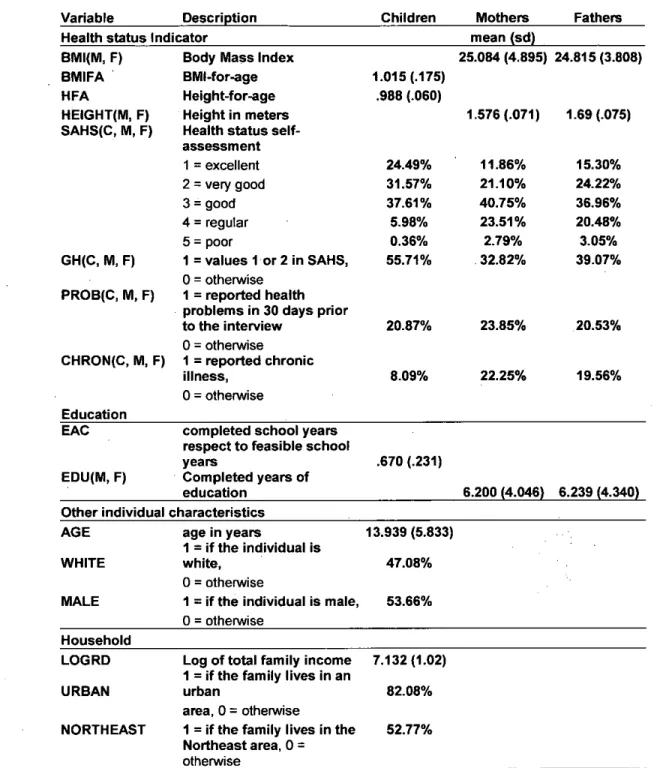
(42) II. HEALTH STATUS AND HUMAN CAPITAL ACCUMULATION 41. same consequences in terms of human capital accumulation, is inherent to the effect of child health on school attendance. In particular, it has been shown that poor health status is likely to result in the postponement of the age at which children start attending school, it determines higher absenteeism, and it might affect the probability of ever attending school. The important conclusion is that the initial endowment of health status appears to have an effect on the formation of human capital. Then, the correlation between human capital and earnings ensures that unhealthy children will tend to obtain low wages, which in turn results in low living standard and poor health when adults. Iri the empirical analysis carried out in the next section, we make use of a crosssectional dataset in order to assess the effects of health on education. A distinctiveness of this exercise is the use of a number of different indicators of health status from a large national survey and learning outcomes are measured with respect to the maximum feasible achievement of a child given the age, a methodology that allows for considering simultaneously a number of students with different ages. In addition, this variable permits to assess the effects of health on child ability even when considering a general household survey.. 2. The database and sample. The analysis relies on data from a Brazilian survey, the Living Standards Measurement Survey (Pesquisa sobre Padróes de Vida - PPV), a household survey conducted by the Brazilian Institute of Geography and Statistics (IBGE, 2003) in association with the World Bank. The survey collected data from 19,409 individuals in 4,800 households that.
(43) II. HEALTH STATUS AND HUMAN CAPITAL ACCUMULATION 42. were representative of the northeast and southeast regions of Brazil.3 It has the advantage of including an extended set of variables related to the individual health status (both subjective and objective measures, which are not included in more recent surveys), as well as indicators on the historical outcomes of the educational process. In addition, it contains a great number of socio-economic variables. Another important characteristic, which is useful in intergenerational analysis, is that it allows for linkin ^ parents and children because each member of the family has been interviewed. The Brazilian dataset being considered includes a very heterogeneóus population in terms of health status, income and socio-economic conditions. In particular, about 25% of children suffer from the consequences of poor nutrition (measured as BMI-FORAGE), which is an interesting characteristic in order to analyse its impact on learning ability. In addition, the Gini index for income per capita is about 0.56, underlining enormous differences in the distribution of economic possibilities. Considering the sampling design, the survey is based on a two-stage selection, with stratification of primary units and random selection of second-stage units. The primary unit is the 1991 Demographic Census geographic base sector, while the secondstage unit is the household. A 480-household sample size was determined for each geographic stratum. In urban area ^ , 60 sectors and 8 households per sector on each geographical stratum have been selected; in rural areas, the number of sectors has been fixed to be 30 and that of the selected households, 16. In order to obtain a useful dataset in our purpose, individuals of the same family have been linked using children as reference. As a result, a total number of 4187 children have been extracted from the original dataset, in which full information about 3 The metropolitan regions of Recife and Salvador, the rest of the urban area of the northeast, the rest of the rural area of the northeast, metropolitan regions of Belo Horizonte, Rio de Janeiro and Sao Paulo, the rest of the wban area of the southeast and the rest of the rural area of the southeast..
(44) II. HEALTH STATUS AND HUMAN CAPITAL ACCUMULATION 43. parents is available for each child. In other words, the 4187 observations used in the analysis include children that have been surveyed and whose parents have been surveyed, too. Children are defined as sons or daughters between 5 and 30 years of age, living with their parents. This definition is due to the possibility of comparison with the literature, and its main advantage consists of including higher levels of education such as postgraduate studies. It should be noted that the lower bound óf 5 years is not arbitrarily but it corresponds to the lower age in the dataset. However, the sample has been restricted to children aged up to 20 years when considering BMI-for-age and height-forage because this is the interval considered for WHO standards. In other words, the sample that includes children aged up to 30 years is used when subjective measures are considered, while children between 5 and 20 years old ^onstitute the sample when the health proxies are objective measures.. Variab/es ^. Variables used in the empirical analysis and the .main descriptive statistics, are presented in Table 2.1. Both objective and subjective measures have been used as indicators of health status. The Body Mass Index (BMI) is defined, as usual, as the ratio between weight and height squared, and a relevant feature is that weight and height are not selfreported. This variable has been used when considering adults, since it is heavily dependent on age during the first period of life. When considering children, however, BMI-for-age and height-for-age have been used. BMI-for-age is defined as the ratio between child BMI and median BMI of the age group (2007 WHO standards)..
(45) II. HEALTH STATUS AND HUMAN CAPITAL ACCUMULATION 44. Table 2.1: Variables and descriptive statistics. (Letters C, M and F appended to a variable's name stand for "child", "mother" and "father", respectively.. Description Children Mothers Fathers Variable mean (sd) Health status Indicator 25.084 (4.895) 24.815 (3.808) Body Mass Index BMI(M, F) 1.015 (.175) BMI-for-age BMIFA ^ Height-for-age .988 (.060) HFA 1.576 (.071) 1.69 (.075) HEIGHT(M, F) ^ Height in meters SAHS(C, M, F) Health status selfassessment 11.86% 15.30% 24.49% 1 = excellent 21.10% 24.22% 31.57% 2 = very good 40.75% 36.96% 37.61 % 3 = good % 23.51 20.48% 5.98% 4 = regular 2.79% 0.36% 3.05% 5 = poor 32.82% 39.07% 55.71 % GH(C, M, F) 1 = values 1 or 2 in SAHS, 0 = othennrise PROB(C, M, F) 1= reported health problems in 30 days prior 20.53% 23.85% 20.87% to the interview 0 = otherwise CHRON(C, M, F) 1= reported chronic 22.25% 19.56% 8.09% illness, 0 = otherwise ^ Education EAC completed school years respect to feasible school .670 (.231) years EDU(M, F) Completed years of 6.200 (4.046) 6.239 (4.340) ^ education Other individual characteristics AGE 13.939 (5.833) age in years 1= if the individual is WHITE 47.08% white, 0 = otherwise MALE 1 = if the individual is male, 53.66% 0 = otherwise Household 7.132 (1.02) LOGRD Log of total family income 1= if the family lives in an URBAN 82.08% urban area, 0 = otherwise 52.77% NORTHEAST 1= if the family lives in the Northeast area, 0 = otherwise.
(46) II. HEALTH STATUS AND HUMAN CAPITAL ACCUMULATION 45. Another objective indicator of child health status related to child nutrition used in the analysis is height-for-age, which is defined as the ratio between height and the median height of the age group (WHO standards). Concerning subjective and self-reported measures, self-assessment of health status (SAHS) is a discrete variable varying between 1 and 5, representing 1 the self-perception of the best health status (excellent - excelente) and 5 the worst (very poor - ruim). Variable GH (good health) follows from the selfassessment; its value is equal to 1 if the individual reported an excellent or very good health status (values 1 or 2 in SAHS) and zero otherwise. In addition to these variables, other indicators used in the analysis are provided by responses to the survey questionnaires. Variable PROB follows from the question about the occurrence of health problems during the thirty days prior to the interview and, in addition, individual are asked if they have chronic health problems (CHRONIC). Child education has been measured by the variable EAC (Educational Adequacy of Children), which is defined as the ratio between the number of school years successfully completed respect to the number of years that could have been completed by a child given the age.. Concerning parents, learning has been measured by the. number of years of education. Other control variables have been used in the analysis. In particular, as individual characteristics, age (AGE), racial group (WHITE), and sex (MALE). Family total income (LOGRD) and geographical localization (NORTHEAST, URBAN) characterize the household..
Figure



+7




Documento similar
The draft amendments do not operate any more a distinction between different states of emergency; they repeal articles 120, 121and 122 and make it possible for the President to
Analyzing the impact of institutional factors, capital accumulation (human and physical), foreign investment, economic growth and other indicators of economic development, it
Based on the preceding discussions, the study posits hypotheses and research questions in terms of four dependent variables of gender effects on mobile advertising
In section 3 we consider continuous changes of variables and their generators in the context of general ordinary differential equations, whereas in sections 4 and 5 we apply
GlcN might contribute to the maintenance of joint health in OA patients, but this should be demonstrated in clinical trials designed to investigate its effect on healthy subjects
In this paper, the effects of economic growth and four different types of energy consumption (oil, natural gas, hydroelectric- ity, and renewable energy) on environmental quality
Das (2012) established a relationship between remittances and other important macroeconomic variables, such as consumption, investment and economic growth in Egypt and
This paper has been developed to: (i) analyze the importance of human capital, (ii) evaluate the challenges confronting contemporary academic institutions (channels for generating
