
Keys to a New Deal on Climate Change
11
0
0
Texto completo
(2) Mikel Gonzalez-Eguino and Antxon Olabe (2009). emerging countries with a long recession. This. powers, the “big players”, need to play a clear and. economic context, together with the geo-political. decisive leadership role to overcome these. tensions always emerging around energy, adds. barriers. Initiating a new cycle in the world. great uncertain to the negotiations that seek to. response to changes in the climate requires the. provide a solution to the complex puzzle of. countries involved to assess if the existing. climate change.. agreements and institutional architecture is the most appropriate for the size of the challenge and. Despite the efforts of the international community,. the. real. advance. in. terms. the necessary response times.. of. mitigation has been limited so far, as Rajendra. The paper is structured as follows: Section 2. Pachauri President of the IPCC, stressed in his. briefly introduces the current economic crisis and. acceptance speech of the Nobel Peace Prize. Section 3 and 4 presents the energy and climate. (Pachauri. the IPCC. crisis in confluence. Section 5 the Kyoto Protocol. published its first scientific study on the impact of. agreement is detail with its strengths and. climate change in 1990, global greenhouse gas. limitations. Section 6 analyze approaches for a. (GHG) emissions have continued to increase at a. Post-Kyoto agreement and in Section 7 explores. significant rate. They rose by 70% between 1970. different institutional alternatives for meeting. and 2004. The signing of the Kyoto Protocol (KP). these targets. The paper end with the summary of. in 1997 was a significant step forward in the. the main conclusions derived from the article.. 2007).. Even. thought. correct direction, but there is a pressing need for the major emitter countries, such as the United States, China and India, to be involved. The expiry. 2. AN ECONOMIC CRISIS WITH LONG RUN. of. IMPLICATIONS. the. Protocol. in. 2012. and. its. current. renegotiation with its sights set on 2020 open up an opportunity to ensure that the climate targets and the involvement of the players are more in keeping with the magnitude and severity of the problem.. the end of 2009, we will probably be suffering the effects of the first major global economic crisis since 1929. According to IMF (April 2009) “output. Therefore, the 2007 Bali Summit (UNFCCC 2008) established a “route map” that laid down the aspects to be negotiated leading up to the Copenhagen Summit. These aspects include measures regarding mitigation, sinks, adaptation, technology transfer and funding. Even though there is extensive consensus regarding the principles on which this agreement should be based,. When the Copenhagen Summit is held at. the. heterogeneity. of. interests. and. economic contexts of each country makes it more complex to turn into reality. The leading world. Ambientalia vol. 1 (2009) 1-11. is projected to decline by 1.3 percent as a whole in 2009 and to recover only gradually in 2010” (IFM 2009). The downturn in business and rising unemployment is expected to provide be the background music to the climate negotiations. While. the. governments. are. taking. extraordinary stimulus measures, the crisis has already had a consequence from which there is no turning back: the awareness that the economic power has globalized, spreading from West to East and to the emerging countries, and that. 2.
(3) Mikel Gonzalez-Eguino and Antxon Olabe (2009). effective global action is needed to overcome the. currently employs 350,000 people and is expected. traditional national sphere.. to overtake the conventional car industry by 2020.. When the world eventually emerge from. This idea has taken off strongly in the. this crisis, we will remember that it marked the. United States, where President Barack Obama. end of theG-8 and that the G-20 will have. wants to allocate $150 billion over ten years to. permanently replaced it. As the declaration of the. create five million “green” jobs (Isbell 2009).. G20 meeting held in Washington stated, “ We. According to Obama, “our dependence on oil is. underscored that the Bretton Woods Institutions. one of the greatest threats we have ever faced. It. must be comprehensively reformed so that they. is a threat to our national security, our planet and. can more adequately reflect changing economic. our economy”. Obama‟s new energy policy and. weights in the world economy and be more. targets could transform rapidly United States into. responsive to future challenges. Emerging and. a leader on climate change solutions.. developing economies should have greater voice and representation in these institutions” (G20 2008).. 3. THE ENERGY CRISIS: A REVOLUTION IN. One of the risks of the economic crisis is that. PROGRESS. it may postpone the Post-Kyoto agreement in Copenhagen. However, economic recovery and. The economic crisis and the climate crisis. the fight against climate change should not be. have converged with another transformation. seen as conflicting as both could function in the. related to the growing lack of fossil fuel, which. same direction. The magnitude of this crisis. currently accounts for nearly 80% of the global. probably will require probably still a more. demand for primary energy. The foreseeable. expansive fiscal policy sustained over time to. increase in prices and the insecurity regarding the. maintain the economy recovery. This time, given a. conventional supply of gas and oil will have far-. scenario of climate change and lack of fossil fuels,. reaching economic and geo-strategic implications.. major and sustain investment in energy efficiency and renewable energies would be more than. In July 2008, the price of a barrel of oil. justified. Even though these policies will be costly. reached a record high 147 dollars a barrel, which. and will increase the deficit, they could be. pushed up the price of food and most products. profitable in the medium term and create millions. (FAO 2008). Even though there could be a cyclical. of new productive. component to part of this increase, it is widely. “green” jobs,. as many. institutions are now defending. A “Green New. accepted. that. conventional. fossil. fuels. will. Deal”, as the United Nations Environmental. structurally begin to be scarcer in the near feature. Program (UNEP 2008) has called for, may serve as. due to the strong increase in demand and to the. an urgent stimulus of the economy and to ensure. limited reserves. Probably, when the economy will. sustainable public expenditure. As an example, in. recover the price will start increasing again.. Spain or Germany, the renewable energy sector. Ambientalia vol. 1 (2009) 1-11. 3.
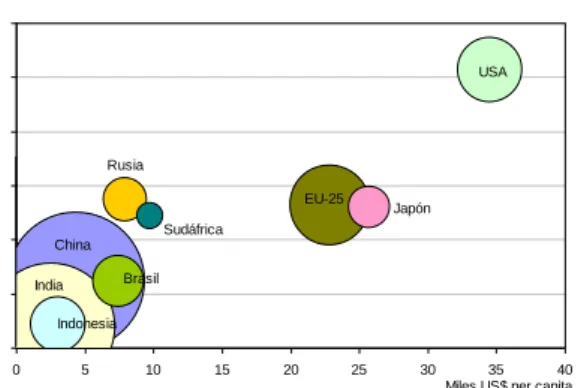
(4) Mikel Gonzalez-Eguino and Antxon Olabe (2009). The International Energy Agency in its last. World Energy Outlook 2008 therefore called for. that depend 100% on the Russian supplier (The Economist 2009).. "an energy revolution" (IEA 2008). According to the IEA: “We cannot let the financial and economic crisis delay the policy action that is. 4. THE UNPRECEDENTED CHALLENGE OF THE. urgently needed to ensure secure energy supplies. CLIMATE CRISIS. and to curtail rising emissions of greenhouse gases”. Furthermore, and for the first time ever, the IEA stated that the "peak in oil extraction" was in the near future. In a recent interview (The Guardian, 2008), the chief economist of the IEA, Fatih Birol, stressed: “we are expecting that the. production of conventional oil will come to a plateau around 2020 which is, of course, not good news from a global oil supply point of view”. The stagnated growth of conventional oil may be positive for climate change if it leads to a leap in energy efficiency and the use of renewable energies. However, it may be very negative if the technologies. tend. towards. coal. and. non-. conventional oils such as tar and bitumen sands, whose carbon contents are very high. At the same time, the end of oil and cheap gas announced by the IEA will make use of sources that are abundant and close to the markets every attractive, such as coal. This is particularly true in countries such as China, the United States, India and Russia, which hold 65 per cent of the known coal reserves. Neither can a scenario where the fight for access to increasingly scarce energy resources strains international relations and the adoption of climate agreements be ruled out. One example of these tensions was witnessed 2009 winter in Europe, when the cutting of the gas supply by Russia lasted for several weeks seriously affected countries such as Finland, Bulgaria or Lithuania. In 2007, the Intergovernmental Panel on Climate Change pointed out that "atmospheric concentrations of CO2 exceed by far the natural range over the last 650,000 years, due primarily to the fossil fuel use, with land-use change providing another significant but smaller contribution”. If specific mitigation policies are not established, the “average temperature will very probably increase. between 1.8 and 4 ºC by the end of the century ” (IPCC 2007). In other words, there is a very real likelihood. of. breaching. the. “prevention. thresholds” identified by the scientific community that consider 2ºC as the maximum reasonable limit. Greater increases would take us into unknown territory, as just 5ºC is what separates us from the last glacial period. Reducing emissions so that “they do not interfere with the climate system”, by means of a non-traumatic energy transition, requires the world energy system to be deeply transformed towards a low-carbon economy. According to the IPCC, for the climate system to moves towards safe concentration levels global emissions need to peak in approximately 2020, be halved by 2050 and continue to fall until the end of the century. Taking into account the existing strong economic and demographic inertia this means that the global average per capita emissions should be close to two tons of CO2 per person a year in 2050 and then be reduced to one ton in 2100 (Stern 2008). This goal (see Figure 1) is a long way from the current 20 tons of the United. Ambientalia vol. 1 (2009) 1-11. 4.
(5) Mikel Gonzalez-Eguino and Antxon Olabe (2009). States or 10.5 in the European Union (EU-25) and. in emissions it is explained by a rapid reduction of. has even been overtaken by China and Brazil. One. primary forest that also means a great loss in. example that can illustrate the magnitude of the. terms of biodiversity.. challenge is that just one flight from London to New York emits 1.4 tons of CO2 per person.. Given these considerations, two decisive points of reflection emerge. Firstly, by 2020,. Figure 1: The magnitude of the. approximately 90% of humanity is going to. climate change challenge, 2005. belong to emerging and developing countries, whose per capita income will be between seven. 24. tCO2 per capita. and ten times lower than in the rich countries. It is. USA. 20. logical to think that their absolute priority will be. 16. on economic growth to close this breach and that. Rusia 12. EU-25. they will opt for an energy model to serve that. Japón. Sudáfrica. 8. China. central goal.. Brasil. India. 4. Indonesia. Source: World Resource Institute (2005). 0 0. 5. 10. 15. 20. 25. 30. 35 40 Miles US$ per capita. Secondly,. a. successful. climate. change. (Note: The denomination of y-axis refers to current per capita. strategy is impossible in the medium and long. emissions and x-axis to GDP per capita. The centre of each. term without the involvement of emerging. bubble denotes the position of the country on the grid and the. countries, as their emissions will exceed those of. size of the bubble represents the population, i.e. USA: 300M). The only important emitter center that has so far made some progress in mitigation is the European Union. Between 1990 and 2005, the EU-15 reduced its emissions by 2%, although part of this reduction is due Germany‟s „wallfall profits‟. the economically developed countries by 2020. In fact, even if developed countries were to reduce their emissions to zero, the expected growth of the emerging and developing countries would make it highly difficult to achieve the climate stabilization goals.. and the gas-to-coal switch in the UK. The reduction of emissions in Russia is explained fully by its industrial-economic collapse after the fall of. 5. AS KYOTO PROTOCOL COMES TO AN END,. the Soviet system. Even though it is possible to. WHAT NEXT?. separate economic growth and emissions, the question is whether this separation is viable worldwide over the coming decades and to the necessary extent.. greatly over the last decade, even though in energy. intensity has decreased at the double the rate of that of Europe in the last decade. In other countries, such as Indonesia or Brazil, the increase Ambientalia vol. 1 (2009) 1-11. political negotiations and represents an initial attempt to contain the risks of climate change.. Emissions in China and India have increased China - and breaking the stereotype -. The KP (UN 1997) was the result of intense. This international agreement enabled specific contents to be given to the undertaking of the Earth conference held in Rio de Janeiro in 1992 where 198 countries agreed to. act. in a. coordinated manner to "reduce greenhouse emission concentrations to a level that does not. 5.
(6) Mikel Gonzalez-Eguino and Antxon Olabe (2009). interfere with the climate system". The central goal. pointed out. The main one is that the main GHG. of the KP, signed in 1997 and ratified in 2005, is. emitters have not real mitigation targets. The. for developed countries to reduce their joint. United States has not ratified it, Russia lacks real. emissions by 5.2% with respect to the 1990 levels. targets due to its economic collapse and China. between 2008 and 2012. Even though the KP. and. was a positive step forward in the fight against. reduction targets. These four powers account for. climate change, its successes and limitations need. half the world‟s emissions. Furthermore, the Kyoto. to be considered in terms of its renegotiation in. targets are not binding for the signing countries.. India. although. incorporated. has. not. Copenhagen 2009. In practice, some of the principles on which The most notable advance of the Protocol. a climate agreement should be based have been. was that the international community managed. undermined. Firstly, the “leadership principle” of. for the first time to establish mitigation goals and. wealthy. specific timelines. Furthermore, this reduction of. Conference has not been applied due to the USA‟s. emissions. was. based. fundamental. refusal under the Bush government to mitigate its. principles. that. must. any. emissions.. on. two. underpin. climate. countries. Secondly,. that. the. inspired. the. Rio. “cost-effectiveness. negotiation: i) the “cost-effective” reduction of the. principle” or the possibility to reduce emissions. emissions, by means of using flexible mechanisms. cheaply lost a great deal of its potential as the KP. and ii) the “equitable" distribution of the burdens,. only applied to some countries. In fact, this could. by means of applying "differentiated" targets. have led to a carbon leakage phenomenon.. according to the historical responsibility of each. Thirdly,. country and their capacity.. outdated as some countries, such as Rumania or. the. "equity. principle”. has. become. Poland, with KP targets, have been overtaken in At a more technical level, special mention. per capita income by other countries without any. should be made of the important advances made. targets, such as Singapore, South Korea or the. in monitoring emissions, conducting inventories. United Arab Emirates. Finally, the mitigation rate. and the accounting of sinks. This work is vital to. for the Kyoto phase, even though successful as an. assess the progress achieved objectively. Another. initial step, is highly insufficient if we want to. fundamental advance over the years that the. abide by a "precaution principle".. Protocol has helped to reinforce is the role and consolidation of the use of science and the. Despite. these. limitations,. the. overall. scientific system to underwrite and advise on. assessment of the KP is positive as it has helped to. climate agreements. During this period, the IPCC. open up a path full of difficulties. Its fundamental. has. the. contribution is to have enabled mechanisms and. governments and citizens around the world and. structures to be created that are going to be. this is the key inheritance to build the future post-. necessary to make good progress in the future.. gained. huge. credibility. among. Kyoto agreement on a solid and objective base. Along with the advances brought about by the Protocol, there are limitations that should be. Ambientalia vol. 1 (2009) 1-11. 6.
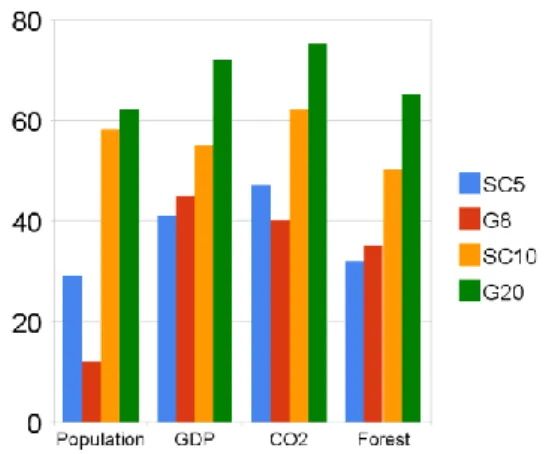
(7) Mikel Gonzalez-Eguino and Antxon Olabe (2009). 6. A “DEEP, THEN BROAD” APPROACH FOR A CLIMATE LEADING. Figure 2: Coalitions for negotiation prior to Copenhagen (% world total), 2005. In order to reach an important agreement in Copenhagen 2009, it is necessary to reflect on the format that those negotiations should take. Two fundamental dimensions (Aldy and Stavins 2007, 2008) of any international agreement are, on the one hand, 1) the scope or depth of the commitments and, on the other hand, 2) the participation or breadth in terms of the countries involved. Both characteristics are desirable to achieve the necessary reduction in emissions.. Source: World Resource Institute (2005) (Note: SC5 refers to the five permanent members of Security Council and SC10 is an expansion of the Council that includes. The KP and the UNFCCC have a “broad,. Brazil, India, Japan, Indonesia and South Africa). then deep” type structure; it enables great participation in the agreements, but is limited due. The extent of the representation of the G8. to the absence of the key players. In the current. in the current world context is clearly out of step.. context, a “deep then broad” approach could help. The SC10 coalition has many characteristics. to achieve a rapid and substantial reduction of the. desirable to reach a climate agreement: i) the. emissions. The most pressing current need is for. number of countries is limited, ii) it represents. the main emitter countries to sit down at a. nearly 4000 million inhabitants, iii) it accounts for. negotiating table to reach an agreement on the. over 60% of world emissions, iv) contains half the. key climate aspects. The prior leadership of these. planet‟s forests and, furthermore, iv) it is a. powers would ensure the ideal conditions to. benchmark of today‟s leading cultures. These. tackle and extend these agreements to the 195. characteristics will be increasingly more marked in. UNFCCC countries at the December meeting in. the future given the energy, economic and. Copenhagen 2009.. demographic inertias. Other configurations are undoubtedly possible (i.e. Jeffry 2008), this is just. Figure 2 sets out the different “small-n”. an example of few entities that could reach to an. combinations of negotiating groups and some. agreement on the three fundamental issues: 1). variables associated to them. These coalitions or. reduction of global emissions, 2) maintaining the. groups are based on the different structures. forests and 3) transfer of technological and. adopted to deal with other global problems, such. financial resources needed for mitigation and. as the G8, the G20 the permanent members of. adaptation.. the Security Council (SC5) – United States, China, United Kingdom, Rusia and France – or a possible expansion of the Council would included Brazil, India, Japan, Indonesia and South Africa (SC10).. Ambientalia vol. 1 (2009) 1-11. 7.
(8) Mikel Gonzalez-Eguino and Antxon Olabe (2009). The main advantage of the ad hoc or G-type. 7. THE ROLE OF THE UNITED NATIONS. structures is their potential for quick decision Probably, and given the past results, the Copenhagen Summit will require also a debate on the design of the most effective institutional framework for a post-Kyoto future. There are currently two complementary approaches that can be figure out: architectures where the United Nations. plays. a. fundamental. role. as. the. administrative and executive authority, and ad. hoc architectures that would operate parallel to international institutions.. the current architecture where climate decisions are taken at the United Nations Conference Managing. and. controlling. the. magnitude of the required programs and funds totally swamp the current capacity of the Environment Program (UNEP) or to scale-up the role of UNFCCC Secretariat. Another possilibity would be to create a new specific institution similar to the International Monetary Fund or the World Bank. This institution could be in charge of managing the global mechanisms that could be created, such as the setting up of an international emissions market. The World Bank has already offered to assume part of those tasks and, in particular,. those. difficulty to ensure that they are “binding” and stable in time. Furthermore, there would be an undesirable drain of the contents that come under the United Nations as the entity entrusted with managing global public assets. Therefore, should. ad hoc structures be necessary for go-between purposes, they should end up being integrated within the United Nations bodies. The Earth‟s climate as a public asset and its. The first approach (Stern 2008) reinforce of. (UNFCCC).. taking, but their greatest limitation lies in the. relating. to. the. funding. mechanisms (World Bank 2009). The second approach is to assign the management of the climate targets to a G-type group, which would operate in a similar way to the G8 or G20. That body would function in a coordinated way with international institutions and would transfer compliance of the targets and. worrying evolution bring us to a debate regarding institutional architecture that transcends the debate on the modernization and effectiveness of the United Nations.. Ultimately, climate change. raises the recurrent dilemma of where to place the frontier between the sovereign right of the States and the need to protect global common assets, such as the Earth‟s climate. Moreover, as science has advanced in the understanding of climate change, the emphasis on global security is now being explored. Therefore it could be consider the role that it can play within this institutional architecture the United Nations Security Council (Sindico 2006, Penny 2007, Olabe and Gonzalez 2008). In fact, the United Nations Security Council has already chaired a session dedicated exclusively for the first time to climate change (SC 2007). For the United Nations Security Council to have the sufficient capacity and representation to turn round the global climate crisis, it would be necessary to extend and reformulate the current veto right of the so-called major powers.. actions to the national sphere, to the regions and to the cities.. Ambientalia vol. 1 (2009) 1-11. 8.
(9) Mikel Gonzalez-Eguino and Antxon Olabe (2009). 8. CONCLUSIONS. era, its innovative and technological machinery have to be used to fight against climate change. The 2009 Copenhagen summit is a key moment. to. achieve. a. post-Kyoto. climate. agreement. The magnitude of the challenge is huge, and urgent and drastic durable actions are required to turn around the climate crisis. The. current. economic. crisis. and to ensure international cooperation. An effective approach to these agreements is, as the Secretary General of the United Nations, Ban Ki Moon, has already requested, for the main emitter countries to hold a meeting prior to the. and. the. emerging energy constrains should not delay the necessary adoption of an ambitious climate agreement. Firstly, as the implications of climate change will be notable and will affect the most vulnerable countries and because deferring it will only serve to aggravate the damage. And, secondly, because there is the possibility, if a Keynesian environmental policy is used, to be tackled in a single direction. Strong private and public investment in developing a low-carbon economy is the lever to stimulate the economy and to yet again generate long-term and productive jobs. This transformation would help to. Copenhagen summit. This meeting would be the antechamber. between states arising from a lack of energy. The massive development of clean and renewable energy sources is necessary and it is also fundamental. that. they. are. more. evenly. distributed.. emitter countries need to be proactive and take leadership. would. be. aspects, such as establishing mitigation targets, maintaining. forests. mechanisms. for. and. the. technology. funding transfer. of and. adaptation. This meeting should also be attended by the top politicians from each country. An agreement in political terms between Heads of State and Government regarding the four or five fundamental. elements. would. facilitate. the. subsequent establishing of the more technical aspects and their extension to the other countries within the UNFCC. Once the agreements have been reached, they will need to be implemented and durable in time. Even though these negotiations may eventually take place in ad hoc structures in the interest of expediency, it is important that they are then incorporated into the United Nations. The proliferation of Groups (G-8, G-10, G-20) outside. The KP experience has shown that the main the. agreements. discussed and possibly reached on different key. avoid the risk in terms of competition and guaranteed supply and also possible conflicts. where. role. for. the. and this would be a serious setback.. Copenhagen. negotiations to be successful. The big players: United States, the European Union, China, Russia, India, Japan, Brazil and Indonesia are responsible for two out of every three tons of greenhouse gases currently emitted to the atmosphere. Among them, the United States needs to be the driving force that is expected of it and, in this new Ambientalia vol. 1 (2009) 1-11. the UN threatens to make the institution irrelevant. Some specific architecture will be necessary in accordance with the magnitude of the challenge. It is also required to control and coordinate the enormous quantity of resources that will need to be mobilized, as the architecture and. implementation. of. the. United. States. Framework Convention on Climate Change in. 9.
(10) Mikel Gonzalez-Eguino and Antxon Olabe (2009). 1992, although positive, is clearly insufficient. The. Isbell, P. (2009) A Preliminary View of Obama‟s. negotiations in Copenhagen not only have to be. Future Energy Policy, Real Instituto Elcano,. the opportunity to reach a climate agreement, but. Madrid.. also to design an institutional architecture to enable international governance to be improved by ensuring that the United Nations institutions continue to be its backbone. Despite their limitations, the UN institutions continue to be the most effective and natural place to manage the global assets across state frontiers.. FAO (2008), The State of Food Insecurity in the World 2008: High food prices and food security – threats and opportunities, Food and Agriculture Organization of the United Nations, Rome. Frankel, J. (2008), “An Elaborated Proposal for Global. During September 2009, four important preparatory or pre-Copenhagen meetings has. Climate. Policy. Architecture:. Specific. Formulas and Emission Targets for All Countries in All Decades”, WP, Harvard.. take place: the Major Economies Forum (G17) in. Olabe, A, González-Eguino, M. (2008) El cambio. Washington, which together with the G8 and the. climático. EU is China, India, Brazil, Mexico, South Africa,. seguridad global: El papel del Consejo de. Australia, Indonesia and the Republic of Korea, the. Seguridad, Política Exterior, 124, 175-186.. como. amenaza. emergente. a. la. Climate Conference at the General Assembly of the United Nations in New York, the G-20. Pachauri, R.K (2007), Acceptance Speech for the. Summit in Pittsburgh and, pre-Copenhagen. Nobel. talks in Bangkok. Time will say if this “minilateralism“ summits among big players had positive effects inCopenagahen Summit.. Peace. Prize. Awarded. to. the. Intergovernmental Panel on Climate Change (IPCC), Oslo, 10 December 2007. Penny, K., (2008) "Greening the Security Council: climate change as an emerging threat to international peace and security‟‟, International. REFERENCES. Environmental Agreements, 7, 35–71.. Aldy, J., Stavins, RN., (2007), Architectures for. SC (2007), Security Council 5663rd Meeting, “On. Agreement: Addressing Global Climate Change in. impact of climate change on peace, security”, 17. the. April 2007.. Post-Kyoto. World.. Cambridge. Press,. Cambridge, 2007. IEA. (2008),. Sindico, F. (2007), Climate Change: A Security. World. Energy. Outlook. 2008,. (Council) Issue? Carbon and Climate Law Review,. International Energy Agency, Paris, 2008.. Vol. 1, pp. 26-31, 2007. IFM (2009), World Economic Outlook: crisis and. Stern (2008) Key elements of a global deal on. recovery, April, Washington, D.C.. climate change, London School of Economics and Political Science, London.. IPCC (2007), Summary for Policymakers: Climate Change. 2007,. Fourth. Assessment. Cambridge University Press, 2007. Ambientalia vol. 1 (2009) 1-11. Report,. The Guardian (2008), When we will run out?, Dec 15th, 2008.. 10.
(11) Mikel Gonzalez-Eguino and Antxon Olabe (2009). The Economist (2009A), Pipe down, Jan 8th, 2009. The Economist (2009B), Troubled waters, Jan 3rd 2009. UN (1997) Kyoto Protocol to the United Nations Framework Convention on Climate Change, United Nations, New York. UNFCCC (2008), Report of the Conference of the Parties on its thirteenth session, Bali, 2007.G20 (2008) “Declaration of the Summit on Financial Markets and the World Economy” Washington on November 15, 2008. UNEP (2008), Green Jobs: Towards Decent work in a Sustainable, Low-Carbon World, United Nations Environment Programme, Nairobi. World Bank (2008), Development and Climate Change: A Strategic Framework for the World Bank Group, World Bank, Washington, D.C.. Ambientalia vol. 1 (2009) 1-11. 11.
(12)
Figure
Documento similar