
Reproduction, distribution and abundan ce of Bothus conslellatus (Pisces: Bothidae), in the Gulf of Tehuantepec, Mexico
9
0
0
Texto completo
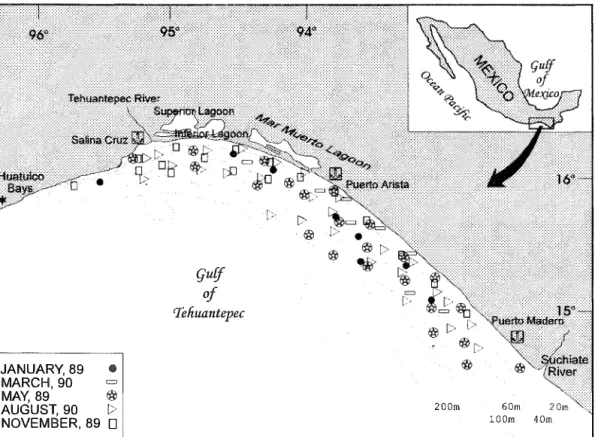
(2) REVISTA DE BIOLOGÍA TROPICAL. 206. variation in space and time, and to characterize the reproduction, spawning and recruitment.. MATERIAL AND METHODS The continental shelf of the Gulf of Tehuantepec is located in the southem Mexican Pacific, between the Huatulco Bays, Oaxaca, and the Suchiate River, Chiapas (Fig. 1). The collections were made during five oceanographic cruises in January, May and November of 1989, and March and August of 1990. The collections of January, May, November and August, were made with the "El Puma" vessel, and the collection of March with the "Don Nachito" boat. A total of 86. ro... collections were made from 15 to 80 m of depth (Fig. 1), with commercial shrimp trawl nets ( 12 and 9 m mouth footrope, mesh size 4.45 cm) at an average of 3 knots during 30 minutes. The trawled area, fish catches and data were processed according to criteria discussed by Stevenson ( 1982), and Sánchez Gil and Yáñez-Arancibia ( 1985). The individuals were measured total length (mm), weighed (g) (wet weight) with and wíthout víscera, and sexed. The population parameters of density (individuals/m2) and biomass (glm2) were determined per station and cruise; average Jength and average weight were determined per cruise; visceral and gonadosomatic index were determined per sex and cruise. Although the data correspond to. [> . @. qulf of. fJéfiuantepec. • JANUARY, 89 MARCH,90 @ MAY,89 [> AUGUST, 90 NOVEMBER, 89 O =. Fig. l . Study area. The collect stations. 200m. fiOm 100m. are. showed in relation lo the oceanographic cruises.. 40m.
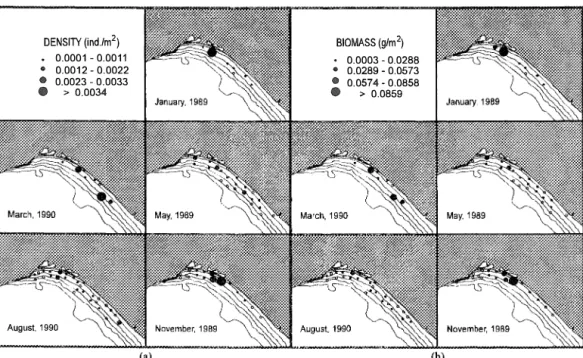
(3) 207. TAPIA -GARC1A et al.: R eproductioll, distribuüoll and abundance of Bot/1tls. different years, they were ordered in an armual ¡'¡eriod to assume the varíations during a year. Gouad matürity: It was detennined according to fue key presented by Laevastu ( 197 1). Stage I ímmature, sexually indeterminate individuals; II immature, sexually determínate individuals; nI in maturíng; IV mature; V reproduction; VI spent; VII resting.. TABLE 1 Total abulldallce alld lengtlzs of B. constellatus by oceanographic cruise. Cmise. =. =. =. =. =. =. =. Size at first maturity: It was determined as the mídpoint between the length of the lal'gest immature individual (H) and the length of the smallest maturing individual (m) (Tapia-García et al. 1995). Gonadosomatic index (GSI): It was evaluated according to Caílliet et al. ( 1986): GSI. =. B/W. where W is the wet weight of the físh, and B ís the wet weight of both gonads. Visceral index (VI): lt was evaluated with the next equation: VI. =. V/W. where W is the weight of the fish, and V is the weight of the viscera. 2). DENSITY (ind./m •. .. (!l. ID. 0.0001 - 0.0011 0.0012 - 0.0022 0.0023 - 0.0033 > 0.0034. January,1989 March,1990 May,1989 August,1990 November,1989 TOTAL CATCH. Number (ind.). Wet Weight (g). Total Length (mm). 209 3 171 247 291 310 4 228. 6 728.1 57 892.5 4 504.2 4 974.6 5341.7 79441.1. 64-157 61-149 51-155 69-147 62-150 51-157. RESULTS Distril:mtioll alld abmuhmce: A total of 4 228 individuals of B. constellatus were captured, with a total weight of 79 44 1. 1 g, and a size mnge of 5 1 to 157 mm total length (Table 1). This species was widely distributed in depths lesser than 60 m on sand and sandy muddy sediments. Greatest density (0.00 12 to 0.0068 ind./m2), and biomass (0.0293 to 0907 glm2) occurred around the 40 m isobath in the northem Gulf, mainly in front of Mar Muerto Lagoon during January, March and November (Figs. 2a, 2b). The monthly density pattem. BIOMASS (g/m 2) •. .. e. •. 0.0003 - 0.0288 0.0289 - 0.0573 0.0574.0.0858 "0.0859. August. 1990. Fig. 2. al Spatial distribution of fue density. b) Spatial distribution of tbe biomass in me Gulf of Tehuantepec. Empty circles mean Úl3t the species was no! found in mese stations..
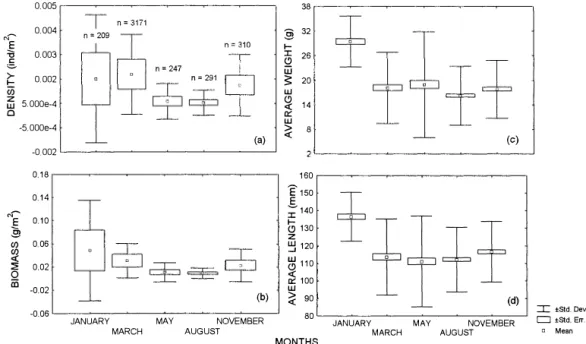
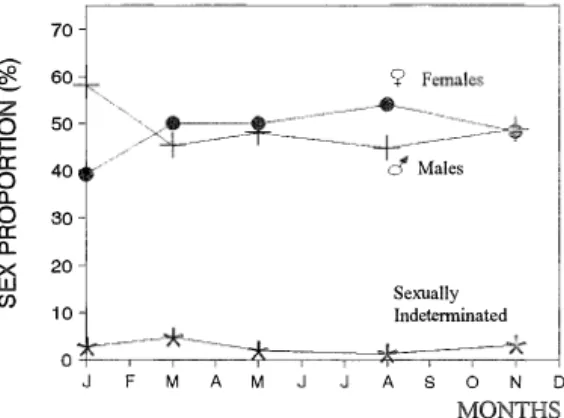
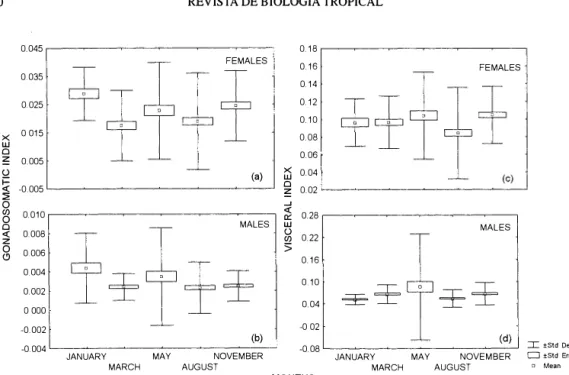
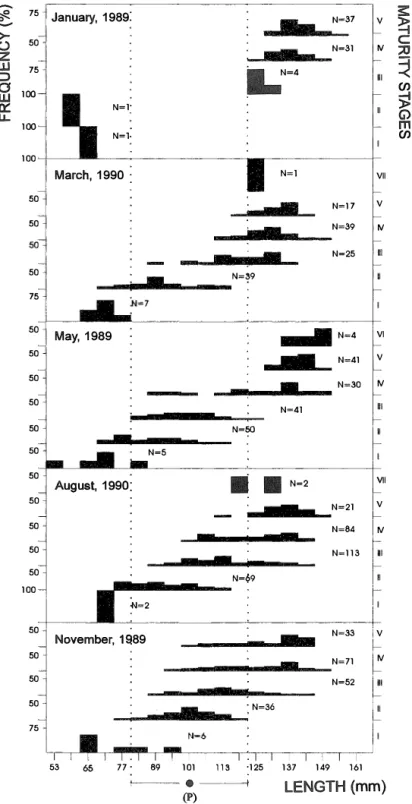
(4) REVISTA DE BIOLOGÍA TROPICAL. 208. 0.005 0.004. N�. E 'O. O"". '. 0.003. " c >f-. 0.002. 15. 5000e-4. ro. O. �. n = 3171. -5.000e-4 -0 002. '". i.ü S w C). « a:: w. (a). �. 20 14 8. 0.14. 0 06. :E. 0.02. � 110. � 100. w. �. (b) MAY. JANUARY MARCH. NOVEMBER AUGUST. (e). fffft«. � 120. ���2. �. ! tí �. -"-. fC) 130 z. -0.02 -0.06. f. 26. 160. (f). O iñ. n = 291. f:c C). 32. E 150 E ;; 140. 0.10. �. '''. Él. 0.18. E. :9. �. o � � "'. 38. 90 80. MONTHS. JANUARY MARCH. MAY. NOVEMBER AUGUST. I ±Sld_Dev D tstd.Err. (J. Mean. Fig. 3. Average variation of the population parameters. a) Density. b) Biomass. e) Weight. d) Length.. showed a high concentration of individuals during January and March (x = 0.00 15 and 0.00 17 ind'!m2 respectively), while the minimum value was during August (x=0.0005 ind.!m2) (standard deviatiou and "u" are showed in fig. 3). The biomass pattem was similar to the density with the highest biomass during January (X=0.048 g/m2), and the lowest during August (X=0.009 g/m2) (Fig. 3b). During January a high number of individuals with the highest weight (X=29.5 g) and length (x= 136 mm) were observed, while during the other months these parameters decreased. The individuals with the lowest weight and size where in May (Figs. 3c, 3d). The analysis of the spatial length distribution indicates that the largest individuals were in front of the main estuarine systems of the zone, and the smallest individuals occurred towards the southeastem of the Gulf The length frequencies were multimodal, except in January (Fig. 4), these were according with the great variation of the weight and length of the individuals during March, May, August and November (Figs. 3c, 3d).. Reproductive biology: In the collections the female: male ratio was near to 1: 1, and only the sexually indeterminate individuals Guveniles) were a small fractíon «5%) (Fig. 5). The individuals had a spatial tendency to distribute by sexes. The gonadosomatic index pattem was similar in both sexes. A maximum average was observed in January (0.029 and 0.004, females and males respectively), and the lowest average values were in March and August (Figs. 6a, 6b). The visceral index pattem was also similar in both sexes, with the maximum average in May and November, and the mínimum averages in January and August (Figs. 6c, 6d). For the females the maximum variations were between May aud August, and the minimum variations were between January and March. For the males, the maximum variation was in May and the minimum in January. Maturity stages analysis showed in January one evident group of adult organisms.
(5) 209. TAPIA -GARCIA el al.: Reprodllction, distriblltion and abundance of Bothus. �. :? o. 45. '-". >-. U. §. O'. � �. 30. 1. j. I. "1 o. �I 30. 70. January,1989 N=209. �. 60. O ¡::::. 50. Z. o::. O. O-. 30. March,1990. @. 20 -. rJJ. i N=3171. 1. Sexually Indete1minated. 10 o. Females. Males. 40. O. o:: O-. 1UlMl.. '?. -----*-----F. M. A. I M. A. '5. S. O. N. O. MONTI:¡:S Fíg. 5. Sex proportion of B. conste/la tus.. 45-. 30. May,1989. was 80 mm (May) (Fig. 7). An analysis of spatial distribution of maturity stages of individuaIs showed that mature individuals were mainly in front of the Mar Muerto Lagoon.. N=247. '5. 45. August,1990. DISCUSSION. N=291 30. Distril:mtion '5. and. abundance:. B.. constellatus has been considered as a dominant. •. 65. ��. 77. B9. I II 101. IIIIII. 113. 125. 137. �. 149. I J. 161. LENGTH(mm). Fig. 4. Length frequencies of B. constellatus for each month.. in a maturing process, and sorne young individuals that have not yet engaged in reproduction. During. the other months aH maturity stages were observed (Fig. 7). The size at first maturity of B. constellatus is 10 1 mm because the largest immature individual (U) was 122 mm of total length (November) and the smallest in maturing (IH). species in the Gulf of Tehuantepec because it had a wide distribution, high abundance (biomass and density), and high frequency of occurrence (Tapia-García et al. 1994). This species was one of the 20 species that represented more than 80% of relative abundance (number and weight) in each analyzed month, among a total of 170 species. The highest abundance was around the 40 ID isobath and towards the northem Gulf. B. constellatus is a typical marine species, which has not been reported in estuarine systems. B. constellatus occurred in depths of less than 60 m on sandy and sandy-muddy sediments, according to the repOlt of distribution of sediments (Carranza-Edwards et al. 1989). This partero is similar to the report of Amezcua-Linares ( 1996). Syacium ovale also has a similar distribution in the Mexican Central Pacific (Barba-Torres 1990). This partero also has been observed in S. gunteri in the Gulf of Mexico, which is most abundant in..
(6) REVISTA DE BIOLOGÍA TROPICAL. 210. 0.045. 0.035. 0.025. ><. w el � (). ¡:: <. ::!!. O (/) O el < z O (!). 0 015. 0.005. -0.005 0.010. 0.18. ±. FEMALES. ff. 0.16 0.14 0.12 0.10 0.08 0.06. t:'í. (a). el �. 0.006 0.004 0.002 0 000 -0.002 -0.004. < o:: w. �T fT. () (/). :>. MARCH. 0.28 MALES. -,-. 0.22. 0.10 0.04. �:r. -0 02 -0.08. NOVEMBER AUGUST. 0.02. 0.16. (b). MAY. JANUARY. ffft�.). -'. MALES. 0.008. 0.04. FE MALES. MONTHS. JANUARY MARCH. o. -:E�. -'-. (d). MAY. NOVEMBER AUGUST. :::r: tstd Oev. CJ tstd. Err o Mean. Fig. 6. Variation of the visceral and gonadosomatic index for females and males.. muddy-silty sediments, between the 18 and 36 m isobath, in areas influenced by estuarine processes (García-Abad et al. 1992, Sánchez Gil et al. 1994). The biomass of B. constellatus was high in January, which is attributed mainly to the presence of abundant adult fish (average 136 mm total length) (Figs. 3b, 3d, 4). From March to November the biomass values result mainly from the great abundance of juveniles, which .. is probably associated to a long recruitment perlod of juveniles to the adult population, although also there is recruitment during the other months, but with less intensity. The juveniles observed in these months are being recruited completely to the adult population in November, which is reflected in a lightly increase of the density and the biomass. The size frequencies also show the modal progression as a result of growth and recruitment. The multimodal distribution shows a wide perlod of reproduction and recruitment. The maximum size was 157 mm, and Amezcua Linares ( 1996) reported a maximum size of 145 in the Mexican Central Pacifico. Reproductive biology: The female:male ratio was practically 1: 1 throughout the study perlod and this could indicate a synchronous maturation between both sexes. The presence of sexually indeterminate individuals Guveniles) during all the months suggests a continuous recruitment and a large reproductive perlod. AIso, a perlod of less reproductive activity can be supposed from November to February. This period could be associated with oceanographic changes. in the system, which are caused by the presence of the north winds during this time (Monreal Gómez and Salas de León 1998, Gallegos García and Barberán Falcón 1998). I The constant presence of sexually indeterminate fish (I), immature (11), in maturing (I1I), mature (IV), and in reproduction (V), suggests that the reproduction occur throughout the year. The analysis of the gonadosomatic index in females and males shows two peaks in January and May. This would indicate high spawning during these months. Although in May also there were individuals with low gonadosomatic and visceral index, the.
(7) TAPIA -GARelA et al.: Reproduction, distribution and abundance of Bothus. -. -oe.. 75. -. � Z. W ::;) O w o:: u... January, 1989:. 50. E. N-a7. v. N-al. w. L. 75. N=4. lOO. MI. �. e :;u. �. en. �. N-l' 100. 211. G) m en. N-l·. 100. March, 1990 : 50. • •. 50. •. 50. •. May, 1989. 50. •. 50. �. 50. V. N-a9. w. N-25. 1I. N=4. VI. N=41. V. •. N=30. W 1I. N-41. 50. N-50. 60 50. N-17. N-�9. •. 75. 50. VII. N-I. N-5. • •. August, 1990:. 50. VII. N-2. •. 50. rr. -. 50. -. 50. •. ÍIIIII. N-2l. V. N=84. W. N=113. II. N=33. V. N-�9. 100 0/11=2 50. November, 1989. -. 50. -. N=71. -. 50. N-52. 50. W 111. . N-36. •. 76. 63. 65. 77'. 89. 101. •. (P). 113. '125. t. 137. 149. LENGTH. 161. (mm). Fig. 7. Size frequencies of B. constellatus, and their relation to the gonad maturity foc each month studied size of first maturity (P)..
(8) 212. REVISTA DE BIOLOGÍA TROPICAL. presence of two groups was evident. This behavior is characteristic of tropical fish, which show a constant recruitment of juveniles, short cycles of life, and reproduction during all the year. B. constellatus probably lives around a year, because it shows patterns of distribution and reproduction like other bothids. S. gunteri is reported with a cycle of life around one year (García-Abad et al. 1992, Sánchez-Gil et al. 1994) and S. ovale also presents fast growth (Barba-Torres 1990). The size at frrst maturity was 10 1 mm TL. Other species of bothids have a size at frrst maturity similar to B. constellatus, as S. papillosum ( 10 1 mm) and S. gunteri ( 106 mm) in the Gulf ofMexico, and S. ovale (95 mm) in the Mexican Central Pacific (Toop y Hoof 1972, Barba-Torres 1990, García-Abad et al. 1992). The individuals distributed in front of Mar Muerto Lagoon, matured first. This suggests the importance of estuaries on the fish, because these zones are highly productive and therefore guarantee a food source for the fish, as a nursery habitat.. identification,. and. natural. history. Wadsworth. Publishing Company, Belmont, California 194 p. Carranza-Edwards, A, L. Rosales Hoz, E. Rulz Ramlrez & S.. Santiago. Pérez,. 1989.. Investigations. of. phosphorite deposits in the Gulf of Tehuantepec, Mexico. Marine Minning 8: 317-323. Evseenko, S. A 1978. Sorne data on the metamorphosis of the genus Bothus larvae (pisces, Bothidae) from the Caribbean Sea. Zool. Zh 57(7): 1040-1047. Gallegos Garcla, A & J.. Barberán Falcón.. 1998.. Surgencia Eólica, p. 27-34. In M. Tapia-Garcla (ed.). El Golfo de Tehuantepec:. el ecosistema y sus. recursos. Universidad Autónoma Metropolitana Iztapalapa, México, D. F. Garcia-Abad, M. C., A Yáftez-Arancibia, P. Sánchez-Gil. &. M.. Tapia-Garcia.. 1992.. Distribución,. reproducción y alimentación de Syacium gunteri Ginsburg(pisces: Bothidae), en el Golfo de México. Rev. Biol. Trop. 39: 27-34. Hensley, D. A. 1995. Bothidae, p. 931-936. In W. Fischer, F. Krupp, W. Schneider, C. Sommer, K. E. Carpenter. & V. H. Niem(eds.). Guia FAO para la identificación de especies para los fmes de la pesca Pacifico centro-oriental. Volumen 11. Vertebrados- Parte 1. Roma,FAO. Hensley,. ACKNOWLEDGMENTS. D. A. 1997.. A new. species. of. Bothus. (Pleuronectiformes: Bothidae) from Mozambique.. The "Consejo Nacional de Ciencia y Tecnología" and the "Universidad Autónoma Metropolitana-Iztapalapa" supported this research.. Spec.. Publ.. J.. B.. L.. Smith. Inst.. Ichthyol.. Grahamstown. No. 58, 8 p. Konstantinou, H. & D. C. Shen. 1995. The social and reproductive behavior of the eye flounder, Bothus ocellatus, with notes on the spawning of Bothus lun...tuJ and Bothus ellipticus. Environ. Biol. rist•.. 44: 311-324.. REFERENCES. Leavastu, T. 1971. Manual de métodos de Biologia Amezcua-Linares, F. 1996. Peces demersales de la plataforma continental del Pacifico central de México. Inst. Cienc. del Mar y Limnol.. UNAM,. Comisión Nacional para el conocimiento y uso de la. Pesquera. Publicación FAO. Ed. Acribia, Zaragoza. 243p. Monreal Gómez, M. A & D. A Salas de León. . 1998. Dinámica y estructura termohalina, p. 13-26. In M.. biodiversidad. México, D.F. 184 p.. Tapia-Garcla (ed.). El Golfo de Tehuantepec: el Barba-Torres, J. F. 1990. Taxonomla, biologla y ecologla del lenguado Syacium ovale (GUOter) en áreas del. ecosistema y sus recursos. Universidad Autónoma \1etropolitana-Iztapalapa, México, D. F.. Pacifico mexicano 1982-1983(Teleostei: Bothidae). Tesis de Maestrla, F ac. de Ciencias,. UNAM,. México, D.F.. Pauly, D. 1982. Studying single-species dynamics in a tropical multispecies context, p. 33-70. In D. pauly. & G. 1. Murphy (eds.). Theory and management of Cailliet, G. M., M. S. Love &AW. Ebeling. 1986. Fishes. . A field and laboratOly manual on their structure,. tropical fisheries. ICLARM Conference Proceeding 9, Manila, Philippines ..
(9) 213. TAPIA -GARCIA et al.: Reproduction, distribution and abundance of Bothus. Sánchez-GiI, P. & A. Yáñez-Arancibia. 1985. Evaluación. Tapia-Garela, M., M. C. Garcla-Abad, G. González. ecológica de recursos demersales costeros tropicales:. Medina, M. C. MacuitI Montes & G. Cerdenares. un enfoque metodológico en el sur del Golfo de. Ladrón. México, p. 275-314. In: A. Yáñez-Arancibia (ed.).. distribución y abundancia de la comunidad de peces. Recursos pesqueros potenciales de México: La pesca. demersales del Golfo de Tehuantepec. Trop. Ecol.. acompañante. 35: 229-252.. del. camarón.. Progr.. Univ.. de. de. Guevara.. 1994.. Composición. Alimentos. Inst Cienc. del Mar y Limnol., Inst NaI. de Pesca. UNAM, México, D. F.. Tapia-García, M., A. Yáñez-Arancibia, P. Sánchez-Gil & M. C. Garela-Abad. 1995. Distribución, abundancia y. Sánchez-Gil, P., F. Arreguín-Sánchez & M. C. Gareía. reproducción de Priacanthus arenatus Cuvier (pisces:. Abad. 1994. Ecological strategies and recruitment of. Priacanthidae), en la plataforma continental del sur del. Syacium gunteri (Pisces: Bothidae) in the southem. Golfo de México. Biotropica 27: 232-237.. Gulf of Mexico shelf. Net J. Sea Res. 32: 433-439. Toop, Stevenson, D. K. 1982. Una revisión de los recursos marinos de la región de la Comisión de Pesca para el. R. W.. & F. H. Hoff, Jr. 1972. F latfishes. (Pleuronectiformes). F la. Dept Nat Res. Mem. Hourglass Cruises 4: 1-135.. Atlántico centro occidental (COPACO). FAO Doc. Tec. de Pesca 211: 1-146. Yáñez-Arancibia, A. & P. Sánchez-GiI. 1988. Ecología de los recursos demersales marinos: fundamentos en. Tapia-Gareía, M. 1998. Evaluación ecológica de la fauna demersal, p. 129-148. In M. Tapia-García (ed.). El. costas tropicales. AGT Editor, S. A. México, D.F. 228p.. Golfo de Tehuantepec: el ecosistema y sus recursos. Universidad Autónoma Metropolitana-Iztapalapa, México, D. F.. Yevseyenko, S. A. 1976. Larvae of Bothus ocellatus from the north-westem Atlantic. 1. Ichthyol. 16: 568-605..
(10)
Figure
+3
Documento similar
At the same time, however, it would also be misleading and simplistic to assume that such Aikido habituses were attained merely through abstracted thought
alteration of marine circulation patterns, the abundance, distribution, and structure of marine species, and the frequency and intensification of atmospheric processes such
In the “big picture” perspective of the recent years that we have described in Brazil, Spain, Portugal and Puerto Rico there are some similarities and important differences,
The draft amendments do not operate any more a distinction between different states of emergency; they repeal articles 120, 121and 122 and make it possible for the President to
H I is the incident wave height, T z is the mean wave period, Ir is the Iribarren number or surf similarity parameter, h is the water depth at the toe of the structure, Ru is the
CUS~, A.(1946).- Upper Cretaceous foraminifera of the Gulf Coastal Regí6n of the United States and Adjacent Areas. (1951).- Paleocene Foramínífera of the Gulf Coastal Region of
In the previous sections we have shown how astronomical alignments and solar hierophanies – with a common interest in the solstices − were substantiated in the
Both the fact that the distribution of the derived oxygen abundance gradients is compatible with a Gaussian distribution and this lack of correlations between the slope values and
