
A&A 588, A7 (2016)
DOI:10.1051/0004-6361/201527181 c
ESO 2016
Astronomy
&
Astrophysics
Abundance ratios of red giants in low-mass ultra-faint dwarf
spheroidal galaxies
P. François
1,2, L. Monaco
3, P. Bonifacio
1, C. Moni Bidin
4, D. Geisler
5, and L. Sbordone
6,?1 GEPI, Observatoire de Paris, PSL Research University, CNRS, Univ. Paris Diderot, Sorbonne Paris Cité, 61 avenue de l’Observatoire, 75014 Paris, France
e-mail:[email protected]
2 Université de Picardie Jules Verne, 33 rue St. Leu, 80000 Amiens, France
3 Departamento de Ciencias Fisicas, Universidad Andres Bello, 220 Republica, Santiago, Chile 4 Instituto de Astronomía, Universidad Católica del Norte, Av. Angamos 0610 Antofagasta, Chile
5 Department of Astronomy, Faculty of Physical and Mathematical Sciences, University of Concepción, Chile
6 Millennium Institute of Astrophysics, Pontificia Universidad Católica de Chile, 4860 Vicuña Mackenna, Macul Santiago, Chile
Received 13 August 2015/Accepted 11 December 2015
ABSTRACT
Context.Low-mass dwarf spheroidal galaxies are key objects for our understanding of the chemical evolution of the pristine Universe and the Local Group of galaxies. Abundance ratios in stars of these objects can be used to better understand their star formation and chemical evolution.
Aims.We report on the analysis of a sample of 11 stars belonging to five different ultra-faint dwarf spheroidal galaxies (UfDSph) that is based on X-Shooter spectra obtained at the VLT.
Methods.Medium-resolution spectra have been used to determine the detailed chemical composition of their atmosphere. We per-formed a standard 1D LTE analysis to compute the abundances.
Results.Considering all the stars as representative of the same population of low-mass galaxies, we found that the [α/Fe] ratios vs.s [Fe/H] decreases as the metallicity of the star increases in a way similar to that which is found for the population of stars that belong to dwarf spheroidal galaxies. The main difference is that the solar [α/Fe] is reached at a much lower metallicity for the UfDSph than for the dwarf spheroidal galaxies. We report for the first time the abundance of strontium in CVn II. The star we analyzed in this galaxy has a very high [Sr/Fe] and a very low upper limit of barium which makes it a star with an exceptionally high [Sr/Ba] ratio.
Key words.galaxies: abundances – stars: abundances – Local Group
1. Introduction
Λcold dark matter cosmological models are in agreement with many observable phenomena, but some discrepancies are found on small scales. In particular, this model predicts many more dark-matter sub-halos (a factor of 50) than the number of ob-served dwarf galaxies (Moore et al. 1999). A solution to this problem was put forward byBullock et al.(2000) who suggested that gas accretion in low-mass halos could be suppressed by the photo-ionization mechanism during the reionization of the Universe. The observed dwarf satellites correspond to the small fraction of halos that accreted enough amounts of gas before reionization. Based on this hypothesis,Ricotti & Gnedin(2005) proposed that dwarf galaxies could be classified into three diff er-ent classes, depending on the occurrence of their star formation relative to the reionization event. Dwarf galaxies that formed most of their stars prior to the reionization are classified as “true fossils”. From this classification, it appears that some of the stars we observe today in the so-called ultra-faint dwarf spheroidal galaxies (UfDSph,Belokurov et al. 2007) could be “survivors” of the reionization period.Brown et al.(2014) analyzed the star
?
Based on observations made with ESO Telescopes at the La Silla Paranal Observatory under programme ID 085.B-0367(A).
formation history of six UfDSphs (Bootes I, Canes Venatici II, Coma Berenices, Hercules, Leo IV, and Ursa Major I). They con-cluded that five of them are best fit by a star-formation history where at least 75% of the stars formed by z ' 10 and 100% of the stars formed by z ' 3 i.e. 11.6 Gyrs ago, supporting the hypothesis of a quenching of the star formation by a global external influence such as reionization. The detailed chemical composition of stars in ultra-faint dwarf spheroidal galaxies is therefore an important tool to probe the early evolution of the Local Group. This paper reports on the detailed abundance de-termination of stars belonging to the UfDSphs Bootes II, Canes Venatici I, Canes Venatici II, Hercules, and Leo IV. Among these five galaxies, only two (Leo IV and Hercules) are consistent with the hypothesis that the bulk of their stars were formed before reionization (Weisz et al. 2014). However, their conclusion has been challenged (Brown et al. 2014) . Three of our galaxies were analyzed byBrown et al.(2014). Using deep and high signal-to-noise ratio (S/N) Advance Camera for Surveys (ACS) imaging over a wide field, they found that the galaxies (and three oth-ers, among them BooI) were consistent with the hypothesis that reionization ended star formation in all of them.
among them Boo I, CVnI, Hercules, and LeoIV. They showed that two single-age bursts cannot explain the observed [α/Fe] versus [Fe/H] distribution in these galaxies. They suggest an al-ternative scenario in which star formation is continuous except for short interruptions. Their conclusion is that the extended SFR model has a higher likelihood than the two-burst model, with the only exception being Ursa Major I. These studies demonstrate that there is an active debate on the identification of UfDSph which could be considered as fossil galaxies.
Before going into the details of our analysis, we would like to remind the most important characteristics of each galaxy for which we obtained mid-resolution spectra with the ESO-VLT and the X-Shooter spectrograph.
1.1. Bootes II
The discovery of Bootes II was reported byWalsh et al.(2007) as an overdensity on the Sloan Digital Sky data release 5 ( hereafter SDSS DR5) distribution. From isochrone-fitting techniques and accurate color−magnitude diagrams, they described Bootes II as an old (12 Gyr), metal-poor ([Fe/H] ' −2.00 dex) galaxy with a distance estimated at 60 kpc. MMT/Megacam imaging in Sloan g and r (Walsch et al. 2008) led to a revised distance of 42 ± 2 kpc. From follow-up spectroscopy of five member stars, Koch et al.(2008) found a mean metallicity of [Fe/H]=
−1.79±0.05 dex. This determination relies on an old calibra-tion of the Ca triplet, which was later revised. Koch & Rich (2014) made a detailed chemical analysis of the brightest con-firmed member star in Boo II using Keck/Hires and derived a very low metallicity of [Fe/H] =−2.93 dex using an updated Ca triplet calibration. They also found a high [α/Fe] ratio that is compatible with theα-enhanced plateau value of the galactic halo.
1.2. Canes Venatici I
Canes Venatici I was discovered in 2006 byZucker et al.(2006) as a stellar overdensity in the north Galactic cap using the SDSS DR 5. From the tip of the red giant branch, they con-cluded that the Galaxy was at a distance of'220 kpc. The first deep color−magnitude diagrams of the Canes Venatici I (CVn I) dwarf galaxy were provided by Martin et al. (2008) from ob-servations with the wide-field Large Binocular Camera on the Large Binocular Telescope. Interestingly, their analysis revealed a dichotomy in the stellar populations of CVn I which harbors an old (≥10 Gyr), metal-poor ([Fe/H]' −2.0 dex), and spatially extended population along with a much younger, more metal-rich, and spatially more concentrated population. However, the claim of a young population in Canes Venatici I has not been supported by more recent studies (Ural et al. 2010; Okamoto et al. 2012). Martin et al. (2008) derived a distance modulus of (m−M)0 = 21.69±0.10 or D = 218±10 kpc. Okamoto
et al. (2012) confirmed the distance modulus using deep im-ages taken with the Subaru/Suprime-Cam imager, obtaining a distance modulus of (m−M)0 = 21.68±0.08 (216±8 kpc).
Kirby et al.(2010) determine the abundances of Fe and several α elements in a sample of 171 stars using medium-resolution spectra (R ∼ 7000) that was obtained with Keck/DEIMOS and found metallicities ranging from−1.0 dex to−3.3 dex. No high-resolution spectroscopy has so far been performed.
1.3. Canes Venatici II
The UfDSph Canes Venatici II is one of the four UfDSph dis-covered by Belokurov et al. (2007) in the Sloan Digital Sky Survey. Follow-up spectroscopic observations were performed in 2008 byKirby et al.(2008) who analyzed 16 stars. They used DEIMOS on the Keck II telescope to obtain spectra atR'6000 over a spectra range of roughly 6500−9000 Å. They derived a mean metallicity of [Fe/H] =−2.19±0.05 dex with a disper-sion of 0.58 dex.Vargas et al.(2013) computed the [α/Fe] ra-tios in eight stars of this galaxy and found an increase of the [α/Fe] as metallicity decreases with a solar ratio at [Fe/H]' −1.30 dex to reach on average an [α/Fe]'0.5 dex at [Fe/H]' −2.50 dex. The distribution of [Ca/Fe] and [Ti/Fe] abundance ratios tends to point towards the presence of a significant scatter at low [Fe/H]. The metallicity was later revised byKirby et al. (2013) who found [Fe/H]=−2.12±0.05 dex.
1.4. Hercules
Hercules is a dwarf spheroidal satellite of the Milky Way, found at a distance of 138 kpc. This UfDSph has been discovered by Belokurov et al.(2007).Coleman et al.(2007) performed deep wide-field photometry in B,V, andr of this galaxy using the Large Binocular Telescope down to 1.5 mag below the main sequence turn-off and found that the Hercules dwarf is highly elongated, which suggests tidal disruption as a likely cause. Simon et al.(2007) obtained a first estimate of the metallicity us-ing Keck-DEIMOS spectroscopy of 30 stars and finds [Fe/H]' −2.27 with a dispersion of 0.31 dex.Koch et al.(2008) analyzes two red giants and derived a metallicity of [Fe/H]' −2.00 dex with strong enhancements in Mg and O and a high deficiency in the neutron capture elements. Later,Adèn et al. (2011) ana-lyzes 11 stars in Hercules and obtains a metallicity spread rang-ing from [Fe/H]=−2.03 to−3.17 dex. They also find that the red giant branch stars are more metal-poor than previously estimated by photometry. A comparison of their spectroscopic stellar pa-rameters with isochrones indicates that the giants in Hercules are older than 10 Gyr.Koch et al.(2013) analyze a new sam-ple of four red giants and confirm the high level of desam-pletion of the neutron capture elements and suggest that the chemical evolution of Her was dominated by very massive stars. Deep g,i-band DECam stellar photometry of the Hercules Milky Way satellite galaxy, and its surrounding field, out to a radial distance of 5.4 times the tidal radius, was performed byRoderick et al. (2015). They identify nine extended stellar substructures asso-ciated with the dwarf, preferentially distributed along the major axis of the galaxy, which demonstrates that Hercules is a strongly tidally-disrupted system.
1.5. Leo IV
The dwarf galaxy Leo IV was discovered byBelokurov et al. (2007) along with Coma Berenices, Canes Venatici II, and Hercules.Simon et al.(2007) obtain Keck/DEIMOS spectra of a sample of stars belonging to this galaxy and derive a metal-licity of [Fe/H] = −2.31 ±0.10 dex. Adopting a reddening
E(B −V) = 0.04±0.01 mag and a metallicity of [Fe/H] =
Milky Way halo. Interestingly, this star is among the most metal-poor stars found in UfDSphs.Okamoto et al.(2012) estimate the average age of the stellar population to be 13.7 Gyr by overlay-ing Padova isochrones.Kirby et al.(2013) revise the metallicity and find [Fe/H]=−2.45±0.07 dex. We present in this paper the determination of the detailed chemical composition of two stars that belong to LeoIV.
2. Observations
The aim of these observations was the study of the metal-poor population of stars belonging to UfDSphs. Therefore the sam-ple is biased towards the brightest targets among the metal-poor sample of these galaxies. Target stars were selected from among the most metal-poor radial velocity member stars with
V < 20.0 in each galaxy, and were extracted from published low-resolution studies (Kirby et al. 2008;Koch et al. 2009). All of the targets have putative metallicities [Fe/H]<−2.0 dex, nine out of 11 having [Fe/H]<−2.6 dex, i.e., more metal-poor than any galactic globular cluster. From their CaT index, seven stars have [Fe/H]<−3.0 dex and are, therefore, extremely metal-poor. The observations were performed in service mode with the ESO-Kueyen telescope (VLT UT2) and the high-efficiency spec-trograph X-Shooter (D’Odorico et al. 2006;Vernet et al. 2011). The list of targets is given in TableA.1.
The observations have been performed in staring mode with 1x1 binning and the integral field unit (IFU). We used the IFU as a slicer with three 0.600slices. This corresponds to a resolving power ofR=7900 in the ultraviolet arm (UVB) andR=12 600 in the visible arm (VIS). The stellar light is divided into three arms by X-Shooter; we only analyzed the UVB and VIS spectra. The stars we observed are very faint and have most of their flux is in the blue part of the spectrum, so that the signal-to-noise ra-tio (S/N) of the infra-red spectra is too low to allow a reliable chemical abundance analysis. Moreover, the sky contamination in staring mode strongly affects the stellar spectrum. The spectra were reduced using the X-Shooter pipeline (Goldoni et al. 2006), which performs the bias and background subtraction, cosmic-ray-hit removal (Van Dokkum 2001), sky subtraction (Kelson 2003), flat-fielding, order extraction, and merging. However, the spectra were not reduced using the IFU pipeline recipes. Each of the three slices of the spectra were, instead, reduced sepa-rately in slit mode with a manual localization of the source and the sky. This method allowed us to perform the best possible extraction of the spectra, leading to an efficient cleaning of the remaining cosmic ray hits, and also to a noticeable improvement in the S/N, thanks to the optimal extraction pipeline routine of X-Shooter. Using the IFU can cause some problems with the sky subtraction because there is only ±100 on both sides of the object. In the case of a large gradient in the spectral flux (caused by emission lines), the modeling of the sky-background signal can be of poor quality owing to the small number of points used in the modeling. As we made our analysis only in the UVB and VIS spectra of X-Shooter, only a few lines are affected by this problem.
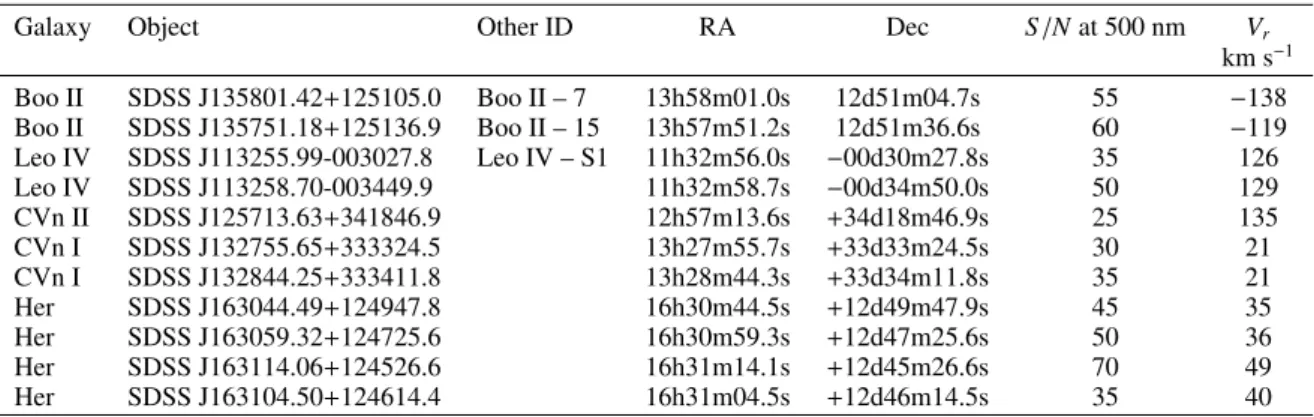
We used the strong lines of magnesium to determine the ra-dial velocities of the stars using the cross-correlation of the syn-thetic spectrum with the observed spectrum. Heliocentric cor-rections have been also applied. The radial velocities of the stars are reported in TableA.1. Typical errors of 5 km s−1 have been
estimated by computing the dispersion of the measurements of the radial velocities on the individual spectra before combin-ing them for the abundance determination. The results are in
good agreement with the systemic radial velocities of the parent galaxies.
3. Analysis
The effective temperature was derived from the (g−i) colors (Koch et al. 2009) for the two Bootes stars and the V andIC
colors taken from Kirby et al.(2008) for the remaining stars. Using the relation given by Jordi et al.(2006), (g−i) have been transformed into (V−IC) using the relation given byJordi et al. (2006). The reddening correction is fromSchlegel et al.(1998). We adopted the calibration ofRamírez & Meléndez(2005), the use of theAlonso et al.(1999) calibration would result in tem-peratures that are 100 K to 150 K hotter. We note that all the pub-lished color calibrations are ill defined for very metal-poor gi-ants, owing to a scarcity of calibrators. TheRamírez & Meléndez (2005) sample of calibrators has more metal-poor giants than theAlonso et al.(1999) sample, hence our choice. The surface gravities have been obtained from the photometry and calculated using the standard relation between logg, mass,Teff,andMbol
relative to the Sun, assuming the solar valuesTeff, = 5790 K,
logg=4.44, andMbol =4.72. We assumed also 0.8Mfor the mass of the giant stars that have been observed. Distance moduli have been taken fromWalsch et al.(2008) for BooII, fromKuehn et al.(2008) for CVnI, fromGreco et al.(2008) for CVnII, from Musella et al.(2012) for Her, and fromMoretti et al.(2009) for LeoIV.
We carried out a classical 1D LTE analysis using OSMARCS model atmospheres (Gustafsson et al. 1975, 2003,2008; Plez et al. 1992;Edvardsson et al. 1993; Asplund et al. 1997). The abundances used in the model atmospheres were solar-scaled with respect to theGrevesse & Sauval(2000) solar abundances, except for theαelements that are enhanced by 0.4 dex. We cor-rected the resulting abundances by taking into account the dif-ference between Grevesse & Sauval (2000) and Caffau et al. (2011b),Lodders et al.(2009) solar abundances.
The abundance analysis was performed using the LTE spec-tral line analysis code turbospectrum (Alvarez & Plez 1998; Plez 2012), which treats scattering in detail. The carbon abun-dance was determined by fitting the CH band near to 430 nm (G band). The molecular data that correspond to the CH band are described inHill et al.(2002) and Plez et al.(2008).
Two stars (HD 165195 and HE1249-3121) with published detailed abundances (Gratton et al. 1994;Allen et al. 2012) ob-tained using high resolution spectra have been used to check the validity of our abundance determinations. For these two stars, we retrieved X-shooter spectra and recomputed the abundances of the elements measured in our sample of UDSph galaxy stars. Our results are in agreement within 0.1 dex with the published abundances. The adopted stellar parameters can be found in TableA.3.
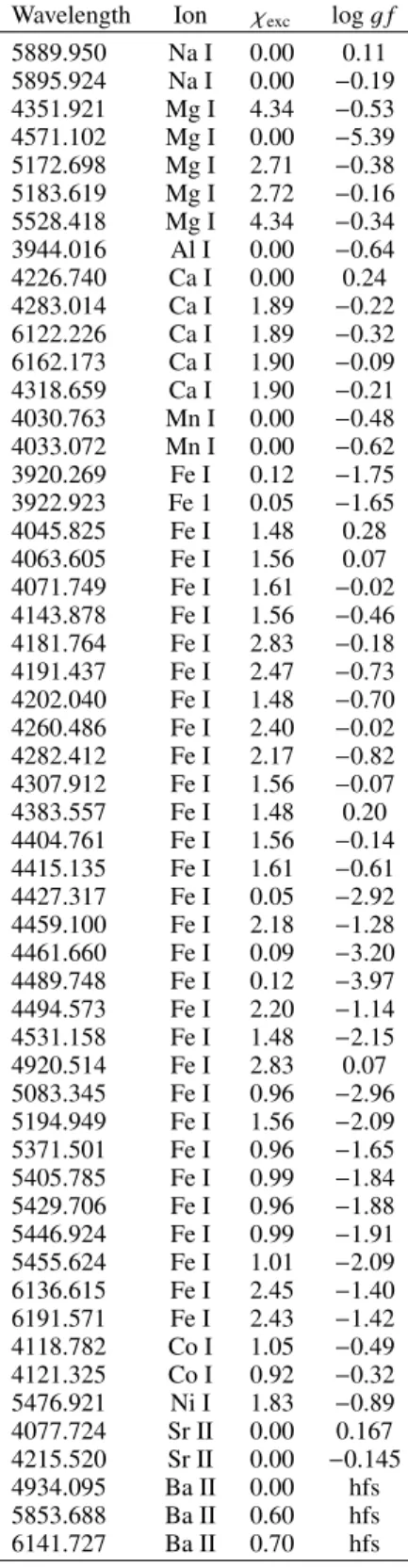
We measured the equivalent widths for a list of Fe
lines given in TableA.4. With the assumed stellar parameters, we first checked the micro turbulent velocity using the method of the curves of growth as inLemasle et al.(2008).Abundance ratios
−4 −3 −2 −1 0
[Fe/H] −1.0
−0.5 0.0 0.5 1.0
[Mg/Fe]
Abundance ratios
−4 −3 −2 −1 0
[Fe/H] −1.0
−0.5 0.0 0.5 1.0
[Ca/Fe]
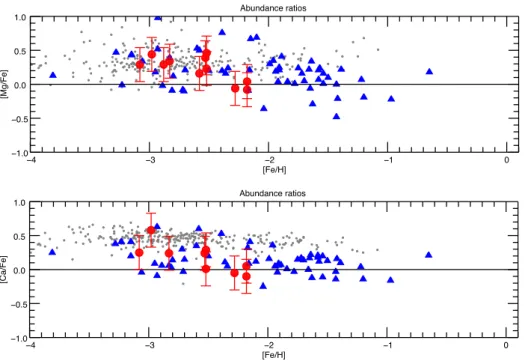
Fig. 1. Alpha elements: gray circles
rep-resent literature data for field stars from Roederer et al.(2014). Blue triangles are lit-erature data for dwarf spheroidal galaxies in Frebel (2010) who collected results from (Shetrone et al. 2001,2003;Cohen & Huang 2004;Fulbright et al. 2004;Geisler et al. 2005;Aoki et al. 2009;Frebel et al. 2010a,b; Simon et al. 2010) Red circles represent the results for our sample of UfDSph stars.
of the spectrum. We therefore did not take these Fe
lines into account and determined the gravity from the photometry, as ex-plained above.For all the lines belonging to the elements other than Fe, we used the spectrum synthesis to determine the abundances.
4. Error budget
TableA.5lists an estimate of the errors that are due to typical uncertainties in the stellar parameters. These errors were esti-mated by varyingTeff, log g, andξin the model atmosphere of SDSS J163114.06+124526.6 by the amounts indicated in the ta-ble. As all the stars of the sample have similar stellar parameters, the other stars yield similar results. The total error is estimated by adding the quadratic sum of the the uncertainties in the stellar parameters and the error in the fitting procedure of the synthetic spectrum and the observed spectrum (the main source of error comes from the incertitude in the placement of the continuum level).
5. Results and discussion
The resulting abundances can be found in TableA.6. Figure1 presents the [Mg/Fe] and [Ca/Fe] ratios found for our sample together with literature data for Milky Way field stars and stars in dwarf spheroidal galaxies. The majority of the stars show a high [Mg/Fe] ratio comparable to what is found in the halo stars. The [Ca/Fe] ranges from '−0.05 dex for a star in CVn I stars to'+0.65 dex for BooII stars. This range is in agreement with the spread found for DSph stars, in the metallicity range−2.00 to −3.00 dex. It is interesting to note that the [Mg/Fe] and [Ca/Fe] ratios reach a solar value at a metallicity lower than the Milky Way field stars (where it is reached at [Fe/H]'0.0 dex) and lower than the dwarf galaxy stars for which the solar ratio is reached at a metallicity of around−2.00 to−1.50 dex, which is in agreement with models of galactic chemical evolution (Vincenzo et al. 2014).
The upper part of Fig.2 shows our results for the [Al/Fe] ratios. As for the previous figure, we have added literature data for field stars and dwarf spheroidal galaxy stars. We find a high value of the [Al/Fe] ratio when compared to the halo stars. We did not apply non-LTE corrections to make a direct comparison with the halo and DSph stars, which have been analyzed under the same assumptions. Sodium does not seem to share the behav-ior, as shown in the lower part of Fig.2. The values of [Na/Fe] tend to be below the median value of [Na/Fe] in halo stars of the same metallicity.
Figure 3 presents the [Sr/Fe] and [Ba/Fe] ratios found for our sample together with literature data for field stars and dwarf spheroidal galaxy stars. The upper graph shows a high value of the [Sr/Fe] ratio for the metal-rich sample of our stars, similar to what is found in the halo stars and significantly different from the DSph stars. For most of the metal-poor stars of our analy-sis, the ratio appears to be lower that what found for the bulk of the field halo stars of the same metallicity. For Barium, our results also fall in to the range of [Ba/Fe] that is found for halo stars.
5.1. Bootes II
We have observed two stars in the Galaxy (BooII-7 and BooII-15) and found metallicities [Fe/H] = −2.98 dex and
Abundance ratios
−4 −3 −2 −1 0
[Fe/H] −1.0
−0.5 0.0 0.5 1.0
[Al/Fe]
Abundance ratios
−4 −3 −2 −1 0
[Fe/H] −1.0
−0.5 0.0 0.5 1.0
[Na/Fe]
Fig. 2.Al and Na abundance ratios: gray cir-cles represent literature data for field stars from Roederer et al. (2014). Blue trian-gles are literature data for dwarf spheroidal galaxies gathered inFrebel (2010) (see de-tails in Fig.2). Red circles represent the re-sults for our sample of UfDSph stars.
Abundance ratios
−4 −3 −2 −1 0
[Fe/H] −3
−2 −1 0 1 2
[Sr/Fe]
Abundance ratios
−4 −3 −2 −1 0
[Fe/H] −3
−2 −1 0 1 2
[Ba/Fe]
Fig. 3.Neutron capture elements: Gray cir-cles represent literature data for field stars from Roederer et al. (2014). Blue trian-gles are literature data for dwarf spheroidal galaxies gathered inFrebel (2010, see de-tails in Fig.2). Red circles represent the re-sults for our sample of UfDSph stars. Red triangles represent upper limits for stars of our sample.
5.2. Canes Venatici I
Abundances of Fe, Mg, and Ca of a sample of stars belonging to CVnI have been reported byKirby et al.(2010) using low resolu-tion spectra. Using the same Keck/DEIMOS medium-resolution spectra that were obtained by Kirby et al.(2010),Vargas et al. (2013) to determine the abundance of Fe, Mg, Ca in stars of this galaxy. In Fig.4, we plotted our results together with the results of Kirby et al. (2010) andVargas et al. (2013). We have also added the results for a sample of UfDSph galaxies, as in Fig.1.
For the first time, we report the abundance determination of the neutron capture elements in two stars of this galaxy. We found for both stars a high ratio of [Sr/Ba], +0.22 dex, and
+0.76 dex, respectively. It is interesting to note that the these ratios are similar to the ones found in the halo stars at the same [Ba/H] abundance as was found byFrançois et al.(2007).
5.3. Canes Venatici II
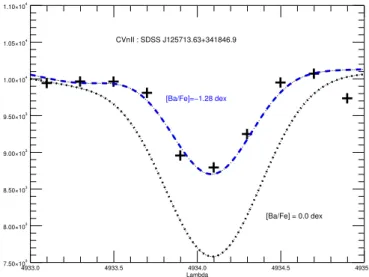
Our results for Canes Venatici II are presented in Fig.5. This is the first Strontium abundance determination for a star in this Galaxy. Our star has very high [Sr/Fe] values and and a low up-per limit of [Ba/Fe], which makes it a star with an exceptionally high [Sr/Ba] – with a value larger than 2.6 dex.
Abundance ratios in CVnI
−4 −3 −2 −1 0
[Fe/H]
−1.5
−1.0
−0.5 0.0 0.5 1.0 1.5
[Mg/Fe]
−4 −3 −2 −1 0
[Fe/H]
−1.0
−0.5 0.0 0.5 1.0
[Ca/Fe]
Fig. 4.Abundance results for the CVnI galaxy
stars. Red circle represent our two stars. Green symbols are results from Kirby et al.(2010). Blue symbols are results from Vargas et al. (2013).
Abundance ratios in CVnII
−4 −3 −2 −1 0
[Fe/H] −1.5
−1.0 −0.5 0.0 0.5 1.0 1.5
[Mg/Fe]
Abundance ratios in CVnII
−4 −3 −2 −1 0
[Fe/H] −1.5
−1.0 −0.5 0.0 0.5 1.0 1.5 2.0
[Sr/Fe]
Fig. 5.Abundance results for the CVnII galaxy stars. Red circles repre-sent the abundance results for our stars. Gray circles reprerepre-sent literature data for field stars fromRoederer et al.(2014).
[Ba/Fe] = 0.0 dex CVnII : SDSS J125713.63+341846.9
[Ba/Fe]=−1.28 dex
4933.0 4933.5 4934.0 4934.5 4935.0
Lambda 7.50×10³
8.00×10³ 8.50×10³ 9.00×10³ 9.50×10³ 1.00×10⁴ 1.05×10⁴ 1.10×10⁴
Flux
Fig. 6. Comparison of the observed spectrum represented by pluses and
synthetic spectra with different barium abundances.
[Sr/Fe] = 0.0 dex CVnII : SDSS J125713.63+341846.9
[Sr/Fe]=1.32 dex
4214.0 4214.5 4215.0 4215.5 4216.0 4216.5 4217.0
Lambda 4000
6000 8000 10000
Flux
Fig. 7.Comparison of the observed spectrum represented by pluses and
synthetic spectra with different strontium abundances.
At low metallicity, strontium may be formed by the weak r -process (Wanajo 2013). The large difference between the two mostly s-process elements, strontium and barium, may come from a peculiar pollution of the cloud that formed the star, the source possibly being a core-collapse supernova as proposed by Wanajo(2013). More recently,Cescutti et al.(2015) have com-puted detailed models of the galactic chemical evolution of our Galaxy. Their computations have shown that the combination of
r-process production by neutron star mergers ands-process by spinstars (Pignatari et al. 2008;Frischknecht et al. 2012) is able to reproduce the large range of [Sr/Ba] ratios at low metallicity.
It would be particularly interesting to obtain a high-resolution high S/N spectrum of this star to detect and measure the abundances of othern-capture elements and compare then with high Sr low-metallicity field halo stars.
5.4. Hercules
Abundance ratios in Hercules
−4 −3 −2 −1 0
[Fe/H] −1.5
−1.0 −0.5 0.0 0.5 1.0 1.5
[Mg/Fe]
−4 −3 −2 −1 0
[Fe/H] −1.0
−0.5 0.0 0.5 1.0
[Ca/Fe]
Abundance ratios in Hercules
−4 −3 −2 −1 0
[Fe/H] −1.5
−1.0 −0.5 0.0 0.5 1.0 1.5 2.0
[Sr/Fe]
Abundance ratios in Hercules
−4 −3 −2 −1 0
[Fe/H] −2
−1 0 1
[Ba/Fe]
Fig. 8.Our results for Hercules are presented as red circles. We have added the results fromKoch et al.(2008,2013) as blue triangles (triangles pointing down are upper limits) andAdèn et al.(2011) as blue pluses. Gray dots are literature data for the field halo stars fromRoederer et al. (2014).
Our results for Hercules are presented as red circles in Fig. 8. We have added the results ofKoch et al.(2008,2013) andAdèn et al.(2011).
Our sample has metallicities that range from−2.28 dex to
−2.83 dex. Our results clearly show an increase of the [α/Fe] ratios as the metallicity decreases. It is important to note that this effect has already been observed byVargas et al.(2013) in not only Hercules, but also in other galaxies. This is what is expected with classical models of chemical evolution where the impact of the contribution of type SNIa iron on the abundance ratios [α/Fe] vs. metallicity relations is shown as a decrease of this ratio as the metallicity increases. For Her, the solar ratio is reached at a much lower metallicity than the one found for the Milky Way or even for the dwarf spheroidal galaxies such as Carina or Sculptor, as shown inVincenzo et al.(2014). Our results for Calcium are in good agreement with the results ofAdèn et al.(2011), although we notice a slightly higher [Ca/Fe] ratio than the one found by Koch et al.(2008,2013) .
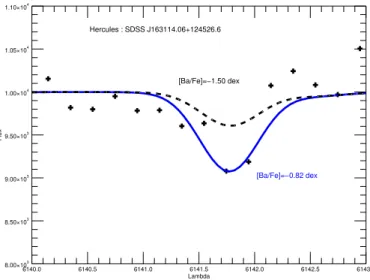
In Figs.9and10, we show the spectrum synthesis of a bar-ium line with two assumptions for the [Ba/Fe] ratio. The high efficiency of X-Shooter allowed us to make a clear detection of
the barium line compared to previous studies, where only upper limits could be derived.
For barium, the combination of our results with the barium detections ofKoch et al.(2008,2013) seem to indicate an in-crease of the [Ba/Fe] ratio since the metallicity increases in line with what is found in our Galaxy. However, this needs to be taken with caution when we add their Ba upper limits since it would reveal quite a large scatter.
5.5. Leo IV
We observed two stars in Leo IV, one of which has been already studied bySimon et al.(2010). In TableA.8, we compare the re-sults from both studies. The rere-sults are in good agreement. The high resolution spectrum used bySimon et al.(2010) allowed the abundance of Ba and Sr to be derived. For our second star, we found a higher metallicity with [Fe/H]=−2.18 dex, [Mg/Fe]=
Hercules : SDSS J163044.49+124947.8
[Ba/Fe]=−0.87 dex [Ba/Fe]=−1.50 dex
6495.5 6496.0 6496.5 6497.0 6497.5 6498.0 Lambda
Fig. 9.Comparison of the observed spectrum represented by pluses and
synthetic spectra. The dashed black line is computed for a barium abun-dance [Ba/Fe]=−1.50 dex, which correspond to the 3σupper limit of Koch et al.(2013). The higher quality of the X-Shooter spectra per-mits the detection of the barium line. The blue line is computed with a barium value [Ba/Fe]=−0.87 dex corresponding to our result.
Hercules : SDSS J163114.06+124526.6
[Ba/Fe]=−0.82 dex
[Ba/Fe]=−1.50 dex
6140.0 6140.5 6141.0 6141.5 6142.0 6142.5 6143.0
Lambda
Fig. 10. Comparison of the observed spectrum represented by pluses
and synthetic spectra. The dashed black line is computed for a barium abundance [Ba/Fe]=−1.50 dex, which corresponds to the 3σupper limit ofKoch et al.(2013). The higher quality of the X-Shooter spectra permits the detection of the barium line. The blue line is computed with a barium value [Ba/Fe]=−0.81 dex, which corresponds to our result.
5.6. Do all UfDSph galaxies have similar abundance ratios?
Among the fives galaxies studied in this paper, it has been sug-gested that two (Her and Leo IV) formed the bulk of their stars before reionization (Weisz et al. 2014). Although this hypothesis remains controversial, it would therefore be particularly interest-ing to check whether the abundance ratios reveal any systematic difference between these two galaxies and the rest of the sam-ple. We have added the results from BooI (Gilmore et al. 2013) to increase the data sample.
In Fig. 11, we plotted our results and literature data for UfDSph with red symbols for Her and Leo IV, and blue sym-bols for the other galaxies. We also added data for the field halo stars, shown as small grey circles, as reference literature. An in-spection of the figure seems to indicate these two galaxies have
a lower [Ca/Fe] than the other galaxies and that [Mg/Fe] is also somewhat lower.
In Fig. 12, we made similar plots for the neutron capture elements Sr and Ba. As we have only Sr and Ba upper limits for Leo IV, this plot includes only the results for Her. Hercules seems to have lower [Sr/Fe] and [Ba/Fe] than the other galaxies. This figure clearly reveals that the abundance ratios of neutron capture elements Sr and Ba are lower than those found for the rest of the sample.
The results from Figs.11and12seem to indicate that these two galaxies share a common chemical history, which is dif-ferent from the other galaxies. Was the SFR lower in these two galaxies than in the other galaxies? Did the SFR history stop at the epoch of reionization (quenching by reionization) for these two galaxies and not for the others, as suggested by Weisz et al.(2014)? The recent study fromWebster et al.(2015) does not support the hypothesis that these galaxies experienced quenching by reionization. A different conclusion was obtained for Hercules byVincenzo et al.(2014), who computed detailed models of galactic chemical evolution to probe quenched and non-quenched star-formation histories. For Hercules, they sug-gested a single SFR burst with a duration of 1 Gyr. A totally opposite conclusion fromWebster et al.(2015) was reached by Brown et al.(2014) who support the hypothesis that the star for-mation was suppressed in all the UfDSph, because of a global event such as reionization of the Universe. If the hypothesis of Brown et al.(2014) is correct, another interpretation of our re-sults could be that all these galaxies are fossil galaxies with dif-ferences in their star-formation history leading to differences in the relations [X/Fe] versus [Fe/H]. However, given the baryonic mass of these galaxies, the upper end of the IMF was probably made of a small stochastic sample of massives stars and diff er-ences in the supernovae that occurred in these galaxies. This may be a better explanation for the observed abundance differences.
It is clear that new observations are urgently required to un-derstand the history of these galaxies.
6. Conclusions
We have reported abundance ratios in a sample of 11 stars be-longing to five different UfDSphs that are based on X-Shooter spectra obtained at the VLT. This study demonstrates that X-Shooter is a very powerful instrument to determine the de-tailed chemical composition of metal-poor stars in UfDSph. With the present analysis, based on only a couple of nights of telescope time, we were able to obtain some interesting results. We can therefore foresee further studies of the detailed chemical evolution of many galaxies of the Local Group using 10-m class telescopes and medium-resolution spectroscopy at the level of
R'8000 and higher. From the comparative analysis of the abun-dances ratios found in these different systems, we can not only study the star formation histories of these galaxies as entities, but we can also check for the universality of the nucleosynthesis of the elements. In particular, UfDsph (low-mass galaxies) are ideal for studying the existence and the frequency of rare events like neutron star mergers and their impact on nucleosynthesis and galactic chemical evolution.
Abundance ratios
−4 −3 −2 −1 0
[Fe/H]
−1.0
−0.5 0.0 0.5 1.0
[Mg/Fe]
Abundance ratios
−4 −3 −2 −1 0
[Fe/H]
−1.0
−0.5 0.0 0.5 1.0
[Ca/Fe]
Fig. 11.Our results for Hercules and Leo IV are presented as a red circle. We have added the re-sults fromKoch et al.(2008,2013) and Adèn et al.(2011) as red triangles. Blue circles repre-sent our results for the remaining galaxies. Blue squares represent literature data for BooI. We did not include the results with upper limits only. Gray dots are literature data for the field halo stars fromRoederer et al.(2014).
Abundance ratios
−4 −3 −2 −1 0
[Fe/H]
−3
−2
−1 0 1 2
[Sr/Fe]
Abundance ratios
−4 −3 −2 −1 0
[Fe/H]
−3
−2
−1 0 1 2
[Ba/Fe]
Fig. 12.Our results for Hercules are presented as red circle. We have added the results from Koch et al.(2008,2013) andAdèn et al.(2011) as red triangles. Blue circles are our results for the remaining galaxies. Blue squares are litera-ture data for BooI. We did not include the results with upper limits only. Grey dots are literature data for the field halo stars fromRoederer et al. (2014).
higher values compared to the stars with the same metallicity that were observed in the halo or in dwarf spheroidal galaxies, whereas [Na/Fe] values tend to be lower than the median halo values.
We report for the first time the abundance of Strontium in CVnII. The star we analyzed in this galaxy has a very high [Sr/Fe] and a very low upper limit of barium, which makes it a star with an exceptionally high [Sr/Ba] ratio.
We found that Hercules and Leo IV have lower [X/Fe] ratios than the other galaxies of the same metallicity, which indicates differences in the star-formation history. This difference could be related to quenching, as suggested by the work ofVincenzo et al. (2014) andWeisz et al.(2014). However, this separation into two groups of galaxies is not supported by the work ofBrown et al. (2014) who suggest that star formation in all of the UfDSph was suppressed by a global outside influence and, therefore, the op-posite point of view by Webster et al.(2015) who favor an ex-tended star-formation history for the UfdSph galaxies. An alter-native interpretation of our results could be that all these galaxies are fossil galaxies with differences in their star-formation history
that has led to differences in the relations [X/Fe] versus [Fe/H]. However, the differences found in the supernovae that enriched these galaxies may be a better explanation for the observed abun-dance differences.
Acknowledgements. We would like to thank the anonymous referee for his
com-ments that helped to improve this article. We would like to thank E. Kirby for sending the data for the individual stars he studied in his 2008 paper in elec-tronic format. P.F. thanks the European Southern Observatory for his support. P.F. and P.B. acknowledge support from the Programme National de Physique Stellaire (PNPS) of the Institut National de Sciences de l’Univers of CNRS. LM acknowledges support from “Proyecto interno” of the Universidad Andrés Bello. C.M.B. acknowledges support from FONDECYT regular project 1150060. This research has made use of NASA’s Astrophysics Data System and of the VizieR catalogue access tool, CDS, Strasbourg, France.
References
Adén, D., Eriksson, K., Feltzing, S., et al. 2011,A&A, 525, A153
Allen, D., Ryan, S;G., Rossi, S., Beers, T., & Tsangarides, S. A. 2012,A&A, 548, A34
Alonso, A., Arribas, S., & Martínez-Roger, C. 1999,A&AS, 140, 261
Aoki, W., Arimoto, N., Sadakane, K., et al. 2009,A&A, 502, 569
Asplund, M., Gustafsson, B., Kiselman, D., & Eriksson, K. 1997,A&A, 318, 521
Belokurov, V., Zucker, D. B.,Evans, N. W., et al. 2006,ApJ, 654, 906
Brown, T. M., Tumlinson, J., Geha, M., & Simon, J. D. 2014,ApJ, 796, 91
Bullock, J. S., Kravtsov, A. V., & Weinberg, D. H. 2000,ApJ, 539, 517
Caffau, E., Ludwig, H.-G., Steffen, M., Freytag, B., & Bonifacio, P. 2011,Sol. Phys., 268, 255
Cescutti, G., Romano, D., Matteucci, F., Chiappini, C., & Hirshi, R. 2015,A&A, 577, A139
Cohen, J. G., & Huang, W. 2009,ApJ, 701, 1053
Coleman, M. G., de Jong, J. T., & Martin, N. F. 2007,ApJ, 668, 43
D’Odorico, S., Dekker, H., Mazzoleni, R. et al. 2006,SPIE, 6269, 33
Edvardsson, B., Andersen, J., Gustafsson, B., et al. 1993,A&A, 275, 101
François, P., Depagne, E., Hill, V., Spite, M. et al. 2007,A&A, 476, 935
Frebel, A. 2010,Astron. Nachr., 331, 474
Frebel, A., Simon, J. D., Geha, M., & Willman, B. 2010a,ApJ, 708, 560
Frebel, A., Kirby, E., & Simon, J. D. 2010b,Nature, 464, 72
Frischknecht, U., Hirschi, R., & Thielemann, F.-K. 2012,A&A, 538, L2
Fulbright, J. P., Rich, R. M., & Castro, S. 2004,ApJ, 612, 447
Geisler, D., Smith, V. V., Wallerstein, G., Gonzalez, G., & Charbonnel, C. 2005,
AJ, 129, 1428
Gilmore, G., Norris, J. E., Monaco, L., et al. 2013,ApJ, 763, 61
Goldoni, P., Royer, F., François, P., et al. 2006,SPIE, 6269, 2
Gratton, R. G., & Sneden, C. 1994,A&A, 287, 927
Greco, C., Dall’Ora, M., Clementini, G., et al. 2008,ApJ, 675, 73
Grevesse, N., & Sauval, A. J. 2000, Origin of Elements in the Solar System, ed. O. Manuel, 261
Gustafsson, B., Bell, R. A., Eriksson, K., & Nordlund, A. 1975,A&A, 42, 407
Gustafsson, B., Edvardsson, B., Eriksson, K., et al. 2003, in Stellar Atmosphere Modeling, eds. I. Hubeny, D. Mihalas, & K. Werner,ASP Conf. Ser., 288, 331
Gustafsson, B., Edvardsson, B., Eriksson K., et al. 2008,A&A, 486, 951
Hill, V., Plez, B., Cayrel, R., et al. 2002,A&A, 387, 560
Jordi, K., Grebel, E. K., & Ammon, K. 2006,A&A, 460, 339
Kelson, D. 2003,PASP, 115, 688
Kirby, E. N., Simon, J. D., Geha, M., Guhathakurta, P., & Frebel A. 2008,ApJ, 685, L43
Kirby, E. N., Guhathakurta, P., Simon, J. D., et al. 2010,ApJS, 191, 352
Kirby, E. N., Cohen, J. G., Guhathakurta, P., et al. 2013,ApJ, 779, 102
Koch, A., & Rich, R. M. 2014,ApJ, 794, 89
Koch, A., McWilliam, A., Grebel, E. K., Zucker, D. B., & Belokurov, V. 2008,
ApJ, 688, L13
Koch, A., Wilkinson, M. I., Kleyna, J. T., et al. 2009,ApJ, 690, 453
Koch, A., Feltzing, S., Adén, D., & Matteucci, F. 2013,A&A, 554, A5
Kuehn, C., Kinemuchi, K., & Ripepi, V. 2008,ApJ, 674, 81
Lemasle, B., François, P., Piersimoni, A., et al. 2008,A&A, 490, 613
Lodders, L., Palme, H., & Gail, H.-P. 2009, LanB 4, 44 Abundances of the el-ements in the Solar System. ed. J. E. Trumper, Landolt-Bornstein (Berlin: Springer-Verlag)
McWilliam, A., & Preston, G. 1995,AJ, 106, 2757
Martin, N. F., Coleman, M. G., De Jong, J. T. A., et al. 2008,ApJ, 672, L13
Moore, B., Ghigna, S., Governato, F., et al. 1999,ApJ, 524, L19
Moretti, M. I., Dall’Ora, M., Ripepi, V., et al. 2009,ApJ, 699, 125
Musella, I., Ripepi, V., Marconi, M., et al. 2012,ApJ, 756, 121
Okamoto, S., Arimoto, N., Yamada, Y., & Onodera, M. 2012,ApJ, 744, 96
Pignatari, M., Gallino, R., Meynet, G., et al. 2008,A&A, 687, L95
Plez, B., Brett, J. M., & Nordlund, A.. 1992,A&A, 256, 551
Ramírez, I., & Meléndez, J. 2005,ApJ, 626, 465
Ricotti, M., & Gnedin, N. Y. 2005,ApJ, 629, 259
Roderick, T. A., Jerjen H., Mackey A. D., & Da Costa G. 2015,ApJ, 804, 134
Roederer, I. U., Preston, G. W., Thompson, I. B., et al. 2014,AJ, 147, 136
Schlegel, D. J., Finkbeiner, D. P., & Davis, M. 1998,ApJ, 500, 525
Shetrone, M. D., Côté, P., & Sargent, W. L.W. 2001,ApJ, 548, 592
Shetrone, M., Venn, K. A., Tolstoy, E., et al. 2003,AJ, 125, 684
Simon, J. D., & Geha, M. 2007,ApJ, 670, 313
Simon, J. D., Frebel, A., McWilliam, A., Kirby, E. N., & Thompson, I. B. 2010,
ApJ, 716, 446
Ural, U., Wilkinson, M. I., Koch, A., et al. 2010,MNRAS, 402, 1357
Van Dokkum, P. 2001,PASP, 562, 35
Vargas, L. C., Geha, M., Kirby, E. N., & Simon, J. D. 2013,ApJ, 767, 134
Vernet, J., Dekker, H., & D’Odorico, S. 2011,A&A, 536, A105
Vincenzo, F., Matteucci, F., Vattakunnel, S., & Lanfranchi, G. A. 2014,MNRAS, 441, 2815
Wanajo, S. 2013,ApJ, 770, L12
Weisz, D. R., Dolphin, A. E., Skillman, E. D., et al. 2014,ApJ, 789, 148
Walsh, S. M., Jerjen, H., & Willman, B. 2007,ApJ, 662, L83
Walsh, S., Jerjen, H., & Willman, B. 2008, Galaxies in the Local Volume, Astrophysics and Space Science Proceedings (Springer: The Netherlands), 191
Webster, D., Bland-Hawthorn, J., & Sutherland, K. 2015,ApJ, 799, 21
Appendix A: Tables
Table A.1. Target coordinates, S/N, and radial velocities.
Galaxy Object Other ID RA Dec S/Nat 500 nm Vr
km s−1 Boo II SDSS J135801.42+125105.0 Boo II – 7 13h58m01.0s 12d51m04.7s 55 −138 Boo II SDSS J135751.18+125136.9 Boo II – 15 13h57m51.2s 12d51m36.6s 60 −119 Leo IV SDSS J113255.99-003027.8 Leo IV – S1 11h32m56.0s −00d30m27.8s 35 126
Leo IV SDSS J113258.70-003449.9 11h32m58.7s −00d34m50.0s 50 129
CVn II SDSS J125713.63+341846.9 12h57m13.6s +34d18m46.9s 25 135
CVn I SDSS J132755.65+333324.5 13h27m55.7s +33d33m24.5s 30 21
CVn I SDSS J132844.25+333411.8 13h28m44.3s +33d34m11.8s 35 21
Her SDSS J163044.49+124947.8 16h30m44.5s +12d49m47.9s 45 35
Her SDSS J163059.32+124725.6 16h30m59.3s +12d47m25.6s 50 36
Her SDSS J163114.06+124526.6 16h31m14.1s +12d45m26.6s 70 49
Her SDSS J163104.50+124614.4 16h31m04.5s +12d46m14.5s 35 40
Table A.2. Log of the observations.
OBJECT TIMESTAMP
SDSS J113258.70-003449.9/Leo IV 2011-02-07T07:11:20.295 SDSS J113258.70-003449.9/Leo IV 2011-02-07T08:17:40.984 SDSS J125713.63+341846.9/CVn II 2010-04-02T06:36:39.302 SDSS J125713.63+341846.9/CVn II 2011-04-09T04:33:13.527 SDSS J125713.63+341846.9/CVn II 2011-04-09T05:43:44.497 SDSS J132844.25+333411.8/CVn I 2011-05-04T13:01:06 SDSS J132844.25+333411.8/CVn I 2011-04-27T04:23:11.240 SDSS J113258.70-003449.9/Leo IV 2010-05-10T03:02:20.251 SDSS J113258.70-003449.9/Leo IV 2010-05-10T04:10:07.978 SDSS J135751.18+125136.9/Boo II – 15 2010-05-12T02:26:01.360 SDSS J135751.18+125136.9/Boo II – 15 2010-05-12T03:21:50.970 SDSS J113255.99-003027.8/Leo IV – S1 2010-06-10T02:12:37.200 SDSS J135801.42+125105.0/Boo II – 7 2010-06-10T03:35:48.990 SDSS J163044.49+124947.8/Her 2011-05-13T14:39:48 SDSS J132755.65+333324.5/CVn I 2010-06-12T02:13:14.498 SDSS J163044.49+124947.8/Her 2010-06-12T05:06:48.771 SDSS J163044.49+124947.8/Her 2010-07-09T05:11:07.059 SDSS J163059.32+124725.6/Her 2010-07-10T04:11:23.800 SDSS J163104.50+124614.4/Her 2010-07-13T04:04:06.392 SDSS J135801.42+125105.0/Boo II – 7 2010-08-03T00:28:32.920 SDSS J135801.42+125105.0/Boo II – 7 2010-08-04T00:45:15.158 SDSS J163114.06+124526.6/Her 2010-08-03T02:43:58.485 SDSS J135801.42+125105.0/Boo II – 7 2010-08-05T00:27:02.020 SDSS J163104.50+124614.4/Her 2010-08-05T01:34:40.556 SDSS J163104.50+124614.4/Her 2010-08-09T03:03:43.065 SDSS J163104.50+124614.4/Her 2010-08-10T01:43:39.930
Notes.All the exposures are of 2950 s.
Table A.3.Stellar parameters.
Star Teff logg ξ [Fe/H]
Table A.4. Lines used for the analysis.
Wavelength Ion χexc loggf 5889.950 Na I 0.00 0.11 5895.924 Na I 0.00 −0.19 4351.921 Mg I 4.34 −0.53 4571.102 Mg I 0.00 −5.39 5172.698 Mg I 2.71 −0.38 5183.619 Mg I 2.72 −0.16 5528.418 Mg I 4.34 −0.34 3944.016 Al I 0.00 −0.64 4226.740 Ca I 0.00 0.24 4283.014 Ca I 1.89 −0.22 6122.226 Ca I 1.89 −0.32 6162.173 Ca I 1.90 −0.09 4318.659 Ca I 1.90 −0.21 4030.763 Mn I 0.00 −0.48 4033.072 Mn I 0.00 −0.62 3920.269 Fe I 0.12 −1.75 3922.923 Fe 1 0.05 −1.65 4045.825 Fe I 1.48 0.28 4063.605 Fe I 1.56 0.07 4071.749 Fe I 1.61 −0.02 4143.878 Fe I 1.56 −0.46 4181.764 Fe I 2.83 −0.18 4191.437 Fe I 2.47 −0.73 4202.040 Fe I 1.48 −0.70 4260.486 Fe I 2.40 −0.02 4282.412 Fe I 2.17 −0.82 4307.912 Fe I 1.56 −0.07 4383.557 Fe I 1.48 0.20 4404.761 Fe I 1.56 −0.14 4415.135 Fe I 1.61 −0.61 4427.317 Fe I 0.05 −2.92 4459.100 Fe I 2.18 −1.28 4461.660 Fe I 0.09 −3.20 4489.748 Fe I 0.12 −3.97 4494.573 Fe I 2.20 −1.14 4531.158 Fe I 1.48 −2.15 4920.514 Fe I 2.83 0.07 5083.345 Fe I 0.96 −2.96 5194.949 Fe I 1.56 −2.09 5371.501 Fe I 0.96 −1.65 5405.785 Fe I 0.99 −1.84 5429.706 Fe I 0.96 −1.88 5446.924 Fe I 0.99 −1.91 5455.624 Fe I 1.01 −2.09 6136.615 Fe I 2.45 −1.40 6191.571 Fe I 2.43 −1.42 4118.782 Co I 1.05 −0.49 4121.325 Co I 0.92 −0.32 5476.921 Ni I 1.83 −0.89 4077.724 Sr II 0.00 0.167 4215.520 Sr II 0.00 −0.145 4934.095 Ba II 0.00 hfs 5853.688 Ba II 0.60 hfs 6141.727 Ba II 0.70 hfs
Notes.HFS data for barium are fromMcWilliam & Preston(1995).
Table A.5. Error budget.
Element ∆Teff ∆logg ∆ξ 100 K 0.3 dex 0.3 km s−1
Mg 0.12 −0.05 −0.12
Al 0.12 −0.10 −0.10
ScII 0.07 +0.05 −0.11
Ti 0.13 −0.04 −0.11
Mn 0.15 −0.06 −0.14
FeI 0.15 −0.06 −0.12
Ni 0.15 −0.04 −0.15
Table A.6. Detailed abundances : [X/Fe] for all the elements except Fe for which [Fe/H] is given.
Star C Na Mg Al Ca Mn
SDSS J163044.49+124947.8/Her − 0.01 0.23 − −0.01 −
SDSS J163059.32+124725.6/Her − 0.02 0.34 0.15 0.29 −
SDSS J163104.50+124614.4/Her −0.34 0.00 0.29 0.23 0.25 −
SDSS J163114.06+124526.6/Her − −0.15 −0.06 0.18 0.05 −
SDSS J113255.99-003027.8/Leo IV – S1 − 0.10 0.44 − − −
SDSS J113258.70-003449.9/Leo IV − 0.05 −0.06 0.08 0.05 −
SDSS J125713.63+341846.9/CVn II − −0.05 0.16 − − −
SDSS J135801.42+125105.0/Boo II – 7 −0.24 − 0.29 0.28 0.25 0.04 SDSS J135751.18+125136.9/Boo II – 15 −0.10 0.50 0.44 0.28 0.58 0.44
SDSS J132844.25+333411.8/CVn I − − 0.46 − 0.29 −
SDSS J132755.65+333324.5/CVn I − − 0.04 − -0.10 −
Ti Fe Co Ni Sr Ba
SDSS J163044.49+124947.8/Her − −2.52 − − 0.02 −0.87 SDSS J163059.32+124725.6/Her − −2.83 − − −0.82 <0.24 SDSS J163104.50+124614.4/Her − −2.53 0.13 − 0.08 −0.47 SDSS J163114.06+124526.6/Her − −2.28 − -0.24 −0.52 −0.81 SDSS J113255.99-003027.8/Leo IV – S1 0.26 −2.88 − − <−0.02 <−0.98 SDSS J113258.70-003449.9/Leo IV −0.14 −2.18 − − <−1.42 <−1.38 SDSS J125713.63+341846.9/CVn II − −2.58 − − 1.32 <−1.28 SDSS J135801.42+125105.0/Boo II – 7 − −3.08 − − <−1.32 <0.32 SDSS J135751.18+125136.9/Boo II – 15 − −2.98 − − <−2.22 <−0.28 SDSS J132844.25+333411.8/CVn I − −2.52 − − 0.62 −0.14 SDSS J132755.65+333324.5/CVn I − −2.18 − − 0.58 0.36
Table A.7.BooII-15 abundance comparison.
Ion This paper Koch & Rich (2014) [Fe/H] −2.98 −2.93
[C/Fe] −0.10 0.03
[Mg/Fe] 0.44 0.58
[Ca/Fe] 0.58 0.35
[Ba/Fe] <−0.28 <−0.62
Table A.8. Leo IV−S1 abundance ratio comparison.
Ion This paper Simon et al. (2010) [Fe/H] −2.88 −3.20
[Na/Fe] 0.10 0.01
[Mg/Fe] 0.44 0.32
[Ti/Fe] 0.26 0.38



![Table A.6. Detailed abundances : [X/Fe] for all the elements except Fe for which [Fe/H] is given](https://thumb-us.123doks.com/thumbv2/123dok_es/3661671.636512/13.892.161.730.146.536/table-detailed-abundances-fe-elements-fe-fe-given.webp)
