
Use of PBL as a teaching innovation methodology in University Nursing Studies in Spain
148
0
0
Texto completo
(2) EUSER EUROPEAN CENTER FOR SCIENCE EDUCATION AND RESEARCH. EUROPEAN JOURNAL OF INTERDISCIPLINARY STUDIES. January April 2018 Volume 10, Nr. 1 Every reasonable effort has been made to ensure that the material in this book is true, correct, complete, and appropriate at the time of writing. Nevertheless, the publishers, the editors and the authors do not accept responsibility for any omission or error, or for any injury, damage, loss, or financial consequences arising from the use of the book. The views expressed by contributors do not necessarily reflect those of the European Center for Science Education and Research.. Typeset by EUSER Printed in, Bergstr. 22, 72108, Rottenburg, Germany. Tel: +4915217510869 EUROPEAN CENTER FOR SCIENCE EDUCATION AND RESEARCH. Copyright © 2018 EUSER © All rights reserved. No part of this book may be reproduced in any form or by any electronic or mechanical means, including information storage and retrieval systems, without written permission from the publisher or author, except in the case of a reviewer, who may quote brief passages embodied in critical articles or in a review. European Center for Science Education and Research Web: http://euser.org, E-Mail: [email protected] ISSN 2411-958X (Print), ISSN 2411-4138 (Online) Indexed in RePEc & Ideas, Google Scholar, Index Copernicus, Crossref & DOI and PKP Key title: European journal of interdisciplinary studies Abbreviated key title: Eur. j. interdiscip. stud..
(3) International Editorial and Advisory Board Prof. Dr. Catalin Zamfir, Director, ICCV, Academia Romana Prof. Dr. Emilian Dobrescu, Academia Romana Prof Dr. Elena Zamfir, University of West, Timişoara, Romania Prof Dr. Misu Jan Manolescu, Rector, University of Oradea, Romania Prof. Dr. Mame S. Sutoko, Rector, Widyatama University, Bandung - Indonesia Prof. Dr. İsmail Hakki Mirici, President, WCCI, Turkiye Prof. Dr. Ms. Jurate Baranova, Lithuania Prof. Dr. Rodica Sirbu, Ovidius” University of Constanţa, Faculty of Pharmacy, Romania Prof. Dr. Mixhait Reci, President Iliria College, Pristina-Kosovo Prof. Dr. Matthias Scharer, Innsbruck, Austria Prof. dr. Siebren Miedema, Educational Foundations Department, Faculty of Psychology and Education, VU University, Amsterdam Prof. Assoc. Dr. Ahmet Ecirli, Hena e Plote Beder University, Tirana, Albania Prof. Assoc. Dr. Sokol Pacukaj, PhD, MCSER, Rome, Italy Prof. Assoc. Dr. Iulian Stanescu, ICCV, Academia Romana Assoc. Prof. Dr. Bekim Fetaji, South East European University, Albania Assoc. Prof. Dr. Dilek Erduran Avcı, Mehmet Akif Ersoy University, Turkey Assoc. Prof. Dr. Norsiah Binti Fauzan, Universiti Malaysia Sarawak, Malaysia Dr. Sandro Knezovic, Seniour Research Fellow, Institute for Development and International Relations, Zagreb, Croatia Dr. Alicja Grześkowiak, Wrocław University of Economics, Poland Dr. Arumugam Raman, Malaysia Dr. Veton Halim Zejnullahi, Kosovo Dr. Fatma Demiray, Turkey Dr. Simona Maria Stanescu, Research Institute for Quality of Life, Romanian Academy, Romania Dr. Sc. Rrustem Qehaja, Kosovo Dr. Ferdinand Gjana, Henae e Plote Beder University, Albania Dr. Edith Dobre, Romanian Academy Gerhard Berchtold, Universidad Azteca, Mexico Lawrence Ogbo Ugwuanyi, University of Abuja, Abuja-Nigeria Santosh Kumar Behera, Department of Education, Sidho-Kanho-Birsha University, Purulia, West Bengal Oby C. Okonkwor, Nnamdi Azikiwe University, Awka-Nigeria Murthy CSHN, Tezpur University Napaam Assam India.
(4) George Aspridis, Technological Educational Institute (T.E.I.) of Larissa Timm Albers, University of Education Karlsruhe, Germany Peter M. Miller, University of Wisconsin-Madison, Usa Pigga Keskitalo, Saami University College Kautokeino, Norway Paul Joseph Pace, University of Malta, Msida, Malta / Centre for Environmental Education and Research Sandro Caruana, University of Malta, Malta William J. Hunter, University of Ontario Institute of Technology, Canada Peter Mayo, University of Malta, Malta Bassey Ubong, Federal College of Education (Technical), Omoku-Nigeria Marcel Pikhart, University Hradec Kralove, Czech Republic Eddie Blass, Swinburne University of Technology, Australia Hanna David, Tel Aviv University, Jerusalem-Israel Raphael C. Njoku, University of Louisville, USA Austin N. Nosike, The Granada Management Institute, Spain Alba Dumi, Ismail Qemali University, Albania Leah Garner-O'Neale, University of the West Indies, Barbados İffet Aksoy Tokgöz, Faculty of Education, Çanakkale Onsekiz Mart University, Turkey Ticuţa Negreanu-Pîrjol, Ovidius” University of Constanţa, Romania Mihaela Ioana Danetiu, EUSER, European Center for Science Education and Research Slađana Živković, PhD. College of Applied Technical Studies. Serbia. Copyright© 2014 EUSER-European Center for Science Education and Research [email protected].
(5) ISSN 2411-958X (Print) ISSN 2411-4138 (Online). European Journal of Interdisciplinary Studies. Jan. Apr. 2018 Vol.10 Nr. 1. TABLE OF CONTENTS. INTERDISCIPLINARY VIEW INTO OPTIMISM AND PESSIMISM IN EMIC PERSPECTIVE. PHD AMEL ALIĆ PHD HARIS CERIĆ MA SEDIN HABIBOVIĆ. 7. 7 7 7. USE OF PBL AS A TEACHING INNOVATION METHODOLOGY IN UNIVERSITY NURSING STUDIES IN SPAIN. ROSA LLABRÉS-SOLÉ MIQUEL OLIVER-TROBAT MARIA ELISA DE CASTRO-PERAZA MARIA ROSA-ROSSELLÒ NIEVES DORIA LORENZO-ROCHA JESUS MANUEL GARCÍA-ACOSTA ANA Mª PERDOMO HERNANDEZ. 18. 18 18 18 18 18 18 18. PROFESSIONS SUSCEPTIBLE TO AUTOMATION; A STUDY ON AUTOMOTIVE SECTOR EMPLOYEES. AYLIN GOZTAS FUSUN TOPSUMER MEHMET KARANFILOGLU OZLEM COSAN. 23. 23 23 23 23. PERCEPTION AND PREFERENCES OF THE DOCTORS FROM THE HEALTH CENTERS TOWARDS THE USE OF ANTIBIOTICS IN PRISHTINA, KOSOVO 34. RUDINA DEGJONI LEUNORA BRIKA HAXHIU RABISHE KURTI JAHA. 34 34 34. THE STRUCTURE OF DISCOURSE: VISUAL SEMIOTIC IN PICTURE BOOK OF "CREATION" BY WOLF ERLBRUCH. MASOUD MOJAVERI AGAH. 43. 43. PREFERENCES OF YOUNG PEOPLE IN THE USE OF FACEBOOK AS A HEALTH EDUCATION TOOL FOR HPV 49. LUZ MARTÍNEZ-MARTINEZ JOSE IGNACIO NIÑO GONZÁLEZ UBALDO CUESTA CAMBRA. 49 49 49. BETWEEN LAW AND TRADITIONS: THE PRACTICE OF (NON) PARTICIPATION OF GIRLS FROM THE ALBANIAN COMMUNITY IN MACEDONIA IN THE FAMILY PROPERTY INHERITANCE 57. LINDITA NEZIRI, MA ABDULLA AZIZI, PHD. 57 57. ORGANIZATIONAL CULTURE MANAGEMENT CHALLENGES. EKATERINE GULUA. 67. 67 5.
(6) ISSN 2411-958X (Print) ISSN 2411-4138 (Online). European Journal of Interdisciplinary Studies. Jan. Apr. 2018 Vol.10 Nr. 1. NATALIA KHARADZE. 67. MEDICAL TOURISM MANAGEMENT CHALLENGES - THE CASE OF DENTAL TOURISM IN ALBANIA. DR. OLTA NEXHIPI. 80. 80. CITIZEN PARTICIPATION AND SENSE OF COMMUNITY IN THE DEVELOPMENT OF THE PERMANENT CONSERVATION PROJECT PLAN. RAFIKA KORTI SASSI BOUDEMAGH SOUAD. 87. 87 87. SEX DIFFERENCES IN PERPETRATION OF LOW INTENSITY INTIMATE PARTNER AGGRESSION IN SOUTH SUDAN. OWEN NDOROMO KARIN ÖSTERMAN KAJ BJÖRKQVIST. 93. 93 93 93. LACK OF GOOD GOVERNANCE AND THE GENERATION OF POLITICAL CRISES IN DEVELOPING COUNTRIES: PRACTICAL CASE OF MACEDONIA, LAST THREE YEARS’ EXPERIENCE 102. BESA KADRIU, PH.D. CAND. 102. NEW MEDIA IN FORMAL AND NON-FORMAL HIGHER EDUCATION IN SOCIAL SCIENCES. LJUBICA KORDIĆ ŽELJKO RIŠNER DUBRAVKA PAPA. 109. 109 109 109. CONTINUITY AND CHANGE IN PATRIARCHAL STRUCTURE: RECENT TRENDS IN RURAL BANGLADESH. MAIN UDDIN. 117. 117. ANALYSIS RELATED TO OPTIMAL SIZE OF MUNICIPALITY AND EFFICIENCY - A LITERATURE REVIEW. DR. EVA DHIMITRI. 131. 131. ARE FTA’S MAKING THE WORLD LESS FREE? A CASE STUDY OF TPP. KEREM ÖZSÜLLÜ. 139. 139. 6.
(7) European Journal of Interdisciplinary Studies. ISSN 2411-958X (Print) ISSN 2411-4138 (Online). Jan. Apr. 2018 Vol.10 Nr. 1. Interdisciplinary View into Optimism and Pessimism in Emic Perspective PhD Amel Alić Associated professor, University of Zenica PhD Haris Cerić Associated professor, University of Sarajevo MA Sedin Habibović Psychologist-therapist, University of Zenica Abstract The tradition of research of optimism and pessimism is very popular nowadays, but the past decades had offered a string of very interesting access into this phenomenon as within separate cultures so on the plan of crosscultural comparisons. The aim of this research was to establish to which extent the different variables describing the style and lifestyle of students in Bosnia and Herzegovina are connected with the level of optimism / pessimism. In that regard, beside the general information on examinees, the differences regarding sex, evaluation of parental control dimensions and emotionality (family status), the level of empathy, intercultural sensibility, and the resistance and or the inclination to depressive, anxious conditions and stress, had been affirmed. An interdisciplinary approach dominated in this research (connecting the knowledge from pedagogy, psychology, sociology) relevant for the question of optimism/pessimism, as well as emic perspective, a perspective of view from within in research of one culture a combination of both qualitative and quantitative methods. The empiric part of research has covered the sample comprising of 457 examinees, students of the Universities of Zenica and University of Sarajevo with total of 9 faculties covering technical, scientific, social and humanistic sciences. The results had confirmed some of previously obtained both theoretical and empiric thesis on connection of optimism / pessimism with family background, level of empathy, intercultural sensitivity and preference of examinees' lifestyles. Keywords: level of optimism / pessimism, parental control and emotionality, intercultural sensitivity, lifestyles. Introduction and theory background Contemporary researches are rich with the endeavour to establish a connection between pessimism/optimism and personal characteristics of members of a single culture. Comparative examinations of happiness started in 60s of previous century and they are able to be found in World Database of Happiness 1. According to last comparative data, among the happiest nations are Danish, Columbians. Swiss, Austrians, Icelanders etc. The level of happiness within majority of commentaries is often connected with the level of national profit / wealth (Westen, 1999). From this, it could be concluded that the people from wealthier countries are happier, and that subjective and objective feeling of satisfaction are on high correlation level under the impact of factors such as: social justice, low level of corruption, social and economic prosperity etc. However, these correlations should be taken into consideration with reserve for the wealth is an indirect factor only that should be correlated with sequence of other factors. Therefore, numerous differences are conditioned culturally knowing that persons from individualistic cultures connect happiness with the achievement of independence, while in collectivistic cultures the bond with the other members of a group they belong to is much important, as well as a compatibility of life with expectations of important persons (Le Vine, 2003; Kağıtçıbaşı, 2007). The research conducted by Veenhoven (2007; after Rijavec et al., 1Veenhoven,. R. (2017). Happiness in Nations. World Database of Happiness, Erasmus University Rotterdam, The Netherlands. (Assessed on: 9.12.2017.) at: http://worlddatabaseofhappiness.eur.nl/hap_nat/nat_fp.php?mode=1. 7.
(8) ISSN 2411-958X (Print) ISSN 2411-4138 (Online). European Journal of Interdisciplinary Studies. Jan. Apr. 2018 Vol.10 Nr. 1. 2008, p.83) has shown that happiness is not merely individual private matter but it depends on numerous social factors, since the happiness of westerners is connected with a sequence of factors depicting the level of social justice achieved, such as: political and economic freedom, obeying the law, human rights, women' rights, low level of corruption and personal freedom. In our researches in the area of Bosnia and Herzegovina (Alić, Cerić and Habibović, 2013, 2015, 2017a, 2017b,2017c) it was shown as in regard to evaluation of personal life satisfaction a level of empathy, the way of building up of social relations, sensitivity and social distance toward the others (in inter-group and outer-group relations), a family functionality, parental style / dominant behaviour examinees are exposed to, and preference of life styles have significant impact. Dispositional optimism represents a general expectance as much more good than bad things should occur during the life. The key difference between optimists and pessimists is that the optimists even being faced with challenges and problems do not give up their goals, but they thrive to carry them out effectively facing with unpleasant emotional states. Martin Seligman has conceptualized optimism as explanatory style but not as personal characteristic knowing that explanation relates to that how people explain the causes of things happening in their lives. Preferred life styles significantly impact the level of optimism, but when they face with bad things, according Seligman, the optimists see its causes in external, interim and specific factors, but pessimists see them within internal, permanent and global causes (Rijavec et al., 2008, p.118). Numerous cross-cultural researches and comparisons of religious groups, optimism and pessimism, locus of control, have confirmed the differences regarding the social cultural context. Since the culture covers numerous factors, people sharing the same systems of values show a tendency of similar behaviour within the same context. The research of religious groups in the United States of America conducted by Sethi and Seligman (1993, after Westen, 1999) showed that the members of religious groups achieve higher scores on optimism scale than examinees who do not declare themselves as religious. In this research, it was found that religious people interpreting a destiny as being God's designation, much easier get along with difficulties and find a solace in everyday situations. The research conducted by Oettingen and Seligman (1990, after Westen, 1999) and which we aimed to compare citizens of Eastern and Western Berlin before the Berlin Wall fall, had offered a series of results useful for understanding of political, social and cultural impacts onto people sharing the same context regarding locus of control and optimism. The researchers had established that citizens of Berlin sharing the same experience till 1945 in a course of time of 45 years being divided into two ideologically confronted blocks, have expresses totally opposed results regarding variables considered. While with the citizens of Berlin it was established and inclination toward external locus of control and pessimistic attitude, the citizens of Western Berlin gained far higher scores on optimism scale and an inclination toward internal locus of control. This way, a significant importance of living within a society of limited freedoms, low economic situation, non-efficient bureaucracy on pessimism and external control was established, contrary to the life in an open society where an individual achievement was awarded and within a society that enabled its citizens a freedom of movement and non-obstructive exchange of ideas. In, presently classic study being conducted in the United States of America by Kluckhorn and Strodbeck (1961, after Westen, 1999) examinees of five northern American groups have been compared: white men from Texas, Mormons, Hispanic, members of Zuni Indians and Navajo Indians. Numerous differences have been noticed within groups observed, but beside individual characteristics they expressed a belief as a human should not disturb natural harmony pointing out the value of peaceful coexistence between a human and a nature as one of the most important cultural value. Contrary to them, a majority of white Texans like majority of inhabitants of the West had emphasized the necessity of human management of nature. For them, a control is one of the most important value, and the lack of control a possible source of frustration and feeling of helplessness. The life in developed industrial West, market orientation, domination, possession and awarding of individual achievements (in the USA also multi-decade programmes „space conquering”, Moon flights, etc.) usually create a person tending to values system of individualism. In a study by Lee and Seligman (1997, after Westen, 1999) there was a comparison of white students from the USA, students born in The USA but originating from China, and students residing in the USA during their studies only but being born in China. The researchers had established that Chinese students gained somehow higher scores on the scale of pessimism than students from the USA, while white students from the USA attributed their success to personal endeavour, but for eventual failure they contributed it to the others. These research findings are just a confirmation that the evaluation of optimism/pessimism should be understood on culturally sensitive manner. In individualistic cultures, where the principle of minimizing the pain and sadness rules, but maximizing of pleasures (utilitarianism philosophy), the life goal is to achieve a success leading to happiness by development of personal potentials, self-efficiency, self-enhancement process and self-confidence (Dejvis, 2017). In collectivistic cultures that process is mostly directed to achievement of collective harmony. In this regard, the manners of 8.
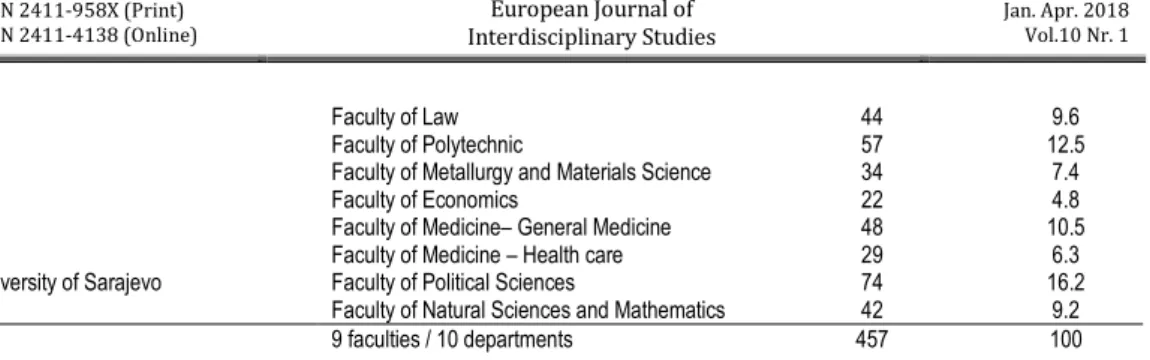
(9) ISSN 2411-958X (Print) ISSN 2411-4138 (Online). European Journal of Interdisciplinary Studies. Jan. Apr. 2018 Vol.10 Nr. 1. teaching individuals to express emotions by cultural patterns: in individualistic cultures negative in intimate, but positive in outer groups while in collectivistic it is vice versa, positive in intimate but negative in outer-group relations (Hofstede, 2001, 2005). The very same conclusions are relevant for the comprehension of the difference between parental control and carefulness: control in individualistic cultures is almost always linked with parental hostility and potential gap being opened in inter-generation perspective, so consequently, it reflects to the level of perception of emotionality of parental behaviour; in collective cultures, the control is regard to be a constituent of parental emotionality and the manner of exposing carefulness in a course of children' upbringing. The comparisons of control perception and carefulness in the USA and Germany on one, and in Japan, Korea and Turkey on the other side, have confirmed that in individualistic cultures from the position of youngsters a control is regarded as lack of love and confidence, while in collectivistic cultures as a constituent of parental expression of carefulness repertory within the process of upbringing (Kağıtçıbaşı, 2007). Why such differences are so implied in regard to a perception and understanding of identical behavioural patterns? The answer could be probably found exclusively in different cultural contexts as a basis for interpretation of behaviour as well as the notion on that what is „normal“, „good“ and „bad“. If within a culture, the ideal of autonomy is promoted, early separations and lower emotional fusions, then parental behaviour will be determined by such strategies and models supporting the achievement of such values. Behavioural models, within the fullness of cultural context, should be understood taking into consideration the beliefs, especially religious ones, that serve as a spring from which all values are created the norms helping to govern and model the young generations. Therefore, the previous findings are the confirmation that evaluation of both optimism/pessimism should be observed in accordance to eco-cultural context and dominant parental ethno-theory1. The aim of research In interpreting the results it was especially interesting to compare data gained by previous researches (Alić, Cerić and Habibović, 2013, 2015, 2017a, 2017b, 2017c) in which, applying similar instruments, we observed different categories of social behaviour of students of elementary and secondary schools, students and young people originating from Bosnia and Herzegovina but living in some European countries and in USA (that is, the all age structures of children of elementary, secondary and higher school level). The aim of this research was to establish to which extent a different variable describing the way and style of living of students from Bosnia and Herzegovina, relate to the level of optimism/pessimism. In this regard, beside the general information about examinees, the differences have been established in respect to sex, evaluation of dimension of parental control and emotionality (family status), level of empathy, intercultural sensitivity, and resistance and/or an inclination to depressive, anxious conditions and stress. In the researches, an interdisciplinary approach predominates (connecting the knowledge from pedagogy, psychology, and sociology) relevant for the questions on optimism/pessimism and emic perspective, a perspective of researching the culture from within of a single culture combined with qualitative and quantitative methods. Methodological frame of research The research has elements of both qualitative and quantitative analyses. Non-experimental empiric transversal layout was used based on the interview with individuals, questionnaire using standardized scales of evaluation, analyses of theoretical materials and statistical data processing. The field part of a research had been carried out in the period between February - June 2017.; data entry and its processing from June-September 2017, but the first analyses of processed data in the period of October and November of the current year. The empiric part of the research covered the sample comprising of 457 examinees, students of University of Zenica and University of Sarajevo including total of 9 faculties from technical, scientific, social and humanistic studies. At the University of Zenica, the research was conducted at the following faculties: Mechanical Faculty, Polytechnic Faculty, Faculty of Metallurgy, Faculty of Law, Philosophy Faculty and Medical Faculty, and at the University of Sarajevo: Faculty of Political Sciences and Faculty of Natural Sciences and Mathematics. The access to sex structure shows that the research included 328 female students and 129 male students (Table 1). Table 1. Structure of sample University University of Zenica. Faculty Faculty of Philosophy Faculty of Mechanical Engineering. Examinees 69 38. % 15.1 8.3. For detailed insight into ethnopedagogy in Bosnia and Herzegovina see: Tufekčić, A. (2012). Osnove etnopedagogije. Sarajevo: Dobra knjiga i CNS. 1. 9.
(10) European Journal of Interdisciplinary Studies. ISSN 2411-958X (Print) ISSN 2411-4138 (Online). University of Sarajevo. Jan. Apr. 2018 Vol.10 Nr. 1. Faculty of Law Faculty of Polytechnic Faculty of Metallurgy and Materials Science Faculty of Economics Faculty of Medicine– General Medicine Faculty of Medicine – Health care Faculty of Political Sciences Faculty of Natural Sciences and Mathematics 9 faculties / 10 departments. 44 57 34 22 48 29 74 42 457. 9.6 12.5 7.4 4.8 10.5 6.3 16.2 9.2 100. The following questionnaires has been used in this research: a questionnaire on general information of examinees, scale of parental perception of family relations (Vulić-Prtorić, 2000) including 25 items by which the examinees evaluate the dimensions of emotionality and control of both mother and father – Alpha Cronbach for emotionality of mother is 0.809, for emotionality of father 0.857, for mother's control 0.766, while for dimension of father's control, Alpha –Cronbach coefficient is 0.76; scale of empathy (Baron-Cohen, 2012) Alpha-Cronbach coefficient in this research is 0,867; Intercultural Sensitivity Scale / containing sub-scales: Interaction Engagement, Respect for Cultural Differences, Interaction Confidence, Interaction Enjoyment, and Interaction Attentiveness (Chen,G.M., & Starosta, W.J., 2000, after to Fritz, Mollenberg & Chen, 2002) - Alpha Cronbach coefficient is 0,833; Scale of optimism / pessimism (Penezić, 2002) – Alpha Cronbach for subscale of optimism is 0,789, for subscale of pessimism 0.806; Questionnaire of life style preference – modified Olport-VernonLindzey scale of values) scale constructed as the fifth-grade scale of Likert type measuring the intensity of ten lifestyles preferences (Luković and Čizmić, 2012); and DASS21 –Alpha Cronbach coefficient in this research for anxiety scale is 0.847, for stress scale 0.839, and for scale od depressiveness 0.863. The Alpha Cronbach values has shown for most questionnaires applied equally high scores as well as in our previous researches (Alić, Cerić and Habibović, 2013, 2015, 2017a, 2017b, 2017c). Analyses and interpretation of research results T-test is a statistical test of difference helping with the review whether there is real difference between the occurrences tested. In this research we have used T-test as a kind of appropriate statistical method to establish the differences regarding sex of examinees, but in regard of a sequence of criteria-variables observed: scale of optimism/pessimism, intercultural sensitivity, dimension of both mother and father control, empathy, stress inclination, depression and anxiety. We have established as regarding the sex, there are statistically significant differences in respect to most variables observed: optimism/pessimism, evaluation of parental dimensions, empathy and intercultural sensitivity, and an inclination to anxiety conditions and stress (Table 2.). Table 2. T-test: Differences between criteria variables regarding the sex of examinees Scales Scale of optimism Scale of pessimism Respect for cultural differences Dimension of mother's emotionality Dimension of mother's control Dimension of father's emotionality Dimension of father's control Empathy Anxiety Stress. Sex female male female male female male female male female male female male female male female male female male female. N 323 127 322 127 327 127 320 125 320 125 296 116 294 116 324 127 323 124 324. 10. M 23.00 21.98 21.60 20.82 25.46 23.43 40.94 39.35 14.14 15.22 38.84 37.80 13.57 15.05 45.63 39.31 6.28 5.02 8.16. δ 4.798 5.483 7.156 6.639 3.522 4.514 4.025 4.489 3.179 3.357 5.078 5.717 3.052 3.650 9.567 10.517 5.103 4.098 5.055. SE M .267 .487 .399 .589 .195 .401 .225 .401 .178 .300 .295 .531 .178 .339 .531 .933 .284 .368 .281.
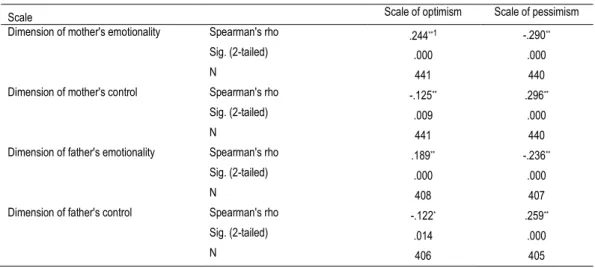
(11) European Journal of Interdisciplinary Studies. ISSN 2411-958X (Print) ISSN 2411-4138 (Online). male. 125. Jan. Apr. 2018 Vol.10 Nr. 1. 7.02. 4.299. .385. t-test sex Scale of optimism. t 1.940. df 448. p .050. Scale of pessimism. 1.062. 447. .289. Respect for Cultural Differences. 4.541. 188.545. .000. Dimension of mother's emotionality. 3.614. 443. .000. Dimension of mother's control. -3.166. 443. .002. Dimension of father's emotionality. 1.796. 410. .073. Dimension of father's control. -3.867. 181.808. .000. Empathy. 5.880. 212.272. .000. Anxiety. 2.709. 275.673. .007. Stress. 2.410. 262.854. .017. A slightly emphasized difference has been noticed regarding female examinees. Having in mind that it has been statistically found significantly higher score at female students at level p<0,05, (r=050, df=448) meaning that female students achieve somehow higher scores at the scale of optimism. The difference is visible when we compare both female and male examinees with average score achieved, so it is at female examinees 23.0 with SD 4.798, while at male examinees 21.98, and SD 5.483. Within a sub-scale Respect of cultural differences, a difference at level p<0,01 (r=.000, df=188.545) has been found, meaning that female students statistically achieve significantly higher scores at this sub-scale. Differences in evaluation of dimensions of parental behaviour has shown that female students evaluate statistically higher the emotionality of mother at level p<0,01 (r=.000, df=443), while male examinees higher evaluate mother's control. p<0,01, r=.002, df=443) and father's control p<0,01 (r=000, df=181.808). Obviously, female examinees are more directed to relationship and relational dimension, but males to normative behaviour dimension of both parents. These data can partially depict normative and relational dimension of observed culture. As it was expected, female examinees in statistically significant higher measure achieve scores at empathy scale at level p<0,01 (r=.000, df=212.272) meaning that female students are significantly empathic that their male colleagues. However, female examinees are at the same time more inclined to anxiety and stress knowing that there is statistically significant difference regarding stress noticeable at level p<0,01(r=.017, df=262.854), and regarding anxiety at level p<0,01 (r=.007, df= 275.673). It is interesting that regarding an inclination to depressive moods there are no differences between the students according to sex. Abstract from correlative matrix for criteria variables observed Calculation of correlation of criteria variables observed has been conducted applying Spearman's rho coefficient of correlation taking into consideration that it was needed to establish the range of correlation. Using Spearman’s rho correlation coefficient, possible connection between variables are examined: general information about students / which served as basic for branching of the sample), evaluation of dimensions both father and mother, level of empathy, intercultural sensitivity, inclination to anxiety, depressive moods, stress, all in relation to the results achieved on optimism/ pessimism scale. In respect to demographic characteristics of students (background, life in urban/rural areas) it is stated as there is no difference regarding optimism/pessimism. Differences are also not noted regarding variables related to family structure – two generation, three generation, complete, incomplete families. It has shown as optimism is in high correlation with evaluations of parental dimensions, but in negative correlation with control, and vice versa. pessimism in correlation with control, but in negative correlation with emotionality of parents (Table 3.).. 11.
(12) European Journal of Interdisciplinary Studies. ISSN 2411-958X (Print) ISSN 2411-4138 (Online). Jan. Apr. 2018 Vol.10 Nr. 1. Differences are to be easily noticed in evaluations of controlling mother's behaviour where correlation at level P<0,01 was noticed with examinees gaining higher scores on optimism scale (r=0.125; p=.009), but the same result was established regarding correlation between father's control and optimism at level P<0.05 (r=0.122; p=.014). On the other side, a positive correlation was established between optimism and examinees who higher evaluate emotionality of mother at level P<0,01 (r=0.244; p=.000), and optimism and higher evaluations of father's emotionality at level P<0.01 (r=0.189; p=000). Table 3. Abstract from the correlation matrix for dimensions of emotionality and parental control, and cultural dimensions Scale Dimension of mother's emotionality. Dimension of mother's control. Dimension of father's emotionality. Dimension of father's control. Scale of optimism. Scale of pessimism. .244**1. -.290**. Sig. (2-tailed). .000. .000. N. 441. 440. -.125**. .296**. Sig. (2-tailed). .009. .000. N. 441. 440. Spearman's rho. .189**. -.236**. Sig. (2-tailed). .000. .000. N. 408. 407. Spearman's rho. -.122*. .259**. Sig. (2-tailed). .014. .000. N. 406. 405. Spearman's rho. Spearman's rho. In Table 4, an abstract from correlation matrix for empathy, intercultural sensitivity, optimism/pessimism and observed everyday habits have been presented. It is interesting that a habit of reading books is not in correlation with optimism/pessimism, but it is with the level of empathy at level p<0,01 (r=0.211, p=.000), and intercultural sensitivity at level p<0,01 (r=0.204; p=.000) from which it is possible to conclude as students who read books on regular basis aside from obligatory study literature, achieve higher scores on the scale of empathy and intercultural sensitivity. Students consuming alcohol are lower empathetic from non-consumers at level p<0.01 (r=0.125; p=.008). Simply: a developed habit of reading books influence empathy and intercultural sensitivity but not to optimism or pessimism, while consuming alcohol, within this sample of young people at least, lower the level of empathy. Table 4. Abstract from correlation matrix for empathy, intercultural sensitivity, optimism/pessimism and criteria of everyday habits observed Scales I read books. Spearman's rho Sig. (2-tailed) N. Daily, periodicals on political topics. Spearman's rho. *. Correlation is significant at the 0.05 level (2-tailed). **. Correlation is significant at the 0.01 level (2-tailed). 1. *. Correlation is significant at the 0.05 level (2-tailed). **. Correlation is significant at the 0.01 level (2-tailed). 2. 12. Empathy. Intercultural sensitivity. Scale of optimism. Scale of pessimism. -.211**2. -.204**. -.086. .067. .000. .000. .069. .156. 451. 453. 450. 449. -.063. -.019. .020. .003.
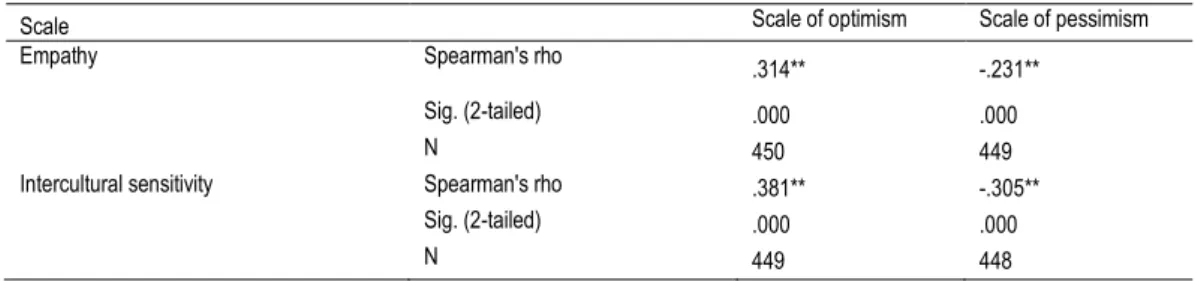
(13) European Journal of Interdisciplinary Studies. ISSN 2411-958X (Print) ISSN 2411-4138 (Online). Sig. (2-tailed) I consume alcohol. Jan. Apr. 2018 Vol.10 Nr. 1. N. .181 451. .691 453. .669 450. .945 449. Spearman's rho. .125**. -.018. .066. -.025. Sig. (2-tailed). .008. .701. .165. .602. N. 452. 454. 451. 450. Aside from a high correlation between the levels of empathy and intercultural sensitivity at level P<0,01 (r=0.422; p=.000) a connection of these mutually conditioned variables has been noted, with optimism and pessimism (Table 5.). Namely, higher level of empathy is in high correlation with optimism at level P<0,01 (r=0.314, p=.000) and it is at the same time a high correlation of intercultural sensitivity with optimism is present at level P<0.01 (r=0.381, p=.000). That means, that empathic persons who express higher level of intercultural sensitivity also more optimistic ones. Table 5. Abstract from correlation matrix for optimism / pessimism, empathy and intercultural sensitivity Scale Empathy. Scale of optimism. Scale of pessimism. .314**. -.231**. Sig. (2-tailed). .000. .000. N. 450. 449. Spearman's rho Sig. (2-tailed). .381**. -.305**. .000 449. .000 448. Spearman's rho. Intercultural sensitivity. N. This conclusion supports theoretical thesis that more confident and open-minded persons view in more bright way to events and people, and they do believe as they are able within their (really and objectively evaluated limits) influence their surroundings. The next abstract from correlation matrix supports previous results. Namely, in Table 6. are shown the results for optimism/pessimism, depression, anxiety and stress where a high correlation between higher scores on pessimism and inclination to depression, anxiety moods and difficulties to cope with stress are visible. Table 6. Abstract from correlation matrix for optimism/ pessimism, depression, anxiety and stress Scale Depression. Spearman's rho Sig. (2-tailed) N. Anxiety. Stress. Scale of optimism. Scale of pessimism. -.272**. .420**. .000. .000. 447. 446. -.222**. .348**. Sig. (2-tailed). .000. .000. N. 445. 444. -.153**. .336**. Sig. (2-tailed). .001. .000. N. 447. 446. Spearman's rho. Spearman's rho. Statistically significant correlation between the level of pessimism at level P<0,01 is noticed at examinees achieving higher scores on depression scale (r=0.420; p=.000) anxiety (r=0.348; p=.000) and stress (r=0.336; p=000). That means as more pessimistic examinees are at the same time those persons that hardly cope with depression, anxiety and stress. Reverse conclusion values for persons inclined to optimism, so these data are a kind of confirmation of some findings from theoretical elaboration and earlier researches (Seligman, 2002; Linley et al. 2004; Rijavec et al., 2008).. 13.
(14) ISSN 2411-958X (Print) ISSN 2411-4138 (Online). European Journal of Interdisciplinary Studies. Jan. Apr. 2018 Vol.10 Nr. 1. Table 7. Results for scale of pessimism per faculties Faculties Faculty of Political Sciences. N. Mean. Std. Deviation. Minimum. Maximum. 72. 24.07. 7.362. 8. 36. Faculty of Polytechnic. 57. 22.96. 7.613. 10. 40. Faculty of Mechanical Engineering. 38. 22.47. 6.044. 8. 35. Faculty of Metallurgy and Materials Science. 33. 21.30. 4.440. 9. 29. Faculty of Law. 42. 21.07. 7.971. 8. 37. Faculty of Economics. 22. 21.05. 7.061. 9. 32. Faculty of Medicine – Health care. 28. 20.86. 7.347. 11. 40. Faculty of Philosophy. 68. 20.62. 6.986. 8. 38. Faculty of Natural Sciences and Mathematics. 42. 19.48. 5.903. 9. 32. Faculty of Medicine– General Medicine. 48. 17.98. 6.069. 8. 33. Total. 450. 21.36. 7.014. 8. 40. The data analyses have shown that the highest average result on scale of pessimism is achieved by students of Faculty of Political Sciences, but the lowest one goes to students of Medical Faculty in Zenica. These results could be linked to the present work market chances-graduated students of political sciences get their job harder, while students of Medical sciences get it easier and along with degrees in medical field could be verified abroad (presently, a great number of young people are in process of leaving Bosnia and Herzegovina searching for jobs within EU countries). By single factor analyses of variant, an impact of choosing the study onto pessimism measured by pessimism scale has been researched. Our sample comprised of ten study programmes from nine faculties from Zenica and Sarajevo. Statistically considerable difference was stated at level p<0,00; F (9,440), p=0.00. With the help of Tukye's test we found differences between the following faculties: Faculty of Medicine Zenica and Faculty of Political Sciences Sarajevo, p=0.00. Mean result on scale of pessimism of the students of Faculty of Political Sciences Sarajevo is 24.07 with standard deviation 7,362 Polytechnic Faculty Zenica and Faculty of Medicine Zenica, p=0,009. Arithmetic mean of the students of Polytechnic faculty is 22,96, with standard deviation of 7,613, while with students of Faculty of Medicine Zenica, the mean result on scale of pessimism is 17,98 and standard deviation of 6.069. This data supports thesis that the students of Polytechnic Faculty are more pessimistic than students of Medicine. Faculty of Political Sciences Sarajevo and Faculty of Natural Sciences and Mathematics Sarajevo, P<0,021. Students of Faculty of Natural sciences and Mathematics Sarajevo achieve mean score on pessimism scale from 19,48 with standard deviation of 5.903. Based on these data we conclude as the students of Faculty of Political Sciences more pessimistic than the students of Faculty of Natural Sciences and Mathematics. Results of scale of optimism and differences between faculties presented in Table 8. Table 8. Results for scale of optimism per faculties Faculties Faculty of Law. N 43. Mean 24.14. Std. Deviation 4.384. Minimum 15. Maximum 30. Faculty of Medicine – Health care. 28. 24.07. 3.114. 15. 30. Faculty of Medicine– General Medicine. 48. 23.71. 4.838. 6. 29. Faculty of Philosophy. 68. 23.31. 4.804. 8. 30. Faculty of Natural Sciences and Mathematics. 42. 22.50. 4.671. 11. 30. 14.
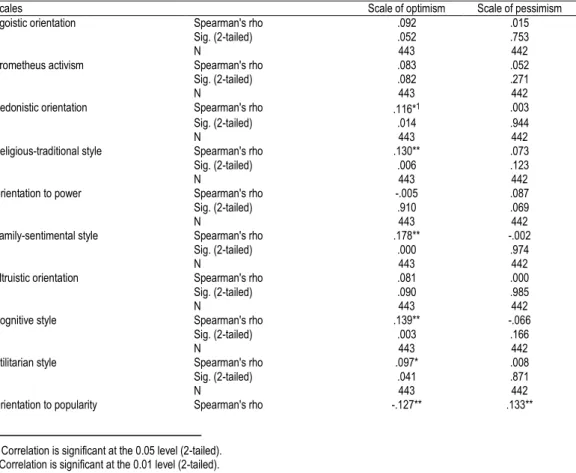
(15) European Journal of Interdisciplinary Studies. ISSN 2411-958X (Print) ISSN 2411-4138 (Online). Jan. Apr. 2018 Vol.10 Nr. 1. Faculty of Economics. 22. 22.27. 5.275. 10. 30. Faculty of Mechanical Engineering. 38. 22.18. 4.826. 12. 30. Faculty of Polytechnic. 57. 22.04. 5.261. 9. 30. Faculty of Metallurgy and Materials Science. 33. 21.94. 5.601. 9. 30. Faculty of Political Sciences. 72. 21.57. 5.718. 6. 30. Total. 451. 22.72. 5.011. 6. 30. Using single factor analyses of variation, it is stressed the impact of choosing the study onto optimism measured by optimism scale. The sample covered ten study programmes from nine faculties in Zenica and Sarajevo. Statistically significant difference has not been noticed: F (9,441) = 1.648, p=0,099. From the table we can see that the highest scores are achieved by students of Faculty of Law Zenica, but the lowest one goes to the students of the Faculty of political sciences (but the difference is just slight one). From the previous results, it could be concluded as the highest scores on pessimism scale are achieved by students of Faculty of Political sciences Sarajevo, but the highest ones on scale of optimism is achieved by students of Medical Faculty Zenica. Previous results have led us to necessity of establishing the eventual correlation between preferred life styles of students and optimism/pessimism displayed (Table 9.). Table 9. An abstract from correlation matrix for dimensions of emotionality and parental control and cultural dimensions Scales Egoistic orientation Prometheus activism Hedonistic orientation Religious-traditional style Orientation to power Family-sentimental style Altruistic orientation Cognitive style Utilitarian style Orientation to popularity. Scale of optimism .092 .052 443 .083 .082 443 .116*1 .014 443 .130** .006 443 -.005 .910 443 .178** .000 443 .081 .090 443 .139** .003 443 .097* .041 443 -.127**. Spearman's rho Sig. (2-tailed) N Spearman's rho Sig. (2-tailed) N Spearman's rho Sig. (2-tailed) N Spearman's rho Sig. (2-tailed) N Spearman's rho Sig. (2-tailed) N Spearman's rho Sig. (2-tailed) N Spearman's rho Sig. (2-tailed) N Spearman's rho Sig. (2-tailed) N Spearman's rho Sig. (2-tailed) N Spearman's rho. *. Correlation is significant at the 0.05 level (2-tailed). **. Correlation is significant at the 0.01 level (2-tailed). 1. 15. Scale of pessimism .015 .753 442 .052 .271 442 .003 .944 442 .073 .123 442 .087 .069 442 -.002 .974 442 .000 .985 442 -.066 .166 442 .008 .871 442 .133**.
(16) ISSN 2411-958X (Print) ISSN 2411-4138 (Online). European Journal of Interdisciplinary Studies Sig. (2-tailed) N. Jan. Apr. 2018 Vol.10 Nr. 1. .007 443. .005 442. Statistically significant correlation between the level of optimism at level P<0,01 is noticed at examinees preferring religioustraditional style (r=0,130; p=.006), family-sentimental style (r=0,178) and cognitive style (r=0,139; p=.003). Statistically significant correlation between the level of optimism at level P < 0,05 is noticed at examinees preferring hedonistic orientation (r=0.116; p=.0,14) and utilitarian style (r=0.097; p=.041). Statistically significant but negative correlation between the level of optimism at level P<0,01 is noticed at examinees preferring orientation of popularity (r=0.127; p=.007). These data also support a sequence of theoretical findings on correlation of optimism with living the religious-traditional, family-sentimental, cognitive, utilitarian styles and hedonistic orientation (Seligman, 2002, Rijavec, et al. 2008). Statistically significant correlation between the level of pessimism at level P<0,01 is noticed at examinees preferring the orientation of popularity (r=0,133, p=.005) that could be contributed to present negative status of examinees, for the desire for higher level of presence and visibility on social networks and the world surrounding someone in general, can point to low level of self-esteem and self-confidence. Conclusive reflection The tradition of measuring of optimism and pessimism is very popular nowadays, but previous decade offered a sequence of very interesting views into this phenomenon as within separate cultures through emic, so as on the field of cross-cultural researches through ethic perspective. In our research conducted on a sample comprising of 457 students of University Zenica and Sarajevo, it emerged as optimism correlates with higher level of empathy, intercultural sensitivity, along with preference to the following life styles: religious-traditional, family-sentimental, cognitive style, hedonistic orientation and utilitarian style. Statistically significant correlation between the level of pessimism is noticed with examinees preferring orientation to popularity that can be related to present and enormously big influence of social networks where popularity varies from minute to other and is connected to likes of other persons, a number of posts seen etc. Namely, it seems to be conditioned by situation. Consequently, such bonds to other people can lead to lower down the level of self-esteem and self-confidence and lower emotional stability. For the higher level of optimism variables of evaluation of father and mother have shown as important ones. Favourable emotional climate within family is very strong factor of shaping up mature and stable personality, and such persons possess a potential for building up the next emotionally literate generations. In B&H society the importance of family is nourished, and connection is confirmed by these findings. It is interesting that at the very brink of statistical importance female examinees display somehow higher results on the scale of optimism than male examinees. Higher level of pessimism is also noticed with examinees achieving higher scores on depression scale, anxiety and stress, meaning that more pessimistic examinees are at the same time those persons who hardly cope / or have difficulties regarding depression, anxiety and stress. Reverse conclusion values for persons who incline to optimism so, these data are also a kind of confirmation of some findings from theoretical elaboration and previous researches. It seems as these findings suggest a necessity of introduction of programmes in learning some social and emotional competence, but up-to-present researches and evaluation of numerous programmes show that these skills could be learned. Single factor variant analyses have served for research of influence of choosing study onto optimism/pessimism measured by optimism/pessimism scale. Based on this part of research it was confirmed that the highest scores on pessimism scale has been displayed by students of Faculty of Political Sciences Sarajevo, but the highest scores on optimism scale belong to students of Medical Faculty Zenica. The emphasized pessimism of the students of Faculty of Political Sciences and the lowest one with the students of Medical Faculty, could be connected to present work-market chances-graduated students of Political Sciences hardly get a job, while students of medical sciences get it easily having an opportunity it to be verified in some other countries/presently, a great number of young people are in process of leaving B&H seeking the job in any of UE country. Perception of a better future is strong predictor for development of optimism, happiness and easier way to cope with stress, depression and anxiety.. 16.
(17) ISSN 2411-958X (Print) ISSN 2411-4138 (Online). European Journal of Interdisciplinary Studies. Jan. Apr. 2018 Vol.10 Nr. 1. References [1] [2] [3] [4] [5] [6] [7] [8] [9] [10] [11] [12] [13] [14] [15] [16] [17] [18] [19] [20] [21] [22] [23] [24] [25] [26] [27] [28]. Alić, A., Cerić, H. i Habibović, S. (2017a). Studija kulturalnog kontakta i socijalnog utjecaja United World College u Mostaru. Sarajevo: Dobra knjiga. Alić, A., Cerić, H. & Habibović, S. (2017b). Students' Cultural Background as a Determinant of Various Categories of Social Behaviour. European Journal of Social Sciences Education and Research, 11(2), pp. 267-282. Alić, A., Cerić, H. & Habibović, S. (2017c). Evaluations of Students and Teachers on Quality of Teaching Process Regarding Working Styles. European Journal of Social Sciences Education and Research, [S.l.], v. 10, n. 2, pp. 94-100, May 2017. Alic, A., Ceric, H., & Habibovic, S. (2015). The Connections of Empathy and Life Styles among Bosnian Students. Procedia-Social and Behavioral Sciences, 205, pp.457- 462. Alić,A. & Habibović, S. (2013). Approaching to Immigrant Families – The Scope of Transgenerational and Culture Shock Model, Procedia - Social and Behavioral Sciences, Volume 84, 9 July 2013, pp. 144-148. Alić, A. (2012). Struktura i dinamika obiteljske kulture. Sarajevo: Dobra knjiga. Aronson, E., Wilson, T.D., & Akert, R.M. (1998). Social Psychology (3rd ed.). New York: Longman. Baron-Cohen, S. (2012). The Science of Evil: On Empathy and the Origins of Cruelty. Basic Books. Bezinović, P. (1990). Skala eksternalnosti (lokus kontrole). In: N. Anić (Eds.).Praktikum iz kognitivne i bihevioralne terapije III(pp. 155-157). Zagreb: Društvo psihologa Hrvatske. Bjelošević, E., Habibović, S. (2018). Zloupotreba psihoaktivnih supstanci. Zenica: Univerzitet u Zenici. Dejvis, V. (2017). Industrija sreće. Beograd: Clio. Fritz, W., Mollenberg, A., & Chen, G.M. (2002). Measuring Intercultural Sensitivity in Different Cultural Contexts. Intercultural Communication Studies, 11(2), 165-176. Hofstede, G.H. (2001). Culture's Consequences: Comparing Values, Behaviors, Institutions and Organizations Across Nations. London: Sage Publications, Inc. Hofstede, G.H. (2005). Cultures and Organizations- Sofware of Mind. New York: Mc Graw Hill. Kağıtçıbaşı, Ç. (2007). Family, Self, and Human Development Across Cultures. London: Lawrence Erlbaum Associates Publishers. Keller, H. (2007). Cultures of Infancy. London: Lawrence Erlbaum Associates Publishers. Kottak, C.P., (2002). Anthropology – The Exploration of Human Diversity. Boston: McGraw Hill. LeVine, R.A. (2003). Childhood Socialization. The University of Hong Kong: Comparative Education Research Centre. Linley, P.A., Joseph, S., and Seligman, M.E.P. (2004). Positive Psychology in Practice. New York: John Wiley & Sons, Inc. Luković, S. i Čizmić, S. (2012). Povezanost preferencija životnih stilova i profesionalnih interesovanja petnaestogodišnjaka. Primenjena psihologija. 81-108. Penezić, Z. (2002). Skala optimizma/pesimizma. U: Lacković-Grgin, K., Prorokovi, A., Ćubela, V. i Penezi, Z. (2002). Zbirka psihologijskih skala i upitnika. Zadar: Sveučilište u Splitu, Filozofski fakultet Zadar. Rijavec, M., Miljković, D., Brdar, I. (2008). Pozitivna psihologija. Zagreb: Ekološki glasnik Samarin, R.M. i Takšić, V. (2009). Programi za poticanje emocionalne i socijalne kompetentnosti kod djece i adolescenata. Suvremena psihologija, 12,2, 355-371 Seligman, M.E.P. (2002). Authentic Happiness. New York: The Free Press. Tufekčić, A. (2012). Osnove etnopedagogije. Sarajevo: Dobra knjiga i CNS. Veenhoven, R. (2017). Happiness in Nations. World Database of Happiness, Erasmus University Rotterdam, The Netherlands. (Assessed on: 9.12.2017.) at: http://worlddatabaseofhappiness.eur.nl/hap_nat/nat_fp.php?mode=1 Vulić-Prtorić, A. (2000). Somatizacija i kvaliteta obiteljskih interakcija kod djece i adolescenata. Medica Jadertina, 30 (1-2) 21-31. Westen, D. (1999). Psychology Mind, Brain, and Culture. New York: John Wiley & Sons, Inc.. 17.
(18) European Journal of Interdisciplinary Studies. ISSN 2411-958X (Print) ISSN 2411-4138 (Online). Jan. Apr. 2018 Vol.10 Nr. 1. Use of PBL as a teaching innovation methodology in University Nursing Studies in Spain Rosa Llabrés-Solé Universidad de Les Illes Balears. Profesora EUE Nª Sª de La Candelaria. Universidad de la Laguna. Servicio Canario de Salud. Tenerife, Canary Islands Spain Miquel Oliver-Trobat Phd, Universidad de les Illes Balears. Facultad de Educación. Palma de Mallorca, Spain Maria Elisa de Castro-Peraza Phd, Directora EUE Nª Sª de La Candelaria. Universidad de la Laguna. Servicio Canario de Salud. Tenerife. Canary Islands Spain Maria Rosa-Rossellò Phd, Universidad de les Illes Balears. Facultad de Educación. Palma de Mallorca. Spain Nieves Doria Lorenzo-Rocha Phd, Hospital Universitario de Canarias. Profesora EUE Nª Sª de La Candelaria. Tenerife. Canary Islands Spain Jesus Manuel García-Acosta Universidad de la Laguna. Tenerife. Canary Islands Spain Ana Mª Perdomo Hernandez EUE Nª Sª de La Candelaria. Universidad de la Laguna. Servicio Canario de Salud. Tenerife. Canary Islands Spain Abstract Health Sciences have undergone a great transformation. University degrees such as Nursing, in its adaptation to the Bologna Plan, have seen how their studies went from a purely mechanistic conception (Haidar Torres, 2015), as surgeon assistants, to the establishment of a university superior Degree where the students must develop and acquire a series of competencies and knowledge that are considered necessary for their future development as professionals. Keywords: PBL, nursing, Higher Education, Skills Introduction We can’t talk about Problem Based Learning (hereinafter PBL) as an innovative educational tool without first referring to the process which transformed the Education methodology throughout Europe, the Bologna Plan (Education, 19 June 1999). Bologna Plan’ passing date was the exact moment when important changes were introduced in all University/College studies. The studies were given a new focus encompassing a better quality, mobility and versatility, therefore, it also meant the reviewing of all prior University Plans that were previously in force. Due to the Bologna Plan, the prior applicable Credit System was replaced for the European Credit Transfer and Accumulation System, hereinafter ECTS, being the latter, a system focused in the students (…) as it is adapted to their goals and needs (MEC, 2003), moreover, standardising all European Credit Systems.. 18.
(19) ISSN 2411-958X (Print) ISSN 2411-4138 (Online). European Journal of Interdisciplinary Studies. Jan. Apr. 2018 Vol.10 Nr. 1. This new focus, generated a series of relevant methodological changes over faculties, as the professors’ role needed to be adjusted to this new educational concepts, becoming a supportive roleplay throughout the teaching process, operating as a tutor and guide in order to orientate the students through their learning. What is more, this learning and knowledge to be acquired is part of the educational activities where in-person lessons are one of the necessary elements to achieve a series of skills (Credit Transfer and Accumulation, 2002). The approach to the labour market is established as one of the Bologna Plan’s principles, being this principle crucial within the Health Science Field. The ageing of the population, the development of new technologies within the field and the new demands of consumers with a broader access to information, have made the approach to the labour market in Faculties, crucial. Even a document made by the UNESCO Chair (Education, 2006) establishes the need of new innovative educational methodologies to narrow the breach between the professional reality and the existent training itinerary, especially in the Health Science Field. By means of this goal, self-learning and the acquisition of new skills and aptitudes is essential, which means that the amassing of theoretical knowledge becomes the background of this new methodological tools. Moreover, those abovementioned skills encompass knowledge, attitudes, and moral values which will allow the students to overcome all academic and professional hindrances (Ariño, 2010). PBL has been revealed as a methodological tool capable of perfectly adjusting itself to all new learning and teaching schemes, (Alcolea-Cosín et al. 2012). The most relevant elements of PBL (Branda, 2004) are the student learning goals, the cases (directly taken from clinical practice) and an evaluation system in tune with the learning tools. PBL looks forward to achieving a certain goal predefined and set in a practical case. Students work in small teams, orientated by a tutor that guides them. The group reads, interprets, analyses and thinks up the necessary information to solve the problem and reach the goal. Therefore, the students must be able to use rational strategies to identify concrete concepts, not just in the case in question but in similar situations. With the PBL usage, universities want students to obtain the necessary skills to integrate all historical field limited knowledge in the form of courses, resulting in an integral and interrelated learning. Spanish literature already includes some works regarding the experience of using PBL with College students, especially in the Health Science Field (Armenta Hernández, Salinas Urbina, and Mortera Gutiérrez 2013) and nursing (Alcolea-Cosín et al. 2012). The main difference between our research proposal and the Spanish literature lies within the use of PBL in nursing Degrees as a pedagogical tool able to act as a link among the different courses. That means the development of transversal and specific skills. What is more, in this case in particular, introducing the PBL method in all first-year courses of the Nursing Degree will allow students to visualise their future patients as a whole, thus promoting a breach of the traditional subjects/courses academic seal (which, to be said have a narrower approach to the Healthcare world). This reality has triggered the start of this study, and the goal of which being the integration of the PBL methods with the support of the students, determining the satisfaction level of the whole university community with this pedagogical tool. Methodology: The courses, which were selected to impart in an integrated manner and within the PBL methodology, were: Human Anatomy and Histology, Biochemistry and Nutrition, Physiology and Pathophysiology and Research and Evidence-Based Nursing. All of them were compulsory courses in relation to the Nursing degree 1st year and semester with 6 ECTS each. In all of them, a continuous evaluation was carried out, and the PBL results represented a 20% of the total mark of each student in each course. 19.
(20) ISSN 2411-958X (Print) ISSN 2411-4138 (Online). European Journal of Interdisciplinary Studies. Jan. Apr. 2018 Vol.10 Nr. 1. The methodological scheme used for the introduction of the PBL was divided into five stages: PHASE I: Discussion Groups (ABP methodology), where it is decided: Selection of subjects. Introduction to PBL, (Exhibition). Training workshop, (tutors) PHASE II: Discussion Groups (tutors, experts), where it is decided: Experts and case generation. Evaluation, types: selfevaluation, peer evaluation, tutor evaluation, satisfaction PHASE III: Start-up and development of the PBL, where it is carried out: Assessment tutor, peer, self-evaluation. Student satisfaction Interaction of students, forum and virtual classroom PHASE IV: Evaluation of knowledge generated by the January call. PHASE V: Evaluation of long-term knowledge, generated by the July call. Prior to the start of this stages, all faculties were offered to participate in the PBL initiative, therefore, the project began with those who wanted to support it. Once the practical case was elaborated considering the content of the subject (Schedule I), we proceeded to implant the figure of the expert as an integrating element and joint point between the daily professional practice and the learning context. Together, the expert and the professor become the main pillar for the development and implementation of the PBL. Therefore, the professional knowledge of the expert and the theoretical knowledge of the lecturer, jointly, are the key to success regarding the PBL implementation (Wosinski et al. 2018) Straightaway, students received an introductory class and were offered information about the characteristics and main aspects of the PBL methodology. The PBL was developed and carried out during three two hours sessions that took place weekly. The students were divided into groups which performed the reading, analysis and treatment of the case presented to them since this method comprehends a social, participative, and dynamic process that favours and impulses the achievement of the goals (CastroPeraza et al., 2016). At last, the students’ satisfaction with the applied PBL methodology, was evaluated by means of an anonymous survey concerning 20 questions to be punctuated from 0 to 10 according to the grade of the agreement, being 10 de maximum scale (fully agreement). What is more, the survey included an option for the students to express their own opinion regarding their PBL experience. The reliability, accuracy and trustworthiness of the survey were tested with Cronbach’s alfa (0,815), and it was created by the professors with the participation and support of an experts group. Results The response rate was 89.8% (n = 60). 86.4% were women and 13.6% were men. The average age was 21.6 (sd 3.39). No student had had previous experience in PBL. There were students from other degrees (29. 5%). The 20.5% were combining work and studies. A 72.7% of the students believed the experience of PBL to be very positive. The 90.9% would recommend repeating the experience in the following years. When the students were asked to evaluate the different learning methods that had been used throughout the different degree courses, they considered the PBL methodology to be the best, and therefore it was well rated, however, on the other hand, the master class was the lowest rated methodology. Regarding the last question, which asked the students to evaluate their experience in their own words, they mostly stated the following: "I have learned a lot, I liked the used work dynamics" "I liked the experience" 20.
(21) ISSN 2411-958X (Print) ISSN 2411-4138 (Online). European Journal of Interdisciplinary Studies. Jan. Apr. 2018 Vol.10 Nr. 1. "It allows us to put our knowledge in common" "It motivates us to move forward" "It allows us to realize the great amount of knowledge we have" "This type of motivation throughout the sessions is fundamental for our progress" The PBL’ methodology global rate reached an 8.84 score (sd 0.8). The self-assessment of the students reached a 7.86 score (sd 0.93). The evaluation between the tutor and the students scored an 8.93 (sd 0.96) and the method was considered as a crucial way to improve the student-teacher relationship by an 8.7 (sd 1.3). Conclusions The obtained results prove that the PBL experience turned out to be highly positive, as it meant, according to the students, the improving of their skills and knowledge, moreover being these results equal to similar experiences that had been already carried out by other authors (Zúñiga Arbalti et al. 2017; González et al. 2014; González-Hernando et al. 2013). In our Faculty, the use of a hybrid methodology encompassing PBL and master sessions has had good results. Even in previous researchers (De Castro et al. 2013; Kang et al. 2015) the PBL method reached good results and meant the student's improvement in problems resolution and self-oriented learning. Notwithstanding, there are a few drawbacks in relation to the PBL methodology that needs to be pointed out, as it is our duty as professors. Given that PBL consists basically in a collaborative methodology, its possibilities of success is linked to several factors, such as the following: It needs a fully available tutor (Wosinski et al., 2018). It must comprehend small groups of students. An important economic and workload is needed since it is necessary to increase the number of teachers due to the above-mentioned bullet. In consequence, these factors must be considered when adopting this methodology, albeit no literature has been found in this regard. Moreover, we believe that more research is necessary to find solutions to the increase of costs. The current University System is based on watertight courses, which greatly affects in a negative way the core of the PBL purpose, and constitutes an obstacle for students to obtain transversal skills. To sum up, it is necessary that the whole community tries to question the effectivity of traditional methodology and cognizes that there is a global need for collaborative learning. In conclusion, despite the remarked hindrances, it is crucial to consider PBL methodology as a way to improve our educational system quality within the European Higher Education Area. An idea that has been already supported by other international and national authors (Blanco-Sanchez 2005, Guerra-Martín 2009). References [1] [2]. [3] [4] [5]. Alcolea-Cosín, M. Teresa et al. 2012. “Aprendizaje Basado En Problemas En La Formación de Estudiantes de Enfermería: Impacto En La Práctica Clínica.” Educación Médica 15(1): 23–30. http://scielo.isciii.es/scielo.php?script=sci_arttext&pid=S1575-18132012000100007&lng=en&nrm=iso&tlng=en. Armenta Hernández, Moisés David, Verónica Salinas Urbina, and Fernando Mortera Gutiérrez. 2013. “APLICACIÓN DE LA TéCNICA EDUCATIVA APRENDIZAjE BASADO EN PROBLEMAS PARA CAPACITACIÓN A DISTANCIA (E-LEARNING).” RIED. Revista Iberoamericana de Educación a Distancia 16(1): 145–57. http://revistas.uned.es/index.php/ried/article/view/2060. De Castro, M. E et al. 2013. “El Aprendizaje Basado En Problemas En El Grado de Enfermería, ¿es Realmente Útil?” Metas de Enferm 15(10): 25–31. http://www.enfermeria21.com/revistas/metas/articulo/80389/ (January 28, 2018). González-Hernando, C., P. Martín-Villamor, M.Á. Carbonero-Martín, and F. Lara-Ortega. 2013. “Evaluación Por Competencias de Los Estudiantes de Enfermería a Través de Aprendizaje Basado En Problemas.” Enfermería Universitaria 10(4): 120–24. http://linkinghub.elsevier.com/retrieve/pii/S166570631372640X (December 12, 2017). González, C, MA Carbonero, F Lara, and P Martín. 2014. “Nursing Students’ Satisfaction in Problem-Based Learning/Aprendizaje Basado En Problemas Y Satisfacción de Los Estudiantes de Enfermería.” Enfermería Global 13(3): 105–12. http://search.proquest.com/docview/1664837249?accountid=14477%5Cnhttps://nevada.ual.es/biblioteca/gtb/sod/poa_login.. 21.
(22) ISSN 2411-958X (Print) ISSN 2411-4138 (Online). [6]. [7] [8]. European Journal of Interdisciplinary Studies. Jan. Apr. 2018 Vol.10 Nr. 1. php?centro=$UALMG&sid=$UALMG&title=Enfermería+Global&atitle=Nursing+students’+satisfaction+in+ProblemBased+Learning/Aprendizaje+Bas. Kang, Kyung-Ah Ah et al. 2015. “Comparison of Knowledge, Confidence in Skill Performance (CSP) and Satisfaction in Problem-Based Learning (PBL) and Simulation with PBL Educational Modalities in Caring for Children with Bronchiolitis.” Nurse Education Today 35(2): 315–21. http://linkinghub.elsevier.com/retrieve/pii/S0260691714003293 (December 11, 2017). Wosinski, Jacqueline et al. 2018. “Facilitating Problem-Based Learning among Undergraduate Nursing Students: A Qualitative Systematic Review.” Nurse education today 60: 67–74. https://www.sciencedirect.com/science/article/pii/S0260691717302022 (November 30, 2017). Zúñiga Arbalti, Felipe Andrés et al. 2017. “Utilización de Aprendizaje Basado En Equipos, Como Metodología Activa de Enseñanza de Farmacología Para Estudiantes de Enfermería.” Revista Cubana de Educacion Medica Superior 31(1): 78– 88.. 22.
(23) ISSN 2411-958X (Print) ISSN 2411-4138 (Online). European Journal of Interdisciplinary Studies. Jan. Apr. 2018 Vol.10 Nr. 1. Professions Susceptible to Automation; A Study on Automotive Sector Employees Aylin Goztas Full Professor at Ege University Fusun Topsumer Full Professors at Ege University Mehmet Karanfiloglu Research Assistant at Mustafa Kemal University Ozlem Cosan Ph.D. Candidate at Ege University Abstract The future of jobs has been a popular issue in the industry 4.0 process and digitization. Many of today's profession groups are at risk with automation in the digitalization process and most will be replaced to computerbased software and robots. By this concept, with Industry 4.0, we come up with whether the jobs are susceptible or non-susceptible to automation. According to researchers, jobs, where more routine and labor-intensive work is done, are categorized as group of jobs prone to automation, on the other hand jobs requiring human skills in which intellectual skills are used intensively, especially those that cannot be done through machines yet are categorized as group of jobs non-susceptible to automation. A recent Forrester Report predicts that by 2021, 6% of jobs in the US will be automated. In another study, it is predicted that 47% of the professions in the US will be unmanned during the automation process. By this study, a review of the literature on the susceptibility of the various professions to automation will be made and self-assessment of the automotive sector managers in İzmir and the surrounding areas regarding their future professions will be studied through a descriptive study. Keywords: Industry 4.0, Self-Assessment, Automotive Sector Introduction Future of the professions has become a current issue by the process of Industry 4.0. Despite the fact that Industry 4.0 has started to shape job's future, industry 4.0 will provide new opportunities for current positions according to some people for those who defend that everything would be better and there will be more need to people; the contrary, it is objected by some of those who are dystopian and defend that everything would be worse. Both opinions show that there would be an absolute change in anyhow and both sides come together on this idea. Many positions in the banks became unnecessary by the existing of Automatic Teller Machine (hereinafter ATM). Thus, many working bank tellers have been unemployed due to fact that ATM's had taken their place. Logically, after that unemployment, we must have seen fewer workers in the banks. Conversely, after ATM's have been invented results show that the number of the tellers and the other employees became increased instead of drop. Furthermore, people need for the banks gradually increased after ATM's have been placed, this led many other job positions. These facts, revealed in a recent book by Boston University economist James Bessen, raise an intriguing question: what are all those tellers doing, and why hasn't automation eliminated their employment by now? If you think about it, many of the great inventions of the last 200 years were designed to replace human labor. Tractors were developed to substitute mechanical power for human physical toil. Assembly lines were engineered to replace inconsistent human handiwork with machine perfection. Computers were programmed to swap out error-prone, inconsistent human calculation with digital perfection. These inventions have worked. We no longer dig ditches by hand, pound tools out of wrought iron or do bookkeeping using actual 23.
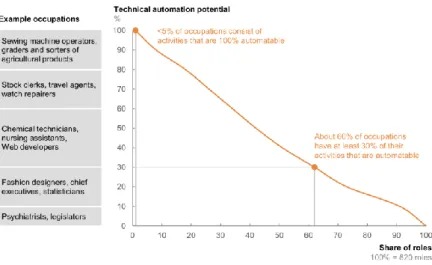
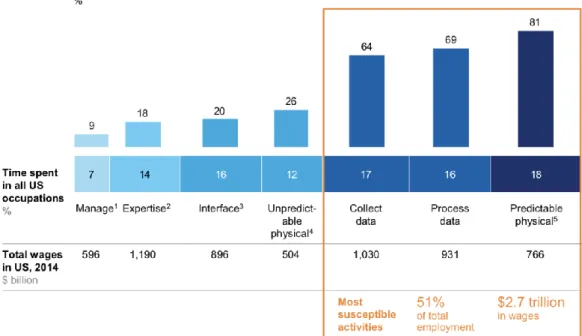
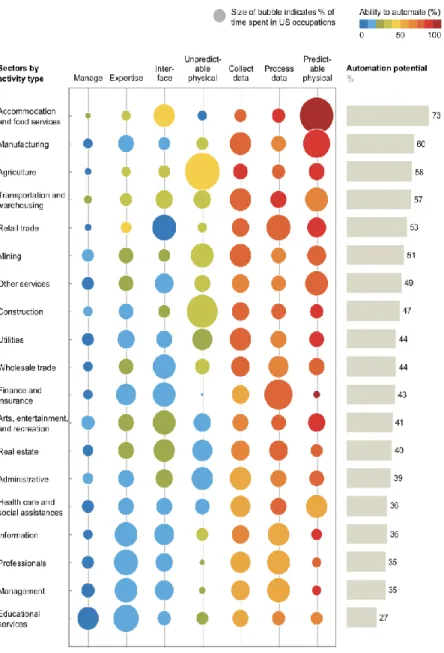
(24) ISSN 2411-958X (Print) ISSN 2411-4138 (Online). European Journal of Interdisciplinary Studies. Jan. Apr. 2018 Vol.10 Nr. 1. books. And yet, the fraction of US adults employed in the labor market is higher now in 2016 than it was 125 years ago, in 1890, and it's risen in just about every decade in the intervening 125 years. David Autor, on a stage talk on TEDx, has explained this growth in business with O-Ring and Never Get Enough principles. O-Ring principle defines the types of work we do, Never Get Enough principle determines how many jobs there actually are. Most of the work that we do requires a multiplicity of skills, and brains and brawn, technical expertise and intuitive mastery, perspiration, and inspiration in the words of Thomas Edison and that bring us to the second principle: never get enough. In 1900, 40 percent of all US employment was on farms. Today, it's less than two percent. He questions that why there are so few farmers today. It's not because we're eating less. A century of productivity growth in farming means that now, a couple of million farmers can feed a nation of 320 million. This grand progress means there are only so many Oring jobs left in farming. It can be clearly seen as technology can eliminate jobs however farming is only one example. According to David Autor, it's unwise to say there's nothing to worry about. This can be understood incorrectly. If the US had not invested in its schools and in its skills a century ago with the high school movement, we would be a less prosperous, a less mobile and probably a lot less happy society. But it's equally unwise to say that our fates are sealed. That's not decided by the machines. It's not even decided by the market. It's decided by us and by our institutions (Autor, 2017). In the light of all this information, we can see that it necessary to define how the organizations assess themselves and take place to deal with the phase in Industry 4.0 process. Therefore, it is of great importance that to be understood the processoriented self-assessment of organizations. Literature Review Concerns about the impact on the workplace of the industry 4.0 process are not new. If the concerns are justified, the seats of the constructions working in this area will be discharged by transferring many business fields to the computers in the next few years. The emergence of evidence that computers in the last few years have replaced a large number of jobs, especially accountants, cashiers and telephone operators, has rekindled this debate (Schwab, 2017). By Industry 4.0, robotic systems will take place by means of machines can communicate with each other in factories. Here in after, all the organizational structures and the way of working for companies will be fundamentally changed according to Schwab. It is debated that whether all the process steps and work style would change from marketing to sale department, production to place and rest departments. There will be new concepts that get into our daily life such as; robotics, autonomous transportation, artificial intelligence, learning machines, advanced materials, biotechnology and genome science. While some professions would be gone, there will be new positions that we never heard of, and some profession will be only updated to the future's conditions. Farther, human recourses departments will be affected by those changes that evolve into the new human-machine oriented process. Technologies grow so fast that innovations which have been approved by the companies would take place the old fashion machines in rapidly by new technologies arrives into the business. Those new machines and systems are connected to the internet (IoT: Internet of Things) by inner wireless connection plugs so that they can talk to each other and manage the process in dark factories. It can also be seen in our high-tech design houses with new applications through interior machines such as; automatic curtains, lights, bed, coffee machines… etc. In these houses, the owner can control and secure the whole house facilities with a smart-phone application. The velocity that is one of the most important factors of Industry 4.0, is a key factor of increasing concerns in this regard. Depth and extensity can be sorted as the other factors, which brought us to see there are many radical changes occurs and all the systems re-structured from head to toe. From this point, it is possible to say that this powerful force can put all the professions' process forward and re-organize them in differentiated dimensions. However, it is still not clear to see that how further this can go and in what amount of time. To handle this, first of all, İt shall be studied that how deterioration and automation of technology can substitute labor with capital and how taking workers to be unemployed and/or to force them to use their skills on other positions emerges a devastating effect. Secondly, this destructive effect is accompanied by a developer effect; the demand for new products and services that are increasing and bringing new professions, jobs, and even sectors. Thus, two different results can be handled within this period; there is one side who believes to the happy end and the other side who believes that this will create massive technological unemployment. A qualitative change in current labor is vital. 24.
Figure
+7



Documento similar
Second, all age and gender groups are statistically significant. In comparison with the reference category (woman over 64 years), belonging to
The tentative spin and parity assignment to the observed levels in 44 S is based on the comparison between the calcu- lated and experimental (i) excitation energies, (ii)
Introduction: The aim of this study was to describe incidence, incidence trends and survival patterns of lymphoid neoplasms (LNs) and its subtypes in Spain in the period 2002-2013
The expansionary monetary policy measures have had a negative impact on net interest margins both via the reduction in interest rates and –less powerfully- the flattening of the
Jointly estimate this entry game with several outcome equations (fees/rates, credit limits) for bank accounts, credit cards and lines of credit. Use simulation methods to
In our sample, 2890 deals were issued by less reputable underwriters (i.e. a weighted syndication underwriting reputation share below the share of the 7 th largest underwriter
The aim of this study was to examine the effect of the use of the flipped classroom on the level of self-efficacy and the assessment of clinical competencies in nursing
The Dwellers in the Garden of Allah 109... The Dwellers in the Garden of Allah
