
Analyzing lexical cohesion in medical students’ writing
55
0
0
Texto completo
(2) Analyzing Lexical Cohesion In medical Students’ Writing. This investigation has been read by the members of the Committee of. Anette Esmeralda Jiménez Sánchez And it is considered worthy of approval in partial fulfillment of the requirements for the degree of. MAESTRÍA EN LA ENSENANZA DEL INGLÉS. _______________________________ Dra. Teresa Aurora Castineira Benitez Thesis Director. ____________________________. __________________________. Dr. Michael Thomas Witten Ulrich. Dra. Elizabeth Flores Salgado. Reader. Reader. ________________________________ Mtra. Leonor Juárez García Reader. Benemérita Universidad Autónoma de Puebla Puebla, Pue. January 2016.
(3) ABSTRACT. The overall purpose of this study is to analyze those features of lexical cohesion contained in English as a foreign language (EFL) in medical written texts in order to provide a better understanding of how cohesion functions within students’ writing inside the previously mentioned contex. The present study explored the lexical cohesive elements utilized in two genres written by EFL medical students. The study intended to analyze lexical cohesion, to determine to what extent this contributes to the perceived coherence of a text of student’s academic writing. The study has the general purpose of exploing the main lexical devices used in texts written by medical students. It aims to establish what features of lexical cohesion contribute to a text being perceived as cohesive and coherent as well as establishing the frequency with which each device is used. The study utilizes as its methodological foundation Discourse Analysis within a particular bounded context, which could be considered a case study. The results demostrate that lexical cohesion is a very importat tool for the development of cohesive writing. Furthermore, the three lexical devices. that were most frequently employed were. repetition, collocations and lexical fields.. i.
(4) ACKNOWLEDGEMENTS The Master’s program has been one of the most rewarding experiences in my life. Being part of a program of such quality as it is the MEI has made me feel privileged and blessed. I cannot thank enough to all the people involved in the program. To the principal of this Faculty Mtro. Roberto Criollo Avendaño my greatest thanks for being always concerned for the development of a good faculty and better programs. In addition; to all the people dedicated to help me through the process of accomplishing this program, especially to Dr. Michael Witten who is always actively involved in the enhancement of the master’s program as well as for the benefit of students. He is always willing to support students and his valuable guidance and advices have made a difference in my professional development. To my thesis advisor Dra. Teresa Castineira Benitez, whose advices, patience and help encouraged me to complete the process of my thesis. Her counsel enlightened me during the completion of my work.. ii.
(5) DEDICATIONS. To all the people who selflessly helped me along the way to complete this important process in my life. To my best friend, companion, counselor and savior my God Jesus. I thank you for all you have given me and all the opportunities undeserved that you have granted me. To my parents and sister who have always been supportive and caring about me and my dreams. I dedicate this work and success to you. My life wouldn’t be the same without all your advices, help, patience, love and appreciation. Additionally, to my husband and best friend Luis; you and only you have been my inspiration to continue strong and dedicated to the things I love. I love you. Finally but not last to my friend Isabel and my thesis director Dra. Teresa Castineira Benitez. Your insightful thoughts and advices, to make my work better, have been a light in my professional development. I am very grateful to my Alma mater for this magnificent opportunity and for the blessing of completing such an excellent program.. iii.
(6) TABLE OF CONTENTS. Abstract. i. Acknowledgments. iii. Dedications. iv. CHAPTER ONE: INTRODUCTION 1.0 Introduction. 8. 1.1 Purpose of the study. 11. 1.2 Significance of the study. 11. 1.3 The context of the research. 12. 1.4 Location of the research. 13. 1.5 Aims. 14. 1.6 Research questions. 15. CHAPTER TWO: REVIEW OF THE LITERATURE 2.0 Discourse Analysis. 16. 2.1 Systemic Functional Linguistics. 16. 4.
(7) 2.2 Texture. 17. 2.3 Cohesion. 18. 2.4 Grammatical Cohesion. 20. 2.5 Lexical Cohesion. 20. 2.5.1 General Nouns. 21. 2.5.2 Reiteration and Repetition. 22. 2.5.3 Synonyms. 22. 2.5.4 Antonyms. 23. 2.5.5 Hyponymy. 25. 2.5.6 Collocations. 25. 2.5.7 Lexical Fields. 27. 2.6 Genre. 27. CHAPTER THREE: RESEARCH METHODOLOGY 3.0 Introduction. 29. 3.1 Case study as a research method. 29. 3.2 Research Methodology. 30. 5.
(8) 3.2.1 Research questions. 31. 3.3 Context. 31. 3.4 Participants. 32. 3.5 Data collection method and instruments. 32. 3.5.1 Developing an imaginary story. 33. 3.5.2 Medical Case study. 33. 3.6 Conclusion. 33. CHAPTER FOUR: FINDINGS 4.1 Data collection Analysis. 34. 4.2 Analysis. 35. CHAPTER FIVE: CONCLUSIONS 5.0 Introduction. 46. 5.1 Overlapping. 46. 5.2 Implications in ESP writing. 47. 6.
(9) 5.3 Study limitations. 48. 5.4 Directions for further research. 48. 50. LIST OF REFERENCES. 7.
(10) Chapter 1: Introduction English as a Foreign Language (EFL) writing is learned for multiple purposes and in various sociocultural contexts. Each context is shaped by its own socio-historical factors, educational purposes and values, and by different writers who must learn to deal with multiple demands in various educational and professional situations. According to Manchon R. (2009), the contexts in which EFL writers write and learn to write shape their metacognitive knowledge about composing and textual conventions, their conception of writing, motives for writing and, consequently, their approach to writing. Other studies have examined the relationship between writing and cognition and have shown that writing is often a tool for learning. Writing to learn is as important as learning to write, and this writing/learning relationship exists in all fields, not only in composition courses (Homstad, T. & Thorson, H. 1996, p. 1). All in all, writing is an important skill that needs to be developed and that provides many benefits for student’s acquisition process of the language. Discourse analysis which is a rapidly growing and evolving field offers a wide variety of flows from different academic disciplines. Due to this fact many disciplines perceive discourse and discourse analysis in very different ways. However, for Fasold (cited in Schiffrin D. et al 2001), the study of discourse is the study of language use. As mentioned before, discourse analysis covers a wide range of approaches. It is used to describe, discuss, analyze and interpret texts at the intersection of disciplines as diverse as sociolinguistics, psycholinguistics, philosophical linguistics and computational linguistics, (Brown & Yule, 1983). Discourse analysis will look at any given text, and this means. 8.
(11) anything that communicates a message, and particularly, how that message constructs a social reality or view of the world. Therefore, it can be stated that discourse analysis studies larger chunks of language as they flow together. It attempts to study the organization of language above the sentence or above the clause, and therefore to study larger linguistic units, such as conversational exchanges or written texts. In words of Martin (cited in Schiffrin, D. et al 2001), the goal of discourse analysis is to build a model that places texts in their social contexts and looks comprehensively at the resources which both integrate and situate them. For Tanskanen (reviewed in Halliday and Hasan’s 1976), a text is a passage of, discourse which is coherent in regards to the context of the situation and which is consistent with its corresponding register. The types of text examined in this study can be classified as stories, and case studies within medical student’s academic writing, these constitute two separate genres that will be examined. Bathia, V. (2004), refers to genre as the language use in a conventionalized communicative setting in order to give expression to a specific set of communicative goals of a disciplinary or social institution. Within the analysis of texts there is one fundamental part called cohesion. According to Martin (cited in Schiffrin D. et al 2001), cohesion can be defined as the set of resources for constructing relations in discourse which transcend grammatical structure. In other words, Halliday and Hasan, (1976 p. 2), cohesion is defined as the set of linguistic means we have available for creating texture. One of the complement of grammatical cohesion involves open system items, and so is referred to as lexical cohesion. Lexical cohesion comes about through the use of items that are related in some way to those that. 9.
(12) have gone before. In short, lexical cohesion occurs when two words in a text are related in terms of their meaning. For Fasold (cited in Schiffrin et al., 2001), the study of discourse is the study of language use. Another definition cited by Trappes-Lomax, H. (cited in Davies, A. & Elder, C. 2004), claims that discourse analysis may, broadly speaking, be defined as the study of. language viewed communicatively and/or of communication viewed linguistically. Any more detailed spelling out of such a definition typically involves reference to concepts of language in use, language above or beyond the sentence, language as meaning in interaction, and language in situational and cultural context. Therefore; this study will focus on the study of language in written text. For that, the use of a subfield within Discourse Analysis (DA) will be used. It is called Systemic Functional Language. Systemic Functional Linguistics (SFL) highlights the relationship between language, text and context. Its scope is wide in that it sets out to explain how humans make meaning through language and other semiotic resources, and to understand the relationship between language and society. This study will be carried out making use of this subfield, and focus on cohesion specifically.. 10.
(13) 1.1 Purpose of the study The overall purpose of this study is to analyze those features of lexical cohesion contained in English as a foreign language (EFL) in medical written texts. It is important to mention that understanding how cohesion functions, within texts to create semantic links, could be beneficial to students of English as a second or foreign language to help “decode” meaning. This study will also contribute to the field of English for Specific Purposes (ESP) since participants in this study are enrolled in a medical school.. 1.2 Significance of the study The present study seeks to explore the lexical cohesive elements utilized in two genres written by EFL medical students. It is intended to analyze lexical cohesion, to determine to what extent this contributes to the perceived coherence of a text of student’s academic writing. According to Van Tonder (1999), lexical cohesion can be a key to develop better writing skills, specifically those in academic writing. Lexical cohesion is "the cohesive effect achieved by the selection of vocabulary" (Halliday and Hasan, 1976, p.74) and is, therefore, the greatest resource writers have at their disposal for creating cohesion in texts. Evidence from certain empirical research suggests that lexical cohesion may be used by student writers in an effort to produce coherent writing of acceptable quality Engber, 1995; Faigley, 1981 McCulley, 1985; Stotsky, 1986; Wessels, 1993(cited in Van Tonder 1999). Many times students at different levels of learning English are unfamiliar with the conventions of English writing. For this reason, they lack abilities to form cohesive and coherent texts. Therefore, it is intended that 11.
(14) the present study can be useful in the field of cohesion analysis and in the teaching of writing, especially in an ESP context.. 1.3 The context of the research Most educators will agree that teaching writing is not exactly one of the easiest skills to teach. Writing involves the ability to express one’s ideas effectively in a foreign language as well as responding appropriately in order to convey meaning effectively. Writing, considered as one of the four skills, has always formed part of the syllabus in the teaching of English (Harmer, 2008 p. 31). Writing can be taught in different ways and for different purposes, however, since the present research has been analyzed in a level of a university context, it could be observed that it is hard to develop that skill that not all people are able to develop, especially if it is in another language. According to Harmer (2008), writing has always been used as a mean of reinforcing language that has been taught. In its simplest form, teachers often ask students to write sentences using recently learnt grammar. Nevertheless, it is hard for students to master accuracy and cohesiveness in grammar by writing on their own and in isolated exercises. There are many ways to teach writing according to the teacher’s and the course objectives; nonetheless many times it is thought that writing must be learned by means of a lot of practice. Very often students are asked to write many times without success the same text so that they can master this ability. However, if well integrated conventions of English writing are taught, results in coherent prose are highly expected. (Johns, 1986, p. 251).. 12.
(15) Xuefan’s (2007), study aim to discover the features of lexical cohesion in Chinese college EFL writing. By the end of the study, he states that the overall college students present a common pattern: repetition. For him, one possible explanation for overuse of exact repetition in English texts might be due to student’s ignorance of the notion of lexical cohesion, so most students have not received any instruction on the term lexical cohesion or on the variety of lexical cohesive devices available for textual cohesion. Another study done in the area of lexical cohesion is that of Fatimah and Yunus (2014), where they aimed to analyze the use of lexical cohesion among TESL post-graduate students in academic writing. The objectives of their research were to discover which what types of lexical cohesion students used in their writing, as well as the most frequent and the least frequent types of lexical cohesion. In addition, their research was made to identify how the students use lexical cohesion in their academic writing.. 1.4 Location of the research The research was conducted with one group from the medical area of a public university in the state of Puebla, which is a public university located in one of the biggest cities of the central part of Mexico. This group is required to take four levels of English in order for to graduate from the major. The group is formed by 28 students and they are in the fourth level of English which is similar to an upper intermediate level that compared with the CEFR would be an A2.. 13.
(16) The following description explains the abilities that an A2 learner according to the CEFR must accomplish. An A2 learner must develop the ability to deal with simple, straightforward information and begin to express oneself in familiar contexts. Some examples would be: . Can take part in a routine conversation on simple predictable topics.. . Can understand sentences and frequently used expressions related to areas of most immediate relevance.. . Can communicate in simple and routine tasks requiring a simple and direct exchange of information on familiar and routine matters.. . Can describe in simple terms aspects of his/her background, immediate environment and matters in areas of immediate need.. 1.5 Aims This study has the general purpose of: . exploring the main lexical device used in texts written by medicine students. . establishing what features of lexical cohesion contribute to a text being perceived as cohesive and coherent. . establishing the frequency with which each device is used.. 14.
(17) 1.6 Research Questions The following are the research questions that guided this study: 1.-What are the predominant elements of lexical cohesion in texts written by EFL medical students? 2.-What are the different cohesive devices used in two different genres by EFL medical students? In the next chapter, the theoretical foundations of this study are discussed.. 15.
(18) Chapter 2: Literature Review Discourse Analysis For Schiffrin et al (2001), discourse analysis (DA) is a rapidly growing and evolving field. It is thought that the current research in this field has numerous academic disciplines now that flow and are very different from one another. Therefore, there are so many forms to perceive DA as a discipline. One definition of DA comes from Nikander, P. (2006), she states: “The term “discourse analysis” (DA) is best understood as an umbrella designation for a rapidly growing field of research covering a wide range of different theoretical approaches and analytic emphases” (p. 2), more specifically, we see discourse analysis as a related collection of approaches to discourse, approaches that entail not only practices of data collection and analysis, but also a set of meta-theoretical and theoretical assumptions and a body of research claims and studies. In addition, this field is helpful to analyze written texts as well as face to face conversations. One last definition is the one provided by Bathia, V. (2004), where it is explained that DA refers to the study of natural occurring written discourse focusing in particular on its analysis beyond the sentence level. Then it can be said that in general DA focus on lexico - grammatical and other textual properties as well as language use in a variety of social contexts.. 2.1 Systemic Functional Linguistics The theory of Systemic Functional Language is oriented towards the language as a social process that is interconnected with a determined culture and society. SFL provides us a broader view on how language can be adapted according to different settings, cultures and 16.
(19) contexts. The SFL highlights the social function of language. Halliday 1978 (cited in Castineira, T. Ignatieva, N. & Witten, M., 2013). It is in this sense that SFL contributes to interpret the purpose for which language is produced. Tucker, G. (2008), states that the contribution of systemic functional linguistics (SFL) to language education is based mainly on the theory's relevance to the explanation and interpretation of texts. It is therefore a general assumption of linguists/ teachers working within this tradition that the primary 'learning outcome' of courses in SFL will be an awareness of the role of lexico - grammar (the integrated system of grammar and lexis) in the production and negotiation of the social meanings that are realized in both spoken and written texts. So as established by Halliday language is, in the first instance, a resource for making meaning; so text is a process of making meaning in context. As a result we can summarize that SFL offers a great and powerful tool to help students acquire better cohesion in their writing. Instructing students to draft and use this interface as an open window to modify those mistakes they have at text level is something that could benefit them in a great manner. 2.2 Texture Texture is one aspect of the study of coherence, which can be thought as the process whereby a reading position is naturalized by texts for listeners/readers. Alongside texture, this process involves understandings and expectations about the social context a text dynamically construes (Martin, cited in Schiffrin et al. 2001). However, some other definitions attach more closely to the meaning of texture to the whole idea of text. That is the case of Eggins, S. (1994), who points out that texture is the property that distinguishes 17.
(20) text from no text. Texture is what holds the clauses of a text together to give them unity. In other words, the cohesive relations between its linguistic features are also known as texture. Halliday & Hasan (1976), state that texture derives from the fact that it functions as a unity with respect to its environment. Texture provides body to a text; it is a property that makes texts be distinguishable from other type of discourse. The word texture derives from the word text, which in linguistics refers to any passage spoken or written, of any length, that does form a unified whole. (ibid. p.1) When people speak or write, they produce text, and text is what listeners and readers engage with and interpret. The term ‘text’ refers to any instance of language, in any medium, that makes sense to someone who knows the language; we can characterize text as language functioning in context. (Halliday & Hasan 1976; Halliday, 2010). A text is best regarded as a semantic unit: a unit not of form but of meaning so. Starting from this point we can state that cohesion must be present in the body of a text since for a text to be a unified whole needs to possess cohesion. Derived from this, it can be said that cohesion helps to create text by providing texture, therefore; cohesion is at the level of semantics, which refers to relations of meaning that exist within the text, and that defines it as a text (Ruqaiya and Hasan, 1976). As a result; cohesion occurs when the interpretation of some element in the discourse is dependent on that of another. Halliday and Hasan suggest that text involves the interaction of two components: coherence and cohesion. With these two elements working together the result obtained is a piece of language which uses linguistic resources in a meaningful form.. 18.
(21) 2.3 Cohesion According to Halliday and Hasan (1976), Halliday (1985) and Hasan (1984), the type, number, and degree of utilization of cohesive devices used in the text contribute to the cohesiveness of a text. Those relations are the ones that define text. Therefore, there are certain elements within the text that provide form to the text. For Hoey (cited in Mirzapour & Ahmadi 2011 p.245) cohesion is a property of a text whereby certain grammatical or lexical features of the sentences of the text connect them to other sentences in the text.” Cohesion takes place whenever the interpretation of one element is dependent on that of another. In that case one sentence would presuppose the other and one cannot be understood without the presence of the other one. Due to cohesion a text can be understood since it is embodied in the concept of text. Halliday and Hasan (1976), make clear that cohesion expresses the continuity that exists between one part of the text and another. This means that at each stage of the discourse must be a point of contact with what has been mentioned before. Another definition regarding this aspect is the one established by Tahseen (2008), who states that cohesion is the most important principle and criterion of textuality is the connection or the connectedness manifested when the interpretation of one textual element is dependent on another element in the text. In addition, Halliday and Hasan (1976), view cohesion as a semantic relation based on the central notion of presupposition- one element presupposes another which is located somewhere in the text (anaphora or cataphora) or in the context of situation (exophora) and which is essential for text interpretation. Therefore; cohesive relations are semantic 19.
(22) relations, they are realized through the lexico - grammatical system of a language. The grammatical forms of cohesion proposed by Halliday and Hasan are: ellipsis, substitution, reference, and conjunction, although conjunction has in addition to this a lexical component to it. The form of cohesion realized through vocabulary is called lexical cohesion and is the focus of the present study. It is worth mentioning that according to these scholars, cohesion may be grammatical and lexical. The focus of this study will be on lexical cohesion. 2.4 Grammatical cohesion Cohesion connects certain grammatical or lexical features of the sentences to the text of the other sentences in the text. Grammatical cohesion is constructed by the grammatical structures each component tie each other. Halliday and Hasan (1976), classify grammatical cohesion into four major classes: reference, substitution, ellipsis and conjunction. However, as previously mentioned, there is another linguistic category, which creates cohesion within a text. This will be developed throughout the following section. 2.5 Lexical cohesion Lexical cohesion is a resource of textual cohesion, in Halliday and Hasan’s model it is defined as the cohesion achieved by the selection of vocabulary. It is classified into two major subcategories: reiteration and collocation, both of which involve presupposition. It is worth mentioning that lexical cohesion contains the sub-categories of repetition, synonymy, antonymy and general nouns. According to Bloor and Bloor (1995, p.100), lexical cohesion refers to the use of lexical items in discourse where the choice of an item relates to the choices that have gone before. Although cohesive relations are in reality semantic relations, they are analyzed 20.
(23) through the lexico - grammatical system of a language. Halliday and Hasan (1976), distinguish between grammatical forms of cohesion and those forms which are revealed through vocabulary. Carter (cited in Van Tonder 1999, p.33) argues that the study of lexis in discourse accounts for “More obvious features of cohesion such as repetition of items as well as more complex relations of collocation and of structural - semantic, sense connections across sentence boundaries.” The interesting fact in lexical cohesion lays in the evidence that every lexical item may fall into a cohesive relation; however, by itself it shows no proof that it is functioning cohesively or not, that can be established only by relation to the text. Lexical cohesion differs from the other cohesive elements in text in that it is nongrammatical. Lexical cohesion refers to the “cohesive effect achieved by the selection of vocabulary” (Halliday and Hasan, 1976).. 2.5.1 General nouns On the borderline between grammatical and lexical cohesion we can find the class of general nouns. According to Halliday and Hasan (1976), the class of small sets of nouns having generalized reference within the major noun classes, those such as “human noun”, “place noun” and “fact noun”. It can be said that the general nouns function as an anaphoric reference item for another noun mentioned previously in a sentence. There is also a statement that says that general nouns work as superordinate members of major lexical sets which gives us an idea that they could also be considered as reference words. Examples of general nouns may be thing, stuff, problem and situation.. 21.
(24) 2.5.2 Reiteration or Repetition Previous research on lexical items shows that reiteration is one of the most used strategies in written discourse; this can be due to the fact that it involves repetition of a word previously mentioned. According to Halliday and Hasan (1986), repetition is a form of lexical cohesion which involves the repetition of a lexical item at one end of the scale and a number of things in between, the use of a synonyms or superordinate terms is also common. In words of Tahseen (2008,) reiteration pertains to the repetition of a lexical item, either directly or through the use of a synonym, a superordinate term or a generally related word, therefore it can be said that reiteration includes synonymy or near-synonymy, hyponymy (specific-general), meronymy (part- whole), antonymy and general nouns. However in this study, synonyms, antonyms and hyponyms will be treated as separate categories.. 2.5.3 Synonyms Synonyms can be considered as part of reiteration due to the fact that the strategy applied is similar as the one used in repetition. In words of Ahmadi & Mirzapour (2011), lexical cohesion is also created by the selection of a lexical item that is in some sense synonymous with a preceding one. An example that shows how a word can be replaced by another one similar in meaning is seen in the following excerpt: What people want from the government is frankness.. 22.
(25) They should explain everything to the public. Cruse (cited in Van Tonder 1999), proposes that there are two possible ways to establishing synonymy; first in terms of "necessary resemblances and permissible differences" between lexical items, and secondly in terms of their contextual relations. He concludes that synonyms are: "Lexical items whose senses are identical in respect of 'central' semantic traits, but differ, if at all, only in respect of ... 'minor' or 'peripheral' traits”. There is a variation of synonyms that are called near synonyms. Near-synonyms are words that are almost synonyms, but not quite. They are not fully intersubstitutable, but vary in their shades of denotation or connotation, or in the components of meaning they emphasize; they may also vary in grammatical or collocational constraints. (Retrieved from http://www.mitpressjournals.org) E.g. . skinny : thin : slim. . ruin : annihilate. 2.5.4 Antonyms Two forms with opposite meanings are called antonyms. In this type of lexical cohesion, it comes about by the selection of an item which is opposite in meaning to a preceding lexical item (Ahmadi & Mirzapour, 2011). However, there are some antonyms, that when used, do not necessarily imply the meaning of the opposite word (Yule, 2010). Within the antonyms we can find types of them for example: gradables and non - gradables.. 23.
(26) Gradable antonyms are typically pairs of adjectives that can be qualified by adverbs such as very, quite, extremely, etc. E.g. The tickets were very expensive -------------- The tickets were rather cheap Some other pairs of gradable antonyms are the following:. . friendly/unfriendly hot/cold wet/dry interesting/boring bright/dull modern/old-fashioned bland/delicious. On the contrary, non-gradable antonyms are pairs of words that are opposite in meaning, cannot be graded and are mutually exclusive. That is, they can exist independently of each other. Some examples can be observed (in italics) in the following lines: There might be a daughter in a family but not the complementary opposite of a son, as girls can exist without their complementary opposite of boys. (Retrieved from: http://www.englishlc.com/antonyms). 24.
(27) 2.5.5 Hyponymy Davies and Fraenkel (2003), describe Hyponymy as a hierarchical relationship between general and specific words. A general word includes in its meaning more specific terms which are called hyponyms of the more general word. In simpler words hyponymy is a relationship between two words, in which the meaning of one of the words includes the meaning of the other word. For example, apple can be considered as a hyponym of fruit For Yule (2010), the term hyponymy represents a word contained in another word of a higher rank. A more specific term would be inclusion. A word is included within a bigger reference word. For example, the words, animal and dog are related in such a way that dog refers to a type of animal, and animal is a general term that includes dogs as well as other types of animal. E.g. A dog is a symbol of loyality. That animal is mine. (Mirzapour & Ahmadi. 2011). 2.5.6 Collocation The Oxford Dictionary defines a collocation as “the habitual juxtaposition of a particular word with another word or words with a frequency greater than chance.” However, there are different ideas on the number and types of words that constitute a collocation. For Tahseen (2008 p.97), collocation pertains to lexical items that are likely to be found together within the same text. Collocation occurs when a pair of words is not necessarily dependent upon the same probabilistic percentage, but rather than upon a systematic percentage (Carter cited in Van Tonder 1996, p.42). Collocations can be classified according to the parts of speech there are in the collocation. There are two types of collocation, strong collocations and weak collocations, strong collocations are those. 25.
(28) which collocate with less words than weak collocations. However, the present study will mainly focus in the semantic relationship found in all kinds of collocations than in one type of collocations specifically. Collocation is achieved through the association of lexical items that occur in the same environment regularly. Under collocation, Halliday and Hasan (1976), include relationships of oppositeness, ordered and unordered lexical sets including co-hyponyms, and lexical items whose cohesive relationships are on the description and analysis of strong collocations. Lackman (2011) describes strong collocations as the collocations whose strength is determined by how frequently the two principal words occur with other words. Strong collocations feature words that do not occur with many other words while weak collocations are made up of words which occur with many other words. Lewis (1993) describes collocations as the way in which words co-occur with others. Some examples from numerous variations are: Prices------ fell Incomes----------- rose Unemployment------------------- stabilized. Another way of categorizing collocations is, fixed collocations and free collocations. A fixed collocation is a phrase or construction which is decompositional and whose constituents combine with each other. Like words with varying degrees of informal content, collocations at different ends of the fixed/free spectrum suggest different pedagogical procedures. (Lewis, 1993, p. 93). The present study will focus on fixed collocations since most of those phrases have less variations and therefore are easier to use for beginner learners. Nattinger and deCarrico 26.
(29) (1992) state that collocations are strings of specific lexical items such as blood pressure and heart attack, that co-occurs with a mutual expectancy greater than chance. These strings have not been assigned particular pragmatic functions by pragmatic competence.. 2.5.7Lexical relations or lexical fields For Yule (2010), words cannot only be treated as “containers” of meaning, or as fulfilling “roles” in events, but they can also have “relationships” with each other. Relationships of words that not necessarily fall into the categories of hyponymy or synonymy are the ones that can be found within a text dealing with any topic. A segment of reality symbolized by a set of related words is known as lexical field. For Davies & Fraenkel (2003), another way to create cohesion within a text is through the use of items belonging to the same lexical field. Here are some examples of lexical fields related to parts of the face: forehead – brow - temples nose – nostrils – bridge / tip of the nose septum – mouth - lips eyes – eyebrows – eyelids - eyelashes. 2.6 Genre Within Discourse Analysis (DA) there are many paths that can describe what genre is and what place it takes in the analysis of a text. However two definitions will be taken into consideration for the development of this research. 27.
(30) The first definition comes from Bhatia, V. (1997), who states that a genre is language use in a conventionalized communicative setting in order to give expression to a specific set of communicative goals of a disciplinary or social institution, for example, a medical consultation, a prescription or a medical history. This author explains that genre analysis is best understood as an examination of linguistic performance in academic and professional settings. In addition to this, Martin and Rose (2003) point out that genre includes different types of texts that enact various types of social contexts. Butt et al. (2000) define genre as texts that share the same general purpose in the culture, they will share the same obligatory and optional structural elements and so they belong to the same genre or text type. Some examples of academic genres can be an essay, an article or a lecture. Based on these definitions we can state that having different types of texts from different social contexts allows us to examine the linguistic performance not only in academic fields but also in other professional settings. The concept of genre applies to this study, since participants were asked to produce two different types of genre: a story, and medical case study.. 28.
(31) Chapter 3: Research Methodology The purpose of this study is to explore the lexical cohesive elements utilized in two genres written by EFL medical students. These genres consist of a story, and a medical case study. These genres will be analyzed by means of lexical cohesion to determine to what extent this contributes to the perceived coherence of a text of student’s academic writing.. 3.1 Case study as a research method. A case study is an empirical inquiry that investigates a contemporary phenomenon in depth and within its real-life context, especially when the boundaries between phenomenon and context are not clearly evident (Yin 2009, p. 18).On the other hand Richards (2003) claims that a case study focuses on a particular unit or set of units, institutions, programs, events, and so on, and the aim should be to provide a detailed description of the units. Therefore; it can be said that detailed consideration is given to a certain group, person or situation over a certain period of time. Some characteristics used during the development of a case study involve the use of interviews observation and recording as well as texts produced by the participants in the case study. For Cresswell (1998), different forms of qualitative traditions exist and the design of research within each has distinct features.. Therefore, a case study is a holistic inquiry that investigates a. contemporary phenomenon within its natural setting. This research can be considered as a case study, since it focuses on a particular group of university students and the texts produced by them. For a case study to be done the researcher needs to do a detailed. 29.
(32) description of the case, then a thematic analysis of the case needs to be done and finally the researcher needs to make assertions about the case.. 3.2 Research Methodology A case study methodology was used for the development of this research. Normally case study methods are used for an in-depth investigation of a single individual, group, or an event. It provides a systematic way of looking at events, collecting data, analyzing information, and reporting the results (Richards, 2003). This method of study is especially useful for trying to test theoretical models by using them in real world situations and since this research was applied to a group of students with a specific need, I believe this approach was the one that suited best to fulfill that need. Guerring (2006) states that a case study approach to research is most usefully defined as an intensive study of a single unit or a small number of units (the cases), for the purpose of understanding a larger class of similar units (a population of cases). So in a case study, the researcher is deliberately trying to isolate a small study group, one individual case or one particular population. Guerring (2006) defines a case study in a complex way making clear those points in which it does not resemble any other type of research as he states in the following lines: I have argued that what distinguishes the case study method from all other methods is its reliance on co-variation demonstrated by a single unit and its attempt, at the same time, to illuminate features of a broader set of units. It follows from this that the number of cases (N) employed by a case study may be either small or large and, consequently, may be evaluated in a qualitative or quantitative fashion. 30.
(33) As it is perceived, the use of case studies can be used to help experimenters to adapt ideas and produce novel hypotheses which can be used for later testing. That is the case of this research in which different pieces of text will be analyzed to discover whether or not lexical cohesion is found and how it can be improved. At this point, it is important to remember the research questions posed in chapter 1. 3.2.1 Research Questions 1.-What are the predominant elements of lexical cohesion in texts written by EFL medical students? 2.-What are the different cohesive devices used in two different genres by EFL medical students?. 3.3 Context The university students in this context are required to learn a second language. For this purpose the Faculty of languages offers a BA in English teaching as well as a BA in French. The faculty also offers General English courses to Tronco Común Universitario which is the area that is in charge of providing English to the different faculties within the University. In order for students to graduate they must present and pass four levels of English courses. The present study focuses on some of those students from the medical area which are enrolled in the last semester of their studies.. 31.
(34) 3.4 Participants For this study, it was chosen a group of 30 students from a public University, located in the city of Puebla, enrolled in an English 4 level course, equivalent to an A2 in the CEFR. Their ages range between 20 to 22 years. There were an average of 18 females and 12 males most of them from the state of Puebla; however, there are some of them who came from other states. Most of the students from this group were already in their 5th semester and this level of English is the last they must cover as part of their curricula. As students of a public school, many come from a medium socio-economic background. However, the majority are supported by their families due to the fact that the major in which they are enrolled demands a great amount of their time every day. As part of their curricula they are required to fulfill four levels of English which are the basic ones to graduate from any major. The level they must accomplish by the end of their major must be an equivalent of an A2 according to the CEFR. By the end of the four courses they must present an exam to certify this level.. 3.5 Data collection method and instruments The instruments used to develop this research were made of two different activities/genres, which are based on individual work. The instruments were collected and developed during the time of the class. In the following paragraphs, it will be given a brief description of the activities that served as instruments of this research.. 32.
(35) 3.5.1 Developing an imaginary story During this activity students were required to complete an imaginary story that had a beginning provided by the teacher and a word limit. This word limit helped students keep a good understanding of being concise and specific. At the same time, the word limit provided the researcher with texts that were the same length to a greater or lesser extent.. 3.5.2 Medical case study In the second instrument students were provided with a fictional medical case study in which they were required to solve a problem (this should not be confused with the term case study used in the methodology section). This specific task was oriented towards their professional field which is the health area. They were asked to read and provide and individual solution to the problem presented. The aim as mentioned before was to collect samples of students’ writing to see whether there are any signs of lexical cohesion and how these devices helped to create cohesion in their texts.. 3.6 Conclusion It can be concluded that the present collected data might seem to be insufficient due to the fact that many more activities could have been collected. However; since the present study is based on a case study method, the number of activities developed throughout the course was limited as well as time to develop such activities. Nonetheless, the two instruments collected served efficiently for the purpose of the present research.. 33.
(36) Chapter 4: Findings 4.1 Data collection analysis This chapter presents the findings of the study. For the purpose of the present study this research will use a mixed method approach which employs qualitative and quantitative procedures. The results and a short interpretation in respect to each genre analyzed are presented below. Initially, however, an overview of the methods and forms of collecting data will be given. As mentioned in previous chapters two types of genre were collected and analyzed. The present data was collected from a group of 15 students from the medical area. The first genre collected was developed within the classroom and students were asked to complete an imaginary medical story. For this purpose an initial beginning of the story was given to them. Therefore, all the fifteen students had the same start in their stories however they were responsible for completing the story in a logical and coherent way. The beginning of the story read: In the second genre students were asked to provide a solution to a medical case study. They were provided a medical condition in which they were asked to analyze and write the steps and procedures they would follow to solve that case study. The instructions for the medical case study read: All these two genres were related to the medical field; therefore they were expected to use a register that would suit with the given topics. For the process of collecting and analyzing the data, color coding was used in order to identify the different lexical components. (In some cases, synonyms may be considered as reiteration) The categorization of colors was classified as follows: 34.
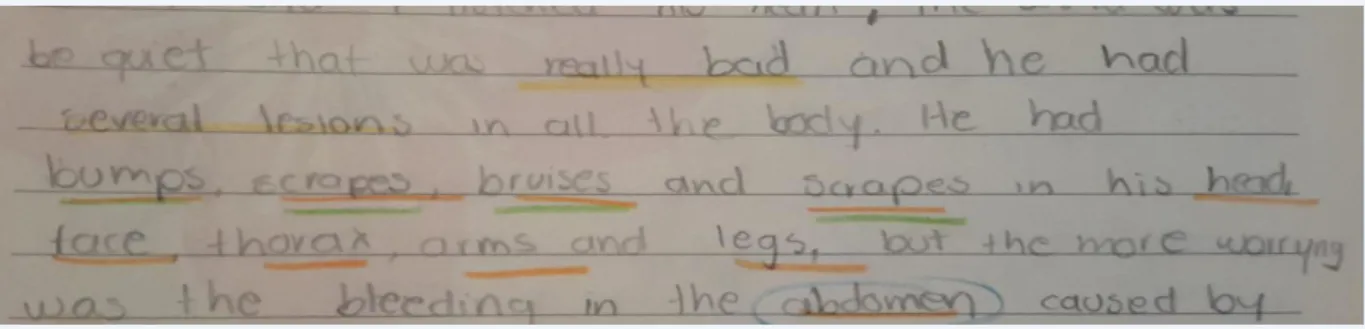
(37) Repetition---------blue. Collocations-------yellow. Synonyms/-------- purple. Hyponymy----------green. Antonyms------- red. Lexical fields ---------orange. 4. 2 Analysis In the following chart, (Figure 1.0) we can observe that two words circled in blue: diagnosis” and “signs” are considered as repetition and were found two times within the same text.. Figure 1.0 At the same time figure 1.0 shows the presence of collocations; For example: Clinical history and made a lot of questions, those words were highlighted in yellow. In figure 2.0 we can observe groups of words classified as hyponyms and lexical fields, therefore they are underlined in orange as well as green. We can see that the words bumps, scrapes, bruises and scratches are hyponyms of lesions and at the same time belong to the same lexical field.. 35.
(38) Figure 2.0 In Figure 3.0 it can be observed that there are some antonyms present within one text. They were identified through red color. As can be seen, the example below shows Lost weight vs. ate well Dehydration vs. ingestion of liquids Increase vs. inhibited. Figure 3.0 Examples of antonyms. 36.
(39) In Figure 4.0 an example of a synonym can be found. It is shown in purple. Synonyms are words that mean the same. In this case the synonym is related to the loss of blood that in other words can be understood as a hemorrhage. By doing the same process with the 24 papers collected from students, it was possible to count the number of incidences in each lexical field. In the following charts the obtained results can be observed. The following chart shows in a more specific view the number of repetitions found in each category; based on this chart a quantitative analysis was made. Genre: Written Story. Number of Ocurrence. 15 papers collected. Repetition/Reiteration. 56. Synonyms/ Near Synonym.. 17. Antonyms. 7. Hyponymy. 15. Collocations. 44. Lexical Fields. Each paper was taken as one lexical field since most nouns, verbs and expressions were related to the field of medicine.. 37.
(40) As it can be observed, the two categories that have the most usage in student’s papers are repetition/reiteration with 56 occurrences and collocations with 44 occurrences. In the case of lexical fields each text was considered as one lexical field as they belonged to the field of medicine. The rest of the categories show a low use. Nonetheless, they are still present in the student’s papers. The following graphic shows in a more visual form the obtained results.. Categories. Reiteration Synonyms /near Antonyms Hyponyms Collocations Lexical fields. Figure 5.0 In figure 5.0 we show with the different colors from the previous classification, the number of occurrences in each category. The category that obtained the fewer incidences is antonyms with only 7 and hyponyms with 15.. 38.
(41) With these results it can be seen that the selection of lexical phrases rely on the area of study as well as the appropriate context. It is interesting to note that some categories can overlap into two or more categories that is the case of some hyponyms that also fall into the category of near synonyms. Here is an example: In figure 2.0 it can be observed that the words underlined are: bumps, scrapes, bruises, scratches, those belong to the category of lesions, and therefore, they would be considered hyponyms of such word. However, they could also be considered as near synonyms regarding the context in which they are used.. Lesions. Bumps. Scrapes. Bruise s. Scratches. Near synonyms: The patient had: bumps = scrapes = bruises = scratches The results here show as mentioned before, that among the lexical cohesive ties – reiteration and collocation (Halliday & Hasan, 1976) were the most used, this can be perceived from the number of times that these items are present. This type of cohesion is regarded by Halliday and Hasan as the “cohesive effect achieved by the selection of vocabulary” (p.274).. 39.
(42) Synonyms and hyponyms were the second most used in the texts. According to Mojica, M. (2006), studies show that among the lexical cohesive ties, reiteration and collocation. (Halliday. &. Hasan,. 1976),. or. repetition,. synonyms,. antonyms,. superordinate/hyponyms, text-structuring words, the most heavily used is repetition as was the case in the present study. In one of her studies like the one found in Castro (2004), was found that students were able to relate their ideas more conveniently through these lexical cohesive devices. The same observation is evident in DuterteAngeles’ (2005) and Mojica’s (2006) studies – students seem to have used this device with ease. This interesting finding seems to indicate the need to further investigate students’ attempts to achieve lexical cohesion in their papers. As stated by Mirzapour, F. & Ahmadi, M. (2011), lexical cohesion comes about through the use of items that are related in some way to those that had gone before. In short, lexical cohesion occurs when two words in a text are related in terms of their meaning. Reiteration and collocation are the two major types of lexical cohesion; not surprisingly those two types of lexical cohesion were the ones mostly found in the results of this research. In the case of repetitions in some cases in order for them to be considered as repeated they need not to be in the same morphological shape however, in the texts analyzed in this study repetitions tended to be mostly found in the same form, in other words, participants used the very same word over and over to refer to the same person or item. In the second part of this study a series of medical case studies were analyzed. Participants were asked to read a medical case and based on their medical knowledge provide a possible solution for the illness. 40.
(43) The following chart shows the obtained results.. Genre: Medical Case Study. Number of Incidences. Repetition/ Reiteration. 59. Synonyms /Near. 18. Antonyms. 9. Hyponymy. 13. Collocations. 67. Lexical Fields. 15. As shown in the chart it can be observed that the three categories with the most occurrences were repetition, synonyms and collocations. Being collocations the one that has the most incidences. In the following excerpts we can observe some examples of all the categories presented in the collected data.. 41.
(44) Figure 6.0 In this example the presence of collocations and hyponyms is seen. In the first part clinic history and personal activities are found as collocations. Then a list of words related to this topic is observed. They can be recognized as lexical fields as well as hyponyms.. Personal information. Name. Age. Address. Phone number. As mentioned in the previous analysis, in many cases the categories overlap and several categories can be found within the same words. Another example is the one found in the following excerpt where antonyms (underlined in red) were used.. 42.
(45) Figure 7.0 Antonymy (lexical opposition) has traditionally been classified as a paradigmatic relation between words. That is, antonym pairs form a contrastive paradigm within a semantic field, such that in contexts in which one member of the pair can occur, so could (with different truth conditions) the other member of the pair. (Murphy, 2010). Antonyms was not a very used device within the analyzed texts; however, its presence shows that many of the participants understand the use of it as a resource to cohesiveness.. Figure 8.0 In the previous excerpt, an antonym can be shown as well as hyponyms of the word food such as: chocolate, avocado, egg and yogurt. This confirms the overlapping of different categories within the same text.. In the following graphic results can be seen in a more detailed form.. 43.
(46) Categories. Reiteration Synonyms/Near Antonyms Hyponyms Collocations Lexical Fields. Figure 9.0 In figure 9.0 it can be observed that reiteration and collocations were the categories with the most percentage among the other categories. From the obtained results it can be said that students have a tendency to use these types of lexical cohesion. So then, it can be concluded that in terms of sub-types of lexical cohesion in the 30 analyzed papers the order of occurrence is: . Reiteration with a total of 115 occurrences. . Collocations with a total of 111 occurrences. . Synonyms with a total of 35 occurrences. . Lexical fields with a total of 30 occurrences. . Hyponyms with a total of 28 occurrences. . Antonyms with a total of 16 occurrences. In both data the most frequent sub-types are repetition, collocation, and synonymy. In addition, it can be noticed that the general inclining is towards the use of repetition and 44.
(47) collocation. According to Halliday and Hasan (1976, p.278–282), the simplest form of lexical cohesion operates with repetition, either simple string repetition or repetition by means of inflectional and derivational variants of the word contracting a cohesive tie. This study, then, confirms these scholars’ views. The more complex types of lexical cohesion work on the basis of the semantic relationships between words in terms of sense relations, such as synonymy, hyponymy, antonymy and metonymy.. 45.
(48) Chapter 5: Conclusion 5.0 Introduction A set of data was analyzed in terms of sub-types of lexical cohesion and then the results were presented in graphics. From the information drawn from the previous analysis it was demonstrated that the majority of students have a predilection to use certain categories such as repetition and collocation. This propensity cannot necessarily be attached to the fact that students have certain preferences to the use any of them, instead to the fact that many of the students do not know how to apply However, the present study shows that even when students do not necessarily receive input from lexical cohesion to write their papers, they are aware of certain devices that make their text coherent.. 5.1 Overlapping The previous study sheds light in the analysis of cohesion in ESP written texts. First, we can observe that as some scholars suggest, the strategy of using repetition is the most common in the small corpus analyzed. It can also be observed that there are certain categories that overlap and are found in different parts of the text. This situation shows how words are always related and form meaning within language. In the same impression in figure 6.0 we can see how within the same paragraph two categories can be found. Hyponyms and collocations, however, the majority of overlapping found was within lexical fields since a whole text can be considered one lexical field that 46.
(49) makes a coherent whole. Therefore within the whole text many other categories were found.. 5.2 Implications in ESP writing From this study I can draw the conclusion that lexical cohesion is a very important aspect when teaching not just writing but reading as well. Ahmadi and Mirzapour (2011), express that good readers are usually good writers. In addition, it can be accounted that cohesion in texts creates one kind of texture through the ties that coordinate ideas and experiences. Tahseen Hameed (2008). It is important to bear in mind that in order for students to know how to write more than just isolated sentences they must be aware of the different devices and words they can use to generate cohesive texts and paragraphs not just simple sentences. This idea is supported by Mirzapour, F. and Ahmadi, M. (2011), who claim that many students who have graduated from high school cannot write a coherent paragraph, even though they can write correct sentences in isolation. . The issue that students cannot communicate via written language can be explained by the assumption that sentence elements which create cohesion have not been taught. As a result, the present study also showed that these medical students at this level are somehow aware of lexical cohesion and made used of the different strategies in a correct form. The small corpus that was taken into account for this research suggests a positive relationship between the effective use of lexical cohesion devices (usually delimited in terms of Halliday and Hasan's 1976 model) and the coherence or writing quality of a text of student writing even though the majority of devices used where the simples ones according 47.
(50) to Halliday. Nonetheless, students achieve the purpose of communicating the message in medical terms.. 5.3 Limitations Due to the limited amount of data, it is hard to determine whether or not a correlation between the coherence of the texts and their English level could be established. This does not allow for generalizations which could claim that all students in the medical area have a tendency to use reiteration and collocations in a major scale. Further research would need to be done so that a more generalizable result could be obtained.. 5.4 Directions for further research: The development of this research can provide teachers, with a broader view of the great need to teach cohesion within texts both in writing as well as in reading. Further development in this area can be done so that new findings and therefore techniques could be applied for the development of a more precise and correct lexis in student’s texts. Some studies have used computational techniques to study the contribution of lexis to textual organization. Francis (cited in Stubbs, M. 2002) uses large corpora to identify the nominal groups which are typically used to encapsulate and often evaluate discourse topics and which often use common collocations. Therefore, the use of larger corpora would be advisable in order for deeper results to be obtained. Another study is the one of Phillips (1985), who uses automatic methods of lexical analysis to study the distribution of lexis in science textbooks and how words therefore contribute to cohesion within chapters. As a 48.
(51) result I could conclude that many more detailed instruments could be applied to a larger amount of data resulting in a more detailed and specific results that could continue the development of this research as well as the enhancement of cohesion in student’s writing.. 49.
(52) REFFERENCES Bathia, V. (2004) Worlds of Written Discourse. New York: Continuum Bloor, T.& Bloor, M. (1995) The Functional Analysis of English. London: Arnold Brown,G.& Yule, G. (1983) Discourse analysis. Cambrdige: Cambridge University Press Coulthard, M. (1985) An introduction to discourse analysis. London: Longman Cruse,D. (1986) Lexical semantics. Cambridge: Cambridge University Press Davies, P.& Fraenkel, A. (2003) The Language in English Teaching. London: Richmond Publishing. Davies, A. and Elder, C. (2004) The Handbook of Applied Linguistics.UK: Blackwell Publishing Ltd. Eggins, S. (1994) An Introduction to Systemic Functional Linguistics. London: Pinter Halliday, M.A.K. & Hasan, R. (1976) Cohesion in English. London: Longman. Halliday, M.A.K.(1994). An Introduction to Functional Grammar. London: Edward Arnold Harmer, J. (2008) The practice of English language teaching. London: Longman Homstad, T. & Thorson, H. (1996) Using write-to learn activities in the foreign language classroom. Technical Report Series, 14, The center of interdisciplinary Studies of Writing Lackman, K. (2011) Teaching collocations activities for vocabulary building. Ken Publishers. 50.
(53) Lackman & Associates retrived from : http://www.kenlackman.com/files/Collocations11sample.pdf Lewis, M. (1993) The Lexical Approach. London: Colour Press Manchon, R. M. (2009) Foreing Language Writing, Learning, Teaching and Research. Bristol: Multilingual Matters. Martin, J.R. & Rose, D. (2003) Working with Discourse: meaning beyond the clause. London, New York: Continuum Mirzapour, F. & Ahmadi, M. (2011) Study on lexical cohesion in English and Persian research articles (a comparative study) Islamic Azad University Retrieved from: http://dx.doi.org/10.5539/elt.v4n4p245 Mojica, L. (2006) Reiterations in ESL learners’ academic papers: do they contribute to lexical. cohesiveness?. De. la. Salle. University-Manila. Retrieved. from:. http://www.dlsu.edu.ph/research/journals/taper/pdf/200612/MOJICA.pdf Murphy, M.L. (2010) Antonyms as Lexical Constructions: or, why paradigmatic constructions is not an oxymoron at: www.construction-online.de/articles/speevolI (accesed November 2015). Nattinger, J. & Decarrico, J. (1992) Lexical Phrases and Language Teaching. Oxford: Oxford University Press Nikander, P. (2006) Constructionism and discourse analysis.. Finland: Handbook of. Constructionist Research. 51.
(54) Schiffrin D.,Tannen D., & Hamilton, H. (2001) The handbook of discourse Analysis. USA: Blackwell Publishing. Stubbs, M. (2002) Words and Phrases Corpus Studies of Lexical Semantics. Australia: Blackwell Publishing Tahseen Hameed, H. (2008) Cohesion in Texts: A Discourse Analysis of a News Article in a Magazine. Irak: Diyala University. Tucker, G. (2008) Systemic functional linguistics in language education. Retrieved from: http://www.llas.ac.uk/resources/gpg/103 Yule, G. (2010) The study of Language (4th). Cambridge. Cambridge University Press. Van Tonder, S. (1999) Lexical cohesion in student academic writing. Unpublished MA. 52.
(55) 53.
(56)
Figure
Documento similar
The aim of this paper is to demonstrate that reading authentic literary material in the English as a Foreign Language (EFL) classroom can improve students’ language learning skills as
With respect to the alternative solution of replacing the English lexical item with a restatement of the idea in Papiamentu, the questionnaire responses show that in the
In order to study a different metabolic disorder in which homocysteine has a relevant role and to gain better insights into its pathophysiology, the purpose of this study has been
In this context, the purpose of the present study is to analyze social, demographic, and economic correlates of mental health during the COVID-19 pandemic in the population residing
Most provincial and territorial governments were also able to provide basic demographic information on persons receiving medical assistance in dying, the settings in which
The purpose of this research is to analyze the features of English as a Lingua Franca (ELF) interactions in travel blogs and explore some strategies used by participants in blog
• While undergraduate students in Saudi universities are expected to have desired English language skills in order to further advance in their specialized areas of study, writing
We obtained a corpus to contrast the terms used in the articles written in English and in the articles written in Spanish in order to study what types of translations are made
