Clinical practice outcomes and
differential results in maternal and
neonatal morbidity among pregnant
women in Spain who are candidates for
a normal birth: a cross-sectional study
Ana Casteleiro,1 M Santibanez,2,3,4 Paula Paras-Bravo,3,4 Amada Pellico-Lopez,3 María Paz-Zulueta3,5To cite: Casteleiro A, Santibanez M, Paras-Bravo P, et al. Clinical practice outcomes and differential results in maternal and neonatal morbidity among pregnant women in Spain who are candidates for a normal birth: a cross-sectional study. BMJ Open 2019;9:e026899. doi:10.1136/ bmjopen-2018-026899 ►Prepublication history and additional material for this paper are available online. To view these files, please visit the journal online (http:// dx. doi. org/ 10. 1136/ bmjopen- 2018- 026899).
Received 26 September 2018 Revised 22 March 2019 Accepted 30 July 2019
For numbered affiliations see end of article.
Correspondence to
Dr M Santibanez; santibanezm@ unican. es © Author(s) (or their employer(s)) 2019. Re-use permitted under CC BY-NC. No commercial re-use. See rights and permissions. Published by BMJ.
AbstrACt
Objective To determine the percentage of pregnant
women who are potential candidates for a normal birth in the region of Cantabria, Spain. Also, to compare the main clinical practice outcome indicators and the rates of maternal and neonatal morbidity among the group of candidate women versus non-candidates.
Design A cross-sectional study.
setting A tertiary Hospital in Cantabria (Northern region
of Spain).
Participants The study population comprised the total
number of hospital births that took place between 1 January 2014 and 31 December 2014 (n=3315).
results Secondary registers were accessed to review
the main indicators of care and the outcome of births. The χ2 test or the Student’s t-test were used to compare
both groups for the categorical and continuous variables, respectively. In total, 1863 births (56.20%) were candidates for applying the strategy of care for a normal birth. In 50.86% of these candidate births, an episiotomy was performed, compared with 60.96% in the group of non-candidates (p<0.001). Regarding caesarean sections, these were carried out in 19.32% of the candidate births, compared with 26.79% of non-candidate births (p<0.001). Furthermore, there were statistically significant differences between the groups according to the type of birth, the need for instrumental birthing methods, the existence of perineal tears, Apgar scores and the requirement for the infant to be admitted to the neonatal intensive care unit.
Conclusions Our results suggest a differential clinical
practice, in line with the recommendations of the Clinical Practice Guidelines for Care of Normal Birth. Nonetheless, improvements are necessary regarding the care provided to women and infants, as the percentages of episiotomies and caesarean sections are still high when compared with current standards and compared with other reports.
IntrODuCtIOn
With the aim of reducing maternal and neonatal morbidity at the time of birth, numerous international organisations, such as the WHO1 and the National Institute for
Health and Care Excellence (NICE),2
recom-mend providing more humane care during the birth process, respecting the physiology of the same while ensuring the autonomy of mothers.
The recommendations for reducing maternal and neonatal morbidity include reducing the number of instrumental births, as these can cause injuries to the neonate, plus result in a greater number of third or fourth degree tears in the mother.3–5
Further-more, the aim is to reduce the percentage of caesarean sections in healthy mothers, as this has proven to reduce maternal and neonatal mortality. Ideally, caesarean section rates of <10% are considered optimal, after which an increase in the rate of caesarean sections is not related to a decrease in the mortality rate.6 7 Systematic episiotomies are also not
recommended, as the risk–benefit ratio compared with a first or second degree tear is negative, that is, an episiotomy is considered
strengths and limitations of this study
► The total number of hospital births attended over the duration of 1 year were classified according to whether the pregnant mothers may be potential candidates for a normal birth.
► Most of the clinical practice indicators showed statistically significant differences according to whether the pregnant mother was considered to be a candidate for a normal birth, suggesting a differ-ential clinical practice, in line with the recommen-dations of the Clinical Practice Guideline of Care for Normal Births.
► In retrospective studies based on secondary infor-mation (registers), one of the main limitations could be the poor quality of information provided which, in turn, could lead to possible information bias.
on August 20, 2019 by guest. Protected by copyright.
a more severe perineal traumatism with a greater need for sutures which, in turn, is associated with greater prob-lems for scarring.8 The criteria currently in place for
the practice of episiotomies are based on the existence of a clinical need, such as an instrumental delivery or suspected fetal involvement. An episiotomy should not be performed routinely during vaginal delivery in women with third or fourth degree tears in previous births.9
Concerning the type of birth, the recommendations are for an active birth, via the administration of oxytocics, as this has demonstrated to reduce early postpartum haem-orrhage.10 11
In countries such as the UK, the initiatives for achieving a more humane birth include providing midwives with more responsibility in the process of normal, minimally intervened births.12 The NICE guidelines state that
preg-nant, low-risk women who are cared for at units led by midwives have a lower risk of suffering an instrumental birth or a caesarean section, require less use of epidural analgesia and have a lower risk of receiving an episiotomy.
In consideration of the same, in 2007, the Spanish Ministry of Health published the ‘Strategy for the Care of Normal Births in the National Health System’.13
There-after, in 2010, the ‘Clinical Practice Guidelines on Care of the Normal Birth’ (CPGCNB) was published14 to support
the strategy for providing care for normal births within the Spanish national health system.
The Spanish Society of Gynaecology and Obstetrics15
and the Spanish Federation of Associations of Midwives16
support this line of care for the humanisation of birth, having published their own consensus documents.15 16
These comprise recommendations that are similar to those of the CPGCNB.13 14
The aim of our study was to research the total number of births attended over a 1 year period at a tertiary hospital in northern Spain and to determine the percentage of preg-nant mothers who are potential candidates for a normal birth. Furthermore, we sought to compare the main care and outcome indicators according to the recommenda-tions of the CPGCNB and the international guidelines for pregnant women who are candidates for a normal birth versus non-candidates.14
MAterIAls AnD MethODs
A cross-sectional study was performed. The study popu-lation were the total number of hospital births attended at the University Hospital from 1 January 2014 to 31 December 2014 (n=3315).
As it is recommended in the current national guide-lines, in our hospital each woman is attended by one midwife.13 14 At the time a pregnant woman enters
hospital, and is assessed by the midwife, the term ‘candi-date for a normal birth’ is defined as a pregnant woman without pathologies during pregnancy (maternal, amni-otic liquid or fetal), with regular and adequate prenatal care, carrying a single, live fetus, with spontaneous onset of birth, and at term.13–15 This implies a low intervention
protocol, as the pregnancy can also be classified as a low-risk pregnancy according to national and interna-tional guidelines.1 2 13 The term ‘normal birth’ is defined
as a euthocic delivery, cephalic, no instrumental, this is, without requiring any additional intervention during the birth.
The objective of the current national guidelines13 14 are
‘to contribute to the transformation of the model of birth care in our health system in such a way as to offer more effective, safe and personalised care’, so that childbirth may, once again, be considered a physiological process rather than a medical–surgical procedure. The strategy for normal birth includes recommendations for the three stages of labour, as detailed below.
The recommendation for the first stage of labour aims to encourage normal labour and reduce the number of caesarean sections by establishing the time margin that must be taken into account for performing a caesarean section via stopping the dilation. This guideline estab-lishes that, once stimulation with oxytocin has been intro-duced, a margin of 4 hours with a dilation progress of <2 cm is necessary for the performance of a caesarean section.
With regards the second stage of labour or period of expulsion, the guideline establishes the time limits considered normal for parturition according to parity and the use of an epidural analgesia, in an attempt to favour normal (eutocic) deliveries and reduce instru-mental deliveries. The guideline establishes the following time margins for passive and active expulsion:
1. Passive second stage: presence of complete dilation in the absence of involuntary expulsive contractions. Currently, the guidelines indicate that the normal duration of the same in nulliparous women with, or without, an epidural is 2 hours. The normal duration in multiparous women is 1 hour without an epidural and 2 hours with an epidural.
2. Active second stage: when the fetus is visible or there are expulsive contractions or the mother is bearing down. Currently, the normal duration of this stage in nulliparous women is considered to be 1 hour without an epidural anaesthesia and up to 2 hours if an epidur-al has been administered. The normepidur-al duration in mul-tiparous women is 1 hour with, or without, an epidural. Another recommendation included in the Spanish guidelines regarding the period of expulsion is to perform episiotomies selectively, only when there is ‘clin-ical need’, such as an instrumental delivery or suspected fetal involvement.
Regarding the third stage of labour, the guideline recommends active management. Active management of the third stage of labour comprises three manoeu-vres: administration of oxytocin IV, early clamping of the umbilical cord and controlled cord traction. Active management has been associated with a reduction in early postpartum haemorrhage.
The information regarding each birth was gathered by accessing and reviewing the birth records of the Hospital
on August 20, 2019 by guest. Protected by copyright.
Universitario Marques de Valdecilla (HUMV). The infor-mation was collated or completed (if data were lacking from the register) and data were compiled using the Qlikview software programme.
Patient and public involvement
Since the information was collected from hospital records anonymously, neither patients nor the public were involved in this study.
Variables
For the purpose of classifying the 3315 hospital births into those who were candidates for the application of the CPGCNB and those who were non-candidates, the following variables were gathered: gestational age, preg-nancy check-ups, multiple births, maternal or fetal disease during pregnancy (hypertension during pregnancy, gestational diabetes, coagulation disorders, intrauterine growth restriction and oligohydramnios), serious compli-cations during birth (umbilical cord prolapse, shoulder dystocia, previous placental abruption of normally inserted placenta and so on), the manner in which labour started (induced or spontaneous) and the vital status of the fetus. The study protocol specified that if at any time during the three stages of labour, any complication took place, the mother should no longer be treated using a low-intervention protocol, but rather she should receive the high-risk care required.
With the objective of evaluating the care of the normal birth, the following variables were collected: episiotomy, type of management during the third stage of labour, instrumental births and caesarean sections. These vari-ables were gathered as indicators of quality of clinical practice in the strategy of care for a normal birth.13
To evaluate the result of the care of the normal birth, we gathered the following variables related with maternal morbidity: perineal tears, as these are one of the most frequent complications of a vaginal birth17 and early
post-partum haemorrhage (in mL), as one of the most severe postpartum complications and the first cause of maternal morbidity in Spain.18 The variables related with neonatal
morbidity were: the Apgar score at 1 and 5 min after birth, as this is a test that assesses the neonatal status at birth, where a low score correlates with subsequent neonatal consequences19; the pH of the umbilical artery at birth, as
this is the best way of knowing the acid–base status of the infant at birth20 21; and admission to the neonatal
inten-sive care unit (NICU), as birth care outcome indicators. According to the American Academy of Pediatrics, to consider that neonatal asphyxia has occurred, and thus, damage to the infant, a metabolic acidosis is needed with umbilical cord arterial pH <7.0 and an Apgar score ≤3 at 5 min.22
statistical analysis
The data analysis incorporated an initial descriptive anal-ysis. For the categorical and discrete variables, we esti-mated proportions with their corresponding 95% CI,
according to the Wilson method, using the χ2 Pearson’s
test for comparisons or, alternatively, using the Fisher’s exact test when >20% of the fields presented a number of expected cases ≤5. For the continuous variables, we estimated the mean and the SD, or the median and IQR in the case of asymmetric distributions. The Kolmogor-ov-Smirnov test was used to determine the normality of the distribution. Comparisons for continuous variables were performed by using the Student’s t-test or the Mann-Whitney U test when appropriate.
The alpha error was set at 0.05 and all the p values were two-sided. All the statistical analyses were performed using the SPSS V.22.0 package by IBM and Stata V.13.0. ethical considerations
The data were anonymised and treated confidentially in compliance with the Spanish Organic Law 15/13 December 1999, pursuant to the protection of personal data. Confidentiality of the information was maintained according to the Law 41/14 November 2002 and the Law of Cantabria 7/10 December 2002, of Healthcare Stan-dards of Cantabria.
results
Of the total number of births (n=3315) registered in our sample, 1863 births (56.2%) took place in pregnant women who met the criteria for a normal birth strategy (candidates for a normal birth). See online supplemen-tary figure S1.
The mean age of the women in our sample was 32.52. The majority were European (89.57%) and the second most common origin was from Latin America (7.04%). In total, 55.13% of the pregnant women in the candidate group were primiparous compared with 72.11% of the non-candidate group.
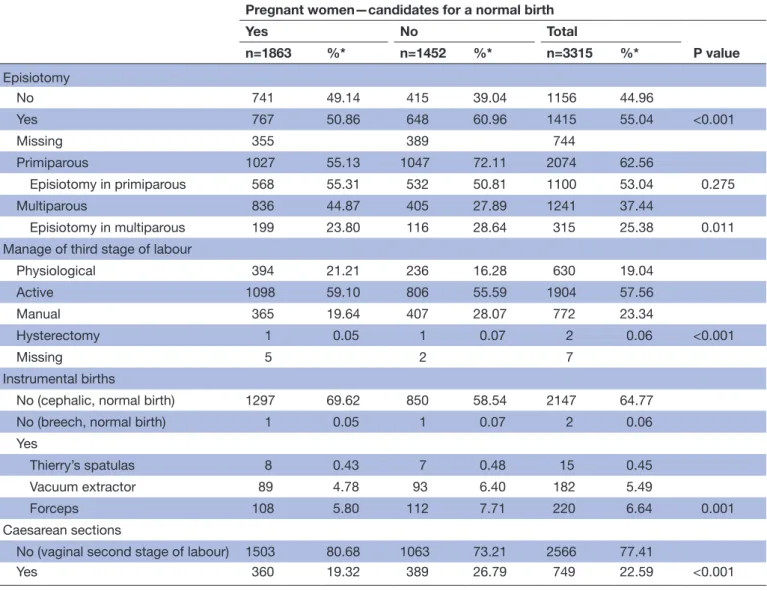
In 50.86% of the candidate births, women received an episiotomy, and in the group of non-candidates, this took place in 60.96% of the sample (p<0.001). Both groups were classified into either primiparous or multiparous women, observing that in 55.31% of primiparous candi-date women, an episiotomy was performed, compared with 50.81% of non-candidate primiparous women (p=0.275). In the case of multiparous women, 23.80% of the group of candidate births received an episiotomy, compared with 28.64% of the non-candidates (p=0.011).
Active management of the third stage of labour took place in 59.10% of the candidate births, compared with 55.59% of the non-candidate births. Among the group of candidates, physiological management of the third stage of labour was registered in 21.21% of the cases, whereas manual management of the third stage of labour was registered in 19.64% of the cases. In the group of non-can-didates, physiological management of the third stage of labour took place in 16.28% of cases whereas manual management of the third stage of labour was reported in 28.07% of the cases (p<0.001).
on August 20, 2019 by guest. Protected by copyright.
Table 1 Clinical practice indicators used in the strategy of care for normal births, according to whether the mother was a candidate for a normal birth
Pregnant women—candidates for a normal birth
Yes No Total P value n=1863 %* n=1452 %* n=3315 %* Episiotomy No 741 49.14 415 39.04 1156 44.96 Yes 767 50.86 648 60.96 1415 55.04 <0.001 Missing 355 389 744 Primiparous 1027 55.13 1047 72.11 2074 62.56 Episiotomy in primiparous 568 55.31 532 50.81 1100 53.04 0.275 Multiparous 836 44.87 405 27.89 1241 37.44 Episiotomy in multiparous 199 23.80 116 28.64 315 25.38 0.011 Manage of third stage of labour
Physiological 394 21.21 236 16.28 630 19.04 Active 1098 59.10 806 55.59 1904 57.56 Manual 365 19.64 407 28.07 772 23.34 Hysterectomy 1 0.05 1 0.07 2 0.06 <0.001 Missing 5 2 7 Instrumental births
No (cephalic, normal birth) 1297 69.62 850 58.54 2147 64.77
No (breech, normal birth) 1 0.05 1 0.07 2 0.06
Yes
Thierry’s spatulas 8 0.43 7 0.48 15 0.45
Vacuum extractor 89 4.78 93 6.40 182 5.49
Forceps 108 5.80 112 7.71 220 6.64 0.001
Caesarean sections
No (vaginal second stage of labour) 1503 80.68 1063 73.21 2566 77.41
Yes 360 19.32 389 26.79 749 22.59 <0.001
*Valid percentage (without considering the missing or unknown data).
In total, 69.62% of the births among the group of candidates were normal births as the term is defined in the methodology (cephalic, euthocic, without requiring any additional intervention), compared with 58.54% in the case of the group of non-candidates. In the group of candidate births, the forceps were used in 5.80% of the cases, a vacuum extractor was used in 4.78% of births, and Thierry’s spatulas were used in 0.43% of cases. In the case of non-candidate births, the forceps were used in 7.71% of the cases, a vacuum extractor was used in 6.40% and Thierry’s spatulas were used in 0.48% of the cases, p=0.001. Caesarean sections were performed in 19.32% of the candidate births, compared with 26.79% of the group of non-candidate births (p<0.001). See table 1.
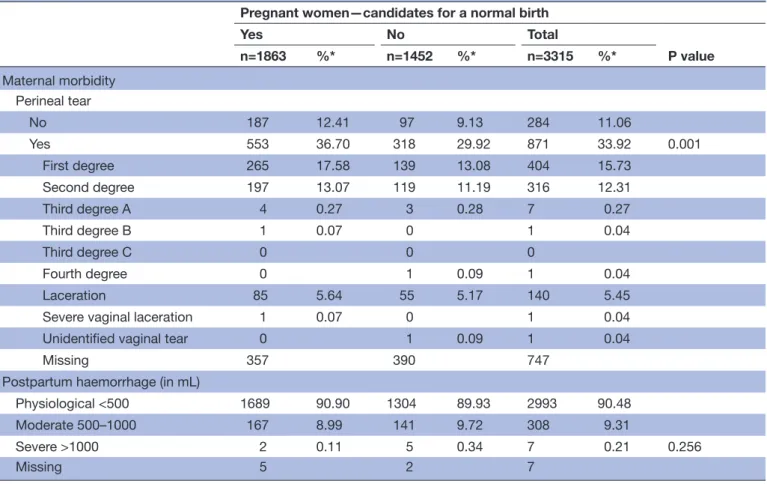
Regarding maternal morbidity, 36.70% in the candi-date group and 29.92% of the non-candicandi-date group had perineal tears (p<0.001). Regarding the severity of peri-neal tears among the candidate group: 5.64% had vaginal lacerations, 17.58% had a first degree tear, 13.07% had a second degree tear, 0.27% had a third degree grade A
grade, and in one case, there was a third degree grade B tear, and also there was one case of severe vaginal lacer-ation. Among the group of non-candidates: 5.17% had vaginal lacerations, 13.08% had a first degree tear, 11.19% had a second degree tear, 0.28% had a third degree grade A tear and there was one case of a fourth degree tear. See
table 2.
Additionally, the prevalence of maternal haemorrhages was studied, with non-significant findings (p=0.256). Within the group of candidate women, 90.90% of the haemorrhages were physiological (<500 mL), in 8.99% this was moderate (between 500 and 1000 mL) and in 0.11% the bleeding was severe (>1000 mL). In the group of non-candidates, 89.93% experienced physiological haemorrhages, 9.72% suffered moderate haemorrhages and in 0.34% of the women the haemorrhages were clas-sified as severe. See table 2.
Regarding neonatal morbidity, significant differences were found for the Apgar score 1 and 5 min after birth among the group of candidate births, who obtained a
on August 20, 2019 by guest. Protected by copyright.
Table 2 Outcome indicators of maternal morbidity after implementing the strategy of care for a normal birth, according to whether the pregnant mother was a candidate for a normal birth
Pregnant women—candidates for a normal birth
Yes No Total P value n=1863 %* n=1452 %* n=3315 %* Maternal morbidity Perineal tear No 187 12.41 97 9.13 284 11.06 Yes 553 36.70 318 29.92 871 33.92 0.001 First degree 265 17.58 139 13.08 404 15.73 Second degree 197 13.07 119 11.19 316 12.31 Third degree A 4 0.27 3 0.28 7 0.27 Third degree B 1 0.07 0 1 0.04 Third degree C 0 0 0 Fourth degree 0 1 0.09 1 0.04 Laceration 85 5.64 55 5.17 140 5.45
Severe vaginal laceration 1 0.07 0 1 0.04
Unidentified vaginal tear 0 1 0.09 1 0.04
Missing 357 390 747
Postpartum haemorrhage (in mL)
Physiological <500 1689 90.90 1304 89.93 2993 90.48
Moderate 500–1000 167 8.99 141 9.72 308 9.31
Severe >1000 2 0.11 5 0.34 7 0.21 0.256
Missing 5 2 7
*Valid percentage (without considering the missing or unknown data).
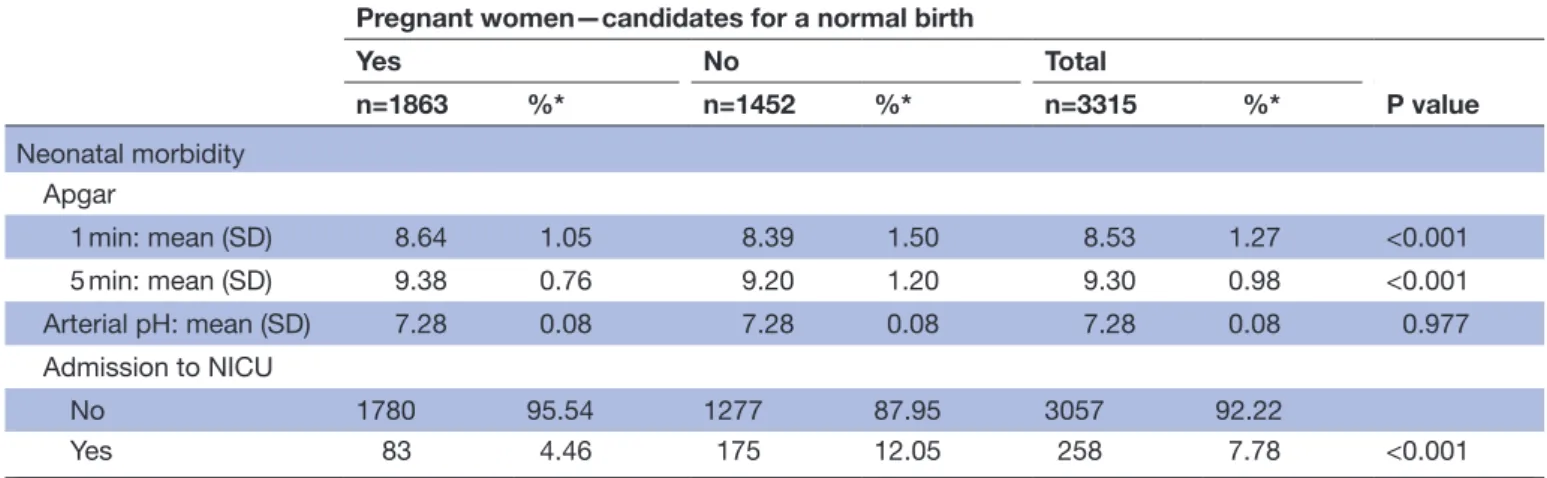
mean of 8.64 (SD 1.05) and of 9.38 (SD 0.76), respec-tively, and the group of non-candidates, who obtained a mean of 8.39 (SD 1.50) at 1 min and 9.20 (SD 1.20) at 5 min (p<0.001).
Significant differences were found in the rates of admission to a NICU according to whether the mothers belonged to the group of candidates, in which 4.46% of the neonates were transferred, or the group of non-can-didates where 12.05% of neonates were transferred to the NICU (p<0.001).
Regarding the pH of the umbilical artery, no significant differences were observed, registering the same mean in both groups, that is, 7.28 (SD 0.08), p=0.977. See table 3.
Concerning the professional attending the birth, 52% of the deliveries was attended by midwives among women candidates for a normal birth (low-risk pregnancies). See
table 4. As it is showed in table 5, even though the women were considered candidates for a normal birth, and the deliveries were finally euthocic and cephalic without any additional intervention, this percentage increased only to 74.17%.
DIsCussIOn
A large percentage of pregnant mothers (almost 44%) were not susceptible to being cared for following the
strategy of care for a normal birth. The number of induced deliveries in these births is noteworthy, representing 25.07% of the total. These rates are higher than those observed in the USA where a previous study reported 22.3% of induced births,23 or the UK, with reported rates
of 19.8%.24 Another study in which eight Latin-American
countries were included, registered 11.4% of induced births,25 which is a percentage that is lower than that
obtained in our study. The indicators of quality of care showed statistically significant differences according to whether or not the pregnant woman was considered to be a candidate for a normal birth, suggesting a differen-tial clinical practice according to the recommendations of the CPGCNB. The results of maternal and neonatal morbidity were likewise more favourable, with the excep-tion of the arterial pH scores, where the average values were normal in both groups. Regarding the percentages specifically observed in the group of candidate mothers, the results support the fulfilment of the care indica-tors and the outcome indicaindica-tors of the CPGCNB, with the exception of the percentage of episiotomies and caesarean sections.
The CPGCNB urges the implementation of a policy of selective episiotomies. Despite this, the group of pregnant women who were candidates for a normal birth received
on August 20, 2019 by guest. Protected by copyright.
Table 3 Outcome indicators of neonatal morbidity gathered after the implementation of the strategy of care for a normal birth, according to whether the pregnant mother was a candidate for a normal birth
Pregnant women—candidates for a normal birth
Yes No Total P value n=1863 %* n=1452 %* n=3315 %* Neonatal morbidity Apgar 1 min: mean (SD) 8.64 1.05 8.39 1.50 8.53 1.27 <0.001 5 min: mean (SD) 9.38 0.76 9.20 1.20 9.30 0.98 <0.001 Arterial pH: mean (SD) 7.28 0.08 7.28 0.08 7.28 0.08 0.977 Admission to NICU No 1780 95.54 1277 87.95 3057 92.22 Yes 83 4.46 175 12.05 258 7.78 <0.001
*Valid percentage (without considering the missing or unknown data). NICU, neonatal intensive care unit.
Table 4 Professional attending the second stage of labour according to whether the pregnant woman was a candidate for a normal birth (low-risk pregnancy)
Pregnant women—candidates for a normal birth
Yes No Total
P value n=1863 %* n=1452 %* n=3315 %*
Professional attending the birth
Midwife 969 52 516 35.54 1485 44.80
Gynaecologist 894 48 936 64.46 1830 55.20 <0.001
*Valid percentage (without considering the missing or unknown data).
a high percentage of episiotomies: 51% of the study sample. This finding is higher than other reports imple-menting the same policy of selective episiotomies. A study performed in the USA with low-risk mothers reported 24.5% of episiotomies.26 In other studies conducted in Spain in which no distinction is made between women at high or lower risk, varying rates of episiotomies are reported, ranging from 20%,27 8%28 and 33.5%,29 all of which are lower rates to those obtained in our study.
The implementation of a policy of selective episiot-omies, as recommended by the CPGCNB, should not translate into an increased percentage of third and fourth degree tears. In this manner, in our group of potential candidates for a policy of selective episiotomies, 0.34% of third degree tears were registered, and no fourth degree tears. These results are in line with previous studies carried out in Spain such as reports by Sadornil-Vicario et
al29 and Pérez-Valero et al.30 Another study conducted in the USA also reported similar results to our study with a percentage of 0.25% for third and fourth degree tears in low-risk women without routine episiotomy.31 Conversely, in a study conducted in Brazil, percentages of severe tears were higher than those observed in our study, probably because their population did not distinguish between
low-risk and high-risk women.32 Another study based in Finland also found higher percentages compared with our study; however, in this case also, no distinction was made between high-risk and low-risk women.33 These studies show that the percentages of episiotomies can vary greatly depending on the hospital's obstetric protocol, population or country. However, the current interna-tional recommendations are clear about the implemen-tation of a policy of selective episiotomies. Therefore, we believe that it may be interesting to compare the results across different countries in order to assess the degree of implementation of this policy and the impact on maternal or fetal morbidity.
Regarding the type of management of the third stage of labour, in the group of candidates active births were more common (59% of the cases), which is in line with recom-mendations by the WHO and the CPGCNB.34
The implementation of the CPGCNB recommendations should result in a decrease in the percentage of instrumental births and caesarean sections. Our study shows that, among the group of candidates for a normal birth, the percentage of instrumental births was 11%, which is considerably less than the percentage of other Spanish maternities, which is estimated at 15.1%.35 These findings are more similar
on August 20, 2019 by guest. Protected by copyright.
Table 5 Professional attending the second stage of labour of the normal births (euthocic, cephalic deliveries) according to whether the pregnant woman was a candidate for a normal birth (low-risk pregnancy)
Pregnant women—candidates for a normal birth
Yes No Total
P value n=1297 %* n=850 %* n=2147 %*
Professional attending the birth
Midwife 962 74.17 516 60.24 1485 68.65
Gynaecologist 335 25.83 935 39.76 1829 31.35 <0.001
*Valid percentage (without considering the missing or unknown data).
to data from England, where, between 2013 and 2014, the percentage of instrumental births was reported to be 12.9%.36
Regarding the percentage of caesarean sections, in the group of candidates 19% underwent caesarean sections. This percentage is higher than the international recom-mendations, as the WHO recommends not surpassing 10% of caesareans in women considered to be at low-risk.6 7 On
the national level, our results are closer to those of other Spanish maternities, where percentages of 22.2% and 23.8% of caesareans are registered.35 37 Likewise, a study performed
in Italy with data from 2013 found a percentage of caesarean births of 28.3%, which is a higher rate to that obtained in our study.38 In contrast, a study performed in the
Nether-lands found an increase in the percentage of caesareans in women of low-risk attended by midwifes, of up to 8.3% in primiparous women and 1.1% in multiparous women, which are percentages that are well below those registered in our study and below the limit recommended by the WHO.39
It is important to note that, since 1985, health professionals worldwide have estimated that the ideal rate of caesarean section should be between 10% and 15%, therefore, these data should be considered with caution, as a caesarean section with an appropriate indication can potentially save the life of the fetus and/or the pregnant woman.
Following the recommendation that normal births should be attended by midwives, this study shows that 74% of these births are being attended by midwives. These rates are higher than other studies showing that, in 2006, in tertiary Barce-lona hospitals, only 26.3% of normal births were attended by midwives.40 In contrast, in England, in the period between
2013 and 2014, 88.6% of normal births were attended by midwives, which is a superior rate compared with our findings.36
Our study reveals findings based on relevant health indi-cators. By obtaining such specific data on the percentage of episiotomy and caesarean sections, this study allows us to discuss whether the thresholds established by interna-tional recommendations are reached, that is, whether there is more work to be done in this regard. In this sense, data such as the percentage of caesarean sections or episiotomies could be susceptible to meta-analysis or comparison with other countries. On the other hand, our results support the safety of implementing a less interventionist protocol in low-risk women. We therefore believe that this concrete data
can be compared or meta-analysed. Furthermore, this line of research may be of interest to other colleagues or gener-alisable at least internationally among developed countries. limitations and strengths
In retrospective studies such as the present, where data are based on secondary information (records), one of the main limitations may be the poor quality of the information, which could lead to a possible information bias. To minimise such bias, prior to the onset of the study, we selected the vari-ables which tend to be stated in the medical records more homogenously, systematically and objectively. To minimise a possible selection bias, we decided to include all births in the study.
However, it is important to note that the cases of the placenta accreta spectrum or placenta previa could not be identified homogeneously and systematically in this study, and therefore, this data could not be included in the anal-yses. We were also unable to identify homogeneously and systematically the time margins for passive and active expul-sion; nor the time with dilation progress in relation to the initiation of oxytocin stimulation restricted to women with dilation progress of <2 cm. For these reasons, these data could not be included in the analyses.
Regarding the strengths of this study, the fact that we were able to study all the births occurring during the study period minimises the possibility of a selection bias. The study popu-lation represents 90% of all the births attended in the auton-omous community of Cantabria within the public health system (according to the official data of births for the year 2014) and 73%41 of the births if we were to include the births
attended in the private health sector. This also supports the external validity of our study.
COnClusIOn
In our study, most of the clinical practice indicators showed statistically significant differences according to whether or not the pregnant mother was considered to be a candidate for a normal birth, suggesting a differential clinical prac-tice, in line with the recommendations of the CPGCNB. Nonetheless, the percentages of episiotomies and caesarean sections are still high compared with the standards and with the results of other studies. As expected, the outcome indica-tors on maternal and neonatal morbidity were better in the
on August 20, 2019 by guest. Protected by copyright.
mothers who were considered as being potential candidates for a normal birth.
Author affiliations
1Servicio de Obstetricia y Ginecología, Hospital Universitario de Basurto, Bilbao, Spain
2Global Health Research Group, Universidad de Cantabria, Santander, Spain 3Faculty of Nursing, University of Cantabria, Santander, Spain
4Nursing Research Group, IDIVAL, Santander, Spain 5GRIDES, IDIVAL, Santander, Spain
Acknowledgements The authors would like to thank all the staff of the Obstetrics Service of the Marqués de Valdecilla University Hospital and the Cantabrian Health Service for their support and use of the facilities for the development of this study.
Contributors AC, MP-Z and MS designed, analysed and interpreted the data and were involved in drafting and revising the manuscript for important intellectual content. PP-B and AP-L made a substantial contribution to the analysis and interpretation of data. All authors critically revised drafts of the work and approved the final version of the manuscript.
Funding The authors have not declared a specific grant for this research from any funding agency in the public, commercial or not-for-profit sectors.
Competing interests None declared.
Patient consent for publication Not required.
ethics approval The research protocol was approved by the Clinical Research Ethics Committee of Cantabria in May 2014.
Provenance and peer review Not commissioned; externally peer reviewed.
Data availability statement Data are available upon reasonable request.
Open access This is an open access article distributed in accordance with the Creative Commons Attribution Non Commercial (CC BY-NC 4.0) license, which permits others to distribute, remix, adapt, build upon this work non-commercially, and license their derivative works on different terms, provided the original work is properly cited, appropriate credit is given, any changes made indicated, and the use is non-commercial. See: http:// creativecommons. org/ licenses/ by- nc/ 4. 0/.
reFerenCes
1. World Health Organization, Maternal and Newborn Health/Safe Motherhood Unit. Care in normal birth: a practical guide. Geneva: OMS, 1996. Available: http://www. who. int/ maternal_ child_ adolescent/ documents/ who_ frh_ msm_ 9624/ en/ [Accessed Jan 2018].
2. NICE. Intrapartum care for healthy women and babies. Clinical
Guideline [CG190]. England: NICE, 2014.
3. Johnson JH, Figueroa R, Garry D, et al. Immediate maternal and neonatal effects of forceps and vacuum-assisted deliveries. Obstet
Gynecol 2004;103:513–8.
4. Caughey AB, Sandberg PL, Zlatnik MG, et al. Forceps compared with vacuum: rates of neonatal and maternal morbidity. Obstet
Gynecol 2005;106:908–12.
5. O'Mahony F, Hofmeyr GJ, Menon V. Choice of instruments for assisted vaginal delivery. Cochrane Database Syst Rev 2010;11. 6. World Health Organization, Maternal and Newborn Health/
Safe Motherhood Unit. Who statement on caesarean section rates. Geneva: OMS, 2015. Available: http://www. who. int/ reproductivehealth/ publications/ maternal_ perinatal_ health/ cs- statement/ en/ [Accessed Jan 2018].
7. Ye J, Zhang J, Mikolajczyk R, et al. Association between rates of caesarean section and maternal and neonatal mortality in the 21st century: a worldwide population-based ecological study with longitudinal data. BJOG 2016;123:745–53.
8. Carroli G, Mignini L. Episiotomía para El parto vaginal. Cochrane
Database Syst Rev 2012.
9. World Health Organization, Maternal and Newborn Health/Safe Motherhood Unit. Who recommendation on episiotomy policy. Geneva: OMS, 2018. Available: https:// extranet. who. int/ rhl/ topics/ preconception- pregnancy- childbirth- and- postpartum- care/ care- during- childbirth/ care- during- labour- 2nd- stage/ who- recommendation- episiotomy- policy-0 [Accessed Jan 2019]. 10. Begley CM, Gyte GML, Devane D, et al. Active versus expectant
management for women in the third stage of labour. Cochrane Database Syst Rev 2011;(11).
11. Sheldon WR, Durocher J, Winikoff B, et al. How effective are the components of active management of the third stage of labor? BMC
Pregnancy Childbirth 2013;13.
12. Munro J, Spiby H. Guidelines for midwifery led care in labour. Shef eld: The Central Shef eld University Hospital, 2000.
13. Ministry of Health; Observatory on Women's Health and the National Health System. Strategy of normal birth care in the National health
system. Madrid: Ministry of Healt, 2007.
14. Working group of the Clinical Practice Guideline on Normal Birth Care. Clinical practice guideline on normal birth care. quality plan for
the National health system of the Ministry of health and social policy. health technology assessment agency of PAIs Vasco. (OSTEBA). health technology assessment agency of galicia (Avalia-t. Clinical
Practice Guideline in the NHS, 2010.
15. SEGO. Recommendations on childbirth assistance. Spanish Society of Gynecology and Obstetrics, 2008.
16. FAME. Normal birth initiative. consensus document. Federation of Midwifery Associations of Spain: Barcelona, 2007.
17. Pavón-León P, Durán-González LI. Obstetric complications in a gynecology and obstetrics Hospital. Veracruzana University’s Medical
Journal 2003;3:37–47.
18. De Miguel-Sesmero JR, Muñoz-Cacho P, Muñoz-Solano A, et al. Maternal mortality in Spain in the period 2010-2012: results of the Spanish Society of Gynecology and Obstetrics’ survey. Progress of
Obstetrics and Gynecology 2016;59:342–9.
19. Salvo H, Flores J, Alarcón J, et al. Risk factors for low Apgar test in newborns. Rev Chil Pediatr 2007;78:253–60.
20. Thorp JA, Rushing RS. Umbilical cord blood gas analysis. Obstet
Gynecol Clin North Am 1999;26:695–709.
21. Blickstein I, Green T. Umbilical cord blood gases. Clin Perinatol 2007;34:451–9.
22. Committee on fetus and newborn American Academy of pediatrics, and Committee on obstetric practice, American College of obstetricians and gynecologist. use and abuse of the Apgar score.
Pediatrics 1996;98:141–2.
23. Moleti CA. Trends and controversies in labor induction. MCN Am J
Matern Child Nurs 2009;34:40–7.
24. NICE. Induction of labour. clinical guideline. England: NICE, 2008. 25. Guerra GV, Cecatti JG, Souza JP, et al. Factors and outcomes
associated with the induction of labour in Latin America. BJOG 2009;116:1762–72.
26. Frankman EA, Wang L, Bunker CH, et al. Episiotomy in the United States: has anything changed? Am J Obstet Gynecol 2009;200:573. e1–7.
27. Molina-Reyes C, Huete-Morales MD, Sánchez Pérez JC, et al. Implantation of a selective episiotomy policy in the hospital of Baza. maternal and fetal outcomes. Progresos de Obstetricia y Ginecología 2011;54:101–8.
28. Aceituno-Velasco L, Sánchez-Barroso MT, Huertas-Segura M, et al. Evolution of the episiotomy rate in a community Hospital, between 2003–2009. severe perineal tears risk factors. Clínica e Investigación
en Ginecología y Obstetricia 2013;40:154–61.
29. Sadornil-Vicario ME, Espinilla-Sanz B, González-Nicolás I, et al. Evolution of the rate of episiotomies in the university hospital of Burgos and its relation with perineal and neonatal outcomes.
Matronas Prof 2016;17:39–46.
30. Pérez Valero S. Episiotomy in eutocic vaginal births at the University Hospital "La Ribera". NURE Inv 2013;10.
31. Groutz A, Hasson J, Wengier A, et al. Third- and fourth-degree perineal tears: prevalence and risk factors in the third millennium. Am
J Obstet Gynecol 2011;204:347.e1–4.
32. Oliveira LS, Brito LGO, Quintana SM, et al. Perineal trauma after vaginal delivery in healthy pregnant women. Sao Paulo Med J 2014;132:231–8.
33. Räisänen S, Vehviläinen-Julkunen K, Heinonen S. Need for and consequences of episiotomy in vaginal birth: a critical approach.
Midwifery 2010;26:348–56.
34. World Health Organization. Who recommendations for the prevention
and treatment of postpartum haemorrhage. Geneva, Suiza: WHO,
2012.
35. Salgado-Barreira A, Maceira-Rozas M, López-Ratón M, et al. Variability in delivery in Spain. Analysis of the minimum data set for hospital discharges. Progresos de Obstetricia y Ginecología 2010;53:215–22.
36. Hospital Episode Statistics Analysis, Health and Social Care Information Centre. Hospital episode statistics, NHS maternity
statistics – England, 2013-14. HSCIC, 2015.
37. Redondo A, Sáez M, Oliva P, et al. Variability in the cesarean ratio and indications for the procedure among Spanish hospitals. Gacet
Sanit 2013;27:258–62.
on August 20, 2019 by guest. Protected by copyright.
38. Plevani C, Incerti M, Del Sorbo D, et al. Cesarean delivery rates and obstetric culture – an Italian register-based study. AOGS 2017;96:359–65.
39. Offerhaus PM, de Jonge A, van der Pal-de Bruin KM, et al. Change in primary midwife-led care in the Netherlands in 2000-2008: a descriptive study of caesarean sections and other interventions among 807,437 low risk births. Midwifery 2015;31:648–54.
40. Corchs S, Martínez C, Vela E, et al. Activities and usual practices of midwives in delivery care in public hospitals in the province of Barcelona. Midwives Profession 2006;7:5–11.
41. Statistics National Institute. Bulletin of demographic synthesis Cantabria, 2015. Available: https://www. icane. es/ c/ document_ library/ get_ file? uuid= bb81b96d- 07b1- 4abe- 8df0- a6ce70c282df& groupId= 10138 [Accessed Jan 2018].
on August 20, 2019 by guest. Protected by copyright.