EU Drug
Markets Report
2016
In-depth Analysis
S REPOR
T
In-depth Analy
sis
EMCDD
A
EUROPOL
EU Drug
Markets Report
In-depth Analysis
of the data contained in this document. The contents of this publication do not necessarily reflect the official opinions of the partners of the EMCDDA and Europol, any EU Member State or any agency or institution of the European Union.
Europe Direct is a service to help you find answers to your questions about the European Union Freephone number (*): 00 800 6 7 8 9 10 11
(*) The information given is free, as are most calls (though some operators, phone boxes or hotels may charge you).
More information on the European Union is available on the internet (http://europa.eu).
Luxembourg: Publications Office of the European Union, 2016 ISBN: 978-92-9168-843-2
doi:10.2810/219411
© European Monitoring Centre for Drugs and Drug Addiction, 2016 Praça Europa 1, Cais do Sodré, 1249–289 Lisbon, Portugal Tel. + 351 211210200
[email protected] | www.emcdda.europa.eu twitter.com/emcdda | facebook.com/emcdda
© Europol, 2016
The Hague, the Netherlands File No: EDOC 798834
Publications: https://www.europol.europa.eu/publications/
All rights reserved. No part of this publication covered by the copyright thereon may be reproduced or used in any form or by any means — graphic, electronic, or mechanical, including photocopying, recording, taping, or information storage and retrieval systems — without the permission of the EMCDDA and Europol. Credits for cover photos (from left): Europol; David Mansfield; Pharmaceutical Control Laboratory, Office of the Cantonal Pharmacist, Bern, Switzerland; iStockphoto.
Recommended citation:
European Monitoring Centre for Drugs and Drug Addiction and Europol (2016), EU Drug Markets Report: In-Depth
5
I
Foreword 7I
Introduction 9I
Acknowledgements 11I
Executive summary 15I
OverviewPART I
Understanding the widespread ramifications of the drug market
23
I
Key issues 27I
CHAPTER 1The ramifications of the illicit drug market
43
I
CHAPTER 2Drivers of drug market developments
PART II
Main drug markets in the EU
55
I
CHAPTER 3Cannabis
73
I
CHAPTER 4Heroin and other opioids
95
I
CHAPTER 5 Cocaine115
I
CHAPTER 6Amphetamine, methamphetamine and MDMA
139
I
CHAPTER 7New psychoactive substances
PART III
Tackling the illicit drug market
155
I
CHAPTER 8Drug supply reduction policies and responses
167
I
References 183I
Abbreviationsareas for organised crime groups operating in the European Union. Each year Europeans spend at least EUR 24 billion on illicit drugs. If the sums of money spent on illicit drugs are considerable, then the costs for our communities and citizens are even bigger. The analysis presented here explores these costs in detail. They extend beyond simply the harm to which those who use drugs are exposed; the collateral damage to society resulting from drug market activities is manifest in unsafe communities, damage to legitimate commercial activities, the corruption of officials, violent crime and even the destruction of the
environment. This wider impact is why this topic is so important and why I am pleased that two agencies for which I am responsible, the European Union’s law enforcement agency, Europol, and our drugs agency, the EMCDDA, have once again joined forces to produce a new state-of-the-art analysis of the European drug market and its impact. This information is invaluable for policy-makers and governments to be able to make informed choices and better policies for the benefit and protection of our citizens and societies overall.
We live in an increasingly joined-up and fast-moving world in which Europe faces social, economic and security challenges on several fronts. Globalisation and technological changes are impacting on all aspects of modern life and the drugs market is quick to exploit these new opportunities as they arise — as is illustrated by the rapid growth of the open trade and sale of new psychoactive substances. In this report it has been necessary to address the growing implications of new technology and the internet, the growth in global trade and the existence of a commercial infrastructure that enables goods to be moved rapidly across international borders. The report shows us why a better understanding of the operations of organised crime and the changing business models used by groups active in drug trafficking and production can help us better target the vulnerabilities of these groups. Importantly, it also explores links to and associations with other criminal activities, such as human trafficking and other illicit trade, and how the income generated from the drug trade can undermine international development efforts, support insurgency and even finance terrorism.
Finally, this report shows clearly that any measures to reduce drug supply will be ineffective unless equal vigour is devoted to addressing the demand for illicit drugs and factors that foster involvement in the drug trade. The EU Drug Markets Report 2016 demonstrates the importance and the growing complexity of the problems we face in this area. I am also convinced, however, that the points for action it contains will make a valuable contribution to both European and national strategies to disrupt the drug market and reduce the harm it causes.
Dimitris Avramopoulos
Europol published the EU drug markets report: a strategic analysis, which was the first report of its kind, bringing together our knowledge and understanding of the operation and structure of the drug market within the broader context of the illicit drugs phenomenon. In this report, we build upon the groundwork carried out during that first joint analysis, developing the themes and applying new ideas and concepts that give us an improved insight into this dynamic policy-relevant field. The coupling of Europol’s expertise and knowledge of criminal networks with the EMCDDA’s holistic overview of the drug situation helps to separate important signals from the ever-present noise. This provides a unique insight that will inform policy development and facilitate action at European Union (EU) and national level.
In this report we present cross-cutting themes that help us understand the illicit drug market. For this we first need to explain what exactly we mean by ‘drug market’. Here we use the term to describe the entire chain of events from the production of the drug in the source country to acquisition of the drug by the user in the destination country. We can think of this in terms of the processes, the actors and the impacts/harms. The process includes, but is not limited to, the farming of drug crops; the procurement of precursor chemicals and specialist equipment; the production of the drug itself; trafficking activities and routes; concealment methods; the adulteration steps; and the distribution from wholesale all the way down to the retail level and, finally, consumption. The actors involved are farmers or synthetic drug ‘cooks’, members of organised criminal groups, facilitators, corrupt officials, middlemen, professionals, whether complicit or not, specialists providing criminal services, dealers and consumers. In addition, the report considers the broader harms associated with drug markets and their impact on society.
Reflecting upon the conclusions and recommendations of the first edition, we find that many are still relevant today, while some new themes are emerging. For example, the adaptable and opportunistic nature of organised crime remains a key challenge for law enforcement, often hampered by the refocusing of national priorities or the need to work with diminishing resources. Criminal elements respond to innovations and take advantage of their ready access to large amounts of cash to buy specialist services, such as the hacking of computer systems, or the latest communication equipment with secure encryption technologies. The internet continues to change how we live, and the recent developments of anonymising software and crypto-currencies such as ‘bitcoin’ offer new opportunities for online drug supply. Traditional trafficking routes persist, but diversification continues, and the routes appear to be less commodity specific than before, whilst legitimate transport and logistic infrastructures continue to be exploited, with maritime containers representing a convenient channel for large consignments of drugs coming to Europe.
There has been progress on many of the recommendations, and the report was influential in informing EU policy initiatives in this area. Examples of the wide range of initiatives being undertaken both within the EU and internationally are included in the report, and considerable work has been undertaken to improve our knowledge of organised crime operations and to focus on the individuals and groups who are most harmful, but there still remains more to be done. In some areas there has been less progress and, as a result, work on these recommendations needs to continue; however, new challenges are also emerging. Our understanding of how criminal actors and activities in the drug market permeate our society has evolved to the point at which we can begin to describe it in some detail. Our
analysis shows how drug markets are related to other criminal activities, and that they create a strain on government institutions and have a serious impact on legal business and the wider economy, not to mention negative effects on neighbourhoods, families and individuals. We report how the drugs business and the organised crime groups that control it have an impact upon many aspects of society, from the exploitation of vulnerable migrants as a workforce for cannabis cultivation to the corruption of officials in public office. The report also considers the critical success factors for criminal organisations operating within the drugs market and the conditions that influence their operations. Building on previous research projects, we present for the first time estimates of the retail market size, in terms of quantity and value, for the main drugs. These have been constructed as far as possible from the data routinely submitted by Member States to the EMCDDA, and we have been guided in doing so by an advisory group of leading experts in these methods. In making these estimates we have made some very bold assumptions, and the figures we have derived must be seen as indicative only. However, we believe that this is the right time to start undertaking this work, and that the estimation process itself will highlight important gaps in our knowledge which, if filled, will lead to improvements in the estimates in the future as the methodology is refined.
At the same time, we must not forget the on-going instability in some neighbouring regions that could have potentially profound effects on the drug situation in Europe. It is clear that illicit drug markets remain one of the key threats to the security of the European Union. Efforts to understand them and the key actors involved are essential if we are to make sound policy decisions that will have any lasting impact. This report aims to improve that understanding and provide a platform for debate in the coming years. After all, drug markets are essentially driven by two simple motives: profit and power. The ability to undermine these motives is critical if we are to have any impact on drug-related crime and reduce the wider impacts on society.
Alexis Goosdeel Rob Wainwright
of sources. The EMCDDA and Europol would like to thank the following organisations for their help and contribution in producing this report:
n the European Commission, for providing the original idea for this report, their
contribution on the issue of drugs precursors, their revision of Chapter 8 and their input at the production stage;
n the Reitox network of national focal points, for the provision of raw data and reports on
the drug situation in their country, and the revision of selected parts of the report;
n law enforcement officials from the Member States and third countries, for sharing
operational intelligence on criminal activities and groups affecting the European Union (EU), principally through the network of Europol National Units;
n the EU Reference Group on drug supply, for providing input on the structure and content
of the report;
n Eurojust, Cepol and Frontex, for their valuable contributions;
n the Maritime Analysis and Operations Centre – Narcotics, and the Combined Maritime
Forces for providing additional case-related material.
In addition, we would like to thank the many other organisations and individuals whose work we have cited.
Sources of information used for this publication include reports from the International Narcotics Control Board, Interpol, the United Nations Office on Drugs and Crime, the United States Department of State and Drug Enforcement Administration and the World Customs Organization. Copyright for the photos used in this report lies with the sources cited.
The analysis provided in this report is based on a synthesis of the joint knowledge of the EMCDDA and Europol on the EU drug market. Where the opinions are literature based, citations are provided; otherwise, the findings are based on monitoring of the drug situation by the EMCDDA and Europol in accordance with their mandates, including information provided by their expert networks in the EU Member States and further afield, as well as contributions from other EU agencies, the European Commission and others.
changing patterns of drug use, cultural and social factors and links to wider criminality. Drug markets continue to be one of the most profitable areas for organised crime groups (OCGs) and it is estimated that EU citizens spend over EUR 24 billion (range EUR 21 to 31 billion) every year on illicit drugs. The impacts that drug markets have on society are correspondingly large and go beyond the harms caused by drug use. They include involvement in other types of criminal activities and in terrorism; impacts on legal businesses and the wider economy; strain on and corruption of government institutions; and impacts on wider society.
Three overarching themes emerge from our analysis:
n The increasing organisational and technical complexity, interconnectedness and
specialisation of groups involved in drug markets.
n Globalisation and technology are accelerating the rate of change in the drug market. n Drug market-related activities are concentrated in a number of established and emerging
geographical locations.
These developments challenge those trying to respond to the problems created by the illicit drug market and the associated wider problems and suggest that:
n A systemic analysis of drug market business models will be helpful for both operational
and policy purposes.
n Partnerships between national authorities and with industry are becoming ever more
important, as is engagement with international organisations and third countries.
n Efficient use of resources can be achieved through the identification and targeting of
geographical locations where drug market-related activities are concentrated.
n Continuing recognition of the value of a strategic response, informed by sound
information used to identify new opportunities as well as challenges, is essential. The report also looks in more detail at the markets for the main drug types and the key points are summarised below.
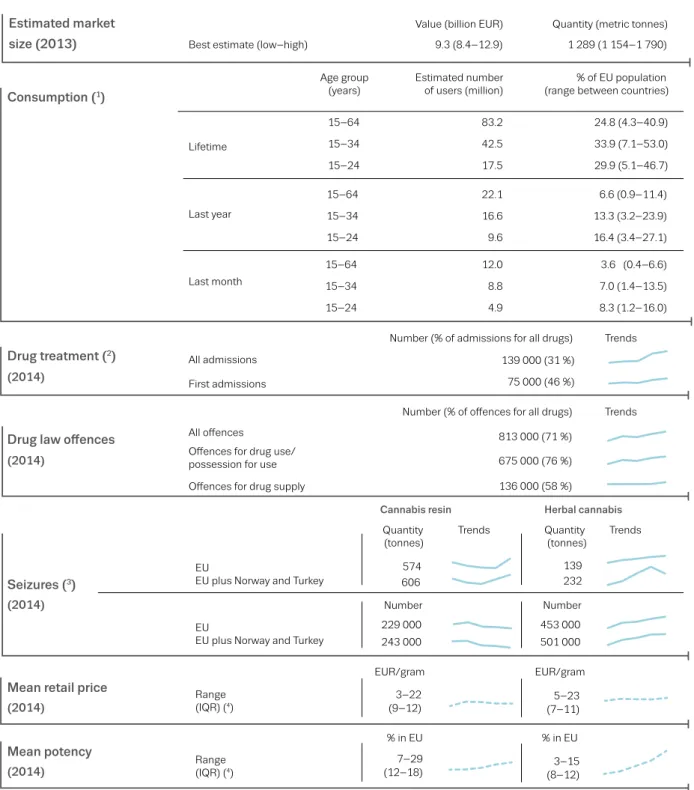
Cannabis is the most widely used drug in Europe and it is estimated that cannabis accounts for around 38 % of the retail market for illicit drugs and is worth more than EUR 9.3 billion annually (range EUR 8.4 to 12.9 billion). Some 22 million adults in the EU have used it in the last year and around 1 % of European adults use it on an almost daily basis, increasing the risk of health and social problems. OCGs are heavily involved, making full use of technological innovations to produce larger quantities of more potent products in Europe itself. While the market is dominated by herbal cannabis grown within the EU, the cannabis resin from Morocco has been increasing in potency and may be trafficked to the EU alongside other illicit goods and human beings, a trend potentially exacerbated by instability in North Africa and the Middle East.
The heroin market is the second largest illicit drug market in the EU. It is estimated at EUR 6.8 billion annually (range EUR 6.0 to 7.8 billion) and is responsible for a significant proportion of drug-related deaths and social costs. Following a period of decline, there are recent signs of increasing availability that may signal increased harms. Opium production remains generally high in Afghanistan. Production techniques, locations, trafficking routes and modi operandi are increasingly flexible and dynamic, as shown by an increase in very large heroin seizures, suggesting a shift to maritime container trafficking, and new
routes involving Africa, the Southern Caucasus, Syria and Iraq are emerging. Nevertheless, the Balkan route remains a key corridor for heroin entry to the EU. There are also signs of diversification in the market, with prescription medicines and new synthetic opioids increasingly being misused.
Cocaine is Europe’s most commonly used illicit stimulant, with a retail market estimated to be worth at least EUR 5.7 billion annually (range EUR 4.5 to 7.0 billion). Most use occurs in western and southern Europe and has been fairly stable over recent years, although there are signs of increasing availability. Coca cultivation appears to be increasing after a period of decline but there is uncertainty about how much cocaine is produced and where this occurs. Sea and air transport are used to traffic cocaine to Europe, with Colombia, Brazil and Venezuela being key departure points. The Caribbean and West Africa remain important transit areas, while Central America is emerging. Use of maritime containers shipped through major European ports is a continuing problem. An evolving array of concealment methods is used, including cocaine being incorporated into ‘carrier materials’ (e.g. plastics) before being chemically extracted on arrival in Europe. Colombian and Italian groups continue to dominate wholesale cocaine supply to Europe, in cooperation with other groups (e.g. Dutch, British and Spanish). West African, especially Nigerian, groups are also active in transporting cocaine from Africa to Europe and Balkan OCGs are emerging actors. The market for the main synthetic stimulants, amphetamine, methamphetamine and MDMA, is estimated to be at least EUR 1.8 billion annually (range EUR 1.2 to 2.5 billion) in the case of amphetamines (including methamphetamine) and EUR 0.67 billion (range EUR 0.61 to 0.72 billion) for MDMA/ecstasy. Amphetamines appeal to both recreational and marginalised drug users and the market for them interacts with those for cocaine and some new psychoactive substances. Recent concerns include the availability of high-dose MDMA products and the increased use of methamphetamine. In the EU, the Netherlands and Belgium are important for MDMA and amphetamine production, while most
methamphetamine appears to be made in the Czech Republic. Production is becoming more sophisticated and diverse, and the use of new precursor and pre-precursor chemicals may increase health risks. The dumping of toxic waste also poses health risks and causes environmental damage. Aggressive marketing is becoming more apparent in the ecstasy market suggesting competition between suppliers and more active targeting of specific groups of users.
A large number of new psychoactive substances (NPS) are sold openly as ‘legal’ replacements for illicit drugs. There are no signs of a slowdown in the development of these substances; 100 new substances were reported for the first time in 2015 and the EU Early Warning System is monitoring over 560. The market supplies both recreational and, increasingly, marginalised users and producers anticipate legal and regulatory controls by developing new substances. Globalised supply chains allow bulk quantities of NPS to be ordered online and transported to Europe where they are packaged and marketed on the open or illicit drug market. It is a low-risk, high-profit business attractive to organised crime and there are signs of production in Europe. Distinct but overlapping markets have emerged, such as ‘legal highs’, ‘research chemicals’ and ‘dietary supplements’ sold through ‘bricks and mortar’ and online shops. With increased availability, harms have increased, such as acute, sometimes fatal, poisonings and harms associated with injecting cathinones.
Background and aims of the report
This report provides a contemporary, strategic and action-orientated analysis of the information available on Europe’s drug market. It is built on a synthesis of operational intelligence, research data and information available from the on-going monitoring of the drug situation. The extent and nature of the drug market, in all its ramifications, is an important topic for this sort of consideration. Significant effort and resources are dedicated to restricting the supply of drugs in the European Union (EU) as part of an integrated and evidence-based balanced approach that also recognises the parallel importance of reducing the demand for drugs. The justification for these investments is that activities in this area benefit both public health and community safety as well as contributing more generally to economic and social wellbeing. But sound policy and actions in an area such as drug control are possible only if they are grounded in an understanding of the complex nature of the problems they are addressing. The hidden, and criminal, nature of the drug market makes it a challenging issue in this respect. Moreover, these challenges are growing, as the drug market has become more dynamic, internally interlinked and externally connected to many of the other critical policy issues Europe faces today. This report helps address these information needs by providing a state-of-the-art review of the data currently available in this area, and draws from this analysis key learning and action points.
The report describes the EU drug market from a number of different perspectives. Starting with consideration of the overall impact of the drug market on society, the overlap with other criminal activities and the drivers of these, it then takes a more in-depth look at what is known about the markets for the main illicit drugs. The last part of the report then reviews the policy and operational responses to the challenges posed by these markets. Thus, the report is intended to provide a comprehensive overview of what is known about the European drug market. This is unavoidably derived from a triangulation between diverse, partial and often contradictory information sources. While putting these together helps provide a more complete picture, it remains important to acknowledge uncertainty and identify where critical information gaps exist. Therefore, throughout this report attention is also drawn to ‘what we don’t know, but need to know, about the European drug market’, an essential introspection if future policies and actions in this area are to deliver maximum returns.
Insights provided by an analysis of the EU drug market in 2016
A number of overarching key themes emerge from the analysis presented in this report. There is increasing evidence that organised crime groups continue to take advantage of weak states and conflict zones, a situation that appears to be worsening. Furthermore, organised criminal groups actively facilitate their illicit business by managing risks and avoiding detection. This may be accomplished by establishing front companies, using the latest encryption and other technologies, hiring specialists to provide ‘crime as a service’, by corrupting officials and professionals, and by the use or threat of violence. At the same time, globalisation and the internet have continued to play a key part in transforming the way in which the drug market operates, resulting in supply chains becoming shorter and opportunities for detection being reduced. These developments represent major challenges for existing policy and practice in this area, but a better understanding of them may present new opportunities to intervene. There is a need to reinforce international cooperation efforts and to ensure that the available legal and judicial mechanisms, tools and platforms are used effectively. Efforts to improve the sharing of information and intelligence on a strategic and operational basis, building
border control capacities where needed, and to develop closer collaboration both between different law enforcement agencies, and between these agencies and the private sector, are clear priority areas for action. The exchange of knowledge, expertise and best practice, and the provision of training are domains in which the collective EU experience has the ability to plug gaps in vulnerable areas. It is abundantly clear that there are key strategic locations for the drug market and therefore coordinated operational activities targeting these areas are likely to be particularly valuable. Beyond this, the expanding demand for drugs in countries neighbouring the EU and elsewhere must have consequences for the EU in the future, and therefore vigilance and international engagement are likely to become even more important. Lastly, but of considerable importance, is the recognition that the drug market concept is one where the supply of drugs interacts with the demand for these substances. In order to adequately address the negative consequences of the drug market, both for individuals and for society as a whole, effective drug prevention, treatment and harm reduction interventions are as important as interventions aimed at reducing supply.
Key themes and their implications for action
Three overarching, interconnected themes emerge from the analysis developed in this report:
The increasing organisational and technical complexity, interconnectedness and specialisation of groups involved in drug markets. It is now common for organised crime groups (OCGs) involved with the drug market to diversify across multiple drugs, to engage in other forms of criminality, and to form alliances across ethnic and geographical boundaries. Meanwhile there is more specialisation seen in respect of roles and the use and sharing of assets alongside the harnessing of specialist expertise.
Globalisation and technology are accelerating the rate of change in the drug market. The dramatic transformation seen in legitimate commodity markets arising from developments in the global economy and information technology also affect the illicit drug market. Criminal groups are quick to identify and exploit the opportunities provided by easier access to information, the internet as a social and commercial medium, and the growth in international trade, with large volumes of goods rapidly moving across international borders and through multiple transit points.
Drug market-related activities are concentrated in a number of established and emerging geographical locations. Innovation in synthetic drug production and changes in cannabis cultivation have resulted in greater opportunities for drugs to be produced nearer to consumer markets in the EU. Nevertheless, within Europe and elsewhere, some specific geographical locations or ‘hotspots’ remain particularly important for drug production or trafficking. Some of these areas are long established, while new zones are also emerging. For those taking action in this area, these themes have important implications, which are elaborated further in the action points in the main body of this report. They are:
A systemic analysis of drug market business models will be helpful for both operational and policy purposes. Understanding the dependencies and potential for interaction between different areas of the drug market, and the rationales, roles and organisational models used within it, is of growing importance. This perspective can assist the disruption of market activities by identifying modi operandi, structural vulnerabilities and emerging new threats, helping to refocus operational priorities on key target areas.
The EU Drug Markets Report — main elements
This report uses the concept of the drug market as a useful perspective for focusing on the illicit production, trafficking and sale of controlled substances. The rationale for this is that, despite being one of the priority areas for drug control policy and supply reduction activities, the drug market is rarely considered holistically or systemically and yet such a perspective is likely to be critically important to both the formulation and evaluation of activities in this area. Supply reduction efforts are central to Europe’s response to the drug problem, and in this report these are considered within the general context of a multidisciplinary approach which has the objective of improving public safety, with a focus on protecting public health, but also preventing and reducing violence and other harmful consequences associated with the production, distribution and use of drugs. At a strategic level, the identification, disruption and dismantling of serious organised crime groups involved in drug trafficking, money laundering and corruption are key elements of law enforcement activities in this area. One of the key aims of this report is to highlight that drug markets, though largely hidden, do not operate in isolation but have widespread implications for society. Part I of the report explores the impacts of the drug market and the harms it causes not only to those involved in the trade, but also to the legal economy, government institutions and society more
Partnerships between national authorities and with industry are becoming ever more important, as is engagement with international organisations and third countries. Organised crime groups are likely to be active in a diverse range of criminal activities, spanning, or deliberately exploiting the existence of, national borders and involving links with legitimate business sectors. This means that inter-sectoral cooperation, coordination and intelligence sharing, both within and between countries, are of increasing value. Correspondingly, poorly coordinated responses may increase the risk of displacement to those areas where enforcement efforts or regulatory frameworks are weakest; transnational crime requires a transnational response.
Efficient use of resources can be achieved through the identification and targeting of geographical locations where drug market-related activities are concentrated. Such specific locations, which include large container ports, parcel delivery hubs, specific land or air border points, and relatively discrete geographical areas used for drug production, represent priority targets for interdiction efforts. More generally, the larger but still distinct geographical areas identified in this report as important zones for drug production or trafficking activities deserve special attention, and coordinated action plans, addressing development and governance issues alongside drug-related programmes, will be necessary for an effective response.
Continuing recognition of the value of a strategic response, informed by sound information used to identify new opportunities, as well as challenges, is essential. This report makes a strong case for continuing to invest in an intelligence- and data-driven approach to the drug market, which is supported by concrete examples of how and why this works. Looking to the future, the need to anticipate and respond more rapidly to emerging threats is clearly growing. It is equally important to identify and exploit new opportunities, for example: insights derived from forensic data (so-called ‘forensic intelligence’); new technologies for monitoring and surveillance; increased opportunities for international engagement driven by the recognition of shared problems; and growing operational understanding and capacity to work in challenging areas, such as cyber-enabled drug markets.
generally. The links with other serious criminality that may also be perpetrated by organised crime groups involved in the drug trade are also explored. This includes human trafficking and exploitation, and there is also some evidence of links to terrorist activities. The damage to the environment caused by the dumping of waste materials from drug production is often overlooked, but its impact can be severe and include harm to fragile ecosystems and surrounding populations in producing regions, or pollution to land and water systems in the EU. Part I also examines the current drivers of drug market evolution, such as developments arising from globalisation and technological developments, including the increasingly important role of the internet in information exchange and as a marketplace.
Another new element of this report is the inclusion of an estimate of the size of Europe’s drug market. Calculations in this area are extremely challenging, and the approach used here has been a deliberately cautious one. Based on the available data, a minimum estimate is provided, noting that some consumption remains unknown and cannot at present be included. Even a minimum estimate in this area, however, represents a considerable financial sum. Additionally, it is hoped that the existence of a data-based estimate, with identified areas for future improvement, not only provides a useful and technically credible baseline for informing current policy discussions, but also represents an important step to inform the future work necessary to improve the estimates. The methodology of how these estimates have been derived can be found in a supporting technical report.
Part II of the report provides an analysis of the market for each of the main drug types, discussed in order according to their market share: cannabis; heroin and other opioids; cocaine; and then the synthetic drugs amphetamine, methamphetamine and MDMA together. The new psychoactive substances, being slightly different from the other substances considered here, are dealt with separately at the end of Part II. Discussion of each drug follows a similar structure, commencing with the key issues in brief, followed by a detailed analysis, and then finishing with action points. These chapters detail the specificities of the market for each substance, but also illustrate the links between the different market areas. This is a point of critical importance to successful policy formation, as actions targeting any specific substance risk being ineffective, or even counterproductive, if they do not take into account their possible wider ramifications for other aspects of the drug market.
Finally, in any action-orientated analysis it is also necessary to both recognise the importance of, and describe, existing policies, structures and activities that are currently targeting the market-related aspects of Europe’s drug problem and Part III of the report focuses on these. Here the relevant EU policies and legal, institutional and financial arrangements are described, as well as the actions and initiatives undertaken by the relevant bodies that play a role in their implementation. Many of these reflect the priorities and action points identified in the first EU drug markets report: a strategic analysis, emphasising the value that a strategic perspective can have in this area. Many of the issues described in that initial analysis remain important today and are further elaborated here. The 2016 analysis is, however, more grounded in published evidence, and the speed of development in this area has been so rapid that important new elements now need to be considered. Concrete examples of this include the role the internet is now playing with respect to drug supply and the continuing problems posed by the introduction of new psychoactive substances. These are two examples of issues that were addressed in 2013 but which have had to be significantly updated and revised for this report.
This report is accompanied by a Strategic Overview aimed at policymakers and covering the key points. This main report, in contrast, is intended as a more detailed reference document for professionals, practitioners and researchers working in the field of drug supply reduction.
The routine data that support the analysis, as well as the studies that were commissioned to inform the analysis provided in this report, are published separately and are available online. The EMCDDA and Europol would like to acknowledge all who played a part in the production of the report. We are indebted to our colleagues at the European Commission and other EU bodies and also note in particular the specialist networks of experts working in this area across Europe, whose insights and advice have proved invaluable in informing the drafting of this report.
CHAPTER 1
The ramifications of the illicit drug market
CHAPTER 2
Drivers of drug market developments
Understanding the widespread
ramifications of the drug market
Drugs are big business, estimated to make up about one-fifth of global crime proceeds. In the EU they have been estimated to account for 0.1–0.6 % of the GDP (gross domestic product) of the nine Member States for which published data are available.
The EU retail drug market is estimated to be worth at least EUR 24 billion a year. The cannabis market is the largest, making up about 38 % of the total, followed by heroin (28 %) and cocaine (24 %). These estimates are based on limited data, with many gaps. Information about the economics of other aspects of the drug market is even more scanty. The ramifications of the illicit drug market are wide ranging and go beyond the harms caused by drug use. They include:
n involvement in other types of criminal activities and in terrorism; n impacts on legitimate businesses and the wider economy; n strain on and corruption of government institutions; n impacts on wider society.
Drug supply can usefully be viewed from a business perspective; consideration of features such as architecture, reputation and innovation, as well as risk minimisation and displacement, may identify new areas for law enforcement intervention.
Globalisation is a key driver for change and innovation in drug markets; organised crime groups (OCGs) rapidly exploit new opportunities for increasing profits and evading detection, while authorities often lack the commensurate flexibility to respond.
As with other consumer goods, the internet has had an important influence on the drug business, providing both open and hidden sales outlets, as well as opportunities to shorten the supply chain and for perceived anonymity for technology-savvy consumers on dark marketplaces, while reducing opportunities for law enforcement intervention.
Impact on the legal economy
The large amounts of cash generated by the drugs trade have to be legitimised in some way, and a portion needs to be sent overseas to pay suppliers.
Illegal money impacts on the legal economy as businesses and high-value assets are acquired to ‘launder’ cash. These ‘investments’ distort the true economy, leaving legitimate businesses and consumers at a competitive disadvantage.
The activities of criminals engaged in the drug market may have a direct impact on legitimate businesses, such as exposing companies to the risk of being associated with trade-based money laundering schemes, the theft of electricity or damage to rental properties used for drug production.
Wider criminal activity
Criminals, particularly OCGs, are adaptable, and hence there are many ways in which drug markets and those involved in them interact with other areas of illegal activity. These overlaps are not always recognised, so our knowledge of the extent of these interactions is limited and important intelligence and opportunities for action may be missed.
The interactions with other criminal activities can be viewed as being of three broad types: 1. when those involved in drug supply engage in the trade of other illicit goods, for
example, firearms or migrant smuggling;
2. when drug supply is used as a means to a different end, as when it provides financing for other criminal activities or when drugs are used to control those being exploited; 3. when other criminal activity is integral to the drug trafficking activity, for example when
trafficked individuals are coerced into participation in drug production or trafficking; when corruption is used to facilitate trafficking; when profits are laundered; when cash is smuggled to pay for supplies; or when violence is used to maintain market position.
Terrorism
Internationally there is evidence of some links between OCGs involved in drug trafficking and terrorist organisations, which use these links to fund their terrorist activities. However, these relationships are largely functional in nature.
In Europe, terrorist activity is increasingly fragmented, mainly carried out by either small cells or even a ‘lone wolf’. Some of these terrorists may finance their activities through drug dealing or trafficking, but other sources of funding seem to be more common.
While some Member States have already addressed this issue, the functional separation and specialisation of those tackling terrorism and drugs can result in some links being overlooked.
Strain on and corruption of government institutions
Drug supply reduction activities account for the largest share of drug-related expenditure in most countries; budgets for public order and safety from which these activities are financed are under increasing pressure, adding to the strain on already tight resources.
The corruption of public officials in law enforcement and the judiciary, as well as those operating at the political level, facilitates the operation of the illegal market and exerts a corrosive effect, undermining the authority of governments. The corruption of professionals is also a common feature of how criminals avoid anti-money laundering regulations and manage to operate their illegal business within the licit economy.
Development and stability are adversely affected in transitional and developing drug-producing or transit countries, which are often targeted by criminals because of their weak governance structures. In such countries, where there may be few alternative options for legitimate income generation, drug policies need to be integrated with international development programmes.
Impacts on wider society
Drug dependence is particularly associated with the need to commit acquisitive crime, causing losses to individual victims and businesses.
Drug-related violence, including homicide, is present in some drug markets as an inherent component used to gain market dominance or for the resolution of disputes. As well as affecting individuals and families, such systemic violence contributes to feelings of insecurity within neighbourhoods, as does the operation of open drug markets.
Drug production generally involves the use of chemicals, many of which are harmful to the environment when the waste materials are dumped. This threatens both fragile ecosystems and the populations where laboratories are located, in the EU and in other drug-producing regions of the world. In addition, a range of other harms are associated with the cultivation of cannabis, coca and opium poppies, such as deforestation and erosion; these harms, although they largely affect countries outside Europe, may nevertheless have an indirect impact in the EU through migration, destabilisation and climate change.
1
ILLICIT DRUG MARKETS Wider criminal activity and terrorism Impact on society more generally Impact on the legal economy Strain on government institutionsIllicit drugs are big business. The hidden nature of the illicit drugs business makes it difficult to estimate the amount of money it generates, but the United Nations Office on Drugs and Crime (UNODC) has estimated that illegal drugs account for about 20 % (17–25 %) of global crime proceeds and are equivalent to about 0.6–0.9 % of global gross domestic product (GDP) (UNODC, 2011a). However, it is important to bear in mind that such figures are not precise estimates but rather an indication of orders of magnitude. To put the size of the illicit drug market into the context of the wider economy in the European Union (EU), it has been estimated that illegal drug production and trafficking in the eight Member States for which data are available (1) represented between 0.1 % and 0.6 % of the
national GDP in the period 2006–13 (Warmark Magnusson, 2008; ISTAT, 2014).
In the EU, the retail market for illicit drugs is estimated to have been worth at least EUR 24 billion in 2013 (range EUR 21 billion to EUR 31 billion); the cannabis market is the largest, accounting for about 38 % of the total, followed by the heroin (28 %) and cocaine (24 %) markets (Figure 1.1). These new estimates are based on very limited data, with many gaps, which has necessitated some very broad assumptions. Hence, these figures must be viewed as initial minimum estimates that will need to be revised in the future as the data underpinning them is improved (see box on page 28). The estimation process has built on previous work in the area (Trautmann et al., 2013) and uses a demand-side estimation approach described in detail in the accompanying technical report (EMCDDA, 2016a). Beyond estimates of the size of the retail market there is a need to develop our understanding of the economics of other aspects of the drug market, such as production and wholesale supply activities, to allow a fuller estimation of
(1) Estimates are publicly available for the Czech Republic (2010), France
(2013), Germany (2011), Italy (2011), the Netherlands (2010), Spain (2010), Sweden (2006) and the United Kingdom (2009). The combined GDP of these countries accounts for over 80 % of the total EU-28 GDP.
the costs and revenue generated at other stages of the drug market and inform broader estimates of illicit financial flows relating to the illicit drug market in the future.
The impact that drug markets have on societies is not restricted to their financial weight. As well as generating vast sums of money, as was highlighted in the previous edition of this report, drug markets are increasingly diversified and globalised and interact more and more with other licit and illicit markets and activities. Thus, drug production and supply, and the individuals or groups engaged in these activities, cannot be considered in isolation: they have connections and impacts throughout the criminal sphere, the licit economy, government institutions and society more generally.
The ramifications of the illicit drug
market
FIGURE 1.1
Estimated minimum retail value of the illicit
market for the main drugs in the EU
EU illicit drug market shares Cannabis €9.3 billion 38 % 28 % 24 % 8 % 3 % Heroin €6.8 billion Cocaine €5.7 billion Amphetamines Ecstasy €1.8 billion €0.7 billion
Note: Percentages do not add up to 100 % due to rounding.
These areas of interaction and overlap can be considered within four broad groupings, as illustrated in Figure 1.2, although the distinctions between these groupings are blurred. These broad areas, the most important of which are discussed in more detail below, are:
1. interference in or involvement with legitimate businesses and the wider economy;
2. involvement in other types of criminal activities, e.g. human trafficking and exploitation, and terrorism; 3. strain on and corruption of government institutions; 4. impacts on society in general.
The impact of drug markets on
legal business and the economy
Drug trafficking interferes with legal economic activity in many different ways, as do other types of crime. The consequences stem largely from the direct and indirect influences of the large amounts of money generated by the illicit trade, which must be legitimised, but also from the direct impact of losses to legitimate business and corruption associated with the drug trade.
The extent of illicit financial flows
The drug trade generates large sums of money that then need to be dealt with in some way, and a range of methods
The challenge of estimating the size of the illicit drug market
The illicit nature of drug supply means that the market is hidden and collecting data on the nature and extent of the phenomenon is very difficult; for this reason there are important gaps in our knowledge of key aspects. This hampers the estimation of the size of the market and any such estimates have a number of important limitations and often vary considerably as a result of the use of different data sources and the assumptions made to fill in gaps. For this report our approach has been to use, wherever possible, data sources that are collected routinely and reported to the EMCDDA by most EU countries to enhance consistency and facilitate on-going development. Methods of imputation for missing data and all assumptions made, together with the limitations of the current estimates, have been documented in detail in the technical report (EMCDDA, 2016a). The estimation process essentially involves taking estimates of the number of people who use each drug in a year for each country in the EU and then multiplies these by an estimate of the average amount used in a year and the average retail price in each country. The national estimates are then summed to provide a European total. Key limitations to be borne in mind when considering the estimates presented here are:
n Undercoverage. General population surveys of adults
(aged 15–64 years) have formed the basis of most of the estimates of numbers of users, but it is known that some groups of users, particularly some marginalised groups, may be under-represented in these surveys. While we have attempted to use estimates of problem
users and treatment data to identify use by some of these groups, there are still likely to be gaps in coverage.
n Under-reporting of use. Estimates of numbers of
users, as well as of frequency of use and amounts consumed, are based on self-reports and it is known that, particularly with respect to stigmatised behaviours, people will often underestimate or under-report use. We have not made any adjustment for this because, at present, we have no robust data on which to base any adjustment and the extent of under-reporting is likely to vary considerably between countries.
n Knowledge gaps. There are significant gaps in the
availability of the basic information that we need to estimate market size. In particular, we have very little information about the amounts of drugs used by different groups of users (such as occasional versus frequent users), the relative use of different forms of drugs (e.g. cannabis resin versus herb or ecstasy powder versus tablets) or quantities consumed in different countries, although we do know that there are large differences between countries. Similarly, information on the prices paid is limited. In such areas, we have had to make assumptions and use the best data available.
In the light of the above limitations and others described in the accompanying technical report, it is clear that the estimates presented in this report must be interpreted with caution and must be seen as minimum estimates. There is a need to develop a programme of work to improve the basic data on which such estimates are based to improve future estimates.
are used by those engaged in the market to integrate these financial flows into the licit economy to legitimise income and establish power and influence. Obtaining estimates of the extent and sources of illicit financial flows is challenging but, as indicated above, drug trafficking is a major
contributor to these, estimated to account for about one-fifth of all crime proceeds and about half of all transnational organised crime proceeds in 2009 (UNODC, 2011a). The important contribution of the drug trade to illicit financial flows was also highlighted in a recent report looking at illicit trade in the EU (Savona and Riccardi, 2015). This estimated that illicit drug markets in the EU (heroin, cocaine, cannabis, amphetamines and ecstasy) accounted for one-quarter of the proceeds from all illicit retail markets.
An analysis of the cocaine trade carried out as part of the UNODC study yielded an estimated global value equivalent to EUR 61 billion (2) (USD 85 billion) in 2009, of which
EUR 60 billion (USD 84 billion) was considered to be gross profit (3). The analysis sought to take account of what is
(2) US dollar amounts have been converted to euros using 2009 exchange rates.
(3) Although, strictly speaking, this is not gross profit as no expenses were
de-ducted. It should be noted that the methodology used in these estimates was different from that used in our estimates of the retail market, e.g. including wholesale activities, and is therefore not directly comparable.
known about the structure of the cocaine market and the impact of seizures, and the fact that many of those involved at the lower levels of trafficking organisations make very little, if any, profit, while a few at the higher echelons make huge sums. The cocaine market in Europe was estimated to be worth EUR 19.4 billion (USD 27.5 billion) overall in 2009, with 44 % of retail profits and 90 % of wholesale profits (or 55 % of total profits) being available for laundering, equivalent to EUR 10.8 billion (USD 15.1 billion). Not all of this would be laundered within Europe; the analysis suggested that about half would be laundered in the country in which it was generated and that some would flow out of the region (e.g. to the Caribbean or South America), but almost equivalent amounts would flow in (e.g. South American organised crime groups (OCGs) investing in property in Spain), so that net outflows from the region would be small (UNODC, 2011a).
If we assume that the figure of 44 % of retail profits being available for laundering holds for other European drug markets and apply it to our estimate of retail market size of about EUR 24 billion, this would suggest that something in the region of EUR 11 billion arising from the retail drug trade in the EU might be laundered annually. However, this is a crude estimate and needs to be treated with caution. FIGURE 1.2
The widespread ramifications of illicit drug markets on society
ILLICIT
DRUG
MARKETS
Wider criminal activity and terrorism Impact on society more generally Impact on the legal economy Strain on government institutions Terrorism Human trafficking and exploitation Government expenditure Corruption of officials Impact on development and governance Impact on individuals, families and neighbourhoods Drug-related crime and violence Environmental damage Trafficking of arms and other illicit goods Infiltration by illicit financial flows Impact on businesses Money laundering and cash smuggling Source: EMCDDA.Money laundering
The profits from the drugs trade generally need to be ‘laundered’ to make them appear legal before they can be used further. Money laundering schemes are often complex, involving the placement of the ‘dirty’ money into the financial system, transferring it internationally to increase the distance from the initial transaction in an attempt to obscure the audit trail and hamper detection efforts, and then returning the ‘clean’ money to the hands of the criminal in a manner that does not arouse suspicion. In many EU countries, prosecution for money laundering depends on linking the money to the predicate offence, i.e. the underlying criminality that generated the profits in the first place. Proving a link between suspicious funds and a specific predicate offence remains a key challenge for law enforcement. Drug offences account for 21 % of all predicate offences in the EU, the highest proportion of all crimes according to a survey of the Member States conducted by Europol — ahead of corruption/bribery (14 %), fraud and swindling/scams (11 %), and human trafficking/smuggling of migrants (10 %) (Europol, 2015a). A limited number of Member States have provisions for ‘unexplained wealth’, whereby the authorities can pursue civil forfeiture if they can prove that wealth has not been derived from a legitimate source. Indications of criminality, however, are normally required in order to achieve forfeiture. Such investigations require significant investment in order to be successful: a combination of specially trained officers and prosecutors, international cooperation and a degree of persistence. They can last several years in complex cases. The investigation of money laundering offences is a key priority in the EU Policy Cycle on Organised Crime; however, the efforts of investigators
in this field are frustrated by a combination of the creativity of criminals, slow or inadequate international cooperation, and limited domestic legislation in this area.
A number of characteristics have been identified that make certain legitimate business sectors particularly attractive to money launderers. They tend to be cash intensive, territorially specific (as this facilitates control over the territory in which drug dealing may occur), low-tech and labour intensive. In addition, they often involve public administration or public subsidies (which provides opportunities for infiltration and corruption), small firms useful for their illicit activities, or activities subject to weak regulation. Thus, the legal business sectors most targeted for criminal investment are bars and restaurants (as illustrated in Case study 1), construction, wholesale and retail trade, especially of food and clothing, transportation, real estate activities and hotels (Savona and Riccardi, 2015).
Gambling in casinos, on fixed odds betting machines, or on horse racing, and lotteries are also ways used to legitimise funds. For example, small-denomination notes obtained from drug dealing can be fed into betting terminals and the winnings are returned with a ticket showing that cash has been received from gambling. Although a proportion of the original stake is lost, the remainder now has a legitimate provenance. In the case of lotteries, the money launderer buys winning tickets for more than the prize value and obtains a ‘clean’ bank cheque when the tickets are redeemed (Europol, 2015a). Insurance policies purchased with ‘dirty’ cash and then redeemed early, even if this incurs a penalty, are even harder to detect.
Purchases of high-value assets may be used for money laundering but also have other uses. For example, real estate properties may be purchased for money laundering purposes, providing a high return on investment or income, or used to facilitate the trade, providing sites for drug production or sales. Similarly, boats and cars may be useful for trafficking and as status symbols. The purchase of securities, such as bonds or stocks, may provide cover and an apparently legitimate reason for transfers, as well as ownership of legitimate businesses that may be used for money laundering or to facilitate drug trafficking (Schneider, 2012).
Trade-based money laundering, which involves using trade transactions to disguise the source of funds or move money around and which is particularly difficult to detect, is another vehicle for integrating illicit funds into the legal economy. Practices such as over- or under-invoicing for goods or services, or falsely describing them, are used to misrepresent the price, quantity and quality of goods traded, and transfer value from one party to another.
Case study 1: The use of legitimate
businesses for money laundering
Fourteen businesses, including restaurants, nightclubs and bars, worth EUR 15 million were seized by Italian authorities investigating the money laundering activities of a mafia clan involved in a portfolio of crime including drug crime and extortion. The choice of businesses, which were all owned and managed at arm’s length from the criminals, further facilitated the criminality by providing locations for drug dealing. Drug dealers were paid for their criminal activities through ‘legitimate’ wages paid to family members employed as service staff that in fact came out of criminal funds. The scheme was discovered because the profits from the businesses declared to the tax authorities seemed unreasonable relative to the actual running costs.
Trade-based money laundering is thought to account for as much as 80 % of illicit financial flows from developing economies (FATF, 2006; PwC, 2015).
Successful money laundering often requires the involvement of professional enablers working in the financial and legal sectors, although the degree to which they are criminally complicit may vary; some will be fully aware of the illegal source of the money involved, whereas some will be indifferent and others simply negligent or incompetent in applying anti-money laundering measures. Activities that fall into this category include the services provided by individual professionals, for example the use of a solicitor to purchase property or other assets, but professional involvement may also take place at the corporate level. For example, major international banking organisations have been found negligent in their application of financial controls; in 2012, HSBC was fined for allowing drug cartels in Mexico and Colombia to launder large sums of money through their accounts (Mollenkamp, 2012; US Senate, 2012). The importance of continued vigilance by financial regulators is illustrated by other recent cases involving other banking groups that have failed to apply proper controls, leaving the banking system vulnerable to exploitation by drug trafficking groups (e.g. Young, 2014; Slater and Jones, 2015).
The need for money transfer and the
importance of cash
The transfer of money overseas, whether to pay for drugs or trafficking services or for investment or concealment, is achieved in a variety of ways. Examples using legal financial institutions include electronic transfers or depositing small amounts of cash (‘smurfing’), but informal money or value transfer systems (see Case study 2), such as the hawala, also known as hundi, system, are also used; and sometimes money is simply moved as hard cash. As controls in the regulated financial sector are tightened worldwide, the use of informal value transfer systems and cash smuggling for money laundering may become increasingly attractive (FATF, 2013). Cash, and its transfer between countries, plays an important role in drug markets for two main reasons. First, drug sales themselves generate large amounts of cash, generally in low-denomination notes. Large sums in this form are bulky so before such money can be spent by dealers it needs to be laundered such that it can be used without arousing suspicion. Hence, it is unsurprising that, in the EU, drug trafficking is the offence most commonly linked to the use of cash in money laundering schemes. Secondly, cash is useful within the laundering process because it is a bearer negotiable instrument, which means
that it belongs to whoever has it and, unlike electronic transfers, it is hard to ascertain its source and impossible to know the intended beneficiary. Institutions subject to regulation may still be involved at some stage and cash is still the main trigger of suspicious transaction reports, making up a third of all reports (Europol, 2015a).
Cash may be physically smuggled between countries, often using methods similar to those used to transport drugs themselves, and cash smuggling is a specialist service. In return for a proportion of the amount to be smuggled (4),
(4) For example, in a study of smuggling between the Netherlands and
Colombia this proportion has been estimated to be between 10 and 17 % (Soudijn and Reuter, 2015).
Case study 2: Transforming cash
A recent investigation by French authorities into a drug trafficking network led to several arrests relating to the laundering of the group’s profits.
Money from the sale of cannabis was collected in France. The laundering process began with the transport of cash from Paris to Belgium, where it was used to buy gold. Thereafter, couriers (often Belgian students) acted as mules, transporting the gold to Dubai. In Dubai the gold was then made into jewellery, which was then sent to India to be sold on the gold market. The profits were finally shared between the OCGs and money launderers with the assistance of bankers with access to the financial system. A key organiser admitted having laundered EUR 36 million since 2010 and sending 200 kg of gold from Belgium to India. The network collected about EUR 170 million per year.
Furthermore, the case revealed a connection between tax evasion and drug trafficking in a scheme designed to balance two illegal flows of cash. Cash coming directly from cannabis dealing in Paris was exchanged for sums secreted in Swiss bank accounts which tax evaders sought to access or repatriate. The cash profits from drug sales were handed over in plastic bags full of small dirty notes to individuals with hidden Swiss accounts. Equivalent amounts were debited from their secret Swiss accounts and further transferred through a complex network of shell companies which integrated funds through the purchase of high-value assets. In this way, the need to smuggle the proceeds of drugs across the French border was eliminated.
the smuggler guarantees the transfer and then uses various trafficking means to deliver the money to the required destination. Because of their smaller volume, high-value notes are important here and traffickers are prepared to spend significant proportions of their revenue to make the conversion. For instance, EUR 1 million in EUR 500 notes equates to just 2 000 notes weighing 2.2 kg, and would fit inside a small laptop bag. In comparison, the same amount of money in EUR 50 notes would weigh over 22 kg and occupy the space of a small suitcase (Soudijn and Reuter, 2015). This suggests that it is important to tighten controls on outgoing traffic to identify cash smugglers as well as incoming traffic for drugs and to review the continued issuing and controls on access to EUR 500 notes. In some countries, informal value transfer schemes such as hawala (also known as hundi) may be of particular importance. For example, a recent report on the financial flows associated with the trade in Afghan opiates highlights the importance of these systems in this context, with an estimated 50–90 % of transactions in Afghanistan taking place through such systems (FATF, 2014). It is believed that in most cases payments from consumer countries are first transferred through the banking system to intermediate countries, such as Pakistan and the United Arab Emirates, from where the money is transmitted to Afghanistan via value transfer schemes.
Impact on businesses and the economy
The drug trade has both direct and indirect impacts on businesses, many of which are easy to overlook. For example, open or street drug markets can negatively affect local businesses by reducing the attractiveness of the area to customers and the general public and lowering property values. A more specific example is the large amounts of electricity required for indoor cannabis plantations, which may be illegally diverted from electricity suppliers, reducing revenues and tax payments, and potentially increasing costs to legitimate customers (Ofgem, 2013). The illicit drug market also absorbs resources from the legal economy. Money spent on illicit drugs is denied to governments in taxes and to producers of other consumer goods.
The large proportion of illegal proceeds from the drug trade that is not reinvested in illegal activities but channelled back into the legal economy can also have a negative impact (Unger, 2007). For example, the market for products or services can be distorted when business and investment decisions are made not on a commercial basis but to reduce the risk of detection or facilitate drug-related activities, thus FIGURE 1.3
Examples of cash smuggling attempts detected
at European airports
Photo © Dutch Schiphol teams (Customs/FIOD/Marechaussee)
Photo © German Customs, via Europol
Case study 3: Corruption and manipulation
of public sector procurement
The threats posed by modern OCGs are increasingly diverse. Some activities of OCGs are obviously criminal but others less so, such as the use of criminal acts to achieve unfair advantage in other areas. Some EU Member States have reported cases of criminals bribing public officials to allow them to win tenders for public contracts that provide opportunities for money laundering.
Another example of corrupt practice is provided by the tender process for a contract to provide transportation services for patients travelling to and from hospitals in a region of Scotland. A total of seven tenders were submitted from two separate companies that were associated with OCGs engaged in drug supply by both reputation and criminal intelligence reports. The two companies colluded in the process to provide the appearance of open competition and, for some unknown reason, there were no other applications from any competitors. In the absence of any serious alternative bidders, the contract was awarded, despite the efforts of law enforcement to intervene and prevent public money flowing into the hands of one of the criminally associated firms.