COOPERATION IN WIRELESS SENSOR NETWORKS WITH INTRA AND
INTERCLUSTER INTERFERENCE
S. Zazo, I. Raos, B. Béjar
Dpto: Señales, Sistemas y Radiocomunicaciones-ETSIT. Universidad Politécnica de Madrid phone: + (34) 915495700 (Ext: 4042), fax: + (34) 913367350, email: [email protected]
ABSTRACT
Virtual MIMO configuration, a common model for coopera-tion in sensor networks, trades off cooperacoopera-tion cost in front of MIMO gains. Most of proposed approaches rely mainly on the fact that cooperation at transmitter side alone seems to be much more powerful than receiver cooperation alone. The scenario that is analysed in this contribution includes the effect of interference of other clusters located closely that clearly degrades whatever cooperation type aforemen-tioned. Under these circumstances, the use of additional sensors at receiver side helps creating a set of virtual beam-formers, optimally designed to cancel the undesired signal. So, transmitter cooperation based on Dirty Paper Coding (DPC) strategies to minimize intra-cluster interference and virtual beamformers to minimize inter-cluster interference seems to be a very satisfactory combination.
1. INTRODUCTION1
Sensor networks and ad-hoc networks are receiving more and more attention from the research community in the recent years. There are several challenges from many points of view coming up from Information Theory limits, device efficiency (power saving) and network issues (routing). In particular, cooperative diversity is a novel technique where several nodes work together to form a virtual antenna array [1, 2]. This point is quite important because connects this new topic with more mature experience in MIMO communications in the real antenna array. Vector Gaussian, Broadcast, Multiple Access and Interference Channels (GC, BC, MAC, IC) are the standard models assumed for different degrees of coop-eration in real MIMO links [3]. In Wireless Sensor Networks (WSN) the same asymptotic performance can be achieved if cooperation is not penalized. However, although these results are very valuable it is also important to review critically these conclusions considering more realistic models. This is the fundamental goal of this contribution.
The notion of cooperative communication has been formu-lated in several recent works [4 and references therein] and reviewed as an equivalent (degraded) BC or MAC channels. Basically, three following scenarios are considered depend-ing on the available information: a) at the transmitter side a group of sensor are able to share the messages to be
1
This work has been partly supported by National Spanish Projects TEC2006-13067-C03-01/TCM, TEC2007-67520-C02-01, ICT-2007-217033.
ted and also the set of channels, b) at the receiver side, nodes share their own received signals by forwarding processes (this is the relay principle, although other approaches may be considered) and also the channel coefficients, c) the informa-tion is shared at both sides. Reference [5] presents a very suitable model for these link addressing penalizations in terms of required power and bandwidth to achieve the coop-eration benefits establishing a trade off between them. This contribution follows the idea of [5], although in our case a more general situation is considered including the effect of fading channels instead of just a phase shifting. More indeed we have modeled the effect of interference coming from ad-jacent clusters. This effect may be modeled as an extra Gaus-sian noise following the Central Limit Theorem. In the case where there is not inter-cluster coordination, performance degrades for whatever intra-cluster cooperation that might be proposed. Our contribution is based on the idea of exploiting spatial diversity by setting an extra (Nb -1) number of sensors
and waking up them to create a beamformer pointing towards the transmitter [6, 7, 8]. Assuming that clusters are spatially separated, interference is minimized. This strategy is an ex-tension of our proposal analyzed in [9], where a suboptimum precoder based on Zero-Forcing DPC, combined with opti-mally designed beamformers at each multiantenna receiver, is shown to be performing very close to the optimum DPC approach. The present work modifies the design of the beamforming criteria by minimizing interference instead of maximizing throughput. For this purpose interference fading channels are supposed to be known at both transmitter and receiver sides.
The paper is organized as follows: In Sections 2 and 3 the system model is presented for the interference-free and inter-ference scenario, respectively. The proposed solution is giv-en in Section 4 while some simulations are presgiv-ented in Sec-tion 5. Conclusions are given in SecSec-tion 6. References are provided at the end of the paper.
2. INTERFERENCE FREE SCENARIO
The system model assumes that N simultaneously active (awake) sensors are split in Nc clusters, each one with Ns= N/Nc sensors (assumed integer). P is the total available power
configura-tion. In [5] states that Tx cooperation is the most suitable approach of cooperation to be used in the absence of inter-cluster interference. Nevertheless, assuming existence of the inter-cluster interference, some kind of Tx / Rx cooperation is recommended.
Let us consider first the scenario where no interference is present. For the notation, hk (1xNs), k=1..Ns represents the
Rayleigh fading between all the Ns transmitters and the k-th
receiver while x (1xNs) is the transmitted vector.
Figure 1. Schematic scenario
Let us consider first the scenario where no interference is present. For the notation, hk (1xNs), k=1..Ns represents the
Rayleigh fading between all the Ns transmitters and the k-th
receiver while x (1xNs) is the transmitted vector. Let define Pt and Pr the power consumed per sensor to allow coopera-tion at the Tx and Rx, respectively. Thus, the power dedi-cated to the inter-cluster communications is given by
PMIMO=P-Ns(Pt+Pr) and the received signal by the k-th
re-ciever is given by
k H k MIMO
k P n
y = h Fx+ (1)
where nk ~ Nc(0,σ
2
) and F is a general precoder power nor-malized. Following the spirit in [5], cooperation link is as-sumed just a Gaussian channel with gain G representing that intra-cluster nodes are Gtimes closer than inter-cluster distance normalized to 1.
If we allow receivers to relay their own received signals through cooperation channel, each sensor may create its own virtual MIMO. For instance, if we consider receiving sensor 1, the virtual MIMO signal becomes
, 1 12 2 1 1 + + = s s N N r r n y GP n y GP y M y (2)
where nkj ~ NC (0, σ2), k ≠ j and nkk = 0. By normalization of
the noise component at each element in order to have unit variance, we can easily get
(
)
(
)
1 1 1 2 12 2 2 11 1 1 ~ ~ 1 ~ 1 ~ 1 n Fx H Fx h Fx h Fx hy = +
+ + + + + = s s N H N r r MIMO H r r MIMO H n G P GP P n G P GP P n σ σ σ M (3)
Now H1 collects all the effect related with the virtual MIMO
creation and ñ1 is the equivalent white normalized Gaussian
noise. It is remarkable that this situation becomes a standard MIMO problem but with non identical distributions of the matrix entries. Obviously, the choice of Pt and Pr will
deter-mine the achievable rate for the inter-cluster communication. We can choose a pair of values of Pt and Pr in order to
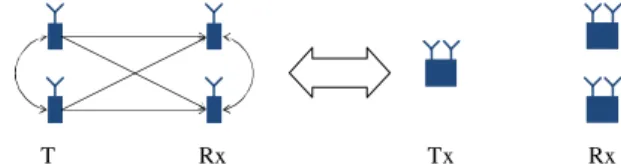
maximize the sum capacity in a similar way as in [5]. How-ever, due to space limitations, we skip out this point and as-sume that an appropriate selection on the powers is made. Figure 2 shows the schematic equivalent view of the simplest case where 2 transmit sensors and 2 receiving sensor are al-lowed to cooperate. It is observed that the original interfer-ence channel is transformed into a BC channel with multiple receiving antennas. This is the reason of the performance improvement.
Figure 2. Left hand side. Original scenario. Right hand side,
equiva-lent scenario with both Tx and Rx cooperation
3. SCENARIO WITH INTERCLUSTER INTERFERENCE
The model presented in this section permits to quantify the new situation where other cluster is also transmitting there-fore interfering in transmission. We will only consider the case of one interfering cluster. Extension to several clusters is straightforward and will reinforce the Gaussian hypothesis for the interference that we will claim. Interfering signal at sensor k will be
int intx F mH k MIMO k P
i = α (4)
where mk is the flat fading channel from interfering cluster to
the reference sensor, Fint is the precoding (power normalized)
performed at that cluster and xint is the transmitted sequence.
The factor α >0 means the extra loss in front of the de-sired link and models the fact that interfering cluster may be further away. Mean interference power clearly becomes:
MIMO k H k MIMO P P
Pint =α m FintFintHm =α (5)
By applying the Central Limit Theorem to the interference, we can approximate it as additional Gaussian noise. The equivalent effect of interference makes effective noise to be increased from:
MIMO
eff σ αP
σ2 = 2+ (6)
Figure 3 shows performance degradation in a 4x4 system in terms of the sum rate for different values of the effective noise variance, σeff2.
The result of the simulation states that independently of the cooperation strategy, wireless ad hoc networks needs some kind of coordination between neighbouring clusters in terms of multiple access strategy to avoid this important perform-ance degradation.
Tx cluster
Rx cluster
Interference cluster
In order to provide a feasible solution to this problem, we recall that in fact in a cluster are usually located many sen-sors additional to the already mentioned Ns that use to be
sleeping until some event wakes them. The idea that we pro-pose is to awake a set of sensors Nb -1 per every Ns sensors
so involving NbNs sensors where in each group of Nb sensors, the Nb-1 sensors play the role as dumb antennas in an
irregu-lar bidimensional beamforming. Hence we exploit SDMA (Space Division Multiple Access) principles. Although this is a well know topic in the literature, we have to claim that de-centralized beamforming adds some new features that must be looked at carefully. In fact we are dealing with irregular spatial distributed beamformers where preliminary results point out a significant array gain. It is also important to re-mark that the main drawback of this approach is that syn-chronization must be quite accurate [6, 7, 8].
0 5 10 15 20 25 30
2 4 6 8 10 12 14 16 18 20 22
Gain [dB]
S
u
m
r
a
te
[
b
/s
/H
z
]
System 4x4
σ2eff=0.3
σ2eff=0.03
Figure 3. Performance degradation due to interference
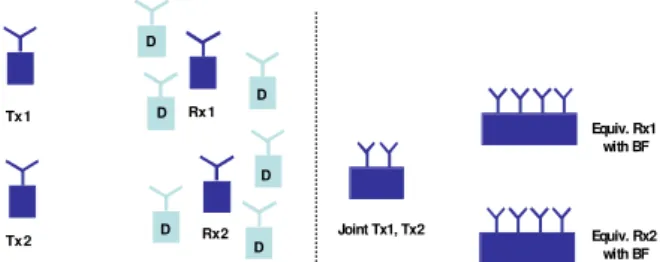
The use of dummy sensors and the equivalent MIMO system are shown in Figure 4. The 2x2 system with 3 dummy sen-sors per each receive sensor is depicted. It can be seen that the equivalent system becomes a MIMO system with single transmitter with Nt=2 antennas, and Ns=2 receivers with Nb=4
antennas.
Tx1
Tx2 D Rx2 D D Rx1
D D
D
Joint Tx1, Tx2
Equiv. Rx1 with BF
Equiv. Rx2 with BF
Figure 4. Left: 2x2 system with 3 dummy sensors per receive sen-sor. Right: Equivalent MIMO system
The key issue now is how to design beamfoming to improve performance. It is important to remark that dummy nodes only retransmit the received signal and that beamforming is only performed at the principal node. Our proposal follows a double purpose: on one hand, eliminate intercluster interfer-ence, on the other maximize intra-cluster throughput. In order to provide a reasonable model for this situation, we recall a suboptimum approach to the DPC optimization cri-teria known as Zero-Forcing DPC (ZF-DPC) [10].
4. PROPOSED SOLUTION FOR THE INTERFERENCE SCENARIO
Taking into account the interference and the fact that addi-tional dummy nodes are used to form a sub-cluster of Nb
nodes, signal vector received at the main node of the k-th sub-cluster (with beamforming) is given by
(
k k k)
H k
k r H Fx M F x n
y = + int int+~ (7)
where Hk (NbxNs) and n~ (k Nbx1) are the same as in Eq. (3)
but particularized to the k-th sub-cluster, Mk (NbxNs) are the channel coefficients (with proper scaling) between interfering cluster and k-th sub-cluster and rk(NbxNs), is the
beamfor-mer applied at the main node of k-th sub-cluster. It is impor-tant to say that we will force Nb>Ns for rank reasons as we
will see later when computing the beamformers. If we define the received vector as T T
Ns T
] , ... , [y1 y
y= (NsNbx1), the total
channel matrix as TN T
T
s]
, ... ,
[H1 H
H= (NsNbxNs) and the total
interfering matrix T T
N T
s]
, ... ,
[M1 M
M= , we can put it
alto-gether to form
n R x MF R HFx R
y= H + H int int+ H (8)
where R diag{r1r2 rNs}
K
= is a diagonal block matrix
col-lecting individual array processing at every receiver and n is an (NsNbxNb) vector collecting the noise samples. The
di-agonal structure of R means that receivers in different clus-ters do not cooperate.
The ZF-DPC strategy is shown in [10] where F is the unitary matrix associated to the QR-decomposition of the equivalent channel matrix Heq
LQ H R H = H =
eq (9)
where L is the upper triangular matrix and Q is the orthogon-al matrix associated with the QR decomposition of matrix Heq. According to this idea, in our case we forceF=QH.
Clearly the triangular structure of L allows the DPC strategy to achieve no intra-cluster interference, while the beamform-ing design guarantees no intercluster interference.
Our criterion assumes that interference channels are known at receiver beamformers location. The suboptimum proce-dure can be described in several key ideas:
a) Eliminate completely the inter-cluster interference. In or-der to guarantee this condition, every beamformer rk must
fulfill:
0
int intx =
F M r k
H
k (10)
where Mk is the same as in (7).
Eq. (10) is quite simple under the rank condition already mentioned because rk must belong to the null space of Mk.
b) Recalling [9] it is proposed a suboptimum solution to this problem in the real multiantenna scenario without interfer-ence. We showed that beamformers maximizing throughput must be found from the following eigenanalysis.
k k
H k
kH r r
c) In order to fulfil both previous points, our solution is based on the decomposition of Hkinto 2 orthogonal components,
one of them expanding the null subspace of Mk.
k k
k k k
M M
H H
H = + ⊥ (12)
Final solution modifies criteria given by (11) as
k k
k kr r
H⊥M =λmax (13)
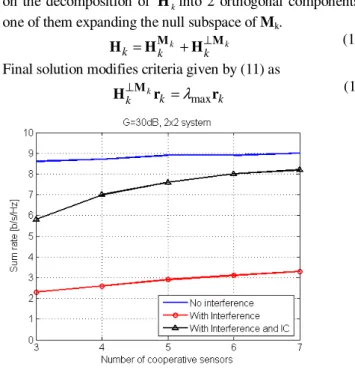
Figure 5. Effect of the number of dummy sensors
5. SIMULATION RESULTS
This section addresses some of the most remarkable results. The first scenario assumes that sensors are very closely spaced at both Tx and Rx (G=30dB). A low noise variance (σ2
=0.03) has been used in order to notice the degradation due to inter-cluster interference. Two transmit and two re-ceive sensors (2x2) system is considered, with variable num-ber of dummy sensors – from 2 to 6 (that is, 3 to 7 coopera-tive sensors). Simulation results are shown in Figure 5. The sum rate capacity is depicted depending on the number of dummy sensors for three different configurations: “Without interference”, “With interference” and “With interference and IC”. The first two approaches use beamforming given by Eq. (11) while the last one uses our proposed solution which can-cels interference by using beamforming of Eq. (13).
These three scenarios enable the comparison of the proposed system in terms of the maximum sum rate when no interclus-ter ininterclus-terference is present and dummy sensors are used for throughput maximization. It is interesting to notice that in-crement of the number of dummy sensors does not lead to important capacity improvement in the scheme (With Interfe-rence) while our proposed solution (With interference and IC) approaches sum rate without interference as the number of dummy sensors increase.
Another analysis considers the effect of the gain G. The same, 2x2 system is considered again, with four dummy sen-sors per each active Rx sensor (2x2x5) and noise variance
σ2=0.03. The simulation results are depicted in Figure 7. Only gains above 10 dB are considered as cooperation is not recommendable at low gains [5]. It can be observed that the performance loss of the system with inter-cluster interference and IC with respect to the system without cluster
inter-ference can be considered constant independent of the gain value. Nevertheless, it is interesting to notice that the per-formance gain is less pronounced with gain increment in the second system, with inter-cluster interference but without its cancellation, as the noise corresponding to the interference remains constant, independent of gain.
Figure 6. Effect of the gain in Tx and Rx sectors
6. CONCLUSIONS
This paper presents a new approach to the cooperation design in wireless sensor networks when both intra and inter-cluster interference are considered. The proposed solution is based on a combination of DPC principles for transmitter design to eliminate the intra-cluster interference while at receivers we have made use of dummy sensors to design a virtual beam-former that minimizes inter-cluster interference. This work also reinforces the idea that join Tx /Rx cooperation is the most suitable strategy for realistic scenarios with intra and inter-cluster interference.
REFERENCES
[1] A. Scaglione, D.L. Goeckel, J.N. Laneman. “Cooperative communications in mobile ad-hoc networks,” Signal Processing Magazine, IEEE Vol. 23 (5), September 2006. [2]: V. Stankovic, A. Host-Madsen, X. Zixiang. “Cooperative diversity for wireless ad hoc networks.” Signal Processing Magazine, IEEE Vol. 23 (5), September 2006.
[3] T.M. Cover, J.A. Thomas. Elements of Information Theory, New York, Wiley 1991.
[4] N. Jindal, Multiuser Communication Systems: Capacity, Duality and Cooperation. Ph.D. Thesis, Stanford University, July 2004.
[5] C. Ng, N. Jindal, A. Goldsmith, U. Mitra. “Capacity Gain from Two-Transmitter and Two-Receiver Cooperation.”
IEEE Transactions on Information Theory, vol. 53, no. 10, pp. 3822 – 3827, Oct. 2007.
[6] Ochiai, H., Mitran, P., Poor, H.V., Tarokh, V.; “Collabora-tive Beamforming for Distributed Wireless Ad hoc Sensor Networks.” IEEE Transactions on Signal Processing, Vol. 53, No11, November 2005.
[7] Mudumbai, R., Barriac, G., Madhow, U.; “On the Feasi-bility of Distributed Beamforming in Wireless Networks.”
[8] Barton, R.J., Chen, J., Huang, K, Wu, D., Wu, H-C.; “Per-formance of Cooperative Time-Reversal Communication in a Mobile Wireless Environment.” International Journal of Distributed Sensor Networks, to appear.
[9] S. Zazo, H. Huang. “Suboptimum Space Multiplexing Structure Combining Dirty Paper Coding and receive
beam-forming.” International Conference on Acoustics, Speech and Signal Processing, ICASSP 2006, Toulouse, France, April 2006.