The large-activation-energy analysis of extinction of counterflow
diffusion flames with non-unity Lewis numbers of the fuel
Amable Lifian
3, Daniel Martinez-Ruiz
b,Marcos Vera
b, Antonio L Sanchez
0'*
A B S T R A C T
Large-activation-energy asymptotic techniques are used to describe the effects of non-unity Lewis num-bers of the fuel on strain-induced extinction of axisymmetric counterflow diffusion flames. The present work extends and clarifies previous investigations by accounting also for variable density and variable transport properties of the gas. In our asymptotic analysis the flame structure near extinction is, at lead-ing order, given by the Burke-Schumann limit of infinitely fast reaction; i.e. two outer regions of equilib-rium flow, with the fuel and the oxygen separated by an infinitesimally thin reaction layer where they arrive by diffusion in stoichiometric proportions. The leading-order description provides the basic flow structure, including the flame-sheet location, the fuel-consumption rate, the temperature gradients on both sides of the flame, and the peak value of the temperature, which plays a dominant role in flame extinction and differs significantly from the adiabatic-flame value for non-unity Lewis numbers. In the near-extinction regime small departures, due to finite rates, from the fast-reaction limit are enough to dominate the structure of the reaction layer, and must be taken into account in this thin layer and in the outer chemically frozen regions, where the corrections are associated with the reactants leaking, with small mass fractions, through the flame. The main effect of the differential diffusion in the near-extinction regime is due to the strong modification of the reaction rates resulting from the changes in the Burke-Schumann peak temperature, with only moderate corrections due to leakage of the reactants through the flame. For large values of the overall stoichiometric ratio S of the diffusion flame, defined as the mass of the air stream needed to burn to completion the unit mass of the fuel stream, the extinction conditions occur in a premixed-flame regime, in which the reaction layer is displaced towards the fuel side with respect to the Burke-Schumann flame sheet position and a fraction of the arriving fuel mass flux leaks through the reaction layer, while the mass fraction of the leaking oxygen decreases to negli-gibly small values. The asymptotic predictions are tested by comparison with numerical integrations of extinction curves based on continuation methods.
1. Introduction
Norbert Peters's work had a profound effect on our understand-ing of many different aspects of Combustion Science. Of paramount importance are his contributions to reduced-kinetic mechanisms, and to the development of flamelet-modeling approaches for the description of finite-rate effects in turbulent combustion [1]. In his famous 1984 review paper [2], he explained in an exemplarily ped-agogic manner the role of laminar diffusion flamelets in turbu-lent non-premixed combustion, building on ideas introduced ear-lier by Forman Williams [3]. As stated by Norbert Peters [2], "the
steady laminar counterflow diffusion flame exhibits a very similar scalar structure as unsteady distorted mixing layers in a turbulent flow field", which leads him to propose the counterflow geometry as "the most representative steady flow field to study chemistry models and molecular transport effects in laminar flamelets". In the present paper, we pay homage to Norber Peters by revisiting the counterflow diffusion flame, with particular attention given to differential-diffusion effects on flame extinction.
point the mixing layer is selfsimilar, with the temperature and species mass fractions varying only with the distance to the stag-nation plane. The solution depends on the stagstag-nation-point value of the strain rate imposed on the mixing layer, given by the rate of growth of the radial velocity, constant in each of the external streams.
In diffusion flames, when the rate-controlling chemical reac-tions have a strong temperature dependence, the nonlinear inter-action of the flow and the chemical kinetics leads to the existence of distinguished regimes of ignition and extinction, described by Lifian [5] for unity values of the Lewis numbers of the reactants, consumed by a single irreversible reaction having an Arrhenius rate with large activation energy. While in fuel-air systems that ap-proximation is sufficiently accurate for oxygen, most hydrocarbon molecules are large, and their diffusivities, although of the order of the thermal diffusivity of the gas mixture, are smaller, with val-ues of the fuel Lewis number LF moderately larger than unity, the
approximation LF = 1 being reasonably accurate only for methane.
On the other hand, hydrogen molecules are small, and the asso-ciated Lewis number is LF = 0.3; although an overall reaction is
only applicable near the lean flammability limit when the hydro-gen is diluted significantly in its feed stream [6]. Both moderately large and moderately small values of LF are of interest in
applica-tions, thereby motivating the present investigation of differential-diffusion effects that, as explained below, complements many of the previous efforts to analyze extinction.
Linan's asymptotic analysis [5] showed that the structure of the diffusion flame in near-extinction conditions is given, at leading or-der, by the Burke-Schumann fast reaction limit, when the reaction layer appears as a flame sheet separating a region without fuel from a region without oxidizer. The description of extinction re-quires consideration of nonequilibrium effects within the reaction layer. The asymptotic formulation for large activation energies re-quires a double-limit expansion in which the preexponential fac-tor and the activation energy of the Arrhenius reaction-rate con-stant both grow to large values in such a way that the resulting temperature decrement in the reaction layer from the peak Burke-Schumann value is small, of the order of the Frank-Kamenetskii temperature, sufficient to decrease the strongly temperature de-pendent reaction rate by a factor of order unity, and lead eventu-ally to flame extinction. The asymptotic analysis generates, from a reaction-diffusion balance, a canonical boundary-value problem for the reaction-layer structure, whose solution determines the small amount of reactants that leak through the flame in terms of the Damkohler number, the appropriate ratio of the strain time and the reaction time. The leaking reactants, whose growth is respon-sible for the extinction of the flame, are transported out of the reaction layer, where in the near-extinction regime the reaction is frozen because of the lower temperatures. When the reactant Lewis numbers are equal to unity, as considered in [5], the solution for the reaction-layer structure and the associated computation of the critical extinction conditions are not influenced by the feed-back effect of the outer perturbations due to the reactant leakage. For non-unity Lewis numbers of the reactants the inner problem and the first-order corrections to the outer equilibrium solutions are coupled, thereby complicating the determination of the criti-cal extinction conditions, which involves the integration of a set of linearized, chemically frozen transport equations for the leaking reactants in the external streams (see, e.g., the online supplemen-tal appendix of [7]).
It is now known how to deal with the Burke-Schumann (B-S) fast-reaction limit to describe the diffusion-flame-sheet structure for non-unity Lewis numbers [7], and how to calculate the peak flame-sheet temperature, which plays an essential role in determining the finite-rate effects that lead to flame extinc-tion. For unity Lewis numbers of the reactants, in the limit of
in-finitely fast reaction, the peak temperature is equal to the adia-batic flame temperature, defined as the combustion temperature of a gas mixture obtained by combining in stoichiometric propor-tions the air and fuel feed streams with their corresponding ini-tial temperatures. However, for non-unity Lewis numbers the peak temperature of the B-S limit depends on the values of the Lewis numbers, the dilution of the fuel stream, and also on the spe-cific geometric configuration considered, so that, for instance, the resulting peak temperature is typically found to vary along the flame surface. While accounting for differential-diffusion effects in B-S computations is a relatively simple task in one-dimensional-type steady configurations like the counterflow considered here, in time-dependent multi-dimensional flows the computation poses a complicated free-boundary problem, difficult to handle in nu-merical simulations. As explained in [7-9], these computations can be facilitated for non-unity Lewis numbers by using a formulation based on chemistry-free, Shvab-Zel'dovich, linear combinations of the temperature and reactant mass fractions, not changed directly by the reactions, as conserved scalars.
Different researchers have attempted to solve the extinction problem with non-unity Lewis numbers [10-13], starting with Lifian [10], who addressed also the possibility of extinction in the premixed-flame regime. Extinction in the diffusion-flame regime was studied by Chung and Law [11] for various one-dimensional configurations in the constant-density approximation. Their anal-ysis, which correctly accounts for departures of the flame tem-perature from the adiabatic value, showed how the reaction-layer structure is reducible to the canonical problem derived originally by Lifian [5] for the equidiffusional case, although in this case the matching procedure involves two terms in the expansions for the outer regions, to include the feedback effect of the leakage of re-actants through the flame. This aspect of the problem was also subsequently acknowledged by Kim and Williams [12], who specif-ically considered equal diffusivities of the two reactants in their counterflow extinction investigation. The validity of a previous at-tempt [13] to describe differential-diffusion effects on extinction without accounting for these outer perturbations and for depar-tures of peak temperadepar-tures from the adiabatic value is necessarily restricted to near-unity Lewis number cases.
The purpose of the present paper is to provide a clarifying de-scription of the extinction for large activation energies of counter-flow diffusion flames, based on the appropriate double limit for the diffusion-flame extinction regime. Our work accounts for the effects of variable density and variable transport properties. The accuracy of the asymptotic analysis will be assessed through com-parisons with results of finite-rate computations employing a one-step Arrhenius model with large but finite activation temperature.
The paper begins by giving in Section 2 the formulation of the counterflow problem, with a one-step Arrhenius reaction, ac-counting for variable density and variable transport properties. The structure of the diffusion flame in the Burke-Schumann limit of infinitely fast reaction is formulated in Section 3 for a non-unity Lewis number of the fuel, and the resulting problem is solved nu-merically for relevant values of LF and of the fuel-feed dilution.
Departures from chemical equilibrium leading to flame extinction are considered in Section 4. The simplified description of the near-extinction conditions occurring in the premixed-flame regime for small values of the B-S heat-loss rate to the fuel side is given in Section 5. Finally, concluding remarks are given in Section 6.
2. Description of diffusion flames in counterflow mixing layers
2.1. Chemistry model
separating a stream of air from a stream containing a mixture of fuel and inert. The reaction between the fuel and the oxygen of the air will be considered to occur according to the global irreversible step
F + s 02^ (1 + s)P + q> (1)
where s and q' are the mass of oxygen consumed and the amount of heat released per unit mass of fuel burnt; the products of the reaction are lumped, for simplicity in the presentation, into a sin-gle product P. As noted in [7], the resulting values of these pa-rameters differ only by a small amount for saturated hydrocarbons (e.g., s = (3.52,3.48) and q' = (48.10,44.56) MJ/kg for heptane and dodecane, respectively). It is of interest that, although the associ-ated values are quite different for hydrogen, for which s = 8 and q' = 120 MJ/kg, the value of the heat release referred to the unit mass of oxygen burnt q'js = 15 MJ/kg is very similar to the values q'js = 13 MJ/kg found for alkanes.
In the following analysis, the reaction rate will be modeled us-ing the simple Arrhenius expression
wF = B'p'e-E'^Y,Y07 (2)
for the mass of fuel consumed per unit volume per unit time, first order for the fuel and oxygen for simplicity in the presentation. Here, p' and T represent the density and temperature of the gas mixture and YF and YQ2 are the mass fractions of fuel and oxy-gen. Two rate parameters appear in (2), namely, the preexponen-tial frequency factor B' and the activation energy E, which defines the activation temperature Ta = E/R when divided by the univer-sal gas constant R. The Arrhenius exponential is a strongly depen-dent function of the temperature when E is large compared with the thermal energy RT (i.e. for TajT » 1). The much smaller tem-perature dependence of the frequency factor of the overall, non-elementary, reaction is neglected.
It is worth emphasizing here that (1) is not an elementary re-action; it is an overall reaction representing the underlying stoi-chiometry of the fuel-oxidation process. Consequently, its overall rate, given in (2), does not follow the law of mass action. In appli-cations, the kinetic parameters B' and E could be selected to give a good approximation of the stoichiometric premixed-flame struc-ture. A kinetic model of this type, including unity orders for both reactants, has been shown to be successful in describing methane combustion [14], for instance. It would be straightforward to ex-tend the asymptotic analysis given below to reaction rates with non-unity reaction orders, as done for premixed flames in early work [15].
2.2. Conservation equations and boundary conditions
We shall consider the steady axisymmetric counterflow diffu-sion flame established in a steady mixing layer separating opposed nearly inviscid streams of fuel, coming from z = oo, and air, com-ing from z = -oo. In the stagnation-point region the radial veloc-ities on the air and fuel sides outside the mixing layer grow lin-early with the radial distance to the stagnation point r according to 2v' = AAr and 2v' = A0r. The strain rates on the air and fuel sides AA and A0 are different, their values being related to the fuel-to-air density ratio p'0/p'A by the equation A0 = AAJp'A/p'0, resulting from the condition of negligible pressure variation across the mix-ing layer. In the stagnation-point region the reactmix-ing flow is self-similar, inside and outside the mixing layer. The density p'{z), the temperature T{z), and the mass fractions Y^{z) and YQ2 (Z) of fuel and oxygen are functions of the distance z to the stagnation plane, as are the axial velocity u'{z) and the strain rate A'(z) = 2v'/r, the latter determining the linear growth with r of the radial velocity v''. The velocity field is coupled with the density through the
con-tinuity equation
_d_
dz ( p V ) + p'A' = 0. (3)
Since the radial pressure gradient -dp''/dr = p'AAjr/4 = p'0A^r/A is uniform, the radial component of the momentum equation takes the form
A ( AA'\ . ,&A' \ , , Al ,An, n
(4)
where \i! is the viscosity of the gas mixture. The conservation equations for reactants are
d / d YF\ , ,dYF
d n,n dYo2
p V dYo2 dz SWp.
(5)
(6)
A Fickian description is adopted for the species diffusion velocities, with Dp and D0 representing the molecular diffusivities of fuel and
oxygen, respectively. The energy conservation equation is
_d_ dz
d T
:"dz • p'u'cp
dT
"dz -q wF. (7)
where k and cp are the thermal conductivity and the specific heat
at constant pressure, the latter assumed to be constant for sim-plicity in the presentation. Here wF is the mass consumption of
the fuel per unit volume per unit time, given by the Arrhenius expression (2), involving an oxygen-consumption rate sw? and a heat-release rate q'w?.
The above equations must be supplemented with the equation of state, which is written in the simplified form
p'V = p'Ji,
(8)neglecting the variations of the pressure, an approximation jus-tified for low-Mach-number combustion, and, for simplicity, the variations of the mean molecular mass. Here T'h is the temperature of the air stream. The simple power-law expressions
fi p'Df p'D0
kA fiA pADfA p'ADoA (9)
will be adopted for the temperature variation of the transport properties from their air-side values, with the exponent a = 0.7 used in the computations below.
The above equations must be integrated with the boundary conditions
A'-A0=Y,-Yh A'-AA=Y¥ = Y07
Y0l = - VQ2A
0 as
as
+OC
(10)
where ro' represents the fuel-stream temperature and Yp0 and
Y0lA ~ 0.232 are the values of the mass fractions of fuel and oxy-gen in their respective feed streams. The translational invariance present in the counterflow mixing-layer problem is removed by se-lecting the origin for the transverse coordinate at the stagnation plane, so that u'(0) = 0.
The equations will be written in dimensionless form by intro-ducing the scaled variables
A N_
A~A
yFo
p'u'
P>A(DTAAA)V2 yp2
yb,A
p
EL
P'Kwhere DjA = kA/(pAcp) is the air-side value of the thermal dif-fusivity. The effects of the large variations of density and trans-port properties occurring across t h e mixing layer, as a result of the combustion process, can be conveniently accounted for in the formulation by defining a dimensionless heat-conduction-weighted transverse coordinate
\ 1 / 2 z
incorporating t h e temperature dependence of t h e transport prop-erties given in (9). In (12) z appears divided by (DjA/AA)ll2, the
characteristic mixing-layer thickness based on the constant heat conductivity and density values of the air stream. This alterna-tive transverse coordinate r\, which is different from the Howarth-Dorodnitsyn variable, will be used below to compare with the an-alytic description given later.
Introduction of the dimensionless variables defined above into (3)-(10) leads to
dF
r L - rf f- V \ = o (13)
at]
along with the dimensionless thermochemical parameters S and q. The parameter S = SYF0/YO2A is the mass of t h e air stream needed to burn t h e fuel contained in t h e unit mass of the fuel stream, which appears as t h e ratio of the reaction terms in (16) and (15); its value depends on the mass fractions of t h e fuel and the oxygen in their feed streams. Although S is a fairly large number in undi-luted fuel-air combustion (e.g., S ^ 15 and S = 34.5 for dodecane-air and hydrogen-dodecane-air cases, respectively), values of order unity are also of interest because they are found in combustion systems with reduced values of Yp0 resulting from dilution of the fuel stream. The other thermochemical, exothermicity, parameter is t h e dimen-sionless heat release per unit mass of fuel q = q%Q/(cpTA), based
on T^ and on the specific heat at constant pressure cp, consid-ered in this paper to be constant; q appears as t h e ratio of the reaction terms in (17) and (15). Notice that q/S = (q'/s)Y02A/(cpT£)
is independent of t h e fuel dilution in its feed stream. The ra-tio q/(S+ 1) = Ts - 1 is t h e dimensionless temperature increment,
based on T^, for the adiabatic isobaric combustion of the gas mix-ture generated by mixing, in stoichiometric proportions, the unit mass of t h e fuel stream with the mass S of t h e air, both at the air-side temperature 7^.
Pr d2A ,dA T° drj2 drj
1 d2YF
kJrf2
,dYp drj
TO
Y
^YpYnJ-e-(14) 2.3. Conserved scalars from coupling functions in diffusion flames
Ta/T
A*
dr]2 :dYo
dr]
AT
ST
" A
(15)
(16)
,/»/» B
-qT°-%Y0^< Ta/T (17) d2r
drj2 ' ' dr] ~ ^ 'r'uA \
subject to F ( 0 ) = 0 and t h e matching conditions with t h e outer streams
| A - y r0 = YF - 1 = Y0 = T - T0 = 0 as r] - * + o c
L 4 - 1 = YF= Y0- 1 = r - l = 0 as r / ^ - 0 0 . (18)
Here T0 = T^/T^ represents the fuel-to-air temperature ratio, with the fuel-to-air strain-rate ratio given by A0/AA = (p'A/ p'0)X12 = ^/%-.
as follows from t h e equation of state (8). Here, LF = (k/cp)/(p'Df)
and Pr = ]i/(k/cp) are t h e fuel Lewis number and t h e Prandtl
num-ber, both assumed to be constant but different from unity. A unity value is assumed for the Lewis number of 02, a reasonably good approximation for fuel-air mixtures. Note that, because of the nor-malization of the reactant mass fractions, a modified frequency fac-tor B = B'Y0 A replaces B' in the reaction-rate terms in (15)-(17).
Since we have chosen the origin of i\ where the transverse ve-locity vanishes, t h e condition F ( 0 ) = 0 has been added when inte-grating (13)-(17). If desired, the numerical integration determines the displacements (F - T/)-CO and (F - T^~ /2i])+00 of t h e air and
fuel streams. The numerical integrations given below for equal feed temperatures (i.e. T0 = 1) revealed that t h e displacements are very
small, as it is also t h e case of the deviation of F from i\ across the mixing layer. If we use in t h e conservation Eqs. (15)-(17) the approximation F = i\ then these equations are, aside from t h e fac-tor TCT_1 in t h e reaction terms, identical to those obtained in the thermodiffusive approximation (i.e. with constant density and con-stant transport properties), thereby simplifying considerably the analysis.
In addition to t h e parameters LF, Pr, and a entering in the transport terms, two dimensionless kinetic parameters, namely, the dimensionless frequency factor {BjAA) and the nondimensional
ac-tivation temperature Ta=E/(RTA), appear in the reaction terms,
To facilitate t h e analysis of t h e fast-reaction limit it is conve-nient to replace two of Eqs. (15)-(17) by two chemistry-free con-servation equations, obtained by eliminating the reaction terms through appropriate linear combinations. For instance, multiplying (16) by qjS and adding (17) leads to
d2 dr]2
(T + qYo/S)
dr] ^ qYo/S) 0. (19)
involving a single coupling function ( r + qY0/S), which can be conveniently expressed as an excess thermal and chemical en-thalpy H = T - 1 + (q/S)(Y0 - 1) (i.e. enthalpy in excess of that in the air stream) that, divided by its value in t h e fuel stream, de-fines
r - l + ( g / S ) ( Y0- l )
or
T0 - 1 - q/S
r - i = (
9/s)(i-£-?o) + (ro-i)£-
(20)The normalized enthalpy £ is a conserved scalar, not changing in the reaction, with a Lewis number equal to unity, which satisfies the source-free equation
dr]2 dr]
with t h e boundary conditions £ ( - 0 0 ) = 0 and f (00) = 1; so that § increases monotonically with i\ from 0 to 1. The first term in the second relation in (20) shows how the temperature grows when the oxygen mass fraction decreases due to t h e reaction.
The reaction term can also be eliminated by subtracting (16) from (15) times S to give
_d__ dr]2
SYF
I F F ^
Yo) = 0 . (22)
Two different linear coupling functions appear above in t h e con-vective and diffusion terms w h e n the fuel Lewis number LF is dif-ferent from unity. When these coupling functions are normalized with their values in t h e air and fuel feed streams we obtain a diffusion-weighted mixture fraction
SYF/LF 1
arising from the diffusion terms, in addition to the classical mix-ture fraction
SYF
S + l (24)
derived from the convective terms, so that (22) takes the compact form
S/U + 1 d2Z | f dZ _ Q
S + l drj2 drj
(25)
The boundary conditions (18) together with the definitions given in (20), (23), and (24) lead to
Z - l = Z — 1 = 0 and % = 1 as t\ -* oc
Z = Z = 0 and £ = 0 as t\ -* -oo, (26)
to be used as boundary conditions for (21) and (25), the latter involving the unknowns Z and Z. These equations are to be inte-grated together with (13), (14), and one of the equations, e.g. (17), involving the reaction term.
2.4. Sample computations
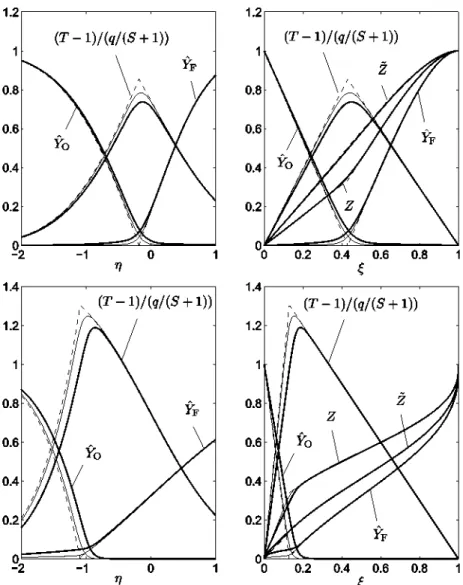
Results of numerical integrations of (14)-( 18)—carried out for a = 0.7 and Pr = 0.7, as is appropriate for fuel-air mixtures—are given in Fig. 1 for dilute fuel feed (S = 2) and equal feed temper-atures (T0 = 1). The figure includes solid curves representing
tem-perature and reactant mass fractions for LF = 0.3 (lower plot) and
LF = 2 (upper plot) along with dashed curves representing results
for infinitely fast reaction, to be discussed later. For both flames in Fig. 1, the values of the ratio BjA^ have been selected using the estimate (45) to place the flame near extinction.
The Lewis numbers are representative of hydrogen (LF = 0.3)
and large hydrocarbon (LF = 2) molecules, respectively. Because of
its higher diffusivity, the hydrogen reaction layer, where the tem-perature peaks, sits farther from the stagnation plane than that of the hydrocarbon flame. Differential diffusion has a noticeable ef-fect on the resulting temperature increment T - l , measured in the plots with the value q/(S+ 1) corresponding to adiabatic sto-ichiometric combustion. The temperature profile for LF = 2
dis-plays a peak value below the adiabatic flame temperature Ts = 1 + q/(S + 1), whereas a superadiabatic peak temperature above Ts is found for the diffusivity of hydrogen.
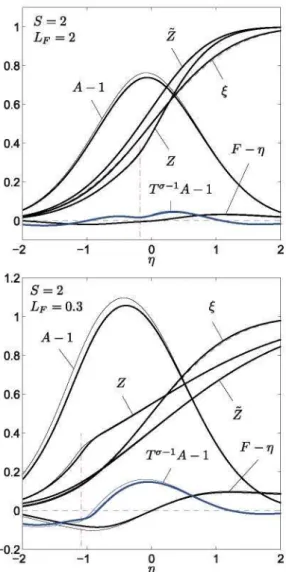
As previously anticipated, for the description of gaseous coun-terflow mixing layers the heat-conduction-weighted coordinate r\, defined in (12), is more convenient than the commonly used density-weighted coordinate, in that it facilitates the analytic de-scription of the flow. The simplification stems from the fact that with this coordinate the variation with temperature of the heat conductivity does not appear in the transport terms of (14)-(17). There is the additional unexpected advantage that the resulting transverse mass flux F is approximately given by F = r\, holding for all conditions tested in this paper, as illustrated in Fig. 2 by paring F = rj with the function F[r\) given by the numerical com-putations shown in Fig. 1. Also shown in the plot is the variation with rj of £, Z, Z, and the strain rate A{r\), or radial velocity scaled with r, which has an overshoot due to the pressure gradient im-posed on the heated gas of the mixing layer. If this approximation F = rj is used in (15)-(17) then the temperature and mass fractions become identical, with the coordinate r\, as given by the approxi-mation of constant density and transport properties. The expected degree of accuracy of the resulting approximate description is in-vestigated in Fig. 2 by plotting the overshoot above 1 of the source term of F in (13), and also the excess enthalpy £ computed nu-merically, as defined in (20), to compare with the analytic predic-tion | = j[\ +erf(7//\/2)] obtained from (21) with F = i\. As can be seen, the resulting departures in £ are negligibly small, thereby
motivating the use of the approximation F = i\ in (15)-(17) to ob-tain analytic predictions for different flame properties.
3. The B-S limit of infinitely fast reaction
3.1. General considerations
As mentioned above, in computing the reactive mixing layer, one can replace two of the three Eqs. (15)-(17) by the chemistry-free Eqs. (21) and (25). This replacement is required in the B-S limit, B/J4A -> oo, of infinitely fast reaction rates, for which
the dimensionless reaction rates on the right-hand side of (15)—(17), which involve the ratio BjA^ as a factor, lead to the same chemical-equilibrium condition of non-coexistence
%% = 0 (27)
of the reactants, outside an infinitesimally thin reaction layer lo-cated at 7} = rjf, because the fast reaction prevents them from crossing the reaction layer. The B-S fast-reaction problem is then reduced to the integration of the reaction-free Eqs. (13), (14), (21) and (25), together with (27), which corresponds to the com-plete consumption of either the fuel or the oxygen outside the flame. In the B-S limit BjA^ -> oo the reaction terms in (15)-(17) become Dirac-delta source terms, that—necessarily balanced by the diffusion terms—act as sinks for the reactants—which in this limit arrive at the flame sheet with zero concentration—and as a heat source for the temperature, which peaks at t] = t]f with a value F = Tf. This, as well as the value £y of £ at the flame, are to be calculated as part of the solution. The fuel and the oxygen reach the flame sheet by diffusion from opposite sides to arrive in sto-ichiometric proportions, with the ratio 1/S of the Dirac-delta type reaction terms in (15) and (16). The associated mass fraction gra-dients, which jump down to zero across the reaction layer, are de-fined by
mF
1 dYF _l_dYb
S drj
m0
S ' (28)
Here mF and m0 = Snip are appropriate nondimensional measures
of the fuel and oxygen flame consumption rates. For example, the value of mF can be used to evaluate the rate of fuel consumption
per unit flame surface nip = p'DpdYp/dz, giving
m'i
•• mF. (29)
The heat released at the flame, given by qm? = (q/S)m0, is trans-ported by conduction towards both sides of the flame according to
qrrif. dT drj dT drj (30)
because the Dirac reaction term in (17) is q times the reaction term in (15). The relations (28) and (30) can be obtained directly from the reaction-free conservation Eqs. (19) and (22), because in the thin reaction layer the two infinitely large second derivatives in their first term must compensate each other with negligible effect of the convective term.
For the counterflow problem, and also for other one-dimensional problems, the flame location rjf and the peak tem-perature at the flame Tf can be determined by patching two reac-tion free boundary-value problems, in which (13)-(15) and (17) are integrated for i\ > 7\f (where Y0 = 0), while (13), (14), (16), and
(17) are integrated for i\ < 7\f (where % = 0). At the flame sheet, we use the condition YF = Y0 = 0 resulting from the limiting
1.2
1
0.8
0.6
0.4
0.2
(T-l)/(q/(S
- \ \''
s\ ^ / ^ ~ x
\ // /
*°
A / /
//y\z J
+1))
y
yF
-\
Fig. 1. The profiles of temperature and reactant mass fractions as obtained from integrations of (13)-(17) (solid curves) and from integrations of (13), (14), (21), and
(25) (dashed curves) for T0 = l, <J=20, and S = 2 with LF = 0.3 (lower plot) and LF = 2 (upper plot). The left-hand side plots use the distance to the stagnation plane
i) as independent variable while the right-hand side plots, which include also profiles of Z and Z evaluated from (24) and (23), use the excess enthalpy £ defined in (20) as independent variable. The values of the rate parameters in the finite-rate chemistry computations are B/AA = 1.585 x 101" (thick lines) and B/AA = 2.868 x 101" (thin lines)
with Ta = 140.26 for LF = 0.3 and B/Ah = 2.82 x 10⁷ (thick lines) and B/Ah = 6.354 x 10⁷ (thin lines) with T„ = 67.31 for LF = 2; the activation temperature T„ is selected in both computations to give a value of the Zel'dovich number based on the B-S peak temperature f) = 10, with f) defined in (44).
in the gradients of temperature and reactant mass fractions at the flame sheet, resulting from the Dirac-delta nature of the chemical-reaction term in the limit BjA^ -* oo.
3.2. Conserved-scalar description of the fast-reaction limit
Handling for non-unity Lewis numbers the B-S limit of infinitely fast reaction becomes considerably more difficult in un-steady or multidimensional situations, for which the determination of the flame location poses a complicated free-boundary problem. For those general configurations, the velocity, temperature, and fuel and oxygen concentrations can be obtained (see [7-9]) using the fast-reaction limiting condition (27), i.e. Y0% = 0, together with the coupling functions £, Z, and Z defined in (20), (23), and (24), which satisfy chemistry-free transport equations (given for the counterflow in (21) and (25)), to be integrated together with the continuity and momentum equation, needed to determine the accompanying velocity field. To solve these equations we need to relate T and Z with £ and Z. These relations can be obtained using the fast-reaction condition (27) of non-coexistence of Y0
and YF, which are simultaneously zero at the flame, given by the
iso-surface Z = ZS = 1/(1 +S), or Z = ZS = 1/(1+S/LF), as follows
from the definitions (23) and (24). For Z >ZS
"o 0 and Yf
Z-Zs Z-Z,
r - 1 = ( T
01 ) £ +
-whereas for Z <ZS
% = 0 and Y0
T - 1 = ( 7 b - ! ) £ + •
:0
Zs
z
\-Z
s(31)
Z
2s"
z
(32)Equations (31) and (32) provide piece-wise linear relations for the evaluation of YF, Y0, and Z in terms of Z. In addition, the last
relation in the equations gives T in terms of Z and £. When these are used together with (20) and (23), the flame location rjf is determined as the value of r\ where Z = Zs, and Z = Zs, while the flame temperature
Q,
Fig. 2. The variation of the transverse mass flux F, strain rate A, excess enthalpy £, mixture fraction Z, and diffusion-weighted mixture fraction Z as obtained from integrations of (13)—(17) (solid curves) for the parametric values of Fig. 1. The dashed lines represent the excess enthalpy profile £ = 1[1 + erf(ij/V2)] obtained from (21) with the approximation F = IJ. The vertical dash-dotted lines indicate the flame location rjf in the B-S limit.
is given by t h e value £y of t h e excess enthalpy at the flame, as follows from (20). Notice that the temperature and mass fractions, and also Z, given by (31) and (32) are continuous at the flame sheet, while their gradients have j u m p s there associated with the Dirac-delta reaction terms of their original conservation equations, as seen in t h e sample calculations of Figs. 1 and 2. However, the gradients of t h e conserved scalars £ and Z, determined by the sourceless Eqs. (21) and (25), are continuous at the flame sheet, as shown by (28) and (30). Their values at t h e flame sheet, Z = Z$, can be used to evaluate the fuel and oxygen consumption rates per unit flame surface
mF: m0 S
1 dYF
IdYb
S dr]l + S / LFd Z
d/j it
and the fuel-side temperature gradient
dT_ drj
ft
(T0 - 1 - q/S)
it
The latter expression can be combined with (30) to yield
KF = 1 - Ko <jmF
i dr
drjm
0
\ q/S J
dr](35)
(36)
for the fractional amount of chemical heat release that is con-ducted towards t h e fuel side of the flame; while y0, close to unity
when S > 1, represents the fraction transported to the air side. The problem simplifies when LF = 1, in which case t h e two scalars Z and Z are equal and satisfy the same Eq. (21) and bound-ary conditions as t h e conserved scalar £. The solution reduces to the integration of (13) and (14) together with an Eq. (21) for the passive scalar £ = Z = Z. In particular, t h e peak temperature evalu-ated from (33) with £y = ZS is
'/
1 S + l S + lq (To - 1 ) :(37)
where Ts is t h e adiabatic flame temperature resulting from
burn-ing, at constant pressure, t h e mixture formed by combining in sto-ichiometric proportions t h e unit mass of t h e fuel stream with the mass of the air stream, at their corresponding initial temperatures. As can be seen in the sample B-S computations with LF ^ 1 shown in Fig. 1, the peak temperature TV differs from Ts.
3.3. Burke-Schumann description for non-unity fuel Lewis numbers with the approximation F = r\
The use of the approximation F = i\ for the velocity field in (21) and (25) allows us to derive analytic predictions for rjf, Tf, mF, and yQ, which are identical to those obtained with the assumption of constant density and constant transport properties in the sup-plemental online material of [7]. With F = i\ the excess enthalpy obtained from integration of (21) reduces to
%
r - i + ( g / s ) ( yT0 - 1 - q/S 2 0- i ) _ i[1+erf 07/72)]
(38)whereas integration of (25) supplemented with (31) and (32) pro-vides
VF = 0 a n d Y0 •.
for Tj < Tjj
and
Y0 = 0 a n d YF: Z_
Zs
Z
Is
1 + erf(??/V2)
1 + evf(r]f/V2)
(39)
Z-Zs Z-Z,
1 11 - Z s 1 - 2S 1 - erf(/j/v/LF/2)
for rj > rjf (40)
for t h e composition. Using (39) and (40) in (34) yields
mF
m o _ y2/0rLF)exp(-LF)]2/2) ^ (^2/7t/S)exp(-r]j/2) ~S~~ 1 1 + erf (J7//V2)
(41)
for the rates of reactant consumption. The last equation in (41) de-termines implicitly the flame location rjf, which can be used in (38) to yield
(34) £/
1 + erf(Tif/y/2) _Ts-(\+q/S)
2 T
0-0+q/S)
(42)for £<• and TV and in (36) to yield
KF = 1 - Ko 1 \ 1 \ q/S )
rf(J7//V2)
('"¥>
(43)
for yF and y0, thereby completing the determination of the flame
3.4. Variation of flame properties with the fuel diffusivity and fuel-feed dilution
The exponent a for the temperature dependence of the trans-port properties enters in the continuity and momentum Eqs. (13) and (14)—the latter involving also the Prandtl number Pr— which determine the transverse velocity F. Besides these trans-port parameters, the formulation in the limit B/A& -> oo involves as main parameters S, q, LF, and the fuel-to-air temperature ratio
F0. The numerical integrations, for the realistic values Pr = 0.7 and
a = 0.7, are restricted here to the case of equal feed temperature (T0 = 1). In selecting the other parameters the reader should note
that the values of S and q vary linearly with Yp0, so that their
ra-tio q/S = q'Yo2A/(cpTfS) is independent of the degree of dilution of the fuel stream. In fuel-air systems the resulting value is very sim-ilar for different fuels, including hydrocarbons and hydrogen, for which q'/s ~ 13 - 15 MJ/kg yielding qjS ^ 10 when YQ2A = 0.232,
cv = 1200 J/(kg K), and T'h = 300 K are used in the evaluations. This invariance is used in selecting the parameters in the computations below, so that for each value of S the nondimensional heat-release parameter q is given by q = 10S, representative of all fuel-air dif-fusion flames considered here. When this is implemented, only the two parameters LF and S, respectively measuring the diffusivity of
the fuel and the dilution of the fuel feed, need to be considered in evaluating the main flame properties in the limit of infinitely fast reaction.
The values of rjf, Tf, mF, and y0 obtained numerically by in-tegration of (13), (14), (21) and (25) supplemented with (31) and (32) are shown in Fig. 3. The figure allows us to evaluate the dependences of the different flame properties on the fuel Lewis number and on the fuel-feed dilution. To facilitate the represen-tation, the overall stoichiometric ratio S is replaced in the plots by the stoichiometric value of the modified mixture fraction Zs =
1/(1 +S/Lp). The range of values of the fuel Lewis number con-sidered 0.3 < LF < 2.5 covers adequately the conditions
encoun-tered in typical combustion applications. Besides results of numer-ical integrations, indicated by the solid curves, the plots include as dashed curves the approximate analytic predictions obtained from (41)-(43). The degree of agreement displayed in the plots is re-markable, thereby further underscoring the utility of the weighted coordinate r\ in analyzing counterflow flames.
The plots reveal the significant influence of the differential-diffusion effects on flame temperatures. While the temperature in-crement Tf - 1 with Lp = 1 remains always equal to the adiabatic value q / ( S + l ) , the peak temperatures are subadiabatic, i.e. Tf -1 < q/(S+ -1), for Lp > -1 and superadiabatic, i.e. Tf - -1 > q/(S+ -1), for Lp < 1. These observations are consistent with the classical rea-soning according to which for LF > 1 the rate at which the fuel
diffuses into the reaction layer is smaller than the rate at which the heat is removed, thereby resulting in a temperature decrease, while the opposite behavior is found for LF < 1. It is also of interest
that this effect is more pronounced for moderately dilute flames that sit close to the stagnation plane, as can be seen by observing the accompanying plots of flame location rjf. It is worth pointing out that caution should be exerted when extrapolating the quanti-tative results presented here, in that the values given are specific to the counterflow and cannot be applied directly to other config-urations, where Tf varies along the flame surface.
4. Extinction of diffusion flames in the diffusion-flame regime
4.1. Finite-rate effects for large activation energy
Finite-rate effects in the diffusion-flame regime are negligi-ble for large values of the Damkohler number, defined tenta-tively by multiplying the strain time A^1 by the characteristic
reaction rate Bexp(-ra/7y), evaluated with the B-S flame
tem-perature Tf. For large values of this tentative Damkohler num-ber, (B/AA)exp(-Ta/Tf), the reaction layer is very thin, with small mass fractions and small temperature differences from Tf, which grow to values of the order of the Frank-Kamenetskii temperature, ThTa, when approaching the extinction conditions.
For large values of the activation energy, or values of the acti-vation temperature Ta large compared with the flame temperature Tf, flame extinction in the diffusion-flame regime [5] occurs with small departures from the equilibrium solution described above. Extinction is associated with small decrements of the temperature in the reaction layer from the peak value Tf, which when of order F?/Ta are sufficient to reduce the reaction rate by a factor e, as can be inferred from the exponential temperature dependence in (2). The ratio of the characteristic temperature increase by the chemi-cal reaction, given by q/(S+ 1), to this Frank-Kamenetskii temper-ature, Tf/Ta, defines the Zel'dovich number
of order Ta\Tf for large S, as the relevant large parameter in the asymptotic description. The chemical reaction is confined to a thin layer of relative thickness /3_ 1, where we find small reactant mass
fractions of order YF ~ /3_ 1 and Y0 ~ /3_ 1. These estimates, together
with the requirement that the inner structure of the reaction layer is given by a balance between reaction and diffusion, can be used to provide from (17) the order of magnitude of the extinction strain rate
AA^Tf-\S + -[)p-3Bexp(-Ta/Tf). (45)
This estimate shows how the asymptotic limit of large activation energies, Ta\Tf > 1, requires simultaneous asymptotically large val-ues of the frequency factor B, resulting in the balance (45) to ensure that the temperature decrements are of order Tj/Ta = B^q/(S + 1) in the reaction layer.
The asymptotic description for /3 > 1 implies expansions in powers of /3_ 1 for the different variables in the inner reaction layer
and in the outer convective-diffusive layers. The determination of the critical strain rate at extinction, if we are ready to accept errors of order 1//3, requires consideration of only two terms in the ex-pansions of the dependent variables in the inner and outer layers. These two-term expansions begin, at leading order, with the B-S description; although the outer perturbations correspond to chem-ically frozen flow because of the associated low temperature.
4.2. The inner layer
The leading-order description of the thin reaction layer begins with the zero values of the mass fractions Yp and Y0 and the
flame-sheet temperature Tf, corresponding to the B-S limit, but small perturbations of order 1//3 in the reaction layer have to be taken into account for their description, with relative errors of order 1//3 in the extinction regime, using the reaction-diffusion balance and leaving out the convective term, which is smaller by a factor 1//3. In the inner reaction layer, the first perturbations to the leading-order B-S flame are rescaled to give normalized variables of or-der unity according to f = fi(r\ - r]f), yF = /3YF, y0 = /3Y0, and 0 =
Ta(T -Tf)/Tj = f)(T -Tf)/[q/(S + \)]. At the order pursued here, the determination of the extinction conditions involves only the terms in the above expansions, which are determined by integra-tion of the corresponding reacintegra-tion-diffusion equaintegra-tions
S d29 d2y0 S d2yF SB^B T/T „
0.2 0.4 0.6 0.8 ZS=1/(1+S/LF)
0.2 0.4 0.6 0.8 ZS=1/(1+S/LF)
1.4-1.3
+
1.2-31.1
T - H I 1
0.9
0.8
1
0.9
0.8
0.7
^ 0 . 6 I - | 0.5
II
P0.4 r~
0.3
0.2
0.1
__
0.5
1
2
LF = 0.3
\
\
y
——~~^' __^^y^
2.5
0.2 0.4 0.6 0.8 Zs = 1/(1 + S/LF)
x\
i/p = 0.3 / 0.5
/ 1
/ / 2
/ / 2.5
0.2 0.4 0.6 0.8
Z
s= 1/(1 + 5/L
F)
Fig. 3. The variation with Zs = (1 + S/Lp)-1 of the flame distance from the stagnation plane r]f, peak temperature Tf, fuel consumption rate mF, and fractional amount of heat of combustion towards the oxidizer y 0 of the counterflow B-S flame for Pr = 0.7, a = 0.7, <j/S = 1 0 , T0 = 1, and selected values of LF. The solid curves are results obtained
from numerical integrations of (13), (14), (21) and (25) supplemented with (31) and (32), whereas the dashed curves are the results obtained from the approximate analytical formulas (41)-(43).
obtained from (15)-(17); notice that the Arrhenius exponent is simplified to its linearized form 0. The boundary conditions for in-tegration of (46), given by
A9_ _
d l
=as A0_ _
d l
=as
- ( l - K o ) ( S + l)mF,
f -* oc
Ko(S + l)mF, ^ =
f - * —00
1 dyF
IF df
•"•£
: mF.
dyo d?
-Srrif
(47)
follow from matching with the gradients of the B-S solution in the outer regions. In the intermediate matching region—for large |f | and small \rj - ?7j|—the inner variables take the form
0 = - ( l - y b ) ( S + l)mF? +9+, y¥ = m¥L¥i;+y+.,
y?=y¥,yo = -s™?<; +y0 y0=yo as £
0 = yo(S + l)mFf
+9-as £ -> —oc
(48)
corresponding to (47). These expressions involve six unknown constants, namely, the reactant leakages y j and y^ and the apparent shifts y^, y^, 0+, and 0~.
When the first two equations in (46) are integrated once, using the boundary conditions given in (47), the result is
S + 1 dy0 , d6 , „ . , , S dyF dy0 c
—W
+
v
=
-
MS+l)m and
r
¥
w~W
=Sm
-(49)
while a second quadrature provides the relationships
—-—yo + 0 = -yp(S + l ) m
F£ + Q and —y
¥-y
0=Sm
¥l;+C2..
j LF
(50)
valid everywhere across the reaction layer. The two integration constants C\ and C2 are related to those in (48) by
S + l , . , S + l _ „ , Ci = ~^yt + e = ~^y0 + e and
-2 =
ryj-yz =
ry
¥-y
0,
LF Lp
obtained by substitution of (48) into (50). The interpretation of these constants becomes more evident when the two relations (50) are written in terms of the excess enthalpy and diffusion-weighted mixture fraction to give the expressions
S C,
S-Sf
and
Z-Z, drj
AZ drj
(Tj-rjf)+
fi-ts (S + l ) [ l - ( T0- l ) / ( 9 / S ) ]
(52)
(r]-r]
f)+fi-%C
2.,
if
which indicate that the terms of order / 3_ 1 measured by C\ and
C2, to be calculated as part of the solution, correspond to apparent
shifts in the levels of £ and Z at the flame from their B-S values %f and Zs, associated with the leakage of the reactants through the reaction layer. As can be seen in (21), the perturbations to £ in the presence of finite-rate effects are only due to the modifications of the transverse velocity F, associated with the small perturbations in its source term. The resulting perturbations are neglected when the approximation F = i\ is used in the computation of £ to yield £ = [1 + erf(7//\/2)]/2, in which case C\ = 0, as discussed below in Section 4.5.
4.3. The canonical problem
Using (50) to write the reaction rate in terms of yF reduces the
last equation in (46) to
d2yF _ fi^U B
-E'RT'i exp (C l + ^ C ^ y p ( ^ yF -Sm^ - C2)
: exp S + l yF + Ko(S + l)mFf
Introducing the normalized coordinate g and the rescaled fuel variable y, defined by
g = (S + l)mFf + — ^ C2 and y = yf—.—
so that
& = -y+Yog+Q + —^—YFC2 and y0 = j—y(y- g),
enables the problem to be written in the canonical form
d^y
dg2 Ay(y-g)e -y+Yos y = y~
as g as g
+OC —oc
in terms of the reactant leakages
y+= y S ( S + l ) / S and y - = y p ( S + l)/LF
The balance between chemical reaction and diffusion is measured in (56) by a canonical Damkohler number
A = V exp (cx + - ^ — yFC2) ,
of order unity near extinction, a nondimensional measure of the strain time A^1 ensuring when V is of order unity the correct
balance between B and the nondimensional activation energy-represented by Ta\Tf or fi—associated with the double asymptotic limit implied in the estimate (45). The Damkohler number V involves the parameters Tf and mF—the former also entering
through the value of /3 as defined in (44)—that are determined by the B-S description for non-unity values of the fuel Lewis number LF. Notice the strong dependence of V with Tf, reflected in the
(53) exponential term and in the Tsf+a dependence of the prefactor. The value of A defined in (58), due to the exponential factor, is different from the relevant Damkohler number V. The constant Cj + yFC2(S+1)/S, which carries the influence of the
perturba-tions in the outer regions on the extinction process, represents a displacement of the temperature profile in the inner reactive region, as shown in (55b).
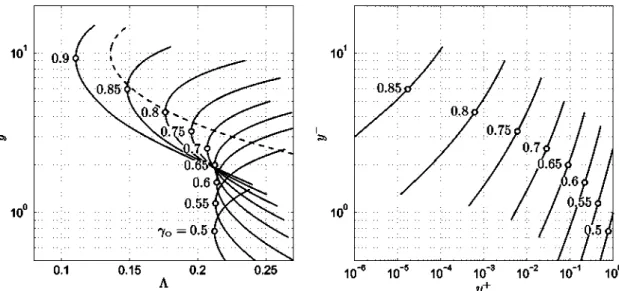
For a given value of the relative heat loss to the oxidizer side Yo, determined from the B-S solution, the integration of (56) pro-vides the inner structure of the reaction layer for different values of A, including the reactant leakages. For the values 0 < y0 < 1 that apply to most conditions of practical interest, two solutions are found for A above a critical value AE and no solution exists for A < AE. To handle effectively the resulting multiplicity, and thus determine accurately the solution near the turning point, in-stead of solving (56) for a known value A, the problem should be posed as that of finding the solution for a given fuel leakage y~. Increasing the value of y~ in successive integrations provides the evolution of A and y+ shown in Fig. 4. Results are shown for Yo > 0.5. Corresponding results for y0 < 0.5 can be easily ob-tained from Fig. 4 by replacing y0 by yF = 1 - y0 and exchanging y- and y+.
Since the Damkohler number V is defined in terms of the val-ues of Tf and mF, provided by the B-S solution, the critical value
of the strain rate at extinction can be evaluated from the critical value of V corresponding to the turning point of the curve giv-ing the fuel leakage y^ as a function of V. As explained below, when the Lewis number of the fuel is unity, the case considered in [5], the constant C\ + yFC2(S+l)/S appearing in (58) is
iden-tically zero, in which case V = A and the critical strain rate can be obtained directly from the canonical solution given in Fig. 4. When LF ^ 1, however, the perturbations in the outer regions,
as-sociated with the leakage of reactants, introduce a nonnegligible correction to the critical extinction conditions through a nonzero value of Cj + y?C2(S + 1)/S, and the determination of the extinc-tion condiextinc-tions requires consideraextinc-tion of the perturbaextinc-tions in the outer layers, a problem addressed in the following section.
4.4. The outer chemically frozen regions
When considering the outer solution, the reaction layer appears as a sheet located at rjf. Different expansions must be used for the different flow variables on each side of the flame sheet. In the fol-lowing, the terms in the expansion on the fuel side of the mixing layer (i.e., for rjf <rj < +oo) will be denoted by the superscript + , while those on the air side (i.e., for -oo <r\ < rjf) will be denoted by the superscript - , giving for instance
(54)
(55a)
(55b)
(56)
(57)
(58)
involving C\ and C2, unknown constants appearing in the first
per-turbations in the matching layer with the outer chemically frozen regions. The parameter A is written in (58) in terms of the rele-vant Damkohler number
P
Sfi-^UTf-1 B
(S + l)
3m2 V
-Ta/T,
ml
Ta'/
Bq/Sl AA
-Ta/Tf
(59) T
T
--= T++j8-1T+, YF =
(r]f<r]< +oo)
= T
0+fi-%-,Y?--Y+
-Y~
-iv+ • ' o o Y+ -iv+
A
Y-(60)
rFl> rO = I00 "r'y 20 1
( - 0 0 <T] <T]f)
Fig. 4. The values of A and y+ as a function of the fuel leakage y- for different values of y0', the circles mark the turning point of the curves y~(A). The dashed line on
the left plot represents the curve y~(A) predicted by (71) in the premixed-flame regime for y0 = 1 - yf = 0.9.
,0 0 _ u ™ ,, ^ i]f, as follows from (27). The resulting
zeroth-order solution, which corresponds to that represented with dashed curves in Fig. 1, determines in particular the reaction-sheet loca-tion rjf along with the addiloca-tional flame properties shown in Fig. 3.
The first-order corrections are due to finite-rate effects in the reaction layer, leading in particular to nonzero boundary values
'/
and Yi, for the functions Y ' 0 1 and Y+ at r\ = rij, associatedwith reactant leakage of order /3_ 1 across the flame. The
bound-ary values for the first-order perturbations in the outer regions T*.
Yp* , and Y^ are related to the reactant leakages y j and yp and
the apparent shifts yp", 8+, y^, and 8~ of the inner solution by
9
K
Y± and y* •Y± (61)g/(S + l ) '
as required at this order to achieve the matching of (48) with the outer solution (60).
The equations involved in the computation of the functions Yp*, and I f and of the associated velocity perturbations are ob-Y±
tained by linearizing (13)-(17) without the reaction terms. The boundary values and their gradients on both sides of the flame must satisfy a number of constraints associated with the conser-vation equations. For instance, a first integral of the chemistry-free equation (22) with use made of the expansions (60) provides
S
+ LF
}(%
-Y« / )-dYF l dY+
drj
dY,
it 01
drj (62)
where Hjif) is to be evaluated from the leading-order solution.
4.5. The perturbations in the outer regions with the approximation F = 7}
The solution to the first-order outer perturbations simplifies greatly when the approximation F = r\ is adopted for the velocity field, leading to explicit expression for the constants C\ and C2. It
can be noted that the simplified form of (21) when F = r\ has the exact solution given in (38) valid for all r\, so that in (52) C\ = 0. The outer perturbations T\{rj) and Y0I(T/) are related by T^(rj) =
-(q/S)Y^(ri), and from (61) it follows that 9± + (S+ l)y±/S = 0. Using the approximation F = r\ in the transport equations for Yp* and Y^, integrated with the boundary conditions Yp* (±oo) =
Y± (±oo) = 0 and YF± (r,f) - Y±f = Y± (r,f) - Y± / = 0 provides
1 - erf(j7/V2) Y+ __ 1 - erf(^v/IF/2)
and
for rj > rjf
and
YF- l + e r f ( ^ LF/ 2 )
and Y+
Joi _
Y+h 1 - evf(r]f/V2)
Ym _ l + e r f ( ) ] / V 2 ) Y01f l + e r f ( ^ / V 2 )
(63)
for rj > rjf
with associated gradients at the flame given by
(64)
dY± drj
dY±
U Io i
drj
TYc
X/2LF/7T exp(-LF)]?/2)
it
it
' 1 T erf(rjf^J2)
y/2J7t exp(-r]2f/2)
' lTerf(^/V2)
and
(65)
The above expressions can be used in (62) to give
^JlLf/TC exp(-Lp)]?/2)
flG;
Urjf
SY-' 0 1 ,
Urjf
If
1 - eTf(r)Iy/Lf/2)
^/2L¥/7texp(-L¥r]2/2)
1 + evKrjf^Lf~j2)
2/7T exp(-rj2J2)
+Yoh
1 - erf(J7,/V2)
/2/7T exp(-rj2J2)
1 + evf(rjf/V2)
(66)
Substituting into (66) the expressions
SYi SYz.
s + i-
s + i-
s +
1.3 1.2
1.1
1
o.g
0.8
0.7
0.6
0.5
°4
0. 21S = 2 LF= 2
0.22 0.23
V,A
0.24
'rf
1.3
1.2
1.1
1
o.g
0.8
0.7
0.6
0.5
0.4
5 = 2 LF = 0.3
0.11 0.12 0.13 0.14 0.15 V,A
Fig. 5. The variation of the fuel leakage with A and V for LF = 2 and LF = 0.3 with S = 2; the circles mark the turning point of the curves yF (A) while the triangle marks
the extinction point, corresponding to the turning point of the curves y^(T>).
which follow from (51), (57), and (61), and solving for C2 finally
yields
S + l
C, '2/TT exp(—/j?/2) I1 1 + evf(r]f/V2)
y/2LfJjt exp (—Ip r\ l /2)
1 - frf{riSy/UJ2)
( y + - y - ) ( IF- ! ) / ] / +
( I F - 1 ) ^
/2/7t exp (-rj2J 2)
1-erf2 ( ^ 7 ^ 2 )
[y++y- + (y+-y-)evKr]f/V2)]
^/2L¥/7texp(-L¥r]j/2)
\-etf{riSy/ui2)
V+ +y- + (y+ - y - ) e r f ( ^/ v/ L ^ 2 ) ] J, (68)
to be used in (58) with C\ = 0 to relate the Damkohler numbers A and V.
4.6. Evaluation of the extinction conditions
For given values of S, IF, q, and r0, the above results can be
used to determine the critical value of the strain rate at extinc-tion, given by the minimum value of 23 for which a solution exists, associated with an intermediate value of the fuel leakage yj:. The computation begins by considering the limit of infinitely fast reac-tion to determine the flame locareac-tion rjf, the peak temperature Tf, the reactant consumption rates m0 and mF = m0/S, and the heat-loss parameters y0 and y¥ = \ - y0. As shown above, these quan-tities can be evaluated with excellent accuracy by using the ex-pressions (41)-(43) associated with the approximation F = r\. The heat-loss parameter y0 can be used when solving the canonical problem (56), which gives the variation of A and y+ = y+(S + 1 )/S with y~ =yp (S+ 1)/IF. The curve giving the variation of 23 with
yp can then be obtained by using (58) together with C\ = 0 and (68), giving the results shown in Figs. 5 and 6.
The effect of the outer perturbations on the critical extinction conditions for IF ^ 1 is illustrated in Fig. 5. The dashed curves
represent the functions yp (A) obtained from direct evaluation of the solution to the canonical problem (56) for the value of y0
corresponding to S = 2 with Ip = 2 and Ip = 0.3, while the cor-rected extinction curves y^ (23) accounting for the outer perturba-tions are shown as solid curves. The differences between the re-sulting Damkohler numbers, associated with the nonzero values of C2, are seen to be moderately small for the two cases considered
in the figure. It is also of interest that the turning point of the curve 23(yp) identifying extinction (i.e. the solid triangles on the solid curves) occurs at a value of y^ that differs from that of the turning point of the canonical curve A(y^).
The variation of the extinction curves with dilution for IF = 2
and Ip = 0.3 is shown in Fig. 6. As can be seen, the corrections to the critical Damkohler number associated with the perturba-tions to the outer flow, induced by reactant leakage through the flame, are moderately small. Also of interest is that the value of the fuel leakage y^ at extinction exhibits a non-monotonic dependence on S.
It is worth noting that, as shown in Fig. 4, for values of S of order unity the values of the temperature gradients are not far from the symmetric case y0 = 1 - yF = 0.5 and the extinction of
the diffusion flame occurs with significant leakage of both reac-tants. The bifurcating unstable branch, for values of the Damkohler number large compared with the extinction value, has the struc-ture of the partial-burning regime analyzed in [5]. For the Arrhe-nius overall exothermic reaction considered here the only possible solution for the decreasing temperature from its peak value has the same slope when the reaction becomes frozen on both sides of the reaction layer. It is of interest that this partial-burning regime was encountered recently by Norbert Peters and coworkers [16], and found to be stable, for the non-Arrhenius reaction associated with cool flames of alkanes, such as heptane, when the reaction rate is found to decrease with the peak temperature in a certain temper-ature range.
4.7. Comparison with numerical results for finite values of fi.
Fig. 6. Extinction curves and values of correction factors A/V = exp[yFC2 (S + 1)/S] for different dilutions with LF = 2 (upper plots) and LF = 0.3 (lower plots); the triangle marks the extinction point on each curve.
constant in the form B_ ,-Ta/T
••V
(S-SL
lM
r-i,
7 1 exp
.r-r,
/ ls
9/(S + l ) (69)
For given values of q, S and LF, the B-S solution was computed
first to obtain the equilibrium values Tf and mF. Then, the
finite-chemistry numerical simulations were carried out for a fixed value of the Zel'dovich number /3 for different values of V and the resulting curves of peak temperature versus V were compared against the predictions of the asymptotic analysis corresponding to large /3 in the distinguished extinction regime V ~ 1.
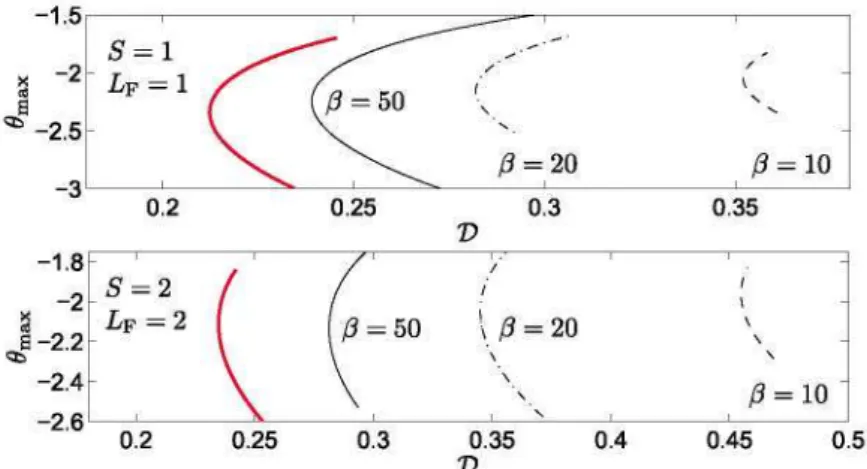
Figure 7 compares the value of 6>max = ^(rm a x - Tf)/[q/(S+ 1)] evaluated from the peak temperature rmax of the numerical
inte-grations for several values of /3 with the asymptotic prediction for large /3 obtained from the local maximum of the curve 0(g) eval-uated from (55b) at extinction. The agreement of the asymptotic predictions with the numerical results is satisfactory in the two cases considered, with errors of order / 3_ 1 that decrease for
in-creasing /3.
5. Extinction of diffusion flames in the premixed-flame regime
For large values of S and small values of LF the B-S flame
migrates towards the air side of the mixing layer; resulting in a small value, yF/yo < 1, of the ratio of the temperature gradients
to the fuel and the air side of the reaction layer, as seen in Fig. 3. Under these conditions, extinction of the diffusion flame occurs in
a premixed-flame regime, because the drop in temperature from the B-S value is not enough on the fuel side to allow the leakage of the oxygen through the thin reaction layer prior to flame extinction (i.e. note in Fig. 4 the negligibly small value of y+ at extinction when 1 - y0 < 1). However, when approaching the ex-tinction conditions by lowering the canonical Damkohler number A, the mass fraction of the leaking fuel has grown to large values of order y~ ~ (1 - yoY1, thus lowering the flame peak temper-ature from the Burke-Schumann value Tf by an amount of order Tf/Tq. The reaction layer is also displaced from the B-S position towards the fuel side, to a location given approximately by g = y~. This reaction layer separates a chemically frozen region with y =y~ from a region in chemical equilibrium with y - £ = y+ = 0.
Since for large y~ the fuel mass fraction y changes only by a small amount, of order l/y~, across the reaction layer, one can evaluate the reaction rate with y=y~ when solving (56), and rewrite the problem in terms of the oxidizer mass fraction y = y - g and the translated coordinate g = g - y~ to give
dcf2 Ay exp(-y
Fy )ye :0
gx:
as as
(70)
![Fig. 3. The variation with Z s = (1 + S/Lp) -1 of the flame distance from the stagnation plane r] f , peak temperature T f , fuel consumption rate m F , and fractional amount of heat of combustion towards the oxidizer y 0 of the counterflow B-S flame](https://thumb-us.123doks.com/thumbv2/123dok_es/6828845.835795/9.892.145.771.85.686/variation-distance-stagnation-temperature-consumption-fractional-combustion-counterflow.webp)

![Fig. 6. Extinction curves and values of correction factors A/V = exp[y F C 2 (S + 1)/S] for different dilutions with L F = 2 (upper plots) and L F = 0.3 (lower plots); the triangle marks the extinction point on each curve](https://thumb-us.123doks.com/thumbv2/123dok_es/6828845.835795/13.892.209.694.82.630/extinction-curves-correction-factors-different-dilutions-triangle-extinction.webp)