Epidemiological (Baer, Barr, Bookstein, Sampson, & Streissguth, 1998; Baer, Sampson, Barr, Connor, & Streissguth, 2003) and pre-clinical research indicates that passive social infl uences (Hunt & Hallmark, 2001), as well as a history of exposure to ethanol in the womb (Abate, Pueta, Spear, & Molina, 2008; Spear & Molina, 2005), rank among the strongest predictors of ethanol consumption in adolescence.
Animal models have shown that observing the effects of ethanol in peers increases behavioral responses to ethanol odor
(refl exive sniffi ng; Eade & Youngentob, 2009), preference for its aromatic properties (“passive social infl uences”: Fernández-Vidal & Molina, 2004) and intake (Maldonado, Finkbeiner, & Kirstein, 2008). Through social transmission, animals learn what fl avors to like or dislike (Galef, Whiskin, & Bielavska, 1997). Studies of social transmission of food preferences utilize the “observer-demonstrator” paradigm in which a naïve animal (the observer) is allowed to interact with a demonstrator eating/drinking a given food/fl uid and is expected to modify its preference to that food or fl uid following that interaction (Galef, 1996).
Heightened preference for ethanol consumption has been shown in observers that have previously interacted with an ethanol-intoxicated demonstrator (1.5 g/kg), but not if the demonstrator had been given decaffeinated coffee or water (Hunt, Holloway, & Scordalakes, 2001). Similarly, Fernández-Vidal and Molina (2004) found increased preference to ethanol odor (assessed in a two-way
Olfactory preference for ethanol following social interaction with an
intoxicated peer in adolescent rats exposed to ethanol in-utero
Samanta M. March
1,2, Ricardo M. Pautassi
1,2, Michael Nizhnikov
3, Juan Fernández-Vidal
1, Norman E. Spear
3and Juan C. Molina
1,21 INIMEC-CONICET, 2 Universidad Nacional de Córdoba, and 3 Binghamton University
Abstract
Background: Prenatal exposure to ethanol and later socially mediated exposure predicts ethanol intake in human adolescents. Animal rat models indicate that brief interactions with an ethanol-intoxicated peer result in heightened preference for ethanol odor and ethanol intake. Methods:
This study assessed preference for ethanol odor in adolescent male rats (observers) following social interaction with an ethanol intoxicated peer (demonstrators) as a function of prenatal ethanol exposure (gestational days 17-20, 1.0 g/kg, intragastric). Social behavior and locomotion during social interaction was also measured. Results: Social investigation was greater in observers that interacted with an intoxicated demonstrator in comparison to those that interacted with a sober peer. Social contact increased when the demonstrator was under the effects of ethanol, but only if the observer had experienced ethanol prenatally. Ethanol inhibited locomotion in the demonstrators. Finally, social interaction with an intoxicated peer during adolescence as well as prenatal ethanol experience increased preference for ethanol odor. Conclusions: Fetal exposure to ethanol mediated by maternal intoxication at late gestation or by interaction with an intoxicated peer at adolescence heightens preference for the chemosensory cues of the drug.
Keywords: social learning, odor preference, prenatal ethanol exposure, adolescence, ethanol.
Resumen
Preferencia por el olor del etanol tras la interacción social con un congénere intoxicado en ratas adolescentes expuestas a la droga in útero. Antecedentes: la exposición prenatal al alcohol y la exposición postnatal en contextos sociales predice el consumo de alcohol durante la adolescencia en humanos. Modelos animales indican que la interacción con un congéner intoxicado aumenta la preferencia por el olor del alcohol y su consumo. Método: se analizó la preferencia hacia el olor del etanol en ratas macho adolescentes (observadores) que interactuaron con un compañero intoxicado con alcohol (demostrador), en función de la exposición prenatal al alcohol (días gestacionales 17-20, 1,0 g/kg, intragástrica). Durante la interacción social, se evaluó la conducta social y la locomoción.
Resultados: la investigación social fue mayor en los observadores que interactuaron con un sujeto intoxicado en comparación con aquellos que interactuaron con un sujeto sobrio. El contacto social aumentó cuando el demostrador estaba intoxicado, solo si el observador había sido expuesto al alcohol prenatalmente. El alcohol inhibió la locomoción en los demostradores. Finalmente, tanto la interacción social con un congéner intoxicado como la exposición prenatal incrementaron la preferencia por el olor a etanol. Conclusiones: el contacto con etanol durante la vida fetal, así como mediante la exposición a un par intoxicado durante la adolescencia, incrementa la preferencia por las claves quimiosensoriales de la droga.
Palabras clave: aprendizaje social, preferencia al olor, exposición fetal al alcohol, adolescencia, etanol.
Received: March 28, 2012 • Accepted: March 5, 2013 Corresponding author: Samanta M. March Faculty of Psychology
odor test) following social interaction with an intoxicated peer (ethanol dose 1.5 g/kg). This study showed that passive pre-exposure to ethanol through a surrogate partner (a cotton ball odorized with ethanol) or via an anesthetized alcohol-intoxicated peer did not increase later acceptance for the drug aromatic cues. Interestingly, social interaction in Fernández-Vidal and Molina’s study (2004) occurred when alcohol levels in blood were presumably peaking. The observer could perceive the odor of ethanol (through perspiration and salivation of the demonstrator) along with its behavioral effects (through the demonstrator’s behavior). So even when social behavior during interaction was not assessed, changes in preference for ethanol odor were attributed to an association between ethanol odor cues and the behavior displayed by the demonstrator.
Additionally, prenatal ethanol exposure can determine future responsiveness to the drug. In utero ethanol experience heightens the palatability of ethanol (Arias & Chotro, 2005a), self administration (March, Abate, Spear, & Molina, 2009; Miranda-Morales, Molina, Spear, & Abate, 2010) and intake (Arias & Chotro, 2005b; Domínguez, López, & Molina, 1998). Prenatal ethanol also affects social behavior. Rats given ethanol in-utero throughout most of gestation show changes in play and parenting behavior at adolescence (Barron & Riley, 1985; Meyer & Riley, 1986). Human fetal ethanol effects include social defi cits such as irritability, inappropriate sexual and parenting behavior, as well as diffi culty cooperating with peers (Kelly, Day, & Streissguth, 2000). It has been suggested that the offspring of ethanol-consuming parents are more likely to relate, during adolescence, with peers who also drink, hence increasing the likelihood of future ethanol use and abuse (Brook, Whiteman, Gordon, & Brook, 1990).
Until now the impact of social interactions with an intoxicated peer has been assessed only in terms of ethanol intake (Hunt & Hallmark, 2001; Hunt et al., 2001; Hunt, Lant, & Carroll, 2000) or ethanol odor preference (Fernández-Vidal & Molina, 2004). However, it remains unclear which components of such interaction are critical for promoting this later acceptance for ethanol. In the present study, we assessed preference for ethanol odor as a function of previous exposure to the drug, either during gestation or through interaction with an intoxicated peer at adolescence. As mentioned, social interaction allows the organism to process information about food safety and value, affecting later choices for food. In those social interactions events in which one or more peers have had access to ethanol, it is possible that the observer perceives the ethanol odor and the behavioral intoxicating effects of the drug in the demonstrator. Using the observer-demonstrator paradigm we evaluated (a) changes in locomotive and social behavior in the dyad likely to be involved in the transmission of ethanol preference during adolescence, and (b) whether learning about ethanol effects through social interaction during adolescence is modulated by a prenatal exposure to ethanol (GD 17-20). To our knowledge, the answer to this question remains unknown. Previous studies have found that in utero ethanol exposure may facilitate (Brook et al., 1990) or detract (Kelly et al., 2000) from social transmission of ethanol preference at adolescence.
Methods
Subjects
Ninety (forty-fi ve observers and forty-fi ve demonstrators) adolescent Wistar male rats, representative of 24 litters bred and
reared at the vivarium of the INIMEC-CONICET (Córdoba, Argentina), were tested. Animals were housed in a temperature and humidity-controlled vivarium (22 °C) maintained on a 12-hr light / dark cycle (lights on at 0800) with ad libitum access to food (Cargill, Pilar, BA, Argentina) and water. Births were examined daily and the day of parturition was considered as postnatal day 0 (PD 0). On PD 1, all litters were culled to eight pups, four males and four females, whenever possible. Pups were housed with the dam in maternity cages (57 cm height × 37 cm width × 22 cm depth) with free access to water and lab chow. After weaning (PD21), male littermates remained together until PD 28 (the females were employed in other experiments). From PD 28 throughout the course of the experiment, the males were pair-housed in standard housing tubs (46 cm height × 30.5 cm width × 20 cm depth).
Procedures
Prenatal treatment. Six pregnant females (gestational days –GD– 17-20) were administered with ethanol (1.0 g/kg, intragastrically, i.g.), 6 with water and 12 litters remained untreated. Ethanol dose was achieved by intubating the dam with a volume equivalent to 0.015 ml per gram of body weight of an 8.4% v/v ethanol solution. This schedule of prenatal ethanol exposure results in ethanol-mediated learning without exerting deleterious effects upon sensorimotor capabilities of the rat (Abate et al., 2008). Administration was conducted by introducing into the dam’s oral cavity an 8-cm section of PE 50 polyethylene tubing connected to a 12 cc syringe mounted with a 26 gauge needle.
Housing, training and testing procedures followed those described by Fernández-Vidal and Molina (2004). Observer animals representative of ethanol or water-treated litters were allowed to interact with an intoxicated or with a sober (i.e., vehicle-treated) demonstrator. In all cases, the demonstrator animal was derived from a prenatally untreated litter. Social interactions during postnatal days 30-33, as well as odor preference test on postnatal day 34 were videotaped with an analogic camera. Videotapes were later analyzed by a researcher who was blind to the experimental conditions of the subjects.
Housing conditions after PD 28. Males were pair-housed in standard maternity cages (referred to as “home cage”) from PD 28 throughout the course of the experiment. Each pair included one “observer” derived from a prenatally treated litter (with water or ethanol) and a “demonstrator” randomly chosen from an untreated litter. Animals were marked every other day by a permanent marker (Sharpie, Sandford, Oak Brook, IL). Procedures followed the Guide for the Care and Use of Laboratory Animals (Institute of Laboratory Animal Resources, 1996) and were approved by the Animal Care and use Committee at INIMEC-CONICET.
social interaction were registered by an Experimenter blind to the experimental conditions of the animals. Locomotion was defi ned as coordinated movement of the 4 paws (Nizhnikov, Pautassi, Molina, & Spear, 2009). Based on previous studies (Galef & Whiskin, 2000; Varlinskaya & Spear, 2006), social grooming, play fi ghting, social investigation and social contact were measured in the dyad.
Preliminary data analyses indicated that only social investigation and social contact were affected by the factors under analysis. Therefore, only these variables were selected for defi nitive statistical analysis. Based on previous work (Fernández-Vidal & Molina, 2004), sniffi ng was considered a dependent variable refl ecting investigation of the conspecifi c. This was corroborated by direct observation of the observer-demonstrator interaction, which indicated that sniffi ng was mainly directed towards the mouth and perioral regions of the demonstrator. Social investigation was registered when the observer sniffed any section of the demonstrator’s body. Social contact was defi ned as any occurrence of physical contact between the animals. These dependent variables were mutually exclusive. Preliminary data indicated that, under the present experimental preparation, social interaction takes place during the fi rst 10 minutes of testing. Afterwards, all animals remain motionless and in direct side-by-side contact. Hence, in the present experiment, behavioral measures were assessed during the fi rst 10-min of daily training and rated by the experimenters in fi ve 2-min clusters (referred to as “bins”).
Due to technical problems, locomotion behavior during the last training day could not be registered. Moreover, during the third training day, locomotion data from 6 pairs of observer/ demonstrator animals (1 prenatal ethanol-postnatal water; 3 prenatal ethanol-postnatal ethanol and; 2 prenatal water-postnatal water) were lost. Hence, locomotion data analysis was performed for training days 1 to 3 and did not include those 6 pairs of animals. Even though the lack of this information was unfortunate, the analysis of locomotion data is relevant, as it indicates behavioral stimulation and depression induced by ethanol. Although rats have been deemed as being mostly insensitive to ethanol-induced stimulation, studies with preweanling and adolescent rats have revealed these effects after moderate ethanol dosing (Acevedo, Molina, Nizhnikov, Spear, & Pautassi, 2012; Arias, Molina, Mlewski, Pautassi, & Spear, 2008). The rationale for including this variable was to determine whether demonstrator rats were activated or sedated while interacting with the observers, and if these effects altered other behavior of the observer. After termination of the social interaction phase, demonstrators were again removed from the tub for 4 hours to allow complete clearance of ethanol.
Odor preference test. On PD 34, observer animals were tested in a 5-min, two-way odor preference test. Animals were individually placed in the center of a black Plexiglas chamber (50 × 25 × 25 cm) equipped with two holes located on the smaller opposite walls. On the external side of each hole was a Plexiglas cup containing a cotton ball scented with 1.5 ml of either ethanol (undiluted, 190-proof, Porta Hnos., Córdoba, Argentina) or vanilla (undiluted, Montreal, Córdoba, Argentina). To prevent potential place-preference effects, the position of the odorants was counterbalanced within each particular treatment group. Animals were free to investigate the odorant by nose-poking into the hole. Time spent on a given olfactory section of the apparatus was computed whenever the head and front paws were positioned inside the section. The apparatus was virtually divided in three
sections: a middle section (about 20% of the entire surface of the apparatus) and two olfactory sections (equivalent surfaces close to the cups containing the cotton ball scented with either vanilla or ethanol). Percent time spent on the section of the cage scented with ethanol was considered as a measure of olfactory preference for ethanol, and was calculated with respect to absolute time spent in the two opposite olfactory sections of the cage [(total time spent in the ethanol-scented section × 100) / (total time spent in the ethanol-scented section + total time spent in the vanilla-scented section]. The middle section (considered as a neutral area) was not taken into account for data collection or analysis.
Data analyses
Social investigation and social contact during daily training sessions (seconds per bin) were analyzed by separate four-way mixed ANOVAs, which included observer’s prenatal treatment (ethanol or vehicle) and condition of the demonstrator (ethanol-intoxicated or sober) as between factors. Training days (1, 2, 3 and 4) and bin of evaluation (bins 1-5, bin duration: 2 min) served as within-measures.
Locomotion during training was analyzed through a fi ve-way mixed ANOVA. Prenatal treatment given to the observer (ethanol or vehicle), postnatal treatment received by the demonstrator (ethanol or vehicle) and role in the dyad (observer or demonstrator) served as between factors. The within measures were training days (1, 2 and 3; data for day 4 was lost due to technical problems) and bin of evaluation (bins 1-5, bin duration: 2 min).
Time spent in the ethanol-scented section of the test chamber was analyzed through a 2 (prenatal treatment) × 2 (postnatal treatment received by the demonstrator) factorial ANOVA.
The loci of signifi cant main effects or interactions were further examined through follow-up ANOVAs and post-hoc comparisons (Fisher’s Least Mean Signifi cant tests). The alpha level was set at 0.05 for all statistical analyses.
Experimental Design: A 2 [prenatal treatment: water or ethanol] × 2 [condition of the demonstrator during training: sober or intoxicated] factorial design was employed. Each of the four groups was composed by 11-12 animals.
Results
Social interaction
Social investigation was signifi cantly affected by condition of the demonstrator, F (1, 41) = 12.03, p<0.005. Post-hoc analyses indicated that more time was spent in social investigation when dyads included an intoxicated demonstrator compared to those including a sober demonstrator (Figure 1, top section). This pattern of results was similar between and within training sessions and across prenatal treatment.
remained fairly stable (see Figure 1, lower section), regardless of demonstrator condition. The ANOVA indicated no signifi cant main effect or signifi cant interaction involving day of training.
Locomotion
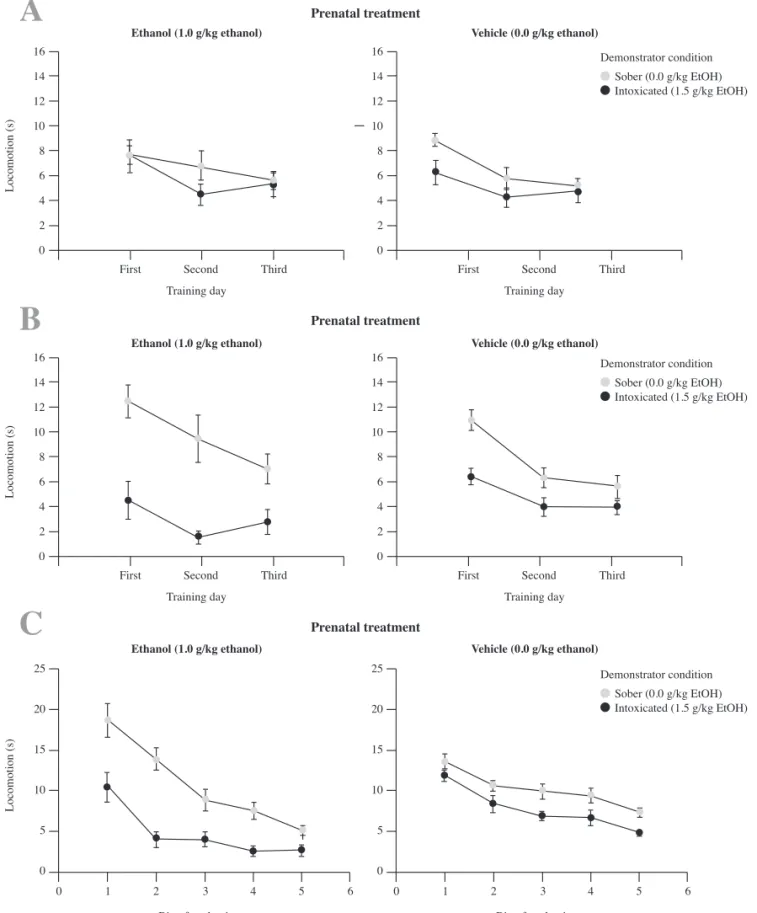
This ANOVA indicated a complex pattern of results (see Figure 2). Signifi cant main effects of demonstrator condition (ethanol- intoxicated or sober), role in the dyad, day of assessment and bin of evaluation were found: F (1, 74) = 35.43, F (1, 74) = 4.48, F (2, 148) = 29.62, F (4, 296) = 81.65; all ps<0.05. The following two-way interactions also achieved signifi cance: postnatal treatment × condition in the dyad; demonstrator condition × training day; condition in the dyad × bin and training day × bin: F (1, 74) =
11.92, F (2, 148) = 3.37, F (4, 296) = 5.35, F (8, 592) = 4.82; all ps<0.05. Finally, the interaction comprising prenatal treatment, demonstrator condition and bin also achieved signifi cance: F (4, 296) = 5.05, all ps<0.05. Locomotion was greater during the fi rst day and during the fi rst bins and then decreased as a function of days and bins of evaluation. Additionally, locomotion was greater in demonstrators than in observers (Fig. 2, top section, panel B vs. panel A, respectively), but only when demonstrators were sober. Ethanol inhibited demonstrator’s motor activity, particularly during the fi rst and second day of training.
To better understand the three-way interaction, separate ANOVAs were conducted for observers and demonstrators. For demonstrators, the analysis yielded an interaction between prenatal treatment, demonstrator condition and bin of training, F (4, 148) = 3.00,
12
10
8
6
4
2
0
0.0 g/kg 1.0 g/kg
Prenatal treatment
Social investigation (s/bin)
Demonstrator condition
Sober (0.0 g/kg EtOH) Intoxicated (1.5 g/kg EtOH)
Social contact (s)
Demonstrator condition
Sober (0.0 g/kg EtOH) Intoxicated (1.5 g/kg EtOH)
40
30
20
10
0
0 1 2 3 4 5
Bin of evaluation (2 min bins)
Ethanol (1.0 g/kg EtOH)
40
30
20
10
0
0 1 2 3 4 5
Bin of evaluation (2 min bins)
Vehicle (0.0 g/kg EtOH)
Prenatal treatment
Demonstrator condition
Sober (0.0 g/kg EtOH) Intoxicated (1.5 g/kg EtOH)
p<0.05. Pre-training administration with 1.5 g/kg ethanol exerted an inhibitory effect in the demonstrators (see Figure 2, bottom section, panel C). Moreover, those demonstrators treated with vehicle –that interacted with a companion treated with ethanol prenatally– showed greater locomotion than demonstrator counterparts that interacted
with an observer given water prenatally. According to appropriate planned comparisons, this difference achieved signifi cance during the fi rst and second bins of testing. The ANOVA for observers only yielded signifi cant main effects of day and bin of testing, F (2, 74) = 11.04 and F(4, 148) = 20.20, ps<0.05.
A
1614
12
10
8
6
4
2
0
Locomotion (s)
First Second Third
Training day
16
14
12
10
8
6
4
2
0
First Second Third
Training day Ethanol (1.0 g/kg ethanol) Vehicle (0.0 g/kg ethanol)
16
14
12
10
8
6
4
2
0
Locomotion (s)
First Second Third
Training day
Demonstrator condition
Sober (0.0 g/kg EtOH) Intoxicated (1.5 g/kg EtOH) Prenatal treatment
B
Prenatal treatmentEthanol (1.0 g/kg ethanol) Vehicle (0.0 g/kg ethanol)
C
0 1 2 3 4 5 6
25
20
15
10
5
0
Locomotion (s)
Bin of evaluation
Ethanol (1.0 g/kg ethanol) Vehicle (0.0 g/kg ethanol) Prenatal treatment
0 1 2 3 4 5 6
25
20
15
10
5
0
Bin of evaluation 16
14
12
10
8
6
4
2
0
First Second Third
Training day
Demonstrator condition
Sober (0.0 g/kg EtOH) Intoxicated (1.5 g/kg EtOH)
Demonstrator condition
Sober (0.0 g/kg EtOH) Intoxicated (1.5 g/kg EtOH)
Odor preference
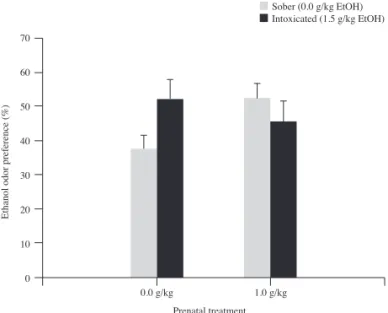
This ANOVA yielded a signifi cant interaction between prenatal treatment and condition of the demonstrator, F (1, 42) = 4.99, p<0.03. Post-hoc tests indicated that independently of condition of the demonstrator during social interaction (sober or ethanol intoxicated), observers exposed to ethanol prenatally spent more time in proximity to ethanol odor than observers with no prenatal exposure to ethanol that interacted with a sober peer (both ps<0.05). Additionally, odor preference for ethanol was greater in animals lacking prenatal exposure to ethanol but exposed to an intoxicated peer compared to subjects from a similar prenatal treatment (vehicle) that interacted with a sober peer at adolescence. These results, indicative of ethanol-mediated social learning and prenatal ethanol effects, have been depicted in Figure 3.
Discussion
In agreement with Fernández-Vidal and Molina (2004), we found greater preference for ethanol odor following interaction with an intoxicated adolescent peer (1.5 g/kg), and effect indicating that passive social infl uences can signifi cantly modulate responsiveness to the drug. The present study adds relevant information that helps understand the mechanisms underlying this effect. Social investigation was greater in dyads composed by a ethanol-intoxicated demonstrator, than in those featuring a control, sober demonstrator. This novel result suggests that social investigation of an intoxicated partner may be a critical component in promoting increased preference for ethanol chemosensory attributes (Fernández-Vidal & Molina, 2004) and ethanol consumption (Hunt & Hallmark, 2001).
Another relevant fi nding was that prenatal experience with ethanol modulated social contact (but not social investigation). Among adolescents prenatally treated with ethanol, social contact was signifi cantly increased when demonstrators were intoxicated by ethanol. This result suggests that ethanol exposure in the womb facilitates later interaction with ethanol-intoxicated conspecifi cs. If human adolescents are more prone to interact with peers who are
under the infl uence of ethanol, they could be at an enhanced risk for engaging in ethanol seeking and consumption. This could be one of the mechanisms underlying the association between prenatal ethanol exposure and heightened ethanol intake at adolescence, as found for humans by Baer and co-workers (1998; 2003).
Locomotion during training was signifi cantly greater in demonstrators than in observers. This effect was likely caused by the fact that training sessions started when the demonstrator –but not the observer– returned from an individual holding chamber. That is, observers were habituated to the test chamber while for demonstrators the chamber had some degree of novelty. Perhaps more important, we assumed that the chemosensory attributes of respired ethanol from intoxicated demonstrators mediate the infl uence of the demonstrator on observer behavior towards ethanol. An alternative explanation is that ethanol stimulated the demonstrator’s behavior, which affected the observer’s behavior irrespective of the chemosensory attributes (e.g., ethanol) of the demonstrator. This seems unlikely, since intoxicated demonstrators displayed signifi cantly less motor activity than sober demonstrators. In other words, ethanol intoxication inhibited demonstrator’s behavior. One could wonder whether the suppressive motor effects of ethanol in the demonstrator affected the observer’s motor behavior. That was not the case. Observer animals displayed greater locomotion in the fi rst training days and during the fi rst evaluations bins, but these effects were not affected by prenatal treatment or demonstrator condition. An effect of prenatal ethanol exposure was also apparent in the analysis of locomotive patterns. Demonstrators given vehicle exhibited enhanced locomotion when interacting with a companion treated with ethanol prenatally than when the partner had been given water prenatally. This result reveals another subtle, yet signifi cant, effect of prenatal ethanol on social behavior at adolescence. Future studies should explore this phenomenon.
Prenatal exposure to ethanol resulted in heightened preference for ethanol odor at adolescence, regardless of the nature of social interaction. This result indicates that experience with ethanol during late gestation promotes an ethanol-related memory that can persist into adolescence and signifi cantly affect preference for the drug’s odor. It could be argued that this increased preference for ethanol odor might have resulted from teratogenic effects of prenatal ethanol. However, alteration of the olfactory system results from much more extensive prenatal exposure to ethanol (GD 6-20, inducing blood ethanol levels of 150 mg%: (Youngentob, Molina, Spear, & Youngentob, 2007) than provided in the present experiment. Ethanol exposure during late gestation (GD 17-20, 1 g/kg) has resulted in neonatal memories for the sensory attributes of ethanol (Domínguez, López, Chotro, & Molina, 1996) in the absence of teratology (Domínguez et al., 1998; Pueta, Rovasio, Abate, Spear, & Molina, 2011).
Spear & Molina (2005) proposed that prenatal ethanol leads to increased acceptance of the drug later in life due to a simple passive pre-exposure effect or due to the formation of an associative memory. The latter hypothesis implies that the fetus exposed to ethanol would learn that chemosensory properties of ethanol predict the positive rewarding postabsorptive effects of the drug. Several studies support the hypothesis of prenatal ethanol resulting in an appetitive memory (Abate, Pepino, Domínguez, Spear, & Molina, 2000; Abate, Spear, & Molina, 2001; Abate, Varlinkaya, Cheslock, Spear, & Molina, 2002; Chotro & Arias, 2003). For example, fetal exposure to an aromatic cue (cineole) followed by ethanol
Demonstrator condition
Sober (0.0 g/kg EtOH) Intoxicated (1.5 g/kg EtOH)
70
60
50
40
30
20
10
0
Ethanol odor preference (%)
0.0 g/kg 1.0 g/kg
Prenatal treatment
intoxication results in increased postnatal grasping of a surrogate nipple aromatized with cineole (Abate et al., 2002). The results found in the present study do not allow conclude if the increased preference for ethanol odor following prenatal exposure or social interaction with an intoxicated peer is due to familiarization with ethanol odor or to an associative memory. However, this study adds new support for the basic phenomenon: moderate ethanol exposure during late gestation results in ethanol-related memories that last until adolescence and promote preference for the drug’s attributes. Social interaction with an intoxicated peer is also suffi cient to increase ethanol odor preference. It has been suggested that mere pre-exposure to ethanol odor does not account for this effect. Pre-exposure to an ethanol-scented cotton or to an anesthetized demonstrator fails to increase preference for the drug’s aromatic cues (Fernández-Vidal & Molina, 2004).
Among animals prenatally exposed to ethanol, ethanol odor preference was similar for those that interacted with a sober or intoxicated peer. However, the possibility of an interaction between prenatal ethanol and nature of social interactions at adolescence cannot be completely ruled out. It could be that under the present testing circumstances, preference for ethanol odor reached a functional ceiling masking potential interactive effects. Alternatively, it could also be speculated that exposure to ethanol in-utero inhibited the effectiveness of ethanol odor as a cue during social interaction at adolescence. Pre-exposure to a conditioned stimulus (CS) gives rise to latent inhibition, which in turn reduces learning effi cacy when this CS is subsequently paired with an unconditional stimulus (Chang, Meyer, Feldon, & Yee, 2007).
Our expectations in this search for underlying mechanisms were that an association would emerge between the nature of social interactions between the observer and demonstrator and preference for ethanol odor among observers. This expectation was not fulfi lled, at least, not in any obvious way. The difference between social contacts with a sober versus intoxicated demonstrator was greater among observers that had been exposed to ethanol prenatally than among controls not exposed prenatally. Yet, the ethanol odor preferences of rats exposed to ethanol prenatally were the same whether they had interacted with an intoxicated or sober demonstrator. In contrast, ethanol odor preferences of observers that had not been exposed to ethanol prenatally were greater after interaction with an intoxicated than with a sober demonstrator. This pattern of results does not indicate a simple mechanistic relationship between social interactions involving ethanol and preference for ethanol odor.
In conclusion, the present work supports the notion that contact with ethanol through maternal intoxication in late gestation or peer intoxication at adolescence promotes heightened preference for the drug’s chemosensory cues.
Acknowledgements
This work was supported by grants from the Agencia Nacional de Promoción Científi ca y Tecnológica, Argentina, to JCM and RMP (PRH-UNC) and from the NIAAA (AA11960, AA013098, AA15992) and the NIMH (MH035219) to NES; and by a doctoral fellowship awarded by Consejo Nacional de Investigaciones Científi cas y Técnicas (CONICET, Argentina) to JFV.
References
Abate, P., Pepino, M.Y., Domínguez, H.D., Spear, N.E., & Molina, J.C. (2000). Fetal associative learning mediated through maternal alcohol intoxication.
Alcoholism: Clinical and Experimental Research, 24(1), 39-47.
Abate, P., Pueta, M., Spear, N.E., & Molina, J.C. (2008). Fetal learning about ethanol and later ethanol responsiveness: Evidence against “safe” amounts of prenatal exposure. Experimental Biology and Medicine (Maywood), 233(2), 139-154.
Abate, P., Spear, N.E., & Molina, J.C. (2001). Fetal and infantile alcohol-mediated associative learning in the rat. Alcoholism: Clinical and Experimental Research, 25(7), 989-998.
Abate, P., Varlinkaya, E.I., Cheslock, S.J., Spear, N.E., & Molina, J.C. (2002). Neonatal activation of alcohol-related prenatal memories: Impact on the fi rst suckling response. Alcoholism: Clinical and Experimental Research, 26(10), 1512-1522.
Acevedo, M.B., Molina, J.C., Nizhnikov, M.E., Spear, N.E., & Pautassi, R.M. (2012). High ethanol dose during early adolescence induces locomotor activation and increases subsequent ethanol intake during late adolescence. Developmental Psychobiology, 52(5), 424-440. Arias, C., & Chotro, M.G. (2005a). Increased palatability of ethanol
after prenatal ethanol exposure is mediated by the opioid system.
Pharmacology, Biochemistry and Behavior, 82(3), 434-442.
Arias, C., & Chotro, M.G. (2005b). Increased preference for ethanol in the infant rat after prenatal ethanol exposure, expressed on intake and taste reactivity tests. Alcoholism: Clinical and Experimental Research, 29(3), 337-346.
Arias, C., Molina, J.C., Mlewski, E.C., Pautassi, R.M., & Spear, N. (2008). Acute sensitivity and acute tolerance to ethanol in preweanling rats with or without prenatal experience with the drug. Pharmacology, Biochemistry and Behavior, 89(4), 608-622.
Baer, J.S., Barr, H.M., Bookstein, F.L., Sampson, P.D., & Streissguth, A.P. (1998). Prenatal alcohol exposure and family history of alcoholism in
the ethiology of adolescent alcohol problems. Journal of Studies on Alcohol, 59(5), 533-543.
Baer, J.S., Sampson, P.D., Barr, H.M., Connor, P.D., & Streissguth, A.P. (2003). A 21-year longitudinal analysis of the effects of prenatal alcohol exposure on young adult drinking. Archives on General Psychiatry, 60(4), 377-385.
Barron, S., & Riley, E.P. (1985). Pup-induced maternal behavior in adult and juvenile rats exposed to alcohol prenatally. Alcoholism: Clinical and Experimental Research, 9(4), 360-365.
Brook, J.S., Whiteman, M., Gordon, A.S., & Brook, D.W. (1990). The role of older brothers in younger brothers’ drug use viewed in the context of parent and peer infl uences. Journal of Genetic Psychology, 151(1), 59-75. Chang, T., Meyer, U., Feldon, J., & Yee, B.K. (2007). Disruption of the US
pre-exposure effect and latent inhibition in two-way active avoidance by systemic amphetamine in C57BL/6 mice. Psychopharmacology (Berl), 191(2), 211-221.
Chotro, M.G., & Arias, C. (2003). Prenatal exposure to ethanol increases ethanol consumption: A conditioned response? Alcohol, 30(1), 19-28. Domínguez, H.D., López, M.F., Chotro, M.G., & Molina, J.C. (1996).
Perinatal responsiveness to alcohol’s chemosensory cues as a function of prenatal alcohol administration during gestational days 17-20 in the rat. Neurobiology of Learning and Memory, 65, 103-112.
Domínguez, H.D., López, M.F., & Molina, J.C. (1998). Neonatal responsiveness to alcohol odor and infant alcohol intake as a function of alcohol experience during late gestation. Alcohol, 16(2), 109-117. Eade, A.M., & Youngentob, S.L. (2009). Adolescent ethanol experience
alters immediate and long-term behavioral responses to ethanol odor in observer and demonstrator rats. Behavioral and Brain Functions, 5, 23. Fernández-Vidal, J.M., & Molina, J.C. (2004). Socially mediated alcohol
Galef, B.G., Jr. (1996). Food selection: problems in understanding how we choose foods to eat. Neuroscience and Biobehavioral Reviews, 20(1), 67-73.
Galef, B.G., Jr., & Whiskin, E.E. (2000). Demonstration of a socially transmitted fl avor aversion in rats? Kuan and Colwill (1997) revisited.
Psychonomic Bulletin and Review, 7(4), 631-635.
Galef, B.G., Jr., Whiskin, E.E., & Bielavska, E. (1997). Interaction with demonstrator rats changes observer rats’ affective responses to fl avors.
Journal of Comparative Psychology, 111(4), 393-398.
Hunt, P.S., & Hallmark, R.A. (2001). Increases in ethanol ingestion by young rats following interaction with intoxicated siblings: A review.
Integrative Physiological and Behavioral Science, 36(3), 239-248. Hunt, P.S., Holloway, J.L., & Scordalakes, E.M. (2001). Social interaction
with an intoxicated sibling can result in increased intake of ethanol by periadolescent rats. Developmental Psychobiology, 38(2), 101-109. Hunt, P.S., Lant, G.M., & Carroll, C.A. (2000). Enhanced intake of ethanol
in preweanling rats following interactions with intoxicated siblings.
Developmental Psychobiology, 37(2), 90-99.
Kelly, S.J., Day, N., & Streissguth, A.P. (2000). Effects of prenatal alcohol exposure on social behavior in humans and other species.
Neurotoxicology and Teratology, 22(2), 143-149.
Maldonado, A.M., Finkbeiner, L.M., & Kirstein, C.L. (2008). Social interaction and partner familiarity differentially alter voluntary ethanol intake in adolescent male and female rats. Alcohol, 42(8), 641-648. March, S.M., Abate, P., Spear, N.E., & Molina, J.C. (2009). Fetal exposure
to moderate ethanol doses: Heightened operant responsiveness elicited
by ethanol-related reinforcers. Alcoholism: Clinical and Experimental Research, 33(11), 1981-1993.
Meyer, L.S., & Riley, E.P. (1986). Social play in juvenile rats prenatally exposed to alcohol. Teratology, 34(1), 1-7.
Miranda-Morales, R.S., Molina, J.C., Spear, N.E., & Abate, P. (2010). Participation of the endogenous opioid system in the acquisition of a prenatal ethanol-related memory: Effects on neonatal and preweanling responsiveness to ethanol. Physiology and Behavior, 101(1), 153-160. Nizhnikov, M.E., Pautassi, R.M., Molina, J.C., & Spear, N.E. (2009).
Conditioned preferences and aversions in infant rats mediated through ethanol inhalation. Alcohol, 43(1), 1-12.
Pueta, M., Rovasio, R.A., Abate, P., Spear, N.E., & Molina, J.C. (2011). Prenatal and postnatal ethanol experiences modulate consumption of the drug in rat pups, without impairment in the granular cell layer of the main olfactory bulb. Physiology and Behavior, 102(1), 63-75. Spear, N.E., & Molina, J.C. (2005). Fetal or infantile exposure to alcohol
promotes ethanol ingestion in adolescence and adulthood: A theoretical review. Alcoholism: Clinical and Experimental Research, 25(6), 909-929.
Varlinskaya, E.I., & Spear, L.P. (2006). Ontogeny of acute tolerance to ethanol-induced social inhibition in Sprague-Dawley rats. Alcoholism: Clinical and Experimental Research, 30(11), 1833-1844.