Vol. 4, No. 3 July-September 2016 pp 171-177
Revista Mexicana de Ortodoncia
Case RepORt
www.medigraphic.org.mx
Extraction of a lower incisor as a treatment alternative
in orthodontic treatment. Case report
Extracción de un incisivo inferior como alternativa
en el tratamiento ortodóncico. Presentación de caso clínico
Dayana Duron Rivas,* Elias Ulises Tafoya Barajas§
* Third year Resident of the Orthodontics Specialty.
§ Guest professor of the Orthodontics Specialty.
Children’s Hospital of Mexico «Federico Gomez».
This article can be read in its full version in the following page: http://www.medigraphic.com/ortodoncia
Resumen
Se presenta a un paciente masculino de 17 años dos meses de edad, con ligera asimetría facial y perfil convexo, presenta clase ósea II, patrón hiperdivergente, clase l molar bilateral, clase ll ca-nina bilateral, apiñamiento leve en arcada superior e inferior, OD 31 vestibularizado, sobremordida horizontal aumentado y sobre-mordida vertical dentro de la norma. Se determinó como plan de tratamiento el uso de brackets MBT slot 0.022" con la extracción de primeros premolares superiores y de un incisivo central inferior como plan de tratamiento compensatorio debido al grado de apiña-miento que presentaba obteniendo clase molar II funcional y canina I bilateral, sobre mordida horizontal y sobre mordida vertical ade-cuados, guía incisiva, desoclusiones en lateralidades y una sonrisa armónica.
Key words: Extraction of mandibular incisor, skeletal class II. Palabras clave: Extracción de incisivo inferior, clase II esquelético. AbstRAct
Male pacient, 17 years 2 months of age, with a slight facial assimetry and convex profile. He was a hyperdivergent skeletal class II with bilateral molar class I, bilateral cuspid class II, mild crowding on the upper and lower arches, OD 31 with a bucal possition, increased overbite, and normal over jet. It was determined as a treatment plan: the use of MBT technique slot 0.022, extraction of the first maxillary bicuspids and one mandibular incisor as an alternative for dental compensation due to the degree of crowding. Functional bilateral molar class II and a bilateral canine class I was obtained as well as anormal overbite and overjet, incisor guidance and harmonic smile.
IntroduCtIon
During orthodontic treatment, Nanda mentions that the removal of a lower incisor is one of the alternatives in cases of overcrowding in the mandibular arch.1
The removal of mandibular incisors is an appropriate therapy in certain types of carefully selected malocclusions. It is especially suitable for patients with skeletal class I and mild skeletal class III malocclusions with a slight tendency to open bite.2 According to
Zachrisson, the removal of a lateral incisor is generally preferred because it is less noticeable aesthetically, but the incisor that is farther outside of the natural arch and closest to the crowding is usually the best candidate to be extracted.3
It is important to mention that, when teeth are aligned to correct the crowding, it is necessary to check that there is enough space in the arch by performing the necessary measurements in order to determine which incisor to remove thus achieving an optimal occlusion that will provide function, stability and aesthetics.4 The removal of a lower incisor has many
advantages with respect to premolar extractions: first, it reduces treatment time (especially if the crowding occurs in the anterior region); second a more stable treatment is expected in the anterior region because intercanine width is not altered significantly. Finally, since it requires minimal retraction unlike cases of premolar extractions, the anteroposterior position of the mandibular incisors does not change significantly so a harmonic profile may be maintained. Extraction of a lower incisor has some disadvantages, for example: if there is a Bolton discrepancy lower space closure will result in an overjet increase.5
www.medigraphic.org.mx
Figure 1. Initial frontal photograph.
Figure 2. Initial smile photograph.
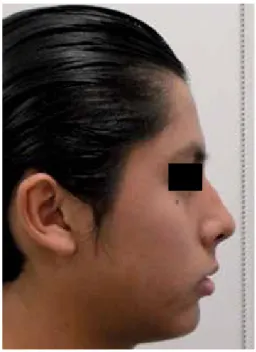
Figure 3. Right profile photograph.
Figure 4. Initial lateral headfilm.
www.medigraphic.org.mx
facial thirds relationship was observed (Figure 1).
Upon smile analysis, he showed the totality of the clinical crowns, reduced buccal corridors and mild crowding in the upper arch (Figure 2). He had a
convex profile, increased nasolabial angle, normal interlabial distance as well as incisal edge-stomion relationship, upper lip retrusion and a slight soft chin retrusion (Figure 3).
InItIal radIographIC studIEs
In the lateral headfilm (Figure 4), a skeletal class
II, vertical growth, upper incisors within normal values and lower incisor proclination may be noted.
In the initial panoramic radiograph short condyles, short mandibular ramus without asymmetries or apparent pathologies, complete dentition and impacted third molars may be observed (Figure 5).
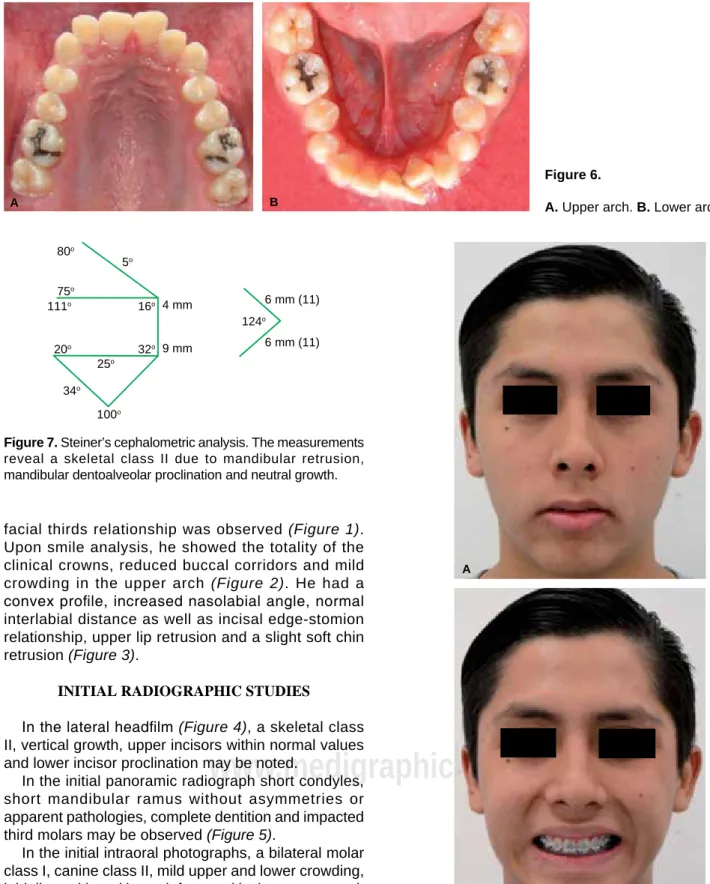
In the initial intraoral photographs, a bilateral molar class I, canine class II, mild upper and lower crowding, labially positioned lower left central incisor were noted. The patient also presented an increased overjet and a normal overbite with oval arch form both upper and lower (Figures 6 A and B).
Figure 7. Steiner’s cephalometric analysis. The measurements
reveal a skeletal class II due to mandibular retrusion, mandibular dentoalveolar proclination and neutral growth.
80o 5o 75o 111o 16o 20o 32o 4 mm 9 mm 25o 34o 100o 124o 6 mm (11) 6 mm (11) Figure 6.
A. Upper arch. b. Lower arch.
A b
Figure 8. A. Frontal photograph. b. Smile photograph. A
www.medigraphic.org.mx
Este documento es elaborado por Medigraphic
Figure 9. Frontal intraoral photograph.
Figure 10.
Occlusal photographs.
Figure 11.
Right and left lateral photographs.
anchorage loss of the posterior segments. Therefore it was decided to perform the extraction of the right and left upper premolars and a lower left central incisor (31)
In the facial photographs it may be observed that the patient continues to have a mild facial asymmetry, the interlabial opening improved and the buccal corridors were reduced (Figures 8 A and B).
Intraoral progrEss photographs
In the intraoral photographs the complete appliance placement including second molars may be observed. After the alignment and leveling stage the initial CuNiTi archwires were changed for 0.019” x 0.025” stainless steel archwires. A better alignment is evident: the upper dental midline is centered (Figure 9) and a
better archform (Figure 10).
In the right and left lateral photographs a bilateral functional molar class II and canine class I may be observed although the extraction spaces have not yet been closed (Figure 11).
www.medigraphic.org.mx
In the progress radiographic studies it may be observed that the patient continues to be class II with hyperdervergent growth (Figure 12).
In the panoramic radiograph after 6 months, some radicular convergences and divergences were evident and it was decided that some brackets needed
Figure 14.
A. Final photographs. Figure 12. Lateral headfilm. Figure 13. Panoramic radiograph.
www.medigraphic.org.mx
Figure 14.
b. Final photographs with canine
guidance and protrusion movements with posterior disoclussion.
canine class I was achieved as well as a normal overbite and overbite. The profile remained harmonic. Treatment time was 18 months (Figures 14 A and B).
The patient underwent upper premolar extractions in order to improve the archform, which was accomplished. Sliding mechanics was facilitated due to the technique.6
dIsCussIon
The extraction of an incisor is an effective treatment in patients with mild crowding and combined with
recommended by night only for another year.
ConClusIons
Incisor extraction is an effective method for correction of malocclusions compared to conventional mechanics in cases where premolars extractions would inevitably have been performed as well as retraction of the anterior segment for crowding correction and overbite improvement. It is a therapeutic option that corrects problems quickly and
www.medigraphic.org.mx
effectively in patients with mild crowding and without compromising the profile.
Incisor position should be assessed carefully since in these cases, it is a better option to remove a tooth that has periodontal problems or bone loss due to its position than extract a healthy tooth. If the tooth is compromised this option may be the best choice. One of the biggest advantages in carrying out this alternative is that it decreases treatment time.
A disadvantage of this kind of treatment is that the lower dental midline will not be centered with the facial midline at the end of treatment, however the overjet remains normal.
rEfErEnCEs
1. Uribe F, Nanda R. Considerations in mandibular incisor extraction cases. J Clin Orthod. 2009; 43 (1): 45-51.
2. Faerovig E, Zachrisson BU. Effects of mandibular incisor extraction on anterior occlusion in adults with class III malocclusion and reduced overbite. Am J Orthod Dentofacial Orthop. 1999; 115 (2): 113-124.
3. Ravindra N. Biomecánica y estética en ortodoncia. México:
Amolca; 2007.
4. Lenz GJ, Woods MG. Incisal changes and orthodontics stability.
Angle Orthod. 1999; 69 (5): 424-432.
5. Bennett JC, Mclaughlin RP. Mecánica en el tratamiento de ortodoncia y la aparatología de arco recto. Madrid, España: Editorial Mosby/Doyma libros; 1994: pp. 35-238.
6. Dacre JT. The long term effects of one lower incisor extraction.
Eur J Orthod. 1985; 7 (2): 136-144.
lECturEs rECommEndEd
— Valinoti JR. Mandibular incisor extraction therapy. Am J Orthod
Dentofacial Orthop. 1994; 105 (2): 107-116.
— Klein DJ. The mandibular central incisor, an extraction. Am J
Orthod Dentofacial Orthop. 1997; 111 (3): 253-259.
— Kokich VG, Shapiro PA. Lower incisor extraction in orthodontic
treatment. Four clinical reports. Angle Orthod. 1984; 54 (2):
139-153.
Mailing address:
Dayana Duron Rivas