
An assessmente of pink shrimp (Penaeus brasiliiensis) populations,in three areas of the Caribbean coast of Costa Rica
12
0
0
Texto completo
(2) 240. REVISTA DE BIOLOGIA TROPICAL. park borders, and are mostIy frequented by small-scale commercial fishermen. Trawling samples were o btained with a trawl net 16 m in length, with 7.6 m of head rope, and a 1.0 cm mesh size. Traw1ing time was 30 min and the trawled area extended from the nearest point of the river outlet at a right angle to the 100 m isobath. After sorne prelimi nary samples and an acoustic survey of the area, the trawling frequency was set aj one trawl/area/month.. MATERIAL AND METHODS Data on P. brasiliensis were obtained from a trawl survey designed to monitor the shrimp fishery from May 1990 to February 199 1 at three study locations: The Colorado river out let, the Parismina river outlet, and and the MoÍn river outlet . (Fig. 1) These areas were selected because they are relatively well developed in terms of commer cial fishing, they are outside national marine 1055'. ----� � "\ \. ... NICARAGUA. :. COLORA Do . r !Ver. - -. .... -. � �. �. . .<: .. . .. . . ... • . . .. ... .. ... ... ... .... \ \. COSTA RICA. 9{. 10°. 10. M_M. 1. O M. 10 ,. Km. Fig. l. Sampling areas of the north Caribbean coast of Costa Rica.. ::ARIBBEAN SEA. I I I I I I I I I I I I I I I I I I I I I I I I I I I I I I I I I I I I I I.
(3) TABASH: Penaeus brasiliiensis populations in Costa Rica. The shrimp were separated from the by-catch and shipped on ice to the Fishery Sciences Laboratory at the School of Biological Sciences at the Universidad Nacional (UNA). A total of 5736 individuals of P. brasiliensis were caughted in Limón, 6363 in Parismina, and 4329 in Barra del Colorado, their total length (mm) and total weight (g) was measured and grouped in 5 mm length classes. The length-frequency analysis was carried out with the Compleat ELEFAN software package (Gayanillo et al. 1988) in order to obtain the. modal distribution of the population and the growth parameters (Loo, K) of von Bertalanffy's ( 1934) growth curve as used by Pauly (1978). The original growth parameters were re-estimated with the addition of a sea sonal growth oscillation, using the modifica tions of the von Bertalanffy growth function (VBGF) proposed by Pauly and Gaschultz ( 1978) and Sommers (1988). The jacknife method was used to estimate the 95% confidence limits for Loo and K values (Pauly 1984). Assuming that the samples are representative of P.brasiliensis population, an empirical relationship (1Il') was obtained, as proposed by Pauly and Munro ( 1984) and mod ified b y Appeldoorn (unpublished) from intraspecific comparisons based on the relation between Loo and K values. Using the length frequency distribution obtained in this study, a modal progression analysis was performed with the Battacharya method permit to identify all the age groups , by area and by sexo A length-converted catch curve, pooling the percent samples, was used to estimate total mortality (Z) by area and sex, and to derive approximate probabilities of the first capture by length (Pauly 1984). This probability of capture assumed use of a trawl net. The capture of all smaller shrimps by trawI net, and the genera tíon of the natural mortality (M) obtained under minimum length as well as the estímated Z by interpolatíon between M and Z. Natural mortality was estimated using Pauly' s empirical relationship (Pauly 1980). Fishing mortality (F) was computed by subtrac tion and the optimum exploitation rate (E) by calculating the ratio of F over Z. This method assumes that Z was the same in all age groups used in the plot. AH the age groups recruited had the same abundance, all. 241. were equally vulnerable to the gear used and the sample was large enough to effectively rep resent the average population structure over the time period considered. Recruitment patterns were obtained by pro jecting length-frequency data backward along the time axis, using the growth equatíon to recover the pulsing of annual recruitment (Pauly 1986). This allowed quantification of recruitment seasonality. Estimations of Relative Yie ld per Recruitment and Relative Biomass per Recruitment were plotted for P. brasiliensis populations in Barra del Colorado, Parismina and Limón. RESULTS The length-frequency distribution obtained from P. brasiliensis and the growth curves by sex and total population are presented in Fig. 2. TabIe 1 presents the growth parameters esti mated in the three sampling areas for indivídu als larger than 40 mm Lt as well as the p' val ues obtained. The C and WP parameters sug gest a strong seasonal oscillation in growth. The growth parameters (Loo and K) do not pre sent variations in the C value. The WP parame ter indicates a minimum growth between June and August. The modal progression analysis applied using the Battacharya method is presented in Figure 3. A maximum of four age groups were detected monthly in Limón, Parismina and Barra del Colorado, but taken over the whole year, this method defines 3 age groups. Possibly, age groups 3 and 4 overlap. This result corresponds to the number of modes obtained in the length frequency distribution. The length con verted catch cúrves for P. brasiliensis in Limon, Parismina and Barra del Colorado for the total population and separated by sex are presented in the Fig. 4. Estimates of Z, F, M , E and probabilities of capture are pre sented in TabIe 2. Total mortality obtained in the three areas refers. only to shrimp fully recruited by the trawl neto In all are as total mortality did not differ between sexes. In Barra del Colorado a h ! g her f ishing mor�ality f (F=0.54 year- ) wlth a natural mortahty uf 1 1.95 year for total population was obtained, assuming that intraspecific distribution by sex did not existo Apparently the sex ratio in catch-.
(4) 242. REVISTA DE BIOLOGlA TROPICAL. TABLE 1 Growth parameters (Loo, [(), seasonal oseillation (e, WP) ami �' valué obtained for P. brasiliensis popularion sampled in Limón, Pa/'ismino anA Barra del Co./orado,. Costa Riea. Parametel'. Sampling areas. Limón. Loo (mm). Barra del Colorado. Parismina. P.l. M. F. P.t. M. 186.4. 189.0. 186.4. 18 l.0. 185.0. F. M. P.l. 184.6. F. 182.0. 183.8. 186.0. K (year-1 ). 0.748. 0.810. 0.820. 0.580. 0.600. 0.600. 0.990. 1.240. 0.800. C. 0.80. 0.90. 0.80. 0.90. 0.90. 0.80. 0.90. 1.00. 0.90. WP. 0.70. 0.80. 0.70. 0.80. 0.70. 0.70. 0.80. 0.70. 0.93. >'l'. 4.414. 4.460. 4.455. 4.278. 4.312. 4.3i!. 4.524. 4.613. 4.442. P.l =: Total population M ",Males F=Fernales. TABLE 2 Total mOl'fality (Z), .fishing mortality (F), natural mortality (M), mean length of probabiíity of capture (Le-50) and exploita lion rafe (E) estimated for P. brasiliensis populations sampled in Limón, Parismina ami Barra del Colorado. ParameterlArea. Limón. Pansmina. Barra del Colorado. M. F. P.l. M. 1.55. 1.55. 1.51. 2.49. 2.44. 2.39. 0.46. 0.19. 0.18. 0.13. 0.54. 0.48. 0.44. 1.33. 1.21. 1.36. 1.37. 1.38. 1.95. 1.96. 1.95. 0.27. 0.26. 0.27. 0.14. 0.14. O.l!. 0.22. 0.18. 0.16. 68.5. 67.0. 69.5. 68.0. 69.5. 69.0. 71.0. 70.5. 67.0. P.I. M. F. P.l. Z (year1 ). 1.78. 1.81. 1.67. F (year-1 ). 0.49. 0.48. M (year·' ). 1.29. E Le-50 (mm). F. P.!=Total population. M= Males F=Females. es was 1: 1, in general agreement with the biol ogy of this species. The value of M, which vades from 1.21-1.95 year -1 for the total popu lation, could be due to this sex ratio and to the lower optimum exploitation rate obtained in Limon, Parismina and Barra del Colorado. Gear efficiency was related to the behavior of the shrimp and could modi fy the sex ratio. However LeSO lengths can help illustrate the e f f e c t of similarity in natural mortality between sexes and its effect on fishing mor-. tality. Probability of capture patterns are pre sented in Table 2 in Limon, Parismina and Barra del Colorado, those patterns enable estimaiion of the mean lengths of the first capture, mainly owing to the selectivity effeet of the trawl neto In the recruitment patterns obtained (Fig. 5), P. brasiliensis populations caught in Limon presented high similarity between sexes. Por males the second pulse represents 74% of the recruitment population and for females, 85%..
(5) gYJJE'T,�,��J !tl� ,�,,�_,_�l ��m!2:, -,,�'l ,== - ,E,!a . � �11ª A. U. A. U. A. M. •. I. l'. J. I. J. A. S. A. J. ... S. . A· S. •. O. .O. O. M. dt. N. N.. D. O. N · O. J . B.. I. J. J. F. F. F. J. Colorado. U. ti. U. A. L. A U I I A S O _dII_l.'83,8 .... lC.lllO. A. .. ti J J A S Unldn l.'''''''''' K.U". O. ... A M J J A S _l.1I1.0mm.lC.l5811. S. .. ,,,,',. O. .182,0 mm.. N O K- 1.240. .. O. J.. N. O. N. O. N. O. F. TABASH. An assessment 01 the pink shrlmp popü!ations •. O. • •. ::::E:,�", , �, BJ31' 2!1�j,.j.,"'�" �., ,jg.��.:DI' g",.ij3.".".�,."., j.fH,.E.�I' J. F. J. J.. J. M. F. F. F. A. M. M. M. M. A. A. A. J. ... M. ". J. ... M. t,!.. . Umón. ,. J. •. J. . Um6n. J A S O L . 189.0 mm, K•.,810. J. Par.mlna. A S L • 185.0. O mm. K.. N. O. N. 0,600. J. D. J A ' S O N O . B. Colorado L _ 186.0 mm, K_ 0,800. J A S O L - 186,4 mm, K. 0.820. N. D. F. J. F. J. J. '. F. F. O. �. >. ti>. ;;:. , �. i:1 .... :::.:. �:. 1:;'. 1. a.. �. S'. i. �. Flg.2. Fig.2. Re e structured length-frequency data of total population, females and males of Penaeus brasiliensis in Limón, Parismina, and Barra del Colorado, and estimate of growth curves and seasonality.. e.
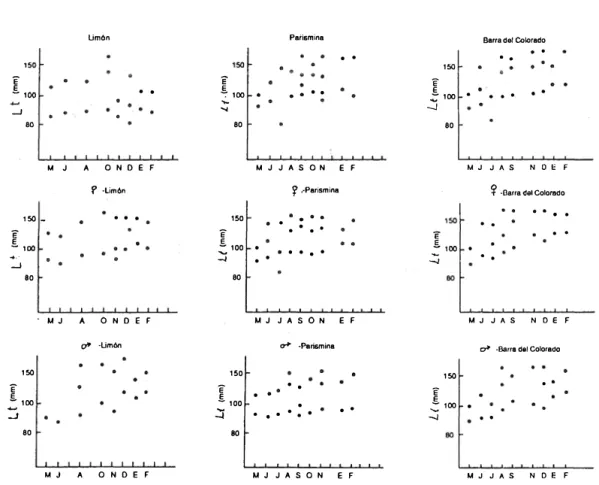
(6) REVISTA DE BIOLOGIA TROPICAL. 244. '50 E. �. '50. E -'00 -l. . .. E. --:.... 100. SO. 150. F. � ... o. E. '50. 11 ·. . .. •. .. • .. MJ. A cr". E. 150. '50. E �100 -l 80. E. .. .::¡. .. E - 100. M J. A. aN o E F. ,·t t. ":100 --.J. I. •. ·. .. .. . .. N O. E:. F. .. . .. . .. I. I. I. 150 .. .. 80 MJ JA Sa N. .. . .. , , , ,. N OE F. .. E. .. ·. cr- ·BafrB dar ColoradO:. . .. ·. .. ·. . .. MJ J A S. EF. a'" ·Parismina. ·UmÓ<1. E. "J J AS. o.. .. MJ J A S O N. o N o E F. . .. ·. � -Garra del Colorado. -J. 60. .. .. 80. EF. E 100 :: • 8' ••• • •• 80. E -'00. .. ? ,·Parismina E. �.'. .. '50. E �100. ••. MJJASaN. . .. E. o. .. -J. -lim6n .. _. .. 80. aN o E. A. l'. -l. E. '". M J. Barra del Colorado. Patismina. Umón. F. E. E :;100. .....¡. .. • •. •. MJ JAS. N OEF. Fig. 3. Results of modal progression analysis by Battacharya's method on pooled samples of total population, males and females of Penaeus brasiliensis in the three areas studied.. In Parismina, the main recruitment pulse repre sents 79% with a secondary pulse that includes 2 1%, without sex-related differences. In Barra del Colorado, the recruitment patterns are simi lar to those of Limon and Parismina. In all three areas, the difference between reeruitment pulses was 3 months. The relative yield per recruitment (Y' IR) and Biomass per Recruitment (B' IR) were cal eulated (Fig. 6). The population of P. brasilien s i s i n Limon, Parismina and Barra del Colorado, shows M values of 1.29, 1.36, and 1.95 year- 1, respeetively, and M/K ratios of 0.0 172 in Limón, 0.023 in Parismina, and 0.0 19 in Barra del Colorado. DISCUSSION By means of the length-frequency distríbu tÍon obtained in this study for P. brasiliensis. populations, aecording to the number of shrimp eaught and the length interval obtained, we may establish that the sample size obtained is adequate. The minimum length eaught was lower than those reported by Garcia and Le Reste ( 198 1) and Kawahara (1983) for the same species. A decrease in the number of modes for greater lengths indieates that data collection was carried out under a precise sam pIe design (Franee et al. 199 1). This population presents 3 c1early distin guishable age groups, suggesting consecutive spawning periods. This result coincides with the number of modes obtained in the length frequency distribution. The sample size reported by month, in the three sampling areas, is greater than those reported by Jones ( 198 1), Franee (1985) and Davies ( 1989), which were adequate for several crustacean species..
(7) TABASH: Penaeus brasiliiensis populations in Costa Rica. 245. femaJes. majes InINlI1�·Z·.4I)I). L_. ln(N/(I-exp(-Z"41))). ·Urn6n. �Um6n. -. 'IP. "oC D. D. .. In(Nf{1-aJCp(-Z"4I) ). .. .. Parism�a. In (Nf(1.xp(-Z't.1}». Parismina. z,..1.55. .. ;.-Parismina. In (NI{I-axpl-Z"4I)). :�. �. •. Z.·I.51. •. '. "'". .. Barra del Colorado. In(Nf(I..oxp(-Z"4t)l). &rradelCoIorado. .fmradelColorado. Z• .¡z.49. .. z...e.439. ... Relative age. Relative age. TABASH. An assessment of the pink shtimp populations •. Relative age. " used 111 nOI U$ed. • •. Fig. 4. Length-converted catch curves by . sex and total population of Penaeus brasiliensis in Limon, Parismina and Barra del Colorado.. The estimates of LOO and K are homoge neous bet ween sexes. Similar results were reported by Sumiomo (1988). Therefore, the P. brasiliensis growth level in Limón, Paósmina, and Barra del Colorado did not present a higher sex variability. In general terms, the LOO and K estimates are consistent with the assumption that penaei ds are small sized, fast-gro wing, and short-Iiv ing animals. The parameter fIl', as originally descóbed by Pauly and Munro ( 1984), used for intraspecific comparisons (Appeldoorn, unpub lished) indicates similar growth performance, and these values are the same as those obtained for other related species. Garcia ( 1977) report ed analogous fIl' values in P. notialis (fIl'=4.46) and Kawahara ( 1983) in P. subtilis (fIl'=4.39), both of these in French Guiana. Willmann and Garcia (1986) reported that P. notialis, P. sub-. tilis, and P. brasiliensis correlate with respect to their maximum length, maturation and life cycle. Growth coefficients (K) vary greatly from one area to another, between ranges of 0.58 and 1.24 year- 1 for males and intervals of 0.6 and 0.82 year- 1 for females. With regards to this variance, the estimated growth seasonality (C and WP) of P. brasiliensis in the three study zones, and the relative difference of fIl' values calculated by zone, according to reported by Oliver et al. ( 197 1) and Defeo et al.( 1988), sug gest that probably the seasonality of penaeid growth, underestimates or overestimates the K value obtained. Assuming that the age composition is in equilibrium, just as a previous condition for the estimation of Z, required establishing' that the mortality is constant in time by cohort, it is.
(8) N. 20.00. .... c:. � .... '" .. u ... g;. aI't. 15.00. ]. 10.00 I. 5.00 i. � Limón. Males -'Ii1!1!l.I. 30.00 1. •. 22.50. ........ . .. ..... .... e. � ... ;::1 .. u .... g;. aI't. Limón. o ' I. Pemales. E ... u. 15.00. g;. aI't. o. 20.00. 1. 7.50 1. .:17 �. =] a 15.00 10. . 00. �. O. 5 . 00. §5:. O. Parismina. 50. .00. 50 37. 25.00. 12.50 -. Fig5. Recruitment patteJ;lls by sex and total population in Penaeus brasiliensis in Limón, Parismina and Barra del Colorado.. O. �Cñ. � g. 10.00. O. Total population. Barra del Colorado. 15.00. 7.50. 7.50. tl:M. Barra del Colorado. 7.50. 77'·=7=. 22.50. O. l. I\�. 15.00. llmcln. -. 15.00. �!lml!Wl -. 30.00,. 30.00. 22.50. 2 ! ·50. I. 7.50,. 11 ID. o '. 30.00. ._._-. .! _1!i!i!I�ii¡1I.-. Parismina. � 1. ..J:::I.. Barra dal Colorado. �.
(9) TABASH: Penaeus brasiliiensis populations in Costa Rica. Barra del Colorado. 1.0 .9. ". .8. .'�. .6. , •••• ". .0157. m� .0118 .0098 .0078 _ Lo "'!:"--";""--l.0059. 3 t---:,r---�. 2 .. .0039. ,/. 0020. ,/. .1. 0000 .1. .2. .3. .4. .5. .6. .7. MI/<. Parismina. 1.0 .9. .0243 .-.----�...... �. mro m�. �. ...J. ;4. .3 2 . .1. m�. .0097 t:--": .;.. -_f.0073 , , '--- -�:-=--.....0049. ,/. ,. .0024. ,/ ����OOOO ���. Limón. 1.0 .9. , .' ". .8. .7. _.- •••••••. '.. ". MIl< vIII . • ••• • •. .. ....1. .0048 .0038. .4. .1. .0077 .0058. .5. .3 .2. 0096. .0086 .0067. :". .6. �. .0219 �1�. J. ��. M/K. .0196 .0176. ". ". <d .5 .3 .4 .. ,, ". ---.. ". ,:. J. ••••••. .0029. :'. --I.0019 �,""____�"""'_"":::__ :" , .0010 ,' S'/R ,. .0000. .9 .10. Exploilation rate Fig. 6. Relative yield per (eCruitment (Y'IR) and biomass. per recruitment (B 'IR) calculated from the total population of Penaeus brasiliensis.. likewise important to consider this limitation in order to analize the total mortality values in the three areas. Total mortality is lower than that reported for other species with similar small-scale com mercial fishing pressure ( Manisseri 198 1, Demm 1986 and Choy 1988). Estimations of. 247. natural and fishing mortality show the area as underexploited because the probability of death by natural causes is higher than the fishing mortality. Probably the Z value was overesti mated, because when total mortality decreases, the exploitation rate obviously decreases accordingly. Since the fishing mortality in Limón, Parismina, and Barra del Colorado is lower than the natural mortality, the effect of F on E was very small. The length of probability of c apture (Lc50%) was 69 mm Lt in all three areas . Comparing this result with the minimum length of m aturation reported by Ligt hburn and Orellana ( 1983) in the Nicaraguan Caribbean by Willmann and Garcia ( 1986) in Suriname for P. brasiliensis, both of 75 mm Lt, it was determined that over 50% of the sampled shrimps are immature. Thus, an increase in the mesh size was recommended, starting with lengths greater than" 70 mm Lt. The average of the first recruitment pulse incor porated 78.6% ± 6.2% in Limón, Parismina, and Barra del Colorado, the second recruitment pulse was presented 2 or 3 months after; result that is in correspondence with the modal progression analysis applied . These types of successive recruitment patterns are typical of shrimp of Penaeus genera and corre spond to migration cycIes, spawning and rain patterns (Gwyther 1980, Tenakanai 1980, Waffy 1980; Garcia 1984, Robertson et al. 1984, and Agasen and Del Mundo 1988). The actual exploitation rate is considerably low, despite its being a very commercially important species along the entire Caribbean coast. The relative yield per recruitment (Y' IR) reveals that these populations can withstand an increase of 55% in current fishery production in Barra del Colorado, 38% in Parismina, and 73% in Limón, without affecting the population renewal rate (B'IR). Duringthis sampling peri� od the B'IR was estimated at 0.65 in Limón and 0.75 in Barra del Colorado and Parismina. ACKNOWLEDGEMENTS The author expresses his sincere gratitude to the Consejo Nacional de Investigaciones Científicas y Tecnológicas (CONICIT), PRO GRAMA CARIBE:JAPDEV A-UNA and Dirección de Investigación de la Universidad.
(10) 248. REVISTA DE BIOLOGIA TROPICAL. Nacional, for the economical support. Special thanks to Jorge Gunther N., Roxana Víquez M., and Jorge Alfaro M. for their time and interest. RESUMEN Datos de frecuencia de longitud del camarón rosado, Penaeus brasiliensis Latreille, se obtu vieron en tres áreas de estudio en la costa Caribe de Costa Rica: Limón, Parismina y Barra del Colorado, se utilizaron para estimar parámetros de evaluación pesquera. Por sexo y área de muestreo, se obtuvieron el crecimiento, mortalidad, probabilidad de captura, patrones de reclutamiento y los estimados de producción y biomasa relativa por recluta. Además, se real izó un análisis de progresión modal con el objeto de determinar exactamente el número de grupos de edad presentes en la población anal izada. Ello por medio de la programación de evaluación pesquera ELEFAN. Los parámetros de crecimiento son consistentes con las carac terísticas de los camarones peneidos, referidru¡ a su rápido crecimiento, tamaño y corto ciclo de vida. Se estimó una significativa variación estacional en el crecimiento y el punto de míni mo crecimiento se ubicó entre julio y agosto. Se obtuvieron bajos valores de mortalidad por pesca y tasa de explotación en las tres áreas de estudio, lo que indica que se encuentran subex plotadas, no obstante que los estimados de pro ducción y biomasa relativa por recluta indican que en las tres zonas poseen poblaciones que soportan un incremento en la producción pes quera sin afectar su tasa de renovación.. REFERENCES Agasen, E.V. & C. M. Del Mundo. 1988. Growth, mortality and exploitation rates of Penaeus indicus in Manila Bay, Phillippines and Southeast India. In J. M. Moller Christensen, D. Pauly & S. Venema (eds.). Conrt ib. Trop. Fish. Biol. FAO. Rome. Bowler, K. & D.J.Brown. 1977. Some aspects.of growth in the British freshwater crayfish Austropotamobius pal lipes (Lereboullet), p. 295-310. Caddy, J.F. 1989. Overview of crustacean fisheries: Assessment and population dynamics., p. 3-11. In J.F.Caddy (ed). Marine Invertebrate Fisheries: Their assessment and management. John Wiley & Sonso New York.. Choy, S.C. 1988. The fishery and biology of Penaeus caniculatus (Crustacea: Decapoda: Penaeidae) in Laucala Bay, Republic of Fiji. Fishbyte 6: 21-24. Crocos, P.J. & J.D. Kenn. 1983. Maturation and spawning of the banana prawn, Penaeus merguensís de Man (Crustacea: Penaeidae) in the Gulf of Carpentaria, Australia J. Exp. Mar. Bio\. Eco\. 69:37-59. Cummings, W.C. 1961. Maturation and spawning of the pink shrimp Penaeus duorarum. Trans. Amer.Fish. Soco 90:462-468. Davies, I.J. 1989. Population callapse of the crayfish Orconectes virilis in response to experimental whole lake acidification. Can. J. Fish. Aquat. Sci. 46: 910922. Defeo, O. 1988. Dinámica poblacional de la almeja amaril la Mesodesma mactroides en playas de la costa atlánti . ca uruguaya. Simp. sobre Pesq. Pesqueira. Rio Grande, Brasil. p: 136 - 141. Dernm, V. 1986. Estimation of Z I K and Loo form a length distribution when Loo is assumed to vary between indi viduals. ICES. C. M: 10. Statistics Ctee. 14 p. F1int, R.W. 1975. Growth in a population of the crayfish Pacifastacus leniusculus from a subalpine environment. J. Fish. Res. Board Can. 32: 2433-2440. France, R., J.Holmes & A. Lynch. 1991. Use of size-fre cuency data to estimate the age composition of crayfish populations. Can. J. Fish. Aquat. Sci., 48: 2324-2332. García, S. 1984. Environmental aspects to penaeids shrimps biology and dynamics. p: 268 - 271. In: J.A. Gulland B.J. Rotschild (eds.). Penaeid shrimps: their biology and management. Fishing New B o o k s Fam ham, U.K. Garcia, S & L. Le Reste. 1981. Ciclos vitales, dinámica, explotación y ordenación de las poblaciones de camarones peneidos costeros. FAO. Doc. Tec. Pesca 20: 180 p. Gayanillo, F.C., M.L. Soriano & D. Pauly. 1988. A draft guide to the Compleat ELEFAN. ICLARM Software 2, 65 p. Gwyther, R.W. 1980. Cornmercial and biological aspects of the Gulf of Papua prawn fishery . Res. Bull., 21. Dept. Prim. Ind. Port Moresby, Australia Hartnoll, R.G. 1982. Growth p:15-62. In: L.G. Abele, (ed.)., The Biology of Crustacea, vol 11. Academic New York. Hazlett, B.A. and D. Rittschof. 1985. Variation in rate of growth in the crayfish Orconectes virilis. J. Crustacean Biol. 5: 341-346. Herke, W.H. and B.D.Rogers. 1989. Threats to coastal fish eries. p. 196-212. In: W.G. Duffy, & D. Clark (eds.). Marsh management in coastal Louisiana: Effects and.
(11) TABASH: Penaeus brasiliiensis populations in Costa Rica. issues - proceedings of a symposium. U.S. Fish Wild.Serv. Bio. Rep. 89. Jones, R. 1981. The use og length composition data in fish assessment (with notes in VPA and cohort analysis). FAO. Fish. Circo No. 734. 55p. Kawahara, H. 1983. Distribution, stock sizes and length frequencies of the shrimps of the continental shelf of Suriname and French Guiana. FAO. Fish. Rep. 278: 83 - 110. Kennedy, F.S. and D.G. Barber. 1981. Spawning and recruitment of pink shrimp Penaeus duorarum off Eastern Florida. J. Crnst. Biol., 1: 474-485.. Ligthburn, M.M. Y F.T. Orellana. 1983. La técnica del análisis de poblaciones virtuales (APV) aplicada a la pesquería del camarón blanco del Atlántico de Nicaragua. FAO. INF. PESCA., 278: 143 - 163. Manisseri, L.B. 1981. Preliminary results of a method fOf age determination in the length - frequency study in Baja California. Veliger 11: 135-139. Mathews,C.P. 1974. An account of sorne methods of over coming errors in ageing tropical-subtropical prawns populations when hard tissue growth marking and unre liable and the data sparse. p: 158-160. In: T.B. Bagenal (ed.). Ageing of fish and prawns. Unwin Broth.,Ltd., U.K. Mathews, C.P. 1981. A review of the North American penaeid fisheries with particular reference to Mexico. Kuwait Bul!. Mar. Sci., 2: 325-409. Mathews, C.P., M. AI-Hassaini, A.R.Abdul Ghaffar & M.AI-Shoushaní. 1987. Assessment of short-lived stocks with special reference to Kuwait' s shrimp fish eries: A contrast of the results obtained from tradii t onal and recent size-based techniques, p.147-166. In D. Pauly & G.R. Morgan (eds.). Length-based rnethod in fisheries research. I CARM Contrib. Manila. Philippines. Motoh, H. 1981. Studies on the fisheries biology of the giant tiger prawn, Penaeus monodon in the Phillipines. SEAFDEC Tech. Rep. 7:21-26.. 249. Pauly, D. 1980. A new methodology fOf rapidly acquiring basic information on tropical fish stocks: growth, mor tality and stock recruitrnent relationships, p.154-172. In S.B.Saila & P.M. Roedel (eds.). Stock assessment for tropical smalI-scale fisheries. Un iv. Rhode {sland, Kingston. Pauly, D. 1984. Length-converted cateh curves. Apower full tool for fisheries research in the tropies (Part 2). Fishbyte 2:17-19 . . Pauly, D. 1986. On improving operation and use of the ELEFAN programs. Part I. Avoiding "Drif!" of K towards low values. Fishbyte 3:13-14. Pauly, D. & G. Gaschutz. 1979. A simple method for fit ting oscillating length growth data, with a program pocket ealculators. ICES. CM. 6:24. Pauly, D. and J.L. Munro. 1984. Once more on growth comparíson in fish and invertebrates. Fishbyte 2:21. Penn,1.W. 1980. Spawning and fecundity of the western king prawn, Penaeus latisulcatus kis hinouye, i n Western Australian waters. Aust.J.Mar.Freshw.Res. 31:21-35. Rao, P.V. 1968. Maturation and spawning of the penaeid prawns of the southwest coast of India. FAO Fish.Rep. 57:285-302.. Robertson, J.W., R.G. Coles & G.B. Goeden. 1984. Distribution patterns of commercial prawns and repro duction of Penaeus esculentus around the WelIesley islands in the southeru Gulf of Carpentaría, p.215-221. In. P.C. Rothlisberg., BJ. HiIl & BJ. Staples (eds.). Seeond Aust.Nat.Prawn Sem., NPS2, Cleveland, Australia. Rodríguez,A. 1977. Contribution to the knowledge of the biology and fishing of the prawn Penaeus kerathurus (Forskall, 1755 ) fron the Cadiz Gulf. Invest. Pesq. 41:603-632. Shepherd;J.G. & M.D. Nicholson. 1991. Multiplicative modelling of catch-at-age data, and its application to eatch forecas!. J.Cons.in!. Explor.Mer. 47:284-294. Somers, LF. 1988. On a seasonally oscillating growth fune tion. Fishbyte 6:8-11.. O' Connor, C. Y. 1979. Reproducti ve periodicity of a Penaeus esculentus population near Low Islets, Queensland, Australia. Aquaculture 16:15-162. Oliver, S.R., D. Capezzani, J. Carreto, H. Cristianses, V. Moreno, J.A. de Moreno & P.E. Penchaszadeh. 1971. Estructura de la comunidad, dinámica de la población y biología de la almeja amarílla (Mesodesma mac t r o i d es) en M a r A z u l . P r o y . D e s . P e s q . F A O . Ser.Inf.Téc. 27:1-90. Pauly, D. 1978. A preliminary compilation of fish length growth parameters. Ber. Inst. Meer. (Kiel Univ.) No. 55, 2oop.. Stanley,J. & J.F. Caddy. 1989. The population biology of decapods, p.327-74. In. J.F. Caddy (ed.). Marine Invertebrate Fisheries: Their assessment and manage men!.10hn Willey, New York. Surniomo, B. 1988. Estimation of growth and mortality in banana prawn (Penaeus m erguensis) from the south coast of Java, Indonesia. FAO. Fish.Rep. 389:69-88. Tenakanai, D. 1980. Sorne aspects of the biology of the endeavor prawns (Metapenaeus spp) in the Gulf of Papua. Res. Bull. 28:43-49..
(12) 250. REVISTA DE BIOLO GIA TROPICAL. TholÍlas, M.M.1974. Reproduction, fecundity and sex ratio of the green tiger prawn, Penaeus semisulcatus de Haan. Indian J. Fish. 21:152-163.. Waffy, A. 1990. Population dynamics oí Metapenaeus ensis (Penaeidae) in the Gulf of Paptía, Papua, New Guinea Fishbyte 8:18-20.. Vón Bertalanffy, L. 1934. Untersuchungen uber die geset zlichkeit des Wachstums. l. AlIgemeine Grundlagen der Theorie, mathematische und physiologische Gesetzlichkeit des Wachstums bei Wassertieren. Ronx' Archiv. Entwickl. Mechanik ., 131 :613-652. In. D. Pauly & G. Gaschutz. 1979. A simple method for fit ting oscillating length growth data, with a prograni pocket calculators. ICES. CM. 6:24.. Willmann, R. & S.M. Garcia. 1986. Modelo bioeconóffiÍco para el análisis de pesquerías secuenciales artesanales e industriales de camarón tropical (con ún estudio de la pesquería del camarón de Surinam). F A O .D oc. Téc.Pesca.270:47p..
(13)
Figure



Documento similar
Bishop proves and discusses equivalent formulations of the traveling salesman theorem expressed in terms of different multi-resolution families, (see, Appendix B in
If the concept of the first digital divide was particularly linked to access to Internet, and the second digital divide to the operational capacity of the ICT‟s, the
The draft amendments do not operate any more a distinction between different states of emergency; they repeal articles 120, 121and 122 and make it possible for the President to
H I is the incident wave height, T z is the mean wave period, Ir is the Iribarren number or surf similarity parameter, h is the water depth at the toe of the structure, Ru is the
Since such powers frequently exist outside the institutional framework, and/or exercise their influence through channels exempt (or simply out of reach) from any political
In a survey of 1,833 business management undergraduates in six Ibero-American countries, factor analysis identified three approaches to stakeholder relations, behaviors, and
Of special concern for this work are outbreaks formed by the benthic dinoflagellate Ostreopsis (Schmidt), including several species producers of palytoxin (PLTX)-like compounds,
Fatta-Kassinos, Long-term wastewater irrigation of vegetables in real agricultural systems: Concentration of pharmaceuticals in soil , uptake and bioaccumulation in
