
Capitellidae (Annelida: Polychaeta) from the Pacific coast of Costa Rica
15
0
0
Texto completo
(2) 70. REVISTA DE BIOLOGIA TROPICAL. in the abdominal region or perhaps an abrupt increase in the number of setae (capillaries or hooks) in the neuropodial fascicle. The abdominal region is usually uniform throughout although some capitellids possess thin-walled branchial structures or have modified setae in far posterior segments (i.e. Mediomastus ambi-seta (Hartman 1947), the genus Scyphoproctus Gravier). The pydidium is usually not an important taxonomic character with the genera Scyphoproctus and Pulliella Fauvel being no-table exceptions. Fauchald (1977) listed 36 genera within the family Capitellidae and several new genera have since been described (Amastigos Piltz (1977); Dodecaseta McCammon & Stull (1978); Nonatus Amaral (1980); Octocapitella Brown (1987); and Paracapitella Carrasco (1987)). Ewing (1984a) estimated there to be 140 species of capitellids known to that time. Concerning the Pacific Ocean, Hartman (1947) reviewed 19 species of capitellids from the northeast Pacific and later reported 25 taxa (including 4 subspecies of Capitella capitata) from Cali-fornia (Hartman 1969). Fauchald (1972) later recorded an additional 9 species of capitellids from deep waters off Mexico. De León González (1994) and HernándezAlcántara & Solís-Weiss (1998) reported 34 known species of capitellids from the Gulf of California, Mexico, although HernándezAlcántara (1992) indicated that, despite the high number of species, the capitellids were not particularly abundant. Further south in the eastern Pacific, Carrasco (1977) and Carrasco & Gallardo (1987) have found five species of capitellids from the Chilean coast while Hartmann-Schröder (1962) has reported two species from the Peruvian coast. There have been few species of Capitellidae reported from the Pacific coast of Central America. Hartmann-Schröder (1959) reported a single species, Mediomastus setosus (probably M. ambiseta (Warren et al. 1994)), from the mangroves of El Salvador. Molina-Lara & Vargas-Zamora (1995) resampled HartmannSchröder‘s study site about 30 years later and again found the species described as M. setosus but also found the capitellid Dasybranchus lumbricoides Grube 1878 as one of the numerical dominants. On the Pacific coast. of Panama Monro (1933) recorded two species belonging to the genus Dasybranchus and Fauchald (1973) later described a species of Notodasus from intertidal sands. Dean (1996a & b) listed three species of capitellids collected subtidally from the Gulf of Nicoya and also listed three subtidal species from Golfo Dulce in Costa Rica for a total of five separate species. Vargas (1987, 1988, 1989) has sampled intensively at an intertidal site at Punta Morales in the Gulf of Nicoya and reported Mediomastus californiensis to be one of the numerically dominant benthic species. This paper reviews eleven species of Capitellidae collected either subtidally or intertidally from the Gulf of Nicoya and Golfo Dulce on the Pacific coast of Costa Rica. MATERIALS AND METHODS Subtidal material was collected in the Gulf of Nicoya using a modified Smith-McIntyre bottom grab. Subtidal station sites and sediment characteristics may be found in Maurer & Vargas (1984). Intertidal specimens were collected in the Gulf of Nicoya by the author during a series of collecting trips partially supported by the Universidad de Costa Rica’s Centro de Investigación en Ciencias del Mar y Limnología (CIMAR). J. A. Vargas (CIMAR), provided material from his study site at Punta Morales and from the intertidal of Golfito and H. Buttner (Center for Tropical Marine Ecology (ZMT), Bremen, Germany), kindly provided specimens from several mangrove sites in the Gulf of Nicoya. Voucher specimens of most of these species have been deposited in the Museo de Zoología, Universidad de Costa Rica or the Museum of Comparative Zoology (MCZ), Harvard University, Cam-bridge, MA, USA. Key to species of Capitellidae collected from the Pacific coast of Costa Rica 1. First four thoracic setigers with capillary setae………………………………………….2 1a. More than four thoracic setigers with capillary setae……………………………………..3.
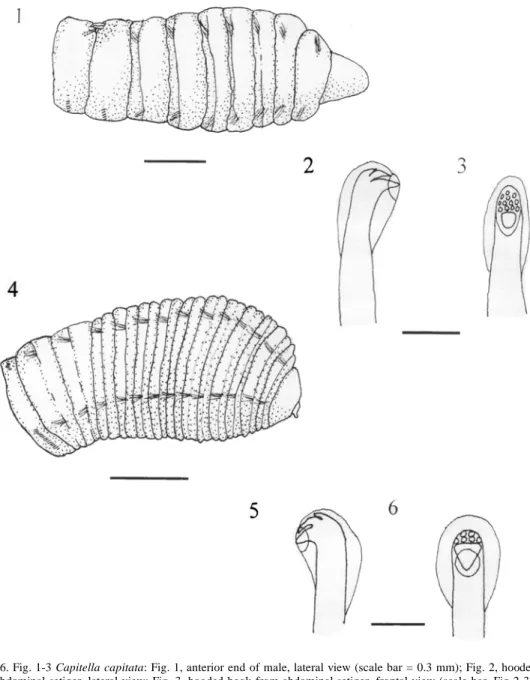
(3) ECOSISTEMAS ACUATICOS DE COSTA RICA II. 2. Spinous bifid hooks in abdominal notopodia. Capillary setae in posterior notopodia ………….…………….Mediomastus ambiseta 2a. Spine-like notopodial hooks and posterior capillary setae absent, thoracic and abdominal hooks morphologically similar, body more robust in appearance……………….…………. …………………. Mediomastus californiensis 3. Five thoracic setigers with capillary setae ……………………….Heteromastus filiformis 3a. More than five thoracic setigers with capillary setae……………………………………..4 4. Thorax with 9 segments, 7 thoracic setigers with capillary setae (when mature) …………... …………………………………Capitella capitata 4a. More than nine thoracic segments ………5 5. Ten thoracic setigers with capillary setae, first setiger incomplete; with patches of pale orange eyespots ….……….Decamastus nudus 5a. More than ten thoracic setigers with capillary setae …………………………………….6 6. Eleven thoracic setigers with capillary setae ……………………………………………….7 6a. More than 11 setigers with capillary setae ……………………………………………...10 7. At least first two abdominal notopodia with mixed fascicles of both capillary setae and hooks, first setiger incomplete………………... ………………………..Mastobranchus variabilis 7a. Capillary setae lacking in abdominal setigers ……………………………… Notomastus …8 8. A pair of elongate fields of eyespots present, first setiger incomplete ……Notomastus tenuis 8a. Fields of eyespots lacking ……………….9 9. First setiger with capillaries in both the noto- and neuropodia ……………..N. lineatus 9a. First setiger incomplete ……N. hemipodus 10. Twelve thoracic setigers with capillary setae ………………...Leiochrides cf. pallidior. 71. 10a. Thirteen thoracic setigers with capillary setae …………….Dasybranchus lumbricoides Species Descriptions Capitella capitata (Fabricius 1780). Fig. 1-3 Lumbricus capitata Fabricius 1780: 279. Capitella capitata. --Hartman 1969: 361. --Maurer et al. 1988: 46. --Warren 1991: 276 -282. Paraheteromastides sp. --Dean 1996b: 83. Material examined: --Gulf of Nicoya, Subtidal: Sta. 4, 9º53'40" N, 84º46'10" W, 40 m, mud, Jul 1980, (1, USNM 80410). Intertidal: Jicaral, 9º58' N, 85º06' W, intertidal, mangrove roots, Jan 1996 (1)(coll: H. Buttner). --Golfo Dulce, Subtidal: Sta GD-09 (LeónMorales & Vargas 1998), 8º39' N, 83º26' W, 43 m, grey mud, Dec. 1993, (1). Intertidal: Golfito Bay, 8º38' N, 83º10' W, 2 Km west of main dock, muddy sand, Sep 1986;(8) (coll: J.A. Vargas). Remarks: Capitella capitata is a mediumsized species with 9 thoracic segments and no visible peristomium or achaetous segments, thus segments 1-7 bear capillary setae only (Fig. 1). Two individuals had mixed fascicles in both the notopodia and neuropodia of setigers 6 and 7. Warren (1976) found that juvenile individuals of this species may exhibit mixed fascicles in anterior segments beginning as early as setiger 4. Mature males possess genital spines on setigers eight & nine while the females have hooded hooks on these last two thoracic segments. This setal arrangement is in agreement with the description for this species given by Warren (1991, Fig 1 A) in her review of the genus. The genital setae of the males is made up of three stout, posteriorly directed spines on setiger eight and a deeply embedded, thin spine projecting anteriorly from setiger nine. The hooded hooks of the abdominal segments have a main fang with many small teeth in several rows (Fig. 2 & 3). Warren (1991) indicated that C. capitata is cosmopolitan but with equatorial submergen-.
(4) 72. REVISTA DE BIOLOGIA TROPICAL. Fig. 1-6. Fig. 1-3 Capitella capitata: Fig. 1, anterior end of male, lateral view (scale bar = 0.3 mm); Fig. 2, hooded hook from abdominal setiger, lateral view; Fig. 3, hooded hook from abdominal setiger, frontal view (scale bar, Fig 2-3 = 0.02 mm). Fig. 4-6 Dasybranchus lumbricoides: Fig. 4, anterior end, lateral view (scale bar = 0.5 mm); Fig. 5, hooded hook from abdominal setiger, lateral view; Fig. 6, hooded hook from abdominal setiger, frontal view (scale bar, Fig 5-6 = 0.02 mm).. ce; however, most of these specimens from Costa Rica were collected intertidally. Grassle and Grassle (1976) have shown that this species often exists as a complex of sibling species which are very difficult to differentiate so, until a simple means of recognition of these subspecies is established, local populations of. this species are usually referred to as the C. capitata spp. complex. Most of the Costa Rican specimens of C. capitata were collected at Golfito, the only major port in Golfo Dulce. This species has often been regarded as indicative of organically polluted environments (see Pearson & Rosenberg (1978) for a.
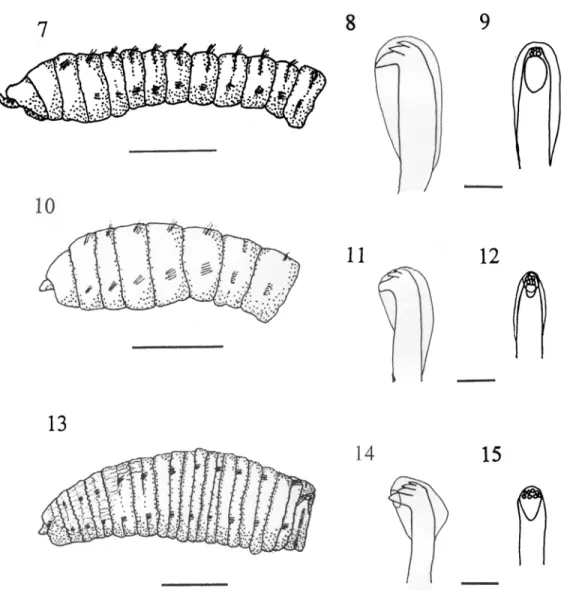
(5) ECOSISTEMAS ACUATICOS DE COSTA RICA II. discussion) and such pollution would be expected at this site due to the many ships and boats using this port (Spongberg & Davis 1998). Dasybranchus lumbricoides Grube 1878. Fig. 4-6 Dasybranchus caducus Grube, var. lumbricoides Grube. --Monro 1933: 1059-1060. Dasybranchus lumbricoides Grube 1878: 190191. --Hartman 1947: 431-432; 1969: 373374. --Ewing 1984a: 14.38-14.41. --Fauchald 1977: 52. Material examined: --Gulf of Nicoya, Intertidal: Punta Morales, South side, Lagartos Point, muddy sand, Aug 1996 (1). Remarks: D. lumbricoides is a medium-sized species with an enlarged thoracic region relative to the abdominal region. It has an achaetous peristomium and thirteen thoracic segments all with capillary setae in both the notopodium and neuropodium (Fig. 4). The thirteenth thoracic setiger of the single Costa Rican specimen has hooks as well as capillary setae in the neuropodium which I interpret as a juvenile character. Warren (1976) and Fredette (1982) have both shown in Capitella capitata and Heteromastus filiformis, respectively, that anterior segments may possess hooks in young individuals with the hooks being progressively replaced by capillaries with age. In the first few abdominal segments the notopodia are situated dorsally, almost touching one another as described previously by Monro (1933). The hooded hooks of the abdomen have six smaller teeth above the main fang, four in a lower row and two above this (Fig. 5 & 6). The number and distribution of these small teeth is apparently quite variable as Hartman (1969) described the hooks of D. lumbricoides as having only 3 small teeth above the main fang while Ewing (1984a) reported 3-4 rows of small teeth in specimens from the Gulf of Mexico. Retractable branchiae were not seen as most of the posterior end of this specimen was regenerating but the enlarged neuropodial tori of the last two thoracic segments and lateral organs,. 73. similar to those described by Ewing (1984a), were observed. D. lumbricoides has been reported from the eastern and western Pacific as well as the western Atlantic and Gulf of Mexico. It has been collected in the eastern Pacific from California to Panama as well as the Galapagos Islands in intertidal or shallow waters. Here a single specimen was collected intertidally in the Gulf of Nicoya. Decamastus nudus Thomassin 1970. Fig. 7-9 Decamastus nudus --Thomassin 1970: 81-82. -- Hernández-Alcántara & Solís-Weiss 1998: 709. Notomastus tenuis Moore --Maurer et al. 1988: 46 (in part). --Dean (1996a): 71 (in part). Material examined --Gulf of Nicoya, Subtidal: Sta. 3, 9º52'00" N, 84º48'10" W, 33 m, sandy mud, Jul 1980, (2, USNM 80383). Sta. 4, 9º53'40" N, 84º46'10" W, 40 m, mud, Jul 1980, (1, USNM 80384). Sta. 6, 9º45'20" N, 84º46'25" W, 42 m, mud, Jul 1980, (1, USNM 80385). Sta. 22, 9º48'25" N, 84º52' 40" W, 22 m, muddy sand, Jul 1980, (5, USN M 80406 & 15, USNM 80392). Sta. 23, 9º48'35" N, 84º 43'50" W, 35 m, mud, Jul 1980, (1, USNM 80407). Sta. 24, 9º49'25" N, 84º41' 20" W, 11 m, sand, Jul 1980,(16); Jan 1981, (4); Apr. 1981,(2); Jun 1981,(5) Aug 1981,(8). Sta. 27, 9º51'57" N, 84º50'50" W, 12 m, muddy sand, Jul 1980, (1, USNM 80408). Sta. 29, 9º54'55" N, 84º45'15" W, 18 m, muddy sand, Jul 1980, (1 & 1, USNM 80396); Aug 1981,(3). Sta. 30, 9º54'40" N, 84º45'50" W, 18 m, muddy sand, Jul 1980,(2); Apr 1981,(3). Sta. 31, 9º44'00" N, 84º59'25" W, 20 m, mud/sand, Jul 1980, (1). Intertidal: Punta Morales, Playa Blanca, lower intertidal muddy sand, Sep. 1994, (1). --Golfo Dulce, Intertidal: Golfito Bay, 2 Km west of main dock, 8º38' N, 83º10' W, muddy sand. Sep 1986, (9) (coll: J. A. Vargas). Remarks: The anterior segments of D. nudus are weakly tessellated and the small prostomium possesses patches of small, orange pig-.
(6) 74. REVISTA DE BIOLOGIA TROPICAL. Fig. 7-15. Fig 7-9 Decamastus nudus: Fig. 7, anterior end, lateral view (scale bar = 0.05 mm); Fig. 8, hooded hook from abdominal setiger, lateral view; Fig. 9, hooded hook from abdominal setiger, frontal view (scale bar, Fig. 8-9 = 0.02 mm). Fig. 10-12 Heteromastus filiformis: Fig. 10, anterior end, lateral view (scale bar = 0.05 mm); Fig. 11, hooded hook from abdominal setiger, lateral view; Fig. 12, hooded hook from abdominal setiger, frontal view (scale bar Fig. 11-12 = 0.02 mm). Fig. 13-15 Leiochrides ?pallidior: Fig. 13, anterior end, lateral view (scale bar = 1.0 mm); Fig. 14, hooded hook from abdominal setiger, lateral view; Fig. 15, hooded hook from abdominal setiger, frontal view (scale bar, Fig. 14-15 = 0.02 mm).. ment spots. This species is of medium body size relative to other capitellid species. There are 11 thoracic segments, with the first achaetous followed by ten setigers with only capillary setae, the first setiger is incomplete (Fig. 7). The hooded hooks have a main fang with two sets of small teeth above that (Fig. 8 & 9). Complete specimens from Golfito possessed. two pairs of digitate branchial processes inserted dorso-laterally on the posterior edge of each setiger in far posterior segments. Such branchiae were not observed by Thomassin (1970) or Ewing (1984a) for specimens belonging to this genus probably because, in both cases, their material was incomplete. It is also possible that development of branchial.
(7) ECOSISTEMAS ACUATICOS DE COSTA RICA II. lobes in speci-mens of the Golfo Dulce population is an adap-tation to low oxygen conditions in the sediments. Nonetheless, this is the first report of branchiae in the genus Decamastus and necessitates a revision of the original genus description by Thomassin (1970) indicating that branchiae may be present in posterior setigers. Thomassin described this species from coralline sands in Madagascar but Hernández-Alcántara and Solís-Weiss (1998) later reported the same species from fine and silty sands at depths of 32-106 m in the Gulf of California, Mexico. In Costa Rica, D. nudus was collected subtidally from sand or muddy sand at 11-42 m depth as well as from intertidal muddy sands in both the Gulf of Nicoya and Golfo Dulce. Heteromastus filiformis (Claparède, 1864). Fig. 10-12 Heteromastus filiformis --Hartman 1947: 427428; 1969: 377. Material examined --Gulf of Nicoya, Intertidal: Punta Morales, North side, lower to mid intertidal, sand and muddy sand, Jul. 1996, (8); Aug, 1996 (2). South side, Lagartos Point, lower intertidal, muddy sand, Jul. 1996, (1). Remarks: This is a medium sized species with 11 thoracic segments, the first being achaetous, followed by 5 setigers with capillaries only and the remaining thoracic segments possessing hooks (Fig. 10). In posterior setigers there is a single short branchial process inserted dorsal to each notopodia, but there was no indication of the multi-filamentous branchiae described for H. filobranchus Berkeley & Berkeley 1932 by Hartman (1969). Fredette (1982) demonstrated that H. filiformis could be confused with Mediomastus ambiseta (Hartman 1947) as during development the juveniles pass through stages in which there may only be three or four setigers with capillary setae prior to reaching the adult complement of five setigers. Com-plete specimens of M. ambiseta may be differ-enttiated from these juveniles by their posse-ssion of capillary setae in posterior. 75. setigers. Hooded hooks from far posterior segments have a main fang surmounted by two rows of two small teeth each (Fig. 11 & 12). H. filiformis is a widespread species found in all types of sediments, especially intertidal muds. In Costa Rica it was found in the Gulf of Nicoya on fine or muddy sands in the intertidal. Leiochrides cf. pallidior (Chamberlin 1918). Fig. 13-15 Notomastus pallidior. --Chamberlin 1918: 179; Berkeley & Berkeley 1942: 198. Leiochrides pallidior. --Hartman 1947: 429-430; 1969: 382-384. Material examined --Gulf of Nicoya, Subtidal: Sta. 29, 9º54'55" N, 84º45'15" W, 18 m, muddy sand, Jul 1980, (2, USNM 80398). Apr 1982 (1). Remarks: This species has a very large, robust body possessing 13 thoracic segments, the first an achaetous peristomium followed by 12 complete setigers bearing capillary setae only. The Costa Rican material was incomplete with the largest fragment having 37 segments and there were no branchiae observed. The hooded hooks on posterior setigers possess a main fang and 8-10 small teeth in 2 irregular rows. The descriptions of L. pallidior by Chamberlin (1918) and Hartman (1947, 1969) are very incomplete and some of its characteristics can only be inferred making it difficult to establish a definitive identification of the present material. This species can be differentiated from L. hemipodus Hartman 1960 previously reported from the Gulf of California, Mexico (Hernández-Alcántara & Solís-Weiss 1998) by having a complete first setiger, apparently lacking palmate branchiae in abdominal setigers and having more numerous small teeth on the hooded hooks. L. pallidior has been reported from intertidal and shallow subtidal waters in California by Hartman (1947, 1969) and Berkeley & Berkeley (1942) who collected it at 89 m. In Costa Rica it occurred on muddy sand at a.
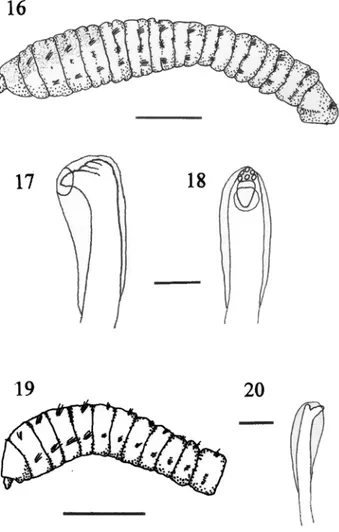
(8) 76. REVISTA DE BIOLOGIA TROPICAL. single station of 18 m depth. This extends the known range of this species from California, USA to Pacific Costa Rica. Mastobranchus variabilis Ewing 1984. Fig. 16-18. Mastobranchus sp. A. --Ewing 1984a: 14.3435. Mastobranchus variabilis. --Ewing 1984b, 793 -796. Mastobranchus ?variabilis. --HernándezAlcán-tara & Solís-Weiss 1998: 710. Material examined --Gulf of Nicoya, Subtidal: Sta. 29, 9º54'55" N, 84º45'15" W, 18 m, muddy sand, Apr 1982 (3). Remarks: M. variabilis possesses a thorax with a large achaetous peristomium and 11 setigers with capillary setae only (Fig, 16). The first setiger is incomplete. The transition from thorax to abdomen is marked only by the presence of both capillary and hooded hooks (mixed) in the notopodia and hooks in the neuropodia of the abdominal segments. The three specimens collected from Costa Rica were all anterior fragments (the longest was 28 setigers long) so the digitate branchial filaments (beginning at setiger 67 in the holotype) were not seen. Hernández-Alcántara & Solís-Weiss (1998) identified their specimens of Mastobranchus from western Mexico as M. ?variabilis since they too worked with incomplete material and were unable to confirm the presence of branchiae in posterior segments. As noted by Ewing (1984b) and Hernández-Alcántara & Solís-Weiss (1998), however, the other two described species in this genus possess a complete first setiger. The Costa Rican material also agrees with Ewing’s (1984b) species description of M. variabilis in several other characters which further supports its identification as this species. Nephridial apertures described for M. variabilis were visible as a pair of small pores in the groove between segments in the last five thoracic and the remaining abdominal segments. Additionally, the paired pores seen in M. variabilis (termed “lateral organs” by Ewing 1984b) were visible on thoracic segments between the notopodium and neuro-. podium, increasing in size towards the posterior of the thorax. In abdominal segments these organs appear as raised, oval structures between the notopodium and neuropodium. Finally, the structure of the hooded hooks, a large fang with 5 or 6 teeth in two or 3 irregular rows, agrees quite closely with those described for M. variabilis. While branchial segments are missing in these incomplete specimens it is clear they agree closely with the description of M. variabilis in other respects. M. variabilis was first described from coarse to fine sand in the northern Gulf of Mexico (Ewing 1984b). Hernández-Alcántara & SolísWeiss (1998) later identified this species from the Gulf of California, Mexico, in sandy sediments at 30 to 50 m depth. In Costa Rica specimens were collected at a single station in the Gulf of Nicoya at 18 m depth on a muddy sand substrate. Mediomastus ambiseta (Hartman 1947). Fig. 19-20 Capitata ambiseta Hartman 1947: 409-410. Mediomastus ambiseta --Hartmann-Schröder 1962: 143. --Warren et al. 1994: 234-236. Mediomastus ambiseta? --Dean 1996b: 83. Mediomastus californiensis Hartman --Dean 1996a: 71 (in part). Material examined --Gulf of Nicoya, Subtidal: Sta. 22, 9º48'25" N, 84º52'40" W, 22 m, muddy sand, Jul 1980, (52). Sta. 24, 9º49'25" N, 84º41'20" W, 11 m, sand, Jul 1980, (90); Jan 1981,(26); Apr 1981,(37); Jun 1981,(12) Aug 1981,(63). Sta. 28, 9º52'16" N, 84º45'30" W, 26 m, mud, Jul 1980, (1); Jan 1981 (1); Apr 1981 (3); June 1981, (7); Aug 1981, (8). Sta. 29, 9º54'55" N, 84º45'15" W, 18 m, muddy sand, Jul 1980, (9); Jan. 1981, (139); Apr. 1981, (10); June 1981, (14); Aug. 1981, (54); Apr. 1982, (20). Sta. 30, 9º54'40" N, 84º 45'50" W, 18 m, muddy sand, Jul 1980, (14); Jan 1981, (53); Apr 1981, (2); June 1981, (7); Aug. 1981, (13). Intertidal: Jicaral, 9º58' N, 85º06' W, mangrove roots, Jan. 1996 (1) (coll: H. Buttner). Punta Morales, North side, muddy sand, Aug. 1986 (1). --Golfo Dulce, Subtidal: Sta GD-08 (León-Morales & Vargas 1998),.
(9) ECOSISTEMAS ACUATICOS DE COSTA RICA II. 77. Fig. 16-20. Fig. 16-18 Mastobranchus variabilis: Fig. 16, anterior end, lateral view (scale bar = 1.0 mm); Fig. 17, hooded hook from abdominal setiger, lateral view; Fig. 18, hooded hook from abdominal setiger, frontal view (scale bar, Fig. 1718 = 0.02 mm). Fig. 19-20 Mediomastus ambiseta: Fig. 19, anterior end, lateral view (scale bar = 0.05 mm); Fig. 20, spine-like notopodial hook from abdominal setiger, lateral view (scale bar = 0.02 mm).. 8º43' N, 83º29' W, 50 m, brown mud, Dec 1993, (1). Intertidal: Golfito Bay, 8º38' N, 83º10' W, 2 Km west of main dock, muddy sand, Sep. 1986; (1154) (coll: J. A. Vargas). Remarks: M. ambiseta has a thin, thread-like body with an achaetous peristomial segment followed by a thorax with 10 setigers, the 10th being shorter than the rest and perhaps considered transitional (Fig. 19). Capillary setae only are present in setigers 1-4 of the thorax, the remaining thoracic segments with. hooded hooks only. Abdominal hooded hooks of the neuropodia short with a main fang surmounted by several small teeth, hooded hooks of the notopodia bidentate, long and spine-like (Fig. 20). Posterior notopodia of abdomen with long capillary setae. Methyl green staining resulted in setigers 6-9 being darkly stained dorsally. This agrees fairly well with the results obtained by Warren et al. (1994) on intertidal and shallow water specimens from California and Massachusetts (USA) but is dissimilar to the methyl green staining patterns.
(10) 78. REVISTA DE BIOLOGIA TROPICAL. seen by Blake, (2000) on deeper water material from the Santa Maria Basin and western Santa Barbara Channel. M. ambiseta is known from both the East and West coast of North America as well as the Gulf of Mexico and is usually collected from mud & muddy sand in the intertidal or shallow subtidal (Warren et al. 1994). In Costa Rica this species was collected at several subtidal stations with mud or muddy sand bottoms. It was also collected intertidally in mud or muddy sand from mangrove regions in the Gulf of Nicoya and was in extremely high abundance, along with Capitella capitata, at Golfito in Golfo Dulce. Mediomastus californiensis Hartman 1944. Fig. 21-23 Mediomastus californiensis Hartman 1944: 264265; 1947: 408; 1969: 387-388. --Ewing 1984a: 14.14-14.16. --Warren et al. 1994: 239-241. --Vargas 1987: 304; 1988: 294; 1989: 1909. --Maurer et al. 1988: 46. --Dean 1996a: 71, 1996b: 83. --Leòn-Morales & Vargas 1998: 85. --Hernández-Alcántara & Solís-Weiss 1998: 710.. 1980, (2, USNM 80367). Sta. 28, 9º52'16" N, 84º45'30" W, 26 m, mud, Jul 1980 (1; 18, USNM 80368); Jan 1981 (1); Apr 1981 (1); June 1981,(5); Aug 1981,(7). Sta. 29, 9º54'55" N, 84º45'15" W, 18 m, muddy sand, Jul 1980, (9; 16, USNM 80369; 2, USNM 80370); Jan 1981,(68); Apr 1981,(5); June 1981,(14); Aug 1981,(57); Apr 1982, (21). Sta. 30, 9º54'40" N, 84º45'50" W, 18 m, muddy sand, Jul 1980, (13); Jan 1981,(54); Apr 1981, (2); Jun 1981, (5); Aug 1981, (13). Sta. 32, 9º53'47" N, 84º49'35" W, 24 m, mud/sand, Jul 1980, (1, USNM 80371; 311, USNM 80372 & 1, US NM 80401). Sta. 34, 9º55'30" N, 84º50'05" W, 24 m, sand, Jul 1980, (5, USNM 80373). Sta. 35, 9º55'42" N, 84º47'40" W, 13 m, sand, Jul 1980, (1, USNM 80403). Sta. 36, 9º55'32" N, 84º45'20" W, 18 m, sandy mud, Jul 1980, (1, USNM 80374). Sta. 37, 9º57'38" N, 84º48'20" W, 14 m, muddy sand, Jul 1980, (7, USNM 80375). Sta. 40, 9º58'25" N, 84º01'05" W, 15 m, mud, Jul 1980, (3, USNM 80376). Sta. 44, 9º59'17" N, 84º54'25" W, 24 m, muddy sand, Jul 1980, (13, USNM 80377). Intertidal: Punta Morales, North side, mud, Jul 1986 (5)(coll: J.A. Vargas). --Golfo Dulce: Subtidal: Sta GD-12 (León-Morales & Vargas 1998), 8º21' N, 83º14' W, 200 m, green mud, Dec 1993, (1). Intertidal: Golfito Bay, 2 Km west of main dock, 8º38' N, 83º10' W, muddy sand, Sep 1986; (3) (coll: J. A. Vargas).. Material examined --Gulf of Nicoya, Subtidal: Sta. 1, 9º57'30" N, 84º53'00" W, 46 m, mud, Jul 1980, (13, USNM 80357). Sta. 2, 9º 55'28" N, 84º52'05" W, 18 m, muddy sand, Jul Remarks: M. californiensis is a rather small1980, (2, USNM 80358). Sta. 3, 9º52'00" N, bodied species with a more “muscular’’ anterior 84º48'10" W, 33 m, sandy mud, Jul 1980, (1, region and a more thin-walled abdominal region. USNM 80359). Sta. 7, 9º56'42" N, 84º57'50" The thorax is 10 segments in length preceded W, 15m, muddy sand, Jul 1980, (1, USNM Fig. Sta. 21-26.13, Fig.9º52'30" 21-23 Mediomastus californiensis: 21, anterior end, lateral view by an achaetous Fig. peristomium. Capillary setae(scale bar = 0.05 mm); Fig. 22, 80360 & 9, USNM 80386). hooded hook(6, from abdominal setiger, view; Fig. 23, hooded hook from abdominal only lateral are present on the first four thoracic setigers setiger, frontal view (scale bar, N, 84º43'50" W, 26 m, Jul 1980, USNM Fig. 22-23 = 0.05 mm). Fig. 24-26 Notomastus hemipodus: Fig. 24, anterior end, lateral view (scale bar = 1.0 mm); Fig. 25, with the remaining thoracic setigers having 80361& 2, USNM 80362). Sta. 14, 9º57'05" hooded hook from abdominal setiger, lateral view; Fig. 26, hooded hook from abdominal setiger, frontal view (scale bar, hooded hooks in both rami similar in morphoN, 84º45'30" W, 9 m, sandy mud, Jul 1980, (7, Fig. 25-26 = 0.02 mm). logy to those of the abdominal region. The USNM 80363). Sta. 15, 9º57'40" N, 84º47'00" hooded hooks have a main fang with three W, 15 m, sandy mud, Jul 1980, (1, USNM smaller teeth similar to those seen by Hartman 80364). Sta. 17, 9º57'52" N, 84º59'00" W, 9 (1969). As was pointed out by Warren et al. m, mud, Jul 1980, (3). Sta. 22, 9º48'25" N, 84º (1994), this species can be differentiated from 52'40" W, 22 m, muddy sand, Jul 1980,(6; 2, M. ambiseta by the lack of capillary setae in USNM 80365). Sta. 23, 9º48'35" N, 84º43'50" posterior segments, a lack of spine-like notoW, 35 m, mud, Jul 1980, (1, USNM 80366). podial hooks and the overall more “muscular” Sta. 24, 9º49'25" N, 84º41'20" W, 11 m, sand, appearance of the anterior region. AdditionalJul 1980,(84); Jan 1981,(23); Apr 1981,(23); ly, Blake (2000) points out that the similarity Jun 1981,(13) Aug 1981,(62). Sta. 27, 9º51' of thoracic and abdominal hooded hooks in M. 57" N, 84º50'50" W, 12 m, muddy sand, Jul.
(11) ECOSISTEMAS ACUATICOS DE COSTA RICA II. californiensis could also be used to differentiate the two species as the hooks of M. ambiseta are dissimilar in the two body regions. Methyl green staining resulted in a pattern of transverse stripes on setigers 7-9 somewhat similar to the results of Warren et al. (1994). Blake (2000), however, reported variable methyl green staining patterns with his material from the intertidal of Murro Bay, California (USA). M. californiensis has been reported from both coasts of North America and the Gulf of Mexico on fine to muddy sands from the intertidal and shallow subtidal waters (Ewing 1984a). Hernández-Alcántara & Solís Weiss (1998) collected M. californiensis from depths of 3369 m in silty sands from the Gulf of California in Mexico and this species has often been reported from various sites in Pacific Mexico (De León-González 1994; Salazar-Vallejo 1981; Van Der Heiden & Hendrickx 1982; AriasGonzález 1984; Varela-Hernández 1993). It is one of the most common subtidal species in the Gulf of Nicoya being collected from numerous sites in sediments ranging from mud to sand. A few specimens have also been taken intertidally from mud and muddy sand in both the Gulf of Nicoya and Golfo Dulce. Notomastus hemipodus Hartman 1945. Fig. 24-26 Notomastus (Clistomastus) hemipodus --Hartman 1945: 38; 1947: 424; 1969: 393. Notomastus hemipodus. --Ewing 1984a: 14.28. --Vargas 1987: 304. --Hernández-Alcántara & Solís-Weiss 1998: 711. Notomastus luridis Verrill --Maurer et al. 1988: 46. --Dean 1996a: 71. Material Examined --Gulf of Nicoya, Subtidal: Sta. 1, 9º57'30" N, 84º53'00" W, 46 m, mud, Jul 1980, (USNM 80378). Sta. 2, 9º55'28" N, 84º52'05" W, 18 m, muddy sand, Jul 1980, (2, USNM 80379; 1, USNM 80380 & 1, USNM 80381). Sta. 3, 9º52'00" N, 84º48'10" W, 33 m, sandy mud, Jul 1980, (2, USNM 80382). Sta. 13, 9º52'30" N, 84º43'50" W, 26 m, Jul 1980, (2, USNM 80387). Sta. 14, 9º57'05" N, 84º45'30" W, 9 m, sandy mud, Jul 1980, (1, USNM 80388). Sta. 15, 9º57'40" N, 84º47'00". 79. W, 15 m, sandy mud, Jul 1980, (13, USNM 80389 & 3, USNM 80390). Sta. 20, 10º01'40" N, 84º55'57" W, 14 m, sand, Jul 1980, (1, USNM 80391). Sta. 22, 9º48'25" N, 84º52'40" W, 22 m, muddy sand, Jul 1980,(1). Sta. 23, 9º48'35" N, 84º43'50" W, 35 m, mud, Jul 1980, (1, USNM 80393). Sta. 24, 9º49'25" N, 84º41'20" W, 11 m, sand, Jul 1980,(4); Jan 1981, (5); Apr 1981, (16); Jun 1981, (4) Aug 1981, (15). Sta. 27, 9º51'57" N, 84º50'50" W, 12 m, muddy sand, Jul 1980, (9, USNM 80394). Sta. 28, 9º52'16" N, 84º45'30" W, 26 m, mud, Jul 1980, (7; 16, USNM 80395); Jan 1981 (24); Apr 1981 (45); June 1981,(22); Aug 1981,(3). Sta. 29, 9º54'55" N, 84º45'15" W, 18 m, muddy sand, Jul 1980, (7; 3, USNM 80396; 1, USNM 80397; 6, USNM 80398); Jan 1981, (15); Apr 1981, (3); June 1981, (7); Aug 1981,(14); Apr 1982, (35). Sta. 30, 9º54'40" N, 84º45'50" W, 18 m, muddy sand, Jul 1980,(7; 1, USNM 80399); Jan 1981, (3); Apr 1981,(46); June 1981, (2). Sta. 31, 9º44'00" N, 84º59'25" W, 20 m, mud/sand, Jul 1980, (3, USNM 80400). Sta. 32, 9º53'47" N, 84º49'35" W, 24 m, mud/sand, Jul 1980, (1, USNM 80401). Sta. 35, 9º55'42" N, 84º47'40" W, 13 m, sand, Jul 1980, (1, USNM 80403). Sta. 37, 9º57'38" N, 84º48'20" W, 14 m, muddy sand, Jul 1980, (3, USNM 80404). Sta. 44; 9º59'17" N, 84º54'25" W, 24 m, muddy sand, Jul. 1980 (1). Intertidal: Punta Morales, North side, mid intertidal, muddy sand, Aug 1988 (1). Jicaral, 9º58' N, 85º06' W, mangrove roots, Jan 1996 (1) coll: H. Buttner. Remarks: N. hemipodus has a relatively large, robust body with a peristomium which is visible only ventrally and a thoracic region with 12 segments. The first thoracic segment is achaetous and is followed by 11 setigers with capillaries in both rami except for the first which lacks capillaries in the neuropodia (Fig. 27). The first 4-6 thoracic segments are areolated dorsally. The transition from the thorax to the abdomen is apparent only by the changeover from capillary setae in the thorax to hooded hooks in abdominal segments and the increased length of the setal fascicles in both rami in abdominal segments. The hooded hooks of the abdomen have a main fang surmounted by 5 or 6 smaller teeth in a single row (Fig. 28-29)..
(12) 80. REVISTA DE BIOLOGIA TROPICAL. Fig. 27-32. Fig. 27-29 Notomastus lineatus: Fig. 27, anterior end, lateral view (scale bar = 0.05 mm); Fig. 28, hooded hook from abdominal setiger, lateral view; Fig. 29, hooded hook from abdominal setiger, frontal view (scale bar, Fig. 28-29 = 0.02 mm). Fig. 30-32 Notomastus tenuis: Fig. 30, anterior end, lateral view (scale bar = 0.05 mm); Fig. 31, hooded hook from abdominal setiger, lateral view; Fig. 32, hooded hook from abdominal setiger, frontal view (scale bar, Fig. 31-32 = 0.02 mm).. N. hemipodus is known from both coasts of North America and the Gulf of Mexico from the intertidal to 120 depth in muddy sands (Ewing 1984a). Hernández-Alcántara & SolísWeiss (1998) collected this species from the Gulf of California, Mexico, at depths of 22106 m on fine, medium and silty sands and muds. It has also been reported from the northern and central Gulf of California, Mexico (Varela-Her-nández 1993; González-Ortiz 1994). In Costa Rica, N. hemipodus was fairly widespread in the Gulf of Nicoya in muds, to muddy sands, to sands from the intertidal to 46 m depth. Notomastus lineatus Claparède, 1870. Fig. 27-29 Notomastus (Clistomastus) lineatus. -Hartman 1947: 419; 1969: 395-396. -Fauchald 1977: 52.. Notomastus lineatus. --Ewing 1984a: 14.2314.26. --Hernández-Alcántara & Solís-Weiss 1998: 712. Material Examined: --Gulf of Nicoya, Intertidal: Punta Morales, South side, mouth of Rio Morales, upper intertidal fine sand, Aug, 1996 (1). Remarks: There are 12 segments in the thorax with 11 complete setigers bearing only capillary setae although the setal fascicle of the first setiger in this single specimen was very small with only a single short capillary setae. The transition from thorax to abdomen was well defined and the changeover from capillary setae to hooded hooks was also apparent. The hooded hooks from abdominal segments have a sharply bent main fang and 5 small teeth in a single row above. The branchial lamellae,.
(13) ECOSISTEMAS ACUATICOS DE COSTA RICA II. present as club-like extensions dorsal to the neuropodia, do not appear until far posterior setigers, unlike the specimens described from the Gulf of Mexico by Ewing (1984a, Fig. 1418c) which possessed branchial lamellae starting on the first abdominal segment. Fine walled lateral organs located between the notopodial and neuropodial rami in abdominal segments are present in the Costa Rican specimen. N. lineatus is a wide ranging species having been reported from the Mediterranean, the Gulf of Mexico, the eastern Pacific, and the Antarctic, usually from coarse sediments. HernándezAlcán-tara & Solís-Weiss (1998) reported it from fine to coarse sands at depths from 29 to 78 m in the Gulf of California, Mexico. It had previous-ly been reported from Pacific Mexico by Salazar-Vallejo (1985) and Van der Heiden & Hendrickx (1982). A single specimen was col-lected from intertidal fine sand in the Gulf of Nicoya. Notomastus tenuis Moore 1909. Fig. 30-32 Notomastus (Clistomastus) tenuis. --Hartman 1947: 420; 1969: 387. Notomastus ? tenuis. --Ewing 1984a: 14.2614.28. Notomastus tenuis. --Hernández-Alcántara & Solís-Weiss 1998: 712-713. Material examined --Gulf of Nicoya, Subtidal: Sta. 2, 9º55'28" N, 84º52'05" W, 18 m, muddy sand, Jul 1980, (1, USNM 80405). Sta. 29, 9º54'55" N, 84º 45'15" W, 18 m, muddy sand, Jan 1981, (1). Sta. 34, 9º55'30" N, 84º50'05" W, 24 m, sand, Jul 1980, (1, USNM 80402; 1, USNM 80409). Sta. 37, 9º 57'38" N, 84º48'20" W, 14 m, muddy sand, Jul 1980, (1, USNM 80404). Remarks: N. tenuis has 12 segments in the thorax with one achaetous segment and eleven setigers with capillary setae, the first setiger being incomplete (Fig. 30). It is a large species, similar to N. hemipodus in body size. N. tenuis differs from N. hemipodus in its possession of a pair of elongate patches of dark eyespots on the prostomium. The hooks have a main fang with about 4 small teeth seen from the side. 81. (Fig. 31). In frontal view there is a row of 5 teeth above the fang with about 4 small teeth in an irregular row above that (Fig. 32). This species is commonly found in the eastern Pacific from Canada to Mexico although Ewing (1984a) also “questionably” identified this species from the Gulf of Mexico. HernándezAlcántara & Solís-Weiss (1998) collected it from the Gulf of California, Mexico, in fine to silty sands from at depths of 39 to 120 m. It has previously been reported from western Mexico by Rioja (1962), De León-González (1994), Salazar-Vallejo (1981), Van Der Heiden & Hendrickx (1982) and Fauchald (1972). In Costa Rica it was taken occasionally in the Gulf of Nicoya from 14 to 24 m depth in muddy sand to sand stations. ACKNOWLEDGEMENTS The numerous collection trips to Costa Rica have been made possible through the aid and encouragement of the University of Costa Rica’s Centro de Investigación en Ciencias del Mar y Limnología (CIMAR) and its director Jose A. Vargas. Additional material was provided by J. A. Vargas (CIMAR) and H. Buttner (ZMT). L. Ward and K. Fauchald kindly provided the loan of Costa Rican material from the United States National Museum collection. REFERENCES Amaral, A. C. Z. 1980. Breve caracterizaçaõ des gêneros da família Capitellidae Grube (Annelida, Polychaeta) e descriçaô de Nonatus longilineus gen. sp. nov. Bull. Inst. Oceanogr., São Paulo 29: 99-106. Arias-González, E. 1984. Diversidad, distribución y abundancia de anélidos poliquetos en la Bahía de Mazatlán, Sinoloa, durante un ciclo anual. Tesis Profesional, Facultad de Ciencias, Univ. Nac. Autón. Méx. 102 p. Berkeley, E. & C. Berkeley. 1942. North Pacific Polychaeta, chiefly from the west coast of Vancouver Island, Alaska, and Bering Sea. Can. J. Res. 20(7): 183-208. Blake, J. A. 2000. Family Capitellidae Grube, 1862. Pp 47-96. In J.A. Blake, B. Hilbig & P.H. Scott (eds.). Taxonomic atlas of the benthic fauna of the Santa Maria basin and western Santa Barbara channel, Volume 7. The Annelida, Part 4. Santa. Barbara Mus. Nat. Hist., Santa Barbara, California..
(14) 82. REVISTA DE BIOLOGIA TROPICAL. Brown, B. 1987. A new genus and species of Capitellidae (Polychaeta) from the Atlantic coast of the United States. Bull. Biol. Soc. Wash. 7: 56-61.. Fauchald, K. & P. Jumars. 1979. The diet of worms: A study of polychaete feeding guilds. Oceanogr. Mar. Biol. Ann. Rev. 17: 193-284.. Carrasco, F. D. 1977. Polychaeta (Annelida) de Bahia de Concepcion, Chile. Familias Orbiniidae, Cirratulidae, Cossuridae, Capitellidae y Ampharetidae, con la descripción de tres especies y una subespecie nuevas. Bol. Soc. Biol. Concepción 51(1): 67-92.. Fredette, T. J. 1982. Evidence of ontogenetic setal changes in Heteromastus filiformis (Polychaeta: Capitellidae). Proc. Biol. Soc. Wash. 95: 194-197.. Carrasco, F. D. & V. A. Gallardo. 1987. A new genus and species of Capitellidae from a stressed environment in the Bay of Concepción, Chile. Bull. Biol. Soc. Wash. 7: 53-55. Chamberlin, R. V. 1918. Polychaetes from Monterey Bay. Proc. Biol. Soc. Wash. 31: 173-180. Dean, H. K. 1996a. Subtidal benthic polychaetes (Annelida) of the Gulf of Nicoya, Costa Rica. Rev. Biol. Trop. 44 (Suppl. 3): 69-80. Dean, H. K. 1996b. Polychaete worms (Annelida) collected in Golfo Dulce during the Victor Hensen Costa Rica expedition (1993/1994). Rev. Biol. Trop. 44 (Suppl. 3): 81-86. De León-González, J. A. 1994. Poliquetos (Annelida: Polychaeta) de la plataforma continental de la costa oeste de Baja California Sur, México: taxonomía, hábitos alimenticios y distribución. Tesis Maestría, Centro Interdisciplinario de Ciencias Marinas, Instituto Politécnico Nacional. 177 p. Ewing, R. M. 1984a. Chapter 14. Family Capitellidae, p. 14.1-14.47. In J. M. Uebelacker & P. G. Johnson, (eds.). Taxonomic guide to the polychaetes of the Northern Gulf of Mexico. Barry A. Vittor & Associates, Mobile, Alabama. Ewing, R. M. 1984b. Generic revision of Mastobranchus and Peresiella (Polychaeta: Capitellidae) with descriptions of two new species from the Gulf of Mexico and Atlantic Ocean. Proc. Biol. Soc. Wash. 97: 792-800. Fabricius, O. 1780. Fauna Groenlandica, systematice sistens, Animalia Groenlandiac occidentalis hectenus indagata, quod nomen specificum, triviale, vernaculumque; synonyma auctorum plurium, descriptionem, locum, victum, generationem, mores, usum, capturamque singuli, pront detegendi occasio fuit, maximaque parti secumdum propris observationes, Hafniae. 16: 1-452. Fauchald, K. 1972. Benthic polychaetous annelids from deep water off western Mexico and adjacent areas in the eastern Pacific Ocean. Allan Hancock Monogr. Mar. Biol. 7: 1-572. Fauchald, K. 1973. Polychaetes from Central American sandy beaches. Bull. So. Cal. Acad. Sci. 72: 19-31. Fauchald, K. 1977. Polychaetes from intertidal areas in Panama, with a review of previous shallow-water records. Smithson. Contr. Zool. 221: 1-81.. González-Ortíz, L. 1994. Los poliquetos (Annelida: Polychaeta) de la plataforma continental del Golfo de Tehuantepec, México. Tesis Profesional, Facultad de Ciencias, Univ. Nac. Autón. Méx. 191 p. Grassle, J. F. & J. P. Grassle. 1974. Opportunistic life histories and genetic systems in marine benthic polychaetes. J. Mar. Res. 32: 253-284. Grassle, J. P. & J. F. Grassle. 1976. Sibling species in the marine pollution indicator Capitella (Polychaeta). Science 192: 567-569. Grube, A. E. 1878. Annulata Semperiana. Beiträge zur Kenntis der Anneliden-fauna der Philippinen nach den von Herrn Prof. Semper mitgebrachten Sammlungen. Mem. Acad. Sci. St. Petersburg 25: 1-300. Hartman, O. 1944. Polychaetous annelids from California, including the description of two new genera and nine new species. Allan Hancock Pac. Exp. 10: 239-307. Hartman, O. 1945. The marine annelids of North Carolina. Duke Univ. Mar. Sta. Bull. 2: 1-53. Hartman, O. 1947. Polychaetous annelids, Part VII. Capitellidae. Allan Hancock Pac. Exp. 10: 391-481. Hartman, O. 1969. Atlas of the sedentariate polychaetous annelids from California. Allan Hancock Foundation, Univ. So. Cal., Los Angeles. 812 p. Hartmann-Schröder G. 1959. Zur Ökologie der Polychaeten des Mangrove-Estero-Gebietes von El Salvador. Beitr. Neotrop. Fauna 1: 69- 183. Hartmann-Schröder, G. 1962. Zweiter beitrag zur Polychaeten fauna von Peru. Kiel Meeresf. 18: 109-147. Hernández-Alcántara, P. 1992. Los poliquetos (Annelida: Polychaeta) de la plataforma continental del Golfo de California, México. Taxonomía, abundancia numérica y distribución geográfica. Tesis Maestría, UACP y PCCH, Univ. Nac. Autón. Méx., 427 p. Hernández-Alcántara, P. & V. Solís-Weiss. 1998. Capitellids (Polychaeta: Capitellidae) from the continental shelf of the Gulf of California, México, with the description of a new species, Notomastus angelicae. Proc. Biol. Soc. Wash. 111(3): 708-719. León-Morales, R & J. A. Vargas. 1998. Macrofauna of a tropical fjord-like embayment: Golfo Dulce, Costa Rica. Rev. Biol. Trop. 46. (Suppl. 6): 81-90..
(15) ECOSISTEMAS ACUATICOS DE COSTA RICA II. 83. Maurer, D.& J. A. Vargas. 1984. Diversity of soft-bottom benthos in a tropical estuary: Gulf of Nicoya, Costa Rica. Mar. Biol. 81: 97-106.. Sponberg, A. L. & P. Davis. 1998. Preliminary investigation of pesticide contaminants in Golfo Dulce, Costa Rica. Rev. Biol. Trop. 46 (Suppl. 6): 111-124.. Maurer, D., J. A. Vargas & H. Dean. 1988. Polychaetous annelids from the Gulf of Nicoya, Costa Rica. Inter. Rev. ges. Hydrobiologie 73: 43-59.. Thomassin, B. 1970. Contribution à l’étude des polychètes de la région de Tuléar (SW de Madagascar). Sur les Capitellidae des sables coralliens. Recueil des Travaux de la Station Marine d’Endoume, (Suppl. 10): 71-101.. McCammon, J. A. & J. K. Stull. 1978. A new genus and species of Capitellidae (Polychaeta) from California. Bull. So. Calif. Acad. Sci. 77: 40-43. Molina-Lara, O. A. & J. A. Vargas-Zamora. 1995. Poliquetos (Annelida: Polychaeta) del estero de Jaltepeque, El Salvador una comparación 1959-1991. Rev. Biol. Trop. 43(1-3): 195-205. Monro, C. A. 1933. The Polychaeta Sedentaria collected by Dr. C. Crossland at Colón, in the Panama Region, and the Galapagos Islands during the Expedition of the S. Y. ‘St. George.’ Proc. Zool. Soc. 4: 1039-1092. Pearson, T. H. & R. Rosenberg. 1978. Macrobentic succession in relation to organic enrichment and pollution of the marine environment. Oceanogr. Mar. Biol. Ann. Rev. 16: 229-311. Piltz, F. M. 1977. A new genus and species of polychaete (Family Capitellidae) from southern California. Bull. So. Cal. Acad. Sci., 76: 57-60. Reish, D. J. 1957. The relationship of the polychaetous annelid Capitella capitata (Fabricius) to waste discharges of biological origin. p. 195-200. U. S. Public Health Service, Biological Problems in Water Pollution. Cincinnati.. Vargas, J.A. 1987. The benthic community of an intertidal mud flat in the Gulf of Nicoya, Costa Rica. Description of the community. Rev. Biol. Trop. 35: 299-316. Vargas, J.A. 1988. Community structure of macrobenthos and the results of macropredator exclusion on a tropical mud flat. Rev. Biol. Trop. 36: 287-308. Vargas, J. A. 1989. A three year survey of the macrofauna of an intertidal mud flat in the Gulf of Nicoya, Costa Rica. p: 1905-1919. In: Magoon, O., M. Converse, D. Miner, L.T. Tobin & D. Clark (eds.). Proceedings of the 6th Symposium on Coastal and Ocean Management. Vol. 2 American Society of Civil Engineers, New York. Van Der Heiden, A. M. & M. E. Hendrickx. 1982. Inventario de la fauna marina y costera del sur de Sinaloa, México. Segundo Informe, Instituto de Ciencias del Mar y Limnología, Univ. Nac. Autón. Méx.. 135 p. Varela-Hernández, J. J. 1993. Anélidos poliquetos de la plataforma continental de Jalisco, México. Tesis Profesional, Facultad de Ciencias Biológias, Univ. Guadalajara. 113 p. Warren, L. M. 1976. A review of the genus Capitella (Polychaeta Capitellidae). J. Zool. Lond. 180: 195-205.. Reish, D. J. 1979. Bristle worms (Annelida: Polychaeta). p. 77-125. In Pollution Ecology of Estuarine Invertebrates. eds. C. W. Hart & S. L. H. Fuller. Academic press, London.. Warren, L. M. 1991. Problems in capitellid taxonomy. The genera Capitella, Capitomastus, and Capitellides (Polychaeta) Ophelia (Suppl. 5): 272-282.. Rioja, E. 1962. Estudios anelidolégicos XXVI. Algunos anélidos poliquetos de las costas del Pacífico de México. Anales del Instituto de Biología, Univ. Nac. Autón. Méx. 33: 131-229.. Warren, L. M., P. A. Hutchings & S. Doyle. 1994. A revision of the genus Mediomastus Hartman, 1944 (Polychaeta: Capitellidae). Rec. Austr. Mus. 46: 227256.. Salazar-Vallejo, S. I. 1981. La colección de poliquetos (Annelida: Polychaeta) de la Facultad de Ciencias Biológicas de la Universidad Autónoma de Nuevo León, México. Tesis Profesional, Facultad de Ciencias, Univ. Nac. Autón. Méx. 156 p. Salazar-Vallejo, S. I. 1985. Contribución al conocimiento de los poliquetos (Annelida: Polychaeta) de Bahía Concepción, Baja California Sur, México. Tesis Maestría Centro de Invesigaciones y Estudios Superiores de Ensenada, México. 311 p..
(16)
Figure
Documento similar
with respect to other transition metals. Whilst, as in our case, the complete absence of spectral features from graphene is surprising, this phenomenon has been previously
Ecological features of Terebellida (Annelida, Polychaeta) inhabiting the intertidal and subtidal soft–bottoms of Ensenada de San Simón (NW Spain) were analysed by means of
ilex leaf metabolome, the identification of novel metabolites with an emphasis on those with bioactivity previously reported, the characterization of tolerance to drought from
The opposite situation was described by Batsi Alak hens from Mexico [67] and Fulani ecotypes of Nigeria [68], which reported similar mean values to those of Bolivar, Guayas, Morona
As a first step, we verify the analysis procedure using simu- lated point-like sources with the computed spectra correspond- ing to (1) the inner part of the lunar disk (the total
In addition to two learning modes that are articulated in the literature (learning through incident handling practices, and post-incident reflection), the chapter
To do that, we have introduced, for both the case of trivial and non-trivial ’t Hooft non-abelian flux, the back- ground symmetric gauge: the gauge in which the stable SU (N )
Compound chaetae of A Sphaerosyllis pirifera (falciger, unidentate, almost smooth on margin) B Trypanosyllis coeliaca (falciger, bidentate with both teeth similar, moderate spines
