
Variation in Dorsal Fin Morphology in Common Bottlenose Dolphin Tursiops truncatus (Cetacea: Delphinidae) Populations from the Southeast Pacific Ocean
13
0
0
Texto completo
(2) IWC Scientific Committee Meeting, Bled, Slovenia, May 2017. Common bottlenose dolphins Tursiops truncatus of Pacific South America, a synoptic review of population identification data 1,3 2 3 4,5 1 Koen Van Waerebeek , Julio C. Reyes Gian Paolo Sanino , Fernando Félix , Marie-Françoise Van Bressem , 6,7 1,8 1,9 1 2 Isabel C. Avila , Luis Santillán , David Montes , Ignacio García-Godos , Mónica Echegaray , Andrés Venegas 10 Abad 1 Peruvian Centre for Cetacean Research /Centro Peruano de Estudios Cetológicos (CEPEC), Lima 20, Peru 2 Áreas Costeras y Recursos Marinos (ACOREMA), Pisco, Peru. 3 Centre for Marine Mammals Research – LEVIATHAN, Santiago, Chile 4 Museo de Ballenas, Av. Enríquez Gallo S/N, Salinas, Ecuador 5 Pontificia Universidad Católica del Ecuador (PUCE). Av. 12 de octubre y Roca, Quito, Ecuador. 6 Department of Biometry and Environmental System Analysis, Faculty of Environment and Natural Resources, University of Freiburg. Tennenbacher Straße 4, 79106 Freiburg, Germany 7 Sociedad Colombiana de Mastozoología (SCMas), Bogotá, Colombia 8 Universidad San Ignacio de Loyola, Av. La Fontana 550, La Molina, Lima, Peru 9 Facultad de Ciencias Veterinarias y Biológicas, Carrera de Biología Marina, Universidad Científica del Sur (UCSUR), Lima, Peru 10 División Administración Pesquera, Subsecretaría de Pesca y Acuicultura, Valparaiso, Chile. ABSTRACT We succinctly summarize population ID information for common bottlenose dolphins Tursiops truncatus of the Pacific coast of South America, covering four coastal range states. Phylogenetic uncertainties relate primarily to offshore vs. coastal (inshore) ecotypes and biogeographic borders between the five proposed populations (2 offshore, 3 coastal): Colombia-Ecuador Offshore stock (probably = ETP Offshore), Peru-Chile Offshore, Ecuador Coastal, Peru Coastal and an unique community (Pod-R) on the north-central coast of Chile. Main questions concern the extent of gene flow between the offshore stocks at one hand, and with -and between- the three coastal populations at the other hand. Seven cranial characters, four non-metric (separation of occipital condyles, pterygoid bone development, exostosis of periotic) and three metric (tooth width, antorbital process length, maximum width palatines), dorsal fin shape, body stockiness, mt-DNA (control region), habitat, prey composition, parasite load, behaviour and prevalence of some infectious diseases differentiate coastal from offshore forms. 'Pod-R' is the southernmost (29°15'S) and only confirmed coastal form community in Chilean waters, albeit with an offshore (falcate) dorsal fin. Bottlenose dolphins which regularly transit nearshore in the Lagos and Aysén regions (Chilean Patagonia) and occasionally enter deep fjords, present an offshore morphotype. We suggest that two other coastal areas in Chile where bottlenose dolphins have been documented over decades, one a ca. 60 km stretch of coastline centered at Valparaiso/Laguna Verde (33°10'S) in central Chile, and a 190 km coastline around the Mejillones Peninsula (23°10'S) in northern Chile, may not host coastal but offshore form animals. The continental border of the Atacama Trench off northern and northcentral Chile leaves an extremely narrow, steep shelf with nearshore deep water, locally with strong coastal upwelling and increased productivity. This habitat seems to attract oceanic cetaceans, including offshore T. truncatus, sperm whales, large balaenopterids, and other species. The southern distribution range of true coastal morphotype bottlenose dolphins in Pacific South America remains unknown but off Chile distance-to-shore may not be the reliable indicator of ecotype as it is further north in the study region.. INTRODUCTION Unlike for the Northeast Pacific, no nominal Tursiops species have been described for the Southeast Pacific, and scarce records are documented in pre-1980 historical literature (reviewed in Van Waerebeek et al., 1990). Nonetheless, the common bottlenose dolphin Tursiops truncatus Montagu, 1821 is one of three most frequently captured cetacean species in Peruvian waters, consistently over a period of a quarter century (Read et al., 1988; Van Waerebeek et al., 1988, Van Waerebeek and Reyes, 1994a,b; 1997; García-Godos, 1993, 2007; Mangel et al., 2010; Tzika et al., 2010), is the second-most commonly bycaught cetacean in Ecuador (Félix and Samaniego, 1994; Van Waerebeek et al., 1997) and is at least occasionally taken in Chile (Guerra et al., 1987) and Colombia (Mora and Muñoz, 1994; Prieto, 1990; Avila et al., 2008). Despite considerable fisheries-related mortality, merely a handful of studies have focused on population structure of T. truncatus in Chile, Peru and Ecuador, evaluating morphological variation (Van Waerebeek et al., 1990; Santillán, 2003; Anchante et al., 2008; Santillán et al., 2008; Félix et al., 2017a), molecular genetics (Sanino et al., 2005; Bayas, 2015), distribution (Sanino and Van Waerebeek, 2008; Olavarría et al., 2010) and feeding ecology (Van Waerebeek et al., 1990; García-Godos et al., 2007). All lines of evidence point to the existence of ecologically, morphologically and genetically distinct coastal (inshore) and offshore (oceanic) stocks in Ecuador, Peru, and Chile. No other region-wide review of T. truncatus has been presented since Van Waerebeek et al. (1990), hence an update is due.. 1.
(3) IWC Scientific Committee Meeting, Bled, Slovenia, May 2017. Analysis of new specimen data is underway but no results are as yet available. Considering a single Tursiops species in the SE Pacific Ocean, whose taxonomic identity (T. truncatus) is not disputed, we henceforth refer to 'the bottlenose dolphin'. Status at subspecific levels is less clear and the terms ecotype, form, population and stock are used here more or less interchangeably. Two ecotypes have been recognized, either coastal (inshore) or offshore (oceanic) (sensu Van Waerebeek et al., 1990). 'Nearshore' is meant as a purely spatial indicator of habitat without phylogenetic connotations. 'Morphotype' emphasizes substantial morphological variation implying phylogenetic distance through reproductive isolation. In terms of research effort (detailed below), most data from Ecuador were derived from dedicated boat-based surveys and some specimen collection; in Peru information was obtained primarily from necropsies of bycaught specimens at fishing ports, beach-combing, and some boat surveys; in Chile and Colombia primarily from dedicated boat-surveys and limited specimen collection. In all countries opportunistic shore-based sightings contributed to respective datasets. Genetics information is limited to insights from mtDNA (331bp control region) which evaluated relationships between four groups: Chilean inshore (n=8), Peruvian inshore (n=3), Chilean offshore (n=8) and Peruvian offshore (n=12) (Sanino et al., 2005); as well as a population structure study of the coastal bottlenose dolphin from the inner estuary of the Gulf of Guayaquil and a phylogeographic study based on both mtDNA and microsatellite data of stranded and free-ranging animals that included both coastal and offshore specimens (Bayas, 2015). COASTAL POPULATIONS Colombia-Coastal García et al. (2008) reported on the distribution of T. truncatus in Pacific Colombia (Chocó, Bahia Málaga, Isla Gorgona and Isla Malpelo) and Chiriqui Gulf, Panamá. Bottlenose dolphins were observed in small groups mostly in protected waters including bays. Near Isla Gorgona (Colombia) and Bahía Honda (Panama), the species was considered rare, while around Isla Malpelo it was common. In the Utría National Park and surrounding areas, Chocó (05º59'N, 77º21'W), coastal bottlenose dolphins were most commonly found in rocky areas and near mangrove forests, where they forage (Suárez, 1994). Two coastal surveys conducted in the north of Chocó (06°30'N, 77°40'W) in 2004-2008 report frequent presence, especially in March, with an encounter rate estimated at 15.3 individuals/h. Forming small groups (6-20 ind.) main behaviours observed were feeding and slow travel (Avila et al., 2008; Avila, 2009). Palacios et al. (2012) compiled sighting data collected under various survey programmes and concluded that T. truncatus was well represented in Colombia's nearshore waters, but most encounters occurred north of 04°N. More south, in Bahía Málaga (03º55'N,77º21'W), bottlenose dolphins also showed a preference for nearshore habitat (<1 km from shore) including inside the bay. Small groups (mean=7) were encountered during 38% of boat sorties. Activities included feeding, socializing, rest and slow transit (Rengifo et al., 1995; Londoño, 2005). Bottlenose dolphins and pantropical spotted dolphins (Stenella attenuata) are exploited for bait in the Colombian Pacific (Mora and Muñoz, 1994; Prieto, 1990; Avila et al., 2008). Interviews in Bahía Solano showed that dolphins were used by artisanal long-liners (37% of registered fishermen) and that 16% of fishermen occasionally hunted them, taking up to 6 dolphins/month (Avila et al., 2008). A description of regular landings of dolphins and human consumption, was provided by a member of the fishers community of Buenaventura port on 04-II-1990 (K.Van Waerebeek, unpubl. data). The present situation is unknown and needs to be re-evaluated. No morphological variation data or genetics analysis have been presented for the Colombian Pacific, and no specimen reference collection is available. Photographs by one of us (ICA) of coastal T. truncatus in the Málaga area (Figure 1) demonstrate the same triangular-shaped dorsal fins with low falcateness as Ecuadorian and Peruvian coastal animals (Félix et al., 2017a).. 2.
(4) IWC Scientific Committee Meeting, Bled, Slovenia, May 2017 Figure 1. Common bottlenose dolphins slowly moving nearshore in the Málaga bay area, southern Colombia, on 15 July 2012. Small group size and triangular-shaped dorsal fins with minimal falcateness are consistent with the coastal forms of Ecuador and Peru. Photos © Isabel C. Avila.. Ecuador-Coastal Since the early 1990s research on T. truncatus in Ecuador has focussed primarily on the ecology, population structure and abundance of a number of inshore communities in the interior estuary of the Gulf of Guayaquil and off Salinas port, on Ecuador's SW coast (e.g. Felix, 1994, 1997, 2001). A population of 637 animals (CI 95% 541-733) was estimated consisting of two types of communities, resident and non-resident (with seasonal occurrence), with an average of 115 animals (SD=37) per community (Félix, 1994, 1997). Resident communities exhibit many characteristics that are consistent with a coastal ecotype, while non-residents are of uncertain status (Félix, 1994, 1997, 2001) but most likely are also coastal. Cranial data (Santillán et al., 2003) suggested a possible third, intermediate, morphotype, but evidence was not convincing. Variation in dorsal fin shape supports the occurrence of two morphotypes, coastal and offshore (Félix et al., 2017a). A fisheries interaction study found indications of an important incidental catch in the southern Gulf of Guayaquil (Puerto Bolívar), estimated at 227 bottlenose dolphins/year of unknown stock (Van Waerebeek et al., 1997), however in retrospect considering the very wide 95% CI (0-665) the actual take may have been either overestimated or catches of additional dolphin species were included. From scars and injuries on the back and dorsal fins, some 2.2% of coastal bottlenose dolphins in the interior estuary of the Gulf of Guayaquil showed evidence of boat collisions or traumatic contact with fishing gear in the early 1990s. Incidence increased 5-fold over the past 25 years, presently reaching 11.1% (Félix et al., in press). The Gulf of Guayaquil population suffers a sustained decreasing trend as four population parameters (average community size, average group size, average encounter rate and average density) have declined between 39% and 54% in these 25 years (Félix et al., 2017b). Another study in Posorja and El Morro yielded similar conclusions (Jiménez and Álava, 2014). In the northwestern part of the Gulf of Guayaquil (Salinas), a small community of coastal bottlenose dolphins (n=9) ranges nearshore over about 40km on both sides of the Puntilla de Santa Elena (Zavala et al., 2016). This community also seems to be decreasing according to existing historical records (F. Félix, unpublished data). Occasionally groups of offshore ecotype can also be observed off the Puntilla de Santa Elena (F. Félix, unpublished data). Between 1996 and 2010, 14 strandings of T. truncatus were recorded on Ecuador's central coast. In three cases the stranding was firmly associated with fisheries interaction and in one case with a collision (Félix et al., 2011). Mortality in fishing nets has also been registered in Puerto López, Manabí (Castro and Rosero, 2010). In January 2017, three new cases of interaction with fishing gear were recorded in Morro, Gulf of Guayaquil, suggesting that the frequent fisheriescaused mortality as identified in the mid-1990s (Félix and Samaniego, 1994; Van Waerebeek et al., 1997) persists, and probably affects the entire population of the Gulf of Guayaquil (Félix et al., in press). Stomach contents of coastal T. truncatus in the Gulf of Guayaquil included Scynoscion sp. and Cetengraulis mysticetus (Félix, 1994) Peru-Coastal Unlike in Chile, coastal morphotype bottlenose dolphins have a more or less continuous nearshore distribution along most of the central and northern Peruvian coast (Van Waerebeek et al., 1990). Communities likely spatially overlap and interbreed. For instance, two individuals shared the same control region haplotype although they were landed in ports 556 km apart (Sanino et al., 2005). The southern distribution boundary of the coastal ecotype in Peru is unclear but at least extends to Bahía Independencia (14º13’S, 76º09’W). Five strandings of T. truncatus, presumably dead from fisheries interactions, were reported for Tacna, southern Peru (Pizarro, 2010), but their ecotype is unknown. Three metric and four non-metric cranial characters are diagnostic (Van Waerebeek et al., 1990 and allow an almost complete separation between coastal and offshore specimens when the skull is available. During at-sea observations the typical triangular dorsal fin with low falcateness index (overhang/length base of DF) allows differentiation with a high degree of certainty (Félix et al., 2017a). Only a single individual (MFB-185) with both cranial features and fisheries data confirming an offshore form, showed a DF with coastal phenotype. It was the only specimen to be misclassified after ocular inspection. Mean group size, from small-boat surveys in the Paracas Bay area, was 8.7 (Reyes et al., 2002). Most sightings occurred between the surf-zone and the 5m isobath. Paracas Bay appears to form the border between two local resident groups. A spatially wider sample, between Ancón (11°44'S) and Paracas (13°50'), yielded a mean group size of 6.5 (SE=1.0) (Van Waerebeek et al., 1990). In the Paracas (Pisco) area, besides two resident groups, there is some evidence also for a rare transient community (Echegaray et al., 1992). Comprehensive datasets remain to be analysed, but at one cliff-top observation platform on the central coast (Pucusana), over a 30-year period, mean sighting rates as well as mean group sizes have fallen dramatically, while boat traffic (and disturbance) increased and water pollution from. 3.
(5) IWC Scientific Committee Meeting, Bled, Slovenia, May 2017. untreated sewage grew worse (K.Van Waerebeek, unpublished data). The most common prey, in terms of both total prey items and frequency of occurrence (Van Waerebeek et al., 1990) were Peruvian anchovy (Engraulis ringens), Patagonian squid (Loligo gahi), Peruvian weakfish (Cynoscion analis), and Pacific sardine (Sardinops sagax). Observations from the Cerro Azul pier, in 1991, showed that they preyed on mullet (Mugil cephalus) and horse mackerel (Scomber japonicus) (García-Godos, pers. observations). Chile-Coastal Pod-R of central-north Chile The so-called 'pod-R' (for resident), a unique inshore occurring community in the central-north of Chile (González et al., 1989; Capella et al., 1999; Sanino and Yañez, 2001), originally consisting of some 28 photo-identified individuals moved ca. 27 km south from Isla Chañaral (29°02'S) to the area near Islas Choros, Damas and Gaviota (29°15'S) after one dolphin was illegally harpooned by swordfish fishermen (Sanino et al., 2001). Genetically pod-R is highly divergent from both Peruvian offshore and coastal stocks but showed a relatively closer mt-DNA affinity with the Chilean offshore stock (Sanino et al., 2005). We hypothesize that this coastal community may have diverged relatively recently from the large offshore population. It retains at least one 'ancestral' offshore morphologic trait, i.e a strong falcateness in dorsal fin shape, normally found in offshore bottlenose dolphins of the SE Pacific (Félix et al., 2017a). Otherwise, the pod's long-term nearshore residency, their slender body, non-stubby rostrum and light colouration are consistent with the coastal morphotype in Peru and Ecuador. Although one carcass stranded in Punta de Choros in April 2013 and several members have not been re-identified since several years, no cranial specimens have become available. The examination of even a single adult skull of Pod-R would be revealing. This community has been seen feeding on Strangomera bentincki, Engraulis ringens and Mugil cephalus (G.P. Sanino, pers. observations). Excessive pressure from incorrectly managed dolphin-watching led to evidence of stress and complete reproductive failure for at least three years (1995-1998) (Sanino and Yañez, 2000). Due to its small community size, unique genetic markers (Sanino et al., 2001) and vulnerability to anthropogenic pressures, the Chilean government legally granted nearshore ecotype bottlenose dolphins Endangered/EN status while the rest is listed as Least Concern/LC (Ministerio del Medio Ambiente, 2016). OFFSHORE POPULATIONS Colombia-Ecuador Offshore (= ETP-Offshore?) Walker (1981), based on NMFS/NOAA ship surveys, suggested that the eastern tropical Pacific (ETP) offshore population of bottlenose dolphins extends as far south as the waters off Colombia and Ecuador, including the Galápagos Islands. Except for general distribution, knowledge of the biology of T. truncatus in the Colombian Pacific is scarce (Avila et al., 2013). The offshore population has been estimated between 3,548 - 14,493 (Gerrodete and Palacios, 1996) following sighting cruises in the 1980s and 1990s. Palacios et al. (2012) from later cruises (1986-2008) estimated an encounter rate (density) of 3.21 groups of T. truncatus per 1,000 km distance and between 3.97 - 11.43 groups per 100 hours observer effort. Among offshore sightings several occurred over the Malpelo Ridge. Off Malpelo Island (03º56'N, 81º34'W) bottlenose dolphins have been sighted during all seasons of the year. Calves and juveniles of different sizes suggest they may breed near the island (Herrera et al., 2007, 2011). Unfortunately, no photo-identification or telemetry studies have been carried out. Near Gorgona Island (03º56'N, 78º12'W), separated by a 35 km wide, 270 m deep channel from mainland, bottlenose dolphins have only been reported from April to November (but not in June), in groups of 20-200 individuals (Flórez-González and Capella, 2001; Flórez-González et al.,2004). Their ecotype status is unconfirmed but large group size suggests offshore animals. Offshore T. truncatus have also been recorded aboard Ecuadorian oceanographic cruises along the Ecuadorian coast in deeper water, and towards and around the Galapagos archipelago (Clarke et al., 2001; Alava, 2002). By geographic argument, this population is identifiable with the nominal species Tursiops nuuanu Andrews, 1911 (type locality, 12°N, 120°W). Scott and Chivers (1990) recorded their offshore presence as far south as 15°S. Félix et al. (2017) demonstrated some dorsal fin shape difference between Ecuador offshore and Peru offshore. However, it is assumed that some degree of overlap (parapatry) and reproductive exchange occurs between the three large offshore, highly mobile stocks (ETP, Ecuador Offshore, and Peru-Chile Offshore) (see below). A phylogeographic analysis revealed that six specimens stranded on the central coast of Ecuador, presumably offshore ecotype, were closest related to Northeast Pacific animals (Bayas, 2015). The results of Bayas (2015) have not yet been compared with Sanino et al. (2007), for the control region sequence examined in the former was larger, but a comparison is due. Peru-Chile Offshore stock Although they shared only one control region haplotype, explainable because of very large population size, no significant differences were found in the mtDNA control region between Peruvian and Chilean offshore dolphins. 4.
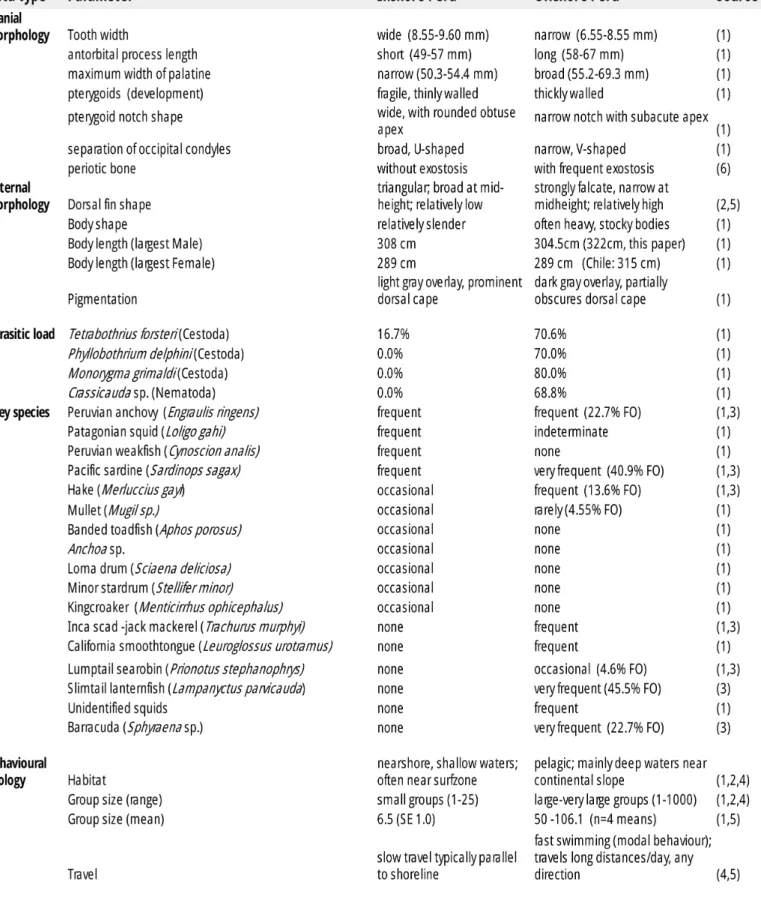
(6) IWC Scientific Committee Meeting, Bled, Slovenia, May 2017. (Sanino et al. 2005), prompting the authors to name this population the 'Peru-Chile offshore bottlenose dolphin stock'. Results from an IWC/SOWER cruise off Chile in 1997-98 (Findlay et al., 1998) indicated large group sizes which ranged from 2 up to 2,000 individuals (mean= 108.5; SD=313.7; N=49; median=25). Off Peru, offshore bottlenose dolphins have been recorded during IMARPE cruises in groups up to at least 1,000 individuals (Table 1), in waters from 71 m to more than 1000 m deep, with mean SST 18.9ºC, and with distances from shore ranging 12-65 nm (Márquez and Arias-Schreiber, 2001; Sánchez and Arias Schreiber, 1998). One of us (J.C. Reyes) during an experiment with longlines, confirmed that T. truncatus observed 60 nm off Pucusana, central Peru, showed indeed the offshore morphotype sensu Van Waerebeek et al. (1990). Mean. SD. Min. Max. N. Source. 50. 119.7. 1. 440. 18. Bello et al. (1997). 28.7. 105.8. 1. 1000. 92. Sánchez and Arias-Schreiber (1998). 142.1. 194.2. 10. 500. 9. Marquez and Arias-Schreiber (2000). 106.1. 132.0. 1. 500. 22. Ontón et al. (1997). Table 1. Variation in group sizes for offshore T. truncatus reported off Peru during four IMARPE cruises in 1997-2000. With few exceptions groups are considerably larger than those seen in the coastal form.. At least three metric and four non-metric cranial characters (Table 2) have been identified that allow to discriminate between Peruvian inshore and offshore skulls (Van Waerebeek et al., 1990; Anchante et al., 2008). Three parameters, including antorbital process length, maximum width of palatines and tooth width showed no overlap between adults of the two forms which are thus diagnosably distinct (Table 2). Although the inshore sample was small, new specimens tend to confirm this. An evidently offshore skull from south of Bahía Inglesa (27°10'S,70°55'W) in northcentral Chile showed the same combination of cranial characters as Peruvian offshore specimens (Sanino and Van Waerebeek, 2008). Three species of cestodes and one nematode affected most offshore animals and none, or a few, inshore dolphins (Table 2). Highly divergent helminth parasite loads serve as a powerful indicator of ecological separation. It is thought to be linked to different prey composition, as parasite larvae are thought to be transmitted through prey that function as intermediate hosts. For instance, readily diagnosable osseous lesions in cranial sinuses known as 'basket-like lesions' (Van Bressem et al., 2007), caused by the nematode Crassicauda sp., are significantly more common in offshore animals. Stomach contents analysis supports the vastly different diets between ecotypes (Table 2). In Peru, offshore bottlenose dolphins (n=22) consumed mainly slimtail lanternfish (39.2%), barracuda Sphyraena sp. (13.5%) and Pacific sardine Sardinops sagax (13.3%). The diversity index of the diet and temporal shifts in the main prey suggest an opportunistic feeding strategy, which take advantage of the locally most available epipelagic and mesopelagic schooling fish (García-Godos et al., 2007). Patagonian Offshore stock (Los Lagos, Aysén) Bar one outlier (see below), the southernmost range of T. truncatus in Chile is at the southern part of Región de Los Lagos (Golfo Corcovado) and Región de Aysén (Aguayo et al., 2006; Sanino and Van Waerebeek, 2008; Olavarría et al., 2010; Viddi et al., 2010). A mother-calf pair was sighted deep inside Comau fjord, at 42°22’S,72°24'W. A single skull showed the offshore morphotype, but morphological variation data are very limited. Three sightings between 43°45°S (Corcovado Bay, Temuan Channel, Vera Sound) in January and December 2007 (Sanino and Van Waerebeek, 2008) were morphologically (stocky bodies with short, stubby snout; falcate dorsal fins; very dark overlay which obscured cape pattern in some) and behaviourally (large groups of 40-120 individuals; fast, high-energy swimmers) consistent with an offshore form, despite encountered inside fjords, one group almost 50 nmiles from open water. Individual variation in colouration pattern was significant, especially in the extent of the dorsal overlay. Dark eye patches were common. Variation in colouration remains to be quantified. The temporary use of nearshore habitat is explainable because Patagonian fjords mimic slope waters due to their great depth, may reach several 100s of meters in the main channels and several tens of meters even in the smaller channels. The fjords may provide shelter from stormy waters of the South Pacific as well as abundant prey, associated with the numerous rivers. Three groups counted respectively 40, 100 and 120 individuals, which is consistent with the Chilean offshore form (Sanino and Van Waerebeek, 2008) and considerably larger than inshore form group sizes in central Peru (mean= 6.5; Van Waerebeek et al., 1990), Paracas communities (mean =8.70), Ecuador (mean = 8.12, SD=4.48; Félix et al., 2017b), i.e. where groups rarely exceed 15 individuals (K. Van Waerebeek, unpublished data). All groups were actively attracted to a rigid-hull inflatable and moved at high speed with frequent leaps.. 5.
(7) IWC Scientific Committee Meeting, Bled, Slovenia, May 2017. Olavarría et al. (2010) reported several sightings for the Los Lagos (42°-44°S) and Aysén (44°-46°S) Regions and listed 4 encounters over one week in summer 2009 with (apparently) a single group of 5 individuals in the western Magellan Strait at 53°22'S,72°38'W. The authors suggest, and we concur, that these bottlenose dolphins probably originated from the Atlantic, considering their proximity to the western South Atlantic population in Argentina's Tierra del Fuego, and the complete lack of records in Chile's southern Aysén and Magallanes regions. The southernmost record then of Chilean bottlenose dolphins is at 45°49'S,74°59'W in Bahía Darwin (Aguayo-Lobo et al., 2006). INCERTAE SEDIS (IN NEARSHORE HABITAT) Chile-Incertae sedis Peninsula of Mejillones and surroundings, northern Chile In the late 1980s, Guerra et al. (1987) first documented the nearshore presence of bottlenose dolphins in Chile. These authors reported five specimen records (3 bycatches, 2 strandings) over a ca. 190 km stretch of coastline centred around the Mejillones Peninsula (23°10'S, II Region, Antofagasta) in northern Chile. One very large (315 cm) harpooned female (AMM-017) stranded at Coloso was collected and is thought to be an offshore specimen. Recent observations confirm that bottlenose dolphins are regularly sighted in the Bay of Mejillones. Their movements, seasonality, population identity, and status are currently under study (Anna María García, University of Antofagasta, pers. comm. to KVW). Interestingly, fin whales have recently been documented to enter the Bay of Mejillones with some regularity (Pacheco et al., 2015), possibly because of feeding opportunities due to strong local upwelling. We suggest that offshore bottlenose dolphins may access these nearshore, but fairly deep waters, for the same reasons (prey availability). The close examination of any new stranded or bycaught specimens will have high priority. Laguna Verde and surroundings, central Chile Bottlenose dolphins, locally known as 'delfines de Laguna Verde', are regularly sighted in nearshore waters near Valparaiso, central Chile (V Region) since at least the early 1990s until today. Confirmed observations, both land-based and boat-based, have been made off Caleta Barco, Quintay, Caleta los Docos, Bahía Laguna Verde, Bahía Valparaiso, Concón and Isla Mantagua (G.P. Sanino and Andrés Venegas, pers. observations; Table 3). Diaz-Aguirre et al. (2009) also reported sightings between Punta Angeles (33°01'S) and Punta Gallo (33°16'S), centered at Punta Curaumilla, in several periods between 2004-2007. Dolphins seemed to be feeding on neritic fishes near the surface. Diaz-Aguirre et al. (2009) did not provide group sizes nor photos, but an overall mean derived from reported total number of animals divided by total number of groups gives 25.8 ind./group, which is the median group size (25) for offshore T .truncatus off Chile (Findlay et al.,1998). 'Preliminary information on photo-identification suggests that some individuals are present year-round (Diaz-Aguirre et al., 2009), and 'the distribution and movement pattern [parallel to the coastline], according to Diaz-Aguirre et al. (2009), 'suggest that this population probably pertains to the coastal ecotype'. In view of the lack of published data, firm assignation to ecotype is premature, but we believe these animals are more likely incursing offshore form, similar to the Patagonia Offshore stock. Importantly also, the utilised coastal zone is considerably larger than reported and stretches at least from Caleta Barco in the south to Isla Mantagua off Concón (Figure 2). Data confirm long-term utilisation of the area by T. truncatus, from early 1990s till today, but a dedicated photo-ID study will be required to properly evaluate degree of residency.. Table 3. Associated data for 5 sightings of T. truncatus made from small-boats north of Bahía de Valparaiso, as plotted in Figure 2. Group sizes of 40 individuals and higher and deep water point to an offshore population.. 6.
(8) IWC Scientific Committee Meeting, Bled, Slovenia, May 2017. Figure 2. Recent sightings of bottlenose dolphins (made by AVA) north of Bahía de Valparaiso demonstrate the northern known limit of a ca. 60 km stretch of coastline utilized by T. truncatus, centered off Valparaiso and Laguna Verde. Although nearshore, habitat consists of fairly deep water (see Table 3).. DISEASES AS POTENTIAL STOCK INDICATOR A variety of infectious and non-infectious diseases have been documented in T. truncatus. Below we summarize those with potential value as stock indicators in the study region, as some have shown widely differing prevalence levels between coastal and offshore populations. Skin diseases Tattoo skin disease, a dermatologic infection by cetacean poxviruses, was detected in offshore (prevalence 41.6%, n= 12) and coastal (n=1) bottlenose dolphins in central Peru (Van Bressem and Van Waerebeek, 1996). Lobomycosis-like disease, with a clinical pattern highly reminiscent of lobomycosis (caused by an uncultivatable strain of Paracoccidioides brasiliensis), has been found in coastal dolphins in Peru (n=1), Ecuador and southern Colombia (Bahía Malaga, Tumaco) with varying prevalence levels, from 1.6% (n= 441, Gulf of Guayaquil) to 16.7% (n = 18, Salinas, EC) (Van Bressem et al., 2007, 2015a). So far, it has not been detected in the offshore ecotype. Pale dermatitis (PAD) of unknown aetiology affected 6.9% (n=87) of coastal bottlenose dolphins from Paracas Bay, central Peru (Van Bressem et al., 2015b), but was not detected in the offshore form. A female from Palena, southern Chile (offshore), presented numerous skin vesicles (Viddi et al., 2005, Van Bressem et al., 2007). Other infectious diseases Penile warts likely due to papillomaviruses were observed in three of 8 offshore males (Van Bressem et al. 1996). Serum antibodies against dolphin morbillivirus were detected in 3 of 6 offshore specimens (Van Bressem et al. 1998). Cowpox virus neutralizing antibodies were reactive in 6 offshore dolphins tested (Van Bressem et al. 2006). Finally, serum antibodies against Brucella spp. were detected in 1 of 2 coastal and in 2 of 3 offshore dolphins caught off central Peru in 1993-1995 (Van Bressem et al., 2001). Osteological lesions Lytic cranial lesions were the most frequently observed disease in coastal (26.9%, n= 26) and offshore (42.9%, n= 42) bottlenose dolphins, followed by hyperostosis and ankylosing spondylitis in offshore (31%) and inshore (15.4%) specimens. Prevalence of basket-like (lytic) osseous lesions in the skull caused by Crassicauda sp. was almost four times higher in offshore (26.2%) than in inshore (7.7%) specimens from Peru (Van Waerebeek et al., 1990; Van Bressem et al., 2007). Both ecotypes were affected by periodontal lytic disease to a similar degree (coastal 15.4%, offshore 16.7%). Traumas and fractures were also similarly prevalent in coastal (7.7%) and offshore (7.1%) specimens (Van Bressem et al., 2007).. 7.
(9) IWC Scientific Committee Meeting, Bled, Slovenia, May 2017. CONCLUSIONS Uncertainties of taxonomy and phylogenetics concerning bottlenose dolphins occurring off the Pacific coast of South America are limited to populational/subspecific issues. Five populations (2 offshore, 3 coastal) are provisionally identified: Colombia-Ecuador Offshore stock (most likely identifiable with ETP-Offshore), Peru-Chile Offshore, Ecuador-Coastal (mainly Gulf of Guayaquil), Peru-Coastal and a unique isolated community (Pod-R) living nearshore on the north-central coast of Chile. In particular questions remain, at one hand, about the extent of gene flow between the Colombia-Ecuador Offshore stock and the large Peru-Chile Offshore stock at one hand, their relationship with the three coastal populations at the other hand, and finally the inter-coastal affinities. At least seven cranial characters, four non-metric (separation of occipital condyles, pterygoid bone development, exostosis of periotic) and three metric (tooth width, antorbital process length, maximum width palatines), dorsal fin shape, body stockiness, mt-DNA (control region), habitat, prey composition, parasite load, behaviour and prevalence of some infectious diseases differentiate the coastal from the offshore forms. Several of the cranial characters are diagnosably distinct between morphotypes to such a degree that a brief ocular inspection of the skull, or the dorsal fin, is often sufficient to correctly allocate specimens to the correct form. Pod-R from northcentral Chile, till date, is the only confirmed coastal form community in Chilean waters, and thus also the southernmost (29°S) off Pacific South America. Bottlenose dolphins regularly transiting nearshore in Chile's Patagonia and occasionally entering fjords in the Los Lagos and Aysen regions, exhibit both offshore morphotype (stocky body; stubby snout; falcate dorsal fin; dark overlay obscuring cape pattern) and offshore type behaviour (forming large groups; fast travel). Also we suggest that bottlenose dolphins utilizing some 60 km of coastline centered off Valparaiso/Laguna Verde (central Chile), and dolphins inhabiting nearshore though fairly deep waters over a 190 km stretch of coast centered around the Mejillones Peninsula in northern Chile may also belong to the offshore morphotype. Nonetheless confirmatory evidence will be required. The continental border of the Atacama Trench off northern and northcentral Chile leaves an extremely narrow, steep continental shelf with deep water close to shore, locally with strong coastal upwelling favouring high productivity and prey concentration. This quasi-pelagic habitat seems to attract oceanic cetaceans, including offshore stock T. truncatus, sperm whales (Physeter macrocephalus), fin whales (Balaenoptera physalus) and other species. Unsurprisingly, sperm whales were successfully hunted in the 20 th century from a shore-based whaling station at Quintay, located precisely at Laguna Verde where also bottlenose dolphins are reported, we believe from an offshore stock. The southern distribution range of true coastal form bottlenose dolphins in Pacific South America remains unknown but off Chile distance-to-shore may not be the reliable indicator of morphotype as it is further north in the study region (i.e. Peru and Ecuador). REFERENCES Aguayo-Lobo, A., Acevedo-Ramirez, J., and Vargas-Morales, R. 2006. Diversidad de mamíferos marinos en las aguas del Archipiélago de los Chonos (43°39'S-45°50' S), XI Región de Chile. Revista Ciencia y Tecnología del Mar 29(2): 129-145. Álava, J. J. 2002. Registro y abundancia relativa de mamíferos marinos durante el crucero oceanográfico insular B/I Orión (CO-II2000) en las islas Galápagos y sus alrededores. Acta Oceanográfica del Pacífico 11(1):165-172. Anchante, H.A., Ormeño, M., Reyes J.C., Van Waerebeek, K. 2008. Diferenciación de especies de cetáceos menores en el mar peruano mediante el uso del complejo tímpano-periótico. 13a Reunión de Trabajo de Especialistas en Mamíferos Acuáticos de América del Sur, Montevideo, Uruguay, 13-17 Octubre 2008: 103. Avila, I.C. 2009. Mamíferos Acuáticos en el Pacífico Choco Norte, Colombia, en el Marco del Proyecto Unidad Ambiental Costera Pacífico Norte Chocoano. Fundación Omacha. Informe Final para la Fundación MarViva. 12p. Avila, I.C., García, C., and Bastidas, J.C. 2008. A note on the use of dolphins as bait in the artisanal fisheries off Bahía Solano, Chocó, Colombia. Journal of Cetacean Research and Management 10(2):179–182. Avila, I.C., C. García, D. Palacios and Caballero, S. 2013. Mamíferos acuáticos de la Región del Pacífico colombiano. Págs: 128- 169. En: Trujillo, F., A. Gärtner, D. Caicedo y M. C. Diazgranados (Eds.). Diagnóstico del estado de conocimiento y conservación de los mamíferos acuáticos en Colombia. Ministerio de Ambiente y Desarrollo Sostenible, Fundación Omacha, Conservación Internacional y WWF. Bogotá, 282 p. [In Spanish]. Bayas, R. (2015). Population structure and conservation status of the botlenose dolphin population in the Gulf of Guayaquil, Ecuador. MCs Thesis. Pontificia Universidad católica del Ecuador (PUCE). Quito, Ecuador. 78 p. [In Spanish]. Bello, R., Arias-Schereiber, M. and Sánchez, R. 1998. Distribución y abundancia relativa de cetáceos durante el crucero Crucero BIC Humboldt 9707-10, de Mararani a Paita. Informe Instituto de Mar del Perú 130: 78-85. [In Spanish]. Capella, J., Vilina, Y. and Gibbons, J. 1999. Observation of cetaceans at Isla Chañaral and new records at the Humboldt Penguin National Reserve, northern Chile. Estudios Oceanológicos 18: 57-64.[In Spanish]. Castro, C., and Rosero, P. 2010. Interacción de cetáceos menores con artes de pesca artesanal en el Parque Nacional Machalilla – Ecuador. pp. 19-26, In: CPPS (Ed). Esfuerzos para mitigar el impacto de actividades pesqueras en cetáceos en los países del Pacífico Sudeste. Comisión Permanente del Pacífico Sur. Clarke, R, Félix, F., Paliza, O. and Brtnik, P. 2002. Ballenas y delfines observados por la expedición Ballenas Libres durante el. 8.
(10) IWC Scientific Committee Meeting, Bled, Slovenia, May 2017 crucero oceanográfico CO-II-01 entre Guayaquil y las Islas Galápagos del 17 de septiembre al 9 de octubre de 2001. Acta Oceanográfica del Pacífico, INOCAR, Ecuador, 11(1):173-180. Díaz-Aguirre, F., Navarrete, S., Salinas, C., Hiriart, L., Castillo, V., Zerega, A., Ritter, R., and Castilla, C. 2009. First report on the longterm presence of common bottlenose dolphins (Tursiops truncatus) off central Chile. Latin American Journal of Aquatic Mammals 7(1-2): 85-87. doi:http://dx.doi.org/10.5597/lajam00140 Echegaray M., Reyes J.C. and Van Waerebeek K. 1992. Observaciones del bufeo Tursiops truncatus en el litoral de Pisco, Peru. Resúmenes, 5ta Reunión de Especialistas en Mamíferos Acuáticos de América del Sur, 28 Sept- 2Oct 1992, Buenos Aires, Argentina: 23. Félix, F. 1994. Ecology of the coastal bottlenose dolphin Tursiops truncatus in the Gulf of Guayaquil, Ecuador. Investigations on Cetacea. Ed. by G. Pilleri. Vol. 25:235-256. Félix, F. 1997. Organization and social structure of the bottlenose dolphin Tursiops truncatus in the Gulf of Guayaquil, Ecuador. Aquatic Mammals, 23(1):1-16. Félix, F. 2001. Escorting behaviour: a territorial manifestation in wild bottlenose dolphins? Estudios Oceanológicos. 20:67-70. Félix, F. and Samaniego, J. 1994. Incidental catches of small cetaceans in the artisanal fisheries of Ecuador. Rep. int. Whal. Commn (special issue) 15:475-80. Félix, F, Haase, B., Denkinger, J. and Falconí, J. 2011. Varamientos de mamíferos marinos registrados en la costa continental de Ecuador entre 1996 y 2009. Acta oceanográfica del Pacífico 16(1):61-73. Félix, F., Van Waerebeek, K., Sanino, G.P, Castro, C., Van Bressem, M.-F., Santillán, L. 2017a. Morphological differences in dorsal fins among bottlenose dolphin populations in the Southeast Pacific. Document SC/xx/xx , IWC Scientific Committee, Bled, Slovenia, May 2017. Félix, F., Calderón, A, Vintimilla, M. and Bayas-Rea Rosa A. 2017b. Decreasing population trend in coastal bottlenose dolphin (Tursiops truncatus) from the Gulf of Guayaquil, Ecuador. Aquatic Conservation: Marine and Freshwater Ecosystems. https://doi.org/10.1002/aqc.2763. Félix, F., Centeno, R., Zavala, M., Romero., J., and Vásconez, O. (In Press). Prevalence of scars from anthropogenic origin in coastal bottlenose dolphin in Ecuador. Journal of the Marine Biological Association of the United Kingdom. Félix, F. 2001. Escorting behaviour: a territorial manifestation in wild bottlenose dolphins? Estud. Oceanol. 20:67-70. Findlay K., R. Pitman, R., Tsurui, T., Sakai, K., Ensor, P., Iwakami, H., Ljungblad, D., Shimada, H., Thiele, D., Van Waerebeek, K., Hucke, R. and Sanino, P. 1998. 1997/1998 IWC-Southern Ocean Whale and Ecosystem Research (IWC-SOWER) Blue Whale Cruise, Chile. Final Report of the third IWC Blue Whale Cruise of the International Whaling Commission SOWER program. (Unpublished) 39pp. Flórez-González, L. and J. Capella. 2001. Mamíferos Marinos Locales y Regionales. Pág. 133-140. En Barrios, L. M. Y M. LópezVictoria (Eds.). Gorgona Marina: Contribución al conocimiento de una isla única. INVEMAR, Serie Publicaciones Especiales No 7, Santa Marta. [In Spanish]. Flórez-González, L., Capella, J. J., Falk, P. E., Ávila, I. C., Herrera, J. C., and Peña, V. 2004. Mamíferos acuáticos del Parque Nacional Natural Gorgona y su área de influencia: ecología, divulgación y uso sostenible. Informe Fondo para la Acción Ambiental Fundación Yubarta, Parque Nacional Natural Gorgona. [In Spanish]. García, C.; Ávila, I.C.; Palacios, D.; Gerrodette, T.; Suárez, M.; Soler, G.; Rasmussen, K.; May-Collado, L.; Parson, C.; Trujillo, F. and Bessudo, S. 2008. Presence, distribution and threats of Stenella attenuata and Tursiops truncatus in the Pacific waters of Panamá and Colombia. Resumen 310 en Memorias XIII Reunión de Trabajo de Especialistas en Mamíferos Acuáticos de América del Sur y 7° Congreso SOLAMAC. Montevideo, Uruguay. Octubre 13-17 de 2008. [In Spanish]. García-Godos, I. 1993. Captura estacional de cetáceos menores en la caleta de Ancón. Memoria. X Congreso Nacional de Biología, Lima, 2-7 agosto 1992: 273-279. [In Spanish]. García-Godos, I. 2007. Revisión de las interacciones entre cetáceos y la pesquería marina peruana; perspectivas para la conservación de cetáceos en Perú. Pp: 77 – 82, In: F. Félix (Ed). Memorias del Taller de Trabajo sobre el Impacto de las Actividades Antropogénicas en Mamíferos Marinos en el Pacífico Sudeste. Bogotá, Colombia, 28 - 29 de noviembre de 2006. CPPS/PNUMA, Guayaquil, Ecuador. [In Spanish]. García-Godos, I., Van Waerebeek, K., Reyes, J.C., Alfaro-Shigueto, J. and Arias-Schreiber, M. (2007). Prey occurrence in the stomach contents of four small cetacean species in Peru. Latin American Journal of Aquatic Mammals 6(2): 171-183. Gerrodette, T. and D. Palacios. 1996. Estimates of cetacean abundance in EEZ. Waters of the Eastern Tropical Pacific. Administrative Report LJ 96-10. NMFS - SWFSC. La Jolla, CA. González, J., Capella, J. and Gibbons, J. 1989. Delfines nariz de botella Tursiops truncatus (Montagu, 1821) habitando frente a isla Chañaral, Provincia de Huasco, Chile. Estud. Oceanol. 8:67-71. [In Spanish]. Guerra C., C., Van Waerebeek, K., Portflitt, G. y Luna, G. (1987) Presencia de cetáceos frente a la segúnda región de Chile. Estudios Oceanológicos 6:87-96. [In Spanish]. Herrera J.C., I.C. Avila, P. Falk, G. Soler, C. García, I.C. Tobón y J. Capella. 2007. Mamíferos Marinos en el SFF Malpelo y aguas hacia el continente. En: Dimar-CCCP y UAESPNN-DTSO. Santuario de Fauna y Flora Malpelo: descubrimiento en Marcha. Dimar (Ed.). Bogotá, Colombia. [In Spanish]. Herrera, J.C., J. Capella, G. Soler, S. Bessudo, C. García y L. Flórez-González. 2011. Ocurrencia y tasas de encuentro de mamíferos marinos en las aguas de la isla Malpelo y hacia el continente. Bol. Invest. Mar. Cost. 40: 57-78. [In Spanish]. Jiménez, P., and Alava, J. 2014. Population ecology and anthropogenic stressors of the coastal bottlenose dolphin (Tursiops truncatus) in the El Morro Mangrove and Wildlife Refuge, Guayaquil Gulf, Ecuador: Towards Conservation and Management Actions. pp.129-163. (ed) Samuels J. In: Dolphins: Ecology, Behavior and Conservation Strategies. Nova Science Publisher. Londoño, C. 2005. Ecología del delfín Tursiops truncatus y Stenella attenuata en el sector de Bahía Málaga, Pacífico colombiano. Tesis de Pregrado. Medellín-Colombia, Universidad de Antioquia, Facultad de Ciencias Exactas y Naturales. [In Spanish].. 9.
(11) IWC Scientific Committee Meeting, Bled, Slovenia, May 2017 Mangel J.C., Alfaro-Shigueto J., Van Waerebeek K., Cáceres C., Bearhop S., Witt M.J. and Godley B.J. (2010) Small cetacean captures in Peruvian artisanal fisheries: High despite protective legislation. Biological Conservation 143: 136-143. Márquez, J. and Arias-Schreiber, M. 2001. Avistamiento de cetáceos en el mar peruano y su relación con algunos parámetros oceanográficos en mayo 2000. Informe del Instituto del Mar del Perú 163: 19-24. [In Spanish]. Ministerio del Medio Ambiente (Chile). 2016. Nómina de especies según su estado de conservación. Revisión Nº15, enero de 2016. [in Spanish]. Mora, D. and Muñoz, M. 1994. Registro y análisis de las muertes y varamientos de mamíferos marinos en el Pacífico colombiano. Tesis BSc. Universidad Nacional de Colombia. Bogotá, Colombia. 205p. [In Spanish]. Olavarría, C., Acevedo, J., Vester, H., Zamorano-Abramson, J. et al. 2010. Southernmost distribution of common bottlenose dolphins (Tursiops truncatus) in the Eastern South Pacific. Aquatic Mammals 36(3): 288-293. Ontón, K., Soto, K. and Arias-Shreiber, M. 1997. Distribución y abundancia relativa de cetáceos en el mar peruano durante el crucero de evaluación del stock de merluza, BIC Humboldt 9705-06. Informe del Instituto de Mar del Perú 128: 122-127. [In Spanish]. Pacheco, A.S., Villegas, V.K., Riascos, J.M. and Van Waerebeek, K. 2015. Presence of fin whales Balaenoptera physalus in Mejillones Bay, a major seaport area in northern Chile. Revista de Biología Marina y Oceanografía 50(2): 383-391. Palacios D.M., T. Gerrodette, J. Herrera, C. García, G. Soler, I. C. Avila, S. Bessudo, E. Hernández, F. Trujillo and L. Flórez-González. 2012. Cetacean distribution and relative abundance in Colombia’s Pacific EEZ from survey cruises and platforms of opportunity. Journal of Cetacean Research and Management 12(1): 45–60. Pizarro-Neyra, J. 2010. Varamiento de cetáceos en Tacna, Perú (2002-2010). Rev. peru. biol. 17(2): 253-255. [In Spanish]. Prieto, M. 1990. Estudio preliminar en la interacción de la pesca artesanal con los cetáceos costeros del Pacífico colombiano. Reporte No. 699 INDERENA, División Pesca Artesanal, Bogotá. 10p. [In Spanish]. Read A.J., Van Waerebeek K., Reyes J.C., McKinnon J.S. and Lehman L.C. 1988. The exploitation of small cetaceans in coastal Peru. Biological Conservation 46:53-70. Rengifo, B.; J. J. Capella y L. Flórez-González. 1995. Patterns of occurrence of bottlenose dolphins in Bahía Málaga, Colombian Pacific: Preliminary observations. En: Abstracts Eleventh Biennial Conference on the Biology of Marine Mammals. 14 al 18 de diciembre. Orlando Fla.,USA. Reyes, J.C., Echegaray, M. and De Paz, N. 2002. Distribucón, comportamiento y conservación de cetáceos en el área Pisco – Paracas. In: J. Mendo and M. Wolff (eds). Memorias I Jornada Científica de la Reserva Nacional de Paracas. Universidad Nacional Agraria La Molina. [In Spanish]. Sánchez, R. and Arias-Schreiber, M. 1998. Cetáceos observados frente a la costa peruana y su relación con la distribución y abundancia de los recursos pelágicos. Crucero BIC Humboldt 9808-09, de Paita a Callao. Informe del Instituto del Mar del Perú 141: 55-66 [In Spanish]. Sanino G.P. and Van Waerebeek K. 2008. A note on the southern distribution range of inshore and offshore common bottlenose dolphins Tursiops truncatus in the Southeast Pacific. Scientific Committee document SC/60/SM18, International Whaling Commission, June 2008, Santiago, Chile. Sanino, G.P., Van Waerebeek, K., Van Bressem, M.-F. and Pastene, L.A. 2005. A preliminary note on population structure in eastern South Pacific common bottlenose dolphins, Tursiops truncatus. Journal of Cetacean Research and Management 7(1): 65-70. Sanino, G.P. and J.L. Yáñez. 2000. Effects of Whalewatching in Punta de Choros, Chile. Revista Gestión Ambiental (Chile). 6: 41-53 [In Spanish] Sanino, G.P. and Yáñez, J.L. 2001. Nueva técnica de video identificación y estimación de tamaño poblacional en cetáceos, aplicada de delfines nariz de botella, Tursiops truncatus, de isla Choros, IV Región de Chile. Bol. Mus. Nac. Hist. Nat. Chile 50:37-63. [In Spanish]. Santillán, L.A. 2003. Differencias craneales entre las poblaciones costera y oceánica de Tursiops truncatus (Montagu, 1821) ‘delfin nariz de botella’ en el mar peruano. Licenciado en Biologia Thesis, Universidad Ricardo Palma, Facultad de Ciencias Biológicas (unpublished). 80pp. Santillán, L., Félix, F. and Haase, B. 2008. A preliminary morphological comparison of skulls of common bottlenose dolphins Tursiops truncatus from Peru and Ecuador. Paper SC/60/SH10 presented to the 60th Scientific Committee of the International Whaling Commission. Santiago, Chile, June 2008 Scott, M.D. and Chivers, S.J. 1990. Distribution and herd structure of bottlenose dolphins in the eastern tropical Pacific Ocean. Pp. 387-402. In: S. Leatherwood and R.R. Reeves (eds). The Bottlenose Dolphin. Academic Press, San Diego. Suárez, M. 1994. Aspectos ecológicos y del comportamiento de Tursiops truncatus y Stenella attenuata en el Parque Natural de Utría, Chocó, Colombia. Tesis BSc. Universidad Nacional. Bogotá, Colombia. 105p.[In Spanish]. Tzika A.C, D'Amico E., Alfaro-Shigueto J., Mangel J.C., Van Waerebeek K. and Milinkovitch M.C. (2010) Molecular identification of small cetacean samples from Peruvian fish markets. Conservation Genetics 11: 2207-2218. Van Bressem, M.-F. and Van Waerebeek, K. 1996. Epidemiology of poxvirus in small cetaceans from the Eastern South Pacific. Marine Mammal Science 12: 371-382. Van Bressem, M.-F., Van Waerebeek, K., Piérard, G. and Desaintes, C. 1996. Genital and lingual warts in small cetaceans from coastal Peru. Diseases of Aquatic Organisms 26: 1-10. Van Bressem, M.-F., Van Waerebeek, K., Flemming, M. and Barrett, T. 1998. Serological evidence of morbillivirus infection in small cetaceans from the Southeast Pacific. Veterinary Microbiology, 2: 89-98. Van Bressem, M.-F., Van Waerebeek, K., Raga, J.A., Godfroid, J., Brew, S.D. and MacMillan, A.P. 2001. Serological evidence of Brucella species infection in odontocetes from the south Pacific and the Mediterranean. Veterinary Record 148: 657-661. Van Bressem, M.-F., Van Waerebeek, K. and Bennett, M. 2006. Orthopoxvirus neutralising antibodies in small cetaceans from the Southeast Pacific. Latin American Journal of Aquatic Mammals 5(1): 49-54. Van Bressem M-F., Simões-Lopes P.C., Félix F., Kiszka J., Daura-Jorge F.G., Avila I.C., Secchi E.R., Flach F., Fruet P.F., du Toit K., Ott P.H., Elwen S., Di Giacomo A.B., Wagner J., Banks A., Van Waerebeek K. 2015a. Epidemiology of lobomycosis-like disease in. 10.
(12) IWC Scientific Committee Meeting, Bled, Slovenia, May 2017 bottlenose dolphins from South America and southern Africa. Diseases of Aquatic Organisms 117: 59-75. Van Bressem M.-F., Flach L., Reyes J.C., Echegaray M., Santos M., Viddi F., Félix F., Lodi L., Van Waerebeek K. 2015b. Epidemiological characteristics of skin disorders in cetaceans from South American waters. Latin American Journal of Aquatic Mammals 10(1): 20-31. DOI: http://dx.doi.org/10.5597/ lajam00190. Van Bressem M-F., Van Waerebeek K., Reyes J.C., Félix F., Echegaray M., Siciliano S., di Beneditto A.P., Flach L., Viddi F., Avila I.C., Herrera J.C., Tobón I.C., Bolañez-Jiménez J., Moreno I.B., Ott P.H., Sanino G.P., Castineira E., Montes D., Crespo E., Flores P.A.C., Haase B., Medonça de Souza M.F., Laeta M. and Fragoso A.B. 2007. A preliminary overview of skin and skeletal diseases and traumata in small cetaceans from South American waters. Latin American Journal of Aquatic Mammals 6(1): 7-42. Van Waerebeek K., Reyes J.C. y Luscombe, B.A. 1988. Revisión de la distribución de pequeños cetáceos frente al Perú. pp. 345-51. In: H. Salzwedel, A. Landa (eds.). Recursos y Dinámica del Ecosistema de Afloramiento Peruano. Boletín del Instituto del Mar del Perú, Callao, Vol. extraordinario. Van Waerebeek K., Reyes J.C., Read, A..J. and McKinnon J.S. 1990. Preliminary observations of bottlenose dolphins from the Pacific coast of South America. Pages 143-54. In: S. Leatherwood and R.R. Reeves (eds). The Bottlenose Dolphin. Academic Press, San Diego. 653 pp. Van Waerebeek K. and Reyes J.C. 1994. Interactions between small cetaceans and Peruvian fisheries in 1988-1989 and analysis of trends. Report of the International Whaling Commission (Special Issue 15): 495-502. Van Waerebeek K. and Reyes J.C. 1994. Post-ban small cetacean takes off Peru: a review. Report of the International Whaling Commission (Special Issue 15): 503-520. Van Waerebeek K., Van Bressem M.F., Félix F., Alfaro J., García-Godos A., Chávez L., Ontón K., Montes D. and Bello R. 1997. Mortality of dolphins and porpoises in coastal fisheries off Peru and southern Ecuador in 1994. Biological Conservation 81: 4349. Van Waerebeek, K., A.N. Baker, F. Félix, J. Gedamke, M. Iñiguez, G.P. Sanino, E. Secchi, D. Sutaria, A. van Helden & Y. Wang. 2007. Vessel collisions with small cetaceans worldwide and with large whales in the Southern Hemisphere, and initial assessment. Latin American Journal of Aquatic Mammals. Vol. 6(1):43-69. Viddi, F.A., Van Bressem, M.-F., Bello, M. and Lescrauwaet, A.K. 2005. First records of skin lesions in coastal dolphins off southern Chile. 16th Biennial Conference on the Biology of Marine Mammals, 12-16 December 2005, San Diego, CA, USA. Viddi, F.A., Hucke-Gaete, R., Torres-Flórez, J. P., and Ribeiro, S. 2010. Spatial and seasonal variability in cetacean distribution in the fjords of northern Patagonian, Chile. ICES Journal of Marine Science 67: 959-970. Walker, W.A. 1981. Geographical variation in morphology and biology of bottlenose dolphins (Tursiops) in the eastern North Pacific. NOAA, NMFS, SWFC Admin. Rep. LJ-81-03C. 54pp. Zavala, M., Félix, F. and Salas, J. A. 2016. Resultados preliminares sobre el estado poblacional del bufeo costero Tursiops truncatus (Montagu, 1821) (Cetacea: Delphinidae) en la Puntilla de Santa Elena-Ecuador. I Congreso Nacional de Manejo de Vida Silvestre y III Congreso Ecuatoriano de Mastozoología. Universidad Estatal Península de Santa Elena.8 - 10 June 2016. Santa Elena, Ecuador. 11.
(13) IWC Scientific Committee Meeting, Bled, Slovenia, May 2017 Table 2. Discriminatory biological characteristics for Peruvian coastal and offshore forms. Sources: (1) Van Waerebeek et al. ,1990; (2) Félix et al., 2017; (3) García-Godos et al., 2007; (4) Sanino and Van Waerebeek, 2008; (5) this paper ; (6) Anchante et al. (2008). Leuroglossus urotramus is now considered a junior synonym of L. stilbius.. 12.
(14)
Figure

Documento similar
In recent years, the number of contributions for Chilean plants has increased including a spectr um of cytogenetic characters (e.g., chromosome number, kar yotype morphology,
Recommendation 1 is based on evidence statements 1 through 3 from question 2 in which there is moderate- to high-quality evi- dence from RCTs that in the general population aged
We investigated whether fat and carbohydrate intake modified the association of FTO gene variation with BMI in two populations, including participants in the Genetics of Lipid
Our analysis considers Equatorial Guinea, not as a political entity whose autonomy is weakened by local misbehaviour or foreign exploitation, but as a space configured
First we infer the sequence of topological relations between the robot (seen as a region) and each region of its environment in order to navigate from one initial region to the
The second people detector applied to every blob is based on the algorithm proposed in [8], which iteratively computes the largest ellipse contained in the foreground
Although the AHVd variants from cultivars “Fuji” (Zhang et al., 2014) and “Pacific Gala” cluster in distinct phylogenetically groups (Messmer et al., 2017), with the
Moreover, in line with what was found in Chilean and Brazilian soccer players, the most common dermatoglyphics in Mexican soccer players in this study were those related to
