
TítuloApplication of Anaerobic and Ozonation Processes in the Landfill Leachate Treatment
8
0
0
Texto completo
(2) Introduction Landfill leachate is a complex wastewater as its characteristics depend on the age of the landfill, the origin, the type of wastes in the landfill, the seasonal variations, etc. This fact means that the leachate treatment is affected by its composition. Landfill leachates are usually characterized by high concentrations of both organic and nitrogenated compounds, metals, recalcitrant organic matter and alkalinity. One of the parameters commonly used in order to select the treatment process is the age of the leachate and its biodegradability, whose typical indicator is the biological oxygen demand to chemical oxygen demand ratio (BOD/COD). Normally, this ratio lies within the range 0.05-0.8 (Alvarez-Vazquez et al., 2004). Leachates can be classified according to their biodegradability and, therefore, their age. It can be a young, a mature or an old leachate. Young leachates have a low biodegradability and high organic loads due to the presence of fatty acids. Mature leachates have intermediate biodegradability and lower fatty acids loads. Old leachates have low biodegradability and organic loads constituted by complex molecules with a high molecular weight, such as humic and fulvic acids. Many authors have investigated different treatment systems as biological, chemical or physical processes. The application of advanced oxidation processes in the leachate treatment has been investigated as well (Wang et al., 2003). However, the most effective treatments are usually obtained with the combination of several treatment technologies, such as H2O2/UV, ozone/catalyst and a biological process (Steensen, 1997), Fenton and biological processes (Lau et al., 2001), coagulation-flocculation, ozone and a biological process (Bila et al., 2005), etc. When the BOD/COD ratio is lower than 0.30, physical-chemical processes are more effective than biological systems, which offer good results when this ratio is high. Nevertheless, advanced oxidation processes can not only remove organic matter but also increase the BOD/COD ratio as well as the biodegradability of the leachate (Fang et al., 2004). Ozone is known to be an effective oxidant for several applications, such as pollutant degradation or water disinfection, due to its high oxidation potential (Haapea et al., 2002). Ozone can react through two different mechanisms with the compounds present in the water, with a direct reaction or through an indirect reaction, which involves the generation of ·OH radicals in the decomposition of ozone. By means of these reactions, organic compounds with long chains can be fragmented in lower chains, with an increase of their biodegradability, or degraded to carbon dioxide. The use of ozone for mineralization of recalcitrant organic matter has been widely studied, with good results in the elimination of biorefractory COD. Baig and Liechti (2001) studied the full-scale treatment of a landfill leachate with a COD concentration of 1400 mg/L. The treatment consisted of a nitrification-denitrification system, and lime and FeCl3 precipitation with a final treatment with an ozone dose of 600 mg O3/L, resulting in 88% global COD removal. However, ozonation can be used in order to increase the biodegradability of the wastewater by partial oxidation, using low ozone doses. Wang et al. (2004).
(3) studied the effect of ozone doses on COD reduction in a biologically treated leachate, showing removal efficiencies of 47% and 75% at ozone doses of 2.6 and 8.4 g/L, respectively. Nevertheless, the highest increase of the BOD5 value from 17 up to 72 mg/L occurred at an ozone dose of 2.6 g/L. A dose increase resulted in a BOD5 decrease. The combined treatment through ozonation and biological process, carrying out ozonation before the biological process, can increase the biodegradability, resulting in a higher BOD/COD ratio (Geenens et al., 2000), and therefore, in a more efficient COD removal in the biological process. The aim of this work was the optimization of leachate treatment, determining the best configuration using biological and ozonation processes. First, the raw leachate was treated with ozone. In a second assay, the leachate was diluted with tap water and biologically treated. Then, the anaerobic effluent was treated with ozone in order to increase its biodegradability with a minimum organic matter removal. Results from both experiments revealed the optimal configuration for the ozonation process in the combined biological- ozonation treatment. Materials and Methods The leachate studied was collected from a landfill in the province of A Coruña (Spain) and refrigerated at 4ºC. The leachate is characterised by high COD (8.48-13.33 g/L) and ammonium (3.02-4.47 g N/L) concentrations. Raw leachate can be considered a mature leachate with a BOD5/COD ratio of 0.35. In order to increase this ratio the ozonation process was applied to the anaerobic pre-treated effluent. The biological treatment was carried out in a lab-scale Upflow Anaerobic Sludge Blanket Reactor (UASB). The leachate was diluted to 1/5 with tap water before the anaerobic process. In the ozonation studies, a tubular reactor (high 63 cm and inner diameter 6 cm) with a porous plate with 10-40 µm pore diameter, and an Erwin Sander 307.1 lab-scale ozone generator were used. Ozonation was carried out at room temperature (around 20ºC) and the gas flow rate was 20 L/h. Ozone gas was produced from pure oxygen. Erlenmeyer flasks containing 1% KI solution were connected in series to the reactor in order to determine the input and output concentrations of ozone gas passing through the reactor, and remove the residual ozone in the exit gas. At the end of the ozonation process, residual ozone was purged out from the liquid phase and reactor headspace by bubbling nitrogen for about 15 minutes. Different assays were carried out using raw leachate and anaerobic effluent at a constant ozone dose, varying the contact time. The effluent from the anaerobic reactor fed raw leachate diluted to 1/5 with tap water was submitted to the ozonation process. The ozone dose was maintained around 34.99 mg/L·min, varying the contact time from 10 up to 120 minutes. The raw leachate was submitted to the ozonation process as well. The ozone dose was fixed around 38.72 mg/L·min, varying the contact time from 15 up to 60 min..
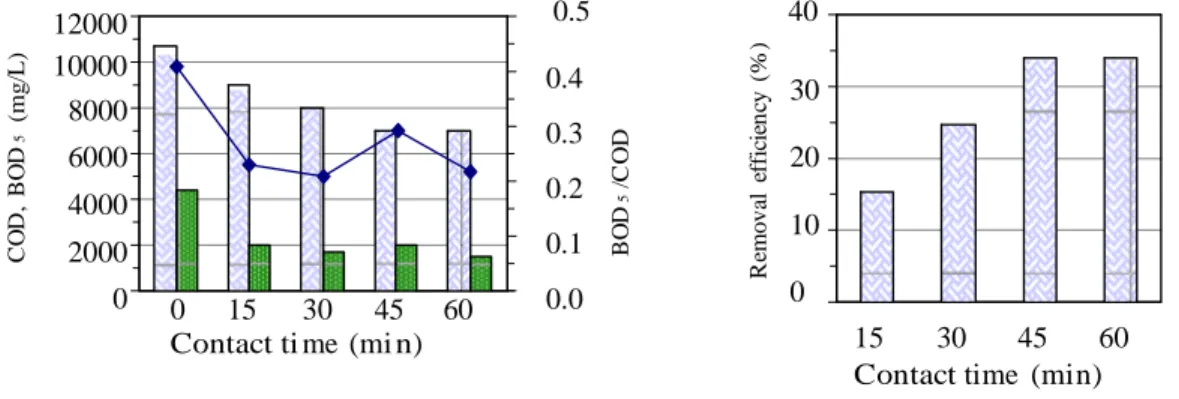
(4) VSS, COD and BOD were analyzed according to Standard Methods (APHA, 1998). Ammonium and pH were measured using selective electrodes. Ozone concentrations in the inlet and outlet gas streams were measured by iodometric titration (Rakness et al., 1996).. Results and discussion Ozone treatment Raw leachate The raw leachate was submitted to the ozonation process. The ozone dose was fixed at 38.72 mg/L·min, varying the ozone contact time from 15 up to 60 minutes. Figure 1 shows COD and BOD5 concentrations, and COD removal efficiencies versus contact time.. 0.4 0.3. 6000. 0.2. 4000. 0.1. 2000 0. 40. 0 15 30 45 60 Contact ti me (mi n). 0.0. Removal efficiency (%). 0.5. 12000 10000 8000. BOD 5 /COD. COD, BOD 5 (mg/L). Figure 1 Effect of the ozone contact time on the raw leachate using a mean ozone dose of 38.72 mg O3/L·min. A. Evolution of COD ( ) and BOD5 ( ) concentrations in the left axis, and BOD5/COD ratio (♦) in the right axis; B. COD removal efficiency percentage ( ). 30 20 10 0 15 30 45 60 Contact time (min).
(5) In the raw leachate, the COD and BOD5 concentrations were 10660 and 4360 mg/L, respectively. The BOD5/COD ratio was 0.41 which is higher than 0.3, the minimum value considered appropriate for the efficient application of a biological treatment. As shown in Figure 1A, the COD decreased from 10660 mg/L to 7020 mg/L when the contact time increased up to 45 minutes. The percentage of COD removal for the contact times of 45 and 60 min was 34.1% (Figure 1B). The BOD5 concentration diminished from 4360 to 2050 mg/L after 15 min of ozonation, remaining practically constant at higher contact times, between 2000 and 1500 mg/L. Therefore, the BOD5/COD ratio decreased stepwise with the contact time, obtaining a minimum of 0.21 at 30 min of ozonation. For longer ozone contact times, the BOD5/COD ratio varied between 0.29 and 0.22. The ozonation of raw leachate with high BOD5 concentrations produced a lowBOD5/COD ratio, and therefore, low biodegradability. When increasing the contact t ime, the organic matter removal increased and the BOD5 went down. This fact showed that ozone reacted first with the biodegradable organic matter and the refractory organic compounds were not oxidized simultaneously. For 45 and 60 minutes contact time, the COD and BOD5 concentrations remained constant. The application of ozonation as a pre-treatment process to the biological system did not improve the biodegradability of the raw leachate, and the biodegradable matter was oxidized. Effluent from the anaerobic reactor fed diluted leachate The biological treatment of the leachate was carried out in a lab-scale anaerobic reactor which was operated at 36ºC. The anaerobic reactor was fed with leachate diluted to 1/5 with tap water, applying an OLR around 0.70-0.93 g COD/L·d and keeping the HRT constant at 2.02 days. In these conditions, the mean COD removal percentage was 30.5%. The effluent generated in this reactor was submitted to the ozonation process. The ozone dose was maintained around 34.99 mg/L·min, varying the contact time from 10 to 120 minutes. The results are plotted in Figure 2..
(6) In Figures 1 and 2 the BOD values were obtained from non-filtrated samples and the COD values were determined in filtrated samples. The COD and BODf concentrate ons of the anaerobic effluent were 1108.45 and 74.75 mg/L, respectively. The BODf/COD ratio was 0.07. As shown in Figure 2A, the BODf increased significantly at the lowest ozone contact time of 10 min, from 74.75 mg/L in the anaerobic effluent up to 895 mg/L, and reached a maximum of 1220 mg/L at 20 min contact time. The BODf/COD ratio was also rising up to 1.74, obtained with 60 min of contact time, and decreased to 0.77 for longer contact times. However, the percentages of organic matter removal increased stepwise with the contact time, reaching values of up to 64.6% COD for a 120 min contact time (Figure 2B). So, when applying an ozone dose around 34.99 mg/L·min at 20 min contact time, the BODf values increased considerably, the BODf/COD ratio reached values higher than 1, and low percentages of mineralised organic matter were obtained, lower than 20% COD removal. As shown in Figure 2, the application of ozone to the effluent from the anaerobic reactor fed diluted leachate, improved the biodegradability, as the BODf/COD ratio increased for all contact times applied. The highest values of BODf/COD ratio and BODf concentration were obtained for contact times of 60 and 20 minutes, respectively. Conclusion The ozonation of raw leachate, applying an ozone dose of 38.72 mg/L·min and different ozone contact times from 15 up to 60 minutes, led to the decrease of the COD and BOD5 concentrations as well as the BOD5/COD ratio. The ozonation of the raw leachate with a high BOD5 concentration, of 4360 mg/L, produced low BOD5/COD ratios between 0.21 and 0.29, and therefore, low biodegradability. Ozonation as a pre-.
(7) treatment process to the biological system did not improve the biodegradability of the leachate, and oxidized the biodegradable matter. The application of ozone to the effluent from the anaerobic reactor treating leachate improved the biodegradability of the leachate for all contact times applied, as well as the BODf/COD ratio. The highest values of BODf/COD ratio, 1.74, and BODf concentration, 1220 mg/L, were obtained for contact times of 60 and 20 minutes, respectively. In order to optimize the leachate treatment by combining biological and ozonation processes, it is necessary to consider that the biodegradable matter should be removed biologically. The ozonation of the effluent from the biological stage involves the oxidation of the refractory organic matter increasing, therefore, its biodegradability. Nomenclature COD: Chemical Oxygen Demand BOD5: Biological Oxygen Demand after 5 days of incubation BDOf: Biological Oxygen Demand after 28 days of incubation BOD/COD ratio: ratio commonly used to evaluate the biodegradability of the wastewater HRT: Hydraulic Retention Time OLR: Organic Loading Rate VSS: Volatile Suspended Solids Acknowledgements The present research has been funded by the Spanish Ministry of Environment (project 2.6257/2005/3- B). A. Vilar is grateful to the University of A Coruña for her fellowship (200506). References Alvarez-Vazquez H., Jefferson, B. and Judd S.J. (2004). Membrane bioreactors vs. conventional biological treatment of landfill leachate: a brief review. Journal of Chemical Technology and Biotechnology, 79 (10), 1043-1049. Baig S. and Liechti P.A. (2001). Ozone treatment for biorefractory COD removal. Water Science and Technology, 43 (2), 197-204. Fang H.H.P., Lau I.W.C. and Wang P. (2004). ‘Anaerobic treatment of Hong Kong leachate followed by chemical oxidation’, 4th IWA World Water Congress and Exhibition, Marrakech. Geenens D., Bixio B. and Thoeye C. (2000). Combined ozone-activated sludge treatment of landfill leachate, Water Science and Technology, 44 (2-3), 359-365. Haapea P., Korhonen S. and Tuhkanen T. (2002). Treatment of industrial landfill leachates by chemical and biological methods: ozonation + hydrogen peroxide, hydrogen peroxide and biological post- treatment for ozonated water. Ozone Science ad Engineering, 24, 369378. Lau I.W.C., Wang P. and Fang H.H.P. (2001). Organic removal of anaerobically treated.
(8) leachate by Fenton coagulation. Journal of Environmental Engineering, 127 (7), 666-669. Rakness K., Gordon G., Langlais B., Masschelein W., Matsumoto N., Richard Y., Robson C.M. and Somiya I. (1996). Guideline for measurement of ozone concentration in the process gas from an ozone generator. Ozone Science and Engineering, 18 (3), 209-229. Standard Methods for the Examination of Water and Wastewater (1998). 20th edn, American Public Health Association/American Water Works Association/Water Environment Federation, Washington DC, USA. Steensen M. (1997). Chemical oxidation for the treatment of leachate-process comparison and results from full-scale plants. Water Science and Technology, 35 (4), 249-256. Wang F., Smith D.W. and Gamal El-Din M. (2003). Application of advanced oxidation methods for landfill leachate treatment – A review. Journal of Environmental Engineering and Science, 2 (6), 413-427. Wang F., Gamal El-Din M. and Smith, D.W. (2004). Ozonation of biologically treated landfill leachate: treatment efficiency and molecular size distribution analysis. Environmental Technology, 25, 1277-1283..
(9)
Figure
Documento similar
Keywords: Metal mining conflicts, political ecology, politics of scale, environmental justice movement, social multi-criteria evaluation, consultations, Latin
In the previous sections we have shown how astronomical alignments and solar hierophanies – with a common interest in the solstices − were substantiated in the
Even though the 1920s offered new employment opportunities in industries previously closed to women, often the women who took these jobs found themselves exploited.. No matter
Government policy varies between nations and this guidance sets out the need for balanced decision-making about ways of working, and the ongoing safety considerations
No obstante, como esta enfermedad afecta a cada persona de manera diferente, no todas las opciones de cuidado y tratamiento pueden ser apropiadas para cada individuo.. La forma
Although some public journalism schools aim for greater social diversity in their student selection, as in the case of the Institute of Journalism of Bordeaux, it should be
In the “big picture” perspective of the recent years that we have described in Brazil, Spain, Portugal and Puerto Rico there are some similarities and important differences,
In the preparation of this report, the Venice Commission has relied on the comments of its rapporteurs; its recently adopted Report on Respect for Democracy, Human Rights and the Rule
