
TítuloEffects of oral glutamine during abdominal radiotherapy on chronic radiation enteritis: a randomized controlled trial
7
0
0
Texto completo
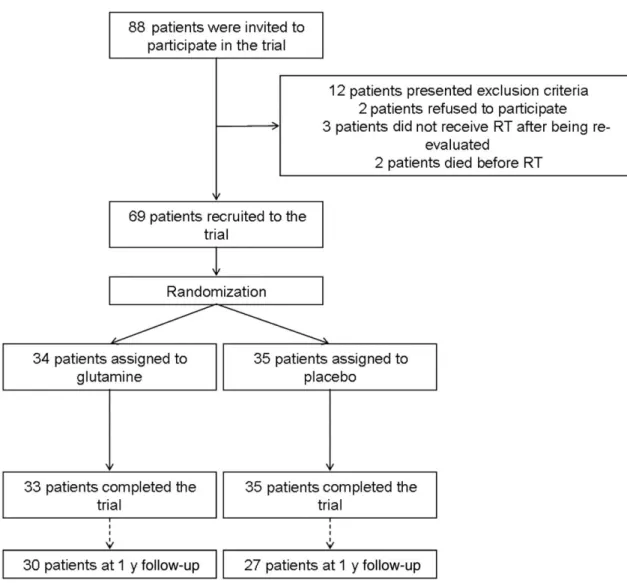
(2) Methods and participants The methodology followed in this trial was reported previously [10]. Briefly, a randomized controlled, double-blind study was designed to compare the effectiveness of Gln versus placebo in the prevention of radiation enteritis. The study was evaluated by the local Research Ethics Committee, which confirmed that it followed the Declaration of Helsinki, and was registered with Clinical Trials (ref. no. NCT00828399). Participants Inclusion criteria included being age >18 y and undergoing abdominal or pelvic RT due to a neoplasm in that location, independent of other cancer treatments (surgery, chemotherapy, or brachytherapy). Exclusion criteria included a life expectancy <1 y, short bowel syndrome, intestinal diseases (e.g., inflammatory bowel disease, celiac disease, or Whipple disease), moderate or severe chronic kidney disease, and the inability to receive either oral medication or to understand the information provided. All patients signed an informed consent document. The treatment group received supplementation with 30 g/d of oral Gln (Glutamina NM©, Nutrición Médica, Madrid) and the control group received a placebo (supplementation of 30 g/d of whole casein, Proteína NM©, Nutrición Médica, Madrid) beginning 3 d before starting RT until completion of the antitumoral treatment. Researchers did not modify the patients' dietary habits; rather, patients followed their usual diet including protein amount and sources. Chronic radiation enteritis assessment In this phase of the study, patients were re-evaluated 1 y post-RT. At that time, they were asked about the number and characteristics of stools, and intestinal toxicity was classified according to the criteria of the Radiation Therapy Oncology Group (RTOG): grade 0 (no diarrhea), grade I (5 stools per day, abdominal cramping, scarce bleeding), grade II (>5 stools per day, rectal mucus, intermittent bleeding), grade III (intestinal obstruction or bleeding that requires surgery), and grade IV (necrosis, perforation, or fistula). Nutritional assessment Nutritional status was evaluated using the Subjective Global Assessment (SGA). Anthropometry included the measurement of height and body weight, body mass index (BMI), dynamometry (Smedlay's Dynamo Meter©, Tokyo, Japan), and the determination of fat-free mass (FFM) and fat mass by bioelectrical impedance (Tanita Body Composition Analyzer TBF-300©). The fat-free mass index (FFMI) was calculated by dividing an individual's FFM by the square of their height (kg/m2). Statistical analysis The normality of quantitative variables was assessed using the Kolmogorov-Smirnov test. Those variables with a normal distribution were summarized as the mean and SD and compared using the paired Student's t test. Quantitative variables without a normal distribution were summarized by the median (Md) and interquartile range (IQR), and compared using Mann-Whitney's U-test. Categorical variables were summarized as percentages and compared using the χ2 test. Relative risk (RR) and its 95 % confidence interval (CI) were also calculated. Results Sixty-nine patients were originally recruited for the trial, however, only 57 could be reassessed 1 y after the end of RT (Fig. 1). The participants had received a daily dose of Gln of 0.4 (0.1) g/kg (minimum 0.3 g/kg, maximum 0.6 g/kg). No differences were found between the characteristics of the initial group of patients and those that completed the follow-up (Table 1)..
(3) Fig. 1. Flowchart of the study. The recruitment included 69 of the 88 patients initially invited to participate in the study. All the recruited patients were randomized and included in the intention-to-treat analysis. Three patients in the glutamine group and eight in the placebo group were lost during follow-up. RT, radiotherapy.. Table 1. Patient characteristics. Age (y) Sex (male) (%) Pathology (%) Urologic cancer Gynecologic cancer Rectal cancer Other tumors Radiation dose (Gy) Chemotherapy (%) Previous surgery (%) Brachytherapy (%). Gy, Grays. Initial group (N = 69). Group after 1 y (N = 57). P-value. 64.9 ± 9.7 64.7. 63.6 ± 6.9 61.4. 0.382 0.794. 47.1 23.5 20.6 8.8 50.4 ± 33 44.1 32.4 23.5. 43.9 28.1 22.8 5.2 50.4 ± 33 38.6 33.3 28.1. 0.597. 1.000 0.710 0.894 0.674.
(4) Stool characteristics Patients in both groups reported a stool frequency of once per day (Md, IQR = 1) before RT. After 1 y, the patients who had received Gln reported two stools per day (Md, IQR = 1). Those who were randomized to the placebo group reported one stool per day (Md, IQR = 1). The increase in stool frequency in the Gln group was significant (P = 0.01), as was the difference between the two groups at 1 y (P = 0.004). In the Gln group 56.7 % experienced changes in intestinal movements with respect to before RT versus 40.7 % in the placebo group (P = 0.230). There were no differences in the frequency of patients with liquid or soft stools between the Gln and placebo groups: 26.7 % (8 of 30) versus 11.1% (3 of 27), respectively, P = 0.137. However, more patients in the former group reported changes in stool consistency: 33.3 % (10 of 30) versus 7.4 % (2 of 27), P = 0.020. Chronic radiation enteritis Chronic enteritis was present in 14 % (n = 8) of the patients. Most cases were grade I intestinal toxicity (75 %, n = 6), with one patient each suffering from grade II (12.5 %) or grade IV (12.5 %) toxicity according to the RTOG criteria. In the Gln group 16.7 % presented diarrhea (n = 5) versus 11.1% (n = 3) in the placebo group (P = 0.540). The severity of chronic enteritis was similar between groups, with most cases being grade I (Gln 60 % versus placebo 100 %, P = 0.600). The RR for the development of chronic enteritis in patients who received Gln during RT was 1.33 (CI 95 %, 0.35–5.03). When subgroups of the different types of tumor were analyzed, there were no differences according to the treatment received ( Fig. 2). The RR of chronic enteritis was 1.57 for urologic tumours (CI 95 %, 0.16–5.16), 17 for gynecologic tumors (CI 95 %, 0.06–4.70), and 0.58 for rectal cancer (CI 95 %, 0.07–4.95).. Fig. 2. Prevalence of chronic radiation enteritis according to type of tumor.. Nutritional status During the administration of RT, most patients maintained weight and FFM, and few patients developed malnutrition (three with Gln, two with placebo), as a result of a stable energy and protein intake [10]. One year later, according to the SGA, one patient in the placebo group was malnourished; none of the patients in the Gln group were malnourished (P = 0.288). There were no differences between patients in terms of anthropometry ( Table 2)..
(5) Table 2. Comparison of Anthropometric parameters among groups. BMI (kg/m2) Weight change (%) Fat mass (%) FFMI (kg/m2) Handgrip strength (kg). Glutamine. Placebo. P-value. Chronic enteritis. No chronic enteritis. P-value. 28.9 ± 4.2 1.0 ± 6.6 32.4 ± 6.6 19.4 ± 2.1 31.4 ± 8.5. 27.3 ± 4.5 2.9 ± 4.4 31.9 ± 7.4 18.4 ± 2.2 29.2 ± 5.5. 0.176 0.206 0.783 0.078 0.253. 29.9 ± 5.1 1.6 ± 6.4 34.0 ± 6.7 19.3 ± 2.0 25.8 ± 5.3. 27.9 ± 4.2 1.9 ± 5.6 31.9 ± 7.0 18.8 ± 2.2 31.1 ± 7.4. 0.225 0.891 0.431 0.544 0.058. BMI, Body mass index; FFMI, fat-free mass index. None of the patients with chronic enteritis was diagnosed as malnourished by SGA versus only one of those without intestinal toxicity (P = 0.648). Patients with chronic enteritis presented similar nutritional parameters as patients without toxicity ( Table 2). Discussion To our knowledge, this is the first randomized, double-blind, controlled trial to evaluate the effects of the administration of oral Gln during RT on chronic radiation enteritis. During RT, more cases of acute diarrhea were found among patients who had received Gln than in those patients who received placebo [10]. One year later, patients who were randomly allocated to receive 30 g/d of Gln during RT presented significant changes in stool frequency and consistency. Nevertheless, there were no differences in the diagnosed cases of chronic enteritis according to RTOG criteria. The different criteria for the diagnosis of diarrhea and radiation enteritis hinder comparison of the prevalence of this complication between studies. The interval between RT and evaluation also could influence its prevalence. Most studies reported a wide range of prevalence of between 5 % and 60 % [11], [12], [13], [14] and [15]. This study found a prevalence of chronic enteritis near the lower limit, a fact that could be explained by the restrictive definition of diarrhea in the RTOG criteria (≥5 stools per day) and the relatively short time after RT. Furthermore, about 50 % of patients reported changes in stool frequency and 33 % in stool consistency. Previously, only one study has observed the effects of Gln during RT on chronic enteritis. In this open-label, non controlled cohort study, 32 patients received 30 g/d of oral Gln during RT until 4 wk after completion of treatment, and 26 patients received no treatment. The former group had lower rates of acute (28 % versus 61 %) and chronic diarrhea (3.8 % versus 15.6 %) than the latter group, although the authors did not provide the statistical significance of these results [9]. Regarding the effects of Gln on acute radiation enteritis, two randomized controlled, double-blind trials have been published in full to date. The first included patients with pelvic cancer, and found no differences in the development of acute toxicity. The second included patients with rectal cancer, and found that 64.3 % of those treated with Gln had acute enteritis compared with 53 % in the placebo group, although this difference was not significant [7] and [8]. None of the studies evaluated the patients several months after RT. Two studies have shown possible beneficial effects of Gln during pelvic RT. The first study recruited patients with prostate cancer who received either 21 g/d Gln or placebo. Glutamine treatment was associated with less tissue damage in the rectum, but not with better clinical outcomes [6]. The second study has already been commented on, and described a lower incidence of acute radiation enteritis with Gln treatment [9]. The mechanisms by which Gln may exacerbate the intestinal toxicity of radiation remain unclear. In rats, arginine has been related to increased radiation-induced damage of the colon [16]. This damage appears to be induced by the production of nitric oxide. Glutamine can directly promote the generation of this molecule by macrophages under stress conditions, and indirectly by the pathway Gln-citrullinearginine [17]. Glutamine also can regulate collagen production, and thereby modulate the healing of irradiated tissue [18]. In rats, Gln supplementation prevents acute changes in extracellular matrix and collagen expression in the urinary bladder after exposure to radiation, but the effects on fibrosis have not been studied [19]. The same amino acid increases the transcription of the collagen gene in skin fibroblasts, suggesting that the type of tissue and stimulus may influence the effects of glutamine [20]. The analysis of tissue sample probably would have proportionated more information about the intestinal damage in both groups, but these samples were not obtained due to ethical restrictions. Finally, this is not the first study showing adverse effects related to the administration of glutamine. The REDOX (Reducing.
(6) Deaths due to OXidative Stress) trial, in which critically ill patients received Gln, showed an increased mortality related to the administration of high doses of this amino acid [21]. The study we present is involved in several controversies within the field of clinical nutrition, the first of which was the selection of a placebo. In our trial, casein, a protein obtained from milk, was selected for its nutritional composition and its lack of other possible effects on health. Other studies used maltodextrin, but it resulted in a comparison between a protein-enriched diet and a carbohydrate-enriched diet. Other amino acids used in trials, like glycine, have antioxidant effects like Gln [22]. A whole protein was considered a suitable, although not perfect, comparator. It should be noted that Gln is present in all protein foods, although represents <10 % of the amino acid content of casein [23]. The appropriate dose of Gln for each clinical condition is also unclear. Previous studies evaluating its effects on patients receiving RT have administered 30 g/d, and this dose has been safely tried in critically ill patients [24], [25], [26] and [27]. Additionally, lower doses (0.15 g/kg) than the used in this study (0.4 g/kg) did not promote glutathione in women receiving chemotherapy [28]. Following this background, 30 g was the selected dose of treatment, and a similar amount of protein of placebo. Nevertheless, Gln dosage may be the key to understanding the results of this study, as the amount of Gln contained in diet may modulate gut inflammation. Rats receiving a medium dose of the amino acid developed less bowel inflammation than those with a higher dose or a Gln-free diet [29]. The prevalence of malnutrition was low in both groups in this study, as well as among patients with chronic enteritis. Anthropometric data remained unchanged 1 y after the completion of RT. This may reflect the limited nutritional effects of the mild and infrequent GI symptoms that were found. Malnutrition has been found in more than half of patients with more severe grades of enteritis (i.e., those who require surgery) [30]. However, all patients who developed acute radiation enteritis during the first phase of the trial received nutritional counseling for the relief of toxicity, which may have helped to prevent the deterioration in nutritional status. Some studies have demonstrated that dietary manipulations, such as restriction of fat or fiber, can reduce GI symptoms and prevent weight loss during RT, but there is a lack of strong evidence about these kinds of interventions [31]. This study has some limitations that should be considered. First, the sample size was calculated for the detection of differences between groups regarding acute diarrhea but not for chronic enteritis. This fact, in addition to the loss of patients during the follow-up period, reduces the statistical power of the study. Second, it was not possible to evaluate the development of chronic intestinal toxicity in patients lost to follow-up, although their initial characteristics were similar to those who completed the study. Third, the researchers were aware of the treatment that the patients had received during RT, so the assessment 1 y after RT was not double-blind. Finally, biochemical markers of intestinal function (e.g., citrulline) or inflammation (e.g., calprotectin) could not be measured, and the assessment of toxicity was performed using only the symptoms and signs that the patients reported. Conclusion This trial demonstrated that the administration of the usual dose of oral Gln during abdominal or pelvic RT was associated with an increase in stool pass frequency and changes in stool consistency 1 y after completion of treatment. These results, in addition to the lack of effect on acute radiation enteritis, suggests that the use of this amino acid in patients with abdominal or pelvic tumors treated with RT is not useful to attenuate the intestinal symptoms induced by the treatment.. References [1]. J. Brush, S.L. Lipnick, T. Phillips, J. Sitko, J.T. McDonald, W.H. McBride. Molecular mechanisms of late normal tissue injury. Semin Radiat Oncol, 17 (2007), pp. 121–130. [2]. E.M. Rosen, S. Fan, I.D. Goldberg, S. Rockwell. Biological basis of radiation sensitivity. Part 1: factors governing radiation sensitivity. Oncology, 14 (2000), pp. 543–550. [3]. J. Andreyev. Gastrointestinal complications of pelvic radiotherapy: are they of any importance?. Gut, 54 (2005), pp. 1051–1054. [4]. N.E.P. Deutz. The 2007 ESPEN Sir David Cuthbertson Lecture: amino acids between and within organs. The glutamate-glutamine-citrulline-arginine pathway. Clin Nutr, 27 (2008), pp. 321–327. [5]. R. Curi, C.J. Lagranha, S.Q. Doi, D.F. Sellitti, J. Procopio, T.C. Pithon-Curi, et al. Molecular mechanism of glutamine action. J Cell Phys, 204 (2005), pp. 392–401. [6]. E.W. Richards, C.L. Long, J.A. Pinkston, V. Ellis, M. Mostaghimi, R.E. Gandy. The role of oral glutamine supplementation in the prevention of radiation-induced enterocolitis in prostate cancer patients. FASEB J, 6 (1992), p. A1680 (abstr)..
(7) [7]. T.F. Kozelsky, G.E. Meyers, J.A. Sloan, T.G. Shanahan, S.J. Dick, R.L. Moore, et al. Phase III double-blind study of glutamine vs. placebo for the prevention of acute diarrhea in patients receiving pelvic radiation therapy. J Clin Oncol, 21 (2003), pp. 16669–16674. [8]. N.R. Kozjek, L. Kompan, P. Soeters, I. Oblak, D.M. Mastnak, B. Mozina, et al. Oral glutamine supplementation during preoperative radiochemotherapy in patients with rectal cancer: a randomized double blinded, placebo controlled pilot study. Clin Nutr, 30 (2011), pp. 567–570. [9]. R. Ramírez Vargas. Efficacy of glutamine as prophylactic treatment of enteritis in patients due to abdominal and pelvic radiation therapy. Radiother Oncol, 90 (Suppl 1) (2009), p. S27. [10]. A. Vidal-Casariego, A. Calleja-Fernández, J.J. de Urbina-González, I. Cano-Rodríguez, F. Cordido, M.D. Ballesteros-Pomar. Efficacy of glutamine in the prevention of acute radiation enteritis: a randomized controlled trial. J Parenter Enteral Nutr, 38 (2014), pp. 205–213. [11]. A.W. Fyles, A.J. Dembo, R.S. Bush, W. Levin, L.A. Manchul, J.F. Pringle, et al. Analysis of complications in patients treated with abdomino-pelvic radiation therapy for ovarian carcinoma. Int J Radiat Oncol Biol Phys, 22 (1992), pp. 847–851. [12]. A.J. Mundt, K.T. Murphy, J. Rotmensch, S.E. Waggoner, S.D. Yamada, P.P. Connell. Surgery and postoperative radiation therapy in FIGO stage IIIC endometrial carcinoma. Int J Radiat Oncol Biol Phys, 50 (2001), pp. 1154–1160. [13]. J. Abayomi, J. Kirwan, A. Hackett. The prevalence of chronic radiation enteritis following radiotherapy for cervical or endometrial cancer and its impact on quality of life. Eur J Oncol Nurs, 13 (2009), pp. 262–267. [14]. M. Turina, A.M. Mulhall, S.S. Mahid, C. Yashar, S. Galandiuk. Frequency and surgical management of chronic complications related to pelvic radiation. Arch Surg, 143 (2008), pp. 46–52. [15]. A. Mahmud, B. Brydon, J. Tonita, T.P. Hanna, M. Schmidt, P. Tai. A population-based study of cervix cancer: incidence, management and outcome in the Canadian province of Saskatchewan. Clin Oncol (R Coll Radiol), 23 (2011), pp. 691–695. [16]. K. Klimberg, W.W. Souba, D.J. Dolson, R.M. Salloum, R.D. Hautamaki, D.A. Plumley, et al. Prophylactic glutamine protects the intestinal mucosa from radiation injury. Cancer, 66 (1990), pp. 62–68. [17]. C.F. Bellows, B.M. Jaffe. Glutamine is essential for nitric oxide synthesis by murine macrophages. J Surg Res, 86 (1999), pp. 213–219. [18]. H.P. Rodemann, M. Bamberg. Cellular basis of radiation-induced fibrosis. Radiother Oncol, 35 (1995), pp. 83– 90. [19]. B. Rodirgues Rocha, F. Meirelles Gombar, L. Maria Barcellos, W. Silva Costa, F.J. Barcellos Sampaio, C. Fonte Ramos. Glutamine supplementation prevents collagen expression damage in healthy urinary bladder caused by radiotherapy. Nutrition, 27 (2011), pp. 809–815. [20]. G. Bellon, B. Chaqour, Y. Wegrowski, J.C. Monboisse, J.P. Borel. Glutamine increases collagen gene transcription in cultured human fibroblast. Biochimica et Biophysica Acta, 1268 (1995), pp. 311–323. [21]. D. Heyland, J. Muscedere, P.E. Wischmeyer, D. Cook, G. Jones, M. Albert, Canadian Critical Care Trials Group, et al. A randomized trial of glutamine and antioxidants in critically ill patients. N Engl J Med, 368 (2013), pp. 1489–1497. [22]. B. Matilla, J.L. Mauriz, J.M. Culebras, J. González Gallego, P. González. La glicina: un nutriente antioxidante citoprotector. Nutr Hosp, 17 (2002), pp. 2–9. [23]. C.M. Lenders, S. Liu, D.W. Wilmore, L. Sampson, L.W. Dougherty, D. Spiegelman, et al. Evaluation of a novel food composition database that includes glutamine and other amino acids derived from gene sequencing data. Eur J Clin Nutr, 63 (2009), pp. 1433–1439. [24]. L.C. Cerchietti, A.H. Navigante, M.A. Lutteral, M.A. Castro, R. Kirchuk, M. Bonomi, et al. Double-blinded, placebo-controlled trial on intravenous L-alanyl-L-glutamine in the incidence of oral mucositis following chemoradiotherapy in patients with head-and-neck cancer. Int J Radiat Oncol Biol Phys, 65 (2006), pp. 1330– 1337. [25]. M. Algara, N. Rodríguez, P. Viñals, M. Lacruz, P. Foro, A. Reig, et al. Prevention of radiochemotherapyinduced esophagitis with glutamine: results of a pilot study. Int J Radiat Oncol Biol Phys, 69 (2007), pp. 342– 349. [26]. E. Topkan, M.N. Yavuz, C. Onal, A.A. Yavuz. Prevention of acute radiation-induced esophagitis with glutamine in non-small cell lung cancer patients treated with radiotherapy: evaluation of clinical and dosimetric parameters. Lung Cancer, 63 (2009), pp. 393–399. [27]. D.K. Heyland, R. Dhaliwalm, A. Day, J. Drover, H. Cote, P. Wischmeyer. Optimizing the dose of glutamine dipeptides and antioxidants in critically ill patients: a phase I dose-finding study. JPEN J Parenter Enteral Nutr, 31 (2007), pp. 109–118. [28]. J.W. Mourao de Farias, F. Siqueira Furtado, S. Botelho Guimaraes, A. Ribeiro da Silva Filho, R. Leitao de Vasconcelos. Oxidative stress parameters in women with breast cancer undergoing neoadjuvant chemotherapy and treated with nutraceutical doses of oral glutamine. Acta CirBras, 26 (Suppl 1) (2011), pp. 82–87. [29]. M. Shinozaki, H. Saito, T. Muto. Excess glutamine exacerbates trinitrobenzenesulfonic acid-induced colitis in rats. Dis Colon Rectum, 40 (10 Suppl) (1997), pp. S59–S63. [30]. W. Zhu, J. Gong, Y. Li, N. Li, J. Li. A retrospective study of surgical treatment of chronic radiation enteritis. J Surg Oncol, 105 (2012), pp. 632–636. [31]. C. McGough, C. Baldwin, G. Frost, H.J. Andreyev. Role of nutritional intervention in patients treated with radiotherapy for pelvic malignancy. Br J Cancer, 90 (2004), pp. 2278–2287..
(8)
Figure


Documento similar
Here, we present a dou- ble-blind, randomized clinical trial to assess the effect of 3% hypertonic saline solution on primary fascial closure and the timing of abdominal wall
Conclusions: Very preterm infants who received formula with an ω-6/ω-3 ratio of 2/1 had higher blood levels of essential fatty acids during the first year of life, and
To further explore the pleiotropic effects of statins in COPD, we designed a randomized pilot clinical trial to investigate compre- hensively their potential effect on (1):
Due to the impact in quality of life of frailty, CP and lower PA and the potential benefits of PA programs for frailty prevention and CP manage- ment our aim is to evaluate
Taping combined with Back School in patients with chronic low-back pain: Randomized controlled trial
We carried out a blind evaluator randomized controlled clinical trial. The patients that were included were referred by the Acute Care Hospital “Dr. Fernández” De- partments of
Primary analysis of a phase II randomized trial Radiation Therapy Oncology Group (RTOG) 0212: impact of different total doses and schedules of prophylactic cranial irradiation
The main objective of the current study is to describe the research procedure for a randomized controlled clinical trial in a multidisciplinary intervention
Effects of Exergames on Quality of Life, Pain, and Disease Effect in Women with Fibromyalgia: A Randomized Controlled Trial. A Randomized Clinical Trial of an Individualized
