A
HUBBLE
DIAGRAM FROM TYPE II SUPERNOVAE BASED SOLELY ON PHOTOMETRY: THE
PHOTOMETRIC COLOR METHOD
*T. de Jaeger1,2, S. González-Gaitán1,2, J. P. Anderson3, L. Galbany1,2, M. Hamuy1,2, M. M. Phillips4, M. D. Stritzinger5,
C. P. Gutiérrez1,2,3, L. Bolt6, C. R. Burns7, A. Campillay4, S. CastellÓn4, C. Contreras5, G. Folatelli8,9,
W. L. Freedman10, E. Y. Hsiao4,5,11, K. Krisciunas12, W. Krzeminski13, H. Kuncarayakti1,2, N. Morrell4, F. Olivares E.1,14,
S. E. Persson7, and N. Suntzeff12 1
Millennium Institute of Astrophysics, Santiago, Chile;[email protected] 2
Departamento de Astronomía—Universidad de Chile, Camino el Observatorio 1515, Santiago, Chile
3
European Southern Observatory, Alonso de Córdova 3107, Casilla 19, Santiago, Chile
4
Las Campanas Observatory, Carnegie Observatories, Casilla 601, La Serena, Chile
5
Department of Physics and Astronomy, Aarhus University, Ny Munkegade 120, DK-8000 Aarhus C, Denmark
6
Argelander Institut für Astronomie, Universität Bonn, Auf dem Hgel 71, D-53111 Bonn, Germany
7
Observatories of the Carnegie Institution for Science, Pasadena, CA 91101, USA
8Instituto de Astrofísica de La Plata, CONICET, Paseo del Bosque S/N, B1900FWA, La Plata, Argentina 9
Institute for the Physics and Mathematics of the Universe(IPMU), University of Tokyo, 5-1-5 Kashiwanoha, Kashiwa,Chiba 277-8583, Japan
10
Department of Astronomy and Astrophysics, University of Chicago, Chicago, IL 60637, USA
11
Department of Physics, Florida State University, Tallahassee, FL 32306, USA
12
George P. and Cynthia Woods Mitchell Institute for Fundamental Physics and Astronomy, Department of Physics and Astronomy, Texas A&M University, College Station, TX 77843, USA
13
N. Copernicus Astronomical Center, ul. Bartycka 18, 00-716 Warszawa, Poland
14
Departamento de Ciencias Fisicas—Universidad Andres Bello, Avda. República 252, Santiago, Chile Received 2015 August 24; accepted 2015 November 11; published 2015 December 17
ABSTRACT
We present a Hubble diagram of SNe II using corrected magnitudes derived only from photometry, with no input of spectral information. We use a data set from the Carnegie Supernovae Project I for which optical and near-infrared lightcurves were obtained. The apparent magnitude is corrected by two observables, one corresponding to the slope of the plateau in theVband and the second a color term. We obtain a dispersion of 0.44 mag using a combination of the(V−i)color and the rband and we are able to reduce the dispersion to 0.39 mag using our golden sample. A comparison of our photometric color method(PCM)with the standardized candle method(SCM)
is also performed. The dispersion obtained for the SCM (which uses both photometric and spectroscopic
information)is 0.29 mag, which compares with 0.43 mag from the PCMfor the same SN sample. The construction of a photometric Hubble diagram is of high importance in the coming era of large photometric wide-field surveys, which will increase the detection rate of supernovae by orders of magnitude. Such numbers will prohibit spectroscopic followup in the vast majority of cases, and hence methods must be deployed which can proceed using solely photometric data.
Key words:distance scale– galaxies: distances and redshifts–supernovae: general
1. INTRODUCTION
A fundamental probe in modern astronomy to understand the universe, its history, and evolutionis the measurement of distances. Stellar parallax and the spectroscopic parallax allow us to reach∼100–1000 pc, respectively, but farther afield other methods are needed. A traditional technique for measuring distances consists ofapplying the inverse square law for astrophysical sources with known absolute magnitudes, also known asstandard candles. One of thefirst such objects used in astronomy wasCepheid stars. A Cepheid starʼs period is directly related to its intrinsic luminosity (Leavitt 1908; Benedict et al. 2007) and allows one to probe the universe to 15 Mpc. To attain larger distances, brighter objects are required. Type Ia supernovae (SNeIa)have an absolute B -band magnitudes of about −19.5 to−19.2 mag(depending on the assumptions ofH0Richardson et al.2002; Riess et al.2011)
which can be precisely calibrated using photometric and/or spectroscopic information from the SN itself, and can be used as excellent distance indicators. Indeed, there are two parameters correlated to the luminosity. The first one is the decline rate: SNeIa with fast decline rates are fainter and have narrower lightcurve peaks(Phillips1993), and the second one iscolor (Riess et al. 1996; Tripp 1998): redder SNeIa are fainter. The standardization of SNeIa to a level∼0.15–0.2 mag (Phillips1993; Hamuy et al.1996; Riess et al.1996)led to the measurement of the expansion history of the universe and showed that, contrary to expectations, the universe is under-going an accelerated expansion (Riess et al. 1998; Schmidt et al.1998; Perlmutter et al.1999). Within this new paradigm, one of the greatest challenges is the search for the mechanism that causes the acceleration, an endeavour that will require exquisitely precise measurements of the cosmological para-meters that characterize the current cosmological concordance model, i.e., ΛCDM model. Several techniques that offer the promise to provide such constraints have been put forward over recentyears: refined versions of the SNeIa method (Betoule et al.2014), cosmic microwave background radiation
measure-ments (Cosmic Microwave Background Explorer, Fixsen
© 2015. The American Astronomical Society. All rights reserved.
et al.1996; Jaffe et al.2001;Wilkinson Microwave Anisotropy Probe, Bennett et al. 2003; Spergel et al. 2007; and more recently the Planck mission, Planck Collaboration et al.2013),
and baryon acoustic oscillation measurements (Blake &
Glazebrook 2003; Seo & Eisenstein 2003). All of the above techniques have their own merits, but also their own systematic uncertainties that could become dominant with the increasingly higher level of precision required. Thus, it is important to develop as many methods as possible, since the truth will likely emerge from the combination of different independent approaches.
While SNeIa have been used as the primary diagnostic in constraining cosmological parameters, type IIP supernovae (SNeIIP)have also been established to be useful independent distance indicators. SNeIIP are 1–2 mag less luminous than the SNeIa; however, their intrinsic rate is higher than the SNeIa rate (Li et al.2011), and additionally the rate peaks at higher redshifts than SNeIa (Taylor et al. 2014), which motivates
their use in the cosmic distance scale (see Hamuy &
Pinto 2002). Also, the fact thatthey are in principle the result of the same physical mechanismand,their progenitors are better understood than those of SNeIa,further encourages investigations in this direction. SNeIIP are thought to be core-collapse supernovae(CCSNe), i.e., thefinal explosion of stars
with zero-age main-sequence mass 8Me (Smartt 2009).
CCSNe have diverse classes, with a large range of observed luminosities, lightcurve shapes, and spectroscopic features. CCSNe are classified in two groups according to the absence (SNeIb/c: Filippenko et al.1993; Dessart et al.2011; Bersten et al. 2014; Kuncarayakti et al.2015)or presence (SNeII)of HI lines (Minkowski 1941; Filippenko 1997 and references
therein). In addition tothe SNeIIP and SNeIIL which are discussed later, SNeII are composed by SNeIIb thatevolve spectroscopically from SNeIIP at early times to HI-deficient at
a few weeks to a month past maximum(Woosley et al.1987)
and SNeIIn which have narrow HI emission lines (
Cheva-lier 1981; Fransson 1982; Schlegel 1990; Chugai & Danzi-ger1994; Van Dyk et al.2000; Kankare et al.2012; de Jaeger et al.2015).
Historically, SNeII were separated in two groups: SNeIIP (70% of CCSNe; Li et al. 2011), which are characterized by long duration plateau phases (100days) of constant lumin-osity, and SNeIIL, which have linearly declining lightcurve morphologies (Barbon et al. 1979). However, as discussed in detail in Anderson et al. (2014b), it is not clear how well this terminology describes the diversity of SNeII. There are few SNeII thatshow flat lightcurves, and in addition there are very few (if any)SNe thatdecline linearly before falling onto the radioactive tail. Therefore, henceforth we simply refer to all SNe with distinct decline rates collectively as SNeII, and will later further discuss SNe in terms of their“s2”plateau decline
rates (Anderson et al. 2014b). Sanders et al. (2015) also suggested that the SNeII family forms a continuous class, while Arcavi et al.(2012)and Faran et al.(2014a,2014b)have argued for two separate populations.
The most noticeable difference between SNeII occurs
during the plateau phase. The optically thick phase is physically wellunderstood and is due to a change in opacity and density in the outermost layers of the SN. At the beginning, the hydrogen present in the outermost layers of the progenitor star is ionized by the shock wave, which implies an increase of the opacity and the density, which prevent the radiation from
the inner parts from escaping. After a few weeks, the star has cooled to temperatures allowing the recombination of ionized hydrogen(higher than 5000 K due to the large optical depth). The ejecta expand and the photosphere recedes in mass space, releasing the energy stored in the corresponding layers. The plateau morphology requires a recession of the photosphere in mass that corresponds to a fixed radius in space so that luminosity appears constant. As Anderson et al.(2014b)show, this delicate balance is rarely observed and there is significant diversity observed in theV-band lightcurve. To reproduce the plateau morphology, hydrodynamical models have used red supergiant progenitors with extensive H envelopes(Grassberg et al. 1971; Falk & Arnett 1977; Chevalier 1976). Direct detections of the progenitor of SNeIIP have confirmed these models(Van Dyk et al.2003; Smartt et al.2009). It has also been suggested that SNIIL progenitors may be more massive
in the zero-age main sequence than SNeIIP (Elias-Rosa
et al. 2010, 2011) and with smaller hydrogen envelopes
(Popov1993).
To date, several methods have been developed to standardize SNeII. The first method, called the expanding photosphere method(EPM), was developed by Kirshner & Kwan (1974)
and allows one to obtain the intrinsic luminosity assuming that SNeII radiate as dilute blackbodies, and that the SN freely expands with spherical symmetry. The EPM was implemented for thefirst time on a large number of objects by Schmidt et al. (1994) and followed by many studies (Hamuy et al. 2001; Leonard et al. 2003; Dessart & Hillier 2005, 2006; Jones
et al. 2009; Emilio Enriquez et al. 2011). One of the
largestissues with this method is that the EPM only works if one corrects for the blackbody assumptions, which requires correctionfactors computed from model atmospheres(Eastman et al.1996; Dessart & Hillier2005;see Dessart & Hillier2006
for the resolution of the EPM-based distance problem to SN 1999em). Also, to avoid the problem in the estimation of the dilution factor, Baron et al. (2004) proposed a distance-correcting factor that takes into account the departure of the SN
atmosphere from a perfect blackbody, the spectral-fitting
expanding atmosphere method” (SEAM;updated in Dessart
et al. 2008). This method consists of fitting the observed spectrum using an accurate synthetic spectrum of SNeII, and then since the spectral energy distribution is completely known from the calculated synthetic spectra, one may calculate the absolute magnitude in any band.
A simpler method, also based on photometric and spectro-scopic parameters, the standardised candle method(SCM), was
first introduced by Hamuy & Pinto(2002). They found that the luminosity and the expansion velocity are correlated when the SN is in its plateau phase (50 days post-explosion). This relation is physically well understood: for a more luminous SN, the hydrogen recombination front will be at a larger radius, thereby the velocity of the photosphere will be greater(Kasen & Woosley2009)for a given post-explosion time. Dueto this method, the scatter in the Hubble diagram (hereafter Hubble diagram) drops from 0.8 to 0.29 mag in the Iband. Nugent et al. (2006) improved this method by adding an extinction correction based on the(V−I)color at day 50 after maximum. This new method is very powerful and many other studies (Nugent et al. 2006; Poznanski et al. 2009; D’Andrea et al.
2010; Olivares et al. 2010) have confirmed the possibility ofusingSNeII as standard candles finding a scatter between
suggested that using near-infrared (NIR)filters, the SCM, the dispersion can drop to a level of 0.1–0.15 mag (using 12 SNeIIP). Indeed, in the NIR the hostgalaxy extinction is less important, thus there may be less scatter in magnitude. Note also the work done by Rodríguez et al. (2014), where the
authors used the photospheric magnitude method (PMM),
which corresponds to a generalization of the SCM for various epochs throughout the photospheric phase, and found a dispersion of 0.12 mag using 13 SNe. This is an intrinsic dispersion and is not the root mean square(rms).
The main purpose of this work is to derive a method to obtain purely photometric distances, i.e., standardize SNeII only using light curves and color curve parameters, unlike other methods cited above which require spectroscopic parameters. This is a large issue, and purely photometric methods will be an asset for the next generation of surveys such as the large synoptic survey telescope (LSST; Ivezic et al. 2009; Lien et al.2011). These surveys will discover such a large number of SNe that spectroscopic follow up will be impossible for all but only for small number of events. This will prevent the use of current methods to standardize SNeII and calculate distances. Therefore, deriving distances with photometric data alone is important and useful for the near future but also allows us to reach higher distance due to the fact that obtaining even one spectrum for a SNII atz 1 is very challenging.
The paper is organized as follows. In Section2a description of the dataset is given. In Section3 we explain how the data
are corrected for Milky Way (MW) extinction and how the
K-correction (KC) is applied. In Section 4 we describe the photometric color method(PCM)using optical and NIRfilters and we derive a photometric Hubble diagram. In Section5we present a comparative Hubble diagram using the SCM. In
Section 6 we compare our method with the SCM and we
conclude with a summary in Section 7.
2. DATA SAMPLE
2.1. Carnegie Supernova Project
The Carnegie Supernova Project15(CSP;Hamuy et al.2006)
provided all the photometric and spectroscopic data for this project. The goal of the CSP was to establish a high-cadence data set of optical and NIR light curves in a well defined and well understood photometric system and obtain optical spectra for these same SNe. Between 2004 and 2009, the CSP
observed many low-redshift SNeII (NSNe∼100 with
z0.04), 56 of which had both optical and NIR light curves with good temporal coverage. This wasone of the largest NIR
data samples. Two SN 1987A-like events were removed (SN
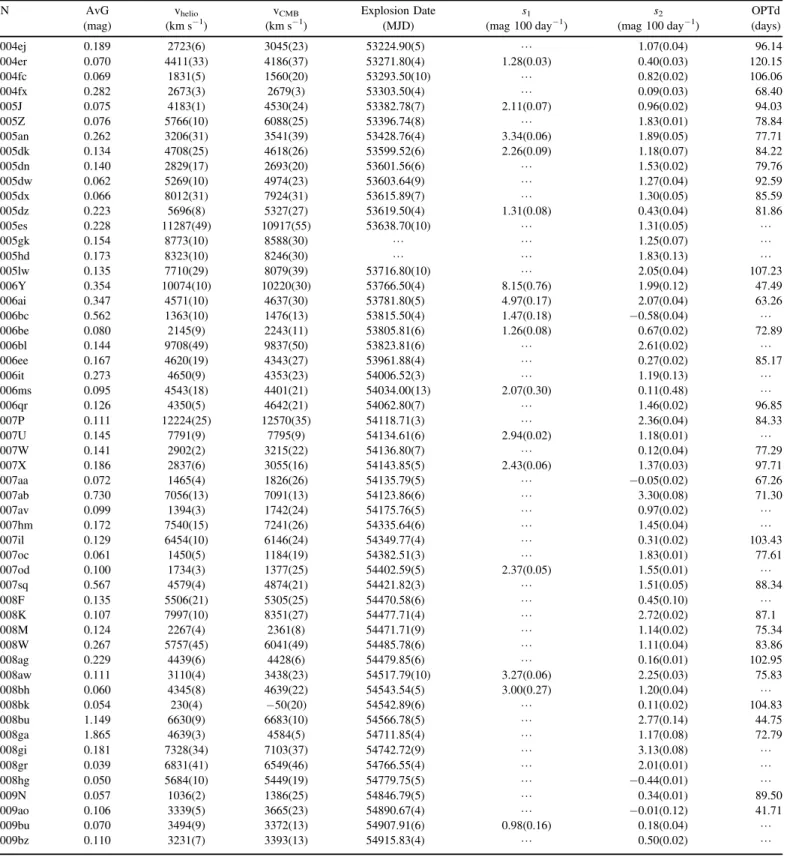
2006V and SN 2006au; see Taddia et al. 2012), leavingthe sample listed in Table1with photometric parameters measured
by Anderson et al. (2014b). Note that we do not include
SNeIIb or SNeIIn.
2.2. Data Reduction
2.2.1. Photometry
All the photometric observations were taken at the Las
Campanas Observatory (LCO)with the Henrietta Swope 1 m
and the Irénée du Pont 2.5 m telescopes using optical(u,g,r,i,
B, and V)and NIR filters (Y, J, and H;see Stritzinger
et al. 2011). All optical images were reduced in a standard way including bias subtractions,flat-field corrections, applica-tion of a linearity correcapplica-tion, and an exposure time correcapplica-tion for a shutter time delay. The NIR images were reduced through the following steps: dark subtraction, flat-field division, sky subtraction, geometric alignment, and a combination of the dithered frames. Due to the fact that SN measurements can be affected by the underlying light of their host galaxies, we took care tocorrectly removethe underlying hostgalaxy light. The
templates used for final subtractions were always taken
months/years after each SN faded and under seeing conditions better than those of the science frames. Because the templates for some SNe were not taken with the same telescope, they were geometrically transformed to each individual science frame. These were then convolved to match the point-spread functions, andfinally scaled influx. The template images were then subtracted from a circular region around the SN position on each science frame(see Contreras et al.2010).
Observed magnitudes for each SN werederived relative
to local sequence stars and calibrated from observations of standard stars in the Landolt(1992;BV), Smith et al.(2002;u′ g′r′i′), and Persson et al. (2004;YJHKs) systems. The photometry of the local sequence stars are on average based on at least three photometric nights. Magnitudes are expressed in the natural photometric system of the Swope+CSP bands. Final errors for each SN are the result of the instrumental magnitude uncertainty and the error on the zero point. The full photometric catalog will be published in an upcoming paper (note that theV-band photometry hasalready been published in Anderson et al.2014b).
2.2.2. Spectroscopy
The majority of our spectra were obtained with the 2.5 m Irénée du Pont telescope using the WFCCD- and Boller and
Chiven spectrographs (the last is now decommissioned) at
LCO. Additional spectra were obtained with the 6.5 m
Magellan Clay and Baade telescopes with LDSS-2, LDSS-3, MagE(see Massey et al.2012for details), and IMACS together with the CTIO 1.5 m telescope and the Ritchey-Chrétien Cassegrain Spectrograph, and the New Technology Telescope at La Silla observatory using the EMMI and EFOSC instruments. The majority of the spectra are the combination of three exposures to facilitate cosmicray rejection.
Informa-tion about the grism used, the exposure time, andthe
observation strategy can be found in Hamuy et al. (2006)
andFolatelli et al. (2010). All spectra were reduced in a standard way as described in Hamuy et al.(2006)and Folatelli et al. (2013). Briefly, the reduction was done with IRAF16 using the standard routines(bias subtraction,flat-field correc-tion, one-dimensional(1D)extraction, and wavelength andflux calibration). The full spectroscopic sample will be published in an upcoming paper and the reader can refer to Anderson et al. (2014a)and Gutiérrez et al. (2014)for a thorough analysis of this sample.
3. FIRST PHOTOMETRIC CORRECTIONS
In order to proceed with our aim of creating a Hubble diagram based on photometric measurements using the PCM,
15
http://csp.obs.carnegiescience.edu/
16
IRAF is distributed by the National Optical Astronomy Observatory, which is operated by the Association of Universities for Research in Astronomy
Table 1 SNII Parameters
SN AvG vhelio vCMB Explosion Date s1 s2 OPTd
(mag) (km s−1) (km s−1) (MJD) (mag 100 day−1) (mag 100 day−1) (days)
2004ej 0.189 2723(6) 3045(23) 53224.90(5) L 1.07(0.04) 96.14
2004er 0.070 4411(33) 4186(37) 53271.80(4) 1.28(0.03) 0.40(0.03) 120.15
2004fc 0.069 1831(5) 1560(20) 53293.50(10) L 0.82(0.02) 106.06
2004fx 0.282 2673(3) 2679(3) 53303.50(4) L 0.09(0.03) 68.40
2005J 0.075 4183(1) 4530(24) 53382.78(7) 2.11(0.07) 0.96(0.02) 94.03
2005Z 0.076 5766(10) 6088(25) 53396.74(8) L 1.83(0.01) 78.84
2005an 0.262 3206(31) 3541(39) 53428.76(4) 3.34(0.06) 1.89(0.05) 77.71 2005dk 0.134 4708(25) 4618(26) 53599.52(6) 2.26(0.09) 1.18(0.07) 84.22
2005dn 0.140 2829(17) 2693(20) 53601.56(6) L 1.53(0.02) 79.76
2005dw 0.062 5269(10) 4974(23) 53603.64(9) L 1.27(0.04) 92.59
2005dx 0.066 8012(31) 7924(31) 53615.89(7) L 1.30(0.05) 85.59
2005dz 0.223 5696(8) 5327(27) 53619.50(4) 1.31(0.08) 0.43(0.04) 81.86
2005es 0.228 11287(49) 10917(55) 53638.70(10) L 1.31(0.05) L
2005gk 0.154 8773(10) 8588(30) L L 1.25(0.07) L
2005hd 0.173 8323(10) 8246(30) L L 1.83(0.13) L
2005lw 0.135 7710(29) 8079(39) 53716.80(10) L 2.05(0.04) 107.23
2006Y 0.354 10074(10) 10220(30) 53766.50(4) 8.15(0.76) 1.99(0.12) 47.49 2006ai 0.347 4571(10) 4637(30) 53781.80(5) 4.97(0.17) 2.07(0.04) 63.26 2006bc 0.562 1363(10) 1476(13) 53815.50(4) 1.47(0.18) −0.58(0.04) L 2006be 0.080 2145(9) 2243(11) 53805.81(6) 1.26(0.08) 0.67(0.02) 72.89
2006bl 0.144 9708(49) 9837(50) 53823.81(6) L 2.61(0.02) L
2006ee 0.167 4620(19) 4343(27) 53961.88(4) L 0.27(0.02) 85.17
2006it 0.273 4650(9) 4353(23) 54006.52(3) L 1.19(0.13) L
2006ms 0.095 4543(18) 4401(21) 54034.00(13) 2.07(0.30) 0.11(0.48) L
2006qr 0.126 4350(5) 4642(21) 54062.80(7) L 1.46(0.02) 96.85
2007P 0.111 12224(25) 12570(35) 54118.71(3) L 2.36(0.04) 84.33
2007U 0.145 7791(9) 7795(9) 54134.61(6) 2.94(0.02) 1.18(0.01) L
2007W 0.141 2902(2) 3215(22) 54136.80(7) L 0.12(0.04) 77.29
2007X 0.186 2837(6) 3055(16) 54143.85(5) 2.43(0.06) 1.37(0.03) 97.71
2007aa 0.072 1465(4) 1826(26) 54135.79(5) L −0.05(0.02) 67.26
2007ab 0.730 7056(13) 7091(13) 54123.86(6) L 3.30(0.08) 71.30
2007av 0.099 1394(3) 1742(24) 54175.76(5) L 0.97(0.02) L
2007hm 0.172 7540(15) 7241(26) 54335.64(6) L 1.45(0.04) L
2007il 0.129 6454(10) 6146(24) 54349.77(4) L 0.31(0.02) 103.43
2007oc 0.061 1450(5) 1184(19) 54382.51(3) L 1.83(0.01) 77.61
2007od 0.100 1734(3) 1377(25) 54402.59(5) 2.37(0.05) 1.55(0.01) L
2007sq 0.567 4579(4) 4874(21) 54421.82(3) L 1.51(0.05) 88.34
2008F 0.135 5506(21) 5305(25) 54470.58(6) L 0.45(0.10) L
2008K 0.107 7997(10) 8351(27) 54477.71(4) L 2.72(0.02) 87.1
2008M 0.124 2267(4) 2361(8) 54471.71(9) L 1.14(0.02) 75.34
2008W 0.267 5757(45) 6041(49) 54485.78(6) L 1.11(0.04) 83.86
2008ag 0.229 4439(6) 4428(6) 54479.85(6) L 0.16(0.01) 102.95
2008aw 0.111 3110(4) 3438(23) 54517.79(10) 3.27(0.06) 2.25(0.03) 75.83
2008bh 0.060 4345(8) 4639(22) 54543.54(5) 3.00(0.27) 1.20(0.04) L
2008bk 0.054 230(4) −50(20) 54542.89(6) L 0.11(0.02) 104.83
2008bu 1.149 6630(9) 6683(10) 54566.78(5) L 2.77(0.14) 44.75
2008ga 1.865 4639(3) 4584(5) 54711.85(4) L 1.17(0.08) 72.79
2008gi 0.181 7328(34) 7103(37) 54742.72(9) L 3.13(0.08) L
2008gr 0.039 6831(41) 6549(46) 54766.55(4) L 2.01(0.01) L
2008hg 0.050 5684(10) 5449(19) 54779.75(5) L −0.44(0.01) L
2009N 0.057 1036(2) 1386(25) 54846.79(5) L 0.34(0.01) 89.50
2009ao 0.106 3339(5) 3665(23) 54890.67(4) L −0.01(0.12) 41.71
2009bu 0.070 3494(9) 3372(13) 54907.91(6) 0.98(0.16) 0.18(0.04) L
2009bz 0.110 3231(7) 3393(13) 54915.83(4) L 0.50(0.02) L
in this section we show how to correct apparent magnitudes for MW extinction (AvG) and how to apply the KCwithout the use of observed SN spectra but only with model spectra.
3.1. MW Correction
In theVband the determination of AvG can be applied using the extinction maps of Schlafly & Finkbeiner (2011). To convert AvG to extinction values in other bands, we need to adoptan extinction law and the effective wavelength for each
filter.
SNII spectra evolve with time from a blue continuum at
early times to a redder continuum with many absorption/
emission features at later epochs. This implies that the effective wavelength of a broadband filter also changes with time (see the formula given Bessell & Murphy2012, A.21). To calculate effective wavelengths at different epochs, we adopt a sequence of theoretical spectral models from Dessart et al. (2013)
consisting of a SN progenitor with a main-sequence mass of 15Me, solar metallicity Z=0.02, zero rotation, and a mixinglength parameter of 3.17 The choice of this model is based on the fact that it provided a good match to a prototypical SNII such as SN1999em. For each photometric epoch, we choose the closest theoretical spectrum in each epoch since the explosion, the extinction law from Cardelli et al.(1989), and in timeRV=3.1 to obtain the MW extinction in the otherfilters.
3.2. K-correction
Having corrected the observed magnitudes for Galactic extinction, we also need to applya correction attributable to the expansion of the universe called the KC. A photon received in one broad photometric bandpass in the observed referential has not necessarily been emitted(rest-frame referential)in the same
filter, whichis why this correction is needed. For each epoch of eachfilter we use the same procedure to estimate the KC. Here we describe our method step by step for one epoch and a given
filter X.
1. We choose in our model spectral library (Dessart
et al. 2013, model m15mlt3) the theoretical spectrum (rest frame) closest to the photometric epoch since the explosion time(corrected for time dilatation), with a rest-frame spectral energy distribution (SED), frest(λrest). Because our library covers a limited range of epochs from 12.2 to 133 days relative to explosion, observations outside these limits are ignored.
2. We bring the rest-frame theoretical spectrum to the observerʼs frame using the (1+zhel)correction, where
zhel is the heliocentric redshift of the SN, f
obs(λ)=
frest(λrest(1+zhel))×1/(1+zhel), whereλis the
wave-length in the observerʼs frame.
3. We match the theoretical spectrum to the observed photometric magnitudes of the SN (Hsiao et al. 2007).
For this we calculate synthetic magnitudes (from the
model in the observerʼs frame,fobs(λ))and compare them to the observed magnitudes corrected for MW extinction. We use all the filters available at this epoch. Then we
obtain a warping function W(λ) (quadratic, cubic,
depending on the number of filters used) and do a
constant extrapolation for the wavelengths outside of the
range of filters used. With our warping function, we
correct our model spectrum and obtain fwarpobs ( )l = W( )l ´fobs( )l. We compute the magnitude in the constant in erg s, λ is wavelength,SlX the transmission function offilter X,and ZPXis the zero point offilterX (see Contreras et al.2010; Stritzinger et al.2011). 4. We bring back the warping spectrum to the rest frame
fwarprest ( )l =(1+zhel)fwarpobs (l´1 1( +zhel)) and we
5. Finally, we obtain the KC for this epoch as the difference between the observed and the rest-frame magni-tude,KCX =mzX -m0X.
6. To estimate the associated errors, we follow the same procedure but instead of using the observed magnitudes for the warping, we use the upper limit, i.e., observed magnitudes plus associated uncertainties.
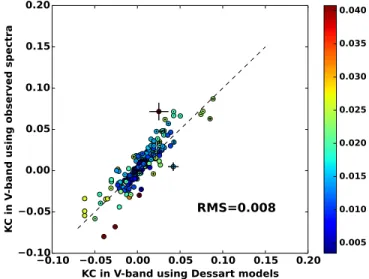
As a complementary work on the KC and to validate our method, we compare the KC values found using the Dessart et al. (2013) model to those computed from our database of observed spectra. In both cases we use exactly the same procedure. First, the observed spectrum is corrected in flux using the observed photometry(corrected for AvG)in order to match the observed magnitudes. The photometry is interpolated
to the spectral epoch. In Figure 1 we show a comparison
between the KC obtained with the theoretical models and using our library of observed spectra at different redshifts. As we can
see,the KC values calculated with both methods are very
consistent. This exercise validates the choice of using the Dessart et al.(2013)models to calculate the KC. There are two advantages to use the theoretical models. First, we can obtain the KC for NIR filters (Y, J, H) for which we do not have
Figure 1.Comparison between the KC calculated using the theoretical models
and observed spectra at different redshifts in theVband. The black dotted line represents x=y. Each square represents one observed spectrum of our database. The color bar on the right side represents the different redshifts.
17More information about this model (named m15mlt3) can be found in
observed spectra, and second, this method does not require observed spectra which are expensive to obtain in terms of telescope time, and virtually impossible to get at higher redshifts.
4. THE PHOTOMETRIC COLOR METHOD: PCM
In this section, we present our PCM with which we derive the corrected magnitudes necessary for constructing the Hubble diagram solely with photometric data. Since we want to examine Hubble diagrams from photometry obtained at different epochs, we start by linearly interpolating colors on a daily basis from colors observed at epochs around the epoch of interest. The same procedure is used to interpolate magnitudes.
4.1. Methodology
To correct and standardize the apparent magnitude, we use two photometric parameters: s2, which is the slope of the
plateau measured in theVband(Anderson et al.2014b), and a color term at a specific epoch. The color term is mainly used to take into account the dispersion caused by the hostgalaxy extinction. The magnitude is standardized using a weighted least-squares routine by minimizing the equation below:
ml1+as2 -bl1(ml2-ml3)=5 log( )cz +ZP, ( )1
wherecis the speed of light,zthe redshift,ml1,2,3the observed magnitudes with different filters, and corrected for AvG and KC, whileα,bl1, and ZP are free-fitting parameters. The errors on these parameters are derived assuming a reduced chi square equal to one. In order to obtain the errors on the standardized magnitudes, an error propagation is performed in an iterative manner. Note thatbl1is related to hostgalaxyRVif we assume
that the color–magnitude relation is due to extrinsic factors(the intrinsic color is degenerate with the ZP). We obtain:
A
the color excess. Assuming a Cardelli et al.(1989)law, there is a one-to-one relationship betweenRV andbl1. Firstwe obtain the theoreticalβfor differentRVvalues using the Cardelli et al. (1989)coefficients(aand b):
Then we deriveRVfrom the value ofβλ1determined from the
least-squaresfit(Equation(1)). We will discuss the resultingRV
values in Section6.5.
4.2. Hubble Flow Sample
We select only SNe located in the Hubble flow, i.e., with
czCMB 3000 km s−1 in order to minimize the effect of
peculiar galaxy motions. Our available sample is composed of the entire sample in the Hubbleflow except for3 SNe. We eliminate two SNe due to the fact that the warping function cannot be computed, thus the KC(SN 2004ej and SN 2008K). We also take out the outlier SN 2007X and found for this object particular characteristics like clear signs of interaction
with the circumstellar medium (flat H alpha P-Cygni
profile;see C. P. Gutiérrez et al. 2016, in preparation). SNeII are supposedly characterized by similar physical conditions(e.g., temperature)when they arrive toward the end of the plateau(Hamuy & Pinto2002), whichis why we use the end of the optically thick phase measured in the V band (as defined by Anderson et al.2014b)as the time origin in order to bring all SNe to the same timescale. When the end of the plateau is not available, we choose 80 days post-explosion, which is the average for our sample.
Given that SNeII show a significant dispersion in the plateau duration driven by different evolution speeds, we decide to take a fraction of the plateau duration and not an absolute timeto ensure that we compare SNeII at the same evolutionary phase. Thus, in the following analysis, we adopt
OPTd*X% as the time variable where OPTd is the optically
thick phase duration andXis percentage ranging between 1% and 100%.
In Figure2we present the variation with evolutionary phase
of the dispersion in the Hubble diagram using the filters
available and the (V−i)color. The lowest rms values in the optical is found for therband, and at NIR wavelength using the
Y/Jband. Note that the coverage in theYband is better than in theJband, hencehereafter we use the Y band. For these two bands we can obtain the median rms over all the epochs(from 0.2*OPTd to 1.0*OPTd) and the standard deviation. We find
for ther band 0.47±0.04 mag and for theY band
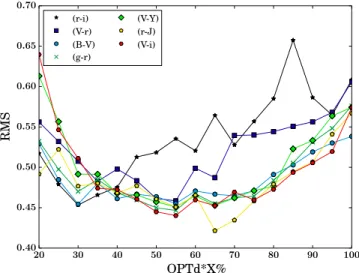
0.48±0.04 mag. In Figure3we do the same as above butwe change colors. Fixing therband and using different colors, we show the variation of the rms. Thisfigure shows that the color that minimizes the rms is (V−i) ((r−J) yields a lower dispersion but the time coverage is significantly less). Wefind a median rms over all the epochs of 0.47±0.05. For this reason we decide to combine therband and the (V−i)color for the Hubble diagram. Note also that the best epoch for therband is close to the middle of the plateau, 55% of the time from the explosion to the end of the plateau, whereas the best epoch in theY band is later in phase post-explosion, around 65%. In
Figure 2. Variation in phase of the dispersion in the Hubble diagram for
general, the best epoch to standardize the magnitude is between 60% and 70% of the OPTd for NIRfilters and for opticalfilters between 50% and 60% of OPTd. Physically these epochs correspond in both cases more or less to the middle of the plateau. Note that we tried other time origins such as the epoch of maximum magnitude instead of the end of the plateau, but changing the reference does not lower the rms.
In Figure4 we present a Hubble diagram based entirely on photometric data using s2and color term for two filters, ther
band and theYband. In therband the rms is 0.44 mag(with 38 SNe)which allows us to measure distances with an accuracy of
∼20%. We find the same precision using the Y′band with a rms of 0.43 mag (30 SNe). Note that the color term is more important for the optical filter than for the NIR filter. Indeed, for the rband the rms decreases from 0.50 to 0.44 mag when
the color term is added, whereas for the NIR filter the
improvement is only of 0.004 mag. Using all available epochs, we find a mean improvement of 0.025±0.011 in therband
and 0.014±0.013 in theY band. This shows that the
improvement is significant in the optical but less in the NIR. The drop using the opticalfilter is not surprising because this term is probably at least partly related to hostgalaxy extinction which is more prevalent in optical wavelengths than in the NIR, so adding a color term for NIR filters does not significantly influence the dispersion. Note that if we use the weighted root mean square(WRMS)as defined by Blondin et al.(2011)we
find 0.40 mag and 0.36 mag for the r band and Y band,
respectively, afters2and color corrections.
In the literature, amajority of the studies used SNeIIP for
their sample. To check if we can include all the SNeII
(fastand slowdecliners), we did some analysis of the SNe and investigate if any of the higher residuals arise from intrinsic SN properties. The overall conclusion is that, at least tofirst order,
we did not find any correlation between SNeII intrinsic
differences (s2, OPTd,K) and the Hubble residuals. This
suggests that SNe within the full range of s2 values (i.e., all
SNeII)should be includedin Hubble diagram.
Following the work of Folatelli et al.(2010)for SNeIa, we investigated the combined Hubble diagram using all the filters available (by averaging the distance moduli derived in each
filter)but the dispersion obtained is not much better. We found the same correlation between the distancemodulus residuals in one band versus those in another band, as found by Folatelli et al. (2010), suggesting that the inclusion of multiple bands does not improve the distance estimate.
If we include SNe in the Hubble flow (cz 3000 km s−1) and very nearby SNe (cz3000 km s−1) for the r band, the dispersion increases from 0.44 to 0.48 mag(46 SNe), whereas in theYband the rms increase from 0.43 mag to 0.45(41 SNe). We also try to use two different epochs, one for the magnitude and the other for the color, but againthis does not improve the rms. Finally, we try also to use the total decline rate(between maximum to the end of the plateau)instead of the plateau slope. Using the total decline rate does not lower the rms(dispersion around 0.47 mag for 45 SNe in therband)but could be useful for high redshift SNe.
5. THE STANDARD CANDLE METHOD(SCM)
The SCM as employed by various authors gives a Hubble diagram dispersion of 0.25–0.30 mag(Hamuy & Pinto 2002; Nugent et al. 2006; Poznanski et al. 2009; D’Andrea et al.
2010; Olivares et al. 2010). Here we present the Hubble
diagram using the SCM for our sample.
5.1. FeIIVelocity Measurements
To apply the SCM, we need to measure the velocity of the SN ejecta. One of the best features is FeIIλ5018 because other
iron lines such as FeIIλ5169 can be blended by other elements.
Expansion velocities are measured through the minimumflux
of the absorption component of P-Cygni line profile after
correcting the spectra for the heliocentric redshifts of the hostgalaxies. Errors were obtained by measuring many times the minimum of the absorption changing the trace of the continuum. The range of velocities is 1800–8000 km s−1for all the SNe. Because we need the velocities for different epochs in order tofind the best epoch (as done for the PCM), i.e., with less dispersion, we do an interpolation/extrapolation using a power law(Hamuy2001)of the form:
V t( )=A´tg, ( )4
where A and γ are two free parameters obtained by
least-squares minimization for each individual SN andt the epoch since explosion. In order to obtain the velocity error, we perform a Monte Carlo simulation, varying randomly each velocity measurement according to the observed velocity uncertainties over more than 2000 simulations. From this, for each epoch(from 1 to 120 days after explosion)we choose the velocity as the average value and the incertainty to the standard
deviation of the simulations. The median value of γ is
−0.55±0.25. This value is comparable with the value found by other authors (−0.5 for Olivares et al. 2010,−0.464 by Nugent et al. 2006, and −0.546 by Takáts & Vinkó 2012). Note that, as found by Faran et al.(2014a), the iron velocity for the fastdecliners (SNeIIL)also follow a power law but with more scatter. Indeed, for the slowdecliners(s21.5), wefind
a median valueγ=−0.55±0.18, whereas for the fast decli-ners(s2 1.5)we obtainγ=−0.56±0.35. More details will
be published in an upcoming paper(Gutiérrez et al.).
Figure 3.Variation in phase of the dispersion in the Hubble diagram using the
rband and different colors. In thexaxis we present the time as the OPTd*X%. The black stars represent(r−i)color, dark blue squares(V−r), blue circles
5.2. Methodology
To standardize the apparent magnitude, we perform a least-squares minimization on:
m v m m
cz
log
5000 km s
5 log ZP, 5
1
Fe
1 2 3
II
1( )
( ) ( )
a b
+ -
-= +
l ⎜⎛⎝ - ⎟⎞⎠ l l l
where c,z, andmλ1,2,3 are defined in Section 4.1and α,bl1, and ZP are free-fitting parameters. The errors on the magnitude are obtained in the same way as for the PCM but the epoch is different. For the SCM, the photospheric expansion velocity is very dependent on the explosion date. Thisis why, after trying different epochs and references, we found that the best reference is the explosion time as used in Nugent et al. (2006), Poznanski et al. (2009), and Rodríguez et al. (2014). The same epoch for the magnitude, color, andiron velocity is employed. Just like for the PCM, we use the same color, (V−i)and the samefilters(r,Yband). For some SNe, we are not able to measure an iron velocity due to the lack of spectra (only one epoch)and our sample is thus composed of 26 SNe.
5.3. Results
In Figure5we present the Hubble diagram and the residual
for two different filters. The dispersion is 0.29 mag (or
0.30–0.28 mag in WRMS for the Y band and r band,
respectively)for 24 SNe(some SNe do not have color at this epoch). These values are somewhat better than previous studies
(Hamuy & Pinto 2002; Nugent et al. 2006; Poznanski
et al.2009; D’Andrea et al.2010; Olivares et al.2010)where the authors found dispersions around 0.30 mag with 30 SNe (more details in Section 6.3). Note the major differences between our study and theirs is that they included very nearby SNe (cz3000 km s−1), only slowdeclining SNeII (SNeII with low s2, historically referred to as SNeIIP), did not
calculate a powerlaw for each SN as we do, and used a
different epoch. Note also the work done by Maguire et al. (2010), where they applyed the SCM to NIRfilters(Jband and (V−J) color) using nearby SNe (92% of their sample with
cz3000 km s−1),finding a dispersion of 0.39 mag with 12 SNe(see Section6.3). Tofinish, we tried a combination of the PCM and SCM, i.e., adding as2term to the SCM but this does
not improve the dispersion.
6. DISCUSSION
Above we demonstrate that using two terms,s2and color, we
are able to obtain a dispersion of 0.43 mag(optical bands). In this section, we try to reduce the rms by using wellobserved SNe and we compare the PCM to the SCM. We also discuss comparisons between the SCM using the CSP sample with other studies. Because the value of the rms is the crucial parameter to estimate the robustness of the method, we also discuss statistical errors. Finally, we briefly present the values
of RVderived from the color term both from PCM and SCM.
6.1. Golden Sample
A significant fraction of values from Anderson et al.(2014b)
do not correspond to the slope of the plateau but sometimes to a combination of s1 (initial decline) and s2. Indeed, for some
SNe, it was impossible to distinguish two slopes and the bestfit
was only one slope. For this reason, we decide to define a new sample composed only by 12 SNe with values ofs1ands2and
withczCMB 3000 km s−1. From this sample and using ther/
(V−i) combination, we obtain a dispersion of 0.39 mag with 12 SNe, which compares to 0.48 mag from the entire sample. From theYband, the dispersion drops considerably from 0.44 to 0.18 mag with only 8 SNe. However, this low value should be taken with caution due to possible statistical effects which are discussed later(see Section 6.4).
6.2. Method Comparisons
In Figures6and7we compare the Hubble diagram obtained using the SCM and the PCM. For both methods we use the
same SNe (Hubble flow sample)and the same set of
magnitude–color. The dispersion using the r band and the Y
band is 0.43 mag for the PCM, whereas for the SCM is 0.29. In general, the SCM is more precise than the PCM but the dispersion found with the PCM is consistent with the results found by the theoretical studies done by Kasen & Woosley Figure 5.In all thefigures, we present the dispersion(rms)using the SCM. The number of SNe(NSNe)and the epoch chosen with respect to the explosion date in days. Both plots present the Hubble diagram using the SNe in the Hubble
flow. On the top we present the Hubble diagram using therband and the color
(2009;distances accurate to∼20%)but the authors used other photometric correlations (plateau duration). Unfortunately, as suggested by Anderson et al.(2014b), using this parameter the prediction is not seen in the observations. We tried to use the OPTd values as an input instead of thes2and we did not see
any improvement on the dispersion. Note also the recent work of Faran et al.(2014b), in which the authors found a correlation between the iron velocity and the I-band total decline rate. Although in this paper we do not use the total decline rate but another quantity related to the plateau slope, our work confirms the possibility of using photometric parameters instead of spectroscopic.
6.3. SCM Comparisons
In this section we compare our SCM with other studies. First, we use only optical filters to compare with Poznanski et al. (2009) and Olivares et al. (2010). Both studies used
the (V−I) color and also the I band. Note that Olivares
et al. (2010) also used the B and V bands but here we
consider only the I band for consistency. Poznanski et al.
(2009)found a dispersion of 0.38 mag using 40 slowdecliners. In our sample, instead of using the Iband we used the sloan
filter, i band, and(V−i)color. Using our entire sample, i.e., SNe(37 SNe in total for all the redshift range), we derive a dispersion similar to Poznanski et al. (2009) of 0.32 mag (epoch: 35 days after explosion). We can also compare the parameterαderived from thefit. Again we obtain a consistent value, α=4.40±0.52, whereas Poznanski et al. (2009)
found α=4.6±0.70. The other parameters are not directly comparable due to the fact that the authors assumed an intrinsic color which is not the case in the current work. Using a Hubble constant(H0)equal to 70 km s−1Mpc−1, we can translate our
ZP to an absolute magnitude (ZP=Mcorr−5log(H0)+25)
Mi=−17.12±0.10 mag that it is lower than the results Figure 6.In all thefigures, we present the dispersion(rms), the number of SNe(NSNe), and the epoch chosen with respect to the end of the plateau(OPTd*X%)for the SCM and with respect to the explosion date for the SCM. On the bottom of each plot, the residuals are shown. In all the residual plots, the dashed line correspond to the rms. For both methods we use the Hubbleflow sample,czCMB 3000 km s−1, therband and the color(V−i). Plotted on the left is the SCM whereas in the right is for the PCM.
Figure 7.In all thefigures, we present the dispersion(rms), the number of SNe(NSNe), and the epoch chosen with respect to the end of the plateau(OPTd*X%)for the SCM and with respect to the explosion date for the SCM. On the bottom of each plot, the residuals are shown. In all the residuals plot, the dashed line correspond to the rms. For both methods we use the Hubbleflow sample,czCMB 3000 km s−
1
obtained by Poznanski et al. (2009;MI=−17.43±
0.10 mag). This difference is probably due to the fact that the corrected magnitude has not been corrected for the intrinsic color in our work.
Using 30 slowdeclining SNe in the Hubble flow and very nearby SNe (z between 0.00016 and 0.05140), (V−I) color, and the Iband, Olivares et al. (2010)derived a dispersion of 0.32 mag which is the same as whatwe obtained. However, the parameters derived by Olivares et al. (2010) are different. Indeed, using the same Equation (5)and the entire sample they obtained α=2.62±0.21, β=0.60±0.09, and ZP=
−2.23±0.07 instead of α=4.40±0.52,β=0.98±0.31, and ZP=−1.34±0.10 for us. From their ZP (H0=
70 km s−1Mpc−1) we derive MI=−18.00±0.07 mag (Mi=−17.12±0.15 mag for us). When the authors restrict
the sample to objects in the Hubble flow, they end up with
20 SNe and a dispersion of 0.30 mag. If we performthe same
cut, we find a dispersion of 0.29 for 24 SNe. We obtain
consistent dispersion for both samples using similar filters.
Note that reducing our sample to slowdecliners alone
(s21.5, the classical SNeIIP in other studies)in the Hubble
flow does not improve the dispersion. As mentioned in
Section 5.3, the difference in dispersion between Olivares et al.(2010)and our study can be due, among other things, to the difference in epoch used, or that we calculate a powerlaw for each SN for the velocity.
With respect to the NIR filters, Maguire et al. (2010)
suggested that it may be possible to reduce the scatter in the
Hubble diagram to 0.1–0.15 mag and this should then be
confirmed with a larger sample and more SNe in the Hubble
flow. The authors used 12 slowdecliners but only 1SN in the Hubble flow. Using the J band and the color (V−J), they found a dispersion of 0.39 mag against 0.50 mag using the
I band. From this drop in the NIR, the authors suggested
that using this filter and more SNe in the Hubble flow could reduce the scatter from 0.25 to 0.3 mag (optical studies) to 0.1–0.15 mag. With the same filters used by Maguire et al. (2010), and using the Hubbleflow sample, wefind a dispersion of 0.28 mag with 24 SNe. This dispersion is 0.1 mag higher than that predicted by Maguire et al. (2010;0.1–0.15 mag). To derive the fit parameters, the authors assumed an intrinsic color (V−J)0=1 mag. They obtained α=6.33±1.20 and
include all SNe at any redshift, the sample goes up to 34 SNe and the dispersion is 0.31 mag. From all SNe we derive
α=4.87±0.52 and ZP=−2.44±0.20 which corresponds to MJ=−18.21±0.20. To conclude, the Hubble diagram
derived from the CSP sample using the SCM is consistent and somewhat better with those found in the literature.
More recently, Rodríguez et al. (2014) proposed another
method to derive a Hubble diagram from SNeII. The PMM
corresponds to the generalization of the SCM, i.e., the distances are obtained using the SCM at different epochs and then averaged. Using the (V−I)colorand thefilter V, the authors found an intrinsic scatter of 0.19 mag. Given that the intrinsic dispersion used by Rodríguez et al.(2014)is a different metric than that used by us (the rms dispersion), we computed the latter from their data, obtaining 0.24 mag for 24 SNe in the
Hubbleflow. Using theVband and the(V−i)color and doing an average over several epochs,, we found a dispersion of 0.28 mag which is similar to the value found from the SCM and comparable with the value derived by Rodríguez et al.(2014).
From the Y band and (V−i) color we find an identical
dispersion of 0.29 mag.
6.4. Low Number Effects
In analyzing the Hubble diagram, thefigure of merit is the rms and the holy grail is to obtain very low dispersion in the Hubble diagram (i.e., low distance errors). In our work, we
show that in the Y band we can achieve a rms around
0.43–0.48 mag using the Hubbleflow sample(30 SNe)and the entire sample (41 SNe), whereas using the golden sample (8 SNe) we obtain a dispersion of 0.18 mag. It is important to know if this decrease in rms is due to the fact that we used wellstudied SNe within the golden sample or if it is due to the low number of SNe. For this purpose we do a test using the Monte Carlo bootstrapping method.
From our Hubbleflow sample, we remove randomly one SN
and compute the dispersion. We do that for 30,000 simulations and thefinal rms corresponds to the median, and the errors to the standard deviation. Then after removing 1SN, we remove randomly 2SNe and again estimate the rms and the dispersion over 30,000 simulations. We repeat this process until we have only fourSNe, i.e., we remove from one SN to(size available sample—fourSNe). For each simulation, we compute a new model, i.e., newfit parameters(α,β, and ZP).
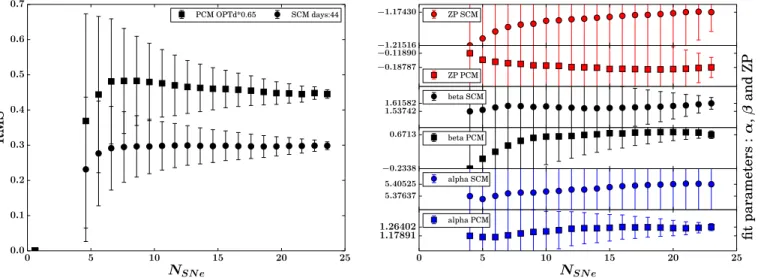
From this test we conclude that when the number of SNe is lower than 10–12 SNe the rms is very uncertain because the parameters(i.e.,α,β, and ZP)start diverging(see the Appen-dix). This implies that the rms is driven by the reduced number of objects so it is difficult to conclude if the model for the golden sample is better because the rms is smaller or because it is due to a statistical effect.
6.5. Low RV
As stated in Section4.1, thebl1color term is related to the total-to-selective extinction ratio if the color–magnitude relation is due to extrinsic factors (dust). In the literature, for the MW,RVis known to vary from one line of sight to another,
from values as low as 2.1(Welty & Fowler1992)to values as large as 5.6–5.8 (Cardelli et al. 1989; Fitzpatrick 1999; Draine 2003). In general for the MW, a value of 3.1 is used which corresponds to an average of the Galactic extinction curve for diffuse interstellar medium. Using the minimization of the Hubble diagram with a color term, in the past decade the SNeIa community has derived lower RVfor hostgalaxy dust
than for the MW. Indeed, they foundRVbetween 1.5 and 2.5 (Krisciunas et al.2007; Elias-Rosa et al.2008; Goobar 2008; Folatelli et al. 2010; Phillips et al. 2013; Burns et al. 2014).
This trend was also seen more recently using SNeII
(Poznanski et al. 2009; Olivares et al. 2010; Rodríguez
et al.2014). This could be due to unmodeled effects such as a dispersion in the intrinsic colors(e.g., Scolnic et al.2014).
We follow previous work in using the minimization of the Hubble diagram to obtain constraints on RV for hostgalaxy
dust. Using the PCM, the Hubbleflow sample, and therband, wefindβrclose to 0.98. Using a Cardelli et al.(1989)law, we
procedure but using the SCM, we also derive low RVvalues,
but consistent with those derived using the PCM.
At first sight, our analysis would suggest a significantly different nature of dust in our Galaxy and other spiral galaxies, as previously seen in the analysis of SNeIa and SNeII.
However, we caution that the low RV values could reflect
instead intrinsic magnitude–color for SNeII not properly modeled. To derive theRV(or pseudoRV)values, we assume
that all the SNeII have the same intrinsic colors and same intrinsic color–luminosity relation;however,theoretical mod-els with different masses andmetallicityshow different intrinsic colors(Dessart et al.2013). Disentangling both effects would require to know the intrinsic colors of our SN sample. Indeed, with intrinsic color–luminosity corrections thebl1color term could change and thus we will be able to derive an accurateRV. In a forthcoming paper, we will address this issue through different dereddening techniques(T. de Jaeger 2016, in preparation)that we are currently investigating.
7. CONCLUSIONS
Using 38 SNeII in the Hubbleflow, we develop a technique
based solely on photometric data (PCM) to build a Hubble
diagram based on SNeII. In summary:
1. Using PCM wefind a dispersion of 0.44 mag using ther
band and 0.43 mag with theYband, thus using NIRfilters the improvement is not so significant for the PCM. 2. The s2 plays a useful role, allowing us to reduce the
dispersion from 0.58 to 0.50 mag for therband. 3. The color term does not have so much influence on the
NIR filters because it is related to the hostgalaxy extinction.
4. We find very low (β) values (the color–magnitude coefficient). Ifβ is purely extrinsic, it implies very low
RVvalues.
5. The Hubble diagram derived from the CSP sample using the SCM yields to a dispersion of 0.29 mag, somewhat better than those found in the literature and emphasizing the potential of SCM in cosmology.
It is also interestingto obtain more data and SNe for which the initial decline rate and the plateau are clearly visible to try to reduce this dispersion. The PCM is very promising, and more efforts must be done in this direction, i.e., trying to use only photometric parameters. In the coming era of large photometric wide-field surveys like LSST, having spectroscopy for every SNe will be impossible hence the PCM which is the
first purely photometric method could be very useful.
We thank the referee for athrough reading of the manu-script, which helped clarify and improve the paper. Support for T.D., S.G., L.G., M.H., C.G., F.O., and H.K.is provided by the
Ministry of Economy, Development, and Tourismʼs
Millen-nium Science Initiative through grant IC120009, awarded to The Millennium Institute of Astrophysics, MAS. S.G., L.G., H.K., and F.O. also acknowledge support by CONICYT through FONDECYT grants 3130680, 3140566, 3140563, and 3140326, respectively. The work of the CSP has been supported by the National Science Foundation under grants AST0306969, AST0607438, and AST1008343. M.D.S., C.C., and E.H. gratefully acknowledge generous support provided by the Danish Agency for Science and Technology and Innovation realized through a Sapere Aude Level 2 grant. The authors thank F. Salgado for his work done with the CSP. This research
has made use of the NASA/IPAC Extragalactic Database
(NED) which is operated by the Jet Propulsion Laboratory, California Institute of Technology, under contract with the National Aeronautics and Space Administration and of data provided by the Central Bureau for Astronomical Telegrams.
APPENDIX
Figure8 (left) presents the evolution of the rms versus the
number of SNe for both methods(PCM and SCM)using theY
band. For both methods, after a constant median value the rms
decreases when the number of SNe is lower than 10–12 SNe
because the model starts diverging. Indeed, if we look at the Figure8on the right where the evolution of thefit parameters versus the number of SNe for one single epoch(OPTD*0.55) and theYband are presented, we see that for the PCM, α,β,
Figure 8.Left panel: we present the evolution of the rms vs. the number of SNe for one single epoch, OPTD*0.65 for the PCM and 65 days post-explosion for the
and ZP change significantly when the number of SNe is around 12. The values start diverging for a number of SNe smaller than 12, so this implies that the rms is driven by the reduced number of objects and therefore it will be difficult to conclude between the fact thatβand ZP are better because we have a better rms or because it is due to a statistical effect. Note that thefigure does not present directly the value of thefit parameters but a fraction of the value, i.e., the value divided by the first value plus an offset corresponding to thefirst value.
REFERENCES
Anderson, J. P., Dessart, L., Gutierrez, C. P., et al. 2014a,MNRAS,441, 671
Anderson, J. P., González-Gaitán, S., Hamuy, M., et al. 2014b,ApJ,786, 67
Arcavi, I., Gal-Yam, A., Cenko, S. B., et al. 2012,ApJL,756, L30
Barbon, R., Ciatti, F., & Rosino, L. 1979, A&A,72, 287
Baron, E., Nugent, P. E., Branch, D., & Hauschildt, P. H. 2004, ApJL,
616, L91
Benedict, G. F., McArthur, B. E., Feast, M. W., et al. 2007,AJ,133, 1810
Bennett, C. L., Hill, R. S., Hinshaw, G., et al. 2003,ApJS,148, 1
Bersten, M. C., Benvenuto, O. G., Folatelli, G., et al. 2014,AJ,148, 68
Bessell, M., & Murphy, S. 2012,PASP,124, 140
Betoule, M., Kessler, R., Guy, J., et al. 2014,A&A,568, A22
Blake, C., & Glazebrook, K. 2003,ApJ,594, 665
Blondin, S., Mandel, K. S., & Kirshner, R. P. 2011,A&A,526, A81
Burns, C. R., Stritzinger, M., Phillips, M. M., et al. 2014,ApJ,789, 32
Cardelli, J. A., Clayton, G. C., & Mathis, J. S. 1989,ApJ,345, 245
Chevalier, R. A. 1976,ApJ,207, 872
Chevalier, R. A. 1981,ApJ,251, 259
Chugai, N. N., & Danziger, I. J. 1994,MNRAS,268, 173
Contreras, C., Hamuy, M., Phillips, M. M., et al. 2010,AJ,139, 519
D’Andrea, C. B., Sako, M., Dilday, B., et al. 2010,ApJ,708, 661
de Jaeger, T., Anderson, J. P., Pignata, G., et al. 2015,ApJ,807, 63
Dessart, L., Blondin, S., Brown, P. J., et al. 2008,ApJ,675, 644
Dessart, L., & Hillier, D. J. 2005,A&A,439, 671
Dessart, L., & Hillier, D. J. 2006,A&A,447, 691
Dessart, L., Hillier, D. J., Livne, E., et al. 2011,MNRAS,414, 2985
Dessart, L., Hillier, D. J., Waldman, R., & Livne, E. 2013,MNRAS,433, 1745
Draine, B. T. 2003,ARA&A,41, 241
Eastman, R. G., Schmidt, B. P., & Kirshner, R. 1996,ApJ,466, 911
Elias-Rosa, N., Benetti, S., Turatto, M., et al. 2008,MNRAS,384, 107
Elias-Rosa, N., Van Dyk, S. D., Li, W., et al. 2010,ApJL,714, L254
Elias-Rosa, N., Van Dyk, S. D., Li, W., et al. 2011,ApJ,742, 6
Emilio Enriquez, J., Leonard, D. C., Poznanski, D., et al. 2011, BAAS,43, 33721
Falk, S. W., & Arnett, W. D. 1977,ApJS,33, 515
Faran, T., Poznanski, D., Filippenko, A. V., et al. 2014a,MNRAS,445, 554
Faran, T., Poznanski, D., Filippenko, A. V., et al. 2014b,MNRAS,442, 844
Filippenko, A. V. 1997,ARA&A,35, 309
Filippenko, A. V., Matheson, T., & Ho, L. C. 1993,ApJL,415, L103
Fitzpatrick, E. L. 1999,PASP,111, 63
Fixsen, D. J., Cheng, E. S., Gales, J. M., et al. 1996,ApJ,473, 576
Folatelli, G., Morrell, N., Phillips, M. M., et al. 2013,ApJ,773, 53
Folatelli, G., Phillips, M. M., Burns, C. R., et al. 2010,AJ,139, 120
Fransson, C. 1982, A&A,111, 140
Goobar, A. 2008,ApJL,686, L103
Grassberg, E. K., Imshennik, V. S., & Nadyozhin, D. K. 1971,Ap&SS,10, 28
Gutiérrez, C. P., Anderson, J. P., Hamuy, M., et al. 2014,ApJL,786, L15
Hamuy, M., Folatelli, G., Morrell, N. I., et al. 2006,PASP,118, 2
Hamuy, M., Phillips, M. M., Suntzeff, N. B., et al. 1996,AJ,112, 2391
Hamuy, M., & Pinto, P. A. 2002,ApJL,566, L63
Hamuy, M., Pinto, P. A., Maza, J., et al. 2001,ApJ,558, 615
Hamuy, M. A. 2001, PhD thesis, Univ. Arizona
Hsiao, E. Y., Conley, A., Howell, D. A., et al. 2007,ApJ,663, 1187
Ivezic, Z., Tyson, J. A., Axelrod, T., et al. 2009, BAAS, 41, 46003 Jaffe, A. H., Ade, P. A., Balbi, A., et al. 2001,PhRvL,86, 3475
Jones, M. I., Hamuy, M., Lira, P., et al. 2009,ApJ,696, 1176
Kankare, E., Ergon, M., Bufano, F., et al. 2012,MNRAS,424, 855
Kasen, D., & Woosley, S. E. 2009,ApJ,703, 2205
Kirshner, R. P., & Kwan, J. 1974,ApJ,193, 27
Krisciunas, K., Garnavich, P. M., Stanishev, V., et al. 2007,AJ,133, 58
Kuncarayakti, H., Maeda, K., Bersten, M. C., et al. 2015,A&A,579, 95
Landolt, A. U. 1992,AJ,104, 340
Leavitt, H. S. 1908, AnHar,60, 87
Leonard, D. C., Kanbur, S. M., Ngeow, C. C., & Tanvir, N. R. 2003,ApJ,
594, 247
Li, W., Leaman, J., Chornock, R., et al. 2011,MNRAS,412, 1441
Lien, A. Y., Fields, B. D., Beacom, J. F., Chakraborty, N., & Kemball, A. 2011, BAAS,43, 33728
Maguire, K., Kotak, R., Smartt, S. J., et al. 2010,MNRAS,403, L11
Massey, P., Morrell, N. I., Neugent, K. F., et al. 2012,ApJ,748, 96
Minkowski, R. 1941,PASP,53, 224
Nugent, P., Sullivan, M., Ellis, R., et al. 2006,ApJ,645, 841
Olivares, F., Hamuy, M., Pignata, G., et al. 2010,ApJ,715, 833
Perlmutter, S., Aldering, G., Goldhaber, G., et al. 1999,ApJ,517, 565
Persson, S. E., Madore, B. F., Krzemiński, W., et al. 2004,AJ,128, 2239
Phillips, M. M. 1993,ApJL,413, L105
Phillips, M. M., Simon, J. D., Morrell, N., et al. 2013,ApJ,779, 38
Planck Collaboration Ade, P. A. R., Aghanim, N., et al. 2014, A&A,
571, 16
Popov, D. V. 1993,ApJ,414, 712
Poznanski, D., Butler, N., Filippenko, A. V., et al. 2009,ApJ,694, 1067
Richardson, D., Branch, D., Casebeer, D., et al. 2002,AJ,123, 745
Riess, A. G., Filippenko, A. V., Challis, P., et al. 1998,AJ,116, 1009
Riess, A. G., Macri, L., Casertano, S., et al. 2011,ApJ,730, 119
Riess, A. G., Press, W. H., & Kirshner, R. P. 1996,ApJ,473, 88
Rodríguez, Ó., Clocchiatti, A., & Hamuy, M. 2014,AJ,148, 107
Sanders, N. E., Soderberg, A. M., Gezari, S., et al. 2015,ApJ,799, 208
Schlafly, E. F., & Finkbeiner, D. P. 2011,ApJ,737, 103
Schlegel, E. M. 1990, MNRAS,244, 269
Schmidt, B. P., Kirshner, R. P., Eastman, R. G., et al. 1994,ApJ,432, 42
Schmidt, B. P., Suntzeff, N. B., Phillips, M. M., et al. 1998,ApJ,507, 46
Scolnic, D., Rest, A., Riess, A., et al. 2014,ApJ,795, 45
Seo, H.-J., & Eisenstein, D. J. 2003,ApJ,598, 720
Smartt, S. J. 2009,ARA&A,47, 63
Taddia, F., Stritzinger, M. D., Sollerman, J., et al. 2012,A&A,537, A140
Takáts, K., & Vinkó, J. 2012,MNRAS,419, 2783
Taylor, M., Cinabro, D., Dilday, B., et al. 2014,ApJ,792, 135