
Evaluating the effects of housing interventions on multidimensional poverty : the case of TECHO Argentina
34
0
0
Texto completo
(2) Mitchell and Macció. Evaluating the Effects of Housing Interventions. Acknowledgements The authors are grateful to María Emma Santos for her suggestions and guidance throughout the process of developing this paper. We also thank Edoardo Masset, Ana Vaz, Bilal Malaeb, Sabina Alkire, Andy Mckay, Nicolai Suppa and other participants at the OPHI Multidimensional Impact Evaluation Workshop, as well as an anonymous reviewer, for their valuable comments. Citation: Mitchell, A. and Macció, J. (2018). ‘Evaluating the effects of housing interventions on multidimensional poverty: the case of TECHO-Argentina’, OPHI Working Paper 120, University of Oxford.. The Oxford Poverty and Human Development Initiative (OPHI) is a research centre within the Oxford Department of International Development, Queen Elizabeth House, at the University of Oxford. Led by Sabina Alkire, OPHI aspires to build and advance a more systematic methodological and economic framework for reducing multidimensional poverty, grounded in people’s experiences and values. The copyright holder of this publication is Oxford Poverty and Human Development Initiative (OPHI). This publication will be published on OPHI website and will be archived in Oxford University Research Archive (ORA) as a Green Open Access publication. The author may submit this paper to other journals. This publication is copyright, however it may be reproduced without fee for teaching or non-profit purposes, but not for resale. Formal permission is required for all such uses, and will normally be granted immediately. For copying in any other circumstances, or for re-use in other publications, or for translation or adaptation, prior written permission must be obtained from OPHI and may be subject to a fee. Oxford Poverty & Human Development Initiative (OPHI) Oxford Department of International Development Queen Elizabeth House (QEH), University of Oxford 3 Mansfield Road, Oxford OX1 3TB, UK Tel. +44 (0)1865 271915 Fax +44 (0)1865 281801 [email protected] http://www.ophi.org.uk The views expressed in this publication are those of the author(s). Publication does not imply endorsement by OPHI or the University of Oxford, nor by the sponsors, of any of the views expressed..
(3) Mitchell and Macció. Evaluating the Effects of Housing Interventions. 1. Introduction The right to adequate housing is a basic human right. 1 The United Nations asserts that for shelter to be adequate it must satisfy the following conditions: 1) security of tenure; 2) availability of basic services and infrastructure; 3) affordability; 4) habitability; 5) accessibility; 6) located in proximity to schools, work and other facilities and 7) respect the expression of cultural identity (UNOHCHR, 2009). The condition of habitability requires housing to guarantee physical safety, adequate space, and protection from cold, heat, rain, wind and other threats to health and structural hazards (UNOHCHR, 2009). The right to housing is also interrelated with other human rights such as the right to work, health and education. The New Urban Agenda adopted in 2016 in Habitat III2 stresses the need for governments to put ‘housing at the centre’ of urban development planning. This new focus represents an important shift from the ‘enabling shelter strategy’ introduced in 1988 and later elaborated on in the Istanbul Declaration and Habitat Agenda, which proposed a market-led approach in which governments facilitate or motivate the deployment of resources for housing production by all actors—public, private, civil society and the people themselves (UN-Habitat, 2016). The change in focus was motivated by the recognition that market-led policies have failed to provide adequate, affordable housing to low-income families (UN-Habitat, 2016) and to reduce the number of people living in urban slums (UNDP, 2015). Target 11.1 of the Sustainable Development Goals—to ensure access for all to adequate, safe and affordable housing and basic services, and upgrade slums by 2030—is in line with this new commitment to improving living conditions in urban slums (United Nations Sustainable Development Solutions Network, 2018). While the percentage of the global urban population living in slums declined from 46% to 30% between 1990 and 2014, the absolute number increased to 880 million, compared with 689 million in 1990 (UNHabitat, 2016:14). The estimated urban slum population is 563 million in Asia, 212 million in Africa and 104 million in Latin America (UN-Habitat, 2016:58). Urban slums are characterized by insecure tenancy, inadequate provision of public services, and poor quality and overcrowded dwellings. Moreover, 980 million urban households live in an inadequate dwelling (UN-Habitat, 2016). In the context of an inadequate supply of affordable urban housing and mortgage credit, low-income families construct their own housing on unoccupied lands (Rojas, 2016). According to some accounts,. 1 The 1948 UN Declaration of Human Rights recognized adequate housing as part of the right to an adequate standard of living. This right was confirmed in the 1966 International Covenant on Economic Social and Cultural Rights. 2 Habitat III was the United Nation’s Conference on Housing and Sustainable Urban Development which took place in Quito, Ecuador, October 17–20, 2016. Link. OPHI Working Paper 120. 1. www.ophi.org.uk.
(4) Mitchell and Macció. Evaluating the Effects of Housing Interventions. more than half of all housing in the Global South can be classified as socially produced, that is, constructed by the future residents alone or with the help of non-profit organizations (Ortiz Flores, 2011). Civil society is a central component of this collective and organized form of urban development. Social movements, cooperatives and self-help organizations coordinate land occupations, collectively produce housing, introduce neighbourhood improvements and provide public service connections (Ortiz, 2011; Wagner, 2011). Non-governmental organizations support these grassroots efforts through programmes to upgrade housing, facilitate credit, broaden access to public services and advocate for public sector actions to improve habitat. TECHO is one of the NGOs working to improve living conditions in urban slums in Latin America that has the broadest geographical scope. The objective of the paper is to evaluate the effect of TECHO’s emergency housing programme on multidimensional poverty. It employs a quasi-experimental ‘pipeline’ evaluation design and is based on household survey data collected in 34 informal settlements in Buenos Aires, Argentina. The paper seeks to broaden the literature on the impact of TECHO’s housing programme (Simonelli et al., 2013; Galiani et al., 2016; Mitchell, Macció and Mariño Fages, 2016) by measuring its effects on multidimensional poverty using the method proposed by Alkire and Foster (2011). There is an expanding body of literature on the effectiveness of providing emergency housing on-site in informal settlements. The evaluation carried out by Galiani et al. (2016) in Mexico, El Salvador and Uruguay, which used an experimental evaluation design, found that a TECHO house produced an increase in subjective measures of quality of life and satisfaction with housing and a reduction in the incidence of diarrhoea in children (in Mexico and El Salvador), but had no effect on the possession of durable goods, complementary housing investments, the incidence of robbery, fertility, income or labour market outcomes. Simonelli et al. (2013) carried out a smaller scale evaluation of TECHO’s programme in Argentina, which focussed on the effects of emergency housing on sleep. Based on a before-after methodology, the authors concluded that the programme was associated with reductions in levels of stress and dissatisfaction with housing and improvements in sleep quality and perception of quality of life. Mitchell, Macció and Mariño Fages (2016) show that the TECHO programme in Buenos Aires had a positive effect on privacy, security, interpersonal relations, psychological health and perception of quality of life, and also increased the percentage of families with school-age children that have a tranquil place to study. Another relevant evaluation of emergency housing is Loschman et al. (2015), which studied the effects of emergency shelters provided to refugees returning to Afghanistan. The contribution of this paper is to demonstrate that when evaluating interventions that affect multiple wellbeing dimensions, additional insights can be gained from applying a multidimensional framework instead of measuring the effects on individual outcome variables. First, it enables one to obtain a summary OPHI Working Paper 120. 2. www.ophi.org.uk.
(5) Mitchell and Macció. Evaluating the Effects of Housing Interventions. measure of the overall effect of the programme on deprivation. Consolidated outcome measures are increasingly used in the impact evaluation literature as a means for resolving the increased probability of type 1 error (a false positive finding) when carrying out multiple hypothesis tests (Anderson, 2008). The Alkire and Foster (2011) method provides a framework for constructing a summary outcome measure based on normative criteria as opposed to purely empirical methods. Second, the method enables one to analyse programme effects on the incidence of multidimensional poverty, the intensity of deprivation experienced by the multidimensionally poor and on a distribution-sensitive measure of poverty incidence. This allows one to analyse the extent to which the policy enables households to escape multidimensional poverty or reduces the intensity of deprivation for those that continue to be multidimensionally poor. Third, the method offers a method for examining the heterogeneity of the effects on households with different levels of initial deprivation. Fourth, as the Alkire-Foster measures are decomposable by indicator, this property can be used to analyse which types of deprivation contribute most to poverty before and after treatment. The paper is structured as follows. Section two describes TECHO’s emergency housing programme. Section three explains the Alkire-Foster method. Section four outlines the evaluation design, data sources and the empirical strategy used to evaluate the programme’s effects on multidimensional poverty. Section four presents the empirical results. The paper concludes with a summary of the main findings and discusses the benefits and limitations of the analysis.. 2. TECHO´s emergency housing programme TECHO, created in 1997 by a group of young people in Chile, today works in 19 Latin American and Caribbean countries. The organization’s stated goal is to fight poverty by working with the residents of informal settlements to improve habitat and foster community development. Using a participatory process, TECHO’s small staff and abundant supply of volunteers work with communities to identify needs and then develop programmes that respond to those needs, including emergency housing, education, employment, youth and microfinance programmes. TECHO’s emergency housing programme provides a basic 18-square-meter dwelling to families that live in informal settlements and experience a severe deficit in the size and quality of housing. The emergency house is made of prefabricated wood panels, has an insulated tin roof and rests on 15 pilings that elevate the dwelling from ground humidity and flooding. The programme does not provide water, sanitation or electrical connections. The cost of materials for each unit is approximately US$1,000.. OPHI Working Paper 120. 3. www.ophi.org.uk.
(6) Mitchell and Macció. Evaluating the Effects of Housing Interventions. Groups of four to eight volunteers construct the emergency dwelling, together with the future residents, on the plot of land where the household resides. This enables the family to continue living in the same neighbourhood and avoids the severing of social and community ties, but also means that when the size of the land parcel is small, the construction of the new dwelling can exacerbate overcrowding. In some cases, the original dwelling must be dismantled in order to make space for the new construction. As the household remains in the same neighbourhood, the programme does not address or improve any of the other common problems in informal settlements, such as insecure tenancy, lack of basic infrastructure or environmental hazards. This characteristic of the TECHO programme appears to be unique. In fact, we have not identified any other NGO programme that provides a new dwelling but does not facilitate access to water and sanitation. TECHO-Argentina’s participant selection process consists of first conducting, in each neighbourhood, a detection survey that collects information on the sociodemographic characteristics of the members, economic situation of the household, access to public services and characteristics of the dwelling. This information is then used to classify households according to the level of need. Households considered to have high and medium-high need are eligible to participate in the programme. Before construction the households must sign a contract in which they agree to pay around 10% of the cost of the materials, attend preconstruction neighbourhood meetings and clear and prepare the plot of land.. 3. Alkire-Foster method The Alkire-Foster method provides a framework for measuring poverty based on a counting approach that assesses the number of deprivations that people experience in multiple dimensions of life. It is composed of identification and aggregation stages. In the identification stage, it is first necessary to select the dimensions of analysis and one or more indicators within each dimension. For each indicator one must choose a deprivation cut-off, which expresses the minimum level of achievement necessary to be non-deprived, and a relative weight, such that the sum of the indicator weights equals one. These criteria are used to calculate for each household (or person) the weighted share of deprivations, or deprivation score ci. Then it is necessary to set a second threshold, the poverty cut-off or k, which is the proportion of weighted deprivations that a household must experience in order to be considered multidimensionally poor. If a household has a deprivation score greater than or equal to the poverty cut-off (ci ≥ k), it is considered to be multidimensionally poor. Once the identification stage is complete, one can define a deprivation score vector, c = [c i], in which ci is the deprivation score of individual i. Additionally, one can construct a censored deprivation score vector c(k) = [ci(k)], in which ci(k) = ci if the person is multidimensionally poor (c i ≥ k) and ci(k) = 0 otherwise. OPHI Working Paper 120. 4. www.ophi.org.uk.
(7) Mitchell and Macció. Evaluating the Effects of Housing Interventions. The aggregation stage of the Alkire-Foster method is based on the extension of the Foster-GreerThorbecke family of unidimensional poverty measures (Foster, Greer and Thorbecke, 1984) to the case of multiple deprivations. Three multidimensional poverty measures are employed in this paper. 3 The multidimensional headcount ratio or H represents the proportion of households identified as multidimensionally poor, according to the parameter k or 𝐻=. 𝑞(𝑘) , 𝑛. (1). where q(k) is the number of multidimensionally poor people (or households) and n is the total number of people. The intensity of multidimensional poverty or A is defined as the average share of weighted indicators in which poor households are deprived, written as 𝑞. 𝐴= ∑ 𝑖=1. 𝑐𝑖 (𝑘) . 𝑞(𝑘). (2). This measure captures the breadth of deprivations experienced by multidimensionally poor households. The score is censored because it ignores the deprivations experienced by households that are not multidimensionally poor. The adjusted headcount measure or M0 is calculated as the product of H and A: 𝑞. 𝑛. 𝑞1 1 𝑀0 = 𝐻𝐴 = ∑ 𝑐𝑖 (𝑘) = ∑ 𝑐𝑖 (𝑘) . 𝑛𝑞 𝑛 𝑖=1. (3). 𝑖=1. M0 measures the sum of the weighted deprivations experienced by poor households, divided by the maximum number of deprivations that could be experienced by all households if all households were poor and deprived in all dimensions. M0 increases either when an additional household becomes multidimensionally poor or any poor household becomes deprived in another dimension. 4. 4. Methodology 4.1 Evaluation design and data The evaluation employs a quasi-experimental pipeline design (White and Barbu, 2006) based on the ex post comparison of treatment group households with a control group composed of households that had been selected for the programme but had not yet received the treatment. This evaluation design was chosen. 3 The other measures within the family of Alkire-Foster measures, M1 and M2, cannot be computed because all the indicators included in our measure are dichotomous. 4 M0 satisfies both the poverty focus and the deprivation focus axioms: the measure of poverty does not change when there is a change in any achievement of a non-poor person, and it is sensitive to the amount of deprivations of the poor (Alkire et al., 2015). OPHI Working Paper 120. 5. www.ophi.org.uk.
(8) Mitchell and Macció. Evaluating the Effects of Housing Interventions. because TECHO-Argentina did not want to alter in any way its housing programme’s processes or delay the provision of a dwelling to households that satisfied the eligibility requirements and for whom resources were available. These conditions ruled out the possibility of using either an experimental design or the difference-in-difference methodology. The treatment group contains the participant households that received the TECHO house during the first half of 2014, and the control group contains the households that received the house in the first half of 2015. The same participant selection process, described in section 2, was applied in each year. In both years all of the selected households chose to participate in the programme and signed a contract in which they agreed to pay approximately 10% of the cost of the materials, attend preconstruction meetings and prepare their plot of land prior to construction. 5 Both the treatment and control group baseline surveys were conducted between one and four weeks before construction of the TECHO house and at the time of the baseline survey the household members already knew that they had been selected to participate in the programme.6 The treatment group follow-up survey was carried out during the first half of 2015, approximately one year after each household had received the TECHO house.7 The cases were selected from the 34 informal settlements in the Province of Buenos Aires, Argentina, in which TECHO carried out its emergency housing programme during 2014–15. The sample includes settlements in the northern, western and southern zones of Greater Buenos Aires and in Greater La Plata but does not include informal settlements in the City of Buenos Aires. A total of 17 neighbourhoods provided both treatment and control cases, 5 provided only treatment cases and 12 provided only control cases.8 All of the settlements satisfy TECHO’s operational definition of informal settlement: neighbourhoods with at least eight families in which at least half of the households do not have a formal land title nor formal access to at least two basic services (water, sanitation and electricity) (TECHO, 2013). Although the majority of the neighbourhoods included in the study have access to the electrical network, most families have an illegal connection. Fifteen of the 34 neighbourhoods are connected to the public. 5 A small number of households did not receive the dwelling because they did not comply with contract’s conditions. 6 The sample size of the treatment group baseline survey was 334 and the size of the follow-up survey was 293. Of the 41 households lost to attrition, 18 sold the TECHO house and left the neighbourhood, 20 moved from the neighbourhood taking the TECHO house with them and 1 house burned down. Robustness tests presented in Mitchell, Macció and Mariño Fages (2016) indicate that attrition likely had a small effect on the evaluation results. 7 In a previous paper (Mitchell, Macció and Mariño Fages, 2016), we present estimates of the before-after difference for the treatment group. Although these estimates do not measure the programme’s causal effects, they serve as descriptive measures of what happened to the treatment group. 8Mitchell, Macció and Mariño Fages (2016) show that when the impact estimates were re-estimated based only on the cases from the 17 neighbourhoods from which both treatment and control group households were drawn, the results were virtually unchanged in terms of both statistical and economic significance. OPHI Working Paper 120. 6. www.ophi.org.uk.
(9) Mitchell and Macció. Evaluating the Effects of Housing Interventions. water system (with irregular connections in all but three cases) and in the rest of the neighbourhoods the households depend on well water. The most common form of sewage disposal is cesspit. Table 1: Pre-treatment characteristics of the treatment and control groups. Characteristics Number of nuclear family units Respondent and spouse in household Share of members under age 5 Share of members ages 6 to 17 Pregnant woman in household Respondent's age Respondent is male Respondent is a foreigner Respondent is from another province Respondent completed only primary school Respondent has some secondary school Respondent completed secondary school Respondent works Respondent's spouse works Number of other family members who work Income per capita (4th-Q 2014 pesos) At least one member has asthma n. Control Stnd. Mean Dev. 1.38 0.60 0.75 0.44 0.27 0.19 0.24 0.21 0.14 0.34 32.99 12.47 0.17 0.38 0.04 0.20 0.19 0.40 0.22 0.41 0.37 0.48 0.13 0.34 0.44 0.50 0.63 0.48 0.50 0.89 1,000 700 0.22 0.42 304. Treatment Stnd. Mean Dev. 1.37 0.61 0.70 0.46 0.26 0.19 0.26 0.21 0.15 0.35 34.26 13.22 0.16 0.37 0.06 0.23 0.19 0.39 0.26 0.44 0.36 0.48 0.11 0.32 0.47 0.50 0.59 0.49 0.49 0.84 1,019 873 0.22 0.42 246. Normalized t-stat difference 0.25 1.34 0.14 -1.11 -0.36 -1.25 0.22 -0.88 0.07 -1.10 0.12 0.70 -0.62 1.06 0.22 -0.31 -0.01. -0.02 -0.11 -0.01 0.09 0.03 0.10 -0.02 0.07 -0.01 0.09 -0.01 -0.06 0.05 -0.08 -0.02 0.02 0.00. Note: Data from TECHO Housing survey, 2014-15.. The household survey collected data on sociodemographic characteristics; income; the size, quality and use of the house; physical and psychological health; sleep; security; social relations and perception of wellbeing. The survey respondent was the person who spent the most time in the home and was usually the mother of the principal family unit. The survey also collected, through the use of a sketch, information on the location of the house on the land parcel, the location and use of each room, and the location of each bed and which family members sleep in them. As both the treatment and the control groups were selected for participation in the programme using the same processes, one would expect them to be highly similar. Table 1 compares 17 pre-treatment characteristics of the treatment and control groups. The tests of differences in means indicate that there is not a statistically significant difference between groups for any of the variables considered. Furthermore, the value of the normalized difference tends to be quite low, providing further evidence of the similarity between the treatment and control groups (see Imbens, 2015).. OPHI Working Paper 120. 7. www.ophi.org.uk.
(10) Mitchell and Macció. Evaluating the Effects of Housing Interventions. We use the following regression equation to estimate the average effect of treatment on the treated for outcomes of interest, Yi:9 10 𝑌𝑖 = 𝛼+ 𝛽𝑋𝑖 + 𝛿𝑇𝑖 + 𝜀𝑖 ,. (4). where Ti is an indicator of treatment, Xi is a set of observed household characteristics and εi is an error term reflecting unobserved characteristics that also affect Y i. The set of observed household characteristics correspond to the variables presented in Table 1 as well as to neighbourhood dummy variables. All of the control variables are based on pre-treatment data for both the control and treatment groups. Robust standard errors with neighbourhood clustering are used for all of the regression models. 4.2 Multidimensional impact evaluation strategy We use the Alkire-Foster method to construct a multidimensional poverty index with dimensions related to the built environment. The dimensions, indicators and weights chosen for our measure are presented in Table 2. The unit of analysis is the household. For the construction of the Alkire-Foster measure we chose to maintain the same dimensions of analysis as were used in previous work (Mitchell, Macció and Mariño Fages, 2016).11 The chosen dimensions are physical health, psychological health, sleep, privacy, interpersonal relations and security. These dimensions were selected based on TECHO’s experience working with households living in informal settlements and a review of the literature. An effort was made to include indicators that correspond to individual (or household) functionings—what people can be or do—rather than income or other means for achieving wellbeing. The first two dimensions of analysis—physical and psychological health—are those for which there has been the greatest amount of research with respect to their relationship to housing. The health literature has tended to focus on the pathological effects of some aspect of housing, such as poor ventilation,. 9 See Angrist and Pischke (2009) for an explanation of why an ordinary least squares regression model is appropriate for measuring average treatment effects on binary outcome variables. 10 Mitchell, Macció and Mariño Fages (2016) employ two different strategies for measuring impact (a before-after comparison and an ex post treatment-control comparison). The study also uses both regression analysis and the propensity score matching technique and presents the results of the following robustness tests: non-random attrition, neighbourhood differences, the division of the household or change in the respondent between the baseline and follow-up surveys, seasonal differences in the time of the survey, alternative matching procedures, use of contemporaneous regression controls instead of pretreatment values and a falsification test in which treatment group post-treatment outcomes were replaced with the values from the baseline survey. 11 The only dimension that was included in Mitchell, Macció and Mariño Fages (2016) but left out here is ‘activities in the dwelling’, which had two indicators: ‘dwelling has a tranquil place for children to study’ and ‘at least one member practices a trade or handicraft in the dwelling’. We decided to exclude the first indicator from the Alkire-Foster measure because there were no survey responses for households without school-age children and the second indicator because factor analysis showed an inverse relationship between that variable and the rest of the deprivation measures. OPHI Working Paper 120. 8. www.ophi.org.uk.
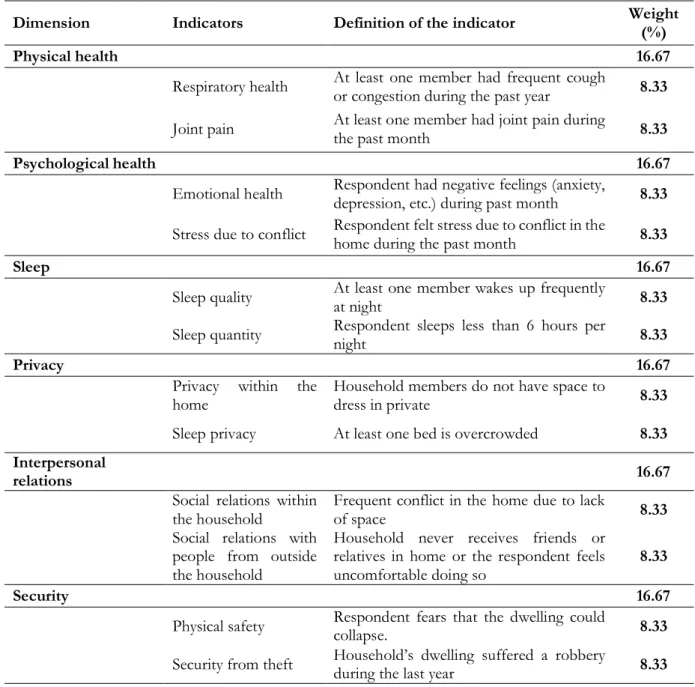
(11) Mitchell and Macció. Evaluating the Effects of Housing Interventions. Table 2: Multidimensional Poverty Index Dimensions, Indicators and Weights. Dimension. Indicators. Definition of the indicator. Physical health At least one member had frequent cough or congestion during the past year At least one member had joint pain during the past month. Respiratory health Joint pain Psychological health. Weight (%) 16.67 8.33 8.33 16.67. Emotional health Stress due to conflict. Respondent had negative feelings (anxiety, depression, etc.) during past month Respondent felt stress due to conflict in the home during the past month. Sleep. 8.33 8.33 16.67. At least one member wakes up frequently at night Respondent sleeps less than 6 hours per night. Sleep quality Sleep quantity Privacy. 8.33 8.33 16.67. Privacy home. within. the. Sleep privacy. Household members do not have space to dress in private. 8.33. At least one bed is overcrowded. 8.33. Interpersonal relations. 16.67 Social relations within the household Social relations with people from outside the household. Frequent conflict in the home due to lack of space Household never receives friends or relatives in home or the respondent feels uncomfortable doing so. Security. 8.33 8.33 16.67. Physical safety Security from theft. Respondent fears that the dwelling could collapse. Household’s dwelling suffered a robbery during the last year. 8.33 8.33. insecure construction or the use of inadequate or toxic materials (Newman, 2008; Thomson et al., 2001). Research has demonstrated, for example, the association between humidity, mould and deficient heating on respiratory problems in children (Peat and Dickerson, 1998; Brunekreef, et al, 1989; Benicio et al., 2004). Overcrowding, moreover, fosters the spread of disease (Fonseca et al 1996; Murtagh et al 1993). Recent research also has provided evidence on the causal effect of housing programmes on health. Cattaneo et al. (2007), for example, showed that a Mexican programme that replaced dirt with cement floors reduced the incidence of parasites, diarrhoea and anaemia, and Galiani et al. (2016) demonstrated the effect of emergency housing programmes in El Salvador and Mexico on reducing diarrhoea in children. Housing can affect mental health both directly, due to poor ventilation, noise and exposure to light, and. OPHI Working Paper 120. 9. www.ophi.org.uk.
(12) Mitchell and Macció. Evaluating the Effects of Housing Interventions. indirectly, by reducing people’s perceptions of the degree of control they have over their lives (Evans, 2003; Krieger and Higgins, 2002). The third dimension, sleep, has been shown to be associated with both housing size and the quality of construction (Cardinali et al., 2014; Simonelli et al., 2015). Housing that does not provide adequate insulation from noise, heat, cold and wind can interrupt sleep or even force people to get up at night. Simonelli et al. (2013) conclude that emergency housing improves the subjective sleep quality and decreases sleep disturbances and daytime somnolence. Moreover, chronic health problems such as cardiovascular disease, diabetes, depression and obesity occur more frequently among persons who do not get adequate sleep (Buxton & Marcelli, 2010; Strine and Chapman, 2005). The fourth dimension, privacy, is closely related to dwelling size. Overcrowding, it is argued, increases social demands, provokes resource competition and negatively affects psychological health when people feel that their daily activities are observed by others (Gove, Hughes and Galle, 1979). Overcrowded housing is also associated with bed overcrowding (Cardinali et al., 2014). The fifth dimension is interpersonal relations. Both overcrowding and the stress and stigma of living in poor quality housing can generate conflict between household members and impede the development of supportive interpersonal relations both within the household and with people from outside of the home (Evans, 2003; Gove, Hughes and Galle, 1979). The sixth dimension is security, defined as the absence of risk or threat. Inadequate building design can produce risks to physical safety, allow the intrusion of external threats and diminish perceptions of security and control (Bonnefoy, 2007). Studies carried out in Brazil and South Africa have demonstrated that injuries associated with precarious housing are higher in informal settlements than in other urban neighbourhoods (Bartlett, 2002). Housing improvements can reduce both the risk of injury and the incidence of robbery by making the house more impervious to theft. In order to construct a parsimonious measure that would be easier to analyse and interpret, we chose to select only two indicators within each dimension from our original list of 31 indicators. To avoid selecting only those indicators for which we had found a statistically significant effect (a problem of ‘cherry picking’), we established the following theoretical-methodological and empirical criteria to guide the selection. 1) Cover the diverse types of deprivations within each dimension (for example, include indicators of both sleep quantity and quality). 2) Include the indicators most critical to household wellbeing (for example, in the privacy dimension, include a measure of ‘lack of space to change in private’, but exclude ‘lack of space to store belongings’).. OPHI Working Paper 120. 10. www.ophi.org.uk.
(13) Mitchell and Macció. Evaluating the Effects of Housing Interventions. 3) Select the indicators that appear to be measured more accurately (for example, include ‘lack of space to change in private’ instead of ‘lack of space to be alone’). 4) Use the relatively less demanding threshold when more than one had previously been considered (for example, include ‘respondent had negative feelings during the previous month’ instead of ‘respondent had negative feelings almost every day during the previous month’). 5) Prioritize objective over subjective indicators.12 6) Not include variables with a large number of missing values.13 7) Exclude variables defined for a subgroup of households. Following these criteria, we reduced the number of impact variables to 12 indicators in six dimensions. In some cases, the indicator refers to the collective deprivation of the household (for example, ‘frequent conflict in the home due to lack of space’) and in other cases the indicator aggregates the situations of deprivation of the household members (for example, ‘at least one member frequently wakes up at night’). The measures of emotional health and sleep quantity refer to the situation of the respondent, the only household member for whom these data were collected. Equal weights are given to all dimensions and to all indicators within each dimension. This decision was made on the basis that all of the dimensions are considered to be essential aspects of housing-related wellbeing. In order to evaluate the associations between our 12 housing-related indicators and identify possible redundancy, we produced 66 contingency tables to assess the associations between all pairs of indicators. For each table we obtained the χ2 statistic for testing the independence between dichotomous variables and calculated the redundancy coefficient, R.14 We used the baseline data for the treatment and control groups and the censored headcounts. Following Alkire et al. (2015), we then analysed the redundancy coefficient for those pairs of indicators that are not independent according to the χ 2 test (p < 0.05). The null hypothesis of independence was rejected for only 15 of the 66 tests and only 4 of these 15 pairs have values of R greater than 0.75. These pairs are (i) sleep privacy and privacy within the home; (ii) sleep privacy and emotional health; (iii) emotional health and sleep quantity and (iv) emotional health and conflicts due to lack of space.. 12 The preference for objective over subjective measures is motivated by what Sen (1985) calls ‘adaptive preferences’, whereby people who experience prolonged periods of deprivation become satisfied with low levels of objective wellbeing. An additional motivation is to reduce the potential problem of ‘confirmation bias” that could arise because TECHO volunteers carried out the survey field work. 13 The Alkire-Foster measure requires that each observation has a valid value for all of the indicators, potentially causing a large loss of observations even if each indicator is missing information for a very small number of households. 14 The coefficient R is equal to the proportion of observations of deprivation in both variables, which represents the joint deprivation, relative to the minimum of the two censored or uncensored headcount ratios (Alkire et al.,2015). OPHI Working Paper 120. 11. www.ophi.org.uk.
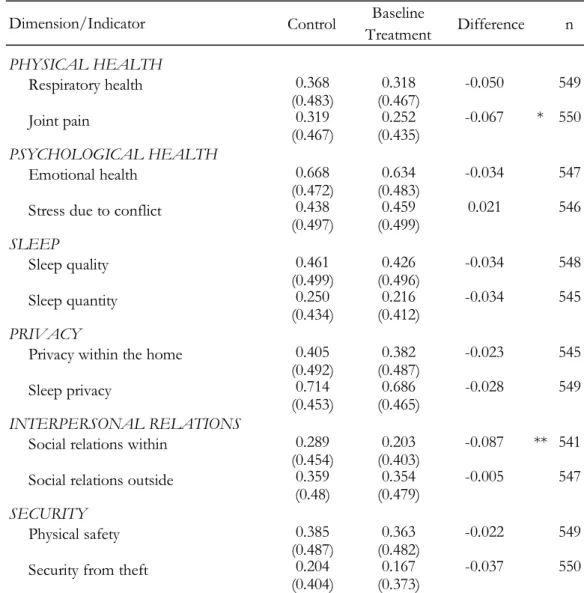
(14) Mitchell and Macció. Evaluating the Effects of Housing Interventions. Based on both empirical and theoretical considerations we decided to maintain the selected indicators in our Alkire-Foster measure. In empirical terms, none of the indicators has a high level of association with all of the remaining indicators. In theoretical terms, all of the chosen indicators measure aspects of deprivation considered to be important for understanding how the TECHO programme affects multidimensional poverty. Table 3 presents the deprivation rates for the 12 indicators included in the Alkire-Foster measure based on the treatment and control group baseline data. The t-test of difference in means indicates that there is a statistically significant difference between groups only in the case of two indicators: joint pain and social relations within the household. In each of these indicators the incidence of deprivation is larger in the control than in the treatment group. We set the poverty threshold, k, at 33% or four weighted indicators. This is the same poverty threshold used in the global Multidimensional Poverty Index (Alkire and Santos, 2011). For a household to be classified as multidimensionally poor it would need to be deprived in two full dimensions or be partly deprived in four dimensions. Section 5.3 presents robustness tests on the poverty threshold. Multidimensional poverty in dimensions related to the built environment can be interpreted as an accumulation of housing-related deprivations that surpasses a critical limit. It is reasonable to imagine that when a household faces a limited number of deprivations, a functioning in one dimension could help the household members to cope with deprivations in other dimensions. For example, strong interpersonal relations and sound psychological health could enable family members to deal with the lack of privacy, frequent sleep interruptions and physical insecurity associated with living in an inadequate dwelling. In this case deprivations in three indicators would not constitute a situation of multidimensional poverty. However, if a family member were to become ill or the household were to suffer a robbery, it is reasonable to imagine that these situations could cause the household to reach a critical state of destitution. A household in this state would be considered to be multidimensionally poor. The Alkire-Foster multidimensional poverty method enables us to obtain an estimate of the programme’s effect on the joint distribution of deprivations. We employ the following three regression equations, which are based on equation (4), to measure the effect of TECHO’s programme on the three Alkire-Foster measures. Equation (5) is used to measure the effect on the incidence of multidimensional poverty, where hi is a dichotomous variable =1 if household i is multidimensionally poor and = 0 otherwise. 𝐻: ℎ𝑖 = 𝛼+ 𝛽𝑋𝑖 + 𝛿1 𝑇𝑖 + 𝜀𝑖. OPHI Working Paper 120. 12. (5). www.ophi.org.uk.
(15) Mitchell and Macció. Evaluating the Effects of Housing Interventions. Table 3: Comparison of control and treatment group baseline deprivation rates. Dimension/Indicator PHYSICAL HEALTH Respiratory health Joint pain PSYCHOLOGICAL HEALTH Emotional health Stress due to conflict SLEEP Sleep quality Sleep quantity PRIVACY Privacy within the home Sleep privacy INTERPERSONAL RELATIONS Social relations within Social relations outside. Control. Baseline Treatment. 0.368 (0.483) 0.319 (0.467). 0.318 (0.467) 0.252 (0.435). -0.050. 549. -0.067. * 550. 0.668 (0.472) 0.438 (0.497). 0.634 (0.483) 0.459 (0.499). -0.034. 547. 0.021. 546. 0.461 (0.499) 0.250 (0.434). 0.426 (0.496) 0.216 (0.412). -0.034. 548. -0.034. 545. 0.405 (0.492) 0.714 (0.453). 0.382 (0.487) 0.686 (0.465). -0.023. 545. -0.028. 549. 0.289 (0.454) 0.359 (0.48). 0.203 (0.403) 0.354 (0.479). -0.087. ** 541. -0.005. 547. Difference. n. SECURITY Physical safety. 0.385 0.363 -0.022 549 (0.487) (0.482) 0.204 0.167 -0.037 550 Security from theft (0.404) (0.373) Notes: Data from TECHO Housing survey, 2014-15. Standard errors in parenthesis. **p < 0.05; *p < 0.1.. Equation (6) is used to measure the programme’s effect on the intensity of poverty among the multidimensionally poor. The dependent variable is the deprivation score and note that the regression is estimated for the subsample of poor households. 𝐴: 𝑐𝑖 (𝑘) = 𝛼+ 𝛽𝑋𝑖 + 𝛿2 𝑇𝑖 + 𝜀𝑖 , 𝑐𝑖 ≥ 𝑘. (6). Equation (7) is used to measure the programme’s effect on the adjusted headcount measure M 0. The deprivation score is the dependent variable again in this model, but in this case the regression is estimated for the full sample (poor and non-poor households). 𝑀0 : 𝑐𝑖 (𝑘) = 𝛼+ 𝛽𝑋𝑖 + 𝛿3 𝑇𝑖 + 𝜀𝑖. OPHI Working Paper 120. 13. (7). www.ophi.org.uk.
(16) Mitchell and Macció. Evaluating the Effects of Housing Interventions. The coefficient 𝛿1 gives an estimate of the effect of treatment on H, 𝛿2 an estimate of the effect of treatment on A and 𝛿3 an estimate of the effect of treatment on M0. Robust standard errors with neighbourhood clustering are used for all of the regression models.. 5. Evaluation results The analysis of the effects of TECHO’s emergency housing programme on multidimensional poverty is divided into five subsections. The first presents the estimated effects on individual outcome measures and the second the effects on the Alkire-Foster multidimensional poverty measures. The third subsection analyses the robustness of the results to changes in the process of selecting of indicators, the indicator weights and the poverty threshold. The fourth subsection assesses the heterogeneity of treatment effects on initially poor versus non-poor households. The last subsection analyses the contribution of the indicators and dimensions to overall poverty. 5.1 Effects on individual outcomes Before analysing the effects of treatment on the impact indicators it is important to consider the direct effects of the programme on the size and quality of the dwelling (see Table A1 in the Annex). TECHO’s programme caused the average size of the dwelling to increase from 29.5 to 36.5 m 2 and the average number of rooms to increase from 2 to 2.7.15 As a result, the percentage of households with less than 5 m2 per person dropped from 47% to 23% and the percentage with more than three persons per room from 37% to 13%.16 With regard to housing quality, the programme did not have a statistically significant effect on the share of rooms with a roof or walls made of materials classified as good quality. This result is likely due to the fact that most of the original dwellings were made of components that in theory were appropriate but were of such poor quality that they did not provide adequate protection (such as, walls made of discarded wood or uninsulated tin roofs). The programme did, however, produce a large and statistically significant reduction in the average share of rooms that had problems with the roof and walls.17 In addition, the share of rooms that flood when it rains fell from 47% to 22% and the share that are very or quite humid fell from 66% to 28%. Galiani et al. (2016) also found that TECHO’s housing programme produced a statistically significant improvement in housing quality and the magnitude of the effect was. 15 The effect of the programme on the size and quality of housing varies according to the use the household gives to the dwelling. Around a third of treatment group households replaced their dwelling with the TECHO house and two-thirds used it as an additional room or as a dwelling for one the household’s nuclear family units. 16 Although a large proportion of households experienced some change in the household composition (such as births, deaths, changes in spouses, etc.), the programme did not produce a statistically significant change in the average household size. 17 While the change in the share of rooms with dirt floors or with dirt or water seepages in the floor also declined according to the Holm procedure, this effect was not statistically significant at the 10% level. OPHI Working Paper 120. 14. www.ophi.org.uk.
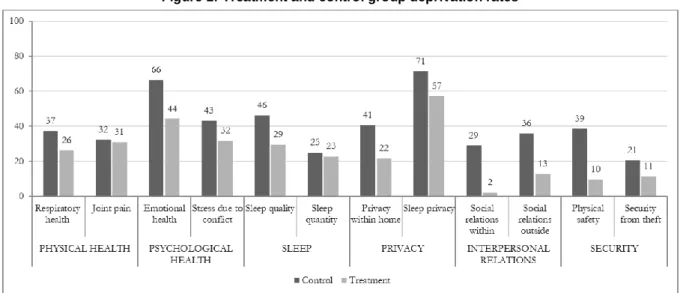
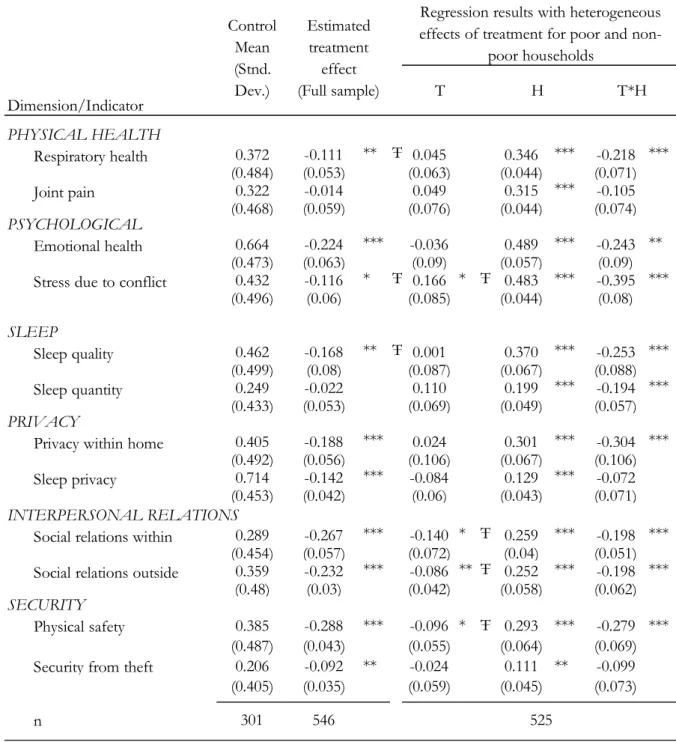
(17) Mitchell and Macció. Evaluating the Effects of Housing Interventions. larger in El Salvador, the country with the worst initial housing conditions. In that study, however, after adjusting for multiple hypothesis testing, the estimated effect on the number of rooms was statistically significant only in the case of Mexico. Finally, consistent with previous research (Galiani and Schargrodsky, 2015; Galiani et al, 2016), the programme did not produce a statistically significant effect on household size. Table 4 presents the estimates of the treatment’s effect on each of the variables included in our AlkireFoster measure based on the regression equation specified in equation (4). 18 Column 4 presents the coefficient estimates for treatment for the full sample and columns 5 through 7 the results of the analysis of the heterogeneity of the treatment effects (see section 5.4). Figure 1 compares the values of the outcome indicators for the control group and the treatment group based on the estimated treatment effects. Tables 4 also presents the results of the Holm stepwise procedure used to correct for the increased likelihood of type I error (rejection of a true null hypothesis) when carrying out multiple hypothesis tests (Lehmann and Romano, 2005).19 Physical health and sleep are the dimensions for which the estimated treatment effects are weakest. While the percentage of households with highly frequent cough or congestion declines from 37% to 26%, based on the Holm procedure for multiple hypothesis tests, this effect is not statistically significant at the 10% level. There is also no statistically significant effect on the percentage of households in which at least one member had joint pain during the past month.20 In the sleep dimension, the results indicate that the TECHO house reduced the percentage of households in which at least one member wakes up frequently at night from 46% to 29%, but based on the Holm procedure the effect is not statistically significant. There also is no effect on the percentage of respondents that sleep less than six hours per night. 21 In the psychological health dimension, the effects of the emergency housing programme are mixed. The programme produces a large reduction in the percentage of households in which the respondent had negative feelings (like sadness, anxiety or depression) during the past week, which falls from a control. 18 The small differences in the treatment effect coefficients with respect to the results presented in Mitchell, Macció and Mariño Fages (2016) are due to differences in sample size, as the estimates presented here are based on the cases that have valid values for all of the indicators included in the Alkire-Foster measure. All of the substantive results are unchanged. 19 To apply the Holm procedure, one first orders the estimation results by p-values i from smallest to largest and then sequentially rejects each hypothesis as long as the p-value < 𝛼𝑖 = 𝛼/(𝑠 − 𝑖 − 1). We employ the Holm stepwise adjustment instead of the Bonferroni procedure because the latter is considered to increase the likelihood of type II errors too much (failure to reject a false null hypothesis) (Perneger, 1998). 20 Galiani et al. (2016) also did not find a statistically significant effect on the incidence of respiratory health in children. 21 Simonelli et al. (2013), in contrast, found that the programme had a positive effect on sleep quality. The difference in the results may be because that study was based on a before-after comparison and the outcome variable was a composite index of sleep quality composed of 19 self-rated questions. OPHI Working Paper 120. 15. www.ophi.org.uk.
(18) Mitchell and Macció. Evaluating the Effects of Housing Interventions. group mean of 66% to 44%. The percentage of respondents that feel stress due to conflict in the home also declines, but the effect is not statistically significant after making the Holm procedure adjustment. In both the privacy and interpersonal relations dimensions, we find that the programme has a large and statistically significant effect on all indicators. The percentage of households in which the members do not have space to dress in private declines by almost half from 41% to 22%, and the percentage of households in which at least one bed is overcrowded declines from 71% to 57%. In addition, the percentage of households that have frequent conflict due to lack of space falls from 29% to just 2%, and the percentage of households that either never receive friends or neighbours in the home or feel quite or very uncomfortable doing so falls from 36% to 13%. Figure 1: Treatment and control group deprivation rates. Notes: Data from TECHO Housing survey, 2014-15.. The TECHO programme also reduced both the perception of insecurity and the incidence of robbery. The percentage of respondents who are concerned that the building could collapse declines from 39% to 10%, and the percentage of households that experienced a robbery during the past year falls by half from 21% to 11%. It is relevant to note that the impact evaluations carried out in El Salvador, Mexico and Uruguay showed that the TECHO programme had a positive effect on the perception of security but did not reduce the incidence of robbery (Galiani et al., 2016).. OPHI Working Paper 120. 16. www.ophi.org.uk.
(19) Mitchell and Macció. Evaluating the Effects of Housing Interventions. Table 4: Treatment effect on the Alkire-Foster measure indicators. Dimension/Indicator PHYSICAL HEALTH Respiratory health. Control Mean (Stnd. Dev.). Estimated treatment effect (Full sample). Regression results with heterogeneous effects of treatment for poor and nonpoor households T. H. T*H. 0.346 *** (0.044) 0.315 *** (0.044). -0.218 *** (0.071) -0.105 (0.074). -0.036 0.489 *** (0.09) (0.057) Ŧ 0.166 * Ŧ 0.483 *** (0.085) (0.044). -0.243 ** (0.09) -0.395 *** (0.08). 0.372 (0.484) 0.322 (0.468). -0.111 (0.053) -0.014 (0.059). ** Ŧ 0.045 (0.063) 0.049 (0.076). 0.664 (0.473) 0.432 (0.496). -0.224 (0.063) -0.116 (0.06). ***. 0.462 (0.499) 0.249 (0.433). -0.168 (0.08) -0.022 (0.053). ** Ŧ 0.001 (0.087) 0.110 (0.069). 0.370 *** (0.067) 0.199 *** (0.049). -0.253 *** (0.088) -0.194 *** (0.057). 0.405 (0.492) 0.714 Sleep privacy (0.453) INTERPERSONAL RELATIONS 0.289 Social relations within (0.454) 0.359 Social relations outside (0.48) SECURITY 0.385 Physical safety (0.487) 0.206 Security from theft (0.405). -0.188 (0.056) -0.142 (0.042). ***. 0.301 *** (0.067) 0.129 *** (0.043). -0.304 *** (0.106) -0.072 (0.071). -0.267 (0.057) -0.232 (0.03). ***. -0.140 * Ŧ 0.259 *** (0.072) (0.04) -0.086 ** Ŧ 0.252 *** (0.042) (0.058). -0.198 *** (0.051) -0.198 *** (0.062). -0.288 (0.043) -0.092 (0.035). ***. -0.096 * Ŧ 0.293 *** (0.055) (0.064) -0.024 0.111 ** (0.059) (0.045). -0.279 *** (0.069) -0.099 (0.073). Joint pain PSYCHOLOGICAL Emotional health Stress due to conflict SLEEP Sleep quality Sleep quantity PRIVACY Privacy within home. n. 301. 546. *. ***. ***. **. 0.024 (0.106) -0.084 (0.06). 525. Notes: Data from TECHO Housing survey, 2014-15. Standard errors in parenthesis, except where indicated. ***p < 0.01; **p < 0.05; *p < 0.1. Ŧ indicates that the variable is not statistically significant at the 10% level according to the Holm procedure for multiple hypothesis testing.. OPHI Working Paper 120. 17. www.ophi.org.uk.
(20) Mitchell and Macció. Evaluating the Effects of Housing Interventions. 5.2 Effects on multidimensional poverty The analysis of the treatment effects on individual outcome measures showed that the TECHO programme reduced deprivation in multiple wellbeing dimensions. We begin the analysis of the programme’s effect on multidimensional poverty by comparing the distributions of the deprivation score, ci, and the censored deprivation score, ci(k), for treatment and control households (Figure 2). The graph on the left clearly illustrates the leftward shift in the distribution of the number of deprivations experienced by treatment group households compared with control group households. The censoring of the deprivation score at the poverty threshold k shows that the fraction of treatment group households with less than four deprivations doubles the fraction corresponding to control group households. These comparisons provide initial evidence of the program’s effect on both the incidence of multidimensional poverty and on the intensity of poverty experienced by the multidimensionally poor. Table 5 presents the results of the estimation of the effects of the TECHO programme on the three AlkireFoster measures of multidimensional poverty. The table first presents the control group baseline estimate of each measure, followed by the estimated treatment effect based on the estimation of regression equations (5) through (7), followed by the estimated value of each measure for treated households (calculated as the sum of the control group mean and the treatment effect) and the observed value of each measure for treatment group households. Figure 2: Distributions of ci and ci(k) of treatment and control group households 70. 70. 60. 60. 50. 50. 40. 40. 30. 30. 20 10. 0. 19 17 17 15 16 16 13 14 11 12 9 11 5 4 4 7 4 2 0 20 10 00 0 0. 1. 2. 3. 4 5 Control. 6 7 8 Treatment. 9. 61. 31 1716 16 13 11 4. 20 10. 9. 4. 7. 2. 4. 0. 20. 10. 00. 10. 11. 12. 0 0. 10 11 12. 4. 5. 6 Control. 7. 8. 9. Treatment. Notes: Data from TECHO Housing survey, 2014-15.. The results indicate that the TECHO programme caused a statistically significant reduction in all three of the Alkire-Foster measures at the 1% significance level after adjusting for multiple hypothesis testing using the Holm procedure. The multidimensional headcount fell by approximately 30 percentage points. Whereas 69% of control group households were multidimensionally deprived in dimensions related to housing, the percentage fell to 39% one year after the treatment group households had received the TECHO house.. OPHI Working Paper 120. 18. www.ophi.org.uk.
(21) Mitchell and Macció. Evaluating the Effects of Housing Interventions. Table 5: Treatment effect on the Alkire-Foster measure for k=33%. Control group Treatment effect (Standard error) Treated group (estimated) Treated group (observed) Diff. Treated(Obs.)-Control Shapley decomposition Incidence of poverty effect Intensity of poverty effect Change in M0 n. H 0.691. A 0.501. -0.306 *** -0.080 *** (0.05) (0.016). M0 0.346 -0.183 *** (0.024). 0.385 0.384. 0.421 0.427. 0.163 0.164. -0.307. -0.074. -0.182. -0.142 -0.040 -0.182 546. 302. 546. Notes: Data from TECHO Housing survey, 2014-15. ***p < 0.01.. Poverty intensity or A declined by eight percentage points. Whereas at baseline the multidimensionally poor were, on average, deprived in half of the weighted indicators, after treatment this proportion fell to 42%.22 The decline in both the incidence and the intensity of poverty caused the adjusted headcount ratio to drop by more than half from .346 to .163. This means that multidimensionally poor households went from being deprived in a third of all of the indicators in which all households can be deprived to only experiencing 16.3% of these deprivations. Following Roche (2013), Table 5 also presents the Shapley decomposition of the effect of treatment on M0 into two components: the incidence of poverty and the intensity of poverty among the multidimensionally poor. While this procedure is usually applied to the analysis of variations over time, it can also be used for crosssectional analysis (Alkire et al., 2015). The incidence of poverty effect is equal to the average poverty intensity of the two groups multiplied by the difference in the headcount ratio between groups. The intensity of poverty effect is equal to the average of the headcount ratios of the two groups multiplied by the difference in the poverty intensity for the two groups.23 The results indicate that for the chosen poverty. 22 When interpreting the effect of treatment on A it is important to recall that, since poverty intensity is equal to the average deprivation score of poor households, when the multidimensional headcount also declines, the share of weighted deprivations is averaged over a smaller and poorer proportion of households. For this reason, A tends to change relatively slowly. 23 The decomposition equation adapted from equation 9.18 in Alkire et al. (2015) is 𝐴𝑇 + 𝐴𝐶 𝑇 𝐻𝑇 + 𝐻𝐶 𝑇 (𝐻 − 𝐻𝐶 ) + (𝐴 − 𝐴𝑐 ). ∆𝑀0 = 2 2 The first term is the incidence effect and the second the intensity effect. OPHI Working Paper 120. 19. www.ophi.org.uk.
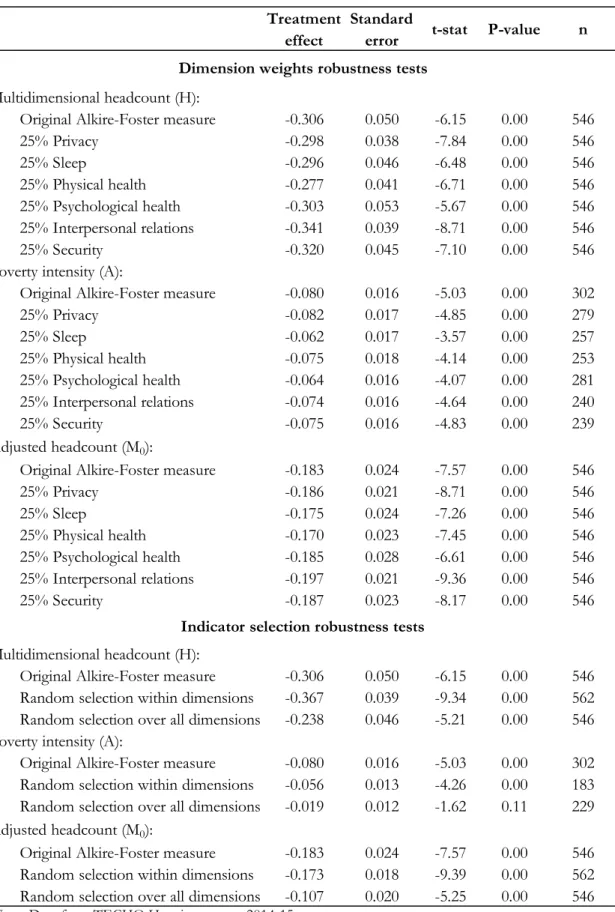
(22) Mitchell and Macció. Evaluating the Effects of Housing Interventions. threshold of 33%, approximately three-fourths of the treatment effect on M0 is explained by the decline in the incidence of poverty and one-fourth by the decline in poverty intensity. 5.3 Robustness analysis In order to evaluate the robustness of the results to changes in the weighting and indicator selection criteria used to construct the Alkire-Foster measures, we carried out three different types of tests. In the first set of tests, we altered the weights used to the construct the Alkire-Foster measures by increasing to 25% the weight assigned to one particular dimension and distributing equally the remaining 75% to the rest of the dimensions. This test was repeated for each of the six wellbeing dimensions. In the second set of tests, we altered the criteria used for the selection of indicators. For the first test we randomly selected two indicators within each dimension and for the second we randomly selected 12 indicators from the original list of 31 indicators.24 For each test we re-estimated the effect of treatment on each of the three AlkireFoster measures using regression models (5) – (7). The results are presented in Table 6. The effects of the TECHO programme on multidimensional poverty are highly robust to variations in the weighting structure used to construct the Alkire-Foster measure. While the size of the treatment effect varies somewhat when alternative weighting structures are used,25 the coefficient on treatment is statistically significant at the 1% level for all of the tests on all three poverty measures. The results are also quite robust to changes in the selection of indictors. For the case in which the indicators were randomly selected within each dimension, the treatment effect continues to be statistically significant for all three Alkire-Foster measures and the size of the effect on M0 falls by only about 5%. When the 12 indicators are selected randomly over all dimensions, the effect of treatment on H and M0 continues to be statistically significant at the 1% level. The magnitude of the effect on M 0 is about 60% of the initial value. With a random selection of indicators over all dimensions, the treatment effect on A is no longer statistically significant. Based on these robustness tests, we can conclude that the finding that TECHO’s emergency housing programme produces a large and statistically significant reduction in multidimensionally poverty holds up to variations in the criteria used to construct the multidimensional poverty measures.. 24 It should be noted that, by chance, the 12 randomly selected indicators included at least one indicator from each dimension. 25 For example, the effect on H varies from 28 percentage points, when a higher weight is given to the physical health dimension, to 34 percentage points, when a higher weight is given to the interpersonal relations dimension. OPHI Working Paper 120. 20. www.ophi.org.uk.
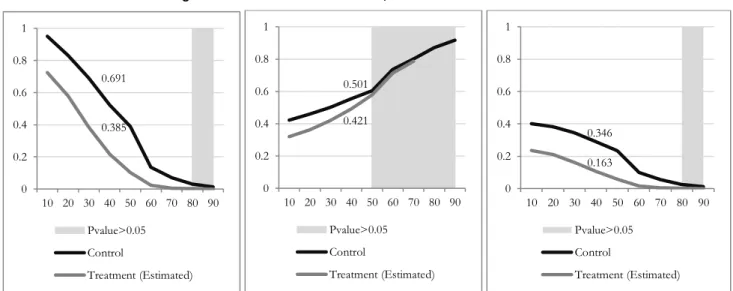
(23) Mitchell and Macció. Evaluating the Effects of Housing Interventions. Table 6: Robustness tests on the criteria used to construct the Alkire-Foster measures. Treatment Standard effect error. t-stat. P-value. n. Dimension weights robustness tests Multidimensional headcount (H): Original Alkire-Foster measure 25% Privacy 25% Sleep 25% Physical health 25% Psychological health 25% Interpersonal relations 25% Security Poverty intensity (A): Original Alkire-Foster measure 25% Privacy 25% Sleep 25% Physical health 25% Psychological health 25% Interpersonal relations 25% Security Adjusted headcount (M0): Original Alkire-Foster measure 25% Privacy 25% Sleep 25% Physical health 25% Psychological health 25% Interpersonal relations 25% Security. -0.306 -0.298 -0.296 -0.277 -0.303 -0.341 -0.320. 0.050 0.038 0.046 0.041 0.053 0.039 0.045. -6.15 -7.84 -6.48 -6.71 -5.67 -8.71 -7.10. 0.00 0.00 0.00 0.00 0.00 0.00 0.00. 546 546 546 546 546 546 546. -0.080 -0.082 -0.062 -0.075 -0.064 -0.074 -0.075. 0.016 0.017 0.017 0.018 0.016 0.016 0.016. -5.03 -4.85 -3.57 -4.14 -4.07 -4.64 -4.83. 0.00 0.00 0.00 0.00 0.00 0.00 0.00. 302 279 257 253 281 240 239. -0.183 -0.186 -0.175 -0.170 -0.185 -0.197 -0.187. 0.024 0.021 0.024 0.023 0.028 0.021 0.023. -7.57 -8.71 -7.26 -7.45 -6.61 -9.36 -8.17. 0.00 0.00 0.00 0.00 0.00 0.00 0.00. 546 546 546 546 546 546 546. Indicator selection robustness tests Multidimensional headcount (H): Original Alkire-Foster measure Random selection within dimensions Random selection over all dimensions Poverty intensity (A): Original Alkire-Foster measure Random selection within dimensions Random selection over all dimensions Adjusted headcount (M0): Original Alkire-Foster measure Random selection within dimensions Random selection over all dimensions. -0.306 -0.367 -0.238. 0.050 0.039 0.046. -6.15 -9.34 -5.21. 0.00 0.00 0.00. 546 562 546. -0.080 -0.056 -0.019. 0.016 0.013 0.012. -5.03 -4.26 -1.62. 0.00 0.00 0.11. 302 183 229. -0.183 -0.173 -0.107. 0.024 0.018 0.020. -7.57 -9.39 -5.25. 0.00 0.00 0.00. 546 562 546. Note: Data from TECHO Housing survey, 2014-15.. In order to test the robustness of the results to changes in the poverty threshold, Figure 3 presents comparisons of the three Alkire-Foster measures corresponding to the control and treatment groups over a range of possible values of k. Note that the estimates of each measure for the treatment group are OPHI Working Paper 120. 21. www.ophi.org.uk.
(24) Mitchell and Macció. Evaluating the Effects of Housing Interventions. calculated as the sum of the control group mean and the treatment effect using, respectively, regression equations 5 through 7. The shaded area of each graph indicates the values of k over which the effect of treatment on the Alkire-Foster measure is not statically significant at the 5% significance level. The results show that the effect of the TECHO programme on the multidimensional headcount ratio H is statistically significant for all values of the poverty cut-off less than or equal to 80%, indicating that the effect on the incidence of multidimensional poverty is not sensitive to the chosen poverty threshold. In the case of the poverty intensity, the graph shows that A is always higher for the control than the treatment group households and that the difference between groups is statistically significant only for values of k below 50%. Finally, M0 is higher for the control than the treatment groups for all possible values of k, and the effect is statistically significant for all values of k ≤ 80%. Moreover, the difference is particularly large for values of k ≤ 50%. From this analysis it can be concluded that the program’s effect on reducing multidimensional poverty is highly robust to variations in the poverty threshold. Figure 3: Effect of treatment on H, A and M0 with variation in k 1 0.8 0.691 0.6 0.4. 0.385. 1. 1. 0.8. 0.8 0.501. 0.6. 0.421. 0.4 0.2. 0.2. 10 20 30 40 50 60 70 80 90. 0.4. 0.346. 0.2. 0. 0. 0.6. 0.163. 0 10 20 30 40 50 60 70 80 90. 10 20 30 40 50 60 70 80 90. Pvalue>0.05. Pvalue>0.05. Pvalue>0.05. Control. Control. Control. Treatment (Estimated). Treatment (Estimated). Treatment (Estimated). Notes: Data from TECHO Housing survey, 2014-15. 5.4 Heterogeneity of treatment effects Impact evaluations frequently assess the heterogeneity of the effects of treatment on programme participants with different initial characteristics. In this section we use the classification of the treatment and control group households as multidimensionally poor before receiving the TECHO house (at baseline) to analyse whether or not the programme has a relatively larger effect on those households that were initially multidimensionally poor. First, in order to analyse the heterogeneity of the treatment effects on the individual outcome measures, we added the following two additional explanatory variables to regression equation (4): (i) a dummy variable for multidimensional poverty, hi =1 if multidimensionally poor, otherwise =0; (ii) and an interaction term between h and the indicator of treatment, T. OPHI Working Paper 120. 22. www.ophi.org.uk.
(25) Mitchell and Macció. Evaluating the Effects of Housing Interventions. The results are presented in columns 5 through 7 of Table 4. The coefficient on T in the new regression equation provides an estimate of the effect of treatment on households that are initially not multidimensionally poor and the coefficient on the interaction term provides an estimate of the differential effect of treatment on households that were initially multidimensionally poor. The results indicate that for all of the indicators in which we had initially found a statistically significant effect of treatment, the coefficient on the interaction term is negative and statistically significant. This means that the magnitude of the treatment effect is larger for households that were initially multidimensionally poor than for the full sample. Additional evidence of the heterogeneity of the treatment effect is that, after applying the Holm procedure for multiple hypothesis tests, we cannot reject the null hypothesis of no treatment effect on the initially non-poor households for any of the outcome variables considered. Figure 4: Distribution of the deprivation score for control and treatment group households by initial poverty status. Poor at baseline. Non-poor at baseline. 50. 50 40. 40 30. 24 24 19 20 19 15 14 13 12. 20 7. 10 0. 45 39. 5. 0. 0. 0. 0. 0. 1. 2. 3. 4. 5. Control. 6. 5. 7. 30 20 10 3 8. 6. 22. 10. 10. 1 21 20 00. 9. 21 22 16 15. 0. 0 0. 10 11 12. 1. 2. 3. 5. 0. 0. 0. 3. 01 01 00 00 00 00. 4. 5. 6. 7. Control. Treatment. 8. 9. 10 11 12. Treatment. Note: Data from TECHO Housing survey, 2014-15.. Second, we use the distribution of the deprivation score of the control and treatment group households disaggregated according to initial poverty status (Figure 4) to assess the heterogeneity of the effects on the distribution of deprivations. On the one hand, when one considers only those households that were multidimensionally poor at baseline, it is evident that the treatment produces a leftward shift in the distribution of deprivation scores that is even larger than for the full sample (Figure 2). On the other hand, the distribution of the deprivation score for households classified as non-poor at the baseline shows that around 20% of the treatment group households became multidimensionally poor after receiving the TECHO house. One cannot conclude that this transition into multidimensional poverty was caused by the TECHO programme as many other factors could have contributed to the worsening of housingrelated deprivation (for example, changes in the quality of access to public services or environmental conditions). It does, however, provide evidence of vulnerability to housing-related deprivations in informal OPHI Working Paper 120. 23. www.ophi.org.uk.
(26) Mitchell and Macció. Evaluating the Effects of Housing Interventions. settlements. While on average the programme reduces both the incidence and the intensity of multidimensional poverty, some households experience a larger number of deprivations after receiving treatment. 5.5 Dimensional contributions to M0 In order to analyse the extent of the contributions of each dimension to overall poverty, this section applies a dimensional breakdown to the adjusted headcount measure. M0 can be expressed as the weighted sum of the censored deprivation rate 𝑀0 = ∑𝑑𝑗=1 𝑤𝑗 ℎ𝑗 (𝑘),. (8). where d is the number of chosen dimensions, 𝑤𝑗 is the relative weight assigned to the dimension and ℎ𝑗 (𝑘) is the proportion of households identified as multidimensionally poor and simultaneously deprived in dimension j (Alkire et al., 2015). The absolute contribution of the jth dimension to M0 is 𝑤𝑗 ℎ𝑗 (𝑘). Additionally, the percentage contribution of each dimension j to M0 can be denoted by 𝜙𝑗0, where ℎ𝑗. 𝜙𝑗0 (𝑘) = 𝑤𝑗 𝑀. 0. for each 𝑗 = 1, … , 𝑑.. (9). Table 7 first presents the control and ex-post treatment group deprivation rates for each of the indicators included in our Alkire-Foster measure and the absolute difference between the two groups.26 The following columns show the control and treatment group censored deprivation rates for each indicator and the absolute difference between groups. Finally, equations (8) and (9) were used to calculate, respectively, the absolute and relative contributions of each indicator to M0. In each case we also calculate the absolute difference in the rates between the control and treatment groups and mark in grey the three values with the largest absolute differences. Also note that both the average of the censored deprivation rates and the sum of the absolute contributions are equal to M0. The examination of the difference in the deprivation rates for the full sample indicates that physical safety, social relations between household members and social relations outside of the home are the indicators for which the programme produced the largest reductions in deprivation. When we focus our attention only the households that are simultaneously multidimensionally poor and deprived in each dimension (that is, we focus on the censored deprivation rates), we find that physical safety, sleep privacy and emotional health are the indicators for which there is the largest difference between the treatment and control groups. These same indicators have the largest absolute contribution to the change in multidimensional poverty. 26 Note that the absolute difference between these values is not equal to the treatment effects presented in Table 4, because the latter estimates were obtained by estimation of regression equation (4). OPHI Working Paper 120. 24. www.ophi.org.uk.
(27) Mitchell and Macció. Evaluating the Effects of Housing Interventions. M0. The differences between the control and treatment group households in the censored deprivation score result from the combined effects of the movement out of multidimensional poverty by households that had previously been deprived in this indicator and the reduction in the overall rate of deprivation in the indicator. Table 7: Percentage and Absolute Contributions to M0. Deprivation rates (full sample) Ctrl. Treat. Diff.. Censored deprivation rates Ctrl. Treat. Diff.. Absolute Percentage contributions to M0 contributions to M0 Ctrl. Treat. Diff. Ctrl. Treat. Diff.. PHYSICAL HEALTH Respiratory health 0.372 0.245 -0.127 Joint pain 0.322 0.278 -0.045. 0.336 0.176 -0.160 0.296 0.180 -0.116. 0.028 0.015 -0.013 0.025 0.015 -0.010. 0.081 0.089 0.008 0.071 0.091 0.020. PSYCHOLOGICAL HEALTH Emotional health 0.665 0.498 -0.167 Stress due to conflict 0.432 0.318 -0.114. 0.558 0.310 -0.248 0.409 0.249 -0.160. 0.047 0.026 -0.021 0.034 0.021 -0.013. 0.134 0.158 0.023 0.098 0.127 0.028. SLEEP Sleep quality Sleep quantity. 0.462 0.314 -0.148 0.249 0.184 -0.066. 0.402 0.229 -0.173 0.213 0.127 -0.086. 0.034 0.019 -0.014 0.018 0.011 -0.007. 0.097 0.116 0.019 0.051 0.064 0.013. PRIVACY Privacy within home Sleep privacy. 0.405 0.245 -0.160 0.714 0.576 -0.139. 0.346 0.155 -0.190 0.535 0.265 -0.270. 0.029 0.013 -0.016 0.045 0.022 -0.022. 0.083 0.079 -0.004 0.129 0.135 0.006. INTERPERSONAL RELATIONS Social relations within 0.289 0.061 -0.228 Social relations outside 0.359 0.122 -0.236. 0.259 0.053 -0.206 0.302 0.090 -0.213. 0.022 0.004 -0.017 0.025 0.007 -0.018. 0.062 0.027 -0.035 0.073 0.046 -0.027. SECURITY Physical safety Security from theft. 0.326 0.049 -0.277 0.173 0.086 -0.087. 0.027 0.004 -0.023 0.014 0.007 -0.007. 0.078 0.025 -0.054 0.042 0.044 0.002. 0.385 0.057 -0.328 0.206 0.114 -0.092. Average 0.346 0.164 Sum n=546 Note: Data from TECHO Housing survey, 2014-15.. 0.346 0.164 -0.182. 1. 1. 0.000. Figure 6 presents the absolute difference in each dimension’s contribution to multidimensional poverty. Privacy was the dimension that contributed the most to the reduction in multidimensional poverty and within that dimension sleep privacy contributed relatively more than the measure of overall privacy within the home. Interpersonal relations was the next dimension that most contributed to the overall change in M0, followed by psychological health and then security. Within the security dimension, the contribution of the physical safety indicator is about three times larger than that of the indicator of security from theft. Finally sleep and health are the dimensions with the smallest contribution to the change in overall multidimensional poverty.. OPHI Working Paper 120. 25. www.ophi.org.uk.
(28) Mitchell and Macció. Evaluating the Effects of Housing Interventions. Figure 6: Absolute differences in each dimension’s absolute contribution to M0. 0.000. -0.010. -0.020. -0.022. -0.023 -0.030. -0.030 -0.034. -0.035. -0.040. -0.038. -0.050 Physical Health Psychological Health. Sleep. Privacy. Interpersonal Relations. Security. Note: Data from TECHO Housing survey, 2014-15.. 6. Conclusions This paper has sought to evaluate the effect of the NGO TECHO’s emergency housing programme on the multidimensional deprivation experienced by households living in the informal settlements of Buenos Aires, Argentina. It employs an Alkire-Foster multidimensional poverty measure with dimensions related to the built environment and a quasi-experimental ‘pipeline’ evaluation design. The paper demonstrates that the TECHO housing programme produces a large reduction in multidimensional poverty. The percentage of households identified as multidimensionally poor declines substantially, from 69% to 39%. The average share of indicators in which the multidimensionally poor are deprived declines from 50% to 42%. Together these effects cause the adjusted headcount measure to fall by more than half. Multidimensionally poor households go from experiencing deprivation in a third of all of the indicators in which all households can be deprived to only experiencing 16.5% of these deprivations. This result provides strong evidence that TECHO’s programme contributes to what Wolff and de-Shalit (2007) call a ‘de-clustering’ of disadvantage. Furthermore, it is shown that these results are robust to variations in the selection of deprivation indicators, indicator weights and the poverty threshold. The Alkire-Foster method also provided a framework for analysing the heterogeneity of the treatment effects on households with different levels of initial deprivation. The results show that the magnitude of the reductions in deprivations is greater, on average, for households that were initially multidimensionally poor. This suggests that emergency housing does not benefit all households in the same way, but rather the effects are magnified for the poorest households. OPHI Working Paper 120. 26. www.ophi.org.uk.
Figure

+7



Documento similar
Drawing upon a conception of natu- ral selection that puts the focus on the transgenerational recurrence of the traits and that supports the thesis that holobionts are units
to identify the factors that influence on such behaviour, in this case, we have concentrated our efforts on the familiar and school environment of adolescents. We have found
Illustration 69 – Daily burger social media advertising Source: Own elaboration based
To verify my second hypothesis, I will again use the hermeneutic approach, to elaborate on ontological, epistemological, and practical considerations regarding the
Thus defined, there are already 3 8 possible behavioral rules in our games; for brevity, we focus on rules based on the theories presented in section 3.1, that is, (1) selfish,
• the study of linear groups, in which the set of all subgroups having infinite central dimension satisfies the minimal condition (a linear analogy of the Chernikov’s problem);.. •
However, when we focus on the official COVID-19 related websites that are operated by international or national health organizations and governments, we notice that the number
The Dwellers in the Garden of Allah 109... The Dwellers in the Garden of Allah
