
TítuloLearning non monotonic Logic Programs to Reason about Actions and Change
194
0
0
Texto completo
(2) Universidade da Coruña Departamento de Computación. Learning non-monotonic Logic Programs to Reason about Actions and Change David. Lórenzo Blanco. Dissertation presented at the Facnltade de Informática de A Cor^ña following the requirements for the degree of. Doctor en Informática. July 2001.
(3) A. ^. Universidade da Coruña Departamento de Computación. PhD. thesis. •. Learning non-monotonic Logic Programs to Reason about Actions and Change David Lorenzo Blanco. PhD. advisor:. Dissertation committee:. Ramón P. Otero. Prof. Dr. Roque Marín Morales Prof. Dr. Stephen Muggleton Dr. Antonis C. Kakas Prof. Dr. Pavel Brazdil. ♦. Prof. Dr. Antonio Bahamonde Rionc^a Substitute members:. Prof. Dr. Senén Barro Ameneiro Dr. Alessandro Provetti. ^.
(4) ^. ^. UNIVERSIDADE DA CORUÑA. DEPARTAMENTO DE COMPUTACION Facultade de Informática Campus de Elviña, s/n. 15071 A Coruña Telf. 981 l67 000 Fax 981 167 160 I^u^rr.óri Pérez Otero, Profesor Titular del Area cíe Cienc:ia,.^ cíe 1:^ C<^rnp^it.ac;ión e Iriteligencia Artificial en la Universidad de A Coriir`ia,.. -. CERTIFICA. Que la memoria titulada "Learning non-monotonic Logic Programs to R.eason about Actions and Change" ha sido realizada bajo mi dirección por David Lorenzo Blanco en el Departamento de Computación de la Universidad de A Coruña, y constituye la tesis que presenta para optar al grado de Doctor en Iriformática.. A Cc^riiñ^.i, 1G de Julio de 2001. w. ^. li!a^^o z Pc^•rez Otero. V°B° lose Luis Freire Nistnl. Direc• .or cle la tesis. Director del Departamento de Computación.
(5) !. Acknowledgements I want to thank my advisor Ramón P. Otero for his guidance and support during these years. To all the members of the AI Laboratory (AILab), since the former member, Charlie, to the. •. most recent one, David E., for making the hours of work much more pleasant. Especially to Pedro Cabalar who was always there to provide helpful suggestions with the only help of his small notebook. I want to thank the members of my reading committee for reviewing this thesis. And, most importantly, to my family for their support and endless confidence during such a long period.. Part of this thesis was completed while I was granted by the X^cnta de Galicia, that also allowed me to make a research stay of three months at the Department of Systems Theory and Information Engineering of the Johannes Kepler University of Linz (Austria), headed by Professor F^anz Pichler. I also received support from the Ministerio de Educación under grant PB97-0228, the X^r^ta de Galicia under grants XUGA-10503B94 and XUGA-10503B96, and the University of A Coruña through travel grants who allowed me to attend to diverse conferences all over the world.. ^.
(6) i. .. Abstract Describing properties of actions and their effects on the state of the world has long been ^onsidered one of the central problems in the theory of knowledge representation (78]. Most of Artificial Intelligence applications require an almost complete description of an agent's actions and the action laws that describe the ef^ects of actions that change the domain, which it is a time consuming task. Machine Learning methods can help to learn the domain specific knowledge necessary in the development of plans, or to construct the description of a robot's actions and its environment. The domain to learn is a system that changes its state when acted upon according to some set of unknown rules or functions. The learner initially knows nothing of the contexts in which actions produce changes in the environment, nor what those changes are likely to be. Then, it must infer how properties of the domain are affected by the execution of actions, or otherwise are subject to the general law of inertia. In most previous works on action-model learning, the inferred model corresponds to a set of STRIPS-like operators [36], that was an early attempt to formalize descriptions of actions. Many extensions have been proposed since then, aiming for theories of actions that are more expressive, however, most of them are procedural representations. In this thesis we shall propose learning action models in non-monotonic formalisms for Reasoning abo^t Actions and Change [78]. These formalisms constitute a formal and expressive representation for action domains, grounded on a mathematical and computational foundation, where system's behaviors are naturally viewed as appropriate logical consequences of the domain's description, so that the specification of actions and their effects is made as intuitive and natural as possible. Any attempt to learn in these formalisms must cope with various facets such as inertia (and the associated Frame Problem [81]), constraints and indirect effects (and the associated Qualification [79] and Ramification problem [58]), non-deterministic and other complex eífects of actions. Our work differs also from previous approaches in the use of Ind^cctive Logic Prograrrzming [93] methods, which allow a natural integration with implementations of Action Theories based on the Logic Programming paradigm. The result is that an action theory is learned in the same way as it will be used, thus there is no a dif%rent representation for learning and another dif%rent for reasoning and planning. For this task we adopt Extended Logic Programs [45] as the form of programs to be learned, where two kinds of negation -negation as failure and classical negationare effectively used in the presence of incomplete information. The use of Action Languages [47] has a significant impact in the generality of the approach, so that diverse learning tasks can be approached in an homogeneous way and with minimal changes, for instance, the dual problem, i.e., learning to act, where action-selection rules for guiding the planning process are learned from solutions to instances of a planning problem. The control rules learned this way do not make explicit reference to the workings of the planner, but only refer to the solution space, so that they can be used by fundamentally different planning architectures..
(7) i. .. Contents i. Acknowledgments Abstract. iii. Contents. v. 1. Introduction 1.1 Ob jectives and Motivation . . . . . . . . . . . . . . . . . . . . . . . . . . . . . . . 1.2 Organization of chapters . . . . . . . . . . . . . . . . . . . . . . . . . . . . . . . .. 1 1 6. I. Background. 7. 2. 9 Non-monotonic Action Theories 9 2.1 Reasoning about actions and change . . . . . . . . . . . . . . . . . . . . . . . . . 2.2 The Situation Calculus . . . . . . . . . . . . . . . . . . . . . . . . . . . . . . . . . 10 2.3 Challenges for Action Theories . . . . . . . . . . . . . . . . . . . . . . . . . . . . 12 2.4 Logic Programs to reason about actions . . . . . . . . . . . . . . . . . . . . . . . 14. .. •. 17 3 Inductive Logic Programming 3.1 General definition of ILP . . . . . . . . . . . . . . . . . . . . . . . . . . . . . . . . 17 3.2 Testing the generality of hypotheses . . . . . . . . . . . . . . . . . . . . . . . . . 19 3.3 Methods in ILP . . . . . . . . . . . . . . . . . . . . . . . . . . . . . . . . . . . . . 20 3.4 Declarative bias . . . . . . . . . . . . . . . . . . . . . . . . . . . . . . . . . . . . . 23 3.5 Recursive programs . . . . . . . . . . . . . . . . . . . . . . . . . . . . . . . . . . . 25 3.6 Multiple predicate learning . . . . . . . . . . . . . . . . . . . . . . . . . . . . . . 27 3.7 Learning Logic programs with negation as failure . . . . . . . . . . . . . . . . . . 30 3.8 Learning Extended Logic Programs . . . . . . . . . . . . . . . . . . . . . . . . . . 31. II 4 •. Learning Action Theories Learning non-monotonic Action Theories 4.1 Learning action models . . . . . . . . . . . . 4.2 A basic definition . . . . . . . . . . . . . . . 4.3 Learning Action Theories as Logic Programs 4.3.1 The Frame Problem . . . . . . . . . 4.3.2 Formal definition . . . . . . . . . . .. 33. . . . . .. . . . . .. . . . . .. . . . . .. . . . . .. . . . . .. . . . . .. . . . . .. . . . . .. . . . . .. . . . . .. . . . . .. . . . . .. . . . . .. . . . . .. . . . . .. . . . . .. . . . . .. . . . . .. . . . . .. . . . . .. 35 35 37 38 40 43.
(8) 4.4 5. 4.3.3 Undefinedness in the observations . . . . . . . . . . . . . . . . . . . . . . . 45 4.3.4 Testing the generality of hypotheses . . . . . . . . . . . . . . . . . . . . . 46 4.3.5 A three-valued setting for SC programs . . . . . . . . . . . . . . . . . . . 49 Conclusions . . . . . . . . . . . . . . . . . . . . . . . . . . . . . . . . . . . . . . . 51. Implementation: LRAC 53 5.1 Learning Action Theories with ILP methods . . . . . . . . . . . . . . . . . . . . . 53 5.2 Description of LRA C . . . . . . . . . . . . . . . . . . . . . . . . . . . . . . . . . . 54 5.2.1 Learning the basic circuit with LRA C . . . . . . . . . . . . . . . . . . . . 61 5.2.2 The Blocks world . . . . . . . . . . . . . . . . . . . . . . . . . . . . . . . . 62 5.3 Conclusions . . . . . . . . . . . . . . . . . . . . . . . . . . . . . . . . . . . . . . . 65. 6. Learning Indirect Effects 67 6.1 The Ramification problem . . . . . . . . . . . . . . . . . . . . . . . . . . . . . . . 67 6.2 Indirect ef%cts in the Situation Calculus . . . . . . . . . . . . . . . . . . . . . . . 68 6.3 Indirect ef%cts = effects propagation . . . . . . . . . . . . . . . . . . . . . . . . . 69 6.4 Learning Action Theories with indirect eífects . . . . . . . . . . . . . . . . . . . . 71 6.4.1 A more complex circuit . . . . . . . . . . . . . . . . . . . . . . . . . . . . 74 6.4.2 Causality-based approaches . . . . . . . . . . . . . . . . . . . . . . . . . . 78 6.4.3 The Blocks world ( contd.) . . . . . . . . . . . . . . . . . . . . . . . . . . . 79 6.4.4 The Logistics domain . . . . . . . . . . . . . . . . . . . . . . . . . . . . . 80 6.5 Relation to integrity constraints . . . . . . . . . . . . . . . . . . . . . . . . . . . . 83 6.6 Cycles . . . . . . . . . . . . . . . . . . . . . . . . . . . . . . . . . . . . . . . . . . 84 6.6.1 Yet another circuit . . . . . . . . . . . . . . . . . . . . . . . . . . . . . . . 88 6.6.2 Recursive indirect effects . . . . . . . . . . . . . . . . . . . . . . . . . . . . 91 6.6.3 Negative cycles . . . . . . . . . . . . . . . . . . . . . . . . . . . . . . . . . 94 6.7 Conclusions . . . . . . . . . . . . . . . . . . . . . . . . . . . . . . . . . . . . . . . 97. 7. Learning Default Action Theories 99 7.1 The Qualification Problem . . . . . . . . . . . . . . . . . . . . . . . . . . . . . . . 99 7.2 Default theories . . . . . . . . . . . . . . . . . . . . . . . . . . . . . . . . . . . . . 100 7.3 Default Action Theories . . . . . . . . . . . . . . . . . . . . . . . . . . . . . . . . 101 7.4 Learning rules with exceptions . . . . . . . . . . . . . . . . . . . . . . . . . . . . 103 7.5. 7.4.1 A small example . . . . . . . . . . . . . . . . . . . . . . . . . . . . . . . . 104 Learning about exceptions . . . . . . . . . . . . . . . . . . . . . . . . . . . . . . . 105. 7.6. Conclusions . . . . . . . . . . . . . . . . . . . . . . . . . . . . . . . . . . . . . . . 107. III 8. Extensions. s. 109. 111 Complex actions 8.1 Concurrent actions . . . . . . . . . . . . . . . . . . . . . . . . . . . . . . . . . . . 111. 8.2 8.3 8.4 8.5. 8.1.1 Learning of concurrent actions . . . . . . . . . . . . . . . . . . . . . . . . 113 8.1.2 Scenarios for concurrent actions . . . . . . . . . . . . . . . . . . . . . . . . 115 Exogenous actions . . . . . . . . . . . . . . . . . . . . . . . . . . . . . . . . . . . 120 Sensing actions . . . . . . . . . . . . . . . . . . . . . . . . . . . . . . . . . . . . . 122 Actions with duration and delayed ef%cts . . . . . . . . . . . . . . . . . . . . . . 123 . . . . . . . . . . . . . . . . . . . . . . . . . . . . . . . . . . . . . . 125 Conclusions. ..
(9) •. !. 9. IV. .. 127 Learning declarative control rules for planning 9.1 Introduction . . . . . . . . . . . . . . . . . . . . . . . . . . . . . . . . . . . . . . . 127 9.2 Action-selection rules . . . . . . . . . . . . . . . . . . . . . . . . . . . . . . . . . . 129 9.3 Extraction of examples from plans . . . . . . . . . . . . . . . . . . . . . . . . . . 130 9.4 Learning action-selection rules in the Situation Calculus . . . . . . . . . . . . . . 131 9.4.1 Using a planner to generate the training set . . . . . . . . . . . . . . . . . 133 9.4.2 Using learned control rules to speed-up planning . . . . . . . . . . . . . . 134 9.4.3 The Blocks world . . . . . . . . . . . . . . . . . . . . . . . . . . . . . . . . 135 9.4.4 The Logistics domain . . . . . . . . . . . . . . . . . . . . . . . . . . . . . 140 9.5 Control rules based on subgoals . . . . . . . . . . . . . . . . . . . . . . . . . . . . 145 9.6 Discussion . . . . . . . . . . . . . . . . . . . . . . . . . . . . . . . . . . . . . . . . 149 9.7 Conclusions . . . . . . . . . . . . . . . . . . . . . . . . . . . . . . . . . . . . . . . 152. Related work and Conclusions. 155. 157 10 Related work 10.1 Learning operators effects for planning . . . . . . . . . . . . . . . . . . . . . . . . 157 10.2 Learning action models using ILP methods . . . . . . . . . . . . . . . . . . . . . 161 10.3 Reinforcement Learning . . . . . . . . . . . . . . . . . . . . . . . . . . . . . . . . 162 10.4 Inference of deterministic finite-state automata . . . . . . . . . . . . . . . . . . . 163 10.5 Learning Qualitative models . . . . . . . . . . . . . . . . . . . . . . . . . . . . . . 163 165 11 Summary and Conclusions 11.1 Summary . . . . . . . . . . . . . . . . . . . . . . . . . . . . . . . . . . . . . . . . 165 11.2 Areas for future work . . . . . . . . . . . . . . . . . . . . . . . . . . . . . . . . . . 166 A Logic Programming concepts. 169. B The stable models semantics. 171. Bibliography. 175. •. •. ..
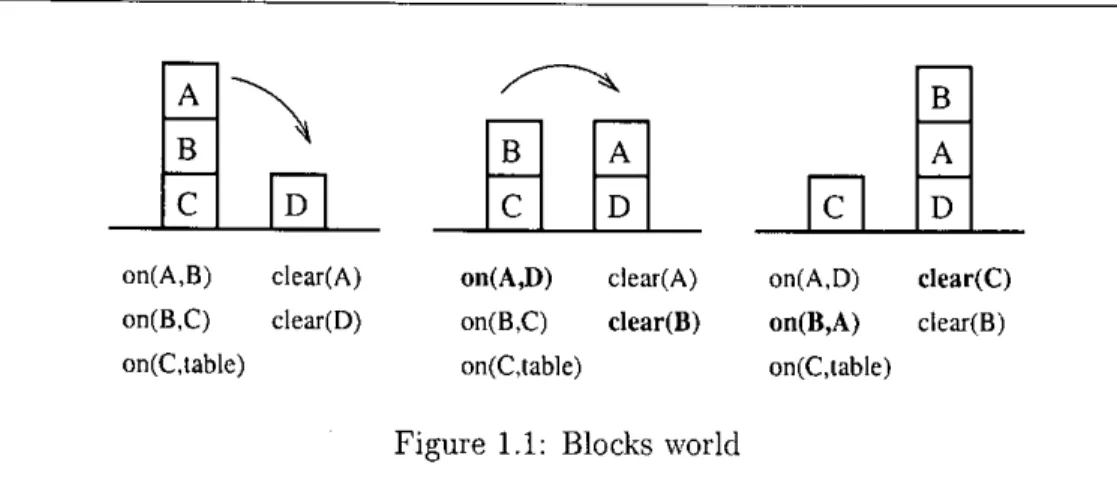
(10) `. Chapter 1. Int ro duct ion .. 1.1. Objectives and Motivation. Describing properties of actions and their effects on the state of the world has long been considered one of the central problems in the theory of knowledge representation [47]. Actions performed in a world change its state, for instance, actions of a robot or an agent, updates in a database, program statements, operations in a supply chain, selections/clicks in an interactive GUI, and so on. In Artificial Intelligence (AI) the goal is to model and build agents capable of reasoning, planning and acting in a changing environment. To perform nontrivial reasoning or to take action in the world, an intelligent agent situated in a changing domain needs the knowledge of causal laws that describe the effects of actions that change the domain, i.e., it must be able to predict the results of its actions. For the most part, applications fall into three broad categories that correspond roughly to the need to predict, explain, and understand physical phenomena [117].. s. 1. predictive, in which the objective is to predict future states of the system from observations of the past and present states of the system. 2. diagnostic, in which the ob jective is to infer what possible past states of the system might have led to the present state of the system. 0 3. planning, in which the ob jective is neither to predict the future nor explain the past but find a sequence of actions that lead the system to a desired state given an initial situation. Most of ^these applications require an almost complete description of the agent's actions and its environment which, for moderately complex dynamic systems, it is a time consuming task. Machine Learning methods can help to learn the domain specific knowledge necessary, for instance, in the development of plans, or to construct the description of a robot's actions and its environment.. A domain description consists of a set of fluent names, a set of action names, and a set of caus^^1 laws that describe the effects of actions that change the domain. Fluents serve to describe situations and are properties whose truth values may change in the course of time as the result of performing actions. Let us consider a classical domain, the Blocks world. Example 1(Blocks world) There is a table and some blocks, such that blocks can be moved onto other blocks or onto the table, which is large enough to hold all the blocks. For each block, either it is clear or else there is block sitting on it. The domain contains the action move and the fluents on and clear to represent the location of blocks and what blocks are clear respectively. ❑.
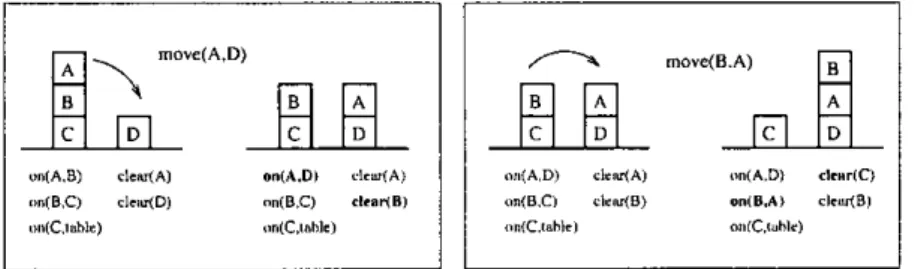
(11) •. Introduction ^-^. a. 0 on(A,B). clear(A). on(A,D). clear(A). on(B,C). clear(D). on(B,C). clear(B). on(C,table). on(C,table). on(A,D). clear(C). on(B,A). clear(B). on(C,table). Figure 1.1: Blocks world The domain to learn is a system that changes its state when acted upon according to some set of unknown rules or functions. The learner initially knows nothing of the contexts in which actions produce changes in the environment, nor what those changes are likely to be. An agent in such an scenario learns to predict the effects of his actions through observation, where inputs correspond to the actions executed and outputs correspond to the perceptual information available (Fig. 1.1), and constructs a dynamic system that can predict the future output of the unknown system, i.e., it must generate theories of how the actions affect the environment. In the blocks world, for instance, this means to determine the conditions under which blocks can be moved onto other blocks or onto the table, and predict the effects, i.e., the state of the blocks at the new situation after executing an action. While such predictions may not be completely accurate since they are based on incomplete experience, it is possible that they may be good enough to allow an agent to perform ef%ctively [13]. It is important to notice that a model need not be exactly the same as the environment from the learner's point of view. In many cases, this is because the perception ability of the agent is limited. To address this problem is a non-trivial task, taking into account the range of phenomena to accommodate, among others [111]:. • The causal laws relating actions to their ef%cts.. s. • The conditions under which an action can be performed. • Enviroriments partially known to an agent. • Exogenous and natural events. • Complex actions. • Discrete and continuous time. • Unreliable sensors. • Uncertainty. • Non-Determinism. Learning of Action Models [13] has been studied in a variety of disciplines including control theory, neural networks, and automata theory. The inferred model might correspond to a system of differential equations, a set of production rules [124], or a set of states and transition probabilities [13]. Most of previous approaches [87] were based on STRIPS [36] operators that. I.
(12) 1.1 Ob jectives and Motivation. were an early attempt to formalize descriptions of actions, consisting of a list of state features (or postconditions) that are added and another list of features that are removed by applying the operator, without more "deductive" features. For instance, the description of the operator move in the blocks world is the following: (move (params (<block> <block-from> <block-to>)) (preconds (clear <block>) (clear <block-to>)) (effects ( (add (on <block> <block-to>)) (del (on <block> <block-from>)) (add (clear <block-from>)). (del (clear <block-to>))))). For years, researchers in the nonmonotonic reasoning community aimed for theories of actions that are more expressive than STRIPS-like systems. Many extensions have been proposed since then, aiming for theories of actions that are more expressive than STRIPS-like systems or to alleviate problems in operator representation caused by the STRIPS assumptions, however, most of them rely on procedural representations. In this thesis we focus on learning representations of environments that can be characterized by non-monotonic formalisms for Reasoning abo^ct Actions and Change. These formalisms constitute an eí%rt towards Commonsense Reasoning grounded on a mathematical and computational foundation. Features as indirect ef%cts of actions (ramifications), implied action preconditions (qualifications), and concurrent actions are now easily represented. These formalisms are intended to precisely capture the ef%cts that an action produces given the current description of the world and the Preconditions that specify when the action can be executed. However, they are interested in temporal reasoning of a more general kind, e.g., explain observations about the state of the world in terms of what actions might have taken place, or what state the world might have been before -when the values of some fluents in one or more situations are given and the goal is to derive other facts about the values of fluents- to make plans and so on. We focus on Logic Programming (LP) theories of actions, i.e., theories of actions that either use logic programming directly to formalize some aspects of reasoning about actions or those that provide translations to logic programs [8]. In particular we deal with a logical approach to modeling dynamical systems based on a dialect of first order logic called the Sit^cation Calc^clvs [81]. Unlike other formalisms, where observations describe the pre- and post-execution states of actions, i.e., transitions are considered as independent entities and the concept of situation is not mentioned explicitly, the Situation Calculus represents explicitly the situation where an action is executed, i.e., the sequence of actions that led to that situation. This particular feature is essential for learning in action domains, as we will see in the next chapters. For instance, the sequence of actions of Fig. 1.1 is represented as the following facts, among others, where so is a constant that represents the initial situation: holds(or^(a, d), do(move(a, d), so)) holds(or^(b, a), do(move(b, a), do(move(a, d), so))) The use of Logic Programming makes it feasible to study the integration of Inductive Logic Programming (ILP) with logic programming theories of actions. Inductive Logic Programming,.
(13) 4. Introduction i.e., Machine Learning methods that use Logic Programming as the representation knowledgeis an emerging field in the area of Machine Learning. The ability to use a Logic Programming representation both for examples and rules has contributed to this success. As a result, an action theory is learned in the same way as it will be used, thus there is no a different representation for learning and another different for reasoning, planning and so on. Additionally these logicbased methods for learning provide a high expressivity with respect to propositional methods, the possibility of including arbitrary logic programs as background knowledge, and other special techniques, e.g., noise handling techniques, while learning without losing representational power. We can translate dynamic data into a Logic Programming representation that ILP methods can manage, where the temporal relationships among components and their states are partly expressed by the introduction of the variable Time in the training data. However, the use of first-order features to merely represent the sequence in a set of examples have restricted ability to model dynamic domains. For instance, non-monotonic reasoning is needed to avoid the explicit representation of unchanged properties from one particular situation to another (Frame Problem [81]). In the blocks world, after moving block A onto D in Fig. 1.1, we have that on(C, table) is not affected by the action, so that approaches that do not consider the inertia assumption have to explicitly assert it in the input data. As a consequence, non-affected values of fluents must be part of the information given to the learning algorithm, thus having to deal with large datasets from which only a small fraction corresponds to effects of actions. Unlike this, with the inertia assumption, observations need only be explicitly given for those situations where a fluent changes, whereas inertia propagates non-affected truth values from one situation to the next one. Thus, the learner must be able to infer how properties of a domain are affected by the execution of actions, or otherwise are subject to the general law of inertia. Furthermore, any attempt to learn in these formalisms must cope with other facets apart from inertia (and the associated Frame Problem), such as constraints and indirect ef^ects (and the associated Qualification [79] and Ramification [58] problem), nondeterministic and other complex effects of actions.. For instance, previous approaches to learning action models are restricted to predi ^ ting a single outcome or eífect of an action. This forces the explicit representation of all the ef%cts of an action as direct effects, producing the so-called Ramification problem, which makes the descriptions of actions cumbersome and difficult for complex domains. In many cases, the eífects of an action are not caused directly by the execution of the action but indirectly through other changes. Thus, the learner should infer how properties of a domain are (directly/indirectly.) affected by the execution of actions, or otherwise are subject to the general law of inertia. Previous approaches also dealt with effects of actions on a world where these are strictly specified. We show how to incorporate defeas^bility into the specifications, where negation-as-failure is used to represent absence of information about exceptions. The explicit use of exceptions allows to learn rules that are more generally applicable, mainly when there are occasional qualifications or noise in the observations which may decrease the quality of the learning results, or when a theory must be specialized minimally.. On the other hand, we need to learn a definition for allowed actions, forbidden actions and actions with an unknown outcome, and therefore we need to learn in a richer three-valued setting. For this task we adopt Extended Logic Programs (ELP) as the form of programs to be learned, where two kinds of negation -negation as failure and classical negatión- are eífectively used in the presence of incomplete information. Let us consider an autonomous agent that has to select its own actions on the basis of acquired knowledge [63]. As pointed by Lamma et al., if the agent learns in a two-valued setting, it will not know the diíference between what is true and what is unknown and, therefore, it can try actions with an unknown outcome. Rather, by learning in a.
(14) 5. 1.1 Ob jectives and Motivation three-valued setting, the agent will know which part of the domain needs to be further explored and will not try actions with an unknown outcome unless it is trying to expand its knowledge. The learning task studied in this thesis is an old problem in the Machine Learning field. We argue that this problem is best framed and solved by non-monotonic action theories where system's behaviors are naturally viewed as appropriate logical consequences of the domain's description, hence the specification of actions and their effects is made as intuitive and natural as possible [122]. Furthermore, a language that makes the notion of sit^cation moré central can provide a more convenient hypothesis space for learning, and a more compact description of observations, where observed time traces of property values are represented in the Situation Calculus in an homogeneous and natural way. Our goal in this thesis is to provide solutions to several representative problems that can be characterized with these formalisms. While we admit that the real world cannot be modeled by such theories to any high degree of predictive accuracy, given appropriate percepts and actions, it makes sense to model system identification in terms of non-monotonic action theories. Actually, very simple scenarios become significantly complex without an appropriate level of abstraction. Even if it were possible to construct such a detailed model, this would be absurdly and uselessly large. Despite these simplifying assumptions, we believe that our models are relevant to a variety of interesting tasks and environments, for instance, those involving agents with higher level cognitive functions that involve reasoning about goals, actions, collaborative task execution, etc.. On the other hand, the use of Action Languages allows that diverse learning tasks can be approached in an homogeneous way, for instance, learning the ef%cts of actions but also the dual problem, i.e., learning to act. In AI Planning, a planner is given an initial state and a goal, and finds a sequence of actions that maps the state into the goal. For instance, turning a configuration of blocks into another is a planning problem in the Blocks world (Fig. 1.2).. current. Goal. Figure 1.2: A planning problem in the Blocks world Planners generally search through a list of domain actions until a correct sequence of those actions has been found that can achieve the desired goals. This problem has been tackled by a number of algorithms and in recent years substantial progress has been made [133]. However, the problem is still computationally hard and the best algorithms are bound to fail on certain classes of instances. An alternative that has been proposed is to use knowledge of the planning domain for guiding the planning process [113, 2, 51] via a set of additional constraints that do not make explicit reference to the workings of the planner, but only refer to the solution space like the constraints that define the original problem instance. Search control information for the blocks-world may say things like: `pick up a mis^laced block if clear' `put current block on destination if destination block is clear and well placed' etc..
(15) 6. Introduction. •. The above control information for the blocks world is not included in the domain description, because it depends on a planning problem, e.g., well_placed is not used to predict the effects of moving blocks. Recent results have shown that it is possible to automatically acquire such high level declarative rules for action selection in planning in a purely declarative way. This problem has been very recently tackled by Kautz and Selman [52], Geffner [76] and Khardon [60], among others, using different schemes for representation and learning. More. precisely, they deal with the problem of learning how to solve a planning problem in a domain, given solutions to a number of small instances of it. Learned rules select the action to be executed based on the current situation where the action will be executed and both the initial and the goal situation, so that control rules encode the solutions to a class of problems that differ on both the initial and the goal situations. . In the last part of the thesis, we consider the task of learning action-selection rules where both plans and the control rules are represented in the Situation Calculus.. 1.2. Organization of chapters. This dissertation is organized as follows. In part I, we give a brief overview of formalisms for reasoning about actions and change (chapter 2), focusing on the Situation Calculus, as well as of Inductive Logic Programming methods (chapter 3). In part II we show what learning means in formalisms for reasoning about actions and change (chapter 4) and show that learning rules about actions and change may be possible using a Logic Programming implementation of the Situation Calculus and Inductive Logic Programming methods. A prototype to learn action theories in the Situation Calculus in the form of Extended Logic programs by using ILP methods is described in chapter 5. In chapter 6 we extend the framework of the previous chapter to deal with indirect effects of actions as well as with cyclical and recursive dependences, whereas in chapter 7 we learn defa^clt theories of actions, where rules are allowed to have exceptions. In part III, we propose some extensions to cope with complex effects of actions (chapter 8) and we adapt the previous framework for learning declarative control rules that help improving planning methods by reducing the search (chapter 9). In the last part, we review the most relevant related work in the field (chapter 10), present some conclusions and outline future work (chapter 11). Appendix A and B give a brief overview of basic Logic Programming concepts and the stable model semantics respectively.. ^.
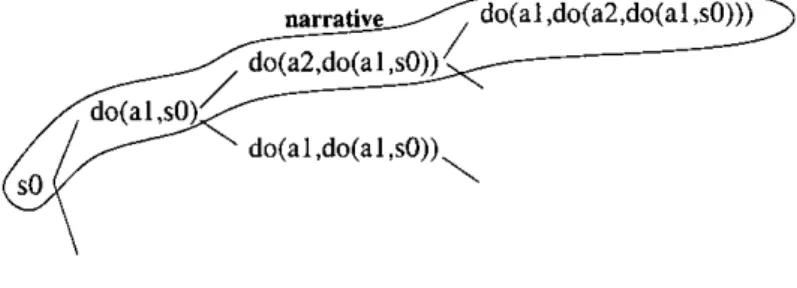
(16) Part I. Background.
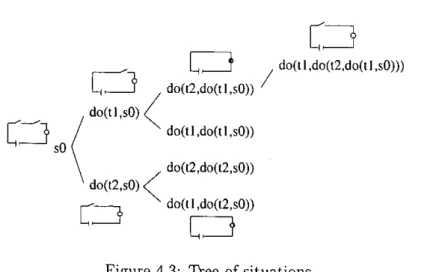
(17) •. •. •. •.
(18) a. Chapter 2. Non-monotonic Action Theories .. Action languages are formal models that are used for talking about the effects of actions [47]. These formal theories of actions are needed to describe dynamic behavior of programs, databases, robots, and other reasoning and actions agents, build agents capable of performing actions and reasoning in the dynamic world and reason about such agents. There are many existing disciplines that focus on modeling dynamical systems, including Petri nets, dynamic logic, temporal logic, finite automata, Markov decision processes, dif%rential equations, STRIPS operators, etc, that. s. solve problems that arise in sometimes narrowly circumscribed fields of specialization. However, as pointed by R. Reiter [111], there should be a unifying theory of dynamics, one that subsumes the many special purpose mechanisms that have been developed in these different disciplines, and that accommodates all the features of dynamical systems. In this chapter, we give a brief overview of formalisms for reasoning about actions and change, focusing on the Situation Calculus [81].. 2.1. Reasoning about actions and change. .. •. One of the goals in reasoning about actions has been to contribute towards the development of `autonomous agents' that can `perform' in a dynamic environment. For this task the agents have to sense, reason, plan, and execute actions. For instance, the task might correspond to the agent being in one of many locations in an office building, in which locations correspond to junctions where hallways meet [11]. In this case, the observed outputs might correspond to the number of hallways incident on a junction, and the inputs to actions for traversing incident hallways. As another example, consider the structure of a voice-mail system. Here the states might correspond to various menus and services, actions to keys pressed by the user, and outputs to the announcements made at each state. There are basic formalisms (referred to as STRIPS-like) -that was an early attempt to formalize descriptions of actions- where the knowledge T simply codes the possible answer pairs (action,ef%ct) without more "deductive" features. For years, researchers in the nonmonotonic reasoning community aimed for theories of actions that are more expressive than STRIPS-like systems. Research in nor^-monotor^ic Action Theories constitutes an effort towards Commonsense Reasoning grounded on a strong mathematical foundation, where system's behaviors are viewed as appropriate logical consequences of the domain's description. Most of these formalizations define an entailment relationship (^) between the specifications (of effects of actions and relations among objects of the world). This ability allows to make plans that will take us to particular kind of worlds and explain observations aboút the state of.
(19) Non-monotonic Action Theories the world explain observations about the state of the world in terms of what actions might have taken place, or what state the world might have been before, or both [11]. Features, as indirect e^ects of actions (ramifications), implied action preconditions (qualifications), and concurrent actions are easily represented in non-monotonic action theories. Until recently, however, these theories were of theoretical interest only because of their high computational complexity. The situation has since changed substantially [67, 128, 101]. In fact, recent works have shown that a competitive planner can be built directly on top of one of such formalisms. Formalisms for reasoning about actions and change are intended to precisely capture the effects that an action produces given the current description of the world and the preconditions that specify when the action can be executed. That is, they allow to do terraporal projections to predict the state of the world after the execution of a sequence of actions. In a temporal pro jection problem, we are given a description of the initial state of the world, and use properties of actions to determine what the world will look like after a series of actions is performed. Current formalizations are interested in temporal reasoning of a more general kind, for instance, the cases when we want to use information about the current state of the world for answering questions about the past, i.e., when the values of some fluents in one or more situations are given, and the goal is to derive other facts about the values of fluents. Recently there has been a lot of progress in formulating theories of actions, particularly in progressing from simple and/or restricted theories and `example centered approaches', to general theories that incrementally consider various specification aspects [122]. This allows that more complex problems can be managed. For instance, Cognitive Robotics is an emerging field aimed at the construction of robots whose architecture is based on the idea of representing the world by sentences of formal logic and reasoning about it by manipulating those sentences [122, 11]. Action formalisms are also used for the diagnosis of dynamic systems [100], where the system behavior is described in an action formalism. Once diagnosis is defined in an action formalism, faults are viewed as any other evolving property of the domain, and the solution to the diagnosis problem provides an explanation for what components failed and when they did. Reiter [69] proposed specifying transactions in databases describing the evolution of a database under the effect of an arbitrary sequence of update transactions, like a dynamic system. Expressed in this way it is possible to pose and answer historical queries, to determine legal or illegal sequences of updates to the database and so on. Recently it has been shown that action formalisms are appropriate for Natural Language understanding due to the inferential and representational capabilities [102].. E. •. •. •. In this chapter, we give a brief overview of these formalisms, focusing specially on the Situation Calculus because it is the formalism we have selected for learning. •. 2.2. The Situation Calculus. The most classical formalisms for actions and change are the Situation Calculus and the Event Calculus. Situation Calculus [81] is a logical approach to modeling dynamical systems based on a dialect of first order logic. A formal framework to reason about actions and change requires the basic notion of a sitnation. Situation Calculus conceives of the world as consisting of a sequence of sit^cations, each of which is a snapshot of the state of the world. Situations are generated from previous situations by actions. Any aspect of a system which can change as the result of an action or event is indexed by a situation and represented as a fluent. The next step is to represent how the world changes from one situation to the next. An action, if executed in some. •.
(20) w. a. 11. 2.2 The Situation Calculus situation, leads to a"resulting" situation. Situation Calculus uses the function do(action, sitz^ation). .. or Res^clt(action,sit^ation) to denote the situation that results from performing an action in some situation. Fluents serve to describe situations and enable to reason about changes in the truth value of observations as the result of performing actions. Holds( f luent, do(action, situation)) A situation argument may be in the form of a constant si or else a situation resulting after executing an action do(action, sit) . An special situation so is included to represent the initial situation. A sequence of situations is encoded in the form of chains: do(actionn, do(actionn_1, . . . , do(actionl, s) . . .)). •. starting from the initial situation. The concept of situation of the Situation Calculus differs from the concept of state used in automata-based approaches. An state S is a set of fluent literals, i.e., expressions of the form f or f, such that each fluent occurs either affirmatively ( f) or negatively ( f) in S. Thus, an state can be mapped to multiple situations. A narrative is a course of actions about which we might have incomplete information. Formalisms for reasoning about actions may be divided into those which are narratiye-based, such as the Event Calculus and those which reason on the level of sequences of actions, e.g., the Situation Calculus. In narrative formalisms, e.g., the Event Calculus [121], situations are usually represented by natural numbers, and a predicate happens/2 is added to indicate the actions that happened at each time point in the narrative. In this case, narratives correspond to a course of real actions. Holds(e, n) Happens(a,^, n), . . . , Happens(al, 1). Situation Calculus operates at a more abstract level than that of actual actions. It allows to reason about the hypothetical situation which results from the performance of a sequence of hypothetical actions [85]. Questions such as "is e an effect after the sequence of actions (al, a2, ..., an)?" are expressed as formulas by means of the predicate Holds(e, s) and the function Res^clt(a, s): Holds(e, Result(an, (. . . (Res^clt(a2, (Resnlt(al, so)))) . . .))) • Actions are described by stating their effects, that is, we specify the properties of the situation that results from doing the action. For instance, consider a robot r that can hold, drop and repair ob jects. The efiect on the fluent brol^en of dropping and repairing something can be expressed in the form: Holds(holding(r, ^), s) n f ragile(^) •. Holds(hasglue(r), s) n Holds(broken(^), s). ^ Holds(broken(^), do(drop(r, ^), s)) ^^Holds(brol^en(^), do(repair(r, ^), s)). where s, ^, y and z are universally quantified variables, and fragile is an static property of objects. These axioms are called effect a^ioms or action laws, and capture the causal laws of a domain describing the changes in the values of fluents as a result of performing actions. In this example, the first axiom states that when the robot drops a fragile ob ject ^ that he was holding, ^ will.
(21) 12. Non-monotonic Action Theories. *. be broken in the resulting situation, whereas the second axiom states that repairing a broken ob ject ^ is possible provided the robot has glue. Given the description of a domain and an initial situation so, it is possible to solve projection problems, where we are interested in the value of a fluent at a particular situation, for instance: Holds(broken(^), do(repair(r, ^), do(drop(r, ^), so)))? In a planning problem, we are given the initial situation and a goal condition and have to find a sequence of actions that lead from the initial situation to a situation where the goal condition holds, for instance:. •. Find A and B such that Holds(brol^en(^), do(A, do(B, so))) In an e^planation problem, we are given one or more observations at one or more situations, for instance, ^Holds(broken(^), sl), and the objective is to explain observations about the state of the world in terms of what actions might have taken place, or what state the world might have been before. Situation Calculus has several problems that limit its applicability [48]. VVhen there are multiple agents in the world or when the world can change spontaneously, or there are actions that have diíferent durations, or whose effects depend on duration, then the Situation Calculus in its intended form cannot be used at all. Advantages and disadvantages of the Situation Calculus have been the sub ject of many debates in the knowledge representation community. It is clear that at least in simple cases -when actions are deterministic and are not executed concurrentlythe language of the Situation Calculus is very attractive. Furthermore, several extensions have been added that allow to deal with ramifications, qualifications, concurrent actions, exogenous actions, durative actions and so on [104]. There are other formalisms to reason about actions apart from the Situation Calculus and the Event Calculus, among others, the family of ,A languages [47], Causal Explanation [77], Temporal Action Logic [50] based on the concept of occlusion, Pertinence Action Language [101, 21] based on the concept of pertinence [101], the GOLOG language [65], and so on. Some of them are based on the Situation Calculus [67, 65], however most of them are narrative formalisms and use circumscription (80] or completion as the non-monotonic inference method. Many of them can be implemented in Logic Programming, however this is classically used for the Situation Calculus and the Event Calculus.. 2.3. .. Challenges for Action Theories. The use of logic-based formalisms raises specific challenges for action theories, of v^^hich the most famous are, in historical order, the Frame Problem, the Qualification Problem, and the Ramification Problem. The Frame Problem [81] is the problem of how to express the facts about the ef%cts of actions and other events in such a way that it is not necessary to explicitly state for every event, the fluents it does not af%ct. The dynamics of the world are specified by effect axioms which specify the effect of a given action on the truth value of a given fluent. As has been long recognized, axioms other than ef^ect axioms are required for formalizing dynamic worlds. These are called frame a^ioms and they specify the fluents unaífected by the execution of an action. For instance, in the example of the previous section, we have the following frame axiom: Holds(holding(r, ^), s) n ^Holds(broken(y), s) n[y ^^ V^ f ragile(y)] ^ ^Holds(broken(y), do(drop(r, ^), s)). .. ..
(22) A.. s. 2.3 Challenges for Action Theories to mean for the conditions under which the fluent broken is not affected by the action drop. Together, effect axioms and frame axioms provide a complete description of how the world evolves in response to an agent's actions. The problem associated with the need for frame axioms is that normally there will be a vast number of them. Normally only relatively few actions will affect the truth value of a given fluent. All other actions leave the fluent invariant, and will give rise to frame axioms, one for each such action. This is the Frame problem. When we specify action laws, we are only interested in describing changes, assuming that all the rest will remain unaf%cted. Solutions to the Frame problem involve the application of the inertia assumption for non-changing fluents. On the other hand, actions often have other ef%cts than those we are immediately inclined to put in the axioms concerned with the particular action. The Ramification Problem [58] is the problem of how to express the effects without forcing the explicit representation of all the effects of an action as direct ef%cts. Let us consider the following example due to Thielscher [128]. Consider the action of toggling a switch, which in the first place causes nothing but a change of the switch's position. However, the switch is probably part of an electric circuit so that, say, some light bulb is turned of^j; as side e,f^`ect, which in turn may cause someone to hurt himself in a suddenly darkened room by running against a chair that, as a consequence, falls into a television set whose implosion activates the fire alarm and so on.. i. The fact that the fire alarm becomes active is not caused directly by toggling a switch, however it started the sequence of events. As a consequence, there will be an ef%ct axiom that connects the fire alarm and every possible action that eventually may cause the television to implode. This makes the descriptions of actions cumbersome and difficult for complex domains. With respect to the robot's example, if the ob ject is a light bulb, the bulb will be definitely oíf when it is dropped. Then we need an eífect axiom for the fluent light_ is_ o, f^` and for every action that eventually breaks the bulb, apart from dropping it. And however, the state of the light does not depend on the particular action that broke the bulb. Solutions to the Ramification Problem are based on the use of indirect eíiects, where domain constraints, i.e., general laws describing dependences between components of the world description, are used apart from the eífect axioms. The Qualification Problem [79] concerns how to express the preconditions for actions without having to account for the many conditions which, albeit being unlikely to occur, may prevent the successful execution of an action. McCarthy poses the following example: that it is necessary to have a ticket to fly on a commercial airplane is rather common to express. That it is necessary to be wearing clothes needs to be kept inexplicit unless it somehow comes up. The Qualification problem is still one of the least understood and with few satisfactory solutions. The main problem is that in general it is infeasible to represent complete specifications of all the preconditions to actions which would include all possible qualifications [30]. Solutions to the Qualification problem are based mainly on the use of defeasible specifications, so that if a new condition is observed where the action, for instance, drop(r, ^), is disqualified, that is not considered in the effect axiom, this can be retracted, in the spirit of non-monotonic reasoning, by adding new postulates. Finally, one of the motivations for action formalisms is to find representations that are elaboration tolerant [79], i.e., representations that allow scenario descriptions to be modified and extended with additional information, to take into account new phenomena or changed circumstances, without extensive changes. In formalisms that do not fit with the elaboration tolerant condition, a single change in the description of the domain leads in many cases to a completely new representation.. 13.
(23) w. 14. Non-monotonic Action Theories. 2.4. Logic Programs to reason about actions. In this section, we focus on logic-based formalisms for reasoning abo^ct actions and change. By logic programming theories of actions we refer to those theories of actions that either use logic programming directly to formalize some aspects of reasoning about actions or those that provide translations to logic programs [46, 9]. Logic programming can be used to represent the effects of actions by importing the ontology of the Situation Calculus [121], representing effect axioms as logic program clauses and using negation-as-failure (NAF) as a means of overcoming the frame problem. Most previous work on Logic Programming consider definite Horn programs. However, research work on Reasoning about actions has shown that such programs are not adequate to represent the ef%cts of actions [46]. First formalizations of actions in LP were adequate for only the simplest kind of temporal reasoning, "temporal pro jection", and only in the cases when the given description of the initial state is complete. The reason for that is that these formalizations use the semantics of logic programming which automatically apply the "closed world assumption" to each predicate. For these reasons, properties of actions are represented by means of Extended Logic Programs (ELP), i.e., logic programs that use both classical negation and negation as failure [46, 9] . Negative information is thus represented explicitly to allow the derivation of the negative value of fluents, whereas negation-as-failure is used for inertia. Situation Calculus programs are logic programs with a fixed clausal structure. Formally we have: Definition 2.1 (Situation Calculus Program) A Situation Calculus program is the conjunction of [121]: • A finite set of general clauses [^]Holds(f, so). (2.1). where so denotes the initial situation. • A finite set of clauses in the form Holds( f, do(a, s)) ^ ^r+. (2.2). ^Holds( f, do(a, s)) ^ ^r-. (2.3). where ^+ and ^- does not mention the Affeets predicate and every occurrence of the Holds predicate in ^r is of the form [-^]Holds(F', s). The description states that, in any situation, if the precondition holds then the effect will hold in the resulting situation. These axioms are called ef,j`ect a^ioms or action laws. • A finite set of A ffects clauses of the form Affects(a, f, s) ^ ^r. (2.4). where ^r does not mention the Affects predicate and every occurrence of the Holds predicate in ^ is of the form [^]Holds( f', s). • The universal frame axiom describes how the world stays the same (as opposed to how it changes). Holds( f, do(a, s)) F-- Holds( f, s) n not Affects(a, f, s). (2.5). ^Holds( f, do(a, s)) ^^Holds( f, s) n not .4ffects(a, f, s). (2.6) ^. ♦.
(24) a •. 2.4 Logic Programs to reason about actions This Logic Programming implementation of the Situation Calculus uses an special predicate af,j`ects/^ and negation as failure to implement inertia. Inertia is tackled in the following way: a fluent may only change if a cause for the change can be derived from the theory. This ability to succinctly represent all the actions which leave a given fluent invariant is precisely the kind of solution to the frame problem we seek. The Universal frame a^iom makes so-called frame axioms unnecessary. Thus, we can add as many eflect axioms as we like and rely upon axioms (2.5) and (2.6) to implement inertia. The description of the robot scenario in section 2.2 would be the following: Holds(brol^en(^), do(drop(r, ^), s)). F-. Holds(holding(r, ^), s), f ragile(^). ^Holds(brol^en(^), do(repair(r, ^), s)). F--. Holds(hasglue(r), s), Holds(brol^en(^), s). Affects(drop(r, ^), brol^en(^), s). ^. Holds(holding(r, ^), s), f ragile(^). Affects(repair(r, ^), brol^en(^), s). F-. Holds(hasglue(r), s), Holds(broken(^), s). Lifschitz [46] and Baral [11, 10] extend this LP formalization under the Answer Set semantics [44], to cope with indirect eífects, exceptions, undefinedness and concurrent actions. Furthermore, several extensions have been developed based on the Situation Calculus to cope with exogenous actions, durative actions and continuous change [104, 86]. We will deal with some of these extensions in the next chapters. Some formalizations of the Situation Calculus include a binary predicate Poss, apart from do, holds and a,f,^ects, such that for any action a and any situation s, Poss(a, s) is true if a is possible (executable) in s. For instance, in the blocks world, we would write: Poss(move(^, y), s) ^ holds(clear(^), s), holds(clear(y), s). E. •. •. to represent that it is possible to move block ^ onto y provided both ^ and y are clear. Thus, holds/^ clauses represent the conditional effects whereas Poss represents the qualifications to the action and acts as a domain constraint forbidding some next states. If an action produces diíferent eífects in dif%rent situations, clauses for Poss/2 represent the union of the applicability conditions no matter what the effects are. Other formalisms use predicates that are somewhat similar to a, f,^ects/^. A dialect of the Situation Calculus due to F. Lin [67] uses a predicate Caused to capture simultaneously both the concept of causality and the truth value of the fluent, that constitutes a solution to both the Frame and the Ramification problems. Tempóral Action Logic [50] uses a predicate Occluded to solve the Frame Problem, that expresses that a fluent has changed from false to true. Pertinence Action Language [101] uses a predicate Pertinent that like af^`ects/^ is not related to the truth value, but it represents a more general concept than simply change of value.. 15.
(25) s 16. Non-monotonic Action Theories. i. i. •. •. s. •. ^.
(26) *. Chapter 3. Inductive Logic Programming .. Inductive Logic Programming [93] (ILP) is a research area formed at the intersection of Machine Learning and Logic Programming. Unlike classical inductive learning [17], where only propositional learning systems are used, ILP uses Logic Programming as the representational mechanism for hypotheses and observations. By doing so, ILP can overcome the two main limitations of classical machine learning techniques: • the use of a limited knowledge representation formalism (essentially a propositional logic) • and the difficulties in using background knowledge in the learning process. •. The first limitation is important because many domains of expertise can be only expressed in a FOL, or a variant of first order logic. An ILP method can be used for propositional domains, however, the utility of ILP is most viewed when dealing with relational domains. As a counterpart, the task of ILP becomes significantly more complex as the space of solutions is extremely large. For this reason, additional mechanisms are added to the classic induction methods that restrict the space of solutions following the user preferences. ILP can use so-called Backgro^cnd Knowledge (BK), consisting basically of predicate definitions to be used during learning [94, 106]. The fact that both facts, rules and the background are in the form of Logic Programs is an appealing feature of ILP systems, where for instance, the background can include domain-independent definitions, e.g., type information, patterns to indicate what kind of rules will be learned, and so on. This kind of information is not obvious how could be added to a propositional learning system. ILP systems have been applied successfully in a number of real-world domains. Presently successful applications areas for ILP systems include the learning of structure-activity rules for drug design, finite-element mesh analysis design rules, and so on. In this chapter we give an overview of ILP methods focusing specially on those features that are relevant for learning action models.. 3.1. General definition of ILP. • ILP systems develop predicate descriptions from examples and background knowledge (B). The examples E_ E+ U E-, background knowledge B and final descriptions are all described as logic programs. E usually consists of ground unit clauses of a single target predicate. E can be separated into E+, ground unit definite clauses and E-, ground unit headless Horn clauses..
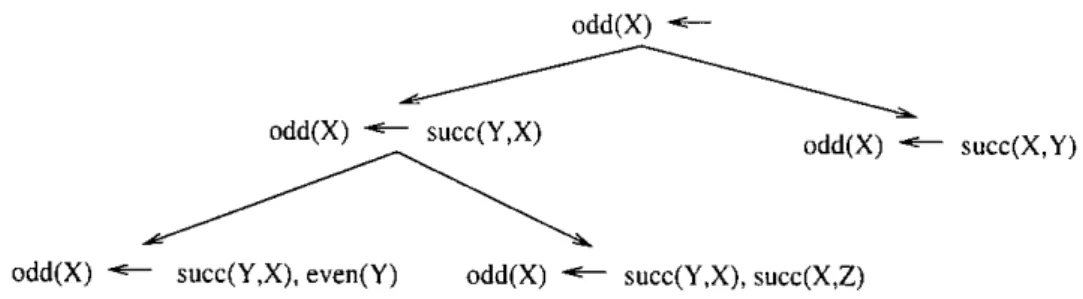
(27) 18. Inductive Logic Programming The following example, dealing with natural numbers, might be represented using the following clauses: E+ _ { even(0), even(2), . . . E- _ { F- even(1), ^ even(3), . . . odd(1), odd(3), . . . B = succ(0, 1), succ(l, 2), succ(2, 3) ... . zero(0) As in propositional learning, the objective is to find a most general rule or set of rules that explain the positive examples and no negative examples. This means that Prolog after consulting program B will answer:. •. Note that, the answer is due to the application of negation-as-failure, because actually Prolog does not know anything about even/2. After learning a correct hypothesis, Prolog will answer: ?- even(4). yes ?- even(3). no. Formally we have: Definition 3.1 (General problem specification of ILP) The general problem specification of ILP is, given background knowledge BK and examples E, find the simplest consistent hypothesis H such that: (Prior Necessity) (Posterior Sufficiency) (Prior Satisfiability) (Posterior Satisfiability). BK ^ E+ BK U H^ E+ BK U E- ^ 1 BK U H U E- ^ 1. Prior Necessity states that the positive examples must not be derivable from only the background, otherwise, learning is not necessary. Prior Satisfiability states that negative examples do not cause contradiction with background, given that the background consists of predicate definitions whose validity is previously assumed and cannot be retracted. Posterior Sufficiency and Satisfiability state that the solution must be a hypothesis that is complete and consistent respectively. The result of the learning process in the even/odd example for the predicate even/2 is a theory in the form: even(A). ^. zero(A). (3.1). even(A). t-. succ(B, A), odd(B). (3.2). •.
(28) 19. 3.2 Testing the generality of hypotheses. •. A crucial feature of most advanced ILP algorithms is the possibility of including arbitrary Prolog programs as background knowledge, and not only ground clauses as in the first methods (106, 94], e.g., by calling a Prolog interpreter to derive ground atoms from intensionally coded specifications of background predicates. Some methods like Progol [89], integrate the induction method into a Prolog interpreter. In the previous example, an intensional definition for the predicate succ/2 can be provided: s^ccc(A, B) ^ B is A+ 1.. 3.2. •. Testing the generality of hypotheses. A central issue in the definition of any ILP method is the method for testing the coverage of a hypothesis, i.e., testing whether a hypothesis entails an example e. This can be done extensionally or intensionally. Definition 3.2 (Extensional coverage) A hypothesis H under background B e^tensionally covers an example e(H ^ e), iff there exists a clause c E H and a substitution B such that head(c) 8 = e body(c) 6 C M(B) where M(B) is the least Herbrand model of the Background Knowledge B.. ❑. In the even/odd example, we have that the learned theory covers extensionally even(2) if there is an instantiation of the rules 3.1 or 3.2, for instance: even(2) E- s^ccc(1, 2), odd(1) •. Extensional coverage uses 8-subsumption which is computationally more efficient than resolution but that it is known to suf%r from several drawbacks: • It has been proved that 6-subsumption is sound, e.g., c^ d implies c--^ d. The converse, however, does not hold for certain types of self-recursive clauses. For instance, the following clause: ancestor(X, Y) E- ancestor(X, Z), ancestor(Z, Y) does not subsume the clause: ancestor(a, d). ^ ancestor(a, b), ancestor(b, c), ancestor(c, d). because there is no substitution 9 that makes body(c) 9 C M(B). However, in fact, the first clause is more general than the second one. Extensional coverage would need the fact ancestor(b, d). This means, that extensional coverage is very dependent on the completeness of the training set, i.e., it needs that all intermediate facts to prove an example are provided. • Given this extensional coverage test, we have to remove from the search space the clause p(X ) F- p(X ) because it is always consistent and complete..
(29) Inductive Logic Programming. •. The problems come from the fact that clauses are learned extensionally but then the whole program is interpreted intensionally (i.e., it is run on a Prolog interpreter). Adopting an intensional ^evaluation of clauses, most of the problems of extensionality are automatically overcome, since a logic program is learned in the same way as it will be used. Definition 3.3 (Intensional coverage) A hypothesis H under background B intensionally covers an example e iff there exists a clause c E H such that. •. BU{c}^e O. F^om a practical point of view, logical entailment of a fact e by a theory T= B U {c} can be verified using a Prolog interpreter with knowledge base T and the query ?- e. With recursive clauses a hypothesis may have to be executed several times to prove an example. For instance, in the example above, the clause for ancestor/2 is executed once for ancestor(b, d) and once for ancestor(a, d).. 3.3. Methods in ILP. The theory of ILP is based on proof theory and model theory for the first order predicate calculus, where inductive hypothesis formation is characterized by techniques including [93]: • inverse resolution • relative least general generalization • inverse entailment. •. First methods [92] approached the problem from the direction of resolution proof-theory, where inference rules based on inverse resolution are able to invert one deductive inference step. Resolution is a sound proof procedure and can be inverted to form a useful inductive inference procedure. Resolution is diagrammatically shown with a large v. c2. Figure 3.1: Resolution There are two operators that carry out inverse resolution, absorption and identification, which are called V-operators. Each operator builds one of the two parent clauses given the other parent clause and the resolvent. More precisely, absorption constructs C2 from Cl and R, while identification constructs Cl from C2 and R. Let us consider the following example given in [82]:.
(30) 3.3 Methods in ILP. 21 parent(u^tri,mury). C2. d a ug h t e^^(^nu ry, Q^111). Figure 3.2: Inverse Resolution We could learn the clause C2 = da^eghter(X, Y) ^ parent(Y, X) which would be the most useful clause. Other solutions include: daughter(mary, ann) Edanghter(X, ann) Edaughter(mary, Y) ^ da^cghter(mary, ann) Fda^cghter(mary, ann) ^ daughter(mary, ann) ^. w. parent(ann, mary) parent(ann, X ) parent(Y, mary) parent(Y, mary) parent(ann, X ) parent(Y, X ). In general there exists a vast range of possible answers of which only a few will be of any value, which introduces many sources of indeterminacy. The Golerri system [94] aims at overcoming the search explosion of its predecessors, due to the high non-determinism of the inverse resolution rules. Golem uses Plotkin's relative least general generalization [105] (rlgg). In the rlgg operator we are given background knowledge B and two examples el and e2, and we want to find a clause C such that both B n C ^ el and B n C ^ el are true, i.e., a generalization of the clauses el ^ B and e2 E- B. To compute the rlgg of the two examples with respect to B, Golem takes the lgg of these clauses. For instance, for the even/odd domain, Golem will build from even(8) and even(12) the following clause: even(a) t- s^ecc(a, b), sncc(c, a), odd(c), succ(d, c), ... In practice, this process is repeated for several examples until a more general hypothesis is obtained. The rlgg operator eliminates all indeterminacy of the search, though it suffers from several problems: • It requires the background to be given extensionally. • The two examples contribute to the generation of one clause, hence, they must be part of the same clause in the target concept. If they correspond to dif%rent clauses, then, in general, the clause produced by rlgg will be useless. To address this problem, Golem consider a large sample of pairs and the best of these is selected and generalized. • In general this rlgg will be large. Some biases must be applied to the clause to reduce it.. •. The Golem system together with Foil, were the first systems to be considered efficient. In both, background must be provided as ground facts. The Foil system [106] is an extended version of the classical C4.5 [107] to deal with relational data, such that, the learning process remains the same but the specialization process is modified to, learn Horn clauses. The process of specialization starts from the most general clause and adds literals to the clause -based on an heuristic measure- until a solution is found (Fig. 3.3)..
(31) •. 22. Inductive Logic Programming odd(X) ^. odd(X ^ succ(Y,X). odd(X) ^ succ(Y,X), even(Y). odd(X) ^ succ(X,Y). •. odd(X) ^ succ(Y,X),succ(X,Z). Figure 3.3: Foil's search space for the even/odd domain. Current methods consider a model-theory approach. In particular, Inverse Entailment (IE) is a generalization and enhancement of previous approaches, implemented in the Progol system [89]. Given background B, an example E and a hypothesis H satisfying B n H^ E, we can invert the entailment relation such that:. BnH^E ^. B^(H^E). (3.3). a. B ^ (^E ^ ^H). (3.4). a. B n ^E ^ ^H. (3.5). Steps 3.3 and 3.5 are derived through the deduction theorem, whereas step 3.4 requires the contrapositive form of a clause. Put 1 as the conjunction of ground literals that are true in every model of B n^E. Then we can write:. ^. ^l ^ ^H. (3.6). H ^ 1. (3.7). ^. Such 1 is effective for reducing the hypotheses space, where a possible hypothesis H is constructed as a clause that subsumes 1, thus, H is derived, in some sense, deductively. For instance, Progol [89] builds the following clause from even(2) and the background: 1= even(a) E- sncc(b, a), odd(b), succ(a, c), odd(c), ... which is subsumed by the clause 3.2 for even/2. In practice, Progol performs an A* search in the space of hypotheses delimited by the most general clause and the bottom clause, until a consistent hypothesis is found that maximizes a compression measure. Yamamoto [134] showed that IE is complete for relative subsumption but incomplete for entailment. The example Yamamoto used -where functions have been removed- is the following: B _ even(0) ^ even(y) ^ s(^, y), odd(^) E= odd(3) ^ s(2, 3), s(1, 2), s(0,1) 1= odd(z) E-- even(0), s(y, z), s(^, y), s(0, ^) The correct hypothesis H= odd(n) E- s(v, ^c), even(v) does not subsume 1 relative to B -thus, H cannot be derived by IE under B- and however B n H^ E. In this case, the incompleteness of the background seems to be the cause, as we do not know odd(1), odd(2), even(1), even(2).. •.
(32) w. 23. 3.4 Declarative bias. •. •. •. In general, IE is incomplete with recursive clauses, where it needs to use the hypothesis more than once to prove the example. Yamamoto [134] and Furukawa [42] gave different conditions that guarantee the completeness of IE. Muggleton showed that enlarging the bottom set leads to completeness of IE [90], where the bottom clause is enlarged with {a ^ a E HB(BnE)-M(BnE)} -where HB is the Herbrand base and M is the least Herbrand model- resulting in the following 1-clause: odd(z); odd(^); ...; even(^); ... E- even(0), s(y, z), s(^, y), s(0, ^) where ; represents disjunction, from which the intended clause can be derived. We can see that in order to prove odd(z) the intended clause must be executed twice, once for odd(^) and once for odd(z). In general, a notion of abduction is needed to cope with the problems caused by the incompleteness of the background knowledge [56]. More recently, a technique called Theory Completion using Inverse Entailment (TCIE) [91] based on IE developed by S. Muggleton uses a notion of abduction. Let us consider the following example of [89]. = hasbeak(tweety) ^ _ ^ hasbeak(tweety) hasbeak(X ) F- bird(X ) _ bird(X ) F- vulture(X ). 1(B, E) Hl. _{ hasbeak(tweety), bird(tweety), vulture(tweety) F= bird(tz,veety) ^. HZ. = bird(X ) E-. H3 H4. = vulture(tweety) F= vulture(X) ^. In this case, Hl, H2, H3, H4 are potential hypotheses that allow to prove E+ and however, the predicate in E+ does not coincide with the head of the hypothesesl. TCIE is given multiple goal predicates and it uses an standard covering algorithm where each example is generalized using a multi-predicate search over all the predicates to find the hypothesis that covers the given example with maximal information compression. TCIE is capable of recovering accuracy to a substantial degree, even when large sections of the background are missing.. 3.4 •. E+ EB. Declarative bias. The space of solutions when learning in first order predicate calculus has to be reduced by using some kind of bias. Most learning systems learn function-free Horn clauses and definite programs. Even so, the space of solutions is still intractable. In this section we review some biases used for current systems.. •. First of all, clauses containing functions, must be flattened before learning can be done. Flattening [116] is a technique that removes constants and functions from the arguments of clauses by introducing a n+ 1-ary predicate for each n-ary function (n > 0). For instance, the fact: odd(succ(succ(succ(0) ) ) ) lIE follows the Observation Predicate Learning (OPL) assumption in which both the examples and hypotheses define the same predicate..
(33) 24. Inductive Logic Programming. •. can be flattened into: odd(z) F-- succ(y, z), succ(^, y), sncc(0, ^) Many different methods exist for declarative bias, each relying on an special formalism. In these methods, the user can previously establish the form of the clauses to be searched, by selecting a predicate for the head and predicates that can appear in the body, and so on, adapting the search to the domain at hand. Language bias imposes certain syntactic restrictions on the form of clauses allowed in hypotheses. Recent results show that reducing the size of the target language often makes ILP learning more tractable. The main restrictions are on the introduction of existentially quantified variables in the bodies of clauses. Most important domain-independent biases are the following: Definition 3.4 (Constrained clause) A clause is constrained if all variables in the body also appear in the head. ❑. •. •. For instance, the following clause: not f ree(A) E- on(B, A) stating that a block is not free when any other block is on it, would be non-constrained according to the definition. Definition 3.5 (Range-restricted clause) A clause is non-generative or range-restricted if all variables in the head also appear in the body. ❑ For instance: this classical definition used in many Prolog books is not range-restricted, as variable C is not referred to in the head. grandparent(A, B) ^ parent(A, C), parent(C, B). Definition 3.6 (Determinate clause) A clause is determinate ifi each of its literals is determinate; a literal is determinate if each of its variables that does not appear in the preceding literals has only one possible binding given the bindings of its variables that appear in preceding literals. ❑ For instance, the relation linked_to in an undirected graph makes that the relation connected cannot be represented as a set of determinate Horn clauses, because several bindings are possible for C in linked_to(A, C). connected(A, B) F- linked_to(A, B) connected(A, B) ^ linked_to(A, C), connected(C, B) This restriction is useful in ILP as it simplifies and speeds up the resolution process, however, it reduces the concepts that can be represented. Definition 3.? (Depth of a variable) The depth d(v) of a variable v in a clause C is defined as follows: 0 if v is in the head of C d(v) _ (minuEU„d(u)) + 1 otherwise where Uv are the variables in atoms in the body of C that contains v.. ❑. a.
(34) w. 25. 3.5 Recursive programs In the following clause, variable z has depth 0, y has depth 1 and ^ has depth 2. odd(z) ^ succ(y, z), succ(^, y), succ(0, x) Consider asking Prolog what lists 1 is a member of. Clearly there are an infinite number of answers, and Prolog cannot find all of them. The member/2 predicate was not really written with those sorts of questions in mind, i.e., the first argument was meant to be the variable, not the second [18]. This sort of difficulty is prevented by the use of so-called mode declarations that specify input and output arguments of predicates. Definition 3.8 (Input/Output variables) Input variables of a literal Li (i < n) in the ordered Horn clause A F-- L1i ..., Ln are those appearing in Li that also appear in the clause A^ L1i ..., Li_1. All other variables are called output variables. ❑ •. In mode declarations, + types are used where there is an input argument of a predicate, and - types are used for an output argument. For instance, in the odd/even domain, new variables are introduced through predicate succ/2. {even(+nat), zero(+nat), succ(-nat, +nat), odd(+nat)} Mode declarations in Progol, combine input/output arguments for every predicate with limits on the number of alternative solutions (recall) for instantiating an atom. For a predicate such as succ/2 the recall would be 1 since a number has at most one predecessor, whereas for a predicate such as square_root/2 the recall would be 2 since a number has at most two square roots. An alternative approach to language restrictions related to the idea of mode and type declarations, is the use of templates that describe the form hypotheses must take. This approach is sometimes referred to as rule-models.. .. 3.5. Recursive programs. Learning recursive programs is an important issue in ILP. Definition 3.9 (Recursive clause) A clause is recursive if the predicate symbol in its head appears in any of the literals in its body. ❑. •. A recursive program contains at least a base case (non-recursive) and one or more recursive clauses. For instance, the definition of inember/2 is of the form: member(A, [A^B]). (3.8). member(A, [B^C]) E- member(A, C). (3.9). Unlike non-recursive programs, to check if a hypothesis covers an example e, the proof pro-. •. cedure actually needs other examples in its recursive execution apart from the background. For instance, when learning the predicate member/2, the proof of inember ( 3,[4 ,1, 3] ) needs the fact member(3, [1,3] ) and member(3, [3] ).. The common approach in learning recursive clauses is to include all the positive examples into the background knowledge. This allows to determine coverage (extensionally) by using these facts to unify with the recursive literals in the body of the clause. In this case, the recursive clause can be learned before the base case. However, this introduces several problems, that are.
Figure
+7
Documento similar