
Structural analysis and stakeholder developed scenarios for the continuous training of secondary school teachers in Barcelona
25
0
0
Texto completo
(2) Journal for Educators, Teachers and Trainers, Vol. 7 (1) ISSN 1989 – 9572 http://www.ugr.es/~jett/index.php. Structural analysis and stakeholder-developed scenarios continuous training of secondary school teachers in Barcelona. for. the. Análisis estructural y escenarios de la formación continua del profesorado de secundaria en Barcelona, desarrollados por los actores involucrados Pablo Baztan, Universitat Autònoma de Barcelona, España [email protected] Bethany Jorgensen, University of Maine, United States [email protected] José Tejada Fernández, Universitat Autònoma de Barcelona, España [email protected] Juan Baztan, Université de Versailles Saint-Quentin-en-Yvelines, Francia [email protected] Abstract Just as teachers strive to inspire a dedication to lifelong learning in their students, educators must also continue their own learning as professionals in order to keep pace with a changing world through updates in curriculum content and pedagogical practices. In Spain, Continuous Teacher Training (CTT) programs are in place to support teachers' in this effort. However, these programs must also be reviewed and, when necessary, reimagined in order to meet teachers' needs. Using a qualitative prospective approach and structural analysis, this research provides a case study from Barcelona resulting in stakeholder-developed objectives and scenarios for improving CTT: an Ideal Scenario and a Basic Scenario. The study takes into account three underlying elements: (i) the complexity of CTT; (ii) innovation; and (iii) adoptability. While this work focuses on a specific location, the objectives and scenarios offer insight into a stakeholderguided process for designing meaningful teacher training programs that is relevant for a broad range of education contexts. Resumen Del mismo modo que los maestros se esfuerzan en inspirar una dedicación a la formación continua en sus estudiantes, los educadores también deben seguir su propio aprendizaje como profesionales, con el fin de seguir el ritmo de un mundo cambiante, los cambios en el contenido curricular o en las prácticas pedagógicas. En España, los programas de Formación Continua de Profesores (CTT) existen para apoyar a los maestros en este esfuerzo. Sin embargo, estos programas también deben ser revisados y, cuando sea necesario, reinventados con el fin de satisfacer las necesidades de los maestros. Desde un enfoque cualitativo de análisis estructural y prospectivo, esta investigación proporciona través de un estudio de caso de Barcelona, objetivos y escenarios de actores, desarrollado para mejorar la CTT: un escenario ideal y un escenario básico. El estudio tiene en cuenta tres elementos fundamentales: (i) la complejidad del CTT; (Ii) la innovación; y (iii) la capacidad de adaptación. Si bien este trabajo se genera en una ubicación específica, los objetivos y escenarios ofrecen información sobre un proceso guiado para el diseño de programas de formación docente, relevantes para una amplia gama de contextos educativos. Keywords Continuous Teacher Training; Education; Prospective scenarios; Stakeholders; Structural analysis Palabras clave Formación Permanente del Profesorado; Educación; Escenarios prospectivos; Actores involucrados; Análisis estructural. Journal for Educators, Teachers and Trainers JETT, Vol. 7 (1); ISSN: 1989-9572. 138.
(3) 1. Introduction The field of education has never been stagnant, and today educators face the double challenge of keeping pace with rapid advances in education research while also adapting to the societal and political circumstances that shape education systems on every level. Often, this means teachers must modify curriculum and pedagogical methods accordingly, and often (GonzálezAnleo Sánchez, 2002; Monarca & Rappoport, 2013; Bartolomé Pina & Grané i Oró, 2013; San Román Gago, 2013; González Delgado, 2014; Murillo Torrecilla & Krichesky, 2015). For this reason, Continuous Teacher Training (CTT) programs have an essential role to play in creating and maintaining robust yet fluid pedagogy within the complexity of education systems. Education systems are complex in terms of their structure and the layers of interactions that take place within them, and also because they are influenced throughout by social phenomena involving multiple stakeholders, ideologies and interests (Santos Guerra, 2010; García Correa, Escarbajal Frutos, & Izquierdo Rus, 2011). The general purpose for CTT identified by various education administrations is to update teachers on subject material and pedagogy (LOE, 2006; LOMCE, 2013; DOGC, 2015). Beyond this, the European Commission urges member states to improve CTT with regards to professional development, continuous reflection, collaboration between institutions and collaboration with the social environment (COM, 2007; Council E.U., 2014). Currently, these provisions and recommendations are not reflected by the reality of teacher training in Spain. For example, according to the 2013 TALIS report, 80.3 percent of lower secondary school teachers in Spain believe there are not sufficient incentives for participating in professional development activities (TALIS, 2013). Clearly, while CTT programs have been used for many years, there remains room for improvement as contexts and expectations for teachers change. Efforts to improve CTT offer opportunities to introduce innovative change in CTT and the education system more broadly (Imbernón Muñoz, 2001; Monereo Font, 2010). However, as proven through many innovative proposals that have failed to gain traction in implementation, it is not enough to develop a new approach to CTT if it is not feasible for the education system and related stakeholders to actually use it. One method for ensuring the innovation of practical approaches to CTT and increasing the likelihood that the new approaches take root is to involve key stakeholders from start to finish throughout the innovation and implementation processes (Gairín Sallán & Rodríguez Gómez, 2011; Miralles Martínez, Maquilón Sánchez, Hernández Pina, & García Correa, 2012). The case study presented in this paper is one outcome of a collaborative effort between researchers and CTT stakeholders to reimagine CTT using structural analysis, focus groups and semi-structured interviews. Three fundamental concepts undergird this research: the complexity of CTT and the education system, the innovation required for developing new approaches to CTT, and the need for new approaches that are realistic in scope and can be appropriated by education systems. The theory of action behind this research also draws on the foundational texts of strategic prospective, the study of possible futures (e.g., Berger, 1957; de Bourbon-Busset & Massé, 2007), which argue that inventive efforts promoting modest changes can modify present trends and inertia and direct them toward a more desirable future. Prospective is based on the collective analysis of the uncertainty, leading to the achievement of consensus to propose achievable alternatives through creativity and proactivity (Rodríguez Cortezo, 2001; Santafé Rojas & Tuta Ramírez, 2013). This case study uses a prospective approach, which is carried out via structural analysis and the construction of scenarios based on CTT objectives identified through the participation of stakeholders (Godet & Durance, 2011). Scenario planning provides tools to position ourselves in front of the inherent uncertainty of the future and allows us to actively engage change (e.g., Rodríguez Cortezo, 2001) by describing possible future situations (López Peláez, 2009). Sources of uncertainty of the future can be classified into three categories: ignorance, surprise and will (e.g., Vanderlinden, 2014). Ignorance refers to the lack of knowledge of a reality, making it impossible to predict; surprise refers to situations impossible to predict with precision, and will refers to unknowns associated with individual or collective expressions of human will. Because uncertainty is a condition of. Journal for Educators, Teachers and Trainers JETT, Vol. 7 (1); ISSN: 1989-9572. 139.
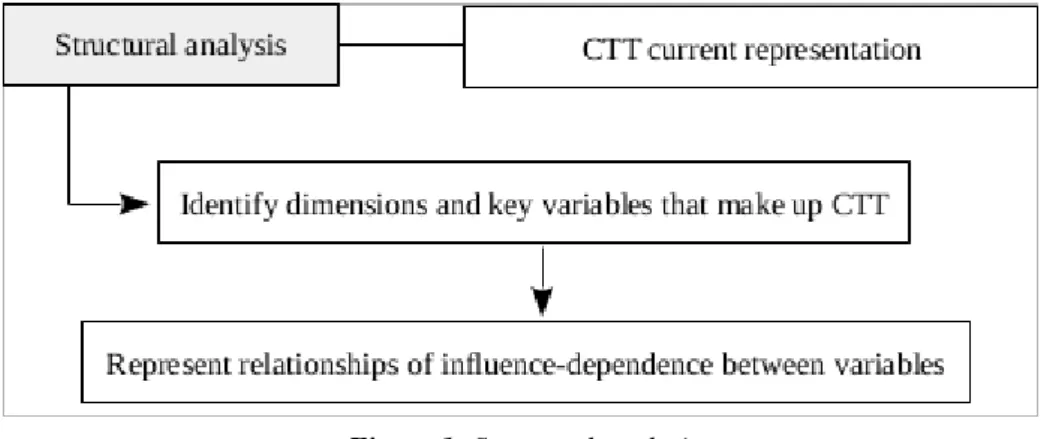
(4) planning for the future, gathering diverse perspectives from stakeholders when designing possible scenarios reduces potential sources of uncertainty and can lead to more resilient programs (Godet & Roubelat, 1996; O’Brien, 2004). By working collaboratively with CTT stakeholders and taking complexity, innovation and appropriation into account, this research offers in-depth analysis of a current CTT system and the prospective construction of alternative scenarios for successful CTT programs.. 2. Methodology In order to develop new, plausible approaches to CTT, we conducted a case study focused on CTT for secondary school teachers in Barcelona, a metropolitan area of Spain. Our research involved working with stakeholder focus groups to complete a collaborative structural analysis of the CTT system and from there identify CTT objectives (Table 1). The objectives were then used to develop scenarios. We concluded the process with semi-structured interviews with selected stakeholders in order to refine the scenarios (Table 2). 2.1. Structural analysis of variables and dimensions This research uses structural analysis as one tool from the prospective approach to understand the complexity of CTT within a complex education system. Structural analysis generates different representations of reality (Amer et al., 2013) by defining the dimensions of the system, the variables that comprise it, and the relations of influence and dependency within the system (e.g., Molés Molés, 1995; Cely B., 1999; Miklos & Tello, 2000; Godet & Durance, 2011; Astigarraga, 2015). Through this method, the elements constituting the complex system are defined in relation to each other, enabling key variables within the system to be identified, including those which could be used as leverage points when planning to systematically facilitate systemic change (Figure 1).. Figure 1: Structural analysis. For this case study, we initially proposed 16 variables related to CTT and grouped them by four dimensions (Appendix 1). These variables were reviewed by the focus groups early on in the process and revised as needed. In order to determine the relationships between the variables, focus group participants completed Matrices of Direct Influence (MDI) for all 16 variables. The matrix is a table of double entry, listing the variables and the degree of influence between them using the following criteria: 0: No influence between the variables; 1: Weak influence; 2: Moderate influence; 3: Strong influence.. Journal for Educators, Teachers and Trainers JETT, Vol. 7 (1); ISSN: 1989-9572. 140.
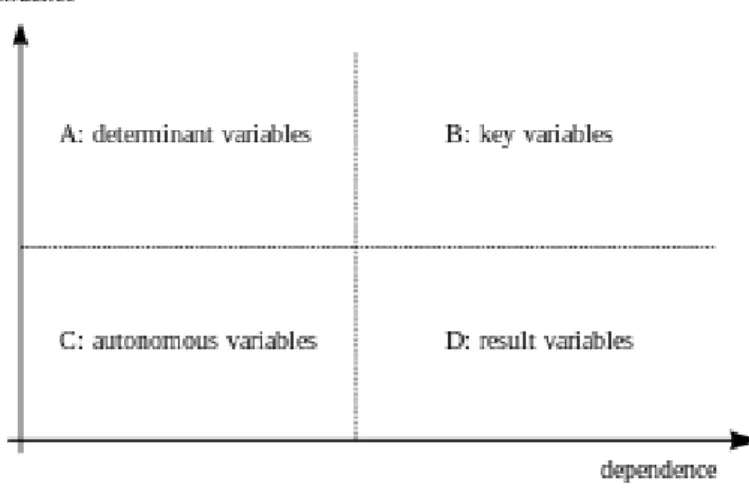
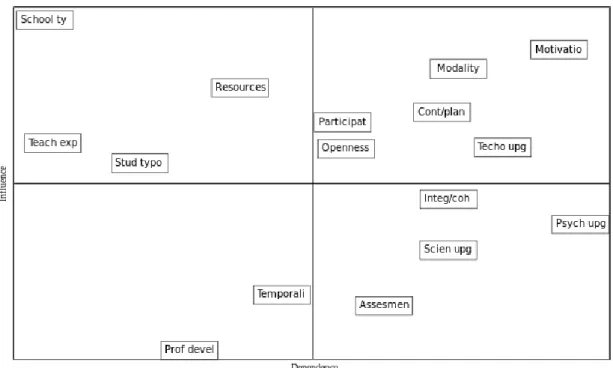
(5) Each focus group generated a consensual matrix, and the groups' discussions to determine variable influence valuations were recorded for further analysis. Subsequently, five participants completed MDIs individually. A combined MDI was created using the average variable valuations from each of the matrices (Table 3). Planes of influence-dependence (IDP) (Figure 2) were generated for each matrix using the MICMAC structural analysis program in order to visually represent the relationships between variables and system dynamics (Cercle d’Action Prospective, 2015). Within an IDP, variables are classified according to their position on the plane, as shown in Figure 2 (Godet, 2007). An IDP of the combined MDI results was also created (Figure 4). By analyzing the influencedependence planes along with the focus group recordings, we finalized the dimensions and variables that shape CTT in the context of this case study (Table 4).. Figure 2: Variable distribution in an influence-dependence plane. Quadrant A: Determinant variables – Given a high degree of drive and low dependence, these variables govern the system. Quadrant B: Key variables – Due to a high level of influence and dependency, changes that affect these variables have a great impact on the system, so strategies for change should focus on them; they are also known as motors or fundamental. Quadrant C: Autonomous variables – Variables with low influence and very independent, they have little impact on the evolution of the system. Quadrant D: Resulting variables – Variables whose evolution depends on the rest of the system, helping in understanding the behavior of the system. Finally, variables close to the central axis of the plane lack a defined character and are called “regulator variables.”. For each variable, we also generated: (a) definition; (b) current analysis; c) detected problems; and d) objectives. The four elements of structural analysis served as the basis for the focus groups and the semi-structured interviews. 2.2. Focus Groups The focus groups were conducted in two stages (Table 1) to ensure balanced stakeholder participation in the process of analyzing and co-constructing the representation of the current CTT system, and also to envision feasible alternative scenarios (Alexander & Korpela, 2012; Lefstein & Perath, 2014). During the first stage, focus groups met to adjust, complete and validate the variables and dimensions structuring CTT as it currently operates. They also analyzed the relationships between variables to map the CTT system. In the second stage, the focus groups met to (i) analyze the results of the first stage; (ii) define the objectives of CTT; (iii) define possible evolutions of the variables; and (iv) develop an ideal scenario for the future.. Journal for Educators, Teachers and Trainers JETT, Vol. 7 (1); ISSN: 1989-9572. 141.
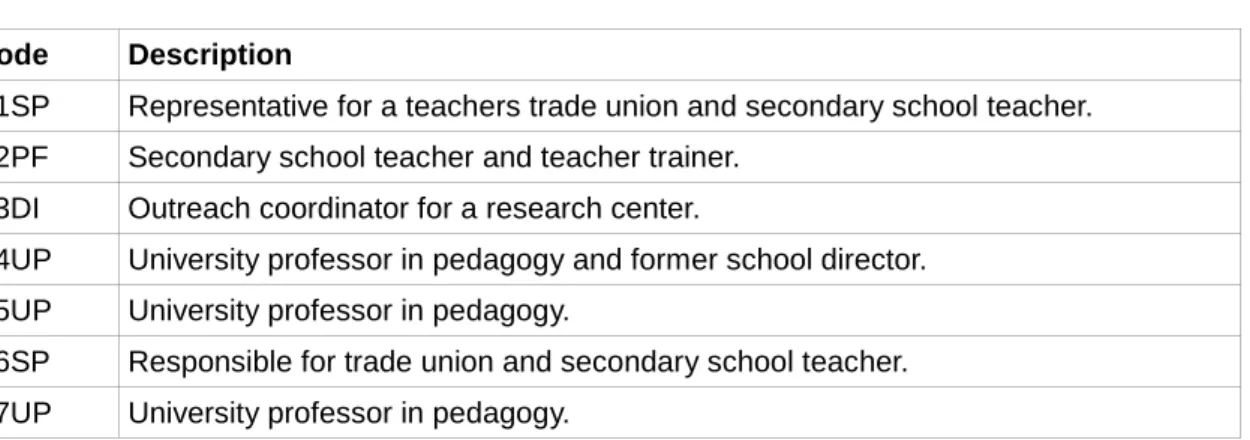
(6) Table 1. Focus group participants and organization Stage. Focus Group. Participants. Duration (minutes). Ph.D. student in secondary education and secondary school 100' teacher. Outreach coordinator for a research center. University professor of pedagogy. Training director in a trade union. University professor in pedagogy.. 1st stage. 3 groups. Teacher trainer. Ph.D. student in education and primary school teacher. Training coordinator: training organizing unit. Secondary school teacher and teacher trainer. University professor and training coordinator. University Professor and training coordinator. Ph.D. student in education.. 100'. 100' Researcher. Representative for a teachers trade union and secondary school teacher. Coordinator of an educational foundation and former school director. University professor in pedagogy and former school director. Teacher trainer and secondary school teacher. University professor in sociology. Ph.D. student in education. 1 group. All the stakeholders from the three groups.. 30'. Ph.D. student in secondary education and secondary school 45' teacher. University professor in pedagogy. Teacher trainer and secondary school teacher. Ph.D. student in education. University professor in sociology. 2 groups 2nd stage. 1 group. 45' University professor in pedagogy. Ph.D. student in education and primary school teacher. Researcher. Representative for a teachers trade union and secondary school teacher. University professor in pedagogy. Secondary school teacher and teacher trainer. All the stakeholders from the two groups, plus: Trainer for a teachers trade union and secondary school teacher. University professor in pedagogy.. 150'. 2.3. Semi-structured interviews Based on the results of the focus groups, seven stakeholders were selected for the semistructured interviews to analyze the ideal scenario developed by the focus groups and to discuss the plausibility of each objective and the degree of difficulty involved in achieving it (Table 2). Seven interviews were conducted until responses reached saturation, with an average duration of 61 minutes per interview. The analysis of the semi-structured interviews identified modifications proposed by interviewees for the objectives, and highlighted concerns interviewees had about making the ideal scenario a reality.. Journal for Educators, Teachers and Trainers JETT, Vol. 7 (1); ISSN: 1989-9572. 142.
(7) Table 2, Description of interviewed stakeholders Code. Description. E1SP. Representative for a teachers trade union and secondary school teacher.. E2PF. Secondary school teacher and teacher trainer.. E3DI. Outreach coordinator for a research center.. E4UP. University professor in pedagogy and former school director.. E5UP. University professor in pedagogy.. E6SP. Responsible for trade union and secondary school teacher.. E7UP. University professor in pedagogy.. 2.4. Scenarios The scenarios methodology is used in multiple ways by various fields (Ramirez et al., 2015), including the design of educational policies (Habana, 1993; Kim & Ryu, 2004), and specifically for teacher training (Lucu & Stingu, 2013; Nicoleta, 2013). Given the anticipatory character of this methodology, representations of possible futures can be developed (López Peláez, 2009). For this case study, each focus group analyzed the trends of the dimensions and variables mapped by the IDPs and structural analysis. Using the prospective approach (Figure 3) and collaboratively defined objectives, the focus groups developed an ideal CTT scenario to meet nearly all the objectives (see Results section). The insight offered through the semi-structured interviews led to the creation of an additional “Basic” scenario that may be more realistic for some schools.. Figure 3. Prospective analysis. 3. Results 3.1 Structural analysis of variables and dimensions The combined matrix of direct influences (MDI) represents the average of the ratings obtained from the MDIs completed collaboratively by the focus groups and individually by five participants (Table 3). This MDI shows the perceived relationships of influence between the 16 initially proposed variables. We note in Column 9 the little influence that the rest of the variables have on "School type": there are no variables with a medium or strong influence on it. This independence implies it would be difficult to modify the culture of a school through a CTT program. We note also that variables such as "Format" (Row 3), "Resources" (Row 8) and "Motivation" (Row 14) have substantial influence on the dimension of "Content," which includes the variables in Columns 1, 2 and 3.. Journal for Educators, Teachers and Trainers JETT, Vol. 7 (1); ISSN: 1989-9572. 143.
(8) Table 3. Combined matrix of direct influences. Journal for Educators, Teachers and Trainers JETT, Vol. 7 (1); ISSN: 1989-9572. 144.
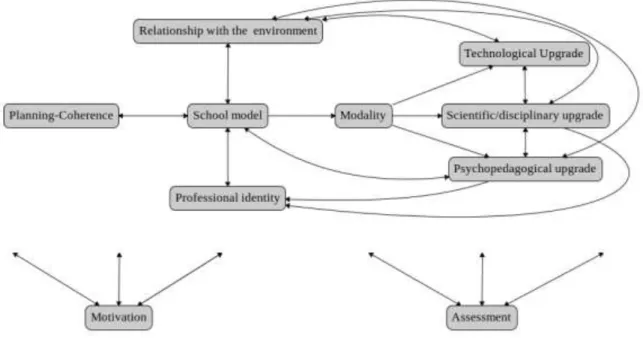
(9) We generated an influence-dependence plane (IDP) to visualize the relationships between variables based on the combined matrix of direct influences (Figure 4). This allows us to visualize a representation of the current CTT reality, drawn from the valuations made collaboratively by focus group participants, participants' individual contributions and the content of the focus group recordings to complete the representation.. Figure 4. Direct influence-dependence plane, obtained from combined MDI matrix By analyzing the distribution of variables in these quadrants, we gain a sense of the overall fluidity of the system. There are only two variables in Quadrant C, the area for autonomous variables. Of the remaining 14, ten are above the average horizontal line in Quadrants A and B, placing them in the area of greatest influence. The other four are in Quadrant D as result variables. The horizontal distribution of variables, which shows degree of dependence, places ten of the 16 variables to the right of the vertical axis. This means these variables are fairly-tohighly dependent. A distribution of this type indicates the system should be fairly susceptible to change, since a relatively small number of key variables have high influence over the rest, and there are many dependent variables. To validate the original list of proposed variables and dimensions, and also identify key variables for the system, we compared the results of the IDP and the data from the focus groups. Through the synthesis of these results, we triangulated the set of representative CTT variables (Appendix 2), and grouped them based on dimension (Table 4). Focus group participants offered important reflections on the originally proposed dimensions. They agreed about the relevance of maintaining “Content” and “Organization” as dimensions, but changed the name of the latter to “Organizational Aspects.” Regarding the dimension of “Context,” there arose a need for clarification around the local context of the school, the socioeconomic context, and the environmental context. This led to the creation of two new dimensions: “Institutional context” and “Socioeconomic context.” The “Assessment” dimension generated doubts as to its definition, and was renamed “Impact,” which includes level of assessment and maximum integration. The resulting definitions and variable classifications are shown in Table 4.. Journal for Educators, Teachers and Trainers JETT, Vol. 7 (1); ISSN: 1989-9572. 145.
(10) Table 4. Collaboratively defined dimensions and variables Variables related to the training's CONTENT 1. 2. 3. Incorporation of ICT in classroom: digital whiteboards, laptops, Technological updates mobile phones, etc. Development of teachers' technological proficiency. Curriculum adaptation reflecting developments in related Scientific/content disciplines. updates Modifications in curriculum, introducing new materials. New classroom management methods. Psychopedagogical Teachers' interpersonal proficiencies: communication, social updates skills, etc.. Variables related to the training's ORGANIZATIONAL ASPECTS 4. Format. Format in which the training is conducted: courses, conferences, research projects, on-line training, etc.. 5. Planning-Coherence. In the school, existence of a training program for medium or longterm to continue the training received, in coherence with other activities and the school's dynamic.. Variables related to the INSTITUTIONAL CONTEXT 6. School model. 7. Professional identity. Concerning school organization, the leadership team, or relationships among the professionals at the school. Includes the typology of the school. Concerning teachers' identification with the profession, value systems, professional conception. Includes professional development.. Variables related to the SOCIOECONOMIC CONTEXT.. 8. Relationship with environment. Teachers of the school interact on a regular basis with other social actors in the development of their work as educators. Includes the socioeconomic characteristics of the environment, families and students.. Variables related to the training's IMPACT. 9. Assessment. Concerning whether the training is evaluated and to what extent.. 10. Motivation. Teacher attitude in respect to CTT program.. 3.2 Objectives The focus groups developed objectives for each variable in Table 4. These objectives were revised in the subsequent interviews. Establishing these objectives was critical, as they serve as guidelines for envisioning new CTT scenarios. The finalized objectives for each variable are found in Table 5.. Journal for Educators, Teachers and Trainers JETT, Vol. 7 (1); ISSN: 1989-9572. 146.
(11) Table 5. Objectives associated with variables 1. Technological updates 1.1. Avoid the technological gap between the school and the outside world. 1.2. ICT training integration to mobilize other ways of understanding teaching and learning processes, not only as literacy. 1.3. Increase possibilities of communication and exchange of experiences through ICT. 1.4. Facilitate the discussion within schools of how to manage the incorporation of technology such as mobile phones or laptops in the classroom. 2. Scientific/disciplinary updates 2.1. Encourage interaction between faculty teaching related subjects, and also with other experts in the field. 2.2. Promote interdisciplinary work by involving internal and external actors. 3. Psychopedagogical updates 3.1. Boost the fundamental objectives that are already in the curriculum, such as autonomy or critical thinking, to avoid putting the entire emphasis of a class on solely the tested components of a subject. 3.2. Train teachers to support students on all levels, from the academic to the everyday, helping students take responsibility for their learning, their mentality, and their goals for the future. 4. Format 4.1. Help teachers organize their own training, with a variety of formats, to empower them to find solutions to on-going problems or challenges as they arise. 4.2. Boost collaborative solutions by involving internal and external actors. 5. Planning-Coherence 5.1. Have good planning that enables coherence in teacher training, avoiding training modules that rarely manage to put down roots. 5.2. Take advantage of day-to-day learning opportunities. 5.3. Preserve teachers' occupational health, not so much with tools for managing stress, but reconfiguring the system to eliminate the causes of tension. 6. School model 6.1. Relate training to the real dynamics of the school. 6.2. Promote the school model as a collective project. 6.3. Stabilize the steering committee if it works effectively and is headed in the desired direction. 6.4. Incentivize those who contribute to initiatives and promote innovation projects. 6.5. Promote individual and joint reflection on daily work, with cycles of reflection between colleagues and community members outside of school. 7. Professional identity 7.1. Reconstruct teacher identities, “How/who am I as a teacher?” drawing from contexts. Before working, teachers have identities as teachers, and it needs to evolve over time and in relation to the circumstances of their work. 7.2. Innovation must overcome outdated beliefs and value systems, calling into doubt these beliefs, while enhancing confidence and self-esteem. 7.3. Promote versatility, motivation, proposal development and the development of leadership skills. 7.4. Incorporate mentoring: veterans can help train novice teachers during a period of learning-through-practice. 8. Relationship with the environment 8.1. Connect lessons with the real-world setting in which the school is situated, with things students can see or do in their environment, and with community-relevant issues. What we do in the classroom should make sense for students and for their growth. 8.2. Open the school to the community, fostering participation. 8.3. Promote work networks between universities, research centers, schools, etc., fostering mutual enrichment. 9. Assessment 9.1. Measure the impact on students and in the school by increasing the evaluation levels and allowing ample time for implementing changes. 9.2. A new role for administrators, not as a manager enforcing processes but as an adviser or facilitator. 10. Motivation 10.1. Training must uphold the dignity of teachers and the importance of their social role, encourage positive selfesteem and professional development. 10.2. Promote those aspects from other variables that influence motivation, which in turn is crucial for improving the rest of the variables.. Journal for Educators, Teachers and Trainers JETT, Vol. 7 (1); ISSN: 1989-9572. 147.
(12) The relationships represented in Figure 5 illustrate the complexity of the system. If we look at Objective 2.2: “Promote interdisciplinary work by involving internal and external actors," we see it involves changes in other variables and is related to several of them, such as Objective 6.5 or the objectives of Variables 7 and 8: "Professional identity" and "Relations with the environment," respectively. On the whole, the objectives described for each variable indicate the relationships between them. For example, we can look at Objective 2.2 and see its relationship to the variables "Psychopedagogical updates," "Professional identity" and "Relations with the environment". The variables "Motivation" and "Evaluation" have a cross-cutting nature, interacting with each of the other variables. As we see clearly in Figure 5, given the complexity of the CTT system it is critical to develop system-wide solutions because it will be difficult for changes to take root if solutions focus solely on individual aspects of the system.. Figure 5. Representation of relationships between variables. 3.3. Scenarios Once the objectives were defined, we wrote an Ideal Scenario, describing a hypothetical CTT program. The scenario, included below, takes place in the school cafeteria and aims to integrate lessons on different subjects and develop capabilities of teachers and students. It covers 33 of the 35 objectives, omitting objectives 6.3 and 6.4. A number “n” at the beginning of each paragraph serves to identify it, and the numbers at the end correspond to the relevant objectives in Table 5.. 3.3.1 Ideal Scenario It is 8 A.M. on a Tuesday, and as every 15 days, I begin the day meeting with the project-based training group. 1) On this occasion we are six people: the math teacher, the English teacher who is also the director of studies, a cook in the school who is a member of AMPA, a trainer from the university, a researcher from the Alicia Foundation and me, the chemistry teacher (2.1-2.2-4.2-8.3). 2) It's the second year of the mathematics teacher in the school, and they asked me to participate to bring my perspective after 25 years at the school (7.4).. Journal for Educators, Teachers and Trainers JETT, Vol. 7 (1); ISSN: 1989-9572. 148.
(13) 3) We begin the meeting by each taking 5 minutes to share with the group how the previous two weeks of the project have been for us (7.5-6.5). 4) This is the third meeting. In the first one, we worked on the initial idea that emerged from a conversation in the lunch room between the mathematics and English teachers, who, with the support of administration contacted the rest of us and proposed a way to integrate pieces of our separate curricula (6.6-4.1). 5) The school is part of a network of education centers, universities and research centers that promotes collaboration between them, and the realization of this project has been quite simple (8.4). 6) This type of project is conducted by various groups in the school, which, together with the administration, organize the times for each of them and look for possibilities to carry it on through future years (5.2). 7) This network has technical support from the administration, which also encourages this type of project in part by increasing the number of teachers in the school, in order to release part of the demand on teachers' time (9.2-4.3). 8) The idea for this project came from one day when the math and English teachers were watching some students eating. After talking to them, they realized how little importance students gave to this part of the day, and the students told them what and how they have breakfast or supper. The teachers realized it was a good opportunity to establish a link between some of the things that are studied in the school and the habits of the students (8.1-8.2). 9) Thus we designed the first part of the project, which consists of the students keeping a daily diary of what they eat, when they eat, and in what context (alone, with family, watching tv, etc.) for a week. With this information, in math and chemistry they study the composition of the ingredients, doing comparative tables, etc., and students prepare a report in English. The ultimate objective of this part is that they design a weekly menu with advice from the Alicia Foundation and working in collaborative groups, guided by the trainer from the university (3.2-5.1). 10) To be trained on these issues, the group worked for two days previously, while other teachers covered their classes (4.3), thanks to a scheduling system that allows flexibility (3.4). 11) We noticed some students do not have good eating habits, either by a tendency to eat too little or by eating in excess, so we have had to be careful when sharing the typical menus for each student with the class as a whole (3.3). 12) During the entire process, families have collaborated, understanding that the project aims to improve the habits of their children. Parents have been able to follow and extend the web results, helping their children to learn about the ingredients and how to cook, etc. (1.1-1.3). 13) The students use mobile devices and computers to maintain the information flow between families, advisers and teachers, and by doing so promote practical and responsible uses for ICT (1.4-1.2). 14) We began the project with assessments of students' knowledge of the curricular aspects they will encounter through this work and their working habits. Before the end of the academic year, we will assess if it has helped them improve their habits and knowledge of what they eat. This assessment is also made of the school cafeteria (9.1-6.1). 15) Once the project is finished, it will be shared with the rest of the school and the research network. We will share the results and the doubts and problems that arose during the process and discussed how we approached them (6.2). 16) Through the network, such projects are shared with other schools and research centers, providing various examples that can be implemented in different years (8.5). 17) Two weeks after the end of the project we will meet to assess what has been done, and share our thoughts, the changes we have observed, etc. If it is anything like previous projects, we will realize it has required us to consider our own way of being in school (7.2). 18) It will require us, and allow us, too, to develop other forms of relationships with the students and their families, with the rest of the teachers, and with the rest of participants (7.1-7.3).. Journal for Educators, Teachers and Trainers JETT, Vol. 7 (1); ISSN: 1989-9572. 149.
(14) 19) We will have sense that beyond genuinely interesting students in the related subjects, they and their families have appreciated the work, seeing us in a new light and not merely purveyors of knowledge (10.1). 20) We already realize that stuck in our own subject and solitary working habits, we wasted opportunities to develop as educators (3.1), and these experiences revive our desire to continue improving our work (10.2). This scenario was discussed with the interviewees, with the following results: they agreed the Ideal Scenario could potentially be achieved in some schools, but in others it is currently impossible to facilitate these kinds of projects. "The class schedule system depends on each center. If you propose this to some state-subsidized schools they will tell you yes, but in this center it is impossible" (Interviewee E2PF); "In the current context it is possible depending on which schools ... Incorporating training into school hours is feasible, simply with a little organizational imagination" (Interviewee E4UP). Using this and other input from the interviews, we developed a Basic Scenario, applicable to schools with a lower likelihood of achieving the Ideal Scenario. To facilitate the comparison between both scenarios, we maintained the paragraph numbering in the second scenario. 3.3.2 Basic Scenario 1) There are six people on the project team: the math teacher, the English teacher who is also the director of studies, a school cook who is a member of AMPA, a trainer from the university, a researcher from the Alicia Foundation and me, the chemistry teacher. Due to organizational difficulties in finding a common time for us all to meet, we structured the 30 hours of teacher training as we show in Table 6. Table 6. Distribution of 30 teacher training hours for the school year Activity. Time of school year. Dedication. 2 Joint preparatory sessions. Before the start of classes. 4h. 2 Individual preparatory sessions. Before the start of classes. 2h. 1 Joint preparatory session. Before working with the students. 2h. 1 Individual preparatory session. Before working with the students. 1h. 3 Joint sessions. During the work with the students 6h. 3 Individual sessions. During the work with the students 3h. Presentation to the rest of the network Once the project is completed. 1h. Preparation of project report. 11h. July, once classes are finished. Total. 30h. This schedule applies to participating teachers only, the rest of participants attend the joint sessions. 2) In an initial research network meeting, the principal presented the possibility of doing a project of this type, asking for the collaboration of novice teachers and veterans. We then met with stakeholders to specify the project. 3) The joint sessions are carried out in a participatory way, with the involvement of all participants. 4) (included in Paragraph 2). 5) Due to the difficulties of continued work in the network, we look for specific support for the project. The connection comes from the initiative of a university department that contracts with several secondary schools, offering advice for training. We are looking. Journal for Educators, Teachers and Trainers JETT, Vol. 7 (1); ISSN: 1989-9572. 150.
(15) for ways to provide incentives for participating teachers (e.g., the possibility to access language courses at the university). 6) Only one project is carried out the first year. 7) We, as participants, do not have the administration's support, and consequently agreements are made for mutual benefit, such as the participation of the school in university research. The distribution of time commitments (see Paragraph 1) allows us to work on the project without support from other teachers. 8) The idea for this project came one day when the math and English teachers were watching some students eating lunch. After talking to them, they realized how little importance students gave to this part of the day, and the students told them what and how they have breakfast or supper. The teachers realized it was a good opportunity to establish a link between some of the things that are studied in the school and the habits of the students. 9) Thus we designed the first part of the project, which consists of the students keeping a daily diary of what they eat, when they eat, and in what context (alone, with family, watching tv, etc.) for a week. With this information, in math and chemistry they study the composition of the ingredients, doing comparative tables, etc., and students prepare a report in English. The ultimate objective of this part is that they design a weekly menu with advice from the Alicia Foundation and working in collaborative groups, guided by the trainer from the university. 10) The meeting arrangement avoids the need to rely on other teachers, but requires more rigid planning and removes potential flexibility during the project. It is necessary that administrators do not burden teachers with extra meetings, and that they respect the time for the joint meetings. 11) We noticed some students do not have good eating habits, either by a tendency to eat too little or by eating in excess, so we have had to be careful when sharing the typical menus for each student with the class as a whole. 12) We invited families to participate, but we did not expect much participation from them, and designed the project accordingly by supplementing this lack of involvement with increased research on the part of the students. 13) We incorporate the use of cell phones within the classroom to work toward the possibility of expanding the use of this technology in the future. 14) We began the project with assessments of students' knowledge of the curricular aspects they will encounter through this work and their working habits. Before the end of the academic year, we will assess if it has helped them improve their habits and knowledge of what they eat. This assessment will also evaluate the school cafeteria. 15) Once the project is finished, it will be shared with the rest of the school and the research network. We will share the results and the doubts and problems that arose during the process and discussed how we approached them. 16) Due to the difficulties of creating a network (see Paragraph 5) we will share our results through the usual channels available to schools and universities. 17) In July we will meet again to assess what has been done, and share our thoughts, the changes that we have observed, etc. If it is anything like previous projects, we will realize it has required us to consider our own way of being in school. 18) It will require us, and allow us, too, to develop other forms of relationships with the students and the rest of the participants. 19) Unfortunately, the participation of the families has been scarce, and we already recognize the difficulties of doing a shared project. 20) Although it has not been possible to do a project with ease of organizational resources, flexibility and participation, some of us are realizing that being stuck in our own subject and solitary ways, we waste opportunities to develop as educators, and these experiences revive our desire to continue improving our work. Others, however, have been complacent and are hesitant to participate in similar projects in the future. Below we share some quotes from the interviews to illustrate participants' responses to the Ideal Scenario and how their input was taken into account in the Basic Scenario:. Journal for Educators, Teachers and Trainers JETT, Vol. 7 (1); ISSN: 1989-9572. 151.
(16) Paragraph 5: About the network involving institutions, interviewees believe that "universities are something apart, I see it as unrealistic, or at least very complex, to try to connect these realities" (Interview E6SP). "I wish, but it is difficult, it doesn't work" (Interview E1SP). "It requires a cultural change. Congregations for example, do not work in a network or between themselves. Maybe they work in networks for administrative, bureaucratic issues, but it does not reach the other layers. The structure is there, but it is not used" (Interview E7UP). "It is not easy, this connection. Connections exist between people, not between institutions. You need a figurehead to give a face and voice to the institution" (Interview E3DI). "It should, but we are far from this. It becomes an overload and is not encouraged. Some university teachers, few, have an interest and some school teachers too: when it works it is beneficial for everyone. Theoretically it is indisputable, but there is no overall country-wide structure to reward it" (Interview E4UP). Therefore it seems difficult, when not impossible, to work in a network with different institutions. Paragraph 5 in the Basic Scenario has been rewritten to reflect occasional participation between different actors. Paragraph 7: Interviewees also discussed the challenge of obtaining support from school administrators: "The administration does not want something that costs them money" (Interview E2PF). "It is not impossible but it requires an increase in the budget" (Interview E6SP). "Reforms are done without agreements, from the top down and without economic reporting. It changes every x years. Decisions are made without time or resources dedicated to training" (Interview E1SP). "The administration does not provide incentives. They have the school under suspicion. I would love to see the administration identifying a project, evaluating, encouraging and rewarding it" (Interview E7UP). "In the current situation of cuts, it cannot be done. But there are enough teachers, it is a matter of organization and will" (Interview E5UP). "Administration cuts teachers based on the ratio of pupils, not on the dynamics of a particular school in order to allow for interesting projects. This is unreal" (Interview E3DI). "Ha! I don't believe it. Up to now, this is the most unrealistic" (Interview E4UP). Given the unanimity of participants on the difficulty of counting on the administration, Paragraph 7 was rewritten to highlight the value of mutual support from participating institutions, without considering the possible involvement of the administration. Paragraph 12: Regarding family participation in such a project, interviewees believe this scenario "clashes with family patterns, and that is not so easy" (Interview E6SP). "Utopia. Families are increasingly less involved. At work, you can't get permission to go to your children's school like you can to go to the doctor" (Interview E1SP). "This is a challenge for the school of the twenty-first century, but it is possible" (Interview E7UP). "Parents do not participate; it is a challenge, but it is viable" (Interview E5UP). "Foreign families usually do not participate because language and culture. It depends a lot on AMPA, whether it is more or less open. It is important to take care of communication, channels and tones. I think that will be difficult and would be a lot of work" (Interview E3DI). "It has to go this way, but you collaborate if your collaboration is valued and facilitated.. Journal for Educators, Teachers and Trainers JETT, Vol. 7 (1); ISSN: 1989-9572. 152.
(17) Depends on the culture of the school" (Interview E4UP). There is agreement on the importance and possibility to involve families in such projects in the future, but interviewees also shared that such collaboration presents many challenges. The Basic Scenario leaves the door open family participation without making it a condition of the project. Through the development of these scenarios and the process of vetting them with stakeholders, we envisioned two possible futures for implementing CTT. As mentioned in the interviews and illustrated through structural analysis, school model and other related variables greatly influence the type of CTT that can be carried out. By offering two example scenarios for successfully implementing CTT, one Ideal and the other Basic, this case study provides stakeholders with templates they can draw from and tailor to their specific circumstances.. 4. Discussion and conclusions The three underlying elements of this research (see Introduction) – complexity, innovation and appropriation – are integrated throughout the case study results, and are further discussed in this section. The complexity of the educational system, and specifically of CTT, is evident from the richness of the discussions that took place in the course of the focus groups. It was also clear in the interviews when interviewees pointed out components of the collaboratively developed Ideal Scenario that, while vetted through the focus groups, seemed completely unrealistic for their specific context or from their experience. The complexity was also illustrated through the structural analysis process by the variables obtained and the web of influences and dependencies between them, as literature suggests (e.g., González-Anleo Sánchez, 2002; Baykal, 2009, Prats & Raventós, 2005; Esteve Zarazaga, 2006). Stakeholder participation was critical for this research. Not only did it allow for the thoughtful construction of a CTT system representation, but it also led to the development of innovative, flexible future scenarios for CTT in such a way that they can serve as tools for a wide range of schools. Since the methodology used for this research was firmly rooted in stakeholder participation, it increases the likelihood that the results will be accepted and appropriated by the wider stakeholder audience. The set of variables and dimensions identified and validated here through collaborative structural analysis is a system representation, which allows for the search of systemic solutions by identifying those variables that can be modified to improve the overall system (Table 4). While the ten finalized variables from this study are not the only ones in the system, they are considered key. Here we analyze three of them from different quadrants of the IDP (Figure 4): School model: In the IDP, this variable is situated in the area of determinant variables, which indicates this variable has a high degree of influence on the other variables. It also means the other variables have little influence on it. For this reason, the focus groups decided not to take it into account as a variable, but included aspects of it in new variables that emerged from the analysis related to institutional context. This structural analysis corroborates the difficulty achieving the cultural change necessary to modify the model of school (Gairín Sallán & Rodríguez Gómez, 2011; Santos Guerra, 2010). Motivation: This variable is located in the area of key variables on the IDP, which means it has a high level both of influence and dependency. The variables situated in this zone are leverage points, places where modifications can result in system-wide change. It implies that if we increase teachers' motivation, this will in turn positively impact those variables that have a high level of dependence motivation, and send. Journal for Educators, Teachers and Trainers JETT, Vol. 7 (1); ISSN: 1989-9572. 153.
(18) ripples throughout the system (Silvero Miramón, 2007; Longás Mayayo & Martínez Martín, 2012). Professional development: This variable is located with the autonomous variables, those with a low level of influence and dependency, which means teachers' professional development, has little to do with the rest of the system variables. The lack of a career path for teachers is evidenced in the literature, which indicates the only options for wage increases are through years of experience or by taking on leadership roles within the hierarchy of the school's organization (Pérez, 2006; Gimeno Sacristán, 2010; Moreno Olmedilla, 2006; Anaya Nieto & López Martín, 2014). As illustrated throughout this project, the variables involved in CTT make up a web of entangled relationships (Figure 5). The 35 objectives developed by the focus groups help to clarify these relationships between the ten variables and establish the characteristics a CTT program should have (Table 5). We analyze several of them here: Objective 1.2: ICT training integration to mobilize other ways of understanding teaching and learning processes, not only as literacy: This objective reflects the dissatisfaction with how ICTs have been implemented, since investment in technology is not always accompanied by the necessary training, or has not generated improvements in educational processes. Failure to fulfill this objective is typically caused by a lack of training (Ortiz Colón, 2006; Alonso Cano, Guitert i Catasús, & Romeu Fontanillas, 2014; Guitart, 2010; Murillo García, 2010). Objective 8.3: Promote working networks between universities, research centers, schools, etc., fostering mutual enrichment: As emphasized by the interviewees, many schools are far from creating and stabilizing this kind of network, despite their high value (Domènech Francesch, 2003; Muñoz-Repiso Izaguirre, 2005; Morales-Lozano et al., 2013). Analyzing both of these objectives together, we see a good example of the kinds of opportunities for innovation provided by CTT. Such opportunities could build bridges between teachers' needs and possibilities offered through relationships with other entities that can provide knowledge and support for these needs (Vilches Peña & Gil Pérez, 2007; Martín Díaz et al., 2013). Some objectives emerged with a transversal nature. These are considered fundamental concepts for CTT, and they have great potential for helping to improve the educational system. Reflection and participation at various levels within the school and wider community are also key (Imbernón Muñoz, 2006; Alsina i Pastells, 2007; González Calvo & Barba Martín, 2014). Schools are complex contexts, and they give rise to an astonishing variety of situations that occur within them, their surrounding environments and in the interpersonal relationships that develop between their stakeholders. The breakdown of objectives for each variable allows us to identify aspects of CTT programs analyzable in any training situation and also provides fundamental building blocks from which to construct possible CTT scenarios. For this case study, the prospective approach to envisioning future change to CTT culminated in the development of an Ideal Scenario with the focus groups, and then a modified Basic Scenario after analyzing stakeholder responses to the Ideal Scenario during semi-structured interviews. While the Ideal Scenario represents nearly all of the collaboratively developed objectives, it became clear in the interviews that for many schools, this model for CTT would be unachievable. In the interest of developing plausible scenarios, the input from the interviews led to the creation of the Basic Scenario, which acknowledges the reality of many secondary schools, where interdisciplinary projects pose a genuine challenge for the reasons outlined above, and also given the strict time restraints teachers face in covering all the necessary. Journal for Educators, Teachers and Trainers JETT, Vol. 7 (1); ISSN: 1989-9572. 154.
(19) material in their curriculum (Bolívar Botía, 2007; Trescastro López & Trescastro López; 2013; Peixoto Pino, 2014; Fundació Jaume Bofill, 2015). Sometimes schools promote interdisciplinary work in a generalized manner, such as the "Integrated Projects" initiative introduced in Andalusia for the 2007-2008 academic year (Hernández-de laTorre, 2010), but, as in this case where the program will end after the 20152016 school year (Junta de Andalucía, 2015), the continuity of such initiatives is often not guaranteed long enough to modify the system structurally. In order to offer stakeholders a range of options for their diverse circumstances, the stakeholder-determined CTT objectives and the two scenarios developed through this research can serve as starting points to help others imagine plausible scenarios to meet the needs for CTT in their own school communities.. 5. Acknowledgments The authors wish to thank all participants for their involvement in the focus groups and those who additionally contributed to this work as interviewees. We also thank the Universitat Autònoma de Barcelona Ph.D. program and the Obra Social “La Caixa”.. 6. References Alexander, B. M., & Korpela, M. J. (2012). Focus Group Strategies in Community Development. EJISDC: The Electronic Journal on Information Systems in Developing Countries, 50. Alonso Cano, C., Guitert i Catasús, M., & Romeu Fontanillas, T. (2014). Los entornos 1x1 en Cataluña: entre las expectativas de las políticas educativas y las voces del profesorado. Educar, 50(1), 41–64. Alsina i Pastells, Á. (2007). El aprendizaje reflexivo en la formación permanente del profesorado: un análisis desde la didáctica de las matemáticas. Educación Matemática, 19(1), 99–126. Amer, M., Daim, T. U., & Jetter, A. (2013). A review of scenario planning. Futures, 46(0), 23–40. Anaya Nieto, D., & López Martín, E. (2014). Satisfacción laboral del profesorado en 2012-13 y comparación con los resultados de 2003-04. Un estudio de ámbito nacional. Revista de Educación, 365, 96–121. Astigarraga, E. (2015). prospectiva.eu. Retrieved from http://www.prospectiva.eu/ Bartolomé Pina, A.-R., & Grané i Oró, M. (2013). Interrogantes educativos desde la sociedad del conocimiento. Aloma: Revista de Psicologia, Ciències de L’educació I de L’esport, 31, 73–81. Baykal, A. (2009). Open systems metaphor in instructional design. World Conference on Educational Sciences: New Trends and Issues in Educational Sciences, 1(1), 2027–2031. Berger, G., Bourbon Busset, J. de, Massé, P., & Durance, P. (2007). De la prospective: textes fondamentaux de la prospective française, 1955-1966. (Paris: Harmattan) Cely B., A. V. (1999). Metodología de los escenarios para estudios prospectivos. Ingeniería E Investigación, 44, 26–35. Cercle d’Action Prospective. (2015). La prospective: “Pour penser et agir autrement.” Le Cercle d’Action pour la Prospective. Retrieved from http://www.laprospective.fr/ COM. (2007). Comunicación de la Comisión al Consejo y al Parlamento Europeo: Mejorar la calidad de la formación del profesorado. Retrieved from http://eur-lex.europa.eu/legalcontent/ES/TXT/PDF/?uri=CELEX:52007DC0392&from=ES Council E. U. (2014). Conclusions on effective teacher education. Retrieved from http://www.gr2014.eu/sites/default/files/142690_2.pdf DOGC. (2015). Llei de formació i qualificació professionals. Retrieved from http://portaldogc.gencat.cat/utilsEADOP/PDF/6899/1431636.pdf Domènech Francesch, J. (2003). Las redes de centros educativos y la renovación pedagógica. Tabanque: Revista Pedagógica, 17, 99–110.. Journal for Educators, Teachers and Trainers JETT, Vol. 7 (1); ISSN: 1989-9572. 155.
(20) Esteve Zarazaga, J. M. (2006). La profesión docente en Europa: perfil, tendencias y problemática : La formación inicial : [Comentarios a los Informes EURYDICE y OCDE sobre la cuestión docente]. Revista de Educación, 340, 19–40. Fundació Jaume Bofill. (2015). Magnet: Aliances per a l’èxit educatiu. Retrieved from http://www.fbofill.cat/projectes/magnet-aliances-lexit-educatiu Gairín Sallán, J., & Rodríguez Gómez, D. (2011). Cambio y mejora en las organizaciones educativas. Educar, 47(1), 31–50. García Correa, A., Escarbajal Frutos, A., & Izquierdo Rus, T. (2011). La formación del profesorado desde una perspectiva interdisciplinar. Revista Electrónica Interuniversitaria de Formación Del Profesorado, 14(1), 27–42. Gimeno Sacristán, J. (2010). La carrera profesional para el profesorado. Revista Interuniversitaria de Formación Del Profesorado, 68, 243–260. Godet, M. (2007). Manuel de prospective stratégique. 2: L’Art et la méthode, 2. Paris: Dunod. Godet, M., & Durance, P. (2011). La prospectiva estratégica para las empresas y los territorios. (Paris: Dunod) Godet, M., & Roubelat, F. (1996). Creating the future: The use and misuse of scenarios. Long Range Planning, 29(2), 164–171. González-Anleo Sánchez, J. M. (2002a). Panorama de la educación en la España de los cambios. Reis: Revista Española de Investigaciones Sociológicas, 100, 185–229. González-Anleo Sánchez, J. M. (2002b). Panorama de la educación en la España de los cambios. Reis: Revista Española de Investigaciones Sociológicas, 100, 185–229. González Calvo, G., & Barba Martín, J. J. (2014). Formación permanente y desarrollo de la identidad reflexiva del profesorado desde las perspectivas grupal e individual. Profesorado: Revista de Curriculum Y Formación Del Profesorado, 18(1), 398–412. González Delgado, M. (2014). Continuidades y cambios en las disciplinas escolares: apuntes para una teoría sobre la historia del currículum. Teoría de La Educación: Educación Y Cultura En La Sociedad de La Información, 15(4), 262–294. Guitart, P. (2010). Pizarras mágicas en el aula. Cuadernos de Pedagogía, 397, 30–31. Habana, P. I. (1993). Building scenarios for education in South-east Asia. Futures, 25(9), 975– 988. Hernández-delaTorre, E. (2010). Cambiar e innovar en educación secundaria: los «proyectos integrados» para construir un conocimiento compartido. Enseñanza & Teaching: Revista Interuniversitaria de Didáctica, 28, 79–95. Imbernón Muñoz, F. (2001). Claves para una nueva formación del profesorado. Investigación En La Escuela, 43, 57–66. Imbernón Muñoz, F. (2006). Actualidad y nuevos retos de la formación permanente. REDIE: Revista Electrónica de Investigación Educativa, 8(2). Iucu, R., & Stingu, M. (2013). Training Induction Mentors: Alternative Policy Scenarios of Romanian Educational System. 5th International Conference EDU-WORLD 2012 Education Facing Contemporary World Issues, 76, 931–934. Junta de Andalucía. (2015). Instrucciones del 8 de Junio del 2015. Retrieved from http://www.adideandalucia.es/normas/instruc/Instruc8junio2015EsoBachillerato.pdf Kim, M., & Ryu, B. (2004). New schools in a new society: Korean perspectives on schooling for the future. International Journal of Educational Research, 41(7–8), 543–552. Lefstein, A., & Perath, H. (2014). Empowering teacher voices in an education policy discussion: Paradoxes of representation. Teaching and Teacher Education, 38, 33–43. LOE. (2006). Ley Orgánica de Educación. Retrieved from https://www.boe.es/boe/dias/2006/05/04/pdfs/A17158-17207.pdf LOMCE. (2013). Ley Orgánica para la mejora de la calidad educativa. Retrieved from http://www.boe.es/boe/dias/2013/12/10/pdfs/BOE-A-2013-12886.pdf Longas, J., Chamarro, A., Riera, J., & Cladellas, R. (2012). La incidencia del contexto interno docente en la aparición del Sínndrome del Quemado por el trabajo en profesionales de la enseñanza. Revista de Psicología del Trabajo y de las Organizaciones, 28, 107 – 118. Longás Mayayo, J., & Martínez Martín, M. (2012). El Benestar als centres i en el professorat: l’estat de l’educació a Catalunya : anuari 2011. (Barcelona: Fundació Jaume Bofill) López Peláez, A. (2009). Prospectiva y cambio social: ¿cómo orientar las políticas de I+D en las sociedades tecnológicas avanzadas? Arbor: Ciencia, Pensamiento Y Cultura, 738,. Journal for Educators, Teachers and Trainers JETT, Vol. 7 (1); ISSN: 1989-9572. 156.
(21) 825–836. Martín Díaz, M. J., Gutiérrez Julián, M. S., & Gómez Crespo, M. Á. (2013). ¿Por qué existe una falla entre la innovación e investigación educativas y la práctica docente? CTS: Revista Iberoamericana de Ciencia, Tecnología Y Sociedad, 8(22), 11–31. Miklos, T., & Tello, M. E. (2000). Planeación prospectiva: una estrategia para el diseño del futuro. (México: Limusa) Miralles Martínez, P., Maquilón Sánchez, J. J., Hernández Pina, F., & García Correa, A. (2012). Presentación: Dificultades de las prácticas docentes de innovación educativa y sugerencias para su desarrollo. Revista Electrónica Interuniversitaria de Formación Del Profesorado, 15(1), 19–26. Molés Molés, V. J. (1995). Análisis estructural: Identificación de las variables fundamentales del sector hotelero. Aplicación al caso de la provincia de Castellón. Estudios Turísticos, 127, 67–88. Monarca, H., & Rappoport, S. (2013). Investigación sobre los procesos de cambio educativo: El caso de las competencias básicas en España. Revista de Educación, 1, 54–78. Monereo Font, C. (2010). La formación del profesorado: una pauta para el análisis e intervención a través de incidentes críticos. Revista Iberoamericana de Educación, 52, 149–178. Morales-Lozano, J. A., Barroso Osuna, J., & Puig Gutiérrez, M. (2013). Colaboración en Red y formación ciudadana desde la perspectiva del profesorado andaluz. Enseñanza & Teaching: Revista Interuniversitaria de Didáctica, 31, 109–124. Muñoz-Repiso Izaguirre, M. (2005). Mejorar las relaciones entre investigación y práctica educativas. Avances En Supervisión Educativa: Revista de La Asociación de Inspectores de Educación de España, 1. Murillo García, J. L. (2010). Programas Escuela 2.0 y Pizarra Digital: un paradigma de mercantilización del sistema educativo a través de las TICs. Revista Electrónica Interuniversitaria de Formación Del Profesorado, 13(2), 65–78. Murillo Torrecilla, F. J., & Krichesky, G. J. (2015). Mejora de la escuela: medio siglo de lecciones aprendidas. REICE: Revista Electrónica Iberoamericana Sobre Calidad, Eficacia Y Cambio En Educación, 13(1), 69–102. Nicoleta, N. S. (2013). Recommendations for Educational and Systemic Policies for Academics Training. 5th International Conference EDU-WORLD 2012 - Education Facing Contemporary World Issues, 76, 565–569. O’Brien, F. (2004). Scenario planning––lessons for practice from teaching and learning. Applications of Soft O.R. Methods, 152(3), 709–722. Ortiz Colón, A. (2006). La Implantación de las TIC o el uso de internet en la escuela. Innovación Educativa, 16, 31–45. Pérez, J. M. (2006). Formar a los formadores. Reflexiones sobre la formación de los docentes. Avances En Supervisión Educativa: Revista de La Asociación de Inspectores de Educación de España, 3. Prats, J., & Raventós, F. (2005). Els sistemes educatius europeus ¿Crisi o transformació? Fundació “la Caixa.” Retrieved from http://obrasocial.lacaixa.es/deployedfiles/obrasocial/Estaticos/pdf/Estudios_sociales/vol1 8_ca.pdf Ramirez, R., Mukherjee, M., Vezzoli, S., & Kramer, A. M. (2015). Scenarios as a scholarly methodology to produce “interesting research.” Futures, 71, 70–87. Rodríguez Cortezo, J. (2001). Introducción a la prospectiva: metodologías, fases y explotación de resultados. Economía Industrial, 342, 13–20. San Román Gago, S. (2013). Evolución de los modelos metodológicos y su relación con la política educativa en España. Educaçao E Pesquisa: Revista Da Faculdade de Educação Da Universidade de São Paulo, 39(1), 227–243. Santafé Rojas, A. K., & Tuta Ramírez, L. T. (2013). Prospectiva: estrategia de capital social. Revista Científica Teorías, Enfoques Y Aplicaciones En Las Ciencias Sociales, 5(11), 113–126. Santos Guerra, M. Á. (2010). La formación del profesorado en las instituciones que aprenden. Revista Interuniversitaria de Formación Del Profesorado, 68, 175–200. Silvero Miramón, M. (2007). Estrés y desmotivación docente: el síndrome del “profesor quemado” en educación secundaria. ESE : Estudios Sobre Educación, 12, 115–138.. Journal for Educators, Teachers and Trainers JETT, Vol. 7 (1); ISSN: 1989-9572. 157.
(22) TALIS. (2013). An international perspective of teaching and learning. Retrieved from http://www.keepeek.com/Digital-Asset-Management/oecd/education/talis-2013results_9789264196261-en#page1 Trescastro López, E. M., & Trescastro López, S. (2013). La educación en alimentación y nutrición en el medio escolar: el ejemplo del Programa EDALNU. Revista Española de Nutrición Humana Y Dietética, 17(2), 84–90. Vanderlinden, J.-P. (2014). Prévoir l’imprévu. CERISCOPE Environnement, [en Ligne]. Retrieved from http://ceriscope.sciences-po.fr/environnement/content/prevoir-l-imprevu Vilches Peña, A., & Gil Pérez, D. (2007). La necesaria renovación de la formación del profesorado para una educación científica de calidad. Tecné, Episteme Y Didaxis: Revista de La Facultad de Ciencia Y Tecnología, 22, 67–85.. Journal for Educators, Teachers and Trainers JETT, Vol. 7 (1); ISSN: 1989-9572. 158.
(23) APPENDICIES Appendix 1 Initially proposed dimensions and variables Variables related to the training's CONTENT 1. 2. 3. Incorporation of ICT in classroom: digital whiteboards, laptops, Technological updates mobile phones, etc. Development of teacher's digital proficiency. Curriculum adaptation reflecting developments in related Scientific/content disciplines. updates Modifications in curriculum, introducing new materials. New classroom management methods. Psychopedagogical Teachers' interpersonal proficiencies: communication, social updates skills, etc.. Variables related to the training's ORGANIZATION 4. Format. Format in which the training is conducted: courses, conferences, research projects, on-line training, etc.. 5. Temporality. Time of the school year when the training is conducted.. 6. Continuity/planning. In the school, existence of a training program for medium or longterm to continue the training received.. 7. Integration/coherence. The training has connection with other activities and school's dynamic.. 8. Resources. Human and economic resources allocated to training.. Variables related to the training CONTEXT 9. School typology. 10. Openness. 11. Participation. 12. Student typology. If the school is public, private or concerted. The teachers of the school interact on a regular basis with other social actors to develop school goals. The decisions in the school are made through consensus between the management team and the rest of the staff, or it is a vertical relationship. Socioeconomic characteristics of the student body, academic background, etc.. Variables related to the training APPRAISAL 13. Assessment. Concerning if the training is evaluated and to what extent.. 14. Motivation. Teacher attitude with respect to CTT program.. 15. Teaching experience. Degree of teacher's experience, based on years working in the profession.. 16. Professional development. Possibilities for academic staff to be promoted throughout their professional careers.. Journal for Educators, Teachers and Trainers JETT, Vol. 7 (1); ISSN: 1989-9572. 159.
(24) Appendix 2 Post-focus group synthesis of dimensions and variables Variable Number. Variable Name. Description. Dimension. Synthesis. 1. Technological updates. Key variable with a relatively low level of Training influence and medium dependency, very Content related to the functioning of the centers, and as a potential tool of new methodologies of teaching and learning, as well as the center communication and with the environment.. Keep proposed. as. 2. Scientific/content updates. Result variable, but near the area of key Training variables. Strongly related to motivation and Content possibilities of relationship between teachers in the same school or different schools and with other social actors.. Keep proposed. as. 3. Psychopedagogic Key variable with relatively low influence and Training al updates more dependence on other variables. Linked Content closely with institutional context and environment.. Keep proposed. as. 4. Format. Result variable, but near the area of key Organization Keep variables and with a high level of dependence. proposed Very related to the contents of training, motivation, impact, institutional context and environment.. as. 5. Temporality. Result variable, practically without influence Organization Disregard on the others but with relatively high dependence, influenced by the management of other variables.. 6&7. Continuity/ planning Integration/ coherence. 8. Resources. Variable in the determinant area, near key Organization Disregard variables through its relationship with the potential of the training and to motivate alternatives. Included in some of the aspects of school typology, and in new variables that emerged from the analysis related to institutional context and socioeconomic environment.. 9. School typology. Totally independent variable, considered fully Training influential. Being a structural variable, it Context determines many of the aspects of the training, but is one we cannot influence. We opted not to take it into account as a variable, but included some aspects of it in. Planning is a key variable with little Organization Integrate & relationship to the institutional context or variables: benefits from innovation and training. In the Planningcourse of the debate, more importance was Coherence given to planning, partly thanks to considering continuity. Integration/coherence is a result variable, near the area of key variables. In the analysis of indirect influences, it moves significantly to the area of autonomous variables, with a high level of dependence. The resulting combination of these variables reflects whether a school has a training program in place for medium or long-term to continue training in coherence with other activities and the school's dynamic.. Journal for Educators, Teachers and Trainers JETT, Vol. 7 (1); ISSN: 1989-9572. Disregard. 160.
(25) new variables that emerged from the analysis related to institutional context. 10 & 11. Openness and Valued in very diverse ways by the Training Participation participants, both variables are very close to Context the central axis of the influence/dependence plane. We opted not to take them into account as variables, but included them in new variables that emerged from the analysis related to institutional context and socioeconomic environment.. Disregard. 12. Student typology. Determinant variable with a relatively low level Training of influence and low dependence. Context We opted to not take it into account as a variable because influencing it is not an option. It is included in new variables that emerged because of its strong relationship with key variables, such as psychopedagogical updates.. Disregard. 13. Assessment. Valued as a result variable. Participants noted Training that training is not well assessed, despite the Appraisal importance of such assesment. We chose to keep it as variable due to the great potential it should have in the future.. Keep proposed. as. 14. Motivation. Considered the most influential variable, with Training a high level of dependence. Related closely Appraisal with good performance of any activity.. Keep proposed. as. 15. Teaching experience. Autonomous, near the area of determinant Training variables with a low level of dependence. Appraisal We chose to dismiss it as a variable, including some aspects of it in the emerging variable “professional identity.”. Disregard. 16. Professional development. Autonomous variable. It is considered that a Training teaching career does not exist as such, except Appraisal for the possibility to attain management positions in the school or administration. We chose to dismiss it as a variable, but included some aspects of it in new variables that emerged from the analysis related to “professional identity” and “school model.”. Disregard. Journal for Educators, Teachers and Trainers JETT, Vol. 7 (1); ISSN: 1989-9572. 161.
(26)
Figure
+2
Documento similar
hand, variables related to technology training and ICT skills in teaching practice did not have a significant impact on the choice of the Flipped Learning model and
In this guide for teachers and education staff we unpack the concept of loneliness; what it is, the different types of loneliness, and explore some ways to support ourselves
En este sentido, parece necesario abordar acciones de investigación que nos trasladen hasta un perfil profesional del docente, en nuestro caso del maestro y la maestra de
Without their efforts the birth in 1997 of the entrepreneurship global measuring project in the world known as Global Entrepreneurship Monitor (GEM) (2) would not have
linguistically and methodologically, as they take part of their school bilingual programs. The remainder are teachers in the process of training, who are potentially
Weber and Link (2016) developed software for performance analysis in goalball (GoalScout, GoalView y GoalTracK). Nonetheless, the coder training process and data reliability
In terms of the teacher training, over 80% had taken general pedagogy courses, about 70% of primary and secondary teachers had taken assessment courses, whereas only 40% of
This study aimed to determine the level of digital competence of Dual Vocational Training teachers (Dual VET) [22,23], as this is a key factor of analysis and study in direct
