
Using MyEnglishLab platform to develop grammatical accuracy in speaking skills
15
0
0
Texto completo
(2) Journal for Educators, Teachers and Trainers, Vol. 9 (1) ISSN 1989 – 9572 http://www.ugr.es/~jett/index.php. Using MyEnglishLab platform to develop grammatical accuracy in speaking skills El empleo de la plataforma MyEnglishLab para el desarrollo de la precisión gramatical en la expresión oral Adrian Abreus González, Universidad de Cienfuegos, Ecuador [email protected]. Abstract Speaking skills development in English has being a focus of attention in the teaching of foreign languages for years. Despite its importance, many teachers still do not find the appropriate ways to introduce, provide practice, and assess the communicative functions in the teaching-learning process of English Language Teaching (ELT). The main purpose of this paper is to reflect upon the development of grammatical accuracy in speaking skills through the use of MyEnglishLab platform, taking as context the teaching learning process of English-as-a-Foreign-Language (EFL) at the Metropolitan Language School in Quito, Ecuador. It presents the main stages and criteria determined for the elaboration and assessment of a Didactic Framework for grammatical accuracy development in speaking skills. The main results of the research conducted state that there is a factual progress in the development of grammatical accuracy in students, regardless the fact that EFL teachers still have to correct the students´ works in relation to the development of speaking skills Resumen El desarrollo de la expresión oral en inglés ha sido el centro de atención de la enseñanza de lenguas extranjeras por años. A pesar de su importancia, algunos profesores continúan sin encontrar las formas apropiadas para introducir, proporcionar práctica y evaluar las funciones comunicativas en la enseñanzaaprendizaje del inglés como lengua extranjera. El objetivo principal de este artículo es reflexionar en torno al desarrollo de la precisión gramatical en la expresión oral en mediante el empleo de la plataforma online MyEnglishLab, tomando como contexto el proceso de enseñanza-aprendizaje del inglés como lengua extranjera en la Metropolitan Language School de Quito, Ecuador. Además presenta las etapas y criterios que sirvieron de base para la elaboración y evaluación de un Modelo Didáctico para el desarrollo de la precisión gramatical en la expresión oral. Los resultados fundamentales de la investigación demuestran que existe un avance palpable en el desarrollo de la precisión gramatical en los estudiantes, a pesar del hecho de que los profesores continúan calificando sus trabajos en la relación con el desarrollo de la expresión oral Keywords Speaking skills; Grammatical accuracy; MEL platform; English as a Foreign Language Palabras clave Expresión oral; Precisión gramatical; Plataforma MEL; Inglés como lengua extranjera. Journal for Educators, Teachers and Trainers JETT, Vol. 9 (1); ISSN: 1989-9572. 194.
(3) 1. Introduction The importance of learning a foreign language, as part of an intercultural education, has been highlighted by UNESCO since the forty eighth International Conference on Education (Koskinen, 2013). Thus, a wide variety of programs and syllabuses for the teaching of both mother tongue and foreign languages have been elaborated, focusing mainly in the communicative approach for language teaching that arose in the 1970s. For years, foreign language teachers have reviewed articles in which it is affirmed that speaking skills have certainly been paid more attention in language instruction than other language skills. This has led to neglecting listening comprehension, reading comprehension, and writing as language skills. Furthermore, the development of researches in the field of foreign languages teaching has focused more on speaking and writing than in listening and reading, which shows an imbalance in the equal treatment of skills in the classroom in both educational practices and research (Abreus, 2015). Some syllabi have been edited to provide practice in all four skills with a special focus on oral skills (speaking and listening). Most of them are based on the idea that communication is not simply an end product of language study, but rather a process through which a new language is acquired. They involve students in the communication process by providing them with useful, natural English along with opportunities to discuss topics of personal interest and to communicate their own thoughts, feelings, and ideas. It is, therefore, important for teachers of English as a Foreign Language (EFL) to enhance the application of communicative functions in the school classroom and outside the school context. Thus, students can accurately make use of the grammar and vocabulary in conditions that are similar to real life situations. As previously stated, speaking skills in English have been taken into account not only as an area of instruction, but also as a research area. Most theorists define oral communication narrowly, focusing on speaking and listening skills separately. However, traditionally, when people describe speaking skills, they do so in a context of public speaking. Definitions of speaking have been expanded in the second half of the 20th century (Brown & Yule, 1983). One trend has been to focus on communication activities that reflect a variety of settings: one-to-many, small group, one-to-one, and mass media. Another approach has been to focus on using communication to achieve specific purposes: to inform, to persuade, and to solve problems. A third trend has been to focus on basic competencies needed for everyday life -- for example, giving directions, asking for information, or providing basic information in an emergency situation (Mead & Rubin, 1985). For Spratt, Pulverness, and Williams (2011), speaking skills is a productive skill that involves using speech to express meaning to other people. When people speak, they usually pronounce words, answer questions, use intonation, ask for clarification and/or explanation, correct themselves, take part in discussions, greet people, ask for and give information, respond appropriately, persuade, tell stories, use fully accurate grammar and vocabulary, use tenses, and take part in conversations (Spratt, Pulvernes & Williams, 2011 p. 34). Accordingly, foreign languages teachers can develop learner’s speaking skills by focusing regularly on specific aspects, such as fluency-pronunciation, body language, and grammatical accuracy, which is the particular aspect the author of the article emphasized on throughout the development of the research. Although close related in terminology and use by teachers, accuracy and fluency in speaking differ in meaning. For Spratt, Pulverness, and Williams (2011), accuracy refers to the use of correct forms of grammar, vocabulary and pronunciation, while fluency is understood as the ability to speak at a normal speed, without repetition or self-correction, and with smooth use of connected speech.. Journal for Educators, Teachers and Trainers JETT, Vol. 9 (1); ISSN: 1989-9572. 195.
(4) Furthermore, Rishi (2014) argues that accuracy refers to the ability of the learner to produce sentences that are grammatically correct. That is, language learners should know the correct grammatical rules of the language so that they can be able to speak and write accurately. Fluency, on the other hand, refers to a level of proficiency in communication. It is the ability to produce written and spoken sentences with ease, efficiency, without pauses, hesitation, or a breakdown of communication. Language teaching in general focuses more on fluency development than in accuracy development, without noticing that a student who does not accurately know the grammar of a language cannot properly convey the ideas in a fluent way. Thus, this paper intends to highlight the role of grammatical accuracy in speaking, so that language learners can be both fluent and accurate in language usage. For the purpose of this research the author agrees with the definitions stated by Spratt, Pulverness, and Williams (2011), and Rishi (2014) about fluency and accuracy, and pays special attention to accuracy development in speaking, summarizing its characteristics as: The correct use of grammar rules in the foreign language The correct pronunciation of vowel and consonant sounds in English while speaking The correct use of vocabulary and language in context. 2. Literature review Developing speaking skills in the classroom involves the implication of the students in the facets of language development for oral communication. Thus, they should practice the communicative functions studied in class through controlled practice, semi-controlled practice, and free practice in the EFL classroom. According to the online TESOL Glossary, controlled practice is used to describe exercises that are designed to re-enforce a specific language point and require a particular answer such as crossword puzzles, word searches and gap-fill worksheets. On the other hand, free practice describes the activities which provide the learner with the possibility of practicing the language unrestrictedly, and usually including the application of prior learnt language. Free practice includes activities such as class debates, role plays, and class surveys, among others. An intermediate point between controlled and free practice is the semi-controlled practice, where teachers give some freedom to the students for them to practice the language, but still control the topics, and language they should use. The main characteristics of speaking skills development at these stages are: During the controlled practice: • The students practice the language in a limited form • The students should pronounce correctly • Corroborate the correct comprehension of the language presented; this is the time where the students should correct important mistakes, either in meaning or pronunciation • Retain linguistic forms During the semi-controlled practice: • The students should exchange information at a minimum communication level • There is necessary information gap related to real life situations the students should become familiar with • Students have certain freedom for choosing what they want to say and how they want to say it • The information provided by one of the speakers confirms the answer to the other, feedback • The exchange has a goal, a communicative aim, not only the formal practice of the linguistic aspect. Journal for Educators, Teachers and Trainers JETT, Vol. 9 (1); ISSN: 1989-9572. 196.
(5) During this stage, the most common activities to be developed are contests, questionnaires, and the find someone who… activity. During the free practice stage, on the other hand, the students test their capacity to use the linguistic resources that they have practiced in the exchange and negotiation of information. This is the time where communicative interaction plays a significant role in language acquisition. In order to accomplish speaking skills objectives at this level the teacher should elaborate activities that engage the students in language learning, such as: role-play, interviews, stories dramatizations, problem solving, simulations, and message writing, among others. The ability to speak fluently and using accurate grammar demands full practice of the foreign language, following different models that can help the students produce the language. In order to meet these demands, teachers should select appropriate teaching aids, so that students can practice the language in a more motivating environment, with a more meaningful purpose. 2.1. Teaching aids and the teaching-learning process Teaching aids are different images and representations of objects and phenomena that are specially elaborated for the teaching process. They are defined, according to Đurđanović (2015), as didactically shaped objects, products of human work, which are used in the teaching process as sources of cognition or learning. Additionally, they have a systematic character, and their representations and instruments help attaining the main objective of the activities (Hernández, 2004). Teaching aids also provide the possibly of creating materials in order to accomplish the scientific demands of the contemporary world in the teaching-learning process. Using teaching aids in the classroom allows the teacher develop mechanisms that facilitate a better process of knowledge since they not only enrich the sensorial perception of objects, phenomena and processes of study, but also stimulate motivation and interest for learning. Consequently, they save time and effort in the classroom during the pedagogical process. A well-balanced selection of teaching aids in the classroom creates the conditions for the students to retain the contents presented. Through the application of teaching aids, teachers can present a greater quantity of information in a short period of time, and they usually motivate the students towards learning. As well, they activate intellectual functions that facilitate the acquisition of knowledge by the student. Thus, teaching aids provides the teaching process with an active characteristic that makes the learning process more effective. Teaching aids can be divided into different groups, some of them include: • • • •. Natural and industrial objects: these aids could be presented in their normal way or in sections if they are to be used partially, - realia. Printed objects: they are made in plane formats, such as pictures, books, booklets, etc. Sound projection aids: Audio-visual aids (film, video-tape, etc) and audio means, such as CD players, tape recorders, computers, Over Head Projectors (OHP). Materials for programmed and controlled teaching.. The constant innovations on the telecommunication fields and audiovisual means have brought about new modalities of use for teaching aids, which have also had an increasing effect on knowledge expansion. García (2002) defined audiovisual aids as technical resources that are applied in the teaching-learning process which combine image and sound in a total harmony so that the language presented is clear and stimulating in order to invite the students to learn. The main objective of the application of audiovisual aids in the teaching-learning process is to significantly contribute to the permanent education of the people, in order to improve their cultural and educational levels.. Journal for Educators, Teachers and Trainers JETT, Vol. 9 (1); ISSN: 1989-9572. 197.
(6) Audiovisual aids include the use of Television, Media, Videos, Software, online platforms, among others. The current research is based on the use of MyEnglishLab platform for the development of speaking skills, which helps the students develop grammatical accuracy at a higher level. Foreign language teaching has been influenced by the application of different models and theories regarding the teaching-learning process in the classroom through all times. The use of Information and Communication Technologies (ICTs) in order to develop the teaching-learning process had its bases in the creation of computers, which has allowed the teachers have access to different areas of the social life through the presentation of several contents in a technological way. There are lots of teachers who recognize the importance of the application of computers in the teaching-learning process. Nowadays, the comparison between the use of computers and the application of other teaching aids in the classroom, like video sequences or radio, has been taken into consideration by researchers; and a lot of investigation has been addressed to find out new ways to apply all these technologies in the classroom. Using computers allows the students have direct contact with the foreign language through interaction activities. This advantage provides the students the possibility to use images and sounds all combined as a high educative capacity means, which turns the use of computers into a recognized pedagogical tool. One of the barriers that teachers encounter when using computers in the classroom has been the lack of practice they have in terms of technology use. Sometimes this happens because teachers do not want to feel replaced by technologies. In spite of this reason, computer usage in the classroom has been expanded very fast in the educational system, either as an object of study, or a way of teaching and working instrument. In any of the three ways, it is important that the teacher analyses how, when, and in what specific moment of the teaching process the use of computers is more convenient. In terms of language teaching, the teaching learning process based on the use of the ICT - in which we can find the use of computers - has been very popular worldwide since the last two decades. The use of computers and online/offline platforms in the classroom provides the students with the possibility to have access to more than 94 per cent of the information presented through the audio-visual channel. 2.2. Using MyEnglishLab (MEL) platform in the EFL classroom Among the platforms for foreign language teaching and learning, My ELT, and MyEnglishLab can be found. Both platforms offer a variety of activities, language focuses, and practice that help students develop language learning at different levels, and at their own pace. MyEnglishLab platform provides complete access to practicing listening comprehension, reading comprehension, and writing skills in a freer way, so that students can use it both in the school context and outside the school context. However, even when the platform has speaking sections devoted to the development of this skills, the correction is still developed by the teacher, and therefore, the time saved while developing the rest of the skills is yet wasted by the teacher while correcting speaking tasks his/her students have recorded into the platform. A previous study conducted by the author of this paper at the Metropolitan Language School (MLS) in Quito in 2016 showed that: The students who used MyEnglishLab platform to practice speaking skills made a lot of grammar mistakes in contents that had already been taught in the same or prior levels The students were fluent in speaking as they felt more comfortable while recording themselves in the speaking tasks at home (but grammar mistakes persisted). Journal for Educators, Teachers and Trainers JETT, Vol. 9 (1); ISSN: 1989-9572. 198.
(7) Most of the students used the platform to practice the language outside the school context Students who needed more help while learning the language were far behind the average students in their speaking practice platform tasks These findings made the language teachers at MLS consider necessary to create a framework for grammatical accuracy development to improve speaking skills through the use of MyEnglishLab platform. This framework is based on the three pedagogical stages for TaskBased Learning (TBL). That is, pre-task, task cycle, and language focus (post task). The reason why the TBL methodology was selected has to do mainly with the fact that the application of tasks for language learning is based on the process rather than the product of communication. Through TBL students learn by interacting communicatively. Students may, as well, encounter situations that are similar to real life settings while practicing the language in the classroom. During the pre-task stage, teachers should ask the students to pay attention to the main grammatical aspects covered in the classroom, so that they recycle the language they need to complete the speaking tasks. The activities selected by teachers at this stage are focused on the grammar the students need to complete the tasks in the next stage of the methodology. These activities should motivate the students, activate their prior knowledge about the grammar and topic of the speaking tasks, and prepare them for the task completion. The task cycle stage is intended for the students to develop the speaking tasks themselves. It is during this part of the process that students complete language tasks where they have to actually use the grammar recycled in the previous stage. Speaking tasks can be organized by the teacher as to be developed by students individually, in pairs or small groups, or as part of class discussions with more advanced classes. The speaking tasks for this cycle may include the activities that have been already defined in MEL platform in order to give the students practice in the specific grammatical contents covered in each unit. However, the teacher may find useful to use some class-prepare tasks where students have to actually use the language in other situations. These tasks include some that have been previously stated in this article, such as: role-play, interviews, stories dramatizations, problem solving, simulations, and message writing. Other speaking tasks teachers can use are: discussions, information gap, brainstorming, storytelling, story completion, reporting, picture narrating, and picture describing, etc (Kayi, 2006). Most of these task types can be adapted easily, so that the teacher can determine what the best task is according to his/her students´ level. Finally, during the language focus, teachers should have students reflect upon the use of grammar during the task. This reflection can be based on specific grammar issues students still encounter after completing the task or on relevant aspects about positive use of the grammar in the communicative speaking task developed. The didactic framework (DF) for the teaching of grammatical accuracy in speaking skills based on online resources can be described as follows:. Journal for Educators, Teachers and Trainers JETT, Vol. 9 (1); ISSN: 1989-9572. 199.
(8) Figure 1. Didactic Framework for the teaching of grammatical accuracy in speaking skills. Designed by the author. 3. Methodology A qualitative methodology was used to conduct the research, essentially based on the possibilities the interpretative approach provides researchers with during the study of phenomena in its context of development. Furthermore, percentage analysis was used to analyze the data collected, and contrast the qualitative findings of the study. Grammatical accuracy development in speaking skills as a research scope was analyzed in the context of the application of MEL platform. Thus, reality was studied and interpreted as it took place. The interpretative approach allowed the researcher to collect information through observation as the main method. As stated by Bevir and Kedar (2008), interpretive methodologies incorporate an orientation that sees human action as meaningful and historically. Journal for Educators, Teachers and Trainers JETT, Vol. 9 (1); ISSN: 1989-9572. 200.
(9) dependent, so the subjects participating in this study are located within particular linguistic, historical, and values standpoints that make the development of the research possible. 3.1. Research questions In order to conduct the study about grammatical accuracy in speaking skills through the use of MEL platform, three specific research questions were determined: 1) How could students benefit from using MEL online platform to develop speaking skills in English? 2) What language tasks can be used to foster grammatical accuracy in speaking skills using online resources? 3) What is the teachers´ role in assessing students´ speaking tasks in an online platform environment? 3.2. Participants and material The participants in the study were 104 students from the Metropolitan Languages School in Quito who were enrolled in levels 1, 2, 3 and 6 at the time of the pedagogical intervention. They all used MEL platform through the courses designed by the professors according to the levels they were in. All syllabi have their own MEL platform courses, depending on the level and coursebook used. Thus, students from level 1 are taught using as main coursebook the series Top Notch Fundamentals A, level 2 uses Top Notch Fundamentals B, level 3 students are taught the contents of Top Notch 1-A, and level 6 students use Top Notch 3. In all coursebooks, speaking skills development is intended to provide students with practice on the communicative functions defined in each unit. Furthermore, there are pronunciation and conversation strategies sections that support the development of speaking by the students, and which they can use to complete the work assigned to them in MEL platform. Around 63 % of the participants were from level 1, and had had slight contact with the foreign language before enrolling at the Metropolitan Languages School. Accordingly, their level of understanding and use of the communicative functions was rather limited. On the other hand, only 29.8 % of the students taking part on the research had being learning English for at least 6 months, which consequently made possible for them to interact more freely in the classroom. The level 6 students, however, had been studying English at the school for over a year and a half at the moment of the study, and this gave them more confidence in completing the tasks assigned. The amount of participants taking part on the study was distributed as follows: 70 60 50 40 30 20 10 0 LEVEL 1. LEVEL 2. LEVEL 3. LEVEL 4. LEVEL 5. LEVEL 6. Figure 2. Total amount of participants per level. Journal for Educators, Teachers and Trainers JETT, Vol. 9 (1); ISSN: 1989-9572. 201.
(10) In order to conduct the study, the researcher had the students develop a set of tasks that were to be completed on MEL online platform, using a variety of activities in which the students had to recall the grammar studied first, and then practice those features of grammar in different communicative functions before using them in a speaking task. Thus, once the students had completed the first stage of the didactic framework elaborated, they moved into defining the communicative functions they needed to complete the task, and recorded their performance onto the platform to complete the exercises assigned. The criteria used to assess the development of grammatical accuracy in speaking skills are related to the stages of the didactic framework elaborated. In all cases they were associated to the use of MEL online platform. These criteria follow the actions defined for the pre-task stage, speaking stage and post-task stage, and were determined as follows: Appropriate recall of the grammatical aspects treated in the units of the coursebooks selected (ARG), Appropriate selection of the communicative functions in which the grammatical aspects can be used (ASCF), Definition of the communicative functions to be used in the speaking task assigned (DCF), Accurate use of the grammatical aspects in the speaking task (AG), and Appropriate revision and revisit of the grammar used for the completion of the task (ARRG).. 4. Results Tables 1 and 2 were elaborated to present the data collection related to the students’ performance while developing grammatical accuracy in speaking skills through the use of MEL platform. Table 1. Students´ performance before the application of the Didactic Framework stages for grammatical accuracy development in speaking skills Percentage of students who met the criteria Levels/Total students in the level L-1/66 ss L-2/15 ss L-3/16 ss L-6/7 ss TOTAL. ARG. ASCF. DCF. AG. 48.4 46.6 50.0 71.4 50.5. 42.4 66.6 50.0 71.4 49.0. 45.4 66.6 56.2 85.7 52.8. 51.5 53.3 56.2 71.4 53.8. ARRG 45.4 53.3 56.2 71.4 50.5. The results in Table 1 were part of the diagnosis developed to corroborate the need for the design and elaboration of a framework. The diagnosis was applied 2 weeks after the students had started the levels, and the tasks assigned belonged to the first two units of each coursebook. All tasks were the same tasks already designed in the platform.. Journal for Educators, Teachers and Trainers JETT, Vol. 9 (1); ISSN: 1989-9572. 202.
(11) Table 2. Students´ performance after the application of the Didactic Framework stages for grammatical accuracy development in speaking skills Percentage of students who met the criteria Levels/Total students in the level L-1/66 ss L-2/15 ss L-3/16 ss L-6/7 ss TOTAL. ARG. ASCF. DCF. AG. 77.2 80.0 75.0 100 78.0. 84.8 100 68.7 100 85.5. 75.7 86.6 93.7 100 81.7. 81.8 80.0 87.5 100 83.6. ARRG 87.8 100 100 100 92.3. As for the data collected in Table 2, they show the students’ performance after a six-week course in which they had to develop the speaking tasks in MEL platform, following the stages determined in the didactic framework presented. As stated above, the main reason why the two data are presented is to allow the author establish a comparison of how accurate the students use the grammar in speaking skills was. It can be noted that before the application of the stages of the DF, the average percentage of students who were able to meet the criteria defined in order to accurately use grammar to develop speaking skills was 51.3%. On the other hand, after introducing the stages of the DF with the specific aim described above, the average percentage of students who were able to accurately complete the speaking tasks on MEL was 87.8%. This increase is a result of the previous and post analyses related to the use of grammatically correct structures in online tasks that are defined by MEL platform, but assessed by the teacher. Furthermore, the facts that students can recall the grammar they have been previously exposed to before they use it in the actual task, allows them prepare themselves for the task. Accordingly, teachers should be able to guide the students towards the correct development of each of the stages in the DF, so that students do not get “lost” while completing the actions that belong to each stage. Appropriately selecting the communicative functions in which the specific grammar for certain unit can be used helps students focus on the communicative aspect of language. At the same time, defining the communicative functions that are related to the task, and discriminating among those that are general also allows them be more precise while using the specific grammar taught with a communicative purpose. As noted on tables 1 and 2, the appropriate selection by the students of the communicative functions in which the grammar taught can be used increased in 36.5 percent. This means that, this stage is crucial for the distinction of the functions necessary to complete the speaking tasks. Additionally, the possibility of revisiting and revising the grammar used for the completion of the task is another stage the students paid more attention to. This may be because they focused on accurate structures that helped them communicate more efficiently in English. All five criteria showed an increased in the use of grammatical structures while speaking in English and provided the students with a more structured way to develop speaking skills accurately. The growth in students’ performance in each of the stages and criteria determined was progressive, as can be noted in Figures 3 to 7 below. These figures show how students performed before (Bef) and after (Aft) the application of the DF stages. Each of the figures shows a particular criterion and is graded from the first to the last stage presented in the DF.. Journal for Educators, Teachers and Trainers JETT, Vol. 9 (1); ISSN: 1989-9572. 203.
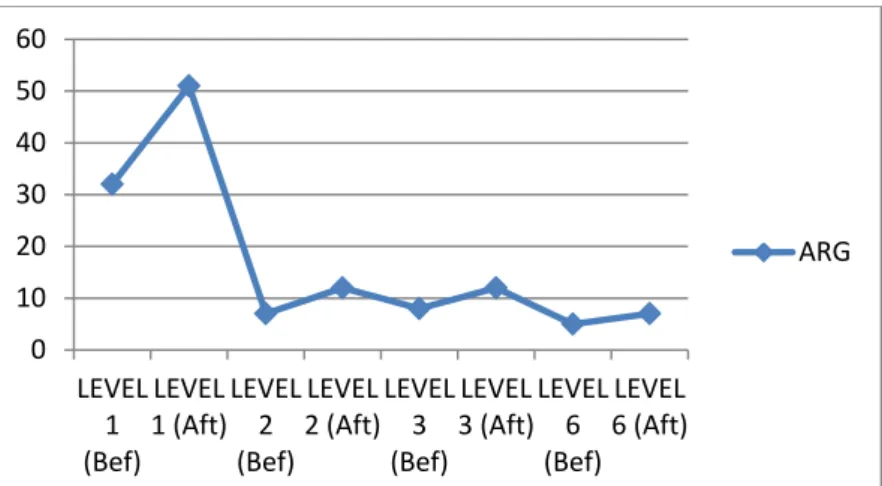
(12) 60 50 40 30 20. ARG. 10 0 LEVEL LEVEL LEVEL LEVEL LEVEL LEVEL LEVEL LEVEL 1 1 (Aft) 2 2 (Aft) 3 3 (Aft) 6 6 (Aft) (Bef) (Bef) (Bef) (Bef) Figure 3. Progress in students´ performance while appropriately recalling grammar The figure above presents the improvement in the students´ performance while appropriately recalling the grammar they needed to complete the tasks assigned. As shown in figure 3, there was an increase in 28.3% of Level 1 students´ performance. At the same time, after implementing the stages of the DF; there was an increase in the percent of students in each level who effectively recalled the grammatical aspects needed to complete speaking skills tasks. Thus, 33.4 % of Level 2 students, 25 % of the Level 3 students, and 28.6% of the Level 6 students showed progress in this criterion. On the other hand, appropriately recalling the grammar needed to complete speaking tasks is not enough since students need to be able to select the appropriate functions to communicate what they want to convey. Figure 4 shows this progress after the DF stages were implemented. In this sense, it can be said that the average percentage of students from Levels 1 to 6 who improved their performance in appropriately recognizing and selecting the communicative functions 36.5 %. 60 50 40 30 20. ASCF. 10 0 LEVEL LEVEL LEVEL LEVEL LEVEL LEVEL LEVEL LEVEL 1 1 2 2 3 3 6 6 (Bef) (Aft) (Bef) (Aft) (Bef) (Aft) (Bef) (Aft) Figure 4. Progress in students´ performance while appropriately selecting the Communicative Functions in which the grammar taught can be used. Journal for Educators, Teachers and Trainers JETT, Vol. 9 (1); ISSN: 1989-9572. 204.
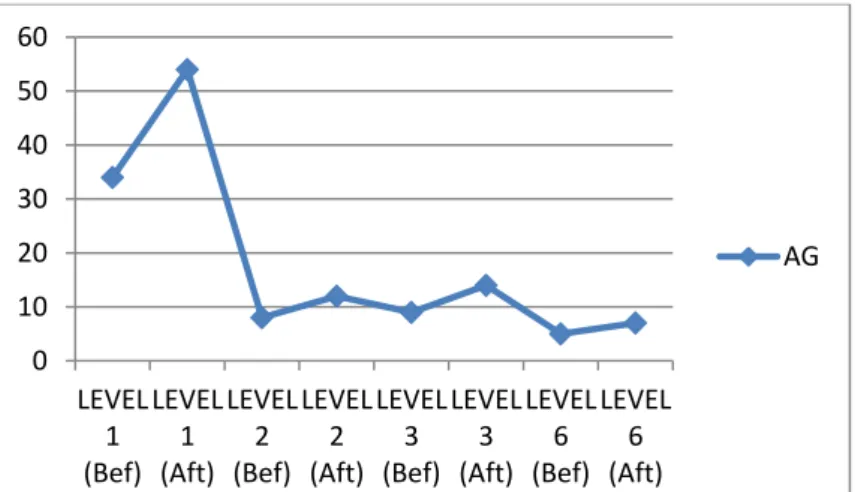
(13) 60 50 40 30 20. DCF. 10 0 LEVEL LEVEL LEVEL LEVEL LEVEL LEVEL LEVEL LEVEL 1 1 (Aft) 2 2 (Aft) 3 3 (Aft) 6 6 (Aft) (Bef) (Bef) (Bef) (Bef) Figure 5. Progress in students´ performance while defining the Communicative Functions to be used in the speaking task assigned in MEL platform Figure 5 presents key results to one of the most difficult stages in the DF. This time students had to define which of the communicate functions selected in the previous stage were the ones they had to use in the speaking task. Thus, 30.1% of Level 1 students showed progress in this matter, while 20% showed progress in Level 2, 37.5% of Level 3 students improved their performance in this criterion, and 14.3% of the students did show progress in Level 6. Overall, 25,4% of the sample students who participated in the study showed progress while defining the specific communicative functions needed to complete the speaking tasks assigned in MEL. 60 50 40 30 20. AG. 10 0 LEVEL LEVEL LEVEL LEVEL LEVEL LEVEL LEVEL LEVEL 1 1 2 2 3 3 6 6 (Bef) (Aft) (Bef) (Aft) (Bef) (Aft) (Bef) (Aft) Figure 6: Progress in students´ performance while accurately using grammar in the speaking task On the other hand, Figure 6 shows the actual performance of students in the speaking skills and evaluates how effective the previous stages of the DF were in order to meet the outcomes for speaking skills development. Accordingly, the figure presents an increase of 29.8 average percent of the sample who were able to use accurately the grammar to complete the speaking task from MEL. The students who were in Level 3 were the ones who showed more progress, with an increase of 31.3% of effectiveness and grammatical accuracy.. Journal for Educators, Teachers and Trainers JETT, Vol. 9 (1); ISSN: 1989-9572. 205.
(14) 70 60 50 40 30 20 10 0. ARRG. Figure 7. Progress in students´ performance while revising and revisiting the grammar used for the speaking task completion Finally, after finishing the speaking tasks, and in order to assess their performance, the final stage of the DF was applied. Figure 6 shows the students´ performance while revising and revisiting the grammar used in the speaking tasks. Thus, Level 1 students showed an increase of 42.4% of effectiveness after performing a revision of the grammar used. Furthermore, 46.7% of the sample from Level 2 showed progress in this stage, as well as 43.8% of the Level 3 students, and 41.8% of the sample from Level 6. The fact that all speaking tasks were developed in MEL platform, and that the use of online resources certainly motivates students towards learning is a positive thing. However, teachers still have to correct the speaking tasks the students recorded on the platform, and monitor students´ progress in speaking skills development. Thus, a systematic follow up to students work in MEL platform is decisive for the teacher to assess the progress of the students.. 5. Conclusions In this study, the author presented an analysis on how MEL online platform can be used in order to develop grammatical accuracy in speaking skills through the application of the stages defined in a Didactic Framework designed for that matter. Furthermore, far from being conclusive in research, the article also presents the results of a six-week period application of the stages mentioned in order to assess the students´ performance in the tasks MEL platform offers for the development of speaking skills. These results show that more than 80% of the participants involved in the study were able to appropriately recall the grammar taught in order to select and define the communicative functions they need to complete the speaking tasks in an accurate way. Moreover, 36.5% of the sample students who participated in the study showed progress while appropriately selecting the communicate functions they had to use in the speaking task. Accordingly, there was an increase in the percent of students who were able to define which of the communicate functions selected were necessary to complete each of the speaking tasks assigned. The development of the speaking tasks themselves was effective since 29% of the sample showed progress in the skills after applying the stages of the DF presented. Finally, 96% of the students were able to revise and revisit the grammar used for the completion of the tasks so that the rules could be learnt and the same mistakes are not made in future speaking tasks. A didactic framework for grammatical accuracy in speaking skills was necessary and helped students meet the goals set in order to develop the language skill in amore communicative way.. Journal for Educators, Teachers and Trainers JETT, Vol. 9 (1); ISSN: 1989-9572. 206.
(15) 6. Bibliography Abreus, A. (2015). La comprensión auditiva en función de la interpretación en la formación del Licenciado en Lengua Inglesa con Segunda Lengua Extranjera (Doctorado). Universidad de Cienfuegos, Cienfuegos. Bevir, M., & Kedar, A. (2008). Concept Formation in Political Science: An Anti-naturalist Critique of Qualitative Methodology, 6(3), 503–517. Brown, G., & Yule, G. (1983). Teaching the Spoken Language: An approach based on the analysis of conversational English. Cambidge: Cambridge University Press. Đurđanović, M. (2015). The Use of Teaching Aids and Their Importance for Students’ Music Education. International Journal of Cognitive Research in Science, Engineering and Education, 3(2). García, J. (2002). La fuerza de la imagen audiovisual en la formación de la cultura del hombre. La Habana: Pueblo y Educación. Hernández, P. (2004). A propósito del proceso de Enseñanza- Aprendizaje. In: Hacia una Educación Audiovisual. Editorial Pueblo y Educación. La Habana, 156-167 Kayi, H. (2006). Teaching Speaking: Activities to Promote Speaking in a Second Language. The Internet TESL Journal. Retrieved from http://iteslj.org/Techniques/KayiTeachingSpeaking.html Koskinen, A. (2013). La lengua creole: de oralidad a forma escrita. Retrieved from www.revistas.bicu.edu.ni/index.php/wani/article/viewFile/76/76 Mead, N., & Rubin, D. (1985). Assessing Listening and Speaking Skills. ERIC Digest. Rishi, S. (2014). Accuracy vs. Fluency in the English classroom. New Man International Journal of Multidisciplinary Studies, 1(4), 55–58. Spratt, M., Pulverness, A., & Williams, M. (2011). The Teaching Knowledge Test Course (TKT) (Second Edition.). Cambidge: Cambridge University Press.. Journal for Educators, Teachers and Trainers JETT, Vol. 9 (1); ISSN: 1989-9572. 207.
(16)
Figure

Documento similar