BENEMÉRITA UNIVERSIDAD
AUTÓNOMA DE PUEBLA
FACULDAD DE LENGUAS
LICENCIATURA EN LENGUAS MODERNAS
Improving Reading Skill
On Students of Starter Level
Using The Learning A-Z Platform
A senior thesis submitted to the Faculty of Languages
For the Degree of
LICENCIATURA EN LENGUAS MODERNAS
Presented By:
MARCO ANTONIO FLORES JUÁREZ
IMPROVING READING SKILL ON STUDENTS OF STARTER
LEVEL USING THE LEARNING A-Z PLATFORM
This Senior Thesis has been read by the members
of the committee of
Marco Antonio Flores Juárez
And is considered worthy of approval in partial fulfillment of the
requirement for the degree of
LICENCIATURA EN LENGUAS MODERNAS
Mtra. Sara Merino Munive Thesis Director
Committee Member Committee Member
Mtra. Elba Méndez García Mtra. Leticia Araceli Salas Serrano
INDEX
1.5 Research questions 3
1.6 Chapter summary and overview 4
Chapter III. The analysis process and the main results 12
3.1 Analysis of the interviews 12
3.2 The useful tool inside RAZ-KIDS that help 12 students to develop their reading comprehension
3.3 Change performance on reading skill during 13 the first three months using RAZ-KIDS at class
3.4 The tool inside the platform teachers consider 14 help students to develop a better reading skill
3.5 Reading Evaluation 15
3.5.1 Number of read books against login time 15
3.5.2 Reading comprehension 18
3.5.3 Fluently and Reading speed 19
Chapter IV. Conclusions 22
4.1 Introduction 22
4.2 Findings and significance of the study 22
4.3 Achievement of research aims 25
References 26
Appendix 28
List of Charts
Chart I Read books against login time 17
Chart II Student's reading evaluation (SEP standardized system) 21
List of figures
Figure I Login time (Hours-Minute) 15
Figure II Read books (RAZ-KIDS) 16
Figure III Ages (Between 7 and 9) 17
Figure IV Reading Comprehension 18
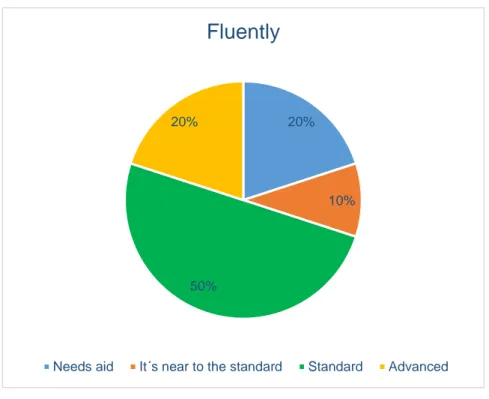
Figure V Fluently 20
CHAPTER I: INTRODUCTION
1.1 Introduction to the problem
The use of the technology to learn and develop a second language nowadays is very
necessary to complement the learning process. This is because in the communication era
the management of the electronic devices is part of our daily life due to the fact that those
devices make our life easier and comfortable. One of the most important devices that
teachers are using for educational purposes are personal computers in which we can surf
on internet and use different platforms designed to improve a foreign language through
many different activities and games. It is very common to see a language learner practicing
his or her listening through songs, speaking through scholar conversations, and writing
through book’s activities, but no many students practice their reading because the majority
tend to underestimate this skill. This project is focused on the development of the reading
skill by using electronic resources such as a specific English training platform called
“Learning A-Z”. I consider that it is essential to have significant reorientations in the
development of this skill by using these new technologies because the new generations are
growing very rapidly and we need to give them adequate tools to improve their reading
abilities.
In the Institute “Centro de Investigación y Atención al Desarrollo Infantil”
(CIADI), these new technologies have been implemented for the first time, and students from the “starters level” are using a new tool called “Raz-kids” in the platform “Learning
the same platform. In chapter III we will discuss the viability of using this tool inside and
outside the classroom as well as the measurement parameters the institution should manage
in order to take advantage of the platform.
1.2 The context of the research
The main objective of this work is to contribute to the education process focused
on the English language learning in the CIADI. In this institution, the methodology is
orientated to develop competencies through the use of the multiple intelligences because
for the school all students are capable to do many and different task according to what
intelligence they have more developed. For that reason, this year the principal and the
school owners, orientated by the English coordination of the institution, decided to
implement a new electronic tool to enhance the teaching- learning process into the
communication era. Learning A-Z is an online platform with vast resources such as lessons, worksheets, interactive audio books, and other materials designed to help teachers
and students to reach their English level. Due to the fact that the universe of investigations
related to the online platforms is very vast, I decided to focus my research only on the
reading tools the platform provides. This tool receives the internal name of RAZ-KIDS
where users may find thousands of interactive books divided into reading levels according
to the different ages of students that are designed to help English learners to improve their
foreign language. RAZ-KIDS contains amazing tools such as audio readings, the platform.
In it, students and teachers can find thousands of reading materials classified for
topics and English levels. Students are divided into different levels based on the University
is beginning the most convenient is to test the tool analysing the progress and development
of beginners (Starters Level) in order to have a more real result at the end of the research.
1.3 Purpose of the study
The present work aims to identify clearly the progress of the students developing
their English language using the Learning A-Z platform. The identification of such issues
will be of significant importance to suggest professional development actions not only for
the institution but also for the whole CIADI community including teachers, students and
parents.
1.4 Research setting
This research took place at CIADI with the kids of starter’s level. Their ages are
between 6 and 8 and they have been on the institution for a year. The reason why I decided
to choose those students was because; based on my work experience with them last year, I
am very sure they are ready to start developing the reading competence. In this regard, it
was easy to identify an increasing ability if it is given.
1.5 Research questions
How effective is the development of context understanding and reading skill of
students from starter’s level at class after three months using RAZ-KIDS?
What is the pertinence of using RAZ-KIDS for improving reading skills on
children?
1.6 Chapter summary and overview
As I mentioned above, the purpose of this work is to determine the utility and
viability of the use of Learning-A-Z to obtain a better development of reading and context
understanding which could be reflected on a better speaking performance on students from
starter´s level. In the second chapter the methodology used to analyse the data is explained.
In the same way, the context of the investigation is detailed. The description of results is
as well the conclusions and proposals are mentioned in chapter four with the intention to
CHAPTER II: METHODOLOGY
2.1 Chapter overview
This chapter is concerned with the description of the methodological considerations taken
into account for carrying out the present research. The chapter also provides a description
of the most important characteristics of the context of the research and the participants
included in this study. The instrument to collect the data is also described and the
procedures for the gathering and analysis of the data are explained. Finally, the chapter
conclusions are given.
2.2 Methodology
Throughout the years different frameworks have been developed in order to do research
in the most appropriate way. A broad distinction has been generally accepted as paradigms
guiding research procedures. This is to say, Quantitative research and Qualitative research.
Broadly speaking, Quantitative research started at the end of the 19th century and
qualitative research was developed in the late of 1800s and early 1900s (Creswell, 2005).
These two approaches have some differences. According to Creswell (2005) quantitative
research involves collecting and analyzing numeric data through the use of specific and
narrow questions. On the other hand, qualitative research involves collecting and analyzing
data subjectively through the use of broad and general questions. In this framework, for the
selection of the approach to be taken in this research the two following considerations were
taken into account:
a) the feasibility to gather the data
Based on the previous information and recalling the objective of the research, which is
to determine the utility and viability of the use of Learning-A-Z to obtain a better
development of reading and context understanding (see chapter one). I decided to set up
my universe of study only with students from the Starters level because in other way it
would result in a titanic endeavor. Considering the fact that one of the purpose and the
reasons of the research was to identify clearly the progress of the students developing their
English language using the Learning A-Z platform and to contribute enhancing the quality
of the teaching English at CIADI. For that reason, it was necessary to include a significant
number of participants in the study in order to obtain an outcome strongly supported taking
into account that the groups are small.
As a consequence, it was noted that the approach to be used that would enable the
researcher to accomplish the objectives more appropriately needed to be qualitative
orientated to obtain 80% of the necessary information to accomplish the main purpose of
the research through interviews off some people directly involved on the use of the
platform as a reading tool and the majority data was obtained from the results of the reading
assessments.. Creswell (2005) indicates that qualitative approach is a contrast with
quantitative research because employs different knowledge strategies of inquiry, and
methods of data collection and analysis. In this sense the best way to obtain the information
seems to be through some interviews to people with high contact with the platform in order
to collect a huge part of the necessary data for its analysis.
The other 20% is going to be obtained from a quantitative approach because it is
necessary to know a statistical parameter about the reading progress of the students.
experiments and surveys though statistical data. In this line on argumentation, a gathering
of information after the reading assessments gives enough would account for the issue of
including a significant number of participants and for the data analysis of the research. A
brief discussion of the main characteristics thus interviews as well as reading assessments
are presented below.
2.3 Setting context
This research took place at CIADI with the students of starter’s level which are
coursing the second and third elementary school year respectively. Their ages are between
6 and 8 and they have been on the institution for at least one year. The mandatory reading
practice using RAZ-KIDS was at home as homework. Students had to read at least one
book per week having the freedom to read more books if they wanted to. Finally the reading
evaluation was during the last week of classes on December inside the classroom and at
English classes.
2.4 Participants
As I mentioned before, this paper seeks to identify the progress and develop of the
reading skills on students from starter’s level using the RAZ-KIDS. The participants were
students on second and third grade of elementary school and they have taken English at
CIADI for at least one year. It was crucial to take into account this aspect because in this
way the final result showed signs of the teaching level of the institution. In the same way
it was important to select to participants by random because this gave more real data about
The number of participants was ten and as I mentioned before, they were selected
to be evaluated through the SEP standardized reading assessment. They must be coursing
Starters English language level in order to be selected (the number of participants
represents approximately 25% of the entire English students coursing this level). Also I
had as participants, three teachers deeper involved in managing the platform and they are
part of the English department of CIADI.
2.5 Instruments
This study relied on the use of interviews to collect significate data. According to
Creswell (2005) using interviews the data collection process might change as doors open
and close for data collection, and the inquirer learns the best sites at which to learn about
the central phenomenon of interest. These interviews where basically planed and focused
to obtain specific information about the utility and viability of the use of Learning A-Z
platform (see chapter one). All of the interviewed answered the same three questions giving
their personal opinion based on their experience working with the platform.
The second instrument and perhaps the most important was the reading evaluation
applied to the participants after three months using the platform practicing their reading
skill. The tool used was the SEP standardized reading assessment which is used to evaluate
the reading level students had in Spanish but for this research it was adapted and translated
by me. It is important to mention there was not an initial evaluation before students started
to use the platform because they are beginners and the great majority did not know English
2.5.1 Interviews
In interviews, the researcher conducts face-to-face interviews with with people
deeper involved in managing the platform and they are part of the English department of
CIADI. The interviews were by telephone, face-to-face, or in modern days by internet.
These interviews involve unstructured and generally open-ended questions that are few in
number and intended to elicit views and opinions from the participants. Creswell, 2005
highlight the importance of to use an interview protocol for recording information during
a qualitative interview which most includes the following components; a heading,
instructions to the interviewer (opening statements), the key research questions, probes to
follow key questions, transition messages for the interviewer, space for recording the
comments of the interviewer, and space in which the researcher records reflective notes. It
is very important to record information from interviews using handwritten notes, audio
taping, or videotaping.
As a very important way to measure students ‘reading I used a standardized reading
evaluation instrument from the Secretaría de Educación Pública (SEP) “Procedures Manual
for the development and assessment of reading comprehension in the classroom” (Consult
annexes to see the instruments) translated and adapted by me to obtain important data to
contribute to the main purpose of this research. The results were analyzed and graphed in
order to have a better perspective of students’ progress. The graphic impression of the used
tools can be found on the Appendix.
Finally, the main tool linked to the rest of the tools was my observation work
take into account and it was so relevant to stablish a better point of view of this electronic
material.
2.6 Data gathering
This research consists on selecting individuals who are the representative of a
specific population (Creswell, 2005). In this way, in the case of the observation and
evaluation of the reading skill, the methodology used to select the participants was
probability sampling. The universe of study was 10 students of 56 which are coursing
Starters English level. The obtained information was analyzed and graphed to have a better
view and perspective of the thinking of students about their everyday work with the
platform.
In the case of the interviews I talked with people deeper involved in managing the
platform and they are part of the English department of CIADI. Through the interviews I
obtained important aspects to be taken into account to help beginners to develop more
efficiently their reading competence. The last step was to gather all the results of the
reading evaluation to analyze the results and one by one and the obtained data was graphed
in order to have a visual aid to compare the information.
2.7 Data analysis
The result of the interviews was analyzed meticulously and with calm in order to
obtain very important information from the interviewed people. The majority of the
answers were very different but some of them were closed related. It is important to
emphasize that the data were not handled as an absolute true, only as a reference to start
In the case of the reading evaluations the result was very interesting because a great
majority of students have the same learning style to develop their reading skill. This was
something that I was expecting from the evaluation and it gave me strong references to
keep my research walking as it was.
Once I have finished the analysis of the reading evaluations my first impression
was satisfactory because 70% of students have demonstrated a positive increase on their
reading skill and context understanding. Moreover, they are able demonstrate their reading
level inside and outside the classroom according to the results of the reading standardized
evaluation of the SEP.
2.8 Chapter summary
This chapter provided all the most important aspects taken into a count to collect
and to analyze the data. The data was collected through interviews, literature review,
consulting of reading strategies, reading assessment and observation. The instrument
application implied a considerable number of participants in order to get a valid and reliable
research. The universe of study consider students of the “Centro de Investigación y
Atención al Desarrollo Infantil” (CIADI) coursing the Starter English level according to
the University of Cambridge. The interviews were applied to teachers who have a
continuous contact with the Learning A-Z platform. The literature consulted is complete
based on the environmental and pedagogical design of learning objects and reading
materials. The reading assessment, on the other hand, were applied to students from CIADI
with a Starter English level. Finally the most important tool was my observation because
it was crucial to identify important aspects that sometimes we as teachers do not identify
CHAPTER III: THE ANALYSIS PROCESS AND THE MAIN
RESULTS
3.1 Analysis of the interviews
After the interviews I gathered all the information and started to analysis the answers of
the teachers. It was evident they had a good impression of the platform and they are very
close related with the tool. However; it was very important to distinguish between the
convergent opinions and the opinions with a different point of view. In this sense, I did the
analysis question by question checking each answer and comparing with my own
experience working with RAZ-KIDS as well as the observation I did when students
practiced inside the classroom.
3.2 The useful tool inside RAZ-KIDS that help students to develop their reading comprehension
Teacher 2 said “I consider when students have the opportunity to relate the images
they see and the words they read at the same time their interest on reading increases and
they fell more comfortable and confidents to read and practice”. In the light of the teacher’s
answers which were close similar to the opinion of T2 and doing a comparison with my
observations; I determined that the reading tool known as RAZ-KIDS provides an
environment adequately created to call kids attention and gives them a lot of visual
stimulations such as images, videos and short interactions during each reading. This help
confident when they try to practice because most of the time in front of other students they
may feel fear and shame causing they do not train correctly.
My conclusion about this aspect is RAZ-KIDS have an educational environment
highly developed to help student to increase their reading comprehension.
3.3 Change performance on reading skill during the first three months using RAZ-KIDS at class
The three teachers as well as me, agreed that this tool had helped students to develop
a better pronunciation, fluency, vocabulary recognition not just when reading but when
they are at class or even outside the class. Some students even are self-correcting and
correct to another classmates this was a big advance because to do this action they had to
feel very sure about what they know. Teacher 2 had an interesting experience after one
month using the platform. T1 told me that one day a little girls from his class of science
came to him and asked him about the colors of the rainbow but she did not know how to
say rainbow before. T1 said “Teacher te gustan the colors del rainbow” that was awesome
because that week they had to read a text related to the weather and there she found this
new word and she was able to use it without the necessity I asked her to do it” because of
that he realized the platform was helping them to increase their vocabulary.
My conclusion about this aspect was that the continuous training of students using
RAZ-KIDS has increased their capacity to read and understand long texts and it has
developed their fluency exponentially. On the other hand this tool achieved to give them
confident and sureness to defend their point of view and more specifically what they think
3.4 The tool inside the platform teachers consider help students to develop a better reading skill
Based on my observation and doing a meticulous comparison with the answers of
the teachers, I realized that one of the most important tool RAZ-KIDS provides is the
recording and audio-book because students develop the four skills at the same time and
enjoy to work and read because they are growing into a new world and to use their personal
devices to study and practice it is a big push for students and a huge motivation to keep
working as a hobby. In words of Teacher 3 “I think the most helpful tool has been the
recording because students pay too much attention on what they are reading so, they easily
comprehend the content of the book and enjoy recording at the same time. That is very
exciting for them”. Her experience working with RAZ-KIDS showed me very important
aspect from the tool.
My conclusion about this aspect was that the platform provides an enormous tool
that could be exploited to help students to increase exponentially student´s four skills
depending of different factors such as log-in time, read books and accessibility to the
platform. These three elements were discussed and analyzed through the reading evaluation
3.5 Reading Evaluation
3.5.1 Number of read books against login time
Before applying the tool I took into account the quantity of students taking Starters
level on this course. The total of students were 56 which I took 10 at random. Their ages
are between 7 and 9 years old and they are coursing first, second and third grade of
elementary school respectively. After three months using the platform there were some
notorious changes on their reading performance as well as their reading comprehension.
On Figure 1 we can observe the time dedicated to the reading practice inside the platform
and how many books they read during this period. At least students had to login and read
one book per week which implied that at the end of the third month they should have read
twelve books. However; only the 60% of students have read that number of books, the 30%
read between 8 and 9 which is close to the objective and the 10% read lest than 5 as we can
see on figure 1 and 2.
Figure 1.
On Figure 2 we can observe that there was something relevant about this research
check this my first impression were to find many read books followed by a long login time
but this was entirely different because there were any patron or time averageable. There
were some students with a long login and just some books on one side, and on the other
side there were some students with few time but a lot of read books.
Figure 2.
This phenomenon was due to the platform gives students some points that they can
use to play on different videogames inside the platform. During my observation I noticed
that some students used to read quickly and then go and play the videogames. This means,
students with less books but long login was because they spent more time playing
videogames than reading. Finally I realized that the age was not a factor that determine the
interest to read because of the notorious variation between the read books and the login
time. This can be observed on Chart 1.
0 5 10 15 20 25 30 35 40 45
Student A Student B Student C Student D Student E Student F Student G Student H Student I Student J
Figure 3.
Chart 1.
Ages (Between 7 and 9)
7 Years Old 8 Years Old 9 Years Old
Read books against login time
Student Age English level Read books
(Raz-Kids) Login time
Student A 7 Starters 23 3h 40m
Student B 7 Starters 42 2h 59m
Student C 8 Starters 9 1h 11m
Student D 7 Starters 16 6h 41m
Student E 7 Starters 18 4h 35m
Student F 7 Starters 13 3h 46m
Student G 7 Starters 3 5h 1m
Student H 8 Starters 8 2h 26m
Student I 7 Starters 26 2h 12m
10% 0%
70% 20%
Reading Comprehension
Needs aid It´s near to the standard Standard Advanced
3.5.2 Reading comprehension
In the previous analysis we discovered the interest and advantage taking students
did during this three months. Now it is crucial to evaluate their reading skill taking into
account the three main aspect SEP consider necessary to develop in order to have a correct
reading skill. (Consult appendix “A”) The first evaluated aspect was the reading
comprehension. A student coursing second or third grade of elementary school must
possess specific characteristics and abilities to be consider a standard reader. Through the
use of this rubric designed by the SEP, I obtained significant results to contribute to my
research.
As we can see on Figure 4. 70% percent of students have and standard reading
comprehension which implies they can read, analyze and understand almost all the text
being able to report the text and give a personal opinion. They have an adequate vocabulary
according to their age and they can understand new words by context. 20% of students
have an advanced level which according to the SEP it is the optimum level that students
most possess at the end of the elementary school. The last 10% needs some aid to increase
adequately their reading skill and get the standard level.
3.5.3 Fluently and Reading speed
After to apply the evaluation of fluently and reading speed on each student,
(Consult appendix “B” and “C”) the results were very close related to the reading
comprehension on the majority of students. In the case of fluently 70% of students had a
standard fluently level or exceed it, while 30% needs to put more emphasis on their training
and practice on the platform in order to increase correctly and in a short time their fluently.
However; comparing this result with the previous analysis of the reading comprehension,
I could conclude that despite the fact that a considerable number of students had a poor
fluently, they are able to understand a short text by their own and to use the information to
solve problems. (Asking and answering questions)
The last point of the reading evaluation according to the SEP is the reading speed.
Students between 7 and 9 years old most be able to read between 85 and 99 words per
minute in order to be considered a standard reader, more than this quantity is label as an
advanced reader according to the ages. This time the correlation between fluently and speed
had a very close relation because the students that had a standard fluently had a standard
or are near to the standard of speed. It means their reading skill are growing adequately and
at the same steep because the 70% of the students with a good fluently are inside of the
20%
50% 30%
Reading Speed
Needs aid It´s near to the standard Standard Advanced
Figure 5.
Figure 6.
20%
10%
50% 20%
Fluently
3.6 General overview
One I finished the evaluations and the corresponding analysis of each student, I
gathered all the data in order to have a general overview and a comparison of their
performance throughout this three month and the results were amazing because I realized
that there was not a student with all his or her abilities developed in the same level. All
students have to keep practicing and increase their reading skill from different sides.
However; 90% of students have or exceed the standard level in reading comprehension
which means that the continuous use of RAZ-KIDS have develop this ability in almost all
the students and it has increased the fluently and speed in the 50% of the children from
starter’s level.
Student's reading evaluation
(SEP standardized system)
Student Reading Comprehension Fluently Reading Speed
Student A Standard Standard It´s near to the standard
Student B Standard Standard It´s near to the standard
Student C Standard It´s near to standard It´s near to the standard
Student D Standard Needs aid Needs aid
Student E Standard Standard Standard
Student F Standard Standard It´s near to the standard
Student G Needs aid Needs aid Needs aid
Student H Advanced Advanced Standard
Student I Advanced Advanced Standard
Student J Standard Standard It´s near to the standard
CHAPTER IV: CONCLUSIONS
4.1 Introduction
In Chapter 2, I showed and described the findings of the interviews as well as the results
of the reading evaluations I applied to the students using charts and graphics. These two
instruments revealed the advantage and disadvantage the platform presents and the results
were presented in Chapter 3.
This chapter restates the research questions and answers them based on the obtained
data throughout the research. Here it is presented a conclusion and suggestions for a deeper
research in the future and at the same time, I report some limitations of the study and I
suggest directions for further research through the answers I gave to my research questions.
4.2 Findings and significance of the study
This section describes the findings and significance of the study. It also answers the
three research questions that guided this study:
RQ1. How effective is the development of context understanding and reading skill
of students from starter’s level at class after three months using RAZ-KIDS?
RQ2. What is the pertinence of using RAZ-KIDS for improving reading skills on
children?
In order to answer the three research questions I applied three interviews and ten
reading evaluations. The interviews showed the positive and negative perspective teachers
from CIADI have in relation with the platform. The three teachers agreed on almost all the
aspects I questioned them and they presented a big trust on the tool because their answers
were very specific and concrete. The interviews also revealed the needs of the teachers
while they worked on the platform as well as the needs of students.
In the other hand, the reading evaluations came to the light specific reading
problems that students had and gave me a reference point to determine how much the tool
have helped them to increase their reading performance and speaking competence in a short
time (three months). Without the use of this standardized instrument the obtaining of the
results would be irrelevant and less dependable.
Based on the previous explained collecting data, I got the answer to my research
questions:
RQ1. At class and outside of the class students presents an exponential growing
because according to the results of the instruments, 80% of students has increase
and potentiate reading fluently and speed. Moreover, now they possess a huge
new vocabulary they did not have before to start practicing with the platform
three months ago. The last and more crucial result was their reading
comprehension due to the fact that the 90% of students presented a standard
level which means they are able to read by their own a text or book and catch the
majority of the information without troubles. And this is not only at class but when
they have to take part on another classes that require them to read and
The final conclusion and answer to this RQ was positive and strongly
supported because there was evidence that demonstrate Learning A-Z through
RAZ-KIDS is highly effective to impulse and aid students to increase their English
level.
RQ2. The second question is close related to the answer to the first one because
if a student presents a significant advance at class, it is almost a fact that student
is be able to use the language outside the class. In the communication era students
are able to interact with technology without any trouble and they learn easy and
fast. The use of platforms to interact and learn a foreign language is not an option
anymore, it is necessary because nowadays to work with technology is part of
student´s daily life and their natural learning proses.
The final conclusion and answer to this RQ was positive and strongly
supported because after three months of working with the platform students
were able to communicate concrete and simple ideas and feelings they have at
any moment.
RQ3. During the whole proses of assessment, observation, practice and evaluation
I realized that more competences were benefit by the use of the platform. 80% of
students now are able to interact at class easier and they are able to reply a
question or to give their personal opinion using a vast vocabulary and with a better
pronunciation. Moreover, many students have developed exponentially their
listening skill because when we practiced using an audio they catched faster key
The final conclusion and answer to this RQ was positive because two more
competences of students were affected during the use of RA-KIDS and this were
reflected on everyday class and even at home doing some homework.
4.3 Achievement of research aims
The aims of this work were to identify clearly the progress of the students
developing their English reading skill using the Learning A-Z platform. This aims were
accomplished through the use and analysis of the interviews and reading evaluations as
well as a constant assessment and observation during three months (from October to
December of 2014). The aims were satisfactory accomplished through the research process
REFERENCES
Colburn, C. (2014). Online Strategic Interaction: ESL Role-Playing via Internet Relay Chat. USA. University of Delaware. [s.d.] [Cited on December 10, 2014]
INEE. (2008). PISA en el Aula: Lectura, México: INEE. [s.d.] [Cited on December 13, 2014]
Learning A-Z. (n.d.). The Story Behind. Learning A-Z. [s.d.] [Cited on December 5, 2014] Available on: http://www.learninga-z.com/about-learninga-z-history.html
Lloyd, M. (2005). Towards a definition of the integration of ICT in the classroom. In “AARE 2005, AARE, Eds. Proceedings AARE '05 Education Research -Creative Dissent: Constructive Solutions”. [Online]. Parramatta, New South Wales. [s.d.]. [Cited on December 21, 2014]
Lerner, D. (2001). Leer y escribir en la escuela: lo real, lo posible y lo necesario. México: SEP. [s.d.]. [Cited on December 13, 2014].
Lloyd, M. (2005). Towards a definition of the integration of ICT in the classroom. In “AARE 05 Education Research - Creative Dissent: Constructive Solutions”, [Online]. Parramatta, New South Wales. [s.d.]. [Cited on December 13, 2014]. Available from internet: http://eprints.qut.edu.au/3553/Lloyd, Margaret M.
North, B. (n.d.). The Common European Framework of Reference: Development, Theoretical and Practical issues. [Online]. [s.d.]. [Cited on December 18, 2014]. Available from internet: http://www.nationaalcongresengels.nl/cgi-bin/north-ede-wagingen%202007-paper.pdf
North, B. (n.d.). The Common European Framework of Reference: Development, Theoretical and Practical issues. [Online]. [s.d.]. [Cited on December 13, 2014]. Available from internet: http://www.nationaalcongresengels.nl/cgi-bin/north-ede-wagingen%202007-paper.pdf
PISA. The extent of knowledge and skills of students. A new framework for evaluation. “MEC, INCE, 2000”. [s.d.]. [Cited on December 13, 2014].
Wiley, D. A. (2000). Connecting learning objects to instructional design theory: A definition, a metaphor, and a taxonomy. In “The instructional use of learning
objects: Online version”. [Online]. [s.d.] [Cited on December 18, 2014]. Available from internet: http://reusability.org/read/chapters/wiley.doc
Appendix “C” Reading speed
Words read per minute
Scholar Grade
Level Needs aid
Level It´s near to the
standard
Level Standard
Level Advanced
First Less than 15 From 15 to 34 From 35 to 59 More than 59
Second Less than 35 From 35 to 59 From 60 to 84 More than 84
Third Less than 60 From 60 to 84 From 85 to 99 More than 99
Fourth Less than 85 From 85 to 99 From 100 to 114 More than 114
Fifth Less than 100 From 100 to 114 From 115 to 124 More than 124