
The current and future role of writing instruction in the English program of the ITESM system
111
0
0
Texto completo
(2) INSTITUTO TECNOLOGICO Y DE ESTUDIOS SUPERIORES DE MONTERREY. CAMPUS EUGENIO GARZA SADA. THE CURRENT AND FUTURE ROLE OF WRITING INSTRUCTION. IN THE ENGLISH PROGRAM OF THE ITESM SYSTEM. Tesis presentada como requisito parcial para optar al título de Maestro en Educación con Especialidad en Enseñanza de Ingles como Segunda Lengua. Autora: Anne Mari e W alsh Asesora: Dr. Jodí Crandall. Monterrey, N. L. 28 de noviembre de 1994.
(3) This thesis is dedicated to MYFAMILY without whose love and support it would never have been possible.. ii.
(4) ACKNOWLEDGEMENTS. The author would like to thank the following people and institutions whose help and cooperation contributed to the successful completion of this study:. 1. The ITESM, for granting me,a scholarship for the Master's Program in Education and ESL.. 2. All of the professors in this program, who gave so generously of their knowledge, and themselves.. 3. The ITESM teachers, department heads, and division directors, who cooperated so willingly with this study.. 4. Dr. Jodi Crandall, my thesis advisor, whose efficient and cheerful help and encouragement kept me from feeling too overwhelmed by this project.. 5. Dr. Irene Gartz, who was patient and understanding when progress seemed slow.. 6. My son-in-law, Jorge Valdez, and my niece, Maria Myma Guajardo, who helped me prepare the final version of this thesis.. iii.
(5) EL PAPEL ACTUAL Y FUTURA DE LA ENSEÑANZA DE REDACCIÓN EN EL PROGRAMA DE INGLÉS DEL SISTEMA ITESM Autora: Anne Marie Walsh Crandall. Asesora: Dra. Jodi. RESUMEN La globalización del ambiente profesional y de negocios para el cual el ITESM prepara sus alumnos requiere que los graduados puedan desempeñarse con un alto nivel en inglés. Siendo la redacción una de las habilidades más importantes para el buen desempeño de los profesionistas, esta tesis propuso averiguar hasta qué punto el programa actual de inglés esté cumpliendo con los objetivos propuestos para el Plan 1995-1999. Un estudio descriptivo de la enseñanza de la redacción en inglés en el Sistema ITESM fue llevado a cabo en los campuses de Monterrey, Estado de México, Guadalajara, Chihuahua y Eugenio Garza Sada durante el semestre de enero-mayo de 1994. Se mandaron encuestas a los directores de los departamentos de inglés de estos campuses, así como a una muestra de los profesores. En adición, se encuestaron a los directores de división del Campus Monterrey. Al mismo tiempo, se llevó a cabo un análisis de contenido de algunos libros de texto utilizados en el programa actual, así como algunos libros que estan bajo consideración para el nuevo programa. Esta investigación reveló que en el presente programa, existe muy poca atención a la redacción en inglés, con algunas excepciones, como la preparatoria bicultural. Ni el libro de texto más utilizado a nivel profesional, la serie Spectrum, ni la serie Interchange, actualmente bajo consideración para el nuevo programa, ofrece instrucción formal en redacción. Sin embargo, la serie de Scott Foresman, In Touch, On Target, y In Charge, también bajo consideración, incluye instrucción sistemática en redacción. Por lo anterior, se recomienda que la serie de Scott Foresman sea seleccionada para su uso en el Plan '95 a nivel de preparatoria tradicional o bilingue, y para el programa remedia} a nivel profesional. Inclusive, en el Curso Sello de inglés a nivel profesional, se recomienda el libro más avanzado de esta serie para los alumnos con calificaciones entre 450 y 520 en el TOEFl. Para los alumnos con calificaciones mayores de 520 , se recomienda continuar con algunos de los cursos que actualmente se imparten en el Módulo Avanzado. Igualmente, para la preparatoria bicultural, se recomienda seguir con el libro MacMillan: Thinking and Writing Processes.. iv.
(6) THE CURRENT AND FUTURE ROLE OF WRITING INSTRUCTION IN THE ENGLISH PROGRAM OF THE ITESM SYSTEM Author: Anne Marie Walsh Crandall. Advisor: Dr. Jodí. ABSTRACT The globalization of the business and professional environment for which the ITESM prepares its students requires that graduates be able to function at a high level in English. Since writing skills play such an important part in students' success as students and later, in their careers, this thesis proposed to investigate whether the current English program at the ITESM meets the objectives proposed for the 19951999 program. A descriptive study of writing instruction was carried out at the campuses of Monterrey, Estado de México, Guadalajara, Chihuahua, and Eugenio Garza Sada during the spring semester of 1994. Questionnaires were sent to the heads of the English departments at these campuses, as well as to selected instructors. In addition, the directors of the academic divisions at the Monterrey Campus were surveyed. At the same time, a content analysis was carried out of sorne of the textbooks currently in use or under consideration for use in the new program. This study revealed that the current program gives little attention to teaching writing in English, with sorne exceptions, such as the bicultural preparatory program. Neither the most widely used textbook, the Spectrum series, nor the Interchange series under consideration contains any fonnal instruction in writing. However, the other text being considered, the Scott Foresman series, does include systematic instruction in rhetoric and composing strategies. For this reason, it is recommended that the Scott Foresman series be selected for use in the 1995 program for the traditional or bilingual preparatory level and the undergraduate remedial level. The most advanced book of this series, In Charge 2, is recommended for the one-semester required course at the undergraduate level, for students whose TOEFL seores are between 450 and 520. For students with seores above 520, it is recommended that they be offered a variety of the courses which are now included in the Advanced Module. Likewise, it is recommended that the bicultural preparatory program continue using the textbook MacMillan: Thinking and Writing Processes.. V.
(7) INDEX PAGE INTRODUCTION. 1. l. THE PROBLEM. 2. 1.1. Background. 2. 1.2. ldentification of Needs. 4. 1.3. Statement of the Problem. 5. 1.4. Purpose and Justification for the Study. 6. 1.5. Questions to Be Answered. 7. 1.6. Scope and Delimitations. 8. 1. 7. Limitations. 8. 2. REVIEW OF THE LITERATURE. 9. 2.1. History, Emerging Trends and Current Practice in ESL Writing Instruction. 9. 2.1.1. Focus on Form and the Product. 10. 2.1.1.1. Controlled, Guided and Free Composition. 10. 2.1.1.2. Rhetoric and Contrastive Rhetoric. 11. 2.1.2. Focus on the Writer and the Process. 13. 2.1.3. Focus on Content. 17. 2.1.4. Focus on the Reader. 18. 2.1.4.1. English for Specific Purposes (ESP). 18. 2.1.4.2. English for Academic Purposes. 19 23. 2.2. The TOEFL 2.2.1. The TOEFL as a Test ofWriting. 23. 2.2.2. The TWE. 24. 2.2.3. Changes in the TOEFL. 25. vi.
(8) 3. METHODOLOGY. 27. 3. 1. Identifieation and Justifieation of Type of Researeh. 27. 3 .2. Proeedures for Colleeting Data. 28. 3 .2.1. Survey of Department Heads. 28. 3.2.1.1. Seleetion of Subjeets. 28. 3.2.1.2. The Survey Instrument. 29. 3 .2.1.3. Exeeution of Survey. 29. 3.2.2. Content Analysis of Textbooks. 29. 3 .2.2.1. Seleetion of Textbooks. 29. 3 .2.2.2. Design of lnstrument for Analysis. 30. 3 .2.2.3. Exeeution of the Content Analysis. 31. 3.2.3. Survey of Teaehers. 31. 3.2.3.1. Seleetion of Subjeets. 31. 3 .2.3 .2. Design and Piloting of the Survey lnstrument. 31. 3.2.3.3. Exeeution of Survey. 32. 3.2.4. Survey of Division Direetors. 33. 3.2.4.1. Seleetion of Subjeets. 33. 3.2.4.2. Design of Survey Instrument. 34. 3.2.4.3. Exeeution of the Survey. 34 34. 3.2.5. TOEFL Seores. 4. PRESENTATION, ANALYSIS AND INTERPRETATION OF RESULTS. 36. 4. 1. Survey of Department Heads. 36. 4.2. Content Analysis of Textbooks. 39. 4.3. Survey of Teaehers. 44. 4.4. Survey of Division Directors. 54. 4.5. TOEFL Seores. 57. vii.
(9) 5. SUI\01ARY, CONCLUSIONS AND RECOMMENDATIONS. 60. 5 .1. Summary. 60. 5.2. Conclusions. 65. 5.3. Reeommendations. 66. 5 .3 .1. Students with TOEFL Seores Below 450. 67. 5.3.2. Students with TOEFL Seores Between 450 and 520. 68. 5.3.3. Students with TOEFL Seores Greater Than 520. 68. 5.3.4. Teaeher Training. 70. BIBLIOGRAPHY. 72. APPENDICES. 79. A. Questionnaire for Survey of Department Heads. 80. B. Cheeklist for Elizabeth Clemente' s Survey of Textbooks Used. 81. C. Cheeklist for Content Analysis of Spectrum Textbook. 83. D. Cheeklist for Content Analysis of Spectrum Workbook. 85. E. Cheeklist for Content Analysis of Jnterchange Textbook. 87. F. Cheeklist for Content Analysis of On Target Textbook. 89. G. Cheeklist for Content Analysis of Mosaie Textbook. 91. H. Cheeklist for Content Analsysis of MaeMillan 1O Textbook. 93. l. First Version of Questionnaire for Survey of Teaehers. 95. J. Revised Version of Questionnaire for Survey of T eaehers. 96. K. Questionnaire for Survey of Division Directors. 99. 101. VITAE. viii.
(10) INDEX OF TABLES. TABLE. PAGE. l. Students Enrolled in English Courses. 37. 2. Students Using Each Textbook. 38. 3. Response Rate for Survey of T eachers. 45. 4. Demographic Data for Teachers. 46. 5. Sentences. 47. 6. Paragraphs.. 48. 7. Essays. 49. 8. BookReports. 49. 9. Research Papers. 50. 10. Joumals. 50. 11. Letters. 51. 12. Job-related Tasks. 51. 13. Teaching Strategies. 52. 14. Results of Survey of Division Directors. 56. 15. TOEFL Seores of ITESM Students at Monterrey Campus. 58. ix.
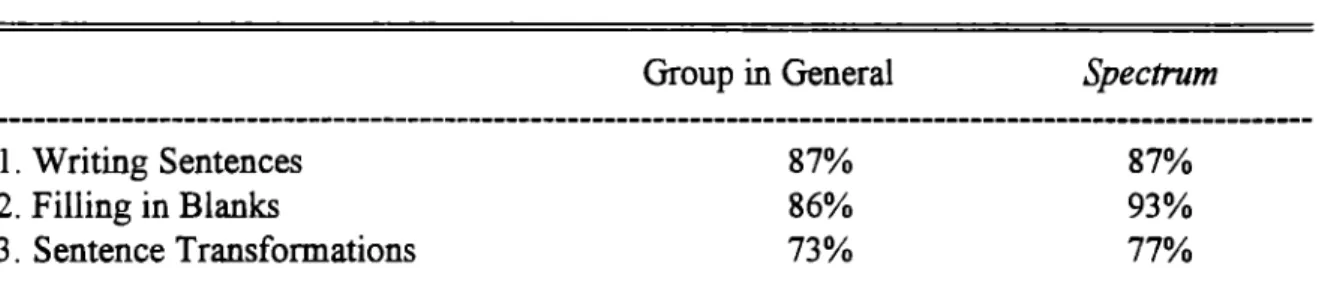
(11) INTRODUCTION. The Monterrey lnstitute of Technology System (ITESM) currently revises its curricula every five years in order to meet the changing needs of society, as well as those of the graduates of this institution who will eventually take their place in that society.. The. present study was undertaken as part of a larger project whose goal is to obtain the information needed to design the curriculum for the period 1995-1999. The specific focus of this study is to describe the present state of the teaching of writing in the ESL programs throughout the ITESM System, both at the preparatory school level and at the undergraduate level, and to discuss how the teaching of writing relates to the goals which have been established for the 1995-1999 currículum. These goals include the specific objective of obtaining a score of 550 on the TOEFL by ali students exiting the undergraduate program, and the more general objective of making a contribution toward achieving the goals described in the Mission of the ITESM System.. These include professional and moral excellence, leadership with. commitment to the development of society, respect for the rights of others and an intemational viewpoint including concern for sociopolitical and geographic issues. With the ITESM's goals in mind, this descriptive study analyzes the course content of the current writing curricula and attempts to answer such questions as what is meant by writing, to what extent it is being taught and by what methods, whether it meets the personal needs of our students as well as those of the local, national and intemational communities, and whether it provides adequate preparation for the TOEFL and for further academic work.. Lastly, sorne recommendations have been offered for the. 1995-2000 currículum.. 1.
(12) l. THE PROBLEM. This chapter will begin with a discussion of the background underlying the current area of concern, followed by the identification of the needs which have given rise to the articulation of the problem. The problem will then be set forth, and its purpose and justification will be explained. This will be followed by a discussion of the specific questions to be answered and finally, the scope and limitations of the present study will be considered.. 1.1. Background. In August of 1990, in response to the changing needs of our students with regard to the learning of English, the Monterrey Institute of Technology (ITESM) intensified the teaching of English. at the preparatory level and established a massive EFL. program at the college level. In order to describe these programs, it is important to point out that the various campuses throughout the System are committed to achieving the goals established by the administration at the System level.. The. programs developed to achieve these goals are established by meaos of a consensus arrived at by the various campuses. These proposals are subject to the approval of the System administration and implemented by the regional administrations.. However,. there is considerable autonomy at the campus leve] to allow for differences in student profiles, as well as human and material resources. degrees of uniformity with regard. Consequently, there are varying. to both the preparatory and the college level. programs. Prior to 1990, the majority of the preparatory schools in the System followed what was known as a. 11. traditional" program in which English as a Foreign Language was. taught as just another subject.. In 1985, the Preparatoria Eugenio Garza Sada in. Monterrey instituted a 11 bicultural II program for students who were already bilingual,. 2.
(13) many of whom had studied since nursery school in private schools where English was the medium of instruction.. In this bicultural program, English is taught as it would. be taught in the United States to native speakers at the high school level.. In addition,. approximately half of the other courses are also taught in English. In recent years, severa! other preparatory campuses in the System have instituted bicultural programs in addition to their traditional programs. Another development in the preparatory school programs has been the upgrading of the amount of English taught in sorne of the traditional programs to ten hours a week, so that they are now called "bilingual II programs. The textbooks used in all of these programs, whether they are called "traditional, 11 "bilingual, 11 or "bicultural, 11 vary widely, with each campus choosing the textbook it prefers. At the college level, from 1976 to 1990, the only required English course was a onesemester course in Reading for Academic Purposes.. In 1990,. a massive. program was established throughout the system at the undergraduate level.. EFL In this. program, all incoming students are required to take three semesters of English, m which ali four. language. skills are taught.. Students whose bilingual. status. 1s. confirmed by the placement test can choose to take French or German (if offered at their campus) in order to comply with the three-semester language requirement, or they can choose from among various advanced English courses. Students whose level of English is too low for the basic program can take one or two non-credit remedia! courses prior to taking the three required courses. At this time, the majority of the undergraduate campuses of the System are using a six-level series of EFL textbooks called Spectrum, which is based on a communicative approach to language learning.. The basic program includes Spectrum 3, 4 and 5. This. program brings students from a low intermediate level through a low advanced level. Levels 1 and 2 are given as remedia! courses; level 6 is not given. Instead, there are a number of other advanced courses available to students who exempt the basic level and. 3.
(14) choose to continue studying English,. rather than start another language.. -. examples of the advanced courses offered at the Monterrey Campus. Sorne. are Academic. Writing, Public Speaking, Understanding Cultures of the World, Readings from Newsweek Magazine, and English in the Workplace. The Guadalajara Campus includes Advanced Reading and Writing and Intemational Business English in their advanced module. There is currently a wide variety in the amount and level of writing instruction offered in the System. The most advanced and intensive instruction in writing is offered in the bicultural preparatory programs, where English is taught as if the students were native speakers, and in which students are required to write research papers during their last semester. On the other hand, the EFL courses taught in the traditional and bilingual preparatory programs and in the remedial and basic undergraduate programs do not seem to place much emphasis on writing instruction beyond the sentence level.. For example, the. Spectrum courses, which are taught at most of the college-level campuses, focus almost. exclusively on everyday social language. Writing exercises include filling in blanks, sentence transformations and writing paragraphs and letters,. but with. no formal. instruction in the process of writing or how to write. Sorne writing is required in the various. courses of the advanced module at the undergraduate level.. Nevertheless,. formal instruction in rhetorical skills is not included in the courses, unless individual teachers include it on their own (with the exception of the Academic Writing course).. 1.2. Identification of Needs The. recent implementation of the NAFTA Treaty. between the United States,. Canada and Mexico has dramatically increased the amount of commercial and cultural exchanges between these countries.. This has greatly intensified the need for. students to. in English. be. able. to. function. 4. at a high level. our. in every aspect..
(15) Furthermore, English has become the lingua franca of our times, to the extent that it 1s not only necessary for international transactions, but even within one's own borders it 1s needed in order to have access to the .. modem technology which is so rapidly. .. mcreasmg. The Mission of the ITESM includes the preparation of professional people who are leaders in their fields and. in their communities.. The globalization of the. professional and business environment has led to an expansion of the concept of "community" to the extent that our graduates will. increasingly be. operating and. competing in an intemational environment. lndicative of the nature of that environment is the fact that recent educational reforms in the United States have placed increased emphasis on upgrading writing skills. international community,. they. If ITESM's students are to be leaders in that. must be able. to compete equally, or even. with. advantage, in an English-speaking environment. Among those skills they will need is the ability to express themselves in writing in English. At this time, we cannot say that many of our students are well prepared for this challenge. In an effort to adapt. to the rapidly. increasing demands of the intemational. environment, the ITESM is considering requiring a TOEFL score of 450 for graduation from preparatory school and 550 for graduation from the undergraduate level in the 1995-1999 curriculum.. This requirement will place additional pressure on both the. preparatory and undergraduate programs to upgrade their English programs, especially with respect to the teaching of the formal, academic language tested by the TOEFL.. 1.3. Statement of the Problem There seems to be a discrepancy between the high level of English competency required of leaders. in today's global environment and the. present level of. English proficiency reflected in our present English program, especially with regard to writing skills. Writing becomes increasingly important at the higher levels of business. 5.
(16) and professional leadership. Therefore, it is becoming more and more important for the ITESM to attend to this need by providing its students with the amount and type of writing instruction necessary to help our students achieve success. In the first place, they need success on the TOEFL, then in their further academic studies (which increasingly include studies abroad or courses taught by foreign professors at the ITESM) and finally, in their professional careers. In order to address this need for writing instruction which is sufficient, adequate and appropriate for the needs of our students, it is first necessary to examine the current English program of the ITESM System, before making recommendations for changes. The present study, therefore, consists of a survey of the ITESM's English program in an effort to determine the characteristics of the writing component and its capacity to contribute toward achieving the goals of the institution and its students.. 1.4. Purpose and Justification for the Study. The immediate purpose of the study is to contribute to the curriculum. design. project for the 1995-1999 curriculum. Any needs assessment for the purposes of curriculum design requires a foundation upon which to make proposals based on rational choices.. Furthermore, the transcendental nature of education makes it impor-. tant to proceed with care when faced with the opportunity and the responsibility of revising a plan of studies. Many factors need to be taken into account when designing a plan of studies, such as sociocultural aspects, the demands peculiar to each profession, and fmally, pedagogical concems. Therefore, a decision has been made to review the current writing program through a formal survey, in order to obtain a clear description of the writing component of the current English program. This information will then be used as a basis for making proposals for the 1995-1999 program.. 6.
(17) 1.5. Questions to Be Answered. The first consideration of this investigation is to determine the content of what is being taught; that is, exactly which writing skills and types of tasks are explicitly included in the program.. Next, it is important to ascertain the extent to which this. content is taught, or the relative importance given to teaching each skill and task in the program.. Finally, the methods by which writing skills and tasks are taught must be. investigated. Once these questions are answered, a judgment must be made with regard to the appropriateness of what is being taught, the sufficiency with which it is covered, and the adequacy of the methodology which is being used.. Another question to be. addressed is the role of writing instruction in helping students achieve a good TOEFL score. Lastly, since the purpose of the study is to contribute toward the improvement of the current program, sorne questions must be answered with respect to the need for improvement, the reason for the improvements and the strategies to be suggested. In other words, it is necessary to establish whether or not the current program is meeting the needs of the students, of the miss ion of the ITESM, and of society.. Then it is. important to identify which needs in particular may not be being met by the present program. Once the focus of the proposed changes has been established, consideration can be given to the question of how the program can be improved. Por example, which features of the present program need to be changed and which features. should be. continued? Should sorne courses by replaced entirely, or would it be preferable to keep them and merely supplement them with extra material to supply what is lacking? What suggestions could be made as to the choice of textbooks, materials or teaching techniques?. And finally,. at what level of proficiency should we place the greatest. emphasis on writing instruction?. 7.
(18) 1.6. Scope and Delimitations. This investigation was carried out during the spring semester and the summer of 1994 and included the undergraduate campuses of Monterrey, Estado de México, Guadalajara and Chihuahua, as well as the preparatory campuses of Eugenio Garza Sada in Monterrey and the preparatory levels at the Estado de México, Guadalajara, and Chihuahua campuses. At the undergraduate level it included all levels from the remedial to the basic and the advanced modules. At the preparatory level, all programs at the aforementioned campuses were surveyed, whether they were characterized as ditional, 11. 11. 11. tra-. bilingual II or 11 bicultural 11 • The teachers who were surveyed were chosen. randomly and the textbooks chosen for content analysis were selected on the basis of widespread use.. A survey of the directors of the six academic divisions located at. the Monterrey Campus (undergraduate level) was also conducted.. l. 7. Limitations. Among the limiting circumstances of this study is the fact that the rapid changes in the world situation are bringing so much pressure to bear on the English programs in the ITESM System curricula that many campuses are already anticipating the changes which will need to be made in the. 1995-1999 curriculum.. Consequently,. textbooks are being piloted and even adopted in advance of the target date. This rapid state of flux malees a descriptive study somewhat difficult, since the curricula hardly stand still long enough to be studied. Another limiting factor in a survey study such as this is that the responses given on questionnaires may not accurately reflect the reality of the situation. Rather, they may reflect only each teacher's perception of the situation, therefore being somewhat subjective. This is not to imply that the teachers' opinions do not provide a valuable contribution to the qualitative data. However, it is hoped that the content analysis of textbooks will provide a complementary element of objectivity to the study.. 8.
(19) 2. REVIEW OF RELATED LITERATURE The first chapter of this study described the problem under investigation, including its background, objectives, scope, limitations and delimitations. In order to establish a theoretical framework for the investigation, a review of the history, developing trends and current practices in ESL/EFL writing instruction was conducted, including a discussion of controlled, guided and free writing, Contrastive Rhetoric, the process approach, content-based programs and English for Academic Purposes. Lastly, the role of the teaching of writing as preparation for the TOEFL was explored. This chapter contains a summary of the results of the literature review.. 2.1. History, Emerging Trends and Current Practice in ESL Writing Instruction The last 25. years of ESL/EFL writing instruction have been characterized by a. dichotomy between a focus on writing as a finished product and attention to the composmg process. The pendulum has seemed to go back and forth, but the research which has accumulated during this time in both camps has greatly enriched the dialogue, providing new insights into both writing as a product andas a process. One area of research which has helped to clarify the role of both product and process is the study of the purposes of writing in the context of language learning. In "Why Write? From Purpose to Pedagogy" (1987), Ann Raimes proposes six purposes for writing, in an order which follows the chronological development of writing theories, as well as the developmental process of language learning. These purposes are writing for reinforcement, for training, for imitation, for communication, for fluency, and for learning, and they are reflected in the principal approaches which have been used throughout the history of ESL/EFL writing instruction. Raimes (1991) classifies these approaches as having a focus on form, on the writer, on content, or on the reader. A. 9.
(20) discussion of these approaches. will include their historical ongms as well as their. present role in the teaching of writing.. 2.1.1. Focos on Form and the Product. A concem for accuracy or correctness of form has characterized writing instruction whose purpose is for reinforcement, training, or imitation. Although it is no longer the predominant consideration in modem classrooms, as it was in the early days of the ESL-EFL profession, it still plays an important role in writing instruction.. 2.1.1.1. Controlled, Guided and Free Composition. Fries wrote in 1945 in his Teaching and Learning English as a Second Language, that 11 •••. even written exercises might be part of the work 11 (8, quoted by Silva in Kroll, 1990). as though writing were of little importance. With the major emphasis on oral work and guided by the behaviorist theory that learning is habit formation, for many years writing was limited to sentence drills, fill-ins, substitutions, transformations and completions, used merely as reinforcement for oral work in the audiolingual method popular in the 50's and 60's. Even during the 70's when sentence combining began to be used, the sentences were usually provided for the leamer, who only manipulated the linguistic forms within the text. This method of controlled composition showed little concem for reader or purpose other than reinforcement; correct fonn was the most important consideration and the emphasis was on the product rather than the process of writing. Although the controlled composition approach has long since been surpassed as the principal means of writing instruction, it still has a place in the modem ESL/EFL classroom, where it is recommended for beginning students. As Kroll (1990) says,. 11 ••. .we still need to set do-able writing tasks for students with a limited range of vocabulary and an incomplete knowledge of English grammatical structures 11 (250). In addition to. 10.
(21) the modalities of controlled writing mentioned above, Kroll suggests such methods as dictation, which can be useful in giving students "the kinesthetic experience of writing in their own hand a well-structured text, while serving as a model for imitation" (250). As students progress in language skills, Kroll suggests less controlled, but guided writing tasks requiring that they actually construct text, such as producing an autobiography by answering a series of open questions whose answers would produce a text with the desired rhetorical structure.. Another guided procedure would be a "dicto-. comp" in which the teacher reads aloud at normal speed a passage such as a newspaper article, and then writes sorne of the key vocabulary items on the board, asking students to write the text from memory as best they can, using the key words and calling upon their own knowledge of grammar and rhetoric. At the upper end of the controlled-free continuum would be writing tasks which require that students produce their own texts, whether they be in the form of joumals whose purpose is the development of fluency, rather than correctness of grammar and format, or traditional writing assignments, such as responding to reading passages in a given format (251 ).. 2.1.1.2. Rhetoric and Contrastive Rhetoric. In the mid-sixties, it became apparent that controlled composition was insufficient in preparing students to produce extended written discourse and ESL teachers began training students in the prescriptive rhetoric which had long been traditional in teaching writing to native speakers, especially at the university level.. Through the. imitation of models of correct form, this approach taught students the elements of paragraph and essay development, as well as the organizational pattems used for different purposes, such as narration, description, exposition and argument. In 1966, this manner of logical construction was described by Kaplan as "linear" in his famous "doodles article" on contrastive rhetoric, "Cultural Thought Patterns in. 11.
(22) Intercultural Education," in which he described the thought pattems of different part of learning a language is mastering. cultures in graphic form and argued that. its system of logic. This article brought an awareness of the fact that rhetoric varies from culture to culture and even from time to time within a culture.. Kaplan's. assertion that the differen ces in the organization of thought across cultures must be taught, just as grammar is taught, supported the tradition of prescriptive training in English rhetoric.. Early teaching of contrastive rhetoric was. still product-oriented,. stressing form over process, but for the first time, it addressed the issue of L 1 transfer as an explanation for at least sorne student errors, leading to a greater sensitivity to the problems facing students of a foreign language.. In a recent article (1989), Grabe and Kaplan apply insights from current research to Contrastive Rhetoric (CR) theory. For example, they cite Jenkins and Hinds (1987) with respect to the relative responsibility of the reader and writer across cultures and the characterization of English as a "writer-responsible" language in which the writer bears the whole burden of making himself clear to the reader. Referring to anotber characteristic of English expository prose,. they. also. cite Wilkerson (1986), who. describes tbe focus of English rhetoric as being on the structure of propositions, rather than on aesthetics, which is more important in sorne languages. With respect to the pedagogical implications of CR, Grabe and Kaplan point out tbat the teaching of CR is directed mainly toward relatively advanced leamers, since it requires a certain level of morphosyntactic control. According to. Leki (1991), its. value is especially obvious with homogeneous groups of leamers, have. been. educated. in. whether they. a different rhetorical tradition or have had little writing. instruction even in their own language, which is often tbe case. An. awareness on. the part. of an ESL teacher. of culturally determined. organizational pattems, or what Leki calls "the relatively arbitrary nature of rhetoric" (1992,90),. can help avoid. stereotyping. students,. 12. recognizing. tbat difficulties in.
(23) writing, although often developmental in ongm, can also be culturally informed. In addition, a knowledge of CR can help teachers to be aware of their responsability m teaching the expectations of the English audience to L2 writers. Although neither Leki, nor Grabe and Kaplan suggest any particular methodology, they all agree with a less prescriptive approach to CR than in the past, and affirm its compatibility with. and content-based approaches,. process-oriented. as well as the. concems of English for Academic Purposes for initiating students into the academic discourse community.. 2.1.2. Focos on the Writer and the Process. In the late 70 1s, researchers such as Zamel (1976) and Raimes (1979) began to recommend that ESL/EFL. writing pedagogy reflect developments in first language. composition theory by shifting concem from surface-level errors and correctness to the cognitive process which the writer uses to create text. Subsequent research into the second-language composing process revealed many similarities between Ll and L2 writing strategies, therefore providing more support for the adaptation of processoriented writing instruction to ESL/EFL classes (Rowe 1990). The process approach considers writing as a vehicle for communication, a meaos of. developing. fluency and a learning process involving creative thiokiog and. expression. The writer discovers what he wants to say during, rather than befare writing, or as Murray (1984) describes it, understandings,. 11. Writing is not a process of puttiog down one's. but of comiog to understand" (qtd. in Warshauer-Freedman, 29).. Therefore, although English rhetorical style may be described as "linear, 11 the actual process by which it is achieved is seen, not as the linear process it was formerly considered to be, but as a recursive, non-linear and cyclical process in which the form is determined by content and purpose.. 13.
(24) In the process approach, the. generation,. the concept of control is replaced. by guidance in. exploration and expression of ideas. Much time and attention is. dedicated to guiding the student during each step of the composing process in a lowanxiety atmosphere. in which creativity is stimulated and risk-taking is encouraged.. During the pre-writing stage, students are taught to list words related to the topic or free-write for a few. minutes. without. regard. for. grammar or format,. or. to. participate in brainstorming and clustering, often as class activities, so that they can benefit from the ideas of others as they choose topics. and subtopics (Kroll 252-. 253 ). The next step in the writing process involves collecting and organizing information in preparation for the composing process. How this is done, or even whether it is done, depends upon the purpose of the writing assignment. discovery and expression through. the. writing. If the goal is self-. of personal essays or joumals, the. information is obtained from the personal experience and thoughts of the writer. On the other hand, if the writing process is being used as a learning tool for exploring a more academic topic, this pre-writing step is likely to include intensive or extensive reading and discussion. Reading is currently enJoymg renewed status as a pre-writing activity, due to recent research which highlights the mutually enhancing, reciproca} nature of reading and writing cognitive skills.. Leki refers. to. the "cross-fertilization of reading and. writing" (1993, 25) in which "... reading builds knowledge of various kinds to use in writing and. . . writing consolidates knowledge in a way that builds schemata to read with". (Bereiter and Scardamalia, 1987; Stemglass, 1988, praphrased by Leki,. 1993, 1O). By using reading as a basis for writing, reading is given a purpose, and in tum provides a source of new knowledge with which the reader/writer can interact in a dialogue and negotiation process whose purpose is the construction of meaning. This active response to a text implies communication with the author of the text, thereby. 14.
(25) underscoring the social dimension of both reading and writing. Furthermore, the interaction of these complementary skills help socialize the learner into the academic discourse community. Krashen (1984) asserts that "lt is reading that gives the writer the 'feel' for the look and texture of reader-based prose" (20). This concept is compatible with his "input + l" theory of language acquisition, which advocates exposing the learner to language which is always a little beyond his current level of proficiency.. In. sum, there are so many advantages of reintegrating reading into the pedagogy of the writing process, that Kroll (1993) argues that, "Teaching writing IS teaching reading" (61). When the focus of the writing instruction is on problem-solving or cognitive aspects rather than self-discovery and expression, the inventive strategies of the process approach include focusing, and planning structure and procedure, a process which may or may not include outlining. Then, once the actual composing begins, students are encouraged to write multiple drafts, each of which is subjected to a process of revision which focuses on clarifying the expression of content by adding, deleting, modifying and rearranging ideas. Editing, which attends to issues of vocabulary, sentence structure, grammar and mechanics (Silva,. 15),. is left until. last, thus. postponing concern for form and accuracy. As students work through the various stages of the writing process, there is one. feature of this approach which distinguishes it from other pedagogical styles, and that is the role of the teacher and the students' peers as helpers in the best Vygotskian tradition of using "social interaction as ... a 'motivating force' for the transition to higher mental functioning" (Everson, 9). Allowing students the opportunity to use such. cooperative learning strategies as brainstorming as a group, talking over their. ideas with their teacher and peers before beginning to write, and completing problemsolving tasks as a. team,. 1s. supported. by. development progresses from externa! or social. 15. Vygotsky's. theory. that language. speech to egocentric speech, and.
(26) then to inner speech. According to Diaz (1991 ), collaborative learning allows students to see writing as a social activity and an act of learning and communication in which they can talk and listen to their peers about something that is important to them, their own writing. Collaborative activities also encourage rethinking and clarifying ideas and allow for errors without penalty, thereby reducing the anxiety and increasing the confidence of the ESL writer. As. students share their writing drafts with teacher and peers for feedback and. suggestions for revision and editing, they enter into a relationship which John-Steiner calls 11 apprenticeship 11 (1985, 200 qtd. by Everson, 11 ). According to John-Steiner, "The influence of a live mentor frequently serves to validate a young person's own discoveries (1985, 200 qtd. by Emerson, 11). In addition, Vygotsky's notion of a "zone of proximal development" or the area within which the leamer is able to complete a task with assistance is described by Smith as the "social and collaborative basis of learning," or in other words, "So much of learning is hanging around people who do it well" (1988, 8 qtd. by Everson, 11). One common practice in the process approach which reflects this role of the teacher as mentor is individual student-teacher writing conferences.. Zamel (1985) recommends. conferences as a superior altemative to written comments on a student's compositions because "dynamic interchange and negotiation is most likely to take place when writers and readers work together face-to-face" (97).. However, the simple fact of having a. student-teacher conference is not sufficient. Goldstein and Conrad (1990) caution that real negotiation of meaning is an essential element if the conference is to have a favorable effect. upon subsequent revisions of students' writing, and that both. teachers and students need to be aware of that, so that the student will actively participate in negotiating meaning and clarifying the teacher's responses. Another way in which the teacher can give individual feedback and promote fluency during the writing process is through a system of interactive ungraded. 16.
(27) writing, of which dialogue joumals are the most common example. This procedure usually consists of an open-ended written conversation over an extended period of time between student and teacher in a bound notebook, in which both parties are free to "reflect on and explore tapies as their minds, interests, and circumstances lead them 11 (Kreeft Peyton, 1988a, 2). The teacher's feedback is limited to responding solely to content as a participant, rather than taking an authoritative or evaluative stance with regard to form.. According to Staton (1983), "The primary goal of dialogue journals is. better personal com.munication and mutual understanding between each individual student and the teacher. Increased competence in using written language (either first or second) is a by-product of achieving this goal ... (2). Thus, this technique is typical of the expressivist school within the process approach to writing instruction.. 2.1.3.Focus on Content. Sorne teachers and researchers felt that the expressivist orientation of the process approach was overrated, unrealistic and inadequate in providing students with the skills. ••. they needed to do college work (Horowitz 1986, Swales 1987, Shih 1986).. One of the. outcomes of that view has been content-based instruction in which the usual subject matter of English courses, such as language, literature and culture, are rejected in favor of subject matter related to other academic courses which students might be taking. This type of instruction can take the form of a whole course designed around an academic discipline, topic-centered modules and mini-courses, courses (in which another academic course is used as English),. 11. linked 11 or "adjunct". a basis for assignments. m. content-centered English-for-special-purposes courses, writing-across-the-. curriculum courses (in which students receive help with course-related writing) and team teaching. Shih (1986) differentiates content-based approaches from traditional (including process) approaches in that the focus is on content rather than form, and writing from. 17.
(28) personal experience is de-emphasized in favor of writing from sources, such as reading, lectures and discussions. This approach gives students a longer. 11. incubation period. with more input from externa! sources," as students "listen, discuss and read about a topic before writing about it. 11. Furthermore, severa! writing assignments can be. assigned on the topic under study, thus creating an in-depth treatment which helps to integrate knowledge,. thus promoting better-organized and more fluent writing (624-. 625). Content-based instruction incorporates many of the features of the whole language model with its emphasis on the real world, authentic reading materials, the construction of meaning, the importance of purpose and relevancy, and the integration of the four language skills of listening, speaking, reading and writing in an interactive atmosphere. In this type of instruction, writing is viewed as a meaos of promoting understanding of the content, as well as developing thinking and research skills.. 2.1.4. Focos on the Reader In the late 1980 's, together with a concem for content, there arose a consideration for the purpose of writing, and with that carne a concem for the expectations of the audience with respect to field-specific language and rhetorical conventions.. 2.1.4.1. English for Specific Purposes (ESP) A movement which has been especially important in the teaching of English as a Foreign Language and in the teaching of adults is English for Specific Purposes. This field includes English for Occupational Purposes (EOP) with its subcategories of Vocational English (VESL) and Professional English, and English for Academic Purposes, such as English for Science and Technology (EST) and English for Academic Purposes (EAP) other than EST. This approach to language instruction is based on an. 18.
(29) analysis of the specific types of language the leamer will need in future vocational, professional or academic settings. According to Johns' (1991) account of the history of this field, m the 60's and early 70's, the emphasis was on the sentence-level or grammatical characteristics of the language, as exemplified by Swales's Writing Scientific English (1971). However, in the late 70's and early 80 1s, the focus shifted toward rhetorical analysis, of which Trimble 1s EST: A discourse-Approach (1985) is an example. Johns describes the contributions of ESP as being principally in the area of needs analysis, curriculum design and the use of authentic materials, and this field has gone beyond communicative or notional-functional syllabuses in favor of task-based (Candlin and Murphy, 1986), project-based ( Herbolich, 1979) and process-based (Breen, 1984) syllabuses.. Since the categories of ESP which are most applicable to the ITESM. situation are EST and EAP, they will be treated in more detail as EAP.. 2.1.4.2. English for Academic Purposes (EAP). The connection between writing ~struction and the various academic disciplines has led to a concern for the rhetorical demands specific to each academic area. Horowitz ( 1986c) accused the process approach of operating in a cultural vacuum, and saw writing instruction "as socialization into the academic community - not as humanistic therapy" (789). Horowitz argues that, "There is . . . a specified range of acceptable writing behaviors dictated not by the individual but by the academic community, and it is the primary responsibility of instructors to do everything in their power to ensure that student writing falls within that range" (789). This view has led to increased interest in one of the branches of English for Special Purposes (ESP), namely, English for Academic Purposes (EAP), whose purpose is to initiate the learner into the academic discourse community through prescriptive teaching of the language and formats. 19.
(30) considered appropiate for meeting the expectations of the reader, who 1s usually a university professor. Shih ( 1986) cites severa! studies which have been conducted in an effort to identify the types of writing required at American universities, and these studies reveal a wide variety of tasks, especially at the undergraduate level. Behrens (1978) found that essays based on experiences or readings were common in humanities and social science courses, but rare in science courses, in which lab reports were more common, whereas in the professions, research papers prevailed. Essay-type exam questions were common in most courses, a finding corroborated by Eblen (1983), who also documented the frequent assignment of informative and transactional writing, such as analytical papers, abstracts of readings, documented papers, essays, lab reports, case reports technical reports and book reports, with sorne expressive or personal writing,. such as. personal essays and joumals, in education and humanities courses. Kroll's (1979) survey of the writing needs of American and intemational students enrolled in Freshman English courses at the University of Southem California revealed that business letters and reports were considered more important by these students than personal essays, with a special concem among the intemational students for term papers in fields other than their majors and for job-related tasks. Another survey of intemational students by Ostler (1980) at the same university revealed a distinction between the needs of undergraduate and graduate students, with the latter expressing a need to write critiques of academic joumals, proposals and research papers.. research. However, the type of task most commonly assigned. differs from one academic field to another, as was found by Bridgeman and Carlson (1983, 1984) who surveyed the faculty of 34 U. S. and Canadian universities with. large numbers of intemational students, and found that, for example, descriptive skills were important in engineering and computer science, whereas arguing for a particular position was seen as important for MBA students. Likewise, West and Byrd (1982). 20.
(31) questioned the graduate engineering faculty at the University of Florida and found that they assigned exarninations, quantitative problems and reports most often, homework and paper writing less often, and progress reports and proposal writing least often. On the other hand, a study by Byrd and Canseco (1989) of the syllabuses of the graduate business courses at Georgia State University showed that the most frequently required type of writing was the examination, followed. by written versions of. problems and projects, with a smaller number of papers and reports. Interestingly, a number of professors required outlining, which suggests that it is considered to be a basic skill expected of graduate students. From these studies it is clear that undergraduate students are called upon to perform a wide variety of writing tasks, and as they begin to specialize, they are required to use more specialized formats, as well as to show increasing knowledge in their fields. The use of personal essays is minimal, since most writing is based on texts or data, with formats tightly controlled by the instructors' prompts.. This is the basis for. Horowitz' (1986) rejection of the process approach as preparation for academic work in favor of specific instruction in the different conventions of academic discourse used in the actual types of writing required in a given academic setting.. Reid (1 9). also recommends using the findings of CR to help learners understand the cultural constraints of U. S. academic writing assignments. Nevertheless, sorne researchers maintain that a process approach can still be useful in this context, as the pre-writing, multiple drafts and editing strategies can help to clarify and organize the content of a writing assignment based on a text, and practice in relating the information therein to the student's own experience and interpretation is a valuable skill (Spack 1988). Furthermore, faced with the impossibility of covering the wide variety of writing styles and formats unique to the various academic fields, as well as the problem of lack of knowledge of those fields on the part of the English teacher, Spack recommends bridging the gap between what students bring to the. 000867 21.
(32) academic community and what the academic communty expects of them by teaching includes general principies of inquiry and rhetoric. general academic writing which. which can be applied to any academic discipline. The findings of studies such as that of Santos (1988) of professors' reactions to the academic writing of nonnative-speaking students (NNS) might shed sorne light on this subject.. Santo found that professors were more critica! of content than of. language, and that the types of errors considered most serious were lexical errors, due to their effect on meaning.. Therefore, Santos argues that "NNS students need to. improve their skills. areas. in. the. that. most. directly affect content,. such. as. organizing, developing, and supporting their ideas and arguments, and these are the areas that are given the most attention by the process approach" (85). With regard to errors in syntax and their effect on the reader, Reíd (1989) cites V ann et al. (1984) who found that academic readers were more tolerant of those errors commonly made by native speakers, such as spelling errors, and more critica} of errors that would be rare among native speakers, sucb as errors in word arder, word choice, deletion of "it" and errors in tense.. Therefore,. Reíd. recommends. a pragmatic. approach, prioritizing attention to certain aspects of grammar, as well as providing the writing skills. and cultural information necessary. to. meet the expectations of the. academic community with respect to content, form and language. Whether one supports the view which favors very specific instruction in academic writing or a more general approach to the writing process, it is evident that the accumulated body of research in the teaching of writing, both in L 1 and L2 contexts, has increased our understanding of the complexity of our task. However, more research is needed into the special needs. of. EFL students, such as students at ITESM,. particularly with respect to their need to develop communicative competence in arder to become productive members of the workplace and thoughtful citizens in a democratic. 22.
(33) society. It is hoped that the present study will help to clarify sorne of those needs and offer sorne constructive suggestions for meeting them. 2.2. The TOEFL Since the ITESM has established as one of its goals for the 1995-1999 currículum that ali students at the college level obtain a score of at least 550 on the TOEFL prior to graduation, it 1s the responsibility of the English Program to assist students in reaching. that. goal.. Consequently, it is important to consider the role of writing. instruction in achieving success on the TOEFL, as well as the newly developed Test of Written English (TWE). Finally, the ongoing redevelopment project known as TOEFL 2000 should be considered.. 2.2.1. The TOEFL as a Test of Writing In order to establish the possible contribution of writing instruction toward success on the TOEFL, it is necessary to examine to what extent writing proficiency is tested by the TOEFL. ·• Mathieson (1993) describes the requirements of its Section 2: Structure and Written Expression.. This section consists of two parts. Part A includes. 15 multiple-choice questions testing the student's knowledge of the structure of formal. written English by asking him/her to choose from among four options the word or expression which best completes each sentence.. The types of structures included in. this part include simple, compound and complex sentences; comparisons; phrases; and parallel structures. Part B requires that the student identify grammatical errors in 25 sentences typical of formal academic writing. The errors frequently tested are related to agreement in number, tense and between subject and verb; grammatical forms, such as compara-tives; parts of speech; word usage; word order; omissions; additions; and style. Many researchers have questioned the validity of indirect tests of writing, such as the TOEFL. In a study by Duran et al. (1985), it was found that the TOEFL did not assess the full range of communicative skills (24). Specifically, "Language production is not required in taking the TOEFL test, and hence, psychophysiological skills. 23.
(34) related to speaking and writing are not required" (40). Furthermore, Duran concluded that by merely requiring examinees to passively understand, rather than produce language, the TOEFL denied them the. opportunity. of personal interaction and. negotiation of meaning (45). Finally, there is sorne question with regard to the ability of a multiple choice test to assess the examinee' s command of rhetoric.. According to. Grabe and Kaplan (1989), "Control of sentential syntax demonstrated through discrete item tests does not mean that the leamer can deal with the structure of coherence in text" (276).. 2.2.2. The TWE Despite evidence of considerable correlation between TOEFL seores and the results of essay tests (Stevenson, in Alderson, Krahnke and Stansfield, 1987,. 81; Carlson,. Bridge-man, Camp and Waanders, 1985, 79), the trend is definitely toward direct testing of language production, for,. as Carlson et al. (1985) claim, "The TOEFL. provides evidence of mastery of English language skills, but not of higher-order writing skills such as organization and quality of ideas". (79).. Therefore, the Educational. Testing Service (ETS), in response to pressure from the ESL profession and college admissions depart-ments introduced the Test of Written English (TWE) in 1986, as a separately-graded part of the TOEFL.. During the 1994-1995 testing year, the TWE. will be offered on five of the twelve testing dates at no extra cost. This test, which asks examinees to write one essay on an assigned topic in 30 minutes, has been subject to a great deal of research in order to verify its validity and reliability. Despite such concems as those expressed by Raimes (1990), many writing experts defend this type of test, for the beneficial backwash effect it can have, as it will ". . . signal to ESOL teachers across the world that people leam how to write by writing, not by doing exerc1ses rn. workbooks. or. on computer screens". (Greenberg 1986,. 541).. Furthermore, more and more U.S. and Canadian universities are requiring it for. 24.
(35) admission. Consequently, even if it is not required by the ITESM at this time, perhaps the English Language Program should consider preparing students for it.. 2.2.3. Changes in the TOEFL According to the TOEFL Update (Spring 1994) published by ETS, sorne changes will be introduced in the TOEFL as of July 1995.. The changes will. affect the. Listening Comprehension and Reading Comprehension sections of the test,. but. no. changes will be made in the Structure and Written Expression Section at this time. However, these changes are part of a major redevelopment effort known as TOEFL 2000.. The purpose of this project is to make the TOEFL. 11 •••. more reflective of the. current understanding of communicative competence and performance-based language assessment ... 11 (2) Among the considerations being taken into account by TOEFL 2000 which could affect the way it assesses writing skills are the following: - trends in intemational and ESL education - washback and development of criteria to assess the pedagogical impact of language testing - communicative competence and language use in an academic context - current theories of communicative competence in terms of listening, speaking, reading and writing - English for Academic Purposes (3) Consequently, sorne of the concems about the TOEFL's imitations as a test of writing will no doubt be addressed in the near future.. The goal of this literature rev1ew was to provide a theoretical and conceptual framework on which to base a survey of current writing instruction in the ITESM. 25.
(36) System. Since the purpose of the study is to provide information which will help in preparing proposals for the 1995-1999 curriculum, this overview of emerging trends and current practices, together with the consideration of the TOEFL as a test of writing, provides sorne helpful information about new developments, innovations and insights in the field of ESL writing instruction and testing, which can be used to orient the decision-m~ing process involved in the design of the new currículum. The next chapter will describe the methodology used to assess the writing instruction in the ITESM System.. 26.
(37) 3. METHODOLOGY The purpose Qf this chapter is to identify, justify and describe the research methodology used in this study. The description will include the procedures and techniques employed in obtaining data, such as choosing the population to be surveyed, designing and validating the instruments for collecting data, and executing the surveys and content analysis. The procedure followed for analyzing the data, drawing conclusions, and elaborating recommendations will also be explained.. 3.1. ldentification and Justification of Type of Research Since the purpose of this study is to obtain information about the current status of EFL writing instruction in the ITESM, it falls into the general category of descriptive research. Isaac and Michael (1981, 46) recommend the following steps in carrying out this type of research: 1. Define the objectives. 2. Design the approach for data collection. 3. Collect the data. 4. Report the results. But, inasmuch as this study aims to go beyond the mere description of the current situation and form judgements with respect to this instruction in the light of the objectives of the ITESM English program for 1995-1999, it could also be considered an intemal evaluative study. It therefore includes the additional steps of comparing the present situation with the desired situation, using the educational objectives as the criteria for judging the current situation and, finally, making recommendations (Sánchez, 26). For, as Stuffiebeam has said, "The purpose of evaluation is to improve, not to prove" (Isaac and Michael, 1981, 2).. 27.
(38) 3.2. Procedures for Collecting Data. The principal methods used for obtaining descriptive data were surveys designed to explore the practices and opinions of division directors, department heads and instructors, as well as content analysis of sorne of the textbooks currently in use or under consideration for use in the 1995 program. The following is a description of the specific steps taken in carrying out each of these procedures.. 3.2.1. The Survey of Department Heads. The heads of the English departments at several college and preparatory campuses in the System were surveyed by means of a questionnaire, in order to ascertain which courses were offered in their departments, which textbooks were used and how many students were enrolled in each course. The purpose of this survey was to get an idea of the percentage of students receiving different types of writing instruction.. 3.2.1.1. Selection of Subjects. This survey was conducted at four of the largest undergraduate campuses, three of which also include preparatory-level courses (the campuses of Estado de México, Guadalajara, and Chihuahua). The Monterrey Campus is strictly undergraduate level; therefore, the Preparatoria Eugenio Garza Sada in Monterrey was also included. Thus, the study included a total of four undergraduate campuses and four preparatory campuses from different regio ns of the country. The larger campuses were preferred for this study, since they offer a wider variety of courses and have a larger number of instructors, thus making it easier to obtain a larger sample. Befare sending the questionnaires, the department heads were contacted by telephone and their agreement to collaborate was obtained.. 28.
(39) 3.2.1.2. The Survey Instrument A questionnaire was designed, requesting the names of all of the English courses offered in each department, the textbook used, the number of groups taking each course, and the total number of students taking each course.. 3.2.1.3. The Execution of the Survey The questionnaires were delivered and picked up in person at the two campuses located in Monterrey.. The questionnaires for the out-of-town campuses were sent by express. delivery with the retum prepaid. All of the departm.ent heads at the undergraduate level, as well as the heads of the bilingual, traditional, and bicultural preparatory programs cooperated with this survey.. 3.2.2. Content Analysis of Textbooks The original intention was to analyze the content of several of the most commonly used textbooks in the current program. However, the survey of department heads revealed that, with the exception of the Spectrum series, which is widely used throughout the System, there was no other textbook which could be said to have considerable importance in the current program. Therefore, it was decided to examine, in addition to the Spectrum series published by Prentice Hall, sorne of the textbooks which are under consideration for use in the 1995-1999 program at the Monterrey Campus, which is the largest campus.. 3.2.2.1. Selection of Textbooks Once the Spectrum series was chosen as being the textbook most representative of the current program, a decision had to be made as to which of the books being considered for the 1995 program should also be analyzed.. Among the texts being considered are the. three-level Jnterchange series by Cambridge University Press, (of which lnterchange 3 was chosen for analysis) and a six-level Scott Foresman series named In Contact 1 and 2, On. 29.
(40) Target 1 and 2, and In Charge 1 and 2 (of which On Target 2 was analyzed). These two. multiskill ESL/EFL series are being considered for the remedia! module; that is, for students who obtain less than 450 on the TOEFL upon admission to the undergraduate level. The information obtained from the content analysis of these books could also be useful in making recommendations for the traditional preparatory school programs, since they would be working with students of similar proficiency levels. One of the books being considered for the basic module of the undergraduate level (for students with TOEFL seores of 450-520) at the Monterrey Campus is Mosaic 1: a Contentbased Writing Book. Ther~fore, this text was also included in the analysis.. Lastly, in order to obtain information which would be helpful m making recomrnendations for the bicultural preparatory programs, the writing textbook currently in use, MacMillan English: Thinking and Writing Processes was examined.. 3.2.2.2. Design of Instrument for Analysis Since one of the purposes of the content analysis was to verify the results of the survey of teachers, a checklist was designed using the same categories that were used in the questionnaire for teachers. These categories included writing tasks, such as paragraphs, essays, letters, and research reports. Also included were elements of good writing, such as unity and coherence. By unity was meant that only one main idea is discussed in each paragraph, and by coherence was meant that sentences and paragraphs are connected logically and smoothly. The last category included in the checklist was teaching strategies, such as brainstorming and peer collaboration. The checklist was designed to include many of the characteristics of a good writing program in accordance with the latest theory and practice in writing instruction. Thus, it was also planned as a tool for evaluating textbooks with respect to their writing component.. 30.
(41) 3.2.2.3. Execution of the Content Analysis. For each textbook or workbook which was subjected to content analysis, every chapter was examined against the checklist, in order to ascertain whether the course contained the aspects of writing included in the checklist. lf the textbook contained additional content which was relevant to this study, but not on the checklist, the presence of this content was recorded on the checklist as well. This occurred mostly in the texts which were principally devoted to writing, and especially in the MacMillan book, which was designed for native speakers and is, therefore, much more detailed than an ESL writing text like Mosaic, and certainly more detailed than the multiskill ESL/EFL series.. 3.2.3. The Survey of Teachers. The purpose of this survey was to explore the practices and opinions of a variety of English instructors, both at the preparatory and undergraduate levels, with respect to the writing component of the current EFL progam.. 3.2.3.1 The Selection of Subjects. The survey of teachers was carried out at the same four campuses where the survey of department heads and the content analysis of textbooks were done. The department heads were asked to distribute the questionnaires to teachers, without regard for the characteristics of the teachers, the type of English course they were teaching, or the textbooks they were using.. 3.2.3.2 The Design and Piloting of the Survey Instrument. A questionnaire designed to explore the opiníons of instructors as to the amount and adequacy of the current writing instruction was piloted with a group of 17 EFL instructors from all over the ITESM System who were taking a graduate course in ESL at the Monterrey Campus during the summer of 1993. The responses to this questionnaire raised. 31.
(42) sorne doubts in the mind of the author as to whether everyone was understanding the same thing when referring to "writing instruction." Consequently, a bibliographical search was conducted on survey design. Of particular value were the recommendations of Isaac and Michaels (1981, 128-13 7). As a result of this search, the author realized that the original questionnaire was lacking in a clear definition of writing and that almost ali of the questions required a subjective response.. For example, the first question of the. questionnaire was "In the multiskill English courses at your campus, about what percentage of time is dedicated to teaching writing?". Severa} teachers using the Spectrum series. responded that they spent 25 or 30% of their time teaching writing, but the content analysis of this textbook did not seem to support that opinion. A completely new survey was designed, including much more specific identification of the writing instruction in question.. In this survey, teachers were asked to state the. frequency with with their textbooks included such writing tasks as writing topic sentences, using cohesive devices, and writing letters, for example. The values given were "often, "occasionally, and never.". Other items in this survey explored the use of teaching. strategies, such as peer collaboration and student-teacher conferences, with values of "yes and no.". Finally, the new questionnaire included severa} "yes-no" items which had. appeared on the original questionnaire, requiring subjective responses and an open item requesting comments and suggestions. This new survey was piloted among five instructors at the Monterrey Campus whose opinions were valued by the author, and their comments were taken into consideration.. 3.2.3.3. The Execution of the Survey The final version of the questionnaire was sent to the out-of-town campuses by express delivery, after contacting the respective heads of the English departments and obtaining their collaboration. The questionnaires were delivered in person at the two campuses located in Monterrey.. 32.
(43) At the Monterrey Campus the questionnaires were divided among the three secretaries in the English Department and they were asked to distribute them to any teachers who happened to approach them for any reason, without regard to the type of courses taught by those teachers or any other characteristics of the teachers. At the Eugenio Garza Sada Campus the questionnaires were hand-delivered to the heads of the Bilingual Preparatory and the Bicultural Preparatory programs, with instructions to distribute them in the same way among their teachers. At the other campuses, the questionnaires which were sent to the department heads were also accompanied by instructions to distribute them in the same way.. 3.2.4. The Survey of Division Directors A survey of division directors was carried out at the Monterrey Campus in arder to obtain their opinion with respect to the need for writing instuction in English. This survey explored the possible need for students to write in English for courses given at ITESM at the undergraduate and graduate levels, as well as the needs of students who participate in undergraduate exchange programs and graduate programs abroad.. Lastly, this survey. questioned the division directors with respect to the possible needs of students, once they are in the workplace.. 3.2.4.1. The Selection of Subjects The Monterrey Campus was chosen for this survey because it was the only campus where it was feasible to hand deliver the questionnaires and follow up on them. lt was considered too much to ask of the heads of the English departments of the other campuses to deliver and follow up on questionnaires sent to other divisions at their campuses, since they would problably be located in different buildings. There are six divisions at the Monterrey Campus - the Division of Sciences and Humanities (DCH), the Division of Agriculture and Food Technology (DATA), the. 33.
(44) Division of Engineering and Architecture (DIA), the Division of Administration and Social Sciences (DCH), the Division of Health Sciences (DCS), and the Graduate and Research Division (DGI).. 3.2.4.2. The Survey Instrument The questionnaire for this survey was written in Spanish and accompanied by a letter of transmittal explaining the purpose of the survey. Many of the questions in the survey instrument requested specific information about the number of courses taught in English at ITESM and the percentage of students who study abroad. In addition, the opinion of the directors was explored with respect to the perceived importance of knowing how to perform various writing tasks.. Lastly, the questionnaire included an open question. requesting the directors' observations regarding their students' needs.. 3.2.4.3. The Execution of the Survey The questionnaires were hand-delivered to the secretary of each division director by a student assistant, who followed up on each one until they were retumed. The only division which did not respond was the Graduate and Research Division, but all of the undergraduate divisions were represented in this survey.. 3.2.5. TOEFL Seores Since the ITESM has established a score of 550 on the TOEFL as a requisite for graduation from the undergraduate level in the 1995-1999 program., it was decided to obtain a sam.ple of recent seores of ITESM students entering the undergraduate level and exiting the basic English program. It was hoped that these seores would give sorne idea of the present status of students with respect to the goal of 550. However, the only seores available were those of an Institutional TOEFL administered to students exiting the basic EFL program at the Monterrey Campus at the end of three eonsecutive semesters - Fall. 34.
Figure


+5


Documento similar