
Analysis and evaluation of prescriptions in Al Ahsa (Saudi Arabia)
5
0
0
Texto completo
(2) Ars Pharmaceutica Analysis and evaluation of prescriptions in Al-Ahsa (Saudi Arabia) Sibghatullah Sangi,1 Mansour Al Turki,2 Ghallab Al Otaibi,2 Muhammad Abdul Karim Al Hazoom,2 Sree Harsha3. 1. Department of Pharmacy Practice, College of Clinical Pharmacy, King Faisal University, Al-Ahsa-31982 (Saudi Arabia); 2. College of Clinical Pharmacy, King Faisal University, Al-Ahsa-31982 (Saudi Arabia); 3. Department of Pharmacy Practice, College of Clinical Pharmacy, King Faisal University, Al-Ahsa-31982, Saudi Arabia. Original Paper Artículo Original. RESUMEN. Correspondence/Correspondencia: Dr. Sibghatuallah Sangi, Department of Pharmacy Practice, College of Clinical Pharmacy, King Faisal University, Al-Ahsa-31982, Saudi Arabia Email: [email protected] tel: +966 563567585. distribución o manejo de un tratamiento, sin importar si dichos errores conllevan sanciones o no, son la. Objetivo: Los fallos de medicación, generalmente definidos como cualquier error en el asesoramiento, causa más inevitable de mal tratamiento en el paciente. Las tasas de errores de medicación estudiadas son muy variables, como resultado de la alta variedad de definiciones y métodos de estudio utilizados. Miles de personas mueren en el mundo cada año debido a errores de prescripción lo que supone un gasto anual de miles de millones de dólares. El presente estudio se llevó a cabo en el departamento de Farmacia Práctica, Facultad de Farmacia Clínica, Universidad de King Faisal, Al-Ahsa, Arabia Saudí del 1 de Octubre de 2010 al 31 de Diciembre de 2011 con el objetivo de investigar errores de prescripción. Material y método: Las prescripciones fueron recogidas de diferentes hospitales de la región este de Arabia Saudí y fueron analizadas en el departamento de Farmacia Práctica, Facultad de Farmacia Clínica. La información de las prescripciones fue analizada estadísticamente.. Received: 1/02/2012 Accepted: 4/09/2012. Resultados: Se procesaron un total de 500 prescripciones. Tras la evaluación se detectaron errores fatales como edad (4,6%), peso (98,8%), diagnóstico (30%), o dosificación (14,6%), que no fueron notificados. Se detectaron errores adicionales e inconsistencias en las prescripciones estudiadas. Conclusión: Es necesario una revisión en profundidad de los sistemas gubernamentales para el control de los errores de prescripción en Al-Ahsa, Arabia Saudí. PALABRAS CLAVE: Prescripción, errores, fallos de medicación. ABSTRACT Aims: Medication faults, broadly defined as any error in the advising, distributing, or management of a treatment, nevertheless whether such mistakes lead to confrontational penalties or not, are the single most inevitable cause of patient maltreatment. Incidences of medication error rates vary widely, as a result of the variety of altered study methods and descriptions used. Several thousand individuals are dying in the world because of the prescription errors every year, at the same time these errors cost billions of dollars annually. This study was conducted in the department of Pharmacy Practice, College of Clinical Pharmacy, King Faisal University, Al-Ahsa, Saudi Arabia from 1st October 2010 to 31st December 2011, to investigate the prescriptions regarding errors. Materials and Methods: The prescriptions were collected from different hospitals of Eastern region of Saudi Arabia and analyzed in the department of Pharmacy Practice College of Clinical Pharmacy AlAhsa. The information in the prescriptions was evaluated statistically. Results: A total of 500 prescriptions were processed. In evaluation it was found that out of 500 prescriptions were having fatal errors like age (4.6%), weight (98.8%), Diagnosis (30%), Dosage (14.6%), were not declared. Along with that a number of errors and inconsistencies were noticed in the prescriptions studied. Conclusion: There is need of a comprehensive review of the government’s control system on prescription error in Al-Ahsa, Saudi Arabia. KEY WORDS: prescription; error; medication faults 28. Ars Pharm. 2012; 53(4): 28-31..
(3) Analysis and evaluation of prescriptions in Al-Ahsa, Saudi Arabia. INTRODUCTION Medication errors are defined as “any avoidable event that could cause or prime to incorrect medication use or patient destruction, while the medication is in the control of the health care specialized, patient, or buyer. Such measures may be interrelated to professional practice, health care products, procedures, and systems, including prescribing; order communication; product labeling, packaging, and vocabulary; compounding; dispensing; supply; administration; instruction; nursing; and habit.”1 The majority of medication errors occurs as a result of poor prescribing and habitually includes relatively inexpert medical employees, who are accountable for the majority of prescribing in hospital. Prescribing errors may be defined as the incorrect drug choice for a patient. Such mistakes can include the dose, amount, indication, or prescribing of a contraindicated drug. Lack of understanding of the prescribed drug, its suggested dose, and the patient particulars contribute toward prescribing blunders. Other contributing factors include, Unreadable script, Incorrect medication history taking, misperception with the drug name, inappropriate use of decimal points. A zero should always precede a decimal point (e.g. 0·1). Likewise, tenfold errors in dose have happened as a outcome of the use of a trailing zero (e.g. 1·0).2 More than one million considerate medication errors occur each year in U.S. hospitals.3 A prescription is a written instruction by a physician or medical doctor to a pharmacist in the form of medication advices for a separate patient.4 Prescription errors are universal5 and while copious errors are risk-free, a number are potentially treacherous. Medication errors often have unfortunate penalties for patients. Many serious medication errors result in unnecessary adverse drug actions (ADEs), roughly 20% of which are unsafe.6 According to the 1999. Institute of Medicine report, To Err is human, medication errors alone contribute to 7,000 deaths annually.7 Medication errors also result in tremendous monetary costs. One ADE adds more than $2,000 on average to the expenses of hospitalization.8 This interprets to $2 billion per year countrywide in hospital costs alone.3 Three independent methods of study of prescriptions errors led to the expansion of a classification of errors constructed on the potential effects and inconvenience of patients, Pharmacists and Doctors. Four types of error are described :Type A (potentially serious to the patients; Type B (major nuisance –Pharmacist/Doctor contact required);type C minor nuisance (Pharmacist must use professional judgment) and Type D (Trivial) 5 OBJECTIVES: • To Collect /evaluate and analyse the data regarding incidence of Prescription errors/Medication errors in Eastern region of Saudi Arabia, especially in Al-Ahsa. • To reduce irrational use of drugs.. MATERIAL METHODS: The study was conducted in diverse pharmacies / hospitals of Al- Ahsa , Eastern province of Saudi Arabia. The city is having a highest population of people.9 The study was a cross-sectional review of prescriptions traditional at the pharmacies. Prescriptions were photographed / photocopied when presented to the pharmacist. A pilot study with 50 prescriptions was conducted to classify the variables to be rated. The most important study, each prescription was rated. Figure 1. Model prescription. Ars Pharm. 2012; 53(4): 28-31.. 29.
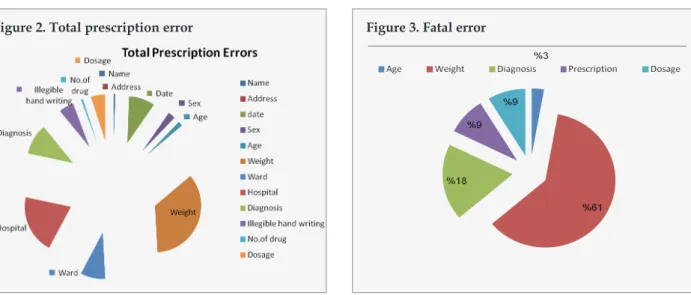
(4) Sangi S, Turki M, Otaibi G, Hazoom MAK, Harsha S.. Figure 2. Total prescription error. according to the variables. The outline of the prescriptions was assessed on the basis of the presence or otherwise of the following details: use of letterhead, information about prescriber, specially focused upon the signature, stamp, doctor’s name/hospital OPD slip digit, address, registration number and signature), patient details (patient’s name and address and date of consultation) and scrawled hand writing . The content of prescriptions was assessed on the basis of drugs used (numeral, period of treatment, category of medications: antibiotics; analgesics; steroids; vitamins/ tonics; GI drugs; psycho-tropics; cardiac drugs; whether generic names or brand names were used and drug dose. The clarity of prescriptions was assessed on the basis of the following points: Whether the prescription was readable (four-point rating system): No problem reading all aspects of prescription + very clear instantly; Clear, but required attempt; 1 aspect (name of the drug/dose/duration/ patients name) not clear; > 1 aspect not clear. Whether the dose (strength of the preparation + total daily dosage) was obvious (four-point rating system); Clear dose affirmed for all medicines; clear, but took effort to interpret; either criteria not met for at least one medicine; Either criteria not met for more than one medicine. All the errors were divided into fatal and non-fatal errors. RESULTS: In this study we examined 500 prescriptions and found that majority of prescriptions contained more than one error, making a total of 1338 errors (Fig-1).The obtained 30. Figure 3. Fatal error. data revealed that in 8 (1.6 %) name,128 (25.6%) date, 36 (7.2%) sex, 23(4.6%) age, 494 (98.4%), 287 (57.4%) hospital, 150 (30%) diagnosis, 71(14.2%) dosage is not mentioned. Along with that 73(14.6%) have indecipherable handwriting, in 10(2%) prescriptions more than 4 drugs have been prescribed. (Fig -2, Fig-3), All of these errors were divided into fatal (age , weight , diagnosis ,dosage are not mentioned and written in illegible hand writing) and non-fatal errors. There were 3% fatal errors in the prescriptions examined.. DISCUSSION The error rates unconfined by the General Medical Council (GMC) is that approximately one in ten hospital prescriptions were erroneous. What is surprising, perhaps, is that the error rate for consultants was as high as one in 20.10 When it comes to drug errors, physicians have habitually received most of the guilt. Because physicians choose most medications, write the prescription and sign it, they are the ones who take the plunge when things go immoral. Slowly, however, that thinking is beginning to transform. Experts are now focusing on the function that health care systems, not just individual physicians, play in medication mishaps. And as organizations scrutinize patterns of drug errors, they are finding that physicians aren’t always the culprits. In fact, experts guess that up to 28% of all drug mistakes made could have been avoided if there had been some system in place to prevent errors.11 This study, probably the first of its kind to be reported from the eastern province of Saudi Arabia has highlighted the Ars Pharm. 2012; 53(4): 28-31..
(5) Analysis and evaluation of prescriptions in Al-Ahsa, Saudi Arabia. presence of severe deficiencies in the layout of a significant proportion of prescriptions. Several prescriptions be deficient in even the basic information such as the uniqueness of the practitioner and patient while the legibility of prescriptions is also not good in several prescriptions, the clarity of commands has also been found inadequate in many prescriptions. These limitations mean that instructions are likely to lead to a mishap and in our view are unsatisfactory. Pharmacists often do not know which medical practitioner has prescribed the medicines, and thus are unable to contact practitioners in case they wish to check any factor of the medication. Since a number of prescriptions were not dated, there is a prospective of the same prescription being re-used for an indefinite period of time. Polypharmacy was the norm , majority of prescriptions having more than one medicine, with a significant proportion of patients receiving five or more preparations. Since many preparations were multi-drug amalgamation, the actual number of specific pharmaceutical entities prescribed was likely to be even elevated. The findings of our study, along with those of similar studies elsewhere in SaudiArabia , highlight the continuing crisis of irrational drug prescribing in the country.12,13 There is a necessitate to carry out systematic research in this regard, which could cover both public and private pharmacies to portray the specific types of irrational drug prescription and in particular the reasons why practitioners use avoidable drugs. Irrational prescribing is a routine that is difficult to treat. However, prevention is achievable. There is some evidence that interventions such as short problem-based training course in pharmacotherapy14 and rational use focused workshops15 can improve prescription behavior and skills. There is an urgent need to implement education initiatives, with support from community sources to make sure that there is no inconsistency of interest, to improve prescription behaviour of practitioners and ensure to facilitate patients receive evidence-based, cost-effective treatments for their health problems.14 CONCLUSIONS: A drug is prescribed on the beginning of Diagnosis / Disease and for adjustment of dose certain factors are measured like age, weight, pregnancy, status of drug metabolizing and excreting organs etc negligence of any of these factors may guide to prescription of erroneous drug or a right drug in wrong dose. Along with that if name is not mentioned in the prescription the drug/drugs may not Ars Pharm. 2012; 53(4): 28-31.. be dispensed to a person for whom, prescription has been written. All of these mistakes may prove deadly for the patients. The results of this study confirm the incidence of medication especially prescription errors in Al - Ahsa Saudi Arabia . Therefore, they point out to the need of a comprehensive review of the government’s control system of these matters. REFERENCES: 1. Benjamin DM. Reducing medication errors and increasing patient safety: case studies in clinical pharmacology. J Clin Pharmacol. 2003; 43(7):768-83. 2. Williams D. Medication errors. J R Coll Physicians Edinb. 2007; 37:343-6. 3. Kronebusch K. Assessing changes in high-volume hospital use. Med care res rev. 2009; 66:197-218. 4. Stolley PD, Lasagna L. Prescribing patterns of physicians. J chronic dis. 1969; 22: 395-405. 5. Neville R., Robertson F, Livingstone S, Crombie IK. A classification of prescription errors. J R Coll Gen. Pract. 1989; 39:110-2. 6. Kelly WN, Rucker TD. Compelling features of a safe medication-use system. Am J Health Syst Pharm. 2006; 63:1461-8. 7. Shah NR, Seger AC, Seger DL, Fiskio JM, Kuperman GJ, Blumenfeld B, et al. Improving acceptance of computerized prescribing alerts in ambulatory care. J am med inform assoc. 2006; 13:5-11. 8. Galanter WL, Polikaitis A, DiDomenico RJ. A trial of automated safety alerts for inpatient digoxin use with computerized physician order entry. J am med inform assoc. 2004; 11:270-7. 9. W, Balaha M, Al Moghannum M, Hashim I. Risk factors and birth prevalence of birth defects and inborn errors of metabolism in Al Ahsa, Saudi Arabia. Pan Afr Med J. 2011; 8:14. 10. The L. How to reduce prescribing errors. Lancet. 2009; 374:1945. 11. Kelly CK. Efforts to prevent prescription errors heat up. ACP Observer, 1998. 12. Ahmed KZ, Al-Saadi AR. A survey of multiple prescriptions dispensed in Saudi Arabia. Pak J Pharm Sci. 2005; 18:1-2. 13. Mahfouz AAR, Shehata AI, Mandil AMA, Al-Erian RAG, Al-Khuzayem A-AM, Kisha A. Prescribing patterns at primary health care level in the Asir region, Saudi Arabia: an epidemiologic study. Pharmacoepidemiol Drug Saf. 1997; 6:197-201. 14. Naik D, Borker P, Vaidya R, Patel V. Irrational drug use in India: a prescription survey from Goa. J postgrad med. 2005; 51:9-12. 15. Thomas M, Cherian AM, Mathai D. Measuring the impact of focused workshops on rational drug use. Trop Doct. 1997; 27:206-10. 31.
(6)
Figure
Documento similar
To illustrate the conundrum of applying neo-institutional frameworks to comparative education research, the case of Saudi Arabia’s King Abdullah bin Abdulaziz Public
This paper uses data from the Kingdom of Saudi Arabia (KSA) to empirically test Wagner's Law in explaining public expenditure growth in association with gross
It can be noticed from Table (5-19) that most of The Washington Post and The Guardian newspapers’ media items that dealt with reforms in Saudi Arabia in the first period (before
At the same time, however, it would also be misleading and simplistic to assume that such Aikido habituses were attained merely through abstracted thought
The aim of this study was to evaluate retrospectively the sensitivity of three different serological tests used in real clinical practice for the screening and diagnosis of
In this context, this study was conducted within a Mexican university and a Span- ish university in order to (i) analyze the frequency of sexting behavior in Mexican and
2 Department of Pharmacology, Faculty of Pharmacy and Pharmaceutical Sciences (FPPS), College of Health Sciences (CHS), Kwame Nkrumah University of Science and Technology,
The results of cointegration analysis also suggest that there is no evidence of long-term relationship between Qatar intra-trade with Bahrain, Saudi Arabia and the United
