Plan for Play in public
spaces, 2030 horizon in
Barcelona
Table of contents
1. INTRODUCTION ... 3
2. PROCESS OF DRAFTING THE CROSS-CUTTING, PARTICIPATORY PLAN ... 6
3. FRAMEWORKS AND REASONS ... 11
3.1 FRAMEwORKS: LEGISLATION, COMMITMENTS, PLANS AND STRATEGIES ... 11
3.2 REASONS: WHY AN OUTDOOR PLAY PLAN FOR THE CITY OF BARCELONA? ... 15
4. PARADIGM SHIFT: 3 LAYERS AND 7 CRITERIA FOR A PLAYABLE CITY ... 21
4.1 THE COLLECTIVE BENEFITS OF PLAY ... 21
4.2 THE 3 LAYERS FOR RETHINKING AND PROMOTING MORE AND BETTER PLAY OPPORTUNITIES IN PUBLIC SPACES 22 4.3 QUALITY CRITERIA FOR MOVING TOWARDS A PLAYABLE CITY ... 24
5. DIAGNOSIS OF THE OPPORTUNITIES FOR PLAY IN BARCELONA’S PUBLIC SPACES ... 29
5.1 THE PLAYFUL INFRASTRUCTURE ... 30
5.2 PLAYFUL USES OF PUBLIC SPACE ... 51
5.3 SUMMARY ... 59
6. 2030 HORIZON AND TARGETS: BARCELONA A PLAYABLE CITY ... 62
6.1 HORIZON 2030 ... 62
6.2 Key milestones of the 2030 Plan………..64
7. OPERATIONAL CONTENTS OF THE PLAN ... 68
7.1 STRATEGIC LINES ... 68
7.2 GENERAL OBJECTIVES OF THE PLAY PLAN ... 69
7.3 PUBLIC SPACE PLAY PLAN ACTIONS ... 70
7.4 LEAD PROJECTS ... 92
7.5 ESTIMATED BUDGET FOR THE LEAD PROJECTS AND ACHIEVING THE TARGETS ... 122
8. GOVERNANCE, MONITORING AND EVALUATION OF THE PLAN ... 125
8.1 GOVERNANCE ... 125
8.2 MONITORING AND EVALUATION ... 128
9. SCHEDULE ... 129
1.
Introduction
The Barcelona Public Space Play Plan Horizon 2030 is the city’s first such plan, a pioneering roadmap that puts outdoor play and physical activity among the key polices for creating a more habitable city and improving the well-being, health and community life of its residents, starting with children and teenagers.
As envisaged, and on the foundations laid by the Barcelona plays things right Strategy: towards a public space play policy (presented at the Full Council meeting in February 2018), this Plan has been drawn up in a year with a cross-cutting, participatory approach. Its purpose is to improve and diversify the opportunities for play and physical activity in public spaces because of its ample benefits for the development and well-being of children and adolescents, as well as the health and social life of all citizens. The Plan is also based on the premise that an urban environment that is more suitable for growing up and spending childhood in is a better city for everyone.
Drafting the Play Plan, coordinated by the Barcelona Institute of Childhood and Adolescence, has involved 400 people, including council staff, experts, social entities and ordinary citizens, both children and adults. The initial diagnoses have produced new data and knowledge and 2030 has been agreed as the target date for achieving the playable city model, with 3 core strategies, 14 objectives and 10 measurable targets. Criteria based on international benchmarks have been established for Barcelona, in order to start making the changes operational, and over 60 specific actions have been identified and planned involving many city services and players. A start has already been made on some of these in certain neighbourhoods which can be scaled up to a city level and others are set to get under way.
Obviously, the Public Space Plan is not starting from nothing. It catalyses lines of action by giving shape to various aspects of other municipal plans and strategies, such as those on greenery and sustainability, the climate, urban planning for gender and everyday life, universal accessibility or sports facilities, as well as childhood, adolescence and ageing. Moreover, the Plan contributes to achieving the Agenda 2030 Sustainable Development Goals for making cities safer, more inclusive and more resilient by adapting public spaces so they are more suited to social groups with less presence there. In other words, the Plan adds a playability layer to a city model that is committed to greening, sustainability and climate change mitigation; to calming city streets and reclaiming them as places for people to meet in their leisure time; to being an educating city, with healthy neighbourhoods and more inclusive environments that encompass age, gender, background and functional diversity.
The Play Plan has enabled the city to start answering these questions, which are relevant to the City Council’s commitment and obligation to make progress on the rights of children and adolescents, bearing in mind the Child-Friendly City seal of recognition it received in 2008, renewed in 2018. Henceforth, Barcelona City Council will be held accountable – under the requirements that the United Nations imposes on public authorities by means of the Committee on the Rights of the Child’s General Comments on the right to play – for protecting, respecting and promoting the human right of children and adolescents to play and leisure (recognised under Article 31 of the Convention on the Rights of the Child). In fact, 4 out of 10 Barcelona residents have a direct interest in the well-being of children and adolescents in the city (because 15% are minors and 23% are adults who live with and look after them). Moreover, we know that people’s experiences in this stage of their lives determine the paths they take in the future, as well as social cohesion in the city. Therefore, the more creative, diverse, free, inclusive and shared play they take part in when they are young, the greater will be their independence, resilience, social skills and physical and mental health later in life.
Given this approach and commitment, Barcelona City Council has taken a qualitative step towards a public space play policy that is based on a comprehensive, cross-cutting view and combines urban planning actions (ranging from micro-interventions and tactical planning to major urban development projects) and social actions (from touring animation initiatives to new public service concepts) in order to move forward as a playable city and a city that people play in. Thus, the three core strategies that the Plan is organised around aim to improve and diversify playful infrastructure in the city’s urban model, as well as stimulate outdoor playful and physical activity among everyone from 0 to 99 by reversing the play deficit and, finally, reinforce the social importance we attach to play.
We wish to emphasise the starting point of the Plan is to promote the exercise of the right of children and adolescents to play. However, it is also conceived to ensure young people find more attractive possibilities for doing physical and playful activity and getting together in public spaces, and so adults and elderly people regain a taste for play and sharing time and places for intergenerational play. Promoting active, everyday playful habits which give rise to social life and help to transform the social setting is an opportunity for reversing social problems such as sedentary lifestyles, child obesity, screen addiction, a lack of autonomy or independence, individualisation and social isolation, or the lack of contact with nature and green spaces, the high level of environmental pollution and road accident rates.
This Plan highlights the vital, human, everyday need to play and its capacity for transforming the city through the sum of many small actions that impact on the well-being, health and social life of its residents. And it does so by responding to the demands of children and adolescents themselves, as well as those of educational leisure associations and the educational innovation and renovation sector which, historically, have asserted the significance of play and the importance of having time and suitable places for it. Likewise, residents’ associations have also linked demands for dignifying public spaces to the need for places to play and meet socially in the neighbourhoods.
2.
Process of drafting the cross-cutting,
participatory plan
The Public Space Plan is based on and is one of the main measures envisaged in the Barcelona plays things right Strategy, presented at the Full City Council meeting in February 2018. This is a joint initiative of two City Council areas – Ecology, Urban Planning and Mobility, and Social Rights – working together on it, listening to social entities and the public – children, adolescents and grown-ups – in 24 face-to-face working sessions involving over 400 people between March and December 2018. The Plan is based on an agreed time-frame and criteria for the paradigm shift while also taking technical feasibility into account.
The Barcelona Institute for Children and Adolescents, as the City Council’s instrumental body, was the one responsible for politically and technically coordinating the process, as well as preparing the draft, where a cross-departmental approach and public participation were key in providing the knowledge to ensure the rigour and quality of the contents.
A participatory process: political, technical and public spheres
The Plan’s premise is the need to rethink the places and opportunities for play that the city offers all its citizens, especially children and adolescents, for diverse and inclusive play and physical activity outdoors, thus helping to improve community life. This reflection was the result of participation designed to gather the various views in the city on outdoor play and physical activity. The process was enriched by the experience of various players, so the resulting plan takes into account the different needs expressed on outdoor play.
The participatory process for drawing up the Public Space Play Plan was designed according to the guidelines set out in the new Citizen Participation Regulation (October 2017). As laid down in the regulation, a participatory process monitoring committee was set up to monitor the drafting of the Plan comprising six of the city’s social entities.
The work carried out encompasses the political, technical and public spheres.
Political sphere:
In the political sphere a reference forum was set up comprising the political heads of the government team (council executive) jointly led by two deputy mayor’s offices and including the commissioners of the main local policies involved:
• Deputy Mayor’s Office for Social Rights
• Deputy Mayor's Office for Ecology, Urban Planning and Mobility • Commissioner for Ecology
Technical sphere:
The technical work of municipal staff was done in five sessions covering two dimensions: one with heads of the different City Council areas and institutes involved and the other with the district technical representatives.
Initial exploratory sessions: with two objectives: 1) to present the conceptual framework of the Play Plan and 2) to start identifying the key factors to be taken into account. Some 70 service, area and district staff took part in the two sessions held.
Technical evaluation sessions: these sessions, involving some 60 professionals, were held with the aim of measuring the feasibility and interest of the various action proposals gradually shaping the Plan’s operational content.
o Session with the Municipal Institute for Persons with Disabilities and the Citizen Agreement for an Inclusive Barcelona’s Independent Living and Accessibility Network.
o Session with educators from Municipal Children’s Leisure and Play Centres. o Session with city district technical managers.
Public sphere:
The process in the public sphere sought the participation of entities involved in the city’s participatory bodies, and social organisations, businesses and reference persons linked to the play sphere and the various uses of public space, as well as individual citizens, both children and adults. Half the working sessions of the entire process were in this sphere (11 out of 24).
Initial exploratory session: Involving some 30 representatives of social entities in the city and experts, with two objectives: 1) to present the conceptual framework of the Play Plan and 2) to start identifying the key factors to be taken into account.
Sessions for constructing the desired time-frame to 2030: The aspects to be considered served as the starting point for constructing the time-frame and doing it jointly in four working sessions involving the various consultative bodies in the city most closely linked to the issues concerned, with some 50 people taking part.
o Session with the Municipal Sports Council o Session with the Municipal Schools' Council o Session with the Barcelona Youth Council
Face-to-face theme-based sessions: with the aim of gathering ideas and possible actions, five sessions, each with a specific theme and open to the public, were organised. They attracted around 100 people with a variety of profiles and links to the subject area, which enriched the creative process and reflection on play in public spaces.
Barcelona Decidim Platform: a two-month window gave anyone interested the chance to submit their suggestions to the digital participation platform but the level of contributions was very low.
A cross-cutting process: three municipal areas and the districts
The complexity and scope of the Public Space Play Plan’s objectives required an integrated, cross-cutting working logic throughout the municipal organisation that incorporated a range of perspectives, both those of deputy mayor’s offices as well as departments and municipal institutes. Thus the process was led in a cross-cutting, cross-departmental fashion, on a political as well as a technical level. The political figures and bodies mentioned above and linked to the policies on green spaces, urban planning and mobility, social rights, health, functional diversity, sport, education and youth. On the technical side, a cross-sectoral committee was set up to draft the Public Space Play Plan comprising services from three areas – Ecology, Urban Planning and Mobility, Social Rights, and Citizens' Rights, Participation and Transparency – and from the districts, all coordinated by the Barcelona Institute for
Children and Adolescents.
The Cross-sectoral Committee for Drafting the Public Space Play Plan, comprising 35 people had 5 meetings and served as the monitoring and technical validation forum for the process proposals and Plan contents, besides working on identifying players and actions to bear in mind and exploring synergies to give the Plan consistency and scope. This cross-cutting work made it possible to bring a range of expertise and perspectives together and to start from experiences already under way in the districts, which the Play Plan highlights, redirects and gives new meanings to or scales up to a city level.
Public presentation at the Play and City Conference
and
Cross-cutting political guidance
Deputy Mayor’s Office for Social Rights Deputy Mayor's Office for Ecology, UrbanPlanning and Mobility Commissioner for Ecology
Commissioner for Education, Childhood and Youth Commissioner for Health and Functional Diversity Commissioner for Sport
Cross-cutting Play Plan drafting committee
Dir. Urban Model, Dir. Environment and Urban Services, Dir. Conservation and Biodiversity, Dept. Urban Prospective, Dir. Communication and Participation Ecology, Dir. Communication Social Rights, Dir. Children, Youth and Elderly, Dir Community Action, Dir. Citizens' Rights and Diversity, Dir. Active Democracy, Districts,
Dept. Gender Mainstreaming, municipal institutes: IMPJ, IBE, IMPD, IMSS, IMEB, ASPB, BR, IIAB
Public Space Play Plan participatory process monitoring committee Formed by people from social entities
Outline of the Public Space Play Plan drafting process
Mu n ic ip al are as a n d in sti tu te
s Dis
trict s Social en tit ie s a n d exp erts Mu n ici p al Social Wel far e Co u n cil a n d Ci tiz en Agr ee m en t Mu n ici p al Sp o rts Cou n cil Mu n ici p al Scho o ls ' Cou n cil Barce lon a Yo u th Co u n cil
5 F2F t
h em e-b as ed se ss ion s Se ss io n s w ith ch ild re
n Decidi
3.
Frameworks and
reasons
3.1
Frameworks: legislation, commitment,
plans and strategies
The Public Space Play Plan - Horizon 2030 arose from the need to establish a new vision of play in the city and interacts with a number of earlier frameworks, which are realised in one way or another or which it helps to catalyse. The various frameworks it intersects with, whether legislation, commitments, plans or strategies, Catalan or international, are explained below.
3.1.1
Starting point Barcelona Plays Things Right Strategy
The Barcelona Plays Things Right Strategy: towards a public space play policy was presented as a government measure at the Full City Council meeting on 23 February 2018. Its purpose is to compile actions that have already been, or are scheduled to be implemented before the end of the term of office in six lines of action. These include producing a Barcelona Public Space Play Plan as an instrument for identifying the core strategies and objectives, and for planning actions in the short, medium and long term to move towards a play policy in public spaces.3.1.2
International agenda and legislative framework
The Play Plan is part of and takes into account both international and Catalan agendas and benchmark legislation.
UN 2030 Agenda for Sustainable Development Goals
UN Convention on the Rights of the Child
With regard to international treaties, this Plan is a specific application of the Convention on the Rights of the Child, Article 31: “...the right of the child to rest and leisure, to engage in play and playful activities appropriate to [their] age and to participate freely in cultural life and the arts” (Art. 31.1). Likewise, all levels of government in States Parties “shall respect and promote the right of the child to participate fully in cultural and artistic life and shall encourage the provision of appropriate and equal opportunities for cultural, artistic, recreationa and leisure activity” (Art. 31.2).
The Plan’s focus and specifications are strongly inspired by and take into account the interpretation and recommendations of the UN Committee on the Rights of the Child, in its General Comment N. 17 (2013) which spells out the conditions for the gradual fulfilment of the right to play and leisure embodied in Article 31.
UN Convention on the Rights of Persons with Disabilities
With regard to children’s participation in cultural life, recreational and leisure activities and sport, Article 30 of the UN Convention on the Rights of Persons with Disabilities establishes that public authorities “must ensure that children with disabilities have equal access with other children to participation in play, recreation and leisure and sports activities, including those activities in the school system”.
European Charter for Safeguarding Human Rights in the City
The Plan also respects the European Charter for Safeguarding Human Rights in the City, which establishes that “local authorities shall guarantee quality leisure spaces for all children without discrimination” (Art XXI.2).and also that “administrations have to encourage physical and sports activities as a healthy habit” (Article 58.4).
Catalan Rights and Opportunities in Childhood and Adolescence Act
The paradigm shift with regard to citizenship and the human rights of minors, which the CRC (Convention on the Rights of the Child) represented, is reflected in the Catalan Rights and Opportunities in Childhood and Adolescence Act (14/2010 – LDOIA). This establishes that “children and adolescents have a right to move around in, enjoy and socially develop in their own urban environments”, that “ the public authorities must enable the development and autonomy of children and adolescents in a safe environment”, and that “municipal urban planning must plan and shape public spaces taking into account the perspective and needs of children and adolescents” (Art. 55).
3.1.3
City commitments, plans and strategies interlinked with
the Play Plan: a plan that catalyses
The cross-cutting nature of the Plan means it is essential to bear in mind strategies, plans and commitments on various matters. At the same time, the Plan itself envisages actions that reinforce and contribute to achieving two city strategies, five plans, two city and two district government measures, and a citizen commitment that are specified below:
Barcelona Strategy for Inclusion and Reducing Social Inequalities 2017-2027
This is a working framework shared between the City Council and social entities for reducing social inequalities and there is a link with the Play Plan in “promoting and ensuring equal, universal access to leisure, cultural, sports and play activities, especially among children and teenagers (Goal 2.6). Also with regard to the goal of “ensuring the city is a living space by offering public spaces and facilities with diverse uses that encourage relations with others, as well as positive community life and intergenerational and intercultural relations” (Goal 3.6). Citizen Commitment to Sustainability 2012-2022
This social agreement is spelt out in Barcelona’s Agenda 21 with 10 goals and the Play Plan contributes specifically to Goal 2: “Public space and mobility: from the street for traffic to the street for living in” and the specific action line that proposes reclaiming the streets for people, generating a welcoming, traffic-calmed space, encouraging a culture of shared public space and promoting and prioritising life on the streets as places for people to meet, spend time together and play.
Barcelona Green and Biodiversity Plan 2012-2020
This defines the challenges, goals and actions with regard to conserving green spaces and biodiversity and how the city’s population is aware of them, enjoys them and takes care of them. Its five goals includes Strategic Line 9: “fostering green spaces as places for health and enjoyment as well as promoting citizen involvement in their creation and in the conservation of biodiversity”. Among others, this line of action includes two of the main ones that the Public Space Play Plan responds to: “Improve and diversify children’s play areas by involving schools, associations and the community” (9.3) and “Increase and improve the number of playful and health facilities offered in parks” (9.2).
Climate Plan 2018-2030
This plan compiles a series of action to achieve three goals: reduce CO2 emissions by 45%, increase urban green spaces by 1.6 km2 and reduce water consumption to less than 100 litres per inhabitant per day. It also responds to the commitment the city assumed by signing the Global Covenant of Mayors for Climate and Energy. Its Action Line 3 on preventing warming includes actions such as prioritising cooling actions, generating more shaded areas or creating water gardens (accessible fountains, lakes, swimming pools, etc.) that are included in the Play Plan.
Child and Citizen Focus 2017-2020. Plan for growing up and living childhood and adolescence in Barcelona
Adolescence and Youth Plan 2017-2021
This plan seeks to guarantee all the rights of young people, making adolescents and young people the protagonists of their own lives and players in social change. The main goals that coalesce with the Play Plan are to: Promote diversity in physical and sports activity with regard to both the types of activity and profiles of young people (Strategic Line 3.2).
Facilitate and legitimise the use of public space by young people, and foster the co-design and co-management of public spaces and facilities with the participation of young people (Strategic Line 4.3).
Guarantee and Improve the Influence of Grassroot Educational Associations in the City.
One of the main aims of this government measure (May 2018) is to facilitate the presence in and use of public spaces by educational associations, and specifically includes as one of it actions “to incorporate steps promoted by and called for by leisure education entities in the Public Space Play Plan, such as facilitating playful use of streets, squares and parks close to their premises” (Action 20).
Demographic Change and Ageing Strategy: a city for every cycle of life 2018-2030
This government measure is designed to address the demographic change that is affecting every sphere of life and people’s life cycles and explicitly refers to the Play Plan: “Foster an intergenerational perspective in children’s play in the city. Monitor the Public Space Play Plan to ensure the intergenerational perspective is considered when designing play spaces in the city.
Universal Accessibility Plan 2018-2026
The goal of this Plan is to put people first and ensure they can fully exercise their rights, irrespective of whether they have some kind of disability or functional diversity. Universal accessibility and universal design make it possible for everyone to live in the urban setting in equal conditions. The Plan provides for a line of analysis and proposals for public spaces, with a specific analysis of accessibility to play areas and green spaces and, more specifically, to carrying out a diagnosis of accessibility to public spaces in the city: streets, parks, children’s play parks and beaches (Goal 10).
Gender Justice Plan 2016-2020
This is a tool for promoting equality between men and women and its goals that need highlighting include combating gender roles that affect women’s health; highlighting women and promoting their participation in sport; making progress on introducing a co-education model in the city’s schools; driving a city model that responds to the needs and experiences of everyday life, improving the perception of public safety and empowering women in public spaces.
Urban Planning with a Gender Perspective
Gràcia Squares, Public and Community Space
This Gràcia district measure includes action to liven up the squares with playful-educational activities and the swap the leather ball for a foam ball programme in collaboration with local retailers, inspiring actions that can be scaled up to a city level.
Let’s Fill School Surroundings with Life
This Eixample district measure is a starting point for encouraging action required across the city, because it proposes improving school surroundings so they become habitable places, community spaces, an extension of the school and a place for play, greenery, and neighbourhood life and history.
3.2
Reasons: Why an outdoor play plan for the
city of Barcelona?
Four main reasons for the Public Space Play Plan
3.2.1
Because children have a right to play and leisure
“Rest, play and leisure are just as important to a child’s development as nutrition, housing, health care and education”
(General Comment No. 17 of the UN Committee on the Rights of the Child)
As has been pointed out in the previous section, both international human rights law in the Convention on the Rights of the Child and Catalan law in the LDOIA recognise the importance of play in the development of children and adolescents. And this is the reason why it has been recognised as a specific human right of this life stage since 1998. “Play has to be understood as an essential element in the growth and maturity of children and adolescents. (...) has to help psychomotor development at each developmental stage (LDOIA Art. 58.2) The right to play is often referred to as one of the forgotten rights of childhood, as it is undervalued in relation to others, despite the fact that the UN Committee on the Rights of the Child (GC No. 17/2013) reminds us of the importance of play in achieving the maximum development of children and adolescents. It also point out that “when there is investment in leisure, it usually goes to organised activities, but it is just as important to create spaces and times so children can devote themselves to exercising their right to spontaneous play, leisure and creativity, as well as promoting social attitudes that support and foster these activities.” Likewise, it warns of situations of poverty or inadequate living standards that can deprive children or condition the exercise of this right, so it needs to be taken into account in housing policies and policies on access to public spaces for children with fewer opportunities for play and leisure at home.
As regards identifying the obstacles to moving forward on the right to play, the United Nations identifies the following nine aspects that pose social challenges around the world and need to be borne in mind:
1) Lack of awareness of the importance of the right to play and leisure time. 2) Unsuitable play environments, due to
their insecurity.
3) Resistance to children using public space due to the growing
commercialisation of public space and low tolerance of their presence. 4) Lack of diverse community spaces for
play and leisure for all ages.
1. Plan ideal environments, facilities and play and leisure spaces, bearing in mind the best interest of the child
Availability of parks, community centres, sports facilities and safe inclusive play areas accessible to all children and adolescents.
Creation of a safe living environment where children can play freely, designing areas that give priority to people who are playing, walking or riding a bike.
Access to green areas, big open spaces and nature for play and leisure, with safe, affordable and accessible transport.
Implementation of traffic-related measures such as speed limits, pollution levels, crossings near schools and so on to guarantee the right of children to play in their community without danger.
2. Pay special attention to girls, children in situations of poverty, boys and girls with a disability or in a minority.
3. Offer children and adolescents opportunities to participate and be heard so their opinions are taken into account in drawing up policies and strategies linked to play and leisure, creating parks and designing environments suitable for children. As well as moving forward on making children co-responsible.
4. Compile data, assess and carry out research on the range of public space uses in the everyday lives of children and adolescents in order to show how public authorities promote their rights as a whole.
3.2.2
Because play and physical activity improve
everyone’s well-being and physical and mental
health
“We don’t stop playing because we grow old, we grow old because we stop playing”
G.B. Shaw.
Playing outdoors implies active play and doing a physical activity which stimulate motor skills and abilities that are essential for good physical development and also, implicitly, healthy psychological development, from both a personal and a social point of view. However, although play responds to a vital need in children to explore their environment and themselves (their body, their emotions and their limits), the situation in Barcelona is that 1 out of 4 children never play in the park or on the street, with a significant gender differential. Moreover, increasing obesity and overweight, which affect 3 out of 10 adolescents and are caused by screen addiction and sedentary lifestyles, among other factors, are growing problems in today’s society. The physical inactivity indexes in the city are very high and there are worse evaluations of the health of teenagers living in poor neighbourhoods compared to high-income neighbourhoods (FRESC-ASPB 2016). Thus, outdoor play is not just a response to children’s playful needs, it is also key for dealing with the challenges posed to physical health, with special emphasis on children living in low-income neighbourhoods and young and older girls.
Another aspect that needs highlighting is the emotional well-being that play brings, especially when it is done with autonomy, in contact with nature and the outdoors, experimenting and learning from managing risks and controlling emotions. In that sense, not playing or not having the possibility to play different games affects skills such as emotional self-control or facing and taking decisions, resilience and personal autonomy. The play deficit, especially as regards free play, shared play and play with challenges, has negative consequences for well-being and mental health, no small matter if we take into account that 1 out of 10 adolescents in the city are highly likely to have mental health problems (FRESC_ASPB 2016). As the Barcelona Mental Health Plan notes (in its priority area of childhood and adolescence), good mental health during childhood helps the processes of learning, interpersonal and family relationships, achieving goals and the capacity to face life’s difficulties, including the transitions to adolescence and adult life.
In addition, the lack of autonomy in childhood due to overprotective adults means less capacity for taking decisions, settling disputes and managing risks. Children themselves provide data in that respect when they say they are not really satisfied with the autonomy they have at home, at school or on the streets (EBSIB‐IIAB 2017). This loss of autonomy is linked to the limited leeway that adults give children to enable them to develop free, self-regulated play by themselves, thus restricting vital learning opportunities.
recovering games shared in childhood.
A playful attitude and a taste for play in young people, adults and elderly people helps them to tackle everyday situations in a positive spirit, which is so necessary for good mental health. Moreover, shared play develops links and affinities in a unique way in both adults and children. The value of shared play lies in the fact that it is a unique activity for sharing, one of the best forms of communication, a very special way of letting children know they are very important, because we share with them what they like and need most: to play.
3.2.3
Because play brings people together and community
life is enriched
“Children playing in the street is a good indicator of the quality of community life”
Jan Gehl, urbanist
Barcelona is a densely populated city where public space is scarce and too much is given over to motor vehicles (estimates put the figure at 60% of the urban environment), so what is left for pedestrians and citizen uses is limited and much less. These days, the social meeting function that streets have always had has very much been lost, having to a large extent and almost exclusively been replaced by the travel function, for both adults and children. In other words, there is not enough space and that needs to be improved so streets are suitable for people to meet and play. That is how the city’s 10 to 12 year-olds put it. They are not satisfied with the spaces for playing and enjoying themselves in their neighbourhood (EBSIB‐ IIAB 2017). The fact of having children playing on the streets not only has consequences for the play deficit children face, it also reduces the knock-on effect of encouraging social life around play. Because it is precisely when there are children playing in public spaces that they become places for informal gatherings, especially, but not only, of parents accompanying children but also of young and elderly people or other local residents.
The conditions in the play setting also determine the time that adults stay and, therefore, the time children play, as well as whether people spend time and socially relate in a public space. Despite all the measures being adopted, urban planning in the city is still a long way from universal accessibility and there are few signs of a gender focus. Among other reasons, that is due to the lack of attention to everyday needs, with urban furniture and features that make public spaces habitable and encourage people to stay (lighting, benches, tables, play equipment, toilets, fountains and so on). Currently less than 1 in 10 recreation spaces in the city have table-tennis tables and only 8.5% of green spaces have public toilets.
To include the different groups in community life, we also need to put the emphasis on reducing the strong gender bias of urban spaces, as well as on the discomfort generated by the presence of young people in public spaces and which often leads to their expulsion. For that reason, we need to stress the importance of reclaiming public space as a place for people to relate and socialise, facilitating access to it and legitimising the uses adolescents and young people make of it, in harmony with the rest of the population. Public space has to be a space for relating and shared experiences that belongs to everyone, in all their diversity in terms of age, gender, social and cultural background and functional diversity.
Finally, a greater presence of people and more life on the streets also increases the perception of public safety and helps to combat individualisation and social isolation, promote personal autonomy and foster intergenerational relations.
3.2.4
Because quality play environments help to green,
calm and make the urban environment safer
Barcelona is still a city that lacks urban green spaces, despite the efforts made in recent decades. Each city resident has 6.6 m2 of green space (not counting the Collserola hills) and, in the districts of Eixample and Gràcia, the figure is way below the city average (1.85 m2 and 3.15 m respectively). In order to mitigate the effects of climate change, Barcelona has made a commitment to increase green space by 1m2 per inhabitant by 2030. This green deficit aggravates a big problem the city faces, namely the alarmingly high level of environmental pollution, both air and acoustic, which makes people’s health worse, especially in the case of children and the elderly. Traffic in the city, where there are still too many private motor vehicles, has a very negative effect on the healthy development of city residents, decreases road safety and increases road accident rates. This situation also makes safe, independent children’s mobility as autonomous pedestrians more difficult and, at the same time, limits the public space available due to wheeled traffic and parking for private vehicles occupying road space. This applies to the whole city, but especially and worryingly around leisure spaces and schools, so the aim is to define the LDOIA’s provision regarding the obligation of local authorities to promote “safe access for children and adolescents to schools and other centres they frequent” (Art.55.5.c).
4.
Paradigm shift: 3 layers and 7 criteria for a
playable city
The vision and goals for achieving the Play Plan mean a paradigm shift in the place given to outdoor play in the urban environment as a whole. Therefore, a conceptual framework has been created specifically for Barcelona, to rethink the outdoor playful opportunities. This framework is based, primarily, on the collective and interconnected benefits of play, not only for children but for all the city’s citizens, as well as for its potential to generate community life and provide an opportunity for improving the urban environment (see Section 3.2 for the reasons). Secondly, the conceptual framework builds a new category of city recreation infrastructure in three layers and, thirdly, it establishes quality criteria for play in order to guide space design and take a more playable city into account at the planning stage.
4.1
The collective benefits of play
“Play is the highest form of research”
Albert Einstein
Play is an end in itself for the pleasure it gives, a vital human need and a recognised right of children and adolescents because of its importance for their development. The UN Committee on the Rights of the Child defines it as “any behaviour, activity or process started, controlled and structured by children themselves that can take place anywhere and when they have the opportunity”.Play, therefore, involves the exercise of autonomy and physical, mental and emotional energy, adopting infinite forms that adapt and change over the course
Benefits of play
Playful infrastructure 3 layers
enjoyment and pleasure. It is a voluntary activity that responds to an intrinsic motivation and becomes an end in itself, so all the benefits that play brings are positive collateral effects that need to be fostered, but it is also very important to be clear that they are not the aim during play. We do not play to learn or because it is healthy, but to have a good time.
There are social and emotional skills that are vital for life which are better learnt playing because play is experienced in the body and through emotions and play means action, experience, involvement and participation, which are key strategies for meaningful learning. Playing is a very serious activity, even though it takes place above all in a fictional framework, where people concentrate to put into practice all their abilities and resources to achieve the objective set. In other words, it implies accepting and overcoming challenges. While playing, people voluntarily put into action their capacity to conquer and excel,accepting not only success but also failure, which is key to developing confidence and self-esteem and managing frustration.
Adults have a vital role in guaranteeing the right to free, stimulating, creative and positive play by putting various quality spaces, free time, materials and friends at children’s disposal and letting them play.However, in general, adults who look after children and adolescents do not always play a positive role in encouraging play, for three main reasons, among others. One is because they organise a daily agenda for their child or adolescent that is packed with activities and obligations that leave very little free time for them to organise themselves. A second is their aversion to risk, which leads them to be over-protective, giving children little or no scope for facing challenges and managing risks, and the third is because they do not vary the types of games enough, thus reducing the range of play experiences.
4.2
The 3 layers for rethinking and
promoting more and better play
opportunities in public spaces
“We have to accept that the most suitable places for playing are the real spaces in the city: steps, building courtyards, parks, squares, streets,
monuments... Everything possible needs to be done so everyone
can use them, children too”
Francesco Tonucci
Image 1. Recreation infrastructure
Source: Barcelona Institute for Children and Adolescents
LAYER 1: Play Areas and School Playgrounds
Both of these are ideal places for children to play outdoors, which are not shared with other uses and are specifically designated and designed for playing and doing physical activity, with some kind of specially designed equipment that requires certification.
Play areas: Enclosed, sign-posted and certified spaces designated exclusively for play with expressly designed and certified playful equipment.
School playgrounds: Outdoor spaces at nursery, infant, primary and secondary schools where children play in school time and at midday, and which can be opened up to the neighbourhood at other times.
LAYER 2: Playful spaces and School surroundings
Both of these spaces are for the exclusive use of pedestrians with possibilities for play and playful uses alongside other public activities. Given their characteristics, they may include urban features with possibilities for play, as well as certified play equipment. They are basically places for people to meet socially that are vital for intergenerational relations, locals to mix and community life. Access to them must ensure children’s safety and their autonomy, as well as facilitate mobility on foot or on wheels. They must also be accessible.
concept of green spaces to call them recreation spaces and identify them as places for play where the idea is to promote play.
School surroundings: Urban spaces around schools and at nursery, infant, primary and secondary school entrances with traffic-calmed access and possibilities for an area to relax and play in.
These places form part of the second layer due to their specific and valuable function as places for meeting and community life, as the schools’ educational community meet there throughout the school year, morning, midday and afternoon, time for waiting and impromptu play. People meet and children play to a greater or lesser extent depending on the urban features of these areas, the environmental conditions and road safety.
LAYER 3: Playable city
This third layer includes other urban and natural spaces, as well as pedestrian routes in the city where children, adolescents, adults and elderly people play or do physical activity more or less spontaneously or by chance. This makes it possible to maximise the opportunities for play by adopting various measures, from widening, optimising and/or conditioning urban spaces to installing urban furniture and other highly playable features, tactical urban planning and one-off initiatives that stimulate play. These include:
Streets for the exclusive use of pedestrians, permanently or temporarily Traffic-calmed streets and wide pavements
Playable urban furniture (benches, shelters, etc.) Urban sports parks (skate parks)
Open multi-sports courts
Sports equipment (basketball baskets, table-tennis tables, pétanque courts, etc.) Beaches, woodland parks and river beds
4.3
Quality criteria for movingtowards a playable
city
Quali
ty
criter
ia
for
movi
ng
towa
rds a
play
-frie
ndl
y
city
Criterion 1: Multiple options for creative, challenging play for
healthy child development
Play areas should offer lots of options that foster all-round healthy child development, maximising diverse physical activity and stimulating the desire to play.
They should offer children challenges so they explore, decide and handle them as the protagonists of the action, accepting responsibilities and assuming risks independently, and testing their skills.
They should allow creative and versatile play with structures that stimulate children to play in different ways, enabling them to handle objects so they can construct, destroy and move them, pile them up and so on, thus fostering their imagination and creativity. The play options should combine movement, symbolic, motor, experimental and other types of play and, at the same time, ensure maximum diversity in the main playful activities (see Table 1), in particular sliding, swinging and climbing, as these are the three that imply more active, more intense play.
1. Multiple proposals for challenging and creative games that
aid a child and adolescent’s healthy
development
7
CRITERIA
FOR A
PLAYABLE
AND
PLAYED-IN
CITY
2. Diverse, stimulating, connected and
accessible
physical space
3. Inclusive play areas for all ages, genders, backgrounds
and abilities.
4. Contact with nature, greenery and play with sand
and water.
5. Shared, intergenerational and collaborative play.
6. Place for meeting up and where the
community can come together.
7. Playful ecosystems and safe, playable
Table 1. Main playful activities and equipment that stimulates them
Activities Equipment/facilities that can stimulate
playful activity
1. Sliding Slides of different heights and widths, long and short, covered in the form of a tube or open, with different gradients and shapes, etc. Sloping slide boards with different heights and gradients.
2. Swinging Single and multiple swings suitable for different ages, from babies to adults, different heights, for swinging in pairs, deckchair-type (suitable for children with functional disability), basket swings for playing together, for adolescents and children with motor disabilities, etc.
3. Climbing Climbing walls, ladders, raised platforms, steps, net pyramids, sculptures that children can climb on, mikado play towers, natural logs and so on, with different heights and levels of difficulty, for all ages.
4. Maintaining balance
Balancing bars, log circuits, hanging bridges, etc., at different heights, with various levels of difficulty.
5. Jumping Trampolines, flexible net, rubbers structures, platforms with springs, etc.
6. Feeling dizzy Merry-go-rounds for one or more children, ziplines, hanging bridges at different heights, firemen’s poles, etc.
7. Rocking Individual or multi-child see-saws, spring or up-and-down type, on the ground or hanging, with ropes and different intensities.
8. Running and riding
Spaces large and open enough for running, cycling, skating, skateboarding or scooting around as well as playing ball games, rope games or other motor-skill games.
9. Hiding Little houses, bushes forming an enclosure, structures for getting underneath, tubes, natural elements in the form of a cave, tunnels, etc.
10. Experimenting Sand tables or surfaces, natural elements (stones, sticks, leaves), water channels, games with pulleys with buckets and receptacles, sound structures, circuit-type spaces for exploring, etc.
11. Role play Little houses, kitchens, structures in the form of vehicles, vessels, trains, cars and animals, other structures that suggest settings, for example, castles, cabins, etc.
12. Self-expression
Criterion 2: Diverse, stimulating, connected and accessible
physical space
Play areas should adopt an overall perspective on the design for play, meaning that the whole area should offer stimulating possibilities for playing with a design that fits in with the environment, offering a variety of uses.
They should be physically attractive, well looked-after, welcoming spaces for people to stay, meet up and play with surfaces (textures, materials, colours, etc.) and a relief (tunnels, embankments) that open up various possibilities and enrich play, apart from the structures.
They should not necessarily, nor always, be confined or demarcated with an enclosure. This should be dependant on each case, the proximity of any dangers, the suitability of installing one or not, the perimeter and type of enclosure, reducing them as much as possible to facilitate connectivity with the rest of the environment.
Criterion 3: Inclusive play areas for all ages, genders, backgrounds and
abilities.
Play areas should be attractive places for people of various ages to play in and, in particular, include the play and playful needs of adolescents (with team-game and lifting equipment, spaces for performance play, etc.) as well as play options for adults.
They should encourage children to play together and, therefore, be diverse places that do not focus too much on more physical activities at the expense of others. They should accommodate the city’s cultural wealth and diversity, with a design that
avoids excessive specialisation and encourages children to relate so that, spontaneously, they become inclusive spaces for children from different backgrounds.
There should be one or more inclusive-certified pieces of equipment that enables a child with a functional disability (motor, sensory, intellectual) functional diversity to enjoy themself with other children.
Criterion 4: Contact with nature, greenery and play with sand and water.
Play areas should include greenery and vegetation that children can interact with, pass under, hide in, climb, touch and feel the leaves, as well as play with the leaves and small branches that fall off.
They should include natural elements such as sand, grass, bark, stones for the surfaces and to expand their playability, as well as water for cooling down and playing with.
Play area structures should foster shared play, encouraging the simultaneous play of two or more children, and group play involving boys and girls (multi-games, see-saws for two or four, wide slides for more than one person to slide down, swings for older persons, etc.).
Some structures should incorporate the need for collaboration (pulleys, see-saws, etc.) as the starting point for shared play which maximises the psychosocial benefits of play.
There should also be options for shared play between children and the adults looking after them, equipment that could be used by adults and elderly people, thus encouraging attitudes and playful activities involving everyone and throughout the life cycle.
Criterion 6: Place for meeting up and where the community can come together
Play areas and their immediate surroundings should not be conceived as children’s playgrounds but as a community meeting place, therefore taking into account the needs of adults looking after the children.
They should be comfortable, welcoming places with benches, picnic tables, toilets, shade, good lighting, fountains, good maintenance and cleaning.
Places where people come together, meaningful places for the community that should promote formulas for joint responsibility when it comes to looking after them.
Criterion 7: Playful ecosystems and safe, playable environments
Play areas should be designed fulfilling as many criteria as possible in each one, while bearing in mind they are part of a broader recreation ecosystem which they complement.
5.
Diagnosis of the opportunities for
play in Barcelona’s public spaces
The knowledge generated in this initial diagnosis of the opportunities for play in Barcelona’s public spaces enables us to guide the actions of the Plan on the basis of data, create indicators, establish base lines in 2018 and measurable targets for 2030 for those challenges for which data is available. This diagnosis is also useful as a starting point for detecting gaps in our knowledge and for future research to understand the scope, update the challenges, see the progress and the impacts on play in public spaces. Creating databases and a system of indicators to carry out this initial diagnosis has required a big effort but means in the future Barcelona City Council will be in the best possible position to account for its work and monitor the opportunities for play in public spaces, to help make public decisions based on evidence in moving towards a playable city that people play in.
This section starts from the preliminary analysis carried out by the IIAG for the Barcelona Plays Things Right Strategy (February 2018), summarises Barcelona Regional’s specific diagnostic report on recreation infrastructure and systematises and analyses the scant data available on the playful uses of public space in Barcelona prepared by the IIAB.
The diagnosis is approached from two angles. First, recreation infrastructure is analysed in terms of availability, density, proximity and quality. Second, the playful uses of public space are analysed in terms of playful and physical activity.
In 2018, Barcelona City Council, or more specifically the Green Spaces, Ecological Biodiversity and Urban Services Directorate, compiled detailed information on the city’s play areas with regard to their location, surface area, age, type of paving and enclosure, as well as the type of playful activity offered in each one based on an analysis of their features. That has enabled a more in-depth look at the qualitative side of the diagnosis. In addition, data provided by the Barcelona Institute of Sport has enabled us to supplement the spaces for doing sport with opportunities for play in any part of the city. A bibliographical review of reports and documents produced by the Municipal Institute for Persons with Disabilities, the Barcelona Public Health Agency and the Barcelona Institute for Children and Adolescents has made it possible to include diagnostic conclusions on other aspects of recreation infrastructure, such as school playgrounds and the areas around schools or the services offered by parks and squares, as well as physical activity in and the play uses of public spaces. With regard to the final aspect on uses, it should be noted that despite the efforts to compile data, there is really very little information so it will be necessary to continue working on this to improve our knowledge of the outdoor playful activity of all ages in the city.
Context
One of the dangers that Barcelona faces, therefore, is becoming too compact. The relationship between the built up area and public space is dominated by the former, which translates into increased urban pressure with various consequences for the city. Barcelona is practically consolidated. The margin for growth is limited and very specific as there is no developable land, in other words, hardly any areas remain for development. Public space cannot be generated on a large scale, except in areas that have already been built or on existing infrastructures, such as Parc de la Sagrera or Parc de Glòries. Urban recycling, transformation, intensification and urban renovation are usual strategies in the city and will be even more so in the future, as generating public space in a city as dense, compact and consolidated as this is one of the main challenges facing Barcelona, and a reality that needs to be borne in mind in the Public Space Play Plan.
5.1
Recreation infrastructure
5.1.1
Play areas
A play area is a space that is signposted, indicating the use and age range for which the play equipment and facilities installed there are intended. There are play areas for 0-5 and 6-12 year-olds, as well as mixed ones with games and activities suitable for both age groups. There are also some accessible and inclusive ones for all children, regardless of their abilities. As children’s play areas are individually identified, there may be more than one, with different characteristics, in the same place (park, garden or square).
Availability and size
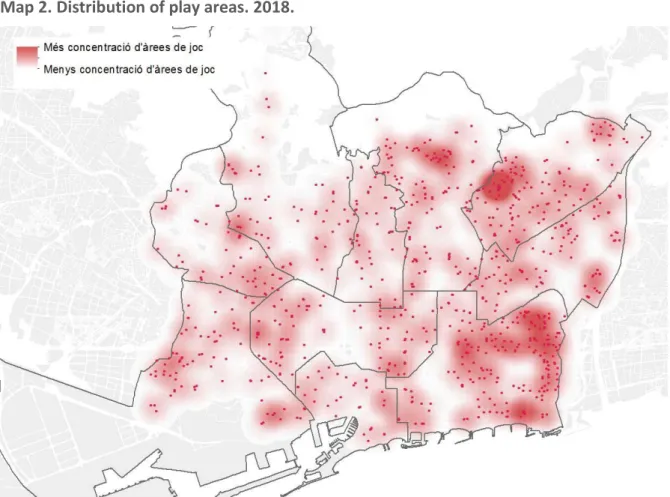
The city has 868 play areas totalling 159,100 m2 (an average of 183 m2 per area) but half of them (51%) can be considered small because they do not reach 150m2 (data from 2018).
There has been no overall planning in the city, nor any minimum standards on their size or what level of provision there should be for children and adolescents. In Barcelona there are play areas ranging from one of 16m2 in El Carmel to one of 2,281m2 in La Guineueta.
Map 1. Play areas under 50m
2. 2018.
Source: Barcelona Regional, based on data from Barcelona City Council
Map 2. Distribution of play areas. 2018.
Source: Barcelona Regional, based on data from Barcelona City Council
Density
Currently there is no report, nor any territorial analysis of the real uses of play areas which would allow us to properly diagnose the density of uses, and not just the ratios of square metres per child used as a reference, despite the limits this poses for understanding the actual situation. It needs to be borne in mind that not all children in the city play at the same time, nor are they equally distributed around the play areas. Other factors influence this, such as their proximity to a child’s home or school, their quality in terms of playability, the age range they are for, maintenance, the social profiles of local residents who go there and the social life they generate (see Section 5.2.3)
There are 178,728 children aged 0 to 12 in Barcelona, which is 11% of the city’s inhabitants, of whom 82,352 are between 0 and 5 (46%) and 96,376 between 6 and 12 (54%). In general, there is a correspondence between the number of children in a district and the total number of play areas there but other data need to be taken into account to be able to assess whether districts with fewer play areas have a good provision.
The play space especially for children aged 6 to 12 (play areas for 6-12 year-olds and mixed, 0‐12) is slightly bigger than that for the 0 to 5 age group (play areas for 0‐5 year-olds and mixed, 0‐12).
The space that Barcelona offers children for playing outdoors is not enough and is too dense: only 0.9m2 of play area per child. This figure is much lower than the recommended 7m2 of area per child, which is approximately half the space for a place in a car park (Guide 7C Canada).
Moreover, the availability of spaces for play in the city’s districts is uneven: children in Sant Martí have more than twice the play area space per child (1.4m2/child) than in Ciutat Vella (0.6m2/per child) or Gràcia (0.5m2/child).
Table 3. Density of play areas per district and according to type 2018
Source: Barcelona Regional, based on data from Barcelona City Council
Map 2. Play area surface area distribution per child by neighbourhood. 2018.
Source: Barcelona Regional, based on data from Barcelona City Council
Proximity
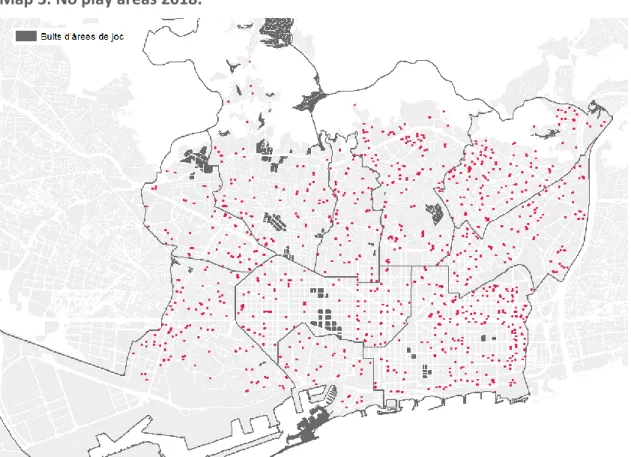
Local provision is good in Barcelona in terms of the number of areas close to children’s homes and schools. Some 80% of children aged 0 to 12 have a play area five minutes walk from where they live (it being understood that a child is capable of walking 200 metres in five minutes) and 98% ten minutes away. The other 2% have play areas over 15 minutes away.
Map 3. No play areas 2018.
Source: Barcelona Regional, based on data from Barcelona City Council
Table 4: The 10 neighbourhoods with the most and least m
2of play area per child. 2018.
Source: Barcelona Regional, based on data from Barcelona City Council
Most nursery, infant and primary, and special needs schools in the city have a play area of their own. Only 2 out of 10 schools (18%) are poorly provided, with the nearest play area over 15 minutes away on foot. On the other hand, four play areas have been identified as potentially having a very high use density because they are less than five minutes away and serve up to 14 nearby schools: Plaça Gal·la Placídia and Plaça de les Dones del 36 in Vila de Gràcia, Torrent de les Roses in Pedralbes, and Parc de Joan Reventós in Sarrià.
Quality
The few available reports on play areas in the city identify questions relating to the number of areas or pieces of equipment. There are also reports on maintenance, safety and regulations, based on the City Council’s rigorous control system with annual audits and certifications to comply with European and municipal regulations. There was a clear lack of play area quality analysis in terms of playability.
This analysis is based on existing play areas and also new data from those where play equipment has been classified by type of equipment (basket swing, wide slide, etc.) and the type of activity (sliding, rocking, swinging, climbing, etc.). This type of identification has given us sufficient data for some quality indicators based on the new conceptual framework and seven criteria already mentioned (see Section 4.3).
Diversity of playful activities
Map 4 Play areas offering at least 6 playful activities. 2018.
Source: Barcelona Regional, based on data from Barcelona City Council
Some 16% of play areas do not offer even three different play activities and are
Map 5. Areas that offer 3 or fewer than 3 of the main playful activities. 2018
Source: Barcelona Regional, based on data from Barcelona City Council
There is not a suitable proportion of the type of equipment found in play areas as a whole: while 67% have springs (rocking activities, often for individual use, 24% offer balancing play and only 22% have revolving equipment.
There is not enough explicit stimulus for symbolic play, as only 18% of play areas have any equipment for that kind of play, structures such as little houses, kitchens or means of transport. In other words, 8 out of 10 play areas do not include resources for symbolic play.
Only 8% have basket swings or wide slides that allow joint play, or a higher degree of risk management or feeling of dizziness and are therefore more appealing to teenagers. There is not enough information to analyse whether the play areas do enough to stimulate children’s creativity or versatility of uses, nor on the real possibilities they offer for handling things (transferring, piling, moving, etc.)
Risk management
Map 6. Play areas with 3m high equipment, giant slides or ziplines (except those at
the beach) 2018
Source: Barcelona Regional, based on data from Barcelona City Council
Stimulating physical space
The physical space of the play areas is not very stimulating as, generally, they are flat, without any mounds or change of level. Moreover, the demarcation is not very permeable or flexible: three out of four have some kind of enclosure. This 73.5% of enclosed play areas contrasts with the fact that half of them are in green spaces (49.7%). When a play area is demarcated by an enclosure in parks, gardens, squares or block interiors, etc., it impedes permeability between that area and its surroundings and reduces the fluid movement of children through that space, while also reducing the possibilities of diversifying play and integrating different ages.
Enclosures are sometimes installed to comply with regulations and, at other times, to meet other criteria, such as preventing anti-social behaviour (for example, that of irresponsible local pet owners) or for the peace of mind of over-protective adults, who prefer to have one because it enables greater control over the children (Etnografia IIAB 2017).
Diversity of ages
above all young children just beginning to walk, there are also play areas for 0 to 5 year-olds, or mixed ones, but not enough in-depth study has been done to see whether the equipment they have enables the youngest children (aged 1 to 2) to play independently and if there is enough equipment really suited to them. It needs to be borne in mind that the capabilities of a 1 year-old are very different to those who are 4 or 5.
There is not a single public space play area designed for 13 to 17 year-olds. In fact, the only ones designed to be used by them are spaces for sport with sports facilities and equipment, such as open courts, table-tennis tables, basketball baskets, urban sports parks or skate parks (see Section 5.1.6).
Functional diversity
Barcelona’s play areas are neither inclusive nor accessible enough for children with functional diversity as only 1 in 4 are accessible or have equipment certified as inclusive. That means 21% of play areas are accessible to children with disabilities, basically with wheelchairs (Analysis of the accessibility of children’s play areas carried out by the Barcelona City Council Area of Social Rights in December 2016). There are only 10 play areas where all the play equipment is inclusive-certified and only 21 with a deckchair swing that enables children with functional diversity to swing.
Contact with green and natural elements
Map 7 Location of play areas inside green spaces. 2018.
Source: Barcelona Regional, based on data from Barcelona City Council