Problem behaviors such as self-injury, aggression, disruptive behavior in school settings, and motor or vocal stereotypies occur in over 60% of people with developmental or intellectual disabilities (Lowe et al., 2007). Thirty years of behavioral research show that problem behaviors are learned performances that interact with the individual’s immediate environment. The model of experimental functional analysis, hereinafter functional analysis (FA), developed by B. A. Iwata, incorporates prevailing reinforcement contingencies allowing to experimentally identify the function of the behavior with a success rate above 90% (Beavers, Iwata, & Lerman, 2013).
In this context, function refers to the relation between an antecedent, a behavior, and a reinforcing consequence: the three-term contingency. The behavioral functions tested in a typical FA
include: positive reinforcement in the form of attention, negative reinforcement in the form of escape from task demands, tangible reinforcement in the form of access to preferred items or activities, and automatic reinforcement (Iwata, Dorsey, Slifer, Bauman, & Richman, 1994/1982). The identifi cation of the functions of problem behaviors and, more generally, of any socially relevant behavior, has not only meant a change in assessment practices, but also a new classifi cation of treatment methods. Specifi cally, treatment strategies may be defi ned as functional when they directly counteract the function that controls problem behavior (e.g., withdrawing social attention following the occurrence of attention-maintained problem behavior), or nonfunctional when they do not (e.g., using blocking for behavior maintained by escape). An intervention that is functional for a given behavior may not be so for another. For example, attention removal would not be a functional intervention if the target behavior were maintained by escape. Furthermore, blocking could be a functional intervention if the behavior were maintained by automatic reinforcement (sensory extinction).
ISSN 0214 - 9915 CODEN PSOTEG Copyright © 2014 Psicothema www.psicothema.com
Advances in the indirect, descriptive, and experimental approaches
to the functional analysis of problem behavior
Jade Wightman
1, Flávia Julio
1and Javier Virués-Ortega
1,2,31 University of Manitoba, 2 St. Amant Research Centre and 3 University of Auckland
Abstract
Resumen
Background: Experimental functional analysis is an assessment
methodology to identify the environmental factors that maintain problem behavior in individuals with developmental disabilities and in other populations. Functional analysis provides the basis for the development of reinforcement-based approaches to treatment. Methods: This article reviews the procedures, validity, and clinical implementation of the methodological variations of functional analysis and function-based interventions. Results: We present six variations of functional analysis methodology in addition to the typical functional analysis: brief functional analysis, single-function tests, latency-based functional analysis, functional analysis of precursors, and trial-based functional analysis. We also present the three general categories of function-based interventions: extinction, antecedent manipulation, and differential reinforcement. Conclusions:
Functional analysis methodology is a valid and effi cient approach to the assessment of problem behavior and the selection of treatment strategies.
Keywords: Functional analysis, self-injury, aggression, stereotypy, intellectual disability.
Avances en los enfoques indirecto, descriptivo y experimental del análisis funcional de la conducta problema.Antecedentes: el análisis funcional experimental permite identifi car los factores del entorno que mantienen y exacerban los problemas de conducta en personas con trastornos del desarrollo y otras poblaciones, siendo esencial para el desarrollo de procedimientos de intervención centrados en el uso de reforzamiento. Método: en este artículo se revisa el procedimiento, validez y aplicación clínica de las variaciones metodológicas del análisis e intervención funcionales. Resultados: se presenta el análisis funcional típico, breve, de función única, de cribado, de latencia, de precursores y de ensayos, y tres categorías de intervención funcional: retirada del reforzador, alteración de operaciones motivadoras y reforzamiento diferencial. Conclusiones: el análisis funcional es una metodología efi ciente y válida para la evaluación de problemas de conducta y para la selección de estrategias de tratamiento.
Palabras clave: análisis funcional, autolesión, agresión, estereotipia, discapacidad intelectual.
Psicothema 2014, Vol. 26, No. 2, 186-192 doi: 10.7334/psicothema2013.142
Received: May 14, 2013 • Accepted: December 12, 2013 Corresponding author: Javier Virués-Ortega
Faculty of Sciences. School of Psychology The University of Auckland
Methodological bases
Indirect methods
Indirect methods assess the function of problem behavior on the basis of reports from parents and caregivers. Some commonly used indirect methods include: the Functional Analysis Screening Tool, Questions about Behavioral Function, and the Motivational Assessment Scale. The latter has been recently adapted to Spanish (Virués-Ortega, Segui, Descalzo, Carnerero, & Martín, 2011). The main advantage of indirect methods is their effi ciency owing to short administration times. Despite reliability of indirect methods being generally favorable, their validity is low when using FA as a standard for comparison (Table 1). Although indirect methods do not replace an experimental FA, they can serve as a guide to identify idiosyncratic functions or to screen for specifi c functions that can be integrated into a brief or single-function FA (Iwata, DeLeon, & Roscoe, 2013).
Descriptive analysis
In a descriptive analysis, problem behavior is observed in its natural environment without the direct manipulation of independent variables. This method identifi es potential functional relations as probabilities of problem behavior given the subsequent or preceding occurrence of events in the environment (conditional probability). For example, if the problem behavior is followed by the termination of instructions in every eight out of 10 occasions and the instructions are removed only if a problem behavior just occurred (conditional probability of 0.8), negative reinforcement in the form of the escape from instructions may be a likely function of the behavior.
The results of a descriptive analysis are often diffi cult to interpret as it is not possible to discern whether the temporal contiguity between behavioral and environmental events is accidental or the result of a true contingency of reinforcement. Several studies indicate that descriptive analysis has low validity when using an FA as a standard for comparison (Table 1). In
addition, naturally occurring behaviors are frequently under the control of intermittent schedules of reinforcement, which may not result in high conditional probability values, thereby inducing false negative biases (Marion, Touchete, & Sandman, 2003). Also, descriptive analysis requires an adequate sampling of the target behavior. Also, behavior sampling may be costly if multiple contexts should be sampled, or may result in bias if the individual’s environment is not sampled properly.
Experimental functional analysis
During an experimental FA, the practitioner manipulates antecedents and consequences of the target behavior across a series of test conditions. The assessment is comprised of a standard sequence of experimental conditions typically composed of alone, attention, play, and demand conditions. Antecedent variables manipulated in an FA include discriminative stimuli and motivating operations. Whereas discriminative stimuli signal the availability of a type of reinforcement (e.g., task presentation may signal the availability of escape contingent upon problem behavior), motivating operations are conditions that alter the effect of a reinforcer (e.g., deprivation from social attention may increase the reinforcing value of social attention; Laraway, Snycerski, Michael, & Poling, 2003). Table 2 presents the antecedents and consequences present in an FA.
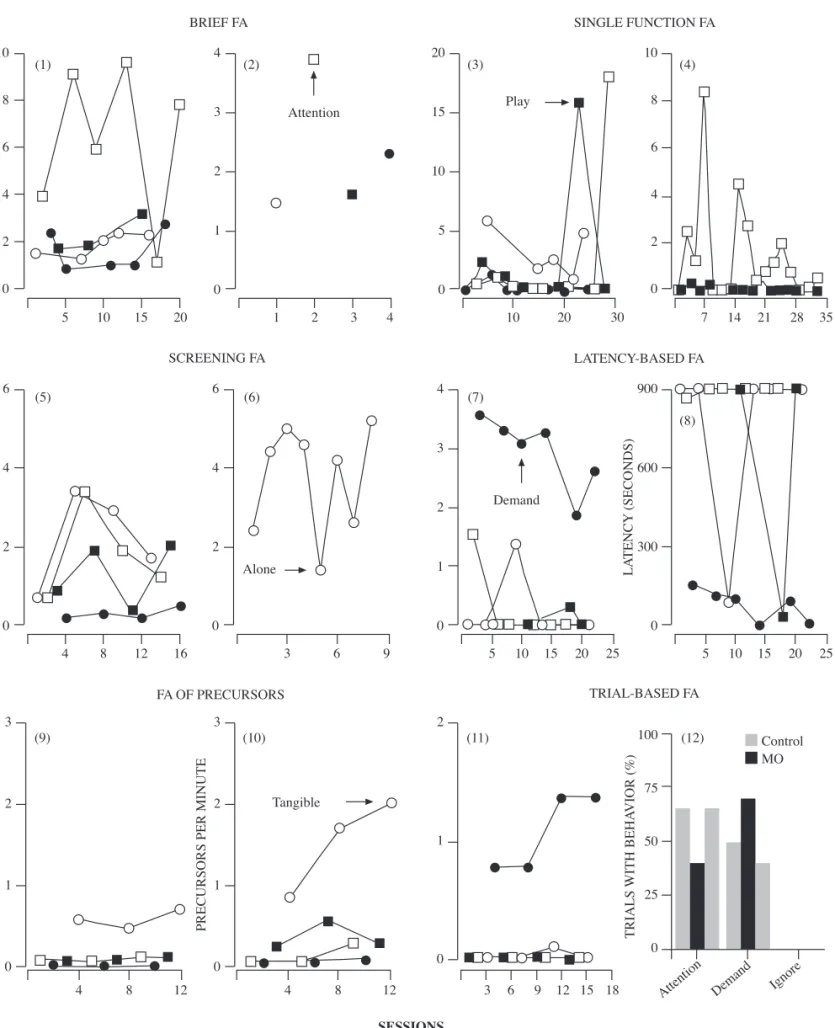
During the alone condition, the participant is exposed to a barren environment with no social stimuli (e.g., an empty room). A high rate of behavior in this condition provides indirect evidence of automatic reinforcement. Namely, as social stimuli are not available, the behavior is likely to be maintained by automatic reinforcement. Therefore, elevated levels of behavior across all FA conditions (undifferentiated FA), and not just during the alone condition, may also be indicative of automatic reinforcement (Figure 1-5) (Querim et al., 2013). In such cases, the presence of social attention, activities, and leisure items present in the attention, play, and demand conditions may not compete with the automatic reinforcement contingency.
During the attention condition, the therapist provides social attention contingent upon the problem behavior and ignores the client under all other circumstances. Social attention typically consists of expressions of concern and brief physical contact. A high level of problem behavior during the attention condition is indicative of behavior maintained by social positive reinforcement.
During the play condition the client receives attention every 30 s and a few highly-preferred leisure items. Play is considered a control condition, as the antecedents (presentation of demands, deprivation from attention) and consequences (escape, contingent attention) for social contingencies are absent. Also, leisure items are expected to compete or interfere with the sensory products of the behavior, thereby attenuating automatic-maintained behavior. The level of responding during play is expected to be low.
Finally, during the demand condition, the therapist prompts the client to engage in low-preference vocational or academic activities. Contingent upon the occurrence of problem behavior, the therapist withdraws the task demands for 30 s. The presence of problem behavior during this condition is indicative of negative reinforcement in the form of escape from task demands.
The sequence of sessions presented above (alone-attention-play-demand) facilitates differentiated response levels across FA Table 1
Validity of indirect, descriptive, and experimental methods of assessment
Correspondence
% (n) Source
Indirect methods 65 (97) Hall (2005), Iwata et al. (2013), Virués-Ortega et al. (2011)
Descriptive analysis 11 (27) Hall (2005), Lerman & Iwata (1993), Mace & Lalli (1991), St. Peter et al. (2005), Thompson & Iwata (2007)
FA variations Brief
Screening Latency-based Precursors Trial-based
68 (53)
93 (30) 90 (10) 100 (12) 66 (15)
Kahng & Iwata (1999), Wallace & Knights (2003)
Querim et al. (2013) Thomason-Sassi et al. (2011)
Fritz et al. (2013), Smith & Churchill (2002) Bloom et al. (2011), LaRue et al. (2010)
conditions (Hammond, Iwata, Rooker, Fritz, & Bloom, 2013). It is possible to add additional or idiosyncratic conditions on the basis of preliminary assessment information. For example, sometimes caregivers’ reports point to a specifi c form of attention or setting that can be subsequently integrated in the FA.
A common addition is the tangible condition. The antecedent for the tangible condition is the removal of a preferred item to be returned as soon as the behavior occurs. The client is then allowed to interact with the item or engage in the preferred activity for a few seconds until it is removed again. Due to its tendency to induce false-positive outcomes, tangible may be added only if caregivers’ reports point to tangible reinforcement as a likely function (Rooker, Iwata, Harper, Fahmie, & Camp, 2011).
The graphs labeled with odd numbers in Figure 1, show a series of typical FA using multi-element experimental designs. In a multi-element design test and control conditions are alternated systematically. Each data point represents the mean rate of behavior per minute during 5- or 10-min sessions.
The experimental FA is the most versatile and rigorous methodology for assessing problem behaviors. In order to increase the likelihood of obtaining interpretable results from an FA, Hanley, Iwata, and McCord (2003) provide a set of evidence-informed recommendations such as: limiting the number of topographies evaluated, including discriminative stimuli to facilitate the discrimination of test conditions, considering the relative duration of access to the reinforcer in the data analysis, and using other sources of information (e.g., interviews) that may contribute to the design of more complex analyses if the typical FA does not provide conclusive results. A recent study summarizing 988 FA cases found differentiated results in 92% of cases (Beavers et al., 2013). Moreover, comparative studies show that function-based treatments are more effective than those that do not use the outcome of an FA as the basis for treatment selection (e.g., Campbell, 2003).
However, the usability of FA methodology is challenged under three main clinical scenarios: (a) the time available to complete the assessment is limited, (b) the target behavior is dangerous and its occurrence during the assessment should be minimized, and (c) a controlled environment to conduct the assessment is not available (e.g., school setting). In the following sections we present a series of methodological variations of the FA that address these diffi culties.
Functional analysis with limited assessment time
The average assessment time of a typical FA is approximately fi ve hours. In order to improve effi ciency, some authors have evaluated changes in validity parallel to reductions in assessment time. The combined reduction in the number and duration of assessment sessions is known as brief FA. A brief FA consists of the presentation of a single 5-min session by condition (Figure 1-2). The procedure, which can be applied in one hour, leads to the identifi cation of the function of the behavior in about two thirds of the cases (Table 1). Often, the clients fail to present the target behavior during this short assessment (Derby et al., 1992). Nonetheless, the brief FA may be a feasible option for high-frequency behaviors.
A second approach to improve effi ciency is known as single function FA (Figure 1-4). During the single function FA, only one test condition is compared to the control condition (play). The test condition may be any of the conditions of a typical FA (demand, attention, alone, tangible). Indirect methods and caregivers’ reports can be used as the basis to select the target test condition. This method may also be used on occasions when the typical FA does not provide clear results (see example of Figure 1-3 and 1-4).
A variation of the single-function test for behaviors likely to be maintained by automatic reinforcement is known as screening FA (Querim et al., 2013). Screening FA consists of the presentation of a number of short alone sessions (Figure 1-6). The level of behavior during the series has been shown to predict, in most cases, whether the behavior is maintained by social or automatic reinforcement. Specifi cally, high levels of problem behavior during the alone series suggests that the target behavior is likely to be maintained by automatic reinforcement. In contrast, if the behavior shows a decreasing trend or near zero levels during the alone series, target behavior is likely to be maintained by either social positive or social negative reinforcement. In the latter case, further assessment would be necessary in order to identify the exact function of the behavior. Screening FA reduces assessment time by 80% and is particularly useful for topographies that are likely to be maintained by automatic reinforcement (e.g., self-injury, stereotypy).
Functional analysis of dangerous behaviors
It is important to limit the number of occurrences of severe problem behavior such as self-injury and aggression during the Table 2
Contingencies in a functional analysis
SD MO SR Contingency
Alone Therapist leaves Deprivation from social and nonsocial stimuli
Aversive sensory stimuli
Changes in sensory stimuli Positive and negative automatic reinforcement
Attention Therapist says “I have work to do” Deprivation from social stimuli Social attention Social positive reinforcement
Demand Task presentation Frequent task presentation Escape from task Social negative reinforcement
Tangible Therapist has a preferred item Deprivation from a preferred item Access to the preferred item Tangible/social positive reinforcement
Play Presentation of preferred items Noncontingent social attention Access to preferred items
No differential consequences Control
10
8
6
4
2
0
5 10 15 20
(1)
BRIEF FA
4
3
2
1
0
1 2 3 4
(2)
Attention
20
15
10
5
0
10 20 30
(3)
Play
SINGLE FUNCTION FA
10
8
6
4
2
0
7 21 35
(4)
14 28
6
4
2
0
4 8 12 16
(5)
SCREENING FA
6
4
2
0
3 6 9
Alone
(6) 4
3
2
1
0
5 10 15 20 25
LATENCY-BASED FA
(7) 900
600
300
0
5 10 15 20 25 Demand
(8)
LA
TENCY
(SECONDS)
3
2
1
0
4 8 12
FA OF PRECURSORS
PRECURSORS PER MINUTE
3
2
1
0
4 8 12
(10)
Tangible
2
1
0
6 12 18
3 9 15
(11) (9)
TRIAL-BASED FA
100
75
50
25
0 (12)
TRIALS
WITH BEHA
VIOR (%)
Attention Demand Ignore
Control MO
SESSIONS
course of the FA. While it is possible to use protective materials to buffer the intensity of the behavior, these procedures can limit the validity of the FA. For example, it has been shown that the use of protective material suppresses the occurrence of behaviors maintained by negative reinforcement and automatic reinforcement (Le & Smith, 2002).
Recent methodological variations of FA methodology minimize the occurrence of the target behavior without altering its function. One of these methods is the latency-based FA. A latency-based FA differs from a typical FA in the dimension of the behavior recorded and the number of sessions needed to arrive at reliable results. Latency is recorded as the time elapsed between the start of the session and the fi rst occurrence of the behavior (Figure 1-8). Once the behavior occurs, the therapist presents the consequent event and the session ends. Only one occurrence of problem behavior is necessary per session. As a result, the number of instances of problem behavior necessary to complete the assessment is minimal. The procedure is appropriate for dangerous topographies that may not be amenable to a typical FA on safety grounds (Thomason-Sassi, Iwata, Neidert, & Roscoe, 2011). The evidence available supports the validity of the latency-based FA (Table 1).
Another alternative to minimize problem behavior during the assessment is the FA of precursors (Figure 1-10). A recent study suggests that, in most cases, problem behaviors are preceded by other behaviors of lower intensity known as precursor behaviors (e.g., pushing before hitting) (Fritz, Iwata, Hammond, & Bloom, 2013). Fritz et al. fi lmed 10 episodes of problem behavior among clients who engaged in self-injurious behavior, aggression, and property destruction. Subsequently, they screened the videos for possible precursors by obtaining conditional probabilities of the occurrence of the precursor relative to the subsequent occurrence of the target behavior. For each case, they selected the precursors that had the highest conditional probabilities. Then, they conducted an FA using the precursors as target behavior. The study showed that the terminal problem behavior was unlikely to occur if contingencies were placed on the precursors during the assessment. Nonetheless, the validity of this approach is high in that precursors seem to serve the same function as the target problem behavior in almost all cases (Table 1). Several authors have suggested that precursors and problem behaviors are part of a hierarchical behavior class. This would explain why precursors occur rarely when contingencies are applied to the problem behavior, whereas when contingencies are applied to the fi nal problem behavior, precursors are common (Smith & Churchill, 2002). The factors governing the order of precursors within the hierarchy are not well understood, albeit response effort (energetic cost of producing a response) and schedule of reinforcement may be involved.
Functional analysis in naturalistic settings
A typical FA requires a controlled environment that is often unavailable to professionals working in school and residential settings. The trial-based FA adapts the functional-analytic methodology to the typical school environment (Bloom, Iwata, Fritz, Roscoe, & Carreau, 2011). This methodology consists of 6-min tests divided into 2-min segments distributed throughout the school day (Figure 1-12). Each test evaluates one of the test conditions in a typical FA. In the fi rst two minutes of the sequence, the teacher removes the motivating operation of the FA
condition that is being evaluated. Next, the teacher presents the motivating operation for two minutes and ends the sequence with an additional two minutes without the motivating operation. For example, if we were to test attention, the teacher would provide non-contingent attention for two minutes in order to remove deprivation from attention as a potential motivating operation. Then the teacher would remove the noncontingent attention for the next two minutes, ending the sequence by reinstating noncontingent attention for two additional minutes. The alone condition requires a controlled environment without social or leisure stimuli. Therefore, alone is not part of the trial-based FA. Although potentially more ecologically valid, the trial-based FA frequently presents results that do not correspond with those of a typical FA, suggesting that criterion validity is limited (Table 1). Nonetheless, the trial-based approach has been used successfully as the only basis for treatment selection. Moreover, caregivers and teachers can implement the procedure with adequate integrity after a short training (e.g., Bloom, Lambert, Dayton, & Samaha, 2013). Similarly to the brief FA, the trial-based FA relies on limited samples of behavior. Thus, undifferentiated outcomes due to low responding during the assessment are a common challenge (Bloom et al., 2013).
Functional analysis and intervention
There are three general function-based treatment strategies: (a) removing the reinforcer (extinction), (b) changing the motivating operation inducing the target behavior, and (c) replacing the problem behavior by other topographies that could be followed by the functional reinforcers (differential reinforcement) (Iwata & Worsdell, 2005). The clinician must know the function of the behavior in order to design a functionally driven intervention. Therefore, a pre-intervention FA is essential. Below we present a brief introduction of these three categories of functional intervention in order to highlight the importance of FA. A detailed description of the functional approach to intervention is beyond the scope of the present article.
First, during extinction the response-reinforcer contingency is discontinued. In other words, the response no longer results in access to the reinforcer. For example, during the extinction of problem behavior maintained by social positive reinforcement, social attention is no longer delivered after the occurrence of problem behavior, while in cases of problem behavior maintained by negative reinforcement, task demands continue in spite of the occurrence of the behavior (escape extinction). Finally, it may be possible to eliminate or attenuate the sensory products of behaviors maintained by automatic reinforcement (sensory extinction). Unfortunately, extinction poses some practical problems. For example, a caregiver could not afford to ignore severe problem behavior as it may not be practical or ethical to block elopement attempts during escape extinction, and it may be diffi cult to attenuate the sensory products of stereotypy.
behavior, respectively. Also, the noncontingent presentation of reinforcers has reductive effects over behavior maintained by automatic reinforcement (Piazza, Adelinis, Hanley, Goh, & Delia, 2000). For behavior maintained by social negative reinforcement, it may also be possible to reduce the aversive quality of demands by simplifying instructions, presenting them gradually, or conducting shorter sessions (e.g., Piazza, Moes, & Fisher, 1996).
Finally, there are two functional approaches to the replacement of problem behavior maintained by social contingencies: differential reinforcement of other behavior (DRO) and differential reinforcement of alternative behavior (DRA). During DRO, all behaviors, with the exception of the problem behavior, are reinforced in regular intervals. Thus, DRO cannot be implemented without extinction. The DRO interval could be variable or fi xed. Also, the therapist may require the behavior to be absent either at the end (momentary DRO) or throughout the interval (interval DRO) for the reinforcer to be delivered. All variations have shown to be effective. However, the momentary-variable DRO may be preferable as it only requires sparse monitoring for accurate delivery (Lindberg, Iwata, Kahng, & DeLeon, 1999). By contrast, the DRA, also known as functional communication training, allows for the functional replacement of problem behavior with more appropriate behaviors. The DRA is used widely as a functional intervention for problem behavior maintained by social contingencies (Kurtz et al., 2003).
Functional analysis is the most adaptable and accurate methodology for evaluating the function of problem behavior in a variety of clinical settings. A typical FA temporarily exposes the
client to prevalent contingencies of reinforcement. The procedure requires few sessions per test condition and, on occasion, a single session per test condition (brief FA). It can also be used in school settings (trial-based FA) and with highly severe problem behaviors (latency-based, precursors). Finally, the outcome of an FA provides specifi c guidance for the development of functionally driven interventions consistent with the assessment fi ndings. The three general approaches to functional intervention include the removal of the reinforcer (extinction), the attenuation of motivating operations, and the replacement of problem behavior through differential reinforcement.
The literature on experimental FA is limited to problem behaviors such as self-injury, aggression, stereotypies, and other behaviors often found among people with developmental and intellectual disabilities. Many authors have made efforts, at least at a conceptual or pre-experimental level, to transfer some aspects of this methodology to clinical problems in individuals with typical development (e.g., Virués-Ortega, Montaño, Froján-Parga, & Calero, 2011), which is one of the areas of future development of the functional-analytical methodology.
Acknowledgments
A Spanish translation of the present manuscript is available upon request.
This study was supported by an establishment grant from the Manitoba Health Research Council to Dr. Virués-Ortega and by the Open Access Authors’ Fund of the University of Manitoba.
References
Beavers, G.A., Iwata, B.A., & Lerman, D.C. (2013). Thirty years of research on functional analysis. Journal of Applied Behavior Analysis, 46, 1-21.
Bloom, S.E., Iwata, B.A., Fritz, J.N., Roscoe, E.M., & Carreau, A.B. (2011). Classroom application of trial-based functional analysis. Journal of Applied Behavior Analysis, 44, 19-31.
Bloom, S.E., Lambert, J.M., Dayton, E., & Samaha, A.L. (2013). Teacher-conducted trial-based functional analyses as the basis for intervention.
Journal of Applied Behavior Analysis, 46, 208-218.
Campbell, J.M. (2003). Effi cacy of behavioral interventions for reducing problem behavior in persons with autism: A quantitative synthesis of single-subject research. Research in Developmental Disabilities, 24, 120-138.
Derby, K.M., Wacker, D.P., Sasso, G., Steege, M., Northup, J., Cigrand, K., & Asmus, J. (1992). Brief functional assessment techniques to evaluate aberrant behavior. Journal of Applied Behavior Analysis, 25, 713-721.
Fritz, J.N., Iwata, B.A., Hammond, J.L., & Bloom, S.E. (2013). Experimental analysis of precursors of severe problem behavior. Journal of Applied Behavior Analysis, 46, 101-129.
Hall, S.S. (2005). Comparing descriptive, experimental and informant-based assessments of problem behaviors. Research in Developmental Disabilities, 26, 514-526.
Hammond, J.L., Iwata, B.A., Rooker, G.W., Fritz, J.N., & Bloom, S.E. (2013). Effects of fi xed versus random condition sequencing during functional analyses. Journal of Applied Behavior Analysis, 46, 22-30. Hanley, G.P., Iwata, B.A., & McCord, B.E. (2003). Functional analysis of problem behavior: A review. Journal of Applied Behavior Analysis, 36, 147-185.
Iwata, B.A., DeLeon, I.G., & Roscoe, E.M. (2013). Reliability and validity of the functional analysis screening tool. Journal of Applied Behavior Analysis, 46, 271-284.
Iwata, B.A., Dorsey, M.F., Slifer, K.J., Bauman, K.E., & Richman, G.S. (1994). Toward a functional analysis of self-injury. Journal of Applied Behavior Analysis, 27, 197-209 (Original 1982).
Iwata, B.A., & Worsdell, A.S. (2005). Implications of functional analysis methodology for the design of intervention programs. Excepcionality, 13, 25-34.
Kahng, S., & Iwata, B.A. (1999). Correspondence between outcomes of brief and extended functional analyses. Journal of Applied Behavior Analysis, 32, 149-159.
Kurtz, P.F., Chin, M.D., Huete, J.M., Tarbox, R.S.F., O’Connor, J.T., Paclawskyj, T.R., & Rush, K.S. (2003). Functional analysis and treatment of self-injurious behavior: A summary of 30 cases. Journal of Applied Behavior Analysis, 36, 205-219.
Laraway, S., Snycerski, S., Michael, J., & Poling, A. (2003). Motivating operations and terms to describe them. Jounral of Applied Behavior Analysis, 36, 407-414.
LaRue, R.H., Lenard, K., Weiss, M.J., Bamond, M., Palmieri, M., & Kelley, M.E. (2010). Comparison of traditional and trial-based methodologies for conducting functional analyses. Research in Developmental Disabilities, 31, 480-487.
Le, D.D., & Smith, R.G. (2002). Functional analysis of self-injury with and without protective equipment. Journal of Developmental and Physical Disabilities, 14, 277-290.
Lerman, D.C., & Iwata, B.A. (1993). Descriptive and experimental analyses of variables maintaining self-injurious behavior. Journal of Applied Behavior Analysis, 26, 293-319.
Lindberg, K.S., Iwata, B.A., Kahng, S., & DeLeon, I.G. (1999). DRO contingencies: An analysis of variable-momentary schedules. Journal of Applied Behavior Analysis, 32, 126-136.
Mace, F.C., & Lalli, J.S. (1991). Linking descriptive and experimental analyses. Journal of Applied Behavior Analysis, 24, 553-562. Marion, S.D., Touchete, P.E., & Sandman, C.A. (2003). Sequential analysis
reveals a unique structure for self-injurious behavior. American Journal of Mental Retardation, 108, 301-313.
Piazza, C.C., Adelinis, J.D., Hanley, G.P., Goh, H.L., & Delia, M.D. (2000). An evaluation of the effects of matched stimuli on behaviors maintained by automatic reinforcement. Journal of Applied Behavior Analysis, 33, 13-27.
Piazza, C.C., Moes, D.R., & Fisher, W.W. (1996). DRA and demand fading in the treating fading in the treatment of escape-maintained destructive behavior. Journal of Applied Behavior Analysis, 29, 569-572.
Querim, A.C., Iwata, B.A., Roscoe, E.M., Schlichenmeyer, K.J., Virués-Ortega, J.V., & Hurl, K.E. (2013). Functional analysis screening for problem behavior maintained by automatic reinforcement. Journal of Applied Behavior Analysis, 46, 47-60.
Rooker, G.W., Iwata, B.A., Harper, J.M., Fahmie, T.A., & Camp, E.M. (2011). False-positive tangible outcomes of functional analyses.
Journal of Applied Behavior Analysis, 44, 737-745.
Smith, R.G., & Churchill, R.M. (2002). Identifi cation of environmental determinants of behavior disorders through functional analysis of
precursor behaviors. Journal of Applied Behavior Analysis, 35, 125-136.
St. Peter, C.C., Vollmer, T.R., Bourret, J.C., Borrero, C.S.W., Sloman, K., & Rapp, J.T. (2005). On the role of attention in naturally occurring matching relations. Journal of Applied Behavior Analysis, 38, 429-443.
Thomason-Sassi, J.L., Iwata, B.A., Neidert, P.L., Roscoe, E.M. (2011). Response latency as an index of response strength during functional analyses. Journal of Applied Behavior Analysis, 44, 51-67.
Thompson, R.H., & Iwata, B.A. (2007). A comparison of outcomes from descriptive and functional analyses of problem behavior. Journal of Applied Behavior Analysis, 40, 333-338.
Virués-Ortega, J., Montaño, M., Froján-Parga, M.X., & Calero, A. (2011). Descriptive analysis of the therapist’s verbal behavior: Known-group validity analysis of the behavioral functions of clinical interaction.
Behavior Therapy, 42, 547-559.
Virués-Ortega, J., Segui, D., Descalzo, A., Carnerero, J.J., & Martín, N. (2011). Caregivers’ agreement and validity of indirect functional analysis. Journal of Autism and Developmental Disorders, 41, 82-91. Wallace, M.D., & Knights, D.J. (2003). An evaluation of a brief functional