The infl uence of parenting practices on the emotional welfare and behaviour of children has attracted great interest among researchers. Several studies have confi rmed its relationship with different variables or problems, such as behavioural problems (Prinzie et al., 2004; Raya, Pino, & Herruzo, 2009; Steinber, Blatt-Eisengart, & Cauffman, 2006), internalising problems (Steinberg, 2001; Taboada, Ezpeleta, & de la Osa, 1998), personality traits (Aluja, Del Barrio, & García, 2007), self-esteem (Alonso & Roman, 2005; Oliva, Parra, & Arranz, 2008), adjustment and psychological well-being (Oliva et al., 2008), and academic competence (Pelegrina, García, & Casanova, 2002; Aunola, Statton, & Nurmi,
2000). Based on the studies conducted, it may be concluded that more effi cient parenting practices promote greater welfare and better adaptation of children in different areas of their lives, and therefore a better quality of life. According to Rezai and Rahimi (2013), children raised under authoritative parenting, characterised by supervision, consistency, involvement, and caring relationships (Baumrid, 1968), have a better quality of life than children under other patterns of parenting.
The bidirectional perspective (Ceballos & Rodrigo, 1998; Palacios, 1999) defi nes parenting practices as a set of attitudes and global trends of parental behaviour that determine the interaction with their children and have a clear effect on child development. From this perspective, which advocates the infl uence of parents on their children and vice versa, there is a clear need to know through questionnaires not only the perception that parents have of their parenting practices, but also the children’s perception with respect to their parents. Such information would provide knowledge about current parenting practices from different perspectives, and
ISSN 0214 - 9915 CODEN PSOTEG Copyright © 2013 Psicothema www.psicothema.com
Factor structure and psychometric properties of the Spanish version
of the Alabama Parenting Questionnaire (APQ) for children
Silvia Escribano, Jennifer Aniorte and Mireia Orgilés
Universidad Miguel Hernández de Elche
Abstract
Background: The Alabama Child Parenting Questionnaire (APQ) is a multi-source and multi-method instrument created to assess the most relevant parenting practices from a bidirectional perspective. Despite its advantages, the APQ has not been validated with a Spanish population. The objective of this study was to analyse the psychometric properties and factor structure of the APQ, child self-report version, in a community sample of Spanish children. Method: The participants were 423 Spanish children (58.9% boys) aged between 8 and 12 years. Results: Exploratory factor analysis suggested a version of the questionnaire that consists of 16 items with a four-factor structure: Parental Involvement, Positive Parenting, Inconsistent Discipline, and Poor Supervision. The internal consistency of the subscales was moderate, except for the father’s Parental Involvement factor, which reached acceptable reliability. Convergent validity with a measure of quality of life was adequate. Gender differences were only found in Poor Supervision, with higher scores in boys than in girls. Conclusions: Overall, these fi ndings provide support for the use of the APQ to measure parenting practices perceived by Spanish children.
Keywords: parenting, children, self-report, Alabama Parenting Questionnaire.
Resumen
Estructura factorial y propiedades psicométricas de la versión española del Alabama Parenting Questionnaire (APQ) para niños. Antecedentes:
el Alabama Child Parenting Questionnaire (APQ) es un instrumento que permite una evaluación multimétodo y multifuente de las prácticas educativas parentales desde una perspectiva bidireccional. A pesar de sus ventajas, el APQ no ha sido validado con población española. El objetivo de este estudio es analizar las propiedades psicométricas y la estructura factorial del APQ, versión autoinforme, en una muestra comunitaria de niños españoles. Método: los participantes fueron 423 niños españoles (58,9% varones) con edades comprendidas entre 8 y 12 años. Resultados:
el análisis factorial exploratorio sugirió una versión del cuestionario formada por 16 ítems y una estructura de cuatro factores: implicación parental, crianza positiva, disciplina inconsistente y pobre supervisión. La consistencia interna de las subescalas fue moderada, excepto para la implicación de los padres, que fue aceptable. La validez convergente, hallada con una medida de calidad de vida, fue adecuada. Únicamente se hallaron diferencias en función del género en la subescala pobre supervisión, con puntuaciones mayores en los niños que en las niñas. Conclusiones: en conjunto, los hallazgos de este estudio apoyan el uso del APQ para medir las prácticas parentales percibidas por los niños españoles.
Palabras clave: prácticas parentales, niños, autoinforme, Alabama Parenting Questionnaire.
Psicothema 2013, Vol. 25, No. 3, 324-329 doi: 10.7334/psicothema2012.315
Received: November 16, 2012 • Accepted: April 9, 2013 Corresponding author: Mireia Orgilés
Facultad de Ciencias Sociosanitarias Universidad Miguel Hernández de Elche 03202 Elche (Spain)
is a prerequisite for developing any intervention program and improving educational practices.
Several questionnaires assess parenting practices as perceived by children: the Parent-Child Relationship Inventory (PCRI; Gerard, 1994), adapted to the Spanish population by Roa and Del Barrio (2001, 2002); the Egna Minnen Betraffande Uppfostran scale (EMBU; Perris, Jacobsson, Lindström, Von Knorring, & Perris, 1980) adapted by Castro, Toro, Van der Ende and Arrindel (l993); and the Alabama Parenting Questionnaire (APQ; Shelton, Frick, & Wootton, 1996) translated by Servera (2007). Among all of them, only the APQ and EMBU take into account both the perception of children and parents.
The APQ consists of fi ve dimensions created based on face validity: positive parenting, corporal punishment, inconsistent discipline, poor supervision, and involvement. It was originally designed to assess parenting practices related to behavioural problems (Shelton et al., 1996) but since its development, it has been used in studies of family adjustment (Gewirt, Polusny, DeGarmo, Khaylis, & Erbes, 2010), language problems (Karande & Kuril, 2011), and alcohol use (Tildesley & Andrews, 2008). The APQ was developed taking into account the bidirectional perspective that highlights the relationship between parents and children. The instrument has four assessment formats, versions for children and parents, and through report form and telephone interview; therefore, the APQ has the advantage of being a multi-source and multi-method instrument. It also assesses the most relevant parenting practices with a small number of items (35) compared to other more extensive instruments like the EMBU (81), which, however, does not examine parental supervision of children. The APQ has shown adequate psychometric properties in different languages and communities (Clerkin, Marks, Policaro, & Halperin, 2007; Dadds, Maujean, & Fraser, 2003; Essau, Sasagawa, & Frick, 2006; Molinuevo, Pardo, & Torrubia, 2011; Shelton et al., 1996). Even though it is considered a psychometrically valid scale for assessing parenting practices (Locke & Prinz, 2002), to date the Spanish version of the APQ has not been validated with a Spanish population.
The present study examines the psychometric properties and factor structure of the children’s version of the APQ, through report form, (Servera, 2007) in a community sample of Spanish children aged between 8 and 12 years. For this aim, factor analysis was conducted and the reliability and validity of the questionnaire was obtained. Adequate internal consistency and validity was expected, with positive correlations between parenting practices and the quality of life in children. The most effi cient parenting practices (greater involvement by both parents, positive parenting, supervision, and consistent discipline) were expected to correlate with a higher quality of life in general and in certain specifi c areas, such as school, family, friends, and self-esteem, as found in previous studies (Rezai & Rahimi, 2013).
Method
Participants
The participants were 423 Spanish children (58.9% boys) aged between 8 and 12 years (M = 9.65, SD = 1.19). The age distribution was as follows: 19.2% of 8-year-olds, 30.3% of 9-year-olds, 22.9% of 10-year-9-year-olds, 21.5% of 11-year-9-year-olds, and 6.1% of 12-year-olds. Of the sample, 83.9% were the children of married
parents. Regarding the employment status of parents, 95% of their fathers and 79.2% of their mothers worked outside the home. The socioeconomic status of participants, estimated based on the school locations and the parents’ professions, was medium.
Instruments
The Spanish version of the Alabama Parenting Questionnaire for Children (APQ; Shelton et al., 1996). The questionnaire assesses, in a self-report format, parental practices perceived by children within the family. It consists of 35 items and measures
five dimensions: Parental Involvement, Positive Parenting,
Inconsistent Discipline, Poor Supervision, and Corporal Punishment. Most questionnaire items obtained information about children ‘s perception of their parents without distinguishing between the mother and father, except for the parental involvement factor, which has nine items formulated separately for the mother and father. The APQ contains seven additional items that measure disciplinary practices other than corporal punishment to avoid negative biases, but they were not included in the data analyses. The items are answered on a Likert scale, with fi ve response categories, ranging from 1 (never) to 5 (always). A total score ranging from 35 to 175 is obtained by adding the fi ve dimensions, with higher scores indicating less suitable parental practices. The items in the positive parenting and parental involvement scales must be reversed. The original version of the instrument has a moderate internal consistency (alpha ranged from .58 to .80) and a convergent validity with other forms of the questionnaire (children, parents, report form, telephone interview) between .26 and .46 (Shelton et al., 1996). The Spanish version of the APQ (Servera, 2007) was translated from English to Spanish using the back-translation method (Hambleton, 2005), and can be freely downloaded from the author’s homepage: (http://devpsy.fi les. wordpress.com/2008/09/apq_child_spanish.pdf).
The Kindl Questionnaire, version for children 8 to 12 years (Kid-Kindl, Ravens-Sieberer, & Bullinger, 1998). The Kindl was adapted and validated into Spanish by Rajmil et al. (2004). It contains 24 questions distributed into six dimensions: Physical Well-Being, Emotional Well-Being, Self-Esteem, Family, Friends, and School. The items are answered on a Likert scale with fi ve response categories: never, rarely, sometimes, often, and always. The questions refer to the week preceding the application. The scores obtained from the means of each dimension are transformed to a scale of 0 to 100, with higher scores representing better health-related quality of life. The total score is obtained from the total of the six dimensions. The instrument has an internal consistency above .70 in the overall index and in the emotional welfare, self-esteem, and family dimensions.
Procedure
omissions. Prior to applying the questionnaires in schools, the Ethics Committee of the Miguel Hernández University of Elche approved the study.
Data analysis
Statistical analyses were conducted using SPSS and Amos version 20.0. First, confi rmatory analysis was computed to assess whether the APQ could be divided into the theoretical subscales proposed by the author of the original version. Due to the model not fi tting well, exploratory factor analysis was performed. The results for the parental involvement factor were obtained separately for the mothers’ and fathers’ data as in previous studies (Essau et al., 2006). Gender differences were examined through independent sample t-tests, and Cohen’s d effect size was calculated for each comparison (Cohen, 1988). The internal consistency of the questionnaire and its subscales were examined using Cronbach’s alpha. Convergent validity was assessed by means of correlational tests between the APQ and Kindl.
Results
Factorial analysis
The confi rmatory analysis showed an inadequate adjustment of the data to the theoretical subscales proposed by the author of the original version of the APQ: S-B χ2 (df = 62) = 2796 , p<.000,
CFI = .58; TLI = .53, RMSEA= .07, CI [.066, .072]. Due to all
the values being very far from the optimum, exploratory analysis was performed with the maximum likelihood extraction method and Promax rotation. The following criteria were considered for selecting the items: (a) an eigenvalue greater than one, (b) factor loadings of at least .30, and (c) an interpretation with respect to the original factors.
Exploratory analysis initially extracted twelve and eleven factors for the mothers’ and fathers’ data, respectively. The explained variance for the mothers’ data was 58.32% and 57.03% for the fathers’. In a second analysis, fi ve items were eliminated from the mothers’ data (Items 6, 19, 26, 32, and 35) and four from the fathers’ (Items 6, 26, 32, and 35) due to loadings below .30. Subsequent analysis was performed, eliminating the items that were not consistent with the original structure; ten items that did not conform to either the mothers’ or fathers’ data (Items 2, 4, 11, 12, 15, 17, 21, 25, 33, and 38), one item for the mothers’ (Item 13), and one for the fathers’ (item 23). A fi nal analysis was performed that suggested eliminating two items (items 24 and 27) for not adapting to the original structure.
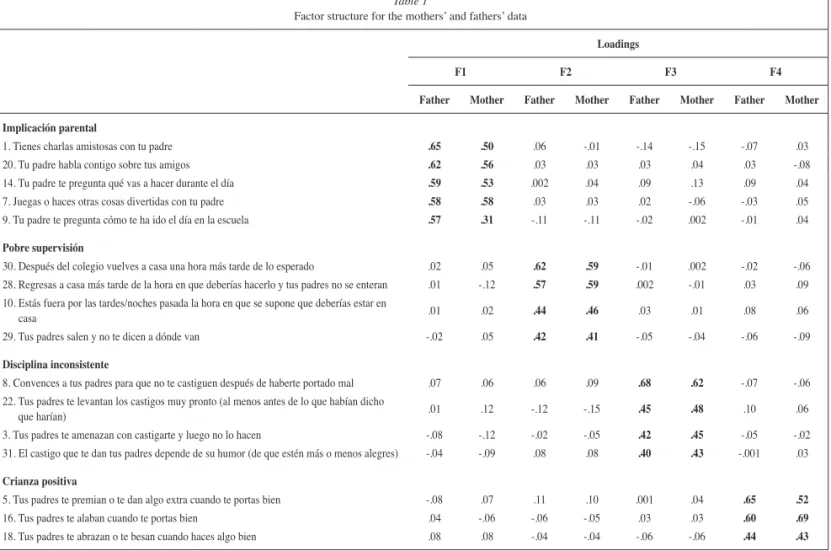
Table 1 shows the results of the factor analysis for the fathers’ and mothers’ data, respectively. Based on these results, we suggest a structure of the questionnaire consisting of four factors (parental involvement, positive parenting, inconsistent discipline, and poor supervision) and 16 items, eliminating the corporal punishment scale included in the original version of the APQ. The KMO (.72 and .75; mothers’ and fathers’ data, respectively) confi rms an adequate structure of the instrument, explaining 45.84 and 48.20% of the total variance.
Table 1
Factor structure for the mothers’ and fathers’ data
Loadings
F1 F2 F3 F4
Father Mother Father Mother Father Mother Father Mother
Implicación parental
1. Tienes charlas amistosas con tu padre .65 .50 .06 -.01 -.14 -.15 -.07 .03 20. Tu padre habla contigo sobre tus amigos .62 .56 .03 .03 .03 .04 .03 -.08 14. Tu padre te pregunta qué vas a hacer durante el día .59 .53 .002 .04 .09 .13 .09 .04 7. Juegas o haces otras cosas divertidas con tu padre .58 .58 .03 .03 .02 -.06 -.03 .05 9. Tu padre te pregunta cómo te ha ido el día en la escuela .57 .31 -.11 -.11 -.02 .002 -.01 .04
Pobre supervisión
30. Después del colegio vuelves a casa una hora más tarde de lo esperado .02 .05 .62 .59 -.01 .002 -.02 -.06 28. Regresas a casa más tarde de la hora en que deberías hacerlo y tus padres no se enteran .01 -.12 .57 .59 .002 -.01 .03 .09 10. Estás fuera por las tardes/noches pasada la hora en que se supone que deberías estar en
casa .01 .02 .44 .46 .03 .01 .08 .06
29. Tus padres salen y no te dicen a dónde van -.02 .05 .42 .41 -.05 -.04 -.06 -.09
Disciplina inconsistente
8. Convences a tus padres para que no te castiguen después de haberte portado mal .07 .06 .06 .09 .68 .62 -.07 -.06 22. Tus padres te levantan los castigos muy pronto (al menos antes de lo que habían dicho
que harían) .01 .12 -.12 -.15 .45 .48 .10 .06
3. Tus padres te amenazan con castigarte y luego no lo hacen -.08 -.12 -.02 -.05 .42 .45 -.05 -.02 31. El castigo que te dan tus padres depende de su humor (de que estén más o menos alegres) -.04 -.09 .08 .08 .40 .43 -.001 .03
Crianza positiva
5. Tus padres te premian o te dan algo extra cuando te portas bien -.08 .07 .11 .10 .001 .04 .65 .52
16. Tus padres te alaban cuando te portas bien .04 -.06 -.06 -.05 .03 .03 .60 .69
Descriptive data of the APQ
Table 2 shows the mean scores and standard deviations for each subscale. Gender differences were only found in poor supervision (p<.01) with a medium effect size of 0.18, suggesting that boys perceive poor supervision more frequently than girls do.
Reliability
Table 3 shows the reliability (internal consistency) of the questionnaire for the four subscales extracted in the exploratory factor analysis. The results show a moderate to low internal consistency, ranging from .55 to .62, except for the fathers’ data on parental involvement in which Cronbach’s alpha is acceptable (α = .74). These reliability coeffi cients were expected due to the small number of items comprising each factor: fi ve items for parental involvement, three for positive parenting, and four for inconsistent discipline and poor supervision.
The correlation between the APQ subscales is shown in Table 4. The poor supervision factor has low correlations with the other
subscales, except with inconsistent discipline (r = .203). Both the mothers’ and fathers’ involvement factors have a positive signifi cant correlation with each other and with the positive parenting subscale, but a non-signifi cant correlation with the inconsistent discipline and poor supervision subscales. Appropriate correlations are observed between the subscales of positive parenting (parental involvement of the father and mother and positive parenting) and between the subscales of negative parenting (inconsistent discipline and poor supervision).
Validity
A quality of life measure was used to calculate the convergent validity. The correlations between parental practices and quality of life are shown in Table 5. In general, the results showed signifi cant positive correlations between the measure of quality of life and the subscales of positive parenting of the APQ (parental involvement of the mother and father, and positive parenting), while the inconsistent discipline and poor supervision subscales correlate negatively with the quality of life and its various dimensions. The
results were as expected, except for the psychological well-being subscale that relates negatively to the involvement of the father, although the correlation is very low.
Quality of life, self-esteem, school, and friends are the subscales most related to adequate parenting in the family (greater
Table 2
Gender differences in APQ
Total score Boys Girls Boys vs. Girls
M SD M SD M SD t d
Positive parenting 07.23 2.99 07.39 3.15 07.01 2.75 -1.28** –
Inconsistent discipline 10.25 3.69 10.22 3.58 10.30 3.84 -0.24** –
Poor supervision 06.37 2.91 06.76 3.22 05.82 2.31 -3.29** 0.34
Parental involvement
Father data 13.09 4.76 12.95 4.69 13.30 4.87 -0.74** –
Mother data 11.62 3.95 11.69 3.85 11.53 4.10 -0.40** –
Note: ** p<.01
Table 3
Reliability of the APQ
Fathers’ and
mothers’ data Fathers’ data Mothers’ data
Parental involvement – .74 .62
Positive parenting .57 – –
Inconsistent discipline .55 – –
Poor supervision .58 – –
Table 4
Correlations between the subscales of the APQ
MI FI PP ID PS
MI –
FI .67** –
PP .34** -.31** –
ID .02** -.04** .11* –
PS .03** -.04** .03* .203* –
Note: MI = Mother involvement; FI = Father involvement; PP = Positive parenting; ID = Inconsistent Discipline; PS = Poor Supervision; * p<.05; ** p<.01
Table 5
Validity of the APQ
APQ
MI FI PP ID PS
Kindl
Quality of life .17** .23** .19** -.16** -.25**
Subscales of Kindl
Physical wellbeing -.06** -.03** -.04** -.17** -.19**
Self-esteem -.23** -.27** -.28** -.01** -.02**
Psychological wellbeing -.10** -.14** -.10** -.09** -.17** Friends -.16** -.18** -.15** -.12** -.14** Family -.08** -.09** -.11** -.11** -.33** School -.14** -.16** -.12** -.12** -.20**
involvement by both parents and positive parenting). Moreover, the poor supervision subscale has a greater relationship with the family, physical well-being, school, and quality of life subscales; less supervision means worse physical well-being, satisfaction with family, and quality of life.
Discussion
The aim of this study was to analyze the psychometric properties of the Spanish version of the APQ for children, self-report form, in a community sample. The results do not support the theoretical structure of fi ve factors suggested by the author in the original study, which has only been confi rmed in the study by Essau et al. (2006) with German children. The results obtained in most previous studies with other populations (Elgar et al., 2007; Clerkin et al., 2007; Molinuevo et al., 2011) endorse a three-factor structure including all the inconsistent discipline and positive parenting subscales; the third factor varies, depending on the study, between hard discipline and poor supervision. The results of our study show a consistent structure for the self-report version for children that consist of four factors: Positive Parenting, Parental Involvement (differentiating between the mothers and fathers), Inconsistent Discipline, and Poor Supervision. The Corporal Punishment subscale, formed by three items in the original structure, was eliminated due to both statistical results and their low content validity. Non-inclusion of this factor does not imply a lack of the measured content; rather, it refl ects extreme disciplinary practices that are minor and not accepted by most of the general population (item 33: “Your parents spank you with their hand when you have done something wrong”; item 35: “Your parents slap you when you have done something wrong”; and item 38: “Your parents hit you with a belt, switch, or other object when you have done something wrong”). The positive dimensions (Positive Parenting and Parental Involvement) are clearly differentiated, according to the structure obtained in the original study and unlike other studies that include both factors together in a single one (Clerkin et al., 2007; Molinuevo et al., 2011).
The results of our study suggest a version of the APQ consisting of 16 items, with an explained variance of 45.84% for the mothers’ data and 48.20% for the fathers’, similar to that obtained in other validations. According to previous studies (Molinuevo et al., 2011; Essau et al., 2006), the parental involvement subscale differed between mothers and fathers. Such differentiation is justifi ed by the valuation of the children on the father’s parenting practice that
does not need to coincide with that perceived in the mother (Mestre, Samper, & Frías, 2004; Rodríguez, del Barrio, & Carrasco, 2009; Rodrigo et al., 2004).
The internal consistency of the subscales is moderate to low, ranging between .55 and .74, which could be explained by the small number of items comprising each factor that affects its reliability. The correlation is statistically signifi cant between the positive subscales of the APQ (Parental Involvement of the mother and father, and Positive Parenting) and between those negative (Inconsistent Discipline and Poor Supervision); relationships between the negative and positive subscales were not found. As an exception, a positive although very low correlation was found between Positive Parenting and Inconsistent Discipline. This unexpected fi nding is a common result in the study by Essau et al. (2006) and could be explained by the diffi culty of applying limits and punishments for children today, highlighting a mainly affective education and characterised by positive reinforcement.
The correlations with the Kindl, to examine the convergent validity, are positive with the parental involvement and positive parenting subscales, and negative with poor supervision and inconsistent discipline. The results therefore seem to confi rm that effi cient educational practices (greater involvement by both parents, positive parenting, supervision, and consistent discipline) relate positively with a higher quality of life. Specifi cally, parental involvement and positive parenting are related to self-esteem, school, friends, and psychological well-being subscales, while discipline and supervision are associated with the family, school, and friends subscales. Although further research is needed to clarify this issue, it seems that the variables related to warmth infl uence individual well-being, and those related to parental supervision have a greater infl uence on children’s interrelationships.
This study has some limitations that should be considered for future research. The main limitation derives from the fact that it is a community sample, so the results should not be generalized to other populations such as clinical samples. Second, we did not obtain the test-retest reliability because of temporary diffi culties with schools. Finally, it would be advisable to confi rm the same structure for the parent version so a validated instrument to measure parenting practices of the Spanish population from different sources (parents and children), as suggested by new theoretical perspectives, would be available for clinicians and researchers. In conclusion, the Spanish version of the APQ for children could be considered an appropriate instrument for measuring parental practices for Spanish children.
References
Alonso García, J., & Román Sanchez, J.M. (2005). Prácticas educativas familiares y autoestima [Family parenting and self-esteem]. Psicothema, 17(1), 76-82.
Aluja, A., Del Barrio, V., & García, L.F. (2007). Personality, social values, and marital satisfaction as predictors of parents’ rearing styles. International Journal of Clinical and Health Psychology, 7(3), 725-737.
Aunola, K., Stattin, H., & Nurmi, J.E. (2000). Parenting styles and adolescent’s achievement strategies. Journal of Adolescence, 23, 205-222.
Baumrind, D. (1968). Authoritarian versus authoritative parental control. Adolescence, 3, 255-272.
Castro, J., Toro, J., Van der Ende, J., & Arrindell, W.A. (1993). Exploring the feasibility of assessing perceived rearing styles in Spanish children with the EMBU. International Journal of Social Psychiatry, 39, 47-57. Ceballos, E., & Rodrigo, M.J. (1998). Las metas y estrategias de la
socialización entre padres e hijos [Goals and strategies for the socialization between parents and children]. In M.J. Rodrigo & J. Palacios (Eds.), Familia y desarrollo humano (pp. 225-243). Madrid: Alianza.
Cohen, J. (1988). Statistical Power Analysis for the Behavioral Sciences (2nd ed.). Hillsdale, NJ: LEA.
Dadds, M.R., Maujean, A., & Fraser, J.A. (2003). Parenting and conduct problems in children: Australian data and psychometric properties of the Alabama Parenting Questionnaire. Australian Psychologist, 38, 238-241.
Elgar, F.J., Waschbusch, D.A., Dadds, M.R., & Sivaldason, N. (2007). Development and validation of a short form of the Alabama Parenting Questionnaire. Journal of Child and Family Studies, 16, 243-259. Essau, C.A., Sasagawa, S., & Frick, P.J. (2006). Psychometric properties
of the Alabama Parenting Questionnaire. Journal of Child and Family Studies, 15, 597-616.
Frick, P.J., Christian, R.C., & Wootton, J.M. (1999). Age trends in the association between parentig practices and conduct problems. Behavior Modifi cation, 23, 106-128.
Gewirt, A.H., Polusny, M.A., DeGarmo, D.S., Khaylis, A., & Erbes, C.R. (2010). Posttraumatic stress symptoms among National Guards soldiers deployed to Iraq: Associations with parenting behaviors and couple adjustment. Journal of Consulting and Clinical Psychology, 78, 599-610.
Hambleton, R.K. (2005). Issues, designs, and technical guidelines for adapting tests into multiple languages and cultures. In R.K. Hambleton, P.F. Merenda & C. Spielberger (Eds.), Adapting educational and psychological tests for cross-cultural assessment. London: L.E.A. Karande, S., & Kuril, S. (2011). Impact of parenting practices on
parent-child relationships in parent-children with specifi c learning disability. Journal of Posgraduate Medicine, 57, 20-30.
Locke, L., & Prinz, R.J. (2000). Measurement of parental discipline and nurturance. Clinical Psychology Review, 22, 895-930.
Martí nez Gonzá lez, A., Inglé s Saura, C., Piqueras Rodrí guez, J.A., & Ramos Linares, V. (2010). Importancia de los amigos y los padres en la salud y el rendimiento escolar [Importance of friends and parents on health and school performance]. Electronic Journal of Research in Educational psychology, 8(1), 111-138.
Mestre, V., Samper, P., & Frías, D. (2004). Personalidad y contexto familiar como factores predictores de la disposición prosocial y antisocial de los adolescentes [Personality and family environment as predictors of prosocial and antisocial disposition of adolescents]. Revista Latinoamericana de Psicología, 36(3), 445-457.
Molinuevo, B., Pardo, Y., & Torrubia, R. (2011). Psychometric Analysis of the Catalan Version of the Alabama Parenting Questionnaire (APQ) in a Community Sample. Spanish Journal of Psychology, 14(2), 944-955. Oliva, A., Parra, A., & Arranz, E. (2008). Estilos relacionales parentales y
ajuste adolescente [Parental relational styles and adolescent adjustment]. Infancia y Aprendizaje, 31(1), 93-106.
Palacios, J. (1999). La familia y su papel en el desarrollo afectivo y social [The family and its role in social and emotional development]. In I. Etxebarría, M.J. Fuentes, F. López & M.J. Ortiz (Coords.), Desarrollo afectivo y social (pp. 267-284). Madrid: Pirámide.
Parra, A., & Oliva, A. (2004). Evolución y determinantes de la autoestima durante los años adolescentes [Evolution and determinants of self-esteem during the adolescence]. Anuario de Psicología, 35(3), 331-346. Pelegrina, S., Garcí a, M.C., & Casanova, P.F. (2002). Los estilos educativos
de los padres y la competencia acadé mica de los adolescentes [Parental educational styles and academic competence of adolescents]. Infancia y Aprendizaje, 25(2), 147-168.
Perris, C., Jacobsson, L., Lindströ m, H., Von Knorring, L., & Perris, H. (1980). Development of a new inventory for assessing memories of parental rearing behaviour. Acta Psychiatrica Scandinavica, 61, 265-274.
Prinzie, P., Onghena, P., Hellinckx, W., Grietens, H., Ghesquière, P., & Colpin, H. (2004). Parents and Child Personality Characteristics as Predictors of Negative Discipline and Externalizing Problem Behavior in Children. European Journal of Personality, 18, 73-102.
Rajmil, L., Serra-Sutton, V., Fernández-López, J.A., Berra, S., Aymerich, M., Cieza, A., …, Ravens-Sieberer, U. (2004). Versión española del cuestionario alemán de calidad de vida relacionada con la salud en población infantil y de adolescentes: el Kindl [Spanish version of the German questionnaire of quality of life related to health in children and adolescents: The Kindl]. Anales de Pediatría (Barc), 60(6), 514-521. Ravens-Sieberer, U., & Bullinger, M. (1998). Assessing health-related
quality of life in chronically ill children with the German KINDL: First psychometric and content analytical results. Quality Life Research, 7, 399-407.
Raya, A.F., Pino, M.J., & Herruzo, J. (2009). La agresividad en la infancia: el estilo de crianza parental como factor relacionado [Aggression in childhood: Parenting style as related factor]. European Journal of Education and Psychology 2(3), 211-222.
Rezai, F., & Rahimi, H. (2013). The impact of authoritative, permissive and authoritarian behavior of parents on self-concept, psychological health and life quality. European Online Journal of Natural and Social Sciences, 2(1), 78-85.
Roa, L., & Del Barrio, V. (2001). Adaptació n del cuestionario de crianza parental (PCRI-M) a població n españ ola [Adaptation of the Parent-Child Relationship Inventory (PCRI-M) for Spanish population]. Revista Latinoamericana de Psicología, 33(3), 329-341.
Roa, L., & Del Barrio, V. (2002). Cuestionario de percepció n de crianza para niñ os y adolescentes [Questionnaire of perceived parenting for children and adolescents]. Psicología Educativa, 8(1), 37-51. Rodrigo, M.J., Máiquez, M.L., García, M., Mendoza, R., Rubio, A.,
Martínez, A., & Martín, J.C. (2004). Relaciones padres-hijos y estilos de vida en la adolescencia [Parent-child relationship and lifestyles in adolescence]. Psicothema, 16(2), 203-210.
Rodrí guez, M.A., Del Barrio, M.V., & Carrasco M.A. (2009). ¿Có mo perciben los hijos la crianza materna y paterna? Diferencias por edad y sexo [How do children perceive parenting? Differences by age and gender]. Escritos de Psicología, 2(2), 10-18.
Servera, M. (2007). Versión en español del Alabama Parenting Questionnaire (APQ), versión para niños [Spanish version of the Alabama Parenting Questionnaire (APQ) for children]. Unpublished document.
Shelton, K.K., Frick, P.J., & Wootton, J. (1996). The assessment of parenting practices in families of elementary school-aged children. Journal of Clinical Child Psychology, 25, 317-327.
Steinberg, L. (2001). We know some things: Adolescent-parent relationship in retrospect and prospect. Journal of Research on Adolescence, 11, 1-20.
Steinberg, L., Blatt-Eisengart, I., & Cauffman, E. (2006). Patterns of competence and adjustment among adolescents from authoritative, authoritarian, indulgent and neglectful homes: A replication in a sample of serious juvenile offenders. Journal of Research on Adolescence, 16(1), 47-58.
Taboada, A.M., Ezpeleta, L., & de la Osa, N. (1998). Factores de riesgo de los trastornos de ansiedad en la infancia y adolescencia [Risk factors for anxiety disorders in childhood and adolescence]. Apuntes de Psicología, 16 (1 y 2), 47-72.