FACULTAD DE EDUCACIÓN DE PALENCIA UNIVERSIDAD DE VALLADOLID
VIRTUAL COMMUNITIES AS A LEARNING TOOL OF
FOREIGN LANGUAGES
COMUNIDADES VIRTUALES COMO HERRAMIENTA DE
APRENDIZAJE DE LENGUAS EXTRANJERAS
TRABAJO FIN DE GRADO
MAESTRO EN EDUCACIÓN PRIMARIA. MENCIÓN LENGUA EXTRANJERA INGLÉS
AUTOR: JESÚS MANUEL RODRÍGUEZ HERNÁNDEZ
1
ABSTRACT
Our lives have suffered many changes due to the emergence of new technologies during the 20th and 21th centuries. Our society has significantly changed in the communication and transmission of information fields. It has been adapted to respond to the challenges of its time, modifying from patience to immediacy because people need to transmit and receive information immediately. In addition, there is a necessity to access and share information or communicate with people, despite of distance. If we focus on the field of education, there are several points of view about the application of ICT in schools. However, this project pretends to exploit the resources that ICT offers us to improve our teaching methodology adapting it to current and potential students. For this reason, this project is based on a present methodology of learning communities’. But it goes a step further because it analyses the benefits and advantages of learning through a virtual community using it as a tool in a specific school. Despite its possible use for all subjects, it will be destined to improve learning of English as a foreign language. Finally, several units and lessons will be developed for students of a primary grade through a virtual space that it was previously designed.
Key words: communication, information, ITC, education, learning communities, virtual community, foreign language and school.
RESUMEN
La irrupción de las nuevas tecnologías a lo largo del Siglo XX y XXI ha influido en todos los campos que afectan a nuestras vidas. Sobre todo en el campo de la comunicación e información. Nuestra sociedad ha experimentado un gran cambio al que es necesario adaptarse. Hemos pasado de la cultura de la paciencia a la inmediatez por la necesidad de recibir y transmitir información al instante. A su vez nos encontramos ante la cultura de la accesibilidad frente al secretismo, la disponibilidad de información y posibilidad de comunicación a distancia. Centrándonos en el campo de la educación, nos encontraremos detractores e impulsores sobre el uso de las nuevas tecnologías. Sin embargo, la intención de éste proyecto no es el juzgar qué modelo de enseñanza es mejor, sino explotar los recursos disponibles para mejorar nuestra metodología de enseñanza y adaptarlo al modelo actual de alumnado. Por ello partiendo desde un modelo actual de enseñanza de comunidades o redes de aprendizaje, pretendemos dar un paso más, analizando las ventajas y beneficios que nos puede ofrecer la enseñanza usando como herramienta una comunidad de aprendizaje virtual en un determinado contexto educativo. Al ser un proyecto que engloba todas las disciplinas, se llevará a cabo concretamente para la enseñanza de una lengua extranjera como es inglés. Por ello, se elaborarán unidades y lecciones para trabajarlas desde un entorno virtual, previamente diseñado, para alumnos de un curso de Educación Primaria.
2
INDEX:
Pages
1. Introduction
-3-2. Virtual spaces (learning digital communities) -4-12- Topic Justification
Related on primary grade competences Theoretical Foundations: virtual communities Theories that support Virtual Learning Process
3. Design of virtual area -13-19-
Analysis of the present situation Making a virtual area
Parts of a virtual area
Improve English learning with virtual communities
4. Results of Analysis and improvement strategies -20-39- Educational Context
Spaces of Working for virtual communities Using ICT in classroom
Analysis of the virtual area
Developing Units and Lessons for virtual communities
5. Final Part -40-42-
Future of education Conclusions
6. Bibliography -43-44-
3
1.
Introduction
ICT has been incorporated in our society around 20 years ago affecting everything surrounding us. We live in a technological era. It involves an evolution of search information systems and communication with a time optimization. Therefore, this situation has affected people lives, transforming their culture of reflexion and patience in immediacy, secrecy in accessibility, dependence in individualism and personal autonomy. As we can see in the past, the main features of the social environment have influenced the education field, directly. The Internet development and incursion offers too many chances to develop education methodologies for students and teachers with alternative approaches to teaching. It is an important step in the evolution of the education approach: Traditional – Actual – ICT. Innovation, practical experience and investigation let us to improve traditional methodology failures with the use of teaching virtual areas.
We can check, through a general vision of the education evolution, with its respective theories, how every study and mechanism to improve education have pretended to evolve adapting to the time, society and most of students. A short timeline could be: Classical conditioning 1914 (Paulov & Watson), Constructivism (Piaget), Social Constructivism 1920 (Vygotsky), Operant conditioning 1955 (Skinner), Significant Learning 1960 (Asusbel) and Discovery learning 1967 (J. Brunner). Teaching methodology was transforming from general methods for students to individualization thinking and focusing on students. However, there were a connective and interactive revolution due to the immersion of new technologies in 2000. It was the time of the education technology era. For Cabero (1999) education base on technologies has this characteristics: It is integrated, relating to several disciplines and technics (Physic, pedagogy, psychology, etc.) dynamic, because it changes and updates continuously, polysomic due to it having different meanings and controversial through several opinions about it, criticisms and defenders.1 It appeared an education based on collective intelligent. It was a flexible type of learning that was focused on the community idea, collectivity and cooperative work destined to achieve the learning objectives. But that idea of education will never succeed if we do not have the essential economic, educational, human and professional resources.
For this reason the objective of this investigation project is to improve, redesign and develop the use of a virtual space of learning as an education strategy in a real school context, concretely in CEIP Nuestra Señora del Villar.
4
2.
Virtual spaces (Learning digital communities)
Topic Justification
Computers have been destined for education since 1940. The autonomy learning or computer guide learning has been used since the 50. Skinner, through his “Operant conditioning”, showed the failures of the traditional methodology and offered some proposals to solve them using “teaching machines”2. He pretended to apply different plan instructions of education with which students could access to specific information at any time. But this application required an active and continuous participation of students. As a result, students could immediately get feedback of their knowledge acquisition process. 3 However, a new methodology of teaching appeared in 1993 based on the interconnection of several users in a virtual network, “Learning Network”. It consisted on making groups of students, communities that work and cooperate together as in classroom at a distance. They looked for knowledge through an online environment. This kind of education system offers such students as well as teachers several chances to improve and access to a shared, flexible and collaborative education. For Coll, digital learning communities have several proposals, tools and practical experiences that affect all levels of the formal education: classrooms, schools, social contexts and new technologies of information and communication uses (Coll,C)4.
Education has changed in our society in a negative way since many years ago. Families, teachers, students and school had the primary responsibility of education but years ago we handed it over the administrator, politicians, and governments. That group of people does not always have a direct experience in education and do not know students necessities. For this reason they manage the education resources in a wrong way building learning barriers.
Virtual learning communities will be a great tool to build new educational spaces with contrasted information through implication and participation of learning process members.
2
Skinner, B.F. (1954). The science of learning and the art of teaching. Harvard Educational Review, 24(2), 86-97.
3
Pressey, S. L. (1964). Theories of learning and instruction: the sixty third yearbook of the National Society for the Study of Education. Part I, chapter Autoinstruction: Perspectives, problems and potentials. University of Chicago Press.
4
Coll, C. (2004) Las Comunidades de Aprendizaje. IV Congreso Internacional de Psicología y Educación "Calidad Educativa", 1047-1060.
5 Related on primary grade competences
The legislation responsible for the regulation, organization and structuring teaching in Primary Education, attaches considerable importance to the acquisition of skills in the new information and communication technologies (ITC). Skills based on searching, processing and communication of information, structural and textual, both in written and oral level, through collaborative work organization. This way, we have identified a number of annotations drawn entirely from the Primary School Curriculum.
It is desirable that the contents include the proper use of digital resources as a learning tool, habitual context and media. Fundamental objectives in training users of new technologies should guide these teaching for students to acquire critical thinking and dispose of the ideal elements to select the texts and information. Reading and writing are considered and should be approached as a basis for forming reflective, selective, open and able to choose properly students.
The educational software management programs (word processors and mailers) and the Internet should be complementary to the construction of knowledge and facilitate the integration of content, procedures and attitudes; and can be motivating tools in developing creative tasks, research, analysis, selection and editing of information. The use of these technologies reaffirms the use of language for communicative purposes, favoring the acquisition of oral and written skills: vocabulary, spelling, essay writing, appropriate introductions, relationships all within a pleasant framework and varied but rigorous with their systematic initiation must be programmed in the first cycle, the practical development in the second, until a recurrent use in different tasks of reading comprehension and written expression.
6
On the other hand, we can get the basic competences from Royal Decree 1513/2006 of the 7th September about minimum teaching requirements and the Decree 40/2007 of the 3th May that includes Primary Curricula of Castilla y León. We specially focus on “Information treatment and digital competence” to select objectives and explain why they affect to each knowledge area.
Nature, social and cultural knowledge: “10. Use Information and communication technologies to get information and as a tool to learn and share knowledge and value their contributions to improve living conditions”. 5
Arts education: “5. Know some possibilities of audio-visual media and information & communication technologies to use for observation, search information and elaborate own works from personal autonomy or combining with external resources and materials.6
Literature: “5 Use social communication media, information and communication technologies and communication to get, interpret and value information and several opinions”. 7
Foreign language: “5. Learn to use means that you can achieve with progressive personal autonomy (ITC) getting information and communicating through a foreign language”. 8
Maths: “6. Use adequately technologic resources such to calculate as to look for and show several data”.9
5
Real Decreto 1513/2006, Anexo II, Áreas de Educación Primaria, Conocimiento del medio natural, social y cultural, Objetivos, 10, página 43064
6 Real Decreto 1513/2006, Anexo II, Áreas de Educación Primaria, Educación artística, Objetivos, 5, página 43072 7
Real Decreto 1513/2006, Anexo II, Áreas de Educación Primaria, Lengua castellana y literatura, Objetivos, 5, página 43084
7 Theoretical Foundations: virtual communities
The definition of community can be a place where information is shared and exchanged for communication. Therefore, a virtual community will be composed of members of the educational community to intercommunicate with each other through tools and Web resources, exchanging information (experiences, ideas, resources, documents,...) formal or informal, following some guidelines preset rules or to pursue an interest or order set.
Through its definition we can define a set of objectives to be achieved with virtual communities:
Dialogic learning: joint construction of meaning through dialogue among participants. Joint construction of new knowledge: learning and working collaboratively to achieve a
common goal.
Autonomous participation in a learning process: interact, collaborate, acquiring skills and learning to learn.
Promote attitude of participation, involvement, and critical reflection: participants are empty vessels to be filled with knowledge and in turn transmit.
Based learning research and inquiry: The process of acquiring knowledge through discovery.
Role Reversal: teacher and student, expert or student. Through collaboration roles are exchanged, learning and teaching together.
Shift the focus of learning in students, reaching process of building collaborative knowledge among members of the educational community.
Use and design strategies for all participants to share their learning.
Focus the teaching process towards interdisciplinary, away from the traditional model of curriculum with isolated teachings.
Acquire a sense of co-responsibility in learning by teachers and students.
Performance of the teacher as facilitator of learning and teaching as a member of the community.
8 Virtual
learning Individual
process
Interaction process
Collaborative process Not
guaranteed process
The virtual learning teaching process includes:
Individual process: personal characteristics of individuals, their involvement in autonomous learning, the external factors influencing the student or teacher and intrapersonal relationships. Process interaction: the interpersonal relationships of each individual influence the acquisition of knowledge. Communication is the basis of understanding. Ultimately learning is a social phenomenon.
Collaborative process: information sharing ideas, resources, peer. There is no clear differentiation between members of the community causing a change of roles between them will depend on the needs of each situation (student, teacher, facilitator, organizer ...).
9 Theories that support Virtual Learning Process
The beginning of computers teaching has always been linked with cognitive and behavioral approaches. The main objective of designers and teachers was transmission of contents as traditional teaching. The only difference was that they used a virtual environment. Organization of contents was their only may concern. In this way, students could access to materials and resources of the classroom. It consisted on several instructions that they had to follow to download some data. It was called Virtual Area. Present examples of them are the virtual area of University of Valladolid10 or the virtual area of CEIP Nuestra Sra. Del Villar School11. The teaching methodology is the same as traditional methods. Resources access is only the difference between them. Teachers give materials to students as photocopies or worksheets in the traditional methodology while students can access when and where they want to the information with virtual areas. Virtual areas designers are responsible on the knowledge of students, how they are going to learn it and in which environments.
However, if we think in our virtual community through constructivist approach, we will pretend to achieve a learning environment based on instructions. The key to success will develop students’ skills on knowledge building, offering solutions to real life problems. Knowledge will be built and shared through experience. On the other hand, teachers will have an important role in that process. They will be guides (facilitators) during the learning process. He will help students to learn instead of being a container of information. Students and teachers will build knowledge with experiences or interactions of environment, building and developing skills about it. In addition, meaning acquisition has to be shared and transmitted to improve it because it is independently of each person with his personal experiences and vision of reality. When each person shares his own knowledge, learning process will be stronger. For this reason, we can offer several answers of a problem. To make it possible, it is necessary to improve elements of communication (dialogue and participation) and attitudes towards interaction (failures, confusion, discord,)
10http://campusvirtual.uva.es
11
ceipnuestrasenoradelvillar.centros.educa.jcyl.es/aula/
10
Piaget and Vygotsky are the two great pioneers of constructivist theory of the twentieth century. Piaget focused his theory on the interaction of people with their environment for meaningful learning. Based on prior knowledge, new knowledge is created by interacting with the initial process of assimilation and accommodation schemes. That interaction between prior knowledge and new acquired one promote the acquisition of meaningful learning. Furthermore, Vygotsky focuses on the interactions of the individual with the environment through specific tools. In our particular case, the computer is the tool used for the interaction of information, people and knowledge regardless of where they are. In turn, he insists that collaborative or group work directly influences the zone of proximal development of each individual (ZPD) which is defined as the distance that lies between the skills displayed by each person when solving a problem individually and through the guidance of an adult (teacher) and help from a group of individuals (students). Therefore the use of new information technologies is an ideal for collaboration and co-construction of knowledge space. The design of a virtual learning environment is not simply using the computer equipment but to build meaningful contexts from everyday situations to provide and transmit solutions to real life problems through collaborative groups.
The proposed virtual learning by Wilson is "a space where students must work together, helping each other, using a variety of tools and information resources to the pursuit of learning objectives and activities for problem solving" (Wilson, 1995, page 27.) . 12
To achieve success in the subsequent design of the virtual environment must know the role of the teacher as facilitator of the process. Salinas’s studies describe teachers function as a guide in the use of virtual areas that provides access for learning resources13:
12 Wilson, B. (1995). "Metaphors for instruction: Why we talk about learning environments"
Educational Technology, 35(5), 25-30
Knowledge Contruction
Social Process
11
For this reason, teachers have to develop many functions in the pedagogic, social, organizational and technical field.
13
SALINAS, J. (1998). “Redes y desarrollo profesional del docente: entre el dato serendipity y el foro de trabajocolaborativo”. Profesorado [artículo en línea] (vol. 2, n.º 1). Universidad de Granada.
<http://www.uib.es/depart/gte/docente.html>.
TEACHERS FUNCTIONS
Instructor, guide, tutor and facilitator
Promote human relationships
Manage learning process
Master digital technology
Provide Knowledge Value students contributions
Brainstorming to solve problems
Make easy the use and learning about
ITC
Raise issues Promote cohesion of
group Provide rules
Show results of work to students
Shape behaviour of students via online
Help students to work collaboratively
Make clear concepts, offer clarifications
and help
12
On the other hand, students will develop their respective functions in a virtual community:
STUDENTS FUNCTIONS
Make curricular decisions
Learn to work collaboratively
Manage groups of learning process
Know the correct use of digital
technology Decide when they
need help Respect opinions
Brainstorming to solve problems
Know the advantages of ITC Explore diversity of
solutions for a problem
Contact with other
students Respect rules
Know results of work their personal and group work
Look for information through web
resources
Be conscience of diversity of situations of real life
Active participation Regular Connection
Evaluate their leaning process
Move school to their
environment Plan learning process
13
3.
Design of virtual area
Analysis of the present situation
Its design shall take into account the present idea of the ITC use in education. The regulation and value of distance learning is irregular because it depends on the country. There is a variety of education offers that do not have academic certification depending on private sector. UNED is the only distance Education University in Spain that has prestige and recognition but it has a limit number of academic degrees. In addition, people are generally unaware of the methodology to design a virtual area, using a traditional learning process in a web environment. Finally, it is necessary to highlight the evaluation systems of virtual areas because there are questionable in many cases. They are based on simple web questionnaires of specific contents unknowing who the authors, designers, managers are …
Traditional teaching resisted to change its methodology as it would involve a modification of structure, organization, law and other interests as the economic one can directly affect to learning-teaching process.
For this reason, it is a great challenge for me, promote the change of teaching methodology using a virtual community that it is destined to work collaboratively and place students at the center of the learning process.
Making a virtual area
We will explain the three types of interaction, placing student at the centre of learning process: 1. Students – Contents: students have more motivation and interest when tasks are more
interactive. However, the use of them gives no assurance of the process quality.
2. Teachers – Students: teachers are facilitators of the learning-teaching process. They are guides that analyse difficulties of students and make reflections about their methodology. They also motivate students to improve their personal learning, creativity and discovery learning through ITC. Therefore, a control process should be continuously monitored especially of students, giving them feedback, revising and correcting when it will be necessary. They are composed by level of knowledge, participation, implication and behaviour.
14
Accordingly with the collaborative learning environment we have to explain the members´ roles of our virtual area:
Teachers: They are responsible of explanations about Project (Virtual Area) that is going to be used along the academic year. It consists on showing the virtual area, advantages or different sections. They will plan and create tasks and activities (individual and for groups) in line with contents of the grade and will monitor and control the process. Finally, they will evaluate and will give feedback of students’ work.
Students: they have to participate and collaborate in tasks and activities, individually and in groups. They also have to be responsible of the learning process. For this reason, they will be conscious of their difficulties, failures, needs and progress.
Group: it has to achieve knowledge construction to pass the grade objectives through communication, collaboration, dialogue, drawing hypotheses and contrast ideas. To make it possible, we need to promote attitudes of personal and group values, overcoming the fear of participation and error and develop social values of respect and equality with all the community members (without barriers).
STUDENTS
Material interaction
Comunication Collaborative
15 Technology: it is the tool of communication. It functions as facilitator and it is destined to improve interaction between all members of the virtual area. In conclusion, thanks to it we will overcome special and temporal barriers.
Parts of a virtual area
There are many possibilities to design virtual areas. Following instructions of Pallof & Prat (1999) 14 we can organize information in several sections:
1. Introduction: short explanation of project, organization, terms and conditions. It can incorporate a notice board to remark the most important events.
2. Community: space of communication and participation between community members (students & teachers). Each one belongs to community and has to participate in it. They should have a chat or forum and email list of the community members. They can communicate with a synchronous and asynchronous way.
3. Container of contents: space to upload contents classifying by grade, classroom and subject. It is essential a correct organization. It should be useful incorporate a glossary where students can incorporate some words about lessons and contents.
4. Reflexion: we will use some communication tools as a forum where students can dialogue about problems or doubts of activities. They can also make a brainstorming to solve tasks and make conclusions about them.
5. Individual evaluation of students: each student will be conscience of learning progress through feedback that teacher and classmates give and results of tasks and activities. There will be some recommendations or modifications during process to improve it. 6. Individual tasks and for groups: space of working where students can show their
projects or tasks (individual & for groups). Students will participate in the evaluation process, giving opinions and feedback, making corrections or trying to improve them. As a result, we can design a purpose of virtual area, applying all theory to practice, resources and tools. It is the model that we will use to analyse the virtual area of Nuestra Señora del Villar School later. In addition, we try to improve it showing advantages of virtual learning.
14
17 Improve English learning with virtual communities
Virtual areas permit students and teachers to improve learning and teaching of foreign languages. Especially in English, there are too many software programs, applications and didactic materials that people can use, explore or work thanks to the Internet. There are a lot of advantages of virtual learning. For example, people can create, modify, upload, post or share all information that they want in an individual or group way. Besides, the design of virtual areas focuses on tasks learning with collaborative working that promote communicative skills between members. It promotes oral and writing communication and level of listening and understanding of English. As a result, we can improve skills in classroom and at a distance. Virtual area has an integrative capacity in the learning process of a foreign language. As we could see before, virtual areas have a lot of resources (visual, sound, textual, graphs…) that offer several advantages of learning:
Members get visual and sound information. It permits them to practice in a real situation of communication.
There is a diversity of material of education with many options of learning where students can experiment and explore their abilities.
It promotes personal learning because it offers many ways of knowledge acquisition to students.
18
Following receptive and productive skills can be developed through tasks of virtual communities:
If we analyse the shortcoming of our educational system in the English learning field, we will discover a huge problem. We have explained along this project that essential objective of language learning is communication. However, nowadays our schools are more concerned with receptive skills than productive skills. As a result, students only focus their learning in grammar and theoretical contents instead mechanism of communication. It induces to apathy and demotivation about learning process between students. That situation can be changed with the use of virtual communities due to it are designed in virtual space that motivate students (they are digital natives), capturing their attention about language both in terms of oral and written production. Virtual areas change the conception of classroom moving it to a relax environment without fear, barriers of communication and making an equally and participative space.
Reading and
understanding Listening
RECEPTIVE SKILLS
Writting Speaking PRODUCTIVE
19
We will able to develop following competences after working with virtual areas:
Grammar: correct use of grammar rules on the transmission and production of information. It is the formal use of communication.
Sociolinguistic: adapt language to environment in which members’ interaction take place.
Discursive: capacity of members to design a speech correctly which give meaning to the message.
Strategic: work on learning and communication strategies of language.
Sociocultural: Learn about the context and cultural aspects of the language they are learning, English in this case.
To make it possible, virtual areas have some tasks designated to work formal language as grammar and contents, adapt the use of language (close to students´ life) and evaluate learning process by students and teachers.
20
4.
Results of Analysis and improvement strategies
Educational Context
The proposal to improve the learning teaching process, through virtual communities, has been developed thinking on the context of school, students, teachers and them available resources. This project has been focused on Nuestra Señora del Villar School for students of the fifth Primary grade, concretely.
Nuestra Señora del Villar is located in Laguna de Duero, Valladolid. The population in Laguna de Duero is around 22000 people of whom the 30% are below 18 years old. The number of births increases every year and also has a big level of diversity. This is an important point because the ages of people means that most of them have experience in the ICT field.
Accordingly the characteristics of education community, there is a middle-high social, cultural & economy level in the families and most of all of them are made up young marriages, people between 25 and 40 years old. They have middle level of studies and the percentage of unemployed is not very high because they usually work in the industrial field in companies as Renault and Michelin. This indicates us that they are in contact with new technologies (computers and machinery) and knowledge of foreign language (English or French). On the other hand, students were born in the new technologies era, transforming their habits. They spend more time with their computers, tablets or computer games than reading. For this reason, the school has many plans to encourage reading or manual activities. In addition, they participated in individual learning process through web pages or blogs. It is a good point to improve their autonomy and personal skills but they also have to work and learn in a collaborative way. It is necessary to teach about the correct use of new technologies in the education field in particular. Virtual communities offer them that opportunity.
The idea of community is applied in classroom during the students learning process. The interpersonal relationships highlight by the values of the students. Teachers try to teach an education based on responsibility and values of the students who learn the meaning of friendship, fellowship, respect, tolerance and understanding. As a result of this positive atmosphere around students there are not many conflicts between students. They play together, practice sports, mixing girls and boys without conflicts, make collaborative groups. In addition, there is a proximity and confidence attitude of the students towards teachers. They always want to share their time with them, tell their troubles or play with them. It may seem strange but it is real, there is an amazing school environment. So we have to transport this idea if community to the virtual community to try to get the same participation and implication with students and teachers.
21
children education. Teachers cannot educate children without the help of their families because if we have to spend all time in it we can never teach them. For this reason, virtual communities are a perfect instrument to move the school to their houses permitting families to get involved in learning process.
The school raises some objectives through this identity signals that are revised every year by the student community and are included in the PGA (Annual General Program). We can find them in the PC (Project of the school). However, we are going to include the most related objectives with the Communication and Foreign Languages that we can use for the design of the virtual community:
Promote personal relationships among students that encourage communication, collaboration and solidarity.
Develop creativity, respect the different points of view and opinions and the gradual acquisition of a critical spirit.
Promote learning and use of English as a second language through bilingual department. Boosting the use of ICT or new technologies in the education field: Smart board, Blogs,
Wikis…
Facilitate the integration of all students in the school, despite their differences and generate attitudes of tolerance, solidarity and social commitment.
Encourage and facilitate continuous training of teachers, establishing the necessary relationships with organizations destined to this labour.
Enhancing the knowledge of the foreign language, mainly in the understanding and speaking fields through the linguistic immersion.
Communicate fluently, understanding specific messages that are necessary to follow instructions in the activities, as well as improving the personal and interpersonal relationships.
22 Spaces of Working for virtual communities
Classroom
We are going to focus on the classroom of the fifth degree, 5th A concretely.
This school follows a bilingual plan that pretends to students begin to use the English language at early ages because their learning will be faster. Students have to be in contact with a foreign language as soon as possible to improve communication skills to integrate in situations of daily life.
The English language will be teaching in these areas:
Science, Geography and History: 2 sessions per week in the second and third cycle of primary education.
Physical education: every session of first Primary grade and one session of Second Primary grade.
Arts: for second Primary grade.
English: every session of Primary and Early years grade. Citizenship: extra session for fifth Primary grade.
Concretely for the fifth Primary grade we have the following didactic units program: Breathing.
23 Government and Society.
The Romans.
The contents of each unit will be work through the use and study of listening & speaking, reading & writing, learning of language and sociocultural characteristics and intercultural conscience.
For this reason, teachers use all resources that they have to teach the English Language. We can discover a lot of them in the classroom of the 4th grade.
If we analyse the resources that we can use to improve our English skills through ICT, we will focus on the Smart board, a computer, a CD player, and a projector. All of them are usually used for reading and listening activities of English classes.
In addition, there is an ICT and audio-visuals room in the first floor. They have got smart boards and enough computers for each student of classroom. By the way, teachers can go there, design and teach a lesson with the support of the computers and students can answer questions or investigate about the topic of the lesson.
Using ICT in classroom
English teachers of the 3th and 4th grade use ICT in their classes with a blog and the virtual area of school.
Blog: “El Villar speaks English”. It is an English blog where families, students and teachers can share information, materials, pictures or doubts with student community. You can find some activities that students do in school and give feedback about them. There is a part where students can improve their knowledge through interactive activities, as games or songs and some useful tools as a dictionary. In addition, this platform has been used to teach some lessons that do not appear in the class book. If you want to discover a useful learning tool go to:
http://el-villar-speaks-english.blogspot.es
Virtual area: virtual web space destined of each grade. It has a personal access to look or for information, ask questions, share activities, check homework and exams of grade. Update and authorization depends on tutors of grade but in the case of the fourth grade, students often use it because ask questions about lessons and note homework or exams every day. Super helpers have that responsibility.
24 Analysis of the virtual area
We are going to describe the main parts of the present virtual area of the 5th grade to analyse the function of each one. It is necessary to adapt our lessons and activities later. However, we can check the errors concerning its use and the reasons because it is not a learning platform. Firstly, we should offer the possibility to select English or Spanish mode because that school has a bilingual plan.
There are two different levels to access inside the virtual space:
Teachers: more privileges than students. They can write notes, homework or exams in the calendar, have access to virtual teacher’s room, upload materials…
25
Sections:
Introduction: space dedicated to describe the virtual area of school. It usually contents a short message of welcome to virtual area, showing the members of the community (5th grade) and the possibilities of the virtual community and a few instructions to navigate above it. However, we could not see this kind of information in that part of the virtual area. There is only a short message that does not explain anything about the objective of the virtual community or members that composed it or something about the learning process. As a result, students or teachers or families can only know the function of the virtual area is someone has explained it before. It does not encourage participation or implication between education communities.
News: relevant aspects about classroom and school. There are only two pieces of news. That is a formal space dedicated to communicate special events or messages about school activities from teachers to students and families. It is composed by formal messages that have to be close to students and families. But the information has to be continuously updated. It involves a monitoring and effort by teachers or tutors of each grade.
26 File storage: it is the container of contents and didactic resources: documents, videos, pictures,… Firstly, we must do a correct clasification of contents and resources. It is essential for students to look for the information that they need and optimize their time. For this reason we should design several parts to classify information depend on curricular or extracurricular department, degree, subjetcs, lessons, contents, resources (videos or pictures) and test results. However, we can check several folders with pictures of extracurricular activities on the same level than curricular contents and resources. That is the labour of admin or tutor or teachers that they are responsaible of each subject and learning process of their students.
27 Forum: It is an asynchronous space that offers members send or read messages. They permit students work together and answer doubts between teacher and classmates. It should be destined to work collaboratively with the contents of lessons. It should be the space where different classroom groups work in tasks, discussing about them, investigate together, look for information and resolve problems. Teachers guide students through a visualization of their work, solving doubts or helping in their difficulties. It is the main part of the virtual community, a space where students can look for the significant learning. In addition, students can upload their work documents to forum to share with their classmates their knowledge and check their learning progress.
Chat: it is a synchronous tool to communicate between members in real time. Members have to be connected to communicate among them with an informal language.
Email Box: it is another asynchronous communication tool. The difference is privacy of information. Users can send emails to their classmates or teachers; even they can send an email to several users, for example to members of a group. On the other hand, teachers can send emails to every student at the same time to communicate some event or modification or clarification.
28
Developing Units and Lessons for virtual communities
Science Unit: Laboratory of learning
15
Social and Natural Sciences, 5th grade, Oxford Education, 2010.
About the unit/ Where this unit fits
This is a unit development for the 5th course of Primary Education. We will discover through the unit specifics concepts and matter properties. These contents are distributed in two lessons in class book (lesson 10 Matter and lesson 11 Matter Changes). This is the continuation of the theme about ecosystems. The book15 starts with a general teaching to go on with other more particular, more concrete. For the same reason we start from the preview unit, ecosystem unit and living beings, to the matter, the thing that made everything.
Due to the difficult of the terms and the abstract of the theme, we use the book only for guiding) our process, to supportour explanations, only for the pupils can absorb a minimum of relevant contents. It will be a teaching process based in practice experiences and experimentation through the virtual area. The virtual area of classroom will content all steps of work: resources, instructions, rules, workgroups, tasks, activities, reinforcement activities… For this reason, class book will be only a secondary resource during the development of the unit.
The approach is something relevant to get significant learning among our students. We based our methodology in practice and participation of all the learners. Manipulating helps students to assimilate better the learning. But above all, we can probe the advantages of virtual learning.
It will permit to students work collaboratively in classroom and in their houses solving tasks and activities that teacher present. As a result, they will have to find their own solutions and contrast it with their workgroups and classmates. It promotes on them a dialogue attitude, encouraging the communication skills and improving English skills (speaking, writing, understanding and listening) due to the use of resources (video, audio, emails, games, interactive whiteboards,…).
29 Lesson 1: students sort materials depend on their physical properties.
Lesson 2: students do experiments about properties of matter.
Lesson 3: students investigate about experiments and link with real life.
Lesson 4: students investigate about changes of matter and are aware of their acquired knowledge.
Lesson 5: students do experiments of mixtures, relating them with previous knowledge.
Lesson 6: students identify chemical changes and are aware of the nature influence of the human beings.
Accordingly the competences of the Official Curriculum of Spain:
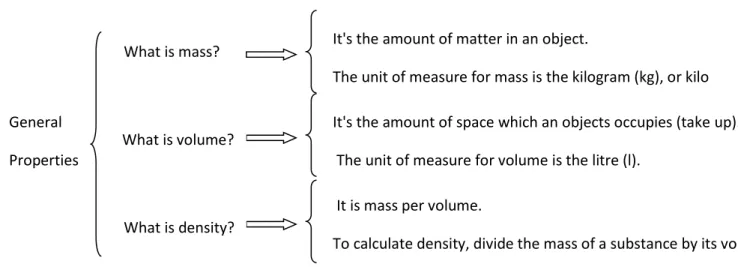
Mathematical competence and basic competences in science and technology: through the proposed activities pupils should carry out some calculations to find the correct result. They also discover simple formulations that help them to calculate volumes, mass… in addition to the use of different units (Kg., L, m3).
Social and civic competences: we want to create a nexus between pupils and the immediate reality (the nearest one). For this reason we use common resources of the daily life in a practice way. Then pupils can be aware of the characteristics of the environment and the interactions that happen continuously.
Digital competence: we try to use all the relevant resources that help pupils in the learning process. Interaction technologies are an important resource in the process. For this reason we make activities using the Interactive Whiteboard, because is a good way to learn all together and also to create a dialogue area to interact.
Learning to learn: far from a traditional concept of teaching base in the acquisition of knowledge, we founded this unit in the experimentation and practice, where pupils are the protagonist of the educational process. Implication, collaboration and participation are very important during the instruction. A variety of tools to arrange and assimilate information are also a relevant part in the teaching act.
Sense of initiative and entrepreneurship: our students have 10 to 11 years old. They can be autonomous and responsible with the work that is developed in class. We want that this practice and experimentation would serve to apply in their personal livings.
30 way. That collaborating mode helps to develop among our student other important social competences. In addition, pupils will learn new concepts and develop different competences that are relevant in their life, identifying different phenomena that occurring around us and the human influence on the matter and materials. We can be aware to the advantages of the use of a virtual area and the possibilities of ITC.
Prior Learning
Language used in the unit
Important Resources
It is helpful if children have:
Remember contents through reading, investigating, watching, listening, discussing about matter.
Rethink learning based on the previous studies about matter and materials that surround us.
Organized workgroups assign the roles and know the rules to work in a laboratory.
The use of a virtual area.
Worked cooperatively in groups.
Make relations between contents and real life.
Pay attention to detail in videos and documents, (reading, watching, listening, etc.) devised questions to help plan a topic.
In this unit children will have an opportunity to use:
Words and phrases related to specific vocabulary of Matter and Scientifics as measuring units, properties, items or work tools of experiments.
A virtual community offers students and teachers the possibility to use a formal and informal language because an important aim of it is to improve communication skills. So students adjust their have adjust their discourse skills (paralanguage, nonverbal language, motoric intelligence, phonetics) depend on context (classroom or distance communications) and communication members (student – students, teacher – students and student – teacher).
Items for experiments
Work tools and measuring instruments
Whiteboard Laptops Internet access Work sheets
Online resources: webs, quiz, PowerPoint
31
Expectations
At the end of this unit all the children must
Classify materials as solids, liquids, and gases Identify some of the properties of each material.
Be able to distinguish the difference between ideas and evidence.
Know that solids consisting of very small pieces behave like liquids in some ways. Investigated about the measure of the mass and volume of a body.
Experimentation with the states of the matter: solid, liquid and gas.
At the end of this unit most of the children should
Do a fair test/experiment.
Recognized the general and specific properties of the matter: mass, volume, temperature and density.
Justify with examples some common changes of matter. Investigate melting and freezing in a range of materials.
They use scientific terms such as evaporation and condensation to describe changes. Explain the changes that occur when some solids are added to water.
Decide what apparatus to use in an investigation. Identify the causes of the common state changes.
At the end of this unit some of the children could
To realize that we can change liquids to gases and gases to liquids back again To recognize that some changes can be reversed and some can not.
Make simple predictions about whether other changes are reversible or not. To know how to separate materials with different densities
Know the physics and chemical changes of the matter: oxidation, combustion, fermentation, begin with natural phenomena
Differences between homogeneous and heterogeneous mixtures and simple and compound substances
32
Lessons Overview
Lesson Learning goals Learning outcomes Main activity Assessment criteria
1
To be able to classify materials as solids, liquids, and gases and identify some of the physical properties of each of them.
Know what matter is, the different states of matter and composition, looking for examples of real life.
Look for different items of real life and upload them to the virtual workgroup space classifying each material through properties.
Sort items into categories.
Solve doubts collaboratively.
Understand the properties of solids, liquids and gases.
2
To be able to classify properties of matter (general and specific) through different experiments.
Apply theory to practice enhancing their knowledge about properties of matter.
Do several experiments about properties of matter: volume, density and buoyancy. Students have to register their work in a daily experiment of the virtual area.
In addition there will be available reinforcement activities in virtual area.
Complete questions and daily about experiments in the virtual area.
Participation in experiments in keeping the rules and roles.
Organization and
collaboration between the groups
3
Learn specific properties of
materials and their
consequences.
Investigate about experiments about temperature and density.
Explain in the virtual area the consequences of mixing several substances of some substances and oscillating temperature of
Explanations of experiments.
33 Look for examples of real life.
Give ideas or make predictions about the result of modifying properties.
some items.
Upload a video on the virtual area an experiment to demonstrate it.
Quality and creativity of experiments.
Use and development of the discourse/communication process, paralanguage and body language.
4
Learn different changes of matter (solid, liquid & gas)
To realize that we can change liquids to gases, gases to liquids and liquid to solid back again.
They use scientific terms such
as evaporation and
condensation to describe changes.
Record their group predictions about the changes of matter before doing the experiment.
Answer questions on the virtual area and collect all their ideas making a brainstorming in order to verify everything at the end of the lesson.
Verify answers of students and subsequent corrections.
Compare previous and acquired knowledge.
Listening to and responding to ideas during discussions.
5
Learn pure substances and
mixture through some
experiments and the
mechanism and apparatus that they have to use to separate them.
To be able to explain the changes that occur when some solids are added to water.
To know that some solids dissolve in water to form SOLUTION-
SOLUBLE/INSOLUBLE solids.
To know how can we separate mixtures?
Do two different experiments in classroom about mixtures and the mechanism to separate components: 1.- salt with water (relate to influence of buoyancy in several items) 2.- Oil with water (densities related). Children have to fill a
worksheet about each
experiment (components, items, properties, doubts …) and how they separated the
Verify worksheets of students.
Check explanations of their family experiments on virtual area (level of writing skills) and the quality of them.
34 two solids and what happened
when they did this
Purpose students in the virtual area to do an experiment with their families. It will be a challenge for them. Each group will have an experiment. They have to explain it (remember the use of English in texts)
6
Learn chemical changes of matter: (oxidation, combustion, fermentation) and influence in our environment
To be able to identify chemical changes looking for examples of real life.
Know the consequences of humans influence in the nature.
Think, explore and propose examples of real life in groups. Do a brainstorming to share information with all pupils later. Answer questions in the virtual area to reinforce knowledge.
Check answers of pupils.
Listening to and responding to ideas during discussions.
35
Lesson 2:
Properties of matter: volume, density and buoyancy.Learning objectives Learning outcomes Evidence for Assessment
Pupils will be able to:
Recognize general properties of the matter: mass, volume and buoyancy. Learn specific vocabulary of properties,
measuring units, tools and items that they use in experiments.
Learn steps to calculate volume and mass. Do experiments to calculate mass, volume
and buoyancy.
Classify materials depend on properties of matter. Identify several properties
of matter and their use. Apply theory to practice. distinguish the difference
between ideas and evidence
Complete questions and daily about experiments in the virtual area.
Participation in experiments in keeping the rules and roles.
Organization and collaboration between the groups
Discourse/Text targeted Language targeted- Non-verbal L Targeted
First of all, teacher has to ask pupil their opinions about scientific functions and the place where they work (laboratory) (informal speech). In addition, He/she has to explain the use of the daily experiments. The language has to be motivational for students using a correct intonation to highlight the important parts of each experiment or to keep attention of students. Due to we are going to transform our learning space in a laboratory it is necessary to respect the rules and work collaboratively (formal speech). Finally they have to use a descriptive discourse to explain step by step each experiment.
36
Outline of leading activities
Teacher can easily transform a class of 50 minutes into a space where students can acquire really significant learning through practice and the use of virtual communities.
Cl as sr oom Ma nag emen t
Timing Grouping Pupils Teacher Resources
Beginning (warming up)
5
All group He/she says Hello! Good morning! Short introduce of the main topic through questions
to students. (close to students life)
They show opinions or ideas
(brainstorming) and note on the green board
Green Board
3 All group He/she explains first contents of the lesson and asks volunteers to read.
There are many volunteers. They always want to participate in classroom. If some student does not have the text book, he/she can check information through virtual area.
Text Book and Laptop
3 All group
He/she make clear contents that students read. Then he/she changes readers and continue. Teachers can choose random numbers of the class list. They have a short scheme of the lesson on the virtual area.
They read again and have to respect the rules. The responsible students of the day go to the virtual area with the computer of teacher and show the schema on the whiteboard.
Smart Board
Text book
Middle
5 All group
He/she explains students that we are going to transform classroom in a Laboratory. Firstly, we have to highlight the importance of rules and the use of daily experiment located on virtual area. Secondly, we divide classroom in 4
Each member of group has a worksheet and they have to decide roles in experiments. Who is going to complete worksheets or look for information in the book?
37 groups of 6 pupils. Finally, we give them
worksheets to take notes about their investigations.
10 All group
He/she gives materials and instructions of each experiment. 1. - Calculate the mass of objects! 2. - Calculate the volume of elements! 3. - Float or not? Then he/ she will go through each group to clarify instructions or concepts.
They pay attention to instructions and ask doubts quickly because they have only 5 minutes to complete the experiment.
Experiments materials:
aluminium paper, screws, corks, plastic, wood balls…
Experiments
recipes: Baker, water bowl, scale
worksheets
5
All group
Experiments rotate between groups. He/she says to his pupils that they have 5 minutes to write. He/she walks around the groups solving doubts.
Each group starts the second experiment.
Experiments materials:
aluminium paper, screws, corks, plastic, wood balls…
Experiments
recipes: Baker, water bowl, scale
38 5
All group
Experiments rotate between groups. He/she says to his pupils that they have 5 minutes to write. He/she walks around the groups solving doubts.
Each group starts the third experiment taking notes about it.
Experiments materials:
aluminium paper, screws, corks, plastic, wood balls…
Experiments
recipes: Baker, water bowl, scale
worksheets
End (evaluation, summary, planning for next lesson)
10 All group
He/she checks answers of students, group by group. They offer students the opportunity to correct among classmates.
They explain their notes of experiments and
complete their worksheets correctly. worksheets
5
All group
He/she propose to pupils an experiment in the virtual for the next class (an enforcement activity) to investigate with their parents. In addition, they will have to answer some questions as “Can eggs float? “ How? Why?
Listen instructions of the activity and note it in agendas, although someone will want to answer in the moment. They can use the worksheet to answer. Complete the daily experiment.
whiteboard
4 All group He/she orders students to clean all tables &
39
Assessment Criteria
All children must be able to
Participation in experiments in keeping the rules and roles.
Work in small groups
Respect opinions of all students
Most of the children will be able to
Organization and collaboration between the groups
Complete questions and daily about experiments in the virtual area.
Discuss their opinions to solve a problem (debate)
Some of the children could
Connect their knowledge with theory
Calculate volume and mass
Solve problems and activities of volume and mass.
Give more examples of experiments and purpose new activities.
40
5.
Final Part
Future of education
After previous investigation of the virtual area of Nuestra Señora del Villar School and their possibilities to improve learning process, I intend to make a virtual area, in the near future, that can be the future of education. The Internet offers us a lot of possibilities to build it, webpages, wikis, blogs... I will select webpages designer software because it is easy to use it and free. Concretely, I will use “WIX” (http://es.wix.com/) that has a section for educational field.
To make this educational project I will incorporate all theories of my previous investigation. It will have different stages of development:
Initial phase: Build and design a virtual environment. It will consist on elaborate a learning community designated to a particular school. The access will be restricted for the members of the school community.
Intermediate stage: Interconnection of schools. Schools are usually not completely isolated because they belongs public or private sector. For this reason they are affiliated to an organization. I will pretend to interconnect those schools to increase advantages of initial virtual community.
Idyllic and final stage: Free access of education. When we will have a consolidated virtual communities associations, I will pretend to give free access to people with a previous register. It will be destined to people who want to improve their knowledge and learning. All people can teach about something and imagine the possibilities of a foreign language if people of different countries participate in it. All resources of communities will be available for people independently location.
41
Virtual community
School
School
School
Final Phase
Intermediate Phase
42 Conclusions
A Project based on virtual learning communities involves an extended investigation if it wants to have success on design and use. If we want to apply in an education environment it has to be explained the use, instructions and functions in detail to know the benefits and advantages in education. On that way, it encourage to education members to use and collaborate what would avoid rejection and fear about it. For this reason it is necessary to promote a methodology of learning communities because it is a joint project that will improve learning process of students. It consists by students on active participation, investigation attitude, interactive and motivational learning. In conclusion, pupils will apply theory to practice through collaborative tasks (workgroups).
Teachers and students need some recommendations with regard to the use of learning communities. Firstly, teachers should need an adequate training about it to know the possibilities and advantages of the application in education. On the other hand, as students belong to digital era, they usually have enough knowledge about the use of ITC. However, that does not mean they know the appropriate use of ITC. If we do a short investigation of it, we can discover that students spend a lot of time with the use of ITC but it destined to play or enjoy or entertainment. So they know to move through the Internet in that way. For this reason, students also need a training and teaching about the correct use of ITC in education.
There is a close teaching-learning model in our country because it depends on education law and it has a short flexibility to change it. In general, the use of class books takes an important part in the methodology of teaching. In addition, the time of teaching is much defined in each lesson that does not permit many modifications of the annual plan of the school. So, it is a great challenge try to apply my project in a school. It will be possible with the participation and effort of all education community.
On the other hand, teaching through virtual area needs a continuously updated and reviewed because students are the most important part of the process and we will have to adapt the methodology to them.
43
6.
Bibliography
Cabero, Julio (1999), Tecnología educativa, Madrid, Editorial Síntesis S.A.
http://www.ucv.ve/fileadmin/user_upload/sadpro/Documentos/docencia_vol2_n2_2001/9_re se%C3%B1a_2Julio_Cabero.pdf (Consulted on May 22, 2014).
Skinner, B.F. (1954). The science of learning and the art of teaching. Harvard Educacional Review, 24(2), 86-97.http://books.google.es/
Pressey, S. L. (1964). Theories of learning and instruction: the sixty third yearbook of the National Society for the Study of Education. Part I, chapter Autoinstruction: Perspectives, problems and potentials. University of Chicago Press. http://books.google.es/
COLL, C. (2004) Las Comunidades de Aprendizaje. IV Congreso Internacional de Psicología y Educación "Calidad Educativa", 1047-1060. (Consulted on May 21, 2014). http://campus.usal.es/~teoriaeducacion/rev_numero_05/n5_art_lozano.htm
Real Decreto 1513/2006, Anexo II y Anexo III. (BOE-A-2006-21409).
Wilson, B. (1995). "Metaphors for instruction: Why we talk about learning environments" Educational Technology, 35(5), 25-30 (Consulted on May 22, 2014).
http://carbon.ucdenver.edu/~bwilson/wils95
SALINAS, J. (1998). “Redes y desarrollo profesional del docente: entre el dato serendipity y el foro de trabajocolaborativo”. Profesorado [artículo en línea] (vol. 2, n.º 1). Universidad de Granada. (Consulted on June 7, 2014).
http://www.uib.es/depart/gte/docente.html
Palloff, R and Pratt, K (2001), Building learning communities in cyberspace. San Francisco: Jossey-Bass.
http://www.uwex.edu/disted/conference/resource_library/proceedings/01_20.pdf
Fernández-Pampillón Ana (2009). Las plataformas e-learning para la enseñanza y el aprendizaje universitario en Internet. Universidad Complutense de Madrid. (Consulted on May 19, 2014).http://eprints.ucm.es/10682/
Hita Barrenechea, Germán (2004). La enseñanza comunicativa de idiomas en Internet. Características de los materiales y propuesta didáctica. (Consulted on May 19, 2014). http://www.mecd.gob.es/redele/Biblioteca-Virtual/2004/memoriaMaster/2-Semestre/HITA-B.html
Jiménez, Francisco José Herrera (2007). Web 2.0 y didáctica de lenguas: un punto de encuentro. La Janda International House. (Consulted on June 2, 2014).
http://www.um.es/glosasdidacticas/gd16/02herrera.pdf
Perdrix Forts, Marc and Villanueva,Juan de Dios (2011).El aula virtual en la enseñanza online de una lengua extranjera: tipos y materiales. Universidad de Granada. (Consulted on May 10, 2014).