low–molecular weight heparin with oral
anticoagulant therapy in the long-term
treatment of deep venous thrombosis
Jose A. Gonzalez-Fajardo, MD, Emilio Arreba, MD, Javier Castrodeza, MD, Jose L. Perez, MD, Leopold Fernandez, MD, Ignacio Agundez, MD, Antonio M. Mateo, MD, Santiago Carrera, MD, Vicente Gutiérrez, MD, andCarlos Vaquero, MD,Valladolid, Spain
Purpose:The primary objective of this study was to evaluate with venography the rate of thrombus regression after a fixed dose of low–molecular weight heparin (LMWH) per day for 3 months compared with oral anticoagulant therapy for deep venous thrombo-sis (DVT). Secondary endpoints were the comparisons of the efficacy and safety of both treatments.
Methods:This study was designed as an open randomized clinical study in a university hos-pital setting. Of the 165 patients finally enrolled in the study, 85 were assigned LMWH therapy and 80 were assigned oral anticoagulant therapy. In the group randomized to oral anticoagulant therapy, the patients first underwent treatment in the hospital with stan-dard unfractionated heparin and then coumarin for 3 months. Doses were adjusted with laboratory monitoring to maintain the international normalized ratio between 2.0 and 3.0. Patients in the LMWH group were administered subcutaneous injections of fixed doses of 40 mg enoxaparin (4000 anti-Xa units) every 12 hours for 7 days, and after dis-charge from the hospital, they were administered 40 mg enoxaparin once daily at fixed doses for 3 months without a laboratory control assay. A quantitative venographic score (Marder score) was used to assess the extent of the venous thrombosis, with 0 points indi-cating no DVT and 40 points indiindi-cating total occlusion of all deep veins. The rate of thrombus reductionwas defined as the difference in quantitative venographic scores after termination of LMWH or coumarin therapy as compared with the scores obtained on the initial venographic results. The efficacywas defined as the ability to prevent symptomatic extension or recurrence of venous thromboembolism (documented with venograms or serial lung scans). The safetywas defined as the occurrence of hemorrhages.
Results:After 3 months of treatment, the mean Marder score was significantly decreased in both groups in comparison with the baseline score, although the effect of therapy was significantly better after LMWH therapy (49.4% reduction) than after coumarin thera-py (24.5% reduction; P< .001). LMWH therapy and male gender were independently associated with an enhanced resolution of the thrombus. A lower frequency of sympto-matic recurrent venous thromboembolism was also shown in patients who underwent treatment with LMWH therapy (9.5%) than with oral anticoagulant therapy (23.7%; P < .05), although this difference was entirely a result of recurrence of DVT. Bleeding complications were significantly fewer in the LMWH group than in the coumarin group (1.1% vs 10%; P< .05). This difference was caused by minor hemorrhages. Coumarin therapy and cancer were independently associated with an enhanced risk of complica-tions. Subcutaneous heparin therapy was well tolerated by all patients.
Conclusion:The patients who were allocated to undergo enoxaparin therapy had a sig-nificantly greater improvement in their quantitative venographic score, a sigsig-nificantly
283 From the Division of Vascular Surgery, Angioradiology (Dr
Arreba), and Epidemiology Department (Dr Castrodeza), Hospital Clinico Universitario.
Reprint requests: Jose A. Gonzalez-Fajardo, MD, Division of Vascular Surgery, Hospital Clinico Universitario, E-47011, Valladolid, Spain.
Copyright © 1999 by the Society for Vascular Surgery and International Society for Cardiovascular Surgery, North American Chapter.
Low–molecular weight heparin (LMWH) has been shown to be at least as effective and safe as intra-venous adjusted-dose heparin in the initial treatment of proximal deep vein thrombosis (DVT).1-10
However, common practice is to carry out treatment with oral anticoagulants for at least 3 months as a form of secondary prevention.11Oral anticoagulant therapy
is associated with a significant risk of bleeding compli-cations, and patients who undergo such therapy require frequent laboratory monitoring. Some of these patients have relative or absolute contraindications to the use of oral anticoagulants.12 Under such
circum-stances, an alternative to prevent delayed thromboem-bolic recurrence is adjusted dose of subcutaneous heparin twice daily.11-13Compared with
unfractionat-ed heparin, LMWH has a longer half life, significantly fewer hemorrhagic complications, and a greater bioavailability at low doses, which allows once-a-day schedule and therefore may be preferable to standard heparin especially for long-term administration.14
Some studies have recently evaluated the role of LMWH as an alternative to oral anticoagulation in the prevention of recurrent thromboembolism.12,15,16
They suggest that fixed doses of LMWH appear to be quite effective and safe, but limited data on the basis of venographic observations are available. Previous inves-tigations that compared LMWH with standard unfrac-tioned heparin in the initial treatment of DVT revealed a phlebographic improvement in the patients who underwent treatment with LMWH when the venograms were performed approximately 1 or 2 weeks later,14but no significant differences were seen
at the 6 month follow-up examination.17 From the
existing evidence, it is likely that a marked or total reduction of thrombi will reduce the incidence of post-thrombotic syndrome.18Because a longer duration of
the treatment with LMWH may increase the success rate of recanalization of the occluded veins, it seems legitimate to use phlebographic endpoints.19 For this
reason, the primary objective of the present study was to evaluate with venography the rate of thrombus regression after a single subcutaneous injection of LMWH (enoxaparin, 40 mg) per day for 3 months as compared with oral anticoagulant therapy for the treatment of patients with DVT. Secondary endpoints were to compare the efficacy (prevention of
sympto-matic venous thromboembolism) and safety (occur-rence of hemorrhage) of both treatments.
MATERIAL AND METHODS
Study design. This was an open, randomized study comparing conventional coumarin therapy with a 3-month course of enoxaparin (4000 anti-Xa units; 40 mg) subcutaneously once daily in a fixed dose. The primary endpoint was the ability to reopen thromboses veins, defined as the difference in quantitative venographic scores after termination of LMWH or coumarin therapy compared with the scores obtained on the initial venography. The sec-ondary endpoints were the development of matic recurrent pulmonary embolism or sympto-matic recurrent venous thrombosis (documented with serial perfusion lung scans or venograms) and bleeding episodes. Randomization was achieved by means of a prescribed schedule. Informed written or verbal consent was obtained from all patients in the study. The study protocol was accepted by the Institutional Review Board.
Patients. Consecutive eligible patients with clinically suspected DVT confirmed with contrast venography were enrolled in the study according to a computer schedule. The reasons for exclusion were: clinically suspected pulmonary embolism, cur-rently active bleeding or coagulation abnormality or disorders contraindicating anticoagulant therapy, pregnancy, two or more previously documented episodes of DVT or pulmonary embolism, ongoing anticoagulant treatment at the time of referral, his-tory of heparin-induced thrombocytopenia, caval fil-ter inserted, allergic reaction to contrast mafil-terial, a coagulation-inhibitor deficiency, a lupus anticoagu-lant, or antiphospholipid antibodies. In each patient, anticoagulant therapy was started as soon as possible after DVT had been documented objectively with ascending contrast venography. Whenever possible, the patients were allowed to walk on the third day of treatment, wearing elastic compressive stockings.
Regimens. In the patients randomized to oral anticoagulant therapy, an intravenous bolus of 100 U/kg of unfractioned heparin was administered, fol-lowed by a continuous intravenous infusion of heparin. The activated partial thromboplastin time lower recurrence rate of symptomatic venous thromboembolism, and a significantly
was measured 4 hours after the beginning of intra-venous heparin treatment, and the test was repeated at intervals of 4 to 6 hours until the result was with-in the prescribed therapeutic range (ratio, 1.5 to 2.0) during the initial 24 hours of therapy. Oral treatment with coumarin (initial dose of 5 mg) was started in patients on day 5 of heparin treatment. The coumarin dose was adjusted daily to maintain the international normalized ratio (INR) between 2.0 and 3.0. Subsequently, heparin treatment was discontinued and the coumarin dose was adjusted with laboratory monitoring for 3 months. Although during this study the classical approach to the treat-ment of DVT was used, the results of two random-ized clinical trials20,21 have shown that oral
antico-agulant therapy starting with heparin at the time of diagnosis is as effective and safe as the conventional regimen. The intensity of anticoagulation therapy in the first 3 months was expressed as the percentage of time during which a patient had a specific INR (<2.0, 2.0 to 3.0, or >3.0), with this period calcu-lated with linear interpolation. No patients under-went oral anticoagulant therapy after 3 months of treatment, unless they had symptomatic recurrent thromboembolism. Patients in the LMWH group were administered subcutaneous injections every 12 hours of fixed doses of 40 mg enoxaparin (corre-sponding to 4000 international factor Xa inhibitory units) for 7 days. After discharge from the hospital, the patients underwent treatment with 40 mg enoxaparin subcutaneously once daily, which was usually administered by the patients themselves or by relatives and only occasionally by nurses. LMWH was administered at fixed doses, without a laborato-ry control assay for 3 months.
Main outcome measures. Venography was per-formed with long-leg films and no ionic contrast material according to the method of Rabinov and Paulin.22The criteria for DVT were an intraluminal
filling defect confirmed in at least two different pro-jections and no filling of a venous defect despite repeated injections with contrast material. A quanti-tative venographic score (Marder score23) was used
to assess the extent of the venous thrombosis, with 0 points indicating no DVT and 40 points indicating total occlusion of all deep veins (Table I). Control phlebographies were performed routinely in all patients after 3 months of treatment. Each patient was assigned to one of the following groups on the basis of differences on the Marder score between ini-tial and post-treatment phlebography: increased thrombosis (an increase in score points), unchanged (unaltered total score or ≤10% decrease in score
points), partly cleared (>10% to ≤50% decrease in score points), substantially cleared (>50% to 89% decrease in score points), and completely lysed (≥90% decrease in score points). Perfusion lung scanning and chest radiography were performed for all patients at baseline. To exclude bias, the assess-ment of venograms and lung scans were scored by two observers who were blind to treatment alloca-tion and to the sequence in which the tests were done (before or after treatment). The efficacy of treatmentwas defined as the ability to prevent symp-tomatic extension or recurrence of venous throm-boembolism. The safety was defined as the occur-rence of hemorrhages. Bleeding was defined as major bleeding if it was intracraneal or retroperi-toneal or if it produced a decrease in the hemoglo-bin level of at least 2.0 g/dL, sufficient to necessi-tate discontinuation of treatment or the transfusion of 2 or more units of blood. Bleeding was defined as minor bleeding if it did not meet the criteria for major bleeding.
Surveillance and follow-up. After discharge, all the patients were seen in our vascular clinic every month during the first trimester and then every 3 months during a total of 1 year of follow-up. They were instructed to come to the hospital immediate-ly if symptoms or signs of recurrent DVT, pul-monary embolism, or bleeding developed. Those patients with suspected recurrent DVT underwent contrast venography. Recurrent DVTwas defined as a constant intraluminal filling defect not present the first day. Patients with clinically suspected pul-monary embolism underwent another perfusion lung scan and chest radiography. The diagnosis was made on the basis of the presence of at least one seg-mental defect not seen on the preceding scan and no abnormality on the chest radiograph area. If the results were inconclusive, pulmonary angiography Table I. Venographic quantitation of thrombosis (Marder score)
Deep veins Score*
Iliac 6
Common femoral 4
Superficial femoral 10
Popliteal 4
Anterior tibial 4 (2 each)
Posterior tibial 6 (3 each)
Peroneal 6 (3 each)
was performed. During the 3 months of treatment, platelet counts were obtained each month in the patients undergoing LMWH therapy to rule out the possibility of heparin-induced thrombocytopenia. Adherence to the study regimens was monitored by reviews of the patients’ charts. At each visit, patients were questioned about the appearance of new symp-toms, bleeding, swelling, heaviness of leg, leg tired-ness, or pain. The clinical status after 3 months of treatment was graded subjectively by each patient as improved, unchanged, or worse in relation to the pretreatment status.
Statistical analysis. On the basis of results from previous trials,24the proportion of patients with an
unchanged or improved Marder score after LMWH treatment was assumed to be 90%. By sample size, we determined a 15% absolute difference in the proportions of patients whose conditions were unchanged and improved that were needed to show a statistically significant difference between the two treatments. At an 80% power for showing this dif-ference at the 5% significance level, with a one-sided test, a total of 78 patients would be necessary at least in each treatment group. The number of patients planned for inclusion into each group was therefore 92, to account for an anticipated drop-out rate of
15%. Quantitative data were expressed as mean ± standard error. Confidence intervals (CI) of 95% for the difference between the two treatment groups were calculated with the normal approximation to the binomial distribution. The rates of asymptomatic pulmonary embolism, recurrent thromboembolism, bleeding, death, degree of thrombus regression, and clinical status in the two groups were compared by means of Fisher exact test or χ2 test as appropriate.
The changes in venographic score were analyzed within and between groups with two-sample and matched-pair and unpaired ttests. Univariate analy-sis was performed to identify factors that affected the differences on the Marder score between initial and post-treatment phlebography. A multivariate step-wise regression model was used to identify indepen-dent variables that could influence the percentage of change in Marder score and complications of both groups. Two-sided P values of less than .05 were considered significant. Software JMP 3.1 from the S.A.S. Institute Inc (Cary, NC) was used.
RESULTS
Patients. From June 1994 to June 1997, 257 consecutive patients with clinically suspected DVT underwent treatment in our hospital. Eligible Fig 1. Venographic changes with 40 mg enoxaparin (4000 anti-Xa units). A,Total occlusion
of popliteal and femoral veins in patient with deep venous thrombosis. B,Complete recana-lization after fixed dose per day for 3 months of treatment.
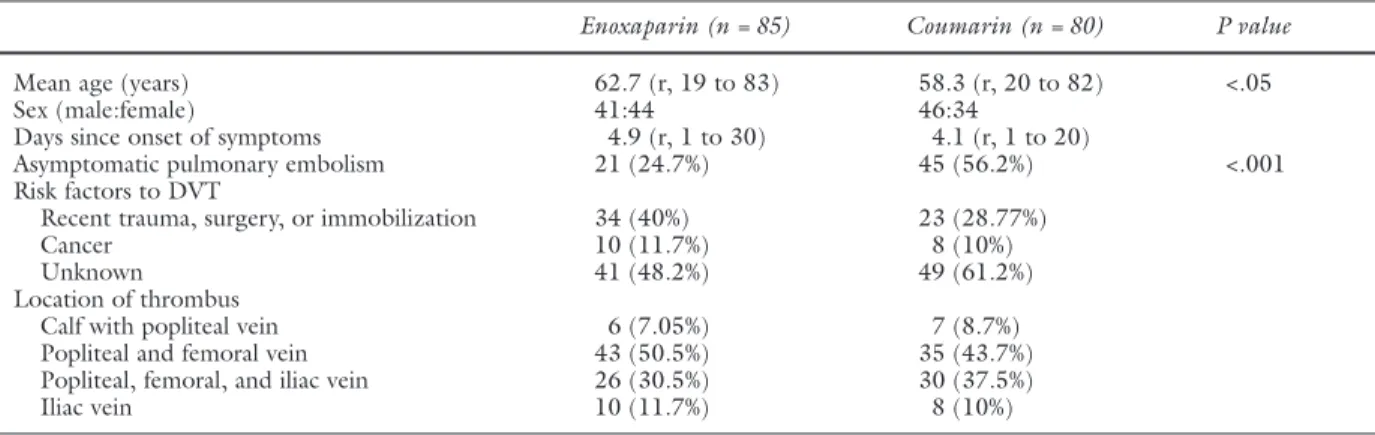
patients (n = 185) had DVT confirmed with contrast venography, perfusion lung scanning within 48 hours of study entry, and chest radiography. Of these, 93 were assigned to undergo LMWH therapy and 92 to undergo treatment with coumarin. Twenty patients were excluded from the analysis (eight in the LMWH group, and 12 in the coumarin group) because the second venogram was not obtained (n = 12), the regimen of treatment was not performed correctly by the patient (n = 5), or the patients were lost during the follow-up period (n = 3). For the 165 patients finally enrolled into the study, the baseline clinical characteristics are shown in the Table II. The treatment groups were compa-rable at entry except for age (younger in the coumarin group) and incidence of silent pulmonary embolism (higher in the coumarin group). To assess the possible effect of this potential age and asympto-matic pulmonary embolism imbalance, multiple logistic regression was used. No significant effect was found.
Degree of thrombus regression. The intensity of oral anticoagulant therapy in the coumarin group was 15% with INR less than 2.0, 64% with INR from 2.0 to 3.0, and 21% with INR more than 3.0. A sec-ond venogram was performed in all patients. The changes in the extent of venous thrombosis on venog-raphy are summarized in Table III. No significant dif-ference in Marder score was observed between the two treatment groups at inclusion. After 3 months of treatment, the mean Marder score was significantly decreased in both groups in comparison with the baseline score, although the effect of therapy was sig-nificantly better after LMWH therapy (49.4% reduc-tion of the Marder score) than after coumarin therapy (24.5% reduction of the Marder score; P< .001; Fig 1). The results of the stratified analysis of the evolu-tion of the thrombus (Table III), on the basis of the percentage of the differences of score between the ini-tial and post-treatment phlebography, also showed a statistically significant superiority of LMWH therapy over coumarin therapy (P< .001).
Table II. Clinical characteristics of patients with deep venous thrombosis treated with enoxaparin or coumarin
Enoxaparin (n = 85) Coumarin (n = 80) P value
Mean age (years) 62.7 (r, 19 to 83) 58.3 (r, 20 to 82) <.05
Sex (male:female) 41:44 46:34
Days since onset of symptoms 4.9 (r, 1 to 30) 4.1 (r, 1 to 20)
Asymptomatic pulmonary embolism 21 (24.7%) 45 (56.2%) <.001
Risk factors to DVT
Recent trauma, surgery, or immobilization 34 (40%) 23 (28.77%)
Cancer 10 (11.7%) 8 (10%)
Unknown 41 (48.2%) 49 (61.2%)
Location of thrombus
Calf with popliteal vein 6 (7.05%) 7 (8.7%)
Popliteal and femoral vein 43 (50.5%) 35 (43.7%)
Popliteal, femoral, and iliac vein 26 (30.5%) 30 (37.5%)
Iliac vein 10 (11.7%) 8 (10%)
DVT,Deep venous thrombosis.
Table III. Venographic evaluation
Enoxaparin (n = 84)* Coumarin (n = 80) P value
Marder score
Before treatment 24.7 ± 1.1 26.06 ± 1.1
After treatment 12.5 ± 1.05 19.7 ± 1.1 <.001
Difference (∆) –12.2 ± 0.9 –6.4 ± 0.8 <.001
Fate of the thrombus <.001
Increase in size 2 (2.3%) 8 (10%)
No change 3 (3.5%) 13 (16.2%)
Partial clearance 39 (46.4%) 45 (56.2%)
Substantial clearance 24 (28.5%) 13 (16.2%)
Complete lysis 16 (19.04%) 1 (1.2%)
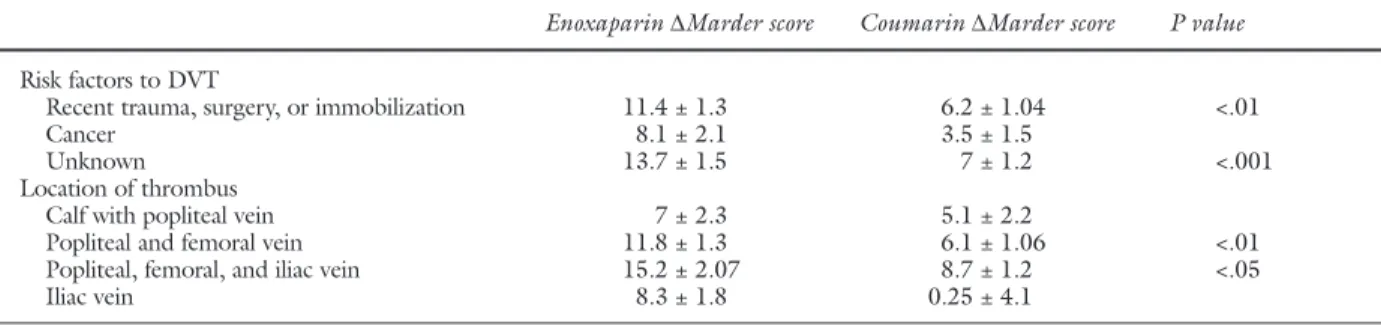
Univariate analysis shows that no significant dif-ferences were observed in the distribution of changes in venographic score between both groups when the cause of DVT was cancer or the thrombus was placed only at geniculate or iliac level (Table IV). In contrast, a higher reopening rate of throm-bosed veins was shown in the patients assigned to undergo LMWH therapy as compared with the patients assigned to undergo treatment with coumarin when the cause of DVT was recent trau-ma, surgery, or immobilization (P = .0037), when the DVT was idiopathic (P = .0009), or when the thrombus was placed in popliteal and femoral veins (P= .0011) or affected completely all of the limb (P = .01005). In a step-wise linear regression model, LMWH therapy (P < .0001) and male gender (P= .0199) were independently associated with an enhanced resolution of the thrombus (Table V). The r2value was 0.11435.
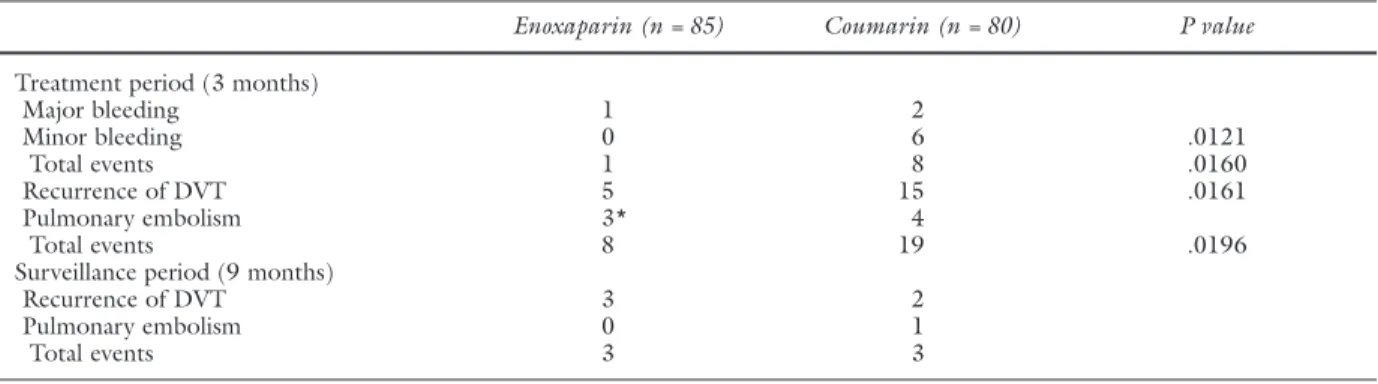
Recurrent thromboembolism. Symptomatic extension or recurrent venous thromboembolism confirmed with objective tests developed in eight patients (9.5%) of the LMWH group and in 19 patients (23.7%) assigned to undergo coumarin therapy (P = .0196; Table V). Of the 19 events in the coumarin group, 15 involved recurrent throm-bosis (13 recurrences were in the same limb, two
were contralateral) and four involved pulmonary embolism (from which all patients required cava fil-ter placement). Of the eight events in the LMWH group, five involved recurrent thrombosis (all in the same limb) and three involved pulmonary embolism (from which one patient died on the fifth day after randomization). The absolute difference in the fre-quency of pulmonary embolism did not reach statis-tical significance (P = .7149). However, significant differences were observed in the frequency of recur-rent thrombosis (P= .0161). During the 12-month surveillance period, two patients in the coumarin group had a recurrence of symptomatic DVT docu-mented with venography after discontinuation of the anticoagulant treatment (one in the 20th week, and the other in the 24th week). In the LMWH group, three patients had symptomatic recurrent DVT documented with venography (one in the 20th week, another in the 24th week, and another in the 32nd week). Only one patient of the coumarin group was readmitted to the hospital in the 21st week because of symptomatic recurrent pulmonary embolism confirmed with perfusion lung scanning and chest radiography. No symptomatic pulmonary embolisms were observed in the LMWH group. Recurrent thromboembolism was associated with recent surgery or trauma in three patients (three Table IV. Univariate analysis of risk factors and location of thrombus associated with differences on the Marder score between initial and post-treatment phlebography
Enoxaparin ∆Marder score Coumarin ∆Marder score P value
Risk factors to DVT
Recent trauma, surgery, or immobilization 11.4 ± 1.3 6.2 ± 1.04 <.01
Cancer 8.1 ± 2.1 3.5 ± 1.5
Unknown 13.7 ± 1.5 7 ± 1.2 <.001
Location of thrombus
Calf with popliteal vein 7 ± 2.3 5.1 ± 2.2
Popliteal and femoral vein 11.8 ± 1.3 6.1 ± 1.06 <.01
Popliteal, femoral, and iliac vein 15.2 ± 2.07 8.7 ± 1.2 <.05
Iliac vein 8.3 ± 1.8 0.25 ± 4.1
∆Marder score,Marder score before treatment – Marder score after treatment; DVT, deep venous thrombosis.
Table V. Independent determinants of the percentage of change in Marder score as selected with multi-variate step-wise linear regression model
Significant independent
95% CI
variables Lower Upper F value P value
Treatment (enoxaparin) –28.329 –9.889 16.5 .0001
Sex (male) –20.348 –1.851 5.53 .0199
cases in the LMWH group, and none in the coumarin group), cancer in 10 patients (five cases in the LMWH group, and five in the coumarin group), and idiopathic disease in 20 patients (three cases in the LMWH group, and 17 in the coumarin group). Bleeding complications. Bleeding complica-tions were significantly fewer in the LMWH group (1.1% vs 10%; P= .0160; Table VI). Major bleeding occurred during or immediately after the initial ther-apy in one patient undergoing LMWH therther-apy (1.1%) and in 2 patients undergoing treatment with coumarin (2.5%; P= .6136). The hemorrhage in the LMWH group consisted of upper gastrointestinal bleeding, and in the coumarin group, there were one upper gastrointestinal bleeding and one retroperitoneal bleeding with hematuria. Minor hemorrhagic complications occurred in none of the patients who underwent LMWH therapy and in six patients who underwent treatment with coumarin (7.5%; P = .0121). The minor bleedings in the coumarin group consisted of two hematuriax, three epistaxis, and one hemoptysis. Small hematomas in the abdominal wall were seen in patients assigned to undergo LMWH therapy. In a step-wise logistic regression model (Table VII), coumarin therapy (odds ratio, 2.82; CI, 1.719 to 4.623; P < .0001)
and cancer (odds ratio, 2.15; CI, 1.101 to 4.233; P = .025) were independently associated with an enhanced risk of complications (symptomatic recur-rent thromboembolism and bleeding). These con-clusions remained unchanged when the few patients with documented DVT who were withdrawn after randomization because of protocol violation were included in an intention-to-treat analysis.
Deaths. One patient from the LMWH group died of massive pulmonary embolism, confirmed with angiography, on the fifth day after the initial treatment. During the 12-month study period, four patients who were assigned to the LMWH group died, as compared with three patients assigned to the coumarin group. The causes of death included can-cer (five patients) and cardiovascular disease (two patients).
Compliance. Only one case of thrombocytope-nia (<100.000/mm3) was observed immediately
after the initial therapy with unfractioned heparin. This disorder dissapeared with oral anticoagulant therapy. Subcutaneous heparin therapy was well tol-erated by all patients. No patients showed heparin-induced thrombocytopenia in the 3-month group with LMWH. The clinical status graded subjectively by each patient was significantly better after LMWH Table VI. Thromboembolic and bleeding complications during initial treatment and follow-up examination
Enoxaparin (n = 85) Coumarin (n = 80) P value
Treatment period (3 months)
Major bleeding 1 2
Minor bleeding 0 6 .0121
Total events 1 8 .0160
Recurrence of DVT 5 15 .0161
Pulmonary embolism 3* 4
Total events 8 19 .0196
Surveillance period (9 months)
Recurrence of DVT 3 2
Pulmonary embolism 0 1
Total events 3 3
DVT,Deep venous thrombosis. *One fatal pulmonary embolism.
Table VII. Independent determinants of complications (venous thromboembolism and bleeding) as selected with multivariate step-wise logistic regression model
Significant independent
95% CI
variables Lower Upper Odds ratio P value
Treatment (coumarin) 1.719 4.623 2.82 .0001
Risk factor (cancer) 1.101 4.233 2.15 .0250
therapy than after coumarin therapy (P < .001). There was an improvement after 3 months of treat-ment in relation to the pretreattreat-ment status in 68 of 84 patients (80.9%) in the LMWH group and in 40 of 80 (50%) in the coumarin group. There were no changes in 15 of 84 patients (17.8%) in the LMWH group and in 35 of 80 (43.7%) in the coumarin group. Finally, there was worsening in one of 84 patients (1.1%) and five of 80 (6.2%), respectively.
DISCUSSION
This study showed that enoxaparin, a LMWH, not only can be used safely and effectively to treat DVT at home for long term but also that its ability to reopen thromboses veins is better than coumarin, an anti–vit-amin K oral anticoagulant. Although the mean Marder score was significantly improved in both groups at the 3-month follow-up examination, a higher degree of recanalization was shown with venography in the patients assigned to undergo LMWH therapy (49.4%) as compared with the patients assigned to undergo treatment with coumarin (24.4%). Moreover, in a multivariate analysis, the male patients were indepen-dently associated with an enhanced resolution of the thrombus. A thrombus reduction of at least 30% or more is at present used in several trials as a sign of clin-ical benefit for the individual patient,19 with the
expectancy that a major recanalization may also result in a reduced incidence of post-thrombotic syn-drome.18,19Because of this, evidence on the basis of
venographic findings suggests that a LMWH may reduce the risk of the late sequelae of DVT, although it will open for discussion to what extent the reduction of thrombus size really is accomplished by long-term benefits. The 12-month follow-up period used in this study is too short to reflect the true development of clinical post-thrombotic syndrome. However, LMWH was subjectively associated by each patient with better clinical status than coumarin therapy after 3 months of treatment.
Long-term venographic follow-up data in patients with DVT are limited.17 Our study is the
first to analyse a longer duration of treatment with LMWH and the tendency of thrombus regression in comparison with patients undergoing oral anticoag-ulant therapy as a form of secondary prevention. The mechanism by which LMWH facilitates thrombus regression is not understood. Probably the inhibi-tion of thrombin formainhibi-tion, the lesser risk of platelet aggregation, and local effects at the endothelial level play a critical role.25,26Indeed, endothelial cells are
the principal physiologic source of tissue-type plas-minogen activator, and the subcutaneous
adminis-tration of LMWH causes an increase in plasma of tis-sue-type plasminogen activator with peak at 3 hours after injection.27,28
The recanalization of thrombosed veins was quite different in these two patient groups according to the cause of DVT and the localization of the venous occlusion. Particularly, there was a significant trend in favor of LMWH when the cause of DVT was recent trauma, surgery, or immobilization, when the DVT was idiopathic, or when the thrombus was placed in popliteal and femoral veins or affected com-pletely all of the limb. By contrast, if the cause of DVT was cancer or the intraluminal filling defect was exclusively placed at geniculate or iliac level, no sig-nificant differences were observed between patients assigned to undergo LMWH therapy and patients assigned to undergo treatment with coumarin. Nevertheless, because of the large standard error and the relatively small number of patients among these subgroups, this study does not have sufficient statis-tical power to detect significant differences. Further studies are necessary before definitive conclusions can be reached.
LMWH have undergone limited investigations for the secondary prevention of venous thromboem-bolism.9 In these studies, patients first underwent
treatment in the hospital with standard heparin, and then therapy with LMWH was compared with thera-py with warfarin15,16 or subcutaneous standard
heparin12for 3 to 6 months. Monreal et al12showed,
in a consecutive series of patients with contraindica-tion to coumarin therapy, that patients who under-went treatment with LMWH had a lower frequency of either recurrent pulmonary embolism or minor bleeding in comparison with unfractioned heparin, although none of these differences were statistically significant perhaps because of the small number of patients (beta error). Pini et al15 confirmed these
findings in a sufficiently large randomized study of patients with DVT, although the diagnosis of recur-rent DVT was often made on the basis of noninvasive testing and diagnosis of pulmonary embolism could be questioned because baseline lung scans were not performed. Despite these facts, they showed essen-tially no difference in the incidence of recurrent thrombosis between patients who underwent treat-ment with LMWH (enoxaparin 40 mg) and patients who underwent treatment with warfarin, but patients allocated to undergo LMWH therapy had a signifi-cantly lower incidence of bleeding. In the third trial, which has been reported in abstract form, Kakkar16
corroborated these findings with dalteparin.
thromboembolism and bleeding also tended to occur less in the patients undergoing enoxaparin therapy than in those patients undergoing coumarin therapy (odds ratio, 2.82; CI, 1.719 to 4.623). As expected, a low bleeding rate was observed in the LMWH group. The regimen of 40 mg enoxaparin, at a fixed dose once daily subcutaneously, resulted in 1.1% ver-sus 10% of hemorrhagic complications compared with the coumarin treatment (P< .05). This difference was a result of minor hemorrhages. Concomittantly, a lower frequency of symptomatic recurrent venous thromboembolism was shown in patients who under-went treatment with LMWH (9.5%) than with oral anticoagulants (23.7%; P< .05), although this differ-ence was entirely a result of recurrdiffer-ence of DVT. Thus, we find a statistically significant superiority of LMWH over coumarin regarding both efficay and safety. Although the doses that we used in the present study were actually prophylactic doses rather than treatment doses, especially for the first 7 days of treatment, it is important to consider whether our results were caused by a true property of enoxaparin because ade-quate dosage finding studies are not available.29,30
The fact that a patient died in the LMWH group of a recurrent pulmonary embolism on the fifth day of randomization suggests that the dosage used may be insufficient and that higher levels should be preferable in these patients. Particularly, we believe that an adjusted dose per kilogram of body weight would be recommendable for the management of DVT, although further dose-related studies are necessary to define minimal and maximal doses.
Because the two regimens were given by different route and because dose adjustments were necessary in the coumarin group, we could not use a double-blind design. To minimize bias in the assessment of symptomatic recurrent venous thromboembolism, all suspected recurrences were evaluated with objective tests and the data were analyzed by two blinded observers. Given that we did routinely screen all patients with venography at 3 months, silent venous recurrences may not have gone undetected, but silent pulmonary embolism may have occurred, because lung scans were only taken to assist diagnosis of symptomatic pulmonary embolism. Some concern may arise from the finding that there was a higher frequency of silent pulmonary embolism in patients allocated to the coumarin group than in patients allo-cated to the LMWH group, which could have poten-tially skewed the results. However, a multiple logistic regression showed that this variable was not inde-pendently associated with the recurrence of venous thromboembolism and bleeding. In addition, both
groups were comparable according to location of thrombus, predisposing factors, and extension of the venous thrombosis. The higher frequency of silent pulmonary embolism confirms previous studies that show that, by the time the DVT has been diag-nosed, many patients have already had a pulmonary embolism.31
The number of deaths and, in particular, the pro-portion of deaths in patients with cancer (three of five in the LMWH group, and two of three in the coumarin group) were comparable in both treat-ment groups. Our data therefore do not substantiate the hypothesis that LMWH administration could exert a favorable effect on cancer progression.1,6
However, the patients with cancer were indepen-dently associated with more complications (odds ratio, 2.15; CI, 1.101 to 4.233).
Regarding the compliance of the patients with LMWH therapy, this was well tolerated and allowed the patients to be fully ambulant. None of the patients had negative reactions to undergoing treat-ment at home with a subcutaneous injection daily for 3 months, and no patients showed heparin-induced thrombocytopenia in the 3-month group with LMWH therapy. However, most patients had small hematomas in the injection sites. Although osteoporosis is a well-known side-effect of heparin therapy, particularly in long-term therapy, we have not performed any bone density measurements, x-rays, or other studies to look for this potential com-plication. According to the only study that has ana-lyzed this fact, LMWH therapy was associated with a lesser risk of bone fracture than unfractionated heparin therapy.12This means that LMWH seems to
be a good alternative to standard heparin for patients in whom oral anticoagulant therapy is contraindicat-ed, especially elderly patients, in whom spine frac-tures are quite common.
high risk of bleeding, elderly people, patients with life-threatening diseases, and those patients in whom the periodic monitoring is impossible because they live in remote areas or are unable to cooperate (dementia, chronic alcoholism, etc).
REFERENCES
1. Hull RD, Raskob GE, Pineo GF, et al. Subcutaneous low-molecular-weight heparin compared with continuous intra-venous heparin in the treatment of proximal-vein thrombo-sis. N Engl J Med 1992;326:975-82.
2. Prandoni P, Lensing AWA, Büller HR, et al. Comparison of subcutaneous low-molecular-weight heparin with intra-venous standard heparin in proximaal deep-vein thrombosis. Lancet 1992;339:441-5.
3. Lopaciuk S, Meissner AJ, Filipecki S, et al. Subcutaneous low molecular weight heparin versus subcutaneous unfractionat-ed heparin in the treatment of deep vein thrombosis: a Polish multicenter trial. Thromb Haemost 1992;68:14-8. 4. A Collaborative European Multicentre Study. A randomised
trial of subcutaneous low molecular weight heparin (CY 216) compared with intravenous unfractionated heparin in the treatment of deep vein thrombosis. Thromb Haemost 1991;65:251-6.
5. Hommes DW, Bura A, Mazzolai L, Büller HR, ten Cate JW. Subcutaneous heparin compared with continuous intra-venous heparin administration in the initial treatment of deep vein thrombosis. A meta-analysis. Ann Intern Med 1992; 116:279-84.
6. Lensing AW, Prins MH, Davidson BL, Hirsh J. Treatment of deep venous thrombosis with low-molecular-weight heparin: a meta-analysis. Arch Intern Med 1995;155:601-7. 7. Levine M, Gent M, Hirsh J, et al. A comparison of
low-mo-lecular-weight heparin administered primarily at home with unfractionated heparin administered in the hospital for prox-imal deep-vein thrombosis. N Engl J Med 1996;334:677-81. 8. Koopman MMW, Prandoni P, Piovella F, et al. Treatment of venous thrombosis with intravenous unfractionated heparin administered in the hospital as compared with subcutaneous low-molecular-weight heparin administered at home. N Engl J Med 1996;334:682-7.
9. Hirsh J, Crowther M. Low molecular weight heparin for the out-of-hospital treatment of venous thrombosis: rationale and clinical results. Thromb Haemost 1997;78:689-92. 10. Luomanmäki K, Grankvist S, Hallert C, et al. A multicentre
comparison of once-daily subcutaneous dalteparin (low mo-lecular weight heparin) and continuous intravenous heparin in the treatment of deep venous thrombosis. J Intern Med 1996;240:85-92.
11. Turpie AGG. Management of venous thromboembolism: optimization by clinical trials. Haemostasis 1996;26:220-6. 12. Monreal M, Lafoz E, Olive A, del Rio L, Vedia C. Comparison
of subcutaneous unfractionated heparin with a low molecular weight heparin (Fragmin®) in patients with venous throm-boembolism and contraindications to coumarin. Thromb Haemost 1994;71:7-11.
13. Pini M. Prevention of recurrences after deep venous throm-bosis: role of low-molecular-weight heparins. Semin Thromb Hemost 1997;23:51-4.
14. Hirsh J. Comparison of the relative efficacy and safety of low
molecular weight heparin and unfractionated heparin for the treatment of venous thrombosis. Haemostasis 1996;26:189-98. 15. Pini M, Aiello C, Manotti C, et al. Low molecular weight heparin versus warfarin in the prevention of recurrences after deep vein thrombosis. Thromb Haemost 1994;72:191-7. 16. Kakkar VV. Dalteparin prevention of recurrent DVT. A study
versus warfarin [abstract]. Haemostasis 1994;24(Suppl 1):S45. 17. Holmström M, Lindmarker P, Granqvist S, Johnsson H, Lackner D. A 6-month venographic follow-up in 164 patients with acute deep vein thrombosis. Thromb Haemost 1997;78:803-7.
18. Rutherford RB. Pathogenesis and pathophysiology of the post-thrombotic syndrome: clinical implications? Semin Vasc Surg 1996;9:21-5.
19. Breddin HK. Treatment of deep vein thrombosis: is throm-bosis regression a desirable endpoints? Semin Thromb Hemost 1997;23:179-83.
20. Gallus A, Jackaman J, Tillet J, Mills W, Wycherley A. Safety and efficacy of warfarin started early after submassive venous thrombosis or pulmonary embolism. Lancet 1986;2:1293-6. 21. Hull RD, Raskob GE, Rosenbloom D, et al. Heparin for 5 days as compared with 10 days in the initial treatment of prox-imal venous thrombosis. N Engl J Med 1990;322:1260-4. 22. Rabinov K, Paulin S. Roentgen diagnosis of venous
throm-bosis in the leg. Arch Surg 1972;104:134-44.
23. Marder VJ, Soulen RL, Atichartakarn V, et al. Quantitative venographic assessment of deep vein thrombosis in the eval-uation of streptokinase and heparin therapy. J Lab Clin Med 1977;89:1018-29.
24. Lindmarker P, Holmström M, Granqvist S, Johnsson H. Comparison of once-daily subcutaneous Fragmin with con-tinuous intravenous unfractionated heparin in the treatment of deep vein thrombosis. Thromb Haemost 1994;72:186-90. 25. Mirshahi M, Soria J, Neuhart E, et al. Effect of heparin and
enoxaparin on platelet interaction with fibrin clots. Thromb Res 1992;65:187-91.
26. Francis CW. The fibrinolytic system: normal physiology and pathophysiology. In: Comerota AJ, editor. Thrombolytic therapy for peripheral vascular disease. 1st ed. Philadelphia: J.B. Lippincott Company; 1995. p. 25-40.
27. Vairel EG, Bouty-Boye H, Toulemonde F, Doutremepuich C, Marsh NA, Gaffney PJ. Heparin and a low molecular weight fraction enhances thrombolysis and by this pathway exercises a protective effect against thrombosis. Thromb Res 1983;30:219-24.
28. Klocking HP, Markwardt F. Pharmacological stimulation of t-PA release. Pharmazie 1994;49:227-30.
29. Breddin HK. Low molecular weight heparins—state-of-the-art and unsolved issues. Blood Coagul Fibrinolysis 1993;4 Suppl 1:S17-9.
30. Haas S, Haas P. The efficacy of low molecular weight heparins. In: Bergqvist D, Comerota AJ, Nicolaides AN, Scurr JH, editors. Prevention of venous thromboembolism. 1st ed. Nicosia: Med-Orion; 1994. p. 149-61.
31. Nielsen HK, Husted SE, Krusell LR, Fasting H, Charles P, Hansen HH. Silent pulmonary embolism in patients with deep venous thrombosis. Incidence and fate in a randomized, controlled trial of anticoagulation versus no anticoagulation. J Intern Med 1994;235:457-61.