UNIVERSIDAD TÉCNICA DE AMBATO
DIRECCIÓN DE POSGRADO
MAESTRÍA EN ENSEÑANZA DEL IDIOMA INGLÉS COMO
LENGUA EXTRANJERA
TEMA: “LANGUAGE GAMES FOR PROMOTING THE SPEAKING SKILL ON ENGLISH LANGUAGE LEARNERS IN HIGHER EDUCATION”
Trabajo de investigación, previo a la obtención del Grado Académico de Magister en la Enseñanza del Idioma Inglés como Lengua Extranjera.
Autora: Licenciada Jazmina Ivonne Mena Mayorga
Directora: Licenciada Ximena Alexandra Calero Sánchez Magíster
Ambato - Ecuador 2018
ii
A la Unidad de Titulación de la Universidad Técnica de Ambato
El Tribunal receptor del Trabajo de Investigación presidido por el Doctor Héctor Fernando Gómez Alvarado, e integrado por los señores: Doctora Elsa Mayorie Chimbo Cáceres Magíster, Doctora Wilma Elizabeth Suárez Mosquera Magíster, Licenciada Sarah Jacqueline Iza Pazmiño Magíster, Miembros del Tribunal designados por la Unidad de Titulación de la Universidad Técnica de Ambato, para receptar el Trabajo de Investigación con el tema: “LANGUAGE GAMES FOR PROMOTING THE SPEAKING SKILL ON ENGLISH LANGUAGE LEARNERS IN HIGHER EDUCATION” elaborado y presentado por la señorita Licenciada Jazmina Ivonne Mena Mayorga, para optar por el Grado Académico de Magíster en Enseñanza del Idioma Inglés como Lengua Extranjera, una vez escuchada la defensa oral del Trabajo de Investigación el Tribunal aprueba y remite el trabajo para uso y custodia en las bibliotecas de la UTA.
iii
AUTORÍA DEL TRABAJO DE INVESTIGACIÓN
La responsabilidad de las opiniones, comentarios y críticas emitidas en el trabajo de investigación presentado con el tema: LANGUAGE GAMES FOR PROMOTING THE SPEAKING SKILL ON ENGLISH LANGUAGE LEARNERS IN HIGHER EDUCATION le corresponde exclusivamente a: Licenciada Jazmina Ivonne Mena Mayorga, Autora bajo la Dirección de la Licenciada Ximena Alexandra Calero Sánchez Magíster, Directora del Trabajo de Investigación, y el patrimonio intelectual a la Universidad Técnica de Ambato.
iv
DERECHOS DE AUTOR
Autorizo a la Universidad Técnica de Ambato, para que el trabajo de Investigación sirva como un documento disponible para su lectura, consulta y proceso de investigación, según las normas de la Institución. Cedo los derechos de mi trabajo, con fines de difusión pública, además apruebo la reproducción de éste, dentro de las regulaciones de la Universidad.
v
ÍNDICE GENERAL DE CONTENIDOS
Portada………...……...…i
A LA UNIDAD DE TITULACIÓN DE LA UNIVERSIDAD TÉCNICA DE AMBATO ... ii
AUTORÍA DEL TRABAJO DE INVESTIGACIÓN ... iii
DERECHOS DE AUTOR ... iv
ÍNDICE GENERAL DE CONTENIDOS ... v
LIST OF TABLES ... viii
LIST OF FIGURES ... ix
DEDICATORIA ... x
AGRADECIMIENTO ... xi
Resumen Ejecutivo ... xii
Executive Summary ... xiii
INTRODUCTION ... 1
CHAPTER I ... 3
PROBLEM STATEMENT ... 3
1.1 Theme of the problem ... 3
1.2 Problem statement ... 3
1.2.1 Contextualization of the problem ... 3
1.2.2 Critical analysis ... 5
1.2.3 Prognosis ... 6
1.2.4 Research Problem Formulation ... 7
1.2.5 Research questions ... 7
1.2.6 Delimitation of the Research Problem ... 7
1.3 Justification ... 7 1.4 Objectives ... 9 1.4.1 General ... 9 1.4.2 Specific ... 9 CHAPTER II ... 10 THEORETICAL FRAMEWORK ... 10
vi
2.1 Research background ... 10
2.2 Philosophical foundations ... 11
2.3 Legal basis ... 12
2.4 Key categories ... 14
2.4.1 Development of the independent variable ... 14
2.4.2 Development of the dependent variable ... 27
2.5 Hypothesis ... 41
2.6 Signaling hypothesis variables ... 41
CHAPTER III ... 42
RESEARCH METHODOLOGY ... 42
3.1 Basic method of research ... 42
3.2 Level or type of research ... 42
3.3 Population and/or sample ... 43
3.4 Operation of variables ... 44
3.5 Data Collection Plan ... 46
3.6 Process and Analysis Plan ... 47
CHAPTER IV ... 49
ANALYSIS AND INTERPRETATION ... 49
4.1 Analysis of results and data interpretation ... 49
4.3 Hypothesis verification ... 65
CHAPTER V ... 68
CONCLUSIONS AND RECOMENDATIONS ... 68
5.1 Conclusions ... 68
5.2 Recommendations ... 69
CHAPTER VI ... 71
PROPOSAL ... 71
6.1 Informative Data ... 71
6.2 Background of the Proposal ... 71
6.3 Justification ... 72
6.4 Objectives ... 73
vii
6.6 Foundation ... 74
6.7 Operating Model ... 76
Introduction ... 79
How to use this booklet? ... 80
What is a game? ... 81
Reasons to use games in the class ... 81
Contents ... 82
Game one: GO AND STOP ... 83
Game two: PARTY TALK ... 84
Game three:BINGO-SPELLING ... 85
Game four: HOT CHAIR ... 86
Game five: DESCRIBING PICTURES ... 87
Game six: EXIT TICKET ... 88
Game seven: CHAIN GAME ... 89
Game eight: CHINESE WHISPERS ... 90
Game nine: MEMORY GAME ... 91
Game ten: SPELLING SURVIVOR ... 92
6.8 Administration of the Proposal ... 94
6.9 Evaluation of the Proposal ... 94
REFERENCES ... 95
ANNEXES ... 98
Annex 1: Research authorization document ... 98
Annex 2: research instrument validation 1 ... 99
Annex 3: Research instrument validation 2 ... 101
Annex 4: Rubric ... 103
Annex 5: Pres-test ... 104
Annex 6: Post-test ... 105
Annex 7: Post questionnaire ... 106
viii
LIST OF TABLES
Table 1 Teaching methods summary ... 17
table 2 Framework for the communication modes ... 31
table 3 Differences between written and spoken grammar ... 40
table 4 Pre-test control group ... 50
table 5 Pres-test experimental group ... 51
table 6 Post-test control group... 52
table 7 Post-test experimental group ... 53
table 8 Comprehension results ... 54
table 9 Fluency results ... 55
table 10 Grammar results ... 56
table 11 Vocbuary results ... 57
table 12 Pronunciation results ... 58
table 13 Average comparison ... 59
table 14 Students’ interest in speaking English ... 60
table 15 Students’ confidence ... 61
table 16 Ease of students to ask and answer questions ... 62
table 17 Students’ motivation ... 63
ix
LIST OF FIGURES
Figure 1. Problem mind map ... 5
Figure 2. Key categories ... 14
Figure 3. Methods to teach english through history ... 16
Figure 4. Communication process ... 30
Figure 5. Operationalization of the independent variable ... 55
Figure 9. Grammar from pre-test and post-test ... 56
Figure 10.Vocabulary from pre-test and post-test ... 57
Figure 11. Pronunciation from pre-test and post-test ... 58
Figure 12. Average comparison ... 59
Figure 13. Students’ interest in speaking English ... 60
Figure 14. Students’ confidence when playing games ... 61
Figure 15. Students’ ease to ask and answer questions ... 62
Figure 16. Students’ motivation when playing games ... 63
Figure 17. Students’ low anxiety. ... 64
x
DEDICATORIA
Con una especial dedicación primeramente para Dios, mi Padre Celestial, quién me dio la fortaleza, inteligencia y sabiduría para terminar este trabajo de investigación. También quiero dedicar este trabajo a mi madre quién me animó y apoyo para alcanzar esta meta profesional.
xi
AGRADECIMIENTO
Con un corazón muy agradecido primero para Dios todopoderoso. Reconozco que sin su ayuda y guía divina, este trabajo no hubiese sido posible. Agradezco también a mi familia quienes me han apoyado incondicionalmente, en especial a mi madre por su gran apoyo. También quiero agradecer a mis compañeros de trabajo quienes compartieron sus conocimientos de investigación y fueron un gran aporte para terminar este arduo trabajo. Gracias a todos mis profesores quienes me inspiran a seguir creciendo profesionalmente.
xii
UNIVERSIDAD TÉCNICA DE AMBATO DIRECCIÓN DE POSGRADO
MAESTRÍA EN LA ENSEÑANZA DEL IDIOMA INGLÉS COMO LENGUA EXTRANJERA
TEMA:
“LANGUAGE GAMES FOR PROMOTING THE SPEAKING SKILL ON ENGLISH LANGUAGE LEARNERS IN HIGHER EDUCATION”
AUTORA: Licenciada Jazmina Ivonne Mena Mayorga DIRECTORA: Licenciada Ximena Calero Magíster
FECHA: 14 de Febrero del 2018
RESUMEN EJECUTIVO
El objetivo de esta investigación es descubrir si los juegos promueven la habilidad oral de los estudiantes de inglés en la educación superior. La población de esta investigación fue cincuenta y dos estudiantes de los primeros niveles del Centro de Idiomas Extensión de la Escuela Superior Politécnica de Chimborazo (ESPOCH). Veinte y seis estudiantes formaron el grupo experimental y los otros veinte y seis el grupo de control. Una prueba de diagnóstico fue aplicada a los dos grupos para conocer su nivel de inglés. Los resultados de esta prueba demostraron que los dos grupos tenían un nivel bajo. Es por esta razón que los juegos fueron aplicados como una estrategia para mejorar la habilidad oral de los estudiantes en el grupo experimental. Después de este proceso, los estudiantes en los dos grupos tomaron una post prueba para saber si la estrategia de los juegos hizo alguna diferencia en la habilidad de habla. Los resultados indicaron que los estudiantes que pertenecieron al grupo experimental obtuvieron una mejor nota promedio en comparación al promedio del grupo de control. Por tal motivo es importante señalar que el grupo experimental superó al grupo de control. En base a estos resultados, se sugiere a los profesores usar juegos en sus planificaciones para reforzar la habilidad oral. DESCRIPTORES: aprendizaje, estrategia de enseñanza, estudiantes del idioma inglés, grupo de control, grupo experimental, habilidad oral, juegos, post-test, pre-test, profesores del idioma inglés
xiii
UNIVERSIDAD TÉCNICA DE AMBATO DIRECCIÓN DE POSGRADO
MAESTRÍA EN LA ENSEÑANZA DEL IDIOMA INGLÉS COMO LENGUA EXTRANJERA
THEME:
“LANGUAGE GAMES FOR PROMOTING THE SPEAKING SKILL ON ENGLISH LANGUAGE LEARNERS IN HIGHER EDUCATION”
AUTHOR: Licenciada Jazmina Ivonne Mena Mayorga DIRECTED BY: Licenciada Ximena Calero Magíster
DATE: February 14th, 2018
EXECUTIVE SUMMARY
This research aimed to find out if language games promote the speaking skill on English language learners in higher education. The target population was fifty-two students of the first levels at the Centro de Idiomas Extensión at the Escuela Superior Politécnica de Chimborazo (ESPOCH). Twenty- six students became the experimental group and the other twenty six students were part of the control group. A pre-test was applied for both groups in order to know their speaking level. The results demonstrated that both groups had a low speaking level. Consequently, language games were applied as a strategy to enhance speaking for learners in the experimental group. After this process, students in both groups took a post-test to see if the language game strategy made any difference regarding the speaking skill performance. The findings indicated that the students who belong to the experimental group got a higher average in the speaking post-test in comparison with the average obtained by the control group. Therefore, it is important to admit that learners in the experimental group outperformed learners in the control group. Based on these findings, it was suggested for professors to use language games in their lesson plans to enhance the speaking skill.
Key words: language games, speaking skill, English students, English professors, teaching strategy, control group, experimental group, pre-test, post-test, learning
1
INTRODUCTION
Teaching English as a foreign language in Ecuador is a challenging job because the only opportunity for learners to practice their speaking skill is inside the class. This fact encourages teachers to be prepared with the necessary teaching tools to enhance this ability. Therefore, this inquiry focuses on language games as a strategy to promote the oral language. The main aim of this work is offering teachers alternatives for their classes to be meaningful and entertaining.
The English oral production of higher education students in Ecuador is deficient. An evidence of this fact is that they attend to English classes since they are little kids, but they do not speak English when they are at university. This is another reason for teachers to look for activities that motivate students to use the language and communicate. That is why this study researches if the use of language games promotes the speaking skill on higher education students. The researcher used a quasi-experimental design with control and intervention groups. First, both groups took a pre-test to know about their speaking level. After that, the intervention group experienced learning English by playing games in class. The findings show that learners at the experimental group had improved their speaking because they obtained higher grades than learners in the control group. Therefore, the results of this work confirmed the effectiveness of applying language games as a strategy to develop speaking.
In the first chapter, the problem of this study is fully described. The contextualization analyses the problem globally but also in the center where this inquiry was performed. General and specific objectives are established as well as the valid reasons to justify this work. The prognosis alerts what will happen in the future if the problem is not tackled on time.
In the second chapter, the research background illustrates authors who already investigated either both variables or one of them. The philosophical foundations
2
explain the educational convictions this investigation relies on. The legal basis shows the law that supports this work. After that, a theoretical framework is presented, it contains the most important literature of the dependent and independent variables. Then the hypothesis is clearly set and also the variables signaling.
In the third chapter, the basic method and level of research show the design this research follows. The sample states the number of people involved and the operationalization of variables displays the development of the instruments for this work. Method of data collection is where these instruments are carefully described one by one. Data collection and analysis exposes how the data is organized and what are the tools to analyze it.
In the fourth chapter, the analysis of results is presented with the findings displayed in figures and charts. The hypothesis verification is also established along with the bell curve.
In the fifth chapter, conclusions and recommendations are given after the results found.
In the sixth chapter, the proposal contains a booklet based on language games for the speaking skill development of English as a Foreign Language Learners (EFL). This booklet presents a brief introduction, contents and ten language games completely described.
3 CHAPTER I
PROBLEM STATEMENT 1.1 Theme of the problem
LANGUAGE GAMES FOR PROMOTING THE SPEAKING SKILL ON ENGLISH LANGUAGE LEARNERS IN HIGHER EDUCATION.
1.2 Problem statement
1.2.1 Contextualization of the problem
Ecuadorian people start learning English since elementary school until they go to university. This statement absolutely confirms that learners have a long time of exposure to the language. However, they are not able to communicate in English. An institution encharged of researching regarding the English language in Ecuador, claimed that it has a low English level. Education First ( 2017) declares that Ecuador got the fifty-five place among eighty countries that were evaluated by the English Proficiency Index. They also added that the average Ecuadorian students obtained in this test was forty- nine over one hundred. The low English level Ecuadorians have is a vast corcern for the autrotities who are in charged of language policy and planning.As a consequence, they determined to reinforce the English level teachers and professors have in the different education settlements around the country.This can be found in the law according to Acuerdo Ministerial N. 41-13 from the Republica del Ecuador, Ministry of Education (2013). Thus, it was mandatory for all Ecuadorian English educators to get a B2 certificate as establised in the Common European Framework of Reference (CEFR).Unfortunately, this law has not solved the low English level in this contry completely.
The problem is still evidenced when most higher education students do not speak English. This might be happening due to different factors such as teaching methods, lack of intrinsic and extrinsic motivation or low future expectations. Firstly, professors play such an important role in this process of learning a language that if they do not look for the right strategies to make the classes meaningful and
4
entertaining, students lose instest in learning the language. (Calle, Calle,Argudo, Moscoso,Smith, Cabrera (2012) asserted that students have limited use of the English language because of the lack of effective teaching strategies. This ratifies that the problem is not only the English proficiency a professor could have, it has to do with the way the teaching process is carried out. Therefore, it is clear that there are problems in the teaching-learning process that must be tackled with immediate action. On the other hand, speaking is a productive skill which necessarily needs to be practiced in class. Reading and writing could be sent as homework, but there is no other opportunity for students to talk that it is inside the class. For that reason, professors should be able to apply different strategies to make students talk and be able to communicate.
At the Centro de Idiomas Extensión at Escuela Superior Politécnica de Chimborazo (ESPOCH) learners are eager to learn and they want to be able to speak English. In fact, the main aim is to get learners prepared to take the Preliminary English Test (PET). Nonetheless, first level professors diminish their intrinsic motivation by using old fashioned teaching methods and strategies such as grammar translation, conversation repetitions, grammatical classes or book filling. Consequently, learners in the first levels do not speak the language they are learning, they become easily bored and some of them even quit. That is why professors must be aware of the different strategies available to take students from intrinsic to extrinsic motivation.
5 1.2.2 Critical analysis
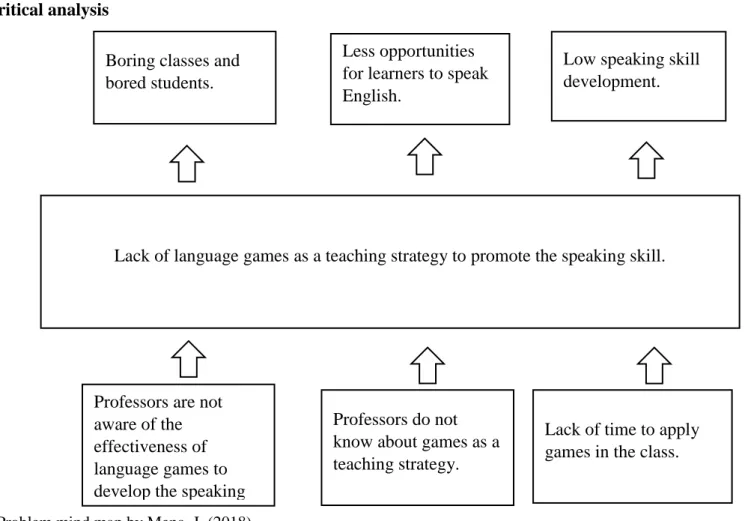
Figure 1. Problem mind map by Mena, J. (2018) Boring classes and bored students.
Less opportunities for learners to speak English.
Low speaking skill development.
Lack of language games as a teaching strategy to promote the speaking skill.
Professors are not aware of the effectiveness of language games to develop the speaking skill.
Professors do not know about games as a teaching strategy.
Lack of time to apply games in the class.
6
The fact that English professors are not aware of language games to develop the speaking skill causes boring classes and bored students. If there are not dynamic activities learners get bored easily and the learning process becomes exhausting for teachers and students. Due to short attention span, it is necessary to include a lot of activities for the class to be active and productive. Most students like to play games in class because they make them smile and have fun. In addition, some games required students to move around, talk to each other and get involved in their own learning. For all of these reasons, it is advantageous to have knowledge about games that can be performed at the beginning of the class, during the class if students are bored and at the end of the class as a wrap-up.
A second fact is the belief that games are just games and do not develop any skill. This reduces the opportunities for students to speak English. Professors think games are only applicable to kinder garden or elementary school students, but not for university students. But they are not aware of adults and young adults enjoying games as part of the lesson. In every class, there are shy students who do not like to speak because they are afraid of making mistakes in front of their classmates. Game strategy takes mistakes as part of the learning process, so shy learners feel ok when making mistakes.
The last fact is the lack of time to teach English. Teachers might have the best lesson plan, but the two hours become short time to perform all the activities planned. Besides, it is mandatory to reach all the content proposed in the syllabus and of course make sure students use the book they paid for. Therefore, time will be another reason why teachers prefer to do what is mandatory rather than having fun activities in the class. Dealing with time is an issue all teachers face in spite of planning.
1.2.3 Prognosis
If language games are not used as a strategy to teach English, learners will have low motivation to come to class every day. They will probably miss classes due to lack
7
of motivation. As a result, if this problem continues students in the first levels will quit and the Center will lose students and this is not a positive fact neither for professors nor the authorities. Another point to be analyzed is that students get easily distracted after a few minutes of paying attention in the class. If the teacher is the one who speaks all the time, the Center will have bored students, and this will be another reason for quitting. Finally, if students develop the speaking skill only through formative assessment, they will always be corrected when speaking, so they will refuse to produce oral language. Learners will think speaking is hard. When students are promoted to the next levels, they will show they do not enjoy speaking English.
1.2.4 Research Problem Formulation
Do language games promote the speaking skill on English language learners in higher education?
1.2.5 Research questions
• What language games promote the speaking skill?
• How effective are language games as a teaching strategy to develop the speaking skill?
• What is the students’ response towards language games? 1.2.6 Delimitation of the Research Problem
Field: Education
Specific field: Language teaching Aspect: Language games
Specific place of research: Centro de Idiomas Extensión at Escuela Superior Politécnica de Chimborazo (ESPOCH).
1.3 Justification
The first interest to carry out this research is to enrich English professors’ strategies repertoire and to be able to provide students with the best environment to develop
8
their ability to speak English. A second interest that encourages the researcher to investigate this topic is the curiosity behind the question about language games being consider an effective strategy to improve the speaking skill. The researcher herself is an English professor who is deeply interested in becoming a better professional every day, therefore a better human being who helps students to have a different perspective regarding English and how it can open new opportunities in their lives.
This research is relevant because it contains specific and important literature regarding language games as well as the speaking skill. All the information about these variables was carefully selected to support higher education professors to have concrete information to rely on. This research is also important because professors can also apply language games in their classes, that means, this research is not only of theory importance but also it brings professors and students to have practice by the use of language games.
This investigation is considered innovative because it explains how language games influence the development of the speaking skill. Additionally, it gets useful information for English teachers to apply games in the English classes. What is different from other inquiries is that the proposal goes beyond a written book, professors will also find each game as a YouTube video. This makes the process of applying games easier and faster. Since everybody learns through YouTube videos, the idea of learning to apply games in the class through videos is very new and I have not found videos on internet that explain in an interactive way how to perform this language teaching strategy.
It is also important to mention that this research is doable because it counts with the appropriate guidance and the information needed is available in books, e-books, magazines, articles and websites. This research counts with the availability of internet access twenty-four hours a day, so this facility helped the researcher to download the literature needed to investigate. Additionally, Ambato has really good
9
libraries where great English books are available. These books surely contributed to the development of this work.
The beneficiaries of this inquiry are the students at Centro de Idiomas Extensión and the professors who work there. Professors are always interested in learning new ways to motivate students to learn English that is why this research would be a great contribution for them. In addition, the speaking skill is the most important skill and the hardest to be developed. If teachers know about games, they will help students to interact more often in class. On the other hand, students will have better grades when taking the speaking test. They will feel motivated to learn English since they see they are able to use English to communicate.
1.4 Objectives 1.4.1 General
To investigate if language games promote the speaking skill on English language learners in higher education.
1.4.2 Specific
1. To identify different language games to enhance the speaking skill. 2. To detect how effective are language games as a strategy to develop
the speaking skill.
3. To determine if students’ response to language games is favorable. 4. Based on the findings, to suggest improvements to the language
10 CHAPTER II
THEORETICAL FRAMEWORK 2.1 Research background
There are not postgraduate investigations related to language games or the speaking skill in the library of the Universidad Técnica de Ambato. However, there are several investigations published in different journals. Thus, the first work found is called Different Reasons to Play Games in an English Language Class.
The author of this research concludes that “The findings of the study have shown how games increased the students’ abilities to speak in simple guided conversations, advanced their language learning to the next level of A2, according to the European Common Framework” (Sevy-Biloon, 2017, p. 89).
In this study the results found claim that playing games in the English class definitely help student to improve their speaking skill. It is said that students in this research began with a specific level of English and the game strategy applied by the teacher brought students to the next level. Therefore, language games truly support learning English.
A second research found is called Using Communicative Games in Improving Students’ Speaking Skill. The author of this work concludes that “The study revealed that using communicative games as means of instruction improved the students’ achievement and results of speaking skill. Students enjoyed their lesson and got more motivation, interest and confidence through their learning” (Dewi, Kultsum & Armandi, 2017, p. 63). This second source also declares that games raised students’ ability to speak. Another important detail to highlight from this conclusion, is that the use of language games as a strategy to teach English allows students to learn in a fun and relaxed way. This environment helps students to have low levels of anxiety and speak without being afraid of making mistakes.
A third investigation found is named Games as Teaching Tools for Teaching English to Speakers of Other Languages. The author of this investigation determines that “Games allow learners to fully use the language that they have learned, participating in the communicative process through the game.” (Gaudart,
11
1999, p. 290). This author also confirms through his research work that using games in the class to teach English permits students to practice and improve their language abilities, specially their communicative abilities. Consequently, language games are communicative activities which involve students’ interaction. This means students have the opportunity to use English in real life settings.
2.2 Philosophical foundations
It is imperative to mention that this research belongs to the educational field. The philosophy of education offers quite a lot learning theories. Therefore, the learning theory that sustains this investigation is the social constructivism. Many learning theories have emerged along the time, they have focused on the teacher to be a better communicator or better transmitter, but education as any other field in science is permanent changing. Now the main emphasis is on the student rather than the teacher. The teacher has become a facilitator. Indeed, nowadays students are active members in the classroom.
Jonassen and Land (2012) claimed that learning is not a process of “knowledge transmission” anymore. Nowadays, learning is a process of “meaning making”. Students interact with other students and consciously and constantly make sense of the interactions they participate in. The role of the student is constructing their own knowledge and having interaction with their classmates.
Salmons (2009) defined social constructivism as a learning theory that focuses on the construction of knowledge through social interaction. It is also important to mention the founders of this theory: Dewey, Piaget, Vygotsky and Bruner. This concept of learning goes along with the two variables of this investigation. Firstly, language games in the classroom let students have interaction among themselves and the instructor. The teacher only gives instructions for students to create their oral answers the speaking game. In such way students construct their own knowledge. This research is also aligned with the multiple intelligence theory created by Gardner. “The eight intelligences propose are: visual/spatial, verbal/linguistic, musical/rhythmic, logical/mathematical, bodily/kinesthetic,
12
interpersonal, intrapersonal and naturalistic. Although individuals possess all eight intelligences, each has their own particular mix of intelligences” (Gillman, 2011, p. 34). Language games can fulfill students who learn through these different types of intelligence. For example, there are board games that require visual aids, this kind of game will help visual/spatial learners. For those who have a verbal-linguistic intelligence, peer interaction games can be applied. The interpersonal intelligence will definitely be part of games in the classroom because of the interaction and speaking practice.
2.3 Legal basis
Authorities who take care of language policies and planning are being very demanding regarding teaching and learning English in Ecuador. Nowadays, university students are required to get a B2 level according to the Common European Framework of Reference (CEFR). Therefore, it is essential to mention the policies that support this research.
Consejo de Educación Superior (LOES)
The Article 30 states that university students should take a proficiency English test once they have approved the 60% of the subjects in their mayor. This article also adds that this is a requirement to continue studying their careers. It clearly establishes that the proficiency level they refer to, is the B1 level according to the CEFR. This article confirms that the English level at universities should step a lot forward in order to get to the fully accomplishment this law. This challenging policy makes Ecuadorian English professors to get prepared to face this path. A safe and necessary way to walk towards this aim is to be aware of the different teaching strategies available. This law supports this research because through the application of language games as a strategy to teach English, professors can make sure students speak English. This will definitely help students to develop this skill and get a good score when they take the proficiency test mentioned in this law.
Ministry of Education
The Article 2, item 2 states “to develop a student-centered environment, promoting the development of interactive and creative syllabi and the construction of
13
knowledge”. (Ministerio de Educación, 2014, p.3). This article has to do with the two variables of this investigation. Firstly, it is mandatory for English teachers to promote a learner-centered atmosphere. Through the use of language games in the class, students will definitely be the main actors in the lesson. Games promote real-life setting interaction, where students really have chances to speak English in a fun way. Secondly, to develop interaction, it is certainly necessary to speak to other people. Language games give students the chance to get to know other people throughout talking. At the same time, students construct their own knowledge giving their own answers to different situations in a game setting.
Another policy that will support this research is taken from the Ministry of Education in Ecuador. There are two main objectives set in the National English Curriculum:
• “To ensure high-school graduates reach a minimum B1 language proficiency level according to the CERF.
• To build up learners’ communicative language competence [and] its linguistic, sociolinguistic and pragmatic components through the development of the four language skills: listening, speaking, reading, and writing” (Ministerio de Educación, 2014, p.7).
These two objectives established by the Ministry of Education require university English standards to go beyond. This means students will necessarily get a B2 level according to the CERF. This demands teachers to use a variety of good strategies for students to get this aim. In the first levels is where the most important foundations of the English knowledge are built. That is why it is vital to give students the opportunity to internalized grammar and vocabulary. Games in the class allow students to use the new grammar and vocabulary learned in a natural way, without thinking about grammatical formulas which were the traditional manner of teaching English some years ago.
Likewise, the second objective focuses on developing the four skills: listening, reading, speaking and writing. It especially emphasizes on the communicative competence. If this is mandatory for secondary education teachers, higher education teachers should be a step beyond this requirement. In other words, educators must
14
continue improving the communicative competence of university students. Consequently, language game strategies are a great contribution to develop the four skills of a language. This research will look for games that teachers can apply as warmers, fillers or wrap-ups in order to improve the speaking skill of their students at university.
2.4 Key categories
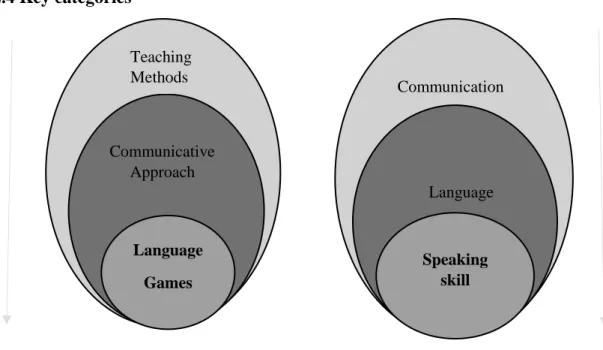
Figure 2. Key categories by Mena, J. (2018)
2.4.1 Development of the independent variable TEACHING METHODS
What is going on in a classroom is the consequence of a very complex relationship among the teaching method used, the professor’s interpretation of this method and the interaction of the learner with this method. According to Anthony (1963), to describe the word method, it is crucial to define three other words like approach, method and technique. First, he stated that an approach is the theory dealing with language teaching and learning. Second, he defined the word technique as detailed teaching activities. Finally, he pointed out that a method is a general systematic plan of a language based on a chosen approach.
e Language Games Speaking skill Language Teaching Methods Communication Communicative Approach
15
Harmer ( 2007) also pointed out concepts that go along with the definition of methodology. These are approaches, methods, techniques and procedures. He explained that an approach is “how people acquire their knowledge of the language”. A method is the practical scene of the approach. This is, the theory put into practice. Methods take decisions over types of activities, roles of the teacher and the students and materials to be used in the class. Another piece of information to highlight is that a method brings a procedure and techniques. Then this author defined procedure as an “order sequence of techniques”. Similarly, this author defined the word technique which is the manner in which activities are presented. Harmer ( 2007) mentioned that an approach is not always the starting point of a method. It can start with procedures and techniques that might work out well within a class and then an approach to match these procedures and techniques can be developed. In the same manner, the approach could be developed first and then procedures and techniques.
Methods to teach a foreign language through history
1880 The Art of Teaching and Learning Foreign Languages
1881 Direct Method
The Audio Lingual Method 1940
16
Figure 3. Methods to teach English through history by Mena, J. (2018). Taken from Richards & Renandya ( 2011)
1989
- Community Language Learning. - The Silent way
- Suggestopedia
17 Table 1
Teaching methods summary
Method Focus Characteristics
Grammar Translation Written literary text Translate from English into your native language
Direct Method or Every day spoken Language Student learns by associating meaning
Natural Method directly in English
Audio-Lingual Method Sentence and sound patterns Listening and speaking drills and pattern practice only in English
Cognitive Code Approach Grammar rules English grammar rules deduced and then understood in context
Humanistic Approaches four popular examples:
- The Silent Way Student interaction rather
Teacher is silent to allow student awareness
than the teacher of how English works
- Suggestopedia
Meaningful texts and vocabulary
Relaxed atmosphere, with music; encourages
18
- Community Language Student interaction Understanding of English through active
Learning student interaction
- Comprehension English speaking delayed until students are
Approach ready; meaning clarified through actions
(Natural Approach, the) Listening comprenhesion and visuals Learnables, and Total
Physical response
Communicative Interaction, authentic Understanding of English through active Language Teaching communication and negociating student interaction; role play, games,
meaning information gaps
Content-based, Task-based
What is being communicated,
not Content based on relevance to students'
and Participatory structure of English lives:topics,tasks,problem-solving Approaches
Learning Strategy
Training How to learn Teach learning strategies, cooperation;
activities vary according to different intelligences
19 COMMUNICATIVE APPROACH
Communication has always been the main objective for professors when teaching English. Thus, the communicative perceives language as an instrument of communication and focuses on the idea that language is to communicate. It all started when Dell Hymes wrote an article about communicative competence. This article fetched a new revolution for linguistics. The basis to create the communicative approach emerged from communicative competence. Hymes (1972) defined communicative competence as “a knowledge of the rules for understanding and producing both referential and social meaning of language”. He viewed communicative competence as a grammatical, psycholinguistic, sociocultural system. In addition, Hymes considered four characteristics for a language learner’s communicative competence. These are grammar, feasibility, appropriateness, and performance features. In other words, learning grammar structures is not enough for a person to communicate. It is essential to learn the language and know how and when to use it.
Jing and Minghe (2015) claimed that grammar helps to know whether or not a language pattern is correct. Thus, if a student has this competence, he or she should be able to identify acceptable forms of the language. Regarding feasibility, they said this means knowing when something is comprehensive to human beings. As a result, learners know when to say something. They also defined appropriateness as knowing if something is suitable to be said according to the social conventions used in different contexts. They referred to performance as the knowledge of whether or not something is done in reality. Now it is clear that communicative competence influences tremendously communicative approach. It strongly advises using language as a communication tool. Olivares and Lamberger (2002) declared that communication in the classroom is a crucial factor when teaching. They stated that communicative approach concentrates more on the meaning than the form and it
20
pays more attention to make sense of what a person is saying than learning grammar.
Communicative language teaching
Almost all people who learn English want to be able to communicate. To achieve this desire, it is important to enhance the teaching process. That is why communicative language teaching appears as a good alternative to help teachers create communicative environments in class. Harmer (2007) defined Communicative Language Teaching (CLT) as a group of principles regarding “what to teach” and “how to teach”. He claimed that the first one refers to language functions and the second one refers to two aspects, language exposure and opportunities to use the language. Finally, he mentions that the activities suggested by CLT require real communication where accuracy is not as important as succeed in the communicative task.
The demand for an appropriate teaching methodology is as stronger as ever. That is why CLT makes it clear that teaching grammar and vocabulary is not enough for communication to happen. It is necessary to empower students’ skills to communicate through activities that make them have the desire to communicate. For example, role plays, games, writing emails, etc. These activities will help students to concentrate on the content rather than any particular language form. This makes absolute sense for teachers whose job is teaching their students more than a formula to teach grammar.
Principles
21 Authentic language or real context
The main aim of this approach is to support students to communicate in the target language. This approach encourages teachers to give each grammar a context or create situations, so grammar does not stand alone neither it is learned mechanically. When students are given a context learning language forms is going to make sense, rather than only tell students to write sentences using grammatical formulas.
Roles of the teachers and learners in the classroom
The kinds of activities suggested in CLT involve new roles for the teachers and learners in the classroom. According to Larsen-Freeman (2004) the role of the professors is to provide students with opportunities to use the target language through setting situations that provoke communication. In other words, to plan on activities that make them communicate with each other or in groups. The author also said that the chief role of the learners is to be “communicators” and actively participate in trying to make themselves understood and understand others. The author also pointed out that students should use the target language even if they are beginners. Another point the author highlights is the student-centered class where the students are responsible managers of their own learning. Both roles are crucial, especially the role of the teacher since he/she guides and leads the students. Therefore, if the teacher does well his/her role, it will be easier for students to carry out their role. For example, if teachers bring communicative activities that are well planned, and they give clear instructions, students will automatically fulfill their role.
LANGUAGE GAMES Definition
22
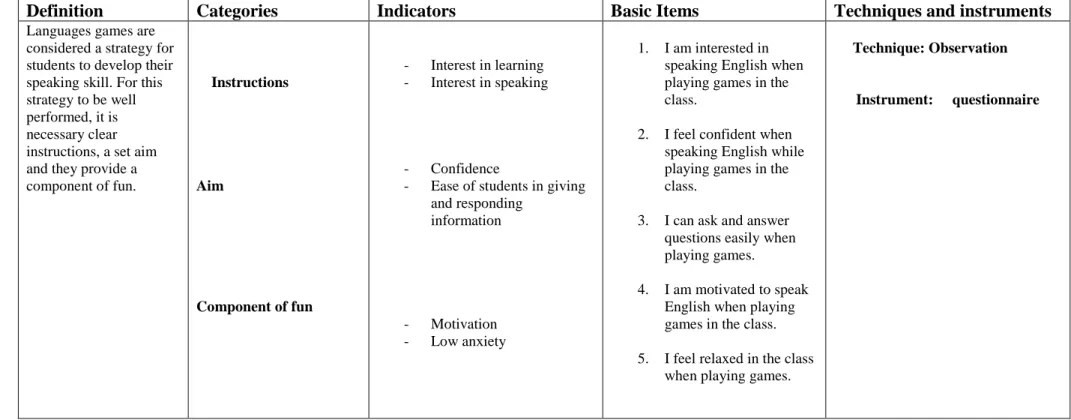
There are many different strategies an educator can select to develop listening, speaking, reading and writing. Language games are an option for English teachers to have fun lesson plans and at the same time give students the chance to use the target language without thinking in grammar. According to Hadfield (1996) games are planned activities with instructions, an aim and a component of fun. Also, games are activities in which learners play and there is interaction among them. Undoubtedly, games are linked to language teaching and learning. Students are relaxed while playing games and learn different grammar patterns.
Gaudart (1999) claimed that games are one of the most effective strategies for professors. He stated that games permit students to practice previous, current and experiment new structures of the language. He pointed out that games are non-threatening settings. As a result, games are a great teaching strategy that professors can add to their lesson plans. This strategy allows students to practice old knowledge as well as building new knowledge. The most important fact is that students do not feel anxious when playing games since they are fun and there is not any kind punishment because the main purpose of using games in the English language classroom is encouraging learners to use the target language.
Reasons to use language games
There are long lists of strategies that educators can use in their lessons. However, it is significant to mention that language games provide several benefits for English learners. The following are some reasons why the teacher should use games as a teaching tool to improve the speaking skill.
• Motivation
All English teachers look for ways to encourage students to learn English and the same time motivate learners to see English not only as a subject they must approve but to see English as a door to open better opportunities in their lives. Mahmoud and Tanni (2014) expressed that the adding games in the lesson plan could raise interest and strengthen previous knowledge. They also said that games are an
23
encouraging, communicative and cooperative option strategy of teaching. Furthermore, games enhance team cooperation and allow students to actively participate.
Motivation and learning should be extremely connected in educational settings. If there is no motivation for learning English, students will fail. Teachers can help students to reinforce both intrinsic and extrinsic motivation. The first one will automatically grow by the strategies the educator uses in class. In this case, language games will definitely make students like to learn English. Students will be motivated to come to the English class every day. In addition, games avoid boredom since they can be used at the beginning, during the class but also at the end of the class as a wrap- up.
• Authentic learning
Language games are communicative activities that provide students real context situations. For instance, a word cannot be learned by itself, it needs a setting. If this setting is a real-life situation learning occurs unconsciously. Deesri (2002) argued that learners do not make a lot of effort thinking about what to say when using the target language since games provoke spontaneous and real circumstances. Thereby, English learners can use the language outside the class. Indeed, that is the aim of learning a foreign language that students are able to communicate. If educators planned on games for teaching, they will definitely provide genuine context for students to produce English.
• Improve different language skills
It is difficult for a teacher to find strategies that motivate students and at the same time improve listening, speaking, reading and writing. Arikan and Yolagelddili (2011) stated that games develop and stimulate the four skills. They also claimed that games offer students the chance to use the grammatical structures by performing them in a communicative manner. Furthermore, games can combine two or more skills in one game. For example, when students play running dictation
24
they put into practice three skills reading, writing and speaking. Then using games in the class will positively affect one or more of the four skills. If teachers see games as a serious strategy for teaching English and planned on them. Students will improve their skills without memorization of grammar patterns or tedious grammatical forms. Language games are a good and easy alternative for teachers and students to enjoy. That is why selecting games as a strategy to teach English supports and benefits learners.
Low anxiety
Everybody likes playing games because it is fun. Games make people smile as well as make students smile in the educational field. They keep learners calm and relaxed in order to learn. When there is a tense environment, there is not learning. Fisher and Schultz (1988) declared that stress levels can be an obstacle for students to pay attention. Traditional strategies are a waste of time, stimulate stress and they also diminish motivation. He claimed that when students play a game, they forget they are in class. In other words, games reduce stress students might face when learning English.
Self-confidence
It is hard for shy students to develop the speaking skill. That is why educators always look for strategies to allow them to speak. Strategies that make them speak without being afraid of making mistakes. Games are al alternative for these students because playing games allow students to make mistakes. So, they feel free to communicate in English. Dewi, Kultsum & Armandi ( 2017) described games as a strategy which allows students to trust in themselves when speaking. They also report that learning with games generates great and pleasant situations. Learners can actively participate playing games and nurture their self-confidence.
There are several positive reasons for educators to include language games in their classes. It is easy to think that games are only for children, and do not use games
25
when working with teenagers or young adults. Many English teachers do not know about the advantages mentioned above and their students cannot participate in this strategy while learning. If educators take into account all the benefits and advantages of using games in a class, they might see the improvement their students can have.
Types of games
Hadfield (1996) explained two kinds of language games:
1. linguistic games
2. and communicative games
The first one focuses on accurateness and the second one concentrates on sharing thoughts with classmates. Thus, these are the types of games found:
• Categorization game: in this game students put words, sentences, numbers, letters, or some other things in order.
• Jigsaw games: one or more participants have got the information that other participants required to complete an assignment given by the teacher. For instance, students are given single words. Their task is forming yes/no questions.
• Predicting games: this kind of game make students guess information through questions. For example, the hot chair game.
• Investigate games: this kind of game gives students the chance to look for information around the class. The very well-known game called “find someone who” is an example of this type of game.
• Board games: this kind of game needs a visual aid and a dice. Students roll the dice and move to the number indicated in the dice on the board.
This kind of games can be selected according to the topic taught in each lesson. Games can certainly reinforce any grammar tense already taught, or they can
26
also be used in the presentation stage of the lesson plan. Educators have a wide variety of options when using this strategy. Therefore, it is very useful to know what games are to be used as warmers, fillers or wraps up. Also, games can fulfill the different learning styles that students have. For instance, board games meet students who have a visual special intelligence. Jigsaw games meet students who learned by talking, and the other types of games help to meet all kinds of learner’s necessities.
Wright, Betteridge and Buckby ( 2009) classified language games as follows: Care and share
These games invite students to share personal information with other learners. They usually feel comfortable asking and answering information about themselves.
Do
In these games, learners are required to do something in response to a read or heard text. These game usually make students move, mime and draw.
Identify
Students are challenged to identify something which is difficult or to hypothesize about something. Students’ skills to performed these games are discriminate, guess, speculate.
Describe
In these games, students describe something to another student by speaking or writing. Students communicate their feelings and associations in order to describe.
27
Students connect, compare, match or group various items of information such as pictures, texts, objectively or subjectively.
Order
Learners put bits of information into an order of quality and importance. Remember
Learners try to remember something and communicate to their classmates.
It is noticeable that both authors determined and offered professors a wide variety of languages games as a strategy that brings lots of benefits and most importantly tangible results.Both descriptions stated games that can be used according to the different students a proffesor may encounter. It is also important to mentioned that games can go aligned with the ability to be developed according to the lesson plan. Language games can always be an option for those professors whose desire is to keep their studets learning in a significant and enjoyable manner.
2.4.2 Development of the dependent variable COMMUNICATION
Jhon and Foss (2008) stated that “communication is the verbal interchange of a thought or idea.” The assumption in this definition is that a thought or idea is successfully exchanged. Another definition by the same author, on the other hand, does not judge whether the outcome is successful or not: “Communication is the transmission of information.” Here information is transmitted, but it is not necessarily received or understood. Thus, communication is a process involving two information-processing devices. One device modifies the physical environment of the other. As a result, the second device constructs representations like representations already store in the first device. Oral communication, for instance, is a modification by the speaker of the hearer’s acoustic environment, as a result of
28
which the hearer entertains thoughts similar to the speaker’s own. (Ezcurdia and Stainton, 2013)
According to Santillana (2006), communication happened when a message is transmitted from one person to another person. Therefore, communication is not a human act only. This means all living creatures can communicate through different signs. Hannam ( 2017) also claimed that communication is “the act of transferring information from one place to another”. The three authors defined communication as the process of telling ideas, feelings and messages to another person in the case of human beings. However, the three authors also mentioned that communication occurs in all living creatures. This is, all living creatures can communicate through different sings. Santillana ( 2006) claimed that a sign is something that brings an idea to our thought. For example, the green light in the traffic light gives people the idea of crossing a street. Another example would be the Red Cross sing that gives people the idea of being close to a hospital.
According to Santillana ( 2006), there are some types of signs: • Visual signs: the no-smoking sign
• Auditory signs: the alarm of a car • Linguistic signs: words
• Non-linguistic signs: gestures, body language
Types of communication
Hannam ( 2017) acknowledged four types of communication:
• Spoken or Verbal Communication: face-to-face, telephone, radio or television and other media.
• Non-Verbal Communication: body language, gestures, how we dress or act - even our scent.
29
• Written Communication: letters, e-mails, books, magazines, the internet or via other media.
• Visualizations: graphs and charts, maps, logos and other visualizations can communicate messages.
• Human beings can use one, two or more types of communication at the same time or only one at the time. Communication allows human beings to be understood and understand others. For instance, a person can use verbal communication and non-verbal communication at the same time. In fact, it has been said that around 90% of what people say is transmitted through body language. Consequently, what body language and gestures say more than words. Thus, words can lie but body language will never lie.
Santillana ( 2006) stated the components of communication as follows: • Sender. The person who creates and transmits the message. • Receiver. The person who gets the message from the sender. • Message. The information sent to the receiver.
• Channel. The mean through the message is sent.
• Code. The group of signs or sign by which the message is built. The transmission of information
Broughton, Brumfit, Flavell,Hill and Pincas (1980) emphasized that the communication process starts when the sender tells the idea or message through a language or code and the receiver recognizes the code and understands the message. This is displayed in the following figure.
30
SENDER RECEIVER
Figure 4. Communication process by Broughton, Brumfit, Flavell,Hill and Pincas ( 1980)
Broughton et al. (1980) explained that once the message is transmitted the sender encodes it and the receiver decodes it. The authors added that this process happens pretty fast that both encoding, and decoding might occur at the same time. When the ideas are hard to be understood the process takes longer. Hannam ( 2017) defined encoding a message like putting thoughts into words and decoding a message is understanding the message sent. This will depend on the communication barriers that may be present.
Communication Modes
Murphy and Sashi (2017) confirmed that the mode of communication talks about the way a message is conveyed. Modes of communication have been examined based on their synchronicity, speed of transmission, and ability to transmit information. These two authors also mentioned that when a person uses an accurate mode of communication, effective communication takes place. A table shows three modes of communication.
LANGUAGE THOUGHT
31 Table 2
Framework for the communication modes
Interpersonal Interpretative Presentational
Direct oral communication Receptive communication Productive communication between individuals who are of oral or written messages using oral or written language in personal contact.
Meditated communication Spoken or written communication Direct written communication via print and non-print for people (an audience) with whom
between individuals who came materials there is no immediate personal
into personal contact contact or which takes place in
Listener, viewer, reader
works one-to many-mode
with visual or recorded materials whose creator is absent
Author or creator of visual or recorded
material not known personally to the listener
Productive abilities: speaking, Primarily receptive abilities:
Primarily productive abilities: speaking,
writing listening,reading, viewing writing, showing
Receptive abilities: listening, reading
Knowledge of cultural
32
governing interactions between perspectives are embeded governing interactions between a individuals of different ages,
in products (literary and
artistic) speaker and his/her audience
statuses, backgrounds. and a writer and his/ her reader.
knowledge of how meaning is Ability to recognize that
languages encoded in products Ability to present crosscultural
use different practices to Ability to analize content, information based on background
communicate compare it to information of the audience
Ability to recognize that cultures use
available in own language
and Ability to recognize that cultures use
different patterns of interaction assess linguistic and cultural different patterns of interaction differences
33 LANGUAGE
Nordquist (2017) claimed that “language is a human system of communication that uses arbitrary signals, such as voice sounds, gestures, and/or written symbols. The study of language is called linguistics.”
Sapir (1921) added that “language is a purely human and non-instinctive method of communicating ideas, emotions and desires by means of voluntarily produced symbols.”
Chomsky (2002) stated that “language to be a set (finite or infinite) of sentences, each finite in length and constructed out of a finite set of elements.”
Weiten (2007) “A language consists of symbols that convey meaning, plus rules for combining those symbols, that can be used to generate an infinite variety of messages.”
These authors agree on defining language as a system of communication that helps people to expresses ideas, feelings and experiences. Language is a wonderful tool living creatures have in order to make communication possible.
Tudor (2001) argued that languages are seen in three different perspectives as follows,
1. Language as a linguistic system
2. Language from a functional perspective 3. Language as self- expression
4. Language as culture and ideology LANGUAGE AS A LINGUISTIC SYSTEM
Tudor mentioned that if language is considered a system, it is necessary for people to dominate this system or at least part of it so communication occurs. This influences the way an English professor teaches for it is necessary to analyze and
34
split language into small parts for teaching and learning to take place. However, this is not an easy task since language is a complex system which cannot be isolated because it can lose their authenticity. At this point, a language professor stops and thinks about how language can be presented to students in an effective and meaningful manner.
LANGUAGE COMPONENTS GRAMMAR
Johnson (1998) pointed out that the word grammar may refer to different aspects to different people, for instance, it might refer to aspects of the language system, while for languages professor it may refer to aspects of the teaching process or it could also refer to a learning activity. These authors define grammar as patterns in language that people use in order to organize their ideas. Grammar also involves the study of other characteristics such as morphology, word formation, tense system, modality and expression of quantity. The Oxford dictionary defines grammar as “the way in which words are put together to form proper sentences.” (Oxford dictionary, 2017)
According to what Johnson claimed about grammar and the Oxford dictionary definition teaching grammar is absolutely necessary so students are able to speak English sentences correctly and they are understood. It always comes to a dilemma when teaching grammar is the subject, for many teachers think that grammar should not be taught because what students want is to speak English. Yet grammar is part of the language system it needs to be taught in context and not in an isolated way so learning takes place through meaningful activities. In fact, Cunningsworth (1995) asserted that grammar is a key component of a language course and also the way fo teaching grammar is what also distinguishes any language course from another one.He also added that grammar is the basis for learning a language.
35
Huddleston (1995) stated that grammar could have different senses, the main one would be that it is a complete description of the form and meaning of the sentences. In other words, grammar has to do with the form of the language.
PHONOLOGY
Cunningsworth (1995) explained that phonology involves the articulation of sound, word stress, sentence stress and intonation. He mentioned that phonological aspects of a language tend to be put aside in a language course due to it requires more complex phases like phonetic transcription. Nonetheless, it is very important for learners to understand a spoken language and also be able to produce comprehensive sentences of the language they are learning.Being able to articulate clear words and sentences is crucial to be understood that is why teaching some aspects of phonology like intonation or word stress is vital for students to know a language.
DISCOURSE
According to Cunningsworth (1995), this aspect of language goes beyond grammar rules and includes areas such as sequencing of sentences, cohesion, paragraphing, structuring text, participation in conversation, etc. This aspect is also very important in order to learn a language, however, Cunningsworth said that grammar and discourse have a strong relationship yet they are different. Thus, grammar refers to a sentence level but discourse refers to longer pieces of language. Moreover, teaching discourse might be difficult for beginner learners since this is a more complicated but important aspect of language.It also important for effective communication.
36 THE FUNCTIONAL PERSPECTIVE
As written before language is a complex phenomenon which goes beyond learning grammar only. Tudor (2001) explained that language is considered a social action that is why the communicative language teaching (CLT) pointed out that language learners need to use the language according to the context they are being faced at any time. He also added that learners should be able to do something in or with this language, in other words, to use the language in different contexts. Tudor also pointed out that there is a goal behind a person who is learning English, for instance, performing professional tasks such as answering the phone or providing information to customers, traveling abroad, studying abroad or doing business. Having a clear idea of why professors are teaching specific parts of language in a course, makes a great difference because a professor who is teaching English to someone who requires it for academic purposes cannot be teaching business vocabulary. So the objective of learning English should also be considered by the professor so he/she matches students’ needs. Tudor provided an example of this as follows “a business person who needs to improve his/her English needs functions such as greeting, introducing people, keeping a conversation going, etc.” This would be called needs analysis that goes along with English for specific purposes. Santillana (2006) mentioned that all people use a language with a purpose or aim. They might need to persuade, order or inform. Santillana mentioned three functions as a classification.
Expressive language function
It expresses the mood of a person; therefore, it expresses feelings and emotions. Informative language function